Substack

Showing posts with label Religion. Show all posts

Saturday, February 7, 2026

Weekend reading links

1. Dame Sarah Mullally, 63, becomes the 106th Archbishop of Canterbury, the first woman to serve as the senior-most bishop of the 85 million-strong Anglican Communion since the role's creation for Augustine of Canterbury in 597 AD!

2. Kevin Warsh as Fed Chairman may pursue significant changes to the way the Fed sets monetary policy.

The Fed’s vast bond-buying programmes, which Warsh initially supported as a Fed governor during the financial crisis, are at the centre of the Trump administration’s allegations that the central bank is acting far beyond its remit to keep prices in check and maximise employment. The... quantitative easing, expanded the Fed’s balance sheet from less than $900bn in 2008 to a peak of almost $9tn. The balance sheet now stands at $6.6tn, following a three-year reversal of QE — dubbed “quantitative tightening” — that the rate-setting Federal Open Market Committee has recently paused amid signs banks were falling short of reserves. Warsh has said he would like to shrink it much further... Warsh in April said successive QE programmes meant politicians found it “considerably easier appropriating money knowing that the government’s financing costs would be subsidised by the central bank”... 

Warsh’s claims that the response to the pandemic “was the biggest monetary policy error in 45 years”... Along with shrinking the balance sheet, Warsh would like to change the Treasury-Fed Accord, a 1951 agreement seen as the foundation for the US central bank’s freedom to set interest rates free from political pressure. Warsh has said he wants a “recommitment” to the accord that would entail a smaller, less powerful central bank, with some control of its balance sheet handed to the Treasury... Trump’s nominee will push the Fed’s staff to gather more “real-time information” to rely less heavily on official government data that comes on a longer lag... He could also deploy economists to find out whether his view is right that an AI-led productivity boom can boost US workers’ pay without stoking inflation — a move that could potentially pave the way for more interest rate cuts.

This is Warsh's WSJ op-ed of March 2023, where he called for an "economic regime change", including stopping the practice of providing forward guidance and stopping the provision of forecasts of the path of interest rates. The expectation now is that Fed may dispense with its widely followed dot plot showing the interest-rate projections of each participant of the FOMC, and end the tradition of press conferences by Fed chair following every FOMC meeting. 

3. Soumaya Keynes points to new research that links commerce and markets to the shaping of cultural norms.

One 2010 study ran money-sharing experiments across a diverse mix of communities, including smaller ones where people foraged or hunted for food. In those less marketised societies, norms around fairness towards strangers seemed weaker... A new study by Max Posch of the University of Exeter and Itzchak Tzachi Raz of Hebrew University takes a different approach, exploring the US economic transformation between 1850 and 1920. Thanks in part to a vast expansion of railroads, internal commerce became much easier. Mail-order catalogues served remote communities with items including shoelaces, suitcases and booze. The researchers compared places and people gaining more and less market access. Unsurprisingly, they found that in the places that enjoyed juicier connections, work shifted to involve co-operation with more distant partners...

Compiling many metrics, they found that on at least three dimensions, new markets did seem to affect culture. First, commercial opportunities made people more outward-looking. In places that became more connected, Americans became more likely to marry someone outside their local community and parents more likely to pick out nationally common names for their children. Second, access to markets raised tolerance levels, as measured by higher religious diversity and greater variation in family size, as well as mothers’ ages at their first birth. (The logic being that more dispersion should reflect more of a “you do you” attitude.) Third, greater market access came with higher trust towards others, as extracted from language in local newspapers. This measure wasn’t perfect, but reassuringly matched trends in more recent survey data, and fell during wars... Instead, they emphasised a story of rapid cultural adaptation among people who were most engaged with impersonal, anonymous exchanges. The changes in naming practices, for example, were concentrated among migrants working in industries that were more exposed to trade with other parts of the country. For those working in construction and entertainment, the market access had no effect.

4. Paul Blustein questions claims about the dollar's dethronement. 

Participants in this market are international banks, securities firms, multinational corporations, insurance companies and pension funds — the biggest private actors in the financial system. Their globe-girdling operations require the movement of immense amounts of money across borders on a constant basis. They use the market to hedge themselves against currency fluctuations by trading a pair of currencies (say, the dollar and Japanese yen) twice, first at the current exchange rate and then swapping back later at an agreed rate. Japanese life insurance companies, for example, invest their portfolios heavily in US Treasuries and other dollar securities. Because they have obligations in yen to their policyholders, they need to protect themselves against movements in the yen-dollar rate and they use swaps to do so. These sorts of transactions occur at such a huge scale that, according to data from the Bank for International Settlements, the amount of outstanding swaps currently stands above $100tn. Some 90 per cent involve the dollar, reflecting the myriad ways it is used. Unwinding all of this activity and subbing in another currency would be staggeringly costly and difficult.

The $12.6 trillion European holdings of US Treasuries confer less leverage to the Europeans than they appear.  

Europe’s US government debt holdings don’t translate into usable leverage, because most of them can’t be politically co-ordinated and selling would be self-defeating. The reason is simple. “Europe” may hold a lot of US assets, but that doesn’t mean Europe can control them or deploy them as a co-ordinated political tool. Much of Europe’s exposure actually sits in private portfolios — pension funds, insurers, banks, and asset managers — not in a single public balance sheet that can be mobilised strategically.

But while a deliberate and coordinated weaponisation is difficult, "a slow, decentralised buyers' strike, as investors gradually stop adding to US assets" is a distinct possibility.

5. Singapore's acclaimed public housing model.

More than three-quarters of its citizen and permanent resident population live in 1.1mn government-built flats, bought at subsidised rates... Rising property costs, notably in the resale market, have sparked concern over affordability, while the lottery system for allocating flats, which favours traditional nuclear families, is being tested by changing social norms. Over the longer term, property values are also being eaten away by the 99-year leases on which they are sold. “The main thing that worries me is that . . . as the lease clock ticks down and as the stock ages, housing equity drops to zero,” Gee added...

When Singapore introduced national service after gaining independence in 1965, home ownership was also encouraged as an incentive for conscripts to fight for their country. Today, more than 90 per cent of Singaporeans live in an owner-occupied home — among the highest rates in the world. Properties are allocated to would-be buyers via a lottery system to applicants who are typically required to be married, engaged or older than 35. Prices are eased through a raft of government subsidies based on personal circumstances. Singaporeans can also dip into their mandated savings and pension plans and obtain mortgages and loans from the HDB directly. But critics have said that the lottery system is unfair to singles and non-traditional families, for whom it is harder to get a flat. Singapore’s marriage rate has been steadily falling in recent decades, dropping from 57 per 1,000 unmarried males in 1994 to 42 in 2024. The HDB system has also been used by Singapore’s government to promote multicultural integration by setting limits on the proportion of different ethnic groups in the same estate. However, this policy has caused problems for some in the resale market by restricting potential buyers... Construction ground to a halt during the Covid-19 pandemic... Wait times to move into a property rose from three years to as many as six. As a result, more buyers turned to the resale market, where HDB owners can sell properties after five years of occupancy. This led to a sharp rise in resale prices, especially in more desirable estates.

6. FT has a long read on Latin America's rightward turn.

“Crime and violence is clearly the top concern of Latin Americans today,” says Jean-Christophe Salles, Latin America chief executive at pollster Ipsos. “It is the biggest concern in almost every country.” Some 55 per cent of Latin Americans name crime and violence as their prime worry, according to Ipsos data, against just 34 per cent worldwide. In Chile, the figure rises to 62 per cent. Fear of crime propelled arch-conservative José Antonio Kast to a landslide presidential election victory last month in Chile over a Communist opponent, Jeannette Jara. His broader rightwing message had failed in two previous elections, but this time he won by focusing on pledges to erect border fortifications, deport illegal migrants and reduce crime...
El Salvador’s President Nayib Bukele is the inspiration for many rightwing challengers across the region. His extraordinary success in transforming El Salvador from one of Latin America’s most murderous countries to one of its safest — albeit through mass incarceration and authoritarian rule — is firing up anti-establishment conservatives across the region just as it enters a major election cycle... Bukele’s newly built giant prison, the Centre for Confinement of Terrorists (Cecot), which has capacity to hold about 40,000 inmates, many detained indefinitely... Even Costa Rica, a country so peaceful that it decreed the abolition of its army in 1948, has been shaken by record levels of drug-related murders. Ahead of elections on February 1, its outgoing president, Rodrigo Chaves, appeared with Bukele to lay a foundation stone for Costa Rica’s own version of Cecot, a $35mn maximum security jail project with capacity for 5,100 prisoners... In Peru, which is set to go to the polls in April, leading presidential contender and former mayor of Lima Rafael López Aliaga is promising to fight what he calls “urban terrorism” with life sentences for serious crimes... In Mexico and Uruguay, leftwing incumbents are cracking down on violent crime to curry favour with voters.

7. The rising share of debt raising by hyperscalers (companies like Alphabet, Amazon, Meta, Microsoft, and Oracle) to finance their AI infrastructure rollouts.

8. What does the India-EU FTA mean for Europe?
9. Ed Luce has this description of the breadth of the Jeffrey Epstein network.
This includes the sitting US president and a previous one, big Wall Street figures, a network of Ivy League luminaries, Silicon Valley entrepreneurs, foreign government officials, Democrats, Republicans, a Maga influencer, a far left scholar, British and Norwegian royals, wives and girlfriends of powerful men, government lawyers, heads of law firms, movie directors and endless celebrities. Epstein’s network is an MRI of the establishment. The idea that anyone did not know about Epstein’s conviction as a sex abuser is absurd. Some people spurned his social approaches. Having been invited in 2010 to an Epstein dinner with Woody Allen and then Prince Andrew in New York, the magazine editor, Tina Brown, replied: “What the fuck is this . . .? The paedophile’s ball?” Brown’s reaction should have been everyone’s. So should that of Melinda Gates, the now ex-wife of Bill Gates, who stepped into Epstein’s home once and immediately regretted it. Alas, their reaction was all too rare.

10. Fascinating account of the egregiously one-sided US-Japan trade deal.

Proposed projects are screened for “strategic and legal considerations” by a committee of US and Japanese members, according to a joint MOU and a document prepared by Japanese officials. Projects are then sent to an investment committee headed by US commerce secretary Howard Lutnick, who chooses which proposals to send to the US president for approval. Donald Trump has the final say on which projects are “deemed to advance economic and national security interests”. Japan and its state-backed bank can delay or refuse to proceed but face potential penalties, including higher tariffs. Funds for approved projects — from JBIC or with guarantees from Japan’s insurance corporation — then flow into an SPV alongside “the provision of land, water, power, energy, offtake agreements, regulatory support, etc” from the US. Free cash generated by projects will be split equally until the Japanese loans are paid back, according to officials. After that, the US will receive 90 per cent. Officials believe Japanese companies outside the project can also make agreements with it separately, with terms negotiated that are different from the US-Japan split of cash flow... The way the agreement with the US is structured also means that if Japan delays or refuses to fund a project recommended by Trump, it could be liable for “catch-up” payments or an increase in tariff rates.

11. Elon Musk may have pulled off the biggest bluff of the century by merging SpaceX with xAI to create the most valuable private company at a combined valuation of $1.25 trillion. xAI, which had revenues in the low hundreds last year and is burning through $1 billion a month, was bought by SpaceX at an eye-popping valuation of $250 billion. Musk says that the move was needed to launch data centres into space, build factories on the moon and colonise Mars. Musk controls both the private companies, whose combined valuation has increased by over $1 trillion in 18 months. To pay for the deal, SpaceX will issue $250 bn in new shares, thereby diluting the existing shareholders.

This from the comments section sums up the deal

You set your own price for a company you own, sell it to another you own and, miraculously you can then leverage the hell out of it.
South-east Asia’s second-largest economy has been stuck at about 2 per cent growth for the past five years, with its pivotal drivers of consumption, manufacturing and tourism all in decline... Making matters worse are prolonged political instability and frequent changes in leadership. The royalist-military establishment has been locked in a stand-off with reformist parties that have won the past two elections but have been blocked from power. Thailand has had three prime ministers in as many years... Signs of economic malaise are increasing. Banks worried about defaults are lending less, the property market is in its worst slump in three decades and headline inflation turned negative last year, signalling weak demand. Thailand’s stock market has been the worst performer in Asia over the past 12 months, declining 10 per cent in 2025 in local currency terms. The government has projected 2 per cent growth this year, but the IMF has forecast just 1.6 per cent, the slowest among major south-east Asian economies...
Manufacturing has been on the decline for years, weighed down by weak domestic demand, an influx of cheaper Chinese goods and intense competition from newer manufacturing hubs such as Vietnam. That has also taken a toll on Thailand’s once mighty auto sector. The country was a regional hub for car manufacturing but Nissan, Honda, Suzuki and others have shut down factories or scaled back production in recent years... Household debt-to-GDP is close to 90 per cent, among the highest levels in Asia, as wages have remained stagnant. And Thailand’s population has been shrinking for four years, with the birth rate hitting a 75-year low in 2025... Tourism, another economic engine, is sputtering and this has had a knock-on effect on retail, agriculture and hotel construction... Thailand recorded 32.9mn foreign visitors in 2025, a 7 per cent fall from the previous year and still below the pre-pandemic peak of 40mn tourists in 2019.

13. US federal debt is at pre-war highs.

14. With the purge of General Zhang Youxia and Gen Liu Zhenli, Xi Jinping has removed all the six members of the Central Military Commission (apart from himself), 35 out the 43 generals in leadership positions of the PLA.
While the Ministry of Housing and Urban Affairs recommends 40-60 buses per 100,000 people, India’s cities together have only about 47,650 buses, nearly 61 per cent of which are concentrated in just nine mega cities.

16. Primer on Project Vault, the $12 bn US program to procure and develop a reserve of critical minerals for civilian and other purposes through a public-private partnership involving the US federal government and US companies. 

Project Vault is a public-private partnership that will buy and store critical minerals and rare earth elements. These include gallium and cobalt, which are essential for modern technology and defence equipment. It will combine $1.67 billion in private seed funding with another $10 billion from the US government’s Export-Import Bank... Companies will make an initial commitment to buy materials later at a fixed inventory price. They will also pay some upfront fees. Based on these commitments, companies can give Project Vault a list of the materials they need. The project will then purchase and store those materials. Manufacturers will pay a carrying cost that covers loan interest and storage expenses.

16. Mihir Sharma has an excellent op-ed that raises the questions about the emerging international order arising from the US National Security Strategy released in December and the more recent National Defence Strategy. Both are anchored around an America First approach that narrowly defines its interests in terms of drug trade, energy security, immigration, etc. 

The rest of the world matters only as a market or as a source of certain raw materials that are not specifically available in the US. This is not a status-quoist view of the world, nor is it radical or aggressive. It is essentially defensive. US interests are defined far more narrowly than earlier, and are more localised. But they will be as aggressively and unilaterally defended as ever, perhaps more.

I'll blog on this in due course.

17. Some staggering numbers in the Big Tech capex plans announced this week, along with their quarterly earnings which have spooked the markets. 

Big Tech stocks sold off heavily after unveiling plans to spend $660bn this year on AI, as investors fret that the “breathtaking” capital expenditures are outpacing the earnings potential of the new technology. Amazon, Google and Microsoft are set to lose a combined $900bn in market value since filing their quarterly earnings over the past week... Along with social media giant Meta, their proposed outlay on data centres and specialised chips needed to train and run advanced AI models would mark a 60 per cent rise from the $410bn they spent in 2025 and a 165 per cent increase from $245bn in 2024... Even a 14 per cent boost to their combined annual revenue to $1.6tn was not enough to overcome the pessimism.
18. Big infrastructure deal in the UK, as Canadian pension fund majors CPPIB and Omers announced sale of their 34% and 33% stakes in Associated British Ports (ABP) in a deal estimated to value the UK's biggest port operator, owning 21 ports in the UK, at more than £10bn. ABP was taken private in 2006 by a group of investors including Goldman Sachs' infrastructure arm and Omers, for £2.8bn. Ownership has chaged over the years, with CPPIB taking stake in 2015, along with others like Singapore's GIC and Kuwait Investment Authority's Wren House Infrastructure. CPPIB manages C$777.5bn ($568bn) of assets and Omers manages C$141bn of assets.

Saturday, April 26, 2025

Weekend reading links

1. Revival of manufacturing in the US faces a collective action problem! It's good as long as I'm not working in manufacturing.

Interestingly, real value-added by US manufacturing has risen sharply even as employment has fallen.
This is also reflected in the shift up the value chain in the sectors involved. 
Since 1990 America has lost over 5mn manufacturing jobs. In that time, it has gained 11.8mn roles in professional and business services, and 3.3mn in transportation and logistical activities, linked to multinational supply chains.

2. One of the most important requirements for a deal between two parties is the space available to negotiate and their credibility as negotiating partners (preferably in terms of track record). If you present the other side with an egregiously unacceptable deal, then it virtually eliminates the likelihood of a deal even before the negotiations have started. 

The Trump administration appears to have erred in two very high-profile negotiations. The magnitude of the tariffs imposed on China and the subsequent public posturing may have made it impossible for the Chinese to not retaliate. On the same lines, the contents and the tone of the letter to Harvard and the track record of Columbia's submission failing to win reprieve on the release of funds meant that Harvard could not but reject the proposal. This tweet describes it nicely. 

Bullies can't make deals. 

3, Tyler Cowen makes a good point

The inconvenient truth, for China, is that its scale relies upon American power and influence. The Chinese export machine, for instance, requires a relatively free world trading order. The recipe to date has been “mercantilism for us, free trade for everybody else.” Yet Trump threatens to smash that framework. If the world breaks down into bitterly selfish protectionist trading blocs, China will be one of the biggest losers. After all, where will the Chinese sell the rising output from their factories?

4. Financial markets and Liberation Day

5. Daron Acemoglu looks ahead to America in 2050 and finds an empire that has collapsed. He explains the foundations of the American century. 

American economic success in the era after the second world war depended on innovation, which in turn relied on strong institutions that encouraged people to invest in new technologies, trusting that their inventiveness would be rewarded. This meant a court system that functioned, so that the fruits of their investments could not be taken away from them by expropriation, corruption or chicanery; a financial system that would enable them to scale up their new technologies; and a competitive environment to ensure that incumbents or rivals couldn’t block their superior offerings. These kinds of institutions matter under all circumstances, but they are especially critical for economies that rely heavily on innovation... A basic pillar of the American century was the country’s ability to shape the world order in a way that was advantageous for its own economy, including for its financial and tech industries... Democracy’s bargain everywhere, and especially in the US, was to provide shared prosperity (economic growth out of which most people benefited), high-quality public services (such as roads, education, healthcare) and voice (so that people could feel they were participating in their own government). From around 1980 onwards, all three parts of this bargain started to fall away.

Unsurprisingly, given his research focus on institutions, he traces America's decline to the erosion of its institutions, which gathered pace during the Trump administration. He foresees increasing business concentration and dominance by the Big Tech firms which come to a head in early 2030s resulting in a massive crash and economic collapse. 

But the real extent of the damage became clear only with the tech meltdown of 2030... After Trump lifted all roadblocks ahead of AI acceleration and cryptocurrency speculation, there was initially a boom in the tech sector. But within a few years the industry had become even more consolidated than before, and both insiders and outsiders came to realise that only companies favoured by the administration could survive. Gargantuan incumbents began crushing rivals, first by using their financial might, then by luring competitors’ workers and innovators (who curiously stopped producing valuable patents once they had joined these mega-firms) and ultimately by stealing their intellectual property. By this point, US courts had lost most of their objectivity, and because the mega-firms were the administration’s friends and allies, they benefited from favourable rulings even when they were blatantly stealing from smaller competitors and engaging in predatory pricing and vertical foreclosure to drive them out of the market. By late 2029, many commentators were questioning what was going on in the tech industry, which had invested heavily in AI but had little to show for this in terms of innovation or productivity growth.

6. In a brilliant essay, Sarah Churchwell compares today's America to that of the Great Gatsby's.  

During the novel’s composition, Fitzgerald immersed himself in reading about Oswald Spengler’s The Decline of the West. Spengler wouldn’t be translated into English until after Gatsby’s publication; Fitzgerald was gleaning his ideas for it from other writers. But he assimilated Spengler’s vision of a world where power-hungry leaders rose from cultures grown cynical and spent — ideas the Nazis later appropriated. Fitzgerald recalled responding to Spengler’s sense of civilisational senescence — what he described as “gang rule . . . the world as spoil”. Fitzgerald absorbed from these sources a pervasive sense of cultural decline, where hope feels both essential and doomed... Gatsby reaches beyond the moral failures of its characters to expose carelessness as a political force. This includes not only the oligarchy’s immunity from consequence, but also the way extraction was equated with success. The unheeding brutality of so-called world-builders has returned most recently in the dark fantasies of Trumpism, and in Silicon Valley’s fatuous motto, “move fast and break things”...

Exploiting anxieties about cultural collapse and demographic shifts, Trumpism frames progress as decline, insisting America must forcibly reshape itself to resemble a mythologised past. If there is a philosophical undercurrent to this panic, it is the same ambient declinism revived by today’s “Dark Enlightenment” ideologues — neo-reactionaries who dress authoritarian nostalgia and rigid hierarchy in the guise of pragmatism. These movements posture as intellectually serious but offer only recycled grievance, cherry-picked from a deeply unserious reading of history. ​The Dark Enlightenment advocates for replacing democratic institutions with authoritarian governance led by a powerful executive, often likened to corporate management... Some Dark Enlightenment thinkers tout “accelerationism”, which seeks to hasten the breakdown of current systems to pave the way for authoritarian governance... People such as Thiel, Elon Musk and Donald Trump seem to find democracy vexatious because it is a theory of power-sharing. Tech moguls who glorify efficiency and advocate “exit” from democratic accountability imagine themselves natural rulers, reasserting hierarchies that protect their privilege. Ironically, of course, it is the very democratic and economic infrastructures they scorn as obsolete that enabled their rise.

7. Good primer on wealth tax, with focus on the UK.  

8. Rote learning and concepts remain the focus of India's school education system. 

9. Globalised supply chain as illustrated by car manufacturing in the US (HT: Adam Tooze). 
11. Ruchir Sharma makes an important point about how US multinationals have been among the biggest beneficiaries of globalisation. 
The big losers are likely to be the biggest beneficiaries of globalisation — American multinationals. As barriers to trade and capital fell in recent decades, US corporations increased profits much faster abroad than at home. Profit margins for S&P 500 companies had held steady since the 1960s. Then margins nearly doubled to around 13 per cent after 2000, coinciding with China’s entry into the WTO. Many US giants generated “supernormal” profits, far higher than their developed world rivals, by cashing in on the appeal of American brands and outsourcing production to nations with the cheapest costs. Today, US multinationals generate more than 40 per cent of their revenue abroad. The biggest gainers were manufacturers, which on average pay their workers overseas 60 per cent less than staff at home. 

Now, American businesses will think twice before setting up new factories abroad and decisions will not be driven by the straightforward logic of maximising profitability. The large multinationals in particular will see profit margins under constant pressure. Amid anger over tariffs, “Made in America” is attracting more controversy than customers. Two in three Germans say they are avoiding US products. Social media campaigners are organising boycotts in Sweden and France. No nation is more irate than Canada, where consumers are switching from US to Japanese whisky, cancelling US streaming services and calling off trips to their southern neighbour.

12.  The rise and rise of gold

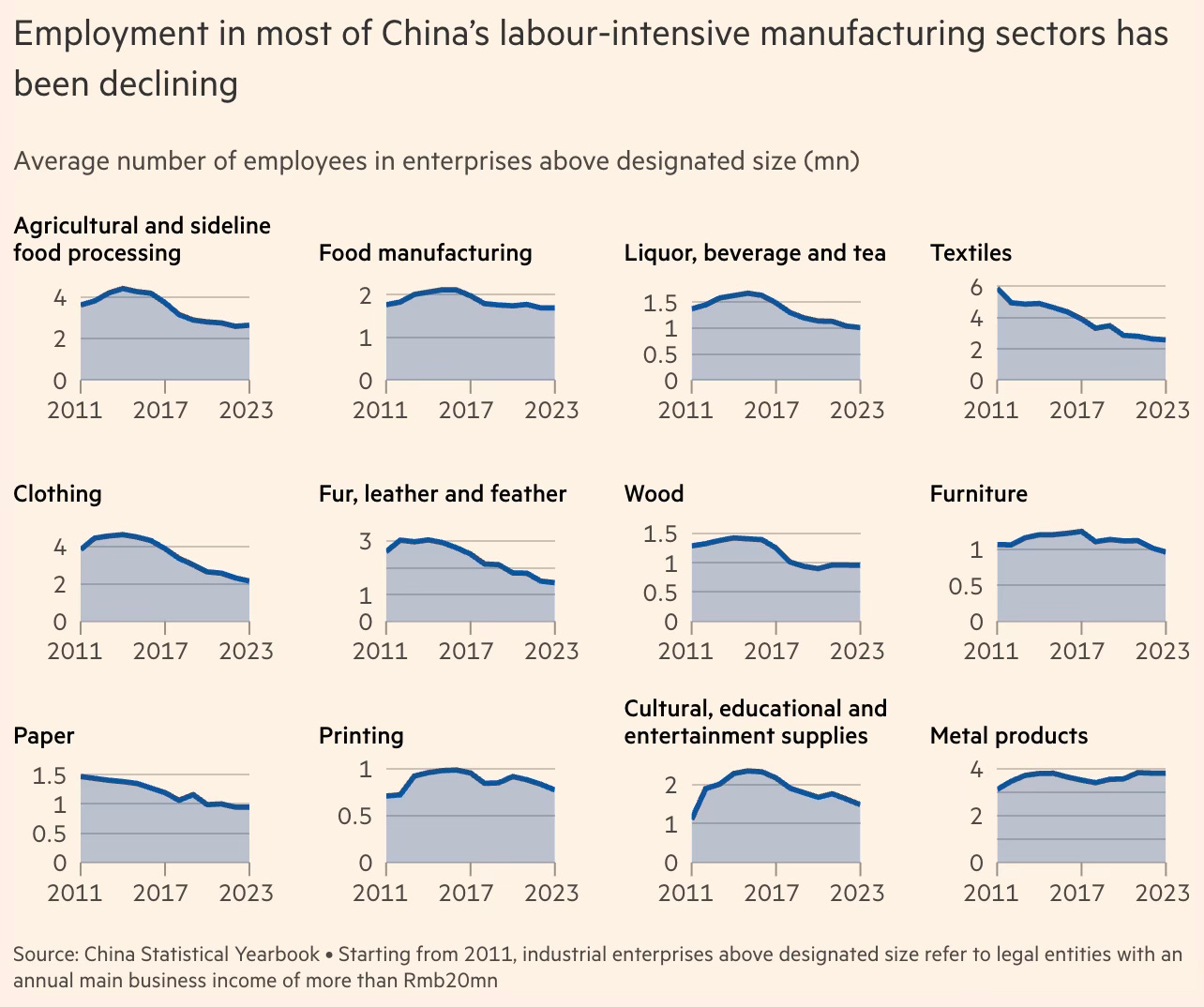
13. Amidst the Trump trade war and the backlash against Chinese imports across countries, Beijing must accommodate a similar ‘China Shock’ underway in the Chinese domestic economy due to the decline in its labour-intensive manufacturing. Rising wages, increasing automation, and stiff overseas competition, coupled with the trade wars are strong headwinds. As an illustration, China’s share of footwear exports has slipped from 70 per cent by 10 percentage points over the decade. 

Vietnam and Indonesia have been big beneficiaries of the migration of labour-intensive manufacturing, gaining more than 10 million jobs since 2011. Their exports have grown at 12.3% and 8.2% respectively from 2019-23. 

Analysis of 12 labour-intensive manufacturing industries between 2011 and 2019 by academics at Changzhou University, Yancheng Teachers University and Henan University found that average employment shrank by roughly 14 per cent, or nearly 4mn roles, between 2011 and 2019. Roles in the textile industry shrank 40 per cent over the period. An FT analysis of the same 12 sectors between 2019 and 2023 found a further decline of 3.4mn jobs… China shares of the export of 10 labour-intensive products — including home fixtures, furniture, luggage, toys and others — peaked at nearly 40 per cent in 2013, according to figures compiled by Hanson at Harvard Kennedy School. Hanson’s figures show that China’s share of the combined 10 goods had fallen to less than 32 per cent by 2018…

Beijing risks experiencing the same “China shock” that it imposed on advanced manufacturing nations after its entry to the World Trade Organization in the early 2000s, when orders migrated en masse from more expensive hubs to the cheap and efficient factories of Guangdong and other provinces. Now, the cheaper factories are in countries like Vietnam and Indonesia where exports have surged… Gordon Hanson, a professor at Harvard Kennedy School… points to the example of Martinsville, in the US state of Virginia, the onetime “sweatshirt capital of the world”, where in 1990 as many as 45 per cent of working-age adults were involved in manufacturing. The majority of those jobs “just disappeared” as the town failed to reposition its economy, he says — and today the poverty rate is double that of the nation.

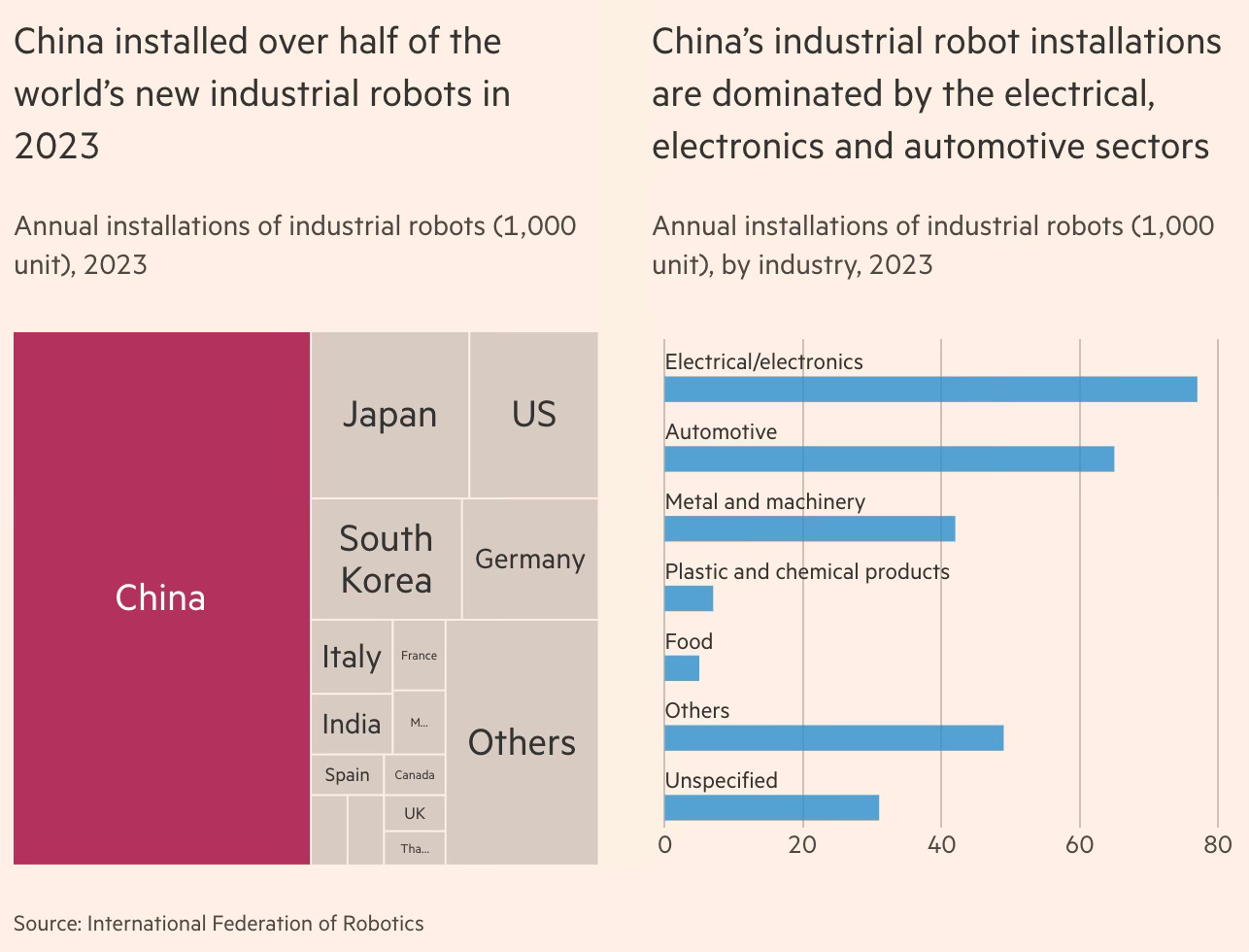
Amidst the declining labour intensity, automation and robots have taken off in China, encouraged by President Xi’s vision of “new productive forces” - high-tech machines run by smart systems to develop sophisticated products. Besides, automation also improves productivity and allows Chinese companies to remain competitive. 

Amplifying automation are demographic trends. China’s working-age population peaked at over 900 million in 2011 and is estimated to decline to 700 million by 2050. The decline, coupled with rising education levels, means that youth are reluctant to work on production lines. While all this creates employment opportunities and consumption, the problem is with the large numbers of workers who will be displaced and are not equipped to seize the emerging opportunities.

14. The death of Pope Francis has been accompanied by articles on his legacy. For a start, he was unique in many ways.

The Argentine prelate was the first pope from the Jesuit order, bearer of a centuries-old tradition of challenging authority and operating with relative independence from the Vatican. He was not only the first pope from Latin America and the western hemisphere, but the first non-European pontiff since the Syrian-born Gregory III (731-741). In this respect, his elevation to the Holy See on March 13 2013 reflected the steady movement of Roman Catholicism in modern times from its historical heartland of Europe to the Americas, sub-Saharan Africa and Asia.

More importantly, his 12-year tenure saw intense debates on several important areas like sexual behaviour, clerical morality and the liturgy. 

In the last months of his reign, Francis lashed out at the Trump administration’s plans for “mass deportations” of migrants... Another powerful example was his 2015 encyclical, Laudato sì (On Care for Our Common Home), a document that for the first time placed concern for the environment on the same level as human dignity and social justice in Vatican doctrine... If such language was guaranteed to raise the hackles of climate change sceptics, no less heated was the conservative response to Amoris Laetitia (The Joy of Love), an apostolic exhortation that Francis published in 2016. Less authoritative than an encyclical, in that it set out a possible course of action rather than binding Vatican doctrine, this document raised the possibility of allowing divorced and remarried Catholics to receive the sacraments — a significant break with Catholic tradition... Francis came under frequent conservative attack for his decision to reverse a 2007 initiative of Benedict and reimpose restrictions on the celebration of some sacraments according to old Latin rites. Yet Francis was no darling of progressive Catholics, either. Many regarded his approach to issues such as homosexuality and the role of women in the Church as too cautious.

His tenure, however, was widely critiqued among the conservative Maga Catholics in the US who were worried that the reforms were deviating from the Bible and the original teachings. They denounced Francis as a spokesman for a liberal cosmopolitan elite and hope that the death of the pope will mark an end to his reformism.  

Distrust of Francis was particularly widespread among the “Maga” Catholics, a group that combines support for Trump’s populist, nationalist agenda with an embrace of Christian orthodoxy and deep suspicion of liberal trends in the church... “Trump has boosted Catholicism by reaffirming some essential things, such as border protection, the defence of human life and the fact there are only two genders,” said John Yep, leader of Catholics for Catholics, a political campaign group. “That was good for Catholics and that’s why 58 per cent of Catholics voted Republican in November.”... Traditionalists were particularly angered by Amoris Laetitia, his 2016 apostolic exhortation, which raised the possibility of allowing divorced and remarried Catholics to receive the sacraments. They also denounced his 2023 decision to approve blessings for same-sex couples, his advocacy of action against climate change and his welcoming approach to migrants. For conservative Catholics who had always been uncomfortable with the reforms of Vatican II, his hostility to the Latin mass was particularly hard to accept.

The rise of MAGA populism among Catholics is an indicator of certain long-term rightward shifts in the US. 

“The clergy that has graduated from seminaries in the last 10-20 years [in the US] tends to be more conservative,” said Janna Bennett, chair of the Department of Religious Studies at the University of Dayton, Ohio. She noted the role played by institutions such as the Franciscan University of Steubenville, in Ohio and Ave Maria University in Florida, both of which have a conservative reputation and have provided a pipeline of aspirant priests and lay ministers with a traditionalist mindset. According to a survey published in 2023 by the Catholic Project, a research group at the Catholic University of America, more than 80 per cent of priests ordained since 2020 described themselves as theologically “conservative/orthodox” or “very conservative/orthodox”. The researchers said that while theologically “progressive” and “very progressive” priests made up 68 per cent of new ordinands in the 1965-69 cohort, that number had today “dwindled almost to zero”. It is no surprise, then, that Pope Francis became such an irritant to many American Catholics.

15. Chris Miller makes the case for component-based tariffs in the case of semiconductor chips.

An iPhone might be assembled in China, but most of the key components are from elsewhere. There is a precedent here in watches, where the tariff rate is calculated based on components like batteries and wrist-straps. The Biden administration previously considered imposing component tariffs on Chinese chips, before backing off, worried about the complexity. Yet imposing component tariffs on chips from China — which produces less than 3 per cent of chips in US supply chains — is far easier than imposing tariffs on all foreign chips.

16. Finally, China's policies with its neighbours are an important reason for the hard limits to its influence in Asia. Consider the example of setting up fish farm installations in international waters in the Yellow Sea, which are part of the country's 'grey zone' tactics to bully neighbours in their territorial waters and establish claims. 

Chinese companies started building large-scale deep-sea fish farms in 2016 for Norwegian companies raising salmon in the Atlantic Ocean. Construction on the first Yellow Sea installation, the Shenlan 1, began in 2018 in the “provisional measures zone”, a disputed area in the Yellow Sea where Chinese and South Korean exclusive economic zones overlap. It was built by Wanzefeng Group, a fisheries company based in eastern Shandong province. A second structure, the Shenlan 2, was installed last year in the PMZ by a joint venture between Wanzefeng and state-owned Shandong Marine Group, despite Seoul’s protests. South Korea dispatched a marine research vessel last month to investigate but was forced to turn back after an hours-long stand-off... some observers warned that such actions in disputed waters could be a precursor for more solid territorial claims. “They put their fishing vessels and fish farms there with subsidies and infrastructure support, and after a while they use the fact of that presence to underpin a historic claim,” said a senior government official in the Philippines, which has repeatedly clashed with China in the South China Sea. 

That stance has also been endorsed by some Chinese observers. Current affairs blogger Shijiu Chen Nianhuashe wrote last month: “On the surface, we are building ordinary fish farms. But in fact, this is a smart move to increase our actual control in these disputed waters.” Nam Sung-wook, a professor at the Graduate School of Public Administration at Korea University, said a chain of Chinese structures in the Yellow Sea could ultimately obstruct South Korean or Korea-based US naval vessels from accessing the East China Sea in the event of a conflict in the Taiwan Strait. “We should have taken action sooner,” Nam said. “If any country doesn’t respond to such territorial issues immediately, it becomes a fait accompli.”

Saturday, July 3, 2021

Weekend reading links

1. Ananth points to Ed Yardeni's hugely informative website. Total assets of central banks in developed countries,

... as a share of GDP

2. On the global EV cars market

3. I have blogged earlier highlighting how corporates across developed countries have used Covid 19 to cut costs and deleverage. It may not be incorrect to argue that the monetary accommodation has had the biggest positive impact for the largest firms. The same appears to have happened in India. Livemint points to an SBI research which shows companies in the top 15 sectors, representing more than 1000 publicly trade firms, reduced debt by more than Rs 1.7 trillion in FY 21. The net debt to equity ratios of BSE 500 companies fell to 0.51 times in FY21.


The pandemic allowed firms to defer expansion plans and use the surplus to retire debt. It also lowered discretionary spends, travel costs, and other operational expenses. 

This comes on top of anecdotal evidence of large businesses cutting down on workers and squeezing suppliers by lowering prices. Even the largest IT companies have used the pandemic to cut employee costs, among other things, by laying off large numbers of engineers and hiring junior engineers at lower wages. 

4. On a related note, the Q4 corporate results continue to surprise on the positive side. This from the results of 1757 listed companies that have so far declared their Q4 results,

Revenues from operations rose 17 per cent, year-on-year, to Rs 26.04 trillion. Profits after tax (PAT) rose a whopping 523 per cent to Rs 2.38 trillion. Operating profits — or PBDIT (profits before tax, depreciation, and interest) — rose 64 per cent to Rs 7 trillion. The interest pay-out dropped 6 per cent, depreciation rose 7.4 per cent, and employee costs increased 9.5 per cent. The resurgence was across many sectors... If volatile sectors such as banking, finance, oil production, and refining are excluded, operational revenues rose 21.9 per cent for the rest. PBDIT and PAT rose 58.9 per cent and 179 per cent, respectively, while interest costs fell 11 per cent and employee-related expenses rose 7 per cent. Banks saw an extraordinary 629 per cent rise in PAT, despite minimal credit growth of 5.3 per cent. Easier provisioning contributed and a turnaround in Canara Bank, Axis Bank, Union Bank, and Bank of India saw this quartet register Rs 5,490 crore in combined PAT, versus combined losses of Rs 10,786 crore a year ago. The story was similar for 163 listed non-banking financial companies (NBFCs), which saw combined PAT rise to Rs 19,977 crore from combined losses of Rs 2,601 crore a year ago. Crude oil, refining, and marketing had combined extraordinary losses of Rs 19,241 crore a year ago, and combined PAT of Rs 45,203 crore this quarter.

5. Indian Express has a very good investigation which analysed the profile of independent directors in corporate Indian Boards. It does not paint a flattering picture. This about regulators going corporate boards, some even before their cooling-off periods were over, may be the most worrying. 

6. Highlighting the interest generated by the PLI scheme at least in mobile phone manufacturing, Taiwanese iPhone maker Wistron has met its five year investment target by investing Rs 1255 Cr in 2020-21. While Foxconn is already in India, Pegatron has not yet set up a factory in India. Apple, through its three vendors, Apple is planning mobile phone production of Rs 3.4 trillion value in five years. This would be 56% of the entire PLI target for global players of Rs 6 trillion. It is thought that 80% of this will be exported, higher than the PLI target of 60%. 

This is a status report on the PLI scheme.

7. Pratap Bhanu Mehta points to the latest Pew survey on religious attitudes,

Stopping religious intermarriage for both men and women is a very high priority for almost 70 per cent Hindus and Muslims... Opposition to caste intermarriage is only slightly less than religious intermarriage, but declines more with college education. It is higher amongst Muslims, 70 per cent of whom oppose inter-caste marriage for men, compared to 63 per cent Hindus.

This from the Pew Survey,

See also this.  

8. From another Pew survey, negative opinion about China reaches all time highs,

In the soft power race, China remains far behind the US.

9. Another health consequence of Covid 19, impact on patients with other medical conditions,

A study published in The Lancet journal in May, which covered 41 cancer treatment centres in India, showed a sharp reduction in oncology services between March and May 2020, compared with the corresponding period in 2019. The largest decrease was observed in the number of new patient registrations—which plummeted from 112,270 to 51,760 (a drop of 54%). A larger reduction in patient numbers was observed in the major cancer centres located in large metropolitan cities than in the smaller cities. The study, which was done by the National Cancer Grid, indicated that the decline in access will result in 83,600-111,500 missed diagnoses and as many patients will require treatment for a more advanced form of the disease in the next two years. It predicted the need for an additional 98,650-131,500 cancer deaths within the next five years.

10. Livemint analysis on the large corporate profits in India,

A broad-based analysis of the corporate results of over 1,100 companies (1,130 to be precise) shows that even as revenues, at the aggregate level, fell by 6%, the operating profit of this representative set of India Inc shot up by 30% and net profit climbed by 48%. In marked contrast, in the US, aggregate net profit decreased by 6% in 2020, according to the US Department of Commerce. The revenue-profit dichotomy within corporate India suggests that companies went on a massive cost-cutting spree, which was at an order of magnitude different from what unfolded in other countries...

One major area of cost-cutting was compensation to employees, whether in the form of laying off staff, employing contract labour for fewer days, or by pruning salaries. In aggregate terms, for our set of 1,130 companies, total employee expenses increased, but at a much slower pace. The year-on-year increase in employee expenses halved from 7.4% in 2019-20 to 3.8% in 2020-21. Within this, though, companies took very different approaches. About 51% of the companies cut employee expenses in 2020-21, with the aggregate decrease amounting to 10%. Among the firms whose net sales increased, about 28% still cut staff costs. This number increased to 74% among companies whose net sales fell. Firms in sectors that were most affected by the pandemic were also the most active in reducing employee costs. About 62% of firms under ‘other services’—mostly in the travel, leisure and hospitality sectors—cut staff costs. Notably, for 127 companies, both sales and profit after tax have risen, but employee expenses have fallen. In other words, these are firms that fared better during the pandemic year, yet they dialled down on compensation to employees. For example, steel major JSW reduced employee expenses by 12% even though it comprises merely 4% of its total expenditure. Others in this set included Reliance Jio, chemicals major BASF India, and tyre manufacturers JK Tyre & Industries and Apollo Tyres. Adani Green Energy reduced employee costs by 64% amid a 20% increase in net sales.

11. One more graphic highlighting TSMC's dominance of chip making,

Also highlights China's relative backwardness in chip manufacturing.

12. Finally, a friend forwards this excellent conversation with Lant Pritchett where he talks about the problems with international development discourse. It has to be experienced to believe the disconnect between the priorities of real-world governments and those of the theoretically focused funders and development opinion makers. 

Sunday, January 22, 2012

America as a conservative outlier among developed economies

The graphic highlights how conservative American society remains despite its modernized society and high national income.

Saturday, May 14, 2011

Most educated religious group in the US?

Hindus again, followed by Jews!

More importantly, David Leonhardt finds a very strong relationship between education levels and incomes across all religious groups and within each of them. He analyzed the data in different ways and comes to the same conclusion - "more affluent people tend to produce more educated children, and more educated people tend to earn much more than less educated people".

The chart below shows the percentage of people with a four-year college degree and the percentage of people with family income of at least $75,000 a year, using data from Pew. Note the near tight upward correlation between education levels and household incomes.


Interestingly, as David points out, the Protestants, who form the largest religious group in the US, are poorer than average and poorer than Catholics, thereby calling to question Max Weber's famous theory that Protestant nations are generally richer than Catholic nations.

I had blogged earlier about the fact that Hindus formed the richest religious group in the US.

Update 1 (25/1/2014)
From a Times oped,
Indian-Americans earn almost double the national figure (roughly $90,000 per year in median household income versus $50,000). Iranian-, Lebanese- and Chinese-Americans are also top-earners. In the last 30 years, Mormons have become leaders of corporate America, holding top positions in many of America’s most recognizable companies... Although Jews make up only about 2 percent of the United States’ adult population, they account for a third of the current Supreme Court; over two-thirds of Tony Award-winning lyricists and composers; and about a third of American Nobel laureates.
The remarkable rise of Asian immigrants is captured by this anecdote,
Take New York City’s selective public high schools like Stuyvesant and Bronx Science, which are major Ivy League feeders. For the 2013 school year, Stuyvesant High School offered admission, based solely on a standardized entrance exam, to nine black students, 24 Hispanics, 177 whites and 620 Asians. Among the Asians of Chinese origin, many are the children of restaurant workers and other working-class immigrants. 

Tuesday, August 17, 2010

Observations from communal marriages

For the past five years, the Tirumala Tirupati Devasthanam (TTD) has been organizing mass marriage programs, "kalyanmastu", across the state, with the objective of helping poor people to get married without running up debts, promote Hindu culture and counter missionary propaganda.

TTD gifts each couple (from the below poverty line families) with a gold mangalasutram, silver toe rings, and a set of wedding clothes to the couple, and to an attendant. It also hosts feast for sixty people from each couple's side, and provides free darshan for six members belonging to the bride and bridegroom family at the Venkateswara temple at Tirumala.

So far, more than 35000 such weddings have been conducted as part of the Kalyanamastu. It is estimated that TTD spends about Rs 10000 for each couple. Here are a few observations from the latest round at Hyderabad.

1. It is undeniable that poor people incur considerable expenditure in organizing marriages and large debts are an inevitable legacy of a marriage. Apart from lowering marriage ceremony expenditures, such unions are less likely to involve dowries.

Since everyone gets married, incur considerable expenditure on their marriage ceremony, and the resultant debts impact a larger number of people (families of both, especially the bride), mass marriages offer a considerable welfare dividend. In many respects, it is equivalent to a large one-time cash transfer.

2. Like all government interventions involving dispensing some benefits, such mass marriages are also vulnerable to leakages. There is the strong possibility that atleast some of the couples already had their wedding recently and have been tempted by the incentives (especially the free darshan). What increases its likelihood is the fact that government officials are given targets to mobilize couples for such weddings.

3. Private marriages are deeply personal events. At a cultural level, arranged weddings are most often sustained, atleast in the initial stages, by the powerful influence of traditions and conventions. The strong memories of the marriage ceremony itself, in the exclusive presence of friends and relatives, will serve as a powerful binding force.

Does the impersonal nature of mass-marriages mean that its psychological impact on the couples are not deep enough? Put differently, it may be fair to say, the contribution of the memory of the marriage ceremony itself towards sustaining the marriage (atleast for the first few years) will be smaller for such mass-marriages.

4. Do such weddings encourage love-marriages, where couples elope to get married? Since the couples incur no expenditure and since they are impersonal occasions (given the large numbers of marriages taking place), they provide an excellent platform for couples fleeing to marry in relative anonymity.

5. What has been the longevity of such marriages? For all the aforementioned reasons, there is atleast a reasonable theoretical case that such marriages may not be as adhesive as the regular private marriages. But then, the fact that these weddings are taking -place before Lord Balaji could offset some of the perverse incentives.

In any case, communal marriages throw up numerous opportunities for immediate individual-level incentive changes and longer-term sociological changes.

Monday, August 31, 2009

Religious "nudges"!

A working paper by Angus Deaton (via Chris Dillow) which examined results from Gallup World Poll from across 140 countries appears to indicate that religion nudges people to good behaviour, which in turn results in positive social outcomes. He writes,

"Religious people report better health; they say they have more energy, that their health is better, and that they experience less pain. Their social lives and personal behaviors are also healthier; they are more likely to be married, to have supportive friends, they are more likely to report being treated with respect, they have greater confidence in the healthcare and medical system and they are less likely to smoke... these effects... tend to be stronger for men than for women...

... on average, over all countries, and over countries sorted into income groups, religious people do better on a number of health and health-related indicators. These protective effects appear to be stronger the poorer is the country... religion is a route to a better life in poor countries, but not in rich ones — and to protect men more than women."


Chris Dillow feels that this outcome is "because being religious is associated with things that are good for you... religious men are less likely to smoke, more likely to feel they are respected by others, and more likely to be married - and these things are good for one’s health."

Freakonomics points to more evidence that religious following can also nudge people to vote and help people overcome childhood disadvantages like poverty and difficult upbringing.

Sunday, May 10, 2009

Caste networks and mobility

An NBER working paper by Kaivan Munshi and Mark Rosenzweig claims that spatial and marital mobility in India have been constrained by the rural caste-based networks, which provides mutual insurance and enables smoothing of consumption in the absence of well functioning markets.

A testimony to the resilience of the caste networks is their finding that "among households with the same permanent income, a permanent increase in incomes in the rest of the jati increases its participation in the caste-based insurance arrangement, while at the same time lowering mobility". The increase in inter-caste marriages over time in urban areas due to the availability of new and superior forms of insurance, suggests that marital mobility could increase in rural areas too as economic growth penetrates the rural economy.

Update 1
Abhijit Banerjee and Co explored data from marriage advertisements in newspapers and find that since supply and demand are well balanced within each caste, the cost of finding an appropriate match is not very high, thereby leading to the persistance of caste in the marriage market. (also in Market Design)

Friday, March 6, 2009

Moderates Vs Jihadists: New clash of civilization?

Bernard-Henri Lévy, French public intellectual and journalist, speaking on Fareed Zakaria's weekly show on CNN, made an interesting observation that the new Clash of Civilization is that within Islam between the moderates and the Al-Qaeda led Jihadist extremists. Discounting for the hyperbole, there is strong immediate relevance to this claim.

Two recent events - victories by rebels in Pakistan's SWAT valley and Somalia - appears to indicate that the extremists are gaining ground. In both the cases, the Al-Qaeda allied Taliban and al-Shabaab, had forced the respective sovereign governments to embrace Sharia law.

Bernard Levy's version of the "clash of civilizations" is atleast an important sub-plot in the larger conflict between Islamic militants and mainly, but not exclusively, Western societies and their governments. A victory of the moderates is the only chance to atleast contain this enduring division. Anything else is a recipe for deepening divisions and violence. It is clear that the moderates need support, or else the momentum will rapidly change decisively in favor of the extremists.

I am a little bit surprised by the silence, forced or otherwise, of many of the leading moderates among the Sunnis. The victories of Al-Qaeda (Sunni organization) supporters are surely eroding the credibility and leadership of these moderates. Or is it that they have been forced into a corner by an environment of anti-western sentiments, fuelled largely by the policies of successive American administrations on Palestine, and cannot afford to take a moderate stance in public? In other words, has moderation been banished to being un/non-Islamic?

What lends credence to this view is silence of moderates like the Grand Sheikh Mohammed Sayed Tantawi of the Al-Azhar mosque of Cairo, seen as the highest authority in Sunni Islam, and a critic of suicide bombings and Al-Qaeda. He had earlier said that groups which carried out suicide bombings were the enemies of Islam, and that extremist Islamic groups had appropriated Islam and its notion of jihad, or holy struggle, for their own ends.

Is Obama administration taking note?