Substack

Showing posts with label Labour issues. Show all posts

Monday, July 13, 2026

Workers and startups are helping train AI to replace them

Data annotation work is increasingly moving up the value chain, from tagging and labelling data to replicating the work of semi-skilled (on the factory floor) and skilled (consultants, analysts, lawyers, engineers, and doctors) workers. 

Startups sell data to AI labs, which use it to train and refine their AI algorithms and develop software products/solutions that replicate the work of these workers. In other words, the semi-skilled and skilled workers, or at least some among them, are feeding their time and skills into the AI algorithms that seek to replace them and their kind. Both the training startups and those workers offering their services to them are basically helping make themselves redundant. 

On this, the FT has a very good film about how Indian startups are paying factory floor workers and gig workers (and even people in their homes doing regular household chores) to use cameras and record their work. Data annotation is becoming the new BPO for India’s IT industry. 

The Ken has an article that raises the possibility that for all the attention and hype around robotics, Indian startups might remain stuck at the lowest end of the robotics value chain - data collection. 

India was the back office for the IT boom. It became the annotation and reinforcement-learning labour pool for the generative AI boom. It is now emerging as the behavioural data factory for the physical AI boom... Building the robot is only half the problem. Building the intelligence behind it is much harder. That requires data. Vast amounts of it. Unlike large language models, which were trained on the equivalent of hundreds of years of human reading scraped from the internet, robotics companies are working with barely a fraction of that in video... What they need is meticulous, first-person recordings of humans interacting with the physical world, carefully collected, annotated, and painstakingly structured. 

So the industry turned to India. Across the country, workers are recording themselves doing everyday chores for data-collection firms, which then sell that footage to companies such as Tesla, Figure AI, and Agility Robotics to train their humanoids. Indian startups see this as a moment to claim a seat in the global AI value chain. The country has over 260 robotics startups, and investors are beginning to pay attention... The footage being recorded by Indian workers becomes proprietary once it leaves the country. The datasets assembled from it are accumulating on foreign servers. The foundation models trained on them are owned by foreign companies.

The NYT has an article about how startups like Handshake, Mercor, and Surge in the US are paying skilled workers to collect data on their work. 

Mercor and a handful of similar start-ups are the primary middlemen in a supply chain of “human data” that may power the next generation of A.I. As OpenAI, Anthropic and other major ventures compete to become the industry’s dominant platform, the market for premium data that has been vetted by experts is exploding…They need mathematicians to annotate proofs, lawyers to mark up briefs and professors to grade essays… To use the parlance of the industry, data labeling has moved up the “value chain,” and the start-ups that offer this service have become some of the fastest growing in Silicon Valley… The data-training start-ups see a lucrative opportunity in recreating workplaces in miniature: controlled environments in which their gig workers can evaluate and reproduce emails, memos and slide presentations in context. The information emerging from such a setup, the companies boast, will help shrink the gap between what A.I. models can accomplish and what office workers actually do from one minute to the next, as ideas and instructions flow between meetings, documents and applications…

To keep improving their models — to make them more useful, more sophisticated, less prone to hallucination and mistakes — A.I. companies heavily refine what goes into them. That’s post-training, and it includes buying data from vendors like Handshake and its competitors… Deeptune, a start-up that makes “training environments” with simulations of the software programs, like Slack and Salesforce, that many workers toggle between all day long to get their work done. The idea is to painstakingly create a mirror image of, say, an investment bank so that A.I. can observe every interaction…

It may turn out that once OpenAI, Anthropic and others have taught their models to perform a certain job, their need for more training data in that area could sharply decline. In this way, Mercor, Scale, Handshake and their peers are much like the elite freelancers they employ: making money today, but in danger of being dropped tomorrow… People sign up for data-training gigs for a variety of reasons. The main one is, of course, money… Though the labor is unpredictable and rates vary… the workers who cobble together enough shifts can generate meaningful income. People might sign up because they have been laid off, or because they can’t find enough work in their field. They might do it because they’re eager to get “A.I.” on their résumé, or because they need extra cash in retirement… Many people who contract for these companies understand that this is a short-term opportunity, a brief chance to train the models to automate jobs before they themselves are automated out of the job of training models.

I asked Claude to generate a visualisation of this market landscape, including an assessment of the Indian landscape. The numbers are clearly estimates and must be validated (though at a ballpark they appear alright). 

The unit economics of the data chain shown below for a garment worker in India is instructive. She gets roughly ₹400 a day to wear the camera (or $0.60 per hour); the startup pays the factory ₹450–500 per hour; US-based startups like Human Archive price data at $1–10 per hour; and once annotated and packaged, it sells to global robotics labs at $15–50 per hour. That is a 25–85 times markup, and every rung above the worker is owned outside India.
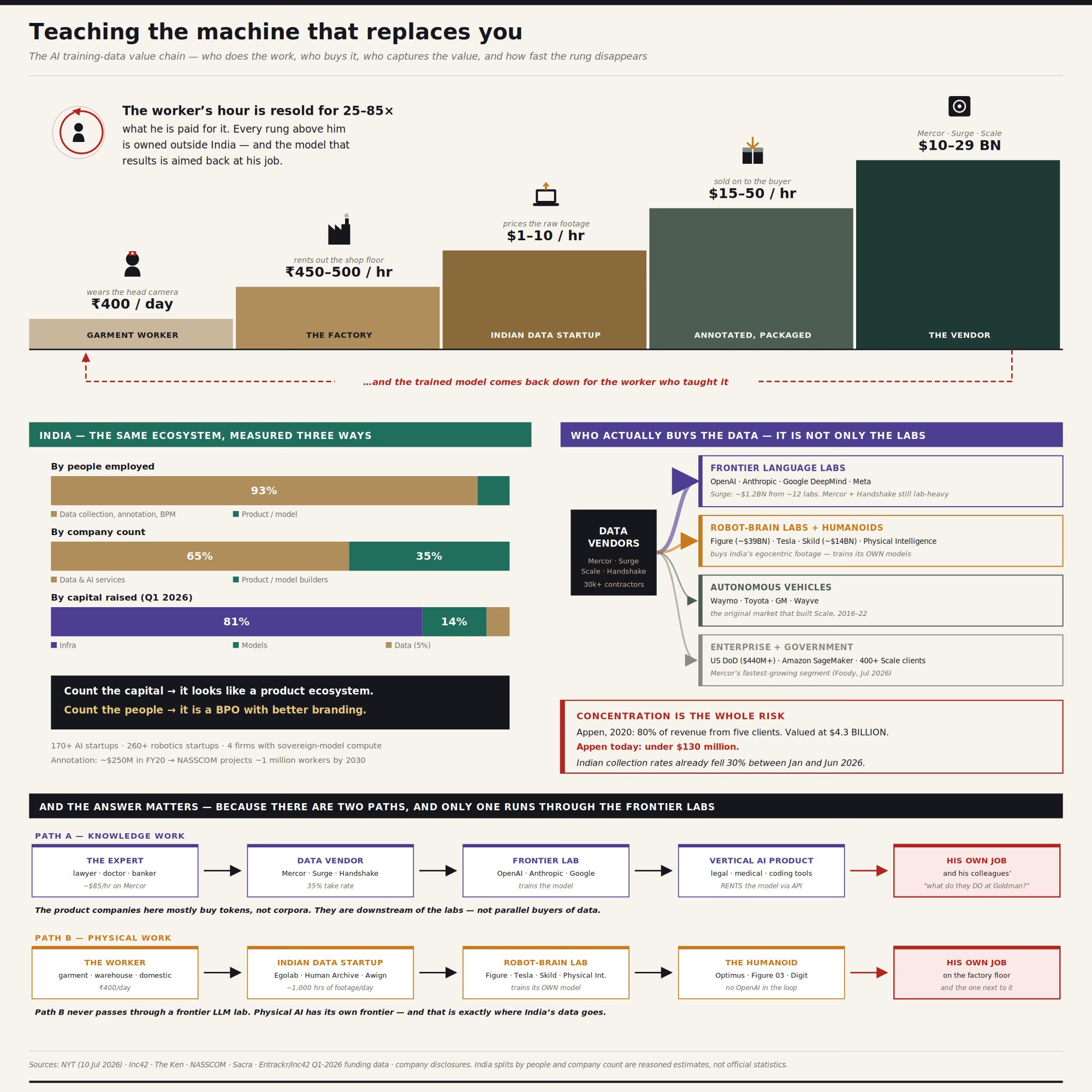
The graphic also shows that the vast majority of AI workers are doing the BPO equivalent, whereas the vast majority of funding is going to those building the data centres. India has 170-odd AI startups that have raised $2.6 billion in total and over 260 robotics startups, but the genuine model/product builders are a tiny set, and the majority have rebranded annotation as an AI line of business (iMerit, Objectways, Awign, Karya, Deccan AI, Human Archive, Egolab, Neo Cambrian, Humyn Labs, RoBoEra, etc.). 

It must also be highlighted that in the majority of cases in India, the data goes from the garment worker to an Indian data aggregator to a robot-brain lab in San Francisco, and comes back as a robot/humanoid. The frontier LLM labs are not in that loop. This also means that none of the emerging governance conversations about frontier models - safety frameworks, export controls, model-access negotiations - touches the mainstream data collection work being done in India. India is negotiating hard for access to frontier language models while simultaneously handing over, for ₹400 a day, the training substrate for the physical models that will actually displace its manufacturing workforce. Those are two different conversations, and only one of them is being had.

Further, as the Times article highlights, while these annotation startups are flourishing now, they may not be sustainable ventures. Once experts teach the models to do something, their services are no longer needed in the same way, and the vendors themselves need the models to keep improving to show they add value, while needing them to remain imperfect so clients keep coming back. 

I asked Claude for historical precedents and got this:

Frederick Winslow Taylor’s explicit programme, from the 1890s, was for management to “gather in all of the great mass of traditional knowledge which in the past has been in the heads of the workmen.” Skilled machinists were stopwatched; the Gilbreths filmed them with chronocyclegraphs — a literal 1910s head-camera. Workers cooperated because they were paid piece-rate bonuses to do so. The tacit craft was decomposed into instruction cards and handed to cheaper, unskilled labour. Outcome: enormous productivity gains, the collapse of the craft wage premium, a machinists’ revolt, congressional hearings in 1911–12, and Taylorism banned in US government arsenals by 1915. It took roughly fifty years and the postwar labour accord before the gains were broadly shared… 

In the 1990s American hospitals routed physician dictations to transcriptionists in Bengaluru and Chennai; it was unglamorous work, but India was good at it. That corpus is precisely what trained speech recognition. The industry peaked and then largely evaporated. Compensation to the transcriptionists: zero… most startups in this space risk meeting the same fate as the transcription companies of the 1990s.

In this context, I am reminded of the claim made by Daron Acemoglu and Simon Johnson in their book Power and Progress that the trajectory of technological progress is a political choice made by society and should not be left to corporations and technocrats. Their central claim is that the direction of technology is a social choice, not a technical destiny, and that redirecting it requires countervailing power rather than better-intentioned technocrats. 

The problem, though, is that globally, and especially due to the Trump 2.0 regime, the rule makers have surrendered agenda-setting to Big Tech and AI Labs. Closer home, India has almost no leverage over the direction of frontier AI. Instead, its leverage is confined to the terms on which its labour and data enter the supply chain, and not to bending the technology’s arc. 

In the circumstances, what can a country like India do?

Here are some thoughts for consideration. One, a statutory floor rate for training-data contribution and an industry-led collective licensing body for data work are both administratively feasible and could increase value capture (from the worker’s current share of 1-2% of the value created) without banning anything. A comparator is the model of SoundExchange (US) or PRS (UK) in the music industry, which acts as a government-designated clearinghouse that collectively licenses music, collects usage fees, and distributes royalties to creators, effectively removing the burden of individual licensing. This model would also subtly frame the market in terms of treating data as labour, and not as mere raw material. 

Second, on the regulatory side, it may be useful to revisit the DPDP Act provision that permits employers to process worker data without explicit consent under “employment purposes”. Instead, there should be purpose limitation, or restrictions on repurposing training data for other activities, and consent requirements of all involved. 

Third, public spending on AI innovation and procurement preference could be made conditional on the recipient retaining licensing rights to datasets collected from Indian workers rather than doing work-for-hire. This would frame the collection of data as an input and not a product, and industrial policy could price it appropriately. Fourth, there is the argument about extending statutory instruments like the gig worker welfare boards or the Code on Social Security present in some states (Rajasthan, Karnataka, etc.) to cover data work. It could help build countervailing power. 

But pursuing these agendas can be costly. This being a global market, prohibiting or putting too onerous terms on value capture and the entry of data into the supply chain will backfire by moving the work to Vietnam, Ethiopia, or the Philippines. Besides, for the Indian workers, already facing an acute scarcity of jobs, the choice isn’t really on offer, and ₹400 a day is ₹400 a day. There is a collective action problem here which calls for multilateral engagement through a forum like the ILO. 

But this should not mean that we sit back helplessly and allow the market dynamics to play out. Instead, before enacting any of them, there must be a public debate on the merits or otherwise of these proposed measures. What are their respective costs, and what can be done to mitigate them? What versions, if any, of these measures should be enacted? Such debates are essential to make informed and collective social and political choices.

The public debate is important since the agenda-setting process here, like with any technology change, pushes certain considerations to the forefront while also marginalising certain others. Almost always, the former represents the interests of the corporations and elite beneficiaries of the change, and the latter represents those of the vulnerable and voiceless. Therefore, such agenda-setting debates are a purely political activity, with profound social implications. 

It is also important since there is the distinct likelihood that India could spend the next five years as the world’s back office for the third time, and when the juice has been sucked out and value captured, there could be nothing left standing that India owns. 

PS: In this context of collective action problems, it is worth taking inspiration from one very impressive and encouraging breakout (which has not received the level of attention it deserves) from South Korea. It is a tribute to the maturity and wisdom of the country’s corporate and political system and the robustness of its democracy that Samsung and SK Hynix agreed to share 10% of their windfall profits from memory chip sales, with no ceiling on payouts, with their employees for the next ten years. Sample this.

Samsung Electronics... agreed last month for employees to share the chipmaker’s blockbuster profits from an AI-led boom... SK Hynix... handed employees a similar profit-sharing deal last year... Samsung is also going to give Won500mn loans at low rates to employees... Samsung and SK Hynix together control much of the market for the advanced memory chips used in AI servers. Employees at both companies are in line for average annual bonus payouts of Won600mn, which compares with a national average salary of about Won50mn... district of Hwaseong... expected to gain corporate income tax receipts of Won1tn to Won1.3tn from Samsung alone this year, an extraordinary sum for a city authority whose annual budget is about Won3.5tn.

Saturday, July 4, 2026

Weekend reading links

1. Indian universities have come to dominate the global rankings for research paper retractions, following complaints of plagiarism, fake peer reviews, and other misdemeanours. According to the Retraction Watch database, India recorded 887 research paper retractions in 2025, form 21% of all retractions (second to China with 41%) despite contributing just 5% of all publications, and occupying six of the world's top 10 universities for retractions. 
2. Stunning statistic about the Algerian demographic dominance of the Les Blues, the French national soccer team.
Only two of France’s 26 players are of non-immigrant ancestry — 22 of them have African roots. Some, such as Mbappé, are deeply connected to their country of origin.

And this dynamic of reverse migration and migrant domination elsewhere.

Of England’s 26 players, eight have Caribbean forebears, 10 African, and 20 who were eligible to represent at least one other country because of their family heritage or birthplace. Belgium has players who trace their lineage to its former colonies — Congo, Burundi and Mali. The Portugal team has those of Cape Verdean, Angolan, and Guinean lineage. Those surplus to their requirements — players of African descent born and raised in Europe — in turn, populate most of the African teams. Ten of the 11 Senegalese players in the starting lineup against France in the opening game were born in France... Six of the players in the US national team are of Afro-Caribbean heritage... There are those from Nigeria, Ghana, and Jamaica. Three are from Hispanic backgrounds — Christian Roldan (Guatemala), Ricardo Pepi (Mexican-American) and Jesús Ferreira (Colombian-American). As many are from Europe, and three others have dual nationalities... For Australia's Socceroos, four players were born in refugee camps. The players represent 15 ethnic backgrounds and include a Malaysian with Sri Lankan roots. Eighteen other players have direct immigrant or refugee heritage. To contextualise, only one Black player (Sam Morris) and another of Caribbean descent (Andrew Symonds) have represented Australia in cricket.

This is a brilliant article by Sandip G about the magnificent quartet in the French team - Kylian Mbappe, Ousmane Dembele, Michael Olise and Desire Doue. 

3. The US military learns from Iran.

The US has, similarly, begun to build its production of drones. It used the Lucas, a one-way attack drone reverse-engineered by start-up SpektreWorks from an Iranian Shahed-136, for the first time in combat in February. The Pentagon is looking to begin mass-producing them, and has requested to triple its spending on drones and related technologies to over $74bn next year.

4. Shenzhen, with 400,000 taxi drivers licensed to provide services in 26 platforms, will permit robotaxis from July 1. The new rules will allow the Shenzhen government to promote the “orderly development” of robotaxi tests, demonstrations and commercial pilots either in select zones or citywide. 

5. Friedrich Merz's landmark pension reforms

Under proposals agreed by a bipartisan commission, a compulsory initial contribution of 0.5 per cent of employees’ pre-tax income, rising to 2 per cent by 2031, will go into a Swedish-style public pension fund managed centrally and invested in capital markets. Contributions are split 50/50 between employees and employers. The statutory minimum retirement age of 67 is set to rise in line with life expectancy; rights to early retirement for people with 45 years of contributions will be restricted.
Such measures have become vital to reduce the deficits of Germany’s unsustainable pay-as-you-go system. Some 16.5mn baby boomers will retire by 2036 with only 12.5mn new workers joining the workforce, according to some estimates. The government spent about a quarter of the total federal budget on plugging gaps in the system in 2024; economists say that could double to 50 per cent in two decades.
Linking the retirement age to life expectancy is projected to mean only a gradual increase — to 67.5 by 2041 and 70 by 2091. But economists say this is the only sound way to stabilise the system without spiralling payroll taxes or huge federal subsidies. Narrowing early retirement rights will address a drain of experienced workers amid acute skills shortages.

6. Important graphic that highlights the extent of renminbi depreciation since the beginning of 2022 and the surge in surplus.

7. China expands export restrictions on dual-use items against Japanese companies in the latest instance of weaponisation of its manufacturing dominance. 
The companies added to the export control list include subsidiaries of Mitsubishi Electric and Mitsubishi Heavy Industries. The restrictions will also apply to several Japanese government research organisations including the National Institute for Defense Studies. Chinese exporters are banned from selling to the entities on the restricted list, and foreign organisations or individuals are also prohibited from selling dual-use items that were built or originated in China. China last expanded the list to 40 companies in February. In parallel with the expanded export control list, China’s commerce ministry on Monday put 20 Japanese companies and organisations on its watchlist, meaning they will get closer scrutiny in any matters relating to potential dual-use technologies. The list includes subsidiaries of Fujitsu, Mitsui E&S, Hitachi, Komatsu and Terra Drone. Beijing’s targeting of Japanese companies is the latest example of China’s weaponisation of trade in recent years. The EU Chamber of Commerce in China in April has found that Beijing has nearly tripled its use of export controls in the past five years. While some instances have been in response to western measures, the researchers noted that Beijing’s controls have also frequently targeted trade chokepoints.

8. GST balance sheet.

Though average GST collections in absolute terms are almost 90 per cent higher than those in the pre-GST period, other parameters tell the real story. The average growth rate in tax collections and the tax-GDP ratio are lower under the GST regime compared to the pre-GST era. Collections were further marred by GST cuts starting September 22, 2025.
With high-skilled IT services under pressure, a financial sector with limited capacity to create low and medium skilled jobs and manufacturing struggling to gain traction, the one area where jobs are being created is low-end services. Delivery riders for Zepto, which has just filed its papers for an IPO, have gone up from 49,278 in 2024 to 2.21 lakh in 2026 — more than a four-fold increase. Zomato and Blinkit have almost doubled to 10 lakh riders in two years. Swiggy now has 6.1 lakh riders, while Uber, at 14 lakh active drivers, outstrips Indian Railways. The gig economy is emerging as an urban employment sink.
10. The Uniqlo-Toray partnership that underpins Fast Retailing's spectacular growth. 
In April 2000, Uniqlo founder Yanai paid a visit to the offices of Toray, a Tokyo-based chemicals and materials conglomerate he had read about in a magazine. It marked the start of a strategic collaboration that provided Uniqlo with arguably its most important advantage over rivals: access to high-tech, specialised fabrics. After testing 10,000 prototypes, Toray invented a material combining four types of synthetic yarn that absorbs moisture from the body and converts it to heat. Uniqlo branded it Heattech, and since 2003 has sold 1.5bn garments made from or containing it. Toray also helped develop the fabrics behind AIRism, used as a breathable base layer, and the Ultra Light Down ranges of packable jackets insulated with bird plumage... control over fibre shape and fineness, dubbed nanodesign, has helped to make highly water-repellent and durable $50 lightweight parkas, creating a far cheaper alternative to specialist outdoor brands such as Patagonia. The two sides are entering a fifth phase of collaboration that aims to combine synthetic fabrics with natural ones, such as introducing cashmere into Heattech products to make them softer. Okawa believes few other retailers have such deep relationships with their key suppliers.
11. Good FT long read about the Jamie Dimon succession struggle at JPMorgan. The things that stand out are the following: 

One, the appointment of someone to the top position in any organisation, public or private, is bound to be opaque and involve considerable discretion. The only disqualification would be the egregiously ineligible. For any others, there will always be ways to spin it as a fair process. This holds with greater effect as the stakes go up. 

Two, in the succession struggle, dominated as they are by a multiplicity of considerations, among those eligible or qualified, it is rare that the most professionally competent will emerge as the successor. 

Three strong leaders will always delay succession, and even when they choose to retire, will seek to retain enough levers to influence the decisions of their successors. Most often, it is about decisions involving the promotion of the interests of those in the organisation closest to them, their pet projects or initiatives, broader organisational strategic shifts, etc.

Monday, March 9, 2026

Labour market in times of technological changes

The impact of AI on the economy, especially on the labour market, is most likely to be the defining political economy issue of this generation. 

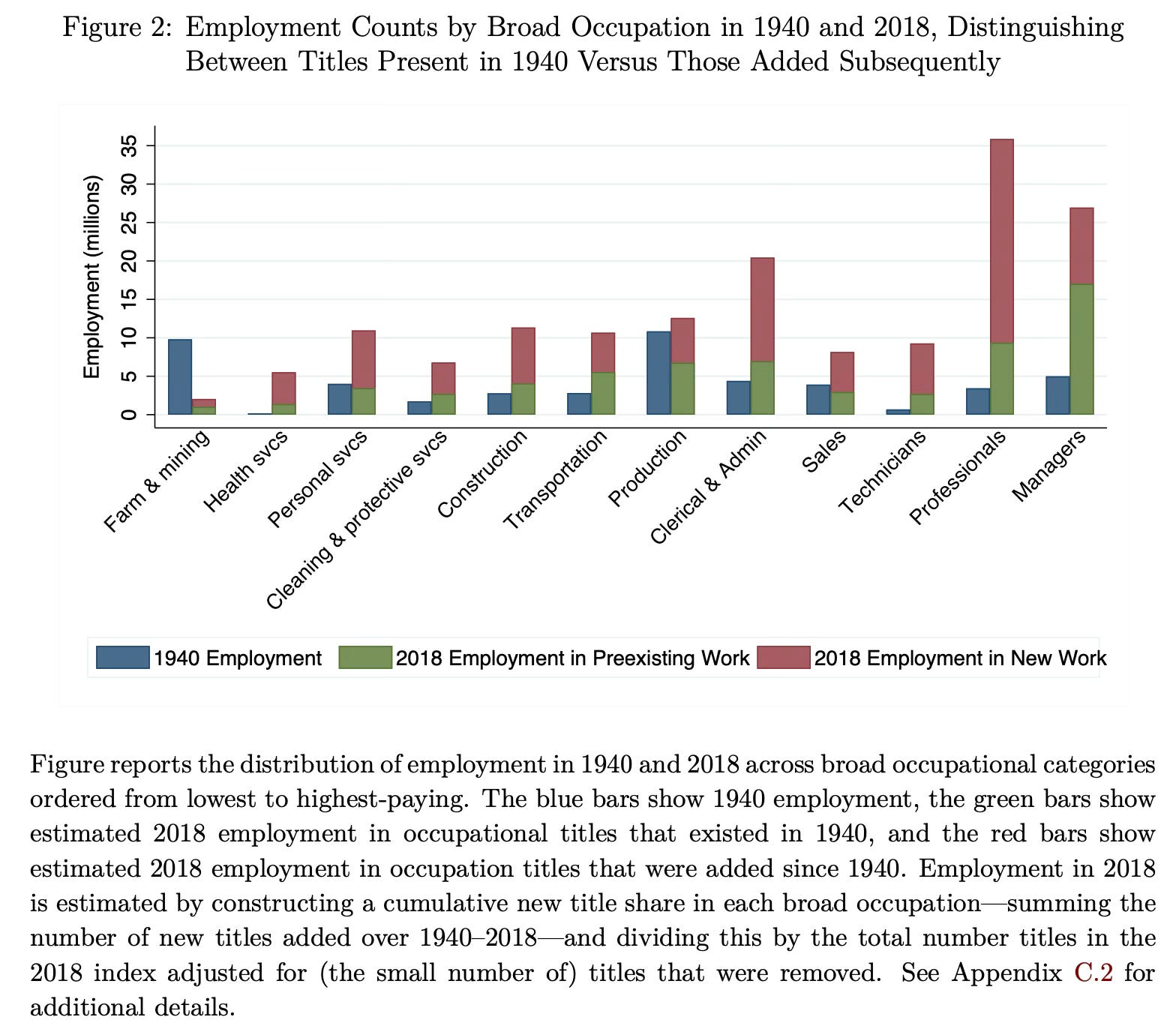
In this context, it is useful to understand the trajectory of the evolution of jobs with technological changes over the last century or so. Daron Acemoglu and Pascual Restrepo have shown that roughly half of America’s employment growth between 1980 and 2010 came from the creation of entirely new occupations. They argue that the automation effect of the displacement of workers is offset by the reinstatement effect arising from the creation of new occupations. 

David Autor, Caroline Chin, and Anna Salomons have a paper which examined the substantive content of emerging job categories (or new work) over the 1940-2018 period in the US, where it comes from, and its effect on labour demand. Augmentation innovations are those that increase capabilities, quality, variety, or utility of the outputs of occupations, thereby generating new demands for worker expertise and specialisation. They constructed a database of new job titles linked both to US Census microdata and to patent-based measures of occupations’ exposure to labour-augmenting and labour-automating innovations. 

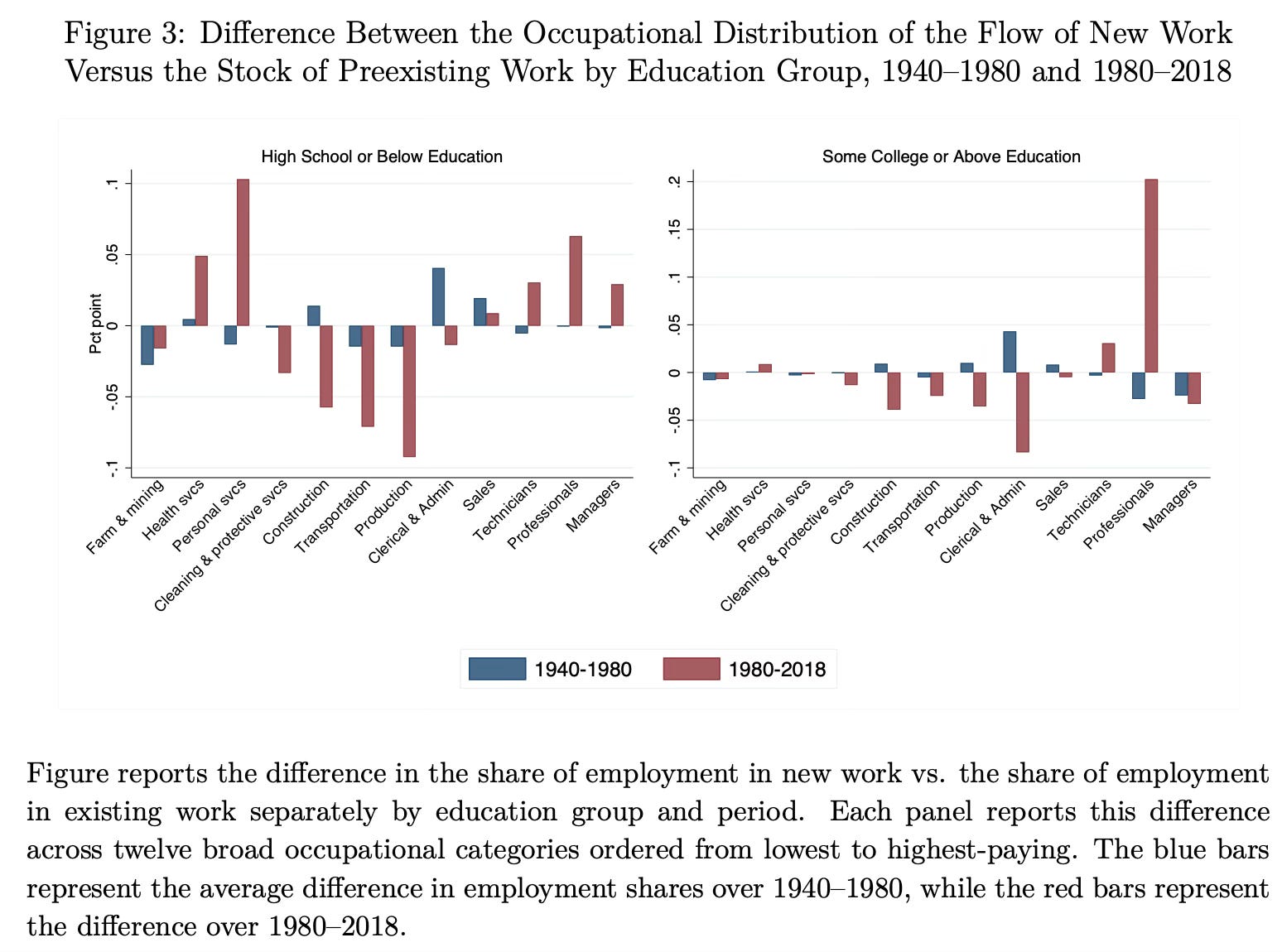
We find, first, that the majority of current employment is in new job specialties introduced after 1940, but the locus of new work creation has shifted—from middle-paid production and clerical occupations over 1940–1980, to high-paid professional and, secondarily, low-paid services since 1980. Second, new work emerges in response to technological innovations that complement the outputs of occupations and demand shocks that raise occupational demand; conversely, innovations that automate tasks or reduce occupational demand slow new work emergence. 

Third, although flows of augmentation and automation innovations are positively correlated across occupations, the former boosts occupational labour demand while the latter depresses it… Employment and wagebills grow in occupations exposed to augmentation innovations and contract in occupations exposed to automation innovations… augmentation innovations increase occupational wagebills by boosting both employment and wages suggests that ‘new work’ may be more valuable than ‘more work’—plausibly because new work demands novel expertise and specialization that (initially) commands a scarcity premium… we establish that the effects of augmentation and automation innovations on new work emergence and occupational labour demand are causal. Finally, our results suggest that the demand-eroding effects of automation innovations have intensified in the last four decades while the demand-increasing effects of augmentation innovations have not.

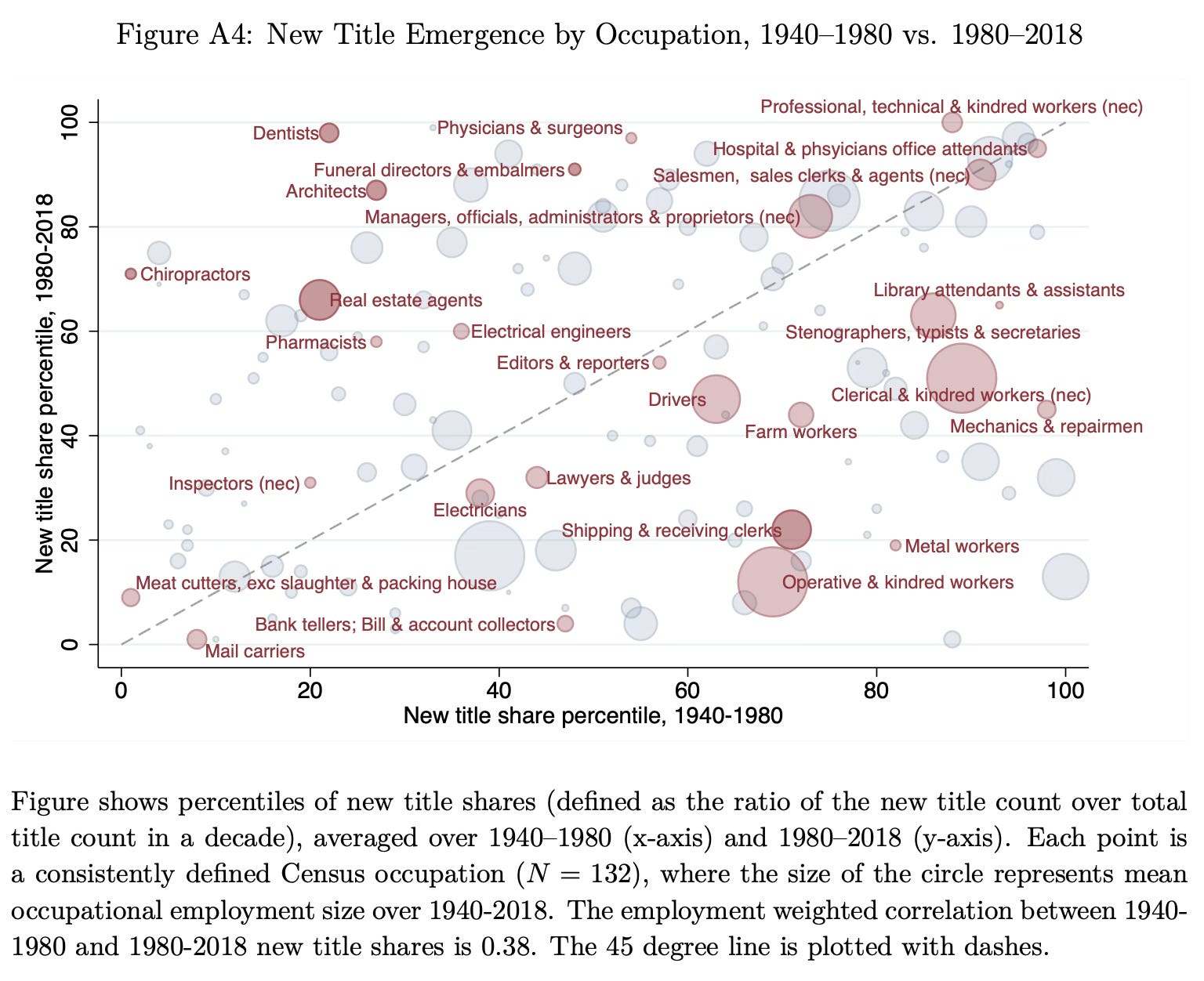
Routine task-intensive occupations gained substantial new titles between 1940-80, and few between 1980-2018.

What most stands out from this figure is the shifting fortunes of routine task-intensive occupations—both blue-collar occupations such as operative and kindred workers, metal workers, and mechanics; as well as white-collar occupations such as shipping and receiving clerks; stenographers, typists, and secretaries; bank tellers and bill and account collectors; and library attendants and assistants. 

So what does this all mean for the labour market in the times of AI? In a much discussed essay, Dario Amodei, CEO of Anthropic, sounds alarm that AI could displace half all white collar jobs in 1-5 years.

The pace of progress in AI is much faster than for previous technological revolutions. For example, in the last 2 years, AI models went from barely being able to complete a single line of code, to writing all or almost all of the code for some people—including engineers at Anthropic. Soon, they may do the entire task of a software engineer end to end… it just implies the short-term transition will be unusually painful compared to past technologies, since humans and labor markets are slow to react and to equilibrate... AI will be capable of a very wide range of human cognitive abilities—perhaps all of them. This is very different from previous technologies like mechanized farming, transportation, or even computers. This will make it harder for people to switch easily from jobs that are displaced to similar jobs that they would be a good fit for… 

AI is increasingly matching the general cognitive profile of humans, which means it will also be good at the new jobs that would ordinarily be created in response to the old ones being automated… Across a wide range of tasks, AI appears to be advancing from the bottom of the ability ladder to the top. For example, in coding our models have proceeded from the level of “a mediocre coder” to “a strong coder” to “a very strong coder.” We are now starting to see the same progression in white-collar work in general… AI, in addition to being a rapidly advancing technology, is also a rapidly adapting technology… Early in generative AI, users noticed that AI systems had certain weaknesses… But pretty much every such weakness gets addressed quickly— often, within just a few months.

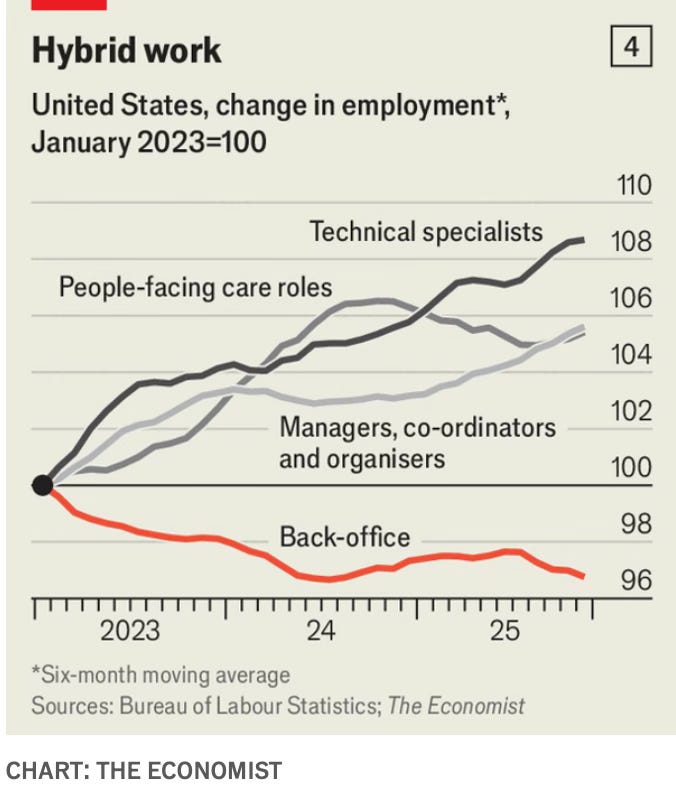
However, in a recent issue, The Economist disputed such alarming prognostications.

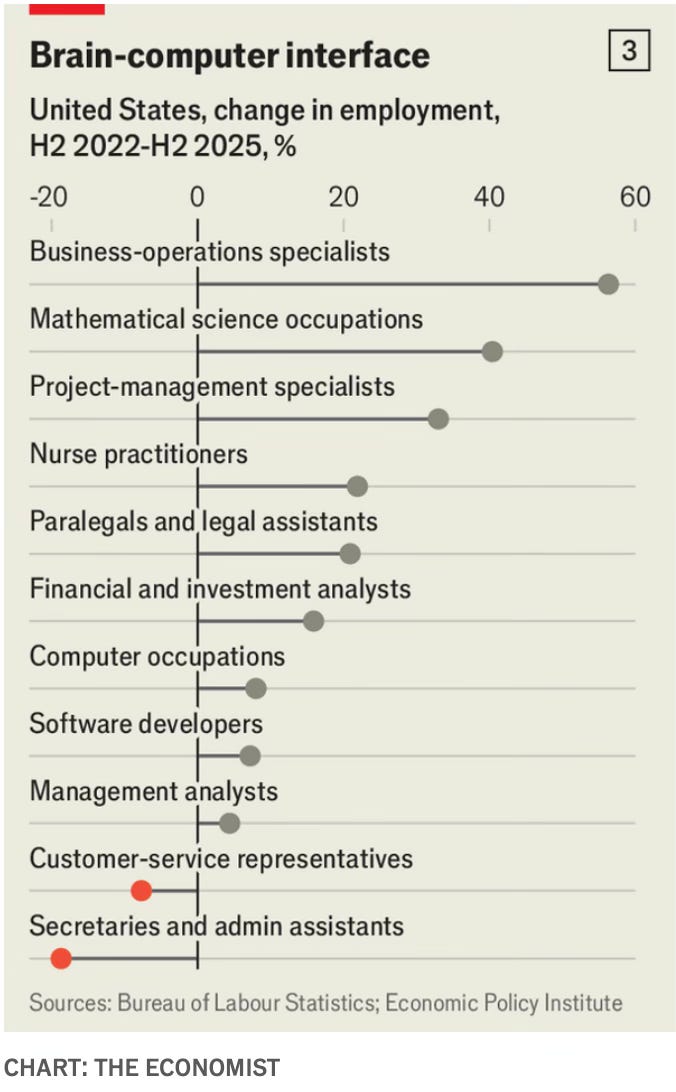
We analysed employment and wage trends across more than 100 large white-collar occupations in America since the second half of 2022. Employment across the sample has risen by 4% and real wages by 3%. To get a sense of AI’s impact on different roles, we used occupational descriptions to classify white-collar roles into four groups depending on the bundles of tasks involved: technical specialists, managers and co-ordinators, care workers, and back-office employees. We then tracked employment in each group starting in late 2022, using six-month moving averages. 

Roles that combine technical expertise with oversight and co-ordination have enjoyed the biggest gains. Employment among project managers and information-security experts has risen by 30% or so. Other occupations which combine deep expertise in maths-related fields with problem-solving are also thriving. So are jobs which involve interpersonal care work and those which demand judgment and co-ordination. Only routine back-office work has shrunk. Over the past three years or so the ranks of American insurance-claims clerks have shrunk by 13% and those of secretaries and admin assistants by 20%.

It also finds AI generating all-new jobs - data annotators, forward-deployed engineers, chief AI officers, and mainly those without settled names (“other occupations”). 

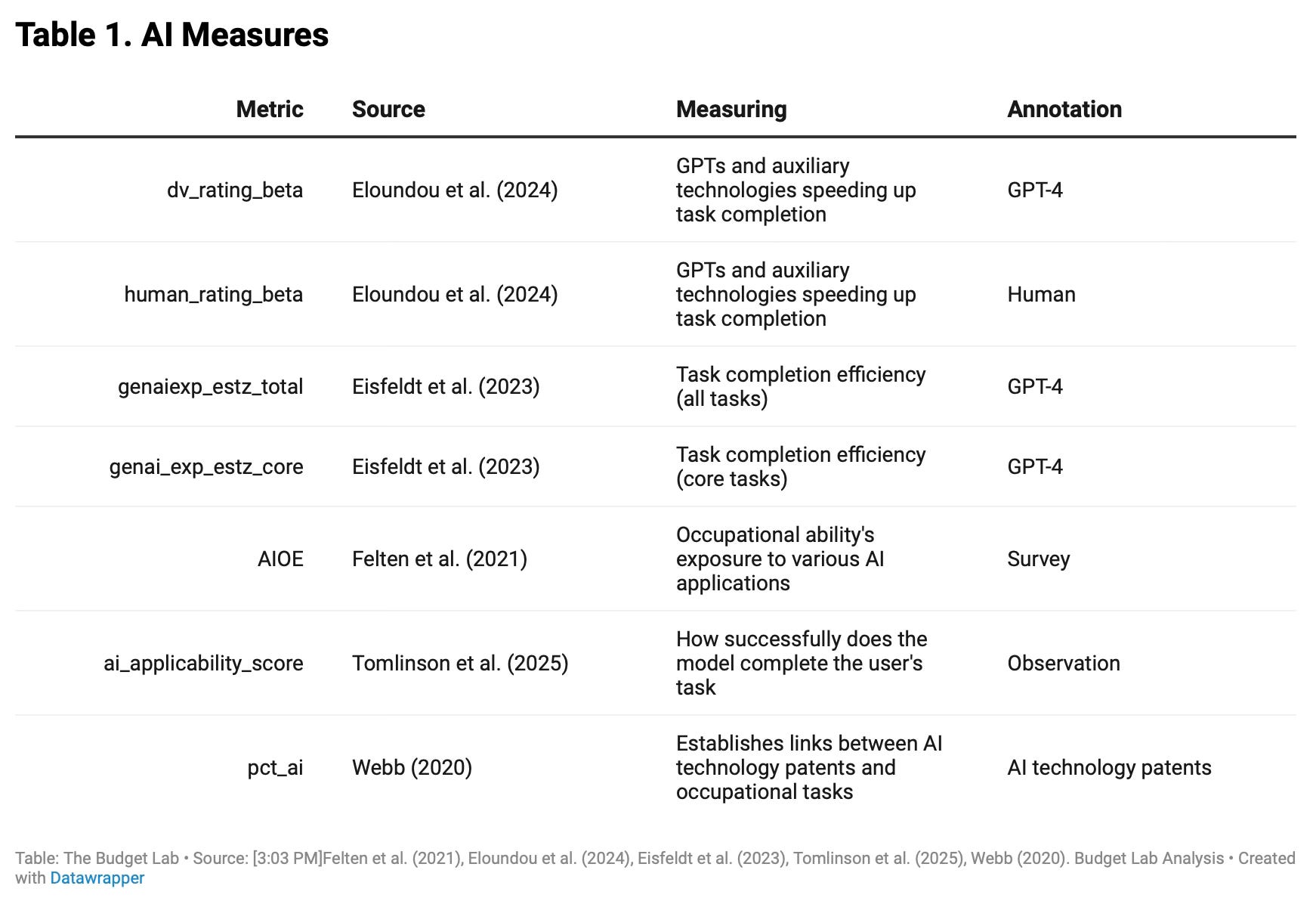
On the impact of AI on jobs, the Yale Budget Lab has a meta-study that compares evidence from across studies. It uses seven different measures of occupation-level AI exposure calculated by researchers and urges caution in reading too much into the findings. These measures are based on human and AI assessments of whether a job’s constituent tasks can theoretically be performed by an LLM, linking tasks with AI-related patents, and using real-world data on how LLMs are being used to carry out particular work-related tasks. 

Its headline findings:

AI exposure metrics broadly agree with each other, but they disagree with each other more on highly exposed occupations. The key point of disagreement between different AI exposure metrics is in the magnitude of exposure, not whether an occupation is exposed. Occupational exposure to AI is not indicative of a jobs AI will automate out of existence. Rather, it indicates places in the labor market where AI could have an impact.

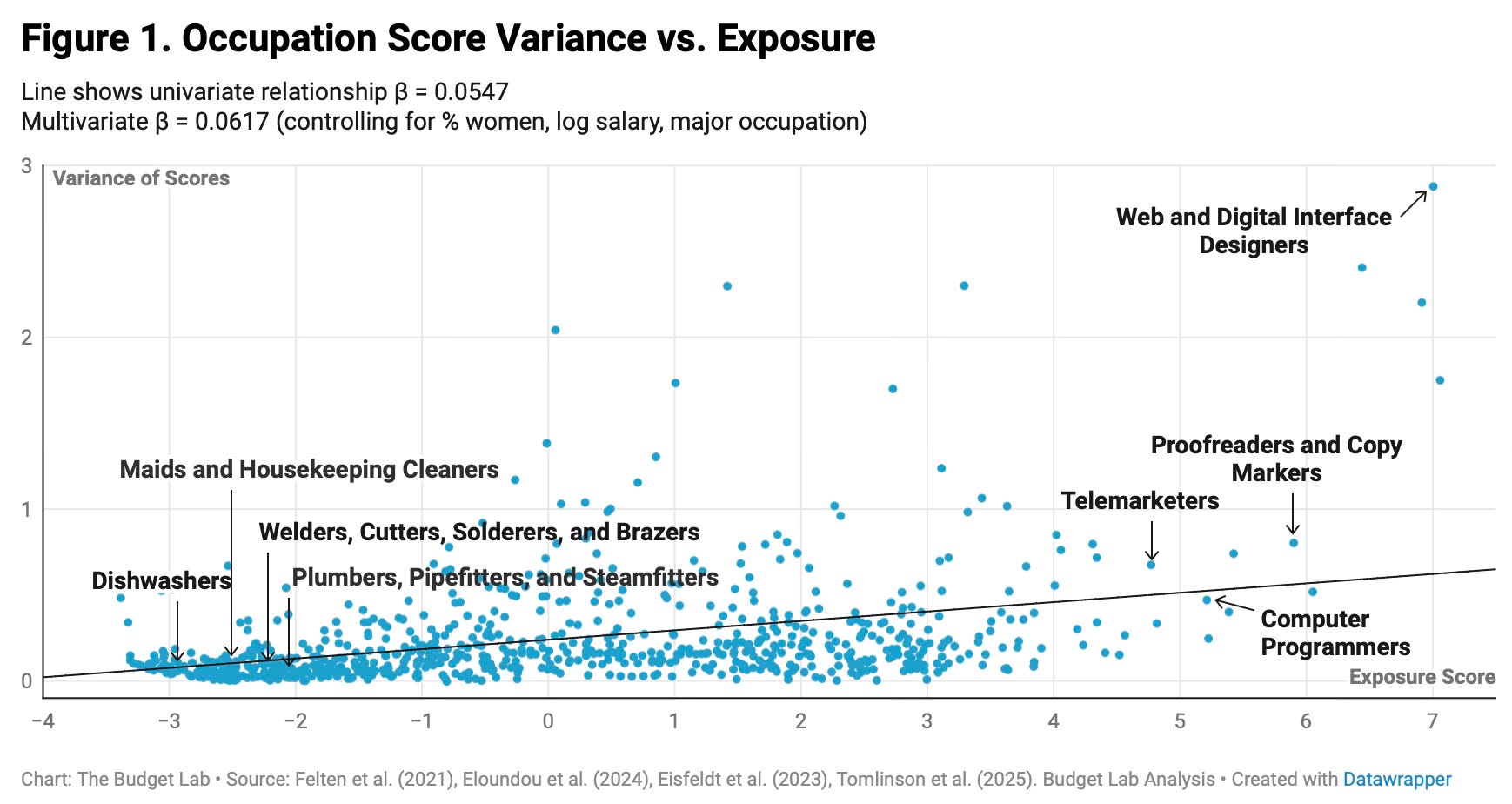
The study uses each occupation’s exposure and variance across the various scores, with low variance pointing to a consensus on exposure. They regressed the two and found greater disagreement for highly exposed occupations, “driven more by how much an occupation is exposed more than whether it is exposed.”

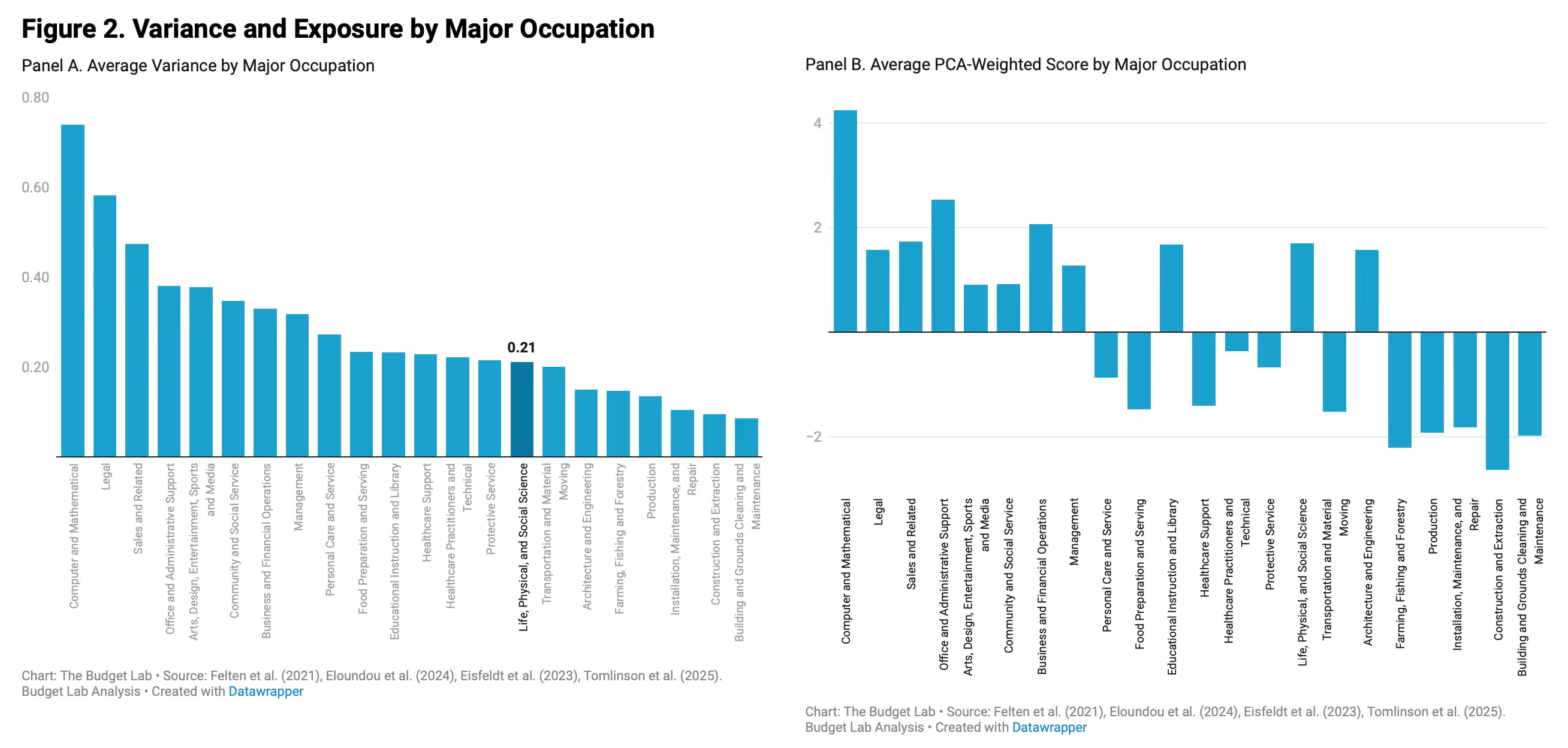
Clearly, occupations focused on computational, text-based, or administrative work tend to have both higher variance and higher average exposure, whereas manual fields like construction and maintenance have lower disagreement and variance. 

The high degree of variance and disagreements point to the perils of forming opinions on the trajectory of AI’s evolution and its impact on the labour market. The meta-study urges caution in drawing conclusions “about where AI disruption to the labor market could be going”. 

John Burn-Murdoch and Sarah O’Connor in the FT point to a few perspectives that are important while considering the impact of AI. Specifically, they point to the nature of the AI exposure and the regulation of AI adoption. 

It is more than 20 years since David Autor and his co-authors argued convincingly that, like the waves of technological change that came before, computerisation threatens jobs where workers are mainly performing tasks to meet a specification, but is a complement to those who determine the specification. Viewed through this lens, the AI revolution may pose less risk to (or even benefit) a software developer who exercises considerable autonomy over what they work on and how they do it, than to a warehouse worker who loses out to a new generation of AI-enhanced robots, or a retail sales assistant whose store is closed as technology drives ever more commerce away from brick and mortar stores and onto the web…

Or consider the role of regulation. As we have written previously, AI models can now evaluate medical scans more accurately than experienced radiologists, but regulatory barriers and insurance policies have made it virtually impossible for fully autonomous systems to be used. Meanwhile, laws have sprung up across the US prohibiting AI tools that “provide services that constitute the practice of professional mental or behavioral healthcare (such as therapy)”. Whatever one’s views on the rights or wrongs of these particular cases, they are clear demonstrations that vulnerability to occupational displacement in the age of AI comes down to far more than “Is AI capable of performing the tasks that make up your job?”

In conclusion, on the overall likely impact, the central questions revolve around three trends - labour automation (associated displacement), labour augmentation (and associated redeployment), and the emergence of new work categories. What will be the relative impacts of the three? Will the first far exceed the second and third? Or will they offset the first? What will be the pace of the first? Will the second and third lag the first significantly?

It is impossible to answer any of these with a degree of confidence. We may only be able to wait and watch how the trends play out and respond accordingly.