Substack

Showing posts with label Politics. Show all posts

Friday, October 2, 2026

The political challenge in the US of being a socialist without being woke

In a recent op-ed, Janan Ganesh made the provocative point that if the Democratic Party in the US could muster a liberal without being woke, then he/she would march to the Presidency. So why is it hard for such a candidate to emerge?

We live in polarised times, where the overlap between the right and left, or Republicans and Democrats (in the US case), on issues has become vanishingly small. This poses a problem for the median voter theorem, which states that in a majority-vote electoral system, candidates will position themselves to appeal to the median voter. Polarisation weakens the conditions under which the median-voter theorem predicts convergence. The nature of the US political system compounds this problem.

The US Presidential candidates have to fight through primaries, progressively winning over their opponents and accumulating votes through a series of compromises. The candidates dropping out keep transferring their endorsement to a remaining candidate in return for support on some of their causes. This plays out till the last candidate remains. 

The very nature of this process entails accommodation. This accommodation was fine as long as there was large overlap between the left and right within the same party on issues and the tails on both sides were small. These compromises would come out as centre-right or centre-left. In this context, candidates constantly adjust their platforms to appeal to moderate voters. 

But the greater ideological sorting and partisanship means a significant and growing proportion of the electorate now occupy the tails. 
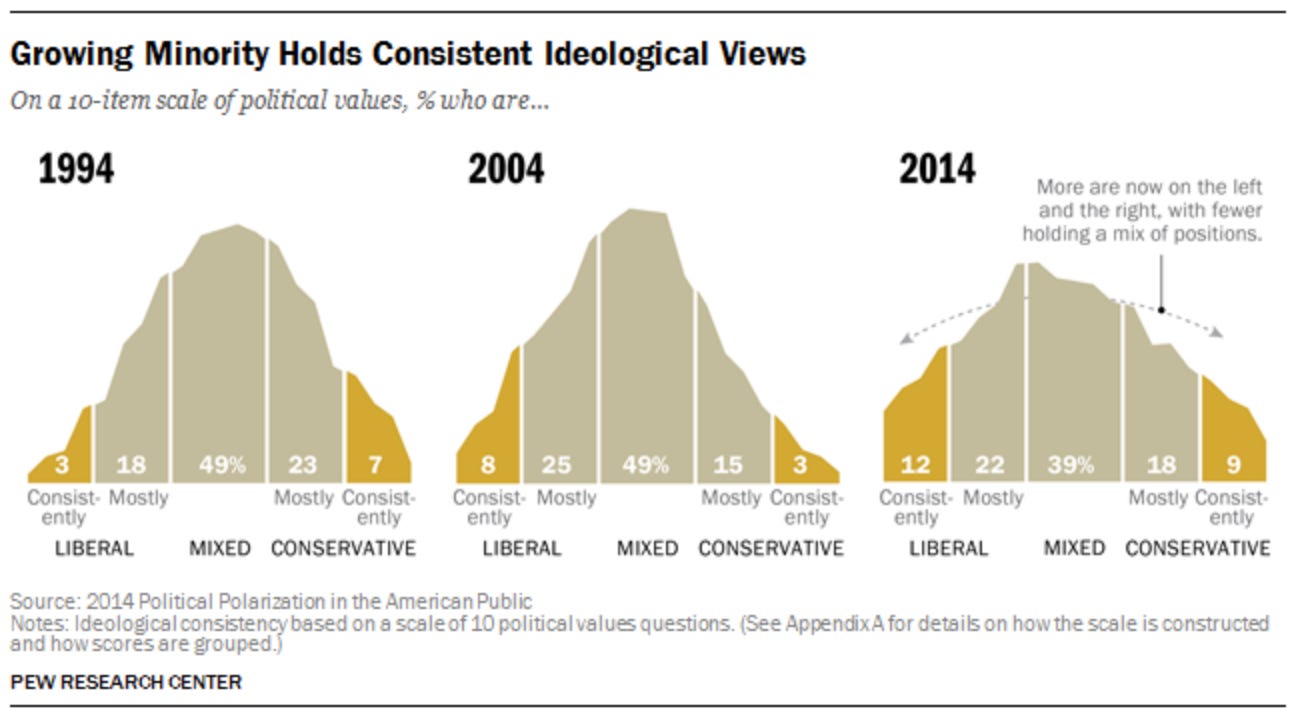
They are also the most politically active electorate. The most politically polarized being more actively involved in politics results in the amplification of the voices that are the least willing to see the parties meet each other halfway.
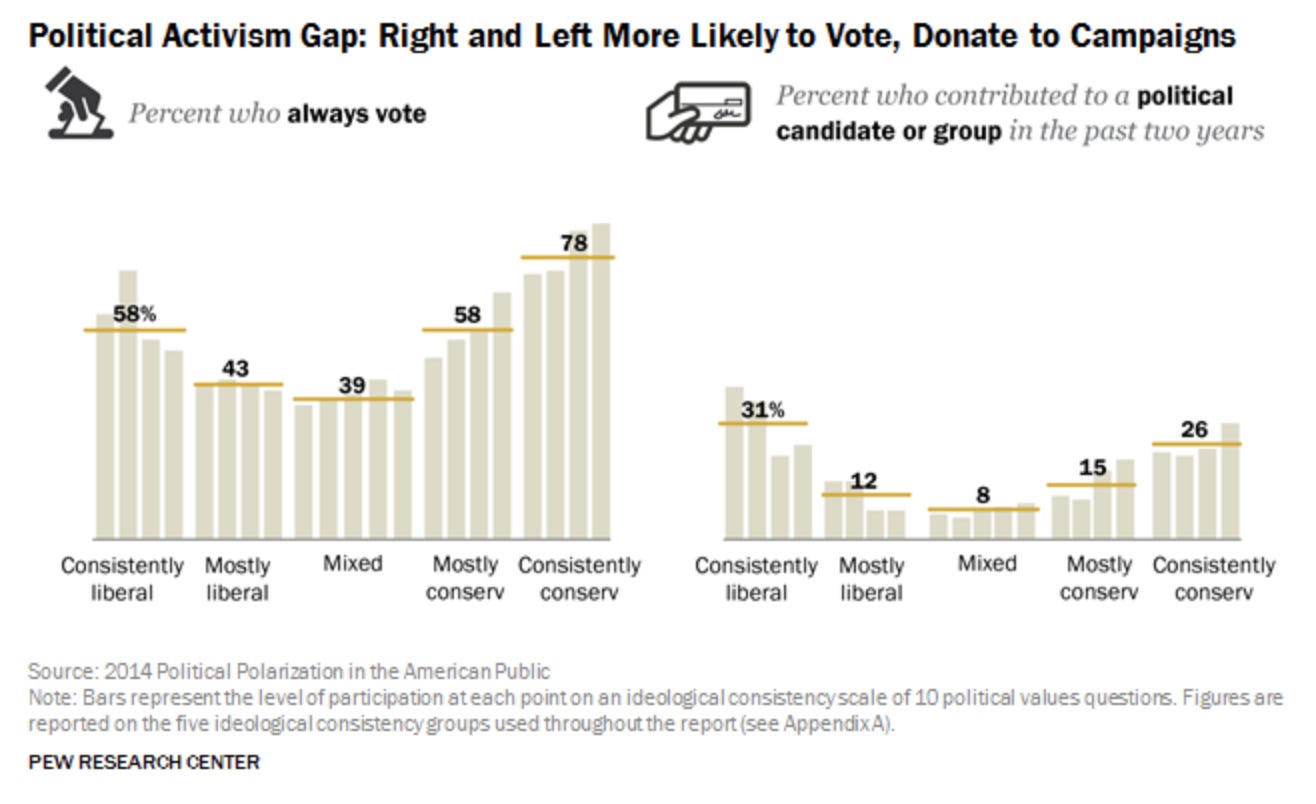
This necessitates compromises and the candidates must constantly adjust their platforms to accommodate at least some elements of the extreme left/right positions. 

For the Democrats, it then becomes necessary to accommodate at least some elements of the woke position - progressive cultural positions on immigration, taxation, race, gender and social policy. This, in turn, leaves them vulnerable to being branded as woke-washed. This, in turn, scares away the median voter, who gravitates to the right or doesn’t turn up to vote. The challenge becomes even more daunting as progressive-woke candidates gradually make deep inroads into the Democratic Party.

What complicates matters is that woke positions can create a gap between the Democratic activist base and moderate voters, especially when voters perceive the party as more culturally radical than its candidates actually are. Therefore, accommodating any of these views can concern even moderates. But without accommodation, the likelihood of electoral success in the primaries decreases. This logic applies just as much to Republicans. 
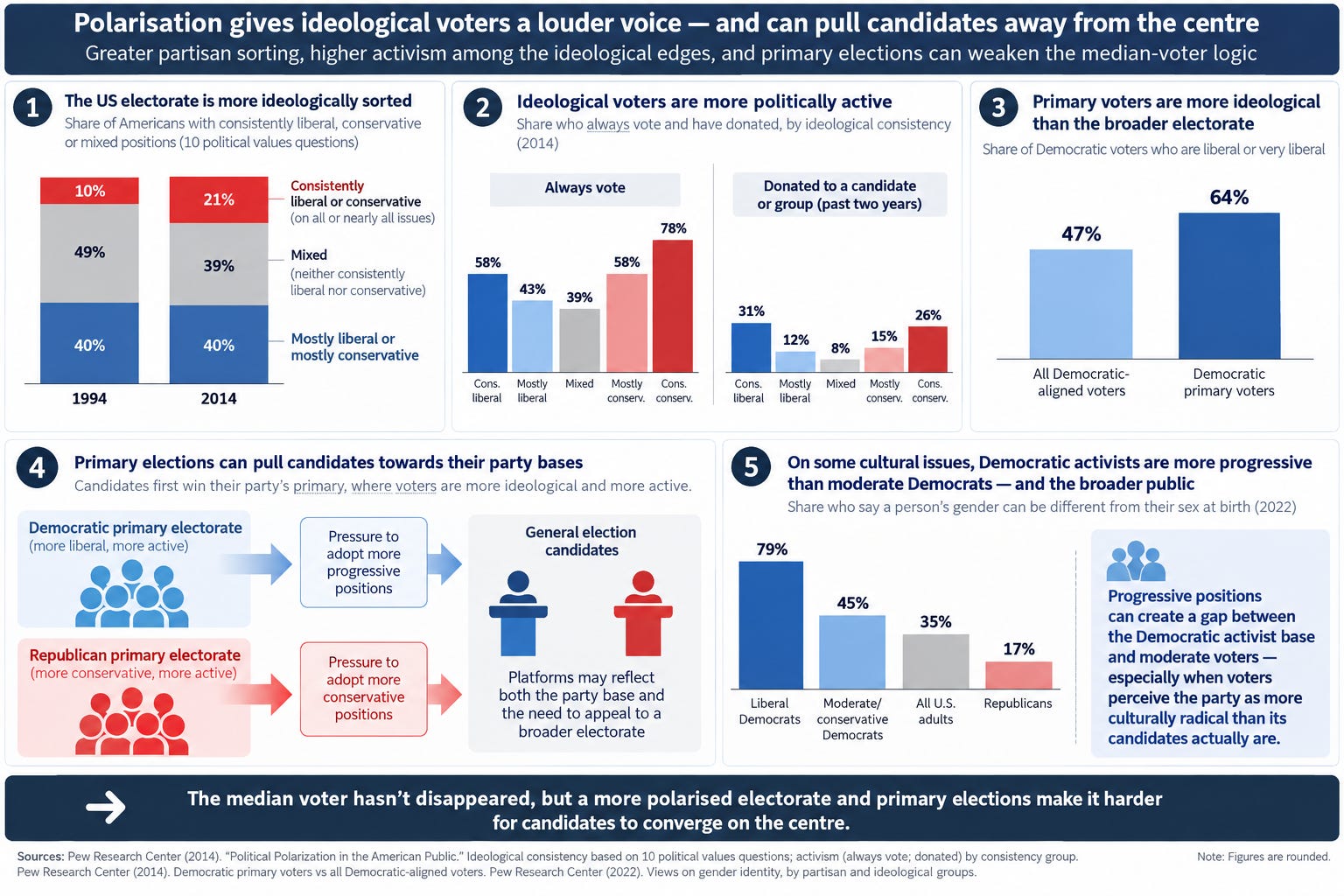
All this creates a potential gap between nomination and election. A candidate with strong support among a party’s ideological base can succeed in a primary even when their positions differ substantially from those of the broader electorate. The electorate that determines the nominee can therefore be systematically different from the electorate that determines the winner in the general election.

This may create particular challenges when a party’s activist base is substantially more progressive than its broader coalition on issues such as taxation, government spending and the role of government. Positions embraced by activists may be less popular among moderate voters, and opponents may amplify that gap by portraying them as more radical than the candidate or party actually is. A Democratic party candidate may be more vulnerable here than a Republican counterpart. 

One way out of this gridlock is that the candidate first satisfy one electorate to win the nomination and then appeal to a substantially broader electorate to win the general election. This has its set of practical problems, especially for Democrats given the substantial divergence between the progressive ideologicals and the broader coalition, and the substantial share of those who describe themselves as progressives. 

A second route would be to nominate a candidate whose personal appeal and policy positioning extend beyond the ideological base from the outset. The objective would be to assemble a sufficiently broad coalition of moderates, independents and swing voters to offset any loss of enthusiasm among the ideological edges. But this requires a candidate who can hold the party coalition together while also establishing credibility with voters outside it. That is a demanding political task since the candidate must satisfy enough of the primary electorate to win the nomination without becoming so identified with the ideological base that they narrow their appeal in the general election.

Sunday, April 12, 2026

Weekend reading links

1. Jesse Norman has this brilliant oped on the lessons from Francis Bacon for the Age of AI.
Bacon articulated a new attitude to nature. As he famously wrote: “Knowledge itself is power.” Nature was not to be revered but interrogated, understood and ultimately controlled... Bacon’s further insight was that the production of knowledge itself could be organised. In The Advancement of Learning, he advocated the creation of specialist colleges of research to gather intellectual and practical knowledge. In New Atlantis, written a few years before his death, he imagined a research institution devoted to collective scientific discovery, anticipating a world in which knowledge is systematically mobilised for practical ends... 

AI, in particular, is the industrialisation of Baconian induction: the extraction of patterns from vast bodies of data in order to generate prediction and control. It is, in a sense, the logical culmination of his method... AI extends our capacity to act without necessarily deepening our understanding. It risks separating power from judgment in ways Bacon himself would have recognised as dangerous... Bacon’s project demands continued scientific and technological ambition. But it also insists on discipline, humility and vigilance against error as correctives to human hubris. In New Atlantis, Bacon imagines a new kind of advanced research institution that he names Salomon’s House. Its members decide which discoveries to publish or withhold, believing that knowledge itself must be governed, not simply unleashed. It is a strikingly prescient image. Today’s AI laboratories face precisely this dilemma: how to manage the release of systems whose power is advancing faster than our ability to understand or control them.
2. Martin Wolf has a brilliant account of Viktor Orban's 16 year rule of Hungary. 

3. Janan Ganesh on the Madman Theory of international relations, where leaders make extreme threats to bring opponents to the table. 

4. Ruchir Sharma argues that the big difference between today and earlier oil shocks is that debt-laded governments are acutely short of policy ammunition to counter the shocks. 
In the 1970s, the typical deficit in the US and other major countries was around 2 per cent of GDP. Today, the average deficit has more than doubled; as a result the average government debt level for the G7 countries has risen from 20 per cent of GDP to more than 100 per cent... Last year, driven by government borrowing, total global debt levels rose at the fastest pace since the pandemic surge, to a record $348tn, which is more than three times global GDP. That leaves very few governments in a position to roll out new stimulus. Central banks are in a similar bind. In recent decades they have worked alongside governments to extend stimulus at the first sign of trouble, but they can’t do so easily now. The US Federal Reserve has missed its 2 per cent inflation target every month for 60 months in a row. Lately, three of every four central banks in developed countries and one of two in emerging countries have been missing their targets, too. Even if the oil shock slows economies, central banks may not be able to act as the shock also pushes inflation upward. The most vulnerable nations are those with the highest government debt and deficits, and with a central bank missing its inflation target; in the developed world they include most prominently the US and the UK; in the emerging world, the most at risk are led by Brazil, Egypt and Indonesia.

5. John Burn-Murdoch points to an important difference between social media and AI, the former divides opinion whereas the latter may be converging opinions. 

Social media companies make money from attention, which in practice means rewarding sensationalism and inflammatory content with little regard for truth... In contrast, as British philosopher Dan Williams argues, AI companies are competing to serve customers who are paying for accurate, objective and, well, intelligent, tools that deliver factual information, often for business-critical purposes... In Williams’s parlance, this makes them fundamentally “technocratising”, exerting the opposite force to social media’s radically democratising influence. American writer Dylan Matthews makes a similar case, arguing that where social media’s inherent mechanisms push towards personalisation and fragmentation, LLMs are innately “converging” — their underlying dynamics push them towards objective reality... Last year I used detailed data on the ideological positions of people who post on social media to show that they over-represent the radical right and left, confirming the polarisation hypothesis. Over the past week I have used the same dataset of tens of thousands of responses to questions on policy preferences and sociopolitical beliefs to test whether and how the most widely used AI chatbots shape conversations about politics and society. The results strongly support the theory of AI chatbots as depolarising and technocratising.
While different AI platforms behave in subtly different ways, all of them nudge people away from the most extreme positions and towards more moderate and expert-aligned stances.
For the first time since the pandemic, individual investors were net sellers in the secondary market in the first 11 months of the financial year that ended in March... Much of the 19 per cent annualised, three-year return on the Nifty Smallcap 100 Index came from bumper performance in 2023 and early 2024. That will soon vanish. If the benchmark stalls at current levels, the new three-year return in March 2027 will be just 1.3 per cent... Last year, more than 60 per cent of the IPO fundraising in India ended up giving exits to firms’ original sponsors. The money didn’t create fresh assets. In fact, a lot of it may have left the country. Overall, overseas investors have sold $22 billion of Indian equities over the past year.

And this.

Foreign Institutional Investors (FIIs) executed an unprecedented sell-off in Indian equities during March 2026, marking one of the largest monthly capital outflows in recent history,” said Pabitro Mukherjee of Bajaj Broking. The total withdrawal was almost $12bn, he said, “reflecting a sharp shift in global investor sentiment towards a ‘risk-off’ approach”.

And rupee's crawling peg. 

7. The rise and rise of private capital, touching $22 trillion in assets with $2 trillion in private credit.

Over the past two decades, private loans such as those made by the Blackstone debt fund and many others have helped finance a record frenzy in private equity takeovers struck at ever higher valuations, with annualised returns of nearly 10 per cent since 2004. Large and midsized banks have been happy to lubricate the activity by offering additional financing. Insurance companies, increasingly owned by private capital giants themselves after a wave of takeovers, have also entered the market, putting portfolios intended to provide safe income to retirees into opaque private assets. Taken together, private capital, once little more than a cottage industry, has grown into a giant part of the financial system, holding $22tn in assets, largely outside the purview of banking regulators... the “retailisation” of private capital continues, following Donald Trump’s decision to allow 401(k) retirement savings accounts to invest in such assets...
Moody’s has estimated that banks have lent $300bn to the private credit industry and another $285bn to private equity funds as of June 2025. The US Treasury’s Office of Financial Research reckons lending to private credit funds by banks and other lenders could now be as high as $540bn, while noting that the data showed “leverage risk overall appears limited”.

This is a sobering note on private equity. 

Private capital’s difficulties with exiting investments have caused industry-wide returns to plummet since central banks started raising interest rates in 2021... Fundraising for private equity deals has now declined by about half from the 2021 peak... Roughly a quarter of private equity funds raised since 2015 have failed to earn the rate of return at which firms earn performance fees, according to the hedge fund Davidson Kempner. 

The problems are partly structural. Private equity groups have often used a standard template to consolidate assets as diverse as car washes, veterinary clinics and insurance brokerages, often using a single company to accumulate such acquisitions. Such businesses have proved too complex to sell to regular corporate buyers. The underlying financial health of private equity-owned companies has also been pummelled by higher rates and geopolitical turmoil. Over 10 per cent of such groups have chosen to increase their debt rather than making their interest payments in cash. The industry’s outsized exposure to software deals threatened by Al has already added to the malaise.

8. Batteries provided 12.3 GW of California electricity, a record 42.8% of demand on March 29. 

Saturday, March 21, 2026

Weekend reading links

1. Private equity has outperformed public markets.

2. The Karnataka government has announced the implementation of an Alcohol-in-Beverage (AIB) based excise duty. As per this, the globally recognised practice for alcohol taxation, percentage of alcohot in a liquor brand will determine the duty levied. 
In Karnataka, alcoholic products currently fall under 16 slabs. A product was designated to a particular slab based on the Declared Price, the selling price determined by the distiller. The Additional Excise Duty levied by the government was dependent on the price per litre of the product, due to which the price of the premium liquor segment was on the higher side... Over the next four years, the government plans to abolish the slab system of excise duty collection completely. For FY 2026-27, the government will merge multiple slabs and reduce their number from 16 to eight... Currently, the duty levied for a bulk litre of say, McDowell’s – which is at the lower end, and Blue Label – which is at the higher end, is different and is based on the Declared Price. Both have 42% alcohol. Under the new system, both drinks will attract the same percentage of additional excise duty irrespective of the declared price

3. Japan lifestyle facts of the week.

The nation’s stock of 2.2mn drinks vending machines is down 23 per cent from its bubble-era peak in 1985, according to the Japan Vending System Manufacturers Association... Japan loved vending machines for their convenience despite higher prices. But three years of rising inflation has driven consumers to greater thriftiness. Well-known brands of tea and coffee can be 20 per cent cheaper in nearby convenience stores, which have also stepped up sales of freshly brewed coffee, while drugstores and supermarkets sell discount private-label brands. In 2024 just 42mn cases of drinks were sold via vending machines, down from 72mn at the 1997 peak, according to data from Inryo Souken, a Tokyo-based research institute. Vending machines also still need people to keep them stocked — and Japan has a chronic shortage of truck drivers.

4. Global crude landscape (HT: Adam Tooze)

As the war rages on, and the blockade of the Strait of Hormuz bites, oil prices are becoming a binding constraint on the world economy. Oil demand is highly inelastic.
Oil demand is, on average, highly inelastic in the short run because most end uses have few immediate substitutes — factory boilers rely on fuel oil, aircraft require jet fuel, and most cars still run on gasoline. Our estimate of the short‑run price elasticity of global oil demand is −0.024, implying that a roughly 40% price increase above 12‑month highs is needed to reduce total consumption by 1%. The response, however, varies materially by product. Naphtha is most sensitive because petrochemical plants can partially substitute ethane in cracking operations. Jet fuel is also relatively responsive, as airlines can cancel lightly loaded flights when fuel costs spike. By contrast, fuel oil is least elastic given its role in essential services like home heating, marine transport, and power generation.
The worst impacted by the 20% reduction in oil supply and 15% in LNG supply is Asia
Most crude shipments through the Strait of Hormuz are bound for Asia, with China, India, Japan, and South Korea as the principal buyers. In total, Asia takes about 11.2 mbd of crude and 1.4 mbd of refined products that transit the Strait. As a result, the immediate physical shortfall is concentrated in Asian markets, where reliance on Gulf barrels is greatest. Early signs of demand destruction are emerging in Asia as product prices surge and spot barrels become prohibitively expensive. Timing effects further reinforce this divergence. A typical voyage from the GCC to Asia takes approximately 10-15 days, while shipments to Europe require closer to 25-30 days via the Suez Canal, or even 35-45 days if rerouted around the Cape of Good Hope. As a result, the impact of disrupted Gulf flows will hit Asian markets earlier and more acutely, whereas Atlantic basin benchmarks such as Brent and WTI will remain cushioned for longer by inventory overhangs and slower supply adjustments.

India's dependence on Strait of Hormuz is especially acute.

Almost 50 per cent of the LPG and 30 per cent of the natural gas that India consumes comes from the Strait of Hormuz.
5. Gideon Rachman writes that Iran may have achieved a major strategic leverage going forward by demonstrating the chokehold that any restrictions on the Strait of Hormuz can have on the world economy. 
The strait’s closure creates both an immediate crisis and a long-term strategic quandary. The current problem is that the longer it is closed, the greater the threat of a global recession. The future dilemma is that Iran now knows that control of the Strait of Hormuz gives it a stranglehold over the world economy. Even if it relaxes its grip in the short term, it can tighten it again in future.

6. A measure of how much Israeli politics has become radicalised.

Israel should destroy all Iran’s oilfields and flatten the energy infrastructure on the island that functions as Tehran’s main oil export hub... the demands... came from Yair Lapid, the silver-haired former premier and television host who heads the centrist Yesh Atid party, and draws much of his support from liberal bastions such as Tel Aviv. Lapid’s message reflects how the fight in Israeli politics, for all Zionist parties in government and opposition, is not over whether to confront Iran but over who will prosecute the war better than Netanyahu. Israel’s offensive has higher public support than almost any other issue in the country’s fractious politics — even after two and a half years of multifront fighting that has disrupted daily life for millions of Israelis. Although Israel’s Arab parties staunchly oppose the war with Iran, polls suggest more than 90 per cent of Jewish Israelis back it, and the country’s Zionist opposition groups have fallen in behind it in unison.

7. Canadian pension funds' PE bets are souring, losing money on their PE investments.

Ontario Teachers’ Pension Plan, which manages C$279bn ($206bn) of assets, and the C$145bn Ontario Municipal Employees Retirement System reported returns of minus 5.3 per cent and minus 2.5 per cent respectively for their private equity portfolios in 2025. For OTPP, it was the worst performance for this asset class since 2008 and for Omers since 2020. La Caisse, Quebec’s C$517bn state pension fund, also reported weak private equity results. The group said its PE portfolio returned 2.3 per cent last year, well below the 12.6 per cent gain in its benchmark index, half of which is made up of listed stocks. The Healthcare of Ontario Pension Plan, which published results this week alongside OTPP, reported private equity returns of 3.6 per cent in 2025. Its broader private markets portfolio returned 2.1 per cent, compared with 11.7 per cent for its listed holdings.
8. Thames Water gets new offer from its senior creditors to take over the struggling utility, committing up to £6.55bn of debt and £3.35bn of equity. It is now with Ofwat for regulatory approval. 
Lenders including hedge fund Elliott Management and private capital group Apollo Global Management are locked in negotiations with the regulator as they attempt to take formal ownership of the UK’s largest water provider. The creditors have proposed a new management plan, which could lead to a stock market listing as soon as 2030... The creditor’s £6.55bn debt figure is made up of £3.25bn that will be made available to Thames Water on day one of their ownership, up from £2.25bn previously proposed, and up to an extra £3.3bn that will be made available to the utility over the funding period. The new debt would come in addition to £3bn of emergency financing approved last year to prevent Thames from being renationalised under the government’s special administration regime... The increased debt offering would come on top of an equity injection that has been revised upwards to £3.35bn from £3.15bn... Under the terms of the new proposal, Thames Water’s class A creditors would take a 30 per cent writedown on their existing debt, on top of “a write-off in full of the Class B Debt and any subordinated debt or equity held by existing shareholders”.

9. TJXX is the fourth-largest retail chain in the US and the fourth most profitable global fashion retailer.

10. Rana Faroohar writes about the concierge economy in the US, where the rich can get to the front of the que and buy convenience at a price. She points to the gold-plated subscription healthcare service that comes with minimal wait times for specialists, 24/7 access to physicians, longer sessions with doctors, and which is a $20 bn global business with roughly 40% in the US. 
The market for personal travel planners, high-end club memberships, private wealth managers and educational consultants has in recent years grown by high single to double digits. Fractional aviation subscription services (think NetJets) are growing by about 10 per cent a year. Those with Clear (the airport service that speeds you through security if you must fly commercial) have tripled since 2022. It’s all part of a burgeoning “concierge” economy that caters to affluent consumers who don’t wait — or want — for anything. The global “lifestyle concierge” services market — that’s the part of the business that gets you the right hotel, colourist, Pilates instructor or front-row tickets to the must-see football game — is expected to grow from $16bn to about $36bn by 2035. It’s about saving time, yes, and it’s also about making sure the rich get to speak to human beings who can fix problems and meet high expectations, rather than dealing with search algorithms, AI bots and monotone-voiced teleworkers, like everyone else. Concierge services are about convenience and access, but they are also about bringing ease and luxury to areas that have become digital commodities or suffer from high levels of consumer dissatisfaction, such as healthcare or financial services.
11. India's AIF market is surging.
From about 160 AIFs in 2015, with less than Rs 28,000 crore in commitments, they’ve grown to over 1,740 in number as of January, spread across three categories and with nearly Rs 15 lakh crore in committed capital, according to Sebi... Category-II funds, which include private-credit, real-estate, venture-debt, and private-equity funds, had become the default recommendation... The Indian alternative-investments industry has grown at a compound annual rate of 49% in ten years to September, according to data from PMS Bazaar. Category-II, III funds have grown at over 50% growth rate... category-II funds account for about two-thirds of the total Rs 15 lakh crore commitment... the US, where hedge funds (category-III funds in Sebi parlance) dominate the alternative-investment space... In India, though, a majority of AIF investors come from family-business backgrounds... A mutual fund would deliver 12–14% returns on a long-term basis, and here, AIFs were promising close to 25% internal rate of return for funds in which investor capital was locked-in for eight to 10 years... Reportedly, two-thirds of the money raised by Indian AIFs comes from domestic investors.
12. Global LNG market.
13. Italian judicial reforms face a referendum.
To insulate judges from political pressure, the constitution established the Supreme Council of Magistrates as an autonomous, self-governing body, comprised of two-thirds serving magistrates, elected by their peers, and one-third parliamentary appointees. The council handles the selection, postings, promotions and disciplinary proceedings of all Italy’s magistrates, now numbering around 10,000... In Italy, resolving contentious civil cases through all three levels of the justice system currently takes an average of 2,217 days — six years and one month. That is better than a decade ago, when it took about eight years but still far slower than the EU average of 795 days, or two years and two months... 

Under the proposed reforms, the magistrates’ council would split into three distinct bodies: one supervising prosecutors, one supervising all other magistrates, and a disciplinary court for all. It is a change that many legal experts — and politicians across the spectrum — have long advocated... the reform also envisions a more controversial change: magistrates would no longer be elected by their colleagues to serve on the self-governing bodies but would instead be chosen by lottery. Critics see this as a device to erode judicial autonomy vis-à-vis the political system.

14.  Softbank's spectacular free lunch in the US-Japan trade deal.

SoftBank was set to earn ¥1tn ($6.3bn) in fees... to build and operate a $33bn gas-fired power station in Ohio... It will earn the payments over 15 to 20 years if it can reach the target capacity of 9.2 gigawatts. The idea of a fee arose because SoftBank would otherwise earn nothing for its role as developer of the project. It has no equity in the power station, which will be financed entirely by Japan and owned 50/50 by the US and Japan via a special-purpose vehicle, set up as part of the trade deal... Under the trade deal, profits from the investments made are supposed to be split 50/50 between Japan and the US until Tokyo has recouped its money. After that, the US gets 90 per cent... SoftBank has already placed large-scale orders to begin construction of the power plant in Portsmouth, Ohio, including $10bn for close to 170 turbines from GE Vernova. As developer, SoftBank plans to sell the electricity to data centres it will also operate, say people familiar with the matter. The data centres will serve customers such as OpenAI, in which the Japanese group is a significant shareholder. Japan’s funding comes from both the Japan Bank for International Cooperation and commercial lenders. Nexi, Japan’s export credit agency, will guarantee 90 per cent or more of the commercial portion.

15. Among the several negative externalities of the Trump administration is the resurgence in interest in going nuclear. 

Britain’s Liberal Democrats... now want the nation to build a nuclear deterrent that is less reliant on the US... France, whose force de frappe is truly sovereign, said this month that it would increase its stockpile of warheads. In Poland, a rare point of agreement between the prime minister and the president is their openness to going nuclear. In South Korea, public support for a deterrent has gone up to 70 per cent in recent years. Saudi Arabia, which has said that it would get one if Iran did, might not wait for such a cue now that it and other Gulf states are under conventional attack from that quarter anyway. Even the original nuclear powers are chafing at old taboos. As of last month, there is for the first time in over half a century no binding agreement to limit nuclear arms between America and Russia, which have the world’s two largest arsenals.

Janan Ganesh writes about how Ukraine, Iran, and Trump's weaponisation of the US security umbrella, especially the last, has revived nuclear bomb acquisition.

One is the ordeal of Ukraine. In 1994, it gave up the Soviet nuclear weapons that were then on its soil in exchange for certain assurances about its security. Two decades later, Moscow began its long and ongoing war against Ukraine with the annexation of Crimea. The lesson, for some, is obvious. A country with dangerous neighbours should retain or acquire the ultimate deterrent. Another salutary tale is that of Iran. It seems that an unfinished nuclear bomb is the worst of all worlds: a provocation to other states but not a deterrent. A rational government would either abandon all ambitions of that kind or realise them in full. On balance, given Ukraine’s experience, observers around the world will regard the second course as the more prudent. On top of all this is the endless unpredictability of the US. Until now, countries with the expertise and resources to build the bomb, such as Japan and several European countries, have chosen to duck under America’s nuclear umbrella instead. As Donald Trump casts doubt over whether he would ever honour those mutual defence treaties, some of which were signed a human lifetime ago, this “nuclear latency” doesn’t seem so clever.

16. Shan Jin-Wei, Kun Li, and Kelly Liu suggest that S&P index inclusion may be up for sale by showing that if you purchase a S&P ratings then the company is more likely to get listed in S&P 500 index.

Firms that had recently obtained an S&P rating were significantly more likely to gain admission to the S&P 500. For non-member firms, the unconditional likelihood of being added to the index was 15.5 per cent; for firms that had recently purchased an S&P rating, it was 21.4 per cent. One possible explanation is that S&P tends to favour fast-growing firms, and that such companies are naturally more likely to issue debt and seek credit ratings. But if that were the whole story, we would expect to see the same pattern among firms that purchased ratings from Moody’s, and we did not. If rating purchases simply reflect firm quality or growth prospects, the effect should not be specific to S&P.

Firms’ behaviour further suggests that they see a link between rating purchases and index inclusion. When mergers among S&P 500 firms create openings for new additions, large non-member firms disproportionately increase their purchases of S&P ratings. Conversely, after a 2002 rule change that made foreign firms ineligible for inclusion, non-US firms listed on US exchanges sharply reduced their purchases of S&P ratings relative to Moody’s. The implication is clear: When the prize disappears, so does demand. Taken together, these patterns suggest that firms believe purchasing S&P ratings increases their chances of joining the index.

17.  Of the 937,876 candidates who took the civil services exams in 2025, just 0.1% got selected.

The situation is not much better if we take all the UPSC examinations, where of the 3.3 million candidates in 2022, the pass percentage was 0.18%.
Tokens... are the most basic units of output from large language models: it takes about 1,300 tokens to generate 1,000 words of text... When OpenAI launched GPT-4 two years ago, for instance, it charged $33 for 1mn tokens. Today, it charges only 9 cents for 1mn tokens produced by its cheapest model.

Saturday, February 28, 2026

Weekend reading links

1. Europe too has its chokepoints over China and the US.

A group of experts called the Geostrategic Europe Taskforce last week published a report which “identifies 41 critical chokepoints where China depends on the EU for more than 80 per cent of its imports, and 67 such dependencies for the United States. These span essential inputs including insulin, pharmaceutical intermediates, medical technologies, and specialised machinery for agriculture, paper production, and industrial processing.” And the German economic think-tank Dezernat Zukunft has also just released a study highlighting that “Europe has more cards than it thinks. We control 80 per cent of US uranium imports. Siemens dominates the turbines US data centres desperately need.”

2. US and Western VCs are struggling to exit their China investments.

Ten of the biggest buyout firms with investments in China including KKR, Blackstone and CVC had zero publicly disclosed complete divestments from mainland Chinese portfolio companies in 2025, according to data from providers PitchBook and Dealogic.

3. Declining attention spans.

A 2022 survey by King’s College London found that 49 per cent of UK adults feel their attention span is shorter than it used to be. Forty-seven per cent feel “deep thinking” has become a thing of the past. Studies that monitor people’s attention in their real-world environment show that since 2004, the average time people stay focused on a single task has dropped from about 2.5 minutes to roughly 47 seconds, according to data tracked in Attention Span, a book by Gloria Mark, professor of informatics at the University of California, Irvine.
4. South Korean stock markets rose 76% last year to become the best-performing major market. 
Retail investors have bought a net Won6.3tn ($4.3bn) of locally listed stocks since the start of 2026, according to Korea Exchange, the country’s securities market operator. In addition, they have pumped Won13tn into Korean ETFs, helping boost the benchmark Kospi by 35 per cent this year and making it one of the world’s best-performing stock market indices for the second year running... The number of individual active stock trading accounts in Korea topped 100mn for the first time last month — the equivalent of roughly two accounts for every member of the population. Deposits held at retail brokerages, reserved for stock purchases, hit a record Won103tn this month, up from Won87tn at the end of last year. Margin balances (the funds investors have borrowed from brokerages to buy stocks) have also surged to a record at Won31.5tn.

5. The MAGA right and progressive left converge in their opposition to emerging AI trends.

AI opposition spans the political spectrum. Democrat Senators Bernie Sanders and Elizabeth Warren warn against corporate power concentration and job displacement, while Maga strategist Steve Bannon and Republican Senator Josh Hawley spread warnings about the dangers of empowering tech billionaires... The list of grievances being raised against AI is varied. At the local level, communities are fighting the construction of data centres that they worry will disrupt resources such as water, land and electricity... Meanwhile, in Hollywood, celebrities have launched the “Stealing Isn’t Innovation” campaign against the use of creative work for AI training, and parents, along with 37 state attorneys-general, are pressing for accountability after Grok, xAI’s chatbot, facilitated the generation of non-consensual nude images of women and children.

6. China announces restrictions on exports of rare earth magnets and other critical minerals, in the guide of "dual-use materials", to dozens of Japanese companies, especially vehicle makers.

7. Contrary to Elon Musk's claims that space-based data centres are three years away, they may be decades away.

Google’s satellite-based data centre initiative, Project Suncatcher, estimates that launch costs would need to fall below $200 per kilogramme (a sevenfold reduction from current levels) before this becomes economically viable. That threshold isn’t expected until the mid-2030s. Even if costs do fall, the components required — including radiation-hardened servers, on-orbit communications infrastructure and in-space servicing capabilities — do not yet exist at commercial scale. Adding to the conundrum, orbital data centres turn routine IT management into a complex space systems problem. On Earth, a failed server can be replaced in minutes. In orbit, that task requires either sophisticated in-space servicing or acceptance of degrading performance and stranded capital that becomes orbital debris as components age and fail. Burning satellites up when they become obsolete is not environmentally neutral: the process injects metal particles into the upper atmosphere where they can affect winds, temperatures and ozone chemistry.

8. On the importance of manufacturing for national economic development.

Most successful development stories — from Britain’s Industrial Revolution to South Korea’s transformation to China’s ascent — have run through the factory floor. Manufacturing drives productivity through economies of scale that services struggle to replicate. It generates innovation spillovers that ripple through entire economies. It enables countries to access global markets at a scale services cannot match. And contrary to fears about automation eliminating manufacturing jobs, countries like China demonstrate that manufacturing can absorb hundreds of millions of workers even as robots proliferate... Digital platforms, financial services, and business process outsourcing... cannot replace manufacturing’s role as the engine of sustained productivity growth and structural transformation...

Between 1750 and 1950, the West’s establishment as the world’s economic hegemon was fundamentally a process of becoming the world’s manufacturing hegemon. Since 1950, this pattern has persisted with remarkable consistency. A World Bank study published in 2008 identified 13 countries that sustained annual growth rates of 7% or higher for a period of 25 years or longer. Among these growth miracles, only two — Botswana and Oman, both small countries with highly idiosyncratic economic structures — achieved this without manufacturing-led development... recent data by the UN Industrial Development Organisation (UNIDO) arrive at similar conclusions. In their Industrial Development Report 2026, they highlight that 64% of growth episodes over the last 50 years can be directly attributed to manufacturing... Manufacturing firms spend heavily on research and development (R&D), generating strong innovation spillovers throughout the economy. In fact, manufacturing is attributed to 53% of global R&D activity. Manufacturing provides the material foundation for innovation, creates demand for new technologies, and enables the accumulation of productive capabilities that underpin further innovation.

9. Britain has a peculiar worsening trend in graduate fortunes. 

10. Good illustration of how regulations may be stifling European business environment. From Pieter Garciano

The whole point of the AI Act, is to create an extremely consistent and level playing field across all of Europe to allow like companies to face a much larger market straight away. The problem is that because of directives, the actual enforcement of a given law is left to the member state and the member states are ordered to create their own regulatory bodies. So for example, in the case of the AI Act, every single member state is ordered to have a notifying authority and an enforcement authority... these different regulators, they talk to each other, but they’re not necessarily forced to agree with each other... And so you have cases where the Irish regulations happened with GDPR, the Irish Data Protection Authority said to Meta, this is excellent. You can do X or Y. And then the Austrian and German data protection authorities disagreed and then fine Meta billions of euros. And so, this is a case where the law, even if you agree with the intent of the law, the way it’s currently being executed, which is through directives, makes it so that you’re going to always get an extremely high friction and fragmented regulatory system... They currently have, I think the count is between these four laws, they’ve created 270 different tech regulators... And that of course has really distortionary effects as well for what kind of basically very large fixed cost. And so if you’re a large company, if you’re a Google or a Meta, you have a thousand guys in your Brussels compliance office and they’re really good at this. But if you’re a smaller company, then you actually really struggle with figuring out what the 270 different bodies want you to do.

European regulators have been influenced by beliefs against big corporations and their market power, which explains both their anti-trust actions against Big Tech and refusal to approve European mergers like those between Siemens and Alstom.  

11. China is leading the race for humanoid robots, including those which resemble human beings and mimic their facial expressions while talking. This is a real advance.

Galbot’s silvery humanoid folds T-shirts, retrieves a bottle of water from a shelf and rolls walnuts about in its hands. Developing multifunctional hands has been a major challenge for robot makers, requiring advanced sensitivity and a high density of mechanical components. The Beijing-based company says its robots can be used for household tasks or in retail contexts such as shops and pharmacies... Galbot, backed by Chinese battery giant CATL, also showed its humanoid picking up irregular shards of broken glass, suggesting “integration of perception, grasp planning, and controlled force and precision, differentiating the performance from purely staged movement”, according to analysts at Morgan Stanley.

12. Is the National Green Tribunal (NGT), the primary appellate authority against orders of the Ministries of Environment of state and central governments, becoming a captive of ease of doing business?

Between 2020 and 2025, of the 329 appeals filed by citizens and activists against the grant of clearances by the Government, only in 20% (65 cases), did the NGT rule in favour of the appeal. Conversely, when the project’s proponents appealed against the denial of clearances by the government, in nearly 80% (126 of 160) of the cases, they secured relief. This is not a historical norm. Data from 2016-2019 shows a more balanced era where relief for both sides hovered between 18% and 31%. This pro-project trend has accelerated sharply in the last 24 months. Between 2024 and 2025, only 7% of appeals challenging clearances were successful. In contrast, 88% of industry-led appeals against clearance rejections got relief... of the 264 unsuccessful citizen appeals during 2020–2025, a significant portion was dismissed on technical grounds, labelled “time-barred” for more than 90 days delay in filing. The rest were dismissed as “not tenable,” or lacking “any merit.”

13. Excellent article by Richard Hurowitz on how gum arabic, a sap that comes from the acacia tree, is fuelling the civil war in Sudan, joining Sierra Leone's blood diamonds and DRC's cobalt in fuelling their respective civil wars. 

Found in everything from soft drinks and candy to cosmetics and pharmaceuticals, gum arabic is a critical ingredient for Coke and Pepsi and gives an M&M its distinctive shell. Commonly listed as E414 on labels, it’s an ingredient in pet food, chewing gum, lipstick, pill capsules and throat lozenges... the groves of Sudan’s subsistence farmers produce 70-80 per cent of the global supply. And no one has yet found an effective synthetic substitute. Sudan exported some 60,000 tonnes of its “white gold” in the year prior to the conflict. It is no surprise, then, that multinationals have been stockpiling gum arabic since the civil war started... 

It is also, tragically, being used to finance what the UN has declared the world’s worst humanitarian disaster. Since April 2023, Sudan has been engulfed in a civil war between the government in Khartoum’s Sudanese Armed Forces and the rebel Rapid Support Forces. The war has drawn in foreign powers including Saudi Arabia, the UAE, Turkey, Russia and Egypt... The crisis in Sudan dwarfs any other current conflict on every measure... According to a former US envoy, over 400,000 people have died. More than 15mn have been displaced. Tens of thousands of Sudanese have been massacred, there is widespread sexual violence and a man-made famine has sent millions into starvation... Both sides have used the commodity to finance their efforts... and the SAF continues to export what it can while the RSF smuggles its supplies abroad... The RSF controls large portions of the main gum-producing regions in Darfur and Kordofan where they have looted warehouses, seized shipments and imposed fees on harvesters and traders. Tens of millions of dollars’ worth of gum arabic has been stolen, smuggled and sold to finance their military operations. At the same time, the SAF controls Port Sudan, where taxes on gum arabic exports fill its coffers with revenue.

14. The killing of Nemesio Oseguera, the leader of Mexico's Jalisco New Generation Cartel (CJNG) has once again drawn attention to Mexico’s pervasive drug gang problem.

Saturday, January 17, 2026

Weekend reading links

1. Municipal bond issuance in India hit a record with nine issuances in FY26 till December, comapred with three and one in the previous two years.  
The total municipal bonds outstanding as on 31st December 2025 was Rs 3,783.9 Cr, with Rs 1000 Cr issued in 2025. 
First-time issuers in 2025 included Agra Nagar Nigam, Prayagraj Nagar Nigam, Varanasi Nagar Nigam and Bhavnagar Municipal Corporation, alongside repeat issuers such as Greater Chennai Corporation and Nashik Municipal Corporation. Market participants said the fiscal support under the Atal Mission for Rejuvenation and Urban Transformation 2.0 (Amrut 2.0) was a key factor behind the rise in municipal bond issuances. Unlike earlier reform phases, where incentives were indirect or uncertain, the current framework provides quantified incentives that lower the cost of borrowing. First-time issuers are eligible for incentives of ₹13 crore per ₹100 crore of bonds issued, subject to caps, which reduce interest costs over long tenors. For repeat issuers, incentives are linked to green bonds, providing predictability while aligning with environmental, social, and governance (ESG) objectives. This has made bond issuance a viable funding option for urban local bodies (ULBs).

2. Ruchir Sharma says that India must stop exporting human capital and increase its imports of financial capital.  

3. India's oil import sources.

“The good malls are doing better than ever. The bad malls are more challenged than ever,” says John O’Connor, head of acquisitions & development at O’Connor Capital Partners, a property owner. Annual sales per square foot at so-called class C malls are often below $400, while premier class A malls — the hosts of the Apple Store and Louis Vuitton — can bring in more than $1,000, according to Green Street, a real estate research group. The top 100 of America’s roughly 900 shopping malls represent about half of the sector’s asset value, according to Vince Tibone, Green Street’s mall research sector head. The bottom 350 account for just 10 per cent... Per person, mall square footage is more than 12 times higher in the US than in the UK, France or Germany, according to Moody’s Ratings.

5. India is at the lower-end of the ladder among developing countries in the adoption of electric vehicles.

6. China's rising trade surplus, amidst declining exports to the US points to diversion to other countries.

7. India's rice stocks stood at 58 mt in December 2025, and incurs an annual carrying cost of $2 billion.

China now controls more than 80 per cent of production for each key stage of solar panel manufacturing, from polysilicon ingots to wafers, cells and modules... research, technical knowhow and equipment spread from the west to China during the 1980s to 2000s. During this period US and European companies regularly sold production lines or other equipment to China and licensed or shared their technology in exchange for access to the Chinese market...

Germany was a prolific exporter of solar production equipment to China... Similarly Poly Engineering, an Italian maker of polysilicon — the key ingredient in solar panels — transferred key production knowhow to China’s Daqo New Energy in 2008, helping China break the grip on polysilicon supply held by the US, Europe and Japan. That same year, Goldwind, now the world’s largest turbine manufacturer, bought a 70 per cent stake in Vensys, a German pioneer of gearless wind turbines. Goldwind had licensed Vensys’s technology for manufacture in China five years earlier. In the early days of the solar industry in the 1980s, there was “very little caution . . . No one had the fantasy to believe China would compete on an equal footing in 15 years’ time,” says Rasmus Lema, an expert on the spread of green technology at the University of Johannesburg in South Africa...A turning point came towards the end of the 2000s, as China’s rapid development of factories, encouraged by the crucial development of its own polysilicon industry, helped push the industry into overcapacity. 
9. Semiconductor chip prices are being squeezed upwards.
At the centre of the squeeze is DRAM, the memory used in smartphones, laptops and servers. Advanced AI processors, such as those made by Nvidia, depend on a specialised variant known as high-bandwidth memory (HBM), which stacks chips vertically to increase speed while reducing power use. The rapid construction of data-centres has sent demand for HBM soaring. Producing it is resource-intensive: HBM requires three to four times as many silicon wafers as standard DRAM. Supply is highly concentrated. Just three firms—SK Hynix and Samsung Electronics of South Korea, and Micron of America—rake in more than 90% of global DRAM revenue. All three are switching capacity to HBM, which will account for half of global DRAM revenue by the end of the decade, up from 8% in 2023, reckons Bloomberg Intelligence, a research group. HBM typically yields operating margins of 50% or more, compared with 35% for standard memory. Investors have rewarded the strategy... But the flip side is that more basic memory chips, which account for 15-40% of the cost of smartphones and PCs, are becoming scarcer and costlier. The price for the DRAM found in most consumer electronics, known as DDR4, has risen by 1,360% since April 2025 (see chart 2).

10. India's affordable housing market facts.

The recent data from Knight Frank and the National Real Estate Development Council (Naredco) underline the severity of the problem. Across India’s top eight cities, the supply-to-demand ratio for homes priced below ₹50 lakh went down to 0.36 in the first half of 2025 from 1.05 in 2019. Meanwhile, the share of affordable housing in new supply has hit 17 per cent, plunging from over 50 per cent in 2018, signalling a structural retreat by real-estate developers from the segment. The shortage in urban affordable housing is estimated at 9.4 million units, with cumulative demand from economically weaker sections (EWS), lower-income groups (LIGs), and middle-income households projected to reach 30 million units by 2030.

11. Tracxn data on startup funding in India.

India’s top 20 startups by valuation accounted for over half of the combined valuation of $69.3 billion of the top 100 startups in calendar year 2025 (CY25), according to an analysis of Tracxn data. The valuation of the top 20 startups stood at $35.7 billion in CY25... Also, the average fundraise for the top 20 startups stood at $195 million in CY25. The top five — Zepto, GreenLine, Uniphore, Infra Market, and Access Healthcare — together raised $1.26 billion last year, accounting for over 11 per cent of the total startup funding in CY25. Other startups in the top 20 list included Meril ($200 million), Spinny ($129 million), Jumbotail, and Raise ($100 million), among others... Total startup funding declined 12.5 per cent to $11.2 billion in CY25, from $12.6 billion in CY24. In CY23, the total startup funding stood at $11.1 billion... 

The top five startups by valuation now account for more than a third (34 per cent) of the total valuation of the top 100 startups and as much as 66 per cent of the top 20’s valuation. These companies, including Zepto, CRED, and Zetwerk, together command a valuation of $23.6 billion. Other startups in the top 20 by valuation include Udaan ($1.8 billion), Uniphore ($2.5 billion), Spinny ($1.0 billion), Jumbotail ($1.0 billion), and Raise ($1.2 billion), among others.

12. Eswar Prasad argues, rightly, that the rising Chinese trade surpluses are a bigger problem than the Trump tariffs. While the latter will possibly end when Trump leaves, the former will continue until addressed systemically. 

13. Edward Luce writes that Ireland may be Ground Zero for MAGA to ignite right-wing populism in Europe, as Steve Bannon pursues an Irish Trump. 

Ireland is rare among European democracies in not having a significant hard right party. Perhaps some of that oxygen is sucked up by Sinn Féin, Ireland’s leftwing nationalist party... Trump’s national security strategy highlighted Britain and Ireland as countries to which America was “sentimentally attached”. The US now officially wants to help these two “restore their former greatness”. Given Britain and Ireland’s fraught bilateral history, this is an eccentric twin ambition to announce. Ireland lacks its own Nigel Farage to play that country’s part in fighting what the document calls the west’s “civilisational erasure”. As the Irish writer and essayist Fintan O’Toole observed, “the catastrophic decline of Irish Catholicism is Exhibit A in this apocalyptic narrative”. If you add that Ireland is increasingly depicted as an antisemitic country by pro-Israel lobby groups, and the Irish economy’s heavy dependence on US corporate tax revenue, particularly from Big Tech, the country could be in for a stormy passage. Ireland would be taking a risk bigger than any of its EU partners in championing the bloc’s digital privacy and service laws.

14. Thomas Edsall has a fascinating psychoanalytical explanation of Donald Trump's actions. 

It is possible to become addicted to power — particularly for certain character structures. Individuals with pronounced narcissistic, paranoid or psychopathic tendencies are especially vulnerable. For them, power does not merely enable action; it regulates inner states that would otherwise feel unmanageable.

Donald Trump is an extreme illustration of this dynamic. From a psychoanalytic perspective, his narcissism is malignant in the sense that it is organized around a profound inner emptiness.

Malignant narcissism is a combination of narcissism and psychopathology. Because there is little internal capacity for self-soothing or self-valuation, he requires continuous external affirmation to feel real and intact. Power supplies that affirmation. Visibility, dominance and constant stimulation temporarily fill the void.