Substack

Showing posts with label Credit cards. Show all posts

Friday, May 5, 2023

The global oligopolies in financial services market

The global market in financial market services is characterized by implicit collusive oligopolies. Consider management consultancy, auditing and assurance, credit rating, and credit/debit card payment processing. There are 3-4 firms that dominate the global market in each of these. In fact, many core financial services - M&A advisory, underwriting, asset management, etc - are also oligopolies. The problems with these gatekeepers are not just about monopoly, but also about systemic risk creation. 

In 2020, the big four accounting firms - EY, Deloitte, KPMG, and PwC - made up 74% of the market share, and audited the vast majority of the biggest firms. The three big rating agencies - Moody's, S&P's, and Fitch Ratings - control 95% of the global rating market, with the first two alone controlling 80%. In 2021, Visa, Mastercard, and Amex made up 97.8% of the US credit card payment processor market, with the first two alone making up 87.3%. Globally, Visa, Union Pay, and Mastercard made up 96%, with Union Pay being the Chinese equivalent. These are all staggering numbers and point to a vice-like grip on these markets. The situation is not much better in financial services like M&A advisory and debt issuance underwriting, especially with large and cross-border transactions. 

What makes the aforesaid markets distinctive and therefore a matter of serious concern is that they are almost essential services in their respective markets. Consultants and auditors are either a necessity or a statutory requirement for businesses. Credit ratings are an essential signature to operate in the financial markets. And payment processors are the gatekeepers to the primary retail transactions platforms. And, all these are all global services with global networks and economies of scale, thereby further increasing the entry barriers. 

These markets are all oligopolies. Oligopolistic markets are characterised by a small number of firms that have similar business models and pricing structures, and who therefore present a similar supply side to an effectively captive market. Besides, their implicit collusion forms insurmountable entry barriers and makes them price givers. Finally, these firms also pose concentration risks, which in turn create perverse incentives. 

FT recently pointed to the common factor behind the three recently failed US regional banks - Silicon Valley Bank, First Republic, and Signature. KPMG was the auditor in all three cases. The FT writes,
In all three cases, KPMG gave the banks’ financial statements a clean bill of health as recently as the end of February... Scrutiny of KPMG’s work was likely to fall on whether its staff were sufficiently independent from the banks they audited, whether they paid proper attention to red flags, and whether they had the right skills to judge the quality of financial statements in an environment that had changed significantly because of rising interest rates, accounting experts said. 
If this were a competitive market, three high-profile failures in just over a month, with clearly documented internal audit failures, would have been enough to tarnish the reputation of the auditor. But unfortunately, in all these markets, egregious omissions and commissions with disastrous consequences for their clients have been common. But the service providers have faced little by way of financial or reputational losses and appear Teflon coated. 

I have blogged about the problems posed by auditors (here and here), consultants (here, here, here, here, and here), and credit rating agencies (here, here, here, and here). The role of egregious auditing omissions by EY in the collapse of payments firm Wirecard is now well documented. Despite numerous high-profile failings with serious adverse impacts, they have continued to offer their services as though nothing has happened. 

In fact, the markets for gatekeeping services of modern capitalism offer good examples of the failure of market discipline. These recurrent revelations are also an indictment of the audit regulator in the US, the Public Company Accounting Oversight Board (PCAOB). This is all the more inexcusable given PCAOB's own assessment showing deficiencies in more than a fifth of audits by the Big Four and in nearly 60% among KPMG's non-US affiliates.
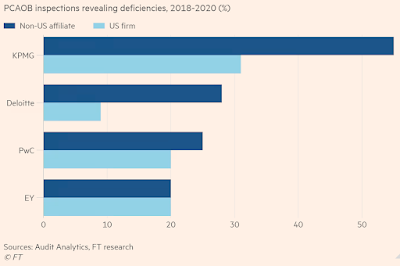
The biggest irony about risk mitigation is that the market which provides assurance and internal controls assessment services itself suffers from an unhealthy level of risk concentration. 
There could also be questions about KPMG’s broad role in the financial system. The firm holds a singular role as auditor of more US banks than any of the other Big Four, and it audits a larger proportion of the country’s banking system by assets than any other firm, according to data from Audit Analytics. As well as being auditor to Wells Fargo, Citigroup, Bank of New York Mellon and three dozen other listed banks, it also audits the Federal Reserve... Publicly listed banks paid the firm more than $325mn in fees in 2021, the last year for which full data is available, with the sector accounting for about 14 per cent of KPMG’s fees from public clients. That compared to 8 per cent at PwC, 3 per cent at EY and 2 per cent at Deloitte.
This market concentration poses several concerns. It ensures monoculture and a lack of internal diversity in auditing practices. There emerge collective blindspots, often conveniently deliberate oversights, within the industry. Apart from firms being left with limited choices, safeguards like auditor rotation become virtually meaningless exercises. 

While revolving doors and conflicts of interest in the consulting industry and policy-making are now widely documented, the extent of perversion in this instance is shocking. 
KPMG alumni have also gone on to play significant roles in the banking sector, including at former clients. The chief executives of Signature and First Republic were both former KPMG partners. Accounting professors said regulators were likely to pay close attention to Signature’s appointment of Keisha Hutchinson, who was the lead partner on the KPMG audit team at the bank, to be its chief risk officer in 2021, less than two months after she signed the 2020 audit report. Securities and Exchange Commission rules require a 12-month cooling off period before an audit partner is hired by a company into a role that oversees financial reporting, although that is usually interpreted to mean chief financial officer or financial controller roles.
Such conflicts of interest arising from revolving doors and cosy personal ties are a much bigger problem with the big management consultants and Wall Street banks. In fact, in recent years, this has been a concern in central banks too.

Saturday, July 10, 2021

Weekend reading links

1. NYT writes that the pandemic may have accelerated the automation trend.

The trend toward automation predates the pandemic, but it has accelerated at what is proving to be a critical moment. The rapid reopening of the economy has led to a surge in demand for waiters, hotel maids, retail sales clerks and other workers in service industries that had cut their staffs. At the same time, government benefits have allowed many people to be selective in the jobs they take. Together, those forces have given low-wage workers a rare moment of leverage, leading to higher pay, more generous benefits and other perks. Automation threatens to tip the advantage back toward employers, potentially eroding those gains... Restaurants, hotels, retailers, manufacturers and other businesses have all accelerated technological investments. In a survey of nearly 300 global companies by the World Economic Forum last year, 43 percent of businesses said they expected to reduce their work forces through new uses of technology.

2.  Arguably the most important challenge facing the RBI would be management of its exit from the current monetary accommodation. There are several factors other than the rising domestic inflation. One is the recovery in the developed economies and the associated likely commodities up-cycle, which would add to inflationary pressures at home. Second is the US economic growth and the inevitable reversal by Fed, which, howsoever much it's communicated in advance, will most likely lead to capital flights. Three, this capital flight may affect India even more given that many emerging economies like Brazil, Mexico, Russia, Hungary, Czech Republic etc have already started raising their rates. 

3. FT has a long read which draws attention to the controversy surrounding the two co-founders of Teneo, the world's premier chief executive advisory firm on PR issues. Both had to quit following serious allegations levelled against them. The article shows how political and corporate interests get enmeshed in questionable relationships, the power of networking in elite circles, the unsavoury practices that happen within corporate networks, and finally how little PR firms bring to the table despite the high amounts they charge. 

4. Credit cards monopoly fact of the day, airline ticketing edition,

Airlines have to pay credit card companies between 1 and 3 per cent of the ticket price, with larger carriers closer to the lower end of that range, according to industry executives. By contrast, the system adopted by Emirates known as Iata Pay charges a fixed fee of just a few euro cents per transaction irrespective of the ticket price... Emirates chief financial officer Michael Doersam told the Financial Times... that fees to payment providers were one of the biggest components of its cost of sales. Iata estimates that prior to the pandemic, airlines globally stumped up $8bn a year for the procession of payments to credit card firms and other external payments service providers.

5. FT reports of a $17 bn takeover of Sydney Airport by a consortium of investment companies,

The consortium offered A$8.25 (US$6.20) a share for the operator of Australia’s busiest gateway, Kingsford Smith International Airport... Members of the consortium included Australian investment manager IFM Investors, pension fund QSuper and Global Infrastructure Management (Australia), an affiliate of New York-based asset manager Global Infrastructure Partners. IFM Investors manages more than A$155bn in assets and is owned by pension groups including Australian Super, Cbus, Hesta and Hostplus. IFM owns 25 per cent of Melbourne Airport, 20 per cent of Brisbane Airport and 13 per cent of Adelaide Airport as well as a stake in Perth Airport, which are all unlisted.

6. Despite all talk of its demise over the last decade, Ruchir Sharma points to the growing economic might of the US,

The US share of global gross domestic product rose from a 2011 low of 21 per cent to 25 per cent last year. Average incomes started the decade 26 per cent higher in the US than in Europe in real dollar terms and finished more than 60 per cent higher. The US income lead over Japan grew even more dramatically... As a financial superpower, the US... share of global stock markets increased in the 2010s from 42 per cent to 58 per cent. The dollar emerged more dominant than ever, helping the US extend its lead over other developed nations. By late 2019, 75 per cent of all overseas loans to individuals and corporations were denominated in dollars, up from 60 per cent before the crisis of 2008. Six of every 10 countries used the dollar as their “anchor” — the currency against which they measure and stabilise the value of their own currency — near a record high.

This has to be counterbalanced with the lows,

In 2010, the US owed the rest of the world $2.5tn, a sum equal to 17 per cent of US GDP. By early last year, those liabilities had risen to $10tn and more than 50 per cent of GDP — a threshold that has often triggered currency crises in the past. Currently they are $14tn and 67 per cent of GDP.

7. The Economist points to work from home in government,

Britain’s tax authority is offering all employees the right to work from home two days a week. In America the federal government predicts that many civil servants will want to maintain flexible schedules after the pandemic. Ireland, which wants 20% of its 300,000 public servants working remotely by the end of the year, is offering financial support to encourage them to relocate outside cities. It will create more than 400 remote-working hubs, allowing staff to work closer to home. Indonesia has set up a “work from Bali” scheme for civil servants to help revive the tropical island’s tourism industry.

8. The problem of pending receivables of small businesses who supply/service larger companies,

While the buyers are legally mandated to make payments to a supplier within 45 days of accepting goods or services, the on-ground reality is frightfully different for small firms. And the pandemic has only made a bad situation even worse. Depending on the size of the small enterprise, the payments cycle—from the time an MSME receives a purchase order to the time they get paid—could vary between 90 to 180 days. In other words, their working capital is blocked for half the year, inhibiting the ability of these companies to scale up—one reason why India’s small firms tend to remain small. Many companies borrow from informal sources at high interest rates in order to meet immediate working capital needs. Since they have to keep borrowing, it’s a cycle of perpetual debt. The Global Alliance for Mass Entrepreneurship (GAME), an organization that works on entrepreneurship development in India, has come up with an estimate to quantify the scale of the problem. Based on consolidated data for FY2019-20 (data for the recent fiscal year is still not fully available), registered MSMEs were awaiting dues that amounted to a mammoth ₹15 trillion...
At the heart of this is a skewed balance of power—a mismatch between the large buyers’ cash flow priorities and the MSME’s cash flow needs. “The large buyers are making a judgement call about their need to show better cash flows. One way to squeeze that number out is by delaying payments to MSME suppliers," Ashwin Chandrasekhar, a vice president at GAME, said. “MSMEs don’t have bargaining power. The small company risks losing the buyer who could be 30-40% of their revenues."

The payment cycle has increased, even doubled in some cases, during Covid.  

A solution to this is the factoring receivables platform, TReDS. On it, a supplier can access loans at 6-7% instead of the 8-9% for regular working capital loans. However, it appears that despite efforts by the Government of India, the volume of transactions on these platforms even by PSUs is limited.

The problem of accessing loans even on TReDS is also one of approval of invoices by the buyers, which often takes time and is also deliberately delayed by them. One way around is to have pre-invoicing approaches like having the invoice validated by "billable events" like a third-party system like the GST or the receipt of a goods received note (GRN). Loans can be extended against such pre-invoices.

9. More about Sheryl Sandberg and Facebook,

Ms. Sandberg surrounded herself with a “kitchen cabinet” of outside political advisers and a team of public relations officials who were often at odds with others in the company.

This is about her role in delaying, denying, and deflecting Facebook's role in the US Presidential election controversy.  

10. Some facts about the IBC. TT Rammohan writes,

According to Macquarie Securities, recovery under NCLT has averaged 24 per cent if we leave out the top nine accounts referred to the NCLT by the Reserve Bank of India (RBI). We should not be surprised. Only 8 per cent of cases have been resolved. Thirty per cent of cases have undergone liquidation. Banks need to see if recoveries in bank-led resolution in the recent years are better... Macquarie estimates that cases take more than 400 days, whether for liquidation or resolution, against the stipulated time limit of 270 days.

Vivek Kaul compares it with the three other options, 

The rate of recovery in the case of the Lok Adalat stands at a measly 5.1% between 2012-13 and 2019-20. When it comes to the DRTs and the SARFAESI Act, the rate of recovery stood at 6.1% and 21%, respectively.

And more details about the IBC's performance,

The IBC came into existence in May 2016. Between then and March 2021, a total of 4,376 companies have been admitted into the corporate insolvency resolution process (CIRP). Of the total, 2,653 CIRPs have been closed. However, only 348 companies have ended up with an approved resolution plan... Of the 348 companies which have ended up with resolution plans, the rate of recovery as of March 2021 stood at 39.3%. Of the ₹5.16 trillion owed to financial creditors, only ₹2.03 trillion has been recovered. Also, the 39.3% recovery rate is primarily due to two big recoveries—the sale of Bhushan Steel and Essar Steel to Bamnipal Steel and Arcelor Mittal India, respectively... If we subtract these two cases from the overall figure, the rate of recovery for the remaining 346 companies falls to 30.7%...
Of the 2,653 closed CIRPs, at least 1,277 firms, around 48.1%, have ended up with an order for liquidation. Liquidation means selling the company piece by piece, asset by asset. As per the January-March 2021 newsletter of the Insolvency and Bankruptcy Board of India (IBBI), of the 1,277 firms where liquidation was ordered, data for 1,272 firms was available. The total outstanding amount in these cases was ₹6.47 trillion. But the assets on the ground were valued at only ₹46,000 crore. Liquidation also takes time. As of December 2020, around 69% of the liquidations had been going on for a period of more than one year; 26% of them for a period of more than two years.

Tuesday, July 26, 2011

The need to regulate consumer finance

One of the most important lessons to be learnt from the sub-prime crisis is the need for better consumer protection in financial markets. In particular, given the shockingly abysmal level of financial literacy among consumers, it was important to provide atleast the most basic level of protection against predatory practices by financial institutions.

In recognition of this imperative, the Dodd-Frank Bill in the US, last year established the Consumer Protection Bureau within the Federal Reserve Board to write and enforce rules protecting consumers of financial products and also increases the authority of state regulators to enforce protections. It would require lenders and sellers of financial products to provide plain-English disclosures, price comparisons with alternative products and clear tripwires before fees are assessed.

This issue assumes much greater relevance in developing countries where financial liberalization of recent years has brought in its wake a proliferation of attractively packaged financial products. The widespread consumer financial illiteracy coupled with skeletal regulation provides fertile ground for predatory lending practices by unscrupulous financiers to unsuspecting borrowers.

A Times article points to the havoc being wreaked by credit card debts, which have also contributed to the extensive economic growth of recent years, in some Latin American countries .

"It has also opened the door to abuses, as credit issuers have used predatory techniques to lure customers, particularly young and less affluent ones, in countries where regulation is scant, annual interest charges can top 220 percent and consumers cannot seek bankruptcy protection, economists and consumer defense groups say... troubling undercurrents in the South American economic boom: indiscriminate lending, lax regulation and ballooning over-indebtedness of large parts of the population, especially those with lower incomes."


And it points to practices that are reminiscent of those of the sterotype of unscrupulous moneylenders, used by certain retailers in Brazil and Chile who peddle consumer durables on credit,

"... among 418,000 clients (of La Polar) in Chile who fell behind on their payments and had their debts repackaged by the retailer La Polar, which raised interest rates and extended loan terms without their knowledge. In early June, it came to light that executives at La Polar had been unilaterally renegotiating clients’ debts for more than six years... The widespread proliferation of credit has been both rapid and relatively recent, developing over the past decade and spurring a consumer revolution across South America. Retail chains like La Polar in Chile and Casas Bahia in Brazil, which sell electronics and housewares, have thrived by offering relatively low-priced goods and extending easy credit terms to entire classes of people who had never had access to it."


While bank-issed credit cards have been regulated, cards issued for in-store use by retailers have enjoyed "light-touch" regulation, thereby setting the stage for a rapidly emerging household indebtedness problem in these countries.

This issue is all the more dangerous for countries like India with a history of extremities of political populism. Credit-driven financial growth has the potential to be the most dangerous form of populism. Unlike conventional electoral populism, involving handing out doles to the electorate which bankrupts the state, credit-driven populism could first bankrupt the households and then the state (in the process of bailing out the banks and the households). This danger is amplified in countries which are in the nascent stages of their financial market growth, where the major share of financial institutions are government owned and financial illiteracy is the norm.

Consider a scenario where the central bank liberalizes (or is forced into) lending regulations on consumer financing (both credit cards and for EMI-based purchases). Predatory lending is never far away and even state-owned banks too enter the fray with several easy-credit schemes. A consumer debt-bubble gets inflated in which a large number of people, especially from the lower middle-class, become exposed. Come elections and the demands start for some form of loan waiver by an electorate socialized into feeling nothing unethical about such demands. It only requires one unscrupulous political party, and there is no dearth of them, to promise write-offs on all consumer debt owed to PSU banks, to force everyone else to follow suit.

That this is not a far-fetched scenario is borne out by the numerous precedents in our history. Loan waivers have been a common feature of our political landscape for decades now. The recent state supported forced write-offs of MFI loans in Andhra Pradesh is a reminder of the vast possibilities of such a trend.

Further, apart from the political populism associated with write-offs, there are factors which strongly encourage such credit growth. For a start, such credit growth drives economic growth. Businesses make profits, consumers are happy borrowing and spending at apparently easy terms and without any hassles, policy makers are satisfied with business investments that create jobs, and bankers are thrilled at the rapid growth of their business (and lending excesses are inevitable). Most importantly, politicians benefit by keeping all these stakeholders satisfied. So where is the incentive to take away the punch-bowl?

It is in this context that more prudent regulation of the sector assumes significance. Such regulation is required to align the incentives of all stakeholders into driving the overall objectives of consumer credit flow. As the experience of Chile and Brazil shows, with increasing financial liberalization, it is only a matter of time before such practices start showing up.

Friday, January 8, 2010

Analyzing the market for credit and debit card payment

I had blogged earlier about how the pricing model of credit and debit cards have been responsible for preventing the development of the market for electronic payment of utility bills. An excellent article in the Times explored the prizing strategies of electronic payment networks like Visa and Mastercard and comes to a few interesting conclusions about a market that is set to overtake cash purchases in the US by 2012.


Electronic payment through credit or debit cards involve four participants - the card issuing bank, the payment network, the merchant or retailer who accepts payment through these cards, and the consumer who uses the card. The payment network agencies provides an electronic network that acts like a tollbooth, processing the transaction between merchants and banks and collecting a fee that averages 5 or 6 cents every time in the US. Further, banks that issue Visa cards also pay a separate licensing fee, based on payment volume.

The major source of discontent against the networks come from another fee, the interchange, amounting to 1-3% of each purchase, that merchants are forced to pay everytime a debit card is swiped. This is then forwarded to the cardholders bank as an incentive and to promote the issuance of more cards. The banks in turn use the interchange fees as a growing profit center and to pay for cardholder perks like rewards programs.

Here are four observations about the aforementioned business model and market structure

1. Electronic payments sector is a classic example of network effects. Customers prefer using cards with the widest acceptance and merchant retailers benefit from minimizing transaction costs by dealing with limited numbers of networks. This sets the ground for payment networks to exploit the resultant increasing economies of scale conferred by the large network of consumers and merchants.

Once the market structure gets established with a few dominant payment networks, consumers and merchants are left with limited options. Merchants cannot refuse the existing networks as it would lower their sales, while consumers opting for alternative networks will be left with limited choice in their shopping and often have to be prepared for making cash payments.

2. Given the aforementioned market structure and business model, competition is more about winning over banks that actually issue those cards than consumers who use them. So the incentive is to reward banks handsomely and win them over, most often at the cost of the merchant retailers and consumers. Such rewards come in the form of higher fees payable to the cardholder's bank by the merchants, who in turn promptly shifts the burden to consumers.

The only way out of this gridlock is to incentivize banks to issue cards with newer payment networks. However, the network effects presents considerable entry barriers for any new agency.

3. The payment networks' explanation for the exorbitantly high prices charged by them is that their services are charged based on its value addition to its customers. They claim their fees as "not a cost-based calculation, but a value-based calculation", and argue that the costs of using such networks has not gone down because the cards now provided greater value than they did five or 10 years ago.

In other words, the payment networks argue that the value added to its users, both comsumers and merchants, by way of a standardized and convenient payment platform far outweighs the payments (or price paid) made by them. This logic goes against similar breakthrough technologies, across sectors, that have while dramatically increasing productivity and convenience have also led to sharp declines in prices.

4. In the case of interchange fees, Visa used its market power to nudge (or force?) consumers into signining on debit card payment reciepts instead of entering the PIN number. The payment network does not charge any transaction fees for payment using PIN, whereas it charges an amount similar to those paid for credit card transactions for those consumers making payments by signing on debit card payment reciepts.


This is another example of the inevitability of such monopoly/duopoly markets being vulnerable to various price discrimination/market differentiation strategies, most often detrimental to consumers.