Substack

Showing posts with label Infrastructure. Show all posts

Wednesday, June 3, 2026

Deploying public finance to derisk private capital in innovation and infrastructure

As the heading suggests, this post points to a few thoughts on the challenge of deploying public funds to derisk and crowd-in private capital into those areas of innovation and infrastructure that are not attractive enough for commercial capital. 

I have blogged about public funding of innovation here and here, and this working paper is about public funding of infrastructure projects. The additionality with public finance arises from its risk-tolerantpatient, and concessional nature. 

An urban water supply or sewerage, or an industrial bulk water supply, or an electricity distribution, or a solid waste management, or a streetlight energy saving project, or a mass transit project, will not attract commercial capital on its own. Similarly, a fledgling startup making transceivers, or display and camera modules, or high precision resistors/inductors/capacitors, or compressors, or brushless DC motors, or anode materials, or aluminium extrusions, or designing a narrow band IoT chip or some other mid-value chip, will generally struggle to attract risk capital. 

But they can be derisked by blending with a layer of public finance. The challenge is how to do this derisking effectively. Specifically, the challenge is how public funds can be channelled to derisk these projects or sectors. 

This is less of a problem with grant funding involving smaller amounts, which is simple enough to be done through public entities. In infrastructure, such grants come in the form of viability gap financing (VGF), and in innovation, they are given to those in TRL 1-5/6 stages. The problem lies in the deployment of risk capital (debt and, especially, equity and structured instruments) by public entities. 

Given its administrative inflexibility and constraints, direct deployment of funds by the government itself is not only inefficient but also creates incentive distortions.

In the circumstances, the commonly suggested option is arms-length financing through Development Finance Institutions (DFIs). But this approach is seriously hampered by unreasonable expectations (about returns or at the least capital preservation) arising from a deficient understanding and acknowledgement that de-risking, by its very nature, entails a strong likelihood of losing money. It would involve investing in projects that would not attract commercial investors, by insuring for the additional risk borne by them. 

Further, even with an arm's-length institutional structure, a fully government-owned entity is subject to constraints that prevent efficient deployment of funds. 

The response to this problem has been to build institutional structures by partnering with private investors, even having majority private investors. This, it has been argued, will free them from the fetters and requirements faced by public entities. 

However, India’s disappointing experience with infrastructure DFIs starting from IDFC, IIFCL, and NIIF, as documented in detail here, raises questions about this response. In all these cases, instead of complementing private capital, the DFI has ended up competing with private investors in their choice of investments. Instead of funding those risky sectors, the DFIs chase the derisked sectors like power generation, renewables, transmission, highways, ports, and airports. 

In this backdrop, a commonly cited option, especially in the context of innovation financing, is to transfer public funds to commercial investment vehicles (or the Fund of Funds, FoF, strategy) and let the latter manage those investments. This looks great in theory, insofar as it aligns incentives and brings in private sector efficiencies. 

But it has one problem. The private investors will be primed to invest, at best, in those marginally risky projects rather than in genuinely risky projects (or sectors) that sorely need public finance to derisk them. So, instead of deriskingprojects or sectors, public funding will do returns amplification for private capital. 

Here, a big problem, a market friction, is the absence of a pipeline of such risky projects and sectors that investors can draw from. Their search costs are a significant enough deterrent for investors. In contrast, commercial investors have access to a widely known pipeline of investible projects or innovations. 

It is also the case that the envelope of such risk capital available to fund infrastructure and innovation is much smaller than the envelope of investible projects. Therefore, there is little incentive to go beyond the confines of the mainstream and search out and fund the riskier projects. 

In the circumstances, I can think of three options for the deployment of public funds such that we are able to realise its additionality, and not compete with and crowd-out private capital or end up being leveraged primarily for returns amplification.

1. Invest in FoFs, but with sharply defined funding mandates, almost prescribing the specific nature of projects to invest in, at least a part of their portfolio. However, this can be unsettling for the commercial investors and may turn away the GPs who sponsor the fund from accessing public funds. 

2. The DFI could announce its offering as a set of financing instruments that meet the derisking objective. They could include credit guarantees (in the form of first-loss buffers), longer tenor, lower interest rate or hurdle rate, lower liquidation preference and a lower charge on the waterfall, subordinate debt, and so on. The DFI should market these instruments and possible investment projects to commercial investors. 

3. The DFI could co-invest with private investors. This would entail the public entity scouting the project or entrepreneur, doing due diligence on it/them, and then shopping it to commercial investors with an offer of an attractive enough derisking financing layer. This would also require an acknowledgement of the fact that the role of public finance is to derisk and not maximise returns. This is perhaps the most ideal approach, one which mature entities like NIIF in infrastructure finance ought to be mandated to do.

The second and third options require highly capable and incentive-aligned institutions. Given weak state capability, that’s a demanding requirement. It is for this reason that even in developed countries, risk capital funding in infrastructure and later-stage innovations is largely deployed through FoFs, notwithstanding its aforesaid failings. 

But this reality should not be a reason to ignore the failings of the FoF strategy and step away from pursuing the second or third options.

Saturday, March 21, 2026

Weekend reading links

1. Private equity has outperformed public markets.

2. The Karnataka government has announced the implementation of an Alcohol-in-Beverage (AIB) based excise duty. As per this, the globally recognised practice for alcohol taxation, percentage of alcohot in a liquor brand will determine the duty levied. 
In Karnataka, alcoholic products currently fall under 16 slabs. A product was designated to a particular slab based on the Declared Price, the selling price determined by the distiller. The Additional Excise Duty levied by the government was dependent on the price per litre of the product, due to which the price of the premium liquor segment was on the higher side... Over the next four years, the government plans to abolish the slab system of excise duty collection completely. For FY 2026-27, the government will merge multiple slabs and reduce their number from 16 to eight... Currently, the duty levied for a bulk litre of say, McDowell’s – which is at the lower end, and Blue Label – which is at the higher end, is different and is based on the Declared Price. Both have 42% alcohol. Under the new system, both drinks will attract the same percentage of additional excise duty irrespective of the declared price

3. Japan lifestyle facts of the week.

The nation’s stock of 2.2mn drinks vending machines is down 23 per cent from its bubble-era peak in 1985, according to the Japan Vending System Manufacturers Association... Japan loved vending machines for their convenience despite higher prices. But three years of rising inflation has driven consumers to greater thriftiness. Well-known brands of tea and coffee can be 20 per cent cheaper in nearby convenience stores, which have also stepped up sales of freshly brewed coffee, while drugstores and supermarkets sell discount private-label brands. In 2024 just 42mn cases of drinks were sold via vending machines, down from 72mn at the 1997 peak, according to data from Inryo Souken, a Tokyo-based research institute. Vending machines also still need people to keep them stocked — and Japan has a chronic shortage of truck drivers.

4. Global crude landscape (HT: Adam Tooze)

As the war rages on, and the blockade of the Strait of Hormuz bites, oil prices are becoming a binding constraint on the world economy. Oil demand is highly inelastic.
Oil demand is, on average, highly inelastic in the short run because most end uses have few immediate substitutes — factory boilers rely on fuel oil, aircraft require jet fuel, and most cars still run on gasoline. Our estimate of the short‑run price elasticity of global oil demand is −0.024, implying that a roughly 40% price increase above 12‑month highs is needed to reduce total consumption by 1%. The response, however, varies materially by product. Naphtha is most sensitive because petrochemical plants can partially substitute ethane in cracking operations. Jet fuel is also relatively responsive, as airlines can cancel lightly loaded flights when fuel costs spike. By contrast, fuel oil is least elastic given its role in essential services like home heating, marine transport, and power generation.
The worst impacted by the 20% reduction in oil supply and 15% in LNG supply is Asia
Most crude shipments through the Strait of Hormuz are bound for Asia, with China, India, Japan, and South Korea as the principal buyers. In total, Asia takes about 11.2 mbd of crude and 1.4 mbd of refined products that transit the Strait. As a result, the immediate physical shortfall is concentrated in Asian markets, where reliance on Gulf barrels is greatest. Early signs of demand destruction are emerging in Asia as product prices surge and spot barrels become prohibitively expensive. Timing effects further reinforce this divergence. A typical voyage from the GCC to Asia takes approximately 10-15 days, while shipments to Europe require closer to 25-30 days via the Suez Canal, or even 35-45 days if rerouted around the Cape of Good Hope. As a result, the impact of disrupted Gulf flows will hit Asian markets earlier and more acutely, whereas Atlantic basin benchmarks such as Brent and WTI will remain cushioned for longer by inventory overhangs and slower supply adjustments.

India's dependence on Strait of Hormuz is especially acute.

Almost 50 per cent of the LPG and 30 per cent of the natural gas that India consumes comes from the Strait of Hormuz.
5. Gideon Rachman writes that Iran may have achieved a major strategic leverage going forward by demonstrating the chokehold that any restrictions on the Strait of Hormuz can have on the world economy. 
The strait’s closure creates both an immediate crisis and a long-term strategic quandary. The current problem is that the longer it is closed, the greater the threat of a global recession. The future dilemma is that Iran now knows that control of the Strait of Hormuz gives it a stranglehold over the world economy. Even if it relaxes its grip in the short term, it can tighten it again in future.

6. A measure of how much Israeli politics has become radicalised.

Israel should destroy all Iran’s oilfields and flatten the energy infrastructure on the island that functions as Tehran’s main oil export hub... the demands... came from Yair Lapid, the silver-haired former premier and television host who heads the centrist Yesh Atid party, and draws much of his support from liberal bastions such as Tel Aviv. Lapid’s message reflects how the fight in Israeli politics, for all Zionist parties in government and opposition, is not over whether to confront Iran but over who will prosecute the war better than Netanyahu. Israel’s offensive has higher public support than almost any other issue in the country’s fractious politics — even after two and a half years of multifront fighting that has disrupted daily life for millions of Israelis. Although Israel’s Arab parties staunchly oppose the war with Iran, polls suggest more than 90 per cent of Jewish Israelis back it, and the country’s Zionist opposition groups have fallen in behind it in unison.

7. Canadian pension funds' PE bets are souring, losing money on their PE investments.

Ontario Teachers’ Pension Plan, which manages C$279bn ($206bn) of assets, and the C$145bn Ontario Municipal Employees Retirement System reported returns of minus 5.3 per cent and minus 2.5 per cent respectively for their private equity portfolios in 2025. For OTPP, it was the worst performance for this asset class since 2008 and for Omers since 2020. La Caisse, Quebec’s C$517bn state pension fund, also reported weak private equity results. The group said its PE portfolio returned 2.3 per cent last year, well below the 12.6 per cent gain in its benchmark index, half of which is made up of listed stocks. The Healthcare of Ontario Pension Plan, which published results this week alongside OTPP, reported private equity returns of 3.6 per cent in 2025. Its broader private markets portfolio returned 2.1 per cent, compared with 11.7 per cent for its listed holdings.
8. Thames Water gets new offer from its senior creditors to take over the struggling utility, committing up to £6.55bn of debt and £3.35bn of equity. It is now with Ofwat for regulatory approval. 
Lenders including hedge fund Elliott Management and private capital group Apollo Global Management are locked in negotiations with the regulator as they attempt to take formal ownership of the UK’s largest water provider. The creditors have proposed a new management plan, which could lead to a stock market listing as soon as 2030... The creditor’s £6.55bn debt figure is made up of £3.25bn that will be made available to Thames Water on day one of their ownership, up from £2.25bn previously proposed, and up to an extra £3.3bn that will be made available to the utility over the funding period. The new debt would come in addition to £3bn of emergency financing approved last year to prevent Thames from being renationalised under the government’s special administration regime... The increased debt offering would come on top of an equity injection that has been revised upwards to £3.35bn from £3.15bn... Under the terms of the new proposal, Thames Water’s class A creditors would take a 30 per cent writedown on their existing debt, on top of “a write-off in full of the Class B Debt and any subordinated debt or equity held by existing shareholders”.

9. TJXX is the fourth-largest retail chain in the US and the fourth most profitable global fashion retailer.

10. Rana Faroohar writes about the concierge economy in the US, where the rich can get to the front of the que and buy convenience at a price. She points to the gold-plated subscription healthcare service that comes with minimal wait times for specialists, 24/7 access to physicians, longer sessions with doctors, and which is a $20 bn global business with roughly 40% in the US. 
The market for personal travel planners, high-end club memberships, private wealth managers and educational consultants has in recent years grown by high single to double digits. Fractional aviation subscription services (think NetJets) are growing by about 10 per cent a year. Those with Clear (the airport service that speeds you through security if you must fly commercial) have tripled since 2022. It’s all part of a burgeoning “concierge” economy that caters to affluent consumers who don’t wait — or want — for anything. The global “lifestyle concierge” services market — that’s the part of the business that gets you the right hotel, colourist, Pilates instructor or front-row tickets to the must-see football game — is expected to grow from $16bn to about $36bn by 2035. It’s about saving time, yes, and it’s also about making sure the rich get to speak to human beings who can fix problems and meet high expectations, rather than dealing with search algorithms, AI bots and monotone-voiced teleworkers, like everyone else. Concierge services are about convenience and access, but they are also about bringing ease and luxury to areas that have become digital commodities or suffer from high levels of consumer dissatisfaction, such as healthcare or financial services.
11. India's AIF market is surging.
From about 160 AIFs in 2015, with less than Rs 28,000 crore in commitments, they’ve grown to over 1,740 in number as of January, spread across three categories and with nearly Rs 15 lakh crore in committed capital, according to Sebi... Category-II funds, which include private-credit, real-estate, venture-debt, and private-equity funds, had become the default recommendation... The Indian alternative-investments industry has grown at a compound annual rate of 49% in ten years to September, according to data from PMS Bazaar. Category-II, III funds have grown at over 50% growth rate... category-II funds account for about two-thirds of the total Rs 15 lakh crore commitment... the US, where hedge funds (category-III funds in Sebi parlance) dominate the alternative-investment space... In India, though, a majority of AIF investors come from family-business backgrounds... A mutual fund would deliver 12–14% returns on a long-term basis, and here, AIFs were promising close to 25% internal rate of return for funds in which investor capital was locked-in for eight to 10 years... Reportedly, two-thirds of the money raised by Indian AIFs comes from domestic investors.
12. Global LNG market.
13. Italian judicial reforms face a referendum.
To insulate judges from political pressure, the constitution established the Supreme Council of Magistrates as an autonomous, self-governing body, comprised of two-thirds serving magistrates, elected by their peers, and one-third parliamentary appointees. The council handles the selection, postings, promotions and disciplinary proceedings of all Italy’s magistrates, now numbering around 10,000... In Italy, resolving contentious civil cases through all three levels of the justice system currently takes an average of 2,217 days — six years and one month. That is better than a decade ago, when it took about eight years but still far slower than the EU average of 795 days, or two years and two months... 

Under the proposed reforms, the magistrates’ council would split into three distinct bodies: one supervising prosecutors, one supervising all other magistrates, and a disciplinary court for all. It is a change that many legal experts — and politicians across the spectrum — have long advocated... the reform also envisions a more controversial change: magistrates would no longer be elected by their colleagues to serve on the self-governing bodies but would instead be chosen by lottery. Critics see this as a device to erode judicial autonomy vis-à-vis the political system.

14.  Softbank's spectacular free lunch in the US-Japan trade deal.

SoftBank was set to earn ¥1tn ($6.3bn) in fees... to build and operate a $33bn gas-fired power station in Ohio... It will earn the payments over 15 to 20 years if it can reach the target capacity of 9.2 gigawatts. The idea of a fee arose because SoftBank would otherwise earn nothing for its role as developer of the project. It has no equity in the power station, which will be financed entirely by Japan and owned 50/50 by the US and Japan via a special-purpose vehicle, set up as part of the trade deal... Under the trade deal, profits from the investments made are supposed to be split 50/50 between Japan and the US until Tokyo has recouped its money. After that, the US gets 90 per cent... SoftBank has already placed large-scale orders to begin construction of the power plant in Portsmouth, Ohio, including $10bn for close to 170 turbines from GE Vernova. As developer, SoftBank plans to sell the electricity to data centres it will also operate, say people familiar with the matter. The data centres will serve customers such as OpenAI, in which the Japanese group is a significant shareholder. Japan’s funding comes from both the Japan Bank for International Cooperation and commercial lenders. Nexi, Japan’s export credit agency, will guarantee 90 per cent or more of the commercial portion.

15. Among the several negative externalities of the Trump administration is the resurgence in interest in going nuclear. 

Britain’s Liberal Democrats... now want the nation to build a nuclear deterrent that is less reliant on the US... France, whose force de frappe is truly sovereign, said this month that it would increase its stockpile of warheads. In Poland, a rare point of agreement between the prime minister and the president is their openness to going nuclear. In South Korea, public support for a deterrent has gone up to 70 per cent in recent years. Saudi Arabia, which has said that it would get one if Iran did, might not wait for such a cue now that it and other Gulf states are under conventional attack from that quarter anyway. Even the original nuclear powers are chafing at old taboos. As of last month, there is for the first time in over half a century no binding agreement to limit nuclear arms between America and Russia, which have the world’s two largest arsenals.

Janan Ganesh writes about how Ukraine, Iran, and Trump's weaponisation of the US security umbrella, especially the last, has revived nuclear bomb acquisition.

One is the ordeal of Ukraine. In 1994, it gave up the Soviet nuclear weapons that were then on its soil in exchange for certain assurances about its security. Two decades later, Moscow began its long and ongoing war against Ukraine with the annexation of Crimea. The lesson, for some, is obvious. A country with dangerous neighbours should retain or acquire the ultimate deterrent. Another salutary tale is that of Iran. It seems that an unfinished nuclear bomb is the worst of all worlds: a provocation to other states but not a deterrent. A rational government would either abandon all ambitions of that kind or realise them in full. On balance, given Ukraine’s experience, observers around the world will regard the second course as the more prudent. On top of all this is the endless unpredictability of the US. Until now, countries with the expertise and resources to build the bomb, such as Japan and several European countries, have chosen to duck under America’s nuclear umbrella instead. As Donald Trump casts doubt over whether he would ever honour those mutual defence treaties, some of which were signed a human lifetime ago, this “nuclear latency” doesn’t seem so clever.

16. Shan Jin-Wei, Kun Li, and Kelly Liu suggest that S&P index inclusion may be up for sale by showing that if you purchase a S&P ratings then the company is more likely to get listed in S&P 500 index.

Firms that had recently obtained an S&P rating were significantly more likely to gain admission to the S&P 500. For non-member firms, the unconditional likelihood of being added to the index was 15.5 per cent; for firms that had recently purchased an S&P rating, it was 21.4 per cent. One possible explanation is that S&P tends to favour fast-growing firms, and that such companies are naturally more likely to issue debt and seek credit ratings. But if that were the whole story, we would expect to see the same pattern among firms that purchased ratings from Moody’s, and we did not. If rating purchases simply reflect firm quality or growth prospects, the effect should not be specific to S&P.

Firms’ behaviour further suggests that they see a link between rating purchases and index inclusion. When mergers among S&P 500 firms create openings for new additions, large non-member firms disproportionately increase their purchases of S&P ratings. Conversely, after a 2002 rule change that made foreign firms ineligible for inclusion, non-US firms listed on US exchanges sharply reduced their purchases of S&P ratings relative to Moody’s. The implication is clear: When the prize disappears, so does demand. Taken together, these patterns suggest that firms believe purchasing S&P ratings increases their chances of joining the index.

17.  Of the 937,876 candidates who took the civil services exams in 2025, just 0.1% got selected.

The situation is not much better if we take all the UPSC examinations, where of the 3.3 million candidates in 2022, the pass percentage was 0.18%.
Tokens... are the most basic units of output from large language models: it takes about 1,300 tokens to generate 1,000 words of text... When OpenAI launched GPT-4 two years ago, for instance, it charged $33 for 1mn tokens. Today, it charges only 9 cents for 1mn tokens produced by its cheapest model.

Tuesday, February 24, 2026

Derisking the public funding of innovation

 The Government of India have recently concluded the first round of applications for accessing innovation funding through the $10.5 bn Research Development and Innovation Fund (RDIF) scheme. It has chosen the wholesale funding approach of financing alternative investment funds, development finance institutions, non-banking finance companies, and focused research organisations (FROs), which in turn give loans to or take equity in private firms and startups engaged in innovation. 

What model of innovation funding generates the greatest bang for the buck in terms of achieving the primary objective of catalysing innovation? 

The additionality from public funding of innovation is that it is risk-tolerantconcessional, and patient compared to commercial capital. It can be blended with commercial capital to derisk and thereby expand the envelope of investible startups. This can be done through two approaches. 

One approach would be to fund startups by investing in a fund of funds (i.e., to be an LP in a startup fund). This approach would require only diligencing the fund and leaving it to diligence the individual investments. It would leave the portfolio building responsibility to the fund, albeit within the broad sectoral scope defined by the public fund. A flip side is that the fund could play it safe and avoid the riskier bets, and use the public funding to merely juice up its returns. 

The other approach would be to co-invest with commercial investors. This would require significant in-house expertise in the due diligence of startups. In theory, it would ensure tight alignment with the specific policy objectives of the government and target investments to the riskier startups. But in practice, public decision-making processes are likely to detract from the objectives. 

There are two possible objectives associated with public funding of innovation startups. One, to de-risk and expand the envelope of investible startups. Two, fund specific products or solutions that are considered strategically important

In terms of these two objectives, the policy question is which one of the two approaches generates the greatest bang for the buck. An analysis of the experience of deployment of public funds through the two approaches reveals that the fund of funds approach is generally superior, except where it is required to target strategically important technologies or firms. 

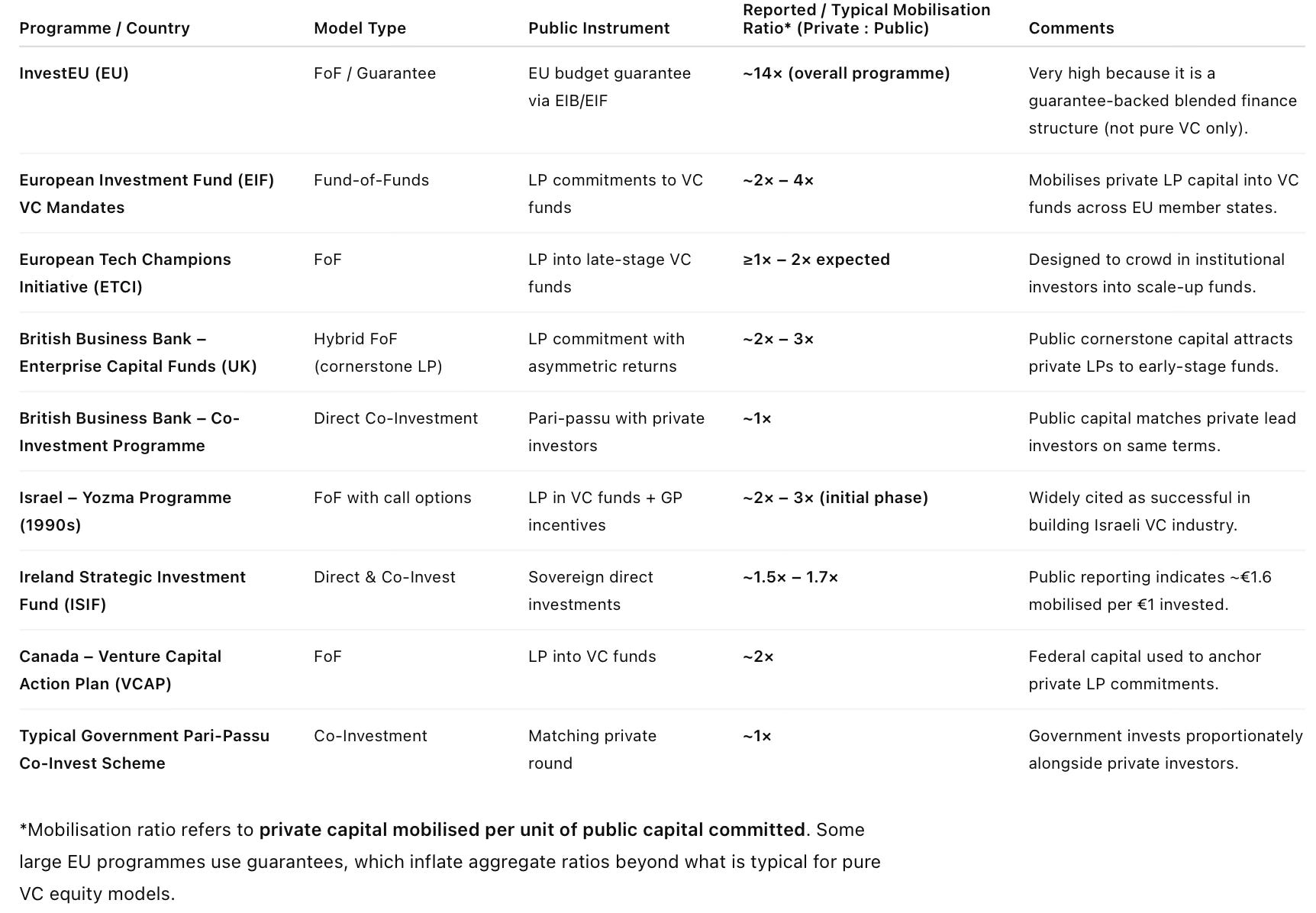
Here’s the list of a few such public funds from Europe and elsewhere, assessed in terms of their mobilisation ratios (or private capital raised per unit of public fund). 

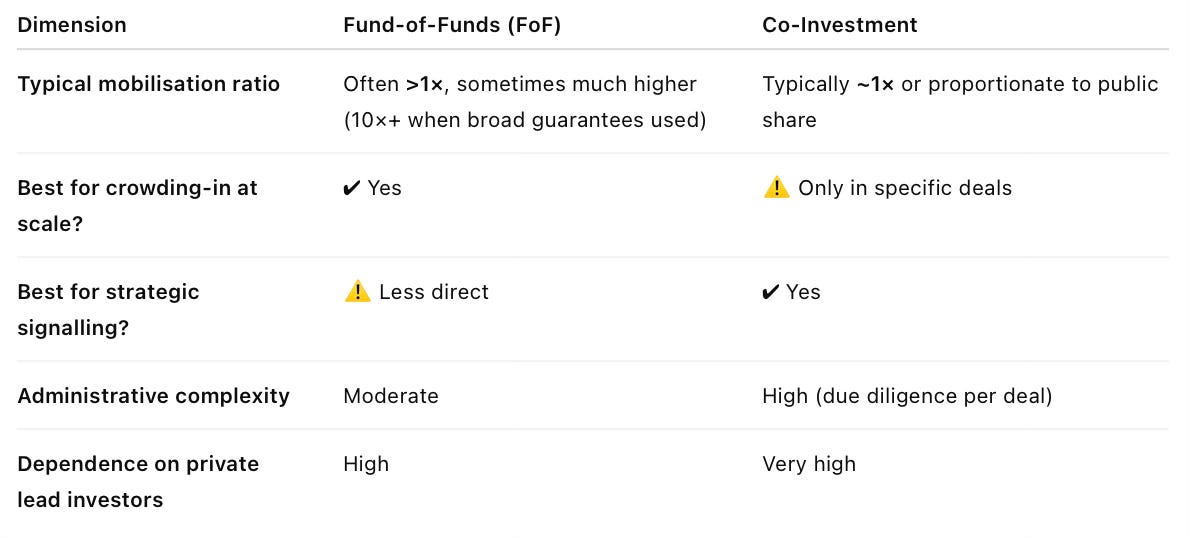
Here is a comparison of the two approaches in terms of various considerations. 
Clearly, if the priority is to maximise the volume of private capital mobilisation and to catalyse the VC market, the fund-of-funds approach is superior. However, if the priority is to catalyse a few strategically important firms or technologies where private capital is reluctant, then co-investment is useful.

In emerging markets like India, where the domestic VC funding for genuine technology innovation (as opposed to imitating technologies already mainstreamed elsewhere) is negligible, there’s a risk that a fund-of-funds approach, at least for some years, could end up catalysing and unlocking the supply of venture capital finance, rather than the supply of innovative technologies. This risk will persist even with tightly prescribing the segments where the funds can invest, given the practical difficulties in monitoring, let alone policing, them. And commercial funds will have the incentive to prioritise the use of public funding to maximise the derisking of their capital instead of expanding the envelope of investible startups. This would be the long-route to catalysing innovation (or catalysing innovation primarily by catalysing risk capital funds). 

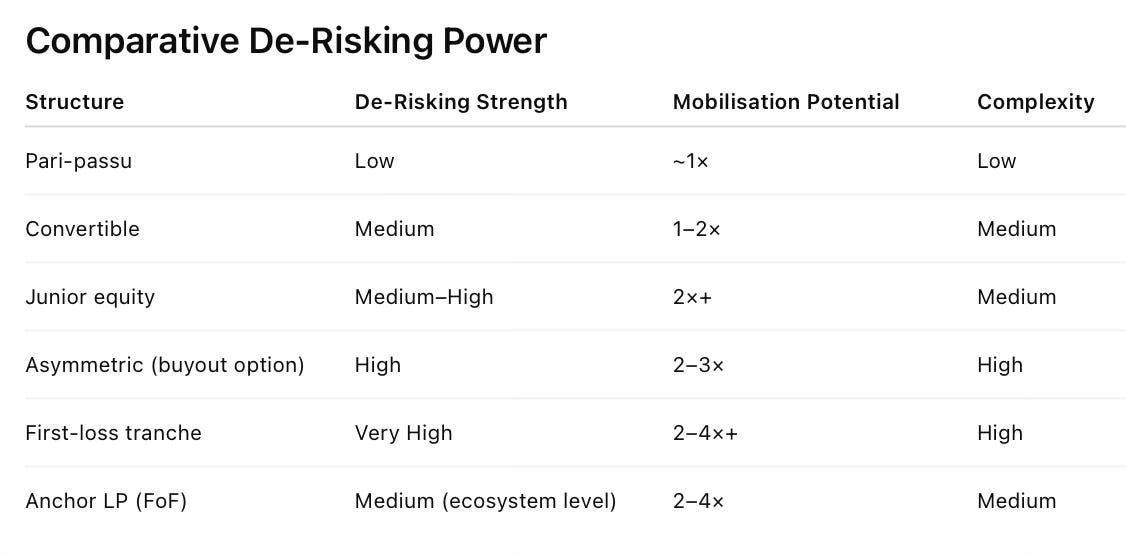
In the circumstances, it is important to consider the option of government co-investing directly in startups with private investors to provide sufficient de-risking of their investments. Such derisking can be done by public funds taking the first-loss equity buffer, offering higher liquidation preferences for private capital, capping public returns, anti-dilution warrants, offering buyout options at modest returns, equity conversion as subordinate capital or at a discount, etc. The graphic below captures the comparative de-risking effect of public capital. 

The challenge with co-investment, of course, is the administration of such funds by a public entity and getting its governance right. While there are good examples of co-investment like the Israeli Yozma fund, European Innovation Council, and the British Enterprise Capital Fund, they have been exceptions to the generally adopted fund-of-funds approach. 

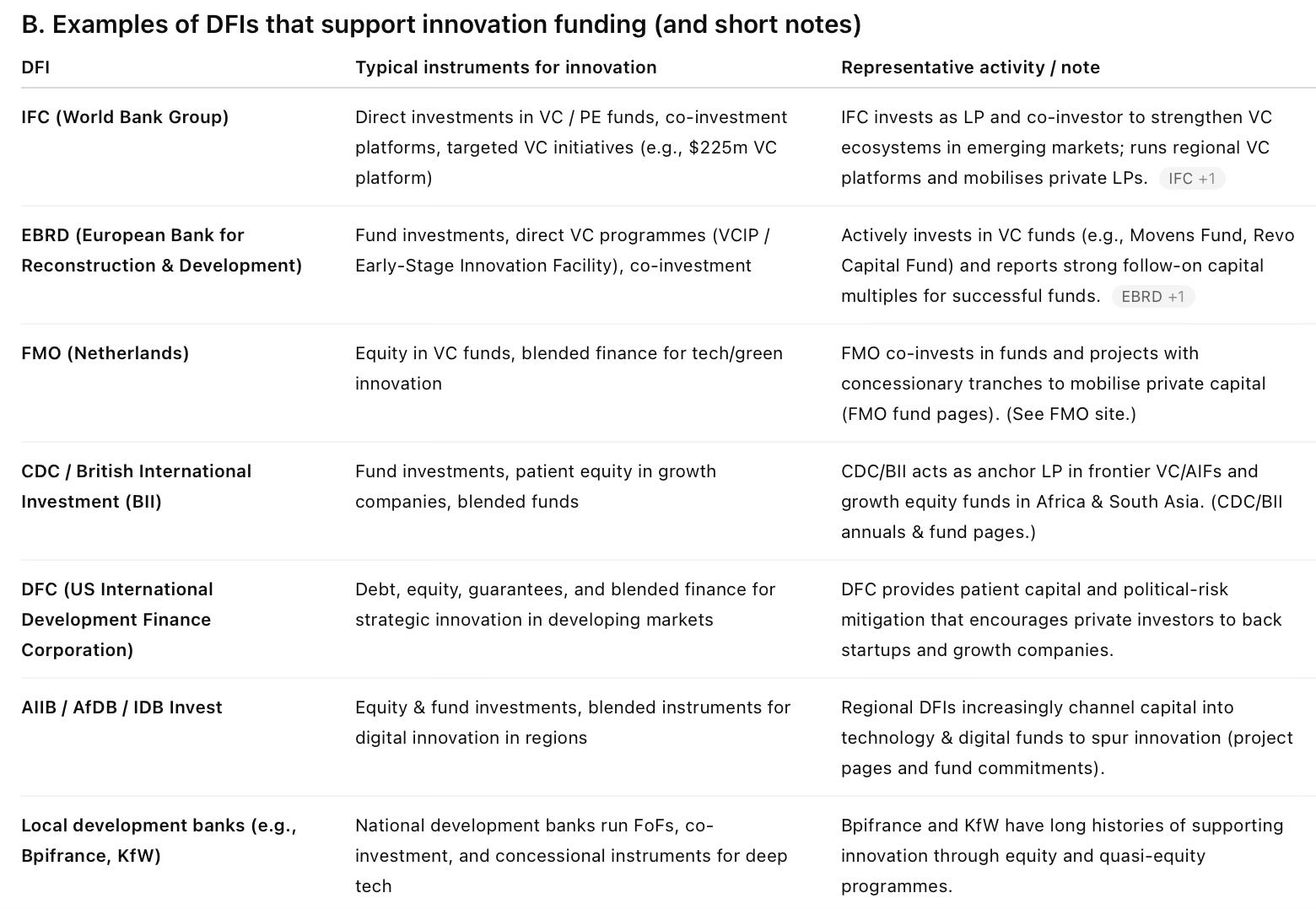
In the circumstances, DFIs are a good platform. While DFIs have traditionally focused on infrastructure financing and industrial growth, they are well placed to directly support co-investments by governments by deploying the full suite of instruments mentioned above, based on the specific nature of the investment proposal. 

I am not sure how many of the above really invest in risky startup-driven innovations as opposed to investing in promising established SMEs in emerging industries. 

As a note of caution, and this applies to the RDIF’s DFI window too, the experience of India’s infrastructure DFIs in actually derisking and catalysing infrastructure market segments has not been encouraging. Instead, they have most often been found chasing the market. See this and this.

Saturday, February 21, 2026

Weekend reading links

1. On the origins of infrastructure financing in the UK.

In the summer of 1858, Britain’s parliamentarians soaked the curtains in the Palace of Westminster with lime chloride in an attempt to counter the “Great Stink” emanating from the river Thames. It failed. The prime minister demanded the Metropolitan Board of Works construct a sewerage system, legislating to allow the board to raise £3mn. This was to be repaid by a three-penny levy on all London households for 40 years. By 1900, the municipal bond market in England was about 50 per cent of the market for UK government debt. Today it is just 4.7 per cent. Back then, most infrastructure projects were not only financed by the private sector but also backed by hypothecated cash flows from money raised locally. For example, the debt for the 1892 Elan Valley Aqueduct to pipe water into Birmingham was funded by an increase in water rates on businesses and households there. So the residents of, say, Manchester were not funding infrastructure elsewhere.

2. India is marching ahead on adoption of electrotech.  

3. Germany is the poster child for central bank independence.

4. Spurred by surging data centre loads, electricity demand is rising sharply in the US.

Data centre power demand will surge from 34.7 gigawatts in 2024 to 106GW by 2035, according to BloombergNEF, a research group, equivalent to more than 80mn homes. Overall US electricity demand is forecast to jump by a quarter by 2030 and by 78 per cent by 2050, compared with 2023, according to consulting firm ICF... Between January and November, the latest month for which data is available, the cost of electricity for residential customers in the US increased by 11.5 per cent.

5. Most Indian state boards focus on memory and conceptual understanding, as opposed to analysis and application. 

6. At 16%, US after tax corporate profit margins are at historic highs.
7. Nick Bloom, Paul Mizen, Gregory Thwaites et al have an estimate of the costs of Brexit (HT: Adam Tooze)
These estimates suggest that by 2025, Brexit had reduced UK GDP by 6% to 8%, with the impact accumulating gradually over time. We estimate that investment was reduced by between 12% and 18%, employment by 3% to 4% and productivity by 3% to 4%. These large negative impacts reflect a combination of elevated uncertainty, reduced demand, diverted management time, and increased misallocation of resources from a protracted Brexit process.
8. Some data on students and migrants from Asia in the US. Even as enrolment of Chinese students has declined, that of Indian students has taken off since 2014. While Chinese students were mainly for the UG programs, Indian students have been mostly for PG studies. (HT: Adam Tooze)
Indian students dominate the workforce of computer science workers. 
Similarly, Indians dominate physicians and Filipinos dominate nursing. 
9. India has one of the lowest free floats in its equity markets.
10. Japan's public debt at 237% of GDP is way off the charts, and considerably constrains Sanae Takaichi's room to manoeuvre. 
11. Tej Parikh writes that UK's biggest economic challenge is its political instability.
The UK doesn’t have a productivity puzzle. The causes of Britain’s weak underlying growth are well known and discussed ad nauseam. Why policymakers aren’t delivering is the bigger conundrum. Instability undermines business investment, hiring and planning decisions, and absorbs the political bandwidth that could be used to address lacklustre growth... Uncertainty and slow growth weaken the appeal of UK assets too. Pound sterling and British stocks have underperformed relative to peers over the past decade. Long-term UK government borrowing costs have remained elevated compared with other G7 nations, having come under frequent selling pressure thanks to fiscal mishaps... For all the turbulence, Britain remains attractive. London remains the leading European destination for foreign direct investment. The country’s strengths in finance, university research, tech and life sciences are draws. Cheap assets add to the allure.
12. Fascinating account of China's largest hotel chain, H World, with 12,700 hotels, adding 1700 hotels in 2025, aiming for 20,000 hotels by 2030, and took in 8.3 m guests during last year's Lunar New Year holiday. As a reference, Marriot has 10,000 hotels worldwide. 
H World was launched in 2005 by Ji Qi, co-founder of online travel booking site Ctrip, after he took inspiration from the multi-brand French group Accor... Its Hanting Inn brand, a fixture of the streets of major Chinese cities, often charges well below Rmb300 ($43) a night, while mid-range Ji Hotels typically cost slightly more. H World has several other brands, while internationally it also operates German brand Steigenberger. Its franchise model mirrors an approach that other Chinese businesses have used to expand in consumer sectors from bubble tea to fast food. For the “vast majority” of its franchised hotels, H World retains a degree of control, sending in hotel managers on its own payroll under what it calls a “manachise” approach. In the US, “typically the franchisees decide almost everything . . . we think in China this would not work,” said He. “A lot of people would not abide by your rules.”
13. VC funding for India's tech startups has fallen 73% since 2021, which also coincided with the rise of Byjus.
14. Fascinating account of the Jeffrey Epstein world

15. Shruti Rajagopalan has a good essay on India's AI ambitions, and more. This on regulation.
The EU went first and went heavy, a binding cross-sector AI Act with tiered risk categories, compliance obligations, and a governance apparatus that could employ a small city. China took the authoritarian-efficiency route. Regulate fast, regulate specifically, and make sure the state retains control over what models can say and do. The US, characteristically, has been light touch at the federal level, leaving governance to a patchwork of executive orders, state laws, and vibes. India, with these guidelines, has landed somewhere interesting, closer to the US in its instinct to avoid a standalone AI law, but far more deliberate in articulating why it is choosing not to regulate horizontally yet. The framework’s core bet is that India’s existing legal infrastructure (the IT Act, the Digital Personal Data Protection Act, sectoral regulators like the RBI and SEBI) can handle most AI risks if enforced properly and updated where needed...

Do not regulate the technology itself, govern its applications through the regulators who already understand those domains. Build incident databases so you learn from failures instead of pretending to prevent them through preemptive compliance theater. Use “techno-legal” mechanisms (standards, system-architecture-level controls, provenance tools) so that compliance scales without armies of auditors. Create sandboxes so regulators can see what actually goes wrong before writing rules. The explicit preference for “innovation over restraint,” listed as a core principle, rejecting the EU’s precautionary posture. Both committees looked at Brussels and decided that regulating AI the way you regulate pharmaceuticals, before you know what the side effects actually are, is a bad trade for a country where AI adoption is still nascent and unevenly distributed... The liability framework it recommended is graded. The regulated entity remains liable to consumers for any losses, but first-time failures where the entity followed prescribed safeguards and reported promptly would not automatically trigger full supervisory penalties. A rigid liability regime that punishes every probabilistic error will cause institutions to constrain AI capabilities to the point of uselessness.

16. Shyam Saran writes about Marco Rubio's speech at the Munich Security Conference, describing it as an "unabashed white, racist manifesto". 

His remarks celebrated the history of conquest, exploitation, barbarity, and even ethnic cleansing, which has marked the history of Western imperialism and colonial empire-building across Asia, Africa, and Latin America. He wants this to be a source of pride and inspiration, not something to “atone for purported sins of past generations”. What is perplexing is that the history of the world after the Second World War, which is often described as an American era, is instead seen as a period of Western decline: 
“But in 1945, for the first time since the age of Columbus, it [i.e. the West] was contracting. The great western empires had entered into terminal decline accelerated by godless communist revolutions and by anti-colonial uprisings that would transform the world and drape the hammer and sickle across vast swaths of the map in the years to come.” Anti-colonial uprisings, which would include our own against British colonialism, are not celebrated as struggles for freedom and human dignity but as evidence of the abdication of the Western will to rule. Strange that this should come from a representative of a country that is celebrating 250 years of its own successful war of independence against British colonialism.

17. AI is leading to changes in software industry business models, resulting in less predictability and more uncertainty.

Software companies have, for decades, sold their wares on a “per seat” basis, where an employee gets unlimited use of a package of tools. Think of the traditional Microsoft 365 licence... In a world of AI “agents” carrying out duties autonomously, that model makes less sense. The unit of account will no longer be users but tasks completed, queries undertaken, and data “tokens” used. Sticky, predictable, year-round software-as-a-service revenue — the kind of thing that private equity firms love because it makes companies easier to load up with debt — may become an endangered species. Some are already embracing the post-seat era. Snowflake, a data management software maker, charges based on consumption, as does Databricks, an unlisted hotshot valued at $134bn, according to Crunchbase. ServiceNow is one of many working on hybrid models, where monthly fees meet pay-as-you-use add-ons... consumption-based pricing... Software companies’ predictability was an asset that contributed to high valuations.
18. Europe telecom industry facts of the day

Europe has more than 44 mobile operators that each have more than 500,000 subscribers compared with eight in the US and just four in China, according to industry group Connect Europe’s State of Digital Communications 2026 report.

19. China high-speed railway facts.

China’s railways have in recent days been ferrying about 20mn passengers a day, with half a billion train trips expected over the 40-day lunar new year period... Nearly three-quarters of passengers will travel at speeds of greater than 200kph, streaking across the country in the white and silver high-speed trains that have become a defining symbol of China’s industrial might. In December, China reached 50,000km of high-speed rail, enough track to circle the globe, compared with 8,500km in the whole of the EU as of 2023. Just over two decades after it was launched, the network now links 97 per cent of cities with populations of more than half a million... China opened its first high-speed passenger line in 2003 between Qinhuangdao and Shenyang in the north-east, with speeds of 200kph. The World Bank estimated in 2019 that China spent about $17mn to $21mn per kilometre on high-speed rail... Another 20,000km of track is planned by 2035... 

China has benefited from a combination of relatively cheap land, enormous scale, standardised designs and a permissive regulatory environment, experts say. The country’s rail project is now overseen by China State Railway Group, a huge state-owned enterprise that operates the network and helps fund new line development. The group plans to invest Rmb520bn ($75bn) this year... The group’s total liabilities have mounted to Rmb6.4tn. China State Railway reported a modest profit of Rmb11.7bn in the first three quarters of 2025, following several years of losses during the Covid-19 pandemic. Analysts said profits from the freight network helped offset losses from passenger high-speed rail. Local governments typically share the burden of building and operating the tracks. But many are struggling with their own shaky finances following the pandemic and the collapse of the property market.

20. Finally, the US Supreme Court has struck down the tariffs imposed by Donald Trump under the International Economic Emergency Powers Act. Also this

Wednesday, February 18, 2026

India's non-financial corporate bond market trends

Deepening of the non-financial corporate bond market has been the big endeavour of financial market reforms in India. I have blogged here and here, pointing to the limits to bond market financing of infrastructure sectors. 

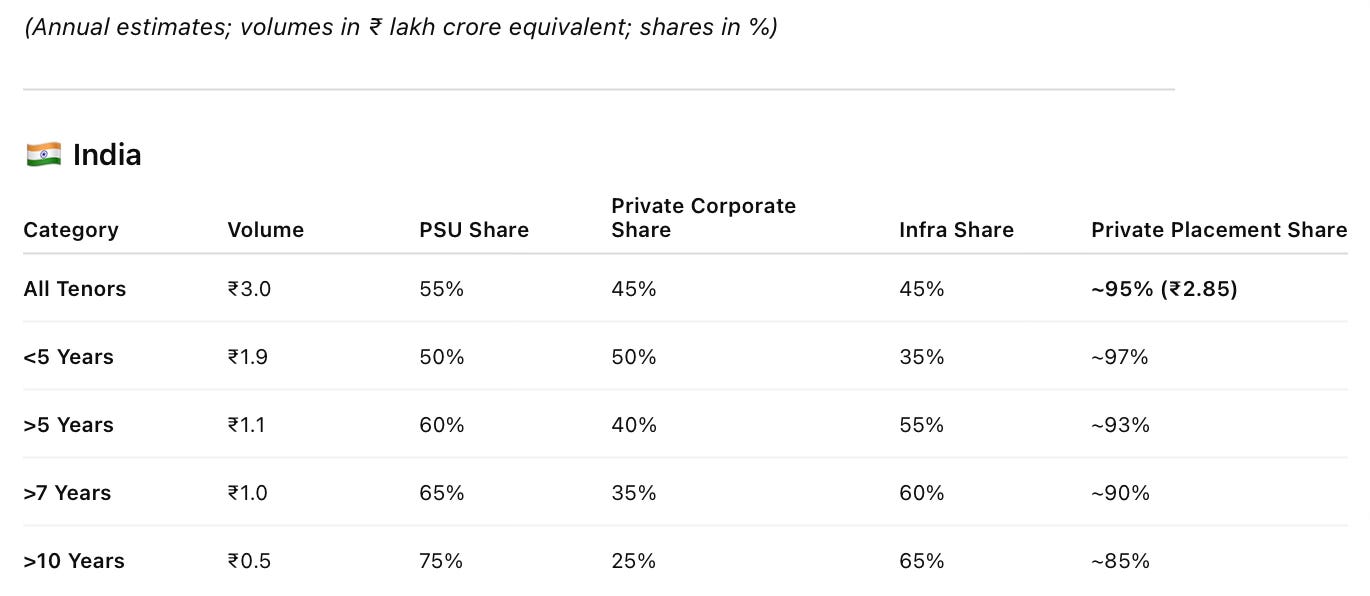
In the absence of readily available longitudinal data, I ran some queries on ChatGPT to estimate the landscape of India’s non-financial bond markets, issued by public sector units and private corporates, across different bond tenors, the respective shares of infrastructure and private placements in each tenor category, and comparison across countries. The data used are from RBI/SEBI, SIFMA (the US), AFME/ECB (Europe), and BIS/Brazilian Central Bank. 

India’s bond market is dominated by private placement, skewed towards the short tenor, and issuance by the PSUs. A positive feature is the high share of infrastructure issuances.

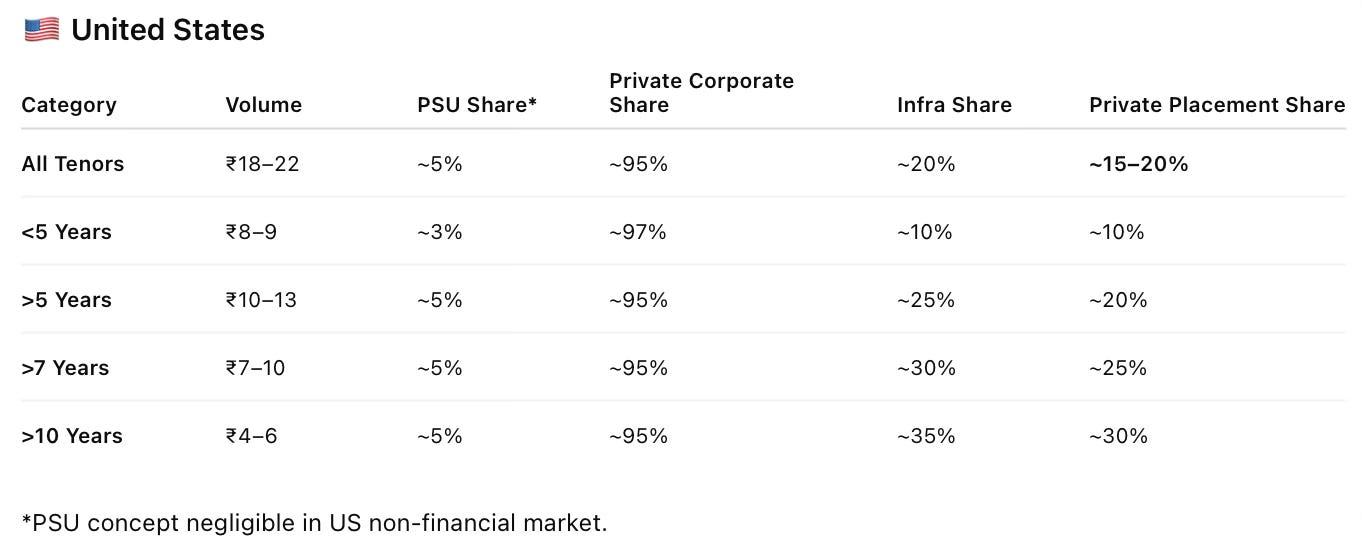
The same result for the US showed up as below. The US corporate bond market is mostly through public placement, dominated by private corporates, and with the majority in longer tenors. The volume below is in Rs lakh crores.

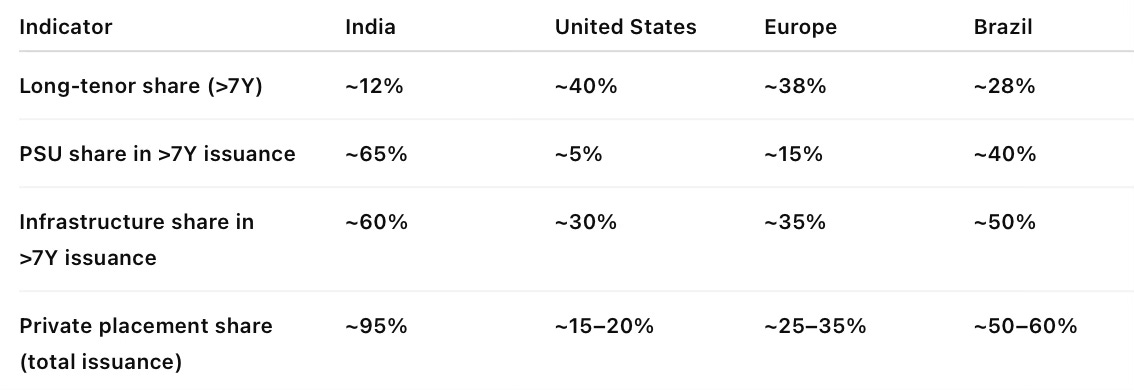
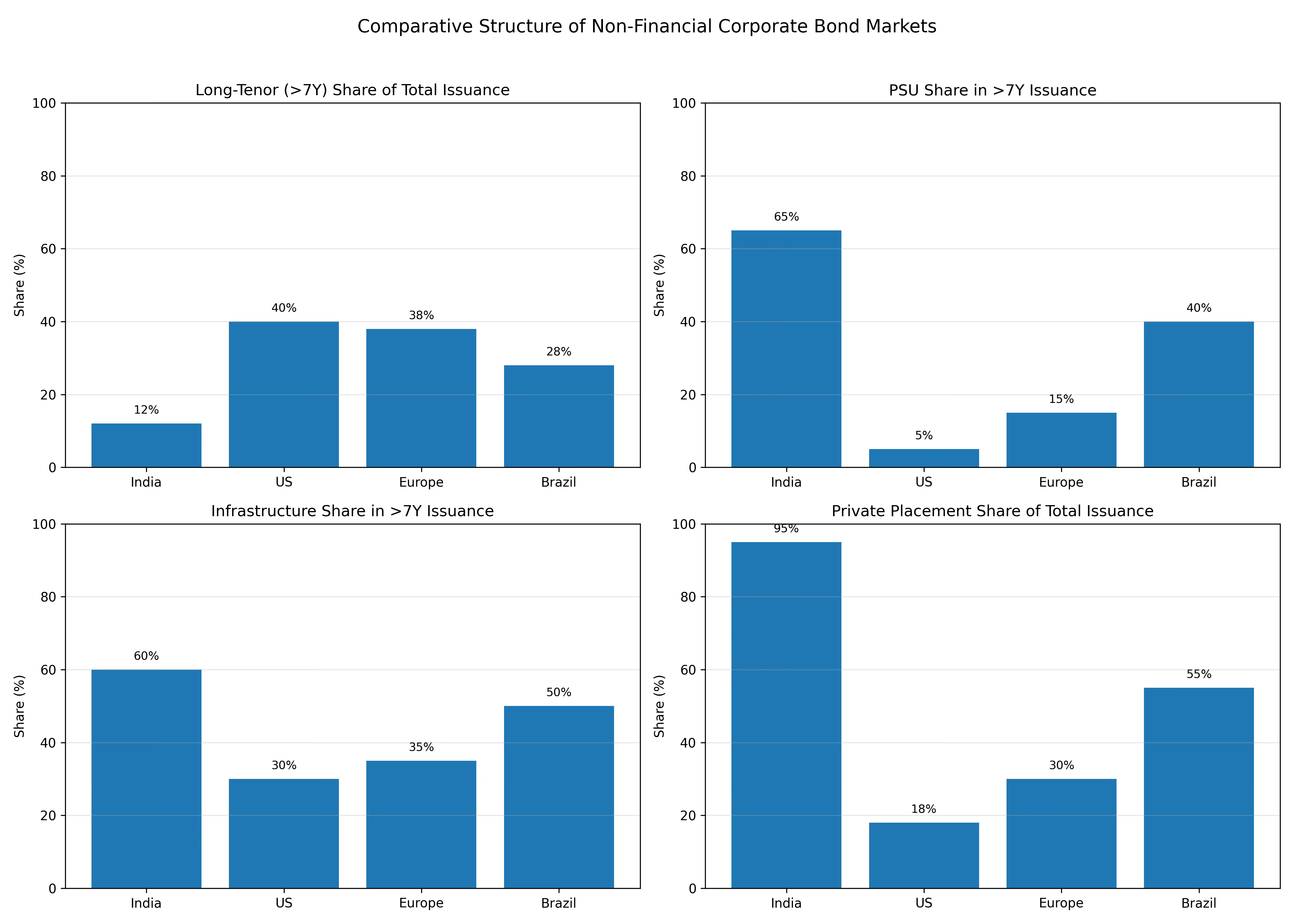
The table below compares across India, the US, Europe (including the UK), and Brazil. India stands out for its dominance in private placements, a high share of public-sector issuance, and a very low share of long-tenor bonds. The private placement market is dominated by AAA and AA bond issuances, thereby squeezing out the vast majority of potential issuers. All three trends must reverse to deepen and broaden the bond markets.

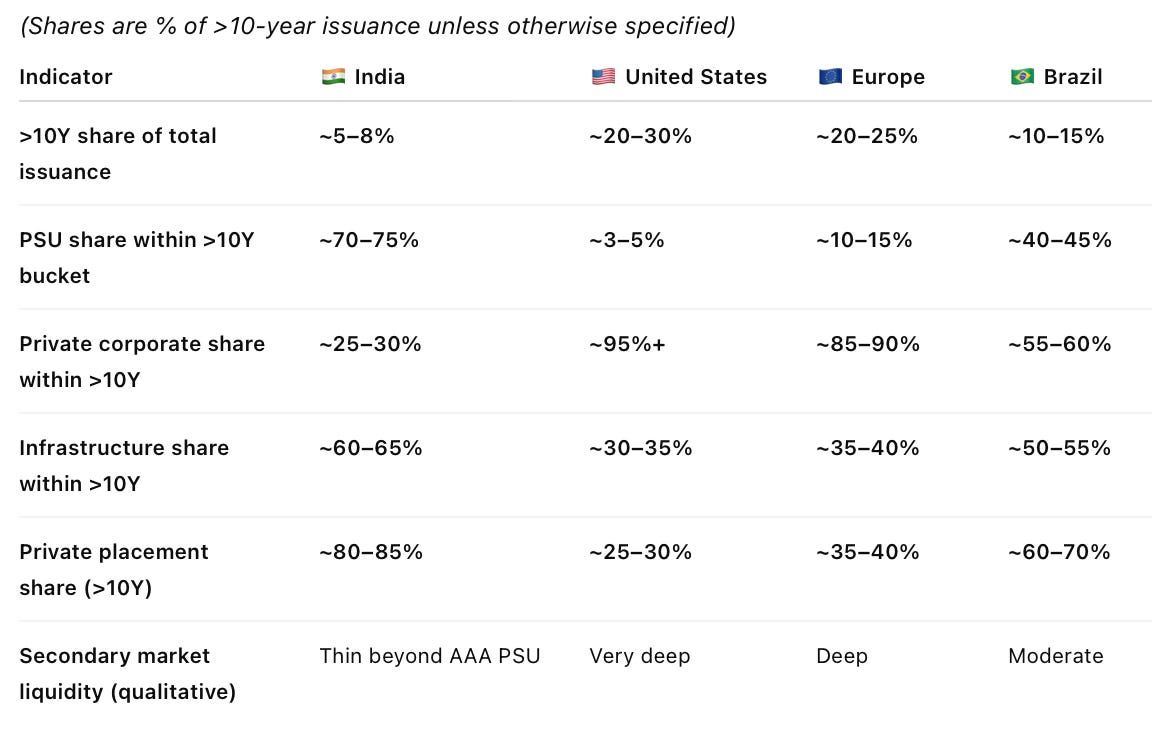
How does the table look for tenor greater than 10 years?

Putting all of them together, we get the following charts. Brazil does a very good job of mobilising long-term infrastructure funds, in absolute value (see latter tables). 

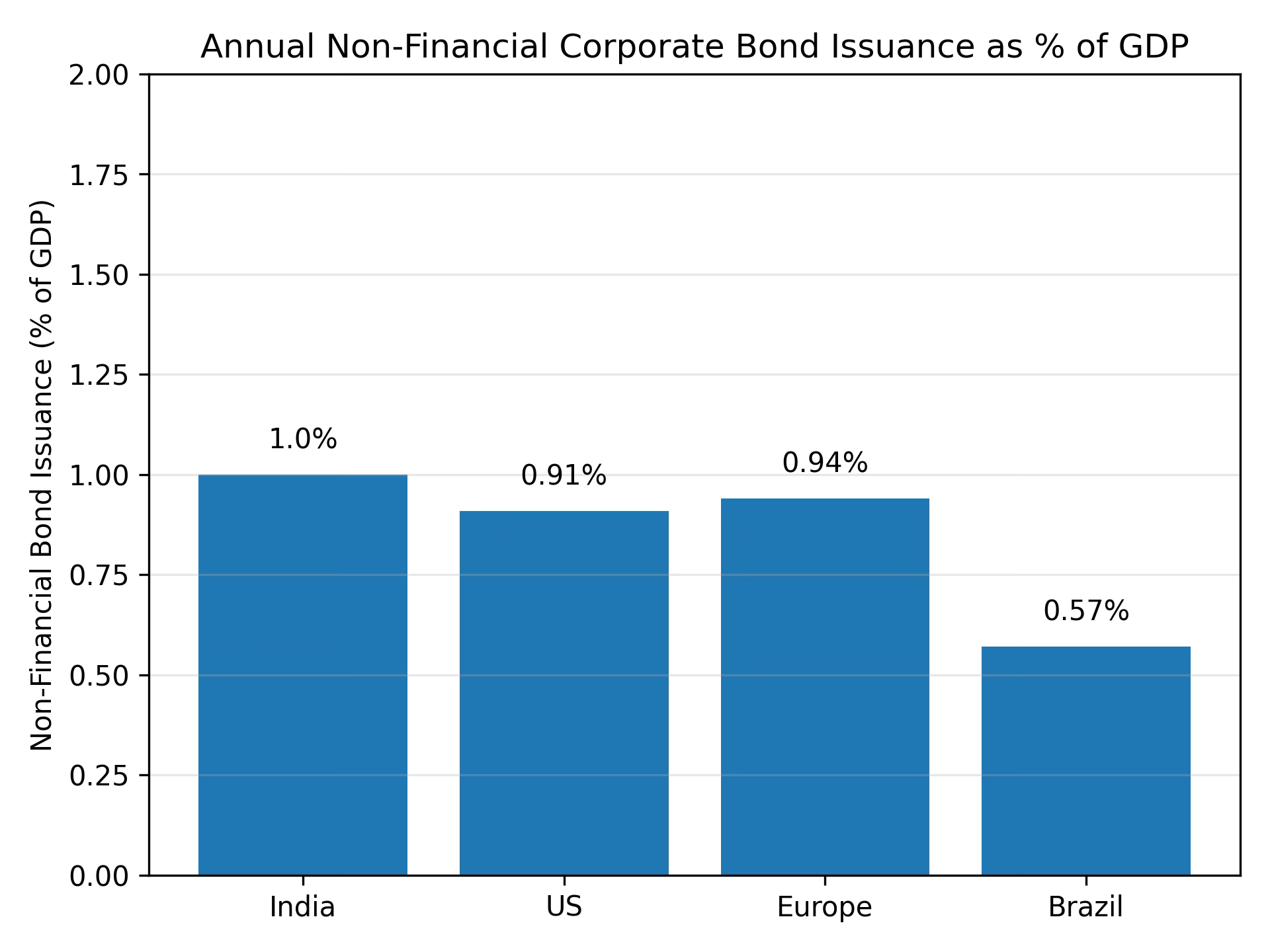
As a percentage of GDP, India does well in non-financial corporate bond issuance. Its challenge, as aforementioned, is with maturity depth and structural composition. 

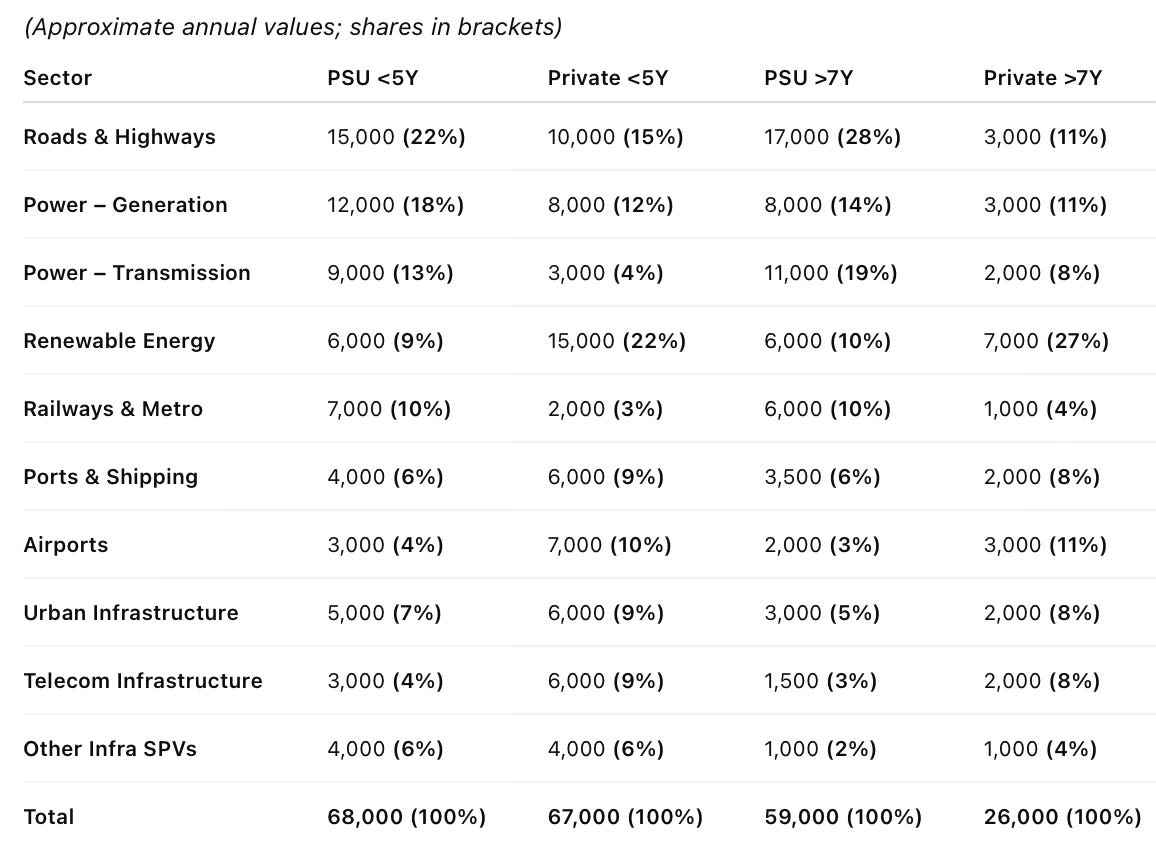
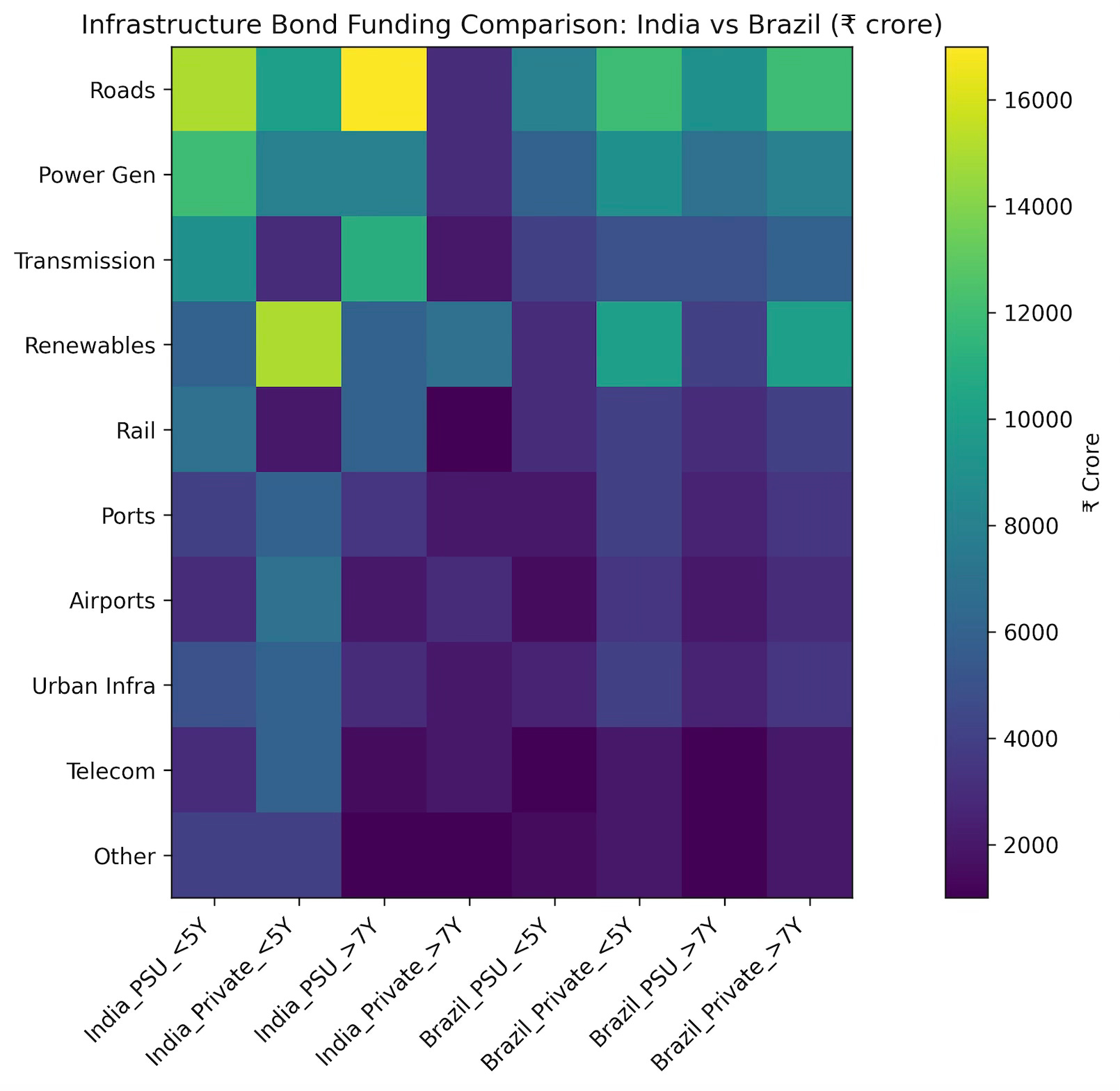
The total infrastructure sector bond raising is estimated in the range of Rs 2.2-2.4 lakh Cr, of which about Rs 1.3-1.4 lakh Cr is with tenor less than 5 years (55% raised by PSUs), and Rs 80,000-90,000 Cr with tenor more than 7 years (65% by PSUs). The table below has the approximate values in Rs crore.

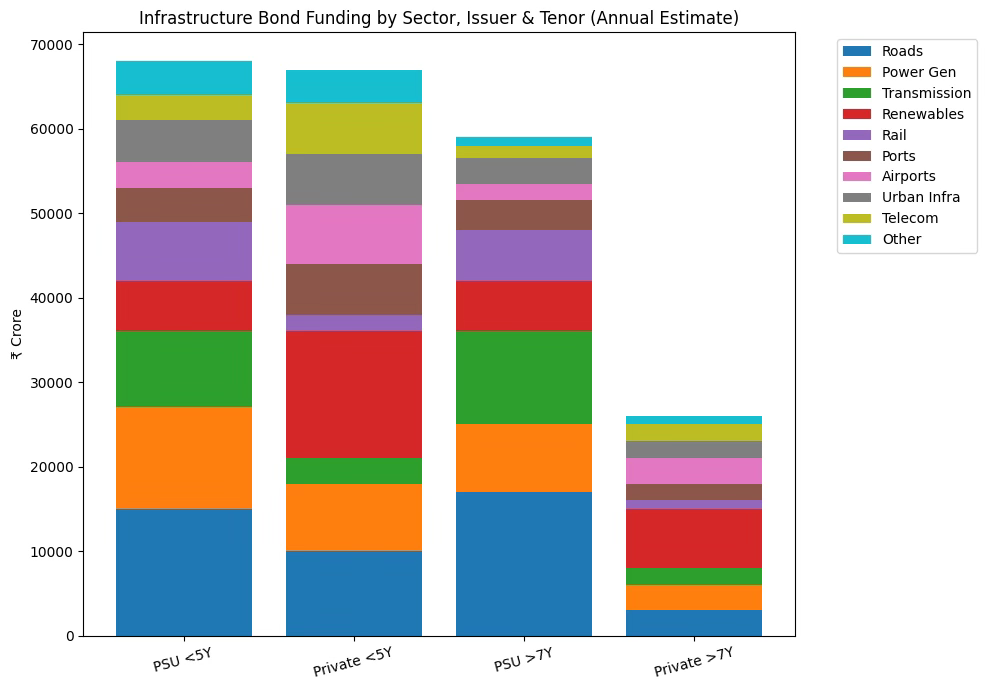
Below is the graphical representation of the estimates.

As can be seen, the usual suspects - roads, power generation (thermal and renewables), power transmission, railways, ports, and airports - make up most of the bond issuance. 

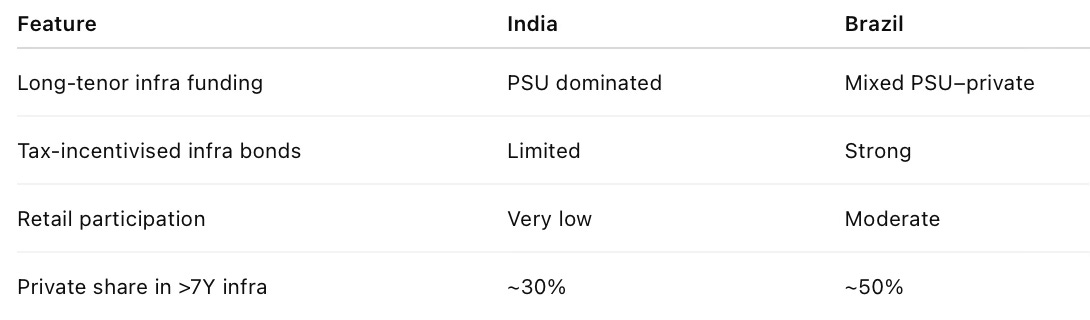
A comparison with Brazil is instructive. Brazil has managed to develop a deeper and broader market for private corporate bond raising, including in infrastructure. In 2011, it introduced the “Debêntures Incentivadas” (Infrastructure Debentures) to finance infrastructure projects. It offers tax exemption on interest income, is mostly issued for 7-15 years, and is used in transport, energy, sanitation, and renewables. 

This is a summary of the comparison of the infrastructure bond markets in India and Brazil.

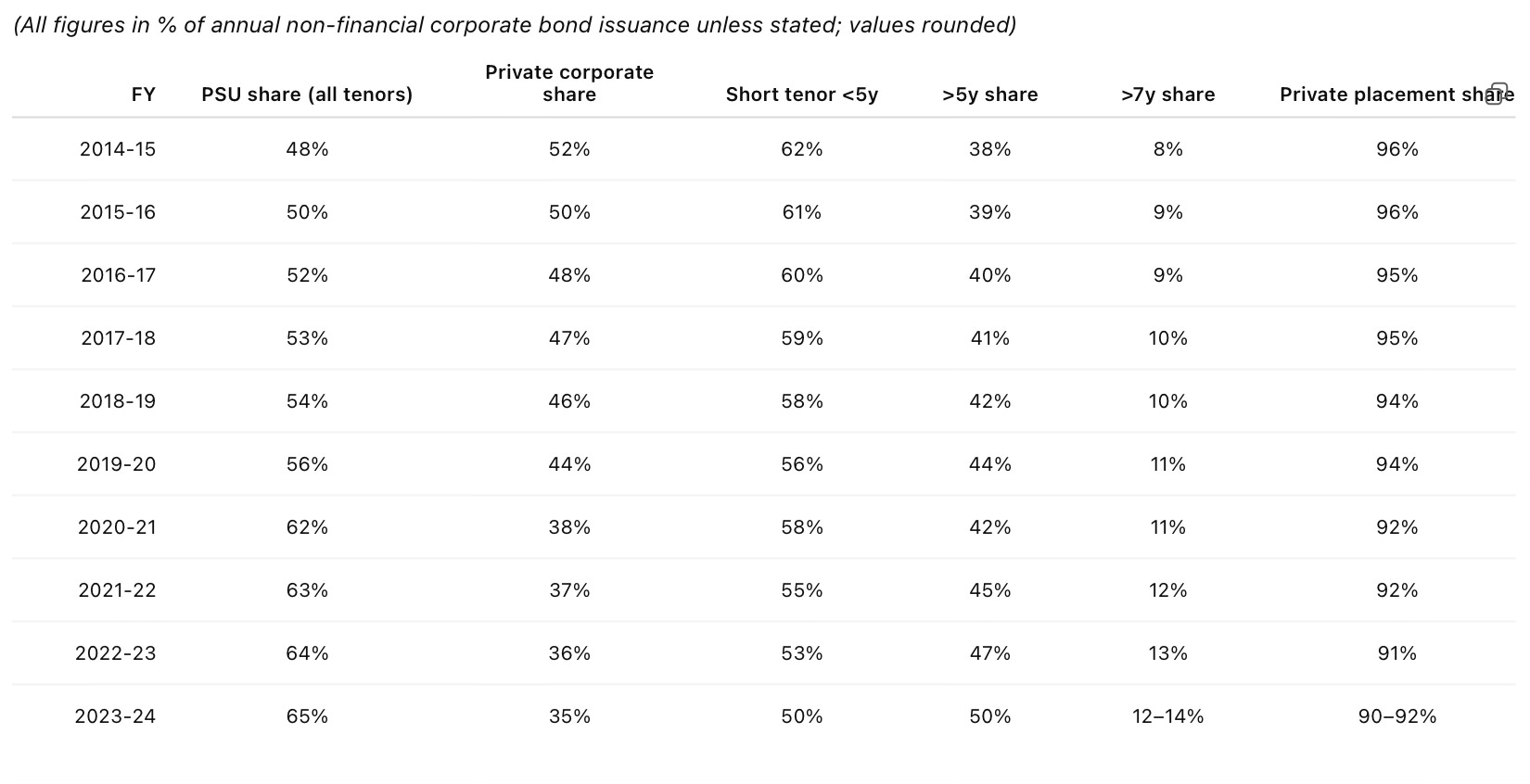
What have been the trends over the past ten years? Disturbingly, the share of private corporates in bond issuance has been falling, declining from over half to about a third. This may have been due to the focus on public capital expenditures through NHAI, Railways, PFC/REC. The share of long tenor bonds (>7 years) has risen only slightly from 8% to about 13-14%. Private placement route has remained stubbornly in the 90-92% range.

Given all the above, what are the policy takeaways?

Policy actions are required on at least three fronts. One, prioritised efforts to expand public placement, thereby ushering in greater liquidity and deeper markets. A practical intermediate pathway would be to promote the listing of existing privately placed bonds. 

Second, diversify the issuer base away from PSUs by encouraging private infrastructure developers to issue long-term bonds by offering policy support through credit enhancement schemes, partial guarantee mechanisms, takeout financing, etc. The DFIs (NIIF, IIFCL, and NaBFID) should have a specific mandate to derisk infrastructure finance instruments. 

Third, increase the tenor of bonds by expanding the use of partial credit guarantees, first-loss facilities, and blended finance models. This should also be complemented by demand-side measures to expand the pool of long-term buyers like pension funds, retirement savings accounts, and insurance funds. 

On all these, the policy actions will be in the form of numerous small steps to simplify disclosures, documentation, listing requirements, listing processes, standardisation of bond structures, improvements on rating transparency, and so on. It must be complemented with initiatives like credit enhancements and guarantees, increasing the proportion allocated to long-term bonds for pension funds and insurers, revisiting risk-weights on long-term bonds, etc.

For references, I blogged here that India could take the lead in demonstrating how DFIs can work on both the demand and supply sides to de-risk infrastructure projects and crowd in long-term capital, respectively. I blogged here on how to reduce the cost of capital for foreign investments in the infrastructure sector, here on how to revise the credit rating framework in general, and here on de-risking and lowering the cost of capital of bank loans and de-risking the use of guarantees to crowd-in bank financing. All of these ideas are consolidated in this long paper