Substack

Showing posts with label PPP. Show all posts

Saturday, July 25, 2026

Weekend reading links

1. SpaceX IPO is ample proof that the Chinese wall between equity research and investment banking in IB firms is a myth.
You might expect wildly divergent views on a company as speculative as SpaceX. Here the underwriters disagreed only over the scale of the upside. Sceptical voices came from outside the syndicate. Morningstar, for example, valued the shares at $63.

This is now dead

When the dotcom bubble burst, regulators uncovered emails showing that Wall Street analysts were privately disparaging stocks they were publicly touting. A 2003 global settlement between banks and regulators on analyst research imposed sweeping restrictions. It barred investment bankers from influencing analyst compensation, tightly controlled communications between research and banking, and banned analysts from IPO pitches and roadshows. New York Attorney General Elliot Spitzer’s premise was that shielding analysts from bankers would deliver truly independent — and better — research. On one level, the reforms succeeded. Banks have constructed a robust compliance apparatus to wall off research from investment banking. “Chaperones” now police interactions between analysts and corporate finance to prevent even the appearance of pressure. The Spitzer global settlement formally ended last December in favour of more flexible rules overseen by an industry association.

It is hard to see how SpaceX shares can avoid a cratering.

About 30 per cent of the roughly 640mn SpaceX shares available to trade have been borrowed to sell short, up 10 percentage points over the past 10 days, highlighting how traders are becoming increasingly sceptical of the company’s market prospects... About 900mn further SpaceX shares could become available to trade as soon as next month when certain lock-up provisions for pre-IPO investors expire. Traders who doubt there is sufficient demand for the deluge of extra equity are cashing out now as a result, market participants say.

2. After reducing their hiring last year, firms with jobs exposed to AI are planning to increase their entry-level hiring this year, but they come with a "seniorisation". 

Candidates for starter roles in the most AI-exposed industries are now expected to show a mastery of the skills traditionally demanded of more seasoned staff, such as data-driven decision-making and people management... Eleanor Lightbody, CEO of Luminance, which develops AI for the legal profession, says these middle layers could be squeezed out altogether, “because we are going to hire more juniors, who are really going to understand how AI works, and more seniors [are] staying in the business because [by using AI], they can be more productive and have more capacity”. The challenge for job seekers is that it is hard to find entry-level jobs that allow them to develop the higher proficiency that seniorised roles now require... Reliance on AI is increasing the demand for distinctively human “soft skills” — or “power skills”, as some are now calling them — such as creativity, empathy, judgment and networking ability. PwC’s jobs report found that new tasks added to job adverts for AI-exposed roles were two and a half times as likely to call for such capabilities.

3. Very good description of how China became so dominant.

It enticed unsuspecting giants such as Apple, Tesla, Motorola, and Lucent with low-cost logic. When sufficient local manpower was trained, subcontractors developed, and stakes became important, China applied the squeeze. China would break contracts, cancel licences, coerce the transfer of technology, control pricing, withdraw incentives, force equity participation, conscript technology and evict them. Huawei, BYD, CATL, and SAIC are some examples of the resulting indigenous giants that emerged. In an act of silent invasion, conscripted technologies have been converted into military capability. It is dominant as a supplier of several raw materials, such as rare earth minerals, gallium, graphite, and lithium; a dominant buyer of soya from Brazil and iron ore and wines from Australia; a financier of BRI projects; and a provider of processing technologies for Chilean copper and lithium in select South American countries. With this web of dependencies, it can choke several factories.

4. Janan Ganesh feels that for Britain to start making real reforms, the incoming PM Andy Burnham must do more welfare and subsidies and discredit the whole .ideology.

What is the precedent for a rich democracy doing pre-emptive economic reform? Which nation ever made controversial structural changes — involving winners and losers — to prevent a crisis, rather than in response to one? Southern Europe needed the Eurozone panic of 2009 onwards to make spending cuts. Hawke, Keating, Margaret Thatcher and Ronald Reagan were reacting to 1970s stagflation. François Mitterrand in 1983 was reacting to a market shock that to some extent he’d created. Reform only happens when it absolutely has to happen. So try again, prime minister. Fail again. Fail worse.

5. Japan embraces a more proactive government-driven economic growth policy.

Sanae Takaichi's cabinet approved a policy blueprint that targets a combined $2.3tn of public and private sector investment between now and 2040 in 17 chosen sectors. Ministries will be able to make budget requests without upper limits; budget construction, according to the document, will be “fundamentally” changed. Much of the blueprint is about economic security, but a refreshingly large amount is about growth... possibly the most meaningful lines in the new strategy place Japan’s future efforts in the global context. “Among advanced countries, there is a big trend of the government and private sectors working together on large-scale, long-term industrial spending,” it read... The government would strive, the document further promised, to meet the challenges of “the era of great global competition between industrial policies”... 

On the same day that the blueprint was agreed, the Ministry of Economy, Trade and Industry produced separate guidance for growth investment — an effort to encourage Japan’s 4,000-odd listed companies to shift more of their endeavours towards growth and a witheringly blunt critique of how matters are at the moment. Within Japan’s 350 largest companies (by sales), 65 per cent of invested capital remains locked in what it calls value-destructive segments, according to METI’s research. In the US, the equivalent ratio is 39 per cent. Both Takaichi’s blueprint and the new METI guidelines are attempting a new version of industrial policy that not only seeks to spur growth, but places a huge bet on the government’s ability to encourage companies in a way that market forces have not.

6. Kevin Warsh is trying to scale down forward guidance

“Financial market prices are probably the most important source of information to guide central bankers,” he said at his inaugural press conference last month. “But when all the financial markets are doing is reflecting back what we’ve said, then we’re taking the most important source of information and we’re being blind to it.” Many agree with the Fed chair’s view that central banks’ focus on predictability has led to a world in which markets obsess more over what officials say than what is actually happening in the economy. “Forward guidance has turned markets into a mirror,” says Ajay Rajadhyaksha, global chair of research at Barclays. “The Fed watches markets; markets watch the Fed. And no one’s actually watching the economy.”...
Recent research by the US central bank suggests its decisions also have an outsized impact on equity markets, leading to big changes in how investors price stocks. Advocates of forward guidance say it helps avoid the sort of surprises for the markets that feed overall volatility and eventually raise borrowing costs as investors demand greater compensation to stomach market swings. Warsh and his allies counter that the attempt to pacify markets simply encourages greater risk-taking, damping short-term volatility but storing up bigger shocks for later. The debate is all the more important because of the backdrop: the surge in borrowing over almost two decades. Government debt around the world has risen sharply following the global financial crisis, the Eurozone crisis, the pandemic and the wars of the 2020s...

Some analysts highlight the so-called taper tantrum of 2013 — when markets were unnerved by Fed statements about its plans to shrink its balance sheet as a result of officials’ false sense of certainty. Others link the 2023 collapse of the US’s Silicon Valley Bank to central bankers’ previous pledge to keep interest rates low.

This is a very important factoid about Fed communications.

Between 1990 and 2022, an era in which the status and prominence of central banks steadily grew, US 10-year government bond yields fell by more than 7 percentage points. All of the downward moves throughout that period took place during the three days around Fed meetings, rather than in response to political events or economic data. But the relationship broke down after the Fed appeared flat-footed on inflation in 2022. The Riksbank data shows that the central bank’s meetings had little to do with the subsequent rise in yields.

An important concern for the bond markets is the sharply increased volume of Treasuries held by hedge funds that use leverage to bet on tiny differences in interest rates. 

The Fed estimates that large hedge funds’ holdings of US Treasuries doubled between 2023 and 2025, faster than the growth of the market as a whole. Such funds now own more than $2.5tn in Treasuries, according to the US central bank and US Treasury data. Such sums dwarf China’s official holdings — not an exhaustive account of the country’s exposure — which have fallen from $1tn in December 2021 to $659bn in May 2026, according to US Treasury statistics. Moreover, the Bank for International Settlements, the central bankers’ bank, has warned that the hedge funds might have to dial back their stakes in government bond markets even quicker than they arrived — a possibility it describes as one of the most troubling financial stability risks in the world today.

Then there are the other concerns for bond markets.

The Bank of England said this month that AI hyperscalers borrowed more in the first half of 2026 than in the whole of 2025. So far this year they have accumulated as much new debt as the UK government. An interest-rate surprise from the Warsh Fed might not only unsettle Treasury yields but set off a vicious circle of margin calls — when a sudden price movement in assets bought with borrowed money requires an injection of capital — and fire sales by hedge funds that could create a dash for cash.

7. A cautionary tale on the difficulty of private enterprise establishing and managing entire railway systems comes from the example of Brightline Express, which connects Miami and Orlando, and became operational in 2023.

Brightline traces its roots to 2007, when Edens’ Fortress spent $3.5bn to acquire Florida East Coast Railway, then a listed freight transport company. Its tracks spanned from north to south in the Sunshine State, and construction for what would become Brightline began in 2014, with the Orlando service beginning a decade later. In a 2024 bond prospectus, Brightline executives forecast that by 2026 they would have nearly 8mn annual riders, split roughly evenly between the Orlando-Miami route and a more local service in South Florida. That base of customers was expected to generate $700mn in revenue... Even with customer levels up 16 per cent year to date through May this year, ridership will struggle to hit 4mn this year. Operating income has at best reached break-even before debt service costs... 

The promoter Wes Edens’ Fortress wrote off its investment long ago, and it is now hedge fund bondholders who are jockeying for control of Brightline. But alongside distressed debt specialists such as Nut Tree Capital Management, Aristeia Capital and Redwood Capital Management, there are a handful of more staid asset managers including Nuveen and First Eagle also at the table. As well as corporate bonds issued by subsidiaries, the group’s debt stack includes more than $2bn of traditional municipal bonds, half of which are guaranteed by a bond insurer.

Saturday, June 20, 2026

Weekend reading links

1. PE firms sitting on $4 trillion of unsold assets, on investments largely made between 2020 and 2022 when rates were slashed to zero, are finding creative ways to offload them. Sample this

Blackstone is marketing a so-called collateralised fund obligation that will bundle more than $2bn of stakes in leveraged buyout funds into bonds to sell to investors and insurers, according to people familiar with the matter. The deal would provide an infusion of cash to investors in a Blackstone Strategic Partners fund, the firm’s unit that invests in other private equity groups’ funds. It is unclear if Blackstone will ultimately go ahead with the securitisation or seek to sell the stakes in a secondary transaction, one person briefed on the matter said... The vehicles, which are sliced and diced to give investors exposure to different levels of risk and return, have boomed. Issuance of CFOs soared to a record of $25.9bn last year from a modest $4.8bn in 2021, according to credit rating agency KBRA.

2. This is a brilliant articulation of the problem with articulating something purely in terms of absolute numbers and aggregates.

In his novel Hard Times, Charles Dickens described a girl called Sissy, who was having a terrible time in her lessons. Her schoolmaster told her to imagine that her schoolroom was a nation in possession of “fifty millions of money”. Wouldn’t that mean it was a prosperous and thriving state? “I said I didn’t know,” she relayed afterwards to a friend. “I thought I couldn’t know whether it was a prosperous nation or not, and whether I was in a thriving state or not, unless I knew who had got the money, and whether any of it was mine. But that had nothing to do with it. It was not in the figures at all.”

3. Interesting story about how old companies are reinventing themselves to profit from the AI-boom.

AI servers must be more tightly linked together, increasing the need for advanced cabling and optics. Shares in Corning, the 175-year-old inventor of Pyrex glass that also supplies screens for Apple’s iPhones, have increased by more than 270 per cent in the past year after it signed deals with Meta and Nvidia to supply optical fibre cabling to AI data centres. The vast amounts of electricity needed for AI training are also fuelling demand for specialised power management, high-voltage electronics and cooling technologies. This has led to big interest in traditional suppliers of electrical equipment, typically deployed in residential and industrial projects. Eaton, an Ohio-based power management company, received 240 per cent more data centre orders in Q1 this year...
 
French electrical equipment maker Legrand has doubled its revenues this decade with half of the growth coming from data centres, which now make up more than a quarter of its turnover. Air conditioning and liquid cooling — using water to stop chips from overheating — are in demand too. Shares in AC maker Comfort Systems USA have shot up 260 per cent over the past year, while Schneider Electric bought a stake in data centre liquid cooling specialist Motivair for $850mn last year. Utilities are rushing to supply AI companies with power — including Spain’s Iberdrola, a leading supplier of power contracts to tech groups in Europe, according to Pexapark data, and Entergy in the US, whose share price hit a record high after a $10bn deal with Meta... Several generator and engine companies have also pivoted to supplying data centres, including Caterpillar, Boeing supplier Howmet Aerospace, Finnish ship engine maker Wärtsilä and Baker Hughes, which formerly focused on oilfield services.

4. China demographics facts of the week.

This year’s cohort of gaokao-takers were mostly born in 2008, a year of 16.1m births. By 2025 births had more than halved, to just 7.9m. The demographic cliff is already visible in nurseries, which saw pupil numbers plummet from 46m to 32m between 2022 and 2025. Numbers in primary schools have also started to thin. Inevitably, over time, secondary schools and then colleges will follow.

And technology adoption

A survey of 322,000 students last year by the China National Academy of Educational Sciences, a state-affiliated think-tank, found that 85.6% of them had already tried using AI to complete their homework. On popular apps such as Zuoyebang (“Homework Help”) and Yuanfudao (“Ape Tutoring”), pupils snap photos of questions and ai walks them through the solutions. (Teachers are using similar technologies to help mark homework.)

5. Public moods on the role of government in the UK - 70% support nationalising energy and 82% water.

Rail subsidies have been rising, £12bn in operational support in 2024-25, up in real terms from £2bn in 2000-01. 
6. Indian economy facts of the week.
The World Trade Organization data show that for non-agricultural goods, the share of tariff lines in the category 10-15 per cent increased sharply from 1.4 per cent to 33.5 per cent between 2014 and 2024 and for the tariff category 15-25 per cent from 1.7 per cent to 14.9 per cent, while the share of tariff lines in the category 0-10 per cent fell steeply from 90.5 per cent to 42.5 per cent over the same period.

7. From Thomas Astbridge's book on the Black Death 

In its most intense phase, from 1347 to 1353, the Black Death killed more than 100mn people, or about half the population in the areas infected, Asbridge estimates. This makes it more lethal than two other great pandemics — the 6th-century Plague of Justinian in the Mediterranean and the pestilence that swept across Asia from the mid-19th century until the aftermath of the second world war — and far worse than Covid-19 in our times... Asbridge demonstrates that the Black Death was probably more devastating in cities such as Cairo and Damascus than in, say, Constantinople or Florence. In Cairo, a metropolis of 500,000 people, almost 10 times larger than London’s population, perhaps 250,000 died, Asbridge suggests.

8. On the role of luck in football tournaments.

According to one study of historical matches, the chances of the team with the worse record winning was 45 per cent in football, compared with just 36 per cent in America’s National Football League. (Yes, this pep talk has statistics. Bite me.) The knockout structure raises the role of chance, as just one dodgy penalty can crash a team out of the competition. According to numbers crunched by James Tozer of Prospect, a sports analytics company, betting odds gave the top four teams in the most recent Premier League a combined 89 per cent chance of winning (after adjusting for bookies’ ability to take advantage of fans’ optimism that their team would win). In the World Cup an upset is more likely, as that figure is only 48 per cent.

9. Aldi effect, as the discount grocery retailer seeks to expand aggressively, as it envisages 4000 stores at an investment of $9 billion in a US market where consumers are facing higher prices due to persistent inflation.

Credit card data analysed by the bank found that when an Aldi store opened, it shaved an average of one percentage point off annual sales from competitors within a 10-mile radius... Aldi prospered in postwar Germany under brothers Karl and Theo Albrecht before a disagreement led to a split in the 1960s. One offshoot, Aldi Süd, oversees Aldi’s US business after opening the first store in Iowa in 1976. The other, Aldi Nord, owns the quirky US grocer Trader Joe’s. The discounter’s stores are austere places with only about six staff on duty. They are designed for maximum efficiency: groceries are shelved without leaving their cardboard shipping trays and oversized bar codes are printed on packing so checkout operators can scan at pace. Customers must deposit a coin to obtain a shopping trolley, which is refunded if they return it. Operating cost savings fund the chain’s low prices... Aldi’s compact stores, which stock only about 2,000 product lines, are often located near competitors such as Walmart, whose large-format stores carry about 120,000 products, including low-priced groceries.

10. Andhra Pradesh shrimp production facts.

India exports approximately 8 lakh tonnes of shrimp a year, with Andhra Pradesh accounting for over 60 percent of production. The state accounts for 80 percent of the country’s shrimp exports and 34 percent of marine exports, valued at around Rs 21,246 crore annually. The state has 2.5 lakh aqua farmer families, of which 2 lakh are small and medium farmers. Another 30 lakh people depend on allied sectors. According to the Union Ministry of Commerce and Industry, India exported a record 17,81,602 MT of seafood worth US$ 7.38 billion (Rs 60,523.89 crore) in 2023-24, of which frozen shrimp alone accounted for 92 percent — a significant share from Andhra Pradesh.

11. India's PPP pioneers

GVK’s 216-megawatt (Mw) Jegurupadu plant became an early proof-of-concept under a power purchase agreement. IL&FS built a 12-km toll road between Rau and Pithampur in Madhya Pradesh, marking India’s first private toll concession.

12. This is a true success story for the Indian economy.

Between 2020 and 2026 the number of Indian retail investors rose from around 40m to 130m.

Thursday, December 19, 2024

The forbidding trilemma of infrastructure finance

I have blogged extensively on the water privatisation in the UK. This is about the ongoing crisis at Thames Water, this and this are about the balance sheet of UK water privatisation, this is about regulatory failure/capture and returns maximisation incentives of investors, and this is about the UK’s infrastructure privatisation in general.

After teetering on the brink of default, Thames Water has managed to get a proposal from a bunch of creditors for a £3bn emergency loan, enough to cover operations till at least next October or even May 2026. The loan has received government approval. But the emergency loan comes with a headline interest rate of 9.75 per cent, and the company spent over £50mn on advisers in raising the debt. It’s also in the process of finding new equity investors, and restructuring its complex capital structure. 

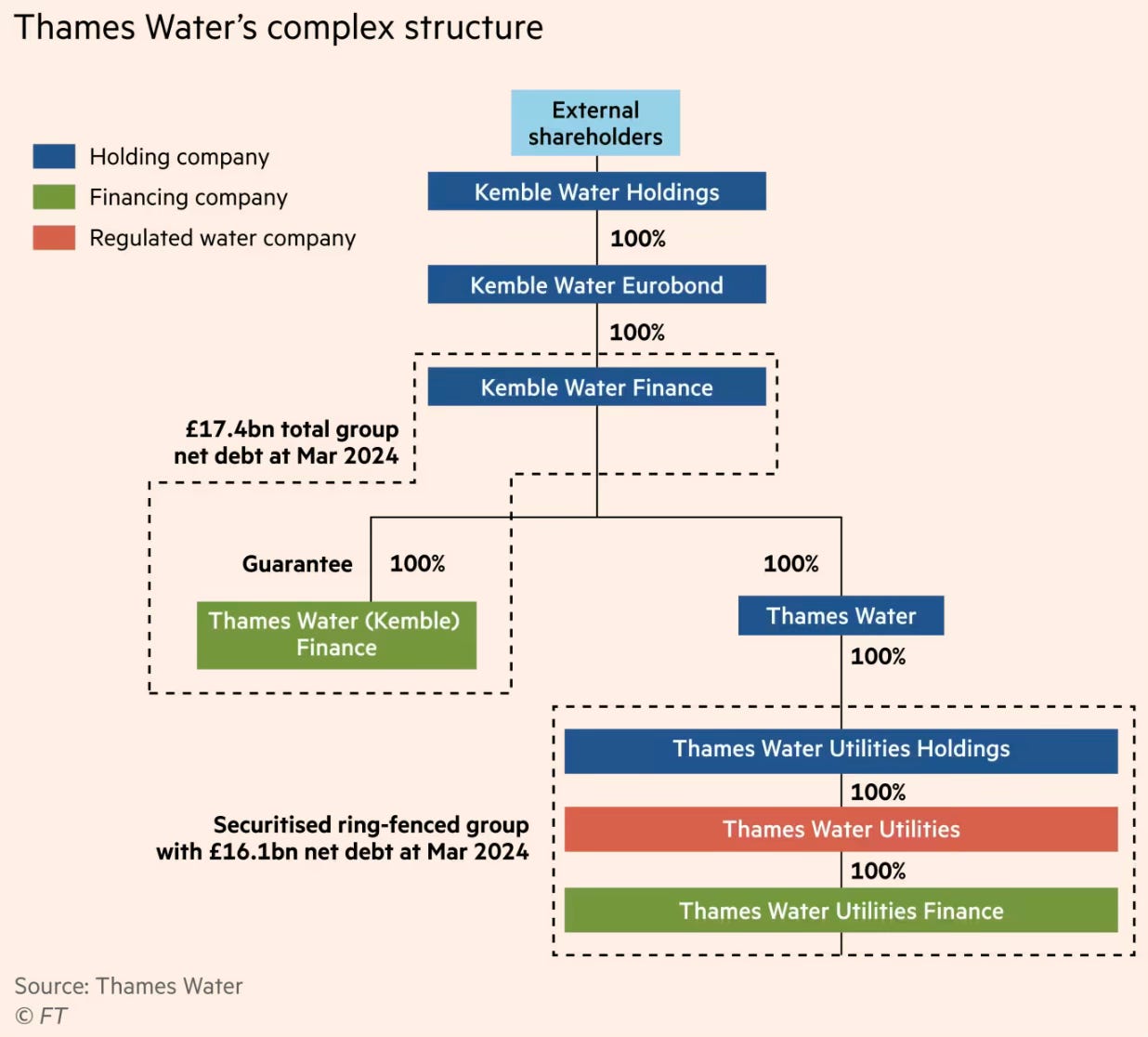
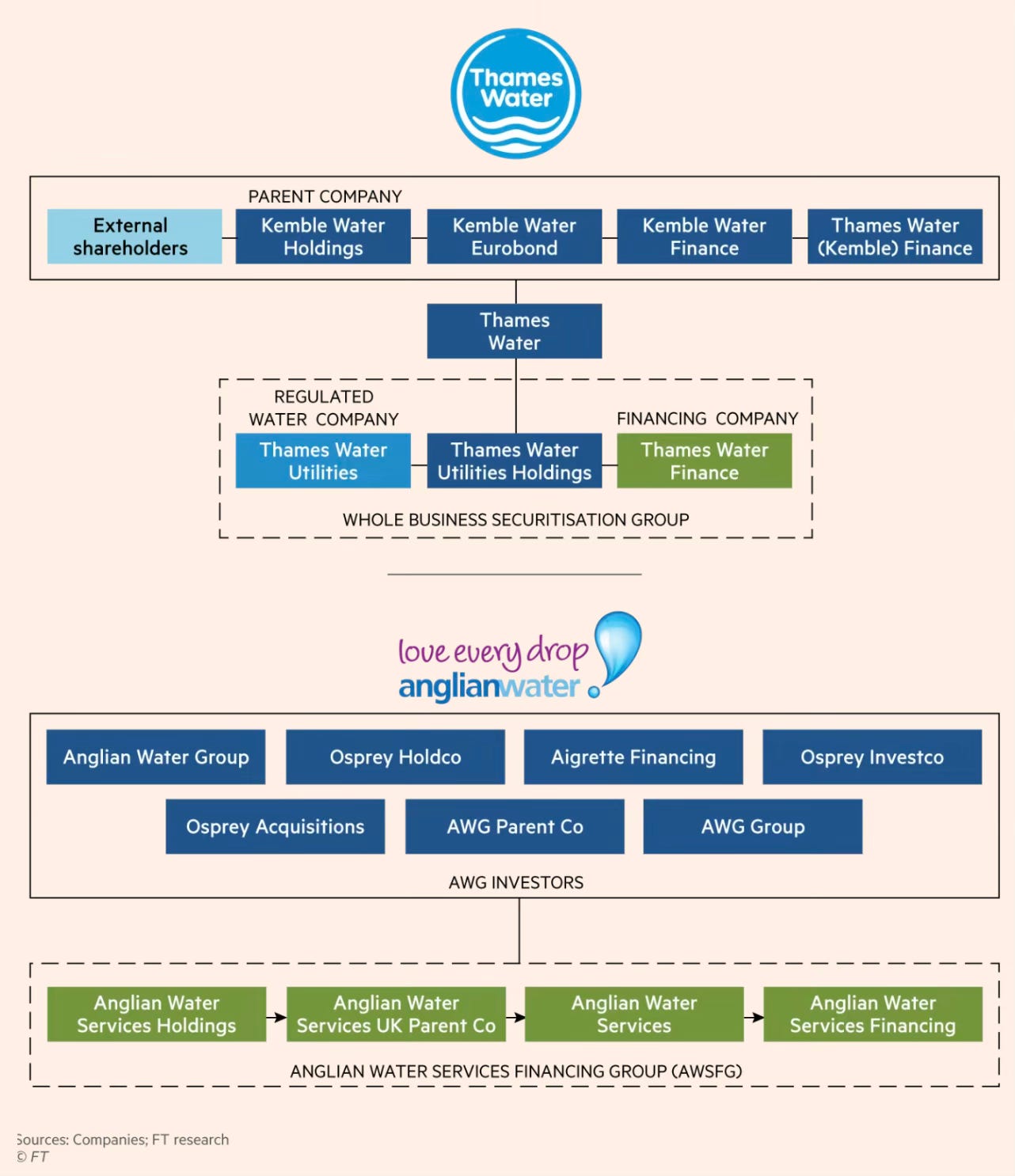
This is the latest update on the Kemble Water Holdings structure.

However, the government approval for the emergency loan proposal has been criticised by Sir Dieter Helm, who believes it’s a case of endless sticking of plasters. He has instead proposed that Thames Water be placed under a Special Administrator to allow a proper restructuring and enable the management to focus on operations instead of financing negotiations. 

In a paper explaining his views, Helm makes some very important points that are of relevance not only to the present case but to infrastructure and public-private partnerships in general. He has argued that the emergency loan is not only not going to fix Thames’s problems but also risks spreading the contagion across the rest of the water industry. He writes

Thames will probably get sold at a very steep discount in a process controlled by its A-class bondholders, and will probably get broken up. Yet even if this turns out to be a potentially very profitable opportunity to purchase the business for a deeply discounted value, it does not bode well for Thames’s future. The private interests of the sellers in the short term should not be confused with the public interest that a Special Administrator would pursue… it is important to understand why Thames is not a self-righting ship; why it is unlikely to emerge as an efficient water and sewerage company over the next decade; and why the sticky plasters may serve to gradually undermine it further.

He has blamed the crisis at the Thames on a combination of bad management, bad regulation, and the failings of successive governments. He points to fundamental incentive distortions and perversions that detracted the management from working to realise the objectives of privatisation. 

Like all the water companies, Thames was privatised with zero debt (indeed a small cash injection was provided upon privatisation). It (and the other water companies) were privatised in order to run their networks and infrastructures better (bringing private sector cost disciplines) and to raise finance to pay for capital investments on the basis of borrowing so that current customers (and current voters) would not have to pay. The Thames model, like that of the other companies, was pay-when-delivered, not pay-as-you-go.

This gave two tasks to the management of all the companies: run the business more efficiently; and raise finance for capital investment. Thames has turned out not to have done the former very well; and it has used the balance sheet to securitise the business, rather than for the objective at privatisation, which was to borrow solely to invest. In both, it has been at the outer edge of water company performance and gearing… it is worth examining what the incentives have been and why cost-cutting has had priority over capital maintenance. RPI-X as a regulatory rule had the advantage of simplicity at the outset. The regulator would set the (fixed) prices ex ante every five years (originally it was supposed to be every ten), and the companies would maximise profits by minimising costs.

As was witnessed across the privatised utilities, this deceptively simple rule required regulators to be very clear about the outputs that had to be delivered as part of the fixed-price contract, and to make sure that they were actually delivered. In practice, this meant approving the business plan for the period, and having clear, measurable and enforceable environmental and social outcomes. Thames (and others) ran rings around the regulators, and provoked a process of regulatory creep with ever-more complex and detailed interventions by the regulators, which even ended up regulating Thames’s dividends. As a rough rule of thumb, regulators added at least two new mechanisms at each periodic review. The added complexity did not result in greater performance improvements…

The governments, OFWAT, the NRA/EA and the companies all implicitly worked on the basis of an approach that started with what they thought customers could afford and then agreed what could be done for these amounts, rather than starting with the environmental and other outcomes required, and then setting charges at whatever it costs to achieve them efficiently. This is the origin of a context in which a blind eye was turned to environmental failures, and the fines were so low as to be part of the cost of doing business. This affordability criterion has undoubtedly curtailed environmental improvements. All this went under the guise of the quadripartite process in the early periodic reviews… As ever, there is a mismatch between, on the one hand, the demands for higher river and water quality, and, on the other hand, the opposition to bills being raised to pay for these. The belated and relatively sudden imposition of large fines reflects this change of tone. Thames and others could have reasonably assumed that the “implicit deal” around affordability would let them off the hook. What their successive boards failed to realise is that the licence gave them the obligations, and relying on politicians and regulators being objective, rather than following public opinion and media coverage, was always a dangerous strategy to pursue.

He also writes about the egregious operational failings of Thames Water, resulting in the normalisation of untreated sewerage spillages into rivers, asset mapping of its networks, and lagging behind in the adoption of digital technologies to improve maintenance. The biggest failing was its financial engineering and asset stripping, second only to the regulatory failure to spot and prevent it.

What makes Thames more of a basket case than the others is that, in addition to failing on the capital maintenance, it was profit-maximising by gearing up its balance sheet at the outer limits of what was sustainable. This turned out to be the most profitable activity of the company. Whereas the balance sheet had been set up at privatisation to move from pay-as-you-go to pay-when-delivered, Thames (and others) used the balance sheet to mortgage the assets and pay out the proceeds in special dividends and other benefits to the shareholders. All the companies were doing this, but Thames pushed it further (though not as far as, for example, Heathrow Airport, at 95% gearing). 

The reason that this model was so profitable was the combination of very poor regulation and extremely low interest rates. OFWAT is the stand-out case of the failure to protect the balance sheets for the purposes they were intended (although OFGEM has neglected balance sheets too). Indeed, OFWAT stressed the importance of leaving matters pertaining to the capital structure and the balance sheets to the companies. OFWAT sets the cost of capital using the CAPM (capital asset pricing model) and then applies a WACC (weighted average cost of capital) to set the allowed returns. The WACC is an average of the costs of debt and the costs of equity. By definition, it will over-reward debt and under-reward equity – before any other consideration is applied to the tax and other impacts. Hence the simple opportunity: replace equity with debt by mortgaging the assets.

Thames took this to a whole new scale, engaging in whole-company securitisation and creating an offshore set of companies to facilitate this, going under the label of various Kemble entities. It was brilliantly executed, building on a strategy that had its origins back in the mid-1990s when OFWAT (and OFGEM’s predecessors: OFFER and OFGAS) decided not to act to protect the balance sheets… the owners… were simply exploiting the opportunities placed in front of them. OFWAT belatedly recognised the mistake of ignoring gearing and balance sheets, and went so far as to give indications about the sorts of gearing it might like, yet at no point did it run proper pro-forma balance sheets from privatisation setting the gearing against investments not paid for by current customers.

The upshot of this combination of failures – failure by Thames to run itself efficiently; failure by Thames to do the necessary capital maintenance; failure by Thames to understand its assets; failure by OFWAT to get a grip on the balance sheets and prevent the huge scale of financial engineering; failure by the NRA and then the EA to properly enforce environmental standards and performance; failure by governments, OFWAT and Thames to ensure that the periodic reviews provided sufficient revenues through customers’ bills; and failure by Thames to appeal against the OFWAT periodic review determinations – is the sorry mess that Thames now finds itself in.

Further, an investigation by the Office for Environmental Protection has revealed regulatory failure and excessive leniency on sewage spillage by the water companies during normal times by three authorities in the UK - the Department for Environment, Food and Rural Affairs; the Environment Agency; and the Water Services Regulation Authority, which is known as Ofwat.

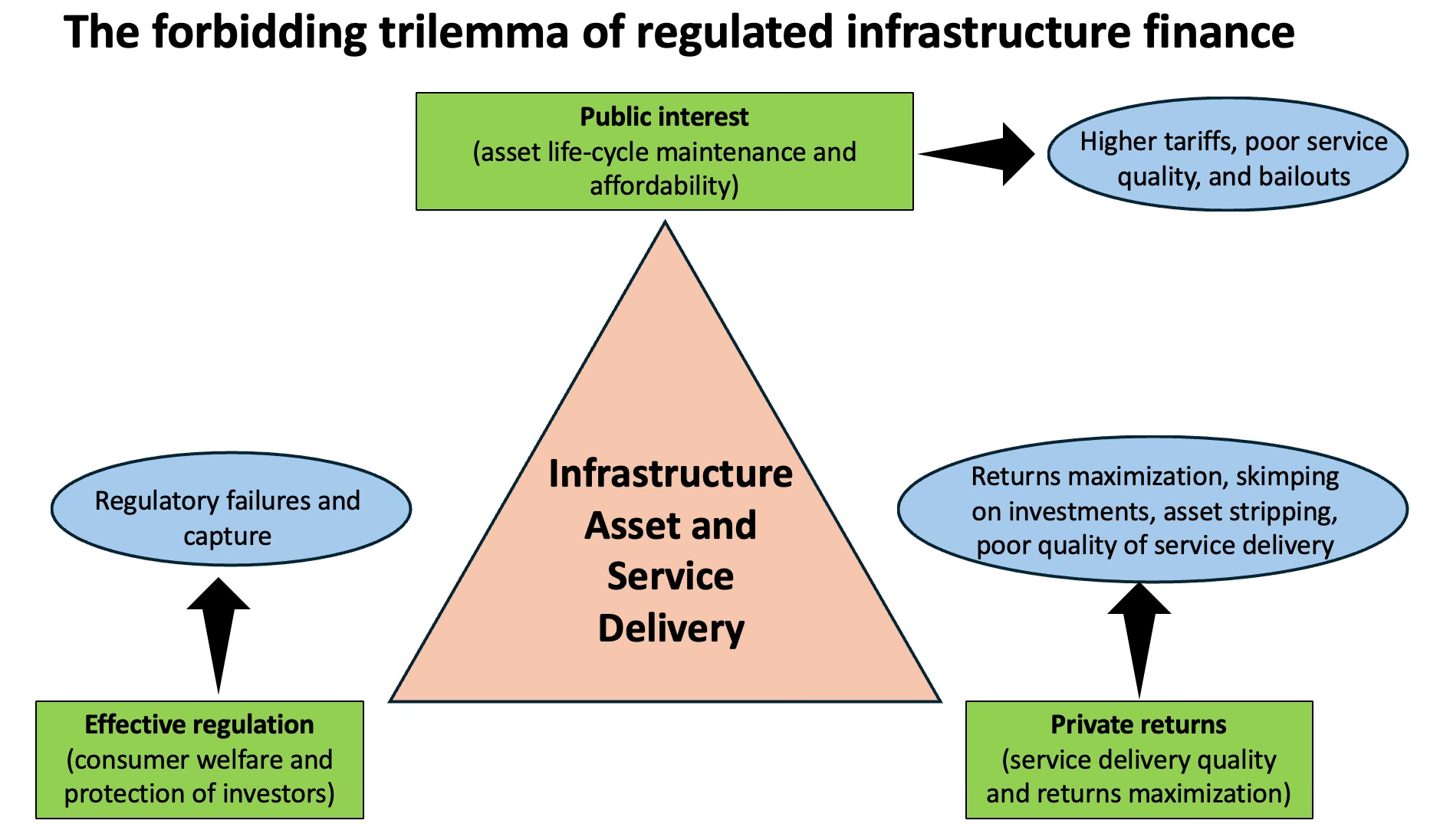
The Thames Water example is an illustration of three forbidding challenges with private investments in infrastructure - the political economy of ensuring the affordability of service delivery; the incentive compatibility of investors in balancing life-cycle asset management and quality of service delivery (public interest) with maximising their financial returns (private interest); and the capability of regulators in reconciling the interests of consumers and investors. 

In the real world, politicians always face the pressure of keeping a lid on prices/tariffs and generally succumb to it; investors cannot but not subordinate all else to returns maximisation; and regulators fail to keep their eye on their primary objectives, struggle to keep up with the changing practices/trends of the industry, and end up being captured by the regulated. 

Taken together, there’s a forbidding trilemma in infrastructure privatisation and PPPs. Private investments in infrastructure struggle when faced with managing public interest, private returns, and effective regulation! It’s very hard to meet all three challenges simultaneously. 

In fact, it boils down to the fundamental and unbridgeable tension between affordability of service delivery and returns maximisation. This challenge becomes daunting with investors like private equity whose returns maximisation objectives fundamentally conflict with infrastructure assets' risk and returns profile. 

None of this should be taken to mean that we should avoid private investments in infrastructure. Instead, it’s a note of caution on the daunting challenges of making private investments work in real-world contexts. 

Given the political economy, private incentives, and weak and/or vulnerable regulatory capabilities, private investments in infrastructure must be intermediated by simple financing structures, contracts with simple and easily observed outcomes, and an acknowledgement of the real costs of capital maintenance and service delivery. Among investors, it must also be incentivised by lower return expectations (or stability and portfolio diversification objectives). 

Saturday, June 29, 2024

Weekend reading links

1. The RBI has recently come out with regulations requiring higher risk weights for infrastructure project loans
In the eye of the storm is the proposal to raise the provision requirement by more than 12 times – from 0.4 per cent to 5 per cent of the outstanding as well as fresh exposure during the construction phase of a project. Once a project reaches the operational phase, the provision can be halved to 2.5 per cent. It will be reduced further to 1 per cent when the project’s cash flow can meet the repayment obligation to all lenders, and the long-term debt of the project declines by at least 20 per cent when it starts commercial operations. The rationale behind such a measure could be that lenders have been evergreening their exposures to under-construction and delayed infrastructure projects. The 5 per cent provisioning during the construction will be achieved in a phased manner: 2 per cent by March 31, 2025 (spread over the four quarters of 2024-25); 3.5 per cent by March 31, 2026 (spread over the four quarters of 2025-26); and 5 per cent by March 31, 2027 (spread over the four quarters of 2026-27)... Typically, the return from such projects for the lenders is around 9 per cent and, for the investors, it’s around 15 per cent. The debt-to-equity ratio for infra projects varies, depending on its nature, but roughly 70:30 is the norm... With the rise in the cost of money, the cost of loans for project finance will rise as no lender would like to compromise on profitability. Analysts predict the impact could be between 0.5 and 0.7 per cent, depending on the balance sheets of the lenders.

2. Interesting observation by Janan Ganesh

Dissent is core to financial success. Why buy an asset unless you think the market has underpriced it? Why set up a business unless you think the world is wrong not to have offered that product or service already? Opening the humblest corner bistro is, in essence, a statement that everyone who hasn’t opened one there has missed a trick. Imagine how much stronger that contrarian impulse must be in a hedge fund seeking above-market returns. 

All power to this attitude. The world would be less prosperous without it. But it doesn’t transfer well to public life. In politics, if you support a radical proposition and turn out to have misjudged it, the consequence might be, oh I don’t know, societal ruin. (Or deaths in the Capitol.) There is no equivalent of limited liability. There is no equivalent of the circuit breakers that the state puts in place to contain bad business bets. The state itself is on the line.

3. Akash Prakash has this view on foreign portfolio investments in India.

The fact is that for the last 2.5 years, the net flow of foreign portfolio investors’ money into India has been zero. India is now at best a neutral weight for most emerging markets investors, having always been an overweight historically. For those allocators who were smart enough to have been in India early, they are rebalancing from the country and taking profits. For new flows, we will have to look at the global funds, which have not been in India historically or took profits much earlier. India’s continuously rising weights make it harder to totally ignore. Until markets catch a breath and consolidate for some time, I don’t think we can expect large foreign flows. The longer-term intention remains to raise weights in India, but there seems to be no urgency. Foreign capital continues to wait for the correction, which surging domestic flows do not allow to happen.

4. Good article on the gravitation of Indian automakers towards hybrid cars and the slowing down of their EV ambitions.  

5. Changing trends in the insurance industry as insurers try to shift from "repair and replace" to "predict and prevent" model of insurance management.

Auto insurers opened the door a decade ago, by offering lower premiums to customers who installed data recorders, known as telematics, in their cars to monitor their driving. Since then, cheaper digital sensors and improved analytics have allowed insurers to step up from tracking to advice and even outright intervention. State Farm offers homeowners free smart plugs that constantly check for electrical faults. Chubb bought a company that makes leak detection systems and offers discounts to homeowners who install them. Manulife first used fitness trackers to monitor customers of its John Hancock Vitality life insurance and reward them for physical activity with prizes as well as lower premiums. But its efforts to nudge customers towards longevity now run the gamut from discounts on fruits and vegetables, to cancer screening and whole-body MRI scans... Corporate insurers are also now helping clients identify and reduce risk. They hope this will take the sting out of rising premiums and generate consulting fees. Chubb sends inspectors armed with infrared cameras to commercial buildings to look for electrical system weaknesses. Zurich advises property owners on how to install rooftop solar panels to minimise future wind and fire damage. It also helps manufacturers guard against product liability claims by advising on quality control programmes.

6. Noice interactive graphic that informs the trajectory of inflation in the US since the pandemic.  

7. Good example of PPPs

The Taj Mahal Hotel of Delhi is a good example of public-private partnership (when the phrase had not yet come into usage) where the New Delhi Municipal Council and Delhi Development Authority provided land and the building structure with the Tatas investing in finishing and furnishing and entering into a long-term revenue sharing contract. These were highly profitable investments for both sides.

8. The volatility in Nvidia's prices is striking

However, it has had far more positive spikes than negative ones, reflecting in its 156% year to date rise. Such volatility is not unique to Nvidia.
More than 200 companies, or roughly 40 percent of the stocks in the index, are at least 10 percent below their highest level of this year. Almost 300 companies, or roughly 60 percent of the index, are more than 10 percent above their low for the year. And each group includes 65 companies that have actually swung both ways. Traders say this lack of correlated movement — known as dispersion — among individual stocks is at historic extremes, undermining the idea that markets have been blanketed by tranquillity... So even on a day like Monday, when Nvidia slumped 6.7 percent, the S&P 500 dropped only 0.3 percent. The broad index was buttressed by other stocks, especially other mammoth technology companies like Microsoft and Alphabet... The options market has ballooned — the number of contracts traded is set to exceed 12 billion this year, according to Cboe, up from 7.5 billion in 2020 — and while there have always been specialists with wonky derivatives strategies, now more mainstream fund managers are said to be piling in. Assets in mutual funds and exchange-traded funds that trade options, including trading dispersion, swelled to more than $80 billion this year, from around $20 billion at the end of 2019, according to Morningstar Direct.

This presents both opportunities and dangers.

This is presenting an opportunity for Wall Street, as investment funds and trading desks pile into dispersion trading, a strategy that typically uses derivatives to bet that index volatility will remain low while turbulence in individual stocks will stay high... The risk to investors is that stocks will again begin to move in the same direction, all at once — most likely because of a spark that ignites widespread selling. When that happens, some fear, the role of complex volatility trades could reverse and, rather than dampen the appearance of turbulence, exacerbate it.

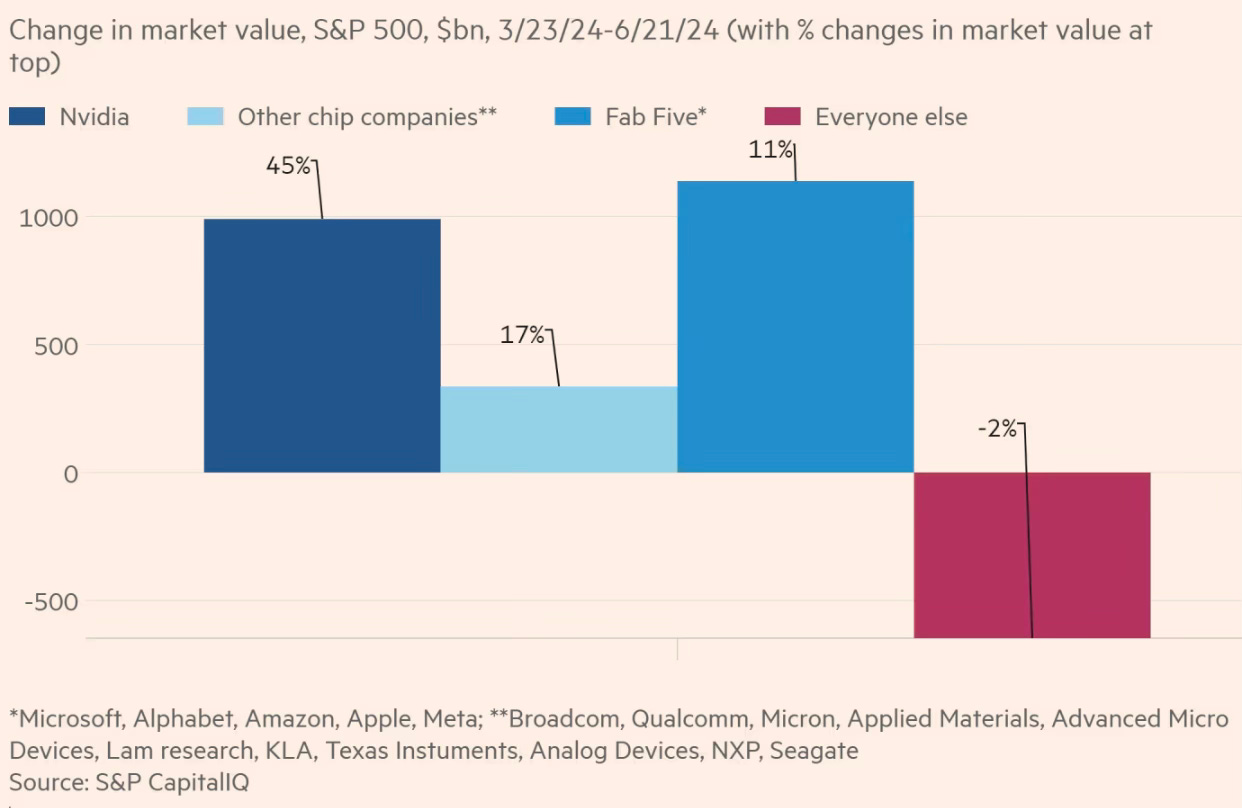
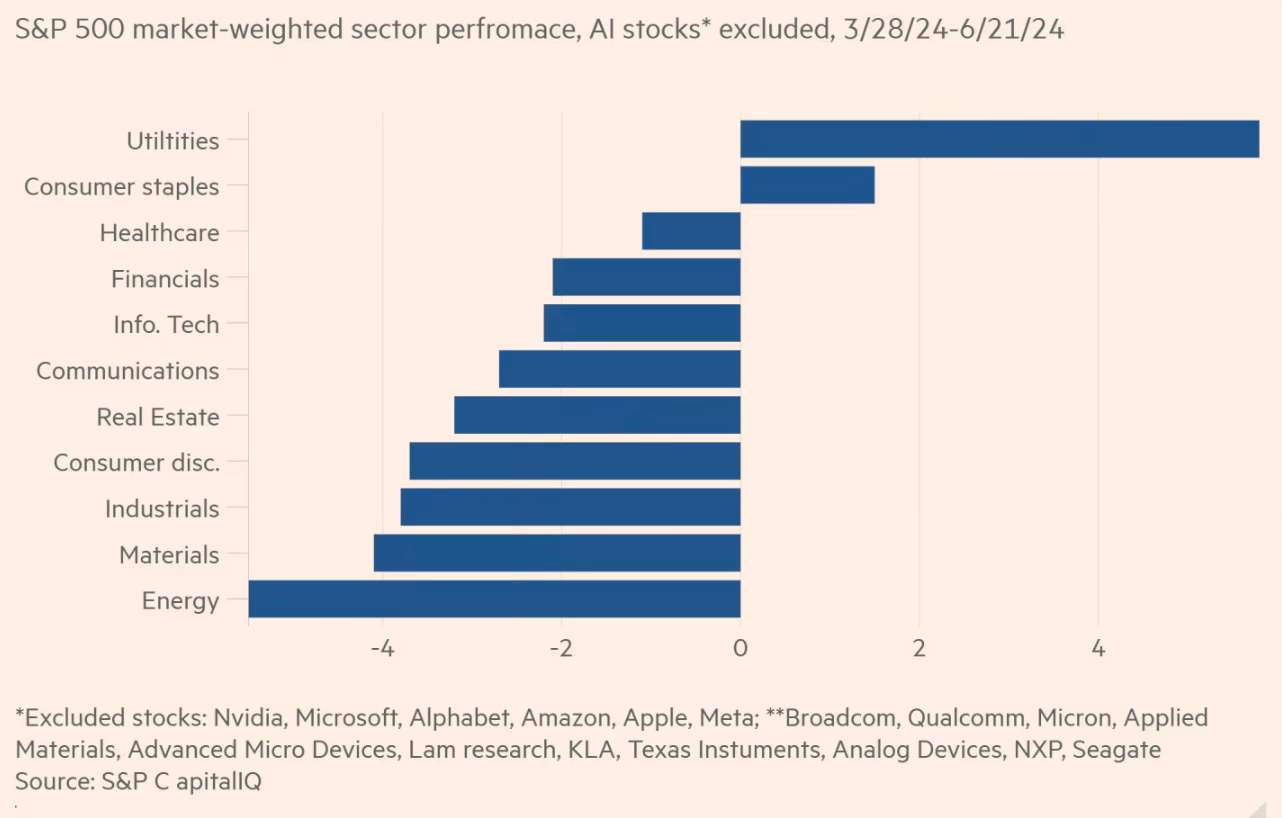
9.  More on Nvidia. FT points to the fact that all the gains in S&P 500 since late March has come from AI or AI-adjacent stocks. 

In the same period, the non-AI stocks are down 2%, with 9 out of 11 sectors are down.

It's hard for anyone to make informed choices. Consider both the bullish and bearish of views on Nvidia. 

Consensus estimates for revenue growth for next year and for 2026 do not, in fact, seem wildly demanding. Analysts are expecting a 23 per cent annual growth rate for Nvidia over that period. This would represent something of a moderation in rate; over the past five years Nvidia revenue has grown at 50 per cent a year. Similarly, the two-year revenue growth rates pencilled in for the Fab Five are at or below the growth rates of recent history. It is only a handful of the chip stocks — Micron, Texas Instruments, Analog, and Lam — where a major acceleration in revenue is expected. Is the recent rally in the AI group driven by upgrades of earnings estimates? Looking at 2025 estimates, not really. Since the end of March, earnings estimates for the group as a whole have crept up in the low single digits, percentage wise. Apple, Amazon, and Micron are the only ones that have received meatier upgrades... In the past three months, the price/earnings ratios of Nvidia, Apple, Broadcom, and Qualcomm have all risen by over 20 per cent. Looking back to last October, when the rally began, the average (harmonic mean) P/E ratio in the AI group is up almost 50 per cent.

Unhedged also points to the internal tension within the AI rally

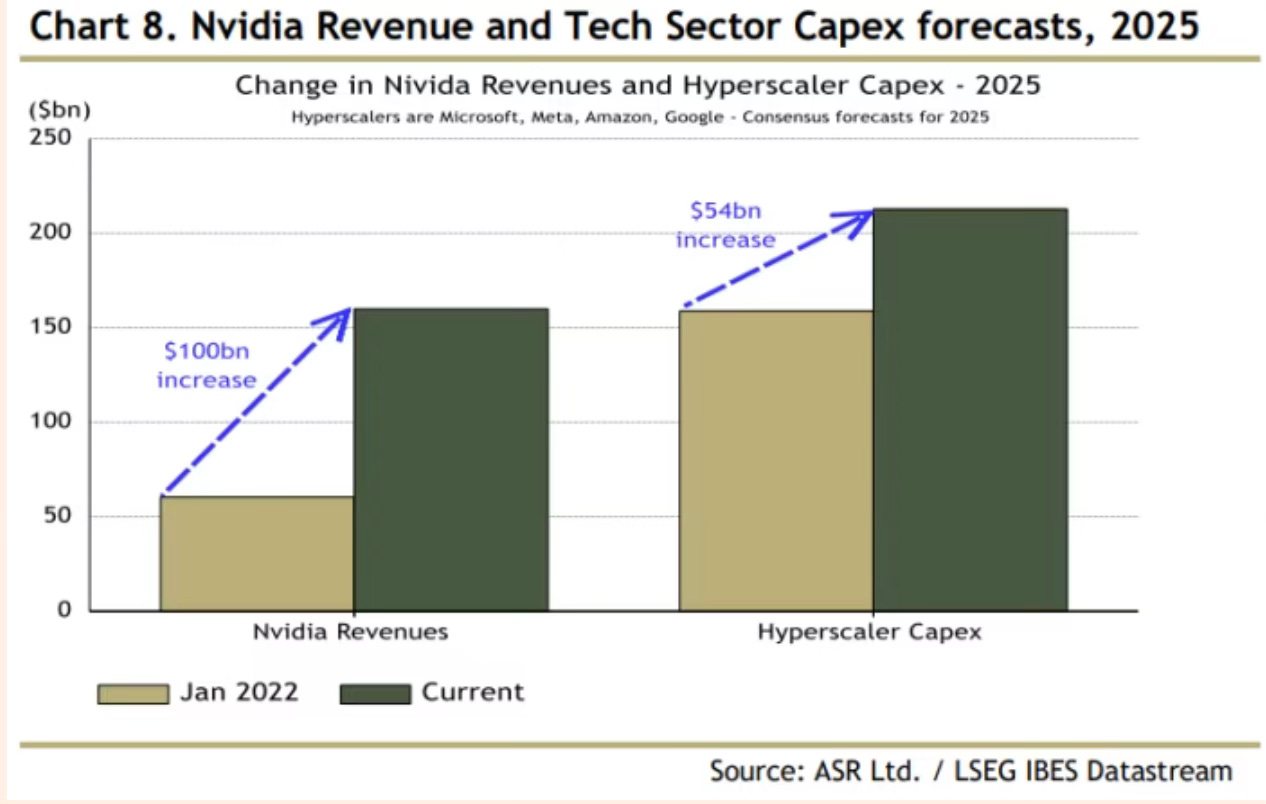
One internal tension within the AI rally is that the revenues of its leading company, Nvidia, are expenses for some of its biggest beneficiaries, the Fab Five. In the short term, Nvidia’s success is a drag on the cash flows of Big Tech companies, which are buying the bulk of Nvidia’s chips. Charles Cara of Absolute Strategy Research has recently made a provocative point about this. He notes that 40 per cent of Nvidia’s revenues come from Microsoft, Meta, Amazon, and Google, and that even the very large expected increase in capital expenditure at those companies is not very large relative to the expected increase in Nvidia’s revenues. The increase in the four companies’ capital spending between the last fiscal year and 2025, at $54bn, is more than 40 per cent of the $100bn expected increase in Nvidia’s revenues, but presumably only a fraction of Big Tech’s capital spending goes to Nvidia’s GPUs. So either the Big Tech will spend more, or Nvidia will make less.

Here's Robert Armstrong's conclusion in interpretation of the spectacular rally.

Perhaps it just reflects momentum and animal spirits. More charitably, it could reflect the expectation that the AI business will provide an increase in profits that lasts for many years into the future. That is to say, it is a bet about the competitive dynamics within the AI industry: that it will not be hypercompetitive, and the winners in the long term will be the same as the winners now — the Fab Five and today’s leaders in the semiconductor industry. To me, the second half of the bet, that the incumbents will keep on winning, seems like a reasonable one. Incumbency in tech is very powerful, to the extent that companies can use their strong market position in one technology to create a strong position in another (think of Microsoft moving from PC operating systems to cloud computing). The first half of the bet, that AI will not turn into a capital-intensive knife fight where no one makes high profits, I don’t know how to assess.

10. Simon Kuper makes an interesting point about why there's so much disillusionment about France about its economy despite the economic health of the country being at its best in decades. 

France has western Europe’s largest territory. Millennia of small farming ended here in a few confusing decades. Today LVMH exports more than all of French agriculture. The consequence: most French towns and villages outside tourist hotspots have lost their reason to exist. If they weren’t already there, nobody would now build them. They are shedding shops, schools and doctors. Places without post offices and train stations are statistically more likely to vote far right, because residents feel abandoned by the Republic. Workers have moved to cities, especially Paris. The EU’s biggest international metropolis is another French asset, but inside France it stands for arrogance and wealth, embodied by Macron. There’s an obvious solution: encourage hybrid working, which would let people leave cities for France’s plethora of cheap charming places near TGV stations.

The article also has a case for nuclear energy

Thanks to its nuclear power stations, France produces electricity with the lowest carbon intensity of any large economy, calculates energy think-tank Ember.

Monday, April 22, 2024

The balance sheet of UK's water and sewage privatisation

It’s no hyperbole to argue that the UK water sector privatisation could be described as the Great British PPP Robbery. It may well become the canonical example of the problems with the privatisation of regulated utilities. 

Consider the latest balance sheet of the water sector in UK. 

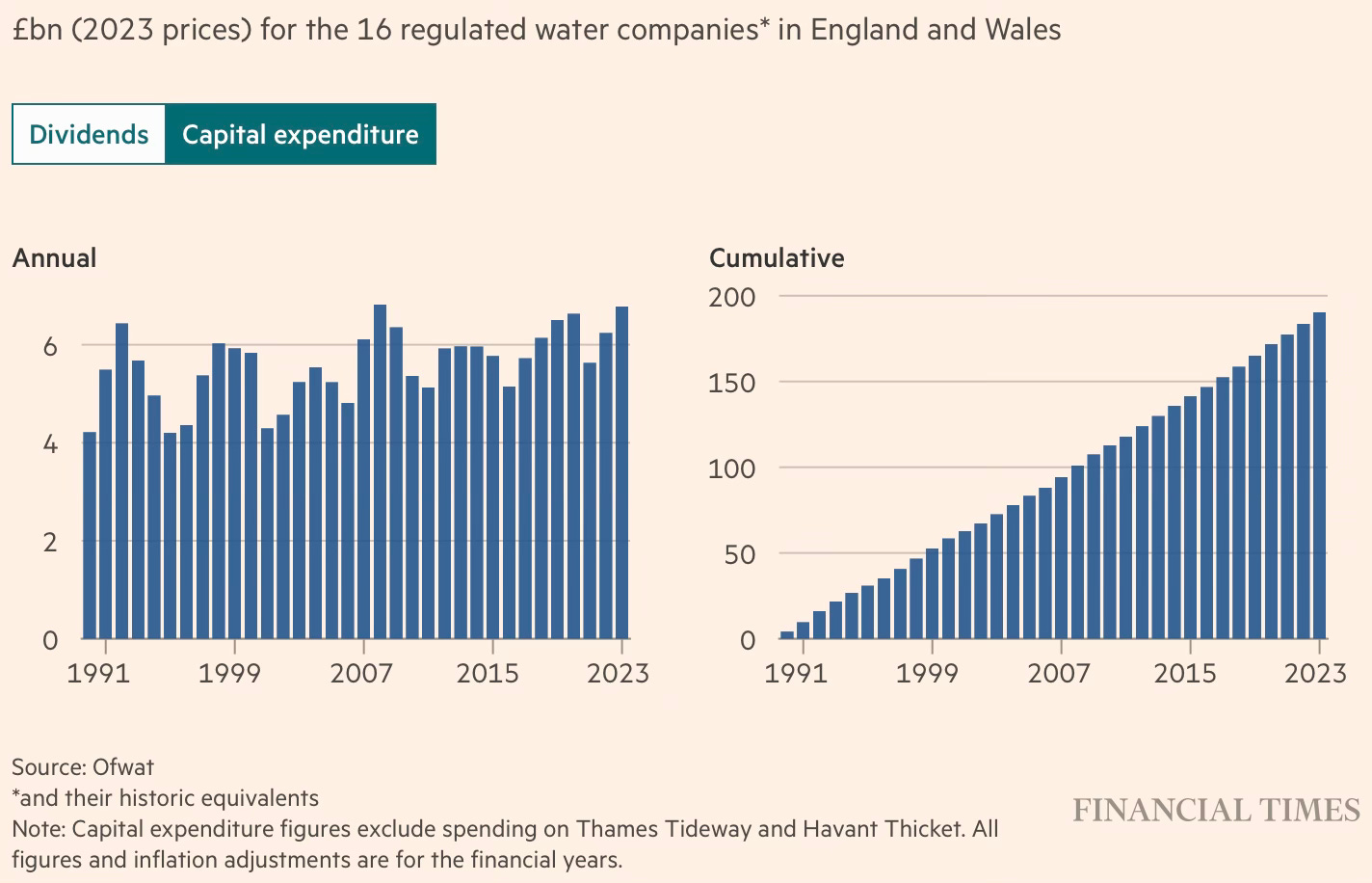
Water companies in England and Wales paid £2.5bn in dividends and added £8.2bn to their net debt in the two financial years since 2021, according to research by the Financial Times. The updated figures mean that the 16 water monopolies have paid out a total of £78bn in dividends in the 32 years between privatisation in 1991 to March 2023, according to the research, which is based on regulatory data and then adjusted for inflation. The £78bn payout is nearly half the £190bn the companies spent in the same three decades on infrastructure. The utilities meanwhile chalked up more than £64bn net in debt over the same period, despite being sold at privatisation with no borrowings.

Consider the dividend payouts since 1991.

And the capital expenditures.

In other words, in the 32 years since privatisation, the owners of the UK water companies took out or created obligations to the tune of £142 bn while investing only £190bn, or a net asset increase of just £48 bn. 

The loading up of debt is a problem in regulated industries like water since the regulator takes the debt service costs into account while fixing tariffs, thereby passing the debt service costs to the consumers through their bills. 

The high noon of such leveraging was the decade-long ownership of Thames Water since 2006 by Macquarie, the Australian infrastructure private equity group. A study by Karol Yearwood at Greenwich University has this summary of the financials of the company during the decade.

Macquarie borrowed more than £2.8bn to finance purchase, and later supposedly repaid £2bn of the debt through new loans raised by Thames Water through a subsidiary in Cayman Islands, effectively transferring the purchase costs to customers. Furthermore, in those 10 years, debt increased 2.3x times (from £4bn to £10bn), dividends averaged 270m per year, yet between 2011 and 2015 they paid no tax.

It’s a testament to the distortions in the market that Macquarie’s rent extraction from Thames Water has been an important motivating force behind the private equity industry’s push to invest in infrastructure. 

The business model of the private owners has sought to retain earnings and avoid equity infusions and instead use debt to finance investments for maintenance and upgrades while paying out dividends from cashflows. In fact, Thames Water received no equity infusion since privatisation till it got a £515mn loan at an 8% interest rate in 2023 through a convoluted structure - the loan was accounted as a debt in the books of the regulated utility’s parent company (Kemble Water), but accounted as equity in the regulated utility itself

Thames Water, which supplies water to about 25 per cent of the population in England, presented the loan in March as “£500mn of new equity funding from its shareholders” to improve “leakage and river health” and deliver a turnaround plan. However, the recapitalisation involved the owners — which include sovereign wealth, private equity and pension funds — providing a £515mn convertible loan to Thames Water’s parent entity, Kemble Water, according to the company’s accounts. Kemble then “cascaded” £500mn of this borrowed money down the chain of holding companies that own Thames Water into the regulated utility. The £515mn increase in debt at Kemble has pushed the group’s consolidated borrowings to over £18bn, having risen from just over £15bn as of March 31 2022. The loan could convert to equity in the future. It is treated as a liability in Kemble’s accounts.

The owners have used complicated financial structures to not only load up on debt but also payout large dividends.

Britain’s privatised water and sewage companies paid £1.4bn in dividends in 2022, up from £540mn the previous year, despite rising household bills and a wave of public criticism over sewage outflows. The figures… are higher than headline dividends in the year to end March 2022. This is because several have layered corporate structures with numerous subsidiaries, only one of which — the operating company — is regulated by Ofwat… The complex arrangements enable providers to distinguish between internal dividends — payments between intermediate holding companies in the group — and external dividends to private equity, sovereign wealth and pension funds, which own the entire water and sewage business including the holding companies… water monopolies argue internal dividends are used to service debt and other costs… Thames Water, the largest water monopoly, paid £37mn of “internal dividends” to its parent company in the year to March 31 2022. This was an increase from £33mn in the previous 12 months, despite announcing that  “external shareholders” had not received dividends for five years…

Adding to the complexity, internal dividends are often only included in notes to the accounts, while dividends can also be deferred until after financial results are released, enabling companies to show zero dividends for the current year in their published annual reports and accounts. Dividend payments are also often described as “cash neutral” as the funds are immediately returned to the company from within the group in payment of debts. In one example, Northumbrian Water, majority owned by CK Infrastructure Holdings, declared £272.6mn in dividends in the year ended March 2022, including an interim dividend of £58.2mn, and a final dividend of £55.4mn. The final dividend was approved after the balance sheet date and will only show as a paid dividend in the 2023 financial statements. The £272.6mn included £159mn as a special dividend, which the company said enabled a group company to pay off a loan, stating that the transaction was “cash neutral” [implying no cash leaves the business], according to the accounts.

Thames Water is not the only company facing acute stress.

South East Water, SES Water and Southern Water are all under close watch by regulator Ofwat over their financial stability. Southern Water was rescued from the brink of bankruptcy in an Ofwat-brokered deal with the Australian infrastructure manager Macquarie in 2021 but the utility was forced to suspend external dividends until at least 2025 following a credit rating downgrade last year. Investor jitters come as Ofwat is pushing them to inject more cash into the utilities. It is not clear whether investors — which include sovereign wealth funds, private equity firms and pension funds — will play ball. Few equity injections have been made since privatisation.

The business models of the companies that relies excessively on debt has taken the sector to the brink of collapse.

Ofwat wants to lower utilities’ debt. It is pushing them to reduce gearing — a measure of debt to assets — from a sector average of around 68 per cent to 55 per cent by April 2025.  Peter Hope, head of regulatory finance at Oxera Consulting, said water companies will need to change how they run their finances in the next few years, given the step change in investment that is expected. “In broad terms, the industry will have to go from a situation of not having retained any earnings since privatisation, to having to retain for the next 25 years almost all of the earnings.”  In addition they will have to inject £5bn equity by 2030, and £8bn in the five-year period following, according to his calculations based on the 55 per cent gearing ratio assumed in Ofwat’s modelling. “Even this does not take into account the need for future increases to replace aged assets and deal with resilience and climate change,” he added.

The problems in water supply are mirrored on the sewerage and wastewater treatment side. Consider this about investments in wasterwater treatment

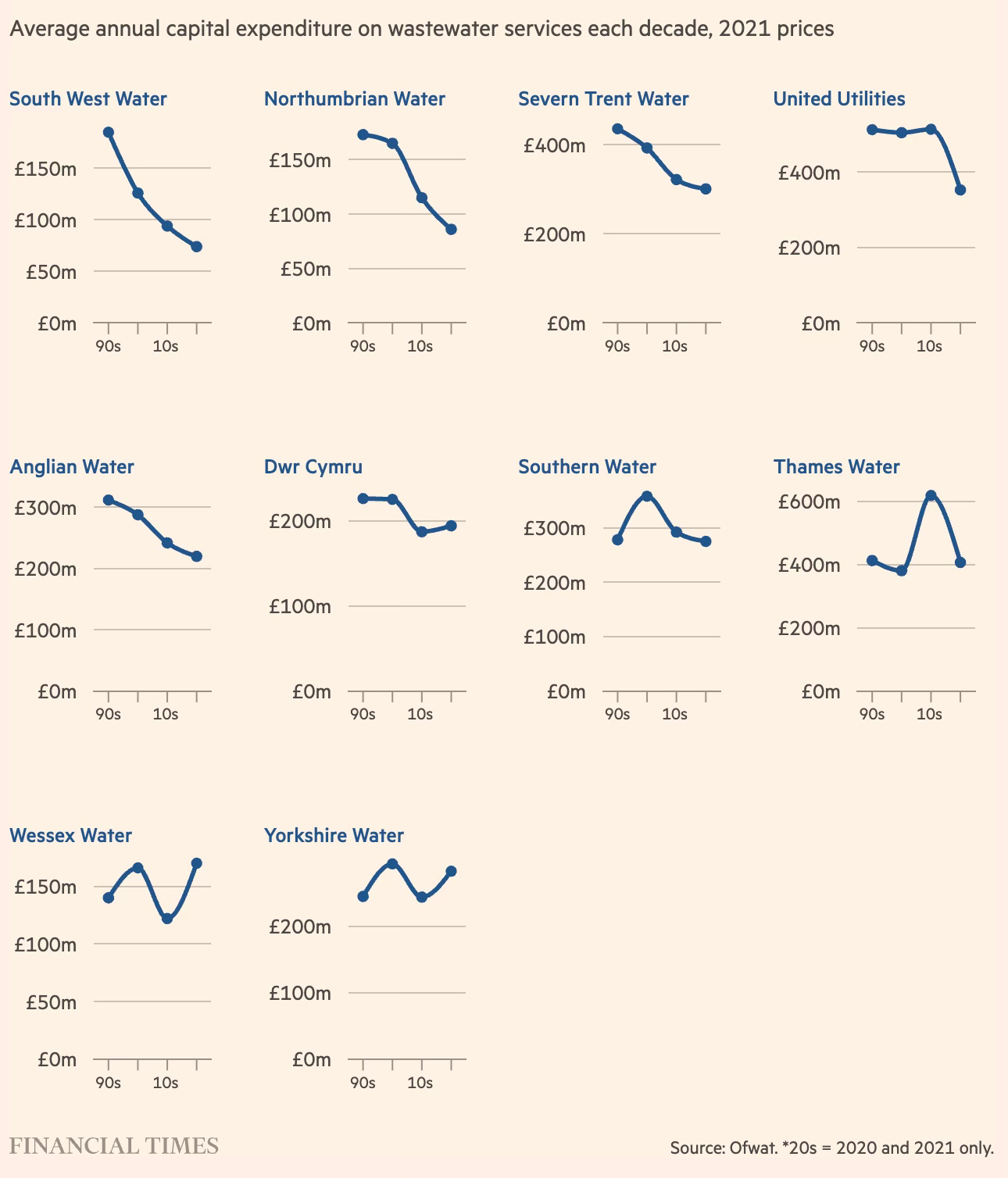
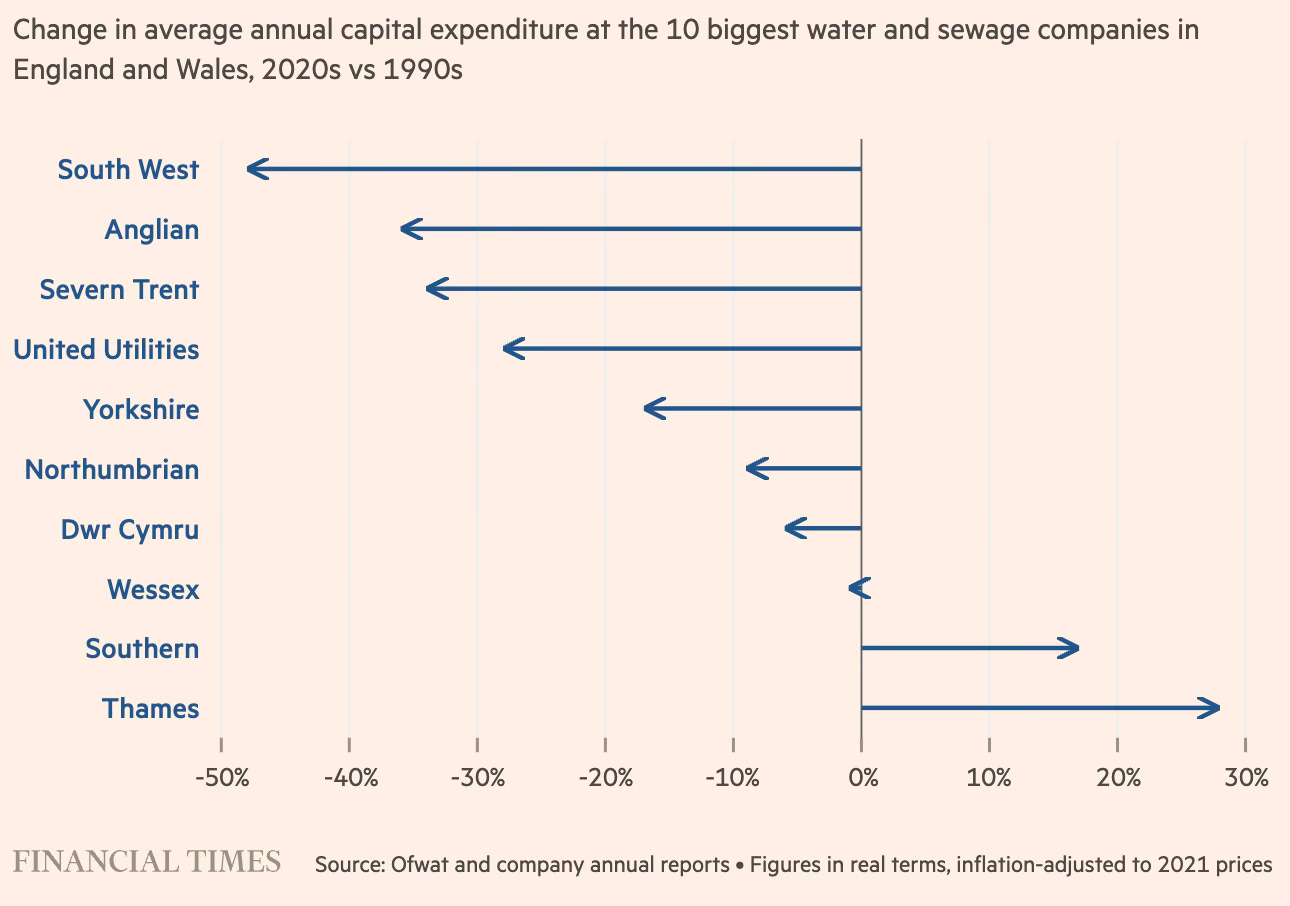
Total spending on waste water infrastructure by the 10 largest companies — excluding Thames Tideway — has failed to rise significantly. Average annual wastewater investment was £295mn in the 1990s, £297mn in the 2010s and £273mn in the 2020s so far.

And this about the worsening quality of waterbodies in the country arising from releases of untreated water.

All 16 companies have been criticised for service failures, including tipping unknown quantities of sewage into waterways, high leakage rates or water outages. The Environment Agency is conducting its largest ever criminal investigation into potential widespread non-compliance by water and sewerage companies at more than 2,200 sewage treatment works, while Ofwat is also running its own investigation into the issue.

This graphic is striking in so far as it shows that all water utilities have cut their investments in wastewater treatment infrastructure since privatisation. 

Consider this balance sheet of wastewater and sewage infrastructure

Total spending on important infrastructure, which hit a post-privatisation peak of £5.7bn a year between 1991 and 1999, fell by 15 per cent to £4.8bn between 2020 and 2021, according to a Financial Times analysis of the accounts of the 10 largest providers in England and Wales. The decline was most extreme for wastewater and sewage networks. Investment there has fallen by almost a fifth, from £2.9bn a year in the 1990s to £2.4bn now… The reductions have come despite a 31 per cent real-term increase in water bills since the 1990s — an average of £100 a year per household — and £72bn in dividend payments to parent companies and investors including private equity, sovereign wealth and pension funds in the same period… In 2019, only 16 per cent of England’s rivers and seas met the minimum “good or better” ecological status as defined by the EU’s water framework directive, according to official Environment Agency figures, while about a fifth of the treated water supply is lost in leakage.

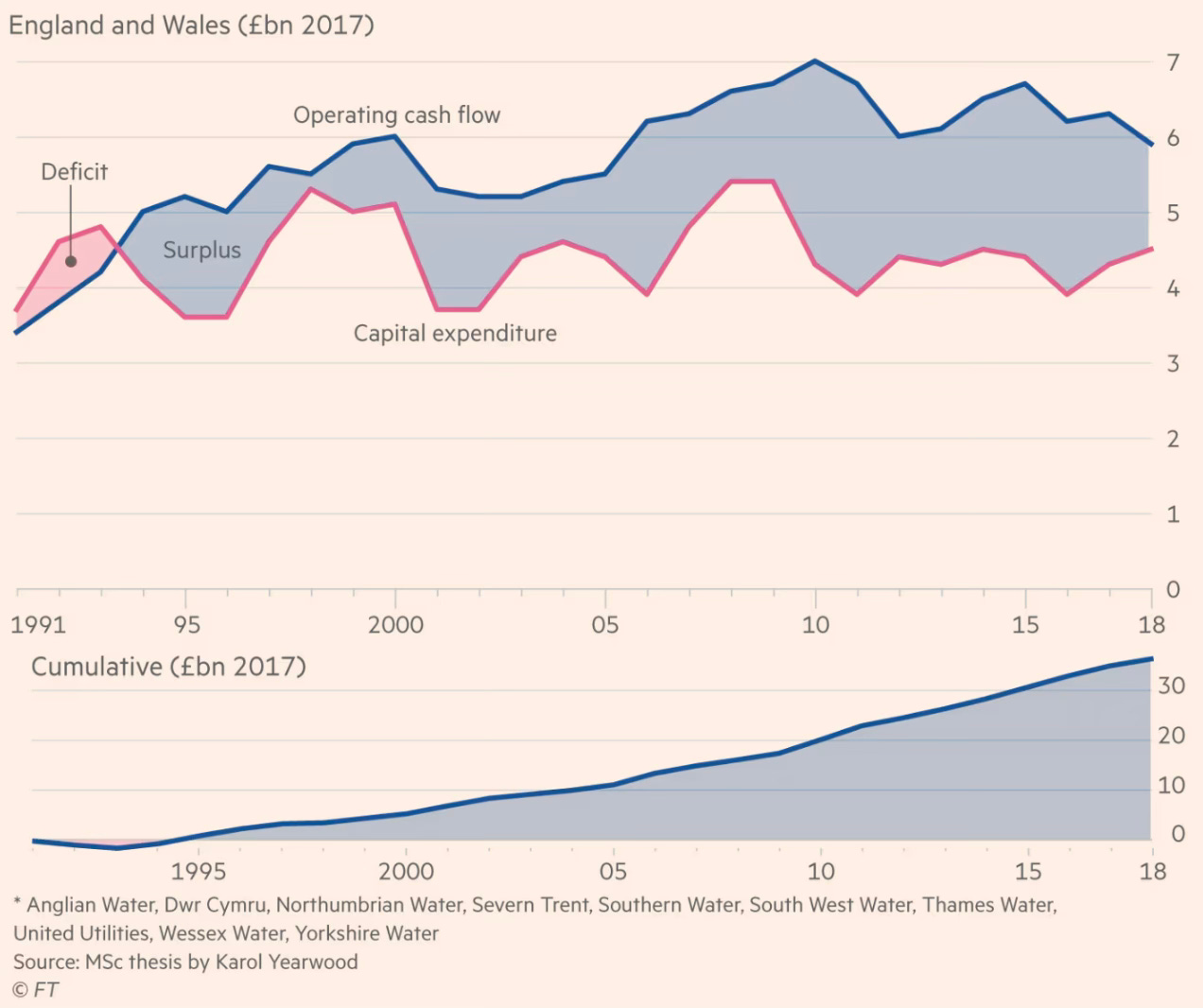
The most striking finding from the Greenwich University study on water and sewage privatisation in the UK is this graphic that shows that the “privatised water companies have generated enough cash to cover investment without taking debt”.

Since privatisation, the aggregate cash flow generated by the English and Welsh companies after operating costs was £36bn more than the £123bn they spent on fixed assets such as new pipes and network infrastructure (all in 2017-18 prices), the study found. This suggests their capital spending could all have been funded out of internal resources… On a combined basis, customers today pay about £1.2bn a year — or £53 a year per household — servicing the debt, according to the analysis by Karol Yearwood... Funding capital spending with debt rather than free cash flow enabled the English companies to pay out £56bn in dividends to investors, which include an array of private equity type groups. 

In other words, it’s clear that the water companies have assumed such massive debt only to payout large dividends. 

And the comparison of the privatised companies with the only public owned utility, Scottish Water, is revealing.

The English water companies have improved efficiencies since they were privatised in 1989. Their revenues have grown by 34 per cent since 1990-91 in constant currency terms, and operating cash flows have increased by 74 per cent over the same period. But the study claims they are not obviously more efficient than Scottish Water, which remains in state hands: its operating spending per household is about 10 per cent lower than the English companies. Customers’ bills in Scotland have fallen slightly in real terms since 2002, when Scottish Water was established, to about £357 per household in 2018. This compares with a 10 per increase in England and Wales over the same period, from an average of £356 per household in 2002 to £395 in 2018.

The study by Yearwood makes extensive comparisons between the privatised utilities and Scottish water on a host of parameters. It’s illuminating and upends the conventional wisdom about private management being superior to public management, at least in developed countries. 

All this raises fundamental questions about the desirability of private equity investments in regulated sectors and their regulatory treatment. 

“These problems are the failings of a system which encourages companies to extract returns as though it was a high risk business,” said Professor David Hall, a director at Greenwich university. “But water and sewerage services are not high risk.” Other experts have also criticised the regulator. Dieter Helm, a professor of energy policy at Oxford university who focuses on British utilities, said that water privatisation had been a “major regulatory failure”. “The companies were given a £1.5bn green dowry at privatisation and the system was set up to encourage borrowing,” he added. “Were their balance sheets used primarily for capital investment? No. They are private companies so of course they are going to try and maximise profits.” While the practice of companies borrowing to pay dividends is not unknown, it is more controversial in industries — such as water — where the regulator takes financing costs into account when setting prices for services.

The result of all this means that the deeply indebted privatised utilities in UK, and especially Thames Water, are close to renationalisation. In fact, the FT’s Lex column has advocated a “period of temporary public stewardship” would be beneficial and help tackle the complex ownership structure. It may be a good one-time reset to the incentives among financial market participants to wipe out the investors, impose haircuts on creditors, and nationalise the utilities.