Substack

Showing posts with label Water. Show all posts

Saturday, March 14, 2026

Weekend reading links

1. Power constraints could emerge as the biggest bottleneck to America's AI growth vis-a-vis China.

Beijing has already prepared by installing an eye-popping 1,500 gigawatts of new energy capacity since 2021, taking its total to 3,891GW. However, the US has not: its installed capacity has barely risen in recent years, and now sits around 1,373GW — or less than what China added in just four years. This is shocking. Worse, China will add over 3.4 terawatts of electricity-generation capacity in the next five years, according to Bloomberg — six times as much as the US.

2. Industrial policy and infrastructure development are back again as priorities for international development actors in Africa, after couple of decades of dalliance with RCTs and small interventions. 

3. The declining labour productivity growth rates.

Between 1950 and 1973, the metric, based on output per hour worked, rose at an annual average of 4 per cent across developed economies. But the rate halved to 1.9 per cent from 1973 to 2009. And since the financial crisis, it has slowed further, averaging just 1.2 per cent between 2009 and 2025.
Pension systems are grappling with increasing dependency ratios.
When the German retirement age was set at 65 in the 1910s, life expectancy was below 50. It has now increased to over 81, while the retirement age is only set to increase to 67... In the 1960s, Japan had eight or nine people aged 20 to 64 for every person aged over 65. Now it is just over one.
4. Richard Hass makes the point that since America chose the war, it must also make the choice on ending it. This is an important point.
America did have other viable options, above all diplomacy, especially as no convincing case has been made that an imminent threat had to be dealt with militarily. The contrast between Washington’s near-unlimited willingness to compromise and demonstrate patience when it comes to persuading Russia to end its aggression against Ukraine and its unrealistic demands and lack of patience with Iran in the run-up to this war is as stark as it is telling. Ukraine’s offer to help defend against Iranian drones while Russia reportedly provides intelligence to Iran only makes the double standard worse.

5. Around 14.5 million barrels of oil transit the Strait of Hormuz daily. It has shrunk rapidly.

More on the Strait
Iran’s ace in the hole has been its de facto blockade of the strait through which one-fifth of the world’s oil and liquefied gas normally flows. At its narrowest point, the strait is less than 21 nautical miles wide, putting tankers perilously close to drones and missiles from Iran’s southern coastline. Tehran now has near-total sway over the Gulf oil market, forcing neighbours such as Iraq to almost entirely stop production and trapping roughly 300mn barrels of oil and gas in the region, a number that rises by about 20mn every day...
With its new supreme leader, Ayatollah Mojtaba Khamenei, announcing his goal to keep the strait closed indefinitely, Iran has wrongfooted oil traders who had always presumed that US military might would keep the waterway open. Iran has never blocked the strait before, despite its previous threats.
6. Some facts about Indian equity markets.

If we look at data from January 1, 2025, to the end of February 2026... emerging market (EM) equities were up 51.4 per cent, international equities were up by 47 per cent, the United States rose by 18.4 per cent, and total world equity returns were 28.3 per cent. In contrast, over this same 14 months period, India was down 0.7 per cent, the second-worst performing market in the world, with only Saudi Arabia performing worse. In fact, India and Saudi Arabia are the only two markets that are actually down (all returns in US dollar). This is when Korea has tripled, Brazil is up 80 per cent, and Taiwan has risen by more than 50 per cent. We have underperformed the EM benchmark by 5,000 basis points in just 14 months... Absolute foreign ownership of the Indian market is at a 15-year low, and we see foreign portfolio investors (FPIs) selling on a daily basis. India has received zero net foreign flows over the last five years, a very long time indeed.

It has definitively debunked the There is no alternative (TINA) hypothesis.

Our markets had done very well, and many other large EM countries were seen as uninvestable. We are the fastest-growing economy in the world — where else will FPIs go? This was the narrative. This myth has been debunked. If they wish, FPIs can totally ignore us. Five years of net zero flows. There are always choices for capital, and capital only chases potential returns. If we do not offer a good risk/return proposition, nobody will come.

7. Middle East has hundreds of desalination plants.

8. On Monday, the benchmark Brent crude price surged to $119 a barrel before diving to $84, the biggest intraday swing in dollar terms ever

9. The Government of India employee count (incl Railways) has remained stationary for the last decade. 
10. M Govinda Rao on the 16th Finance Commission. 

11. After starting out importing everything from China, Ukraine can now make drones with no components imported from China. 
Ukraine will not be mass-producing drones with no Chinese components anytime soon, because it’s still much cheaper to use them. Given China’s dominance of global manufacturing, it is hard to define any drone as truly “China-free.” Many components made outside China still contain Chinese parts or raw materials... Ukraine is one of many nations that have been working to reduce their reliance on Chinese supply chains... Two companies in Ukraine that have built “China-free” drones were picked to compete for contracts in a Pentagon “drone dominance program” under which the United States plans to buy thousands of low-cost attack drones. One of the companies, Ukrainian Defense Drones Tech Corporation, where the men were soldering circuit boards in the basement workshop, was among 11 in all selected last week for possible American drone orders... Ukrainian Defense Drones began making drones in 2023. Initially, all of its components were Chinese. Within a year, however, it had localized production of carbon fiber frames and antennas. By 2025, Ukrainian Defense Drones had expanded to produce flight controllers, speed regulators, radio modems and video transmission systems. Essentially, all its components were made in Ukraine except for the cameras. The company has since gained technology for cameras, too, which it hopes to produce in Europe... 
In the first year after the Russian invasion in February 2022, nearly all of Ukraine’s drones came from China. As demand surged, Beijing imposed export restrictions in 2023 and expanded them in 2024... As the rules tightened, Ukraine resorted to middlemen to buy some parts, and Ukrainian companies began to view the Chinese market as increasingly unreliable. Kyiv turned its focus to building its own drones, and eventually to doing so with fewer Chinese components. By 2024, the vast majority of drones that Ukraine sent to the front were assembled domestically — but still almost entirely with Chinese components. A year later, however, the share of parts from China in Ukraine’s drones had fallen to about 38 percent... Ukraine still buys cheaper Chinese components because the Ukrainian military needs huge numbers of drones and has a limited budget to buy them. Drone missions fail at very high rates, another reason that Ukraine tries to keep costs down.

12.  Finally, on how AI has impacted the Iran-US/Israel war

AI is reshaping how the US military makes decisions in war — a shift clear in Iran, where the Pentagon says it struck more than 2,000 targets in just four days... “If we look at the campaign against Isis, the coalition struck around 2,000 targets in the first six months of the campaign in Iraq and Syria,” said Jessica Dorsey, who researches the use of AI and international humanitarian law at Utrecht University... The unprecedented tempo of targeted attacks has been driven in part by AI systems that sift the torrents of intelligence data from drones, satellites and other sensors, generating strike options far faster than traditional human-led planning. The conflict also marks the first battlefield use of “frontier” generative AI models... helping commanders interpret data, plan operations and provide real-time feedback during combat. Over the past two years, the US Department of Defense has extensively integrated AI-enabled technology within its operations. The primary operating system for the Pentagon’s data is Palantir’s Maven Smart System, which alongside Anthropic’s Claude model forms a real-time data analysis dashboard for operations in Iran... 

During a live military operation such as Operation Epic Fury in Iran, Palantir’s Maven platform acts as the software “brain”. It supports the entire so-called kill chain — finding and hitting a target during active conflict. That ranges from identifying and prioritising the target to selecting the appropriate weapon and finally assessing the battle damage. Traditionally, kill chains involved printing off documents and waiting for a senior commander to study and approve it. “Those [older] kill chains are measured in hours and sometimes days,” said a defence tech expert who asked to remain anonymous. “The point of [AI] is to shrink that into seconds and minutes, almost instantaneous.”... As of May 2025, the Maven system was used by more than 20,000 users across 35 military entities in the field, according to public comments by Vice Admiral Frank Whitworth, director of the National Geospatial-Intelligence Agency. That number may be closer to 50,000 users in the US today, according to defence researchers, with Nato also signing up to use Maven in 2025...
The bombing of a girls’ primary school in Minab, in southern Iran, further illustrates the lethal risks of quickly generated or improperly vetted targets... In Iran, AI has potentially already been involved in identifying exponentially more targets than in previous wars, said Utrecht University’s Dorsey. Those targets could have existed beforehand — or they could have been generated quickly by AI systems, creating a serious concern about how carefully these have been vetted as required by law, she said.

This about the Minab school bombing.  

Saturday, August 2, 2025

Weekend reading links

1. K-shaped growth in the Indian car industry?

Hyundai Creta, a premium feature-laden mid-segment SUV with prices starting at Rs 11 lakh-plus, has emerged as the country’s top selling car in June 2025. With Maruti’s Ertiga, a Multi-Utility Vehicle, the two accounted for almost two-thirds of all cars sold in the month. What is also remarkable is that nearly one in three Creta buyers is a first-time car owner. Officials in Hyundai said the contribution of first-time buyers in Creta’s customer base has gone up sharply to 29 per cent in 2024 from just 12 per cent in 2020. The car market has had a mixed year in 2024-25. While it hit a new sales peak at 4.3 million, the growth was sluggish at just around 3 per cent, primarily due to the continuously declining sales of entry level cars... The entry-level car segment is in a bad shape, primarily due to two factors: higher price tag of Rs 4 lakh-plus due to better safety norms including six airbags, and sluggish income growth in the lower end of consumer base. The bigger problem is that an entry-level car costs nearly four times the prices of a scooter or motorcycle...

According to industry data, sales performance of entry-level cars priced below Rs 5 lakh – a crucial indicator of demand in the economy given that this segment largely attracts first-time buyers – is dire. This segment used to account for nearly a million units a decade ago – 9,34,538 to be precise in FY16. It has since declined to just 25,402 units in FY25. The Maruti Suzuki Alto, for instance, sold more than 18,700 units in June 2019, and was the best-selling then. In June 2025, the Alto and S-Presso combined sold a little over 6,000 units... The two-wheeler segment sales dropped 6.2 per cent to 46.74 lakh units in April-June 2025, pulled down by motorcycles and mopeds. When juxtaposed, suggests a dwindling of purchasing power at the lower and middle-class segments...

According to data collected by the NGO People Research on India’s Consumer Economy – which some carmakers refer to internally – car penetration in Indian households that have a yearly income of less than Rs 4 lakh reduced to 1.4 per cent in FY20, from 1.9 per cent in FY16. Car penetration in households that earn between Rs 4 lakh to Rs 7 lakh annually also reduced to 8.3 per cent from 12.1 per cent in the same time period. Families with incomes of less than Rs 4 lakh and between Rs 4 lakh and Rs 7 lakh are said to make up for around 80 per cent of all Indian households. Though FY20 was the latest data available with a carmaker, they said the trend has not changed in the subsequent years.

2. Cafes are another illustration of the lack of consumption depth in the Indian market.

Running a cafe in India is something that even the boldest players have struggled to perfect, even after decades. Mid-market physical coffee chains like Cafe Coffee Day have collapsed, premium brands like Starbucks are fighting an uphill battle, and artisanal chains like Blue Tokai are facing steady losses. The truth is nobody has cracked the profitability code. The challenges are easy to spot. India may be the world’s seventh-largest coffee producer, but its per capita coffee consumption stands at a minuscule 70g compared to the global average of 1.3kg. “The math simply doesn’t add up when you factor in rental costs, labour complexity, and consumer price sensitivity,” said Abhinav Mathur, CEO of Kaapi Machines, a firm that supplies and services high-quality coffee machines. Cafes cough up 15–20% of their sales as rent at prime locations. For instance, Starbucks reportedly pays Rs 25 lakh ($29,000) per month to operate in Mumbai’s prime spots. The company needs to sell over 500 cups a day just to break even on rent.
The unit economics of coffee making in India is brutal.
“Rent is what makes or breaks a cafe brand in India,” said Mathur. “For Starbucks, rent makes up about 15–20% of its revenue... Even Blue Tokai spends about 15% of its sales on rent, said Chitharanjan. This is “reasonable” for its business model, he said... The investment in equipment adds another layer of complexity to running a cafe. For instance, opening a 1,000-square-foot Blue Tokai outlet costs Rs 85 lakh–1 crore, said Chitharanjan. And espresso machines cost Rs 2.5–5 lakh, depending on whether it’s a semi-automatic or an automatic one... Moreover, Indian consumers have been conditioned by decades of affordable commodity coffee pricing. For instance, a traditional filter coffee in South India costs Rs 15–30, creating psychological barriers to premium pricing. “People find it culturally difficult to pay Rs 200 for coffee,” said Mathur.
As a result, every major chain in the country—from Cafe Coffee Day to Third Wave Coffee—is currently loss-making. For instance, Starbucks’ losses have gone up by more than 5X to Rs 136 crore in the two years to FY25. Similarly, Third Wave Coffee, a chain launched in 2016, posted losses of Rs 110 crore in FY24—almost double the previous year... Despite the industry’s growth, sustainable profitability remains elusive for most players. The successful brands have generally followed one of two strategies: premium positioning with high margins but limited scale (Blue Tokai, Third Wave)—still leading to losses, or ultra-low-cost operations with minimal infrastructure (delivery-only players like the now-struggling Zepto Cafe). 
Some comments on the article offer useful insights.
The psycographic-lifestyle-income gap between cafe coffee consumer and filter coffee consumer is very huge. So for any given locality (physical or qcomm) the market size has a unpenetratable celing. And that market that pays 200-400 for a coffee won’t be happy with just coffee – so the need for complex menus and costly ambiences. The tea shop culture is so broad based in India (which also offers filter coffee and instant coffee with snacks) – the cafe culture stands in isolation or should I say has painted itself in to a corner. So before entreprenuers study economics and business scaling, they should first study culture... These coffee chains expect American levels of coffee consumption when their prices are relatively 5-10x higher making it an extremely premium product. The average person in US spends between 0.1-0.2% of their monthly salary on a single cup of coffee (assuming $5 per coffee). Applying the same multiplier means a cup of coffee in india should not cost more than 50-100 rupees, far cry from the 250-400 being charged currently.

3. An assessment of the India-UK FTA here

4. As the IMF revises global (and US) growth rates upwards, Ruchir Sharma points to the problem with the models used by economists.

Many economists had assumed that, by lowering imports, tariffs would strengthen the dollar almost automatically, as an accounting identity. Instead, it suffered its worst fall over the first half of a year since the early 1970s. This unexpected turn is now attributed to the fact that the dollar started the year historically overvalued. Many foreigners were heavily exposed to dollar assets. Of late, they have been hedging those risks and investing more outside the US. Many countries are increasingly attractive places to park money, in part because tariff threats inspired them to push economic reform and cut trade deals with non-US partners. 

The bigger mystery is why the stagflationary impact of tariffs has yet to materialise in the aggregate data. Is the US really enjoying a free lunch, taking in $300bn a year in tariff revenues with none of the expected heartburn? By some estimates, foreign exporters are indeed absorbing 20 per cent of the costs — a much larger share than they did in response to tariffs in Trump’s first term. The remaining 80 per cent, however, is still getting paid in roughly equal shares by US corporations and consumers. The likely answer is that the negative economic effect of tariffs is being countered by other forces, including the mania for artificial intelligence and more government stimulus. Since January, estimates of what the big tech companies will spend this year on building out AI infrastructure have risen $60bn to $350bn. Smaller businesses are scrambling to catch the wave too, further boosting growth. And all this excitement is neutralising the fear that trade policy uncertainty would dampen animal spirits and freeze new capex. AI-driven bullishness is also lifting growth by keeping financial conditions loose, even with higher interest rates... Meanwhile, the promise of tax relief makes it easier for US corporations to absorb a larger than expected share of the tariff costs, rather than pass it all on to consumers. Trump’s “big, beautiful bill” is expected to save US businesses around $100bn this year and more than that in 2026, mainly in tax breaks.

5. Rama Bijapurkar makes an important point about the current Indian middle class. She writes that the older middle class was dominated by government jobs that offered decent salaries, job security, health care, pensions, etc. With government job recruitments slowing and formal large private sector jobs not compensating, the current middle class is far less secure. 

The majority will be in quasi-formal or quasi-informal small private company employment, small entrepreneurs with limited business scalability and ability to withstand environmental cycles, and self-employed gig workers with varying levels of skills and low levels of stability... They are exhausted from generating the energy needed to find meaningful work and navigate their way up the socio- economic ladder in the absence of facilitating structures. They are in search of white-collar respectability, stability, security, predictability, social mobility, recognition (which the old middle class had). Their holy grail, ironically, is a “government job”. Their deepest desire is a less exhausting life (lower aspiration levels, dreams that are “bonsai”), with little struggle and uncertainty. Is India’s famed aspirational middle class giving way to version next, the exhausted middle class? The stability and homogeneity we assume in the growing numbers of the middle class actually is a mass of heterogeneity and has inbuilt income and occupation volatility... Perhaps we should change our conceptual frame of a single middle class to a two tiered one – an economic development-driving “genuine” middle class that has the attributes discussed earlier; and a consuming capable class with purchasing power at the moment.

6. Art of the Deal in international trade diplomacy.

The president clearly has a winning formula for getting his way. First make shocking demands to stoke panic. Then pull back for time-limited negotiations. Having a mix of economically vulnerable, retaliation-shy, and pliable trade partners helps. Finally, strike an agreement below the initial threat level, and sell the result as a win-win.

7. Canada's prized export, maple syrup, 73% of its global output comes from there, is facing 35% Trump tariff. 

Over 45mn kilogrammes of Canadian maple syrup — enough to smother 3bn American pancakes — went across the border in 2024, amounting to almost 60 per cent of the country’s total demand... For years, syrup flowed freely across the border. But in 1909 US tariffs were imposed to protect American production. In 1972, when those tariffs were cut back to zero, the US Department of Agriculture released a research report which found that the maple tariff was “never very effective in protecting the domestic maple industry from foreign competition”. After this, Canada made its own efforts to protect the industry. In 1996, a maple syrup federation was created in Quebec — where 90 per cent of its syrup comes from. The cartel (known formally as the Quebec Maple Syrup Producers) sets a floor on global syrup prices and smooths out variable harvests. Once processed, Canadian maple syrup can sit in the federation’s enormous warehouses — which have 53 Olympic swimming pools’ worth of storage capacity — for years without degrading. The federation says that it any unsold inventory can be added to this strategic reserve. It also points out that it has made strides diversifying away from US buyers in recent years, reducing the proportion of production that goes there by roughly 20 percentage points over the last couple decades.

8. A snapshot of US imports and exports from India.

And why Trump thinks that India is the "tariff king".

9. Donald Trump on Jerome Powell in a graphic.
10. Good primer on Trump tariffs. This on industry-specific tariffs.
This is on the great walk back on China, whose tariffs are only slightly higher than India's and much lower than Brazil's.
11. The diminishing Palestinian state.
12. FT long read on how Eli Lilly's Mounjaro and Zepbound came from behind to overtake Novo Nordisk's Ozempic and Wegovy as the leading obesity drugs. 

13. Good graphic about the scale at which AI's consumption of computing power and electricity is growing.

14. Robin Harding points to two contrasting facts about the Japanese economy.
Number one: the yield on 30-year government bonds hit an all-time high of 3.21 per cent earlier this month after a series of weak auctions — a sign, perhaps, that markets are finally becoming concerned about the country’s enormous public debt. Number two: according to Morgan Stanley, Japan’s budget deficit was almost completely eliminated in the first quarter of this year, putting the public finances in their best position for almost three decades.

15.  Desalination of water is a rapidly growing industry. Global desalination industry is expected to exceed $20bn in 2027, from less than $15 bn in 2024. And annual growth in desalination capacity is 6-12%. Middle East and North Africa account for 70% of the global capacity.

16. Finally, the progression of Trump tariffs since April 2, 2025.

And their country-wise tariffs.

Thursday, December 19, 2024

The forbidding trilemma of infrastructure finance

I have blogged extensively on the water privatisation in the UK. This is about the ongoing crisis at Thames Water, this and this are about the balance sheet of UK water privatisation, this is about regulatory failure/capture and returns maximisation incentives of investors, and this is about the UK’s infrastructure privatisation in general.

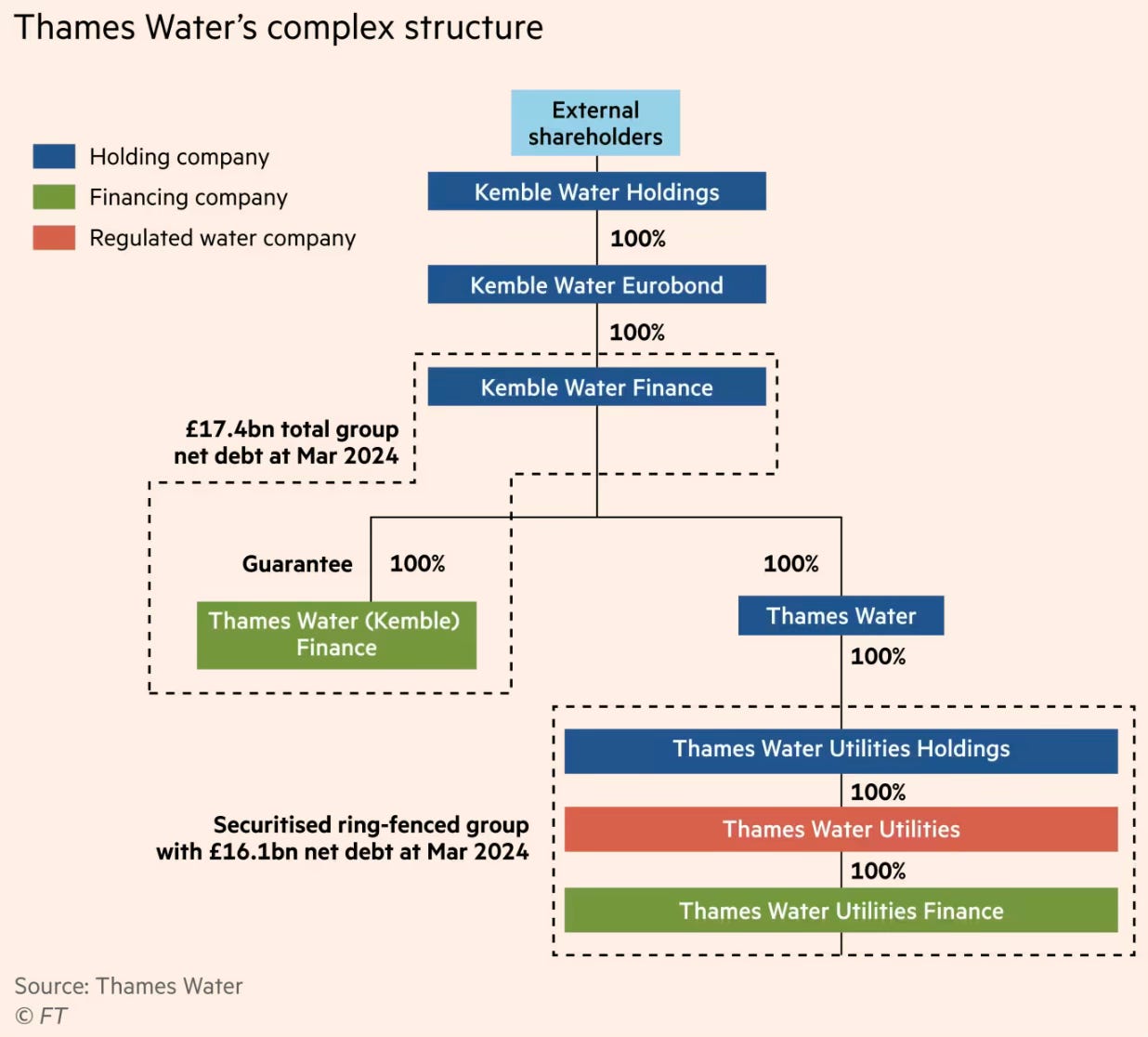
After teetering on the brink of default, Thames Water has managed to get a proposal from a bunch of creditors for a £3bn emergency loan, enough to cover operations till at least next October or even May 2026. The loan has received government approval. But the emergency loan comes with a headline interest rate of 9.75 per cent, and the company spent over £50mn on advisers in raising the debt. It’s also in the process of finding new equity investors, and restructuring its complex capital structure. 

This is the latest update on the Kemble Water Holdings structure.

However, the government approval for the emergency loan proposal has been criticised by Sir Dieter Helm, who believes it’s a case of endless sticking of plasters. He has instead proposed that Thames Water be placed under a Special Administrator to allow a proper restructuring and enable the management to focus on operations instead of financing negotiations. 

In a paper explaining his views, Helm makes some very important points that are of relevance not only to the present case but to infrastructure and public-private partnerships in general. He has argued that the emergency loan is not only not going to fix Thames’s problems but also risks spreading the contagion across the rest of the water industry. He writes

Thames will probably get sold at a very steep discount in a process controlled by its A-class bondholders, and will probably get broken up. Yet even if this turns out to be a potentially very profitable opportunity to purchase the business for a deeply discounted value, it does not bode well for Thames’s future. The private interests of the sellers in the short term should not be confused with the public interest that a Special Administrator would pursue… it is important to understand why Thames is not a self-righting ship; why it is unlikely to emerge as an efficient water and sewerage company over the next decade; and why the sticky plasters may serve to gradually undermine it further.

He has blamed the crisis at the Thames on a combination of bad management, bad regulation, and the failings of successive governments. He points to fundamental incentive distortions and perversions that detracted the management from working to realise the objectives of privatisation. 

Like all the water companies, Thames was privatised with zero debt (indeed a small cash injection was provided upon privatisation). It (and the other water companies) were privatised in order to run their networks and infrastructures better (bringing private sector cost disciplines) and to raise finance to pay for capital investments on the basis of borrowing so that current customers (and current voters) would not have to pay. The Thames model, like that of the other companies, was pay-when-delivered, not pay-as-you-go.

This gave two tasks to the management of all the companies: run the business more efficiently; and raise finance for capital investment. Thames has turned out not to have done the former very well; and it has used the balance sheet to securitise the business, rather than for the objective at privatisation, which was to borrow solely to invest. In both, it has been at the outer edge of water company performance and gearing… it is worth examining what the incentives have been and why cost-cutting has had priority over capital maintenance. RPI-X as a regulatory rule had the advantage of simplicity at the outset. The regulator would set the (fixed) prices ex ante every five years (originally it was supposed to be every ten), and the companies would maximise profits by minimising costs.

As was witnessed across the privatised utilities, this deceptively simple rule required regulators to be very clear about the outputs that had to be delivered as part of the fixed-price contract, and to make sure that they were actually delivered. In practice, this meant approving the business plan for the period, and having clear, measurable and enforceable environmental and social outcomes. Thames (and others) ran rings around the regulators, and provoked a process of regulatory creep with ever-more complex and detailed interventions by the regulators, which even ended up regulating Thames’s dividends. As a rough rule of thumb, regulators added at least two new mechanisms at each periodic review. The added complexity did not result in greater performance improvements…

The governments, OFWAT, the NRA/EA and the companies all implicitly worked on the basis of an approach that started with what they thought customers could afford and then agreed what could be done for these amounts, rather than starting with the environmental and other outcomes required, and then setting charges at whatever it costs to achieve them efficiently. This is the origin of a context in which a blind eye was turned to environmental failures, and the fines were so low as to be part of the cost of doing business. This affordability criterion has undoubtedly curtailed environmental improvements. All this went under the guise of the quadripartite process in the early periodic reviews… As ever, there is a mismatch between, on the one hand, the demands for higher river and water quality, and, on the other hand, the opposition to bills being raised to pay for these. The belated and relatively sudden imposition of large fines reflects this change of tone. Thames and others could have reasonably assumed that the “implicit deal” around affordability would let them off the hook. What their successive boards failed to realise is that the licence gave them the obligations, and relying on politicians and regulators being objective, rather than following public opinion and media coverage, was always a dangerous strategy to pursue.

He also writes about the egregious operational failings of Thames Water, resulting in the normalisation of untreated sewerage spillages into rivers, asset mapping of its networks, and lagging behind in the adoption of digital technologies to improve maintenance. The biggest failing was its financial engineering and asset stripping, second only to the regulatory failure to spot and prevent it.

What makes Thames more of a basket case than the others is that, in addition to failing on the capital maintenance, it was profit-maximising by gearing up its balance sheet at the outer limits of what was sustainable. This turned out to be the most profitable activity of the company. Whereas the balance sheet had been set up at privatisation to move from pay-as-you-go to pay-when-delivered, Thames (and others) used the balance sheet to mortgage the assets and pay out the proceeds in special dividends and other benefits to the shareholders. All the companies were doing this, but Thames pushed it further (though not as far as, for example, Heathrow Airport, at 95% gearing). 

The reason that this model was so profitable was the combination of very poor regulation and extremely low interest rates. OFWAT is the stand-out case of the failure to protect the balance sheets for the purposes they were intended (although OFGEM has neglected balance sheets too). Indeed, OFWAT stressed the importance of leaving matters pertaining to the capital structure and the balance sheets to the companies. OFWAT sets the cost of capital using the CAPM (capital asset pricing model) and then applies a WACC (weighted average cost of capital) to set the allowed returns. The WACC is an average of the costs of debt and the costs of equity. By definition, it will over-reward debt and under-reward equity – before any other consideration is applied to the tax and other impacts. Hence the simple opportunity: replace equity with debt by mortgaging the assets.

Thames took this to a whole new scale, engaging in whole-company securitisation and creating an offshore set of companies to facilitate this, going under the label of various Kemble entities. It was brilliantly executed, building on a strategy that had its origins back in the mid-1990s when OFWAT (and OFGEM’s predecessors: OFFER and OFGAS) decided not to act to protect the balance sheets… the owners… were simply exploiting the opportunities placed in front of them. OFWAT belatedly recognised the mistake of ignoring gearing and balance sheets, and went so far as to give indications about the sorts of gearing it might like, yet at no point did it run proper pro-forma balance sheets from privatisation setting the gearing against investments not paid for by current customers.

The upshot of this combination of failures – failure by Thames to run itself efficiently; failure by Thames to do the necessary capital maintenance; failure by Thames to understand its assets; failure by OFWAT to get a grip on the balance sheets and prevent the huge scale of financial engineering; failure by the NRA and then the EA to properly enforce environmental standards and performance; failure by governments, OFWAT and Thames to ensure that the periodic reviews provided sufficient revenues through customers’ bills; and failure by Thames to appeal against the OFWAT periodic review determinations – is the sorry mess that Thames now finds itself in.

Further, an investigation by the Office for Environmental Protection has revealed regulatory failure and excessive leniency on sewage spillage by the water companies during normal times by three authorities in the UK - the Department for Environment, Food and Rural Affairs; the Environment Agency; and the Water Services Regulation Authority, which is known as Ofwat.

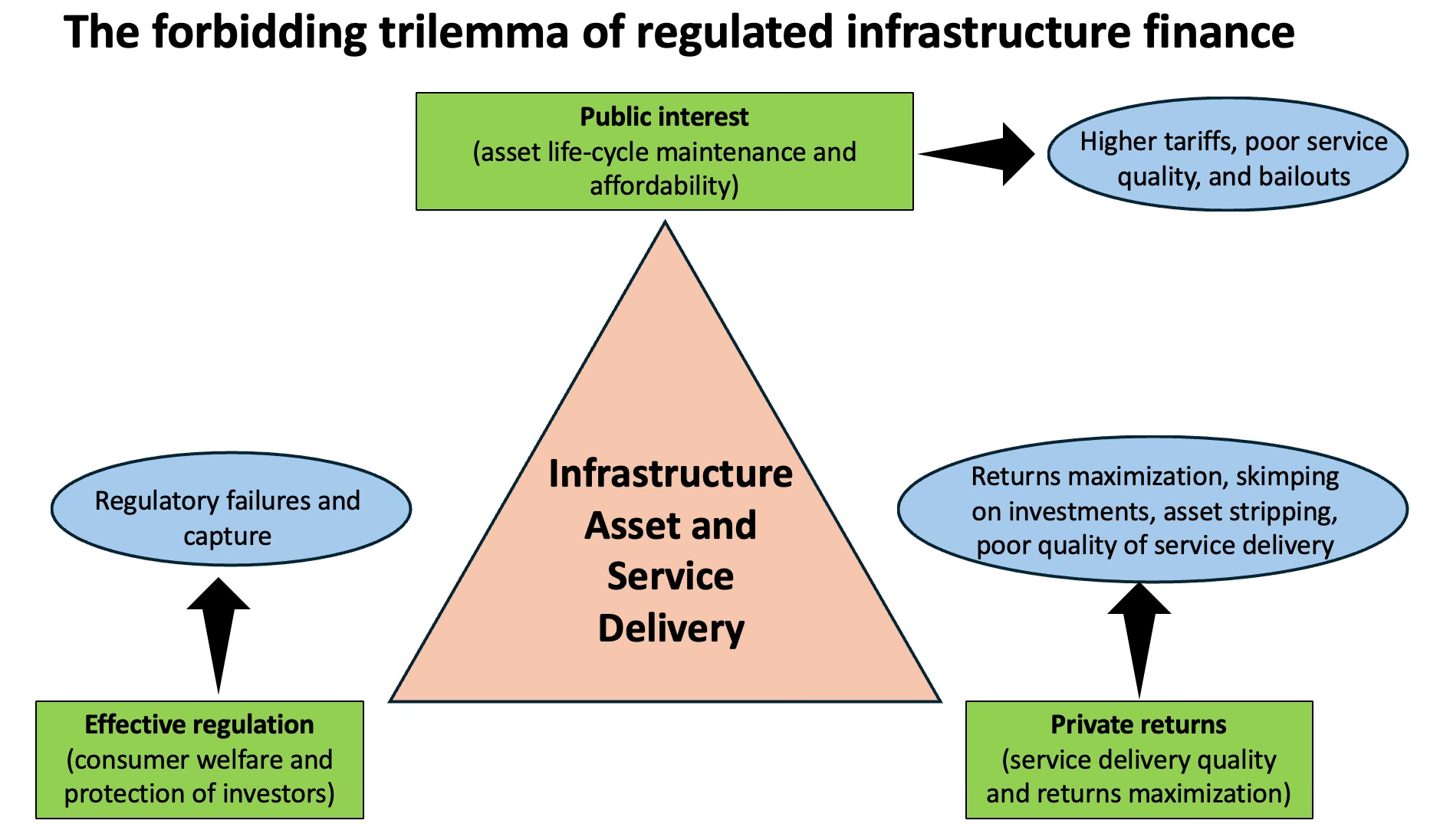
The Thames Water example is an illustration of three forbidding challenges with private investments in infrastructure - the political economy of ensuring the affordability of service delivery; the incentive compatibility of investors in balancing life-cycle asset management and quality of service delivery (public interest) with maximising their financial returns (private interest); and the capability of regulators in reconciling the interests of consumers and investors. 

In the real world, politicians always face the pressure of keeping a lid on prices/tariffs and generally succumb to it; investors cannot but not subordinate all else to returns maximisation; and regulators fail to keep their eye on their primary objectives, struggle to keep up with the changing practices/trends of the industry, and end up being captured by the regulated. 

Taken together, there’s a forbidding trilemma in infrastructure privatisation and PPPs. Private investments in infrastructure struggle when faced with managing public interest, private returns, and effective regulation! It’s very hard to meet all three challenges simultaneously. 

In fact, it boils down to the fundamental and unbridgeable tension between affordability of service delivery and returns maximisation. This challenge becomes daunting with investors like private equity whose returns maximisation objectives fundamentally conflict with infrastructure assets' risk and returns profile. 

None of this should be taken to mean that we should avoid private investments in infrastructure. Instead, it’s a note of caution on the daunting challenges of making private investments work in real-world contexts. 

Given the political economy, private incentives, and weak and/or vulnerable regulatory capabilities, private investments in infrastructure must be intermediated by simple financing structures, contracts with simple and easily observed outcomes, and an acknowledgement of the real costs of capital maintenance and service delivery. Among investors, it must also be incentivised by lower return expectations (or stability and portfolio diversification objectives). 

Thursday, October 24, 2024

Water privatisation in UK and the roles of Ofwat and investors

The UK water utilities are a great case study on the problems of privatising public facilities. I have blogged on multiple occasions (hereherehere, and here), and this post updates the numbers based on a recent NYT article

It has the latest balance sheet of water utilities privatisation in the UK 

When the British government, under Margaret Thatcher, privatized water utilities, it went further than many other countries had. The water and sewage assets were transferred to companies with limited liability and cleared of debt. Shares were floated on the stock exchange, but most of the companies are now privately held, a relatively rare ownership model, though some countries or cities have contracts with private companies for the management of the water systems…

Across England and Wales, insufficient investment in the sewage infrastructure and the water supply has led to a crisis that has been brewing for years. Now, more people are putting the blame on the ownership of the water utilities, which are regional monopolies, predominantly owned by multinational conglomerates and asset managers, including sovereign wealth funds and pension funds. Critics argue that shareholders in the water companies have received billions of pounds in dividends since privatization but failed to put enough money back into the water system while piling up debt…

Thames Water, which has debt of about £15 billion, or $20 billion, said it would run out of cash by May if it was unable to raise more equity. Its shareholders, who own the company through Kemble Water Holdings, include a Canadian pension fund, Abu Dhabi’s sovereign wealth fund and a British pension plan for university staff, and they have been reluctant to inject fresh cash amid clashes with regulators over how much to raise customers’ bills... The average utility bill in England and Wales is £441 a year, higher than some of their European neighbors, like France, but lower than others, such as Norway. Ofwat has proposed increasing consumers’ bills by more than a fifth on average over the next five years.

And the public reaction to this state of affairs has swung towards nationalisation.

The 10 water utilities in England and Wales, which were privatized in 1989 during a wave of deregulation and free-market liberalization, have become a target of public ire over polluted waterways and rising household bills. The number of people getting sick from the water is growing… In June, the Henley Town Council called for the nationalization of Thames Water, which serves about 16 million people, saying the company’s track record has been “beyond concerning.”.. More than 80 percent of Britons said water companies should be run in the public sector, according to a poll in July. In Scotland and Northern Ireland, the water companies are owned by their governments. In 2001, one of Wales’s water companies became a nonprofit organization.

The market is a good mechanism for efficiently allocating general goods and services. But when the goods and services are essentials for human survival and especially when monopolists provide them, the market has been consistently found to fail the allocation test. This is why utilities are tightly regulated and outright privatisation is rare in sectors like water, sewerage, mass transit, and electricity distribution. In fact, the water and sewerage sector is publicly owned in most of the world. There’s a comparator in the UK itself

The Scottish system has remained under public ownership and Scottish Water has invested nearly 35% more per household in the system since 2002 than counterparts south of the border, while it charges 14% less for water. It is reported that the highest paid director of Scottish Water took home less than £400 000 in pay and benefits in 2021—a fraction of what his English counterparts receive.

The UK water utilities are also a good case study on foreign investments in infrastructure sectors like water

Famous investors in Thames Water included Australian Macquarie Capital Funds, until 2017 when they sold their share. Estimates at the time said the fund made between 15.5-19% in annual rate of returns, however, it also faced criminal fines of up to £20m in 2017 for leakages affecting the Thames. In September 2021 Macquarie re-entered the UK private water infrastructure market by investing £1.1bn in equity into Southwestern Water group committing to delivering reliable services and protecting and improving health of rivers and sea… Other well-known financial service companies include Blackrock, Lazard and Vanguard (Severn Trent, United Utilities and South West Water), Germany’s Deutsche Asset Management an US based Corsair Capital (Yorkshire Water). JP Morgan Asset Management owns 40% in Southern Water, and Australian Colonial First State Global Asset Management owns stakes in Anglian Water, Severn Trent, United Utilities and South West Water. Apart from these companies there are numerous other foreign investors from the Arab Emirates, Kuwait, China and Australia (Thames Water), a Malaysian company (Wessex Water), and Cheung Kong Group (Northumbrian Water), an in the Cayman Islands registered fund associated with Hong Kong’s richest person, involved.

The role and influence of foreign investors can be understood best when looking at the Thames Water external shareholders. Canada’s largest shareholder pension fund, Ontario Municipal Employees Retirement System (OMERS), holds over 30% in the water and sewage systems company. The fund had net assets of $129bn at the end of 2023 and invested in Thames Water in 2017. The investment was made using several investment vehicles based in different locations, such as among others Singapore. Close to 10% in the company is held by Infinity Investments SA, a subsidiary of the Abu Dhabi Investment Authority who invested in 2011. The fund also has done an $800m investment into Statoil, a Norwegian natural gas transport company. In 2012, China Investment Corporation, one of the biggest sovereign wealth funds in the world has acquired a 9% share in Thames Water. Further foreign institutional investments include Queensland Investment Corporation, a government owned Australian investment firm (5.3%), and Stichting Pensioenfonds Zorg en Welzijn, the second largest pension fund in the Netherlands… more than 70% of the privatised water industry in the UK is owned by foreign investment firms, private equity, pension funds and, in some cases, businesses based in tax havens, which raises concerns about the public utilities companies acting in the interest of shareholders rather than general population.

While foreign investments, in general, are not bad, as I shall discuss later, the nature of those investors might be a problem in essential public utilities. This is especially since their interests are unlikely to be aligned with the sustainability of the business and would be seeking to maximise their returns. 

Apart from the general consumer welfare decreasing dynamics of monopoly markets, some important reasons for the market failure are the propensity of utility operators to skimp on investments and maximise returns. All these get amplified with private equity ownership, besides engendering other perverse trends like asset stripping by using leverage to pay dividends. Further, their relatively short investment horizons mean that their primary objective as owners is not to build enduring companies but to maximise the returns during their investment tenures and then pass the parcel to the next investors.

Consider the accounts of the water utilities. When the 16 water companies were privatised, the government wrote off all their debts of £4.9 bn and injected a green dowry of £1.5 bn to meet investment requirements. Since being handed over debt-free and till March 2023, they assumed £64 bn in debt, paid out £78 bn in dividends, and invested £190 bn

In other words, in the 32 years since privatisation, the owners of the UK water companies took out or created obligations to the tune of £142 bn while investing only £190bn. Alternatively, for every pound invested from internal accruals, 62 pence was returned to owners, or nearly two-fifth of internal accurals was paid out as dividends. 

A study in 2018 by Karol Yearwood of Greenwich University has this picture of Thames Water.

The company is now owned by a consortium of Private Equity and financial investors, having previously been in the hands of the infamous Macquarie Group since 2006. Shockingly, Macquarie borrowed more than £2.8bn to finance purchase, and later supposedly repaid £2bn of the debt through new loans raised by Thames Water through a subsidiary in Cayman Islands, effectively transferring the purchase costs to customers. Furthermore, in those 10 years, debt increased 2.3x times (from £4bn to £10bn), dividends averaged 270m per year, yet between 2011 and 2015 they paid no tax.

This article examines the Thames Water case in detail. 

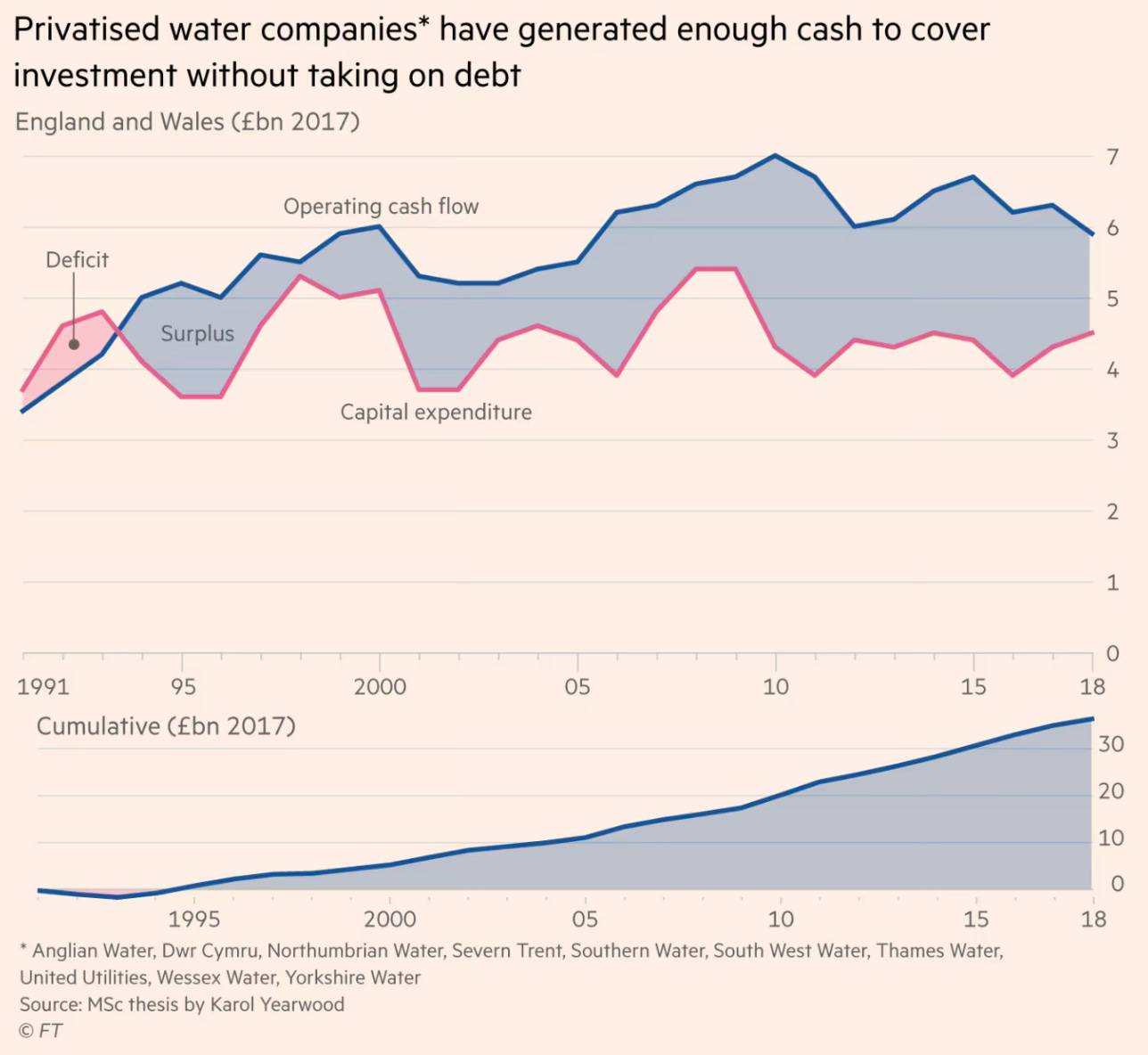
There are two defining graphics about how the UK water privatisation went wrong. The first shows how the utilities kept piling up debts even as their equity base remained the same (or even depleted). 

The second shows that even as they were accumulating all the debt, the private companies were generating sufficient cash to meet their investment needs without taking on debt. In fact, they could have paid out an average of £1.5bn in annual dividends without taking any debt at all. Instead they raised debt and paid out more, thereby causing the current debt pile. It’s no coincidence that £1.5bn of customers’ money is spent yearly by paying interest on these loans.

The two graphs beg the question as to what was Ofwat doing all along. The trends were hard to miss. But Ofwat choose not to act. It is hard not to feel that Ofwat’s monitoring systems failed abjectly in raising red flags to rein in such practices. British water privatisation is as much a story of regulatory capture as it is of the avariciousness of private capital. 

Ofwat’s role in the general failure of supervision and regulation has been a matter of debate for some time now. The British government has just constituted a commission to carry out a “root and branch” assessment of Ofwat and consider all options for the regulation of the industry. The Environment Secretary has blamed the regulator and lack of proper oversight for the failure of the water sector. The Commission, headed by former BoE Deputy Governor Jon Cunliffe, will “will look at strategic planning, protecting consumer interests, and how to come up with rules that hold companies to account without putting off potential investors.” 

Ofwat is undertaking its latest five-year price reviews for the water utilities, on price determination for the period till 2030. The industry sought a 29% increase and got an interim direction for a 19% rise. 

The graphs also draw attention to the point that I have repeatedly made in this blog on the importance of the nature of investors in regulated sectors like utilities. These are low but stable return sectors, appropriate for investors satisfied with low returns but seeking to diversify their returns. 

It’s difficult to believe that private equity firms meet this requirement. PE firms are not known for their commitment to stakeholder responsibilities and for building enduring companies. They have a single-minded focus on maximising returns, which leads them into questionable practices like asset-stripping and loading up their portfolio companies with excessive debt. Their emerging track record across sectors point to a consistent practice of pass-the-parcel after squeezing out all possible returns from their investees. Monopoly public utilities like water and sewerage cannot be left exposed to such practices. 

Instead of targeting specific categories of investors like PE or foreign funds in general, it may be useful for policy makers to put in place conditions that align the incentives of investors and also safeguards against asset stripping by private investors in regulated infrastructure sectors. This is an important requirement given the pass-the-parcel nature of dispersed private ownership associated with those like the kind of investors in UK water utilities. 

The objective should be to ensure that investors be held accountable for the life-cycle of the infrastructure asset by mandating certain fiduciary responsibilities during their ownership of the asset. On the positive side, there should be adherence to clear investment responsibilities, service level standards, and maintenance of asset quality levels. On the negative side, there should be debt-equity ratio ceilings, caps on returns, and close watch on the finances of the asset holding company. 

It’s also for this reason that private participation in public infrastructure like utilities, roads, mass transit etc., should be confined to simple concession contracts of services with tight caps on returns, including all kinds of payouts. It should be made explicit that the investors in such investments are fiduciaries and their value proposition is only stability of returns and not high returns. 

Saturday, August 17, 2024

Weekend reading links

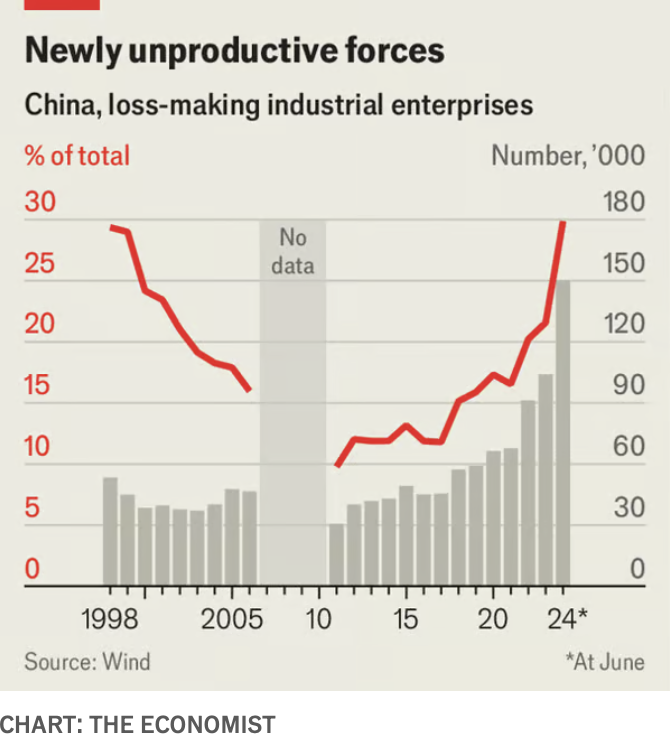
1. The Economist points to the troubles facing Chinese manufacturing companies. The percentage of loss-making industrial enterprises is now even beyond the level of 1998 when reforms to the SOEs started.

At least eight large makers of the cars have shut down or halted production since the start of 2023. The ripples are visible throughout the supply chain... Some 52,000 ev-related companies shut down in China last year, an increase of almost 90% on the year before, according to one estimate. China’s solar industry is also grappling with oversupply. This year the prices of most components of solar modules have fallen below their average production cost. Many companies in the industry are scaling back manufacturing. Others have scrapped plans to enter the market... A shakeout is occurring in the semiconductor industry, too. Local governments have focused their investments on low-end chip components in an effort to “easily win market share”, notes an industry insider. Those parts are now in great oversupply and many of the companies producing them are failing. In 2023 nearly 11,000 chip-related firms went out of business, roughly 30 a day, according to Qichacha, a company that collects corporate data.

2. Nice graphic that captures China's latest investment priorities - solar, EV, batteries, and semiconductor chips.

3. Unintended consequences of public policy actions - in Germany, carbon emissions from power generation rose sharply in 2022 as it shut down nuclear plants.
4. You can do such market micro-management actions only if you are China
China has adopted an unusual tactic to discourage banks from buying government bonds, as authorities try to halt an uncomfortable decline in yields and prevent a bubble forming: naming and shaming the buyers... While buying of their sovereign bonds may be welcomed by many countries, the People’s Bank of China has repeatedly warned that a bubble is forming in the sovereign bond market, with regulators saying that regional banks’ appetite for long-term government debt risks triggering a Silicon Valley Bank-style crisis if there is a sudden surge in yields. “The local PBoC branch called us and advised us not to buy bonds when state lenders are selling,” one bond trader at a local lender in Jiangsu province said this week. “They blamed a few rural banks in Suzhou for acquiring bonds sold by the state banks.” On Monday, large banks sold a net Rmb22bn of long-dated bonds, 10 times the daily average last week, according to BNP Paribas’ securities market data. The government is also trying to spur economic growth by pushing regional lenders away from parking their money in ultra-safe bonds and instead lending it out.

5. Some facts about the trends in low tech manufacturing and China.

Apparel, footwear and furniture accounted for 9 per cent of China’s exports in the first eight months of last year, according to a Bank of America Global Research report, down from 20 per cent in 2001. Car and machinery’s share of total exports increased to 33 per cent from 16 per cent over the same period. China’s share of global footwear and apparel sales has slipped in recent years, with its portion of overall supply for brands Nike and Adidas falling from 20-27 per cent in 2017 to 16-20 per cent in 2022, according to the BofA report. While it remains the world’s largest supplier, China’s share of global footwear exports has declined by more than 10 percentage points over the past decade, according to figures from the 2023 World Footwear Yearbook. Much of that capacity has shifted to south-east Asian countries, particularly Indonesia and Vietnam, the report added. Vietnam, now the world’s second-biggest exporter, has been the biggest beneficiary, with its share rising from 2 per cent to about 10 per cent.

6. About the UK's Teacher's Pension Scheme (TPS)

State schoolteachers (and some university academic staff) are automatically enrolled into the Teachers’ Pension Scheme. The TPS requires contributions of at least 7.4 per cent of gross salary but guarantees an inflation-protected retirement income linked to career-average salary. Like most public-sector schemes it is unfunded; current pensions are paid out of current contributions and if they are insufficient then taxpayers are on the hook. It is also expensive for employers, who currently make contributions of about 28 per cent of salary.

7. Nice Ed Conway X thread on the challenges with replacing existing materials and technologies.

Part of the problem here - one which crops up again and again throughout *Material World* - is that it turns out the suite of materials we tend to use these days are simply VERY good at doing what they do. Kerosene is really hard to beat as an aviation fuel. Methane is a brilliant source of the hydrogen for making, among other things, fertilisers. Concrete might not be the only strong building material, but it’s incredibly easy to lay and also phenomenally cheap... All these things create significant carbon emissions. But they are central to modern life. They are a large part of the explanation for how we've been able to urbanise and feed billions of people in recent decades. Finding low carbon replacements will be HARD.

8. Two good Ed Conway X threads, here and here, on how countries got locked into the single pipe system where the outflows from sewerage and storm water drainage flows through one pipe (instead of separate pipes).

9. Very good graphical article in NYT that shows how China has established nearly 50 new villages and expanded another 100 villages all along its south-western borders, some in areas claimed by India and Bhutan, in an effort to fortify its border claims. 

These villages are called "border guardians" and the villagers are paid to live there. 
Qionglin’s villagers are essentially sentries on the front line of China’s claim to Arunachal Pradesh, India’s easternmost state, which Beijing insists is part of Chinese-ruled Tibet. Many villages like Qionglin have sprung up. In China’s west, they give its sovereignty a new, undeniable permanence along boundaries contested by India, Bhutan and Nepal. In its north, the settlements bolster security and promote trade with Central Asia. In the south, they guard against the flow of drugs and crime from Southeast Asia. The buildup is the clearest sign that Mr. Xi is using civilian settlements to quietly solidify China’s control in far-flung frontiers, just as he has with fishing militias and islands in the disputed South China Sea... The mapping reveals that China has put at least one village near every accessible Himalayan pass that borders India, as well as on most of the passes bordering Bhutan and Nepal... The outposts are civilian in nature, but they also provide China’s military with roads, access to the internet and power, should it want to move troops quickly to the border. 

Villagers serve as eyes and ears in remote areas, discouraging intruders or runaways... in quietly building militarized villages in disputed borderlands, China is replicating on land an expansionist approach that it has used successfully in the South China Sea... To persuade residents to move there, Chinese Communist Party officials promised them their new homes would be cheap. They would receive annual subsidies and get paid extra if they took part in border patrols. Chinese propaganda outlets said the government would provide jobs and help promote local businesses and tourism. The villages would come with paved roads, internet connections, schools and clinics.

10. Livemint reports of declining fortunes of Kota, the coaching centre capital of India - the number of students declined from around 200,000 in 2022 to and estimated 70000-90000 this year.  

The primary reason for Kota’s decline today is coaching institutes opening centres in other cities in the last two years, which has had a cascading effect on local businesses. Allen Career Institute, for instance, now has centres in at least 60 cities across India, including Dibrugarh, Patna, Rohtak, Latur, Jodhpur and Durgapur. Unacademy’s website says it has 61 centres in 44 cities for offline preparation, including Ahmedabad, Bhopal, Bhubaneswar, Bengaluru, Dehradun and New Delhi. Physics Wallah has 124 centres in 105 cities, with its Kota centre opening in 2022. It has more than 200,000 students enrolled across these centres... The other reason for the drop in students in Kota is the image it has developed of being a “suicide and party" hub. According to a Hindustan Times report last month, at least 13 students preparing for NEET or the engineering Joint Entrance Examination (JEE) in Kota had taken their own lives as of July. Last year, 27 suicides were reported, which was the highest number since 2015, said officials.
11. Very interesting snippet in the context of Bharti Airtel's decision to invest £3.2bn and take a 24.5% stake in BT, India is the second largest FDI source for UK!
India is the country’s second-largest source of foreign direct investment: there are more than 950 companies with combined revenue of about $65bn operating in Britain — up from 900 in 2022, according to the UK India Business Council... Bharti Enterprises holds controlling stakes in satellite venture OneWeb and also owns prestigious hotel brands, including The Hoxton and the Gleneagles resort in Scotland, operated by a company founded by his son-in-law. Bharti’s Africa telecoms business is a member of the FTSE 100.

And the Empire strikes back again?

On a 1997 visit to Bengaluru, then-UK prime minister John Major hailed BT’s acquisition of a 21 per cent stake in a phone operator owned by Sunil Bharti Mittal as “an indication of the strength of our economy”. Now Indian politicians are cheering a dramatic reversal after Mittal’s Bharti Enterprises struck a deal to become the British former telecoms monopoly’s largest investor, agreeing to buy a 24.5 per cent, roughly $4bn stake from Franco-Israeli billionaire Patrick Drahi’s indebted Altice. Bharti Airtel, anchor of the 66-year-old Mittal’s conglomerate, has blossomed since its 1995 founding into one of the world’s biggest network providers and now dwarfs BT. With 550mn customers across 17 South Asian and African nations, the company commands a $100bn market value — more than five times that of the UK group, which has shed overseas assets in recent years.

12. Water desalination facts of the day

Christopher Gasson, publisher of Global Water Intelligence, which tracks the industry, figures that about 500 million people rely at least partly on purified salt or brackish water and that the number could rise sixfold to three billion by midcentury. Around the world, there are about 1,500 large plants — those that can produce about 2.6 million gallons a day — with roughly $14 billion being spent annually to operate the existing fleet and build new ones... Saudi Arabia is the largest market for these installations, followed by the United Arab Emirates... With nearly 100 big plants, Spain is the largest user of desalination in Europe and one of the world’s largest... the costs of operating the energy-intensive desalination technology — called reverse osmosis, which is standard at large plants including the one at Torrevieja — are being brought down by pairing water purification with cheap solar energy, encouraging the building of new plants.

13. It appears that Howard Schulz negotiated out several perks for himself from Starbucks that raise concerns about corporate governance and personal ethics.

In 2018, the man who built the Seattle coffee business into a global empire had negotiated an agreement to retain an chair emeritus role — for the rest of his life. The deal lets the 71-year-old attend and observe board meetings, according to Starbucks corporate filings... They range from Starbucks reimbursing Schultz when it uses his private jet for corporate purposes to him owning a stake in a business making extra virgin olive oil for one of the company’s coffee drinks... The deal — which can only be modified or waived if both parties agree... As Schultz was ending his third spell in charge, he was introduced while travelling in Sicily to the idea of eating a spoonful of olive oil every day. It inspired him to create Oleato, which Starbucks began rolling out to customers earlier this year. Corporate filings show that Schultz did not just originate the idea; he also owned 19 per cent of the family-controlled business from which Starbucks buys its oil. Starbucks paid the company, Partanna, about $26mn last year... Schultz’s air travel also remains intertwined with the coffee chain. He owns a jet used by Starbucks, according to filings, for which the company last year paid an entity he controlled about $1mn. He has also stored his plane in a Starbucks hangar, the filings show: in 2023, an entity controlled by Schultz paid Starbucks about $1.3mn to cover rent and other maintenance costs.

For those who scorn at public servants for their questionable integrity, imagine what would have been the case if the likes of much-worshipped Schulz were in the public sector!

14. US CPI inflation falls to 2.9%. Time to call an end to the war on inflation?

15. An emerging structural concern in the banking sector in India is the widening gap between the credit and deposit growth rates
In the last financial year, for instance, while credit expanded at about 20 per cent, deposit growth lagged at about 14 per cent. The gap was also highlighted in the RBI’s latest Financial Stability Report. This trend is reflected in the credit-deposit ratio, which has increased since September 2021. It peaked at 78.8 per cent in December 2023 before moderating to 76.8 per cent at the end of March 2024. The ratio is particularly high among private-sector banks.

Some thoughts here. One, the high ratio among private banks is reflective of the problems with efficiency maximisation pursuit of the private sector, and the need for regulation to bring in resilience to the banking system. Two, as the editorial alludes to, the sharp decline in household savings to a multi-decade low of 5.3% of GDP in 2022-23 may be a reason behind the lower deposit growth rate (apart from the emergence of alternative savings opportunities). Three, just as savers find alternative investment opportunities, the borrowers must also diversify away from banks to capital market avenues. 

16. Interesting snippets of Chinese trade data

While China’s share of US imports has slipped to 13.5 per cent today from 21.6 per cent in December 2017, its overall market share in global goods exports has risen from 12.8 to 14.4 per cent over the same period.
17. Tim Harford on luxury brands
The real trick that luxury brands have pulled off is that the two features of the brand — subtle excellence paired with conspicuous expense — reinforce each other. In its purest form, conspicuous consumption is crass and unattractive; it needs the cover story of excellence before it becomes appealing. Both excellence and expense are part of the brand promise, then, but the difference between them matters. If the brand is mostly about excellence, the purchaser of the fake is the obvious loser: they are getting shoddy goods masquerading as something much better. But if high-end brands are largely about expense for the sake of expense, then counterfeit brands are like counterfeit banknotes. Their ubiquity debauches the value of the once-exclusive brand and the suckers are not the people who buy the fakes, but the people who pay retail for the tarnished originals...
But is this inability to signal quality really a problem for luxury fashion brands? I doubt it. Those who walk into the Louis Vuitton shop down the street from Florence’s Duomo and pay €500 for a baseball cap will be confident that they are getting the real thing, and rightly so. Those who pay €12 in a Palermo street market are expecting a knock-off, and they are right too... The economist Karen Croxson, now at the Competition and Markets Authority, once published a theory of “promotional piracy”, in which companies would tolerate the copying of some products because it created demand for the real thing. Microsoft probably benefits if tens of millions of schoolkids familiarise themselves with pirated copies of PowerPoint and Excel. And while the possibility of counterfeit Gucci loafers seems unlikely to enhance the appeal of the real thing, maybe some brands might be happy to see influential young artists, musicians and trendsetters displaying their logos, fake or not. Or maybe the ubiquity of the imitations builds demand for the original? Over in the Uffizi, “The Birth of Venus” is so prized because it is so recognisable, and that is down to it having been duplicated, imitated and remixed so often. Perhaps this is as true for Versace as it is for Botticelli.