Substack

Showing posts with label Kerala. Show all posts

Monday, April 8, 2024

Palliative care in Kerala - a case study for development

Johanna Deeksha has an excellent story in Scroll.in that chronicles Kerala’s success with palliative care (caring for those living with serious or terminal illnesses like cancer, cardiovascular and chronic respiratory diseases, kidney failure, paralysis, dementia etc.).

The state leads by a large margin when it comes to providing such care to its citizens – while in India, just about 2% of the patient population has access to palliative care, in Kerala, almost 60% of the patient population has access to palliative care… Kerala provides this care through a network of almost 1,700 palliative care centres across its 14 districts, said Kumar. While some of these centres have in-patient services, most provide home-care services – that is, they serve as a hub comprising some medical professionals and volunteers from the area, who visit homes of residents in the region to treat them. Of these, 1,100 are government centres, and between 400 and 450 are run by NGOs. Between 80 and 90 are run by political parties, which Kumar explained is a phenomenon only seen in Kerala. Kozhikode has the largest number of palliative care centres, and is where the state’s model of palliative care has its roots.

It’s interesting that the palliative care success of the state can be traced back to the efforts of a couple of individuals who worked tirelessly to create awareness and mainstream the issue.

As a young medical student in Kozhikode, Dr Rajagopal MR heard screams from his next-door neighbour, who was afflicted with a terminal illness and suffered from intense pain. Rajagopal recounted that this experience led him to start thinking about the importance of pain management… In order to give focused attention to the problem, in 1993, he and his former student Dr Suresh Kumar established the Pain and Palliative Care Society, in Kozhikode – Rajagopal served as its chairman and Kumar as its secretary. Rajagopal recounted that he was deeply influenced by a lecture he attended around this time, by Gilly Burn, a British nurse who was travelling around India and introducing the medical fraternity to the idea of palliative care. He also attended a training programme of about 10 weeks in the United Kingdom, after which he returned to dedicate himself to the society’s work… Initially, the society functioned out of a 12-foot-by-12-foot room with a verandah, at the Government Medical College, where patients could consult doctors on palliative care and pain management. While the society offered home care services from its inception, it was only in 1995 that a formal home care team was established. Also in 1993, Rajagopal established Pallium India, which had broader aims, including of spreading awareness and training about palliative care.

The palliative care system in Kerala is firmly grounded in the community.

Patients spent the greatest amount of time with their family, neighbours and community. “The only way to provide proper care would be to train people in the community to intervene and become caregivers,” Suresh Kumar said. “It seemed like such a simple idea but took us so long to figure that out.” To address this problem, in 1998, Rajagopal and Kumar, with support from several NGOs, set up a community-based and volunteer-driven palliative care programme in Kerala, known as the Neighbourhood Network for Palliative Care, centred on the idea that palliative care is not merely a medical problem, but also a societal one. “That is why only in Kerala, the palliative care programme is the responsibility of the local government bodies – panchayats, municipalities and corporations,” Kumar said. The project was the first of its kind in India, and its approach came to be known as the “Kerala model”.

Five years later, in 2003, Rajagopal and Kumar set up the Institute of Palliative Medicine, adjacent to the medical college – the institute was to serve as a centre for treatment, training, research and outreach. The institute is now a partner to the World Health Organisation, in which role it supports the WHO in carrying out activities related to palliative care in India. The state’s community-centred system of palliative care received a fillip after the government made it the basis of its Palliative Care Policy, released in 2008. The policy stated that palliative care was an integral part of healthcare, and that not just the state health department, but even local government bodies should participate in setting up palliative care services. Kerala was the first state to have such a policy – Maharashtra followed in 2012, and Karnataka in 2016. By 2013, every panchayat in Kerala had a care centre unit. Most of these centres are home care centres, providing doctors, nurses and caregivers at home to families in need. Today, all district and taluk hospitals have palliative care centres where patients can receive treatment – but, Kumar explained, home care centres are more efficacious since most patients, especially those with terminal diseases, and those who are bedridden or otherwise have limited mobility, cannot travel back and forth to treatment centres.

The article has several stories of active involvement by the local community and public-spirited individuals in the sustenance of the state’s palliative care system. 

In many instances, individuals who need palliative care do not have caregivers who can take them to a hospital or provide care at home. In such situations, the local government body ensures that a neighbour or some member of the locality that the patient lives in is given the training needed to become a caregiver. “Do neighbours really volunteer to take care of someone who isn’t related to them?” I asked Nambath, “Why? How would it benefit them?” He responded, “In Kerala, we are a very close-knit society. There is no floating population. People often live in the same area for decades and they all already know each other. So, they step up to help each other.”

At the Community Palliative Care Centre’s office in Malaparamba, volunteers said that they were rarely short of funds. “We always have enough,” Nambath said. “People are always contributing.” He added, “When we told people in the locality that we needed another vehicle so we could visit more houses, immediately the funds poured in, and someone would always enquire if we bought the vehicle and if it had made our jobs easier for us.”

The emergence of palliative care in Kerala provides several learnings for other areas of social development. 

For a start, human engagement interventions must be grounded in the community and develop local ownership and accountability if they are to succeed. This applies to improving student learning outcomes, mental health improvements, sanitation and hygiene, sensitivity to children with special needs, welfare of disabled people etc., just as much or more as it applies to palliative care. 

Second, the service delivery system has to collectively embrace an account of its mission, one that goes beyond being a mere job responsibility. There must be a civic-spirited and moral imperative associated with this account. This is critical and difficult to achieve from a top-down government mandate (top-down mandates can only supplement the critical local action). 

Third, government engagement and funding must be complemented by volunteerism and local philanthropy, for it is such acts that contribute to ownership and accountability. Public policy must acknowledge the importance of such actions and must proactively create (and encourage its creation) the space for them. 

Fourth, the internalisation of an account generally emerges through long-drawn social mobilisation, which in turn comes from a gradual collective realisation of the issue as a problem or felt need. Societies and polities with strong social capital will find it easier to embrace such accounts, whereas those with weak social capital will struggle even with strong top-down promotion. It underlines the need for a strong social fabric in social development. 

Fifth, all such efforts to internalise accounts require a combination of social mobilisation and government support. The former without the latter runs into the problems of sustainability and especially scalability. The latter without the former is unlikely to get internalised and will, at best, meander. 

Sixth, both social mobilisation and top-down engagement require passionate champions to nurture and grow the movement for several years. The top-down bureaucratic change is not likely to come from the typical politician or bureaucrat but from passionate insiders with a strong personal stake in the cause. The system (both in the society and the bureaucracy) must provide the space and openings for the emergence of such champions and encourage them. They are worth their weight in gold. 

Finally, this example highlights a couple of very important high-level points on engaging with such issues. One, there are binding limitations to the effective adoption of externally grafted public policy ideas (and interventions) that lack serious local ownership. The latter is an essential requirement. Two, it’s perhaps wrong to engage with such issues with the framework and objective of their scalability, especially in their early stages. There’s something about the imperatives, techniques, and methods of scalability that conflicts with that of internalisation and adoption. 

Ironically, such ideas and interventions are more likely to scale when we think less of scale and focus on building community ownership and accountability. Long-drawn actions gradually gather enough moss to tip over and scale. As Lenin said, for years and decades nothing happens, and then in days years and decades happen!

Saturday, May 20, 2023

Weekend reading links

1. Brett Christophers has a very good article which links to several examples of infrastructure funds and private equity ownership of infrastructure assets gone wrong. It has become conventional wisdom that governments should stay out of infrastructure and should, at best, use public finance to de-risk projects so that private investors can come and invest. The main source of private investment in infrastructure is nowadays from infrastructure funds. Christophers writes that the number of global infrastructure focused funds rose from fewer than 100 in 2016 to more than 250 by 2020, with the total assets under management having quintipled since 2009. 

Led by Macquarie, an Australian financial services group that is the sector pioneer, asset managers began investing substantially in Asian and European infrastructure in the early 1990s. Today, in countries such as South Korea and Britain, infrastructure funds are the leading owners of major infrastructure assets in a range of sectors, among them energy, transportation and water.

The story of asset-manager-led infrastructure investment is overwhelmingly a negative one. Asset managers are focused on optimizing returns on the assets they control by maximizing the income they generate while minimizing operating and capital costs. Many users of infrastructure that has come under asset manager ownership have suffered, as service rates have risen quickly and service quality has deteriorated. Nowhere is this better illustrated than in Britain. There, numerous types of infrastructure have come substantially under asset manager ownership. This has led to consistently negative outcomes in, for example, care facilities, schools and water supply. Many observers have concluded that essential infrastructure and asset manager ownership simply don’t mix.

And in South Korea, Macquarie’s eight-year investment in Metro Line 9, part of the Seoul subway system, involved a bitter spat with the metropolitan government over a proposal to hike fares by nearly 50 percent. That led Macquarie and other shareholders in 2013 to unceremoniously sell their stake, in what commuters came to call the subway line from hell. Local critics charged Macquarie with taking excessive profits without assuming any risk, an accusation that has been a consistent drumbeat accompanying the phenomenon of asset manager infrastructure investment around the world. Macquarie said that it is committed to its operations in Korea and that its Korean infrastructure fund is a “passive financial investor” that has cooperated fully with the city of Seoul. 

The story has been much the same when housing is owned by asset managers. There have been allegations of skimped maintenance and egregious eviction practices in some areas. Such outcomes have been reported in Spain, for example, a notable hot spot of asset manager investment in housing since the global financial crisis, by a series of academic researchers. If the United States has been a relative laggard in asset-manager-owned infrastructure, it has been in the vanguard of asset-manager-owned housing.

2. Productivity booms lag behind inventions.

3. FT feature on South Africa's izinyoka's or copper thieves who steal for survival or to maintain drug addiction.
Copper was the new gold, as far as their gang was concerned, and anywhere it could be found was fair plunder. Theoretically, the sale and export of scrap copper is carefully controlled by South African officials. But the properties that make it the world’s third most-used metal also make copper a smuggler’s dream. Malleable and recyclable, it is easily melted down, after which its origin becomes virtually untraceable. It was February 2021 and prices had hit a 10-year high, reaching $9,000 a tonne on international markets. Any number of unscrupulous dealers would buy the coveted metal, then resell it in South Africa or, more likely, help smuggle it to booming markets in China and India... That made a ragtag group of izinyoka the first link in a lucrative supply chain ultimately controlled by international syndicates... in their time working together, they had all hacked down telephone poles, dug up underground cables and broken into industrial plants. Train stations were a favourite target. By the end of that year, izinyoka had ripped out more than 1,000 kilometres of overhead cable from Transnet, the state-owned freight rail operator, prompting it to contemplate switching from hybrid electric locomotives to diesel-only models that don’t require cabling...

In January, the consequences of industrial-scale theft in South Africa included: three security guards killed during heists; three hospitals scaling back operations because stolen copper plumbing hampers their ability to pipe oxygen to intensive care units; trains cancelled due to stolen signalling cable or track sleepers; parts of the city going without electricity for days after thieves toppled pylons. Mining, South Africa’s largest industry, has been severely disrupted. Pits across the country churn up gold, gemstones, rare earth metals and coal, and the country is home to about 90 per cent of known deposits of platinum, vital for electronics and electric vehicles. One morning in March, a platinum operator discovered 300 metres of copper cabling had been stolen from a production site. Workers at Royal Bafokeng Platinum laid new cables the following day, but the thieves were back by nightfall... City Power, Johannesburg’s main power utility, reported the cost of replacing cables stolen between July 2022 and February this year at R380mn ($21mn).

4. Edward Glaeser and Carlo Ratti write about reviving New York City, which like other cities around the developed world is facing large office vacancies in the aftermath of the pandemic

New York needs to attract the rich and talented, but the poem beneath the Statue of Liberty reminds us that the city’s greatness comes just as much from being the landing site for “your tired, your poor, your huddled masses” that it is now pricing out. One way to balance these two governmental imperatives — to help the poor and generate tax revenue from the affluent — is to view the city as a for-profit real estate development company wholly owned by a nonprofit poverty-alleviation entity. The for-profit company focuses on keeping the city attractive to the rich, and the revenue it generates gets plowed into schools and support for the poor.

This about how the office spaces can be converted into residential spaces and people brought back to the streets

Modern office towers have deep floor plans meant to maximize square footage, but units in residential buildings need windows and their natural ventilation and daylight. To achieve conversion at scale, we must therefore look past the architecture of the traditional apartment. Deep-core office buildings could be converted into new kinds of spaces optimized for co-living and co-working. Bedrooms, with windows, could line the perimeter while common areas for cooking, laundry, work, exercise and socializing could fill the middle. Such arrangements could also help meet one of the social challenges of our time: loneliness... The urban playground should be constantly rearranged: Streets could be cleared for weekends, annual festivals and temporary exhibitions; food bazaars and pop-up shops could multiply. Movie theaters struggle to compete with boundless streaming catalogs available on cheap 4K televisions. More outdoor screenings on summer nights could tip the balance back toward collective experience. These easy interventions are especially useful for garnering public support. To draw people into the Playground City, we need to show, not tell.

5. TSMC is facing a crunch on its most important resource, skilled chip engineers. Taiwan's chip sector employs around 326,000 engineers. There is an acute shortage of chip engineers, with China reporting an estimated shortage of 200,000 engineers. 

6. The debate on the proper role of the corporation has a century old echo

Chief executives have been debating the proper role of corporations — to make profits for shareholders or to serve society at large? — for more than a century. The Michigan Supreme Court considered the question in 1919, when the Dodge brothers, as shareholders in the Ford Motor Company, complained that Henry Ford was diverting profits into expanding the business and lowering the price of cars, rather than paying dividends. More than 50 years before Milton Friedman would famously declare that an executive’s responsibility was to make “as much money as possible,” Ford argued the opposite, saying the purpose of a corporation was to increase employment and pay good wages, and only incidentally to make money. The court ruled in favor of the Dodges. Some business leaders sided with Ford. Owen Young, the chairman of General Electric, said in the 1920s that, in addition to paying a “fair rate of return,” corporations had an obligation to labor, customers and the public.

7. Norway is at the vanguard of the shift to electric vehicles

Last year, 80 percent of new-car sales in Norway were electric, putting the country at the vanguard of the shift to battery-powered mobility. It has also turned Norway into an observatory for figuring out what the electric vehicle revolution might mean for the environment, workers and life in general. The country will end the sales of internal combustion engine cars in 2025. Norway’s experience suggests that electric vehicles bring benefits without the dire consequences predicted by some critics. There are problems, of course, including unreliable chargers and long waits during periods of high demand. Auto dealers and retailers have had to adapt. The switch has reordered the auto industry, making Tesla the best-selling brand and marginalizing established carmakers like Renault and Fiat. But the air in Oslo, Norway’s capital, is measurably cleaner. The city is also quieter as noisier gasoline and diesel vehicles are scrapped. Oslo’s greenhouse gas emissions have fallen 30 percent since 2009, yet there has not been mass unemployment among gas station workers and the electrical grid has not collapsed.

8. The Economist has an article which suggests that in relative economic terms China may already have peaked and it may never surpass the US GDP. 

Capital Economics, a research firm, argues that China’s economy will never be number one. It will reach 90% of America’s size in 2035 and then lose ground. In so far as the Peak China thesis can be captured in a single projection, this is it. What accounts for the lower expectations for China’s economy? And how much of a reduction is warranted? The answers hinge on three variables: population, productivity and prices. Start with population. China’s workforce has already peaked, according to official statistics. It has 4.5 times as many 15- to 64-year-olds as America. By mid-century it will have only 3.4 times as many, according to the un’s “median” forecast. By the end of the century the ratio will drop to 1.7...

The biggest swing in sentiment relates not to population but to productivity. Back in 2011 Goldman Sachs thought labour productivity would grow by about 4.8% a year on average over the next 20 years. Now the bank thinks it will grow by about 3%. Mark Williams of Capital Economics takes a similar view... As China ages, it will have to devote more of its economic energies to serving the elderly, leaving less to invest in new kit and capacity. What is more, after decades of rapid capital accumulation, the returns to new investments are diminishing... 

If China’s prices or exchange rate fail to rise as Goldman Sachs expects, then China’s gdp might never overtake America’s. If China’s labour productivity grows just half a percentage point slower than Goldman Sachs envisages, its gdp, everything else constant, will also never surpass America’s (see chart). The same is true if America grows half a point faster (as Capital Economic projects). If China’s fertility rate declines further (to 0.85 children per woman by mid-century), it might eke out a lead in the 2030s only to lose it in the 2050s. Even if China’s economy does become the biggest in the world, its lead is likely to remain small.

9.  For all the talk about its decline, The Economist points to some staggering numbers about the American economic progress over the decades, and it continues.

America’s $25.5trn in GDP last year represented 25% of the world’s total—almost the same share as it had in 1990. On that measure China’s share is now 18%... In 1990 America accounted for 40% of the nominal GDP of the G7, a group of the world’s seven biggest advanced economies, including Japan and Germany. Today it accounts for 58%. In PPP terms the increase was smaller, but still significant: from 43% of the G7‘s GDP in 1990 to 51% now... A hundred dollars invested in the S&P 500, a stock index of America’s biggest companies, in 1990 would have grown to be worth about $2,300 today. By contrast, if someone had invested the same amount at the same time in an index of the biggest rich-world stocks which excluded American equities they would now have just about $510... 

America’s working-age population—those between 25 and 64—rose from 127m in 1990 to 175m in 2022, an increase of 38%. Contrast that with western Europe, where the working-age population rose just 9% during that period, from 94m to 102m... between 1990 and 2022 American labour productivity (what workers produce in an hour) increased by 67%, compared with 55% in Europe and 51% in Japan... TFP in America increased by about 20% between 1990 and 2019. The G7 as a whole averaged less than half that... roughly 34% of Americans have completed tertiary education... Only Singapore has a higher rate... America is home to 11 of the world’s 15 top-ranked universities in the most recent Times Higher Education table.

And some pointers of economic dynamism,

In 2013 a Gallup survey found that about one in four adult Americans had moved from one city or area within the country to another over the past five years, compared with one in ten in other developed countries. About 5m move between states each year... Stockmarket capitalisation runs to about 170% of GDP; in most other countries it comes in below 100%... about half of the world’s venture capital goes to firms in America... 5.4m new businesses started in 2021, an annual record and a 53% increase from 2019... an OECD measure of the personal cost of failure for entrepreneurs consistently puts America and Canada at the bottom... (in the) World Management Survey America sits at the top of their ranking. Fierce competition... helps to explain America’s corporate culture. Bosses are more comfortable with firing employees... Markets are readier to reward companies for evidence that they are well run. America’s managerial strength, the survey finds, explains as much as half of the productivity lead that it has over other developed countries.
10. Novovax struggles with getting countries to comply with their advance market commitments to purchase Covid 19 vaccines. The lack of demand has led to governments either reneging or seeking to renegotiate their AMCs. The same problem is there with other vaccine makers' AMCs too. 

11. Berggruen Institute Governance Index for 2022 is here. This is the report. 

12. Indian Express article on Kerala's neighbourhood women's groups, Kudumbashree, that is the largest women's collective in the world and has completed 25 years of existence. 

It runs 49,200 micro-enterprises — 31,589 individual units and 17,611 group enterprises. So ubiquitous that in every half a kilometre in the state, you bump into one initiative or the other of Kudumbashree... Kudumbashree’s 46,16,837 members have organised themselves into 3,09,667 neighbourhood groups (or NHGs, called ayalkootam in Malayalam). The neighbourhood group is the primary level unit of Kudumbashree that has a three-tier hierarchy. The next rung is the Area Development Society (ADS) that functions at the level of the ward, followed by the Community Development Society that works at the local government. The NHGs usually begin with thrift and credit programmes, lending money to members using the group’s savings. Subsequently, NHGs are graded and once they qualify, they are eligible for bank loans. These loans address the immediate financial needs of the group members. Subsequently, the state government supplies grants and subsidies, besides administrative support. Banks provide loans to members at low interest rates. The total thrift collected by NHGs in the state, according to Kudumbashree’s website, stands at Rs 5,786.69 crore and the internal loans generated are to the tune of Rs 23,852.45 crore.

This is a striking achievement

Besides social mobility, the movement has armed women with political mobility too. Of the 11,000-odd seats reserved for women, 7,038 were won by active Kudumbashree members in the 2020 local body elections, up from 848 in 2005.

13. Argentina's latest bout of hyper inflation, spike in interest rate, currency collapse, foreign debt default, IMF bailout, economic contraction is on.

Argentina will announce on Monday a new round of emergency government measures, including raising interest rates 600 basis points to 97 per cent, to try to stave off the country’s worst economic crisis in two decades. The Peronist government is desperate to avoid a big devaluation before elections in October. But the South American country is also running out of foreign exchange reserves as Argentines abandon the fast-devaluing peso and embrace the US dollar. Fuelled by money-printing to finance a large government deficit, Argentine inflation hit 109 per cent a year in April, the highest level since 1991. The economy ministry said the new measures, to be announced Monday, would involve the central bank stepping up intervention in the foreign exchange market to try to slow the peso’s fall. Economy minister Sergio Massa is also trying to persuade the IMF to bring forward the disbursement of agreed loans and will travel to China on May 29 to seek greater use of the renminbi in foreign trade.

14. The Business Standard has an article which analysed 10 infrastructure stocks over the last twenty years and found them big wealth destroyers. 

Companies in the construction and infrastructure sector have been among the biggest underperformers and wealth destroyers in the stock market in the past 20 years. The sector has also seen a wave of corporate failures and bankruptcies, making it tough for retail or non-promoter shareholders to make money on their investments. The numbers suggest that companies in the infrastructure sector go through a typical boom-and-bust cycle. First, there is a sharp rally in the share price as companies report rapid growth in revenues and profits, but then earnings growth loses steam, triggering a big sell-off in these stocks and a further decline in share prices that lasts for years. For the poor showing by these companies, analysts blame high debt, poor return on capital and equity, and the inability of these firms to sustain growth and earnings when financial and macroeconomic conditions turn adverse.

15. Ghana signs a $3 bn bailout from IMF following defaulting on its $34 billion debt in December last. The IMF estimates another 19 countries in the continent could face the same fate. 

The government borrowed heavily to insulate the economy from the effects of the pandemic and may have avoided a recession as a result. But the country’s debt as a percentage of GDP went from 62.7 per cent in 2020 to more than 100 per cent last year, according to finance minister Ken Ofori-Atta. Debt servicing now takes up about 70 per cent of government revenue... The administration stopped charging for mains water and brought in cheaper tariffs on electricity... The government saw an opportunity in leveraging the Covid pandemic to engage in reckless expenditure in view of the 2020 election... Much of the Ghanaian government’s spending took place in a world of low-interest rates. Ghana gorged on cheap money, raising almost $17bn in eurobonds that the Ministry of Finance frequently said were oversubscribed for nine straight years. But as central banks began raising rates to control inflation — the Bank of Ghana has raised rates by 1,250 basis points since March 2022 — Ghana found itself shut out of international debt markets as concerns grew over its ability to repay what it owed. The government has since been forced to rely heavily on a domestic capital market, where interest rates are as high as 40 per cent, and central bank financing of 37.9bn cedis ($3.2bn) in 2022. Some of the money being injected into the economy by the central bank may have helped to fuel inflation.

Historically, Ghana, like Sri Lanka, has been a relative good performer in the region.

16. Finally, Gillian Tett has more data on how bad mobile phone use is on children's mental health.

A group called Sapien Labs, which studies mental health, has polled almost 28,000 18-24-year-olds. Part of Gen Z, Sapien describes this cohort as “the first generation who went through adolescence with this technology”. It’s no surprise that this research shows that Gen Z’s mental state is worse than earlier generations. As psychologist Jean Twenge notes in Generations, teenage mental health has worsened sharply in the past decade, the period after smartphones went mainstream. Covid-19 has exacerbated the problem, according to the Centers for Disease Control and Prevention. What’s most interesting, however, is that Sapien tracked the age at which respondents first got cell phones and compared this with their reported mental health. This showed a clear pattern: kids who received phones at a younger age had worse mental health, even after adjusting for reported incidents of childhood trauma. The share of females experiencing mental health challenges ranged from 74 per cent for those who received their first smartphone at age six to 46 per cent who received it at age 18. For males, the numbers were 42 per cent and 36 per cent... The pattern was particularly stark in one of six mental health categories, known as the “social self”, which tracks how we view ourselves and relate to others.  

Sunday, May 22, 2022

Weekend reading links

1. FT has a long read on the challenges facing the global market for luxury goods. Asian shoppers accounted for more than 60% of the $300 bn (including cars) plus market in 2021.  

This is a stunning snippet

South Korea’s Shinsegae department store in the Gangnam district of Seoul recording sales of $2bn in 2021 — the highest turnover for a single store in the world.

Harrods in London had for long held the top spot.  

2. Another long read on the exploration for Lithium mining in the US, which may have the fifth highest reserves but very little of which is exploited. The search for efficiency and cost cutting, coupled with the dominance of environmental interests meant that there was little incentive to mine its own minerals.

The US’s willingness to allow its manufacturing to take place overseas has attracted criticism... “We outsource everything for slightly lower costs,” says Emily Hersh, an analyst at consultancy DBDC Group, and the chief executive of a company undertaking a lithium brine exploration project in Nevada. “We have punted the supply chains behind the technology we use and love to cheaper jurisdictions, or jurisdictions without stringent environmental policy, so that we can get them cheaper and faster.”

As the EVs market expands, the demand for battery minerals will grow dramatically


3. The rising interest rates have turned spotlight on housing markets in developed countries, which have experienced a sharp increase since the pandemic. The Economist has a good graphic which captures the health of housing market in western economies. 

As can be seen, outside of the Nordics, the western economies remain well placed to weather out the housing market bubble. 

4. It has long been an orthodoxy of management that financial incentives in the form of bonuses spur productivity growth in businesses. Notwithstanding serious doubts, it has endured as a narrative. In this context Pilita Clark points to a study of by Professor Klaus Möller of Switzerland’s University of St Gallen which refutes this conventional wisdom,
Professor Klaus Möller of Switzerland’s University of St Gallen co-authored a study of salespeople at the Lichtenstein-based Hilti group, a family-owned company that sells construction products and services in 120 countries and wanted advice on reforming its pay-for-performance schemes. In early 2019, 190 Hilti salespeople in eastern Europe were switched from a salary that was 65 per cent fixed and 35 per cent dependent on meeting performance targets to an almost entirely fixed salary. (Small, non-monetary rewards such as family dinner vouchers were paid to teams that won internal company competitions for their performance.) The results were impressive: the country group outperformed the market by a factor of 1.4 in 2019, double the rate of 2018. Staff turnover fell by more than 4 per cent and satisfaction with pay rose by 19 per cent, double the company-wide increase. Crucially, sales efforts did not drop off... Hilti teams in other countries have adopted similar systems...

In many countries, bonuses first emerged in factories during the previous century to spur people doing simple, repetitive tasks to work faster and harder. It was relatively easy to judge how many widgets an individual worker produced each day, and pay a bonus accordingly. Today, more office workers collaborate in teams on complex tasks requiring co-operation and creativity. That makes it harder to judge exactly who is hurting or helping performance, yet bonuses have persisted.

Clark also refers to another study done by a big German retail chain which wanted to know if an attendance bonus would reduce absenteeism, 

A study was duly done of apprentice employees in 232 stores who were offered either extra money or more vacation days if they came to work as planned each month. Alas, the time-off bonus had no effect on absenteeism and the cash incentive made it worse: absenteeism surged by about 45 per cent, the equivalent of more than five extra days of absence a year per worker... It turned out that paying people to turn up to work sent unintended signals. Some staff thought it meant bunking off was rife — otherwise why would the company be paying for attendance? So they felt less guilty about being absent themselves. Others thought it showed the work they were being asked to do was unpleasant and underpaid, so they stayed home too.

5.  The application by Finland and Sweden to enter NATO is truly a landmark turn. To put it in perspective,

Sweden and Finland judged neutrality to be in their interests when faced by the Soviet threat, and in the Swedish case for centuries before that. They did not alter course, although they did join the European Union, in the more than three decades since the Cold War’s end. The shift in sentiment in the two countries in the past several months has been dramatic, one measure of how Mr. Putin’s determination to push NATO back and weaken support for it has produced the opposite effect — the rebirth of an alliance that had been casting around for a generation for a convincing reason to exist. Where no more than a quarter of the population in Sweden and Finland supported joining NATO last year, that number has risen sharply today — hitting 76 percent in a recent poll in Finland. Sweden’s governing Social Democratic Party, the country’s largest party and long a bastion of nonalignment, has embraced NATO membership in an extraordinary turnabout... Germany, a generally pacifist nation since it emerged from the rubble of 1945, has embarked on a massive investment in its armed forces, as well as an attempt to wean itself of dependence on energy from a Russia it had judged as, if not innocuous, at least a reliable business partner.

6. Here is the long list of businesses which have paused or exited from Russia. The latest are McDonalds and Renault

7. Jeff Bezos, like Elon Musk, appears to have lost it in this spat between him and the White House on the issue of rich not paying enough taxes. It's natural for the richest to take the cover of libertarian ideology to justify tax evasion. 

8. Shyam Saran reads the tea leaves from Chinese policy statements and speeches of top leaders and finds circumspection

The overall impression one gets from reading these speeches and their further elaborations is that China sees that the “changes unseen in a lifetime”, which had provided a strategic opportunity to advance China’s geopolitical influence, are shifting in a more adverse direction. China senses it is confronted with greater vulnerabilities even as the more positive factors appear to be losing steam. Its economy has slowed down and the persistence of its zero-Covid policy is leading to prolonged economic disruptions. The manner in which Russia has been crippled by economic and financial sanctions has heightened China’s vulnerability especially since its economy is far more integrated with the still West-dominated trade and financial systems. China may have declared victory too early. There are signs of a more cautious external posture going forward.

9.  From Business Standard on the carbon emissions from different energy sources

And the decline in storage costs

10. Kudumbashree self-help groups in Kerala should count as a genuine development success. It could be seen as the social counterpart to the political movement to decentralise governance. 

11. Sri Lanka becomes the first country in Asia-Pacific region after Pakistan in 1999 to undergo a hard default on its sovereign bonds.

12. A good summary of all the recessionary headwinds facing the world economy. 

13. Even as the world grapples with an inflationary spiral, Japan seems to be facing much calmer inflationary situation - while consumer prices rise 2.5% in April over the year earlier, core inflation was up just 0.8% from a year earlier. FT points to an interesting dynamic at work,

In the US and Europe, companies usually respond to a rise in raw material and commodity prices by transferring those costs to consumers. In Japan, however, businesses fear a public backlash if they raise prices, while workers — beaten down by decades of stagnant pay — do not demand the higher wages that would let them afford higher prices in the shops. If companies must pay more for imports but cannot increase their retail prices, they will suffer a squeeze on profits. They often react by seeking to cut wage costs, ultimately creating deflationary and not inflationary pressure. 

It points to other factors contributing to the muted inflation response,

First, a big chunk of the April inflation number reflected the disappearance from annual comparisons of cuts in mobile phone tariffs engineered by the then prime minister Yoshihide Suga last year. That means underlying inflation is less than the numbers suggest. Second, Japan’s economy has yet to recover to pre-pandemic levels, even though the country has never imposed the strict lockdowns carried out in other parts of the world. While there were fewer restrictions on economic activity, people have continued to take precautionary measures, even after most of the elderly were vaccinated against Covid-19. Japan is still closed to tourists. That has hit consumer spending hard. Third, while weakness in the yen used to provide a big stimulus to the Japanese economy, that effect is more muted than in the past. Big Japanese companies have relocated much of their supply chain to China. Demand for the capital goods Japan does still export has been heavily hit by the weakness of the Chinese economy.

14. From an FT long read about long distance truckers, this snippet about cross-border restrictions due to Brexit,

... requiring trucks going into the Republic of Ireland from the UK to present 700 pages of documents that take eight hours to prepare. Archie Norman, chair of Marks and Spencer, said this week: “Some of the descriptors, particularly of animal products, have to be written in Latin and in a certain typeface.” Every sandwich containing butter, he said, requires an EU vet certificate, which means employing 13 vets and budgeting for 30 per cent more driver time... The metaphor of supply “chains” makes the process sound orderly and smooth, but from the first this journey along them was more like an adventure through a wild ecosystem in which we were a prey, dashing between safe habitats such as lorry parks and filling stations, hunted by authorities, legislation and customs rules that sought to charge, delay or stop us.

15. Chinese economy, an April 2022 status check,

Retail sales down 11 per cent from a year earlier, against an expected decline of less than 7 per cent. Industrial production dropped 2.9 per cent. Manufacturing was particularly weak, with auto production falling 41 per cent. Export growth was 4 per cent, a screeching slowdown from 15 per cent growth in March. Real estate activity collapsed, with construction starts falling 44 (!) per cent
  

Sunday, January 30, 2022

Weekend reading links

1. In the latest episode of corporate corruption, Antonio Horta Osorio, the Chairman of Credit Suisse, has resigned following revelations of misuse of corporate hospitality and company jets for family use. This is a pervasive problem among high-flying corporate executives, but only a few get caught. 

Corruption in the private sector is about misusing shareholders money for personal purposes. As a moral issue, I don't know why it should be any less repugnant than similar corruption in government. 

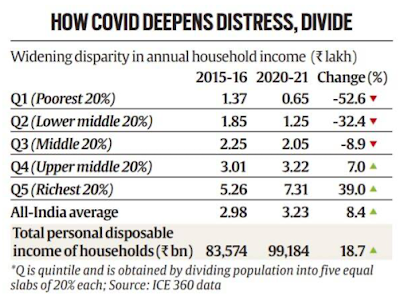
2. Latest evidence of K-shaped recovery in India comes from the ICE360 survey, conducted by People's Research on India's Consumer Economy (PRICE).
The annual income of the poorest 20% of Indian households, constantly rising since 1995, plunged 53% in the pandemic year 2020-21 from their levels in 2015-16. In the same five-year period, the richest 20% saw their annual household income grow 39%... The survey, between April and October 2021, covered 200,000 households in the first round and 42,000 households in the second round. It was spread over 120 towns and 800 villages across 100 districts... How disruptive this distress has been for those at the bottom of the pyramid is reinforced by the fact that in the previous 11-year period between 2005 and 2016, while the household income of the richest 20% grew by 34%, the poorest 20% saw their household income surge by 183% at an average annual growth rate of 9.9%...
The survey showed that while the richest 20% accounted for 50.2% of the total household income in 1995, their share has jumped to 56.3% in 2021. On the other hand, the share of the poorest 20% dropped from 5.9% to 3.3% in the same period... While 90 per cent of the poorest 20 per cent in 2016, lived in rural India, that number had dropped to 70 per cent in 2021. On the other hand the share of poorest 20 per cent in urban areas has gone up from around 10 per cent to 30 per cent now.

The share of poor belonging to urban areas increased, reflecting the likely greater impact of the pandemic on migrants and those living in slums.

3. More on slow recovery in private sector capex in India. A Business Standard analysis of the 500 most valuable companies by market capitalisation compared the performance of the top 5% and bottom 5% on a host of indicators. On gross block (all assets owned by the company)

On allocations going into investments

And on sales growth

4. The spectacular explosion in smart phone usage time in the US, which rose from 3% of waking hours to one-third over the last decade!

Will be pretty much the same elsewhere.

5. John Hussman points to the growing dissonance between the Federal Funds rate and objective functions of monetary policy like the Taylor Rule and various real economy variables. 

One observation from the graph is the consistency with which the Fed actions have overshot the objective functions when both raising and lowering rates. Fed invariably overshoots its monetary policy calibration. Is this time going to be any different?

6. This is the short history of US monetary policy over the last two decades,
The Fed lowered rates to the “zero bound” for the first time during the financial crisis of 2008. It was part of a great experiment, an effort to rescue the shaken financial system and the sinking economy when Ben S. Bernanke was chair. But the experiment never really ended. Because the economy remained weak, the Fed didn’t begin raising rates until December 2015, and it never got far. By 2019, when Mr. Powell was chair, the Fed funds rate had reached only 2.50 percent before signs of economic weakness made the Fed stop. In March 2020, it fell back to nearly zero. By contrast, the Fed funds rate was as high as 6.60 percent as recently as July 2000... 

The amounts involved in the Fed’s quantitative easing have been staggering. Back in 2008, the Fed’s balance sheet had assets of $820 billion. They reached $4.5 trillion — yes, trillion — in 2015 and dropped only as low as $3.76 trillion in the summer of 2019. With the coronavirus financial crisis, they have ballooned again, to $8.9 trillion, and may swell a bit more before the spigot shuts. Assets held by the Fed are already more than 10 times their size in 2008, and bigger, as a proportion of gross domestic product, than at any time since World War II. The Fed’s monetary stimulus accompanied a total of roughly $5 trillion in pandemic fiscal relief by the federal government.

This is the challenge with monetary policy adjustment,

Calibrating the combined effects of quantitative tightening and interest rate increases in real time is exceedingly difficult. Cut off stimulus too rapidly and the Fed could further unnerve financial markets. It could conceivably cause a spike in unemployment and a sharp slowdown in growth, plunging the United States into a recession. Move too gingerly, on the other hand, and the Fed could allow elevated inflation expectations to become embedded, making high inflation even more damaging.

7. A good NYT piece on the dilemma facing consumer brands in associating with China and the forthcoming Winter Olympics.

“The space to please both sides has evaporated,” said Jude Blanchette, a scholar at the Center for Strategic and International Studies in Washington. “When choosing who to upset, it’s either a bad week or two of press in the U.S. versus a very real and justified fear that you’ll lose market access in China.”... the issue of human rights violations in China has not generated enough protests to threaten the profits of multinational companies, while the angry Chinese consumers have fueled painful boycotts... “If any other government in the world did what the Chinese are doing in Xinjiang or even in Hong Kong, a lot of companies would just pull up stakes,” said Michael Posner, a former State Department official who is now at New York University’s Stern School of Business. He cited decisions by companies to divest in places like Myanmar and Ethiopia, as well as the campaigns to boycott South Africa when its apartheid government sent all-white teams to the Olympics. “China is an exception,” he said. “It’s just so big, both as a market and a manufacturing juggernaut, that companies feel they can’t afford to get in the cross hairs of the government, so they just keep their mouths shut.”

8. Interesting graphic about economic recovery in the US

Inflation-adjusted output last quarter was just 1 percent below where it would have been if the pandemic had never happened. Here’s another one: Ignoring inflation, output is 1.7 percent above where it would have been absent the coronavirus.

9. The Kerala government is planning a semi-high speed railway corridor, Silverline, planned across the length of Kerala. The Rs 63,940 Cr project to be financed through external loans would cut the travel time for the 530 km commute from Trivandrum to Kasargode from 12 to 4 hours. Indian Express has an article that points to the public opposition being faced by the project.

I had blogged earlier here about the value of such a project given the urban continuum nature of the state's demography and topography. However, it remains to be seen from the financials about how sustainable it will be. 

10. The bad bank is finally off the ground with the decision to transfer Rs 50,335 Cr from 15 accounts to the National Asset Reconstruction Company Ltd (NARCL) by March 31, 2022. Its private sector owned twin, India Debt Resolution Company Ltd (IDRCL) will be responsible for the resolution of the debts. NARCL will be majority owned by public sector banks and IDRCL majority owned by private sector banks. This is a good primer. 

The NARCL will purchase these bad loans through a 15:85 structure, where it will pay 15 per cent of the sale consideration in cash and issue security receipts (SRs) for the remaining 85 per cent. The SRs will be guaranteed by the government. The government guarantee will essentially cover the gap between the face value of the security receipts and realised value of the assets when eventually sold to the prospective buyers. The government approved a 5-year guarantee of up to Rs 30,600 crore for security receipts to be issued by NARCL as non-cash consideration on the transfer of NPAs. This will address banks/RBI concerns about incremental provisioning. Government guarantee, valid for five years, helps in improving the value of security receipts, their liquidity and tradability. A form of contingent liability, the guarantee does not involve any immediate cash outgo for the central government.
Once the bad loans are transferred to NARCL, a trust will be set up for each loan account, and the debt resolution will be handled by IDRCL, which will not carry any balance sheet.

11. Finally, on budget eve, this article has numbers which makes a strong case for higher long-term capital gains (LTCG) taxation in India. Those who declared more than Rs 1 Cr annually from LTCG was 8629, with Rs 40,000 Cr income for 2017-18. I imagine it would have doubled in these boom times by 2021-22. 

And India's LTCG rate of 10% pales in comparison to this from other comparable economies.

Saturday, January 15, 2022

Weekend reading links

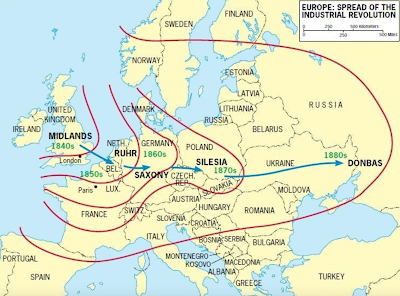
1. Simon Kuestenmacher points to the spread of Industrial Revolution (HT: Adam Tooze)


The twitter account here is excellent.

2. Tamal Bandopadhyay has a story on the super-charged growth at all costs strategy pursued by RBL Bank under its earlier leadership, which invited the attention of the regulator. 

If true, there may be parallels with Vishal Sikka at Infosys, in so far as the management styles and strategies of the two US executives came to be at odds with the more conservative Indian corporate and regulatory cultures and environments. 

3. Informative article about the challenges with privatisation of BPCL. The article points to the 2017 sale of a much smaller Essar Oil by Rosneft for $12.9 bn,
At its $11 billion-plus valuation, BPCL is a risky proposition especially if the government, under pressure from unions, places onerous terms on retrenchment or resale of certain assets and interferes in fixing petrol and diesel prices. BPCL trades at Rs 391. The government expects a much higher valuation factoring in a control premium of Rs 300-Rs 400 a share considering that Rosneft paid more for a less-endowed Essar Oil. That deal included a 400,000 barrels per day (b/d) modern refinery at Vadinar, a captive port and power plant, and 3,500 retail outlets. Compare that to BPCL, which operates 24 per cent of India’s 80,458 retail outlets, 23 per cent each of the 263 aviation fuel stations and of the 21.3 million tonnes of LPG bottling capacity, and a combined 550,000 b/d of refining capacity at Mumbai and Kochi. It also has petrochemical units, stakes in city gas distribution in India and a 10 per cent stake in a $20-billion Mozambique LNG project.

4. FT has a long read on the end of the Chinese lending spree in Africa,

From almost nothing, Chinese banks now make up about one-fifth of all lending to Africa, concentrated in a few strategic or resource-rich countries including Angola, Djibouti, Ethiopia, Kenya and Zambia. Annual lending peaked at a whopping $29.5bn in 2016, according to figures from the China-Africa Research Initiative at Johns Hopkins University, though it fell back in 2019 to a more modest, if still substantial, $7.6bn.

For all its claims of being the largest development finance lender in Africa, its official development aid (at least 25% grant component) share is smaller than that of all major western countries.

5. Striking facts about Kerala's internal migrants,

According to state planning board estimates, the state had 3-3.5 million migrant workers, though the actual number could be 4 million, around 12 per cent of Kerala’s total population. This could swell to 5.5 million by 2030. Other-state migrants now account for 26.3 per cent of Kerala’s total workforce; in districts such as Ernakulam, the share could be as high as 57 per cent. Of this number, close to 2 million are employed in construction, followed by manufacturing, agriculture and low-paid service sectors such as hotels and the retail trade. Based on another planning board study, these migrant workers in Kerala are estimated to be remitting Rs 750 crore annually from Kerala to their native states. It pegs the average monthly income per migrant at Rs 16,000, around Rs 3,500 less than their local counterparts.

Compared to Kerala's own external migrants,

According to the state government’s Norka (Non-resident Keralites Affairs) department, around 4 million people from the state live overseas, 1.3 million in other Indian states. Overseas Keralites account for around 20 per cent of India's remittances of $87 billion as of 2021 (World Bank estimates). Remittances constitute 35-40 per cent of Kerala’s Net State Domestic Product.

This is an important observation,

Benoy Peter, executive director of Centre for Migration and Inclusive Development, an NGO working among migrants says, “In terms of wages, though they earn less than locals, the informal sector workers in Kerala are getting the highest wages in the entire subcontinent... It is almost like West Asia for Keralites, the only difference is the majority of them are not properly educated.”

6. MGNREGA demand continues to far outstrip demand. The real requirement for next year may well be over Rs 1,50,000 Cr, far beyond the Rs 95000 Cr of this years revised allocation. 

7. Shankar Acharya writes about the contribution of the Kenyan Leakey family to the discovery of human origins in Africa,

By some estimates, the collective contribution of fossil discovery and analysis by the Leakey family cumulates to around half the total available fossil evidence relating to human evolution. There are several striking conclusions one can draw from the post-1940 work in this area. First, the origins of man (including various species of hominids) stretch back six million years or more. Second, because the fossil record is, in its nature, still quite fragmentary, our understanding of man’s origins is a work in progress despite the enormous advances of the last few decades. Third, the 300,000-year long history of Homo sapiens is actually a short time span compared to the longevity of various other species, including several lines of hominids. Fourth, it is noteworthy that in recent centuries, the explosive growth of the Homo sapiens population has come at the expense of thousands of other species. Last, and most worrying, sapiens has been the most deadly species not only for others but quite possibly for itself, as the cumulative consequences of its actions pave the way towards the Sixth Extinction.

8. Covid induced consumption shift and its knock-on effects on global trade volumes,

About 60 per cent of spending by a US consumer typically goes to goods and the rest to services, but that has risen to 65 per cent, according to Bernstein. As a result, US imports were up almost 20 per cent in September and October 2021 over the same months in 2019.

Freight shipping rates have rocketed during the pandemic,

The New York Fed has a new index for supply chain disruptions.

9. Excellent FT primer here on the natural gas crisis facing Europe. This graphic captures the sources of India's natural gas imports.

10. Fascinating article in NYT about how ordinary officials and people in China in general and Xi'an province in particular have helped the government impose the draconian lockdowns and other restrictions with great effectiveness during the pandemic. 

11. A South African government judicial investigation has found the consultancy Bain & Co a corporate enabler of graft in the country during the regime of Jacob Zuma. In a damning report, it documented how Bain colluded with Zuma and his cronies to weaken the South African Revenue Service (SARS) and crippling its ability to carry out investigations of tax evaders. It has accused Bain, which was hired as a consultant to advise SARS, of supporting President Zuma with "state capture" by corporate and other interests.  

Bain follows in the footsteps of McKinsey and KPMG who have all been accused or at least tacitly acknowledged guilt in colluding with the previous government to promote rent-seeking. Consider this,

Vittorio Massone, the firm’s former South African managing partner, forged a close relationship with Zuma, meeting him on average every six weeks between 2012 and 2014, according to the report. An event management company owned by a soap-opera producer close to Zuma became Bain’s second-highest paid local adviser around the world, the report said... Between 2012 and 2015, Bain laid plans “to restructure entire sectors of the South African economy” and centralise state procurement, the report said... “In cozying up to [Zuma], I think they [Bain] saw even more money to be made” and Massone was not a rogue actor... “In management consulting in particular, it is impossible to work in a vacuum. The [intellectual property] that Bain developed . . . Massone would have drawn on.”... Bain’s quest for influence even extended to Massone attending meetings to discuss the manifesto of the ruling African National Congress, according to the report. Yet beneath these grand ambitions, “across Africa Bain had no tax authority experience” and “knew that they did not have the necessary expertise”, the report said.

It's most certain that the entire Bain leadership in Boston knew about this. These smells spread quickly across any organisation. And they were culpable in condoning such practices in a distant African country with a promising market. 

More worryingly, it's certain that most of the people in Bain associated with this would have personally been party to some rent-seeking, either cash or in-kind. Does anyone speak about it? Massone, who had become the symbol of the Bain-Zuma partnership, was allowed a dignified exit from Bain. This served the purpose of sweeping things under the carpet and ensuring that others and the company itself does not get dragged any more into the mess. 

12. In some ways, it's good news that India lost to South Africa. The team's collective behaviour on the third day of the last test was despicable. A victory would have given them undeserved bragging rights as being the best Indian team ever, having won in Australia, England, and South Africa. 

As to those claims, it can be said that this team has perhaps the best bowling attack in the last thirty years (or ever), and the weakest batting line-up over the same period. The former has been aided by very weak batting line-ups across countries. The first 6-7 of Australia, England, New Zealand, Pakistan, and South Africa (and all others) are remarkably weak, perhaps the weakest uniformly in decades. 

It needs to be born in mind that India's biggest problem in the last two years has been its 3, 4, and 5 batters. All of the three average 25-28 in 15-20 tests. Pujara was critical in winning in Australia, whereas the other two, Kohli and Rahane, have been bystanders. 

Tuesday, September 21, 2021

Some thoughts on Kerala's social history

Kerala, till the late nineteenth century was one of the most casteist society ("mad house of castes" as Swami Vivekananda described). As late as the nineteenth century, women were treated very low dignity in Kerala, perhaps worse than anywhere in Madras Presidency. Its matrilineal society stuff that is a staple explanator of the state's development is, I think, inaccurate. The matrilineal succession has less edifying reasons. 

But it cannot also be denied that there was something different about the way women were seen. The state, for example, has the largest number of Devi temples. The presiding deity of most of the tens of thousands of family temples (the larger extended family has a temple associated with them) is Devi. This goes much far back in history.

What changed it was several genuine social reform movements and supported by a few enlightened rulers of Travancore and Cochin. These social reformers, led by Sree Narayana Guru, got lower castes into temples, women's dignity protected, established large numbers of schools, even a Sanskrit College. Given the levels of oppression, the social transformation achieved in about 50 years must count as one of the most impressive ones anywhere in the world (unfortunately very less discussed). What sustained it was the communist governments post-independence, and the role of various caste and religious groupings to focus on education. The Nairs, Ezhavas, and Christians all have associations which run hospital and school/college chains across the state. 

The contrast with West Bengal is interesting - the state had less social divisions to start with, an enlightened leadership class (bhadralok), more widely known social reform movements, and a Communist government. It still could not entrench the level of public institutions and civil society that Kerala did. I guess, the role of those social reformers of Kerala in the late 19th and 20th century is one of the less discussed corners of Indian history. 

Finally, it may also have contributed that all the three-religious groups and the major caste groups were numerically similar, if at least by order of magnitude - there was no one overwhelming majority. Further, unlike WB, the social reform leadership emerged from within the lower castes.

Saturday, September 4, 2021

Weekend reading links

1. WSJ has a story on the rise of neo-Brandesian anti-trust activism in the US. It's essentially a battle between two conflicting schools of thought on market regulation - maximise consumer welfare or promotion of competition. It pitted the views of Louis Brandies against those of Robert Bork, with the former winning the first half and the latter the second half. 

The new framework is more rooted in social and political goals than economic ones; more focused on the size of companies per se, less on trying to assess whether that size is good or bad for the economy; and more sympathetic to suppliers, small business and workers, even at the expense of consumers... Louis Brandeis laid out two core themes of antitrust. First, the purpose is more about preserving democracy than fostering growth. As Brandeis wrote in a broadside against the big banks, “Even more important than efficiency are industrial and political liberty.” Second, as he argued in his 1934 book, “The Curse of Bigness,” big business is suspicious in itself, whether economic harm can be proven or not. Brandeis’s antipathy to size was also aimed at government, a nuance often overlooked by his current followers. 

His most famous antitrust ruling, in the 1918 case of Chicago Board of Trade v. United States, gave courts wide latitude to police any business conduct suspected of attempting to “suppress or even destroy competition.” Brandeis repeatedly sided with small businesses, from ice sellers to lumber mills, even when they tried to band together and collude, as long as they claimed to be preserving a more diversified marketplace against bigger rivals...

“The only legitimate goal of American antitrust law,” Bork declared, “is the maximization of consumer welfare.” Bork insisted that a singular focus on consumer welfare was the original intent of Congress and the courts—that is, in his telling, until Brandeis perverted it. Bork labeled Brandeis’s Chicago Board of Trade ruling “deviant”... Bork’s basic view was that antitrust should focus on economics and shed political and social aims. He coupled that framework with a belief in the superior wisdom of the private sector over the public. Attempts by business to gain damaging monopoly power would inevitably be corrected by free markets, he argued, while government intervention to fix perceived problems would cause lasting harm... 
He dismissed the idea that vertical integration could undermine competition. He derided the concept of “predatory pricing”... Bork felt that antitrust should largely be restricted to challenging the biggest horizontal mergers—combinations of direct competitors—and the most egregious anticompetitive practices, such as explicit price fixing.

2. Indian Express has a fantastic story on a Rs 18 Cr steel plant established with share capital from 207 Gulf returnees in Kozhikode district in Kerala. The shareholders in GTF Steel Pipes and Tubes LLP are ordinary villagers from Thikkodi village and its surrounding villages, who were part of a social media group Global Thikkodiyans Forum (GTF) that was formed in 2015. 

This is the first such attempt in the state where expatriates, and returnees, of a village have come together and mobilised capital for a business enterprise of this kind. The total investment of Rs 18 crore was raised from 207 people. Of these, 147 invested only Rs 1 lakh each. The price of a share was fixed at Rs 50,000, and an individual had to invest in at least two shares. There was a cap on the maximum investment as well – Rs 40 lakh per person. “The major highlight of the venture is that a large section of investors are ordinary people who have some small savings, a few lakh rupees, after years of toil in the Gulf. But for an initiative of this type, they would not have been able to be a part of a professional business venture,” said GTF Steels Chairman Mohammed Basheer Nadammal. “Most of these returnees invest in trade or hotel industry, and then back out after incurring huge losses. Our concern was to make such people a part of a business venture,’’ he said... the monthly demand of GI pipes and tubes in Kerala was 40,000 metric tonnes during pre-Covid. It would be down to 25,000 metric tonnes now. However, the production in Kerala is only 4,000 metric tonnes per month. Our monthly production capacity is 3,000 metric tonnes... None of the partners work in the factory. The recruitment was done in a professional manner, with only qualified, trained workers being selected... We have 2,000-odd members in the GTF. Only those interested in investing in the steel industry were selected as partners.

Social media helped bring together the group, some of whose members self-selected to establish the venture, and they choose a commercially viable manufacturing venture. 

3. The Major Port Authorities Act 2021 allows major ports the power to set prices based on market conditions, freeing them from the regulatory control of TAMP. Therefore, given the virtual monopoly nature of most ports, is there a need for tariff regulation before these assets get monetised as part of the National Monetisation Pipeline?

4. The challenges with infrastructure asset monetisation,

In case of national highways, as against a target of Rs 20,815 crore, it has only garnered Rs 14,692 crore, that too because the first auction fetched a 50 per cent premium. Now the government plans to raise nearly Rs 40,000 crore each year from roads. Its track record in the Railways is no different. The Railways has not been able to monetise its existing assets. Sundry earnings for the national carrier have been falling since 2016-17. Last year, the Railways had aimed to collect Rs 30,000 crore via privatisation of some routes, but it only received bids from two companies worth Rs 7,200 crore and had to cancel the auction. Asset monetisation for BSNL and MTNL has remained a pipe dream since 2017.

5. Debashis Basu writes that the final mudra of Mudra loans may well be one of failure.

A few days ago, Dinesh Khara, chairman of State Bank of India (SBI), told a publication that 20 per cent in its loan portfolio ofRs 26,000 crore under the Pradhan Mantri Mudra Yojana (PMMY) scheme had turned bad... In FY21, Rs 3.21 trillion of Mudra loans were sanctioned to around 51 million borrowers and Rs 3.11 trillion was disbursed. SBI has also notched up 9.22 per cent (Rs 26,203 crore) bad loans on its MSME books of Rs 2.84 trillion... From 4.35 per cent of Mudra advances in 2016-17, bad loans shot up to 9.3 per cent in FY19... In January 2019, the RBI cautioned the PMMY generated Rs 11,000 crore of NPAs and could upset the credit market severely. In July 2019, the RBI blamed the poor credit-appraisal system of banks for rising bad debts. The biggest bad loans (12.39 per cent) were in the smallest loan category (under Rs 50,000).

6. Tamal Bandopadhyay writes about how the banking system is awash with liquidity stashed up in low-yielding government securities with the attendance pressure on their margins and profitability.

The banking system’s holding of government securities was to the tune of Rs 46.12 trillion in mid-August — around 30 per cent of deposits (Rs 155.7 trillion), a loose proxy of the so-called net demand and time liabilities, against regulatory requirement of 18 per cent. Apart from the dated securities, banks invest in treasury bills on which their earning is, at best, on average 3.5 per cent now... Overall, at least 10 per cent resources of the banking system are generating a return between 3.35 per cent and 4.2 per cent. For many banks, this is far lower than their cost of funds. In banking parlance, such investments are offering them a “negative carry”. 

The cost of funds for most large private banks and many public sector banks that have a handsome portfolio of the low-cost current and savings accounts, popularly known as CASA, could be 3.75-4 per cent. For others, it’s 4.5-5 per cent. Many banks in the second group, too, have a large CASA base but they offer much higher interest rates on savings bank accounts in contrast to large banks, which pay just 2.75 per cent. If we compare the return from reverse repo and treasury bills with the banks’ marginal cost of funds based lending rate (MCLR), below which no bank can give loan, the negative carry is far higher. This rate factors in the marginal cost of funds, tenure premium, operational cost and the negative carry on account of cash reserve ratio (CRR). The banks don’t earn any interest on the 4 per cent of deposits kept with the RBI as CRR. The overnight and one-month MCLR of State Bank are the same — 6.65 per cent. The comparable rate for ICICI Bank is 7 per cent and IDFC Bank 7.9 per cent. The MCLR is fixed every month.

7. A new amendment to the IBC 2016 provides for a pre-packaged insolvency resolution process (PIRP) for MSMEs, which envisages a hybrid mechanism of negotiated debt restructuring which on approval by NCLT becomes binding on all stakeholders. 

Aimed at causing minimal disruption to business and to ensure job preservation, the PIRP allows the existing management of the MSME to retain control of the firm during the PIRP, unlike the corporate insolvency resolution process (CIRP). However, certain fundamental decisions have to be approved by the Committee of Creditors (CoC) and the PIRP is monitored by a resolution professional (RP). If the existing management grossly mismanages the affairs of the MSME or commits any fraud, then, subject to approvals of the CoC and the NCLT, the management can be handed over to the RP. The option to initiate a PIRP lies solely with the MSME itself. It is also the MSME that prepares and submits a base resolution plan for consideration, although such resolution plan may be subject to a Swiss-challenge from potential investors if it hampers the interests of operational creditors. The PIRP is tailored to be cost-efficient and provides for a strict timeline (90 days for approval of the resolution plan by the CoC and 30 days for approval by the NCLT) to complete the process.

8. Good story on the steel sector in India which is experiencing a health return to profitability and also concentration,

The share of the top two players — Tata Steel and JSW Steel — in flat products stood at 51 per cent in FY2021, up from 48 per cent in FY2018. In the fragmented long products segment, the share of top five producers (which include Tata Steel, JSW Steel, JSPL, SAIL and RINL), has increased from 38 per cent to 53 per cent in the same period. The industry is changing in fa­vour of the big boys with deep pockets.

This graphic on the recovery rates for the different steel plants which went into bankruptcy

The recovery rates were not too bad, at an aggregate of 59% for the five largest accounts. The IBC resolution also ensured consolidation of the steel industry with the emergence of Tata Steel, JSW, and ArcelorMittal/Nippon Steel as the three biggest manufacturers. 

9. Good history of the evolution of telecoms market in India in terms of operator ARPUs over the last fifteen years. This was then,

Going 15 years back to the April-June quarter of 2006, the all-India ARPU for wireless services stood at Rs 346.59, with Delhi topping at Rs 465.51 and Mumbai next at Rs 430.97. In the Delhi circle, the differential between the three players was remarkable—Bharti Airtel’s ARPU was at Rs 524.17, followed by Hutch (which later became Vodafone’s business after a mega deal) at Rs 442.99 and Idea Cellular at Rs 374.05. In Mumbai — other important telecom market—Hutch led with an ARPU of Rs 527.48, followed by Bharti at Rs 422.29 and the third player, BPL Mobile, at a much lower Rs 288.51.

And now,

The latest composition of ARPU is something like this. On average, a subscriber spends 39 paise towards rental in a month, Rs 17.84 on calls, 31 paise on SMS and Rs 89.81 on data, besides the remaining in value-added services, out of a total of Rs 103.58. So calls, which have been the bread and butter for any operator, make up for only 15.6 per cent of revenue from subscribers, while data usage yields a bulky 78.7 per cent.

10. Indian Express points to a large increase in gold loans, a likely indicator of the extent of household distress,

Retail or personal loans — which account for 26 per cent of total bank credit — jumped 11.2 per cent over 12 months till July 2021 compared with 9 per cent over the previous 12 months. Within retail loans, the gold loan outstanding soared by 77.4 per cent, or Rs 27,223 crore, to Rs 62,412 crore by July 2021 on a year-on-year basis. SBI, the largest bank, reported a 338.76 per cent growth in gold loans as of June 2021.

11. FT story on the exiting German Chancellor,

When Merkel came to power, the iPhone had yet to be launched and the oil major ExxonMobil was still the US’s most valuable company (it would be six years before it was supplanted by Apple). The wider world looked very different too. George W Bush was in the White House and Tony Blair in 10 Downing Street...

“She became the Mother Teresa of world politics,” says Josef Janning, a senior associate fellow at the German Council on Foreign Relations. “As someone who was all about negotiating, listening closely to her interlocutor and accommodating his or her views, she was the antithesis of Trump.”... Rufus Franzen, a 17-year-old student who is part of the Berlin pupil council, a representative body for local school children... says, always seemed like “this wise lady who always knew exactly when to act, was rarely impulsive and never put a foot wrong”. But today people crave more “assertiveness... A lot of people feel Merkel isn’t drastic enough in her policies and want someone with more resolve, especially when it comes to climate.”

12. Finally, The Economist on wokeness in US,

... a loose constellation of ideas that is changing the way that mostly white, educated, left-leaning Americans view the world. This credo still lacks a definitive name: it is variously known as left-liberal identity politics, social-justice activism or, simply, wokeness. But it has a clear common thread: a belief that any disparities between racial groups are evidence of structural racism; that the norms of free speech, individualism and universalism which pretend to be progressive are really camouflage for this discrimination; and that injustice will persist until systems of language and privilege are dismantled.