Substack

Showing posts with label Coaching. Show all posts

Saturday, January 28, 2023

Weekend reading links

1. On top of opaque lending practices which have led to debt crises in many countries, it now emerges that poor quality of construction may be another problem with at least some of the Belt and Road Initiative (BRI) projects. Some samples,

Thousands of cracks have emerged in the $2.7 billion Coca Codo Sinclair hydroelectric plant, government engineers said, raising concerns that Ecuador’s biggest source of power could break down. At the same time, the Coca River’s mountainous slopes are eroding, threatening to damage the dam... In Pakistan, officials shut down the Neelum-Jhelum hydroelectric plant last year after detecting cracks in a tunnel that transports water through a mountain to drive a turbine... The head of the country’s electricity regulator, Tauseef Farooqui, told Pakistan’s senate in November that he was concerned the tunnel could collapse just four years after the 969-megawatt plant became operational...

Uganda’s power generation company said it has identified more than 500 construction defects in a Chinese-built 183-megawatt hydropower plant on the Nile river that has suffered frequent breakdowns since it went into operation in 2019. China International Water & Electric Corp., which led construction of the Isimba Hydro Power Plant, failed to build a floating boom to protect the dam from water weeds and other debris, which has led to clogged turbines and power outages, according to the Uganda Electricity Generation Co., or UEGC. There have also been leaks in the roof of the plant’s power house, where the generators and turbines are located, UEGC said. The plant cost $567.7 million to build and was financed mostly through a $480 million loan from the Export-Import Bank of China... In Angola, 10 years after the first tenants moved into Kilamba Kiaxi, a vast social housing project outside the capital of Luanda, many locals are complaining about cracked walls, moldy ceilings and poor construction. The project, built by China’s CITIC Group, was initially funded through a $2.5 billion, oil-backed credit line from the Industrial and Commercial Bank of China that was later refinanced by the China Development Bank.

2. Gillian Tett writes that 4% may be the new inflation norm for central banks.  

3. Business Standard writes about the demand-supply gap for dialysis in India,

Dialysis in India costs $25 a session compared with $300 a session in the US. India, however, with its high hypertension- and diabetes-prone population, remains a growing market for dialysis service providers. Every year, the country adds 600,000 to 700,000 patients in need of dialysis. Given that some 40 per cent die, the net patient addition is 350,000 to 400,000, which translates into an incremental requirement of 55 million dialysis sessions every year, more than double the current number of 21-22 million. The country has 50,000 dialysis machines, 5,000 centres for dialysis and about 3,000 practising nephrologists.

Clearly the demand-supply gap is large enough to keep the supply growing at high double digits for several years. Sample this

Vikram Vuppala, founder and CEO, NephroPlus, said the market will continue to grow at 20-25 per cent over the next three or four decades and predicts that the share of organised private sector players in the dialysis market — there are several mom-and-pop centres run by doctors — will increase from 21-22 to 40 per cent in the next five years.

I'm inclined to argue that such growth rates will not persist beyond a few years and what prevents that from happening are two-fold - affordability (demand-side) and entrepreneurship and capital (supply-side). 

4. NYT article on the tuition industry at Kota

“There are two types of students in Kota — rankers and bankers,” Amit Gupta, a coaching-center biology instructor, told me. “One ranker will attract thousands of bankers. This is our modus operandi. We are in the business of selling dreams.” By Gupta’s definition, rankers are students with the potential to get into elite colleges, while bankers, who are in the majority, are students whose ambitions outrank their capacities. “A ranker was always going to get selected,” Gupta told me. “If he gets good teachers, his rank may improve, but he was already capable of selection. The business model of the coaching industry relies on the banker. We show him a dream — ‘You can also become an I.I.T.-ian or a doctor’ — even though we know all along that he would never be selected because there are just not enough seats.”

5. Noah Smith makes a very interesting observation about the link between depreciating real estate prices in Japan and the country's practice of constant tearing down and rebuilding of property once every 30 years or so.

Japan’s fervor for constant scrap-and-build construction is a major reason why rent there is so affordable, and why local politics haven’t halted dense development as they have in the West... Because Japanese people don’t use their houses as their nest eggs, as they do in much of the West, there is not nearly as much NIMBYism in Japan — people don’t fight tooth and nail to prevent any local development that they worry might reduce their property values, because their property values are going to zero anyway. As a result, Japanese cities like Tokyo have managed to build enough housing to make housing costs fall, even as people continued to stream from the countryside into the city... Even more amazingly, Japan managed all of this while increasing the size of the average person’s home...

When property tends to depreciate, it means that houses don’t cost as much to buy in the first place; that lower price frees up household cash that can be put into stocks and bonds. Basing wealth on productive assets instead of unproductive land is good for the economy — housing scarcity might pump up prices and build individual wealth for homeowners, but at the national level it simply holds back economic growth. And as it turns out, it’s good for middle-class wealth as well — in 2022, Japan’s median wealth per adult was about $120,000, compared to around $93,000 in the U.S. (And this is despite the fact that Japan’s once-legendary household savings rate has collapsed!) So Japan’s somewhat unusual choice not to tie middle-class wealth to housing prices seems like a smart one. Over the past two decades, the country has done better in terms of housing policy, construction, landscaping and urbanism than just about any country in the West. And it did this by embracing constant change rather than the physical stagnation that has prevailed in Western cities.
Noah's post is a brilliant takedown of a goodbye article by BBC's long-time Tokyo correspondent Rupert Wingfield Hayes who characterised Japan as a society resistant to change. 

6. The Big Mac Index appears to show that the Rupee is among the most undervalued currency.
7. The Economist profiles "scripted one-size-fits-all instruction" offered by NewGlobe in public schools in Nigeria's Edo state,
The government has provided tablets and training to more than 15,000 teachers. They in turn have given the new lessons to more than 300,000 children, most of them in primary schools. On any given day pupils throughout the state receive identical lessons, as dictated by the tablet... The scripts enforce instructional practices that are routine in many rich-country classrooms but often neglected in poor ones. These include techniques such as pausing frequently to pose questions to the class, instead of delivering long lectures at the blackboard, or encouraging pupils to try to solve a problem by chatting to the child sitting next to them. 

Detailed, prescriptive lesson plans are also supposed to relieve teachers of the burden of having to write their own... In Edo, tablets register when teachers arrive. They can tell if a teacher has scrolled through a lesson faster than appropriate, or if they have abandoned one halfway through. Beneath lies a low-tech foundation: a team of officials—about one for every ten schools—that observe lessons and coach teachers, helped by data from the tablets... In the past few years the approach has been applied in Gambia, Ghana, Nepal and Senegal. One programme in Kenyan government schools helped push up the number of children reaching the national standard in English by 30 percentage points... teachers sometimes bristle at the constraints that scripts impose... 

Sceptics often come round, she says, when they see kids making swift progress... other expensively trained professionals, such as pilots and surgeons, also have procedures that they must follow to the letter. After some initial complaints (similar to those expressed by dubious teachers) such regimented approaches have become widespread in those fields. They help reduce mistakes, and spread better ways of doing things.

For school systems stuck at very poor baseline instructional quality and low learning levels, scripted pedagogy of the kind that the likes of Bridge International Academies did offers promise. 

8. Livemint has a fascinating set of infographics comparing budgets over the years on a host of variables.

9. Vivek Kaul has an excellent set of graphics on the changing nature of India's banking sector. Three graphics stood out for me. The first is the stagnation in banking sector credit.
The lending of banks has remained around 50-53% of the GDP since March 2009 (with 2020-21 being an exception due to covid-19), and deposits have remained between 67-70%.

Second, in a reversal of their lending targets, banks now lend out more to individuals than businesses.

Finally, the variation across states in credit to deposit ratios - the ratio of total loans given out in the state to the deposits mobilised from the state.

The interesting story in the list is that of Bihar. The credit-deposit ratio of the state has increased from 0.32 to 0.45. Further, the credit-deposit ratio of India’s most populated state, Uttar Pradesh, has barely moved up from 0.44 to 0.45. Andhra Pradesh, Tamil Nadu and Telangana have a ratio of greater than 1, implying that banks need to import deposits from other states in order to meet their lending requirements in these states.

Sunday, July 24, 2022

Weekend reading links

1. Long read in FT on the issue of weight-loss drugs, especially Wegovy the new drug by Novo Nordisk. The self-administered weekly injection is part of the increasing belief that obesity is a disease rather than resulting from unhealthy habits and for the seriously overweight medical treatment may be necessary.

The article points to the long history of failures with weight loss drugs,

Despite the vast need, many major pharmaceutical companies have held back from developing weight-loss drugs, in part because the category is marred by a long history of quackery and safety scares. From the 1930s to the 1960s, the industry poured money into diet pills based on amphetamines. These eventually fell out of favour because they were highly addictive and had harmful side effects. In the 1990s, fen-phen — a combination of fenfluramine and phentermine — became so popular that weight-loss clinics sprung up across the US just to prescribe it, even though some patients on the drug experienced manic episodes. It was later taken off the market after a study showed up to a third of patients could suffer from heart valve defects. As recently as 2020, US regulators forced the withdrawal of weight-loss drug Belviq because of concerns it increased the risk of cancer. For the most desperate, surgery has become popular, though it is expensive and comes with its own risks and restrictions.

2. George Bass, a security guard in a university, has a brilliant essay chronicling life in times of rising inflation.

In my job keeping people and property safe on a university campus, I earn £10.71 per hour. Working 16 12-hour shifts a month bags me an average £1,400, after tax. I’ve always been comfortable earning a modest wage. Since I began working at the age of 15, I’ve picked jobs based on two guiding principles: I don’t want to have to tell lies all day, and I don’t want to get work calls beyond the car park. In my various roles over the past 25 years, working on a gun range, in a lead factory, as a labourer and shifting boxes, those two rules have never been broken. Getting a job in security taught me a third: once the uniform’s on, you need to help people. This year, the drumbeat of news about inflation has made me increasingly anxious.

The essay is a great example of how exceptional talent can remain hidden in all of us. Some, and only some, realise it and become rich and famous (in varying degrees), whereas it remains latent in the lives of most others. And the reason for the talent getting expressed in most cases is either the ovarian lottery of birth circumstances or plain good luck. 

3. The tumult in financial markets have hit emerging market bonds very hard. It's estimated than $52 billion has already been pulled out from EM bonds this year, with devastating consequences on EM bond yields.

EM bonds are having their worst year on record.

4. As it pulls ahead in mass manufacturing of 5 nm chips, TSMC's lead in the semiconductor chip business increases.

5. The age of ultra-loose monetary policy is being followed by a period of frenetic tightening,

In the three months to June, 62 policy rate increases of at least 50 basis points were made by the 55 central banks tracked by the Financial Times. Another 17 big increases of 50 basis points or more have been made in July so far, marking the biggest number of large rate moves at any time since the turn of the millennium and eclipsing the most recent global monetary tightening cycle, which was in the run-up to the global financial crisis. “We’ve seen this pivot point in the market where 50 is the new 25,” said Jane Foley, head of foreign exchange strategy at Rabobank.


This demonstrated collective resolve is an important point that can help anchor inflation expectations. 

6. Pratik Datta writes about the latest example of judicial activism which threatens the future of the Insolvency and Bankruptcy Code.

The Supreme Court recently passed an important judgment in Vidarbha Industries Power Ltd. v. Axis Bank. It held that the National Company Law Tribunal (NCLT) cannot admit an insolvency application filed by a financial creditor merely because a financial debt exists and the corporate debtor has defaulted in its repayment. Instead, the NCLT must consider any additional grounds that the corporate debtor may raise against such admission... The balance-sheet test is one method for determining insolvency at the point of trigger. This test, however, is vulnerable to the quality of accounting standards. That’s why the Bankruptcy Law Reforms Committee did not favour this test in the Indian context. Instead, it recommended that a filing creditor must only provide a record of the liability (debt), and evidence of default on payments by the corporate debtor. This twin-test was expected to provide a clear and objective trigger for insolvency resolution. The hope was this would minimise litigation at admission stage, enabling quicker resolution of distressed businesses. The Supreme Court’s latest ruling is likely to radically alter these expectations. Even if the NCLT is satisfied that a financial debt exists and that the corporate debtor has defaulted, it may not admit the case for resolution if the corporate debtor resists admission on any other grounds. Corporate debtors are likely to use this precedent to the fullest to resist admission into IBC. The likely outcome would be more litigation and delay at the admission stage, enhancing the risks of value destruction in the underlying distressed business. Unless the NCLT consciously constrains the use of its own discretion at the admission stage, the IBC may well end up like the SICA. 

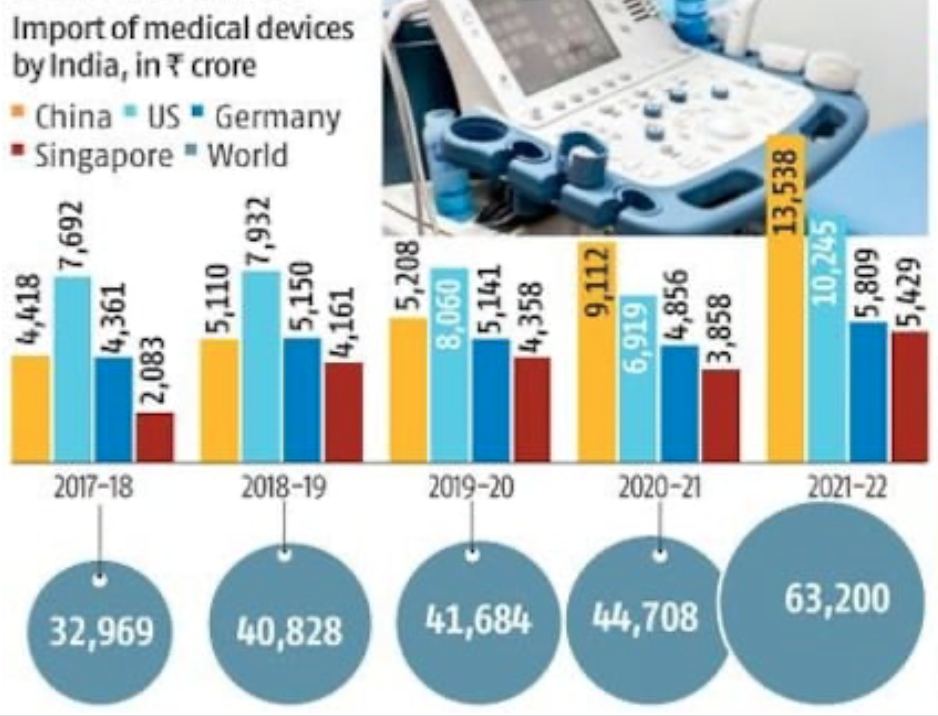
7. The rising dependence on imported medical devices, in particular from China.

The problem is the competitiveness with Chinese manufacturers. The pandemic boost has since subsided and makers are struggling to compete with the Chinese in a normal competitive market.

8. FT has a long read on the enduring high risk appetite among young investors in the US. It has a graphic which points out that only half Americans born in 1984 were likely to out-earn their parents at 30.

And this sums it all on high risk investing
Gary Stevenson, a 35-year-old former trader and financial education campaigner from east London, is one: “My dad never went to university. He worked at the post office for 35 years and could raise three kids and pay off [a mortgage] . . . he has a comfortable retirement,” he says. “That is off the table for most young people now. It’s created a bit of a panic.” “If you can’t do what your dad or grandad did . . . you have to come up with a better plan,” he adds. At some point, risky bets starts to look like the rational choice: “One way, you see a zero per cent chance of success. But if you take on insane risk . . . at least you have a chance.”... “If you said, ‘My dad spends all day gambling,’ [I’d] say, ‘Oh man I’m so sorry for your family’,” he says. But “if someone says, ‘My dad spends all day FX trading’, you think he’s the Wolf of Wall Street . . . It’s not gambling, it’s investing — and investing is how you get rich.”

9. Esther Bintliff has a long read in FT assessing the value of feedback in improving performance. She examines the research and literature on the topic and leaves you wondering whether there is any scientific basis to the claim that negative feedback when given appropriately can lead people to change habits and behaviours and improve their performance.

The article points to a 1996 meta-study of feedback literature by two academic researchers Avraham Kluger and Angelo De Nisi,

The two reviewed hundreds of feedback experiments going back to 1905. What they found was explosive. In 38 per cent of cases, feedback not only did not improve performance, it actively made it worse. Even positive feedback could backfire... Kluger came to believe that as a performance management tool, it is so flawed, so risky and so unpredictable, that it is only worth using in limited circumstances, such as when safety rules must be enforced. If a construction worker keeps walking around a site without a helmet, negative feedback is vital, Kluger acknowledges. The most effective way to give it is with great clarity about potential consequences. The worker should be told that the next time they go without a helmet, he or she will be fired. But in many other types of work, the formula for good feedback includes too many variables: the personality of the recipient, their motivations, whether they believe they are capable of implementing change, the abilities of the manager...
Instead of managers giving top-down feedback, he argues they should spend more time listening to their direct reports. In the process of talking in depth about their work, the subordinate will often recognise issues and decide to correct them on their own. Based on this theory, Kluger developed something he calls the “feed-forward interview” as an alternative, or prologue, to a performance review. He offers to give me a demo... Much of how we respond to feedback is driven by the nature of our relationship with the person giving it. This is why Kluger believes it’s useless to focus on the recipient of feedback alone. The outcome will always depend on the “dyad” — the sociological term for two people in a particular relationship — and what transpires between them.

The time, effort, and skill required to do a good feed-forward interview is too rare as to make the likelihood of a feedback being effective very rare.

10. Even as the Sri Lankan crisis occupies attention, the situation in Pakistan deserves greater attention as things worsened this week,

The Pakistani rupee’s 7.6 per cent tumble to Rs228 to the dollar marked the latest setback for the currency, which has fallen sharply this year. It marked the rupee’s sharpest weekly drop since October 1998. The latest slide reflected mounting concerns that a $1.2bn loan disbursement from the IMF agreed last week might not be enough to avert a balance of payments crisis. Pakistan’s bonds have been among the worst performers in emerging markets this year... Fitch Ratings this week downgraded its country outlook to negative from stable, noting what it called a “significant deterioration in Pakistan’s external liquidity position and financing conditions” this year. The rating agency said the central bank’s forex reserves had declined to about $10bn by June 2022, down from $16bn a year previously and equivalent to just over one month’s worth of current external payments. Pakistan’s central bank raised its main policy interest rate 125 basis points to 15 per cent on July 7 in an effort to stem demand for foreign currencies and reduce inflation.

Friday, September 30, 2011

Coaching to improve performance

Atul Gawande has an excellent article in the New Yorker that examines the effectiveness of coaches in improving performance levels among professionals across sectors. He describes coaches,

"Coaches are not teachers, but they teach. They’re not your boss — in professional tennis, golf, and skating, the athlete hires and fires the coach — but they can be bossy. They don’t even have to be good at the sport... Mainly, they observe, they judge, and they guide."


How are coaches different from teachers?

"The coaching model is different from the traditional conception of pedagogy, where there’s a presumption that, after a certain point, the student no longer needs instruction... Coaching in pro sports proceeds from a starkly different premise: it considers the teaching model naïve about our human capacity for self-perfection. It holds that, no matter how well prepared people are in their formative years, few can achieve and maintain their best performance on their own."


How do coaches achieve success in improving the effectiveness or performance of their wards?

"You have to work at what you’re not good at. In theory, people can do this themselves. But most people do not know where to start or how to proceed. Expertise, as the formula goes, requires going from unconscious incompetence to conscious incompetence to conscious competence and finally to unconscious competence. The coach provides the outside eyes and ears, and makes you aware of where you’re falling short. This is tricky. Human beings resist exposure and critique; our brains are well defended. So coaches use a variety of approaches—showing what other, respected colleagues do, for instance, or reviewing videos of the subject’s performance. The most common, however, is just conversation."


Coaches also help improve learning outcomes in schools. He writes about coaches who sit and observe classroom instruction and provides information to the teachers about where they could improve or change, so as to optimize the learning outcomes in the class,

"California researchers in the early nineteen-eighties conducted a five-year study of teacher-skill development in eighty schools, and noticed something interesting. Workshops led teachers to use new skills in the classroom only ten per cent of the time. Even when a practice session with demonstrations and personal feedback was added, fewer than twenty per cent made the change. But when coaching was introduced—when a colleague watched them try the new skills in their own classroom and provided suggestions—adoption rates passed ninety per cent. A spate of small randomized trials confirmed the effect. Coached teachers were more effective, and their students did better on tests."


These specifics under observation in classroom coaching include - whether the teacher has an effective plan for instruction; how many students are engaged in the material; whether they interact respectfully; whether they engage in high-level conversations; whether they understand how they are progressing, or failing to progress.

In some sense, coaching is about feedback loops that indicate what improvements or changes are required. Even with all the modern technology, individuals cannot conveniently access information about where their professional deficiencies and failures lie. Even when they can observe, it is cognitively difficult for them to overcome all their biases and objectively accept their deficiencies and take steps to address them. It is in this context that a trained external observer, in the form of a coach, becomes valuable in providing the required feedback that can be used to improve their performance.

The challenge with coaching would be to get people who are trained to closely observe their objects in the least invasive manner, and who have a deep understanding of the processes that makes up the activity under observation. More than the content of the activity being observed, their focus should be on the subtle nuances of the many actions that are performed by their wards. Could they have done it any differently so that its impact would have been greater or less harmful? Gawande writes,

"Good coaches know how to break down performance into its critical individual components. In sports, coaches focus on mechanics, conditioning, and strategy, and have ways to break each of those down, in turn."


Gawande sees huge potential in using competent retirees in each profession as coaches to help professionals improve their efficiency and effectiveness. He however feels that professional's general reluctance to accept being coached (or observed in their act) is the biggest stumbling block to widespread use of coaches - "we may not be ready to accept—or pay for—a cadre of people who identify the flaws in the professionals upon whom we rely, and yet hold in confidence what they see".

How I wish there were coaches for bureaucrats!!