Substack

Showing posts with label Emerging economies. Show all posts

Saturday, August 31, 2024

Weekend reading links

1. On mangoes

India is the world’s biggest mango producer, with volumes greater than the next nine growers combined, according to Tridge, a data firm. Yet its share of the global export market by value is a meagre 7%. Mexico, which produces a tenth as much as India, accounts for a quarter. The reasons are many, writes Sopan Joshi in “Mangifera Indica”, a new book about mangoes. Chief among them are the delicate nature of the fruit, poor growing practices in India and strict standards in Western markets.

2. Interesting fact about the state where US companies are getting incorporated, Delaware stands out with over 70%.

3. Data does not bear out signatures of deglobalisation.
4. Some facts about Big Tech 
Since early 2019 the combined worth of the tech giants (Microsoft, Google, Amazon, Meta, and Apple) has more than tripled, to $11.8trn. Add in Nvidia, the only other American firm valued in the trillions, thanks to its pivotal role in generative artificial intelligence (ai), and they fetch more than one and a half times the value of America’s next 25 firms put together. That includes big oil (ExxonMobil and Chevron), big pharma (Eli Lilly and Johnson & Johnson), big finance (Berkshire Hathaway and JPMorgan Chase) and big retail (Walmart). In other words, while the tech illuminati have grown bigger and more powerful, the rest lag ever further behind...

Since 2019 the five tech giants and Nvidia have doubled their capital expenditures, to $169bn last year. Tot up the 25 next firms’ capex and it was just $135bn—up only 35%. As for brain power, over the same period, the big six added 1m jobs, doubling their headcount. No one can accuse them of resting on their laurels. They have invested in ai startups, ploughed fortunes into building large language models and, in Meta’s case, created open-source offerings that almost anyone can use. This year they are doubling down on their ai spending if only to protect their flanks.

5. Striking facts about the importance of immigrants to the US economy.

Immigrants are 14% of the population in America, 16% of inventors and directly produce over 23% of innovation, measured by patents, patent citations and the economic value of those patents, the authors estimate. Taking into account how they make their native-born collaborators more productive, they are responsible for a staggering 36% of total innovation.
6. Law of unintended consequences strikes at the Chinese government ban of tutoring centres for the gaokao entrance examinations.
Researchers at Peking University... analysed surveys of household spending before and after the tutoring ban and found that low- and middle-income families were, on average, spending less on after-school education. The richest families, though, were spending more. Tutors were still active. But because they were acting illegally, they charged more, pricing most people out.

7. Very good summary of the performance of State Bank of India under Mr Dinesh Khara who stepped down as CMD after four years. These are very impressive numbers

Between October 7, 2020 and last week, SBI stock has delivered a 328.36 per cent return to investors, compared to Bank Nifty’s 122 per cent return and Bankex’s 122.9 per cent. During this time, the Nifty returned 111.4 per cent, and the Sensex 103.3 per cent. The largest private bank, HDFC Bank Ltd, saw its stock rise 39.9 per cent, while ICICI Bank Ltd rose 214.6 per cent in this period. For SBI, the return on assets (RoA) moved from 0.43 in September 2020 to 1.10 in June 2024. During this period, return on equity (RoE) increased from 8.94 to 20.98, and earnings per share (EPS) from 19.59 to 76.56... While the bank’s assets have grown over the past three-and-a-half years at a compounded annual growth rate of 10.56 per cent, from Rs 43.58 trillion to Rs 61.91 trillion, its gross non-performing assets (NPAs), as a percentage of total assets, have more than halved, from 4.77 per cent to 2.21 per cent. After provisioning, net NPAs have decreased from 1.23 per cent to 0.57 per cent. Meanwhile, the net interest margin (NIM) — loosely the difference between what it spends on deposits and earns on loans — has risen marginally from 3.31 per cent to 3.35 per cent.
Who said public sector institutions must be inferior also rans compared to their private sector counterparts?

8. Since the pandemic, apart from the Bank of Japan and the Swiss Central Bank, the RBI has undertaken the least number of interest rate changes. 
It's also one of the very few that have not yet moved on reducing rates. 

9. Ruchir Sharma talks about a return of emerging market economies in the coming years. For a start, corporate earnings are growing faster in EMs than elsewhere.
This means that we could see a reversion of the trend since 2010.
10. Some numbers to put in perspective why the US equity markets stand alone globally. 
At the beginning of the 20th century, the US accounted for about 15 per cent of world market capitalisation, second only to the UK, which was at 24 per cent. By 1910, the US had crossed the UK to become the largest equity market in the world. It has since retained this title, unchallenged except for a brief period in the late 1980s when Japan held the top position. Japan peaked in 1989 at 40 per cent of world market capitalisation, while the US was second at 29 per cent. Today, the US remains unchallenged, accounting for more than 62 per cent of world market capitalisation. The next largest market is Japan at 6 per cent, followed by the UK at 3.7 per cent, and China at 2.8 per cent (all based on the FT World Index and free float adjusted). Just 12 markets, including India, account for 90 per cent of world equity market capitalisation. Looking at the longest available data series on equity market performance (1900-2023), spanning 124 years, we see that the US has delivered the best real returns, with an annualised rate of 6.5 per cent. The only market even close is Australia at 6.45 per cent in dollar terms, though there is no comparison in terms of size or absolute market capitalisation created. The UK has delivered 4.9 per cent real return, while Germany and France lag with return profiles of only 3.3 per cent and 3.16 per cent, respectively. Japan delivered 4.2 per cent (all in dollar terms). Compared to the 6.5 per cent real return of the US, the world ex-US, delivered 4.3 per cent, a gap of 2.2 percentage points compounded over 124 years. This leads to huge differences in terminal value. The US has undoubtedly been the right place to invest. If an investor had been exclusively invested in the US for the entire 124 years, their return would have turned one dollar into $2,443 in real terms. The same dollar invested in non-US markets would have grown to only $191, not even one-tenth of the US investment portfolio.

And about India

Over this 30-year period (ending July 30, 2024), MSCI India has delivered a nominal annualised return of 8.65 per cent in dollar terms, compared to 5.3 per cent for MSCI.

11. FT has a nice report from Panyu, a suburb in the southern Chinese city of Guangzhou, which is nicknamed the "Shein village" for its centrality in the retailer's business. The $66 bn valued firm, due for listing at the London Stock Exchange, has shaken up fast fashion with its $5 dresses and $2 T-shirts. 

The article captures the reasons for Shein's competitive advantage.

But going to the heartland of Shein’s supply chain, it was clear that its low prices are in spite of, not because of labour costs, which have been rising in China as the working-age population shrinks and young migrant workers shun factory jobs for the lower-paid service sector. Factory workers that source to Shein typically get paid between Rmb7,000 ($982) and Rmb12,000 monthly, depending on how many clothes they finish. By contrast, the average wage for other blue-collar workers in the area is between Rmb5,500 and Rmb6,500. Part of the reason the clothes are cheap is, well, because they are cheap. One factory manager held up a baggy dress — probably destined for the US or UK — and joked that she would never sell such low-quality clothes to a more discerning Chinese clientele. She says she uses cheaper fabrics for Shein orders than for Alibaba’s Taobao, because the domestic platform gives more money to the factories to cover their costs. 

Shein has also cut out expensive middlemen by shipping goods directly from warehouses in China to shoppers in the west — a model that has the added benefit of the great majority of its packages bypassing import duties. Panyu highlights the attraction of Chinese manufacturing. Like other manufacturing hubs specialising in anything from socks to sex toys to steel pans, it has the entire supply chain concentrated in one district. That means factories can within half an hour place an order, take delivery of fabric or get an engineer to fix sewing machines with components made nearby... China’s migrant worker population also brings it an edge. While in Vietnam and Bangladesh workers tend to return home to their families at night, the labourers in Panyu sleep in nearby dormitories, cutting down commuting time and meaning they can work longer hours if a large order arrives.

12.  Good graphic that shows how the markets over-react to economic news.

Robert Armstorng writes in Unhedged in FT.

Here is the futures market’s expectations for what the federal funds rate will be in December 2024, as well as the Fed’s projections from its quarterly summary of economic projections (the last SEP was released in early June)... One cannot help but notice the pattern of overreaction and correction on the market side. It’s like a car on an icy road. There is a whole sub-industry — Unhedged is part of it — that spends its time arguing about why the Fed is too loose or too tight. But in retrospect we probably overstate the importance of the current and expected level of rates. What matters is keeping expectations anchored on the one hand, and avoiding an unnecessary recession on the other.

BCG has admitted it paid millions of dollars in bribes to win business in Angola, and agreed to give up more than $14mn in profits from contracts it won with the country’s economy ministry and central bank. The consulting firm sent money to offshore accounts controlled by middlemen connected to Angolan officials and members of the ruling political party, according to a US Department of Justice investigation made public on Wednesday. The bribes were paid by BCG through its office in Lisbon, Portugal, between about 2011 and 2017, the DoJ said... BCG agreed to pay an agent with ties to Angolan officials between 20 per cent and 35 per cent of the value of the contracts it won, routing the money through three different offshore entities, the DoJ said... The period of the bribes coincided with the end of the rule of the late José Eduardo dos Santos, who stepped down in 2017 after 38 years in power... In total, BCG won 11 contracts with the Angolan ministry of economy and one with the National Bank of Angola over the years in question, bringing in $22.5mn in revenue. The firm will return the $14.4mn in profits that the contracts generated.

14. But KPMG and UK validates the adage that the more things change, more they remain the same

KPMG has won a UK government contract worth up to £223mn to train civil servants, the second-largest public sector contract awarded to the Big Four firm and agreed before the Treasury set out plans to drastically reduce Whitehall’s reliance on external consultants last month. Under the 14-month deal with the Cabinet Office, which commenced this month, the consulting firm will manage learning and development services across Whitehall, including overseeing courses on policymaking, communications and career development. The maximum value of the contract represents close to 8 per cent of KPMG’s annual UK revenues, making it the second-biggest public sector contract awarded to the firm, according to data provider Tussell. The most valuable piece of public sector work awarded to KPMG was a separate learning and development deal with the Cabinet Office worth £237mn, Tussell said. That four-year contract, which expires in October, involves the firm overseeing technical training for civil servants, such as professional qualifications. The lucrative contracts demonstrate a return to positive relations between the government and KPMG. The Big Four firm stopped bidding for UK government contracts in 2021 following a threat by the Cabinet Office to ban it from winning public sector work after its involvement in a series of scandals. It resumed bidding for public sector contracts in 2022. They also come as the Labour government has committed to halving Whitehall spending on consulting firms during this parliament, with chancellor Rachel Reeves last month ordering departments to stop all “non-essential spending” on external consultants. A government spokesperson said the KPMG contract was agreed before July’s general election. The Conservative party also pledged to halve Whitehall spending on external advisory firms in its election manifesto. The Treasury estimated in July that reducing the government’s reliance on advisory groups would save £550mn in the 2024-25 financial year and a further £680mn in 2025-26, when the policy to halve total spending on consultants came into force. The savings would, in part, help fund significant public sector pay rises, the chancellor said.

15. Very good article on how Nvidia is working to protect its domination of the high-end chips design market. 

The key issue is when the main focus in AI moves from training the large “foundation” models that underpin modern AI systems, to putting those models into widespread use in the applications used by large numbers of consumers and businesses. With their ability to handle multiple computations in parallel, Nvidia’s powerful graphical processing units, or GPUs, have maintained their dominance of data-intensive AI training. By contrast, running queries against these AI models — known as inference — is a less demanding activity that could provide an opening for makers of less powerful — and cheaper — chips... Nvidia’s lead in this newer market already looks formidable. Announcing its latest earnings on Thursday, it said more than 40 per cent of its data centre sales over the past 12 months were already tied to inference, accounting for more than $33bn in revenue... But how the inference market will develop from here is uncertain. Two questions will determine the outcome: whether the AI business continues to be dominated by a race to build ever larger AI models, and where most of the inference will take place. Nvidia’s fortunes have been heavily tied to the race for scale... Yet it is not clear whether ever-larger models will continue to dominate the market, or whether these will eventually hit a point of diminishing returns. At the same time, smaller models that promise many of the same benefits, as well as less capable models designed for narrower tasks, are already coming into vogue. 

Meta, for instance, recently claimed that its new Llama 3.1 could match the performance of the advanced models such as OpenAI’s GPT-4, despite being far smaller. Improved training techniques, often relying on larger amounts of high-quality data, have helped. Once trained, the biggest models can also be “distilled” in smaller versions. Such developments promise to bring more of the work of AI inference to smaller, or “edge”, data centres, and on to smartphones and PCs... The range of competitors with an eye on this nascent market has been growing rapidly... The data centre market, meanwhile, has attracted a wide array of would-be competitors, from start-ups like Cerebras and Groq to tech giants like Meta and Amazon, which have developed their own inference chips. It is inevitable that Nvidia will lose market share as AI inference moves to devices where it does not yet have a presence, and to the data centres of cloud companies that favour in-house chip designs. But to defend its turf, it is leaning heavily on the software strategy that has long acted as a moat around its hardware, with tools that make it easier for developers to put its chips to use.

16. Finally, Japanese startup scene is finally waking up after long drawn persistent efforts by the Government.  

The ambitions are charged with the faith that start-ups can drive GDP growth and productivity, rescue the country from a long-term innovative tailspin and channel its talent in the right — or at least less wrong — direction. It has a belated, even desperate feel to it, but start-ups now seem to be Japan’s core industrial policy. The extent of both central and local government backing is striking. In addition to the many subsidies now on offer, state-backed entities like the Japan External Trade Organization have been drafted into the effort by providing acceleration programmes and other services. The government-backed Japan Investment Corporation has invested close to $1bn into 32 private venture capital funds. Under heavy government pressure, Japan’s three biggest banks have recently begun offering start-ups loans backed against current and future cash flow, breaking their long, entrepreneurialism-crushing habit of only lending against hard collateral such as the property of a would-be start-up founder. By many metrics, all this is working. In 2013, said the Ministry of Economy, Trade and Industry in a recent paper, the total investment into start-ups in Japan was a minuscule $600mn; a decade later, that had risen to over $6bn. Between 2014 and 2023, the number of university start-ups more than doubled to 4,288, with METI research showing that roughly half of university students would prefer to start their careers at one.

Wednesday, August 28, 2024

Some stylised facts about historical trends in FDI and trade

I blogged here about the WDR 2024 which, among other things, extols the importance of economic openness to improve domestic manufacturing competitiveness. However, this claim does not corroborate the empirical evidence on FDI among the North East Asian economies in their early high growth periods. 

There are two channels of economic openness - trade in goods and services, and foreign direct investments. The economic orthodoxy has been that openness on both fronts is essential for developing countries to increase competitiveness and productivity, and broaden their manufacturing base. This post will examine the trends among developing countries on each. 

The historically low penetration of FDI in North East Asian economies is captured nicely in this recent FT article about how corporate Japan is opening up to foreign investments. In the context of an attempt by Canadian retailer ACT to buy 7&I Holdings, the Tokyo-listed company that owns the 7-Eleven convenience stores, the article describes the challenges faced by foreign investors in Japan. 

For decades, would-be foreign buyers have despaired of getting anywhere with Japan, however obviously desirable (Yakult? Konami? Canon? Nintendo? Yamaha?) the list of potential targets. A market for corporate control, whether led by domestic consolidation or foreign takeover, has never properly evolved — in part because no one has forced Japanese companies to accept the primacy of shareholder interests. Absent the forces driving valuations higher, the Tokyo Stock Exchange twinkles with heavily undervalued brands and brilliance… Japanese companies are not rated as if they are profit-hungry, because the country’s long years of ultra-low interest rates means a great many are not. But Japan has also exuded — through fierce resistance, poison pill strategies and more — the message that its treasures were off-limits. Chief executives were not historically obliged, by law, best practice or feisty shareholders, to take unsolicited offers seriously, and conventional wisdom (along with the recommendation of financial advisers) was that only a fully agreed takeover could work.

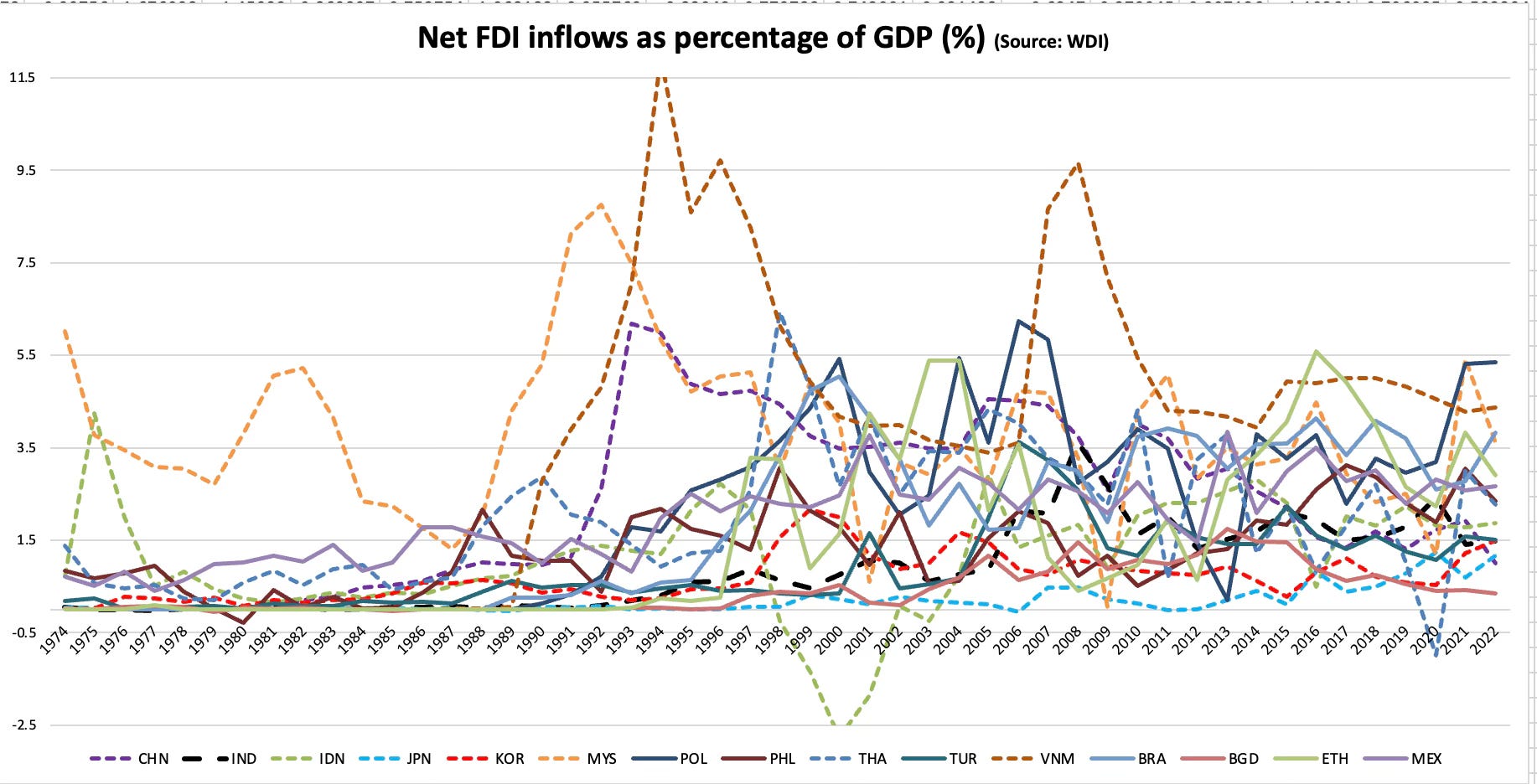
So what has been the historical trend of FDI inflows into the major developing economies? The graphic below compares 16 major developing countries for the period from 1974 to 2022.

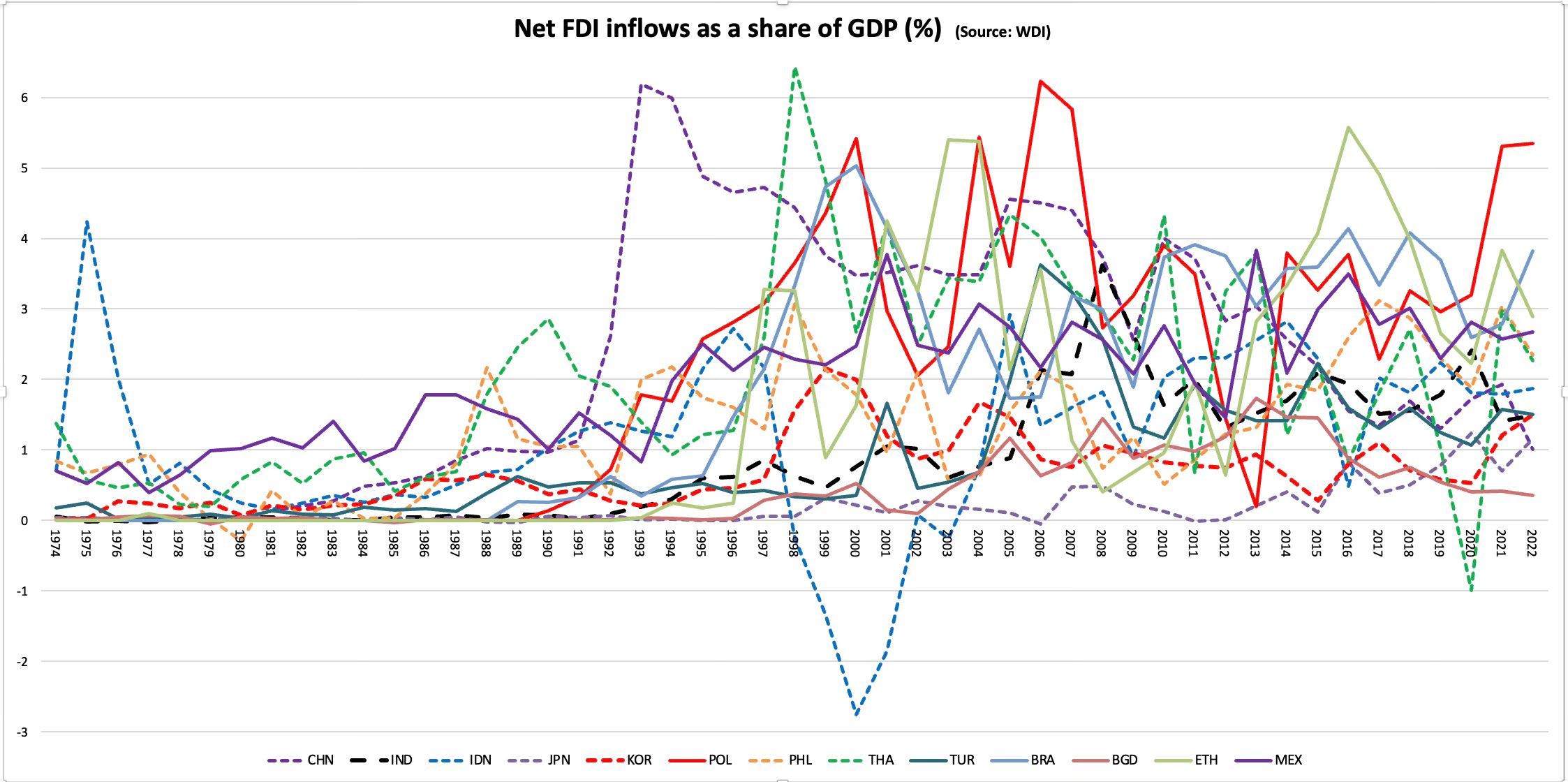
This graphic removes Vietnam and Malaysia so that we can zoom into the trends.

There’s a very large diversity in the FDI experiences of these countries. At one end are Japan and South Korea. It’s remarkable how little of FDI Japan and South Korea received during their high growth periods. In both countries, FDI has been consistently less than 1% of GDP (apart from a brief period in late nineties for South Korea). Clearly foreign competition and FDI-based technology transfers had little to do with the classic North East Asian economic success. As Joe Studwell has nicely described in his book, these countries pursued the classic infant industry protection policies (that countries like the UK and the US pursued before them) with the strong disciplining force of export competition. 

In contrast, China is the star case for FDI. In the 1991-2012 period which coincided with the country’s spectacular economic growth surge, China received 3-5% of GDP every year. But since 2012, it has dwindled to less than 2% of GDP. China perfected the art of inviting foreign companies to establish manufacturing facilities, gradually form joint ventures, force technology transfers, and create local manufacturing champions across sectors using very generous doses of subsidies. But how many countries have the political discipline, resources, and market power to pursue this path?

Since the mid-nineties, the consistently higher FDI recipient countries have been Malaysia, Vietnam, Poland, Brazil, and Ethiopia, with Vietnam being the standout. Since the turn of the millennium, Thailand, Philippines, and Indonesia have received significant FDI, though it has been characterised by large volatility for Indonesia and Thailand. In the last quarter century, apart from Vietnam and Poland (whose case might be different), none of these countries who benefited from large FDI inflows can claim to have grown at high rates, and established diversified economies leave aside become manufacturing powerhouses. 

But for the first half of last decade, FDI has been a very small share of Bangladesh’s economic output, underlining the country’s struggles to go beyond textiles and diversify its economy. 

India has received FDI of about 1.5-2% of GDP for the last decade and a half. However, in its high growth period of the second half of the 2000s, FDI inflows went beyond 3% of GDP and stayed above 2% of GDP. This has not since been replicated. 

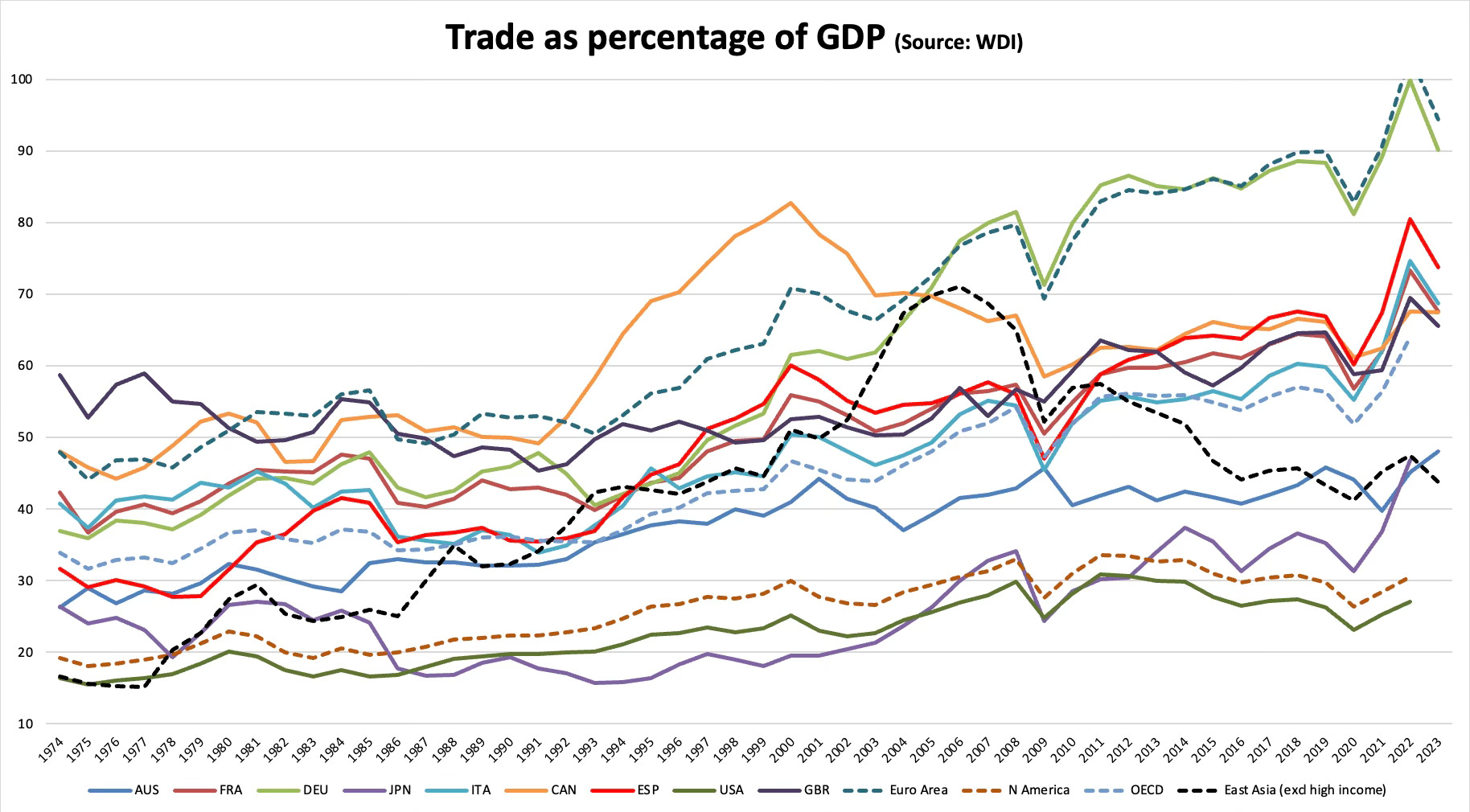
Now, let’s do a similar analysis for trade as a percentage of GDP. Let’s first take the case of today’s advanced economies - US, Japan, Germany, France, UK, Spain, Netherlands, Italy, Australia, and a few regions (E Asia, OECD, N America, and Euro Area - shown as dashed lines below). 

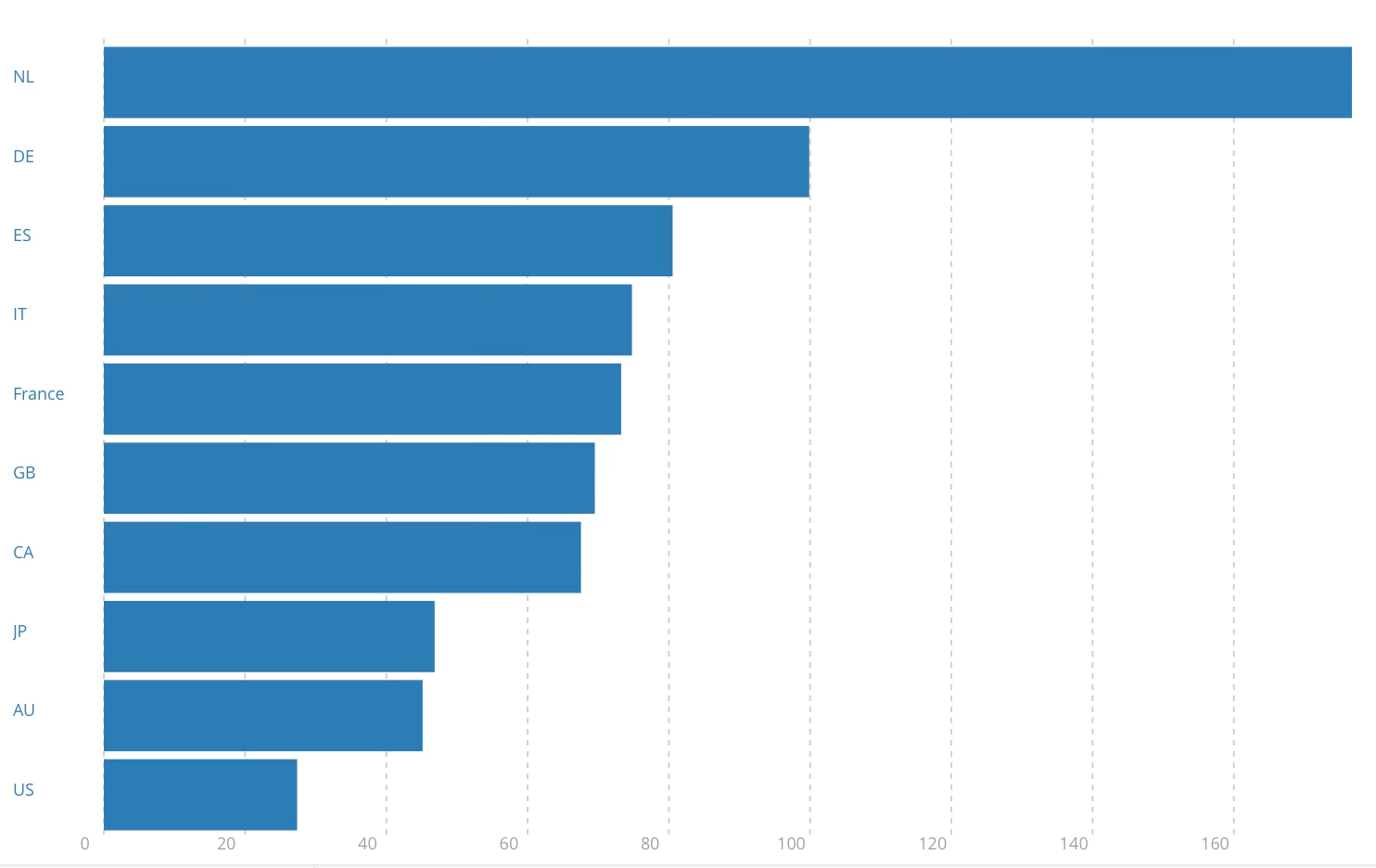
The clear outliers are the Netherlands (not in the graph) and Germany, whose large trade shares skew the number for the Euro area. For the US it has never touched 30% and Japan it has been below 40%. For the rest, the trade share has been in the 40-60% range for a long time, before rising gradually since the financial crisis and sharply since the pandemic to cross 70% (though it’s falling back now). The trade shares for 2022 are in the graphic below.

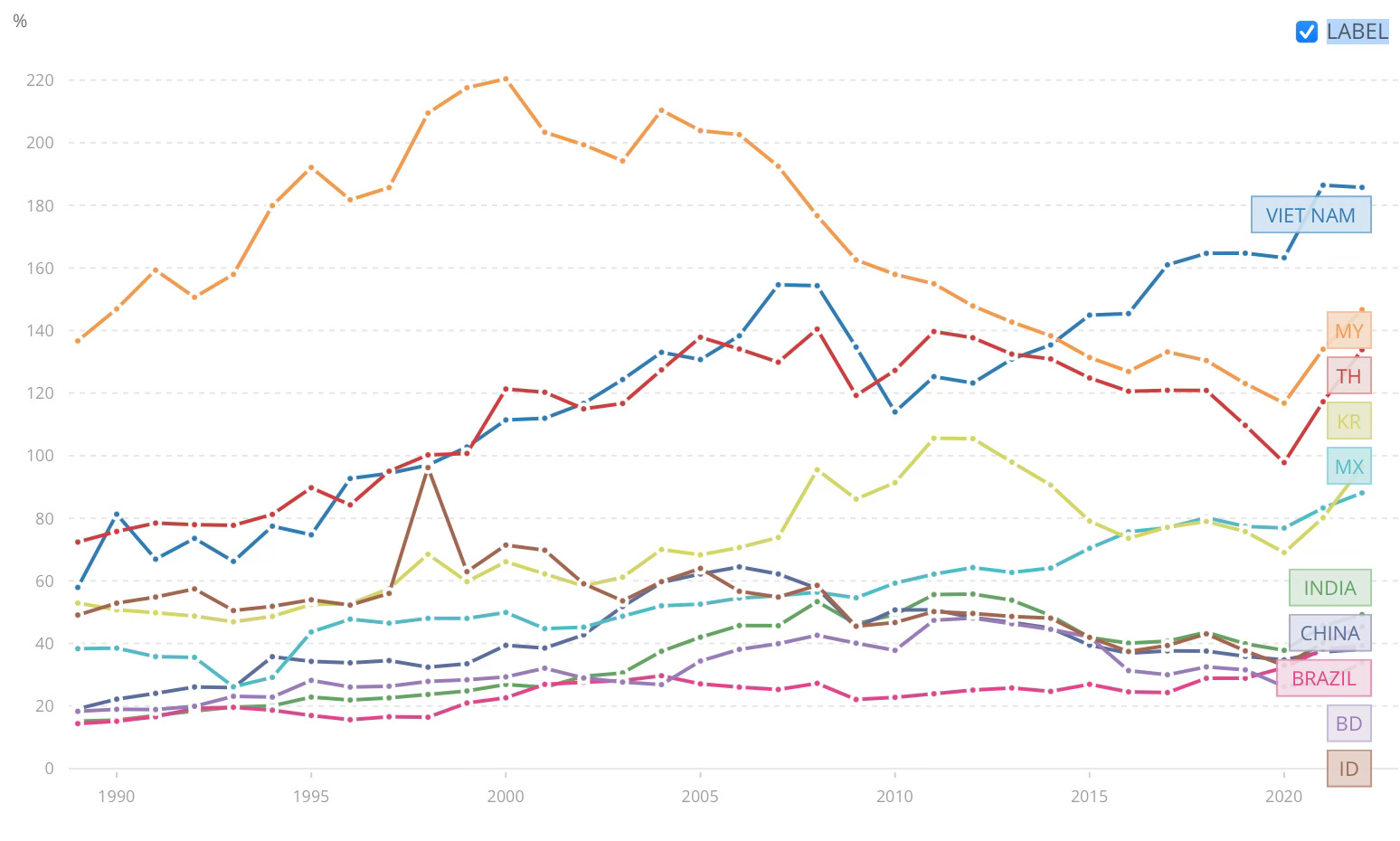
Now consider the case of developing countries, especially the East Asian and Latin American ones. The same trend comparison since 1989 shows the following.

The trade shares of the big economies - China, India, Brazil, and Indonesia - appear to have stabilised in the forties, after having risen from the twenties. They are in a much higher 100-150% of GDP range for the smaller East Asian economies, with Vietnam being a clear outlier among all economies.

Vietnam and, to a lesser extent, Malaysia and Thailand, are the standout performers. Vietnam’s history shows two phases of trade growth, from 1993 to 2007 and then from 2010 to 2022. South Korea has had trade share of consistently more than 60% since the mid-nineties. 

Interestingly, even in its peak growth periods, China’s trade share only touched 64% of GDP in 2006. India’s trade share rose from 30% in 2002 to reach 53% in 2008 and then to 56% in 2011 and 2012 before falling. But since the pandemic, it has been rising. 

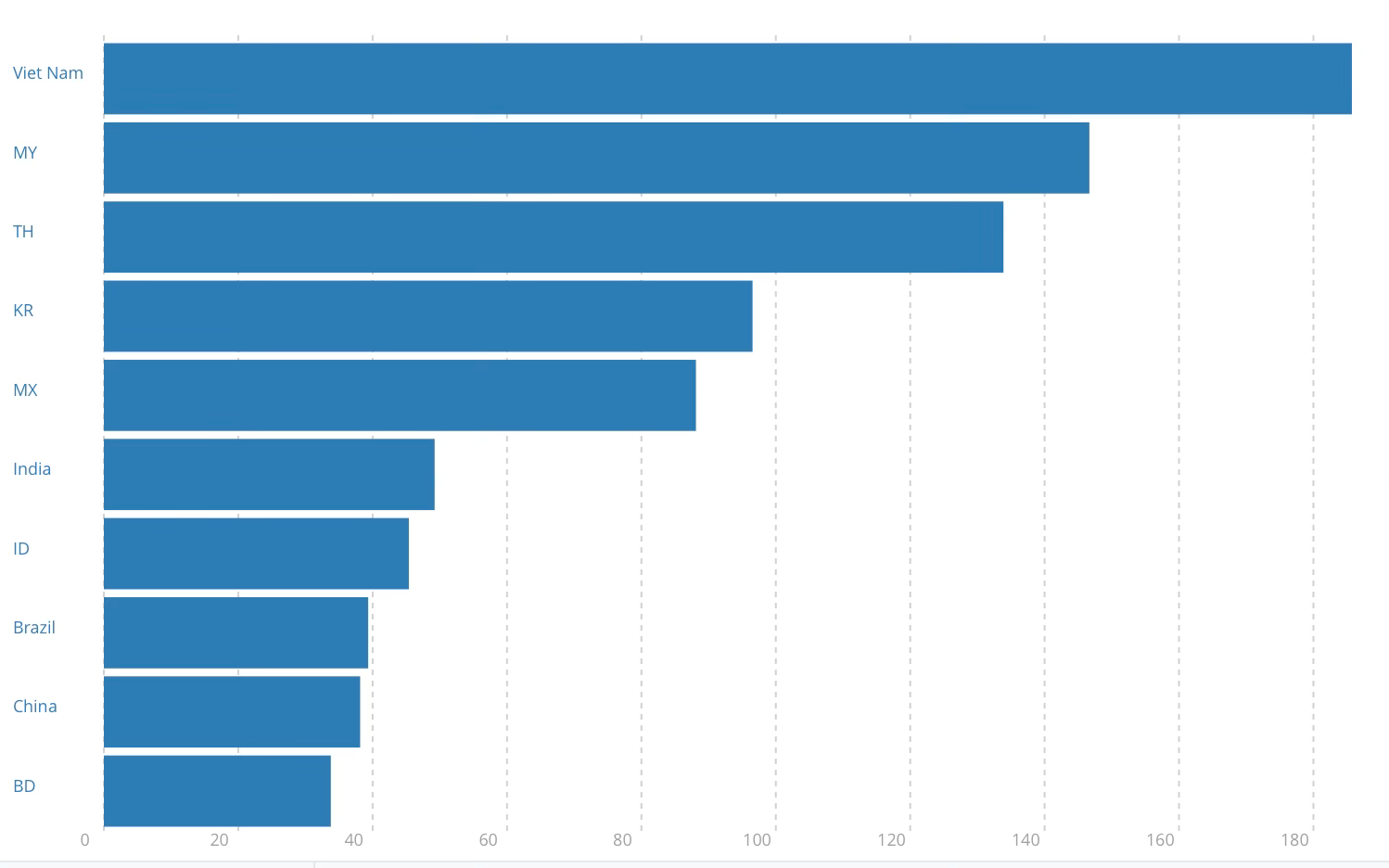
The trade shares touched peaks of 220%, 140%, and 106% for Malaysia, Thailand, and Korea before declining. It’s important to note that trade share remains very low for both Indonesia and Bangladesh, especially striking for the latter given its oft-repeated image as a poster child for textiles exports. 

For the year 2022, the trade shares are as follows. 

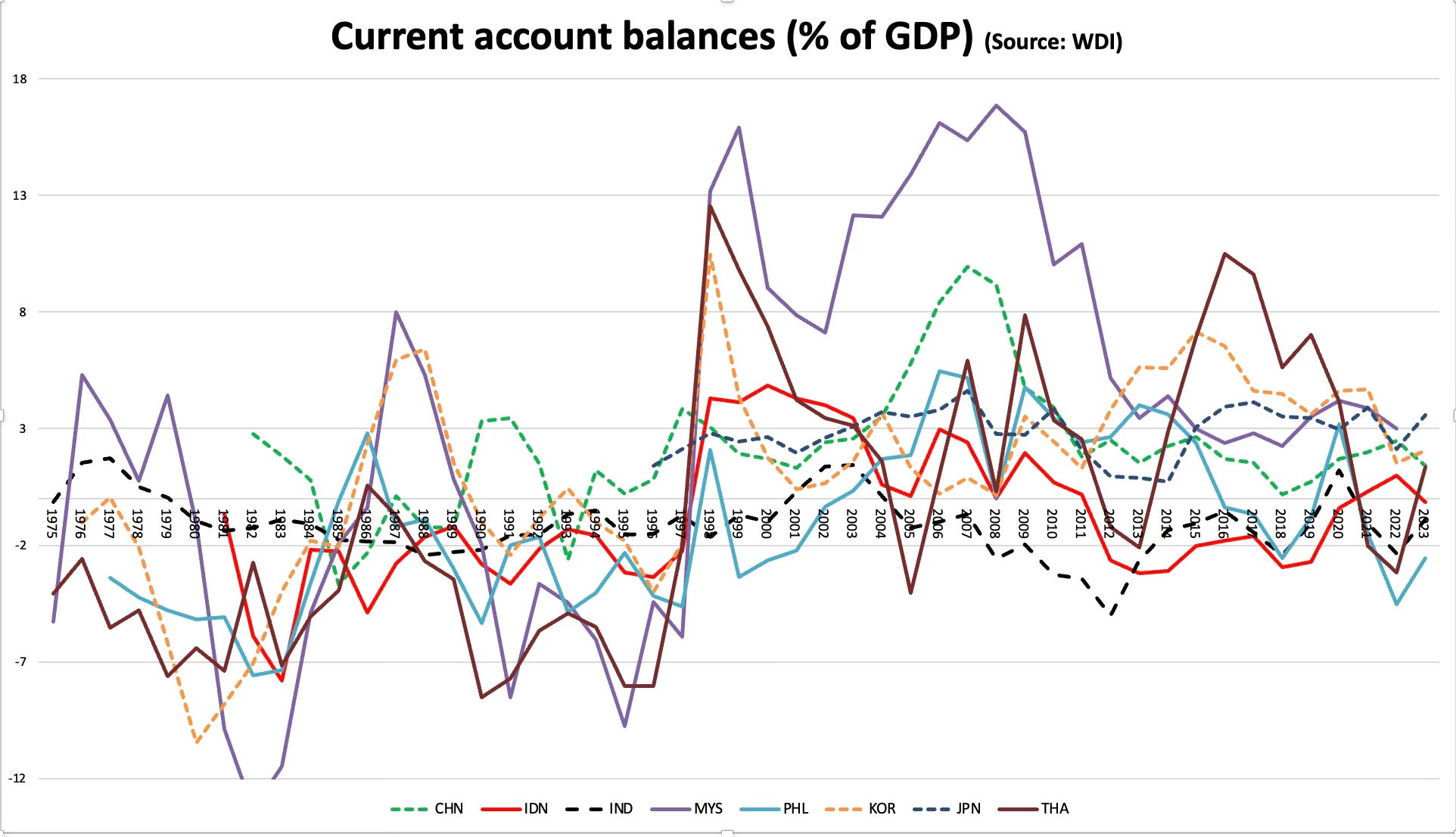
Again, like with FDI inflows, there’s a lot of heterogeneity among countries and it’s not possible to draw any broad generalisation. The high trade shares of the smaller Southeast Asian economies point to their high dependence on foreign trade for economic growth. Given their current account surpluses (the graphic below), these economies appear to have established themselves as input suppliers in the global value chains centring on China. 

The graphic below shows the current account balances of the East Asian economies since 1975. As can be seen, there was a structural break since the East Asian crisis of 1997 whence these countries flipped from running current account deficits to having current account surpluses. Some like Malaysia and Thailand have often run very high surpluses.

China, South Korea, and Japan have consistently run surpluses, at least since the early eighties (except for a brief period in the nineties for S Korea). In contrast, India has been running deficits, albeit mostly within limits, except the brief period in 2012-13. 

The graphics show that the trade shares of economic output for both the developed and developing large economies have been in the range of 40-60% (apart from the US and Japan, for whom it has been much lower) for the last fifty years. 

In sum, if we go by historical examples, India, with current FDI and trade shares of slightly below 1.5% of GDP and 50% of GDP respectively, can at most strive to move its shares to about 2.5% of GDP and 65-70% of GDP respectively. 

Saturday, October 14, 2023

Weekend reading links

1. Tim Harford points to the practice of people subscribing to services they don't use.

A new working paper from economists Liran Einav, Benjamin Klopack and Neale Mahoney attempts an answer. Using data from a credit and debit card provider, they examine what happens to subscriptions for 10 popular services when the card that is paying for them is replaced. At this moment, the service provider suddenly stops getting paid and must contact the customer to ask for updated payment details. You can guess what happens next: for many people, this request reminds them of a subscription they had stopped thinking about and immediately prompts them to cancel it. Relative to a typical month, cancellation rates soar in months when a payment card is replaced — from 2 per cent to at least 8 per cent. Einav and his colleagues use this data to estimate how easily many people let stale subscriptions continue. Relative to a benchmark in which infallible subscribers instantly cancel once they decide they are no longer getting enough value, the researchers predict that subscribers will take many extra months — on average 20 — to get around to cancelling.

This is a rare free lunch, one that exploits people's cognitive failures.  

2. Chinese EV makes enjoy large subsidies from the government. Sample this about Nio

Nio lost $835 million from April through June, or $35,000 for each car it sold. Nio and other companies in China’s sprawling electric car sector have formidable government backing that allows them to withstand such losses and keep growing. When Nio nearly ran out of cash in 2020, a local government immediately injected $1 billion for a 24 percent stake, and a state-controlled bank led a group of other lenders to pump in another $1.6 billion.

3. The Economist has an article on the emergence of consultants like McLarty Associates, Hakluyt, and Albright Stonebridge who offer geopolitical advice to multinationals. 

Lee Feinstein, a one-time ambassador who now works for McLarty, notes that many clients value advice from those who have been “in the room where it happens”. The exact services these firms offer are opaque and vary between them, but generally range from gauging the policy intentions of foreign governments to helping open doors for companies that want to sell or manufacture in a new market.

The management consultants like McKinsey too have established their geopolitical consulting arms. The opaque and secretive nature of the work of these consultants raises several concerns. In many respects, this is effectively legalisation of cross-border spying. And we already know the problems with just management consulting itself. 

4. The Economist examines the erosion of authority and credibility of the Palestinian Authority and the further strengthening of Hamas as the de facto leadership of the Palestinian people. A combination of leadership weakness, corruption within the ruling Fatah party, and Isreali high-handedness have rendered the PA to be nothing more than a municipal authority, and that too one which does a bad job of even that.

This is a timeline of the region's history. 

5. Bond markets have been in turmoil, driving up treasury yields and accumulating MTM losses in bond portfolios 

Paper losses on the most opaque part of US banks’ bond portfolios are now close to $400bn — an all-time high, and 10 per cent above the peak at the start of the year that caused the collapse of Silicon Valley Bank — according to Matthew Anderson, an analyst at bond data firm Trepp. Most banks, and in particular the largest ones, will not have to sell and so will never realise those losses... If paper losses on bond portfolios were realised they would have caused a 200 basis point hit to the common equity tier 1 ratios — a measure of financial strength — of the largest US lenders at the end of June, according to Stuart Graham, head of banks at Autonomous Research.

6. Suyash Rai has an excellent assessment of Make in India initiative by numbers. 

At 14.7 percent, the share of manufacturing in GVA in 2022–23 was the lowest since 1968–69. Even in 2019–20, the year just before the pandemic, it was only slightly better—14.72 percent... Even if we do not consider the pandemic years, when capital investments were difficult to make, there has been no progress on gross fixed capital formation in manufacturing since the Make in India initiative was announced... Between 2016–17 and 2022–23, the number of persons employed in manufacturing fell by almost 1.57 crore. Part of this seems to have happened due to the pandemic, but even before that, there was a large decline... In the eight full financial years since the launch of the initiative, the FDI has averaged 1.76 percent of the GDP, while in the preceding eight years (2007–08 to 2014–15), it had averaged 2.14 percent of the GDP... India’s merchandise exports have declined for much of the last one decade, except for a few quarters in 2021 and 2022, when opportunities temporarily created in developed economies led to a spike in exports, which have since declined.

7. Rai also points to a paper by Chang-Tai Hsieh and two others who argue that China's extraordinary economic growth comes from "special deals" cut by local governments with favoured private firms. They claim that local leaders derive personal benefits, either political or monetary, from these, and competition among local governments limits the predatory effects. 

Its simplicity is striking.

Given the effectiveness of this system depends on the discretion of local officials, on incentives being appropriately aligned among local officials to ensure that they not only maximise investments and job creation but also limit rent-seeking at sustainable levels, and on minimising the damage borne by firms not getting special deals, the authors call this strategy a "high wire act". 

8. Ruchir Sharma points to the difficulty of smart money investors

Since 2000, there have only been three years in which a majority of large cap funds outperformed. In the 2010s, on average, 8 out of 10 mutual funds and 9 out of 10 institutional funds underperformed in the US markets, after fees. The share of pros who beat the market was only slightly better before fees and was equally low in the stock markets of Europe, Asia and the rest of the world... Within the community of retail punters, the most active 20 per cent of traders earn returns far lower than the least active 20 per cent. The losses are not just for day traders in individual stocks. Through bad timing, active amateurs lower their returns by 20 per cent when they are pulling in and out of mutual funds.

He also points to the value of insider information

One of the more interesting insights on information superiority comes from studies of (legal) trading by company insiders. Senior executives tend to sell ahead of abnormal declines and buy ahead of abnormal surges in a company’s shares. Chief executives and chief investment officers tend to do better than less senior executives, probably because they have more complete information. In this well-informed circle, following the herd can work. Local information can provide a similar edge. In emerging markets, big global funds have often assumed they can teach the locals a thing or two about investing, only to learn humility the hard way. In the run-up to currency crises, my research has found that locals often pull out well ahead of foreign investors and then are the first to return, sniffing an economic turnaround. Superior on-the-ground knowledge gives them an edge.

9. The Azerbaijani ethnic cleansing of Armenians in Nagorno Karabakh with the support of Turkey has hardly received any global attention. 

After a 10-month blockade, Azerbaijan launched an attack on Sept. 19, claiming the enclave in a day and causing nearly the entire ethnic Armenian population to flee... For Armenians, a classic relic ethnic minority whose Christianity and peculiar alphabet date to the epic struggles between the Romans and the Parthians, it was another genocide. For the Azerbaijanis, Turkic in language and historically Shia Muslim, a great triumph... in its emboldening of traditional regional powers like Turkey, scrambling for geopolitical spoils after the retreat of superpowers, it’s a harbinger of the coming world disorder.

Nagorno-Karabakh, a mountainous region in the South Caucasus, is perennially contested. Ceded by Persia to Russia in the 19th century, it fell into dispute with the emergence of the Soviet Union, Armenia and Azerbaijan both claiming it. In 1921, Stalin attached the enclave to Azerbaijan, home to oil resources and a thriving intellectual culture... By 1994 the Armenians, mobilizing around the traumatic memories of genocide, succeeded in expelling scores of Azeris from the enclave.

The region is also at the centre of a major geopolitical tussle

President Recep Tayyip Erdogan, a master of vertiginous visions, has already tried Islamic liberalism, joining Europe, leading the Arab revolts, challenging Israel and negotiating peace in Ukraine. He now has another dream: opening a geopolitical corridor from Europe through Central Asia, all the way to China. This is the “Zangezur corridor,” a 25-mile-long strip of land to be carved through Armenia as part of a peace deal imposed at gunpoint.

Iran is not happy with Azerbaijan’s victory. As openly as the Iranians ever do, they’ve threatened to use force against any changes to the borders of Armenia. Iran, a millenniums-old civilization central to a whole continent, cannot tolerate being walled off behind a chain of Turkish dependencies. India, similarly, is on Armenia’s side and has been sending a regular supply of weapons. One spur for such support, no doubt, is Pakistan’s joining the Azeri-Turkish alliance. In the jargon of American lawyers, this opens a whole new can of worms. Then there’s Russia, whose absence from the denouement in Nagorno-Karabakh was striking. Even after the 1990s, Moscow still remained by far the biggest supplier of weapons to both Armenia and Azerbaijan. Their economies and societies, above all the elites and their corruption networks, were until very recently molded together. What we are seeing now, as both nations slip out of Russia’s orbit, might be the second round of Soviet collapse.

10. Good list of 40 companies in developing markets that are beating western multinationals in their markets. 

11. The shocks of 2020-22 have been greater on the low-income countries, as reflected in their GDP shortfall.

Real domestic demand as reflected in private consumption and capital formation too has taken a big hit in the low-income countries. The biggest hit on private consumption has been in China.
And the economic growth projections going forward are not encouraging
12. This is a telling snippet about how financial markets lost all their discipline
In 2017 Argentina’s new president Mauricio Macri was keen to show that the country had changed, and celebrated its return to the fixed income market by selling a $2.75bn bond maturing in 2117, with a yield of 7.9 per cent. The then-finance minister crowed that “such an issuance is possible thanks to our recovery of the world’s credibility and confidence in Argentina and in the future of our economy”. It went about as well as you might expect. Macri was out by 2019 and Argentina defaulted on and restructured the century bond in 2020... Argentina’s creditors received on average 54.5 cents on the dollar. But the 2117 bond was actually sold at 90 cents on the dollar to entice investors, and paid at least a few chunky coupons before it was restructured and exchanged for a lower-value new bond, which would have ameliorated the pain somewhat... It turns out that if you bought at issuance and reinvested the coupons back into the 2117 bond you would have lost about 30 per cent going into the restructuring, and roughly 53 per cent on the other side of it. (NB, the gap is unusually large, which means the Bloomberg data might be a bit shonky.) If you held on to the restructured exchange bonds that mature in 2046 and reinvested the new coupon payments into that, you’d today be staring at a ca 63.7 per cent loss.

But the Alphaville report also points to the fate of the 100 year bonds issued by Austria at the same time. 

That’s an almost 40 per cent loss in price since inception. The miserly semi-annual 2.1 per cent coupon payments helps only a little, crimping the total loss is 31.27 per cent, according to Bloomberg data. If you were unlucky/foolish enough to buy the Austrian century bond at its peak price/record low yield in 2020 then you’re looking at close to a 75 per cent loss. There are few better examples of the explosive power of duration when the interest rate cycle turns.
13. Voting share in WB/IMF and respective national outputs for the major economies

14. Katharina Pistor makes two important observations about Finance 
Finance is no longer just an intermediary that channels money from savers to borrowers... finance is now in the driver’s seat, setting the agenda for others, including governments. There are two big problems with this: finance is both dumb and dangerous. It is dumb because it can only read numbers, unable to understand, much less assess, difficult social problems or complex business or engineering strategies. And it is dangerous because the people at the helm of financial institutions think they are smarter than they are, which leads them to assume that they should steer the ship.

If you are looking only at price tags, ruling the world seems easy. Everything becomes comparable, and you need only buy low and sell high to make a profit. Unless you are one of the few moral investors who wants to feel good about where you direct your money, the nature of what you are buying or selling matters little. The price mechanism dispenses with the need to understand an asset’s real-world qualities, negative attributes, or possible side effects. In fact, the less investors know or care about such matters, the more liquid the market.

15. Finally, there's more emerging troubling trends on climate change. Latest data show that September was 0.5 degree celsius hotter than the prior record, and July and August were around 0.3 degree hotter since reliable global records began in the mid-1800s and probably for the past 2000 years. 

There has been a sharp acceleration in global warming in the last 15 years. 
The rate of warming we’ve measured over the world’s land and oceans over the past 15 years has been 40 percent higher than the rate since the 1970s, with the past nine years being the nine warmest years on record.

Saturday, July 8, 2023

Weekend reading links

1. Commodity traders had a spectacular year in 2022 with eye-popping profits.

Talk about ESG investing and the phase out of mining stocks!

2. An example of restrictive land conversion laws in the US

There is an aging office building on Water Street in Lower Manhattan where it would make all the sense in the world to create apartments. The 31-story building, once the headquarters of A.I.G., has windows all around and a shape suited to extra corner units. In a city with too little housing, it could hold 800 to 900 apartments... But 175 Water Street has a hitch: Offices in the financial district are spared some zoning rules that make conversion hard — so long as they were built before 1977. And this one was built six years too late, in 1983.

“There’s nothing about that building — its construction, its mechanicals, its structural engineering — that prevents it from being converted,” said Richard Coles, the managing partner of Vanbarton Group, which has developed both conversions across the street. Vanbarton owned and thought hard about converting 175 Water, too... A mere stroke of a pen would do it, Mr. Coles said. But that idea died in the State Legislature this spring, along with the rest of the governor’s housing agenda. When Vanbarton concluded no change was coming, it sold the property.

This is the summary

We ask far more of buildings today than decades ago, including that they be accessible, sustainable, hurricane- and earthquake-proof, that they deter flying birds and provide public spaces. Each new goal, while worthy, widens the disconnect between buildings constructed decades ago and what regulation requires today. And we’ve developed over time more rigid ideas about the built environment: that housing should gain value indefinitely, that politicians should ensure that’s so, that property owners have a right to veto change around them. The cumulative effect today, if you want to turn an office into an apartment, or even turn your back porch into an enclosed home office? The building code says no. Or the zoning does. Or the neighbors do. Or a phrase in a decades-old state law does. Or the politicians asked to change that phrase decline to... 
Zoning rules in many cities say precisely how many parking spots are needed per hundred square feet of pawnshop (different from the parking needed per hundred square feet of furniture store). They spell out the architectural flourishes builders must apply, the minimum acreage a home can occupy, or the size of individual units in an apartment building... These rules impede conversions in particular. In New York, a hotel requires a 20-foot rear yard. But a residential building requires a 30-foot one. Does that mean developers should lop off the back of hotels to make housing? Why do we draw such fine lines anyway between buildings where people sleep short-term and those where people sleep permanently?

This statistic is stunning

“It’s pretty clear when you look at zoning codes — over the last century that zoning codes have existed — that they have only gotten longer and more complex,” said Sara Bronin, an architect and legal scholar who helped rewrite the zoning in Hartford, Conn. New York’s original 1916 code was about 14 pages. Today, it is nearly 3,500 pages. Cities have accumulated more prohibitions, more prescriptions, more appendix tables.

It's important that countries like India shed its legacy of copying US planning regulations and avoid adopting their regulations in the name of misguided catch-up and modernisation. 

This is a good multimedia article on the challenges associated with usage conversion in the US cities. 

3. US imports from China as a share of the country's imports has been declining since it peaked in 2018. 

Whoever said that President Trump's actions on China were blunt! While today it has become the norm to pursue policies that sanitise China's access to sensitive technologies, it can be argued that the reversal could not have happened without Trump.

4. Ruchir Sharma points to the remarkable resilience of emerging economies

Normally inflation runs much hotter in emerging economies but, excluding outliers, the median rate is now running at 5 to 6 per cent — no higher than in developed economies. That has not happened in four decades. Some central banks in the developing world have started to cut rates and many others are likely to follow soon. Emerging economies are on track to grow faster than 4 per cent on average over the coming year, or four times faster than developed ones.

5. Andrew Haldane cautions against tightening monetary policy prematurely and excessively, what he describes as monetary austerity,

Despite the headline inflation rise, inflation expectations remain anchored... A year from now, a reasonable view would see inflation at 3-4 per cent without any further tightening. At those levels, it is highly questionable whether those last inflationary drops need to be squeezed out at greater speed. At 3-4 per cent, inflation no longer enters the public consciousness. That is why there is essentially no evidence it would impose costs that are any greater than at 2 per cent. But the costs of lowering inflation those extra few percentage points, measured in lost incomes and jobs, are larger at these levels of inflation...

Imagine a doctor, uncertain about the nature and severity of a disease, who has administered a large medicinal dose which has yet to take effect. Prudence would cause them to pause to see how the patient responded before doubling the dosage. That principle is one central banks should heed now to avoid overdosing the economy. Over a decade ago, in pursuit of lower debt, the UK enacted fiscal austerity. This ruptured growth and was self-defeating for debt. Today, in pursuit of lower inflation, monetary austerity risks the same fate. It is time to steer the stampeding herd away from the cliff edge, for the sake of the financial security of millions of people and the credibility of our policy institutions.

6. Some snippets on Canary Wharf redevelopment

There are about 3,500 residents and 120,000 office workers in Canary Wharf, a 128-acre estate in London’s eastern Docklands area that is jointly owned by Canadian asset manager Brookfield and the Qatar Investment Authority. The district, which sprung out of London’s 1980s financial services boom to house big banks’ expanding trading floors, is now under pressure to reinvent itself as companies downsize their office space to adapt to hybrid working. Home to 30 office buildings, the area has been hit by high-profile exits in recent years, including law firm Clifford Chance and now HSBC, which this week said it would move its global headquarters out of the Canary Wharf tower that bears its logo to smaller premises in the City of London...

Canary Wharf’s history as a financial district dates back to the early 1980s when Michael von Clemm, chair of Roux Restaurants but also investment bank Credit Suisse First Boston, was scouting out the area of decrepit 18th-century warehouses as a potential site for a frozen food processing plant. Von Clemm realised the district would work better as a hub for back-office financial services jobs, with the dockside offering an attractive location for shops and restaurants. It also reminded him of his native Boston, whose own 18th-century warehouses had been through a similar rejuvenation. By the time work began on the development, a host of international banks including Morgan Stanley had signed up — and Canary Wharf would no longer be a base for administrative back-office jobs but a beacon of financial power containing the European head offices and trading desks of the world’s biggest banks...

The district is home to more than 300 retailers as well as eight supermarkets — including the country’s largest Waitrose — more than 70 restaurants and bars, and a cinema. The Elizabeth line, which opened last year, has contributed to a 40 per cent year-on-year increase in footfall in the retail area, where occupancy stands at 97 per cent, according to the estate. However, analysts warn such amenities are a byproduct of the concentration of offices and could vanish with them. “Canary Wharf is first and foremost a place for work and production as opposed to a place for consumption,” said Quinio of Centre for Cities. “Commercial space dedicated to consumption is only there to serve the needs of people who work there.”

7.  On Vietnam's success in school student learning outcomes compared to India

Vietnam’s children spend less time in lessons than Indian ones, even when you count homework and other cramming. They also put up with larger classes. The difference is that Vietnam’s teachers are better prepared, more experienced and more likely to be held accountable if their pupils flunk.

More on Vietnam

The latest data from the World Bank show that, on aggregate learning scores, Vietnamese students outperform not only their counterparts in Malaysia and Thailand but also those in Britain and Canada, countries more than six times richer. Even in Vietnam itself, student scores do not exhibit the scale of inequality so common elsewhere between the genders and different regions... Vietnam’s stellar performance. Its distinctive secret lies in the classroom: its children learn more at school, especially in the early years... 

In a study in 2020, Abhijeet Singh of the Stockholm School of Economics gauged the greater productivity of Vietnam’s schools by examining data from identical tests taken by students in Ethiopia, India, Peru and Vietnam. He showed that between the ages of five and eight Vietnamese children race ahead. One more year of education in Vietnam increases the probability that a child can solve a simple multiplication problem by 21 percentage points; in India the uplift is six points...

The biggest reason is the calibre of its teachers. Not that they are necessarily better qualified; they are simply more effective at teaching. One study comparing Indian with Vietnamese students attributes much of the difference in scores in mathematical tests to a gulf in teaching quality. Vietnam’s teachers do their job well because they are well-managed. They receive frequent training and are given the freedom to make classes more engaging. To tackle regional inequality, those posted to remote areas are paid more. Most important, teacher assessment is based on the performance of their students. Those whose pupils do well are rewarded through presitigious “teacher excellence” titles. Besides such carrots, a big stick is the threat of running foul of the ruling Communist Party. The party apparatus is obsessed with education. This percolates down to school level, where many head teachers are party members.

8. Edward Luce on the hypocrisy and non-relevance of the Ivy League admissions debate in the US following the US Supreme Court direction barring any affirmative action in higher education admissions.

Of the 31mn Americans aged between 18 and 24, just 68,000 are Ivy League schools undergraduates — about a fifth of a per cent. Of these, a varying ratio are non-white beneficiaries of affirmative action. Many of those are from privileged black or Hispanic backgrounds, as opposed to Chicago’s South Side or the wastelands of Detroit. That is the basis on which the Ivy League lays claim to being a deliverer of social change. It is an optical illusion. In that respect the Supreme Court has done America a favour. Any disruption to this status quo is a plus. But it is unlikely to trigger the soul-searching America needs. The US debate remains stubbornly monopolised by the ethnic breakdown of the tiny number of students who win the Ivy League lottery. The 19mn or so of those 31mn young Americans who do not progress beyond high school, and the roughly 12mn who go to less elite colleges, barely feature. Whatever tweaks the Ivy League has to make to keep its diversity ratios after last week’s ruling are thus largely irrelevant to the 99.8 per cent that will never get there.

Instead of expressing outrage, he suggests that the Ivy League do some of this,

The genuinely radical Ivy League option — spending their vast endowments to sharply increase student numbers — is unlikely to be entertained. The key to the Ivy League is exclusivity; a big expansion in intake would dilute that premium. We are thus likely to continue with a situation in which universities such as Harvard, with a $53bn endowment, or Princeton with $36bn, continue to get richer. Each of these fortunes could revolutionise financial aid at dozens of public universities. The second most radical option would be for the Ivy League to abolish what is called “ALDC” — athletics, legacy, dean’s list and children of faculty and staff. Forty-three per cent of Harvard’s intake come from one of these groups. The first, athletics, includes sports that can only be learned by the privileged, such as lacrosse, sailing and rowing. The generous athletics intake by universities is why so many recent admission corruption scandals, such as the FBI’s Varsity Blues sting operation, involved athletics directors. Contrary to popular opinion, most athletics scholars are not black basketball players. Sixty-five per cent are white. The second, legacy students, are the close relatives of alumni — the very definition of elite reproduction. Again, these are mostly white. The third, dean’s List, is a euphemism for the children of people who have donated a lot of money. An example of this is Jared Kushner, Donald Trump’s son-in-law, whose father, Charles, gave $2.5mn to Harvard. Finally, there are the children of faculty members and staff. Taken together, the Ivy League could as easily be construed as an affirmative action plan for wealthy white people, which is very far from the progressive brand it has cultivated.

9. Times has an article that highlights how exports to China is an important factor in the German economy and any shocks will invariably generate social and political tensions. Many mittlestand companies, located in small towns and contributing a disproportionately large share of the local labour force and central to the local economy, are deeply vulnerable to any trade tensions and resultant loss of Chinese market. Take the example of Hate Hydraulics,

In Kaufbeuren, a brightly painted Bavarian town nestled below the Alps, Hawe is a top employer. In the tiny village of Sachsenkam, 60 miles to the west, Hawe provides 250 jobs — the next largest employer is the local brewery, with a staff of 17... The archetypal Mittelstand company is based in a rural German town, making a piece of equipment few have heard of, but that is crucial for goods worldwide — like a screw needed for every airplane or passenger car. These companies... employ 60 percent of its workers, and make up 99 percent of its private sector — a higher percentage than in any industrialized nation in the world... Because that worked so well for years, they had no need to adapt to changes. But now, they need to adjust to the new economic reality. Even as the tech revolution and climate change added strain in recent decades, Germany’s model plodded profitably along. But the pillars it relied on to do that — cheap Russian natural gas and the Chinese market — are collapsing... 

Like its population, Germany’s business owners and entrepreneurs are aging — the average Mittelstand association member is 55. Some are resistant to adapting to new technologies and cling to a loyalty-based system that created lifetime employees — and customers. (Hawe’s very first client in 1949, a forklift producer, still buys from it today.)

10. Times article on how (automobile, in particular electric vehicles) repairs have become prohibitively expensive,

The average cost of making damaged cars good as new has soared 36 percent since 2018, and may top $5,000 by the end of this year, according to Mitchell, a company that provides data and software to insurance companies and auto repair businesses. That big increase is the main reason that insurance premiums have been soaring — up 17 percent in the 12 months through May. New sport utility vehicles and pickup trucks, including a rapidly growing number of electric models, have become so complex and luxurious that seemingly simple repairs can cost a small fortune, auto experts said. Insurers are often on the hook for much of those costs, leading them to raise their rates.

Materials designed to crumple or deform in a crash to protect pedestrians or passengers, for example, can be hard or impossible to repair. Many bumpers must be replaced after low-speed dings because the safety sensors embedded in them may no longer work properly after repairs. Other systems, even some that do not appear to be damaged, must be inspected or recalibrated.

This is part of the trend of businesses trying to maximise value capture. It's a sale plus O&M approach, where businesses seek to maximise their returns over the entire life cycle of their products.   

11. Critical minerals required for the energy transition are acutely deficient,

Achieving the energy transition will demand far more lithium and other minerals by 2030 than the world is on track to produce. Responsibly boosting global production is paramount. Avoiding critical minerals shortages will require some 330 new mines over the next decade, according to Benchmark Minerals, even assuming maximum progress on recycling. This includes 59 new lithium mines; the world currently has a couple of dozen.

Meanwhile automobile makers are striking deals either buying up Lithium mines or entering into long-term purchase agreements with mining operators. This is a throwback to the early stage of automobiles when Ford set up rubber plantations in Brazil to manufacture tyres. But the challenges are daunting,

Many countries with big reserves, like Bolivia, Chile and Argentina, have nationalized natural resources or have stringent currency exchange controls that can limit the ability of foreign investors to withdraw money from the country. Even in Canada and the United States, it can take years to establish mines.

12. On the rise of private credit

Private credit alternative lending has grown nearly six times across public and private markets over the past 15 years. Notably, the private credit market has expanded to become an asset class worth about $1.5tn, rivalling the syndicated loan market in size... The supply of credit from commercial banks has declined by more than 50 per cent in the wake of the global financial crisis, the Covid-19 pandemic and the 2023 turmoil in banking... As a result, in the past 18 months more than 90 per cent of leveraged buyouts globally were financed by private credit.

13. Eurostar's passenger traffic projections were wildly over-optimistic  

... since the first trains ran from London Waterloo to Paris and Brussels in November 1994. During construction of the Channel Tunnel between 1988 and 1994, forecasts had projected that the operation within two years would be handling 13mn passengers annually — a level that the cross-Channel operations have still never achieved. They projected it would be carrying 20mn passengers annually by 2004. The service carried only 3mn passengers in 1995, its first full year, and only 6mn in 1997.

The numbers never even got close to 20 million

This has not stopped the operator who has struggled for commercial viability from making more optimistic predictions,

Eurostar merged last year with Thalys, which operates high-speed services from Paris to Brussels, Amsterdam and Cologne, to launch what former SNCF president Guillaume Pepy predicted would be a “new era” in high speed rail in Europe. The group is now aiming to double traffic from the 14.8mn people it carried in 2022 to 30mn people annually by 2030, according to Cazenave. The operation carried 8.3mn passengers on Eurostar trains and 6.5mn on Thalys in 2022.
This is the iron law of mega project over-optimism. Or strategic misrepresentation to raise financing?

Despite its problems, Eurostar has an 80% share of the London-Paris and Paris-Amsterdam rail and air markets.