Substack

Showing posts with label Taxation. Show all posts

Saturday, July 4, 2026

Weekend reading links

1. Indian universities have come to dominate the global rankings for research paper retractions, following complaints of plagiarism, fake peer reviews, and other misdemeanours. According to the Retraction Watch database, India recorded 887 research paper retractions in 2025, form 21% of all retractions (second to China with 41%) despite contributing just 5% of all publications, and occupying six of the world's top 10 universities for retractions. 
2. Stunning statistic about the Algerian demographic dominance of the Les Blues, the French national soccer team.
Only two of France’s 26 players are of non-immigrant ancestry — 22 of them have African roots. Some, such as Mbappé, are deeply connected to their country of origin.

And this dynamic of reverse migration and migrant domination elsewhere.

Of England’s 26 players, eight have Caribbean forebears, 10 African, and 20 who were eligible to represent at least one other country because of their family heritage or birthplace. Belgium has players who trace their lineage to its former colonies — Congo, Burundi and Mali. The Portugal team has those of Cape Verdean, Angolan, and Guinean lineage. Those surplus to their requirements — players of African descent born and raised in Europe — in turn, populate most of the African teams. Ten of the 11 Senegalese players in the starting lineup against France in the opening game were born in France... Six of the players in the US national team are of Afro-Caribbean heritage... There are those from Nigeria, Ghana, and Jamaica. Three are from Hispanic backgrounds — Christian Roldan (Guatemala), Ricardo Pepi (Mexican-American) and Jesús Ferreira (Colombian-American). As many are from Europe, and three others have dual nationalities... For Australia's Socceroos, four players were born in refugee camps. The players represent 15 ethnic backgrounds and include a Malaysian with Sri Lankan roots. Eighteen other players have direct immigrant or refugee heritage. To contextualise, only one Black player (Sam Morris) and another of Caribbean descent (Andrew Symonds) have represented Australia in cricket.

This is a brilliant article by Sandip G about the magnificent quartet in the French team - Kylian Mbappe, Ousmane Dembele, Michael Olise and Desire Doue. 

3. The US military learns from Iran.

The US has, similarly, begun to build its production of drones. It used the Lucas, a one-way attack drone reverse-engineered by start-up SpektreWorks from an Iranian Shahed-136, for the first time in combat in February. The Pentagon is looking to begin mass-producing them, and has requested to triple its spending on drones and related technologies to over $74bn next year.

4. Shenzhen, with 400,000 taxi drivers licensed to provide services in 26 platforms, will permit robotaxis from July 1. The new rules will allow the Shenzhen government to promote the “orderly development” of robotaxi tests, demonstrations and commercial pilots either in select zones or citywide. 

5. Friedrich Merz's landmark pension reforms

Under proposals agreed by a bipartisan commission, a compulsory initial contribution of 0.5 per cent of employees’ pre-tax income, rising to 2 per cent by 2031, will go into a Swedish-style public pension fund managed centrally and invested in capital markets. Contributions are split 50/50 between employees and employers. The statutory minimum retirement age of 67 is set to rise in line with life expectancy; rights to early retirement for people with 45 years of contributions will be restricted.
Such measures have become vital to reduce the deficits of Germany’s unsustainable pay-as-you-go system. Some 16.5mn baby boomers will retire by 2036 with only 12.5mn new workers joining the workforce, according to some estimates. The government spent about a quarter of the total federal budget on plugging gaps in the system in 2024; economists say that could double to 50 per cent in two decades.
Linking the retirement age to life expectancy is projected to mean only a gradual increase — to 67.5 by 2041 and 70 by 2091. But economists say this is the only sound way to stabilise the system without spiralling payroll taxes or huge federal subsidies. Narrowing early retirement rights will address a drain of experienced workers amid acute skills shortages.

6. Important graphic that highlights the extent of renminbi depreciation since the beginning of 2022 and the surge in surplus.

7. China expands export restrictions on dual-use items against Japanese companies in the latest instance of weaponisation of its manufacturing dominance. 
The companies added to the export control list include subsidiaries of Mitsubishi Electric and Mitsubishi Heavy Industries. The restrictions will also apply to several Japanese government research organisations including the National Institute for Defense Studies. Chinese exporters are banned from selling to the entities on the restricted list, and foreign organisations or individuals are also prohibited from selling dual-use items that were built or originated in China. China last expanded the list to 40 companies in February. In parallel with the expanded export control list, China’s commerce ministry on Monday put 20 Japanese companies and organisations on its watchlist, meaning they will get closer scrutiny in any matters relating to potential dual-use technologies. The list includes subsidiaries of Fujitsu, Mitsui E&S, Hitachi, Komatsu and Terra Drone. Beijing’s targeting of Japanese companies is the latest example of China’s weaponisation of trade in recent years. The EU Chamber of Commerce in China in April has found that Beijing has nearly tripled its use of export controls in the past five years. While some instances have been in response to western measures, the researchers noted that Beijing’s controls have also frequently targeted trade chokepoints.

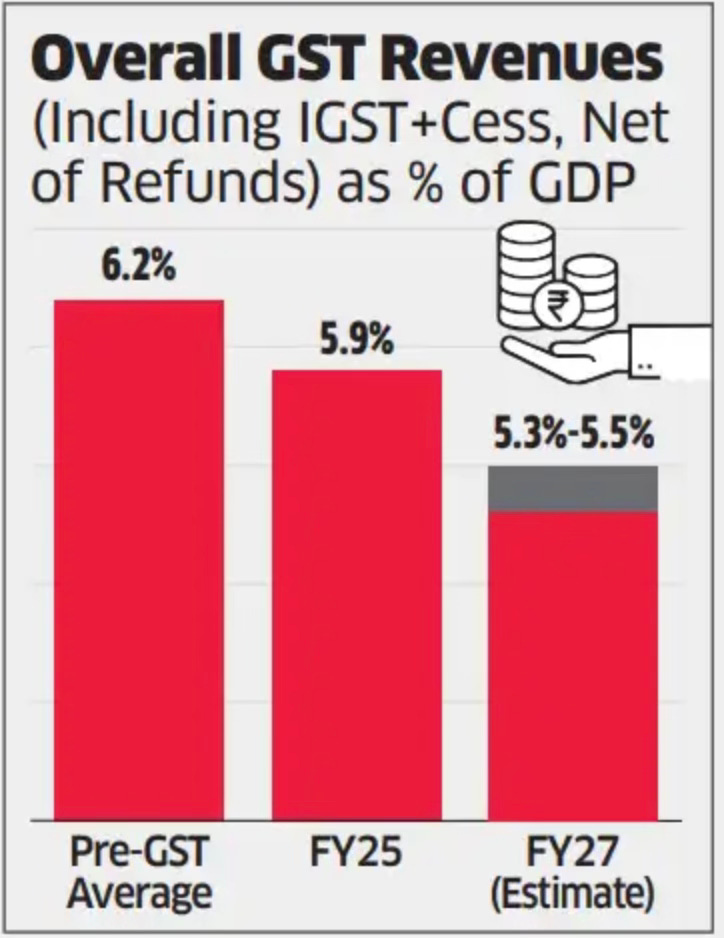
8. GST balance sheet.

Though average GST collections in absolute terms are almost 90 per cent higher than those in the pre-GST period, other parameters tell the real story. The average growth rate in tax collections and the tax-GDP ratio are lower under the GST regime compared to the pre-GST era. Collections were further marred by GST cuts starting September 22, 2025.
With high-skilled IT services under pressure, a financial sector with limited capacity to create low and medium skilled jobs and manufacturing struggling to gain traction, the one area where jobs are being created is low-end services. Delivery riders for Zepto, which has just filed its papers for an IPO, have gone up from 49,278 in 2024 to 2.21 lakh in 2026 — more than a four-fold increase. Zomato and Blinkit have almost doubled to 10 lakh riders in two years. Swiggy now has 6.1 lakh riders, while Uber, at 14 lakh active drivers, outstrips Indian Railways. The gig economy is emerging as an urban employment sink.
10. The Uniqlo-Toray partnership that underpins Fast Retailing's spectacular growth. 
In April 2000, Uniqlo founder Yanai paid a visit to the offices of Toray, a Tokyo-based chemicals and materials conglomerate he had read about in a magazine. It marked the start of a strategic collaboration that provided Uniqlo with arguably its most important advantage over rivals: access to high-tech, specialised fabrics. After testing 10,000 prototypes, Toray invented a material combining four types of synthetic yarn that absorbs moisture from the body and converts it to heat. Uniqlo branded it Heattech, and since 2003 has sold 1.5bn garments made from or containing it. Toray also helped develop the fabrics behind AIRism, used as a breathable base layer, and the Ultra Light Down ranges of packable jackets insulated with bird plumage... control over fibre shape and fineness, dubbed nanodesign, has helped to make highly water-repellent and durable $50 lightweight parkas, creating a far cheaper alternative to specialist outdoor brands such as Patagonia. The two sides are entering a fifth phase of collaboration that aims to combine synthetic fabrics with natural ones, such as introducing cashmere into Heattech products to make them softer. Okawa believes few other retailers have such deep relationships with their key suppliers.
11. Good FT long read about the Jamie Dimon succession struggle at JPMorgan. The things that stand out are the following: 

One, the appointment of someone to the top position in any organisation, public or private, is bound to be opaque and involve considerable discretion. The only disqualification would be the egregiously ineligible. For any others, there will always be ways to spin it as a fair process. This holds with greater effect as the stakes go up. 

Two, in the succession struggle, dominated as they are by a multiplicity of considerations, among those eligible or qualified, it is rare that the most professionally competent will emerge as the successor. 

Three strong leaders will always delay succession, and even when they choose to retire, will seek to retain enough levers to influence the decisions of their successors. Most often, it is about decisions involving the promotion of the interests of those in the organisation closest to them, their pet projects or initiatives, broader organisational strategic shifts, etc.

Monday, April 27, 2026

Impact of policy interventions and shocks on India's economic growth

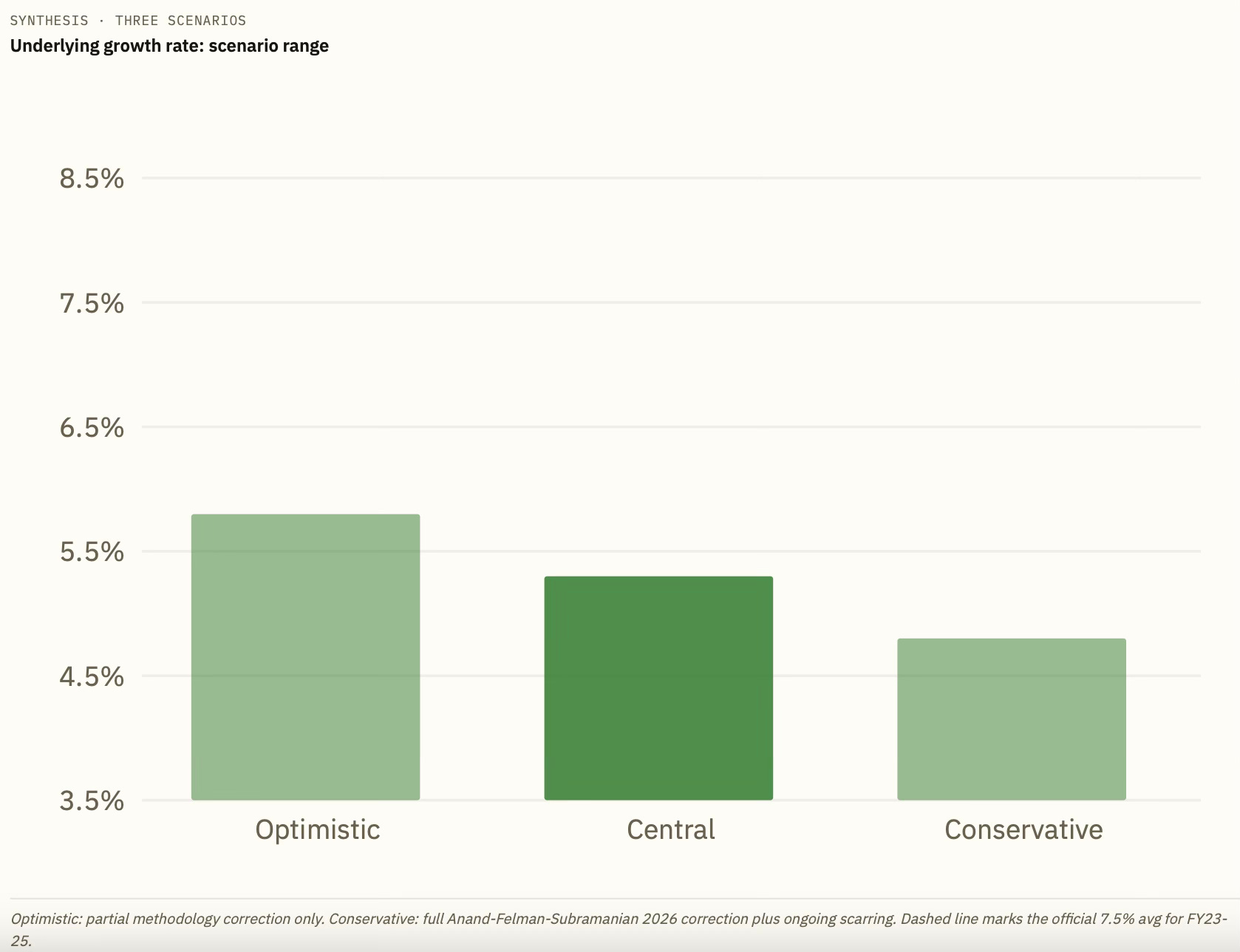
The sustainable growth rate of any economy is that which strips out the positive effects of the government’s fiscal interventions and the negative effects of economic shocks. This blog has held that, given its deficient human, physical, and financial capital, India’s neutral growth rate is about 5-5.5%. 

This post provides a framework to figure out the underlying economic growth rate by stripping these positive and negative contributors. 

So, what has been India’s underlying neutral (stripped of the impact of policy interventions) economic growth rate? 

Answering this requires us to identify the specific interventions and events that have contributed to the positive and negative shocks, and to try to figure out their respective economic impacts. 

In the last decade or so, the economy has faced three large negative shocks: demonetisation, the introduction of GST and associated efforts to formalise the economy, and the pandemic. In addition, on the external front, it has faced the oil shocks from the Ukraine and Iran wars, and the Trump tariffs. 

The economy as a whole has benefited from three fiscal events - corporate tax rate reduction, income tax rate reduction and rationalisation, and the GST rate reduction. 

While it is now clear that the government suffered revenue loss from the corporate tax rate reduction, the income tax rate reduction, and rationalisation appear to have boosted the tax base and increased revenues. It appears (at least for now) that the existing corporate tax rate was on the left side of the Laffer curve, whereas the direct tax rate was on the right side. 

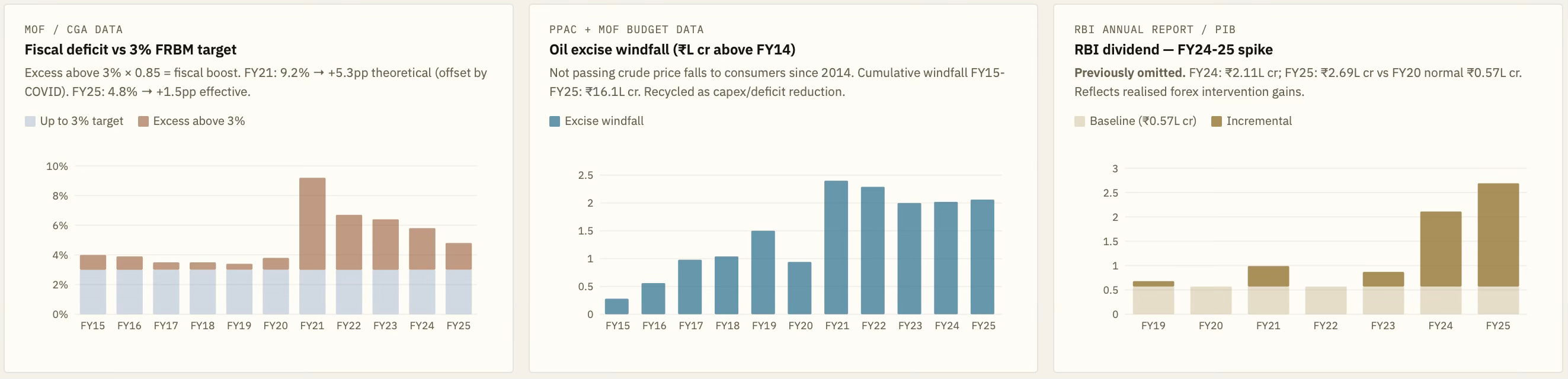
The government clearly benefited from three positive fiscal events: the long period of low oil prices (increased excise tax revenues due to not passing through the reduced oil prices), the surge in RBI dividends, and the large additional fiscal space from discarding the FRBM framework. 

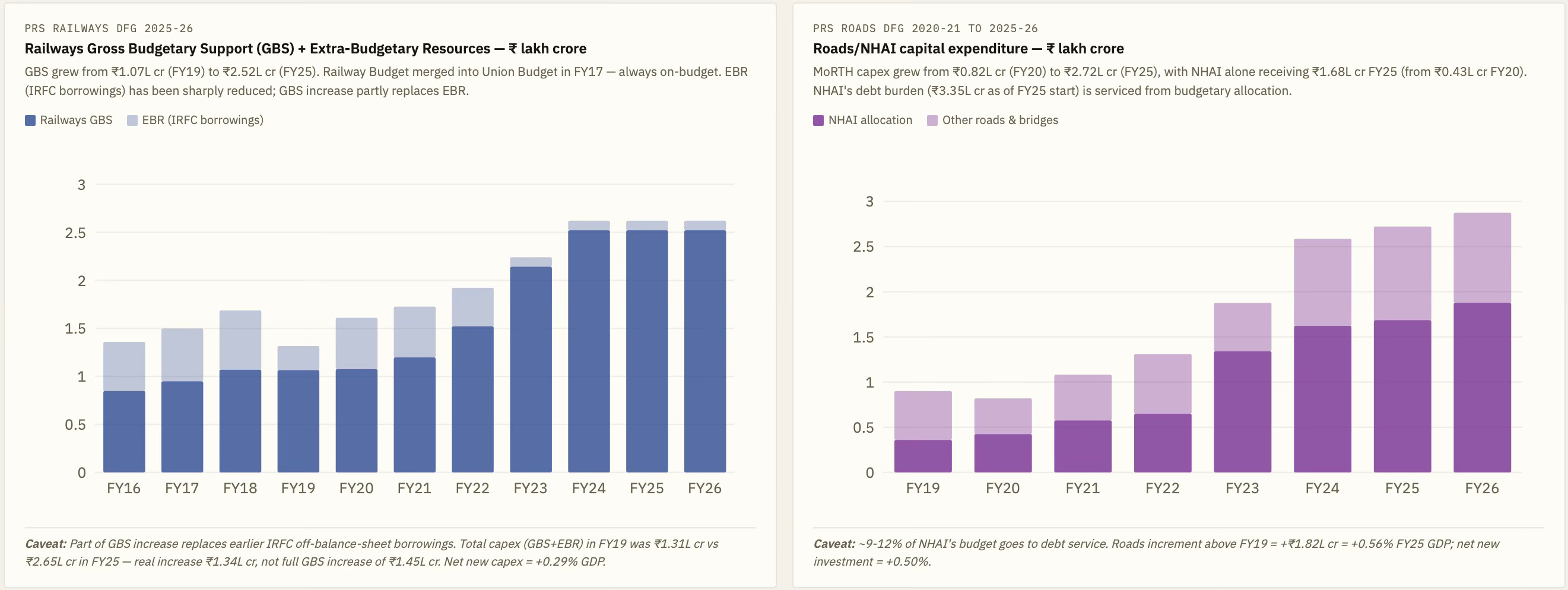
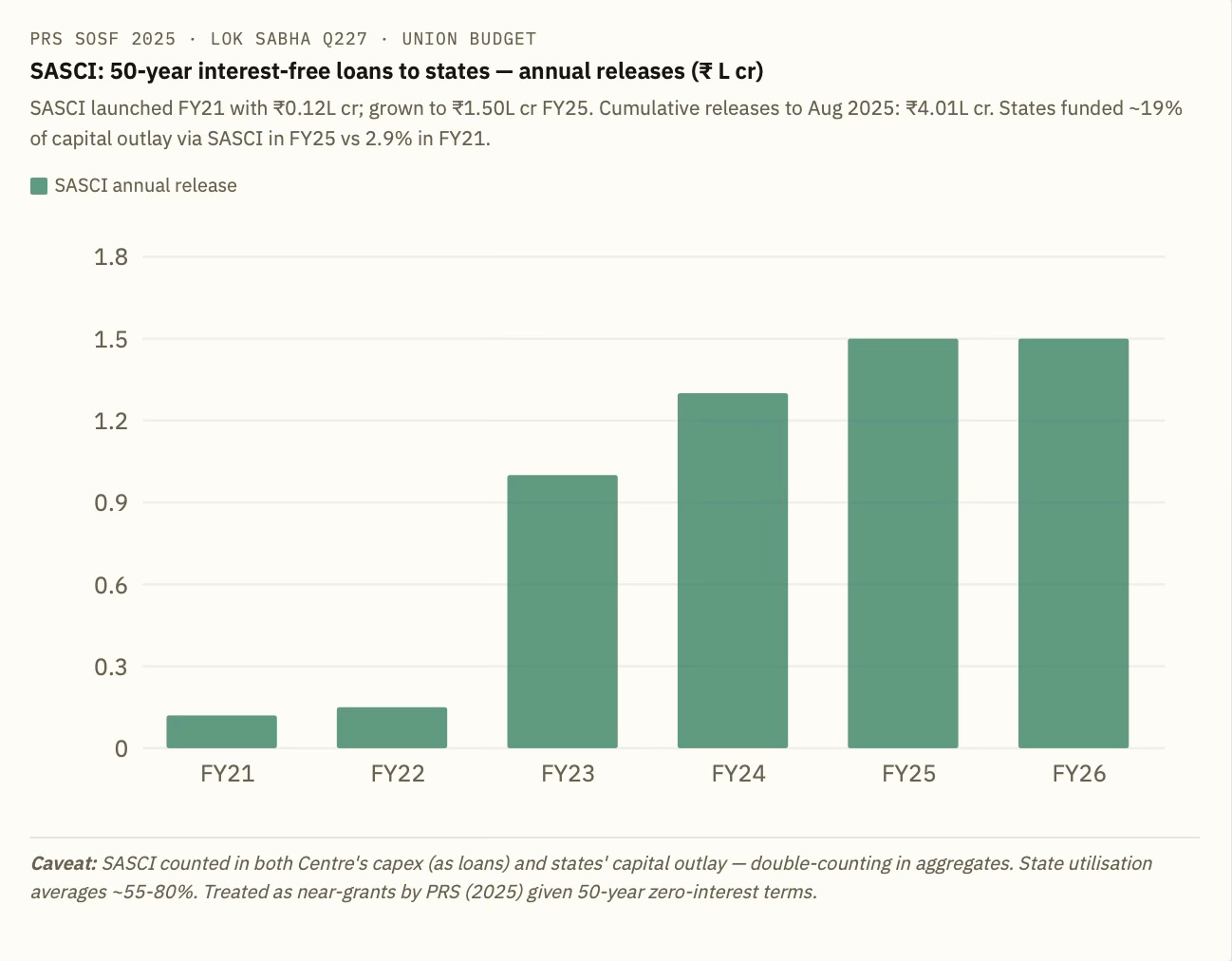
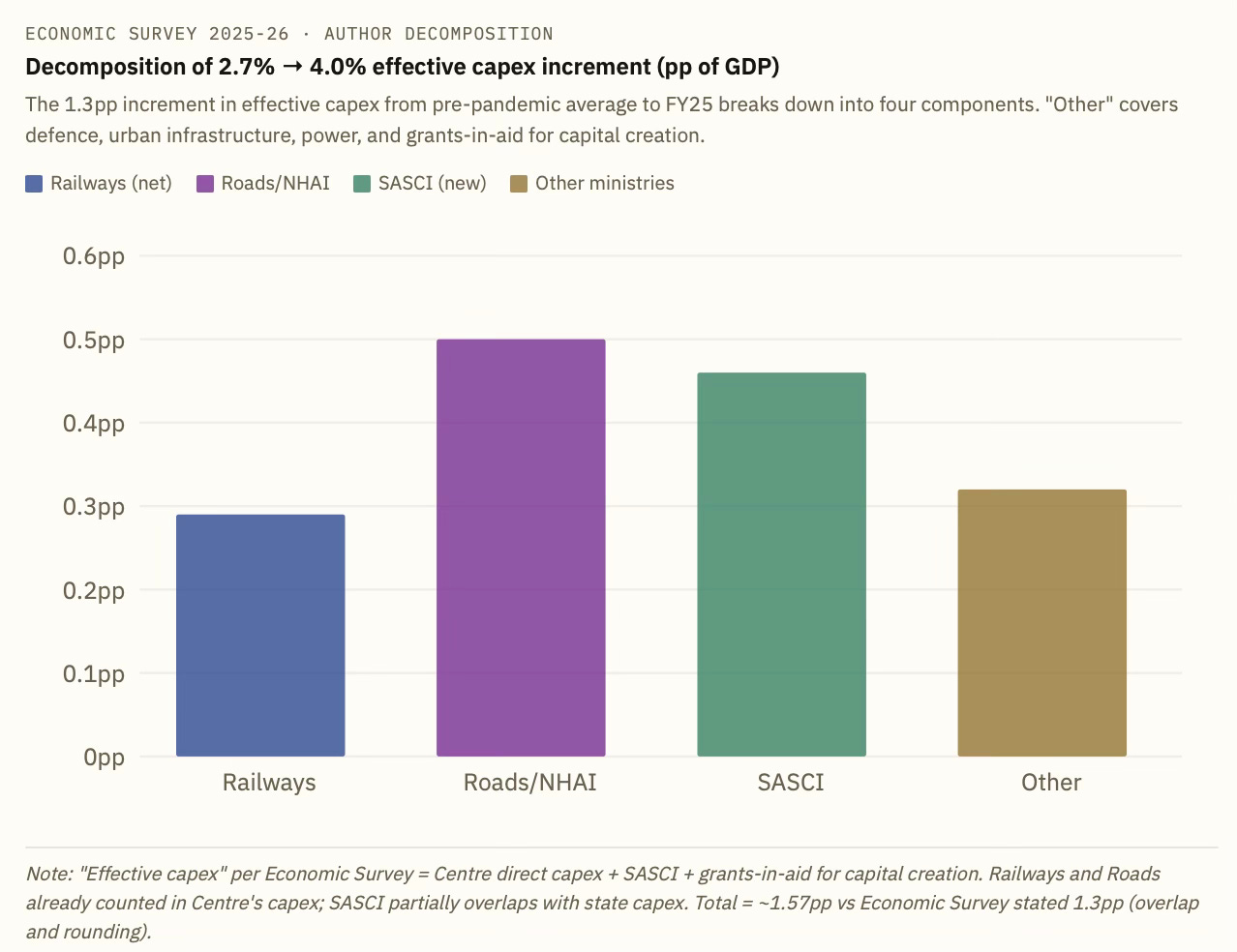
The net boost to fiscal balance resulted in a sharp spike in capital expenditure. It is to the credit of the government that it eschewed the subsidies and revenue expenditure route. This increase in capex includes taking on the budget account capital expenditures of NHAI and Railways. In addition, there has been the introduction of the zero-interest 50-year loan to state governments under the Special Assistance to States for Capital Investments (SASCI). 

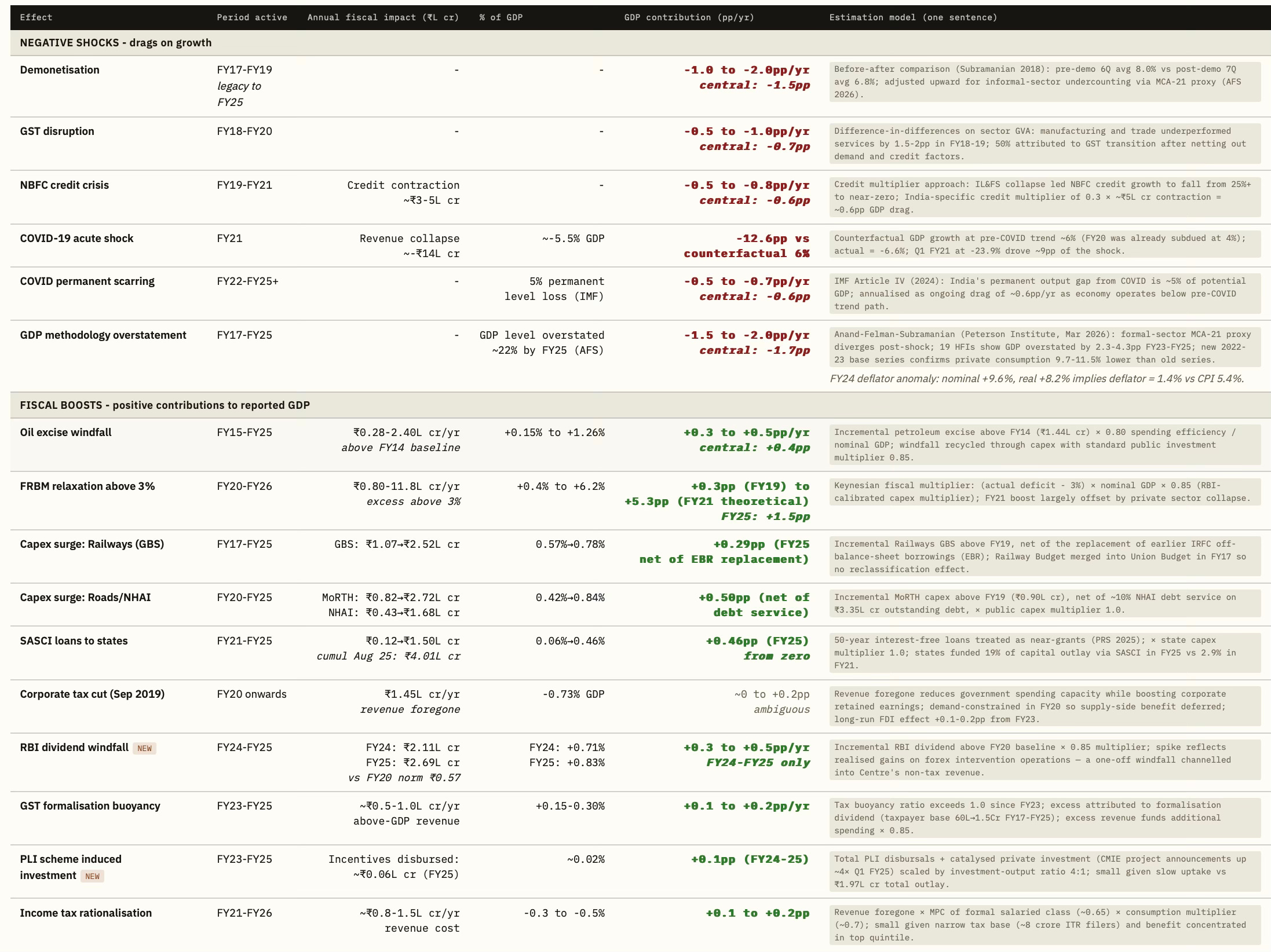
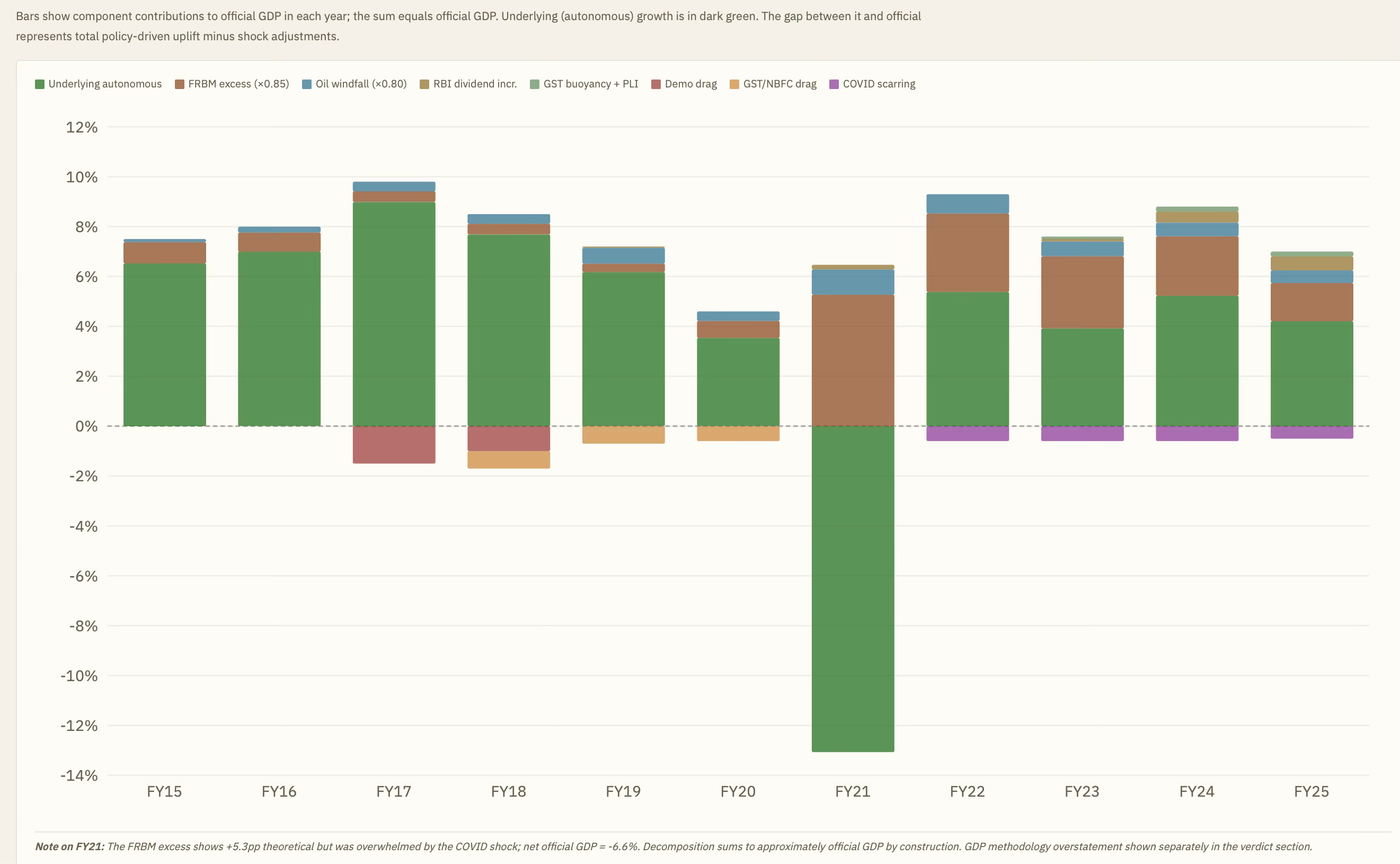
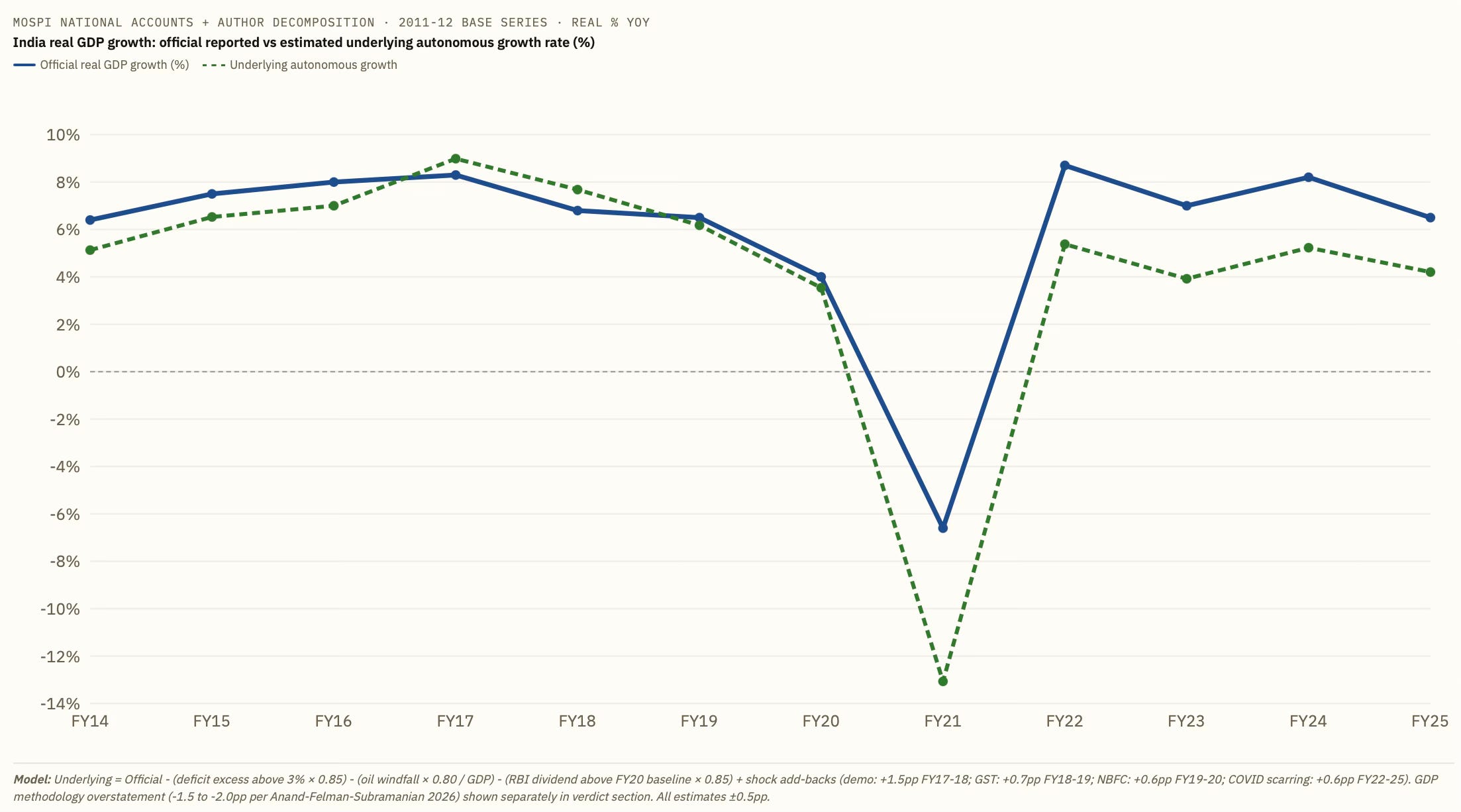
What have been their respective contributions to the output growth? Here is a graphical summary.

This table captures a brief description of the assumptions and estimations used. 

On the positive boosts to the government’s fiscal position, the contributions of the three factors are shown below. 

On the capital expenditure side, the government assumed in the budget the expenditures on railways and highways. 

The fifty-year interest-free loan to states under SASCI was a new addition, amounting to about Rs 1.5 lakh Cr each year. 

This explains how the increase in capex could be disaggregated and distributed among the different parts discussed above. 

The disaggregated impact of the positive and negative factors on the economic output is shown below. 

Based on the above, the underlying neutral economic growth appears to be in the range of 5-5.5%.

Clearly, since the pandemic, policy interventions have played an important role in boosting the economic output. 

The important point here is that while policy interventions may have boosted economic growth for some time, it remains to be seen in the coming years whether they have shifted the economy onto a higher underlying steady state growth trajectory. This is especially important since the headroom for further interventions, like fiscal space for more capex or tax cuts, may have shrunk, and we may be entering a world of increasing uncertainties and headwinds for the foreseeable future. 

In the final analysis, the balance sheet of the policy interventions will boil down to this question. Did the fiscal transfers of the last few years create the conditions (by broadbasing economic growth or increasing capital accumulation, for example) for a shift to a higher trajectory of growth, or was it a case of merely providing a temporary boost to the national output?

Saturday, April 18, 2026

Weekend reading links

 1. Net FDI from India has been negative for several months now.

2. WSJ graphics on US health care system. Cost of inpatient procedures are much higher than elsewhere.


Cost of pharmaceuticals too are much higher.
3. The rise and rise of iPhone manufacturing in India
The company assembled about 55 million iPhones in India in 2025, up from 36 million a year earlier, people familiar with the matter said, asking not to be named because the numbers aren’t public. Apple makes about 220 million to 230 million iPhones a year globally, with India’s share of the total increasing rapidly.

4. For those advocating currency depreciation as the response to a sharp increase in oil prices, Sachidanand Shukla has a cautionary note pointing to the importance of stability and credibility of the rupee.  

The allure of a depreciating exchange rate lies in its simplicity: It makes ones’ goods cheaper for foreigners. However, this is often a Faustian bargain. For many emerging and developed markets alike, the reality of a currency in freefall is not a boom in exports, but often a harsh blow to purchasing power and investor confidence. Imagine yourself in the shoes of a big global financial investor. How confident will you be in investing a billion dollars if you lose 9-10 per cent in a year due to depreciation?

On a related note, as the RBI deploys an expansive toolkit to stabilise the rupee, Rajeswari Sengupta writes that RBI has engaged strongly in the forex markets, selling over $30 bn in the spot markets in March. Its other actions were intriguing. 

It imposed regulatory restrictions —barring banks from taking positions in the offshore non-deliverable forward (NDF) market and capping their daily onshore FX exposure to $100 million each... The RBI did not merely restrict new positions; it required banks to unwind existing ones, reportedly at a cost of ₹4,000–5,000 crore. In effect, banks were penalised for actions that were fully legitimate at the time. Such retrospective costs risk undermining confidence and making banks more cautious in FX markets. Lower participation could reduce liquidity. And when liquidity dries up, currencies tend to become more volatile, not less.

5. The human cost of Israel's bombings of Lebanon.

On the day the cease-fire came into shaky effect — and most civilians across the region began to breathe a sigh of relief — Israel proceeded to launch one of the deadliest strikes on Lebanon ever, including in the heart of densely populated Beirut, without any warning. The operation, which the Israel Defense Forces sayattacked Hezbollah command centers, hit 100 targets in 10 minutes, killed over 350 people and wounded well over 1,000, many of them civilians... over the past six weeks, Israeli strikes in Lebanon continue, and have forced more than a million people from their homes and have left over 2,000 people dead and multiple villages in ruins.

6. The rise of China's export control measures.

China announced restrictions on exports 30 times between 2021 and 2025, the report by the EU Chamber of Commerce in China found, up from just 11 in the previous five years. Since 2020, Beijing had turned to “geoeconomic” controls — measures aimed at achieving geopolitical goals, it said. These include 10 that made use of global chokepoints in supply chains, such as China’s rare-earths exports, and 10 others aimed at coercing other countries using economic measures.
China has also announced sweeping new regulations to punish foreign companies that are trying to decouple their supply chains from China by increasing reliance on non-Chinese suppliers. These measures are part of the government's efforts to counter rising protectionism and decoupling from China. 
The 18-point regulations, described in state media as an effort to “prevent security risks in industrial and supply chains,” supplement the already formidable authority afforded to Chinese regulators to investigate multinational corporations for moving supply chains out of China. Under the new rules, regulators can question employees and examine corporate records during investigations. The regulations also allow authorities to bar companies and individuals from leaving China if they are suspected of moving supply chains elsewhere under foreign pressure... The State Council, China’s cabinet, justified the measures as necessary to protect the country’s economic stability and national security — a rationale it has previously used to expand its ability to pressure companies. China has also adopted sweeping state secrets laws to prevent information from leaving the country.
During the pandemic, Beijing vowed to invest $400 billion in the country in the coming decades in exchange for a steady supply of oil. In 2024, it purchased 90 percent of Iran’s oil exports, according to the International Energy Agency. China also accounted for roughly a quarter of Iran’s non-oil exports from 2019 to 2024, according to data compiled by Harvard University’s Atlas of Economic Complexity, purchasing billions of dollars of Iranian chemicals and metals.
Payments are made in renminbi, China’s currency, avoiding the use of dollars and the need to involve American banks, which are often the primary entities used to help enforce sanctions violations. China, in return, appears to provide nearly 30 percent of the commodities that Iran imports, selling everything from furniture to sunflower seeds. There is another crucial layer of trade between the nations not recorded in official statistics. Both countries have engaged in a complicated barter system that involves secret financing channels. Iran ships oil to China and in return, Chinese state-backed construction companies have built airports and other infrastructure.

8. The new fragile European countries - Britain, Italy, and France (or Bifs).

Europeans still trust the EU over their national political systems, and the margin is wider than it has been since the noughties. (More on this later.) Support for the euro, which was as low as 51 per cent in 2013, has grown to a record high of 74 per cent in the EU, and 82 per cent in the Eurozone. To repeat, that is a near-consensus in favour of the single currency at a time of economic malaise in much of the continent. As for the country-by-country findings, 21 per cent of Austrians think membership is a bad thing. That makes them the most Euro-sceptical people in the union.

10. India reached peak college education premium in 2011?

11. Jason Bordoff makes the important point that, unlike earlier, the risk of oil shocks is a less restraining factor on US supplies.

In 2012, the US was far less equipped to absorb even a small disruption. US crude production averaged just 5mn barrels a day in 2009; last year it approached 14mn. Two decades ago, the US imported about 60 per cent of its oil consumption. Today it is a net exporter and the world’s largest exporter of liquefied natural gas.
12. The data centre construction boom in the US is being held back by construction and other delays, with almost 40% of those due this year at risk of falling behind schedule

13. Finally, excellent description of the regressive nature of income taxation especially for the richest Americans.
In 2021, ProPublica published an investigation built on a bunch of leaked tax documents revealing what the richest Americans really pay — or don’t. Warren Buffett had a true tax rate of 0.1 percent; Jeff Bezos had 0.98 percent; Michael Bloomberg had 1.3 percent... Let’s focus on Jeff Bezos because he’s much more of a classic case. Jeff Bezos started his own business. He owns a dominant amount of the stock. And over the course of the years, he has taken a salary that is no higher than $82,000. It’s been more than 20 years now, and his salary is always capped at $82,000.

You might say: Well, why would it be? He started the company — he’s the man. Why isn’t he taking a huge salary to reflect all that he put into the company? The reason is: Salaries are for suckers. When people take a salary, they’re subject to high income taxes and payroll taxes, and Jeff Bezos and a lot of our other multibillionaires have no interest in paying those taxes.

So instead, they take their benefits through the growing value of their stock — and their stock has grown enormously. And that massive growth of stock happens entirely tax free — with no time frame under our current system in which that stock will ever be subject to tax. That is because we only impose a tax if the stock is sold, and Bezos never has to sell the stock because he can simply borrow against the stock and use that money to support his lifestyle and to pay any interest that’s due on the loan... you’re just taking out one loan after another, sometimes paying one loan back with another, and you’re just doing this again and again.

The interview also makes a reference to Andrew Mellon's views on capital gains (or investment returns) taxation.

The fairness of taxing more lightly incomes from wages, salaries and professional services than the incomes from business or from investments is beyond question. In the first case, the income is uncertain and limited in duration; sickness or death destroys it, and old age diminishes it. In the other, the source of income continues; the income may be disposed of during a man’s life, and it descends to his heirs.

Saturday, March 21, 2026

Weekend reading links

1. Private equity has outperformed public markets.

2. The Karnataka government has announced the implementation of an Alcohol-in-Beverage (AIB) based excise duty. As per this, the globally recognised practice for alcohol taxation, percentage of alcohot in a liquor brand will determine the duty levied. 
In Karnataka, alcoholic products currently fall under 16 slabs. A product was designated to a particular slab based on the Declared Price, the selling price determined by the distiller. The Additional Excise Duty levied by the government was dependent on the price per litre of the product, due to which the price of the premium liquor segment was on the higher side... Over the next four years, the government plans to abolish the slab system of excise duty collection completely. For FY 2026-27, the government will merge multiple slabs and reduce their number from 16 to eight... Currently, the duty levied for a bulk litre of say, McDowell’s – which is at the lower end, and Blue Label – which is at the higher end, is different and is based on the Declared Price. Both have 42% alcohol. Under the new system, both drinks will attract the same percentage of additional excise duty irrespective of the declared price

3. Japan lifestyle facts of the week.

The nation’s stock of 2.2mn drinks vending machines is down 23 per cent from its bubble-era peak in 1985, according to the Japan Vending System Manufacturers Association... Japan loved vending machines for their convenience despite higher prices. But three years of rising inflation has driven consumers to greater thriftiness. Well-known brands of tea and coffee can be 20 per cent cheaper in nearby convenience stores, which have also stepped up sales of freshly brewed coffee, while drugstores and supermarkets sell discount private-label brands. In 2024 just 42mn cases of drinks were sold via vending machines, down from 72mn at the 1997 peak, according to data from Inryo Souken, a Tokyo-based research institute. Vending machines also still need people to keep them stocked — and Japan has a chronic shortage of truck drivers.

4. Global crude landscape (HT: Adam Tooze)

As the war rages on, and the blockade of the Strait of Hormuz bites, oil prices are becoming a binding constraint on the world economy. Oil demand is highly inelastic.
Oil demand is, on average, highly inelastic in the short run because most end uses have few immediate substitutes — factory boilers rely on fuel oil, aircraft require jet fuel, and most cars still run on gasoline. Our estimate of the short‑run price elasticity of global oil demand is −0.024, implying that a roughly 40% price increase above 12‑month highs is needed to reduce total consumption by 1%. The response, however, varies materially by product. Naphtha is most sensitive because petrochemical plants can partially substitute ethane in cracking operations. Jet fuel is also relatively responsive, as airlines can cancel lightly loaded flights when fuel costs spike. By contrast, fuel oil is least elastic given its role in essential services like home heating, marine transport, and power generation.
The worst impacted by the 20% reduction in oil supply and 15% in LNG supply is Asia
Most crude shipments through the Strait of Hormuz are bound for Asia, with China, India, Japan, and South Korea as the principal buyers. In total, Asia takes about 11.2 mbd of crude and 1.4 mbd of refined products that transit the Strait. As a result, the immediate physical shortfall is concentrated in Asian markets, where reliance on Gulf barrels is greatest. Early signs of demand destruction are emerging in Asia as product prices surge and spot barrels become prohibitively expensive. Timing effects further reinforce this divergence. A typical voyage from the GCC to Asia takes approximately 10-15 days, while shipments to Europe require closer to 25-30 days via the Suez Canal, or even 35-45 days if rerouted around the Cape of Good Hope. As a result, the impact of disrupted Gulf flows will hit Asian markets earlier and more acutely, whereas Atlantic basin benchmarks such as Brent and WTI will remain cushioned for longer by inventory overhangs and slower supply adjustments.

India's dependence on Strait of Hormuz is especially acute.

Almost 50 per cent of the LPG and 30 per cent of the natural gas that India consumes comes from the Strait of Hormuz.
5. Gideon Rachman writes that Iran may have achieved a major strategic leverage going forward by demonstrating the chokehold that any restrictions on the Strait of Hormuz can have on the world economy. 
The strait’s closure creates both an immediate crisis and a long-term strategic quandary. The current problem is that the longer it is closed, the greater the threat of a global recession. The future dilemma is that Iran now knows that control of the Strait of Hormuz gives it a stranglehold over the world economy. Even if it relaxes its grip in the short term, it can tighten it again in future.

6. A measure of how much Israeli politics has become radicalised.

Israel should destroy all Iran’s oilfields and flatten the energy infrastructure on the island that functions as Tehran’s main oil export hub... the demands... came from Yair Lapid, the silver-haired former premier and television host who heads the centrist Yesh Atid party, and draws much of his support from liberal bastions such as Tel Aviv. Lapid’s message reflects how the fight in Israeli politics, for all Zionist parties in government and opposition, is not over whether to confront Iran but over who will prosecute the war better than Netanyahu. Israel’s offensive has higher public support than almost any other issue in the country’s fractious politics — even after two and a half years of multifront fighting that has disrupted daily life for millions of Israelis. Although Israel’s Arab parties staunchly oppose the war with Iran, polls suggest more than 90 per cent of Jewish Israelis back it, and the country’s Zionist opposition groups have fallen in behind it in unison.

7. Canadian pension funds' PE bets are souring, losing money on their PE investments.

Ontario Teachers’ Pension Plan, which manages C$279bn ($206bn) of assets, and the C$145bn Ontario Municipal Employees Retirement System reported returns of minus 5.3 per cent and minus 2.5 per cent respectively for their private equity portfolios in 2025. For OTPP, it was the worst performance for this asset class since 2008 and for Omers since 2020. La Caisse, Quebec’s C$517bn state pension fund, also reported weak private equity results. The group said its PE portfolio returned 2.3 per cent last year, well below the 12.6 per cent gain in its benchmark index, half of which is made up of listed stocks. The Healthcare of Ontario Pension Plan, which published results this week alongside OTPP, reported private equity returns of 3.6 per cent in 2025. Its broader private markets portfolio returned 2.1 per cent, compared with 11.7 per cent for its listed holdings.
8. Thames Water gets new offer from its senior creditors to take over the struggling utility, committing up to £6.55bn of debt and £3.35bn of equity. It is now with Ofwat for regulatory approval. 
Lenders including hedge fund Elliott Management and private capital group Apollo Global Management are locked in negotiations with the regulator as they attempt to take formal ownership of the UK’s largest water provider. The creditors have proposed a new management plan, which could lead to a stock market listing as soon as 2030... The creditor’s £6.55bn debt figure is made up of £3.25bn that will be made available to Thames Water on day one of their ownership, up from £2.25bn previously proposed, and up to an extra £3.3bn that will be made available to the utility over the funding period. The new debt would come in addition to £3bn of emergency financing approved last year to prevent Thames from being renationalised under the government’s special administration regime... The increased debt offering would come on top of an equity injection that has been revised upwards to £3.35bn from £3.15bn... Under the terms of the new proposal, Thames Water’s class A creditors would take a 30 per cent writedown on their existing debt, on top of “a write-off in full of the Class B Debt and any subordinated debt or equity held by existing shareholders”.

9. TJXX is the fourth-largest retail chain in the US and the fourth most profitable global fashion retailer.

10. Rana Faroohar writes about the concierge economy in the US, where the rich can get to the front of the que and buy convenience at a price. She points to the gold-plated subscription healthcare service that comes with minimal wait times for specialists, 24/7 access to physicians, longer sessions with doctors, and which is a $20 bn global business with roughly 40% in the US. 
The market for personal travel planners, high-end club memberships, private wealth managers and educational consultants has in recent years grown by high single to double digits. Fractional aviation subscription services (think NetJets) are growing by about 10 per cent a year. Those with Clear (the airport service that speeds you through security if you must fly commercial) have tripled since 2022. It’s all part of a burgeoning “concierge” economy that caters to affluent consumers who don’t wait — or want — for anything. The global “lifestyle concierge” services market — that’s the part of the business that gets you the right hotel, colourist, Pilates instructor or front-row tickets to the must-see football game — is expected to grow from $16bn to about $36bn by 2035. It’s about saving time, yes, and it’s also about making sure the rich get to speak to human beings who can fix problems and meet high expectations, rather than dealing with search algorithms, AI bots and monotone-voiced teleworkers, like everyone else. Concierge services are about convenience and access, but they are also about bringing ease and luxury to areas that have become digital commodities or suffer from high levels of consumer dissatisfaction, such as healthcare or financial services.
11. India's AIF market is surging.
From about 160 AIFs in 2015, with less than Rs 28,000 crore in commitments, they’ve grown to over 1,740 in number as of January, spread across three categories and with nearly Rs 15 lakh crore in committed capital, according to Sebi... Category-II funds, which include private-credit, real-estate, venture-debt, and private-equity funds, had become the default recommendation... The Indian alternative-investments industry has grown at a compound annual rate of 49% in ten years to September, according to data from PMS Bazaar. Category-II, III funds have grown at over 50% growth rate... category-II funds account for about two-thirds of the total Rs 15 lakh crore commitment... the US, where hedge funds (category-III funds in Sebi parlance) dominate the alternative-investment space... In India, though, a majority of AIF investors come from family-business backgrounds... A mutual fund would deliver 12–14% returns on a long-term basis, and here, AIFs were promising close to 25% internal rate of return for funds in which investor capital was locked-in for eight to 10 years... Reportedly, two-thirds of the money raised by Indian AIFs comes from domestic investors.
12. Global LNG market.
13. Italian judicial reforms face a referendum.
To insulate judges from political pressure, the constitution established the Supreme Council of Magistrates as an autonomous, self-governing body, comprised of two-thirds serving magistrates, elected by their peers, and one-third parliamentary appointees. The council handles the selection, postings, promotions and disciplinary proceedings of all Italy’s magistrates, now numbering around 10,000... In Italy, resolving contentious civil cases through all three levels of the justice system currently takes an average of 2,217 days — six years and one month. That is better than a decade ago, when it took about eight years but still far slower than the EU average of 795 days, or two years and two months... 

Under the proposed reforms, the magistrates’ council would split into three distinct bodies: one supervising prosecutors, one supervising all other magistrates, and a disciplinary court for all. It is a change that many legal experts — and politicians across the spectrum — have long advocated... the reform also envisions a more controversial change: magistrates would no longer be elected by their colleagues to serve on the self-governing bodies but would instead be chosen by lottery. Critics see this as a device to erode judicial autonomy vis-à-vis the political system.

14.  Softbank's spectacular free lunch in the US-Japan trade deal.

SoftBank was set to earn ¥1tn ($6.3bn) in fees... to build and operate a $33bn gas-fired power station in Ohio... It will earn the payments over 15 to 20 years if it can reach the target capacity of 9.2 gigawatts. The idea of a fee arose because SoftBank would otherwise earn nothing for its role as developer of the project. It has no equity in the power station, which will be financed entirely by Japan and owned 50/50 by the US and Japan via a special-purpose vehicle, set up as part of the trade deal... Under the trade deal, profits from the investments made are supposed to be split 50/50 between Japan and the US until Tokyo has recouped its money. After that, the US gets 90 per cent... SoftBank has already placed large-scale orders to begin construction of the power plant in Portsmouth, Ohio, including $10bn for close to 170 turbines from GE Vernova. As developer, SoftBank plans to sell the electricity to data centres it will also operate, say people familiar with the matter. The data centres will serve customers such as OpenAI, in which the Japanese group is a significant shareholder. Japan’s funding comes from both the Japan Bank for International Cooperation and commercial lenders. Nexi, Japan’s export credit agency, will guarantee 90 per cent or more of the commercial portion.

15. Among the several negative externalities of the Trump administration is the resurgence in interest in going nuclear. 

Britain’s Liberal Democrats... now want the nation to build a nuclear deterrent that is less reliant on the US... France, whose force de frappe is truly sovereign, said this month that it would increase its stockpile of warheads. In Poland, a rare point of agreement between the prime minister and the president is their openness to going nuclear. In South Korea, public support for a deterrent has gone up to 70 per cent in recent years. Saudi Arabia, which has said that it would get one if Iran did, might not wait for such a cue now that it and other Gulf states are under conventional attack from that quarter anyway. Even the original nuclear powers are chafing at old taboos. As of last month, there is for the first time in over half a century no binding agreement to limit nuclear arms between America and Russia, which have the world’s two largest arsenals.

Janan Ganesh writes about how Ukraine, Iran, and Trump's weaponisation of the US security umbrella, especially the last, has revived nuclear bomb acquisition.

One is the ordeal of Ukraine. In 1994, it gave up the Soviet nuclear weapons that were then on its soil in exchange for certain assurances about its security. Two decades later, Moscow began its long and ongoing war against Ukraine with the annexation of Crimea. The lesson, for some, is obvious. A country with dangerous neighbours should retain or acquire the ultimate deterrent. Another salutary tale is that of Iran. It seems that an unfinished nuclear bomb is the worst of all worlds: a provocation to other states but not a deterrent. A rational government would either abandon all ambitions of that kind or realise them in full. On balance, given Ukraine’s experience, observers around the world will regard the second course as the more prudent. On top of all this is the endless unpredictability of the US. Until now, countries with the expertise and resources to build the bomb, such as Japan and several European countries, have chosen to duck under America’s nuclear umbrella instead. As Donald Trump casts doubt over whether he would ever honour those mutual defence treaties, some of which were signed a human lifetime ago, this “nuclear latency” doesn’t seem so clever.

16. Shan Jin-Wei, Kun Li, and Kelly Liu suggest that S&P index inclusion may be up for sale by showing that if you purchase a S&P ratings then the company is more likely to get listed in S&P 500 index.

Firms that had recently obtained an S&P rating were significantly more likely to gain admission to the S&P 500. For non-member firms, the unconditional likelihood of being added to the index was 15.5 per cent; for firms that had recently purchased an S&P rating, it was 21.4 per cent. One possible explanation is that S&P tends to favour fast-growing firms, and that such companies are naturally more likely to issue debt and seek credit ratings. But if that were the whole story, we would expect to see the same pattern among firms that purchased ratings from Moody’s, and we did not. If rating purchases simply reflect firm quality or growth prospects, the effect should not be specific to S&P.

Firms’ behaviour further suggests that they see a link between rating purchases and index inclusion. When mergers among S&P 500 firms create openings for new additions, large non-member firms disproportionately increase their purchases of S&P ratings. Conversely, after a 2002 rule change that made foreign firms ineligible for inclusion, non-US firms listed on US exchanges sharply reduced their purchases of S&P ratings relative to Moody’s. The implication is clear: When the prize disappears, so does demand. Taken together, these patterns suggest that firms believe purchasing S&P ratings increases their chances of joining the index.

17.  Of the 937,876 candidates who took the civil services exams in 2025, just 0.1% got selected.

The situation is not much better if we take all the UPSC examinations, where of the 3.3 million candidates in 2022, the pass percentage was 0.18%.
Tokens... are the most basic units of output from large language models: it takes about 1,300 tokens to generate 1,000 words of text... When OpenAI launched GPT-4 two years ago, for instance, it charged $33 for 1mn tokens. Today, it charges only 9 cents for 1mn tokens produced by its cheapest model.

Thursday, March 19, 2026

Economic impacts of tax reductions

It has become a canon of economic orthodoxy that lowering corporate taxes will spur investment, and lowering income and indirect tax rates will spur consumption and economic activity, and both will boost tax revenues. 

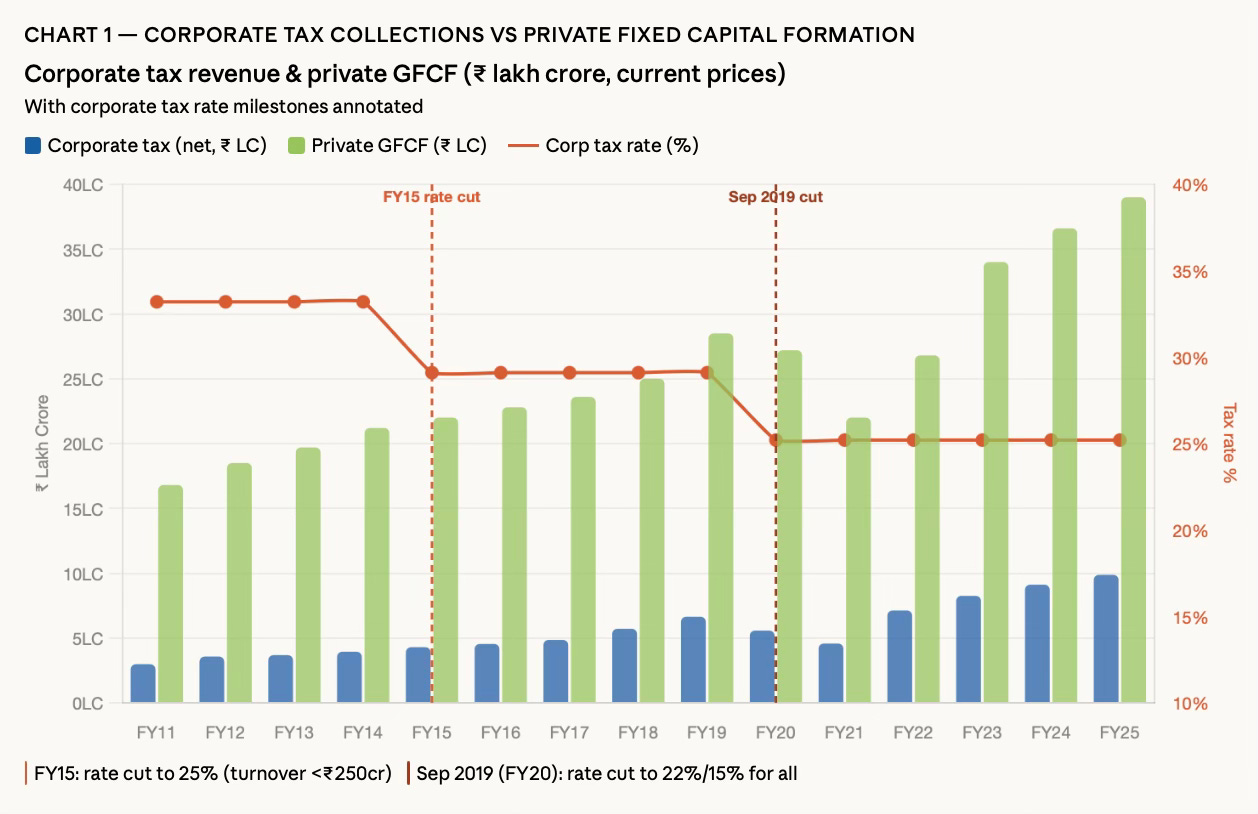
India’s experience with several direct and indirect tax reforms over the last decade may be a test case to evaluate this orthodoxy. This post analyses the impact of these reforms on tax revenues and the economy, especially of corporate taxes. 

On 20 September 2019, the government slashed the base corporate tax rate from 34.94% to 25.17% (inclusive of surcharge and cess) for existing domestic companies, and to 17.16% for new manufacturing companies — representing a fiscal cost of roughly ₹1.45 lakh crore or 0.7% of GDP.

AK Bhattacharya has this description of the corporate tax rate reductions.

In 2016-17, new manufacturing companies incorporated on or after March 2016 were given the option to be taxed at 25 per cent plus surcharge and cess (compared to 30 per cent plus surcharge, etc.) if they did not claim profit-linked or investment-linked deductions, investment allowances, or accelerated depreciation. Additionally, the tax rate for all companies with an annual turnover of less than Rs 5 crore was brought down to 29 per cent plus surcharge and cess. In 2017-18, the tax rate for small and medium companies with an annual turnover of up to Rs 50 crore was brought down to 25 per cent. This meant about 96 per cent of companies that filed a tax return were brought under a concessional tax rate of 25 per cent plus surcharge and cess... In the following year, 2018-19, the government extended the coverage of the 25 per cent tax rate to cover all companies with an annual turnover of up to Rs 250 crore — a move that would benefit 99 per cent of companies filing tax returns... In 2019-20, the government extended the concessional tax rate of 25 per cent to all companies with an annual turnover up to Rs 400 crore, thereby covering 99.3 per cent of all companies filing tax returns. Subsequently, in September 2019, all companies not availing themselves of the various exemptions and incentives like tax holidays were allowed to be taxed at 25 per cent, inclusive of the 10 per cent surcharge and a 4 per cent cess. Moreover, manufacturing companies starting operations after October 1, 2019, were to be taxed at an overall rate of 17 per cent.

And this on its outcomes in terms of revenue impact.

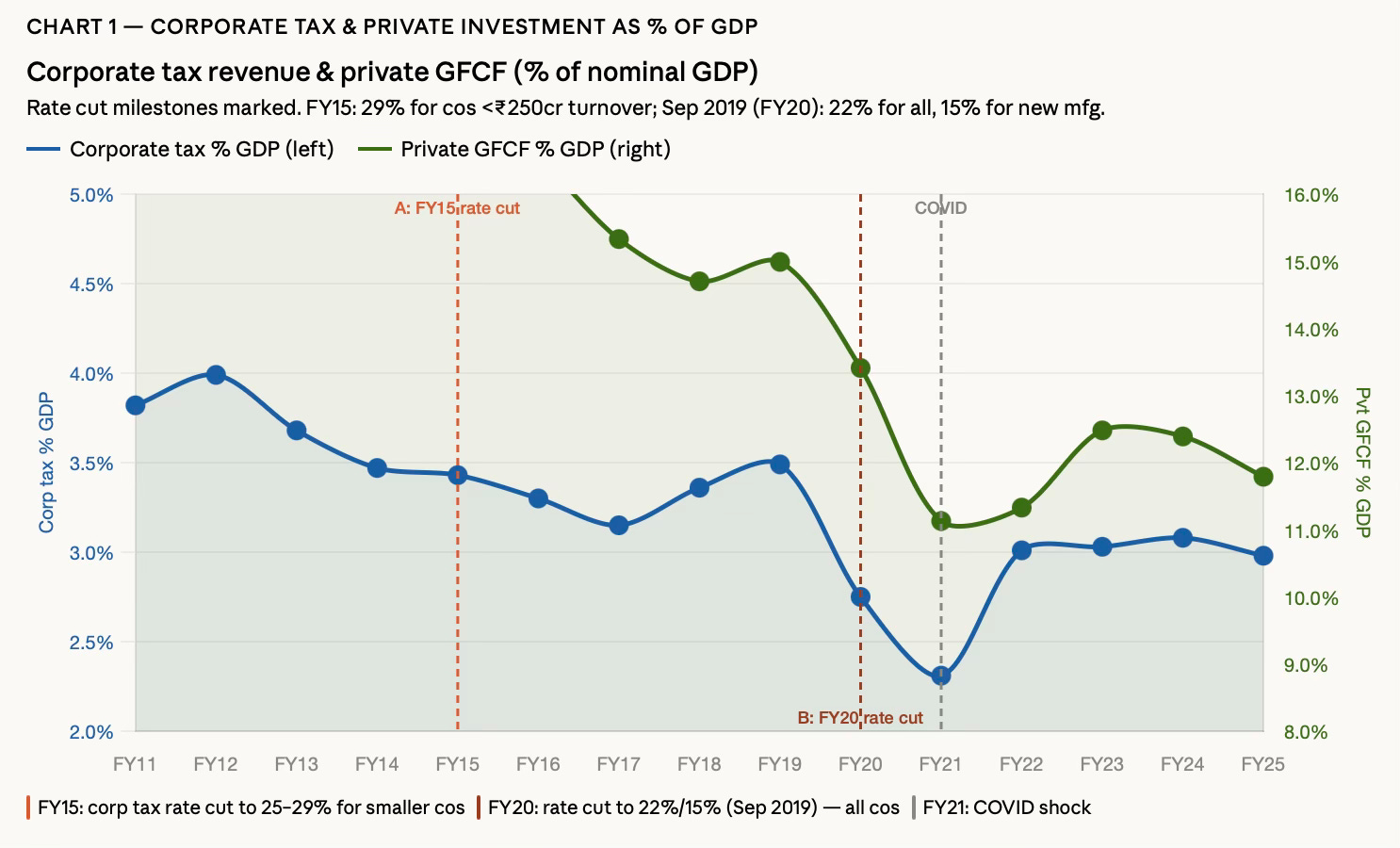
Corporation tax collections used to be about 34 per cent of the Centre’s gross tax revenues in 2014-15. This share plummeted to 28 per cent in 2019-20 and further down to 23 per cent in 2020-21... the share of corporation tax in GDP has kept falling almost every year in this period — from 3.4 per cent of GDP in 2014-15 to 2.74 per cent in 2019-20 and 2.28 per cent in 2020-21... In 2014-15, about 188,000 companies in a sample size of close to 580,000 paid taxes at an effective rate of over 30 per cent and this cohort accounted for 60 per cent of the total corporation tax collected by the Centre that year. In 2018-19, thanks to the various tax concessions, only about 85,000 companies of a larger sample size of 885,000 paid taxes at the rate of over 30 per cent. And this cohort accounted for only 50 per cent of the corporation tax revenue of the Centre... In contrast, there were just about 24,000 companies in 2014-15 paying taxes at an effective rate of 25-30 per cent, accounting for only 16 per cent of the corporation tax collected by the government. Another 15,000 companies paid taxes at the rate of 20-25 per cent, but their contribution to the corporation tax revenue was only 10 per cent. By 2018-19, the number of such companies saw a huge increase, without, however, a corresponding increase in their share in total taxes collected. Companies paying taxes at 25-30 per cent numbered around 184,000 in 2018-19, but their share in corporation tax was 19 per cent. The number of companies paying tax at 20-25 per cent increased to over 46,000 and their share in total corporation tax rose to 23 per cent.

In short, the story of India’s corporation tax revenues is about how more and more companies have been taxed at a lower rate. As a result, the contribution of a large number of companies to the corporation tax kitty is getting smaller. No wonder, corporation tax buoyancy has suffered in the last seven years.

What has been the impact of corporate tax reductions on the wider economy? 

In absolute value trends, there’s no perceptible spike in private sector gross fixed capital formation (GFCF) from reductions in the corporate tax rates. Nor is there any Laffer curve-type rise in corporate tax revenues.

The twin objectives of corporate tax reductions are to spur private investment and, through it, drive up corporate tax collections. However, private sector GFCF as a share of GDP has fallen sharply since the two corporate tax cuts, and corporate tax revenues as a share of GDP have also been declining. It was at 2.98% of GDP in FY25 compared to 4% in FY12!

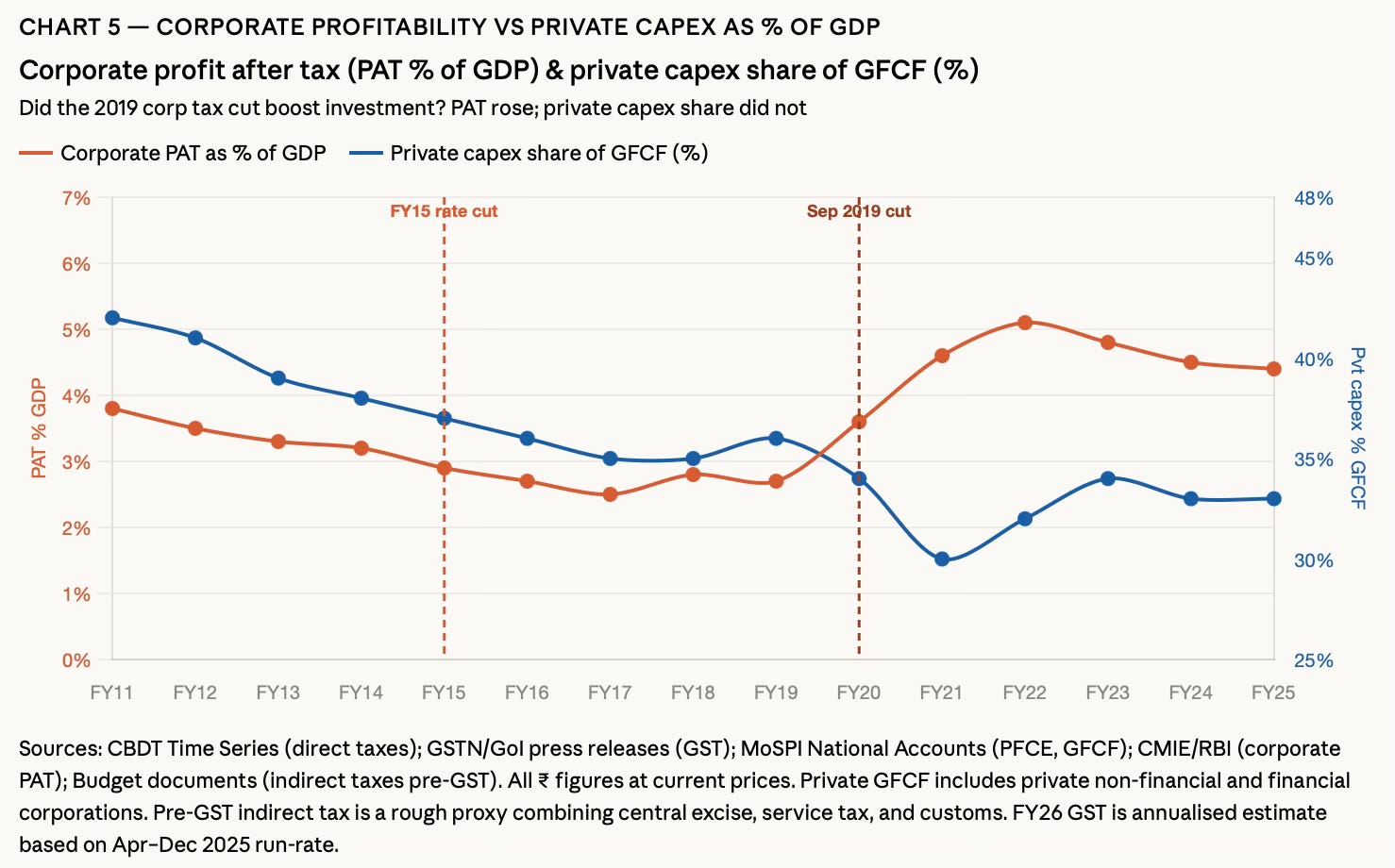
In fact, even as profits after tax rose as a share of GDP, the share of private capex in private sector GFCF declined and has been on a secular decline since 2010-11, apart from a slight recovery from the Covid-19 dip. This should be a matter of concern. 

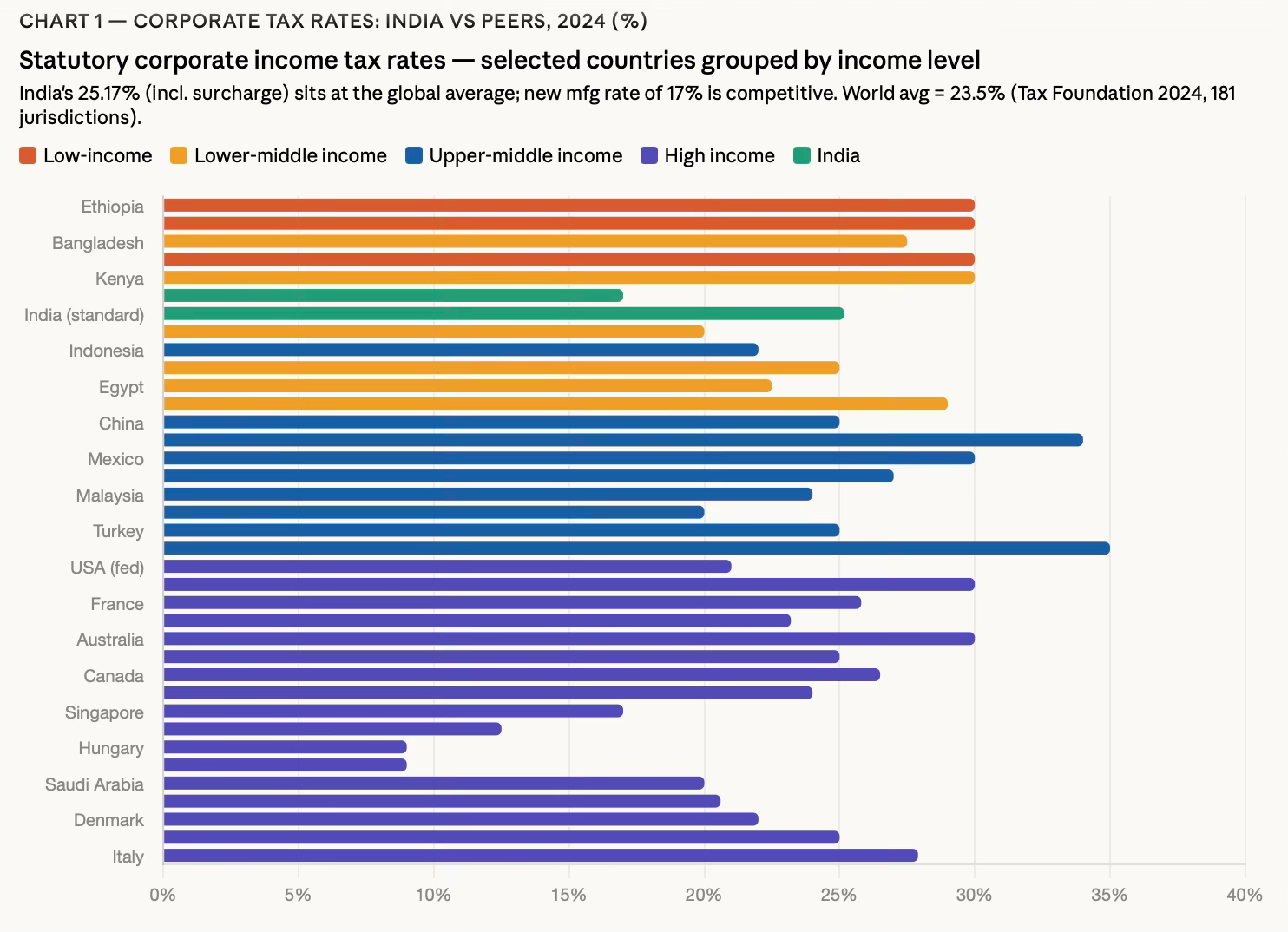
After these reductions, manufacturers in India face one of the lowest corporate tax rates globally today, above only a tiny number of countries. The rates are lower than all major developing country peers. 

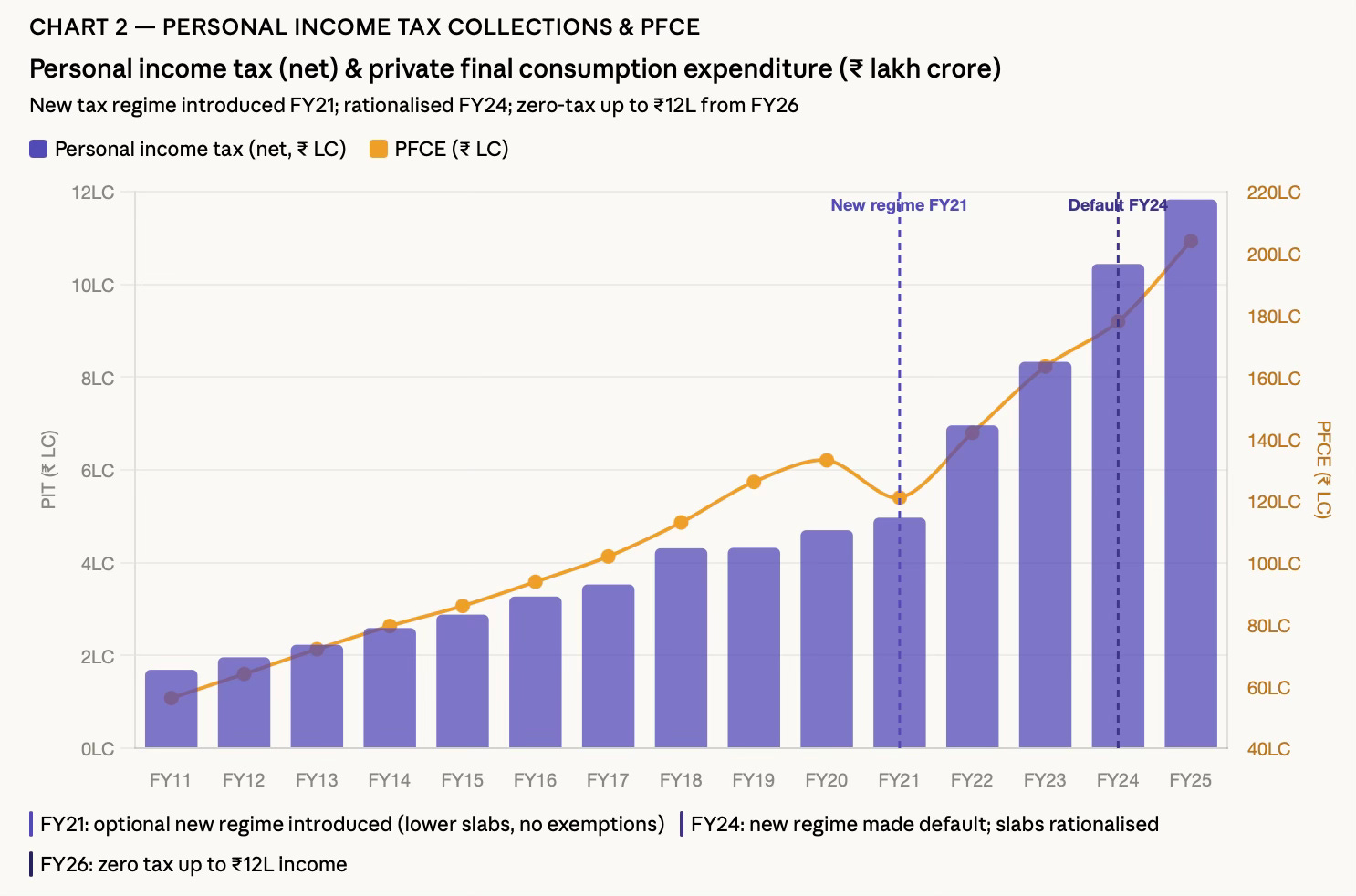
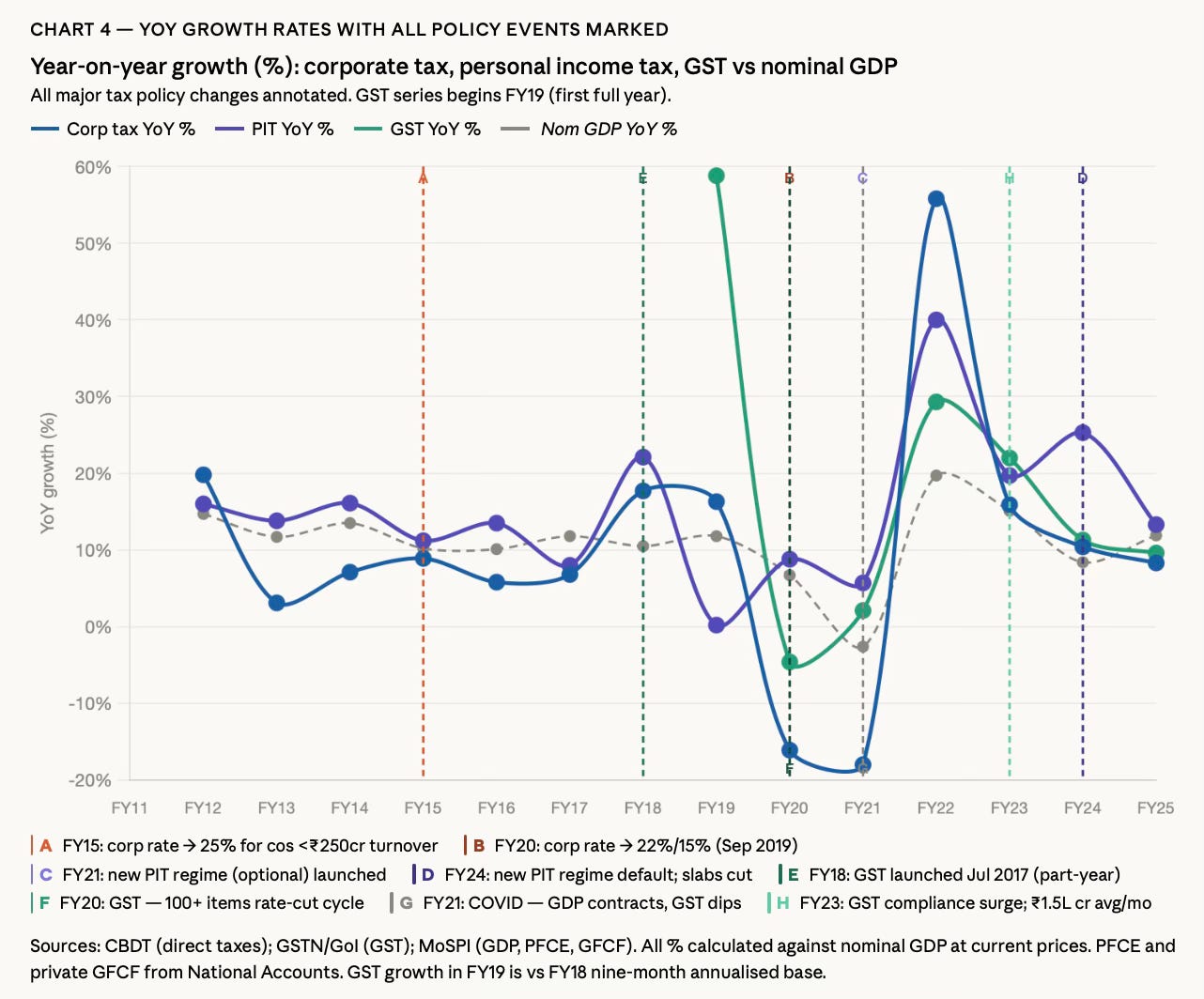
How do personal income tax (PIT) collections look? Encouragingly, it has been rising impressively since the regime shift in FY21. In fact, PIT collections have gone from ₹1.69 LC in FY11 to ₹11.83 LC in FY25 — growing faster than corporate tax every year since FY20, which is a structural reversal.

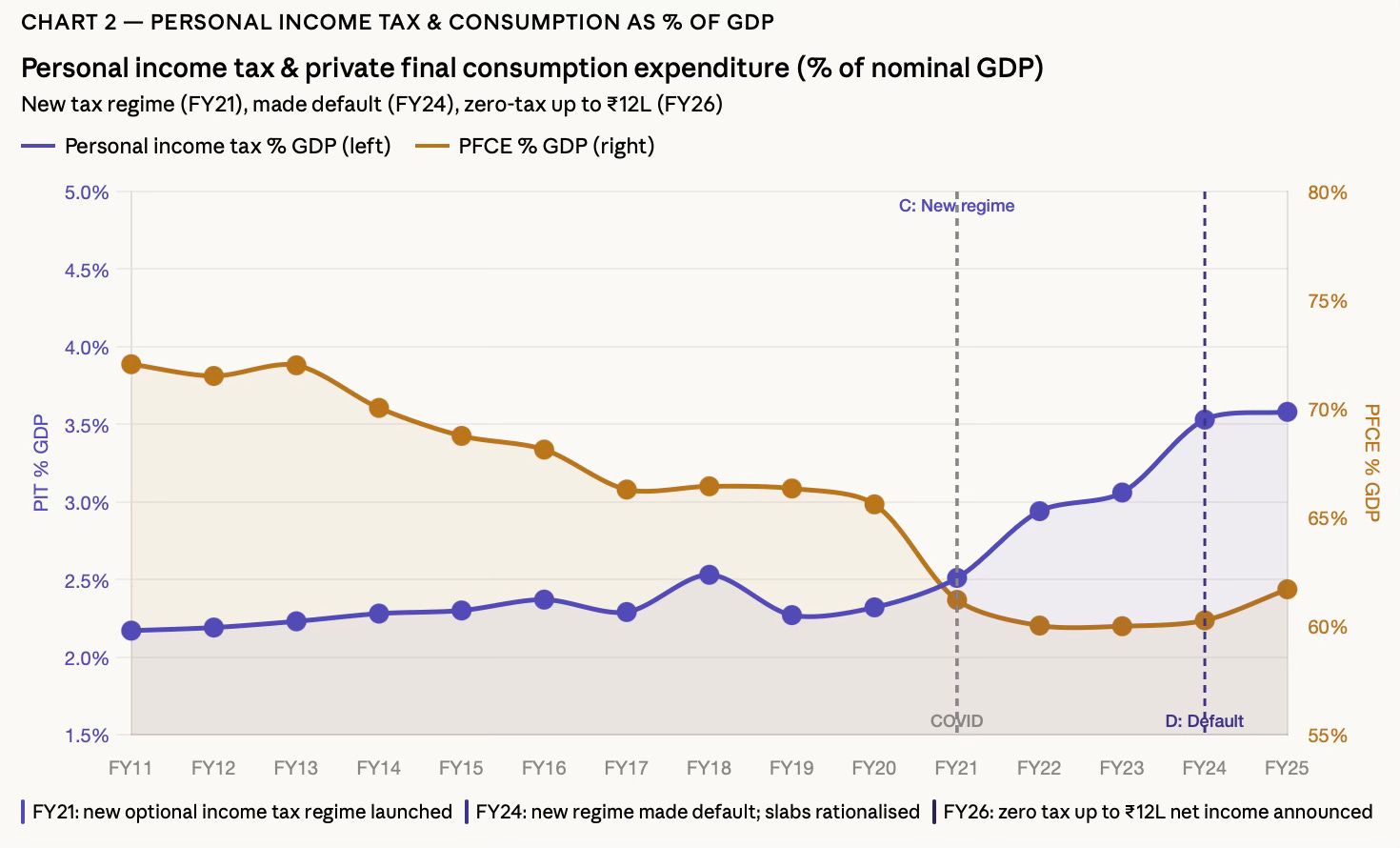
This performance on PIT is confirmed by its sharp increase as a share of GDP since the regime shift. Clearly, the PIT reforms (coupled perhaps with better detections and enforcement) have been a resounding success in terms of increasing PIT from 2.51% of GDP to 3.58% of GDP, a spectacular 43% increase as a share of GDP over just four years. 

However, as a share of PFCE, the trend has been muted, remaining range-bound in the 60-62% of GDP, though there’s a slight uptick since FY24, which must be watched for sustainability.

On the indirect taxes front, the revenue collections response to rationalisation and reductions have not been encouraging. 

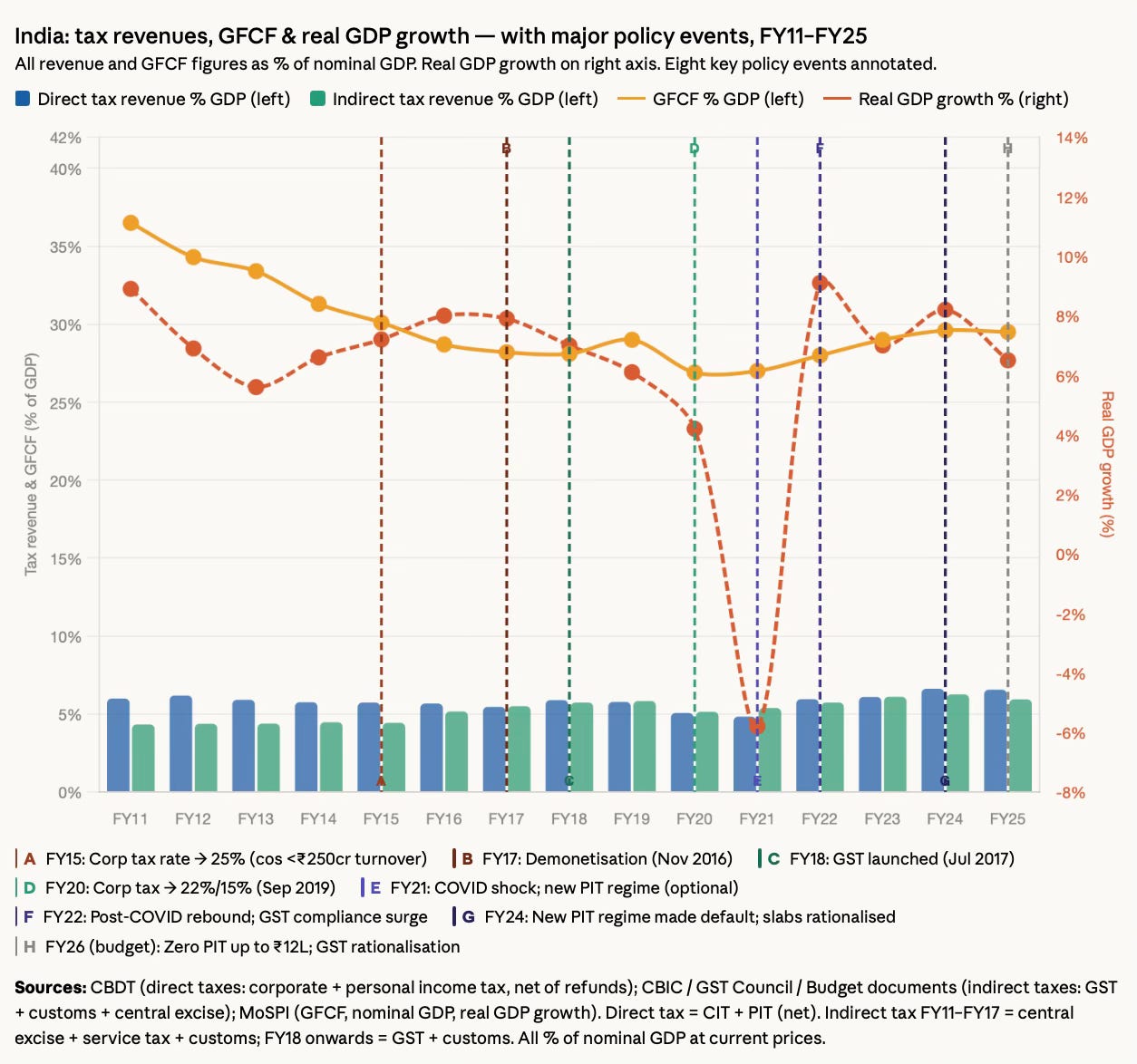
Bringing all of them together, if we take out the pandemic volatility, the decade of direct and indirect taxation reforms and rate reductions (eight episodes in total) does not appear to support the economic orthodoxy on tax reduction’s impact on investment, output, and revenues. 

The launch of GST in July 2017 initially caused a dip in indirect tax collections in FY18, as businesses adjusted. The subsequent compliance surge (event F, FY22 onward) then drove indirect taxes to record levels — monthly GST collections averaging over ₹1.5 lakh crore from FY23.

The GFCF line tells a sobering story. From a peak of 36.5% of GDP in FY11, it fell steadily to 26.9% in FY20 and has recovered only modestly to about 29.5% in FY25 — still well below the FY11 peak. Neither the corporate tax cut (D) nor the post-COVID rebound has restored investment to its earlier trajectory, a point highlighted here.

The most notable pattern is that corporate taxes have shown the highest volatility among all tax revenues. 

Post-COVID (FY22 onward), PIT has consistently grown 20–40% annually — far outpacing corporate tax — making personal income tax the engine of direct tax buoyancy. GST's 29% surge in FY22 and 22% in FY23 (H region) may be a reflection of the compliance dividend of digitisation and e-invoicing, more than any rate changes.

The positive revenue response of PIT compared to corporate tax is perhaps due to corporate tax cuts being a one-time rate reduction that reduced the base but boosted profitability without proportionally boosting investment, while PIT benefits from a widening formal employment base. It is also perhaps understandable that the problem with corporate tax is less about base expansion and more about avoidance and evasion, neither of which is directly addressed through rate reductions. 

The private corporate sector's savings have consistently gone up — from 9.5% of GDP in FY12 to over 11% — while its investment as a share of GDP has been falling, indicating that companies have been using higher post-tax profits to build reserves rather than to invest in fresh capacity. It is not incorrect to argue that the 2019 corporate tax cut largely transferred fiscal resources to shareholders and balance-sheet strengthening rather than to productive fixed investment. This also says something about the economy’s aggregate demand growth expectations.

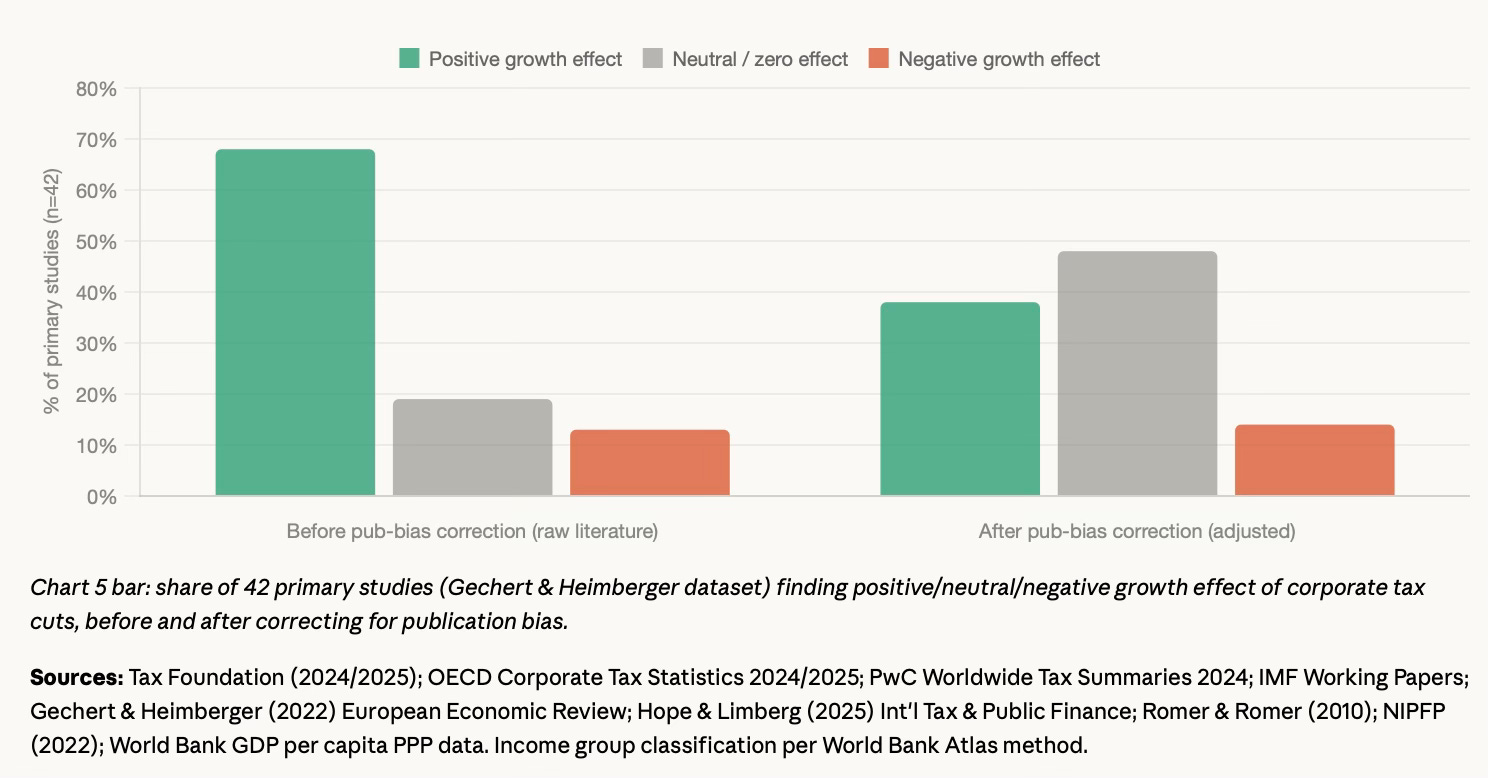
This experience on corporate tax reductions is in line with global experience. A meta-study of 441 estimates from 42 primary studies by Sebastian Gechert and Philipp Heimberger corrected for publication bias — which favours reporting growth-enhancing results — and found that the average effect of corporate tax cuts on GDP growth cannot be rejected from zero. The raw literature (before correction) shows 68% of studies finding a positive effect, but once publication selectivity is accounted for, this falls to about 38%, with nearly half finding a neutral result.

Interestingly, they show that “it is about 2.7 to 3 times more likely to publish a result showing a statistically significant positive impact of corporate tax cuts on growth compared to a significant negative result.” This positive bias is a big problem across economics and elsewhere, and does not get the attention it deserves. 

Their main findings are worth quoting:

First, corporate tax cuts tend to be even less growth friendly when considering a short time horizon. Second, considering both rate and base changes by looking at an effective average corporate tax rate may lead to slightly more positive growth rates in response to tax cuts. However, this is an outlier as compared to the rest of the literature using effective marginal tax rates, corporate tax shares in GDP or statutory tax rates, and the result is also not entirely robust to variations in the meta-regression estimator. Third, there does not seem to be a substantial difference between OECD and non-OECD countries regarding the growth effects of corporate tax changes. Fourth, explicitly controlling for other types of taxation (personal income taxes, capital income taxes, property taxes, sale taxes) does not affect our main findings. Fifth, more recent studies tend to find less growth enhancing effects of corporate tax cuts. Finally, it matters what happens to other budgetary components in conjunction with a corporate tax change: if we hold government spending fixed, a corporate tax hike will be slightly more detrimental to growth, implying that using the additional revenues for government spending instead of fiscal consolidation may foster growth, in line with theoretical arguments from endogenous growth models and empirical evidence on substantial productivity of public capital.

The key conditional findings are: corporate tax cuts reliably attract FDI (semi-elasticity ~-2.9, robust across studies), but their effect on domestic investment is weaker. When product markets have imperfections — which is increasingly the case given rising corporate market power — firms respond to tax cuts by increasing savings and reserves rather than investment. India’s equivalent experience — corporate PAT rising to record levels while private GFCF as a share of GDP fell — is a near-perfect illustration of this theoretical mechanism.

See also this earlier blog post on the questionable virtues of lowering corporate tax rates.

To conclude, let me add to Dan Neidle’s nice description of the tax populism of right and left-wing politicians. 

The tax populism of the right is that we can cut tax without anyone (or at least anyone the populists care about) being hit by cuts in services or benefits. There’s a magic money tree of government waste that can be harvested without consequence. The tax populism of the left is that we can fund services without anyone (or at least anyone these populists care about) being hit by increased tax. There’s another magic money tree, where trade-offs don’t exist.

The enduring tax populism among economists (and market experts) is that we can cut taxes and harvest a triple-win of an increase in investments, a rise in output, and higher revenue collections. There are no such free lunches. India is only the latest in the series of data points that invalidate this tax populism.