Substack

Showing posts with label Culture. Show all posts

Saturday, February 7, 2026

Weekend reading links

1. Dame Sarah Mullally, 63, becomes the 106th Archbishop of Canterbury, the first woman to serve as the senior-most bishop of the 85 million-strong Anglican Communion since the role's creation for Augustine of Canterbury in 597 AD!

2. Kevin Warsh as Fed Chairman may pursue significant changes to the way the Fed sets monetary policy.

The Fed’s vast bond-buying programmes, which Warsh initially supported as a Fed governor during the financial crisis, are at the centre of the Trump administration’s allegations that the central bank is acting far beyond its remit to keep prices in check and maximise employment. The... quantitative easing, expanded the Fed’s balance sheet from less than $900bn in 2008 to a peak of almost $9tn. The balance sheet now stands at $6.6tn, following a three-year reversal of QE — dubbed “quantitative tightening” — that the rate-setting Federal Open Market Committee has recently paused amid signs banks were falling short of reserves. Warsh has said he would like to shrink it much further... Warsh in April said successive QE programmes meant politicians found it “considerably easier appropriating money knowing that the government’s financing costs would be subsidised by the central bank”... 

Warsh’s claims that the response to the pandemic “was the biggest monetary policy error in 45 years”... Along with shrinking the balance sheet, Warsh would like to change the Treasury-Fed Accord, a 1951 agreement seen as the foundation for the US central bank’s freedom to set interest rates free from political pressure. Warsh has said he wants a “recommitment” to the accord that would entail a smaller, less powerful central bank, with some control of its balance sheet handed to the Treasury... Trump’s nominee will push the Fed’s staff to gather more “real-time information” to rely less heavily on official government data that comes on a longer lag... He could also deploy economists to find out whether his view is right that an AI-led productivity boom can boost US workers’ pay without stoking inflation — a move that could potentially pave the way for more interest rate cuts.

This is Warsh's WSJ op-ed of March 2023, where he called for an "economic regime change", including stopping the practice of providing forward guidance and stopping the provision of forecasts of the path of interest rates. The expectation now is that Fed may dispense with its widely followed dot plot showing the interest-rate projections of each participant of the FOMC, and end the tradition of press conferences by Fed chair following every FOMC meeting. 

3. Soumaya Keynes points to new research that links commerce and markets to the shaping of cultural norms.

One 2010 study ran money-sharing experiments across a diverse mix of communities, including smaller ones where people foraged or hunted for food. In those less marketised societies, norms around fairness towards strangers seemed weaker... A new study by Max Posch of the University of Exeter and Itzchak Tzachi Raz of Hebrew University takes a different approach, exploring the US economic transformation between 1850 and 1920. Thanks in part to a vast expansion of railroads, internal commerce became much easier. Mail-order catalogues served remote communities with items including shoelaces, suitcases and booze. The researchers compared places and people gaining more and less market access. Unsurprisingly, they found that in the places that enjoyed juicier connections, work shifted to involve co-operation with more distant partners...

Compiling many metrics, they found that on at least three dimensions, new markets did seem to affect culture. First, commercial opportunities made people more outward-looking. In places that became more connected, Americans became more likely to marry someone outside their local community and parents more likely to pick out nationally common names for their children. Second, access to markets raised tolerance levels, as measured by higher religious diversity and greater variation in family size, as well as mothers’ ages at their first birth. (The logic being that more dispersion should reflect more of a “you do you” attitude.) Third, greater market access came with higher trust towards others, as extracted from language in local newspapers. This measure wasn’t perfect, but reassuringly matched trends in more recent survey data, and fell during wars... Instead, they emphasised a story of rapid cultural adaptation among people who were most engaged with impersonal, anonymous exchanges. The changes in naming practices, for example, were concentrated among migrants working in industries that were more exposed to trade with other parts of the country. For those working in construction and entertainment, the market access had no effect.

4. Paul Blustein questions claims about the dollar's dethronement. 

Participants in this market are international banks, securities firms, multinational corporations, insurance companies and pension funds — the biggest private actors in the financial system. Their globe-girdling operations require the movement of immense amounts of money across borders on a constant basis. They use the market to hedge themselves against currency fluctuations by trading a pair of currencies (say, the dollar and Japanese yen) twice, first at the current exchange rate and then swapping back later at an agreed rate. Japanese life insurance companies, for example, invest their portfolios heavily in US Treasuries and other dollar securities. Because they have obligations in yen to their policyholders, they need to protect themselves against movements in the yen-dollar rate and they use swaps to do so. These sorts of transactions occur at such a huge scale that, according to data from the Bank for International Settlements, the amount of outstanding swaps currently stands above $100tn. Some 90 per cent involve the dollar, reflecting the myriad ways it is used. Unwinding all of this activity and subbing in another currency would be staggeringly costly and difficult.

The $12.6 trillion European holdings of US Treasuries confer less leverage to the Europeans than they appear.  

Europe’s US government debt holdings don’t translate into usable leverage, because most of them can’t be politically co-ordinated and selling would be self-defeating. The reason is simple. “Europe” may hold a lot of US assets, but that doesn’t mean Europe can control them or deploy them as a co-ordinated political tool. Much of Europe’s exposure actually sits in private portfolios — pension funds, insurers, banks, and asset managers — not in a single public balance sheet that can be mobilised strategically.

But while a deliberate and coordinated weaponisation is difficult, "a slow, decentralised buyers' strike, as investors gradually stop adding to US assets" is a distinct possibility.

5. Singapore's acclaimed public housing model.

More than three-quarters of its citizen and permanent resident population live in 1.1mn government-built flats, bought at subsidised rates... Rising property costs, notably in the resale market, have sparked concern over affordability, while the lottery system for allocating flats, which favours traditional nuclear families, is being tested by changing social norms. Over the longer term, property values are also being eaten away by the 99-year leases on which they are sold. “The main thing that worries me is that . . . as the lease clock ticks down and as the stock ages, housing equity drops to zero,” Gee added...

When Singapore introduced national service after gaining independence in 1965, home ownership was also encouraged as an incentive for conscripts to fight for their country. Today, more than 90 per cent of Singaporeans live in an owner-occupied home — among the highest rates in the world. Properties are allocated to would-be buyers via a lottery system to applicants who are typically required to be married, engaged or older than 35. Prices are eased through a raft of government subsidies based on personal circumstances. Singaporeans can also dip into their mandated savings and pension plans and obtain mortgages and loans from the HDB directly. But critics have said that the lottery system is unfair to singles and non-traditional families, for whom it is harder to get a flat. Singapore’s marriage rate has been steadily falling in recent decades, dropping from 57 per 1,000 unmarried males in 1994 to 42 in 2024. The HDB system has also been used by Singapore’s government to promote multicultural integration by setting limits on the proportion of different ethnic groups in the same estate. However, this policy has caused problems for some in the resale market by restricting potential buyers... Construction ground to a halt during the Covid-19 pandemic... Wait times to move into a property rose from three years to as many as six. As a result, more buyers turned to the resale market, where HDB owners can sell properties after five years of occupancy. This led to a sharp rise in resale prices, especially in more desirable estates.

6. FT has a long read on Latin America's rightward turn.

“Crime and violence is clearly the top concern of Latin Americans today,” says Jean-Christophe Salles, Latin America chief executive at pollster Ipsos. “It is the biggest concern in almost every country.” Some 55 per cent of Latin Americans name crime and violence as their prime worry, according to Ipsos data, against just 34 per cent worldwide. In Chile, the figure rises to 62 per cent. Fear of crime propelled arch-conservative José Antonio Kast to a landslide presidential election victory last month in Chile over a Communist opponent, Jeannette Jara. His broader rightwing message had failed in two previous elections, but this time he won by focusing on pledges to erect border fortifications, deport illegal migrants and reduce crime...
El Salvador’s President Nayib Bukele is the inspiration for many rightwing challengers across the region. His extraordinary success in transforming El Salvador from one of Latin America’s most murderous countries to one of its safest — albeit through mass incarceration and authoritarian rule — is firing up anti-establishment conservatives across the region just as it enters a major election cycle... Bukele’s newly built giant prison, the Centre for Confinement of Terrorists (Cecot), which has capacity to hold about 40,000 inmates, many detained indefinitely... Even Costa Rica, a country so peaceful that it decreed the abolition of its army in 1948, has been shaken by record levels of drug-related murders. Ahead of elections on February 1, its outgoing president, Rodrigo Chaves, appeared with Bukele to lay a foundation stone for Costa Rica’s own version of Cecot, a $35mn maximum security jail project with capacity for 5,100 prisoners... In Peru, which is set to go to the polls in April, leading presidential contender and former mayor of Lima Rafael López Aliaga is promising to fight what he calls “urban terrorism” with life sentences for serious crimes... In Mexico and Uruguay, leftwing incumbents are cracking down on violent crime to curry favour with voters.

7. The rising share of debt raising by hyperscalers (companies like Alphabet, Amazon, Meta, Microsoft, and Oracle) to finance their AI infrastructure rollouts.

8. What does the India-EU FTA mean for Europe?
9. Ed Luce has this description of the breadth of the Jeffrey Epstein network.
This includes the sitting US president and a previous one, big Wall Street figures, a network of Ivy League luminaries, Silicon Valley entrepreneurs, foreign government officials, Democrats, Republicans, a Maga influencer, a far left scholar, British and Norwegian royals, wives and girlfriends of powerful men, government lawyers, heads of law firms, movie directors and endless celebrities. Epstein’s network is an MRI of the establishment. The idea that anyone did not know about Epstein’s conviction as a sex abuser is absurd. Some people spurned his social approaches. Having been invited in 2010 to an Epstein dinner with Woody Allen and then Prince Andrew in New York, the magazine editor, Tina Brown, replied: “What the fuck is this . . .? The paedophile’s ball?” Brown’s reaction should have been everyone’s. So should that of Melinda Gates, the now ex-wife of Bill Gates, who stepped into Epstein’s home once and immediately regretted it. Alas, their reaction was all too rare.

10. Fascinating account of the egregiously one-sided US-Japan trade deal.

Proposed projects are screened for “strategic and legal considerations” by a committee of US and Japanese members, according to a joint MOU and a document prepared by Japanese officials. Projects are then sent to an investment committee headed by US commerce secretary Howard Lutnick, who chooses which proposals to send to the US president for approval. Donald Trump has the final say on which projects are “deemed to advance economic and national security interests”. Japan and its state-backed bank can delay or refuse to proceed but face potential penalties, including higher tariffs. Funds for approved projects — from JBIC or with guarantees from Japan’s insurance corporation — then flow into an SPV alongside “the provision of land, water, power, energy, offtake agreements, regulatory support, etc” from the US. Free cash generated by projects will be split equally until the Japanese loans are paid back, according to officials. After that, the US will receive 90 per cent. Officials believe Japanese companies outside the project can also make agreements with it separately, with terms negotiated that are different from the US-Japan split of cash flow... The way the agreement with the US is structured also means that if Japan delays or refuses to fund a project recommended by Trump, it could be liable for “catch-up” payments or an increase in tariff rates.

11. Elon Musk may have pulled off the biggest bluff of the century by merging SpaceX with xAI to create the most valuable private company at a combined valuation of $1.25 trillion. xAI, which had revenues in the low hundreds last year and is burning through $1 billion a month, was bought by SpaceX at an eye-popping valuation of $250 billion. Musk says that the move was needed to launch data centres into space, build factories on the moon and colonise Mars. Musk controls both the private companies, whose combined valuation has increased by over $1 trillion in 18 months. To pay for the deal, SpaceX will issue $250 bn in new shares, thereby diluting the existing shareholders.

This from the comments section sums up the deal

You set your own price for a company you own, sell it to another you own and, miraculously you can then leverage the hell out of it.
South-east Asia’s second-largest economy has been stuck at about 2 per cent growth for the past five years, with its pivotal drivers of consumption, manufacturing and tourism all in decline... Making matters worse are prolonged political instability and frequent changes in leadership. The royalist-military establishment has been locked in a stand-off with reformist parties that have won the past two elections but have been blocked from power. Thailand has had three prime ministers in as many years... Signs of economic malaise are increasing. Banks worried about defaults are lending less, the property market is in its worst slump in three decades and headline inflation turned negative last year, signalling weak demand. Thailand’s stock market has been the worst performer in Asia over the past 12 months, declining 10 per cent in 2025 in local currency terms. The government has projected 2 per cent growth this year, but the IMF has forecast just 1.6 per cent, the slowest among major south-east Asian economies...
Manufacturing has been on the decline for years, weighed down by weak domestic demand, an influx of cheaper Chinese goods and intense competition from newer manufacturing hubs such as Vietnam. That has also taken a toll on Thailand’s once mighty auto sector. The country was a regional hub for car manufacturing but Nissan, Honda, Suzuki and others have shut down factories or scaled back production in recent years... Household debt-to-GDP is close to 90 per cent, among the highest levels in Asia, as wages have remained stagnant. And Thailand’s population has been shrinking for four years, with the birth rate hitting a 75-year low in 2025... Tourism, another economic engine, is sputtering and this has had a knock-on effect on retail, agriculture and hotel construction... Thailand recorded 32.9mn foreign visitors in 2025, a 7 per cent fall from the previous year and still below the pre-pandemic peak of 40mn tourists in 2019.

13. US federal debt is at pre-war highs.

14. With the purge of General Zhang Youxia and Gen Liu Zhenli, Xi Jinping has removed all the six members of the Central Military Commission (apart from himself), 35 out the 43 generals in leadership positions of the PLA.
While the Ministry of Housing and Urban Affairs recommends 40-60 buses per 100,000 people, India’s cities together have only about 47,650 buses, nearly 61 per cent of which are concentrated in just nine mega cities.

16. Primer on Project Vault, the $12 bn US program to procure and develop a reserve of critical minerals for civilian and other purposes through a public-private partnership involving the US federal government and US companies. 

Project Vault is a public-private partnership that will buy and store critical minerals and rare earth elements. These include gallium and cobalt, which are essential for modern technology and defence equipment. It will combine $1.67 billion in private seed funding with another $10 billion from the US government’s Export-Import Bank... Companies will make an initial commitment to buy materials later at a fixed inventory price. They will also pay some upfront fees. Based on these commitments, companies can give Project Vault a list of the materials they need. The project will then purchase and store those materials. Manufacturers will pay a carrying cost that covers loan interest and storage expenses.

16. Mihir Sharma has an excellent op-ed that raises the questions about the emerging international order arising from the US National Security Strategy released in December and the more recent National Defence Strategy. Both are anchored around an America First approach that narrowly defines its interests in terms of drug trade, energy security, immigration, etc. 

The rest of the world matters only as a market or as a source of certain raw materials that are not specifically available in the US. This is not a status-quoist view of the world, nor is it radical or aggressive. It is essentially defensive. US interests are defined far more narrowly than earlier, and are more localised. But they will be as aggressively and unilaterally defended as ever, perhaps more.

I'll blog on this in due course.

17. Some staggering numbers in the Big Tech capex plans announced this week, along with their quarterly earnings which have spooked the markets. 

Big Tech stocks sold off heavily after unveiling plans to spend $660bn this year on AI, as investors fret that the “breathtaking” capital expenditures are outpacing the earnings potential of the new technology. Amazon, Google and Microsoft are set to lose a combined $900bn in market value since filing their quarterly earnings over the past week... Along with social media giant Meta, their proposed outlay on data centres and specialised chips needed to train and run advanced AI models would mark a 60 per cent rise from the $410bn they spent in 2025 and a 165 per cent increase from $245bn in 2024... Even a 14 per cent boost to their combined annual revenue to $1.6tn was not enough to overcome the pessimism.
18. Big infrastructure deal in the UK, as Canadian pension fund majors CPPIB and Omers announced sale of their 34% and 33% stakes in Associated British Ports (ABP) in a deal estimated to value the UK's biggest port operator, owning 21 ports in the UK, at more than £10bn. ABP was taken private in 2006 by a group of investors including Goldman Sachs' infrastructure arm and Omers, for £2.8bn. Ownership has chaged over the years, with CPPIB taking stake in 2015, along with others like Singapore's GIC and Kuwait Investment Authority's Wren House Infrastructure. CPPIB manages C$777.5bn ($568bn) of assets and Omers manages C$141bn of assets.

Saturday, November 8, 2025

Weekend reading links

1. Paul Krugman highlights that Trump tariffs are in practice, lower than the official rates. Tariffs on paper are the average tariff rate one would predict if we apply the announced tariff rates to what we were importing before the tariffs. The tariff rate in practice is the actual amount collected in tariff revenue divided by the value of imports. 

One illustration.
Imports from Canada are a case in point. Even under the Trump tariffs, most goods from Canada can enter duty-free if they’re “USMCA compliant” — that is, they qualified for zero tariffs under the free-trade agreement formerly known as NAFTA, rebranded but barely changed in practice during Trump’s first term. In 2024, only 38 percent of U.S. imports from Canada entered under the USMCA. That’s surprisingly low, but the main reason was probably paperwork: certifying that a good complies with the free trade rules requires a lot of documentation. For smaller exporters, in particular, that paperwork often wasn’t worth doing, because tariffs were low even for goods not certified as USMCA compliant. Now the tariffs are much higher, and there has been a rush to do the extra paperwork. In June 2025, 81 percent of imports from Canada entered duty free. Not incidentally, this points to a hidden cost of the tariffs: Companies are incurring significant administrative costs to deal with a vastly more complex tariff system.

2. Important point about Zohran Mamdani's victory in NYC.

More than 2mn New Yorkers cast ballots in the largest turnout in a mayoral race since 1969.

To put this in perspective, 1.1 million voters voted four years back! 

The Times has a very good account of this remarkable victory.

A backbench assemblyman who had immigrated to New York City at age 7, he had almost no citywide profile. Even fellow socialists thought his views on policing and Israel would put a hard ceiling on his support... Mr. Mamdani’s political rise may be remembered for what came first: the buoyant, flamboyant, rule-breaking primary run that united a new coalition of Brooklyn gentrifiers and Queens cabbies around the city’s growing affordability crisis and the birth of a megawatt talent... The arc of his success is nothing short of staggering. At the start of the year, Mr. Mamdani was polling at 1 percent, tied, as he likes to say, with the candidate known as “someone else.” Few New Yorkers recognized his name, and his own political team put the odds of winning as low as 3 percent. Now, at age 34, he will be New York City’s youngest leader in more than a century, amid a pile of historic firsts: the first Muslim mayor, the first South Asian and arguably the most influential democratic socialist in the country.

3. Nothing captures the essence of the first ten months of President Trump more than tariffs. The FT has a good graphic. 

The point to be noted is the difference between the notional tariff and the actual tariff.

4. European defence spending is on the rise, and is expected to be an important driver of economic growth and innovation. 
5. Japan's famed convenience stores, konbinis, are facing the consequences of the country's demographic problems.
FamilyMart, 7-Eleven and Lawson all rely on a franchise business model to operate stores, taking a cut of sales or gross profit as a royalty in return for store owners using their brand, products and supply chains. In 7-Eleven’s case, typically between 40 per cent to 70 per cent of gross profit — sales minus cost of goods sold — is paid to the company. 7-Eleven Japan does not recognise the Convenience Store Union because franchisees are not its employees... store owners were under pressure because they were struggling to hire more staff. They had little leeway to raise wages unless the companies share more of the profits... Japan’s big three convenience store chains are trying to introduce technology such as self-service tills, artificial intelligence-assisted ordering systems and cleaning robots to reduce the volume of work. If those efforts fall short, the companies could be forced to introduce new franchise contract terms in order to account for higher wages, said analysts. Or, if new franchisees cannot be found, they will have to close stores.

6. Venture capital fund returns

For many years, long-run venture capital returns reported by Cambridge Associates reflected the huge profits from the dotcom boom of the late 1990s, a time when the average VC fund returned more than 20 per cent a year. Last year, though, those funds finally faded into history. Cambridge’s 25-year view now only catches funds raised — and invested — as the 90s boom turned into a bubble. These showed an annualised return of only 8 per cent. For every other period measured by Cambridge since then, VC returns fall below returns from investing in companies trading on Nasdaq. These are averages, and the profits in VC have always been heavily skewed to a handful of successful firms, making it essential to get exposure to the right funds.

And the top VCs benefit from a Mathew Effect,

Startups struggling for attention are drawn to the investors with the best track records: winning the right financial backers acts as a strong signal for young companies with little else to validate their claims of future greatness. That means the most successful VC firms usually get first option on the smartest founders and the best deals.

7.  FT visual article on perhaps the grandest follies of our times, the Saudi Arabian futuristic city of Neom and its 170 km long 500 m tall mirror glass structure, The Line, conceived by Prince Mohammed Bin Salman.

The budget for The Line was $1.6tn, Neom executives were told in late 2021. But an updated internal estimate the following spring put the cost at around $4.5tn, according to a person familiar with the estimates. That is roughly the size of Germany’s annual economic output. Teams then began tackling the unprecedented design and engineering challenges raised: imagining what life would be like inside a 500 metre-high, 170km-long wall; sourcing the steel and cement that would consume much of global supply; and making water circulate in a manmade deepwater port with no current... Its staggering requirements for materials were enough to overwhelm both the capacity of its local infrastructure, and its pricing power... to make the concrete for the first 20 modules, the contractors would need a supply of cement every year that would be greater than France’s annual output. Each 800-metre module required, by design, about 3.5mn tonnes of structural steel, 5.5mn cubic metres of concrete and 3.5mn tonnes of reinforcement steel — the narrow steel bars twisted into cage forms to strengthen the reinforced concrete. “We were going to take something like 60 per cent of the global production of green steel [per year], which causes the price to go up,” said a senior design manager.

8. Ed Luce writes that peak Trump is over. He writes that the Democratic Party election victories owed significantly to their focus on rising prices, and that the deal with China postponing tariffs for one year may have won Trump some reprieve on the inflation front. 

Trump now has a strong incentive to declare similar wins on other trade wars. In that regard, Tuesday night was also a good one for Brazil, India, Canada and other targets of Trump’s ire. By a quirk of timing, the US Supreme Court on Wednesday held hearings on the legality of his tariff war. Was it coincidence that conservative justices sounded unusually bold in querying that? They too might possibly help Trump by striking the tariffs down.

9. John Burn-Murdoch points out that culture conflicts (and not economic differences) have been the drivers of political polarisation in the US.

In their pioneering paper The Business of the Culture War, published earlier this month, MIT and Harvard economists Shakked Noy and Aakaash Rao use second-by-second TV viewing data to show how the commercial incentives of cable news channels helped to sow discord not only among their viewers but across America more broadly.
Their key insights are that content relating to crime, immigration, race, gender and criticism of elites reliably increases viewing figures (while economics and healthcare cause people to switch away). This means there is a resulting shift in coverage towards more culture war issues and fewer socio-economic stories, which leads voters to rate these issues as more important. Politicians then respond by campaigning more on cultural hot button topics. All told, they estimate that the emergence and growth of cable news can account for fully one-third of the increase in US cultural conflict since 2000.
10. State capacity fact of the day, Competition Commission of India
It has exactly one active office. In New Delhi... CCI has no presence in Bengaluru, one small outpost in Navi Mumbai, and a “touch-and-go” office in Kolkata that lawyers say is barely functional. Markets regulator Sebi, by comparison, has 22 offices. The aviation regulator, DGCA, has around 20. When it conducts raids, it flies 25–30 officers to Mumbai. Every investigation means teams of lawyers and informants shuttling to Delhi for two years. “In India, such a large country, there is only one big agency for 28 states,” said Kumar. “Look at the US. There are competition agencies in all the states.” The costs add up. Filing a case itself can set a company back Rs 50,000 to Rs 6 lakh. Add multiple Delhi trips—three or four by the informant, three by lawyers, over a 2–2.5-year period—and justice becomes a luxury good... The Commission is still operating with roughly the same headcount it had in 2009. The Director-General’s office, sanctioned for around 20 officers, has seven. The merger-control team has six. Case disposals that once took three months now take six to eight—on a good day.
11. FT reports that the US has added "poison pill" termination clauses to recent trade deals with countries like Malaysia and Cambodia, which threaten to end the deals if either signs a rival pact that jeopardises "essential US interests" or "poses a material threat" to US security. This is a form of "loyalty test" for trade partners. 
Simon Evenett, professor of geopolitics and strategy at IMD business school in Lausanne, Switzerland, said the clauses were so broad that they handed the US unilateral powers to terminate the agreements, giving Washington fresh leverage across the region. The agreement with Malaysia also includes a provision requiring it to align with US sanctions and other economic restrictions. “Ultimately, poison pill provisions transform trade agreements from purely commercial instruments into tools for managing partner countries’ broader foreign economic policy orientation,” Evenett wrote in a paper this week. Although there is a partial legal precedent for poison pills in the 2020 US-Mexico-Canada Agreement, Evenett said the USMCA clause had legally defined triggers, in contrast to the broad conditions in the Malaysia and Cambodia pacts.

12. The rise and rise of US Government debt

Tuesday, October 14, 2025

Joel Mokyr

The Nobel Prize in Economics this year was awarded to Joel Mokyr, Philippe Aghion, and Peter Howitt. I have blogged about his work here (why the Industrial Revolution happened in England), here (how expanded access to “technical literacy” promoted industrial development in Japan), here (useful R&D), and here (the importance of tinkering and microinventions). 

This post will be about Mokyr, whom I have earlier described as arguably the most important and profound social scientist of our times. His work shines light on arguably the most important question of political economy: what drives economic progress?

Mokyr is best known for studying the period from the mid-eighteenth to the early twentieth centuries, investigating the causes of the Industrial Revolution (IR) and its links to the Enlightenment, and showing that the causal link runs from the latter to the former. He argues that the latter fostered a belief in the possibility and desirability of human progress, scientific temper, and the culture of inquiry and problem-solving, all of which paved the path for the Industrial Enlightenment, which in turn, catalysed the conditions for the IR. 

He first explained why the Enlightenment happened in Europe. 

In Europe in 1500-1700, among the educated elite, there developed a culture and a set of institutions suitable for intellectual innovation and the accumulation of useful knowledge. Europe was lucky to stumble on an institutional solution that supported the market for ideas, actively encouraged innovation, and led to an exponential growth in useful knowledge. This institution was a transnational community of scholars, an intellectual commons resource (scientists, mathematicians, physicians, philosophers). It is described as the “commonwealth of learning” or the “Republic of Letters” (respublica literaria). 

It was a virtual pan-European community that shared, distributed, and evaluated knowledge. It was the “community” that resolved the common resource (of new ideas) problem. Its rules included an open community, which excluded none and where knowledge and data should be shared; which was egalitarian and non-hierarchical; all knowledge, both old and new, was contestable (with no sacred cows); and all new propositions were to be reproduced, checked, tested, and evaluated (reliability of new knowledge).

The Republic of Letters created “open science” as a transnational intellectual commons management device. It created norms that new knowledge would be placed in the public realm and accessible to anyone who wanted to build on it and use it for technological purposes. By 1700, the norms of “open science” were fully in place. By creating a pan-European institution linking intellectuals, it also created economies of scale for ideas. Europe enjoyed “intellectual unification amidst political fragmentation”. It allowed new knowledge and discoveries to diffuse quickly into a large market.

The community thrived because it was largely independent of religion and politics. The political fragmentation of Europe, the Protestant Reformation, etc., limited rulers and organised religion from controlling knowledge creation. Those with ideas could shop around across kingdoms. Another contributor was patronage, which was a competitive market where sellers (those with ideas) and buyers (rulers, universities, academies, etc.) competed intensely to attract smart people to their court as a matter of prestige, and a source of getting useful advice, the latest medical care, tutors for their children, etc.

In simple terms, Mokyr showed that the most important institutional change that explains IR is not better property rights, a decline in transaction costs, or the Glorious Revolution in England. Instead, it was the institutions that governed the accumulation and diffusion of “useful knowledge” and the solution to the “knowledge commons” problem that the Republic of Letters in Europe provided.

Why did the IR start in Britain as opposed to continental Europe?

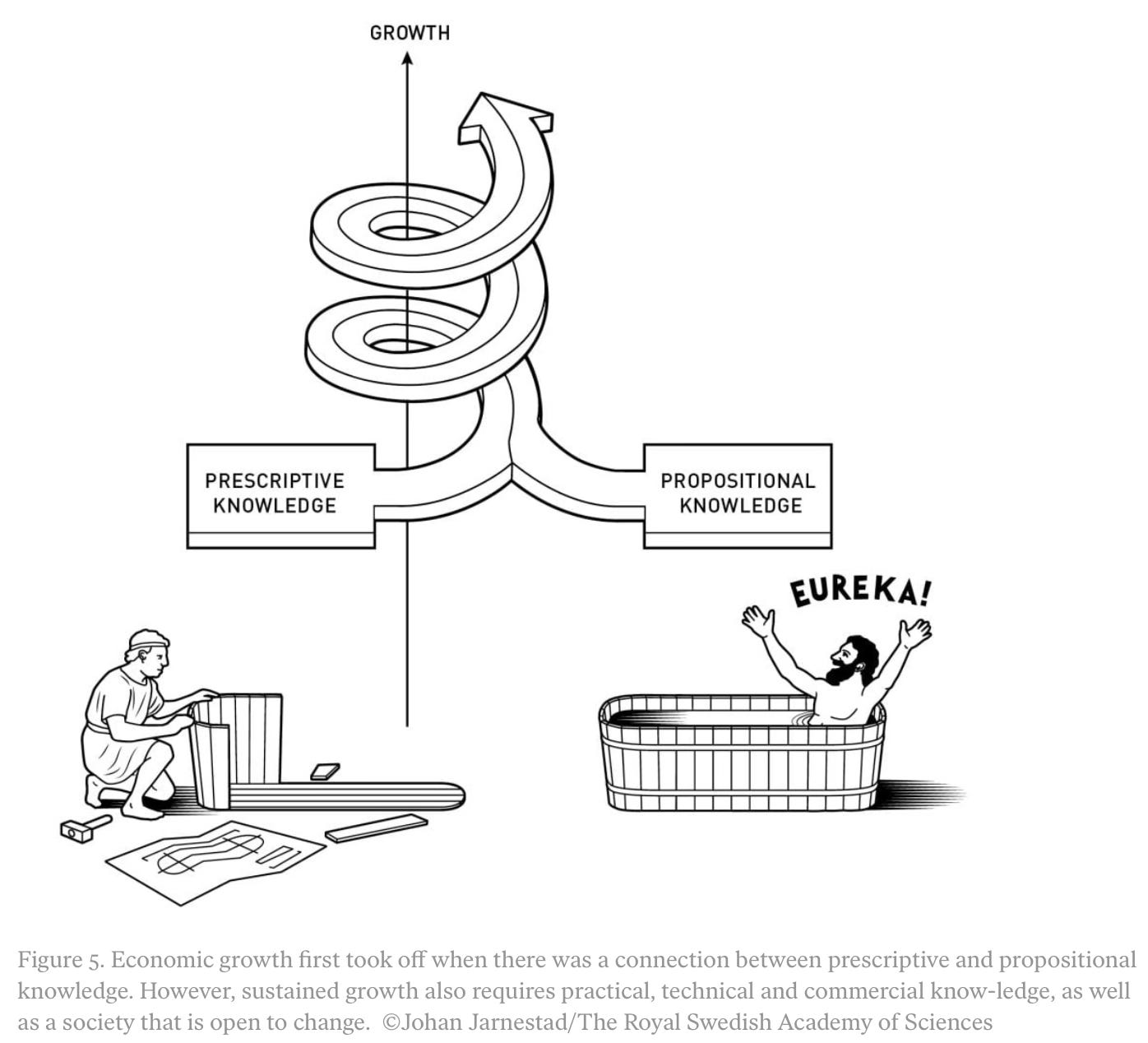
He uses the concept of useful knowledge to answer this question. He defines useful knowledge as that which promotes material progress. It consists of propositional knowledge (“what”) and prescriptive knowledge (“how”). The former describes the “regularities in the natural world that demonstrate why something works”, whereas the latter consists of “practical instructions, drawings or recipes that describe what is necessary for something to work”. It’s a distinction between people who know things (savants) and who make things (fabricants).

He described two aspects of the Age of Enlightenment that led to the deployment of useful knowledge to catalyse the IR and promote economic growth. One, the generation of useful knowledge by creating incentives (patents, awards, prizes, medals, pensions, memberships in Royal Societies, and generally higher social status, etc). 

Second, easier and cheaper access to existing knowledge through written compilations like libraries, book indexes, alphabetisation, compilations based on topic, etc. The Age of Enlightenment expanded access by promoting the codification of knowledge and establishing linkages between philosophers, industrialists, entrepreneurs, inventors and artisans, etc. This meant that savants communicated not only with one another but also with fabricants. 

All this created positive feedback mechanisms between propositional and prescriptive knowledge. He describes this fusion of scientific knowledge, technological know-how, and a culture that valued human progress as the Industrial Enlightenment. 

The Industrial Enlightenment focused on material progress and the growth of prosperity, and it believed that useful knowledge was the key to achieving this. This became the Baconian program. While the English and continental European Enlightenment thinkers shared the belief in the possibility and desirability of progress, there was a crucial difference between them.

The continental enlightenment thinkers focused on morality, government, justice, and what was wrong with society. In contrast, the English intellectuals were less concerned with political and social issues, and more with the kind of progress driven by practical, useful knowledge leading to material advances. The English Enlightenment thinking concerned nuts and bolts, pulleys and belts, cogs and springs. As Roy Porter said, “British pragmatism was more than mere worldliness: it embodied a philosophy of expediency, a dedication to the art, science and duty of living well in the here and now.”

Supplementing this, in his classic work, The Culture of Growth, he points to the different ways in which cultural beliefs create the conditions for the adoption of technology.

The most direct link from culture and beliefs to technology runs through religion. If metaphysical beliefs are such that manipulating and controlling nature invoke a sense of fear or guilt, technological creativity will inevitably be limited in scope and extent. If the culture is heavily infused with respect and worship of ancient wisdom so that any intellectual innovation is considered deviant and blasphemous, technological creativity will be similarly constrained. Irreverence is a key to progress… so, as Lynn White has pointed out, is anthropocentrism. In his classic work, White stressed the importance of a belief in a creator who has designed a universe for the use of humans, who in exploiting nature would illustrate His wisdom and power… social attitudes toward production and work (and leisure) are another major factor in determining the likelihood of innovation.

Technologically progressive societies were often relatively egalitarian ones. In societies dominated by a small, wealthy, but unproductive and exploitative elite, the low social prestige of productive activity meant that creativity and innovation would be directed toward an agenda of interest to the elite. The educated and sophisticated elite focused on efforts supporting its power such as military prowess and administration, or on such topics of leisure as literature, games, the arts, and philosophy, and not so much on the mundane problems of the farmer in his field, the sailor on his ship, or the artisan in his workshop… The agenda of the leisurely elite was of great importance to the lovers of music in the eighteenth-century Habsburg lands, but was not of much interest to their farmers and manufacturers. The Austrian Empire created Haydn and Mozart, but no Industrial Revolution. As McCloskey has stressed, the bourgeois societies of the Netherlands and Britain of the seventeenth century, in contrast, were prime candidates for technological advances.

Finally, Mokyr’s work points to the importance of relentless implementation over just ideas. He describes microinventions, or the incremental improvements needed to turn a new idea into a significant product. Tinkering, embodiment, and scaling are examples of microinventions, and are often more important than the original breakthrough itself. Making technology useful often means building it at scale. Mokyr says,

“Most major inventions initially don’t work very well. They have to be tweaked, the way the steam engine was tinkered with by many engineers over decades. They have to be embodied by infrastructure, the way nuclear fission can’t produce useful electricity until it’s contained inside a working reactor. And they have to be built at scale, the way Ford’s Model T came down in price before it made big difference to the country.”

Interestingly, the Nobel Committee describes all three as “having explained innovation-driven economic growth”. I’m not sure that microinventions are exactly innovations, or what we commonly perceive as innovations. I’m inclined to argue that the popular narrative generated by the innovations and innovators in the information and communication technology (ICT) sector in the US over the last three decades has led to the diminution of persistence and implementation, and elevated ideas and eureka moments as the defining values and skills. 

This narrative will most likely interpret Mokyr’s work as a nod to the importance of such innovation. But that may be misleading. 

It should be noted that Mokyr’s examples of microinventions are tinkering, embodiment, and scaling. This is a process of continuous iteration and adaptation. I’m inclined to describe this as a process of innovation (a structured process of creating new or improved products) driven forward by improvisation (spontaneous, on-the-fly creation of solutions to an immediate problem). As Mokyr writes, for inventions to materialise, the latter may be more important than the former. 

Extending this insight to the field of international development, I had blogged here.

The fundamental insight is that it’s not ideas that lead to development but their implementation, and that implementation is almost always far more daunting than the process of discovery of the idea itself. In fact, only a fraction of the pipeline of ideas ever finds its way into successful implementation… The most valuable individual and collective attributes for progress and development may be the desire and skills to tinker and embody (or institutionalise) to solve problems. In development in particular, they are far more important than the ability to ideate and innovate. Persistence and not mutation is what drives development (and much else in life)… It’s therefore apposite that development embraces and elevates the attributes, skills, and values of problem-solving through the process of tinkering, embodying, iterating, and scaling, instead of the current fetish with new ideas and innovation. 

All in all, the Nobel to Mokyr is a recognition for arguably the pre-eminent social scientist of our times.

Friday, September 5, 2025

The missing culture of global competitiveness in India's private sector

The US tariffs have sparked intense debates in India about the economic responses needed to address a challenging situation. 

On the one hand, it has reignited efforts to focus on self-reliance to insulate the economy from such future shocks, likely given the prevailing protectionist sentiments and the rising geopolitical uncertainties. On the other hand, some worry that this would mark a return to some form of the license-permit raj.

It has also sparked another debate between those who argue that India’s private sector’s lack of ambition, low risk appetite, weak ability to build, and general lack of global competitiveness are responsible for its economic dependence on others, and those who blame this failure on stifling government regulations and a lack of support

In this backdrop, it’s useful to step back and examine the problem using a simplified model to understand the contributors to economic competitiveness. It has four dependent variables:

  1. Internal economic conditions (physical infrastructure, financial capital, human resource availability, etc.), 

  2. Internal business conditions (regulatory environment, business creation and growth enablers, trade policy, market competition, etc.), 

  3. Domestic demand (affordability, size of consumption class, price sensitivity, demand for quality, etc.), and 

  4. Private sector culture 

While much has been written about the first two, and rightly so, the last two do not get anywhere near the attention they deserve. If anything, the last in particular is surprisingly and widely overlooked in public debates. 

I have blogged about the importance of domestic demand here, in that businesses need a large enough quality-conscious consumption class to be able to have the incentives to maintain quality and innovate. A mostly price-sensitive customer base, however large, that discounts quality for price, can be a significant deterrent to investments in quality and innovation. This is an important demand-side constraint. 

This can be significantly addressed if the businesses are exposed to global competition and pursue export markets. This is the point about export-competition (and letting go of the failing firms) that Joe Studwell and others have chronicled in the context of the high-performing Northeast Asian economies. All of them pursued protectionist policies but vigorously enforced export competition through public policies. 

It’s no exaggeration to say that the last variable, private sector culture, does not get any attention in mainstream debates. This is understandable given the difficulties with quantifying it and the limited research and studies that document the issue of business culture from the perspective of economic competitiveness.

In broad terms, we can evaluate business culture in terms of an innate quest for productivity, especially among the large firms. This has an economy-wide domino effect through multiple channels - suppliers, learning by doing, competition, etc. 

This culture is manifest in their R&D investments, attitudes towards innovation, focus on quality, the extent of scale manufacturing, intentions to invest for the long-term, and business dynamism in terms of ambition to continuously move up the value chain, expand business (scale manufacturing), pursue global markets, and so on, and generally aspire to be at the cutting-edge of the technology frontier and be a global leader in their industry. 

While, there’s some endogeneity between economic conditions and government policies and some of these attributes, it can also be argued that for the larger firms in an economy like India, many, if not most, of these attributes are within their control. 

Unfortunately, when evaluated against these metrics, Indian firms, especially the larger ones, fall woefully short. The low R&D investments are an egregious illustration, as also a lack of scale manufacturing, and a near total absence of global brands. Indian firms are conspicuously absent in the echelons of global business. This is generally true of the largest firms across sectors, and the software and pharmaceutical sectors in particular. In general, corporate India, across sectors, suffers from a lack of business dynamism. Even the country’s startups have struggled to imbibe this culture, preferring mostly to engage in copycat innovations

This disturbing deficit in the culture of private sector competitiveness also assumes significance given the history of global economic development. 

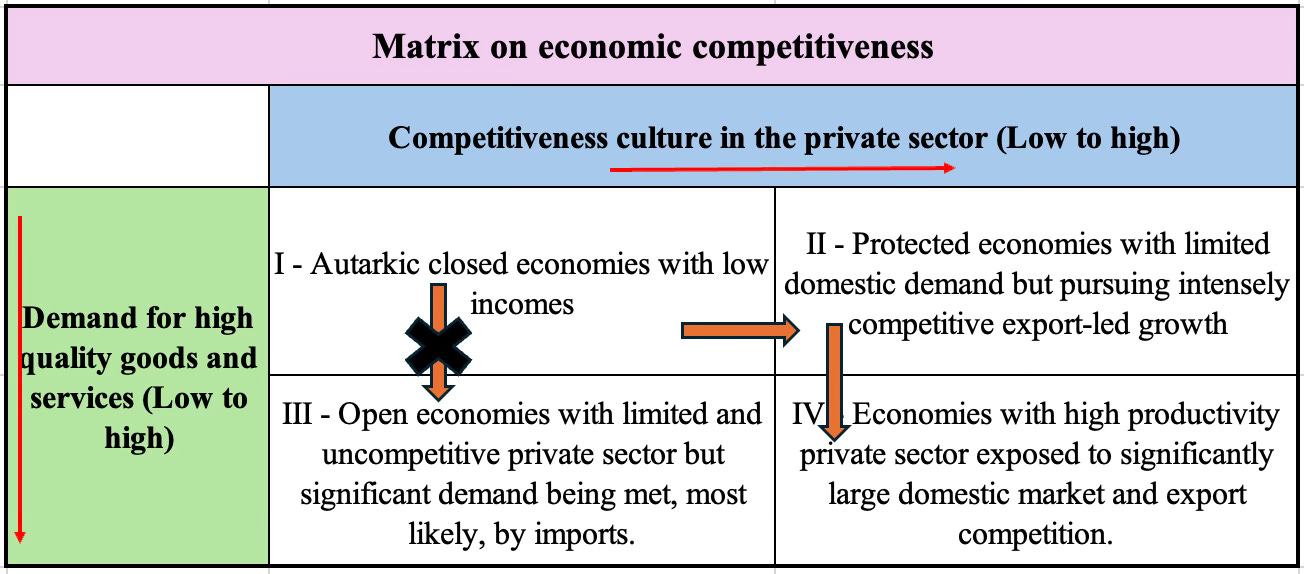
The figure below captures how domestic demand and corporate culture interact with each other. 

There are two broad economic growth trajectory choices available for countries like India that are transitioning to open economies. One, move from a relative autarky characterised by a poor competitiveness culture, to a liberalised regime without the private sector becoming competitive. In today’s world, this would be akin to becoming importers of (mainly) Chinese goods, allowing the existing manufacturing base to erode further and the private sector to remain uncompetitive. 

The second option is to build up private sector competitiveness by maintaining adequate protections and then gradually opening the economy as the private sector competitiveness rises. This strategy is especially relevant given Chinese import competition, which can quickly emasculate domestic manufacturing capabilities. Further, given the small size of the quality-conscious domestic consumer base, the only way for competitive domestic firms to emerge is by manufacturing for exports. This is essentially about Make in India for the World. 

This has been the trajectory followed by all the Northeast Asian economies recently, and the European economies long ago. Admittedly, there are strong headwinds that have emerged in recent years that come in the way of the pursuit of such growth. 

In conclusion, if India is to emulate the Northeast Asians, it’s essential to develop a competitive private sector. As discussed above, this is primarily a work for the private sector to pursue internally, with corporate India taking the lead.

Friday, January 12, 2024

What caused Industrial Revolution?

There are several arguments put forth to explain Industrial Revolution. Why did IR take-off in Europe and not elsewhere, and more specifically in UK and not elsewhere in Europe itself? The more common arguments concern Britain’s commercial successes, its more advanced institutional developments, and its greater urbanisation compared to European peers. 

John Burn-Murdoch points to Joel Mokyr’s argument that it was broader cultural change that made Britain the pioneer of IR. The Enlightenment thinking’s rationalism and empiricism, science and experimentation, and a progress-oriented view of the world are held as drivers behind this cultural transformation. 

Burn-Murdoch points to a recent IZA working paper by Ali Almelhem, Murat Iyigun, Austin Kennedy, and Jared Rubin

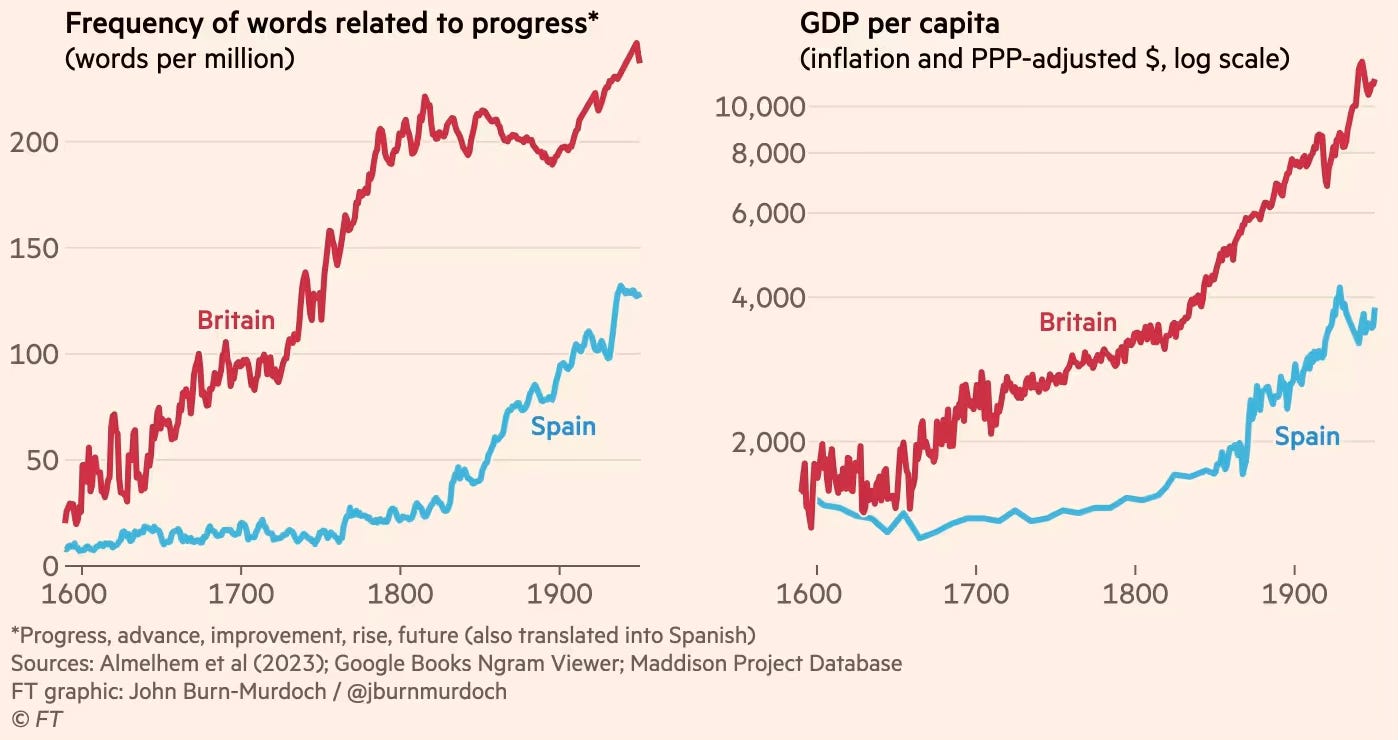
The researchers analysed the contents of 173,031 books printed in England between 1500 and 1900, tracking how the frequency of different terms changed over time, which they use as a proxy for the cultural themes of the day. They found a marked increase in the use of terms related to progress and innovation starting in the early 17th century. This supports the idea that “a cultural evolution in the attitudes towards the potential of science accounts in some part for the British industrial revolution and its economic take-off”. 

To explore whether this holds for other countries, I have adapted and extended their analysis to include Spain, which was economically competitive with Britain well into the 17th century, but then fell behind. Using data from millions of books digitised as part of the Google Ngram project, I have found that the upsurge in discussions of progress in British books occurs about two centuries before the same uptick in Spain, mirroring trends in the countries’ economic development.

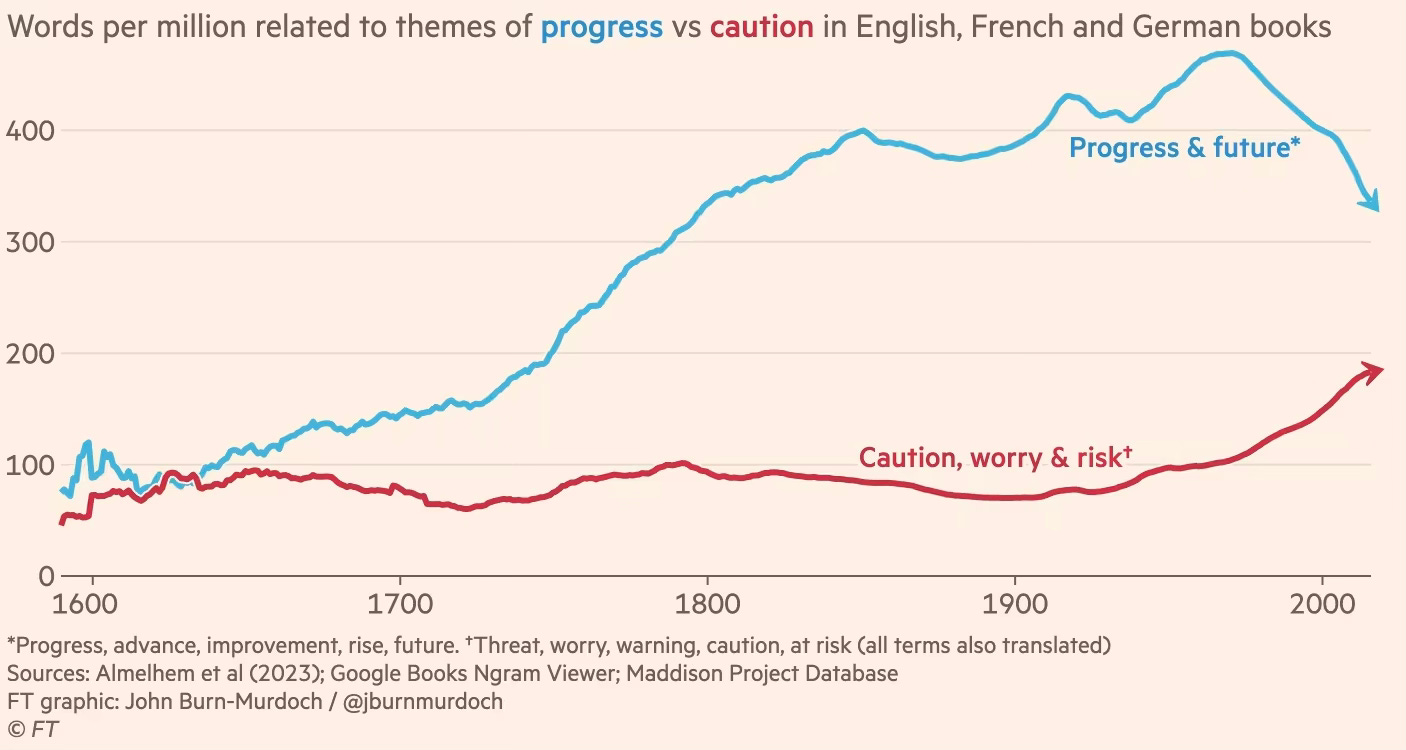
Burn-Murdoch goes further and finds that in contrast the language and culture of today appears to be regressive,

Extending the same analysis to the present, a striking picture emerges: over the past 60 years the west has begun to shift away from the culture of progress, and towards one of caution, worry and risk-aversion, with economic growth slowing over the same period. The frequency of terms related to progress, improvement and the future has dropped by about 25 per cent since the 1960s, while those related to threats, risks and worries have become several times more common.

That simultaneous rise in language associated with caution could well be not a coincidence but an equal and opposite force acting against growth and progress. Ruxandra Teslo, one of a growing community of progress-focused writers at the nexus of science, economics and policy, argues that the growing scepticism around technology and the rise in zero-sum thinking in modern society is one of the defining ideological challenges of our time.

The authors of the IZA paper have three findings,

First, there is little overlap in scientific and religious works in the period under study. This indicates that the “secularization” of science was entrenched from the beginning of the Enlightenment. Second, while scientific works did become more progress-oriented during the Enlightenment, this sentiment was mainly concentrated in the nexus of science and political economy. We interpret this to mean that it was the more pragmatic works of science—those that spoke to a broader political and economic audience, especially those literate artisans and craftsmen at the heart of Britain’s industrialization—that contained the cultural values cited as important for Britain’s economic rise. Third, while volumes at the science-political economy nexus were progress-oriented for the entire time period, this was especially true of volumes related to industrialization. Thus, we have unearthed some inaugural quantitative support for the idea that a cultural evolution in the attitudes towards the potential of science accounts in some part for the British Industrial Revolution and its economic takeoff.

Joel Mokyr has written about the sudden and miraculous explosion of science and technology in one part of the world and the creation of conditions for long-term economic growth, a development that cannot be explained by institutions alone. He points to the importance of culture - beliefs, values, and preferences that can change behaviour - in laying the foundations (in the 1500-1700 period) for the scientific advances and pioneering inventions that would instigate explosive technological and economic development.

I concentrate primarily on the one element in cultural beliefs that economists have so far neglected almost entirely, namely the attitude toward Nature and the willingness and ability to harness it to human material needs. Ultimately the relations with makom, or the physical world around us in the end determine the growth of useful knowledge and eventually that of technology-driven growth. 

Technology is above all a consequence of human willingness to investigate, manipulate, and exploit natural phenomena and regularities, and given such willingness, the growth of the stock of knowledge that underpins and conditions the exploitation of knowledge. The willingness and ability to acquire, disseminate, and harness such knowledge are themselves part of culture and thus determine the intensity of the search for knowledge of nature, the agenda of the research, the institutions that govern the community doing the research, the methods of acquiring and vetting it, the conventions by which such knowledge is accepted as valid, and its dissemination to others who might make use of it. 

It is in this general area that the roots of modern economic growth should be sought—specifically in events and phenomena that precede the eighteenth-century Enlightenment and Industrial Revolution in the centuries that are known, for better or for worse, as “early modern Europe,” roughly speaking between the first voyage to America by Columbus and the publication of the Principia Mathematica by Newton. It is the basic argument of this book that European culture and institutions were shaped in those centuries to become more conducive to the kind of activities that eventually led to the economic sea changes that created the modern economies.

He points to the different ways in which cultural beliefs create the conditions for adoption of technology.

The most direct link from culture and beliefs to technology runs through religion. If metaphysical beliefs are such that manipulating and controlling nature invoke a sense of fear or guilt, technological creativity will inevitably be limited in scope and extent. If the culture is heavily infused with respect and worship of ancient wisdom so that any intellectual innovation is considered deviant and blasphemous, technological creativity will be similarly constrained. Irreverence is a key to progress… so, as Lynn White has pointed out, is anthropocentrism. In his classic work, White stressed the importance of a belief in a creator who has designed a universe for the use of humans, who in exploiting nature would illustrate His wisdom and power… social attitudes toward production and work (and leisure) are another major factor in determining the likelihood of innovation. 

Technologically progressive societies were often relatively egalitarian ones. In societies dominated by a small, wealthy, but unproductive and exploitative elite, the low social prestige of productive activity meant that creativity and innovation would be directed toward an agenda of interest to the elite. The educated and sophisticated elite focused on efforts supporting its power such as military prowess and administration, or on such topics of leisure as literature, games, the arts, and philosophy, and not so much on the mundane problems of the farmer in his field, the sailor on his ship, or the artisan in his workshop… The agenda of the leisurely elite was of great importance to the lovers of music in the eighteenth-century Habsburg lands, but was not of much interest to their farmers and manufacturers. The Austrian Empire created Haydn and Mozart, but no Industrial Revolution. As McCloskey has stressed, the bourgeois societies of the Netherlands and Britain of the seventeenth century, in contrast, were prime candidates for technological advances.

I’ll blog longer about Mokyr’s book that I just finished reading in another post. His analysis, coupled with that of Tirthankar Roy, have interesting implications if we examine India’s historical industrial development pathway.

Saturday, April 8, 2023

Weekend reading links

1. Harish Damodaran writes about the contrasting fortunes of two-wheeler and tractor sales in India. Given that 55-65% of two-wheeler sales are in rural areas, and given non-farm rural sector which has not been doing well compared to agriculture sector and they also form a significant share of the rural economy, is the distress in non-farm rural sector contributing to keeping down two-wheeler sales?

The article has an interesting point about how deferral of implementation of stricter emission standards may have contributed to higher tractor sales,

The government had originally planned to introduce new Bharat Stage TREM IV emission standards for tractors with above 50 horsepower engines from October 1, 2020. That would have entailed replacing mechanical pumps for fuel injection with semiconductor-based common rail direct injection (CRDI) engines. But following representations from tractor makers, the implementation of the revised emission norms was deferred and made effective from January 1, 2023. Companies were also given six months’ additional time to sell their existing stock of tractors based on TREM III A standards.

2. The rise of venture debt

Debt was around 30 per cent of all venture capital raised in European tech in 2022, according to figures from Dealroom, compared with around 16 per cent in the previous six years. Cleantech and fintech companies were among the biggest borrowers...
The Silicon Valley Bank was the pioneer and linchpin of a venture debt market that gave start-ups an alternative source of funding, without the need to sacrifice equity stakes or swallow a much lower valuation. Across the US, SVB was responsible for roughly a tenth of all venture debt issued in the year so far. But on its home turf in California, the bank was behind more than 60 per cent of all deals this year, according to data from Preqin.

3. It turns out that many popular Italian cuisine dishes are not after all Italian. In fact, the migration of South Italians in the late nineteenth and early twentieth centuries into the US led to the emergence of a fusion cuisine which has today come to dominate as Italian cuisine in popular imagination. From an FT article,

Panettone is a case in point. Before the 20th century, panettone was a thin, hard flatbread filled with a handful of raisins. It was only eaten by the poor and had no links to Christmas. Panettone as we know it today is an industrial invention. In the 1920s, Angelo Motta of the Motta food brand introduced a new dough recipe and started the “tradition” of a dome-shaped panettone. Then in the 1970s, faced with growing competition from supermarkets, independent bakeries began making dome-shaped panettone themselves... Tiramisu is another example. Its recent origins are disguised by various fanciful histories. It first appeared in cookbooks in the 1980s. Its star ingredient, mascarpone, was rarely found outside Milan before the 1960s, and the coffee-infused biscuits that divide the layers are Pavesini, a supermarket snack launched in 1948... 

Parmesan, he says, is remarkably ancient, around a millennium old. But before the 1960s, wheels of parmesan cheese weighed only about 10kg (as opposed to the hefty 40kg wheels we know today) and were encased in a thick black crust. Its texture was fatter and softer than it is nowadays. “Some even say that this cheese, as a sign of quality, had to squeeze out a drop of milk when pressed,” Grandi says. “Its exact modern-day match is Wisconsin parmesan.” He believes that early 20th-century Italian immigrants, probably from the Po’ region north of Parma, started producing it in Wisconsin and, unlike the cheesemakers back in Parma, their recipe never evolved. So while Parmigiano in Italy became over the years a fair-crusted, hard cheese produced in giant wheels, Wisconsin parmesan stayed true to the original. 

In the story of modern Italian food, many roads lead to America. Mass migration from Italy to the US produced such deeply intertwined gastronomic cultures that trying to discern one from the other is impossible. “Italian cuisine really is more American than it is Italian,” Grandi says squarely. Pizza is a prime example. “Discs of dough topped with ingredients,” as Grandi calls them, were pervasive all over the Mediterranean for centuries: piada, pida, pita, pitta, pizza. But in 1943, when Italian-American soldiers were sent to Sicily and travelled up the Italian peninsula, they wrote home in disbelief: there were no pizzerias. Before the war, Grandi tells me, pizza was only found in a few southern Italian cities, where it was made and eaten in the streets by the lower classes. His research suggests that the first fully fledged restaurant exclusively serving pizza opened not in Italy but in New York in 1911. “For my father in the 1970s, pizza was just as exotic as sushi is for us today,” he adds. 

Like pizza, mozzarella was fast-tracked to global fame through the funnel of mass migration to America from the Italian south. Comparing her recollections with those of my grandmother, it’s clear that Sicily’s elevated “Sunday” dishes (aubergine parmigiana, cannoli, pasta con le sarde) were the ones that went mainstream, thanks to the south’s contribution to the Little Italys of the US. My grandmother, on the other hand, grew up eating tordelli alla massese (large fresh tortelli with a meat filling, cooked in a ragú sauce) and cappelletti in brodo (fresh tortelli in chicken broth), dishes that are almost entirely unknown outside the region.

4. Martin Wolf has some suggestions on how to avoid the next banking crisis. This is an important and under-appreciated aspect,

The best protection against occasional huge banking crises is frequent smaller ones. Fear works. We have seen, for example, some unwise deregulation. That of smaller banks in the US in 2019, which contributed to the recent crisis, is a powerful example. Pressure for deregulation has also been growing in the UK. A shock like this should make mindless deregulation less appealing to politicians and mindless risk-taking less appealing to bankers. Both lessons might have been learnt in the US and elsewhere, for a while.

5. Charles Goodhart argues that bank managers must face personal financial liability

The main cause of moral hazard is limited liability, especially when this applies to bank managers’ large shareholdings, mostly from bonuses. We cannot go back to the pre-Victorian approach of unlimited liability for all, because it would mean that banks could never get equity capital from outsiders. But there is no reason why we could not require senior bank management to face multiple liability, and in the case of chief executives possibly to have unlimited liability. If senior management faced a really serious loss when their bank failed, there would be far less need for shed loads of restrictive regulations.

6. Rana Faroohar points to a potential fault line from the impact of higher rates on real estate holdings of private equity,

Consider, for example, the trouble brewing in commercial property loans, and private equity real estate funds. This is where the shadow bank and small bank stories meet. Small banks hold 70 per cent of all commercial real estate loans, the growth of which has more than tripled since 2021. Following the easing of Dodd-Frank rules for community banks, smaller financial institutions have also invested more in riskier assets owned by private equity and hedge funds (as have other institutions looking for better returns, including pension funds). Small bank funding to commercial real estate is now tightening. This, along with interest rate rises, is putting downward pressure on commercial property values, which are now below pre-pandemic levels. That will curtail capital flows, derail investments and put pressure in turn on private equity funds with loans that are maturing, or which need equity injections... This means asset managers may be forced to go to investors for more capital (which will be a tough negotiation at the moment) or sell property out of their portfolio to cover loans. This has the feel of a doom loop to me. Big real estate indices had already turned negative in 2022... Consider, for example, how rich non-bank asset managers such as Blackstone, Apollo, Carlyle and others became on both residential and commercial real estate in the wake of 2008. This was partly because they were able to make deals that more regulated banks couldn’t. Private equity players have also made new investments in utilities, farmland, transportation and energy.

7. Apple and Microsoft make up 7.1% and 6.2% of S&P 500, making them disproportionately influential drivers of the index. Tech sector itself has more than doubled to 29% of the index by 2021 since 2001.

8. India's interesting services exports growth story
The binding constraint to growth in IT services exports is the deficiency of quality manpower.

9. Tesla may be about to upend the global EV batteries market,
Most of the world’s electric car batteries are now made in China. Accounting for more than 70 per cent of market share by shipments... But Tesla’s new batteries are set to upend the hierarchy of the industry for good. Panasonic and LG Energy Solution have long been the leading suppliers. But in recent years, Chinese makers such as CATL and BYD have steadily won market share away from Korean and Japanese rivals and have grown to dominate the world’s supply. 

Electric car batteries have undergone rapid technological change in recent years. Until now, the priority has been on improving energy density — for longer driving range — by changing the composition of battery materials. The shape of the battery cells has been less of a focus. Currently, most electric car batteries are designed and moulded in the shape and form that ensures the most efficient use of space. That has meant batteries that are shaped like flat pouches or stackable rectangular boxes have been the leading standards for electric cars until now. Cylindrical battery cells, the third type on the market, have long been considered the less attractive option because empty gaps between the round cells when stacked together was seen as wasted space. These made up just a fifth of the global market last year. Yet Tesla is betting big that these will become the future industry standard. Its cylindrical 4680 battery cells, named after their size, with a diameter of 46mm and length of 80mm, have been developed to have energy density of up to five times that of the batteries currently used in most Tesla cars. For both electric car buyers and for Tesla, the cost advantage is clear. The new cells are cheaper to produce than previous versions. They use new material which includes aluminium, a relatively abundant and lower cost metal, and less raw materials overall. Upgraded technology means the batteries are made using fewer parts — also meaning less weight. They are easier to mass produce as they do not have to be customised to fit different car shapes and designs.

This vertical integration would be a shift for Tesla from its practice of relying on an ecosystem of suppliers. But it has its set of advantages. Further, Tesla is also expanding its Nevada plant to make 2 million 4680 cells a year, up from 1000 cells a week in December. And, this indigenisation will also help the company benefit from the incentives under the Inflation Reduction Act.

10. To the list of Martin Skhereli of Turing Pharmaceuticals, Elizabeth Holmes of Theranos, and Trevor Milton of Nikola, comes Charlie Javice, 31, a Wharton alumni, who falsified the number of subscribers of her student finance website, Frank, and sold it to JP Morgan to pocket $45 million in profits.

Javice represented to JP Morgan that Frank had 4.25 m customers when in fact it had only 300,000. This is a standard practice in the startup world where the headline number on users are a signal of growth potential. Founders are not forced to disclose whether these are mere free downloads or registrations, or one-off subscribers, or active subscribers, and several other categories in between. This can be described as subscriber-washing.

11. Martin Wolf has two graphics about global trade. The first points to the progressive downward recalibration of the trajectory of global trade.

The second points to the increasing rise in global trade restrictions.

12. Gillian Tett compares the current bank run with that in 2007-08 and 1997-98 in Japan. The big difference was the speed with which the information spread, depositors pulled out $42 billion, and the bank collapsed. And the contagion spread rapidly across others. As a metric, the share of US households using internet or mobile banking rose from 39% to 66% between 2013-21.

Until now, the models used in finance do not seem to have taken account of the fact that consumer behaviour online might be different from that in the old-fashioned, physical banking world. But one striking feature about American banks, even before the March panic, was that consumers were moving money out of low-paying deposit accounts into better-yielding money market funds at a dramatically faster pace than at similar points before in history.

That might imply that greater information transparency accelerates consumer reaction to news, even outside crises, increasing the risk of “herding”. Either way, we urgently need some behavioural finance analysis, since American banks will stay healthy only if they hang on to deposits — and digital herding could increase the risks of turmoil in other markets, such as Treasury bonds, if shocks emerge there too... The dangerous weakness of fractional banking is that if nobody has a reason to panic, banks are safe; but if everyone runs, a bank can collapse, even if it previously passed tests on issues such as capital adequacy — unless a government steps in. And while the government never used to worry about smaller banks collapsing, now they fear the digital domino effect.

This raises the issue of how fractional reserve banking can survive in the era of rapid and real-time information flows.

In the context of SVB, Morgan Housel writes,

Controlling your behavior amid uncertainty can be hard enough. Controlling your reactions to other people’s behavior is way harder. Fear is more contagious than any virus, and can instantly push people to react in ways that would have seemed unthinkable a moment prior... Bank runs have been happening for centuries. SVB was unique because it had the social web of a tiny town but the balance sheet of a big, disparate, bank. When one person yelled fire, every other deposit holder instantly heard it, and $50 billion rushed out the door.