Substack

Showing posts with label Political capture. Show all posts

Tuesday, September 16, 2025

The challenge facing liberals in the US

Donald Trump’s upending of long-held conventional wisdom in the polity and economy has shed light on the faultlines and failings of the US politics and society. 

It has dramatically exposed the limitations of the supposed bulwarks of institutional checks and balances in the US government. Apart from this, the Republican Party is captured, the Democratic Party is in shambles, corporate America has fallen in line without any murmur, and public intellectuals in the prestigious and normally vocal academic institutions and think tanks in the US have gone eerily quiet. In fact, when the history of Trump 2.0 is written, it’s most likely that the leaders and scholars of the hallowed Universities will be apportioned as much blame as the Supreme Court for their roles in compromising and allowing the government near-unimpeded pursuit of its goals. Even the civil society seems to be missing in action. 

This accommodation should not have come as a surprise. There’s a strong case that American liberalism was standing on weakening foundations. As an illustration, for a country with a per capita income of $85,000, America suffers from embarassingly high levels of deprivation and poverty, and struggles with the poorest human resource development outcomes among advanced countries. The extent of elite capture of rule-making processes and institutions is perhaps the greatest in the US democratic system. The opinion makers and experts among the liberals who have played important roles in fashioning the economic consensus over the last three decades and have facilitated these outcomes are as much to blame as the policies that have generated them. 

I have blogged on several occasions, highlighting how the public intellectuals in the US have let down liberal democracy and have largely become co-opted by Big Tech and Wall Street. Given that the intellectual establishments in the US (academia and think tanks) are dominated by liberals, it’s surprising that they have allowed the trends of widening inequality, business concentration, and the general political capture by Big Tech, Big Pharma, Wall Street, and other corporate interests to go largely unchecked. 

There are some possible explanations for the lack of even a fight on the face of the ongoing assault on liberal ideas. One argument is that of a society that has not faced any serious existential adversities for long and has been dulled off its collective will and resolve to push back. Since the War, the society has settled into a comfortable equilibrium where all the fundamental requirements of liberal democracy and capitalism - rule of law, free speech, free markets, restraints on untrammelled power, recourse to redressal of grievances, etc., - have come to be taken for granted. Generations have been brought up without having to even think about them, much less fight for them.

On the economy, the great recession in the aftermath of the global financial crisis turned a new page in monetary policy adventurism with a radical expansion of the tools that central banks and governments were willing to use to stabilise the economy. Zero interest rates, quantitative easing, purchases of Treasuries and even corporate bonds, forward guidance, and so on entered the lexicon of central banking. This allowed central banks to keep rates, pump liquidity, and backstop asset prices, thereby propping up both the financial markets and the real economy. Market expectations have been shaped by a giant central bank put, one arising from a belief that if things get out of hand, the central bank will step in as a buyer or lender of last resort. Just like American citizens, its markets too have come to overlook uncertainties and take for granted economic stability. 

Another plausible explanation for the Trumpian backlash could be that, over time, liberalism gravitated to extreme fringes on a variety of issues. On important issues like the traditional family and social values, race relations, immigration, LGBTQ, etc., the liberal positions came to be hijacked by those at the extremes. It’s one thing to accept people’s privately held views that deviate from social norms, but an altogether different matter to decry the social norms and elevate those deviant views as the new norm. The latter is a big social and political shift, and can happen only when the majority or a significantly large representative proportion of the population is willing to embrace it. In its absence, and especially if they are being sought to be imposed by a small progressive vanguard, there will be strong and often violent resistance. Noah Smith has a good blog post here describing how the liberals have lost the plot.

Yet another explanation may be the increasing ideological alienation of Democrats (and liberal parties elsewhere) from their left-of-centre views, given the general shift towards the centre in the post-communist era. I blogged earlier about this here.

Centre-left political parties like the Democrats in the US under Bill Clinton, the Labour Party in the UK under Blair, and the Socialist Party in France under Emmanuel Macron (he split the traditional left and right parties and created a new Renaissance Party of the centre) have sought to widen their electoral base by moving to the centre. From being a counter-point to their economically rightwing (capital-favouring) opponents (Republicans in the US, Conservatives in the UK, and The Republicans in France), these centrist parties sought to embrace the market while also retaining their core working class (labour) bases. From hindsight, this move to the centre appears to have been a fatal mistake. In the delicate reconciliation of the interests of labour and capital, the latter has become dominant. The leadership and the intellectual core of these parties have become captives to the interests of the capital. In the process, the new centrist avatars have alienated their core support base in the labour. The labour base has drifted to the populist camps.

The value of centrism as a mobilising ideology is questionable. Centre has its relevance only with respect to some reference points (the right or the left, liberal or conservative). In itself, moderation cannot be an ideology. On the contrary, it can become a cloak for opportunism and hypocrisy. Further, when faced with the power of capital, a strong ideological base may be essential for political mobilisation. Most worryingly, centrists groups often end up being captured or at least perceived as being captive of the opposite ideological group. As I blogged here, this is a greater risk to the liberals, whose courting of capital can end up with capture by the capitalists (and therefore alienation of its core working-class base). The Democratic Party in the US may be the best exhibit in this regard.

In this backdrop, I point to three articles that highlight some of these challenges. 

The first article goes to the heart of an important theme of the Trump populism - the demonisation of DEI initiatives and the stigmatisation of liberalism. In this context, Eugenia Cheng, a mathematician, makes a very bold and compelling case for DEI initiatives.

A metric is a way of measuring the distance between two points but not necessarily physical distance; it could be how much time it takes with traffic as a factor or how much energy will be expended, depending on whether you’re going uphill or downhill. A distance cannot be measured on the basis of the position of a single point. It requires the effort of measuring the distance between two points. This may sound redundant, but it’s an important clarification: Metrics can be measured only by taking into account the starting point and ending point, as well as relevant features of the journey — the whole story.

When we evaluate people, we could do the same. Instead of just looking at what they have achieved, we could also look at where they started and be clearer about how we are measuring the metaphorical distance they have come and whether we are taking into account the support they had or the obstructions they faced.

If we are selecting sprinters for a track team, we might look at their best times for the 100-meter dash. But if someone had, for some reason, only ever run races uphill or against the wind, it would make sense to take that into account and not compare that runner’s times to others’ directly. We would be treating those people differently but only because their paths were different; really we’d be evaluating their paths fairly relative to their contexts. 

Other forms of achievement are not as straightforward to measure, but the idea is analogous. If someone achieved a certain SAT score after months of tutoring and someone else earned the same score having never seen an SAT before, it would be reasonable to be more impressed with the latter result and think that the second test taker has more potential. We should think of D.E.I. efforts as the best versions of this and aim to design systems that can measure the fuller picture of someone’s professional journey, not just the current result… It shouldn’t be called sexist to help people overcome sexism, and it shouldn’t be called racist to help people overcome racism, but if we give this help too crudely, then we leave ourselves open to these criticisms. Math teaches us that D.E.I. initiatives should be about carefully defining the metrics we use to measure how far people have come and thus how far they have the potential to go. They should be about uncovering when some people are constantly running uphill or against the wind, which can inform us how to give everyone an equal tailwind and an equal opportunity to succeed.

On DEI, by taking it to absurd extremes, the liberals have allowed even the idea of diversity to become contentious. Cheng attempts to retrieve some of the lost ground by trying to anchor the debate in terms of measuring merit and achievement more accurately. 

Cheng’s op-ed is also a testament to the abdication by the liberal intelligentsia, those opinion makers occupying important positions of influence and authority, like in the reputed universities and think tanks. When faced with the assault from the right, the ideological and institutional defenders of liberalism appear to have gone missing. 

In the second article, Ruchir Sharma calls for caution in cutting interest rates given the prevailing conditions.

Financial conditions are very loose. The economy is still resilient. The basic Fed lending rate is not restrictive. Signs of job market weakness are minor compared with the evidence that inflation has become entrenched. And cutting rates with AI mania gripping US markets risks driving them to greater heights… Capital pouring into the US stock market has driven valuations close to historic highs. Venture capital is pouring into profitless tech firms. Credit growth is surging, particularly in private markets. Junk firms can borrow at rates only marginally higher than solid ones or even the government; the premium they pay over Treasuries is as low as at any point in the last half century… 

Trump aides want to stimulate an economy that doesn’t need help. Despite the tariff shock, GDP is on track to expand by more than 2 per cent this quarter. Regardless, juicing up growth is not the central bank’s job. Its mandate is to control inflation while maximising employment. And standard guidelines on how to achieve this, such as the Taylor rule, show that the Fed’s basic lending rate is not currently restrictive…the unemployment rate is still just 4.3 per cent, close to historic lows. Meanwhile, consumer price inflation has exceeded the Fed’s 2 per cent target for five years running and is expected to remain stuck at an elevated pace for the foreseeable future. It’s also a mistake to ignore prices for stocks, homes and other financial assets… 

By easing every time the markets falter — including as recently as last August — the Fed has been fuelling asset price inflation and wealth inequality. Now, it seems poised to go further, easing in a boom. Tech investment is following the path of past bubbles: at nearly 6 per cent of GDP, it roughly matches investment in tech at the 2000 peak as well as investment in real estate at its 2007 peak, and greatly exceeds investment in oil at the 2013 commodity boom peak. Speculators focusing on the least profitable and most expensive stocks are amped up on AI too. Their share of US trading is now approaching the dotcom era high. The “asymmetry” of Fed policy — always rescue but never restrain the markets — is tilting further towards promoting bubbles… What’s needed is a return to symmetry, including periods of restraint.

In this context, I’m reminded of the metaphor of forest fires and avalanches. It’s a well-known principle that allowing small fires and small avalanches is critical for avoiding big fires and avalanches. Small fires prevent the accumulation of large detritus that can lead to big fires. Small avalanches prevent the accumulation of large fault lines in snow mountains that contribute to large avalanches. 

The central bank's interventions are effectively preventing the kinds of smaller recessions that are required to weed out zombie companies and recalibrate expectations among investors about risks and uncertainties. It’s triggering moral hazard by making a generation of investors and market participants less vigilant about risks. 

A current example of how the dominance of Wall Street interests in financial market policy-making comes in the way of throwing sand on the wheels of financial engineering is the ongoing rise of private credit. With private equity having peaked and interest rates being high, private credit has become an attractive alternative to finance emerging areas like data centres. But it’s rapidly becoming clear that private credit is now spawning excesses, and given the increasing levels of exposure of public pension, insurance and endowment funds to private capital, could be a source for the next financial crisis. 

Finally, Edward Luce makes an important point that the Democratic Party should discover its agenda not by reacting to Trump but by imagining that Trump did not exist. It should emerge from a genuine introspection about where it has alienated its traditional support base of blue-collar workers, blacks, and Hispanics (who have increasingly gravitated to the Trump camp). He writes,

The practical difficulty is that the party is shaped by elite professions, particularly law, government, media and academia. Such types often have a hard time concealing their distaste for those who voted for Trump… They are the party of corporate America. No party in history could ever boast of so many expert fundraisers and humane philanthropists… If Trump did not exist, would Democrats want to reform the US administrative state? They should want to reinvent it but are now its militant defenders… If Trump is attacking something, it must be defended to the hilt.

As Luce writes, the Democratic Party is not alone in this struggle to reinvent. The Labour Party in the UK and the Social Democratic parties in continental Europe are sailing on the same boat. 

The challenge before the liberals is to tailor a coherent agenda that addresses the concerns of the vast majority of the population, who feel socially, economically, and politically marginalised and alienated, and mobilise a sufficiently broad and credible coalition. This would require making hard choices. For example, it might in turn require marginalising the currently vocal defenders of liberalism (or the woke vanguard). It’ll also require breaking free from the incestuous elite stranglehold on liberal thought leadership. Unfortunately, there’s little on the horizon that points to a possible regeneration. 

Thursday, October 31, 2024

Corporate power and elite capture - Jeff Bezos and Amazon edition

I have blogged on multiple occasions (this and this) that the biggest challenge to the social contract from widening inequality comes from the consequent inevitable capture of the political processes and the rules-making institutions.  

Jeff Bezos and Amazon are only the latest examples of how this capture plays out. Here are two illustrations from recent newspaper reports.

It has just been reported that as the owner of the Washington Post, Jeff Bezos, has intervened to prevent the paper from endorsing any candidate in the US elections for the first time in 36 years. 

The newspaper’s editorial page staff had written an endorsement of Kamala Harris for US president, but it was not published following a decision by Bezos, the Post’s owner, to change its policy on endorsements, according to an article in the paper... Sir Will Lewis, The Washington Post chief executive, outlined the reasoning behind the policy change in an opinion article in which he acknowledged that it could be read as “an abdication of responsibility” but added: “We don’t see it that way.” However, the newspaper’s guild said the decision raised concerns that “management interfered with the world of our members in editorial”... This will be the first time that the Post has not endorsed a president since 1988... Lewis, a former executive at News Corp and The Telegraph, was appointed by Bezos last year to try to arrest mounting losses and a decline in readership. People close to Lewis have said in the past that he is in regular contact with Bezos, and would not make big decisions without his input... This summer, Lewis angered Washington Post journalists after replacing the executive editor and other staff with his former colleagues from The Wall Street Journal and The Telegraph. He faced investigations from rival newspapers — as well as his own publication — into his role in a phone hacking scandal in the UK while he was a senior executive at Rupert Murdoch’s media empire. The turmoil at the Post came as Murdoch’s New York Post endorsed Trump for president, with a front-page headline declaring that the “choice was clear”... The Post’s reversal on endorsements follows a decision by Patrick Soon-Shiong, owner of the Los Angeles Times, to block an endorsement of Harris. Mariel Garza, the editorials editor, resigned in protest.

At a time of deep social polarisation, digital media-induced perversions of public debates, and the rise of populist politics, corporate takeover of media is a matter of big concern. Apart from the disturbing political consequences of such interferences, there are the motivations that drive such decisions. Sample this.

The Associated Press reported that hours after the Post announced its endorsement decision, Trump greeted executives from Blue Origin, the space company owned by Bezos that has a $3.4bn contract with Nasa to build a spacecraft to carry astronauts to the moon and back.

There would be a temptation to weigh in on the issue by arguing that the media should stay neutral and not endorse any candidate, and to that extent, Bezos is right. While that would be a logical (and correct) argument in many political contexts, it would be a disingenuous abstraction from the context in this case. 

In the US, it's common to see even people like academicians flaunting their political affiliations. In this milieu, newspapers have been ideologically aligned to political parties and, therefore, have historically endorsed Presidential candidates. The increasing flock of corporate media outlet owners like Jeff Bezos are using their ownership position to interfere in editorial decisions to favour their corporate and financial interests. 

And since the interests of corporate owners on a few issues (taxation, anti-trust, widening inequality etc.) are divergent from the wider public interest, such capture of the Fourth Estate has the potential to erode an already fraying social contract further.

The second exhibit concerns carbon emission reduction. Being very large consumers of energy through their data centres and AI algorithms, Amazon and the Big Tech companies are keen to burnish their green credentials by hitting their net zero targets quickly and cheaply. An alternative to actually hitting the target is to manipulate the target itself and the means of hitting the target. This would involve lowering the standards and providing flexibility in measurements. The way emission reduction is calculated offers an opportunity to indulge in greenwashing. 

Consider this

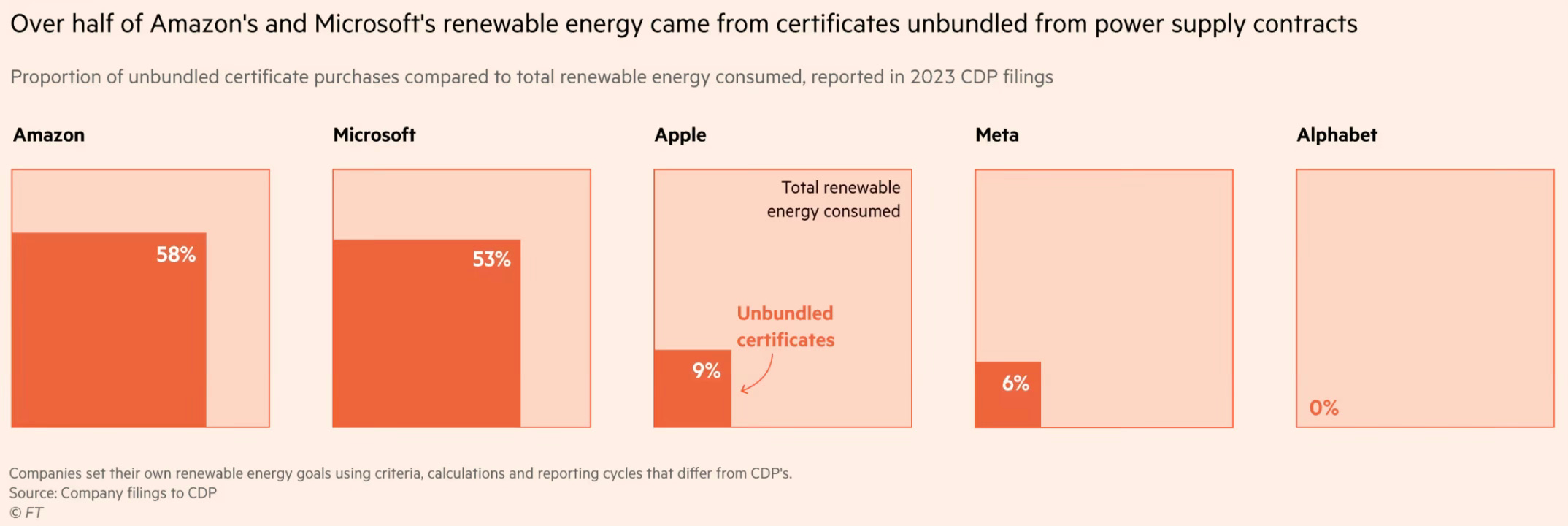
Social media group Meta, for instance, says it has already hit “net zero” emissions in its energy usage. But FT analysis of its 2023 sustainability report shows that its real-world CO₂ emissions from power consumption the prior year were 3.9mn tonnes, compared to the 273 net tonnes cited in the report… Companies including Amazon, Meta and Google have funded and lobbied the Greenhouse Gas Protocol, the carbon accounting oversight body, and financed research that helps back up their positions…A coalition that includes Amazon and Meta is pushing a plan that critics fear will allow companies to report emissions numbers that bear little relation to their real-world pollution and not fully compensate for those emissions. One person familiar with the reform discussions describes the proposal as “a way to rig the rules so the whole ecosystem can obfuscate what they are up to”… A rival proposal by Google, which would require companies to offset their emissions using power generated by more closely comparable means, has been criticised by the Amazon coalition and others for being expensive and too difficult…

Tech companies invest in renewable energy but they cannot fully control how polluting the power their data centres draw from their local grid is. So under current accounting rules, the power used by a data centre during the night in a coal and gas heavy region such as Virginia can be cancelled out by buying a certificate tied to solar energy produced during the day in a region with a cleaner grid, such as Nevada… Each time a wind, solar or hydroelectric facility generates a unit of clean power, its owner can issue an energy attribute certificate, typically known in the US as a renewable energy certificate, or REC. These can either come “bundled” into a contract for clean power, or can be bought individually from a generator or market intermediaries. Companies can purchase RECs “to buy-down their environmental impact”… 

But Matthew Brander, a professor at the University of Edinburgh, says the system is akin to buying the right from a fitter colleague to say you have cycled to work, even though you arrived by a car that runs on petrol. Other experts have raised concerns about how RECs are being used to offset real-world emissions. At present, the certificates must come from the same defined geographic region as the pollution they are offsetting, such as Europe and North America, but not the same grid and not at the same time. That means the clean energy that offsets the emissions could be generated in a different country, at a different time of day — or even in the past…

But both timing and location matter in terms of real-world emissions. For example, one potential buyer hooked up to a coal-dependent grid and another on a much cleaner grid could buy the same certificate to offset one megawatt hour of power use — even though the emissions stemming from that usage will differ in each grid. The certificates are also very cheap. The average forward price of a single US renewable energy certificate to be bought in the next calendar year has been under $5 since at least 2022, commodity trader STX Group estimates… Academics and experts at Princeton, Harvard and the Greenhouse Gas Management Institute have shown that buying certificates typically did not drive either a new supply of renewables or a fall in emissions… Google’s proposed solution is to only match energy consumption with clean energy and certificates from the grids where power is consumed, and to take the time of day of its electricity use into account. Using certificates from one area while operating in another could allow buyers to understate their reliance on fossil-based electricity without addressing the emissions for which they’re physically responsible.

In this context, it’s disturbing that Jeff Bezos’ $10 bn charitable group, Bezos Earth Fund is trying to influence the operations of the carbon credit market to allow Amazon to dilute its emission reduction obligations. Amazon is lobbying to not only continue recognising carbon credits purchased from a different geography and time, but also get a higher credit for those purchased from a dirtier developing country grid than from a cleaner developed country grid. 

The Bezos Earth Fund is among the largest funders of the Science Based Targets initiative, a globally-renowned body relied upon by groups such as Apple and H&M to set voluntary standards and strict limits on the use of carbon credits to offset emissions… The SBTi is also in the middle of a process of rethinking its approach to offsets, a decision that could prove crucial to Big Tech groups at a time when artificial intelligence is resulting in a leap in emissions caused by the greater use of data centres. Experts and campaigners have grown concerned about the potential of Amazon and the Bezos fund… to influence SBTi, which holds sway over whether many corporate groups can achieve a credible “net zero” label… a former SBTi staff member raised fears about perceived influence of the Bezos fund on climate standards in a July complaint to the UK charity commission. The fund has also financed the organisations that employ three SBTi board members…

Grant-making organisations with current or historic ties to big business, such as Bloomberg Philanthropies, the Ikea Foundation or the Rockefeller Foundation are the financial bedrock of the climate standard setting and campaigning space. Google and its philanthropic arm have also funded bodies in this space. But the battle over the future of the SBTi could prove crucial to corporate efforts to achieve climate goals. Some companies have become frustrated at SBTi’s restrictions on the use of credits to just 10 per cent of emissions… The Bezos fund is also a backer of the top standard setter in carbon accounting: the Greenhouse Gas Protocol, which is also in the process of reconsidering its approach to offsets… Amazon is also seen as promoting alternatives to the SBTi’s standards… Amazon last year also contributed to the creation of a market label, Abacus, to test the quality of carbon credits… Buying credits is typically much cheaper than cutting supply chain emissions, making them a tool of choice for some chief executives in the face of pressure to keep climate promises made to shareholders.

There’s a real danger of green-washing here, to fake net zero. 

Here’s the problem. The two examples are only the latest to show that wealth brings outsized influence in the political and rules-setting process, thereby eroding democracy and the social contract itself. It’s Jeff Bezos’ outsized wealth that gives him the power to exercise such influence on a terrain that goes far beyond his business or even industry. It’s not possible through any institutional restraint or safeguards short of outright prohibitions (against, say, corporate ownership of media outlets) to insulate from elite capture. 

But, even such measures are likely to be blunt given the staggering magnitude of wealth concentration and the availability of instruments to exercise influence (electoral funding, ownership of media outlets, philanthropic foundations etc.) that allow the likes of Bezos to manipulate the political process from behind the scenes (though the likes of Elon Musk no longer make have even these pretensions) to suit their interests. 

The final word on the issue should go to this quote from Justice Louis Brandeis (HT: Matt Stoller), who famously said, "We may have democracy, or we may have wealth concentrated in the hands of a few, but we cannot have both." Just as business concentration and competition cannot co-exist, democracy and wealth concentration too cannot go together!

Monday, July 8, 2024

What the UK elections tell us about the limits of centrism for political parties

I blogged here on how narratives create a dissonance between perception and reality. I had also written that centrist parties, especially those that try to achieve the balance between capital and labour, struggle to retain any ideological mooring and end up alienating their core support base. 

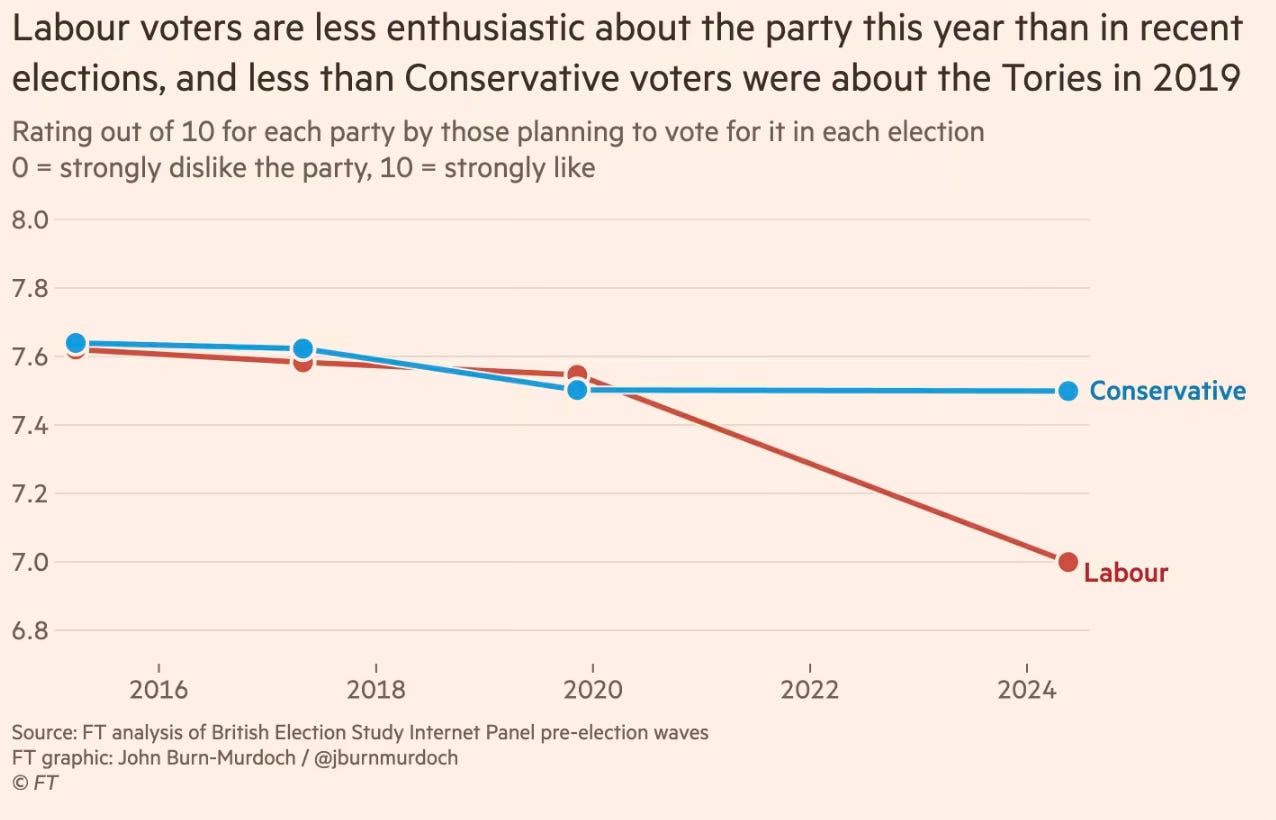
The Labour Party in the UK under Sir Keir Starmer may turn out to be a good example of this. As John Burn-Murdoch has shown brilliantly with data, the Labour victory is built on very shaky foundations. It received half a million fewer votes than its wipeout in 2019, just 34% of the votes, more than doubled its seat share!

Despite their party bagging its second-highest seat tally in history, the lack of enthusiasm among Labour voters is striking.

Consider this about how Starmer reshaped Labour after Jeremy Corbyn’s extremism alienated voters.

Starmer, who won the Labour leadership on a leftwing manifesto offering tax rises and the nationalisation of key industries, now struck different themes. Attempting to win back core working class, social conservatives who had deserted the party during the Brexit years — and middle Britain’s moderate voters — he pulled the party back to a left of centre position. Corbynites were purged, antisemitism was ruthlessly stamped out, the party machine was retooled… During the long months running up to the snap election, Starmer rarely appeared in interviews without the union jack in the background, he adopted tougher language on migration and crime and… he put fiscal discipline and a pro-business agenda at the heart of Labour’s pitch… Starmer, whose previous costly promises to scrap university tuition fees or to bring private companies back under state control were ditched, “fully bought in” to the need for an iron grip on tax and spend policies… Starmer’s transformation of Labour from a leftwing protest party to a centrist government-in-waiting prompted claims that either he does not believe in anything, or that he is a closet leftwinger waiting to unleash a concealed socialist agenda on Britain.

… unlike many members of his incoming cabinet, Starmer is not a career politician. Instead he became a successful human rights lawyer and ended up in charge of the Crown Prosecution Service. He did not enter parliament until his fifties… his time running a big public service made him interested in making bureaucratic machines work. “He’s interested in how, not just what,” says one close ally, arguing that Starmer took a keen interest in turning Labour into an organisation that could deliver change in government. “He’s very professional,” McFadden says. “He likes things to be done right. He expects people to show up with their homework done. He chairs meetings well. He makes sure people know what has been agreed.”.. Sunak has also been among those who claim that Starmer stands for nothing, that he “flip flops” from one position to another; that he was a leftwinger while standing for his party’s leadership, where now he is posing as a fiscal ironman. In essence, the country has no idea what it is getting.

In keeping with centrism, Labour’s manifesto offered very little by way of meaningful reform.

For all the talk of change, Labour’s manifesto was one of the thinnest and centrist in its history. It had little new to say about such core issues as education and skills, public service reform and local government financing. It was largely silent about how both tax rises and austerity could be avoided without breaching its fiscal rules.

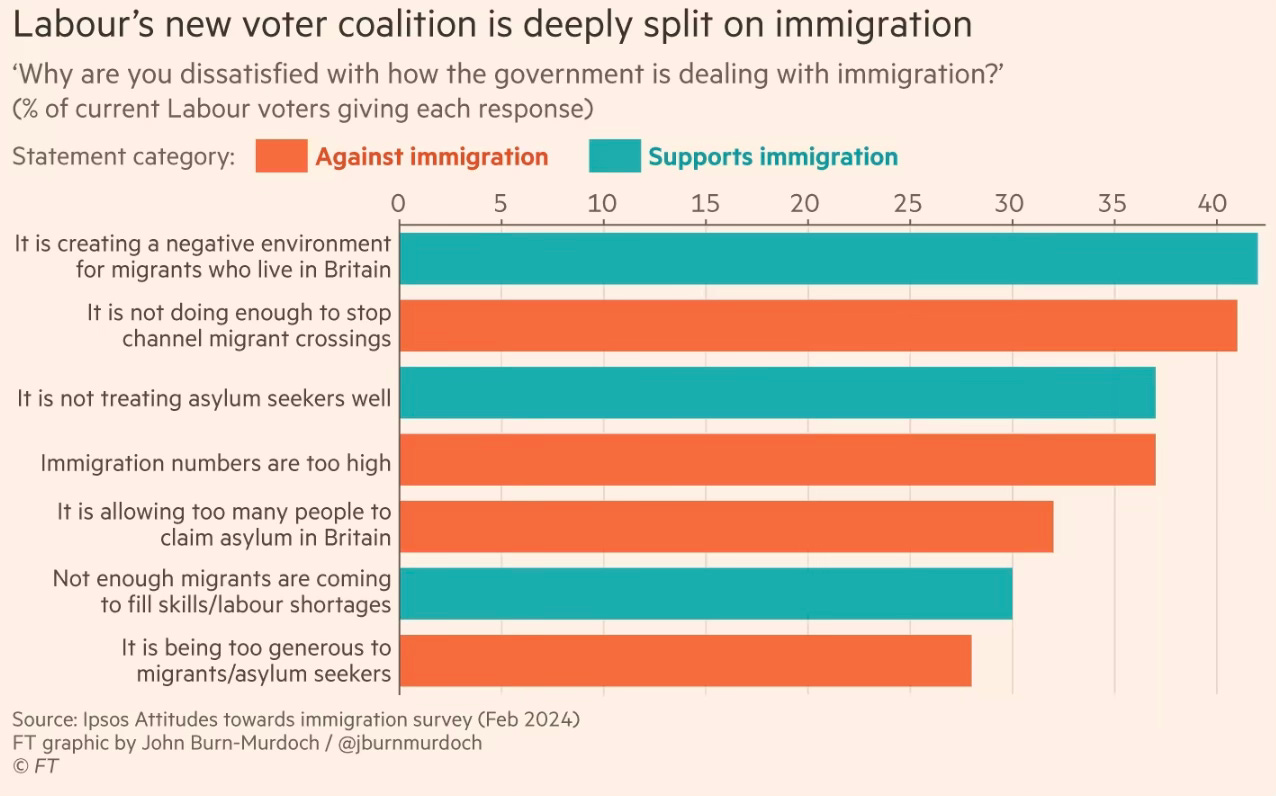
The contradictions in such non-ideological pragmatism is best exemplified in the Labour Party’s views on immigration and asylum.

The clearest illustration of the tightrope Starmer will have to walk here is the way Labour supporters are split into diametrically opposed factions. About a third are angry that the Conservative government created a negative environment for migrants already in the country and want Britain to take in more immigrants. But another 40 per cent identify the problem as too much immigration and too many people allowed to claim asylum.

Almost any position Starmer takes will anger one of these groups. More than 100 Labour MPs now represent constituencies where the right, should the Conservatives and Reform UK unite or ally, would unseat them at the subsequent election. This means that the progressive voters’ side of the debate is likely to be the one that loses out. Nobody should be surprised if the very same split that we’ve seen on the right is mirrored on the left by the next election, with Labour voters peeling off to the Greens and independents.

The short story is this. Keir Starmer was smart enough to apply his technocratic skills and professionalism to opportunistically stitch together a coalition that relied on shifting Labour to the centre and appealing to pragmatism while benefiting from the disillusionment and divisions among the conservative voters. For how long will this balancing act survive?

The problem with such moderation, as I blogged earlier, is that it leaves the party vulnerable to being captured by the interest groups that prefer the status quo. Change of the kind required to reset the balance between labour and capital; arrest widening inequality; roll back the capture of rule-making institutions, especially by Big Finance and Big Tech; break the stranglehold of financial interests; improve the prospects for the next generation, etc., will invariably get pushed to the side. It’s hard to imagine Starmer’s Labour undertaking the kind of measures that would meaningfully upend the status quo in these areas. It’ll tinker at the margins. Expect no more. Disillusionment can quickly set in and the core base will get alienated. The inevitable backlash can threaten liberal democracy and capitalism.

Starmer’s technocratic professional background and limited experience as a politician, coupled with decisions like the handing over of economic management to an out-and-out technocrat like former Bank of England official Rachel Reeves, means that we can expect the Labour government to be one more experiment with technocracy to resolve what are essentially political decisions. Such experiments are unlikely to succeed. 

In this regard, Starmer and the Labour Party only need to look across the channel to France where similar centrism and technocracy by Emmanuel Macron and The Republicans have paved the path for the rise of the far-right populist Rassemblement National (RN) and Marine Le Pen. Esther Duflo writes,

Seven years of Macron but also five years of Socialist president François Hollande (under whom he was economy minister) have shown that whatever it is that the centrist politicians, always intent on demonstrating their reasonableness, keep on offering is now a losing proposition for most French voters. In 2022, it was largely the better off who voted for Macron and his party. The urban poor and the middle class mostly went for the left, and the rural poor and middle class for the RN. In 2024, the wealthier French started to peel off to the RN as well.

In this context, a recent article by the philosopher John Gray is instructive,

Rule by technocrats means bypassing politics by outsourcing key decisions to professional bodies that claim expert knowledge. Their superior sapience is often ideology clothed in pseudo-science they picked up at university a generation ago, and their recommendations a radical political programme disguised as pragmatic policymaking. Technocracy represents itself as delivering what everyone wants, but at bottom it is the imposition of values much of the population does not share… Populism is, among other things, the re-politicisation of issues the progressive consensus deems too important to be left to democratic choice. Immigration was one such issue, climate policy another. Both have stormed back into the political realm. The next will be the declining free market model to which all mainstream parties are committed…

Part of the reason Farage evokes such horror in polite society is that it has forgotten how traditional politicians used to behave… No one knows what Keir Starmer means by “mission-led government”, or remembers the five – or is it six– points of Sunak’s “clear plan”. More to the point, no one cares. Voters are turning to Farage because – like Thatcher, and Blair before he began rhapsodising on the wonders of AI – he tells a story that gels with what they feel about their lives… Farage is speaking to a section of the public – Brexiters who aim to punish the government for reneging on the promise to take control – that he is using to exact his own revenge on the Tories. Beyond this group, he is reaching many who are exhausted and angered by their daily battles to get by. The economic policies set out in Reform’s manifesto are unserious and undeliverable, but they connect with the inchoate sense of a hard-pressed multitude that the market-liberal regime is foundering…

In functioning democracies, technocracy rarely works for long. Relying on scraps of academic detritus, its practitioners struggle to keep up with events. Even when their theories are sound, they do not legitimate their policies… While the populist revolt is gathering momentum, Labour is going all in for technocratic management. Rachel Reeves proposes to give the Office for Budget Responsibility a greater role in approving fiscal policies.

The liberal parties that shift to the centre are especially vulnerable to such technocratic capture. To explain, let me use the framework illustrated by Jonathan Haidt with its six moral foundations - care, fairness, liberty, loyalty, authority, and sanctity. While the liberals are sensitive to the first three foundations, the conservatives are sensitive to all the six. 

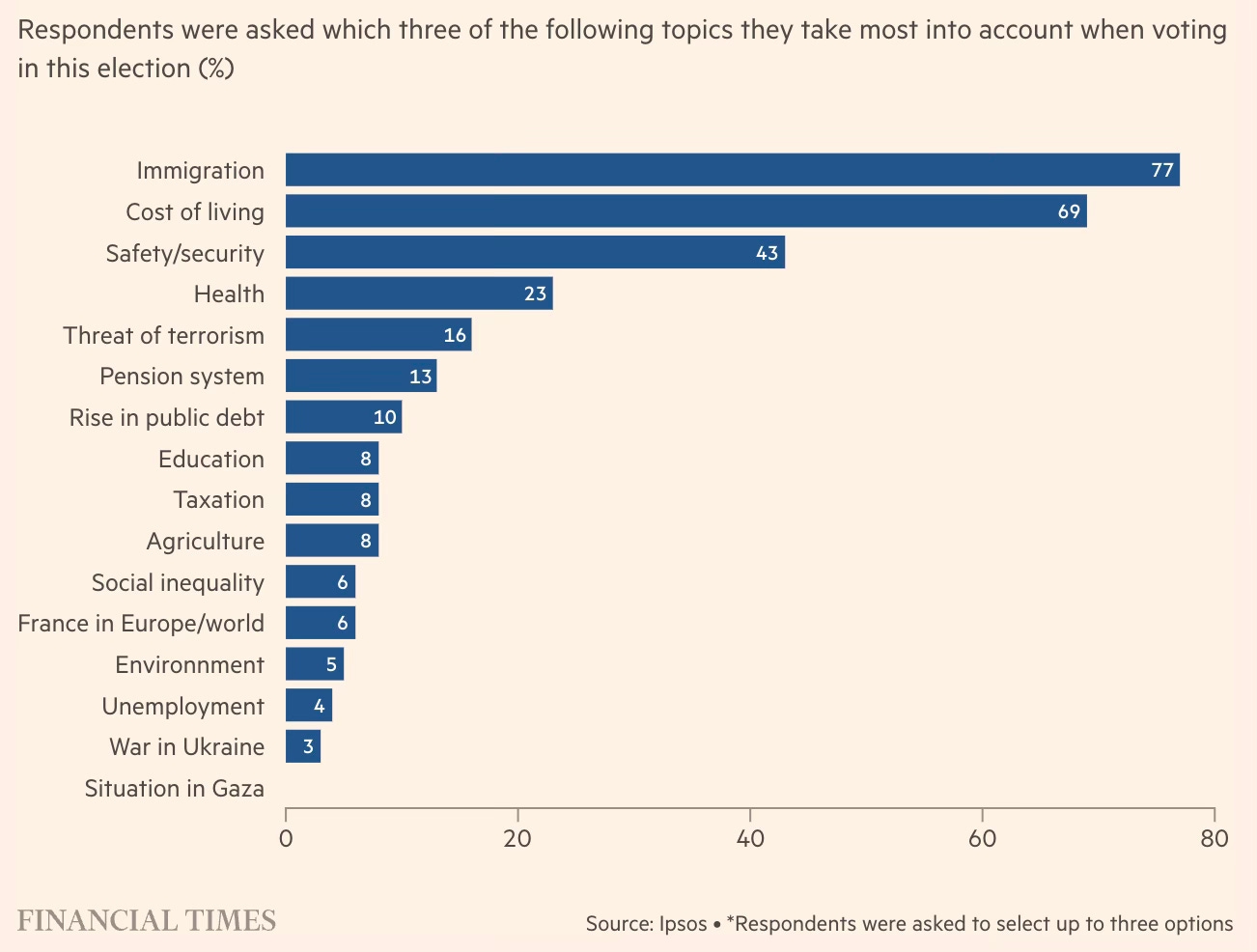
An illustration of this difference is this nice graphic that captures the priorities of the typical supporter of the French right-wing party, Rassemblement National (RN).

Note the low priority attached to typical concerns like inequality or the environment. 

It can therefore be argued that voters with all six values will struggle to embrace a liberal party. Conservative voters will be put off by the narrow value base of liberal coalitions. Similarly, it’ll be difficult for people deeply sensitive to loyalty, respect for authority, and tradition and sanctity to be part of conservative coalitions. This is a blessing in disguise for conservative parties in so far as limits the scope for their ideological dilution. 

In contrast, liberal parties are vulnerable to ideological dilution and capture. Unlike earlier eras, the moneyed interests of today do not owe their income and wealth to traditional sources. The beneficiaries of the managerial movement and shareholder capitalism (with its separation of ownership and management, and the power wielded by the executive class), and technological revolutions, are more likely liberals but with strong vested interests in maintaining the status quo. They are cohorts in the same schools, colleges, clubs, and residential colonies with intellectuals, ideologues, and opinion-makers in the academic, consulting, and journalistic worlds. This confluence tends to edge out the concerns of the working class from the priorities of the liberal parties and prioritise the preservation of the status quo.

Opportunistic pragmatism can mobilise convenient coalitions, but cannot be a substitute for ideological coherence. It’s hard to see Labour succeed in making any meaningful changes. 

Wednesday, March 13, 2024

Some thoughts on digital markets regulation

I have blogged on several occasions on the market abuse problems associated with digital marketplaces. Amazon owns the biggest e-commerce marketplace and is also a seller on it. Facebook and Google provide links to news media content, thereby boosting platform value and traffic, but do not share their revenues with the news publishers. Apple restricts rival app stores on the iPhone and iPad. Apple’s Appstore charges an exorbitant transaction fee for purchases through Apple Pay and also restricts purchases through other payment Apps. All of them erect various kinds of entry barriers to service providers who compete with the platform-owned providers, and also generally try to kill off any kind of nascent competition.

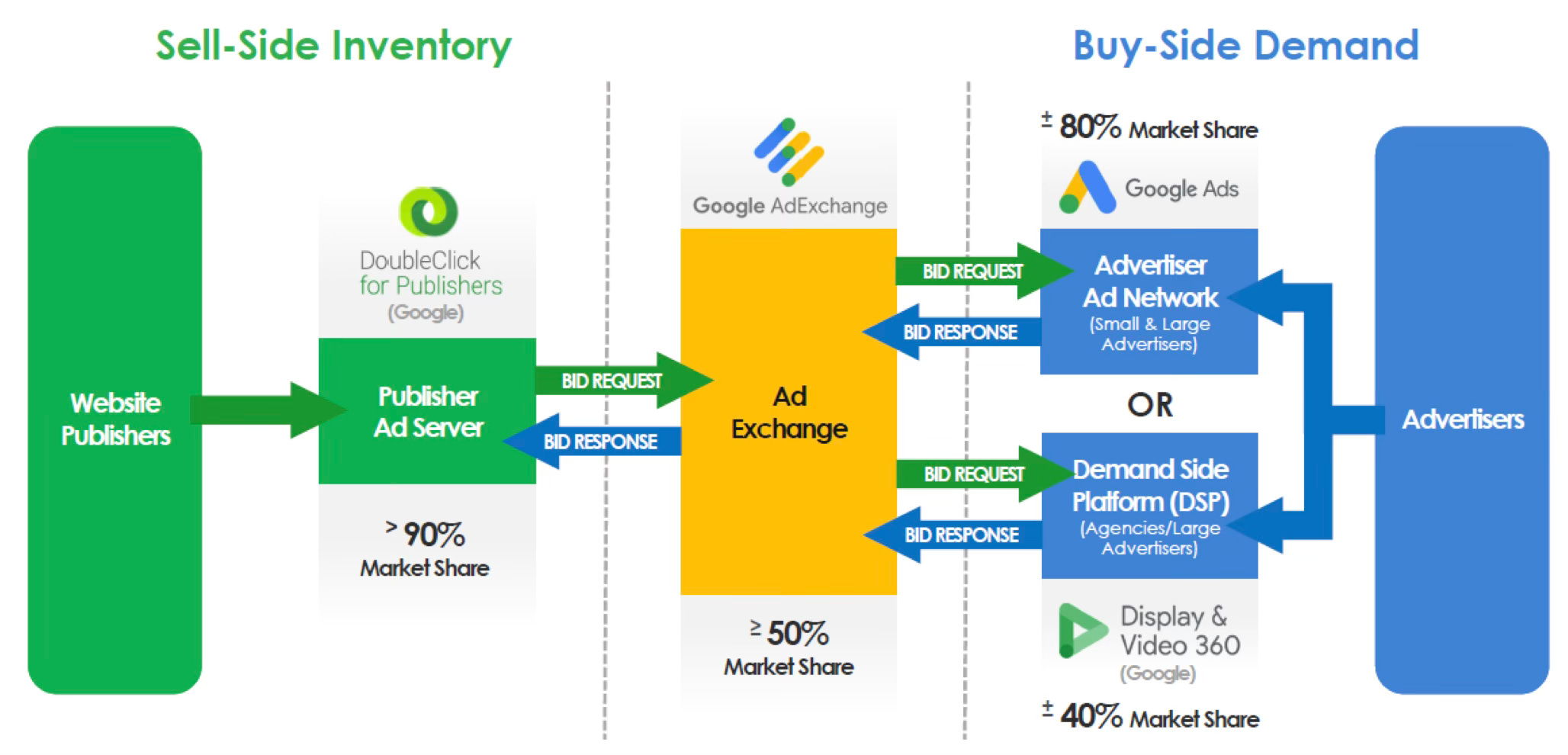
The US Department of Justice’s suit against Google outlines with great clarity how Google has positioned itself across the full value chain of internet advertising and systematically abuses its market dominance.

Every time an internet user opens a webpage with ad space to sell, ad tech tools almost instantly match that website publisher with an advertiser looking to promote its products or services to the website’s individual user. This process typically involves the use of an automated advertising exchange that runs a high-speed auction designed to identify the best match between a publisher selling internet ad space and the advertisers looking to buy it... One industry behemoth, Google, has corrupted legitimate competition in the ad tech industry by engaging in a systematic campaign to seize control of the wide swath of high-tech tools used by publishers, advertisers, and brokers, to facilitate digital advertising. Having inserted itself into all aspects of the digital advertising marketplace, Google has used anticompetitive, exclusionary, and unlawful means to eliminate or severely diminish any threat to its dominance over digital advertising technologies.

Google’s plan has been simple but effective: (1) neutralize or eliminate ad tech competitors, actual or potential, through a series of acquisitions; and (2) wield its dominance across digital advertising markets to force more publishers and advertisers to use its products while disrupting their ability to use competing products effectively... Google, a single company with pervasive conflicts of interest, now controls: (1) the technology used by nearly every major website publisher to offer advertising space for sale; (2) the leading tools used by advertisers to buy that advertising space; and (3) the largest ad exchange that matches publishers with advertisers each time that ad space is sold. Google’s pervasive power over the entire ad tech industry has been questioned by its own digital advertising executives, at least one of whom aptly begged the question: “[I]s there a deeper issue with us owning the platform, the exchange, and a huge network? The analogy would be if Goldman or Citibank owned the NYSE.”

By deploying opaque rules that benefit itself and harm rivals, Google has wielded its power across the ad tech industry to dictate how digital advertising is sold, and the very terms on which its rivals can compete. Google abuses its monopoly power to disadvantage website publishers and advertisers who dare to use competing ad tech products in a search for higher quality, or lower cost, matches. Google uses its dominion over digital advertising technology to funnel more transactions to its own ad tech products where it extracts inflated fees to line its own pockets at the expense of the advertisers and publishers it purportedly serves…

The harm is clear: website creators earn less, and advertisers pay more, than they would in a market where unfettered competitive pressure could discipline prices and lead to more innovative ad tech tools that would ultimately result in higher quality and lower cost transactions for market participants. And this conduct hurts all of us because, as publishers make less money from advertisements, fewer publishers are able to offer internet content without subscriptions, paywalls, or alternative forms of monetization. One troubling, but revealing, statistic demonstrates the point: on average, Google keeps at least thirty cents—and sometimes far more—of each advertising dollar flowing from advertisers to website publishers through Google’s ad tech tools. Google’s own internal documents concede that Google would earn far less in a competitive market.

This problem is not unique to digital technologies. Instead, it’s a common problem with all platforms or platform marketplaces. They are as old as markets and most markets are platforms. Shops, malls, roads, railways, utilities etc are all platforms. Even a school or college, clinic or hospital is also a platform. Imagine a highway monopolist dominating the markets for toll-gate operations, highway rest areas, vehicle manufacturing, ride-sharing, and so on.

All these are universally used markets, enjoy monopoly features, and benefit from network effects (more users result in greater value from its use). Besides, most often they are privately owned, thereby have monopolistic exploitation incentives. They are classic market failures. Therefore the case for their regulation. 

As illustrations, consider the following. Walmart charges exorbitant fees from retail brands to display their wares on its shelves. A railway or road concessionaire charges high fees for railway lines or vehicles to use the infrastructure. A utility company charges high wheeling tariffs on electricity providers using its infrastructure. And so on. And to top it off, all these monopolists also have their proprietary products and services that can potentially get preferential treatment to use the market platform.

The fundamental issue here is that of the near monopoly or disproportionate market power that many platforms command. These platforms become gatekeepers to market access. It becomes a problem when the platform is privately owned and the platform owner starts to charge exorbitant platform access fees. This is considered a market failure. Therefore, given this pervasive problem with all privately owned platforms, such markets are regulated. 

In the initial stages of the emergence of any innovation, it’s natural for the first movers to be incentivised with a high premium in their returns. For practical reasons, the regulations too take time to emerge. All the aforementioned historical platform markets too followed this trajectory of development. We know of the market abuse problems associated with railroad monopolies which made billionaires out of their owners in the US. We also know about the fierce opposition from entrenched monopolists to regulating these markets. 

The evolution of internet-based platforms too is following the same path. Given their practices, profit margins, and piles of cash surpluses, it’s clear that the monopolists have been allowed to enjoy an extended period of unregulated over-exploitation. In any case, it’s hard to argue that e-commerce or social media or payment platforms are not mature enough and therefore need more innovation runway before they are regulated. They should have been regulated yesterday. 

The elite capture of the intelligentsia and academia has meant that the commentary and thinking on this issue have been muted or confined to tinkering at the margins. The political capture of the rule-making process has been critical to perpetuating the unregulated over-exploitation of these markets. It’s a testament to the failure of the progressive movement that they have been co-opted by the Big Tech and Wall Street interests. 

In the US, the courts are still beholden to the consumer welfare test for digital market regulation and thereby tend to overlook the market abuse and anti-competitive practices that Big Tech firms indulge in. In this context, the EU’s ongoing actions against the technology firms deserve to be strongly supported. The centrepiece of the EU’s anti-trust pursuit is the European Union's Digital Markets Act. 

Its full implementation has opened the possibility of widespread anti-competitive actions by the EU. A major objective of the Act is to prevent large tech companies from abusing their market dominance to crush competition and build monopolies. The DMA Rules which came into effect in March 2022 had given time to the large systemic companies (defined appropriately as "gatekeepers") two years till March 7, 2024, for compliance. 

The FT has a long read on the impact of the DMA Rules

There is little evidence yet to suggest that the law is having the desired effect. Industry groups representing travel apps such as Airbnb and Booking.com, and entertainment apps like Spotify and Deezer, complain the tech companies are focused on the letter of the law rather than the spirit of it, and it is having no meaningful impact on their businesses. Judging by the record stock market highs enjoyed by some of these companies, Wall Street doesn’t believe it will have much practical effect on profits or the level of competition either — particularly as the tech industry hurtles into the AI age, resetting the competitive dynamics in some of the core tech markets... The big companies have been adept in the past at redesigning their services to sidestep regulations, making it very difficult for under-resourced government agencies to keep up, this investor says. The law does grant European regulators extraordinary powers of enforcement, including fines of up to 20 per cent of total worldwide annual turnover for repeat infringements, or — as a “last resort option”, forced structural changes such as the break-up of businesses...

A gatekeeper is defined by the law as a platform with an annual turnover of more than €7.5bn, a market cap above €75bn and active monthly users in the EU of 45mn. The commission has singled out 22 “core platform services” offered by the six, ranging from Google’s search engine and Meta’s Facebook and Instagram services to Apple’s App Store. The law forbids the tech companies giving favourable treatment to their in-house services at the expense of third parties — a practice known as self-preferencing — and obliges them to open up their platforms to more alternative services, presenting users with more choices. It also challenges their power to share data between their own services — between Facebook and WhatsApp, for example — without their users’ consent, and seeks to make it easier to switch by making it simpler for users to export their data. “The gatekeeper theory of industry domination is profound,” says Megan Gray, formerly a US Federal Trade Commission lawyer and general counsel at search company DuckDuckGo. At least in theory, it gives the regulators a powerful weapon, she says. On paper, the law could have a direct impact on the profitability of some important tech services, says Gallant. “The DMA poses some risk to Apple’s App Store commissions, which is the biggest part of their services business,” he says.

But the market participants feel that the technology companies will figure out ways to subvert the DMA Rules.

According to Gray, the entrenched nature of the dominant platforms, and in particular the tight linkages between their services that have turned them into powerful digital “ecosystems”, will make it hard to pick them apart by attacking individual products or services. The most drastic effects of the new regulations are also likely to be blunted by the manner in which the tech companies have said they will adapt their services to comply with the DMA... Tech companies are also implementing changes in ways that allow them to hold on to their competitive advantage. This year, Apple published a highly detailed set of technical changes that in effect open the way for rival app stores on the iPhone and iPad, while also allowing developers to stop using its payments service. But it also said that anyone choosing to take advantage of these new arrangements would have to pay a new fee of €0.50 cent for every app downloaded over 1 million installations — something that would hit companies that have large numbers of free app users on mobile platforms, making them less likely to take advantage of the new freedom to launch an app store of their own...

“Spotify, like so many other developers, now faces an untenable situation,” it said following Apple’s announcement. “Under the new terms, if we stay in the App Store and want to offer our own in-app payment, we will pay a 17 per cent commission and a €0.50 cent core technology fee per install and year. This equates for us to being the same or worse as under the old rules.” The changes were designed to give developers like Spotify choice, Apple said. “Every developer can choose to stay on the same terms in place today,” it said, “and under the new terms, more than 99 per cent of developers would pay the same or less to Apple.” The tech companies have also limited most of their technical changes to users in the EU, rather than extending them worldwide — limiting the likelihood of their wider adoption, and creating obstacles for developers.

In India, a Digital Competition Bill is under preparation. A news report says, 

The proposed Digital Competition Bill is expected to put a self-reporting obligation on online entities to declare their dealings are fair and transparent, not restrictive towards third-party applications, according to sources in the know. The digital entities that qualify as gatekeeper platforms or systemically important digital intermediaries (SIDIs) would have to provide this declaration to the Competition Commission of India (CCI), according to the proposed Bill. The CCI will have the power to levy a fine of up to 1 per cent of the global turnover of the online entity in case it fails to make this declaration, sources said. 

Such online firms would have six months to submit this declaration from the time they cross the threshold set for SIDIs, it is learnt. These thresholds, according to sources, are based on the India and global turnover of online platforms, their gross merchandise value in India, average global market capitalisation, and the number of end users. As part of the self-reporting obligation, SIDIs would have to declare that they are not inter-mixing or cross-mixing personal data of end users without their consent and have kept anti-steering provisions, which stop users from going out to other platforms, in check. 

On the issue of digital market regulation, Rana Faroohar writes about the divergence between how consumers and regulators view dynamic pricing in physical and digital markets. 

Surge pricing is something that anyone who takes a ride share on a regular basis has become used to. Try calling an Uber or Lyft on a rainy day during the dinner hour or around the school pick-up or drop-off time and you’ll be paying more than your usual rate — sometimes a lot more.  Yet when consumers are confronted with common online business models like “dynamic pricing” in the bricks-and-mortar world, they may revolt… Platform technology firms developed or perfected techniques like dynamic pricing, real-time auctions, data tracking, preferential advertising and all the other tricks of surveillance capitalism. But the behaviour we take for granted online somehow becomes more problematic when these methods are deployed in the real world. People are outraged about the price of burgers or their rent surging but don’t think twice when it happens to the cost of their commute — particularly when they are booking it on an app…

I’d love to see the FTC, for example, use its rulemaking power to stipulate a “thou shalt not discriminate” statue that makes it illegal to charge people different prices for different goods, no matter how and where they are buying them. What’s illegal in the physical world should also be illegal in the online world. This would put the onus on companies to prove that they are not causing harm, rather than forcing regulators to create a distinct and more complex system for a particular industry. Online or offline, all businesses should be playing by the same rules.

I have blogged earlier about the unfair regulatory arbitrage that digital market firms exploit to their advantage. There’s no reason why such regulatory arbitrage should be allowed to continue in mature marketplaces. 

Big Tech will respond to digital market regulation with denial, tinkering, obfuscation, and brazenness. Unless dealt with firmness, they will keep figuring out ways to limit conceding ground by getting around regulation. Fines are too small in relative terms and are already internalised as a cost of doing business. Aggressive enforcement will have to become the norm. This will require often exorbitant or disproportionate fines, even at the risk of judicial reversals. It will also require the “nuclear option” of even breaking up firms. The norms can be upended and new norms established only through such aggressive actions. When the pendulum has swung too far to one side, there’s a need for disproportionate force from the other side. 

However such actions will require political will and popular support to force these changes in a meaningful manner on the entrenched technology firms.

For references on earlier posts, here is a compilation. I have compared the likes of Amazon to "a large vehicle manufacturer having the power to both prohibit someone from using the road and also make competing vehicle manufacturers unattractive (say, because of inadequate servicing options) for users". I have blogged earlier here(beginning of anti-trust actions in the US and Europe), here (Google and anti-trust challenge), here (anti-trust challenge in the US), here (market monopolisation), and here (Amazon's market abuse of startups) on the problems with market concentration and the need for regulation. This points to what Google founders themselves thought about data monetisation and digital advertising. I have blogged herehere, and here on the problems with regulatory arbitrage and here on the market service quality problems due to limited and poor regulation. And we are not even talking about the several other distortions arising from such market concentration, especially the valuation bubbles in the financial markets - see this and this. Finally, this is a summary examining the dynamics of digital markets and how it offer a different perspective on these markets, and this is a summary of how the big technology companies have become digital gatekeepers to large and critical markets.

Thursday, August 17, 2023

Where's real Progressive movement of today?

I have just completed Daron Acemoglu and Simon Johnson's brilliant and deeply-researched book, Power and Progress, where they show that ideas and technologies have deep political significance and how agenda-setting shapes the nature of the "progress" arising from these ideas and technologies. I blogged briefly about it earlier here.

The point that the book makes is that there's nothing automatic about technology and broad-based progress. They highlight two essential conditions - the technology should improve the marginal productivity of labour (should complement and not substitute labour); and there should be enabling conditions that allow for fair bargaining between labour and capital. They illustrate the point with several historical parallels from agricultural and industrial technologies, whose initial decades were characterised by the exploitation of labour and appropriation of benefits by the owners of these technologies. 

The book makes the point that he who sets the agenda on an idea (and its trajectory of evolution) generally tends to corner the benefits of the idea. Therefore the need for the trajectory of current technologies to be politically determined by society as a whole instead of being narrowly determined by the efficiency and profit maximising incentives of large private companies. 

The application of technologies like big data analytics, facial recognition, artificial intelligence, robotics etc have economic, social, political, and even existential ramifications for all of us. It's therefore only natural that their applications and evolution be a set of political choices. To leave them to the economic incentives of a few vested interests is tantamount to civic and political abdication and is certain to have irretrievably bad consequences for the social contract. 

This post has a few passages. There are several striking snippets about the historical trajectory of changes in the aftermath of the introduction of new technologies. I'll skip them. 

Chapter 8 is the best summary I've come across of the rise of neoliberalism since the seventies. It points to the influential roles played by Friedrich Hayek, George Stigler, Milton Friedman, Michael Jensen, Robert Bork, Michael Hammer etc. 
In a short piece published in September 1970 in the New York Times Magazine, immodestly titled “A Friedman Doctrine”, Friedman argued that the “social responsibility” of business was misconstrued. Business should care only about making profits and generating high returns for their shareholders. Simply put, “The social responsibility of business is to increase its profits”... the impact of the Friedman doctrine is hard to exaggerate. At one fell swoop, it crystallized a new vision in which big businesses that made money were heroes, not the villains that Ralph Nader and his allies painted them as. It also gave business executives a clear mandate: raise profits... The Friedman doctrine pushed in a different direction: good CEOs did not have to pay high wages. Their social responsibility was solely to the shareholders... 

Another economist, Michael Jensen, argued that managers of publicly listed corporations were not sufficiently committed to their shareholders and were instead pursuing projects that glorified themselves or built wasteful empires. Jensen maintained that these managers needed to be controlled more tightly, but because that was difficult, the more natural path was to have their compensation tied to the value they created for shareholders. This meant giving managers big bonuses and stock options in order to focus them on boosting the company’s stock price... 

The Friedman doctrine, along with the Jensen amendment, brought us the “shareholder value revolution”: corporations and managers should strive to maximize market value. Unregulated markets, combined with the productivity bandwagon, would then work for the common good... The combination of the Friedman doctrine and the lavish stock options to top executives motivated several executives to venture into gray areas and then into the red. The journey of the energy giant Enron, a darling of the stock market, is emblematic. The Houston-based company was selected as “America’s Most Innovative Company” six years in a row by Fortune magazine. But in 2001 it was revealed that Enron’s financial success was in large part a result of systematic misreporting and fraud...

Bork’s greater influence was through his scholarship, however. He took Stigler’s and related ideas and articulated a new approach to antitrust and regulation of monopoly. At the center was the idea that large corporations dominating their market were not necessarily a problem that required government intervention. The key question was whether they harmed consumers by raising prices, and the onus was on government authorities to prove that they were doing so. Otherwise, these companies could be presumed to benefit consumers through greater efficiency, and public policy should stand aside.

The Manne Economics Institute for Federal Judges, founded in 1976 with corporate funding, instructed scores of judges in economics during intensive training camps, but the economics they taught was a very specific version based on Friedman’s, Stigler’s, and Bork’s ideas. Judges who attended these training sessions became influenced by their teaching and began using more of the language of economics in their opinions. Strikingly, they also started issuing more conservative decisions and ruling consistently against regulatory agencies and antitrust action. The Federalist Society, founded in 1982 with similarly generous support from antiregulation executives, had a similar aim—grooming pro-business, antiregulation law students, judges, and Supreme Court justices. It has been phenomenally successful; six of the current Supreme Court justices are among its alumni.
This is about the rise of the ideology of efficiency maximisation and cost-cutting, and the emergence of management consultants as implementers of this ideology.
To cut labor costs, US businesses needed a new vision and new technologies, which came, respectively, from business schools and the nascent tech sector. The main ideas on cost cutting are well summarized in a 1993 book by Michael Hammer and James Champy, Reengineering the Corporation: A Manifesto for Business Revolution. The book argues that US corporations had become highly inefficient, especially because there were too many middle managers and white-collar workers. The US corporation should therefore be reengineered to compete more vigorously, and new software could provide the tools... Hammer and Champy emphasized that reengineering was not just automation, but they also took the view that more effective use of software would eliminate many unskilled tasks: “Much of the old, routine work is eliminated or automated. If the old model was simple tasks for simple people, the new one is complex jobs for smart people, which raises the bar for entry into the workforce. Few simple, routine, unskilled jobs are to be found in a reengineered environment.” In practice, the smart people for the complex jobs were almost always workers with college or postgraduate degrees. Well-paying jobs for noncollege workers became scant in reengineered environments... 

The high priests of the emerging vision came from the newly burgeoning management-consulting field. Management consulting barely existed in the 1950s, and its growth coincides with efforts to remake corporations through “better” use of digital technology. Together with business schools, leading management-consulting companies such as McKinsey and Arthur Andersen also pushed cost cutting. As these ideas were increasingly preached by articulate management experts, it became harder for workers to resist... Just like the Friedman doctrine, Reengineering the Corporation crystallized ideas and practices that were already being implemented. By the time the book came out, several large US corporations had used software tools to downsize their workforces or expand operations without having to hire new employees. By 1971, IBM was prominently advertising its “word-processing machines” as a tool for managers to increase their productivity and automate various office jobs...
In 1981 IBM launched its standardized personal computer, with a range of additional capabilities, and soon new software programs for automation of clerical work, including administrative and back-office functions, were being developed... Where Microsoft and Bill Gates led, much of the rest of the industry followed. By the early 1990s, a major part of the computer industry, including emerging household names such as Lotus, SAP, and Oracle, supplied office software to big corporations and were spearheading the next phase of office automation.
On the role of Business Schools in perpetuating this ideology,
The 1970s were the beginning of the professionalization of managers, and the share of managers trained in business schools increased rapidly during this period. In 1980, about 25 percent of CEOs in publicly listed firms had a business degree. By 2020, this number exceeded 43 percent. Many faculty at business schools embraced the Friedman doctrine and shared this vision with aspiring managers. Recent research shows that managers who attended business schools started implementing the Friedman doctrine, especially when it came to wage setting. They stopped wage growth in their firms, compared to similar companies run by managers who did not attend business schools. Managers in the United States and Denmark without an MBA share with their workers about 20 percent of any increase in value added. For managers inculcated in business schools, this number is zero. Somewhat disappointingly for business schools and for economists from the Friedman-Jensen school, there is no evidence that business school‒trained managers increase productivity, sales, exports, or investment. But they do increase shareholder value because they cut wages. They also pay themselves more handsomely than other managers.
The period from 1945 to 1973 is considered the high-noon of broad-based economic growth. The importance of government regulatory involvement in the sharing of prosperity is not well known.
Several iconic government regulations resulted from consumer activism. The National Traffic and Motor Vehicle Safety Act of 1966, which set the first safety standards for automobiles, was a direct response to the issues that Nader publicized. The Environmental Protection Agency was launched in 1970, with an explicit remit to prevent pollution and environmental damage by businesses. The Occupational Safety and Health Administration (OSHA) came into existence in December of the same year to protect the health and well-being of workers. Although some of these problems were previously monitored by the Bureau of Labor Standards, OSHA gained much greater authority over businesses. The Consumer Product Safety Act, enacted in 1972, was even more far-reaching, giving an independent agency authority to set standards, recall products, and bring lawsuits against companies to protect consumers against the risk of injury or death... Equal Employment Opportunity Act of 1972, tasked with going after individual employers for discrimination against Black Americans and other minorities... The Food and Drug Administration (FDA), which had been around since the beginning of the century, significantly increased its powers because of the Kefauver-Harris amendment of 1962 and the US Public Health Service reorganizations of 1966‒1973... The year 1974 also witnessed the beginning of the Department of Justice’s action to break up AT&T, which had dominated the telephone sector in the US... 

"These changes reflected a new, more muscular regulatory approach. Many were implemented under a Republican president, Richard Nixon. Nixon’s embrace of regulation was not a sharp break with the postwar Republican establishment. Dwight Eisenhower had already moved in the same direction, defining himself as a “modern Republican,” meaning that he was going to maintain most of what was left of the New Deal... The 1960s witnessed the success of the civil rights movement and greater mobilization among left-wing Americans supporting civil rights and further political reforms. Lyndon Johnson initiated the Great Society program and the War on Poverty, adapting some key tenets of a European-style social safety net to the US context.
This is a great point, highlighted in numerous posts in this blog, about the inevitable corrosive political economy impact of large corporations.
US Supreme Court justice Louis Brandeis nailed this when he stated, “We may have democracy, or we may have wealth concentrated in the hands of a few, but we can’t have both.” He was opposed to large corporations not just because they increased market concentration and created conditions of monopoly, undercutting the market mechanism. He maintained that as they became very large, they exercised disproportionate political power, and the wealth they created for their owners further degraded the political process. Brandeis did not focus as much on social power—for example, whose ideas and vision we listen to—but his reasoning extends to that domain as well. When a few companies and their executives achieve higher status and greater power, it becomes harder to counter their vision.

This is about the difference between how the US and continental European companies have taken to today's technologies,

Robots increase productivity. However, in US manufacturing, rather than launching the productivity bandwagon, they have reduced employment and wages. As with the automation of white-collar jobs with office software, the elimination of blue-collar jobs by robotics technology was swift. Some of the best jobs available to workers without a college degree in the 1950s and 1960s were in welding, painting, material handling, and assembly, and these jobs have steadily disappeared. In 1960 almost 50 percent of American men were in blue-collar occupations. This number has subsequently fallen to about 33 percent... 

Although they had access to the same software tools and robotics technology, other countries made very different choices than their American counterparts. For example, German manufacturing firms still had to negotiate with unions and explain their decisions to worker representatives on their corporate boards. They were also understandably wary of laying off workers who had gone through years of apprenticeship in the company and developed a range of relevant skills. They thus made technological and organizational adjustments to increase the marginal productivity of the workers they had already trained, blunting automation’s impact. 

Consequently, even though industrial automation has been faster in Germany, with the number of robots per industrial workers more than twice that in the United States, companies made efforts to retrain blue-collar workers and reallocate them to new tasks, often in technical, supervisory, or white-collar occupations. This creative use of worker talent is also visible in how German companies use new software in manufacturing. At the center of programs such as Industry 4.0 or Digital Factory, which became popular in German manufacturing in the 1990s and 2000s, was the use of computer-assisted design and computer-aided quality control that enabled well-trained workers to contribute to design and inspection—for instance, by working on virtual prototypes or by using software tools to detect problems. These efforts ensured that worker marginal productivity increased, even as the German industry rapidly introduced new robots and software tools. Tellingly, following robot adoption, the reallocation of blue-collar workers to new, technical tasks is more pronounced in German workplaces, where labor unions are stronger...

Japanese firms, also facing a declining labor force, have been even faster in adopting robots. But they too combined automation with the creation of new tasks. With the emphasis on flexible production and quality, Japanese companies did not automate all of the jobs on the factory floor, instead creating a range of complex and well-paid tasks for their employees. They also invested as much in software for flexible planning, supply-chain management, and design tasks as software tools used for automation. Overall, during the same time period, Japanese automakers did not reduce their workforces in the same way that their American peers did... In Finland, Norway, and Sweden, where collective bargaining remained important and a large share of the industrial workforce is still covered by collective agreements, corporations have continued to share productivity gains with workers, and automation has often been combined with other technological adaptations more favorable to labor.

Public policy too has supported the direction that US businesses took, 

The US tax system has always favored capital relative to labor, imposing lower effective taxes on capital earnings than labor income. Starting in the 1990s, the asymmetry of capital taxation and labor-income taxation intensified, especially for equipment and software capital... Starting in 2000, capital tax cuts went into overdrive with increasingly generous depreciation allowances on equipment and software capital... Overall, whereas the average tax rate on labor income, based on payroll and federal income taxes, remained over 25 percent for the last thirty years, the effective tax rates on equipment and software capital (including all capital gains and income taxes) fell from around 15 percent to less than 5 percent in 2018. These tax incentives meant that businesses had even a greater appetite for automation equipment, and their demand fueled further development of automation technologies in a self-reinforcing cycle.

The book argues in favour of replacing the AI paradigm of the quest for machine intelligence with that for machine usefulness (MU). It offers four examples of MU,

First, machines and algorithms can increase worker productivity in tasks they are already performing. When a skilled artisan is given a better chisel or an architect has access to computer-aided design software, their productivity can increase significantly. Such productivity increases need not just come from new tools and can also be accomplished by improving machine design. This is the aspiration of the fields known as human-computer interaction and human-centered design. These approaches recognize that all machines, and in particular computers, need to have certain features to be most productively used by people, and they prioritize designing new technologies that increase human convenience and usability... Because this approach puts machine capabilities at the service of people, it tends to complement human intelligence... Virtual- and augmented-reality tools hold tremendous promise to increase human capabilities in tasks such as planning, design, inspection, and training... 

The second type of MU is... the creation of new tasks for workers. These tasks were critical for expanding the demand for both skilled and unskilled workers even as manufacturers such as Ford automated parts of the production process, reorganized work, and transitioned to mass production. Digital technologies have also created various new technical and design tasks over the last half century... Asimov noted the problem of our current system of education: “Today, what people call learning is forced on you. Everyone is forced to learn the same thing on the same day at the same speed in class. But everyone is different. For some, class goes too fast, for some too slow, for some in the wrong direction"... Today, we have the tools for making personalization a reality in many classrooms. Indeed, it should be possible to reconfigure existing digital technologies for this purpose. The same statistical techniques used for task automation can also be used for identifying in real time groups of students who have difficulties with similar problems, as well as students who can be exposed to more advanced material. The relevant content can then be adjusted for small groups of students. Evidence from the field of education research indicates that such personalization has considerable return and is most useful where exactly society has the greatest need: improving the cognitive and social skills of students from low socioeconomic backgrounds... the right type of MU can significantly empower nurses and other health care professionals, and this would be most useful in primary health, prevention, and low-tech medical applications...
The third contribution of machines to human capabilities may be even more relevant in the near future. Decision making is almost always constrained by accurate information, and even human creativity relies on accessing accurate information in a timely fashion. Most creative tasks require drawing analogies, finding new combinations of existing methods and designs. People doing this work then come up with previously untried schemes that are confronted with evidence and reasoning, and are subsequently further refined. All these human tasks can be helped by accurate filtering and the provision of useful information... the World Wide Web is a milestone in human-machine complementarity: it enables people to access information and wisdom that other humans have produced to a degree essentially unparalleled in the past... MU can enable many more applications that provide better information to people in their capacities as workers, consumers, and citizens. Recommendation systems, at their best, have this ability: they can aggregate masses of information from others and present relevant aspects to users to aid in their decision making...

The fourth category, based on the use of digital technologies to create new platforms and markets, may turn out to be the most important application of the Wiener-Licklider-Engelbart vision. Economic productivity is inseparable from cooperation and trading. Bringing together people with different skills and endowments has always been a major aspect of economic dynamism and can be powerfully expanded by digital technologies. 
So why are tech companies not developing tools that help humans and at the same time boost productivity? 
There are several reasons for this, all of them informative about the broader forces we are confronted with. Consider the teaching example, and recall that new tasks, as in this example, are useful in part because they increase productivity by generating meaningful and high-paying jobs for humans—in this instance, for teachers. Yet new teaching tasks imply greater costs for schools already strapped for cash. Most public schools, like other modern organizations, have to focus on containing labor costs and may struggle to hire additional teachers. Consequently, new algorithms for automated grading or automated teaching could appear more attractive to them... The same is true in health care. Despite the $4 trillion that the United States spends on health care, hospitals also face budget pressure, and a shortage of nurses became painfully evident during the COVID-19 pandemic. New technologies that increase nurses’ capabilities and responsibilities would mean hiring more nurses for higher-quality health care. This observation reiterates a key point: human-complementary machines are not attractive to organizations when they are intent on cost cutting...
Under the shadow of the Turing test and the AI illusion, top researchers in the field are motivated to reach human parity, and the field tends to value and respect such achievements ahead of MU. This then biases innovation toward finding ways of taking tasks away from workers and allocating them to AI programs. This problem is, of course, amplified by financial incentives coming from large organizations intent on cost cutting by using algorithms... The tech community did not have to be mesmerized by machine intelligence instead of working on machine usefulness.

The last chapter of the book has some useful suggestions (mostly a consolidation of known ideas) about steering technology in the direction of broad-based progress. In particular is leadership in exposing the problems, popular mobilisation, and articulation of the alternative. 

Consider the exposes that laid the ground work to change the public mood, the anti-thesis,

The United States today would be a very different place if the economic and social conditions of the Gilded Age had endured. But a broad Progressive movement formed to oppose the trusts’ power and demand institutional change. Although the movement had its roots in earlier rural organizations, such as the National Grange of the Order of Patrons of Husbandry and later the Populist Party, Progressives built a much broader coalition around urban middle classes and had a momentous impact on the history of the United States. Central to their success was a change in the views and norms of the American public, especially the middle classes. The transformation was in large part the result of the work of a group of journalists who came to be known as the muckrakers, as well as the writings of other reformers, such as the lawyer and later Supreme Court justice Louis Brandeis. Upton Sinclair’s The Jungle revealed horrible working conditions in the meatpacking industry, and Lincoln Steffens reported on political corruption in many major cities...

Perhaps most influential was the work of another muckraker, Ida Tarbell, on Standard Oil. In a series of articles in McClure’s Magazine starting in 1902, she exposed the company’s and Rockefeller’s alleged intimidation, price-fixing, illegal practices, and political shenanigans. Tarbell had personal knowledge of Rockefeller’s business practices. Tarbell’s articles, collected in her 1904 book The History of the Standard Oil Company, did as much as any other to transform the American public’s perception of the trusts’ and robber barons’ pernicious effects on society... In a series of articles titled “The Treason of the Senate” in Cosmopolitan magazine in 1906, David Graham Phillips shone the light on shady deals and corruption in the Senate. Brandeis’s Other People’s Money and How Bankers Use It did the same for the banking industry, and especially for J.P. Morgan... Also important was the work of community activists such as Mary Harris Jones (known as Mother Jones), who played a leading role in the organization of the United Mine Workers and the more radical Knights of Labor. Mother Jones was the key instigator of the 1903 Children’s Crusade, a march of children working in mines and mills.

... the popular mobilisation led by the Progressive,

In the 1892 election the Progressive Party won 8.5 percent of the total votes. Urban middle classes built on this early success, and a wide variety of politicians such as William Jennings Bryan, Teddy Roosevelt, Robert La Follette, William Taft, and then Woodrow Wilson brought Progressive politics into mainstream parties, winning elections and paving the way to reform... Progressives had an ambitious reform agenda, including the regulation and breakup of trusts, new financial regulations, political reform directed at cleaning up corruption in the cities and the Senate, and tax reform.
And the articulation of policy alternatives, the synthesis,
Key policy reforms of the age were the outgrowth of the ideas that muckrakers, activists, and reformers had popularized. For example, Sinclair’s exposé directly led to the Pure Food and Drug Act and the Meat Inspection Act. Ida Tarbell’s research and writings inspired the application of the 1890 Sherman Antitrust Act to industrial and railway conglomerates. This was reinforced by passage of the Clayton Act in 1914 and the creation of the Federal Trade Commission for further regulation of monopoly and antitrust action. Progressive pressure was also instrumental in the formation of the Pujo Committee, which investigated misdeeds in the financial industry. Even more consequential institutional changes included the Tillman Act of 1907, banning corporate contributions to federal political candidates; the Sixteenth Amendment, ratified in 1913, which introduced the federal income tax; the Seventeenth Amendment of 1913, which required the direct election of all US senators by popular vote; and the Nineteenth Amendment of 1920, giving women the right to vote. Progressives laid the foundations for the New Deal reforms and for post–World War II shared prosperity.

Acemoglu and Johnson summarise it well

THE PROGRESSIVE MOVEMENT provides a historical perspective on the three prongs of a critical formula necessary for escaping our current predicament. The first is altering the narrative and changing norms. The Progressives enabled individual Americans to have an informed view about troubles in the economy and society—rather than just accepting the line coming from lawmakers, business tycoons, and the yellow journalists allied with them. Progressives transformed what was viewed as acceptable for companies to do and what ordinary citizens thought they could do about injustices... The second is cultivating countervailing powers. Building on the change in the narrative and social norms, Progressives helped organize people into a broad movement that could oppose robber barons and push politicians to reform, including via labor unions. The third prong is policy solutions, which Progressives articulated based on the new narrative, research, and expertise.

This historical trajectory of change points to the questions that liberals should be asking. Who are doing the exposes and who are the public intellectuals creating the counter-narratives? Where's the political mobilisation? Where are the policy alternatives?

For sure, there are people and groups at the margins doing these. Some like in anti-trust are struggling to sit at the top of the table. But most others are far from the mainstream. Their efforts to break out into the mainstream get co-opted and blunted by entrenched interests. The mainstream liberals have been co-opted into being compradors of the larger establishment. 

I have three earlier posts in this regard. The first one, from the left, points to an interview with Roberto Unger where he lays down what he thinks should be the progressive agenda. The second one, from the right, points to a similar agenda laid out by Gladden Pappin who writes about reining in the markets and cultural progressivism gone too far. The third one is a synthesis that tries to frame the agendas of the New Right and New Left. I had blogged in this context

Where are the meaningful proposals on addressing issues like business concentration, executive compensation excesses, anti-competitive behaviours, low minimum wages, pro-rich and pro-capital tax codes, declining labour bargaining power, health and housing markets and policies which favour the rich, unaffordable tertiary education, and so on? Where are proposals to this effect from the mainstream intellectuals whose opinions ring loud in the oped pages? When one looks around at the mainstream progressive agenda in the US, one cannot but not get the feeling that it skirts around all deep-rooted structural issues and is confined to tinkering at the margins. It is all about safety valves and pacifiers to buy out the handful of the vocal among the vast mass of discontented.