Substack

Showing posts with label Automation. Show all posts

Saturday, July 12, 2025

Weekend reading links

1. How is global trade changing due to Trump tariffs?

US tariff revenue surged almost fourfold from a year earlier to a record $24.2bn in May, while imports from China fell 43 per cent from the same month in 2024... China's exports are up 4.8% on last year despite a sharp drop in trade with the US.
There's also emerging evidence that Chinese firms are rerouting exports to the US through South East Asia and EU countries to avoid the high tariffs on Chinese exports.
The value of Chinese exports to the US dropped 43 per cent year on year in May, according to figures published by the US census bureau — equivalent to $15bn-worth of goods. But the country’s overall exports rose 4.8 per cent in the same period, official Chinese data showed, as the shortfall in trade with the US was offset by a 15 per cent increase in shipping to the Association of Southeast Asian Nations trade bloc and a 12 per cent rise to the EU... 
Separate research by Capital Economics estimated that $3.4bn of Chinese exports were rerouted through Vietnam in May, a rise of 30 per cent compared with the same month last year. Indirect trade through Indonesia also increased markedly, with an estimated $0.8bn rerouted in May 2025, 25 per cent higher than May 2024. Exports of electronic components such as printed circuits, parts of telephone sets and flat panel display modules to Vietnam were up 54 per cent, or $2.6bn, in May 2025 compared with a year earlier, Chinese data shows... Indian exports to the US jumped 17 per cent in May compared with a year earlier, while imports from China and Hong Kong rose 22.4 per cent according to Ajay Srivastava, founder of the Global Trade Research Initiative, a research group.
This is a good graphic on what products have been squeezed following the tariffs. 
2. The US equity markets are going about their merry ways overlooking the real costs that are introduced by the Trump tariffs. 
Despite the carve-outs and climbdowns, the US’s overall average effective tariff rate now stands at 15.8 per cent, according to calculations by the Yale Budget Lab — the highest rate since 1936 and an increase of more than 13 percentage points since Trump returned to office in January.
A big cause of concern is the uncertainty associated with Trump policies that are taking its toll on investments.
The most tangible consequence of the Trump tariffs so far is not supply chain reordering, but the sudden dearth of dealmaking, according to Persson of EY. A survey of dealmakers by PwC in May found that 30 per cent were either pausing or revising deals because of the uncertainty caused by tariffs. Among those pushed back amid the uncertainty included bids for Boeing’s navigation unit and an expected £4bn sale by buyout group Apax of insurance group PIB. The sudden slowdown flew in the face of investor expectations that Trump’s return to the White House would trigger a wave of M&A activity on the back of a deregulatory splurge, according to Josh Smigel, partner in PwC’s deals practice. As a result, Smigel calculates, private equity firms are holding about $1tn worth of assets that — absent the Trump uncertainty — could have been redeployed back into the market if planned exits had not stalled.

3. Has Israel won the battle, but only to lose the war?

Mr. Netanyahu’s relentless and unapologetic military response to the Oct. 7, 2023, Hamas-led attack that killed 1,200 people and took 250 people hostage has cemented the view of Israel as a pariah, its leadership accused of genocide and war crimes, and disdained by some world leaders. In opinion polls globally, most people have a negative view of Israel. In Gaza, the war against Hamas has taken a devastating toll, killing tens of thousands of people and leaving more than a million homeless and hungry. Much of the enclave has been reduced to rubble. Poverty and hopelessness are rampant... Israel’s actions have shattered a rock-solid, bipartisan consensus in the United States for defending Israel. Now, support for the country has become a fiercely contentious issue in Congress, the subject of angry debates and protests on college campuses and fuel for a surge in antisemitic incidents in the United States and around the world... Israel has created a new wave of global opinion critical of its goals and methods. And many Israelis now feel threatened while abroad, even as they are more secure at home... 
In a Pew Research survey of 24 countries around the world published last month, negative opinions about Israel have surged. In 20 countries, more than half of the people said they had an unfavorable view of Israel. In eight countries — Australia, Greece, Indonesia, Japan, the Netherlands, Spain, Sweden and Turkey — more than 75 percent held that view... Just 46 percent of Americans in the latest Gallup survey expressed support for Israel, the lowest number since the company began asking the question a quarter-century ago. A third of the respondents in the United States said they sympathized with the plight of the Palestinians, up from just 13 percent in 2003... Inside Israel, the decision to prioritize military victories over the return of the hostages has deeply wounded many people. And the violence has strained the good will of the country’s allies and neighbors.

4. Thrive Capital, founded by Josh Kushner, the brother of Jared Kushner is charting a new model of VC investing.

The approach Kushner has developed since launching Thrive 14 years ago: get close to founders, remain loyal through crises and concentrate funds in a small number of companies. Betting a billion dollars or more on a behemoth inverts the classic venture model: firms typically write dozens of small cheques in young start-ups; most fail, but the flops are more than offset by a few spectacular successes... venture capital has mutated from a cottage industry into an institutionalised asset class... The shift has left VCs with a choice: remain faithful to early-stage investing and hope for outsize returns, or scale up funds to meet increasingly massive private companies. Thrive is attempting to manage both, writing cheques for multibillion-dollar start-ups its team believe can still multiply 10 or 100-fold in value... Most VCs split funds between dozens of start-ups, but the vast majority of a Thrive fund will go to just 10-15. The firm has put 10 per cent or more of earlier funds to work in single companies, including workplace messaging app Slack, GitHub, Instagram and Stripe. Thrive first invested in Stripe, then valued at $3bn, in 2014, and has increased its stake multiple times, including investing close to $2bn last year... the firm has quietly shown intense fealty to founders during moments of crisis, such as during the boardroom coup that briefly ousted OpenAI’s Altman last year. Kushner was instrumental in returning Altman to the company after less than a week... 
Thrive’s rivals, including more established West Coast firms, dismiss the approach as closer to asset management. “We invest in companies, they trade in stocks. It’s like an ETF [exchange traded fund] for venture,” says a partner at one Silicon Valley firm. “But private companies are not stocks. You can’t get out when they start going down.” Speaking privately to the FT, some institutional investors question whether Thrive’s massive bets can ever deliver “venture-style returns”. Others say it is too soon to judge a group whose biggest investments have not yet cashed out. Thrive’s biggest portfolio companies, including OpenAI and payments start-up Stripe, have racked up massive paper gains. But until they go public or are acquired, profits won’t be returned to institutional investors in Thrive’s funds... The payout for Thrive and its backers would be enormous should Stripe, OpenAI, or defence tech company Anduril go public... Thrive has raised a total of $12.3bn, and now has almost $25bn under management, making it one of the largest VCs in the country.

Interesting that Mukesh Ambani has a 3.3% stake in Thrive capital as part of a consortium of investors! 

5. This is a very good graphic that shows how VCs are experiencing a squeeze in their cash flows.

Much the same could be said about PE funds.

The private equity giant Blackstone spent $10 billion in 2021 to acquire QTS, and has been pouring billions more into the company to help it expand its data centers... This largely unglamorous industry is critical for A.I. leaders to get right. QTS leases its facilities to companies like Amazon and Meta and supplies the electricity and water needed to power and cool their computers... Blackstone calls data centers one of its “highest conviction investments.” Blackstone is already one of the world’s largest owners of office buildings, warehouses and science labs, but it has sunk more money into data centers and related infrastructure than into almost any other sector in the firm’s 40-year history. All told, Blackstone has put more than $100 billion into buying and lending to data centers, as well investing in construction firms, natural gas power plants and the machinery needed to build them... (it) says it still sees strong demand from tech companies, which are willing to sign what they describe as airtight leases for 15 to 20 years to rent out data center space... 

Blackstone is not alone. Data centers are drawing a crowd on Wall Street — investment giants like KKR, BlackRock and Blue Owl have collectively plowed hundreds of billions into the industry. As investment firms announce larger and larger deals, one Wall Street executive says he jokes about “Braggawatt” deals, as data centers are typically measured by the wattage they use. The spending frenzy has created concerns about whether too many data centers are being built... The complexity and cost of running A.I.-focused data centers stem from the vast amounts of power they guzzle, which can be about 10 to 20 times as much per server or rack as general cloud computing. There is also the need to keep the centers operational 99.999 percent of the day, or the “five nines” in industry parlance. That equates to about five minutes of downtime all year for maintenance or to switch out servers.

7. China's dominance of clean energy technologies

China has also begun to dominate nuclear power, a highly technical field once indisputably led by the United States. China not only has 31 reactors under construction, nearly as many as the rest of the world combined, but has announced advances in next-generation nuclear technologies and also in fusion, the long-promised source of all-but-limitless clean energy that has bedeviled science for years.
And, buoyed by President Trump's policies, America retains leadership of fossil fuels.

This reversal is striking.
Americans created the first practical silicon photovoltaic cells in the 1950s and the first rechargeable lithium-metal batteries in the 1970s. The world’s first wind farm was built in New Hampshire nearly 50 years ago. Jimmy Carter installed solar panels on the White House in 1979... In 2008 the United States produced nearly half of the world’s polysilicon, a crucial material for solar panels. Today, China produces more than 90 percent.

This is a good description of China's manufacturing prowess.

Last June, the Urumqi solar farm, the largest in the world, came online in the Xinjiang Autonomous Region in China. It is capable of generating more power than some small countries need to run their entire economies. It’s hardly an anomaly. The other 10 largest solar facilities in the world are also in China, and even bigger ones are planned. The Chinese automaker BYD is currently building not one but two electric vehicle factories that will each produce twice as many cars as the largest car factory in the world, a Volkswagen plant in Germany.

Finally, a graphic that captures China's clean energy investments globally.

Chinese firms are building wind turbines in Brazil and electric vehicles in Indonesia. In northern Kenya, Chinese developers have erected Africa’s biggest wind farm. And across the continent, in countries rich with minerals needed for clean energy technologies, such as Zambia, Chinese financing for all sorts of projects has left some governments deeply in debt to Chinese banks. Since 2023, Chinese companies have announced $168 billion in foreign investments in clean energy manufacturing, generation and transmission, according to Climate Energy Finance, a research group.

8. Tim Harford points to a new paper by David Autor and Neil Thompson who use an "expertise" framework to explain the impact of automation and AI on jobs. Autor and Thompson pose a question

Would we expect accounting clerks and inventory clerks to be similarly affected by automation? There are several well-established approaches to analysing this question, and all of them suggest that the answer is “yes”. Back in the day, both types of clerk spent a lot of time performing routine intellectual tasks such as spotting discrepancies, compiling inventories or tables of data, and doing simple arithmetic on a large scale. All of these tasks were the kind of things that computers could do, and as computers became cheap enough they took over. Given the same tasks faced the same sort of automation, it seems logical that both jobs would change in similar ways. 

But that is not what happened. In particular, say Autor and Thompson, wages for accounting clerks rose, while wages for inventory clerks fell. This is because most jobs are not random collections of unrelated tasks. They are bundles of tasks that are most efficiently done by the same person for a variety of unmysterious reasons. Remove some tasks from the bundle and the rest of the job changes. Inventory clerks lost the bit of the job requiring most education and training (the arithmetic) and became more like shelf-stackers. Accounting clerks also lost the arithmetic, but what remained required judgment, analysis and sophisticated problem solving. Although the same kind of tasks had been automated away, the effect was to make inventory clerking a job requiring less training and less expertise, while accounting clerks needed to be more expert than before. 

The natural worry for anyone hoping to have a job in five years’ time is what AI might do to that job. And while there are few certainties, Autor and Thompson’s framework does suggest a clarifying question: does AI look like it is going to do the most highly skilled part of your job or the low-skill rump that you’ve not been able to get rid of? The answer to that question may help to predict whether your job is about to get more fun or more annoying — and whether your salary is likely to rise, or fall as your expert work is devalued like the expert work of the Luddites.

9. Two graphics that capture the essence and outcome of One Big Beautiful Bill (OBBA). One, stripped off all its hype, OBBA is a giant tax cut bill.

And its biggest beneficiaries will be the richest.
Analysis by scholars at the University of Pennsylvania suggests that Americans earning under $18,000 would lose $165 in 2027, or 1.1% of their income. By 2033 their annual losses would rise to $1,300 on average—about 7.4% for the group. The richest 0.1%, earning over $4.45m, would gain more than $300,000 in 2027, a 2.3% increase. Much of this comes indirectly, via changes to corporate taxes, which are usually assumed to benefit wealthier households who own stocks... Analysis of the House version by scholars at the University of Pennsylvania suggests that Americans earning less than $16,999 would lose about $820 a year—a 5.7% reduction in median income for that group. The richest 0.1%, earning more than $4.3m, would gain $390,000, a 2.8% increase.
Yimin is one of the five largest open-cast coal mines in China. During peak season, it used to require about 300 trucks, operated by around 1,200 drivers working shifts around the clock, to transport coal to processing sites, and soil, sand and rocks to dumping grounds. But managers said the mine faced a shortage of drivers. Dangerous driving conditions led to high attrition rates, compounded by declining interest among younger generations in pursuing this profession. “Truck drivers face exhausting workloads that often lead to health issues,” said Yimin mine director Shu Yinqiu. The solution came earlier this year with a fleet of 100 photovoltaic-battery-powered, self-driving trucks. They represent the world’s largest deployment of autonomous electric mining trucks, highlighting China’s resolve to upgrade its traditional industries with advanced technologies, as the nation grapples with a shrinking labour force and an ageing population...
Key partners in the project include Huawei Technologies, Xuzhou Construction Machinery Group, State Grid and the Beijing University of Science and Technology. Now, instead of a thousand-man crew, just 24 people, divided into four teams, are needed to operate the 100 new trucks. Staff monitor and control the vehicles from the comfort of a remote control room, where live-feed videos and real-time traffic information are displayed on multiple screens... As of September, the China National Coal Association (CNCA) estimated there were over 1,500 automated mining trucks in China. It predicted that number would triple to 5,000 by the end of this year and exceed 10,000 by 2026... A fleet of 100 unmanned trucks could save coal mine operators 40 million yuan (US$5.6 million) in driver salaries annually, according to CNCA estimates.

11. Major announcement for the establishment of a PCB and Copper Clad Laminate (CCL) manufacturing facility by Syrma SGS Technology at Naidupeta in Andhra Pradesh with an investment of about Rs 1800 Cr and in partnership with South Korean company Shinhyup Electronics Ltd. The project is expected to be commissioned by 2026-27 and can avail incentives under the GoI's Electronics Component Manufacturing Scheme (ECMS). In 2024, the GoI had imposed a 30% anti-dumping duty (ADD) on bare PCBs to boost domestic production. The Indian PCB market was valued at $6.2 bn in 2024 and is estimated to grow by a CAGR of 16.4% from 2025-33. 

12. Spain wants to avoid the costs of being part of NATO, while wanting to access its benefits. It was the only standout against accepting the goal of 5% of GDP defence spending target by NATO members at the recent NATO summit. At the same time, as FT reports, one of its defence firms, Indra, which is 28% owned by the Spanish Government, is benefiting from NATO defence spending. 

In April, the group was given a role in 12 European Defence Fund research and development projects and made the leader of one involving radars. Its executives were in Ukraine last month pitching their wares... In the air, Indra is Spain’s lead participant in Europe’s flagship fighter jet project, the Future Combat Air System, a sometimes prickly partnership with Airbus, which represents Germany, and France’s Dassault Aviation.

13. India's derivatives market, and how Jane Street abused it before SEBI cracked down.

In December 2020 — when Jane Street first set up its Mumbai arm — the monthly turnover of futures and options markets on the National Stock Exchange had reached nearly $300bn, from just $134.7bn four years earlier, and by December 2024 stood at $512.7bn. This became a fertile terrain for Jane Street. Between January 2023 and March 2025 the firm netted an overall profit in India of about $4.3bn, Sebi said in its order on Thursday.
14. Using dupes of expensive brands appears to be a trend in the US, as seen from the ongoing fight between Lululemon which has sued Costco of copying at least six patented clothing designs, including its popular Scuba hoodie and Define jacket.
Once seen as embarrassing parsimony, buying knock-offs has become a fashion statement of its own. Egged on by hashtags, TikTok videos and media articles, customers are leaning into the fun of finding cheaper but still good alternatives, turning the search for dupes into a public treasure hunt. Nearly half of US consumers surveyed by analytics firm First Insight said they had tried a product specifically because it was a “dupe”, and 70 per cent of shoppers who make more than $150,000 said they were more likely to try a dupe than other private label goods...
The warehouse store’s $20 sweatshirt mimics the ornamental stitching and pouch pockets of Lululemon’s Scuba offering, which sells for six times the price. And Costco’s dupe of the Design jacket mimics an unusual line of curved stitching across the back. Lululemon contends in its lawsuit that those specific details violate the “trade dress” patents that it has registered over the past two years, as well as a trademark on the colour description “tidewater teal” that it applied for one day before filing its claim that Costco had “unlawfully traded upon Plaintiffs’ reputation, goodwill and sweat equity”.

Interestingly, US laws allow considerable flexibility in the interpretation of design patents.

US rules protect makers from infringement claims if the similarities are based on function rather than distinctive design. The warehouse group could also try to turn the dupe craze to its advantage by arguing that consumers are unlikely to be misled into believing that they are buying a Lululemon original. Costco’s products are clearly marked with either the Kirkland brand or the manufacturer’s name. Despite the publicity, most patent attorneys expect the dispute to settle, as Deckers’ first Uggs lawsuit did last year. Each side has too much to lose from a trial. Costco could be on the hook for gigantic monetary damages, while “if Lululemon were to lose, it would be open season” for other duplicates, says Josh Gerben, a DC trademark attorney.
15. Good story on how Tamil Nadu's industrial development strategy has brought about broad-based regional development across the state.
Shishu Mapan, an artificial intelligence (AI) tool trained on over 30,000 infants, built by scientists at the Wadhwani Institute for AI, a non-profit that develops AI-based solutions for social impact. Using a short, arc-shaped video while the newborn is undressed and laid on a cloth sheet, the app estimates the infant’s weight and growth metrics, which eliminates the need for scales or guesswork... AI-powered tools like Wadhwani AI’s app could become frontline essentials, capable of transforming child health outcomes where the system often falls short. It also eases the burden on frontline health workers, who often struggle to keep up with high demand in rural areas... AI-powered tools like Wadhwani AI’s app could become frontline essentials, capable of transforming child health outcomes where the system often falls short. It also eases the burden on frontline health workers, who often struggle to keep up with high demand in rural areas... AI-powered tools like Wadhwani AI’s app could become frontline essentials, capable of transforming child health outcomes where the system often falls short. It also eases the burden on frontline health workers, who often struggle to keep up with high demand in rural areas.

17. Interesting that even as the overwhelming majority of the world has no confidence in Donald Trump, India stands alongside Israel in having the highest confidence!

Wonder what actions of Trump warrant such confidence?

18. Patent cliffs facing pharma companies.

Keytruda... cancer medicine is one of the world’s best sellers, earning Merck $29.5bn in sales last year... In 2028 Keytruda’s patent ends... Drugs worth about $180bn of revenue a year are going off patent in 2027 and 2028, according to research firm Evaluate Pharma, representing almost 12 per cent of the global market. Bristol Myers Squibb and Pfizer are also facing 2028 patent expirations for top-selling drugs. 

Interesting aspects of the Pharma industry.
While all innovations can be patented, the pharma industry suffers from patent cliffs in ways that others such as the tech industry do not. This is mainly because the key active ingredient in a drug is covered by one main patent, which is hard to invent around, and chemical formulas are relatively easy to copy. Sampat of Johns Hopkins says the median number of patents per drug is around three to five, not the hundreds or thousands that cover, for instance, an iPhone. “So any given patent expiring doesn’t matter all that much for something like the iPhone, as it would for a drug,” he says. Also unlike the iPhone, few patients are loyal to their brands and healthcare systems are eager to cut costs by moving to generic versions quickly after they are released. Many countries have laws allowing pharmacists to automatically swap out branded prescriptions with generics.

19. The problem with the rail ticket subsidy of Indian Railways

This monopoly network transports 13 million people every day and its non-premium services are heavily subsidised. According to the railway minister, the cost of travel per km by train is ₹1.38 but passengers pay only 73 paise, a subsidy of 47 per cent. Though the government dishes out large sums for passenger subsidies, part of the gap is supposed to be covered by freight services and premium air conditioned passenger services. The problem with this cross-subsidy policy is that railway freight services have been steadily losing share to road transport over the decades and its profits are not enough to cover the losses from passenger services. As for AC services, some of which make money in some years, they account for a minuscule 5 per cent of overall passengers. The proliferation of low-cost airlines and growing air connectivity — ironically, this, too, is government policy — is likely to diminish demand for this segment, despite the investment in semi high-speed premium Vande Bharat service.

20. The NPAs on bank loans to MSMEs are at historic lows.

Gross NPAs in the system have touched a new low of 2.3 per cent of loans, with a sharp drop in NPAs in MSMEs. Gross NPAs in MSMEs declined from 6.8 per cent in 2022-23 to 4.5 per cent in 2023-24 and further to 3.6 per cent in 2024-25. NPAs in the MSME sector have historically been of the order of 9 per cent or more... bankers have found innovative ways, such as the Trade Receivables Discounting System (TReDS), to finance MSMEs... The TReDS book was about ₹2.7 trillion, or 10 per cent of the MSME book, in 2023-24. It cannot explain the current NPA level of 3.6 per cent on the entire MSME exposure. The NPA level in the Emergency Credit Line Guarantee Scheme (ECLGS) is 5.6 per cent. Recall that the ECLGS was introduced during the pandemic in May 2020 in order to facilitate additional lending to MSMEs and prevent a secular collapse in the sector on account of a crisis of liquidity. The eligibility conditions were pretty stringent. Only MSMEs that were solvent prior to the onset of pandemic were meant to qualify. The loans granted under ECLGS in the period 2021-23 amounted to ₹3.68 trillion or 12 per cent of loans outstanding to MSMEs in 2024-25. If gross NPAs on the ECLGS loans were 5.6 per cent and NPAs on total MSME loans are 3.6 per cent, that makes the performance on the remaining 88 per cent of MSME loans truly impressive.

21. Finally, a graphic below on the spectacular reduction in the price of green energy sources since 2010.

Wednesday, January 15, 2025

Industrial policy in the age of automation

One of the most disturbing economic trends of our time is that of technological advances automating work and displacing labour. While in its early stages, there are compelling reasons to believe that unlike with earlier technologies, robots and automation could significantly shrink the labour market. 

This, by itself, should be a matter of deep concern. But this trend also adversely impacts labour’s bargaining power with capital, thereby creating the conditions for worsening the already stark inequities in the sharing of capital returns. 

The prevailing incentives and power relations of the market, left to itself, will invariably encourage firms to deepen and accelerate the adoption of labour-minimising technologies. This market failure will necessitate public policy action.

A recent FT long read examined the impact of the strike last October by some 25,000 members of the International Longshoremen’s Association (ILA) that grounded three dozen container ports on the US east and Gulf coasts, which handle one-quarter of the country’s international trade and cost the economy up to $4.5 bn a day. The strike was withdrawn after just 72 hours following negotiations and an offer of a salary increase of nearly 62% over six years. 

But, as the FT article points out, the main issue goes beyond salaries and is existential for workers.

Although it was the pay rise that caught the attention of the media, the union’s real issue is with automation — specifically proposals by the United States Maritime Alliance (USMX), which represents port operators and container carriers, to equip more US ports with semi-automated cranes. These cranes are equipped with advanced technology that makes them faster and more efficient to operate, say the owners. But the ILA claims that their introduction threatens their members’ livelihoods. Unless USMX agrees to a total ban on automated machinery, the union has threatened to strike again as early as next week. “We embrace technologies that improve safety and efficiency,” the ILA’s colourful president, Harold Daggett, said in a statement. “But only when a human being remains at the helm.”

… As more and more businesses experiment with next-generation robotics, US labour unions representing industries as varied as UPS drivers, Las Vegas casino workers and grocery store employees are fighting for provisions to be added to contracts that focus on retaining jobs and compensating displaced workers in the event of automation. What were previously run-of-the-mill negotiations over pay and conditions have mushroomed into larger, more existential disputes over the relationship between humans and machines… Whatever contract the longshoremen negotiate, say analysts, could help provide a template for agreements nationwide.

Turbocharged by the advances in artificial intelligence, robots are being experimented across sectors.

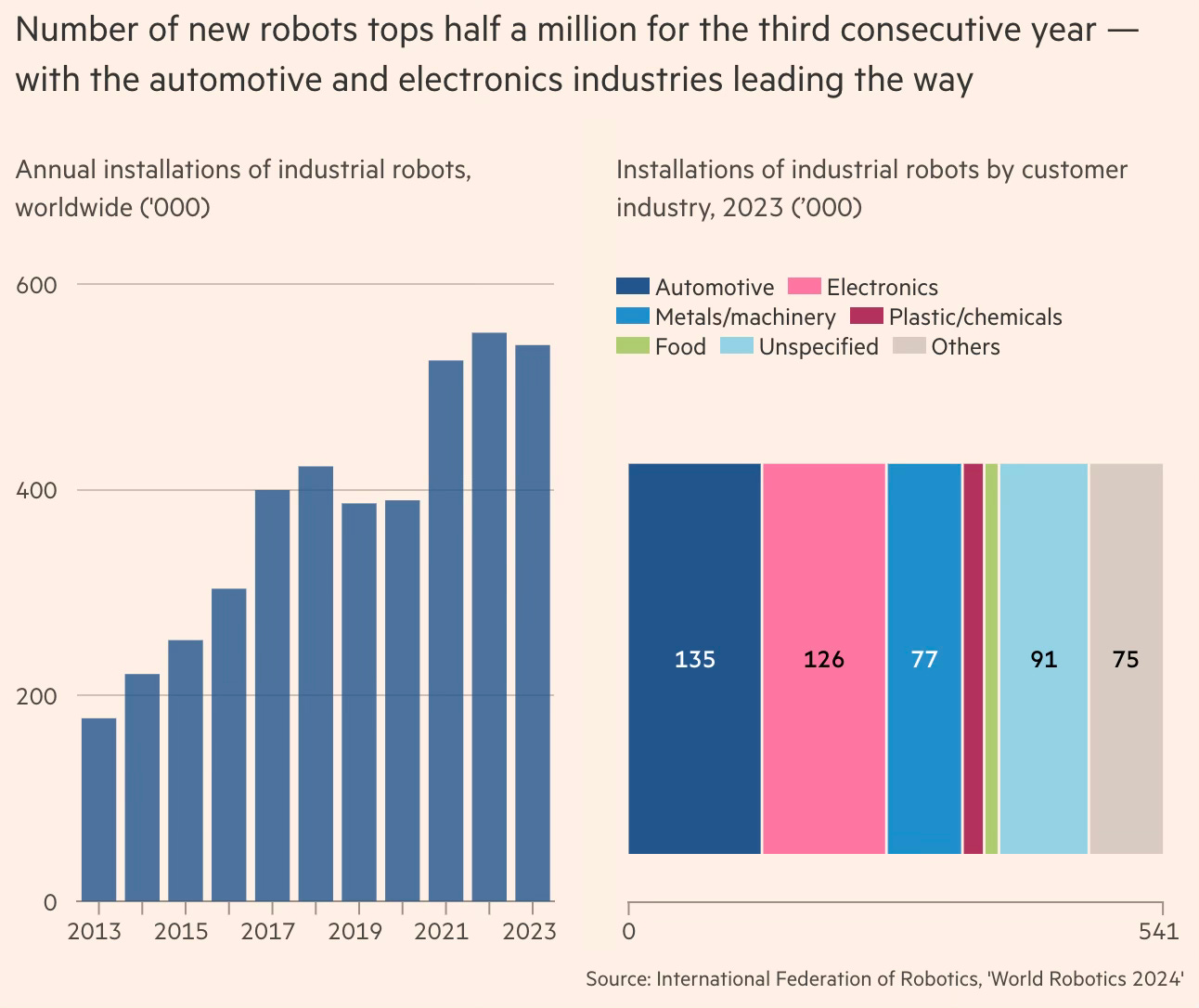
Since General Motors first put robots on assembly lines in the 1960s, carmakers have been pioneers in automation. Yet until the rise of AI, other industries — ones requiring more dexterous tasks, or where robots might need to respond to unpredictable or hazardous environments — struggled to follow suit… Manufacturing companies in particular have invested heavily, with total installations of industrial robots rising by 12 per cent to over 44,000 units in 2023 — the largest volume in at least a decade, according to the International Federation of Robotics. Again, the car industry has led the way, followed by electrical and electronics companies… 

On their annual trip to the Consumer Electronics Show in Las Vegas last year, members of the Culinary Union, which represents staff at casinos in the city, were shocked to see robots frying food and making cocktails… In 2022, real estate developer The Durst Organization’s venture arm invested in the maker of a glass-washing robot, Skyline Robotics, based in Israel. The Ozmo robot can now be seen scrubbing the windows of a skyscraper near Times Square… “It’s very understandable to me why that next generation isn’t showing up,” says Skyline Robotics president Ross Blum. “It is a really tough job . . . Who wants to go hang 1,000 feet in the air today and do manual labour outdoors?”

Worsening the problem is the challenges associated with labour market adjustments arising from automation. 

MIT economist Daron Acemoglu says that robots’ current capabilities mean that those most at risk of being displaced are in blue-collar jobs and lack college degrees, which may make it difficult for them to shift into the high-tech roles likely to be created by automation.

Consider the market forces at play that have driven the search for labour-saving technologies

Jobs that looked like they could only be done by people suddenly look risky; economists have warned of wholesale and disruptive changes to the workforce as machines are capable of more and more… Adding to the pressure in economies like the US, say business owners, is sluggish growth in the labour force, which is making it increasingly hard to recruit workers. President-elect Donald Trump’s plans for mass deportations… will probably only intensify such concerns… Salary increases experienced by many Americans in the past few years have come at a cost… it makes the US somewhat uncompetitive… As the population ages and families struggle to find childcare, the share of Americans in work or seeking work has been declining for decades — dropping from 67.3 per cent in 2000 to 62.5 per cent late last year. Economists estimate that it will sink to 60.4 per cent by 2030.

US investors have piled more than $15bn into robotics start-ups since 2019, according to PitchBook, and the remarkable growth of artificial intelligence in the past 18 months has begun to show dividends… US venture capital investment in robotics has risen from around $2bn in 2019 to more than $3.5bn last year, according to data from PitchBook. In the first nine months of 2024, there were 130 fundraising deals for robotics start-ups — more than across the entirety of 2019. Among the most high-profile was a $675mn investment last February by Amazon founder Jeff Bezos, Microsoft and Nvidia in Figure AI, a Silicon Valley start-up founded in 2022 that is working on a faceless, humanoid “general-purpose” robot. It said that month that these robots — whose cost to customers is estimated at between ​​$30,000 and $150,000 — could complete tasks including moving a box on to a conveyor belt, potentially endangering the job of anyone working in, say, a distribution centre. The first models were delivered to a “commercial client” last month.

The article points to the ILA’s concern at containerisation being a case of once bitten twice shy.

Before the advent of containerisation, longshoremen spent long days unloading individual boxes, barrels and crates, then transferring their contents on to trucks and freight trains — dangerous but reliable, well-paid work that, at its peak, employed an estimated 100,000 men in ports around the US. After the trucking entrepreneur Malcom McLean championed the 8ft-wide steel container in the mid-1950s, that world fell away. The new technology meant that cargo could be transferred with a minimum of effort and drastically reduced costs. Tens of thousands of jobs disappeared almost overnight. Despite a huge increase in world exports, the number of longshoremen employed at the Port of New York and New Jersey plummeted from 55,000 in the 1950s to about 4,000 today, says Jean-Paul Rodrigue, a professor of maritime business at Texas A&M University… 

When semi-automated cranes were first brought in to terminals on the east coast of the US in the early 2000s, ILA leaders say they agreed to the changes because it would help create jobs. But they now say that the opposite happened… A 2022 survey commissioned by the west coast dockworkers’ union found that partial automation of the ports of Los Angeles and Long Beach resulted in the loss of nearly 1,200 jobs in 2020 and 2021. USMX says that because most of the ports its members operate have no spare land available, the only choice is to “densify terminals” by adding machinery that speeds up operations. In a conventional crane, an operator sits inside a cab, lifting containers off ships and sorting them, before transferring them to trucks or trains — a highly skilled job that can earn workers as much as $200,000 annually. In a semi-automated rail-mounted gantry crane (RMG) system, the operator works remotely from an off-site office, monitoring the crane via video link but letting the system do most of the work. The job requires similar skills and training, but fewer people are required… But USMX describes calls to ban automation as “unworkable”, saying that modern crane technology has “nearly doubled” both the throughput of containers and the number of workers at the ports using it.

So how is labour adjusting to the emerging trends?

In recent years, both retail and culinary unions have negotiated clauses in contracts they hope will protect human workers. Las Vegas casinos are now required to give people six months’ notice before implementing new technologies and free training on how to use them, plus severance packages for anyone laid off because of technology. UPS has agreed to negotiate with the Teamsters, one of the most powerful unions in the US, before introducing drones or driverless pick-up vehicles. New York retail stores whose workers are represented by RWDSU, including Bloomingdale’s and Macy’s, also require management to come to an agreement before introducing new technologies.

This has relevance to developing countries like India.

The adoption of labour-saving technologies by companies in developing countries is likely to lag behind those in developed countries. This is a good thing. Given the abundance of cheap labour, the economic case for automation has limits. Further, the vast informal sector, with its deeply price-sensitive consumers, too is unlikely to be disrupted significantly. 

However, the pace of adoption will be significantly higher in those sectors competing globally and among the biggest firms, which are also the creators of good-paying jobs. Consider AI-based automation displacing lower and middle-level software jobs, which comprise the vast majority of well-paying services sector jobs. Or the automation of assembly lines in textiles, footwear, electronics, consumer durables, automotive etc., which make up the vast majority of well-paying manufacturing jobs. The disruption in the former can be immediate and more gradual in the latter. 

In other words, in developing country contexts, the biggest adverse impact of labour displacing technologies is likely to be in the large layer of good jobs that pay reasonably well at the entry and middle levels. They are the lifeboats to enter the middle class.

If this trend starts to surface, it’ll invariably trigger a backlash and create the conditions for populist narratives, with all their risks of distortions and perversions. It’s therefore important that governments realise the strong likelihood of such developments and calibrate policies in this direction. 

Accordingly, there’s an increasingly strong case to align industrial policy to both encourage job-creating economic activities and also discourage the adoption of labour-saving practices and technologies. While the former has always been a salient feature of industrial policy, it’s now time for the adoption of the latter. 

This would entail shifting away from capital investments that lead to automation towards labour subsidies. The PM Internship Scheme, if scaled up in a realistic manner, is the right kind of policy for the times. As an illustration, a Rs 100 Cr capex subsidy is equivalent to providing 50% of the salary for five years for 1250 workers with a starting cost to the company of around Rs 22000 and increasing annually at 10%. At a more realistic 33% and 3 years, the same labour subsidy can employ nearly 3500 workers. This can be a significant incentive for businesses and an entry point for a better life for blue-collar entrants. 

Such industrial policy could discourage assembly line automation in manufacturing. Similarly, it should be examined as to whether tax policies can be carefully tweaked to encourage software companies to develop business models that can accommodate the displaced manpower in other activities/areas. Taxation policies that incentivise manufacturing and R&D should be revisited to keep these challenges in mind. 

From the labour market side, there will be demands to institutionalise as policy mandates the protections being negotiated in the US by labour unions. I’m not sure about its advisability. 

Such policies can create perverse incentives, and administering them can be hard. It’s therefore essential to be flexible with them. 

But they cannot be ignored for too long given the scarcity of good jobs for a rapidly growing pool of labour market entrants, and the strong likelihood of brewing discontent spilling over into some form of undesirable populist backlash.

Saturday, July 22, 2023

Weekend reading links

1. Automation fact of the day

Ford’s revamped electric-vehicle (EV) plant in Cologne, located on the banks of the Rhine in Germany’s industrial heartland, is one such example. The chassis and bodies of vehicles are coated in chemicals to prepare for painting and to prevent corrosion. This happens across multiple storeys; the number of workers involved in the work on site is precisely zero (two keep tabs remotely). Shiny yellow assembly robots further down the production line are sufficiently advanced as to be able to mostly monitor themselves. Although workers are required for assembly—about as many as for traditional petrol-powered vehicles—the activity requires a lot more training. This matches the national picture: according to a study by Wolfgang Dauth of the Institute for Employment Research and co-authors, industrial robots have made available work more complex.

2. For those scorning at industrial policy and government role in market making, look no further than the work of Indian Space Research Organisation (ISRO)

India has become home to at least 140 registered space-tech start-ups, comprising a local research field that stands to transform the planet’s connection to the final frontier. It’s one of India’s most sought-after sectors for venture capital investors. The start-ups’ growth has been explosive, leaping from five when the pandemic started. And they see a big market to serve... anticipates a global need for 30,000 satellites to be launched this decade... Driven more by private enterprise than by gigantic government budgets, space technology is fulfilling smaller-scale, commercial purposes. Imaging systems feed information about the planet back to Earth, helping India’s farmers insure their crops or commercial fishing fleets track their catch. Satellites bring phone signals to the country’s remotest corners and help operate solar farms far from India’s megacities. Since June 2020, when Mr. Modi announced a push for the space sector, opening it up to all kinds of private enterprise, India has launched a network of businesses, each driven by original research and homegrown talent. Last year, the space start-ups raked in $120 million in new investment, at a rate that is doubling or tripling annually...

As ISRO, pronounced ISS-ro, makes room for new private players, it shares with them a profitable legacy. Its spaceport, on the coastal island of Sriharikota, is near the Equator and suitable for launches into different orbital levels. The government agency’s “workhorse” rocket is one of the world’s most reliable for heavy loads. With a success rate of almost 95 percent, it has halved the cost of insurance for a satellite — making India one of the most competitive launch sites in the world... there is money to be made launching equipment into space: That market is worth about $6 billion this year and could triple in value by 2025... India’s vendor ecosystem is staggering in size. Decades of doing business with ISRO created about 400 private companies in clusters around Bengaluru, Hyderabad, Pune and elsewhere, each devoted to building special screws, sealants and other products fit for space. One hundred may collaborate on a single launch.

In recent times, Elon Musk's Space X has dramatically altered the economics of space launch. 

His company, SpaceX, and its relaunchable rockets brought down the cost of sending heavy objects into orbit so much that India could not compete. Even today, from American spaceports at $6,500 per kilogram, SpaceX’s launches are the cheapest anywhere.

This is a great opportunity for Indian startups to break the mould (of being mere copycats) and leverage the strong ecosystem and foundations for satellite launches and dominate the global market. 

3. Pointing to the enormous potential for growth in mutual funds in India, it emerges that they are just a fifth of the total bank deposits.

4. Russia responds to the sanctions by expropriating the assets of western companies based in the country that have closed down operations. The long-term damage of these actions to Russia's credibility among international investors is serious. 

It's ironical that the two strongmen leaders of China and Russia have arguably done more long-term damage to their countries interests than any enemy could ever have achieved. 

5. Shyam Saran points to a possible Japanification of China
Inflation in China is remarkably low and it is an outlier in this respect. This is the result of weak demand and a fall in producer prices. This could be the start of a deflationary phase of the kind Japan experienced in the early 1990s, brought on by a combination of a property bubble bursting, bad debts multiplying and a rapidly ageing population. Japan went from constituting 18 per cent of the global economy in 1990 to only 8 per cent in 20 years.
Despite repeated policy announcements that the Chinese economy must shift from being investment-driven to one that is driven by rising consumption, this has not happened so far. Consumption is still at a relatively low level of 40 per cent compared to over 60 per cent in most mature economies. The Covid pandemic, spanning three years, has dampened consumer demand, and stagnant or falling incomes have made the situation worse. An article in the Nikkei reports that retail sales in China are still 10 per cent below the level reached pre-Covid. Chinese are saving more and these are mainly precautionary savings because the overall economic outlook has worsened. The household saving rate currently is 3 per cent above pre-Covid level, which suggests a continuing reluctance to spend.

As property markets are on their longest ever losing streak, there's pressure mounting on the government to undertake some form of pump priming. The government has so far resisted such measures, preferring to let the markets decline and thereby gradually lower the excessive dependence of the economy and local governments on property prices.

6. Ruchir Sharma has some statistics on the burgeoning US deficits and public debt stock,
During the pandemic, the US budget deficit tripled to more than 10 per cent of gross domestic product, more than double the peak in other developed economies. In coming years, the US deficit is expected to average close to 6 per cent of GDP — well above its historic norm, and a full six times the average in other developed economies... all the $6.7tn in new spending from the Biden administration came after 2020 was over. Most of it had nothing to do with pandemic relief. Instead, Joe Biden used the sense of crisis to launch a latter-day New Deal, building infrastructure and industry ostensibly to compete with China and combat climate change... The US has been running deficits almost every year since the 1960s without triggering a serious financial crisis. So the conventional wisdom is that deficits don’t matter. Many economists argue that they pay for themselves if the economic growth generated by new public spending exceeds the government’s interest payments. That feat was easier to achieve when interest rates were near zero, however. Now that rates are rising, it’s almost impossible...

Through 2025, the trillions unleashed by this administration will push government spending up to 39 per cent of GDP, most of it not covered by new revenue... the US deficit is still projected to hover near 6 per cent of GDP throughout the next decade... While inflation did spike worldwide, it did so most sharply in nations that spent the most during the pandemic. Few spent more than the US. A recent study from the Federal Reserve attributed two-thirds of America’s recent inflation surge to excess demand, and half that increase in demand to deficit spending... it is now one of the most fiscally irresponsible nations. Its deficit has climbed the ranks to worst in the developed world, its public debt is already the third highest after Japan and Italy.

7. Scott Galloway has a great post that touches on many aspects, including Silicon Valley billionaire vanity, 

The Dunning-Kruger effect is a cognitive human bias that causes us to overestimate our abilities in domains where we have low competence. This acutely affects some in the venture capital and tech communities. Enabled by their public profiles, wealth, and tech bro enablers, these folks shapeshift from one week to the next into geopolitical experts and constitutional law scholars and computer scientists. The less they know about a topic, the more confident their tone. We’re all enablers re Elon. If Zuckerberg announced he was building an EV or multistage rocket, wouldn’t we question the industrial logic?

This point about Musk's dramatic retrenchments at Twitter is instructive,

The business strategy that marked 2023 is not leveraging AI or adopting hybrid work, but focusing on bloat. Specifically how to reduce it. Whether you’re a critic or a stan, Elon’s 80% reduction in the bird’s workforce is the most impactful business decision of the year... The result is the Nasdaq’s best first half in four decades, fueled by the nitro and glycerin of AI hype and profits increasing thanks (mostly) to cost cutting. A new generation of business leaders discovered that a firm with a 20% operating margin can see as big an increase in value by cutting costs $1 billion as it can by increasing revenue by $5 billion. For all the complaints from Musk critics about a buggy site “on the precipice of crashing,” he’s maintained a minimum viable product while shedding 4 in 5 employees in six months... Elon didn’t fire 6,000 employees at Twitter, he (effectively) terminated over 300,000 workers across tech. Because every other tech CEO felt they could have the great taste of reduced expenses while avoiding the calories of collapsing revenue. Elon fired people for arbitrary reasons or no reason at all.

This on the spectacular implosion at Twitter

Twitter’s implosion is historic. There has never been a firm in the modern economy that’s fallen this far, this fast that has not been accused of fraud... The erosion of Musk’s guardrails as money and sycophants melt whatever better judgment or grace he had has resulted in a reputation experiencing the same trajectory as Twitter’s revenue. If Elon had never downloaded the micro-blogging app he’d be much wealthier and universally revered for his formidable accomplishments. Instead, he’s set a land speed record for hero to villain.
8. Very interesting set of graphics on Indian oil purchases from Russia over the last year. Since April 2022, India's oil imports from Russia have grown more than ten-fold, with its market share surging from 2% to 24.2%, touching 40.4% in May 2023. OPEC's share of Indian imports fell from 75.3% in May 2022 to 40.3% in May 2023.
The Russian oil has come at a discount, though risk pricing on freight, insurance etc has lowered the discount. 
Interesting that Gulf (Saudi and UAE) oil was the most expensive, compared to even the US and Iraqi oil.
9. Naushad Forbes makes his recommendations for increasing R&D spending in India. 
Indian industry invests around 0.25 per cent of GDP in in-house R&D, to a world average of 1.4 per cent. Indian government spending on R&D, at 0.3 per cent of GDP, is reasonable by world standards. The problem is that unlike the rest of the world, research is not done in universities but in autonomous government institutes. Consequently, India allocates a mere 0.04 per cent of GDP for research done within the higher education system. So what we need to fix is clear: Indian industry must scale its investment in in-house R&D by at least a factor of five. And investment in publicly-funded research within the higher education system must grow eight times.

He points to the promise of the new National Research Foundation (NRF) that gets Rs 50,000 Cr over five years, or Rs 10,000 Cr a year, for research in higher education (in academic research institutions and not autonomous national laboratories), in both public and private institutions. This would double the research done in higher education system. This is interesting

Stanford, a private university, which in 2022-23 spent $2 billion (Rs 17,000 crore, more than every higher education institution in India put together) on research.

There's a bit of populist rhetoric, laced with hypocrisy, in the recommendation for governance of the NRF

Instead, getting a fully professional board (read: No bureaucrats!), headed by an illustrious professional willing to devote the time and energy this needs, would be a far more effective solution.

Such rhetoric does more harm than good. These are the same "illustrious professionals" who have headed Indian corporates and had great opportunities to themselves contribute to the identified failure of abysmal corporate R&D spending! Post-retirement sinecures for corporate executives are just as corrosive as that for bureaucrats.

10. Finally, interesting review of a book on Macquarie, the Australian investment bank firm famous for its infrastructure funds. Its origin can be traced to Hill Samuel, a venerable old British merchant bank and famous for creating the oil company Shell. 

The authors show Macquarie’s culture was far more important than any particular business deal, strategy or innovation, with several of its peculiarities going back to the bank’s early days. The philosophy of David Clarke and Mark Johnson, who built Hill Samuel Australia in the 1970s, “was to give employees as much latitude as possible, while remaining consistent with safety and controls”. Throughout Macquarie’s history there has been little top-down strategy or capital allocation. Instead, the company empowers entrepreneurial individuals to evolve new business lines, from 24-hour foreign exchange dealing in Sydney, to gold bullion arbitrage with London, cash management trusts, cross-border leasing and later ideas in infrastructure and commodities. 

Macquarie loved to explore “adjacencies”. If it was doing well in gold bullion, it could push into other metals. Once it had pioneered infrastructure finance in Australia, it could take the same model abroad, making small bets, each with the potential to grow into a large business. Those that failed, Macquarie quickly shut down; those that succeeded got capital to grow, and the individuals behind them became exceedingly wealthy. Central management was there to support and monitor, while enforcing strict risk controls — another early part of the culture — to make sure nobody blew up the bank. Described like this, Macquarie does not sound so magical, but it is a rare management that truly backs its staff. Macquarie’s approach also differs notably from the strategies that European banks deployed on Wall Street: no transformational acquisitions, no mass hirings of mercenaries from larger companies, no attempts to buy market share by deploying a large balance sheet, and no promises to offer a full range of services — all approaches that led to bloated cost structures and unwise risk-taking.

Sunday, January 23, 2022

Weekend reading links

1. From a few months back, Andy Mukherjee peers ahead into the future of banking in the Indian context,

Google Pay wants to push time-deposit products of small Indian banks that don’t have much of a retail liability franchise of their own. According to a press release, Equitas Small Finance Bank will offer Google Pay customers up to 6.85% interest on one-year funds as part of a “branded commercial experience” on the platform... The move has global significance. It shows the tenuous nature of the hold financial institutions have on a core operation like deposit-taking, and their vulnerability to an assault from online search, social media and e-commerce behemoths. Alphabet, Facebook Inc. and Amazon.com Inc. may pose a far bigger challenge to brick-and-mortar lenders than fintech startups that don’t have the scale of platform businesses. Just like in India, deposit-strapped challenger banks might throw the keys to tech intermediaries with hundreds of millions of active users. When the giants storm the fortress, even larger banks will lose control of banking..

China’s homegrown tech titans have already shown how easy it is to dislodge traditional lenders from lending... India’s deposit-taking institutions don't have any special advantage left in moving retail money. Yes, they still hold the accounts for sending or receiving funds. But rather than transacting on their bank apps or cards, customers prefer to use Google Pay or Walmart Inc.’s PhonePe to pay one another and merchants... Since it won’t even take two minutes for a platform to book deposits from scratch, if another lender offers a better deal, idle funds might go there next. Customer loyalty, which is often just plain inertia, will no longer ensure stickiness... For a fee, platforms can easily extend their insights into consumer behavior and payment flows to influence deposit mobilization. The higher the commission, the lower the banks’ profit... Regulated institutions may be left holding a license to take deposits--and a thick rule book accompanying that privilege--but platforms will decide if a bank’s promotional offer is to be displayed prominently or buried in an obscure corner. The same slow, painful decline that gutted the print media after readers and advertisers moved online and publishers lost their sway over them may be waiting in the wings for banking, too.

2. FT has an interesting report on Dominic Cummings, former chief of staff to Boris Johnson and one of the leading forces behind his Brexit campaign. Cummings who courted numerous controversies during his tenure with Johnson at 10 Downing Street had a very bitter break-up with his boss, and is now leading a concerted campaign of leaks and media attacks to bring down Johnson.  

When he was at 10 Downing, Cummings, with his views on technocracy and scorn for the bureaucracy, had become a sort of poster child for tech-enthusiasts and supporters of bureaucratic reform. But as events since have shown, his hypocrisy and duplicity in trying to unseat Johnson reveals a dangerous and petty mind, one who is best kept as far away from the public realm as possible.

3. Business Standard reports on the near extinction of Indian mobile phone makers and the rise and rise of Chinese ones. 

To give a sense of the scale of opportunity, the Chinese makers sold over Rs 1.45 trillion worth mobile phones between January-October 2021. 

4. On the topic of Indians being successful outside India, there may be couple of statistical factors. One, Indians who emigrate are more likely to be the best and brightest, and therefore a super high quality pool with significant likelihood of spawning corporate leaders. Second, within the high quality pool of emigrants to the US, Indians are among the largest and naturally more likely to contribute such corporate leaders.

As I have written earlier, it's intriguing that all these highly successful Indians are concentrated as managers and executives, and there is hardly any presence in the ranks of similarly successful entrepreneurs. It does say something about the general nature of the emigrants. 

5. India's formal sector too may not be out of the woods,

Since the onset of the pandemic, the Employees’ Provident Fund Organisation (EPFO) has allowed members to avail of an advance to deal with expenses arising from Covid-19. Data from EPFO shows that between April 2020 to September 2021, 1.5 crore such claims were received. This implies that 23 per cent of India’s formal labour force (an upper limit, based on those contributing to EPFO) has availed of this facility. (Members were allowed to do so twice from June 2021). Of these 1.5 crore claims, 87.2 lakh were received in 2020-21. This works out to an average of 7.26 lakh claims per month. In comparison, in just the first six months of 2021-22 (April-September), 63.4 lakh such claims were received, at an average of 10.5 lakh per month. This suggests that not only has the formal labour force continued to face economic hardship, but also that it has been of a similar if not higher magnitude in the ongoing financial year.

It would be useful to compare these trends with the pre-pandemic share of EPFO members availing advances.  

6. Ganesan Karthikeyan has an interesting article where he argues that the endgame for Covid 19 has began. He claims that unlike till now, when the dominant mutants seek to maximise transmissibility, once large proportion of population are either immunised or infected the mutations that provide the virus with an evolutionary advantage are ones that help it evade immunity. Such mutants are more likely to produce milder illnesses so that its transmissibility is less reduced. 

He also makes an interesting point about what happens when the pandemic ends,

As has already become evident, we aren’t going to have lifelong protection after infection or vaccination. It is reasonable to expect that the virus will continue to mutate to evade immunity. Of the several unsavoury scenarios, one optimistic (and perhaps also likely) possibility is that the virus continues to circulate but infects only people without immunity — children born after the pandemic, older adults, or others with waning immunity. These vulnerable individuals will continue to require vaccination. This is presumably what happened after the 1918 pandemic. That virus now causes seasonal influenza.

Excellent primer on Omicron with links to latest research.  

7. The Economist makes an important point about China's AI ambitions

Despite leading America in the overall number of AI-related publications, China produces fewer peer-reviewed papers that have academic and corporate co-authors or are presented at conferences, both of which are typically held to a higher standard. It ranks below India, and well below America, in the number of skilled AI coders relative to its population. These shortcomings are likely to persist, for three reasons.

First, capital may not be being allocated efficiently... Beijing has created a system for rewarding local officials that favours debt-fuelled spending and seldom punishes wastefulness. Many state AI investments have been “reckless and redundant”... Jeffrey Ding of Stanford University. Zeng Jinghan of Lancaster University has documented the rise of firms that falsely claim to be developing AI in order to suck up subsidies. One analysis by Deloitte, a consultancy, estimated that 99% of self-styled AI startups in 2018 were fake... China’s second problem is its inability to recruit the world’s best AI minds, especially those working on high-level research... Though about a third of the world’s top AI talent is from China, only a tenth actually works there. A shortage of non-Chinese researchers further handicaps China’s capabilities... Even more problematic for the party, its master plan ignored the cutting-edge semiconductors that power AI. Since its publication Chinese companies have found it ever more difficult to get their hands on advanced computer chips. That is because virtually all such microprocessors are either American or made with American equipment. As such, they are subject to restrictions on exports to China put in place by Donald Trump and extended by his successor as president, Joe Biden. It will take years for Chinese companies to catch up with the global cutting-edge, if they can do it at all.

8. Scott Galloway points to the graphic that shows more than half US corporate profits are booked in tax havens, compared to roughly 5% in 1966.

9. Vivek Kaul argues in favour of a K-shaped recovery by pointing to the stagnant affordable housing market (compared to the rising higher income housing credit off-take) and declining two-wheeler market volumes (compared to the rising cars and vans market).

This on housing credit
And this on two wheelers (lowest in eight years)
This compared with a total of 2.15 m units of cars and vans sold in the nine months to December, compared to 1.78 m in 2020 and 2.12 m in 2019. 

10. As the pandemic continues, the OECD estimates that there are a record 30 million unfilled vacancies among its members. This raises questions about the much discussed concern that the pandemic will hasten automation and kill jobs. The Economist has an article which has links on research which points to the opposite direction,
Considering that so many doubts about the “robots kill jobs” narrative have arisen, it is not surprising that a different thesis is emerging. In a recent paper Philippe Aghion, Céline Antonin, Simon Bunel and Xavier Jaravel, economists at a range of French and British institutions, put forward a “new view” of robots, saying that “the direct effect of automation may be to increase employment at the firm level, not to reduce it.” This opinion, heretical as it may sound, does have a solid microeconomic foundation. Automation might help a firm become more profitable and thus expand, leading to a hiring spree. Technology might also allow firms to move into new areas, or to focus on products and services that are more labour-intensive.

A growing body of research backs up the argument. Daisuke Adachi of Yale University and colleagues look at Japanese manufacturing between 1978 and 2017. They find that an increase of one robot unit per 1,000 workers boosts firms’ employment by 2.2%. Another study, by Joonas Tuhkuri of the Massachusetts Institute of Technology (mit) and colleagues, looks at Finnish firms and concludes that their adoption of advanced technologies led to increases in hiring. Unpublished work by Michael Webb of Stanford University and Daniel Chandler of the London School of Economics examines machine tools in British industry and finds that automation had “a strong positive association with firm survival, and that greater initial automation was associated with increases in employment”... The methodology used by Mr Adachi and his co-authors is particularly clever. One problem is untangling causality: firms on a hiring spree may also happen to buy robots, rather than the other way round. But the paper shows that firms buy robots when their prices fall. This helps establish a causal chain from cheaper robots, to more automation, to more jobs.