Substack

Showing posts with label Sharing Economy. Show all posts

Thursday, March 20, 2025

The great middle class squeeze

I had been thinking of posting on this for some time. There’s now enough evidence to suggest that the middle class globally is feeling squeezed. 

Tej Parikh has an excellent graphics-filled article on the problems being faced by the middle class in developed countries. Middle-class incomes have stagnated, their numbers have reduced, and inflation has worsened matters.

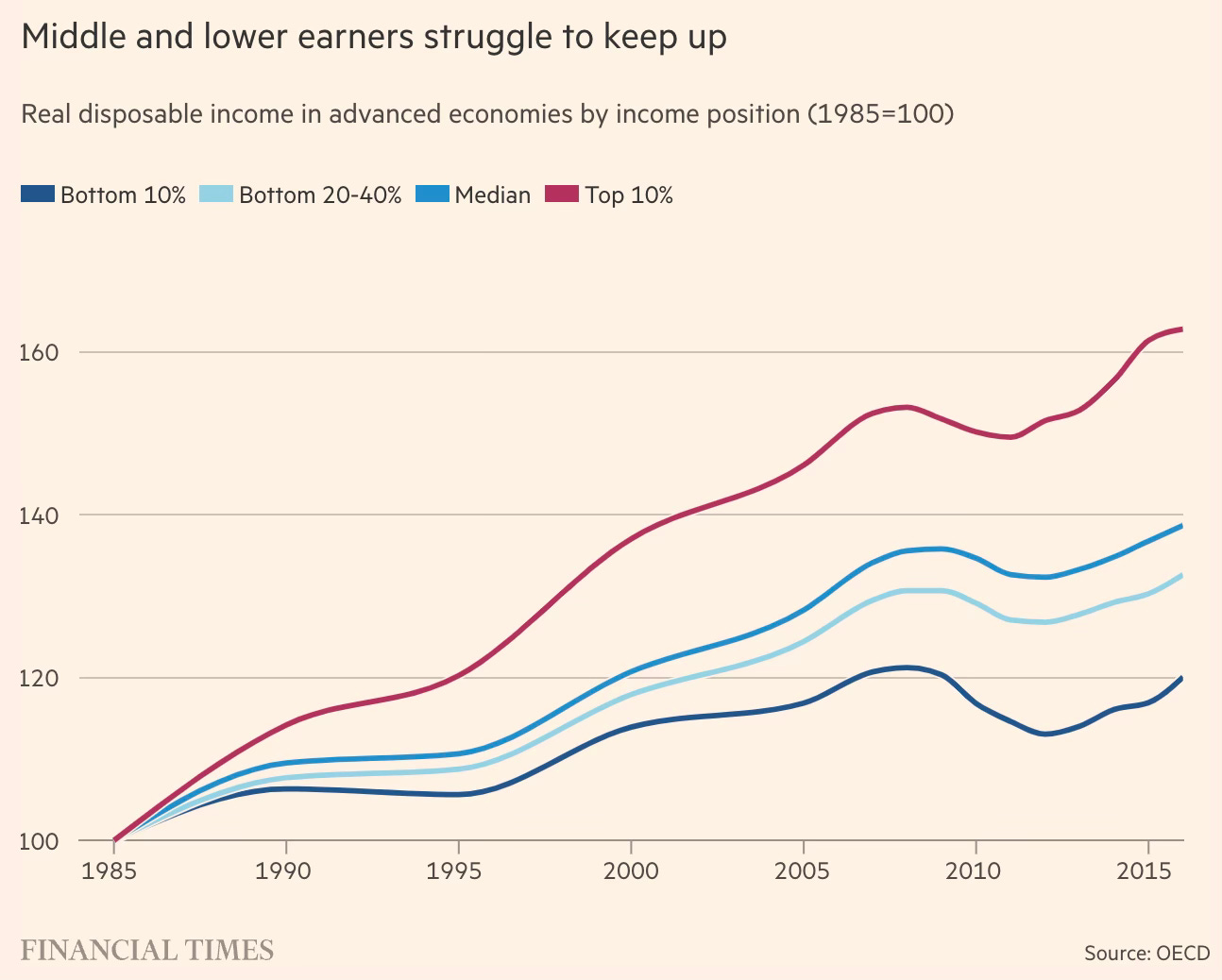
While real incomes at the top have risen, those at the middle and lower ends have stagnated since the financial crisis.
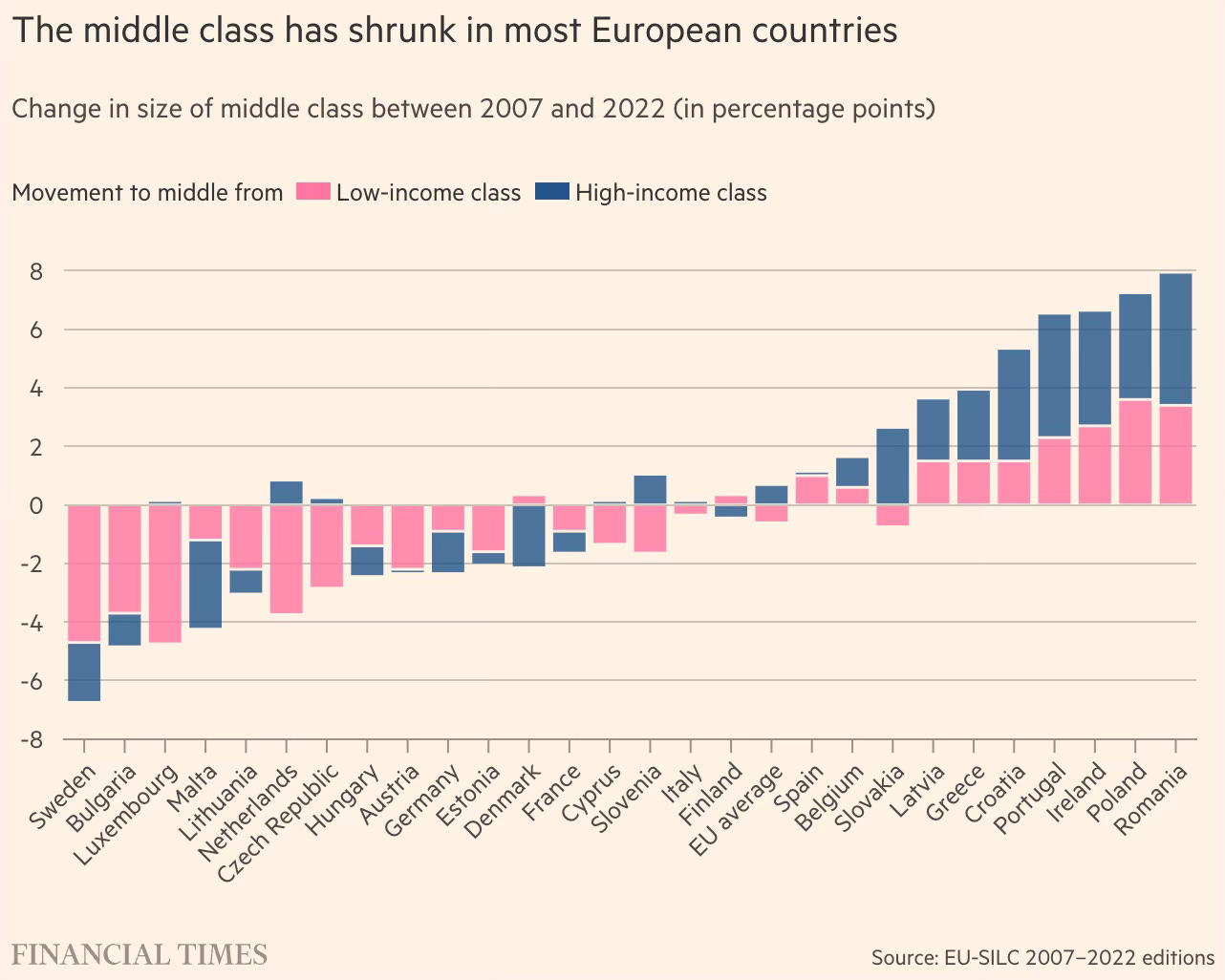
The result is that the middle class has shrunk in many countries. 
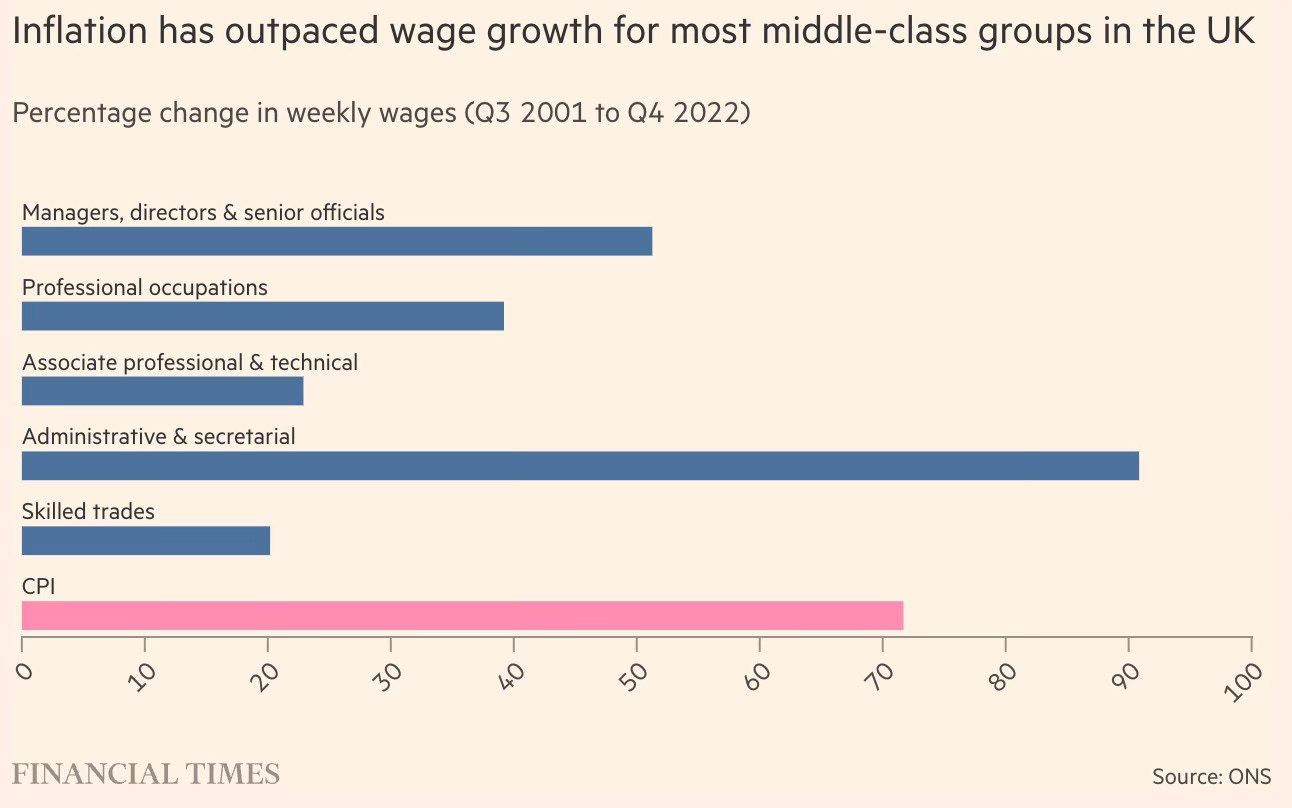
Inflation has been a major contributor. Here’s from the UK on how wage growth has lagged behind inflation.
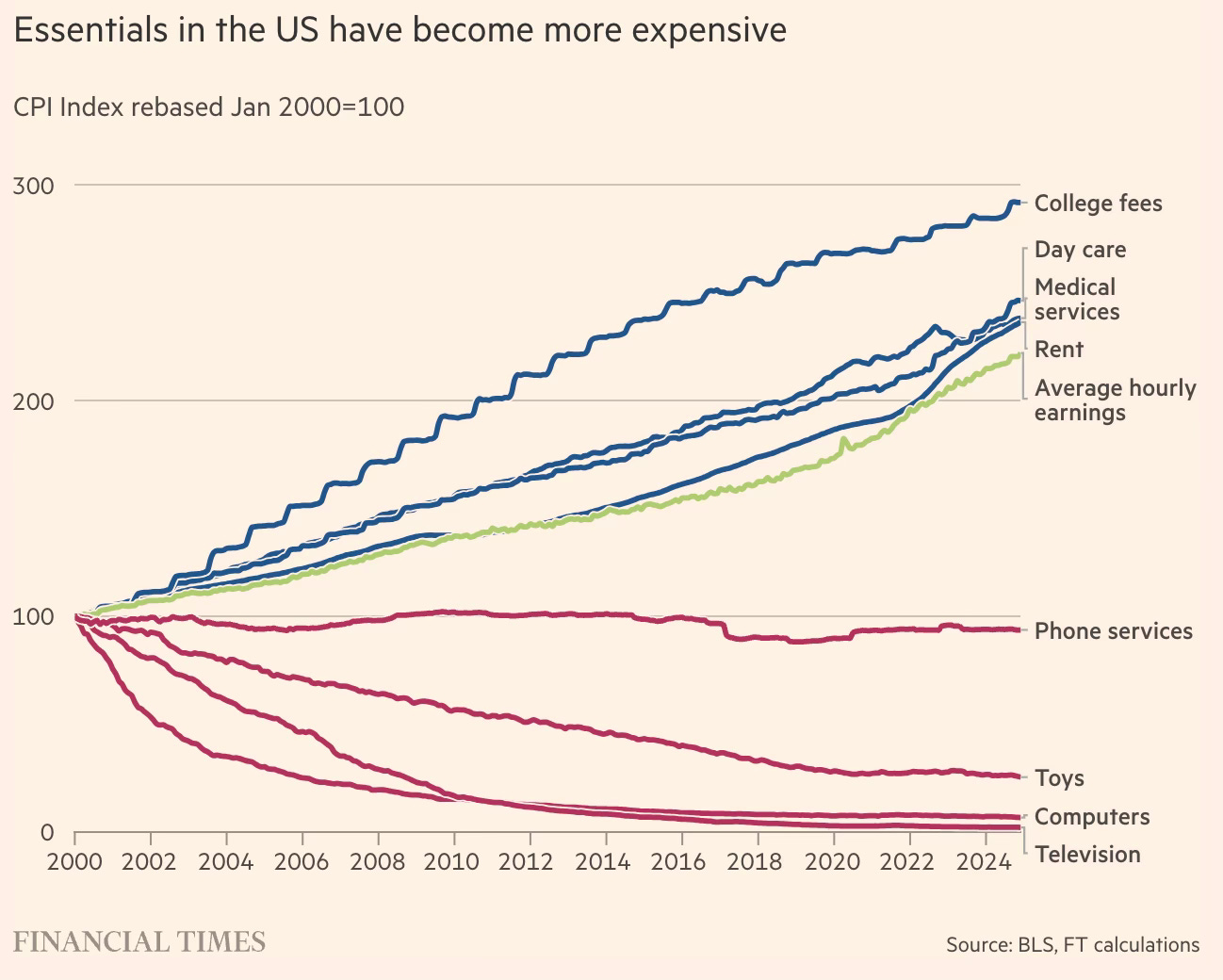
And below from the US, points out that while lower prices of tradeable products have held back inflation, rising costs of non-tradeable essential services have more than offset them. 
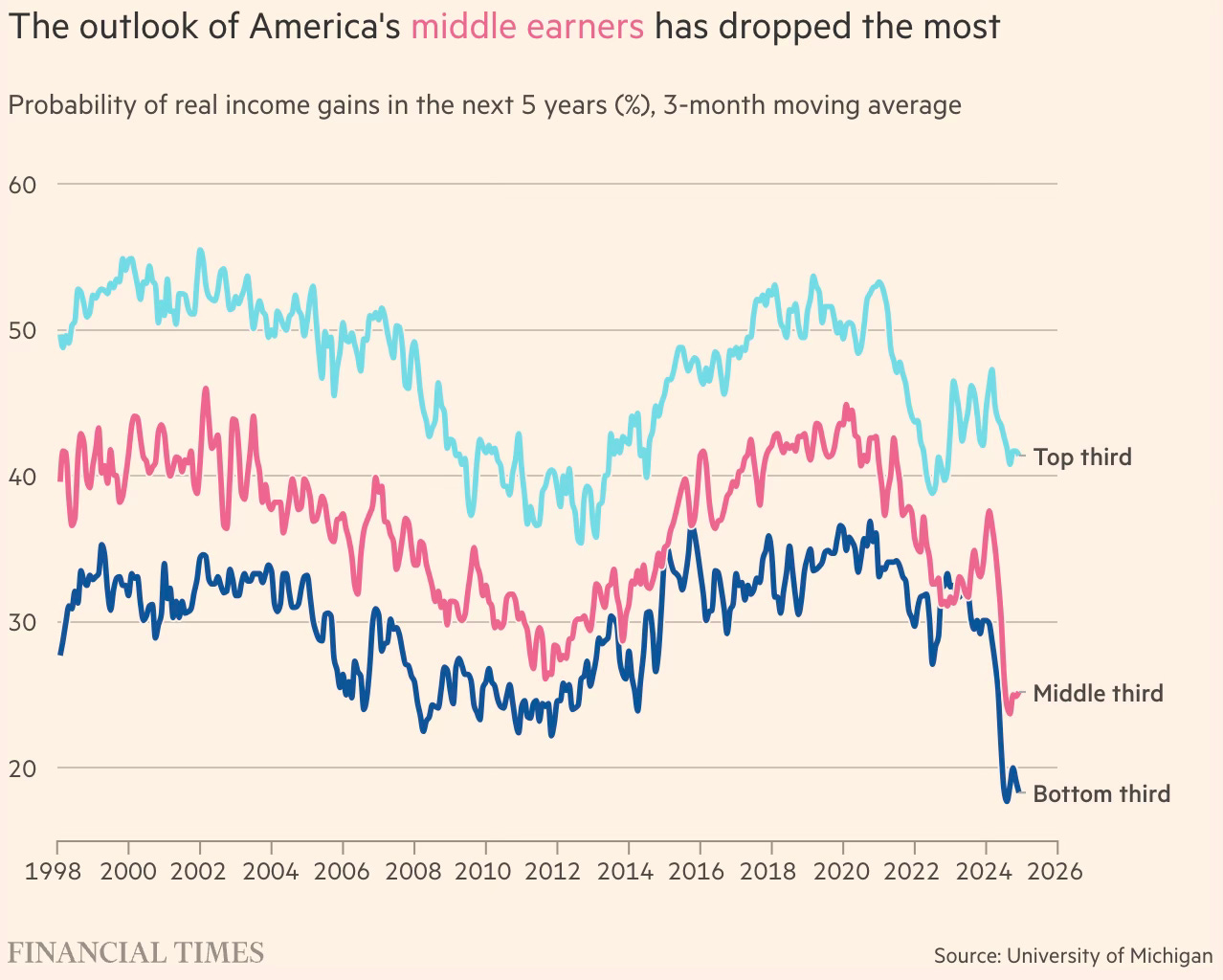
And all this is translating to a middle-class pessimism.
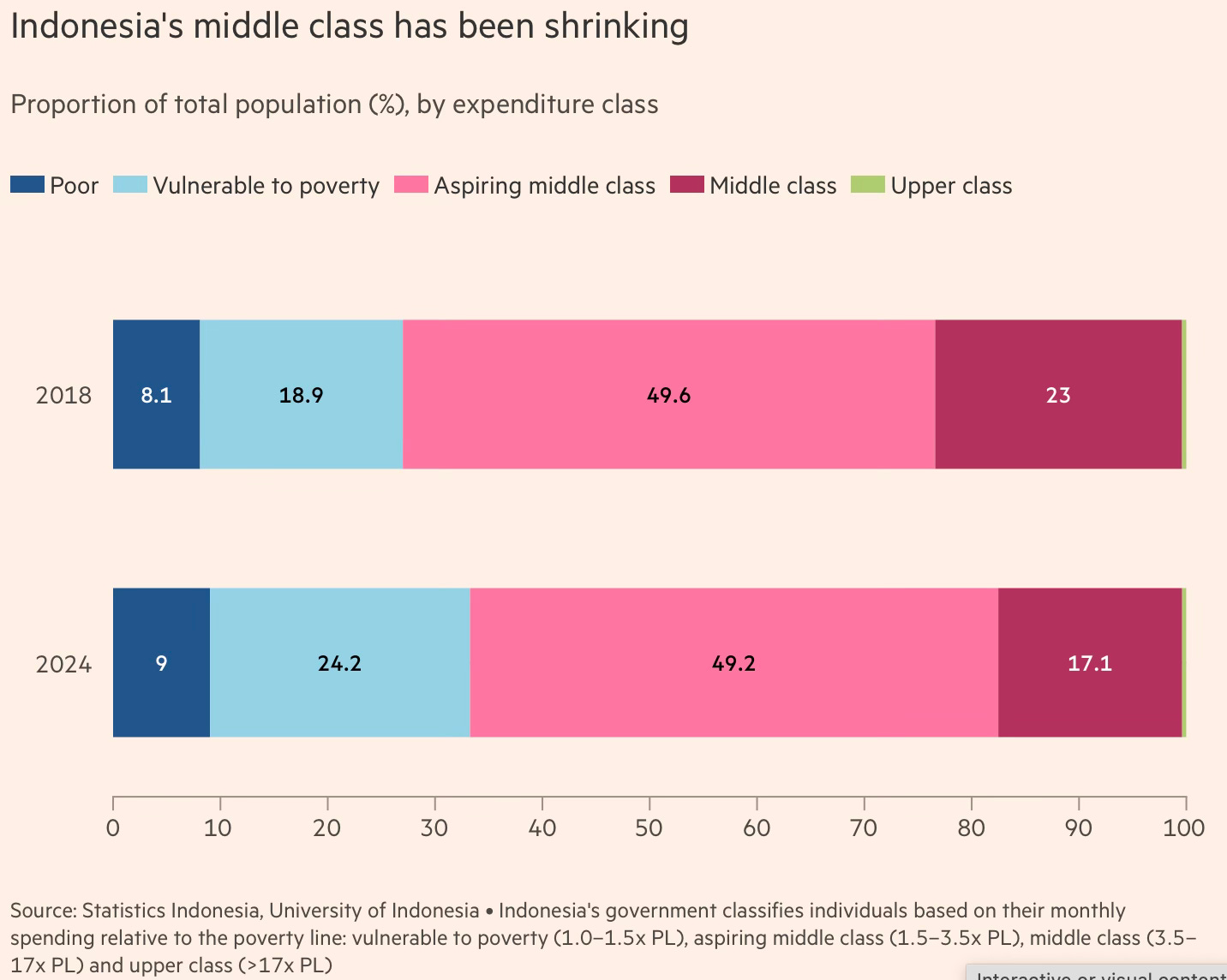
The trend of middle class woes goes beyond developed countries. Another article pointed to the case of Indonesia where middle class (monthly income of $122-605) fell from 47.9 m in March 2024 from 60 m in 2018, down from 23% of the population to 17%. 
See also this on Indonesia’s stock market which fell sharply early this week on the back of fears weakening purchasing power, consumer confidence, and economic growth.

The middle-class squeeze is being felt in India too. India’s fundamental economic problem of a narrow consumption baseis compounded by an economy which is not creating the number of good jobs required to quickly expand the middle-class base to support sustained high growth rates. As I blogged here, the vast majority of job creation is in gig work and the likes of construction, security guards, and housemaids, all of which generate monthly incomes in the range of Rs 15000-20000 and have limited productivity improvement opportunities and occupational mobility. 

See this about the shrinkage of the Indian middle class during the pandemic and this about the small size of its middle class. The problem is amplified by the acutely deficient dynamism in India’s corporate sector, the low level of R&D investments, and rising business concentration

A matter of great concern at the good jobs creation side is the growing share of non-regular workers. The ASI data tells us that in the 2001-02 to 2022-23 period, while the number of workers in formal manufacturing more than doubled from 5.96 m to 14.61 m, the share of contract workers rose from 21.8% to 40.7%. In Bihar, 68.6% of the industrial workforce is contractual, compared to 23.8% in Kerala. Capital-intensive industries have had a greater increase in the share of contractual workers. The Quarterly Employment Survey data tells us that the share of contract employees in nine major non-farm sectors doubled from 7.8% of total workers in April 2021 to 18.44% in July 2022. Even accounting for the cyclicality in certain industries which necessitate the hiring of contract labour, this level of increase is striking. 

Marcellus Investment Managers provide data that points to stagnant middle-class incomes for more than a decade. 
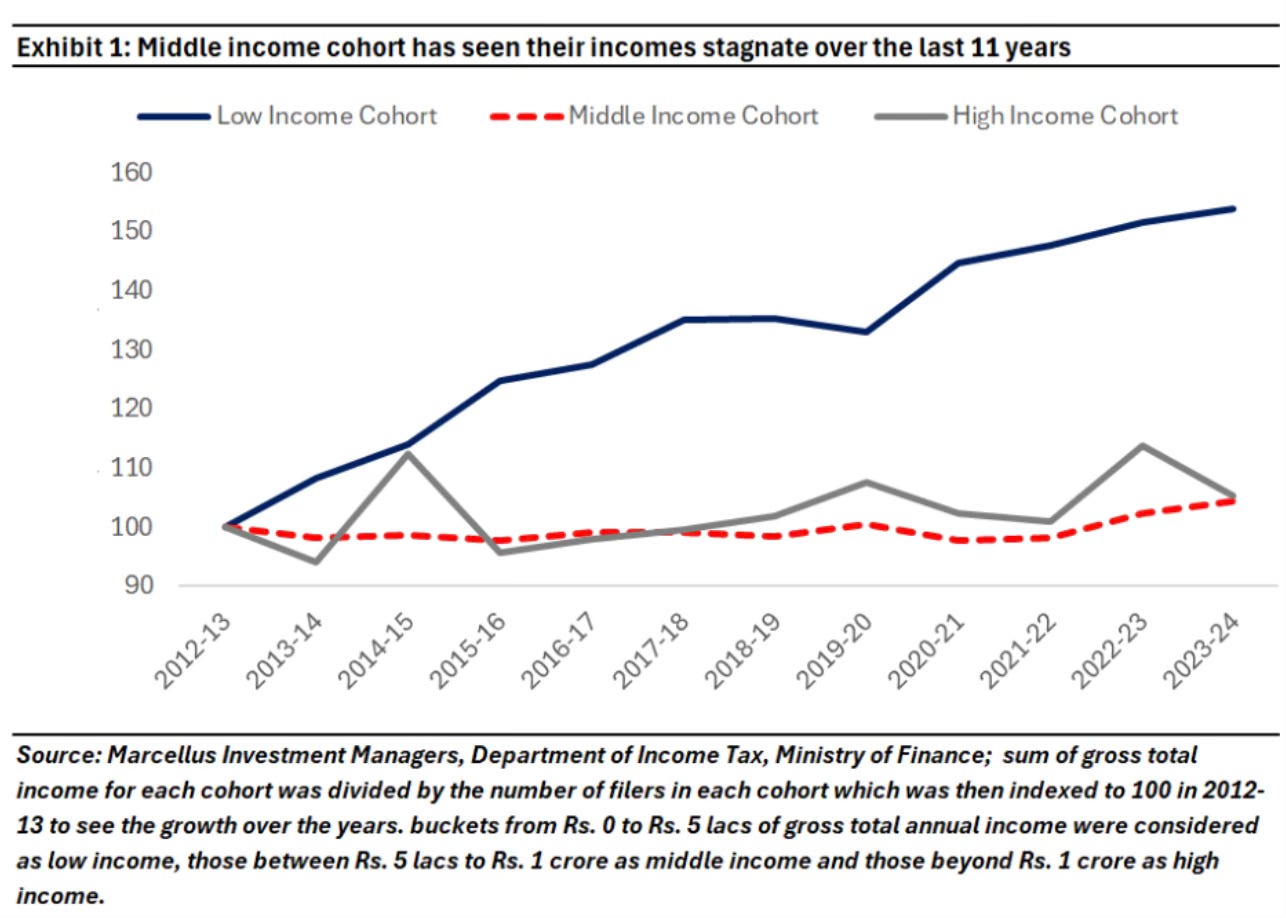
A striking fact presented by them is that the average annual income of the 53% of the taxpayers (2023-24) who filed non-negative tax returns and earns between Rs 5 lakh to Rs 1 Cr per annum have seen their incomes stagnate - average annual income barely moving from Rs 10.23 lakh in 2012-13 to Rs 10.69 lakh in 2023-24!
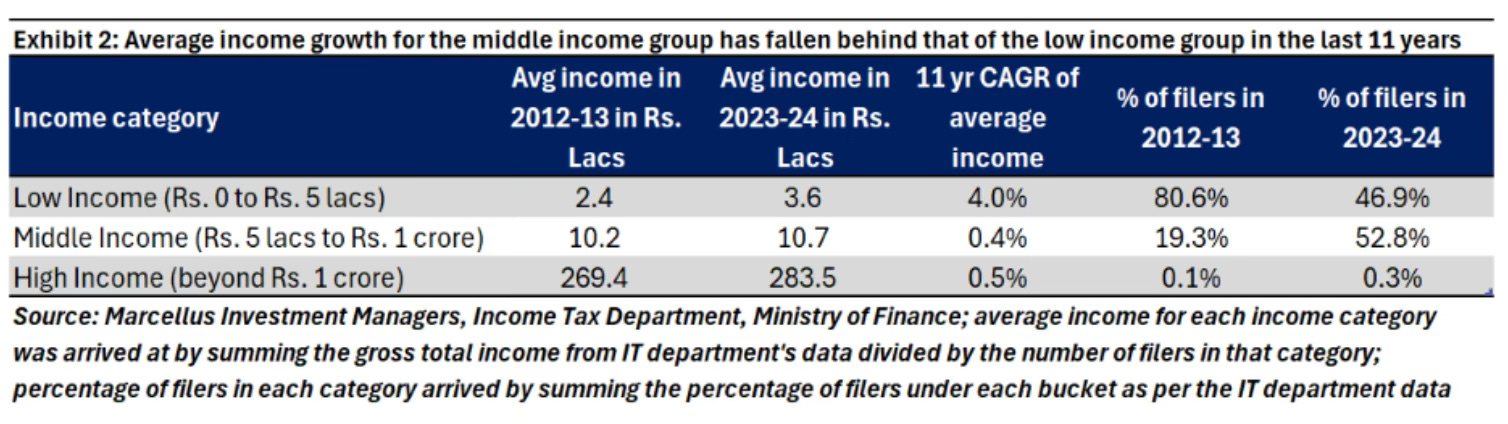
They also point to how inflation has eroded middle class incomes…
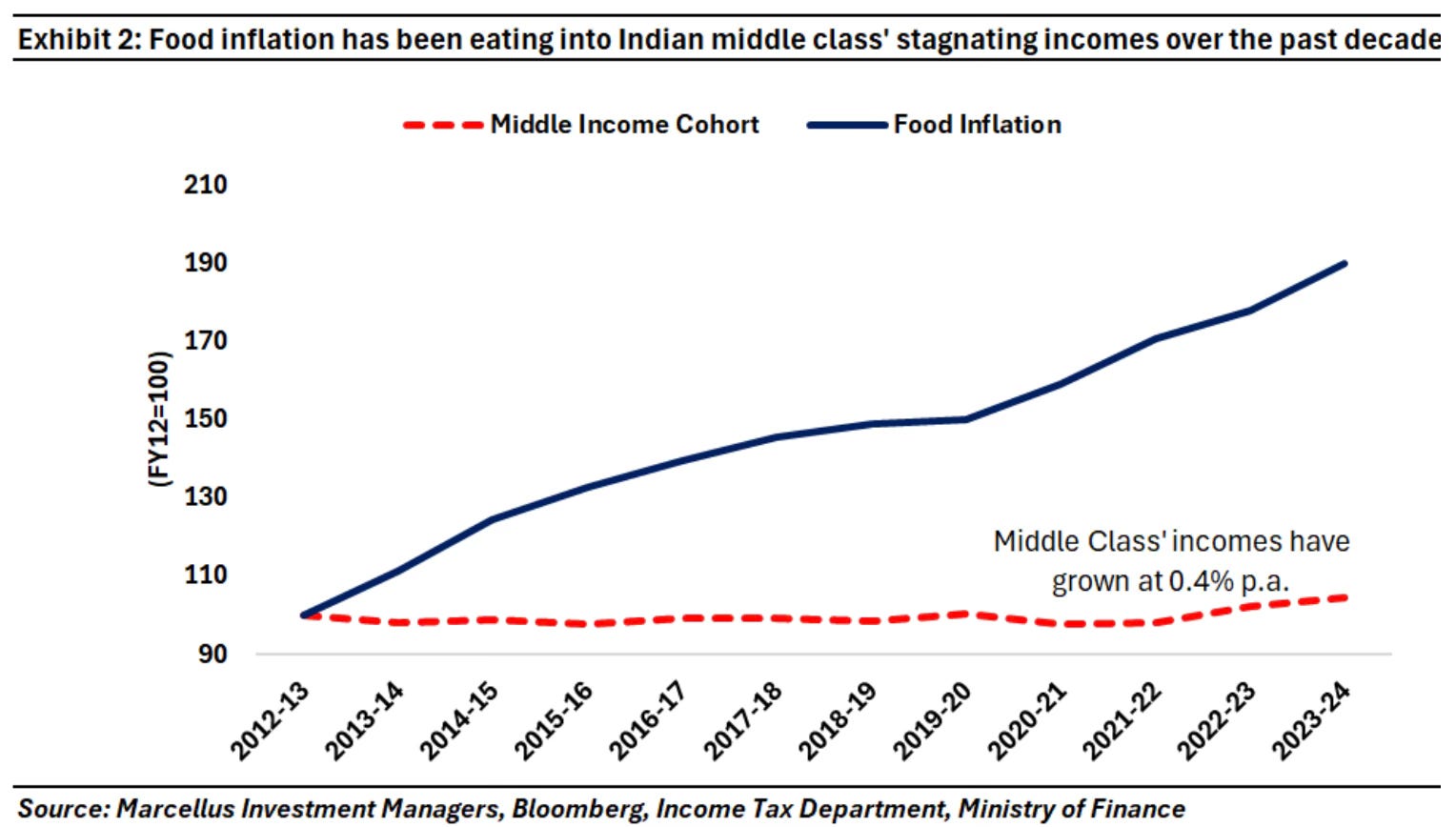
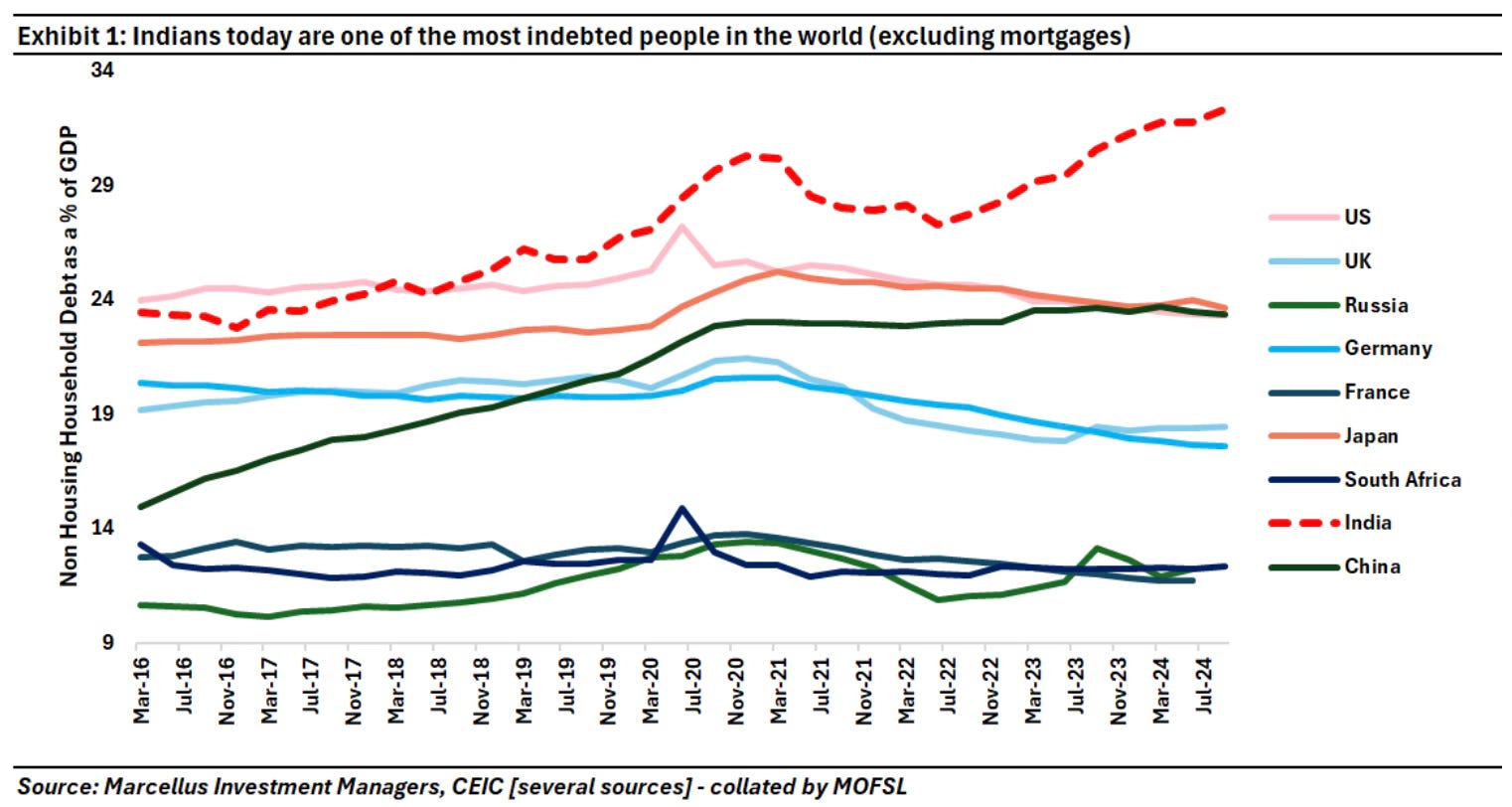
… leading to India having the highest level of household indebtedness if we exclude mortgages. 
This is also reflected in the steep decline in the net household financial savings to 5.1% of GDP in 2022-23, the lowest level since 1976, even as gross household savings hold steady at 10-11% of GDP. 

The middle-class squeeze is likely to be amplified in the days ahead as automation and AI take hold. One of the most disturbing possibilities is that AI models will virtually eliminate the basic coding jobs that have been an important source of middle-class entry for the Indian workforce. In this context, the new version of Agentic AI has the potential to be even more disruptive. 

AI agents, often referred to as ‘Agentic AI’ systems, are models capable of making decisions and taking actions to achieve specific goals without human intervention, making them truly autonomous. Think of a driverless car that adapts to traffic conditions, a smart home assistant that learns your habits, or an AI-driven financial bot that analyses market trends and makes stock trades. Other examples include AI-powered automation in finance and healthcare, policy claims processing, and software development. The distinction between a non-agentic and an agentic system lies in the level of autonomy and decision-making capabilities. For instance, a non-agentic workflow will respond only to specific inputs or commands, follow pre-defined rules and procedures, and need constant human intervention for most decision-making. 

A basic chatbot, for instance, will only respond with pre-programmed, scripted answers to specific questions. An agentic workflow, on the other hand, can initiate actions and take its own decisions… AI agents also learn continuously, refining responses and actions over time, as seen with Uniphore, which improves customer service by analysing call interactions. Unlike large language model-based chatbots, agentic AI integrates with business software such as customer relationship management (CRM) and enterprise resource planning (ERP) systems and handles multi-step workflows such as processing insurance claims or automating supply chains… This means that AI agentic systems go beyond chatbots by autonomously making decisions and executing tasks.

The trends in advanced economies, Indonesia, and India point to the same three aspects of middle-class discontent - scarcity in the creation of good jobs, stagnant wage growth, and erosion of purchasing power. 

Globally, good jobs are being displaced by automation and lower-paying temporary jobs. In the US, David Autor and others have pointed to the role of automation and cheap imports from China contributing to job losses and a hollowing out of middle-class jobs. I have argued here that cheap Chinese imports should be a bigger source of concern for developing countries (than developed ones) in so far as China is their direct competitor at the lower and middle ends of the manufacturing sector. As Artificial Intelligence (AI) emerges as the general purpose technology (GPT) of our times, another trend unfolding is that of automation and job losses. In their search for efficiency and maximisation of profits, businesses will increasingly adopt AI solutions.

Second, greater returns to capital coupled with weaker bargaining power has led to stagnant labour incomes. High and rising business concentration and financialisation raise the returns to capital at the cost of labour. This, coupled with incentives facing them - stock market expectations, a never-ending cycle of rising executive compensation, and weak labour bargaining power - means that businesses are loath to share profits. 

Finally, inflation is eroding incomes. Across the world, globalisation, trade liberalisation, and immigration integrated markets and lowered prices in the tradeable goods and non-tradeable services sectors. But the trend of rising protectionism and anti-immigration are strong headwinds that will start to bind with increasing intensity in future and raise prices. An additional inflationary factor is the compressed timelines on climate change policies. See the latest from Australia on a “cost of living crisis”.

There’s nothing on the horizon that’s likely to counteract these trends. Middle-class discontent will only grow. Any meaningful response must necessarily involve some (or all) of the following

1. In advanced economies, minimum wages must rise to levels that allow for some basic level of dignified life. Notwithstanding inflationary risks, such regulatory wage minimums can have knock-on upward pressures on wages. 

2. In both developed and developing countries, the sharing of returns between capital and labour should become more equitable. This will require that labour’s bargaining power be increased through institutional (unions, workplace management councils, etc.) and regulatory measures. At some time in future, broad caps on the salary and compensation ratios across levels becoming a norm cannot be ruled out. 

Measures in this regard are most effective when they emerge from internal deliberations and form part of an industry consensus. This requires serious debates in industry forums on this issue that both sensitise all stakeholders on its importance and lead to the emergence of constructive solutions to address it. As an example, benchmarks could be agreed upon, and businesses could be ranked on the equity of their recruitment modes and compensation structures. 

3. Gig work is rapidly emerging as the major source of formal sector job creation. It is estimated that there are over 12 million workers employed in the gig economy, and this number is rising rapidly. It poses economy-wide risks to allow such a large workforce to remain without access to basic social safety protections. Since the sector is now de-risked and mature, there’s a case for closing the regulatory arbitrage opportunities essential for its emergence and early growth. 

Further, such services cater to the top end of the income ladder, whose demand is unlikely to diminish significantly even with higher costs of service arising from closing the regulatory arbitrage opportunities. It also helps that these services are non-tradeable in nature. 

4. The practice of increasing contractual and other non-regular modes of recruitment too should be discouraged. As with wages, it’s most appropriate if there’s an industry consensus on these that creates the right industry-wide incentives to ensure balance on the modes of recruitment. To start with, it might be useful to have some light-touch regulation that provides non-binding guidance on the share of non-regular employment. This information for each company should become public and salient. This could be supplemented with mild incentives to encourage firms. 

In the East Asian economies, there are cultural and normative restraints that moderate the undesirable trends on issues like the sharing of profits, executive compensation structures, recruitment modes etc. There’s a danger that corporate India, with its weaker cultural restraints and closer affinities to the US capitalism, could end up imbibing practices arising from the single-minded pursuit of profit and efficiency maximisation. They must be consciously addressed. India could become a global leader in creating consensual industry benchmarks in these areas. 

5. Finally, governments must proactively engage with policies that guide the direction of technology adoption and associated changes. Industrial policy should prioritise incentives linked to employment over capital expenditure and production. Labour-intensive sectors should become the focus of industrial policy. Scarce resources should not be wasted on low-labour-intensity sectors like semiconductor fabrication or data centres. The only exception should be as a strategic requirement.

A strategy would be to double down on employment-linked incentives in various forms - internships, apprentices, reduction in EPF and other costs, wage support for new entrants, industrial policy support through employment generation-linked incentives, etc. The PM Internship Program is a good start. The learnings from the apprenticeship scheme should be used to improve its effectiveness and uptake. Existing schemes like reimbursement of EPF contributions should be simplified to facilitate ease of uptake and continue for an extended period. 

The implementation of all these is challenging, and its quality is critical, though the difficulties with eliminating leakages should not become an excuse for not doing these. After all, efficiency and effectiveness concerns have not deterred us from pursuing highly questionable schemes and projects with massive capital subsidies. 

All these will be effective only if they are complemented with policies that strive to improve human resource quality, lower the cost of capital, and reduce regulatory burdens. A highly ambitious objective for the government would be to discuss, debate, negotiate and arrive at a consensus on a grand compact with the corporate sector on these issues. 

As a final note, while bad choices by the government are certain to attract the ire of opinion makers and the electorate, allowing the market to create bad equilibriums in trade, immigration, inequality, and automation does not generate anywhere close to the same level of opprobrium. And counterfactuals of scenarios avoided by government intervention hardly get a mention.

Sunday, March 27, 2022

Weekend reading links

1. On reshoring and localisation of production,
Large companies that can afford to own more of their entire supply chain have been moving towards vertical integration as a way to smooth disruptions and the inflationary pressures that result. Companies of all sizes are looking for ways to localise more production wherever their consumers are, no matter which country or region they are in. Many smaller “maker” firms in New York have benefited during the pandemic since they source locally, but the technique is also being picked up by big name brands that simply want more buffers against shocks of any kind — be they geopolitical or climate-related.

2.  Russia and Ukraine's exports of cereals and commodities,

3. TN Ninan questions the rich lists put out by various agencies and points to India's missing millionaires  
India as a whole is said to have 140 dollar-billionaires. According to Credit Suisse, there were 764,000 dollar-millionaires in India in 2019, i.e. those with wealth of Rs 7.5 crore and more... And in the same 2019, all of 316,000 filed tax returns declaring income of over $70,000 (or Rs 50 lakh)... Again, there is no central data point, but checks with companies in the business suggest annual purchases and bookings of fewer than 3,000 residential properties that are individually worth Rs 5 crore and more. Even if one were to lower somewhat the bar for unit value, the number of transactions would remain decidedly modest in relation to the reported numbers of millionaires... Sales for the top three German luxury-car makers peaked at 32,500 in 2017 and have fallen since. In 2021, they were just 22,500 -- affected partly by Covid and then the shortage of chips. Allowing for that, and adding on the numbers for Jaguar-Land Rover and top-end Japanese models like the Lexus, the total is unlikely to cross 40,000. The mismatch with the reported number of dollar-millionaires is obvious.

4. Larry Fink and Howard Marks feel that globalisation is on the retreat. Marks points to the examples of problems created by Europe's dependence on natural gas and oil imports from Russia, and the world's dependence on TSMC for computer chips as important triggers for this retreat. 

5. John Micklethwait and Adrian Wooldridge have an excellent essay in Bloomberg signalling that the war could ring in the close of the current era of globalisation. Two graphs on trade stand out. One on the declining trade share of global GDP

Another on the spectacular growth of merchandise trade since the millennium

They conclude with an exhortation for American leadership,

Biden needs to reinforce the Western alliance so that it can withstand the potential storms to come... Biden needs to recognize that expanding economic interdependence among his allies is a geostrategic imperative. He should offer Europe a comprehensive free-trade deal to bind the West together; it could be a slightly remolded version of the rejected Transatlantic Trade and Investment Partnership, based on regulatory convergence (under which a product safe to sell in the EU is safe to sell in the U.S., and vice versa). He should also join CPTPP... Biden should pursue a two-stage strategy: First, deepen economic integration among like-minded nations; but leave the door open to autocracies if they become more flexible. China could be wooed toward freedom. But nothing will improve unless Biden first glues together the free world. That means freer trade — and the sooner he tells his party that, the better... A global new deal should certainly include a focus on making multinational companies pay their taxes, and the environment should be to the fore. But Biden should also talk about the true cost of protectionism in terms of higher prices, worse products and less innovation.

6. A new study on ride sharing companies (or transportation network company, TNC) like Uber or Lyft has interesting findings,

They found that a TNC trip actually decreases local air pollution, on average, compared to driving a personal vehicle... the team found that, on average, a TNC trip produces just half of the local air pollution costs of a personal vehicle trip, reducing air pollution-related health costs by around 11 cents. However, the team showed in their study that added travel on the road from TNC vehicles also carries major drawbacks. TNC drivers spend much of their time driving between passenger pickups or waiting for new ride requests, known as deadheading. This extra driving means that a TNC's fuel consumption — and by extension its greenhouse gas emissions — are on average about 20% higher than a personal vehicle. More time on the road also means more congestion, more noise, and more potential for vehicle crashes. Considering all of these factors, the team found that opting for a TNC over a private vehicle increases external costs to society by 30% to 35%, or about 32 to 37 cents per trip. This burden is not carried by the individual user, but rather impacts the surrounding community. Society as a whole currently shoulders these external costs in the form of increased mortality risks, damage to vehicles and infrastructure, climate impacts and increased traffic congestion.

7. As the Russian invasion has egregiously surfaced the issue of oligarch's using western capitals to launder and hoard ill-gotten wealth and buy into the elite society, Daron Acemoglu has a very good article where he advocates using the opportunity to clamp down on tax havens and plug tax avoidance clauses that allow the use of these off-shore and on-shore locations. 

8. Janan Ganesh has a brilliant oped where he points out that the ongoing crisis has reminded everyone that it's energy and not technology that continues to be the driver of world history
Of all the illusions, though, the most quietly punctured is the idea that tech is the industry at the centre of the world: the one that makes it go round. Energy, it turns out, is still a worthier bearer of that mantle. This is an education for anyone born in the half-century since the Opec oil crisis. Silicon Valley’s self-image as the Middle Kingdom of the business world (or just the world) comes out in different ways... Tech is relevant in Ukraine; see the propaganda war. But next to the existential role of energy, which keeps Russia solvent, and has the west scrambling for alternative sources, what stands out is the modesty of its bearing on events. Silicon Valley is giving history a nudge here and there, no doubt, but not setting its essential course. That is still the role of people who dig stuff out of the ground for fuel.

Saturday, December 18, 2021

Weekend reading links

1. New Zealand bans cigarette smoking,

New Zealand unveiled a plan on Thursday to eventually ban all sales of cigarettes in the country, a decades-long effort unique in the world to prevent young people from taking up smoking. The proposed legislation, which is expected to become law next year, would leave current smokers free to continue buying cigarettes. But it would gradually raise the smoking age, year by year, until it covers the entire population. Starting in 2023, anyone under age 15 would be barred for life from buying cigarettes. So, for instance, in 2050 people 42 and older would still be able to buy tobacco products — but anyone younger would not.

The calibrated and long-drawn nature of the policy is interesting.  

2. Like in many areas, European Commission has taken the lead in greater regulation of technology platforms by unveiling draft rules that, if implemented, would require "companies like Uber to consider their drivers and couriers as employees entitled to a minimum wage and legal protections."

The new labor rules follow a landmark case in February, when Britain’s top court ruled that Uber drivers should be classified as workers entitled to a minimum wage and holiday pay. In the Netherlands, a court ruled in September that Uber drivers should be paid under collective rules in place for taxi drivers... The new European rules would require companies to disclose more about how their software systems made decisions affecting workers. For those who may remain independent, the new rules would also require companies to grant more autonomy that self-employment entails... Spain offers a preview of the potential effects of the E.U. proposal. The country’s so-called Riders Law, enacted in August, required food delivery services such as Uber and Deliveroo to reclassify workers as employees, covering an estimated 30,000 workers.

3. Nice listing of behavioural biases. 

4. A sub-plot to the global supply chain disruptions induced shortages,

Medical device manufacturers have this year spent an estimated $6.4 billion on computer chips, according to Gartner, a research firm. The automotive industry has spent $49 billion. Makers of wireless communications gadgets like cellphones and tablets have purchased nearly $170 billion worth of chips — more than 26 times as much as medical device manufacturers, according to Gartner. The shortages are assailing every industry. But much as airlines prioritize their most frequent fliers in the face of a flight-canceling blizzard, chip makers are in many cases favoring their largest customers, expert say.

This on what caused the disruptions,

The shortages are in large part the result of botched efforts to anticipate the economic impact of the pandemic. As Covid-19 emerged from China in early 2020, it sowed fears of a global recession that would destroy demand for a vast range of products. That prompted major buyers of chips — especially automakers — to slash their orders. In response, semiconductor plants reduced their production. That proved a colossal mistake. The pandemic shut down restaurants, movie theaters and hotels, while slashing demand for cars. But lockdowns imposed to choke off the virus increased demand for an array of products that use chips, like desktop monitors and printers for newly outfitted home offices. By the time global industry figured out that demand for chips was surging, it was too late. Adding chip-making capacity requires as much as two years of lead time and billions of dollars. 

This about the transmission of disruptions in one part of the supply chain throughout the entire chain,

Once a company like ResMed gains regulatory clearance to use a supplier, it cannot simply seek out a new one that might have a ready stock of chips without first going through a time-consuming approval process. That meant that ResMed had to figure out how to squeeze more chips out of its existing supply chain... Faced with the prospect of getting shut out, Mr. Farrell rooted through his supply chain, identifying the suppliers of his suppliers, in the hopes of persuading them to prioritize ResMed’s factories. Mr. Farrell soon realized that a primary reason that his chip supplier could not meet his demand was that — five levels up the chain — a Taiwanese manufacturer of silicon wafers had exhausted its inventory.

Because that plant could not deliver extra products, the next link in the chain — a company that combines wafers and circuitry — could not produce more of its components. That meant that another company that buys those components and packages them into clusters was unable to make more of them. And that meant that ResMed’s supplier of circuit boards could not buy enough of those clusters, leaving ResMed’s factories in Singapore, Sydney and Atlanta short of circuit boards.

See also this excellent FT series on supply chains in times of Covid 19.

5. By Beata Javorcik, Chief Economist at EBRD, in the FT on the possibility of shifts in the prevailing ideology on supply chain management,

The quest to find the most cost-effective suppliers has left many companies without a plan B. More than half of firms surveyed by the Shanghai Japanese Commerce and Industry Club reported their supply chains were affected by the outbreak. Less than a quarter said they had alternative production or procurement plans in case of a prolonged disruption... Businesses will be forced to rethink their global value chains. These chains were shaped to maximise efficiency and profits. And while just-in-time manufacturing may be the optimal way of producing a highly complex item such as a car, the disadvantages of a system that requires all of its elements to work like clockwork have now been exposed... Resilience will become the new buzzword. Firms will think harder about diversifying their supplier base to hedge against disruptions to a particular producer, geographic region or changes in trade policy. This means building in redundancy and perhaps even moving away from the practice of holding near-zero inventories. Costs will certainly rise but, in the post-Covid world, concerns about supply chain fragility will come right after those over cost. Firms will be expected to assess resilience of their second and third-tier suppliers, too. We may see some reshoring as automation reduces labour costs.

6. John Thornhill argues that the mathematics of animal populations may have important insights for the prospects of digital networks. He points to the work of Andrew Chen, a partner at the VC firm Andreessen Horowitz who claims that the Metcalfe's Law, which states that the systemic value of communicating devices/nodes grows as a square of their number, is misleading. 

To take two obvious objections: no two networks are the same, and the value of individual connections varies... In Chen’s view, it may be more useful to study the mathematics of animal populations, including meerkats, sardines, bees and penguins, to understand the life cycles of networks. His insights largely derive from the work of Warder Clyde Allee, a pioneering ecologist from the 1930s who devised the “Allee threshold” to explain the growth and contraction of social animal populations. For example, when mobs of meerkats are too small then they are easily picked off by predators because there are not enough lookouts to scan the skies for raptors. When they pass the “Allee threshold” they multiply and thrive. But when they grow too populous they eat too many bugs and fruits and deplete their surrounding environment. “Allee’s population curves describe a sort of ecological version of the network effect,” writes Chen. 

Look at Uber, for example. Although it would appear to be one global network benefiting from vast economies of scale, it is more accurately understood as a network of networks. As Chen describes in his book, Uber’s war room in San Francisco focused on hyperlocal competition in each and every one of its locations, figuring out ways to outsmart rival taxi firms and exploit regulatory loopholes. But now that Uber has achieved critical mass in most of its markets and is nudging up prices to recoup its massive investments, it is in danger of overeating bugs and fruits. “They are focusing on efficiency and profitability. But if you are a city-by-city network you can be picked off by competitors,” says Chen, pointing to the threat from hungrier food delivery rivals, such as DoorDash and Gopuff.

7. Good table of anti-trust cases globally filed against big technology companies here.

8. Since over two decades, the central government has set aside 5% of its receipts from telecommunications sector to a Universal Service Obligation (USO) fund to bridge market failures in the sector. The fund collection till date exceeds Rs 1 trillion. However, its utilisation remains poor, with nearly Rs 60,000 Cr of un-utilised amount. 

The Comptroller and Auditor General has repeatedly pulled up the government for how it is managing the fund. In the past, the statutory obligation to pass dues on to the USO fund has not always been observed in a timely manner; as a consequence, the money has remained in the Consolidated Fund of India while the Union Budget’s mathematics are being worked out, thereby artificially reducing the fiscal deficit. But, even more worryingly, the CAG has also pointed out that the fund, even when topped up, has been only half used.

9. Neelkanth Mishra has an informative oped with figures on the residential construction industry in India. The argument is simple - the country has too few of houses of the required sizes and good quality, and with increasing incomes this will get addressed and attract massive investments.

India also has fewer houses than households (in comparison, China has 20 per cent more houses than households; and the US 10 per cent more), and still has “mixed-use” dwellings, like a shopkeeper’s family sleeping in the shop at night... the average American house is five times the size of an average Indian house, and has expanded by more than a third since the 1980s... Even though more than 80 per cent of India’s houses are now pukka, either the roof, the walls or the floor for many still need better quality material. Moreover, the pressure of a growing population means taller buildings. Today, 93 per cent of India’s houses are in buildings of one or two storeys and only 0.2 per cent in buildings with more than 10 storeys. In the latter set, which is growing rapidly, construction cost per square foot is nearly 10 times the cost of building a one-floor house in a village.

Rising land prices has been an important constraint to growth of housing, 

The value of dwelling construction was more than a sixth of gross domestic product (GDP) in 2012, and rent is the single largest component of the consumption basket after food. However, growth has been less than 6 per cent annually since 2012 in nominal terms, and nearly zero once adjusted for inflation. Its share of GDP has fallen by 5 percentage points to at least a 17-year low. Why did this happen? The reason may lie in land price movements: On average, they have risen by 10 per cent to 12 per cent a year in the last few decades, but between 2002 and 2013 urban land prices rose 19 per cent annually, and likely well over 25 per cent a year between 2006 and 2013. This overshoot meant that a correction was necessary: The pace slowed to less than 4 per cent a year between 2013 and 2019.

This is a positive trend,

In the last four years, rents have grown faster than real-estate prices, even as the share of rents in overall consumption has fallen from 11.5 per cent in 2012 to 9.5 per cent now.

10. Mahesh Vyas points to the index of consumer sentiments, a barometer of the well-being of households and their income growth perceptions. 

The index of consumer sentiments in November 2021 was 16.1 per cent higher than it was during the pandemic-affected November 2020. What is important is that it was a substantial 43 per cent lower than it was during the pre-pandemic month of November 2019, or in fiscal 2019-20... we are today worse off today compared to where we were two years ago by as much as 43 per cent. The index had reached its nadir in May 2020, when it was over 60 per cent lower than the 2019-20 level. From there, it has scaled back 44 per cent... In November, 39 per cent of the households reported that their income was lower than it was a year ago, and 37 per cent expected their income a year ahead to be worse than their current income. Only 6 per cent of the households believed this was a better time to buy non-durables compared to a year ago compared to the over 50 per cent who believed this was a worse time... 

Rural India saw a much faster improvement in sentiments compared to urban regions. The index of consumer sentiments grew by 18 per cent in urban India between June and November 2021. It grew by a much faster 30 per cent in rural India in this period. With this, the gap between rural and urban sentiments has widened. What is remarkable about this starkly divergent improvement is that even the better-off regions are significantly worse off than they were before the pandemic struck India. Rural sentiments in Novem­ber 2021 were 40 per cent worse than their level in 2019-20. In urban regions, sentim­ents are 49 per cent lower than in 2019-20... Only about 8.5 per cent of the households report income levels that are better than a year ago and even lesser expect these to improve in the coming 12 months. Even fewer, about 6.5 per cent, expect economic conditions in ge­neral to improve over the next one year—or even five years. As a result, less than 6 per cent of the urban households feel that this is a better time to buy non-essentials.

11. Striking figures on the economic contribution of migrants,

The next 25 years will see 33m people retiring with no replacements, thus shrinking the combined UK and EU workforces from 240m to 207m... Migrants usually create far more wealth abroad than if they’d stayed home. When the mass exodus from Syria and its neighbours sparked Europe’s “migrant crisis” in 2015, a study reported that migrants’ worldwide economic contribution was $6.7tn, about 40 per cent more than their likely domestic value. Although only 3.4 per cent of the global population, they accounted for 9.4 per cent of its gross domestic product.

12. Indian stock markets are the frothiest

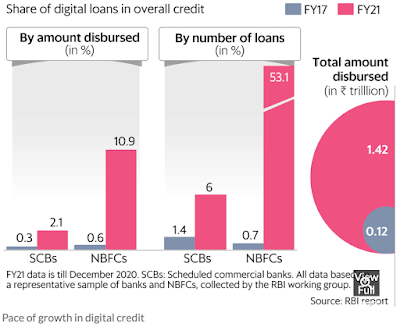
13. Sharp increase in the pace of digital credit growth of banks and NBFCs

14. The Economist has a briefing on the rise of a movement against the use of personal transport vehicles in global cities.
In New York Eric Adams, the incoming mayor, though famous for flouting parking rules, has promised to implement congestion-charging in Manhattan at last. In Boston Michelle Wu, another newly elected mayor, promises to make several important bus routes free for the next two years. In Cleveland, Ohio, Justin Bibb, the mayor-elect, promises to put “people over cars”, and to encourage more people to bike and walk, largely by turning traffic lanes into protected bike lanes. Cities as diverse as Buffalo, New York, and Minneapolis, Minnesota, have begun to ditch “parking minimum” rules, which required developers to provide ample free parking at new buildings. Even in California, a state where driving is practically a way of life, state-assembly members have proposed bills to ban cities from imposing parking minimums near public transport. la Metro, Los Angeles’s transport authority, is studying congestion pricing.

European cities have been doing this in some cases for decades. London established its congestion charge in 2003. The leading city now is arguably Paris, the capital of France. Under Anne Hidalgo, the socialist mayor, and her predecessor, Bertrand Delanoë, cars were banned from the left and then the right banks of the Seine in 2013 and 2017. On the right bank, an expressway named for Georges Pompidou, who proudly opened it in 1967 when he was prime minister, has been converted into a sort of urban park. Ms Hidalgo, who achieved this despite lawsuits led by the right, called it a “reconquest” of the city for its residents. Bars now line the open sections of the road, while families on bicycles zoom through the eerily quiet (and now unpolluted) tunnels. Ms Hidalgo has been a vocal proponent of “15-minute cities”, the idea that almost everything a person needs for daily life ought to be within a 15-minute walk or cycle... 
Britain’s government gave local councils the power to close roads to create “low-traffic neighbourhoods” (ltns) without the usual consultations with residents that block them. Planter bollards have proliferated across England’s cities, blocking off residential streets to all but bicycles (typically, residents can enter and exit with their cars, but cannot drive through). When lockdowns started, Amsterdam temporarily banned cars from Spuistraat, Haarlemmerdijk, and Haarlemmerstraat, three central boulevards. The change now seems likely to be made permanent. As Glasgow, Scotland’s biggest city, played host to cop26 last month, city leaders announced plans to ban all cars from the centre over the next five years, in the hope of reducing carbon-dioxide emissions. In New York City, as in many places, street parking was converted into outdoor dining space, so that restaurants could stay open. Chicago has unveiled plans for a further 160km of segregated cycle lanes.

The results have been impressive, with car ownership in Paris dropping from 60% of households to 35%. But these municipal government measures, apart from raising local opposition from vehicle owners, also come up against the incentives of politicians at the national and provincial levels, who prefer the expand vehicle manufacturing (for revenue generation and job creation) and ownership (for feel-good income effect). 

15. Shyam Saran has a very good oped about the latest political trends in China in the build up to the 20th Party Congress in October 2022 which will also decide on President Xi Jinping's tenure extension. In particular, the recently organised annual Central Economic Work Conference which sets the overall policy guidance for China's economic managers within the overall framework of the 14th Five Year Plan, stressed on "maintenance of macroeconomic stability in 2022". It identified three risks - declining demand, supply shocks, and weakening outlook for future growth. Saran has a good summary of the challenges facing China, 

The country is clearly on a slowing growth trajectory. Even Chinese analysts expect the GDP to grow by 4.5-5 per cent per annum during the 14th Five-Year Plan. The economy is likely to become more domestic-oriented and inward-looking. If the pandemic lingers, the domestic orientation will become more pronounced. China is aware of the headwinds it will be confronting, most importantly the rapid aging of its population and the declining competitiveness of its manufacturing sector. It is betting on technological innovation to avoid a middle-income trap. However, keeping wages low and resisting the secular increase in the exchange value of the Chinese currency slows down the transition of the Chinese economy towards a higher value-added and more service-oriented economic activity. It is not clear how China’s leaders will deal with such contradictions.
16. In an important development, India has lost the dispute at the WTO's DSB over subsidies for sugar exports on a complaint that Brazil, Australia, and Guatemala had filed. The DSB report's finding,
We find that, for five consecutive sugar seasons, from 2014-15 to 2018-19, India provided non-exempt product-specific domestic support to sugarcane producers in excess of the permitted level of 10 per cent of the total value of sugarcane production. Therefore, we find that India is acting inconsistently with its obligations under Article 7.2(b) of the Agreement on Agriculture.

However, in the absence of a functional appellate tribunal, means that if India decides to appeal, the DSB's decision is unlikely to take effect anytime soon.  

18. Scott Galloway has some stunning data on the rise of Apple.

It took 42 years for Apple to reach a $1 trillion valuation — the first ever company to do so. But it took just 2 years to add another $1 trillion in value. Today, Apple’s market cap is roughly equal to all the world’s unicorns combined!


19. The Union Cabinet in India has approved a five-year Rs 76,000 Cr ($10 bn) production linked incentive (PLI) scheme to catalyse a semiconductor manufacturing eco-system in India. It aims to support firms in semiconductor fabs, display fabs, compound semiconductors/silicon photonics/sensors (including MEMS) fabs, semiconductor packaging (ATMP/OSAT), semiconductor design. 

20. It's remarkable that the US Fed FOMC meeting decision to take a more aggressive stance against inflation by indicating that they expected to raise rates thrice in 2022 instead of spooking the markets evoked a 2.2% rise in Nasdaq Composite. The Fed also announced that it would cut its bond purchases by $30 bn a month in January, double its previous pace. FT points to this market rationalisation, 
Investors were not put off by the prospect of reduced direct market stimulus from the Fed, and instead focused on the message that the central bank would not let inflation spiral out of hand. James McCann, deputy chief economist at Abrdn, the asset manager, said: “The Fed really had to demonstrate that they’re willing to move faster and go further to tighten policy more than previously planned as they’ve slipped behind the curve over recent months. It was vital that the Fed acted now to protect its credibility on inflation.”

This is an example of markets collectively suspending logic and preferring to believe that the stock market boom will continue no matter what. 

Sunday, November 21, 2021

Weekend reading links

1. Fascinating account of the social debates taking place in Canada's Atlantic coast areas like villages and towns in New Foundland,

Until recently, Canada’s Atlantic provinces were suffering from so much outward migration that some towns started offering free land to lure workers. But as urban life across the world has been upended by the coronavirus, with lockdowns, shuttered bars and socially distanced gyms, the picturesque region is experiencing the largest inward migration in nearly 50 years. Desperate to escape pandemic doldrums and soaring housing prices, and energized by a global shift to remote working, the newcomers are flocking to Atlantic Canada, where they have been largely welcomed. But in the distinctive coastal region — shaped by the traditional values of its Indigenous peoples and Irish, Scottish, English and French settlers — the migration of moneyed urbanites is also fanning some tensions.

Though housing prices remain low compared with bigger urban centers, in Bonavista, population 3,752, they are exploding, and some local residents bemoan the higher property taxes that come with them. The social fabric of the town has also been changing. Traditional craft shops and restaurants offering fish and brewis, a starchy local dish of cod and bread, have been gradually giving way to designer sea salt companies and to purveyors of cumin kombucha and iceberg-infused soap...

According to Statistics Canada, about 33,000 people from other provinces migrated to the region of 2.5 million people in the first half of this year alone, compared with about 18,500 in the same period in 2005. Many of the new arrivals are millennials... Reg Butler, a crab fisherman, whose family has been in Bonavista for five generations, credited the newcomers for rejuvenating the local economy after the town emptied in the 1990s following a moratorium on cod fishing. But he said a housing shortage was stoking some resentment.

2.  South Korea hallyu facts of the day,

In the last few years alone, South Korea shocked the world with “Parasite,” the first foreign language film to win best picture at the Academy Awards. It has one of the biggest, if not the biggest, band in the world with BTS. Netflix has introduced 80 Korean movies and TV shows in the last few years, far more than it had imagined when it started its service in South Korea in 2016, according to the company. Three of the 10 most popular TV shows on Netflix as of Monday were South Korean... In September, the Oxford English Dictionary added 26 new words of Korean origin, including “hallyu,” or Korean wave... It wasn’t until last year when “Parasite,” a film highlighting the yawning gap between rich and poor, won the Oscar that international audiences truly began to pay attention, even though South Korea had been producing similar work for years.

3. Upshot has this summary of how the pandemic stimuluses have benefited American labour,

Workers have seized the upper hand in the labor market, attaining the largest raises in decades and quitting their jobs at record rates. The unemployment rate is 4.6 percent and has been falling rapidly. Cumulatively, Americans are sitting on piles of cash; they have accumulated $2.3 trillion more in savings in the last 19 months than would have been expected in the prepandemic path. The median household’s checking account balance was 50 percent higher in July of this year than in 2019, according to the JPMorgan Chase Institute... Over the 12 months that ended in September, those in the top quarter of earners experienced 2.7 percent gains in hourly earnings, compared with 4.8 percent for the lowest quarter of earners. For lower earners, that follows years leading up to the pandemic in which pay gains exceeded inflation rates.

4. Barry Eichengreen and Poonam Gupta, along with another, have a reprise of their earlier paper comparing emerging economies during the taper tantrum. Their headline finding on EM vulnerability is on the public debt and fiscal deficit fronts, and India leads on both.

Where emerging markets are weaker is in terms of public-sector indebtedness... interest rates in the U.S. are poised to begin moving up, which will make for higher interest rates in India, as we have shown above. Even without these unfavorable growth and interest-rate developments, it would have been necessary to cut the government’s primary budget deficit to prevent the debt-to-GDP ratio from moving higher. With these developments, larger cuts will be required... What happens when public debt relative to the resources that the government is able to mobilize rises even higher? Either taxes have to be raised or public spending must be cut to generate additional revenues for debt service. If this proves politically impossible, governments have responded, historically, in two ways. When the debt is held externally, they restructure. When it is held internally, they inflate.

The paper is full of graphs comparing EM economies on various indicators. This one is the most disturbing one from India's perspective, even though most government debt is internal (external is just 4% of GDP).

It draws attention to the differential between real interest rate and real GDP growth. 

Since the turn of the century, the real-growth-rate-real-interest rate differential has averaged around 5 percentage points. This means that India can run a primary deficit of 4.5 percent of GDP without seeing its debt/GDP ratio move higher...This follows from the standard equation for debt dynamics: Δb = d + (r – g)b, where the change in the debt b is the sum of the primary budget deficit d and the existing debt multiplied by the difference in the real interest rate r and the real GDP growth rate g. With a value for r-g of 5, as posited in the text, and value for b of 0.9, the product yields a value for d of 4.5 percent of GDP in a steady state... if interest rates now go up owing to global factors, the real-interest- rate-real-growth-rate differential could turn even less favorable... yields on the Indian government’s 10-year securities co-move with US 10-year Treasury yields. The elasticity with respect to U.S. rates approaches unity; this is true in both nominal and real terms. If U.S. yields are now going up, this suggests that even stronger steps will be needed to stabilize the debt/GDP ratio. With a growth rate of 6 percent and a real interest rate of 2 percent, the deficit would have to be cut to roughly 3.6 percent of GDP to stabilize the debt/GDP ratio.

5. The Ken has an investigative report on abusive practices by baby food manufacturers,
On 18 October, Union health Secretary Rajesh Bhushan received an unusual letter. It was a complaint penned by an employee of Nutricia International, the Indian arm of French food-products conglomerate Danone. The employee, one of 216 sales executives tasked with pushing the company’s infant milk substitutes and baby food, accused Danone India of a host of illegal and unethical practices in order to garner better sales in the baby food category. Danone had, according to the letter, sponsored overseas trips for doctors under the garb of an education grant, hosted liquor-fuelled parties for them, arranged for their transport, and even offered them financial inducements and gifts. If true, Danone would be in blatant contravention of India’s Infant Milk Substitutes (IMS) Act. The Act prohibits companies involved in manufacturing baby milk formula and food for babies upto two years of age from indulging in promotional activities. The allegations against Danone are damning... between January 2019 and May 2021, the Ministry of Health and Family Welfare (MoHFW) received 33 complaints about violations of the IMS Act. That’s more than one complaint a month. The alleged offenders included baby food manufacturers such as Nestle, Abbott, Mead Johnson, Danone, and Amul, but also extended to Apollo Pharmacy, Amazon, and even YouTube.

6. The surge in tech IPOs in Indian equity market - tech listings in India has so far raised $2.6 bn in 2021, a jump of 550% compared to last year's total! 

From an FT long read about the Chinese crackdown benefiting India,

For every dollar invested in Chinese tech in the quarter that ended September, $1.50 went into India, according to the Asian Venture Capital Journal.

This is a good indicator of the growth potential of Indian markets,
While listed “new economy” companies account for 60 per cent of China’s MSCI index, they make up only 5 per cent of India’s, according to Goldman Sachs.

And this about what's happening now,

Analytics platform Venture Intelligence says 35 Indian start-ups have become “unicorns” worth over $1bn this year, more than every year since 2013 combined.
7. Scott Galloway has a stunning graphic which shows that the middle 60% of Americans now own less wealth than the top 1%.

In 1989, the middle class in the US owned 36% of wealth, compared to just 17% for the top 1%. 

8. The recent break-ups of GE, Toshiba, and Johnson&Johnson have triggered a debate on the demise of the conglomerate model. In the context of India, Shyamal Majumdar writes
Though the aggregate financial ratios of some of the conglomerates still look respectable, that’s primarily because one company usually makes up for all the other underperforming businesses in the group. For example, Tata Consultancy Services accounts for 67 per cent of the combined market capitalisation of all listed Tata group companies and over 90 per cent of the group holding company Tata Sons’ dividend income. TCS has virtually funded the group’s growth for over a decade now. Similarly, Aditya Birla group’s financial ratios would look less impressive if Ultratech Cement and its parent Grasim Industries are excluded.

9. Putting the PayTm fiasco in perspective,

10. Are low valuations of industrial companies a cause for inflation? Merryn Somerset Webb writes,
In a letter to investors last year, David Einhorn of Greenlight Capital suggested that the low valuations of industrial companies might in themselves be inflationary. If traditional industrial companies have low valuations, and hence an implicitly high cost of equity, it makes sense for holders of the stock to demand that dividend payouts and share buybacks take priority over capacity expansion: if the market attributes little value to your business, why expand it? That leads to continued under-investment and, due to lack of new supply, to “sustained higher prices in a number of industries”, wrote Einhorn.

11. The rise and rise of private equity giants,

12. John Authers points to the poor performance of emerging economy equity markets. 

The BRIC markets are still below their Halloween 2007 peak.
Since 2011, the fates of equity markets of BRIC and developed markets have decoupled.
Authers points to the possibility of an interesting trend - decoupling of EM equity markets from that of China.

13. The ASER 2021 is out. An interesting graphic is the sharp rise in student enrolment in government schools, shifting away from private schools. 

The share of private schools has been rising for a long period, and now the trend appears to have reversed. It's hard to believe that the quality of government schools have improved across India and that of private schools have similarly declined across to warrant this near universal trend since 2018. Is it a proxy for economic distress translating into parents forced to exit private schools and fall back on government schools.

This is the full report.

14. Finally, on Udaan, a B2B online retailer which may be more sensible bet for investors than the other inflated unicorns,
Currently Udaan has 35 lakh installed customers on the platform and as many as 25 lakh undertake regular transactions. From an average 10 per cent of their total transactions going through the Udaan platform two years ago, that share has gone up to 40 per cent. “There are 30 million retailers in the country but three to four million of them account for 85-90 per cent of the trade. So while the number of retailers on our platform might go up slowly to 40-45 lakh, we are targeting the most relevant of them in the ecosystem and ensuring that they source the bulk of their products from us,’ said co-founder Sujeet Kumar. To do so, Udaan will also focus on the availability of those stock keeping units (SKUs) which sell the most for a retailer. For instance, in the FMCG and food space, Kumar says the top 200 SKUs account for 80 per cent of the sales. “We want the retailer to source 90 per cent of these items from us,” he said.