Substack

Showing posts with label Derivatives. Show all posts

Saturday, July 12, 2025

Weekend reading links

1. How is global trade changing due to Trump tariffs?

US tariff revenue surged almost fourfold from a year earlier to a record $24.2bn in May, while imports from China fell 43 per cent from the same month in 2024... China's exports are up 4.8% on last year despite a sharp drop in trade with the US.
There's also emerging evidence that Chinese firms are rerouting exports to the US through South East Asia and EU countries to avoid the high tariffs on Chinese exports.
The value of Chinese exports to the US dropped 43 per cent year on year in May, according to figures published by the US census bureau — equivalent to $15bn-worth of goods. But the country’s overall exports rose 4.8 per cent in the same period, official Chinese data showed, as the shortfall in trade with the US was offset by a 15 per cent increase in shipping to the Association of Southeast Asian Nations trade bloc and a 12 per cent rise to the EU... 
Separate research by Capital Economics estimated that $3.4bn of Chinese exports were rerouted through Vietnam in May, a rise of 30 per cent compared with the same month last year. Indirect trade through Indonesia also increased markedly, with an estimated $0.8bn rerouted in May 2025, 25 per cent higher than May 2024. Exports of electronic components such as printed circuits, parts of telephone sets and flat panel display modules to Vietnam were up 54 per cent, or $2.6bn, in May 2025 compared with a year earlier, Chinese data shows... Indian exports to the US jumped 17 per cent in May compared with a year earlier, while imports from China and Hong Kong rose 22.4 per cent according to Ajay Srivastava, founder of the Global Trade Research Initiative, a research group.
This is a good graphic on what products have been squeezed following the tariffs. 
2. The US equity markets are going about their merry ways overlooking the real costs that are introduced by the Trump tariffs. 
Despite the carve-outs and climbdowns, the US’s overall average effective tariff rate now stands at 15.8 per cent, according to calculations by the Yale Budget Lab — the highest rate since 1936 and an increase of more than 13 percentage points since Trump returned to office in January.
A big cause of concern is the uncertainty associated with Trump policies that are taking its toll on investments.
The most tangible consequence of the Trump tariffs so far is not supply chain reordering, but the sudden dearth of dealmaking, according to Persson of EY. A survey of dealmakers by PwC in May found that 30 per cent were either pausing or revising deals because of the uncertainty caused by tariffs. Among those pushed back amid the uncertainty included bids for Boeing’s navigation unit and an expected £4bn sale by buyout group Apax of insurance group PIB. The sudden slowdown flew in the face of investor expectations that Trump’s return to the White House would trigger a wave of M&A activity on the back of a deregulatory splurge, according to Josh Smigel, partner in PwC’s deals practice. As a result, Smigel calculates, private equity firms are holding about $1tn worth of assets that — absent the Trump uncertainty — could have been redeployed back into the market if planned exits had not stalled.

3. Has Israel won the battle, but only to lose the war?

Mr. Netanyahu’s relentless and unapologetic military response to the Oct. 7, 2023, Hamas-led attack that killed 1,200 people and took 250 people hostage has cemented the view of Israel as a pariah, its leadership accused of genocide and war crimes, and disdained by some world leaders. In opinion polls globally, most people have a negative view of Israel. In Gaza, the war against Hamas has taken a devastating toll, killing tens of thousands of people and leaving more than a million homeless and hungry. Much of the enclave has been reduced to rubble. Poverty and hopelessness are rampant... Israel’s actions have shattered a rock-solid, bipartisan consensus in the United States for defending Israel. Now, support for the country has become a fiercely contentious issue in Congress, the subject of angry debates and protests on college campuses and fuel for a surge in antisemitic incidents in the United States and around the world... Israel has created a new wave of global opinion critical of its goals and methods. And many Israelis now feel threatened while abroad, even as they are more secure at home... 
In a Pew Research survey of 24 countries around the world published last month, negative opinions about Israel have surged. In 20 countries, more than half of the people said they had an unfavorable view of Israel. In eight countries — Australia, Greece, Indonesia, Japan, the Netherlands, Spain, Sweden and Turkey — more than 75 percent held that view... Just 46 percent of Americans in the latest Gallup survey expressed support for Israel, the lowest number since the company began asking the question a quarter-century ago. A third of the respondents in the United States said they sympathized with the plight of the Palestinians, up from just 13 percent in 2003... Inside Israel, the decision to prioritize military victories over the return of the hostages has deeply wounded many people. And the violence has strained the good will of the country’s allies and neighbors.

4. Thrive Capital, founded by Josh Kushner, the brother of Jared Kushner is charting a new model of VC investing.

The approach Kushner has developed since launching Thrive 14 years ago: get close to founders, remain loyal through crises and concentrate funds in a small number of companies. Betting a billion dollars or more on a behemoth inverts the classic venture model: firms typically write dozens of small cheques in young start-ups; most fail, but the flops are more than offset by a few spectacular successes... venture capital has mutated from a cottage industry into an institutionalised asset class... The shift has left VCs with a choice: remain faithful to early-stage investing and hope for outsize returns, or scale up funds to meet increasingly massive private companies. Thrive is attempting to manage both, writing cheques for multibillion-dollar start-ups its team believe can still multiply 10 or 100-fold in value... Most VCs split funds between dozens of start-ups, but the vast majority of a Thrive fund will go to just 10-15. The firm has put 10 per cent or more of earlier funds to work in single companies, including workplace messaging app Slack, GitHub, Instagram and Stripe. Thrive first invested in Stripe, then valued at $3bn, in 2014, and has increased its stake multiple times, including investing close to $2bn last year... the firm has quietly shown intense fealty to founders during moments of crisis, such as during the boardroom coup that briefly ousted OpenAI’s Altman last year. Kushner was instrumental in returning Altman to the company after less than a week... 
Thrive’s rivals, including more established West Coast firms, dismiss the approach as closer to asset management. “We invest in companies, they trade in stocks. It’s like an ETF [exchange traded fund] for venture,” says a partner at one Silicon Valley firm. “But private companies are not stocks. You can’t get out when they start going down.” Speaking privately to the FT, some institutional investors question whether Thrive’s massive bets can ever deliver “venture-style returns”. Others say it is too soon to judge a group whose biggest investments have not yet cashed out. Thrive’s biggest portfolio companies, including OpenAI and payments start-up Stripe, have racked up massive paper gains. But until they go public or are acquired, profits won’t be returned to institutional investors in Thrive’s funds... The payout for Thrive and its backers would be enormous should Stripe, OpenAI, or defence tech company Anduril go public... Thrive has raised a total of $12.3bn, and now has almost $25bn under management, making it one of the largest VCs in the country.

Interesting that Mukesh Ambani has a 3.3% stake in Thrive capital as part of a consortium of investors! 

5. This is a very good graphic that shows how VCs are experiencing a squeeze in their cash flows.

Much the same could be said about PE funds.

The private equity giant Blackstone spent $10 billion in 2021 to acquire QTS, and has been pouring billions more into the company to help it expand its data centers... This largely unglamorous industry is critical for A.I. leaders to get right. QTS leases its facilities to companies like Amazon and Meta and supplies the electricity and water needed to power and cool their computers... Blackstone calls data centers one of its “highest conviction investments.” Blackstone is already one of the world’s largest owners of office buildings, warehouses and science labs, but it has sunk more money into data centers and related infrastructure than into almost any other sector in the firm’s 40-year history. All told, Blackstone has put more than $100 billion into buying and lending to data centers, as well investing in construction firms, natural gas power plants and the machinery needed to build them... (it) says it still sees strong demand from tech companies, which are willing to sign what they describe as airtight leases for 15 to 20 years to rent out data center space... 

Blackstone is not alone. Data centers are drawing a crowd on Wall Street — investment giants like KKR, BlackRock and Blue Owl have collectively plowed hundreds of billions into the industry. As investment firms announce larger and larger deals, one Wall Street executive says he jokes about “Braggawatt” deals, as data centers are typically measured by the wattage they use. The spending frenzy has created concerns about whether too many data centers are being built... The complexity and cost of running A.I.-focused data centers stem from the vast amounts of power they guzzle, which can be about 10 to 20 times as much per server or rack as general cloud computing. There is also the need to keep the centers operational 99.999 percent of the day, or the “five nines” in industry parlance. That equates to about five minutes of downtime all year for maintenance or to switch out servers.

7. China's dominance of clean energy technologies

China has also begun to dominate nuclear power, a highly technical field once indisputably led by the United States. China not only has 31 reactors under construction, nearly as many as the rest of the world combined, but has announced advances in next-generation nuclear technologies and also in fusion, the long-promised source of all-but-limitless clean energy that has bedeviled science for years.
And, buoyed by President Trump's policies, America retains leadership of fossil fuels.

This reversal is striking.
Americans created the first practical silicon photovoltaic cells in the 1950s and the first rechargeable lithium-metal batteries in the 1970s. The world’s first wind farm was built in New Hampshire nearly 50 years ago. Jimmy Carter installed solar panels on the White House in 1979... In 2008 the United States produced nearly half of the world’s polysilicon, a crucial material for solar panels. Today, China produces more than 90 percent.

This is a good description of China's manufacturing prowess.

Last June, the Urumqi solar farm, the largest in the world, came online in the Xinjiang Autonomous Region in China. It is capable of generating more power than some small countries need to run their entire economies. It’s hardly an anomaly. The other 10 largest solar facilities in the world are also in China, and even bigger ones are planned. The Chinese automaker BYD is currently building not one but two electric vehicle factories that will each produce twice as many cars as the largest car factory in the world, a Volkswagen plant in Germany.

Finally, a graphic that captures China's clean energy investments globally.

Chinese firms are building wind turbines in Brazil and electric vehicles in Indonesia. In northern Kenya, Chinese developers have erected Africa’s biggest wind farm. And across the continent, in countries rich with minerals needed for clean energy technologies, such as Zambia, Chinese financing for all sorts of projects has left some governments deeply in debt to Chinese banks. Since 2023, Chinese companies have announced $168 billion in foreign investments in clean energy manufacturing, generation and transmission, according to Climate Energy Finance, a research group.

8. Tim Harford points to a new paper by David Autor and Neil Thompson who use an "expertise" framework to explain the impact of automation and AI on jobs. Autor and Thompson pose a question

Would we expect accounting clerks and inventory clerks to be similarly affected by automation? There are several well-established approaches to analysing this question, and all of them suggest that the answer is “yes”. Back in the day, both types of clerk spent a lot of time performing routine intellectual tasks such as spotting discrepancies, compiling inventories or tables of data, and doing simple arithmetic on a large scale. All of these tasks were the kind of things that computers could do, and as computers became cheap enough they took over. Given the same tasks faced the same sort of automation, it seems logical that both jobs would change in similar ways. 

But that is not what happened. In particular, say Autor and Thompson, wages for accounting clerks rose, while wages for inventory clerks fell. This is because most jobs are not random collections of unrelated tasks. They are bundles of tasks that are most efficiently done by the same person for a variety of unmysterious reasons. Remove some tasks from the bundle and the rest of the job changes. Inventory clerks lost the bit of the job requiring most education and training (the arithmetic) and became more like shelf-stackers. Accounting clerks also lost the arithmetic, but what remained required judgment, analysis and sophisticated problem solving. Although the same kind of tasks had been automated away, the effect was to make inventory clerking a job requiring less training and less expertise, while accounting clerks needed to be more expert than before. 

The natural worry for anyone hoping to have a job in five years’ time is what AI might do to that job. And while there are few certainties, Autor and Thompson’s framework does suggest a clarifying question: does AI look like it is going to do the most highly skilled part of your job or the low-skill rump that you’ve not been able to get rid of? The answer to that question may help to predict whether your job is about to get more fun or more annoying — and whether your salary is likely to rise, or fall as your expert work is devalued like the expert work of the Luddites.

9. Two graphics that capture the essence and outcome of One Big Beautiful Bill (OBBA). One, stripped off all its hype, OBBA is a giant tax cut bill.

And its biggest beneficiaries will be the richest.
Analysis by scholars at the University of Pennsylvania suggests that Americans earning under $18,000 would lose $165 in 2027, or 1.1% of their income. By 2033 their annual losses would rise to $1,300 on average—about 7.4% for the group. The richest 0.1%, earning over $4.45m, would gain more than $300,000 in 2027, a 2.3% increase. Much of this comes indirectly, via changes to corporate taxes, which are usually assumed to benefit wealthier households who own stocks... Analysis of the House version by scholars at the University of Pennsylvania suggests that Americans earning less than $16,999 would lose about $820 a year—a 5.7% reduction in median income for that group. The richest 0.1%, earning more than $4.3m, would gain $390,000, a 2.8% increase.
Yimin is one of the five largest open-cast coal mines in China. During peak season, it used to require about 300 trucks, operated by around 1,200 drivers working shifts around the clock, to transport coal to processing sites, and soil, sand and rocks to dumping grounds. But managers said the mine faced a shortage of drivers. Dangerous driving conditions led to high attrition rates, compounded by declining interest among younger generations in pursuing this profession. “Truck drivers face exhausting workloads that often lead to health issues,” said Yimin mine director Shu Yinqiu. The solution came earlier this year with a fleet of 100 photovoltaic-battery-powered, self-driving trucks. They represent the world’s largest deployment of autonomous electric mining trucks, highlighting China’s resolve to upgrade its traditional industries with advanced technologies, as the nation grapples with a shrinking labour force and an ageing population...
Key partners in the project include Huawei Technologies, Xuzhou Construction Machinery Group, State Grid and the Beijing University of Science and Technology. Now, instead of a thousand-man crew, just 24 people, divided into four teams, are needed to operate the 100 new trucks. Staff monitor and control the vehicles from the comfort of a remote control room, where live-feed videos and real-time traffic information are displayed on multiple screens... As of September, the China National Coal Association (CNCA) estimated there were over 1,500 automated mining trucks in China. It predicted that number would triple to 5,000 by the end of this year and exceed 10,000 by 2026... A fleet of 100 unmanned trucks could save coal mine operators 40 million yuan (US$5.6 million) in driver salaries annually, according to CNCA estimates.

11. Major announcement for the establishment of a PCB and Copper Clad Laminate (CCL) manufacturing facility by Syrma SGS Technology at Naidupeta in Andhra Pradesh with an investment of about Rs 1800 Cr and in partnership with South Korean company Shinhyup Electronics Ltd. The project is expected to be commissioned by 2026-27 and can avail incentives under the GoI's Electronics Component Manufacturing Scheme (ECMS). In 2024, the GoI had imposed a 30% anti-dumping duty (ADD) on bare PCBs to boost domestic production. The Indian PCB market was valued at $6.2 bn in 2024 and is estimated to grow by a CAGR of 16.4% from 2025-33. 

12. Spain wants to avoid the costs of being part of NATO, while wanting to access its benefits. It was the only standout against accepting the goal of 5% of GDP defence spending target by NATO members at the recent NATO summit. At the same time, as FT reports, one of its defence firms, Indra, which is 28% owned by the Spanish Government, is benefiting from NATO defence spending. 

In April, the group was given a role in 12 European Defence Fund research and development projects and made the leader of one involving radars. Its executives were in Ukraine last month pitching their wares... In the air, Indra is Spain’s lead participant in Europe’s flagship fighter jet project, the Future Combat Air System, a sometimes prickly partnership with Airbus, which represents Germany, and France’s Dassault Aviation.

13. India's derivatives market, and how Jane Street abused it before SEBI cracked down.

In December 2020 — when Jane Street first set up its Mumbai arm — the monthly turnover of futures and options markets on the National Stock Exchange had reached nearly $300bn, from just $134.7bn four years earlier, and by December 2024 stood at $512.7bn. This became a fertile terrain for Jane Street. Between January 2023 and March 2025 the firm netted an overall profit in India of about $4.3bn, Sebi said in its order on Thursday.
14. Using dupes of expensive brands appears to be a trend in the US, as seen from the ongoing fight between Lululemon which has sued Costco of copying at least six patented clothing designs, including its popular Scuba hoodie and Define jacket.
Once seen as embarrassing parsimony, buying knock-offs has become a fashion statement of its own. Egged on by hashtags, TikTok videos and media articles, customers are leaning into the fun of finding cheaper but still good alternatives, turning the search for dupes into a public treasure hunt. Nearly half of US consumers surveyed by analytics firm First Insight said they had tried a product specifically because it was a “dupe”, and 70 per cent of shoppers who make more than $150,000 said they were more likely to try a dupe than other private label goods...
The warehouse store’s $20 sweatshirt mimics the ornamental stitching and pouch pockets of Lululemon’s Scuba offering, which sells for six times the price. And Costco’s dupe of the Design jacket mimics an unusual line of curved stitching across the back. Lululemon contends in its lawsuit that those specific details violate the “trade dress” patents that it has registered over the past two years, as well as a trademark on the colour description “tidewater teal” that it applied for one day before filing its claim that Costco had “unlawfully traded upon Plaintiffs’ reputation, goodwill and sweat equity”.

Interestingly, US laws allow considerable flexibility in the interpretation of design patents.

US rules protect makers from infringement claims if the similarities are based on function rather than distinctive design. The warehouse group could also try to turn the dupe craze to its advantage by arguing that consumers are unlikely to be misled into believing that they are buying a Lululemon original. Costco’s products are clearly marked with either the Kirkland brand or the manufacturer’s name. Despite the publicity, most patent attorneys expect the dispute to settle, as Deckers’ first Uggs lawsuit did last year. Each side has too much to lose from a trial. Costco could be on the hook for gigantic monetary damages, while “if Lululemon were to lose, it would be open season” for other duplicates, says Josh Gerben, a DC trademark attorney.
15. Good story on how Tamil Nadu's industrial development strategy has brought about broad-based regional development across the state.
Shishu Mapan, an artificial intelligence (AI) tool trained on over 30,000 infants, built by scientists at the Wadhwani Institute for AI, a non-profit that develops AI-based solutions for social impact. Using a short, arc-shaped video while the newborn is undressed and laid on a cloth sheet, the app estimates the infant’s weight and growth metrics, which eliminates the need for scales or guesswork... AI-powered tools like Wadhwani AI’s app could become frontline essentials, capable of transforming child health outcomes where the system often falls short. It also eases the burden on frontline health workers, who often struggle to keep up with high demand in rural areas... AI-powered tools like Wadhwani AI’s app could become frontline essentials, capable of transforming child health outcomes where the system often falls short. It also eases the burden on frontline health workers, who often struggle to keep up with high demand in rural areas... AI-powered tools like Wadhwani AI’s app could become frontline essentials, capable of transforming child health outcomes where the system often falls short. It also eases the burden on frontline health workers, who often struggle to keep up with high demand in rural areas.

17. Interesting that even as the overwhelming majority of the world has no confidence in Donald Trump, India stands alongside Israel in having the highest confidence!

Wonder what actions of Trump warrant such confidence?

18. Patent cliffs facing pharma companies.

Keytruda... cancer medicine is one of the world’s best sellers, earning Merck $29.5bn in sales last year... In 2028 Keytruda’s patent ends... Drugs worth about $180bn of revenue a year are going off patent in 2027 and 2028, according to research firm Evaluate Pharma, representing almost 12 per cent of the global market. Bristol Myers Squibb and Pfizer are also facing 2028 patent expirations for top-selling drugs. 

Interesting aspects of the Pharma industry.
While all innovations can be patented, the pharma industry suffers from patent cliffs in ways that others such as the tech industry do not. This is mainly because the key active ingredient in a drug is covered by one main patent, which is hard to invent around, and chemical formulas are relatively easy to copy. Sampat of Johns Hopkins says the median number of patents per drug is around three to five, not the hundreds or thousands that cover, for instance, an iPhone. “So any given patent expiring doesn’t matter all that much for something like the iPhone, as it would for a drug,” he says. Also unlike the iPhone, few patients are loyal to their brands and healthcare systems are eager to cut costs by moving to generic versions quickly after they are released. Many countries have laws allowing pharmacists to automatically swap out branded prescriptions with generics.

19. The problem with the rail ticket subsidy of Indian Railways

This monopoly network transports 13 million people every day and its non-premium services are heavily subsidised. According to the railway minister, the cost of travel per km by train is ₹1.38 but passengers pay only 73 paise, a subsidy of 47 per cent. Though the government dishes out large sums for passenger subsidies, part of the gap is supposed to be covered by freight services and premium air conditioned passenger services. The problem with this cross-subsidy policy is that railway freight services have been steadily losing share to road transport over the decades and its profits are not enough to cover the losses from passenger services. As for AC services, some of which make money in some years, they account for a minuscule 5 per cent of overall passengers. The proliferation of low-cost airlines and growing air connectivity — ironically, this, too, is government policy — is likely to diminish demand for this segment, despite the investment in semi high-speed premium Vande Bharat service.

20. The NPAs on bank loans to MSMEs are at historic lows.

Gross NPAs in the system have touched a new low of 2.3 per cent of loans, with a sharp drop in NPAs in MSMEs. Gross NPAs in MSMEs declined from 6.8 per cent in 2022-23 to 4.5 per cent in 2023-24 and further to 3.6 per cent in 2024-25. NPAs in the MSME sector have historically been of the order of 9 per cent or more... bankers have found innovative ways, such as the Trade Receivables Discounting System (TReDS), to finance MSMEs... The TReDS book was about ₹2.7 trillion, or 10 per cent of the MSME book, in 2023-24. It cannot explain the current NPA level of 3.6 per cent on the entire MSME exposure. The NPA level in the Emergency Credit Line Guarantee Scheme (ECLGS) is 5.6 per cent. Recall that the ECLGS was introduced during the pandemic in May 2020 in order to facilitate additional lending to MSMEs and prevent a secular collapse in the sector on account of a crisis of liquidity. The eligibility conditions were pretty stringent. Only MSMEs that were solvent prior to the onset of pandemic were meant to qualify. The loans granted under ECLGS in the period 2021-23 amounted to ₹3.68 trillion or 12 per cent of loans outstanding to MSMEs in 2024-25. If gross NPAs on the ECLGS loans were 5.6 per cent and NPAs on total MSME loans are 3.6 per cent, that makes the performance on the remaining 88 per cent of MSME loans truly impressive.

21. Finally, a graphic below on the spectacular reduction in the price of green energy sources since 2010.

Saturday, July 6, 2024

Weekend reading links

1. Larry Summers is Exhibit A of how the Democratic Party has been captured by the elite interests, both Wall Street and Big Tech. His views about Open AI is representative.

OpenAI board member Larry Summers says the recursive self-improvement aspect of AI will have a "transcendent" impact and any attempt to slow or stop development will play into the hands of America's enemies.

It's the unqualified embrace of AI (and specifically as a spokesperson of a private company with several questionable corporate governance concerns) that's a matter of deep concern. 

2. Good primer that describes India's entry into the JP Morgan Emerging Markets Bond Index (EMBI) from June 28.

India will gain a 10 per cent weight in the GBI-EM Global Diversified Index in phases, with 1 per cent added each month, reaching the limit by March 2025... Launched in June 2005 as the first comprehensive global local emerging markets index, GBI-EM tracks local currency bonds issued by emerging market governments. It took a long time for India’s $1.3 trillion government bond market, the largest among emerging economies after China and Brazil, to enter the global index... the trigger for the inclusion is more to do with Russia’s exclusion from the index... Russia had around an 8 per cent weight in the GBI-EM index. After its exclusion, Indonesia, Mexico, China, Malaysia, and Brazil – five of the 18 countries in the index – each have a 10 per cent weight. India, the 19th nation with access to the index, will be the fifth member of the 10 per cent-club by March 2025. India will eat into the shares of Malaysia and Brazil, apart from Thailand, South Africa, Poland, Czech Republic, Colombia, and others. Serbia, Uruguay, and the Dominican Republic have the least share – less than 1 per cent each... 

In 2020, the RBI removed limits on foreign ownership in certain bonds by introducing the Fully Accessible Route (FAR). Eligible bonds for JP Morgan indices must have a notional outstanding amount of at least $1 billion and two-and-a-half years to mature. So, only those government bonds that are designated FAR and maturing after December 31, 2026, will be eligible to enter the GBI-EM global index suite. There are currently 29 such bonds... Along with the GBI-EM Global Diversified Index, India is also expected to enter other JPMorgan bond indices such as the Asia (ex-Japan) local currency bond index called JADE Global Diversified Index, Jade Broad Diversified Index, and other aggregate suite of local currency indices. In these indices, India’s weight will be close to 15-20 per cent over the 10-month period until March 2025. Overall, JPMorgan government bond indices for emerging markets have $236 billion in assets under management (AUM)... foreign investors have used just 14.17 per cent of their allowed limit in the general category. Their investment in state development loans (SDLs) is 2.41 per cent of the limit. The aggregate holding of foreign investors in the FAR category is also very low – around Rs 1.86 trillion out of an outstanding portfolio of Rs 40.56 trillion...

One can expect $23-24 billion in foreign funds to flow in over the next 10 months – around Rs 17,000 crore a month. Once Bloomberg and FTSE Russell follow JPMorgan, the flow will increase. The inclusion will also facilitate passive flow to the Indian bond market, similar to index fund investment in Nifty, where every stock of a particular index gets investment according to its weight in the index.

3. Indonesia's EV industrial policy on the back of its vast nickel reserves is starting to bear results. FT reports that Hyundai and LG Energy Solutions have opened a $1.1 bn battery cell plant in Indonesia, the country's first, and with an annual production capacity of 10 GW hours. China's BYD and Vietnam's VinFast have already announced that they will begin making EVs in the country, and China's CATL, the world's largest EV battery maker, has already started construction of a battery plant. 

Hyundai and LG will invest a total of Rp160tn ($9.8bn) in Indonesia’s EV ecosystem in stages, he added. Investment minister Bahlil Lahadalia said the South Korean companies would begin constructing the second phase of the battery cell factory, which will have an annual production capacity of 20 gigawatt hours, with an investment of $2bn. The battery cells from the Indonesian plant will be used in Hyundai and Kia’s EV models. Indonesian officials have also said about 90 per cent of the factory’s products will be exported to South Korea and India...

Widodo’s ban on nickel ore exports in 2020 forced foreign companies to invest onshore. The bulk of that investment has come from Chinese companies into the nickel processing sector. But Indonesia has been offering incentives such as tax breaks to woo nickel and EV-related investments from around the world. Hyundai said in 2021 that the Indonesian government had agreed “to offer various incentives and rewards to support the stable operation” of its battery cell plant.

This graphic captures Indonesia's nickel market dominance.

4. The staggering and disturbing rise of futures and options trading in India

Nithin Kamath, founder of stockbroking firm Zerodha, said on X: “We are in the middle of a period of excess in options trading. Volumes in index options have gone up from Rs 4.6 lakh crore (Rs 4.6 trillion) in 2018 to Rs 138 lakh crore (Rs 138 trillion) in 2024, and, more importantly, the share of retail has gone up from 2 per cent to 41 per cent.

5. Climate change is deeply impacting foodgrain yields and thereby leading to food price inflation.

Over the next decade, some of the world’s most globally important crops may be in short supply as rising temperatures and more frequent extreme weather events hamper harvests. Wheat yields, for example, are drastically reduced once spring temperatures exceed 27.8C, yet a recent study found that the major wheat-growing regions of China and the US were experiencing temperatures well in excess of this increasingly frequently. Heatwaves that were expected to occur once every hundred years in 1981 are now expected every six years in the Midwestern US and every 16 years in northeastern China, according to the research by the Friedman School of Nutrition Science and Policy at Tufts University. Rice, soyabeans, corn and potatoes are among other staples that could see yields plummet. For many crops, higher temperatures mean lower yields...
The changes in climate and weather patterns are also altering growing seasons and creating new pressures from pests and diseases. In Ghana and Ivory Coast, which produce two-thirds of the world’s cocoa beans, heavy rainfall last summer created the humid conditions perfect for black pod disease — a fungal infection which rots cocoa pods — to thrive. This, coupled with other diseases and poor weather, knocked yields and led to a global crop more than 10 per cent smaller than the year before... The ECB researchers, for example, found that temperature increases prompted a sharp decline in productivity and rise in inflation once they exceeded a certain threshold. Depending on the crop, a temperature increase of 5C, from 20C to 25C, might have less impact on yields and inflation than one of 2C, from 34C to 36C, for example.

6. The new-found love for stock market investing among Indians shows no signs of letting up.

7. Shein and Temu the low-cost Chinese clothing and home items retailers who have built their e-commerce business models by selling cheap Chinese imports to households in the US and elsewhere and have captured a rapidly expanding market share may be staring at an end-game. 

Temu and Shein are able to charge low prices partly by shipping items in small packages direct to consumers, thereby avoiding customs duties. The EU, US, and UK apply “de minimis” rules which set a monetary threshold below which imported items are able to avoid duties. The allowances are designed to avoid placing onerous costs on small businesses and households for low-value consignments. Customs procedures for such items are often uneconomical. The European Commission is now exploring scrapping its €150 threshold. American politicians have been considering lowering or removing its generous $800 ceiling too... The strategy gives consumers — especially at a time when they are stretched by a cost of living crisis — access to cheaper products and wider choice... Indeed, while the Chinese retailers compete well on price, deliveries take longer, and the products are not always the most durable... A European toy industry body recently found that 18 out of 19 toys it test-bought from Temu posed a real safety risk for children. “De minimis” rules should not be a back door for unethically sourced items to enter western markets. Shein has faced allegations of forced labour in its supply chain, which the company denies.

And this about sustainability

Shipping $10 dresses from China to the US for free adds up. One estimate puts Temu’s cost of shipping and handling per package at around $11. Between that and the billions spent on marketing, Bernstein thinks Temu made an operating loss of $4.6bn last year. This does not look sustainable.

Instead of letting the two companies burn themselves out, Amazon has announced plans to compete with them by launching its own direct from China retail service.  

8. The UK elections once again highlighted a wildly problematic issue with first-past-the-post voting systems.

Four and a half years ago, Jeremy Corbyn’s Labour party received just over 10mn votes in the UK’s 2019 general election — a third of all that were cast. This performance resulted in Labour winning 202 seats in the House of Commons, its lowest tally since the 1930s. Wind forward to yesterday and Sir Keir Starmer’s Labour party received half a million fewer votes than in 2019, again a third of the popular vote. This performance has been rewarded under our first-past-the-post electoral system with a huge majority and 412 seats so far, the second-highest tally in the party’s history.
As John Burn-Murdoch writes, Labour's sweep should not be mistaken as a conclusive verdict for Labour.
A huge 48 per cent of those who intended to vote for Starmer’s party said the main reason was to get rid of the Tories, with far fewer giving a positive motivation relating to Labour and its policies. Seat counts have dominated the narrative of this election more than any before it, facilitating comparisons to Tony Blair’s 1997 landslide. Look deeper, though, and the similarities with 1997 fade. Starmer has much less public goodwill than the incoming Blair, and is inheriting a country in a far worse state.
This is an apt conclusion.
Labour’s towering majority is capturing attention for now, but it is built on weak foundations. As James Kanagasooriam, chief research officer at polling firm Focaldata puts it, the coalition of voters that has put Starmer in 10 Downing Street is better understood not as a skyscraper but a sandcastle. As the tide comes in over the next few years, it could well be washed away, just as the Conservative party’s has been this week.
“Over the past 20 or 30 years, [geopolitics] has been deflationary, created lower risk and made it easier to invest,” says Ali Dibadj, chief executive of Janus Henderson, the British-American investment group that manages about $280bn in assets. “Going forward it is the complete opposite: it is probably inflationary; it is probably going to create more risk; and it is going to make it harder to invest.” An industry that over the past two decades has been hoovering up mathematicians to devise new trading strategies is now leaning on political scientists for guidance... Last year BlackRock, the world’s largest asset manager, added “geopolitical fragmentation” to its list of the most important trends impacting on global growth and markets, putting it on a par with new technology, global demographic shifts and climate change. When Optiver, the market making firm, kicked off 2024 with a list of “top tail risks” for financial markets, more than half were focused on politics, from a contested US presidential election result to escalation in the war between Russia and Ukraine... Theodore Bunzel, head of geopolitical advisory at Lazard, says the firm set up a dedicated political unit in 2022 as clients were increasingly demanding advice on how to navigate investments in regions such as China... Goldman Sachs followed suit last year with a geopolitical advisory unit.

As to why investors seem to shrug off geopolitical risks and keep pouring money, blame it on the industry's incentive structure.

If the entire market tanks in response to a sudden event, an individual portfolio manager probably would not suffer reputational damage for missing a risk that few people noticed. But if their caution causes the fund to miss out on a marketwide rally, they will be blamed. 

10. Interesting factoid about the rise of manufacturing and women's labour force participation rate

In many Asian economies over the last half-century, the rise of manufacturing has been a powerful force of upward mobility. Incomes rose, poverty lessened and working opportunities opened. Women were at the center of this transformation. In Vietnam, where a factory boom has been especially momentous, more than 68 percent of women and girls over 15 are working for some form of pay, according to data compiled by the World Bank. In China, the rate is 63 percent; in Thailand, 59 percent; and in Indonesia, 53 percent. Yet in India, less than 33 percent of women are engaged in paid work in jobs counted in official surveys.

Monday, July 10, 2023

A land derivative trading platform - the case of TDRs

A sector that could do with much more financialisation is land markets in developing countries. This post presents an idea about the exchange trading of Transferable Development Rights (TDRs) issued by municipal governments to landowners who give up their land for road widening and other public purposes. TDRs could be an addition to Real Estate Investment Trusts (REITs) in being an exchange-traded land-related financial instrument. 

These TDRs confer development rights to their owner over a pre-defined area and is therefore a derivative instrument on the underlying development right. This is a good compilation of the TDR policies of states across India.  

In a co-authored working paper, we proposed the idea of a tradable Floor Area Ratio (FAR) where the municipality fixes the permissible additional FAR and periodically auctions them. The idea can be extended to operationalisation of the market for TDRs, thereby eliminating the large cost incurred in land acquisition for road widening and the like. 

In the prevailing TDR regime offered by municipalities in many states, the person who loses his/her land is compensated with TDR equivalent to one to four times the basic/guidance value of the land extent that has been foregone. The TDR can be traded in specified parts of the city or, in some cases like Andhra Pradesh, anywhere across the state. The land loser is given a TDR certificate indicating the monetary value of the compensation. 

The TDR comes with certain benefits. In general, across states, it allows the buyer with three exemptions on the existing regulations – additional FAR beyond the permissible ratio, additional floors over and above the standard height restriction, and certain setback relaxations. In other words, the builder can develop significant additional floor space beyond that permitted by the existing building regulations in an area. All this makes TDRs a generous compensation scheme. 

However, its attractiveness depends on the land loser’s ability and ease in transacting the TDR. Unfortunately, this market matching suffers from information asymmetry and frictions. Currently, there’s no public disclosure of all the TDRs allotted in the state or city. All the transactions happen as informal private trade between the land loser and TDR purchasers, intermediated by brokers. The main TDR purchasers are builders. The land losers face prohibitive search and transaction costs in connecting with a buyer and selling their TDRs, enough to deter many from accepting TDRs. 

In due course, land acquisition payment in general could be substituted with TDRs. Even a small shift to TDRs would be a big step. In theory, this would enable tradeable monetization of land acquisition. Besides, once the market is established, it’s possible that the TDR certificates could even trade at a premium for use in certain areas, thereby allowing for higher compensation for land acquisition land losers. 

In this context, it might be a good idea to establish a state-wide TDR trading platform. This public platform could do the following:

  1. Inventorize all the TDRs already issued in different cities and make them available in a user-friendly searchable manner. Ideally, also update the extent of utilization of those already issued. 

  2. Processing and issue of new TDRs by all municipalities.

  3. Management of utilisation and retirement of TDRs. 

  4. Inventory of all the TDR transactions, with their issue and utilization details, including origin and destination. The information gathered from this can be invaluable decision-support for further refining the TDR policy design. 

  5. Moderation of TDR trades and provision of all support services. The platform can be linked to the Registration and other Revenue Department websites so that registration and mutation can be done simultaneously. 

Currently, while some states have their portals that act as a window for applying, issuing, and storing information in a private view format (this and this are two examples), there is none that facilitates price discovery and allows for trading of these TDRs. The existing portals must be made public and converted into a TDR trading platform, and linked through APIs with the Registration and Mutation services of the Revenue Departments. 

Alternatively, the TDR could be registered as an Exchange Traded Instrument (ETI) and transacted through the combination of a depository and exchange. Once transacted, the state government's portal could help with Registration and Mutation services. 

This would help avoid the large expenditures being incurred on road-widening (and other) related land acquisition. It would also facilitate the monitoring of these TDRs and enable the simultaneous linkage to registration and mutation. Finally, this would be one more important step in formalizing and increasing the efficiency of land markets in the state. 

Such TDR trading is also a very useful urban planning instrument. It can help decongest a very dense area by shifting some development potential outside, and conversely helping densify certain other areas. With appropriate incentives and enablers, it can be an instrument to densify, de-densify, support transit-oriented development, catalyse urban renewal, etc.

The success of this initiative will depend on the volume and liquidity of TDRs available in the market at any time and the demand for them. It’s therefore essential to calibrate the supply of TDRs such that they command a premium on their allotment value. Over-supply can distort the market (and municipalities and governments with the incentive to minimise land acquisition costs could generate an over-supply). In order to ensure the credibility of the market, it’s also important to clean up the TDR database and ensure that it contains only genuine certificates when the trading starts. 

In the case of TDRs with utilization restricted to certain pre-defined areas, the TDRs will get differentiated and their prices will vary depending on the market supply and demand for each recipient area. This offers interesting possibilities for using TDRs to incentivise policy priorities like urban renewal and affordable housing. 

Such financialisation comes with its distortions and abuses. It's inevitable that buyers and sellers will game the market, especially given the likely arbitrage opportunities available in a market consisting of extremely entrepreneurial realtors. Land markets are anyways rife with several abusive and fraudulent practices. It's therefore essential that such trading be tightly regulated, especially in terms of where a TDR can be utilised (the recipient zone). This is a good example of a policy that needs to evolve iteratively. 

The Urban Development Departments of state governments could popularize the scheme through continuous engagement with Licensed Surveyors and Builders. This would increase awareness and credibility of the TDR trading model, and thereby reduce the reluctance among landowners to accept TDRs.

This is an example of an area where financialisation, albeit regulated and gradually and carefully phased in, can be promising in promoting urban development and minimising public expenditures on land acquisition. It's time to trade land like any other exchange-traded instrument. 

Saturday, March 12, 2022

Weekend reading links

1. Another consequence of the Ukraine invasion and President Putin's sabre-rattling by putting the Russian nuclear forces on "high alert" may be the return of nuclear weapons to the centre stage of geopolitics. C Rajamohan has a good summary of the moves already afoot,

In an important statement last week, the former prime minister of Japan, Shinzo Abe, called for a national debate on hosting American nuclear weapons on Japanese soil. In South Korea, which is electing its president this week, front-runner Yoon Suk-yeol has talked of strengthening Seoul’s nuclear deterrence against both Pyongyang and Beijing. Taiwan, which is in the cross-hairs of President Xi Jinping’s regional strategy, is reportedly developing a nuclear-powered submarine that could offer some deterrence against a Chinese invading force. Australia, which is working with the UK and the US to build nuclear-powered submarines, is accelerating the project after the Ukraine invasion...

On the nuclear front, the debate in Japan and South Korea is about potential nuclear sharing arrangements with the US. In Taiwan and Australia, the emphasis is on developing nuclear-powered submarines. The US too is debating the deployment of new strategic weapon systems in Asia that might encourage China to pause before trying to emulate Russia’s Ukraine adventure. One way or another, Russia’s war in Ukraine is bound to transform the Asian nuclear landscape.

2. Making a mockery of the proceedings before the Supreme Court on the dispute by Amazon of the planned $3.4 bn purchase of Future Group's retail assets, Reliance physically seized by stealth the assets of Future Group,

Reliance's takeover began with utmost stealth on the night of Feb. 25 when its staff began arriving at Future stores. Many in Future's management were in the dark about the plans as store employees from all over the country frantically began to call, according to people with direct knowledge of the matter. "It was tense, everybody was panicking. We didn't know who they were. They wanted access and seniors didn't know about it," a New Delhi Big Bazaar store employee said, describing what happened around 8 p.m. that day. At a Future store in Sonipat town in northern Haryana state, announcements were made asking customers to leave as Reliance seized control, one source said. In Vadodara in western Gujarat, Future employees arriving for work the next morning were asked to go back home with no explanation, said another source. Citing unpaid payments by Future, Reliance has taken control of operations of some 200 Big Bazaar stores and has plans to seize another 250 of Future's retail outlets. Combined, they represent the crown jewels of Future's retail network and around a third of all Future outlets.

By any yardstick, given prevailing conventions in the Courts, this is a clear contempt of the court. It makes a mockery of rule of law in the country. If the government did something similar, the media would go to town excoriating the government. When it's India's largest corporate group, analysts describe it gushingly as a "coup de grace" delivered on Amazon!

More here

Ambani’s Reliance Industries Ltd. in late-February quietly began poaching employees and taking over rental leases of hundreds of stores once run by Future Retail Ltd. and Future Lifestyle Fashions Ltd., even as Amazon furiously tried to block formal acquisitions through lawsuits and arbitration across India and Singapore. Ambani’s bloodless coup forced Amazon to seek settlement on the bitter dispute and alarmed Future’s investors and lenders wary of asset-stripping... Reliance’s tacit takeover of about 200 stores by signing new lease agreements with landlords owning Future’s stores and sending job offers to 30,000 workers from the Future Group.

3. Even as brands continue their exit from Russia, the Big Tech have, in keeping with their reputations, continued to stay on. Sample this from an FT article,

Social media platforms have given wings to international Kremlin news outlets such as RT television and its video channel Ruptly. On YouTube, RT boasted of billions of viewers, significantly more than via TV. Ruptly was the most watched “news agency” on YouTube in 2020.... Leaders of the Baltic states wrote to YouTube, Google, Twitter and Facebook asking the platforms to demonetise state media accounts, and not to allow accounts to glorify crimes against humanity. The fact that a political appeal is needed to push companies to take a stance against glorifying war and alleged war crimes is devastating.

McDonalds has followed Coco-Cola, Pepsico, Starbucks, and Unilever in halting operations in Russia, closing down all its 850 restaurants. About 300 major companies have joined the "business blockade" of Russia.

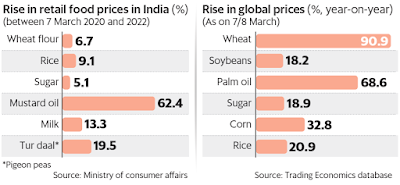
4. The crisis is hitting food prices badly

As the oil embargo by US and UK starts to bite and others join in, oil prices are expected to rise further and also stay elevated for the foreseeable future. Its impact on Indian consumers will be significant, thereby posing a serious problem for the government to absorb some of the increases through excise duty cuts, which in turn would erode its tax revenues.

The cost of the Indian basket of crude, which averaged $69.88, $60.47 and $44.82 per barrel in FY19, FY20 and FY21, respectively, averaged $94.07 in February, according to data from the Petroleum Planning and Analysis Cell (PPAC). The average was at $126.32 a barrel as of 7 March. The Indian basket represents the average of Oman, Dubai and Brent crude... Petrol and diesel have around 2.5% weight in the Consumer Price Index and 13% weight in the wholesale Index. A ₹1 cut in excise duty on petrol costs the exchequer ₹4,000-5,000 crore, while the same for diesel costs ₹14,000-15,000 crore. An ICRA report recently said that India's current account deficit is likely to widen by $14-15 billion, or 0.4% of GDP, for every $10 barrel rise in the average price of the Indian crude basket.

And its impact on inflation in India,

It is estimated that a 10% rise in pump prices or retail fuel prices could lead to a direct impact of 20-25 basis points (bps) on inflation measured by the Consumer Price Index (CPI).

The oil embargo will seriously impact Russia only if European countries follow the US and UK in banning Russian oil imports. 

About 60 per cent of Russia’s oil exports go to Europe, including around 2 per cent to the UK, while 8 per cent go to the US. China accounts for about 20 per cent. 

The crisis has also forced the Europeans to shift away from its dependence on Russia for natural gas

The EU unveiled a plan on Tuesday to cut Russian gas imports by two-thirds within a year. Moscow supplies 40 per cent of the bloc’s gas and a quarter of its crude oil. Brussels aims to import more liquefied natural gas, increase the amount of wind and solar energy, produce biogas and reduce demand by insulating homes and asking people to turn down their central heating.

Oil prices are inching their way to record high.


5. On the topic of oil price increases, a Wood Mackenzie analysis (before the Russian invasion) pointed to three factors,
First, a second successive year of extraordinary demand growth is putting massive pressure on infrastructure and global logistics. Shifting crude from well-head to pump is proving problematic. Second, oil has joined in the general commodity rally of the last 18 months and has had an important interplay with gas along the way. Super-high gas prices in Europe and Asia have encouraged arbitrage and some gas-to-oil switching, albeit much lower volumes than many feared. Both factors helped pull up oil prices. Third, there have been multiple threats to global liquids supply in the last few months: civil unrest in Kazakhstan, which briefly reduced production; political disputes and pipeline outages in Libya; ongoing militant attacks in Nigeria; drone attacks on the UAE; and now the mounting tension in the Russia-Ukraine crisis. Together, these have heightened fears of a supply shortage.
6. Underlining risks associated with futures trading, the London Metal Exchange had to suspend nickel trading following a "short squeeze" sent the price soaring. It arose due to a Chinese metal tycoon, Xiang Guangda, founder of China's leading stainless steel maker Tsingshan Holding Group, accumulating more short position than available inventory. As prices rose due to news of supply disruptions from Russia, it forced margin calls on Xiang which would force losses of billions of dollars.

Xiang had bet that the price of nickel would fall, but when the market moved sharply the other way, he would have been required to either post more cash to cover his losses or buy back the position. The move on Tuesday followed a jump of more than 70 per cent in the previous session as rumours about the size of Xiang’s position swirled around London’s tight-knit metals market. The size of Xiang’s short position is unclear but it is at least 100,000 tonnes of nickel, according to people with familiar with the matter, who said the LME had been forced to act when it became clear that some of its small members were also facing large demands for extra cash to cover trades put on for clients. Several market participants said Xiang faced potential losses stretching into billions of dollars given the size of the trade, but that the figure could change depending on where nickel prices reopen...

The decision to suspend dealings and cancel all trades made on Tuesday is the biggest crisis at the 145-year-old exchange since a rogue trader at Japan’s Sumitomo Corporation racked up huge losses in the 1990s trying to corner the copper market. Unlike most futures exchanges, the LME’s contracts can be settled physically from metal that sits in its network of approved warehouses, which stretch from Rotterdam to Malaysia. This link makes the exchange the leading price setter for industrial metals. Its customers include physical producers and big industrial consumers of metal seeking to hedge their exposure to price moves. Colin Hamilton, analyst at BMO Capital Markets, said it was surprising the LME had let “someone build a short position” in excess of available inventory. “To have such a large short position when there isn’t enough inventory to deliver against it is exchange 101,” he said. “That shouldn’t happen.”

Nickel trading at LME has been suspended since Tuesday morning. The obvious beneficiary is the short position holder, whose margin calls get postponed and allow the markets to get back to normalcy. 

However, the reason for the suspension is certain to become a matter of controversy in the days ahead. It emerges that LME's owner is Hong Kong Exchange, which in turn is owned by Chinese investors, who in turn may have been directed by the authorities in Beijing to shut down the exchange to bail out Xiang Guangda and prevent Tsingshan going bankrupt. The company is the world's leading nickel miner and stainless steel maker. It's now open to the counterparts/brokers who were sitting on the massive gains from Tsingshan's short positions to litigate against being deprived off those gains. It's been remarked that "global markets are being shut down to avoid one Chinese company going bankrupt". 

7. It has been conventional wisdom that Free Trade Agreements are an important requirement for national economic growth. Livemint has a good graphical summary of the effect of FTAs.

For three of the four FTA regions, imports have growth faster than exports after the FTA was signed. Interestingly, the only region with which exports have grown faster is in the South Asia region, where India is the largest and most advanced economy and therefore well placed to benefit from free trade. 

In fact, post-FTA, India's trade gap with ASEAN has diverged, even as exports have stayed flat.  

India’s imports from Asean countries have nearly doubled between 2011-12 and 2018-19. Therefore, India’s ‘terms of trade’ with Asean, calculated as the value of exports relative to imports, have worsened over the past decade, when the FTA has been in place. Amid exports that moved in a narrow band, India’s trade deficit with Asean has widened from $5 billion in 2010-11 to $23.8 billion in 2019-20.

8. Striking graphic about India's very low female labour force participation ratio.

9. A good feature in NYT on where the $5 trillion US pandemic money was spent. 
10. Finally, back to Russia. FT has a long read on President Putin's inner circle, the siloviki. It makes the point about they being motivated by Russian nationalism and deeply resentful of the way in which the Soviet Union collapsed. This is an important motivation,
Ukraine’s place in this doctrine was accurately summed up by former US national security adviser Zbigniew Brzezinski: “Without Ukraine, Russia ceases to be a Eurasian empire.” The Russian establishment entirely agrees. They have also agreed, for the past 15 years at least, that America’s intention is to reduce Russia to a subservient third-rate power. More recently, they have concluded that France and Germany will never oppose the US.