Substack

Showing posts with label Moral Hazard. Show all posts

Wednesday, May 10, 2023

The rise and rise of JP Morgan and BlackRock

The global financial markets are dominated by two institutions as never before - JP Morgan Chase in banking and BlackRock in asset management. The two institutions are bigger than too big to fail, and their Chief Executives Jamie Dimon and Larry Fink command extraordinary influence in policy making. They are the two individuals policymakers in the US turn to at times of financial market distress. In fact, it would not be a hyperbole to say that in some areas they are the market itself.

The recent decision by the US Government to sell the failing First Republic Bank to JP Morgan makes the latter even more systemically important. With this, in the space of 15 years, JP Morgan has been responsible for taking over Washington Mutual in 2008 and First Republic Bank, the largest two bank failures in US history. 

This is a brief description of the First Republic deal

The First Republic deal was different from the structures agreed for Silicon Valley Bank and Signature Bank, the two lenders that collapsed in early March, but similar in that it was another ad hoc solution to the sector’s problems. All deposits were taken over by JPMorgan, which meant the US government did not have to declare the bank a “systemic risk” to protect deposits over the $250,000 guarantee limit. At the same time, JPMorgan secured a loss-sharing agreement with federal regulators to avoid any hit from the most problematic loans on First Republic’s books, a crucial sweetener for the buyer.

The bank now holds slightly less than 15% of all US banking sector deposits. This further increases the too big to fail (TBTF) moral hazard. Its rise in recent years has been meteoric

JPMorgan today, with $3.7tn in assets and 250,000 employees, is the result of a centuries-long consolidation process. Its heritage includes a company started by the US founding father Alexander Hamilton, the investment bank run by legendary financier John Pierpont Morgan as well as lenders that financed the Erie Canal, the Brooklyn Bridge and the UK and French armed forces in the first world war. Even as recently as 1991, the retail bank that would eventually become a global banking juggernaut had only $37bn in deposits. The group now has almost $2.5tn and its market share has grown by 10 times, from 1.5 per cent to 14.4 per cent.
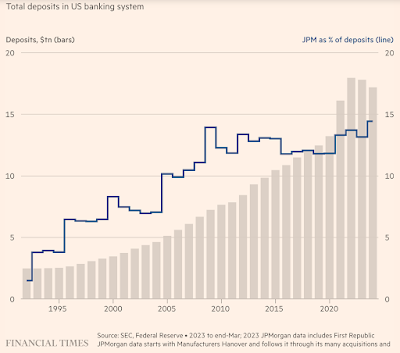
... it was under Dimon, who joined the bank in 2004 when it took over Chicago-based Bank One, that the group really pulled ahead. JPMorgan is now the largest bank in the US by assets, deposits and market capitalisation, with Chase bank branches in 48 states. It also earns more from investment banking fees than any other Wall Street bank, consistently outranking Goldman Sachs, Morgan Stanley and Bank of America.

Max Abelson and Hannah Levitt (HT: Adam Tooze) wrote this in Bloomberg about JP Morgan and Jamie Dimon,

If you’re tempted to compare it to BlackRock Inc., remember that the money manager’s $9 trillion of assets are in funds it oversees for clients. JPMorgan, by comparison, finances the world (and has an asset management operation that’s itself about a third the size of BlackRock). And it processes more than $5 trillion of payments a day. You can think of it as an empire all its own. Bloomberg Opinion columnist John Authers goes further, calling Jamie Dimon the sun around which the financial system revolves and describing JPMorgan as a kind of public utility, big enough for the government itself to depend on... 

Dimon likes to say that the bank has a fortress balance sheet, an image that political economist Mark Blyth elaborates on. “If the only game in town is a medieval fortress, I want to be inside,” says Blyth, who runs the William R. Rhodes Center for International Economics and Finance at Brown University. “Hey, we have the castle. Don’t you want to be in the castle? It’s dangerous out there.” In the first three months of the year, as other banks saw savers depart, deposits at JPMorgan rose. But there’s a problem with everyone wanting to be in the castle. “What happens if the castle walls get breached?” Blyth asks. “We’re all screwed.” Economic power in the US runs in eras. As Blyth puts it, after World War II, when society more or less had to be rebuilt, the fiscal capacity of the US Treasury dominated. When inflation became the enemy and the Fed had the power to fight it, fiscal dominance gave way to monetary dominance. Now too-big-to-fail banks’ becoming bigger could usher in something new. “We may be in a world of financial dominance,” he says. “I don’t know, but it sure smells that way.”

JP Morgan took over First Republic in an auction that had three other smaller banks, PNC, Citizens Bank, and Fifth Third, whose combined assets were less than a third of JP Morgan's. The bid parameter was the least loss to the FDIC, and JP Morgan's was the cheapest at $13 bn of estimated loss. But as the FT article writes, the sheer size of JP Morgan put it at a clear advantage compared to the three competitors. Besides given its sheer size, the Treasury and regulators would have naturally thought that a takeover by JP Morgan would have had a greater confidence-building effect on the banking system. Patrick Jenkins highlights the problem with such thinking 

The Federal Deposit Insurance Corporation, which manages US bank failures and administered the First Republic transaction, made clear JPMorgan had won the deal ahead of other bidders, essentially thanks to its heft. It could afford to offer a better value package to the FDIC — and the organisation has a legal duty to choose the “least-cost” solution. But this is a self-perpetuating argument, and with the banking turbulence of recent months turning into a full-blown regional banks crisis, JPMorgan could well become the natural buyer of other troubled banks. That feels neither healthy nor sustainable. Respecting the “least-cost” law, without considering the longer-term bigger picture, is myopic.

This is perhaps an example of an instance where the government and regulators in the US ought to have kept life-cycle cost (instead of current cost-benefits) as a factor in their decision. It's one thing to ask JP Morgan to take over when nobody was willing (and JP Morgan had declined to take over Silicon Valley Bank at the height of the current banking crisis), but an altogether different thing to hand over the failing bank to JP Morgan when there were others willing to do so. Even at a higher cost, the regulators could have avoided JP Morgan and sent out a message. But that's unlikely given the political capture of decision-making in the US by Wall Street and Big Tech interests. 

It also highlights how deeply entrenched the moral hazard of bailouts has become in the US. As Ruchir Sharma and others have pointed out, it's become all too evident that the policymakers are too scared of letting anything fail that they'll anyways come up with a bailout at the end. And the market participants have internalised this belief. 

All failures have costs. But such bailouts have even greater costs. The real issue is this - do you want to suffer the immediate pain of a bank failure, or invite much bigger long-term harm through distortion of incentives and encouragement for recklessness which erodes the disciplining powers of financial markets and irreparably weakens the foundations of capitalism?

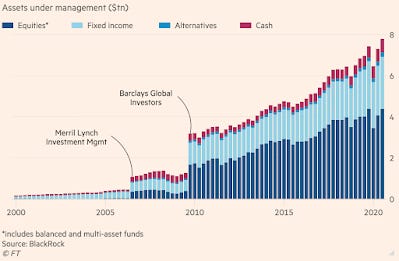
The rise of BlackRock in the asset management industry has been even more meteoric. Founded in 1988 as Blackstone Financial Management, it really took off after the global financial crisis. This is a good primer. 

Its assets under management have risen spectacularly since the financial crisis, more than quintupling to briefly touch $10 trillion in early 2022

This while a bit dated (from November 2020) is still relevant 

The hit to the big banks from the 2008 financial crisis allowed it also to swoop on Barclays Global Investors, then the world’s largest fund manager, in time for the longest bull market in equities since the second world war. That acquisition included iShares, the exchange traded fund unit that has grown seven-fold on the back of a massive shift to passive investing and now accounts for a third of BlackRock’s assets. The iShares unit now accounts for 40 per cent of global ETF assets...

BlackRock amounts to a perpetual reinvention machine that has continually added new sources of growth, most recently from technology services to investors, including chunky contracts for its Aladdin risk management platform. Its $1.3bn acquisition last year of eFront, a risk analysis company, was the biggest deal for BlackRock since the Barclays purchase. The combination of economies of scale from client inflows and these new tech revenues allowed BlackRock to set a new record for operating margin in the third quarter, which at 47 per cent would draw the envy of the tech companies that have led the market this year

The most stunning graphic is this below - BlackRock on its own is about the size of all of the hedge fund and private equity and venture capital industries combined. 
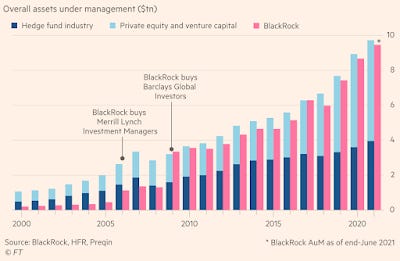
Its AUM has recovered to $9.1 trillion after a decline of $1.4 trillion in 2022, and the Fund is actively engaging on the alternatives side, an area dominated by the likes of Blackstone and KKR. It recently tried and failed to buy Credit Suisse. 

Like with JP Morgan, BlackRock's large size gives it enormous advantages. It's amplified by its presence across the spectrum - asset management, ETF wealth management platform, risk management platform, advisory services, etc. As an illustration, its advisory arm was selected by the FDIC to help sell $114 bn portfolio of securities (mortgage-backed securities, collateralised mortgage obligations, and commercial mortgage-backed securities) inherited after the government takeover of Silicon Valley Bank and Signature Bank. 

BlackRock’s Financial Markets Advisory arm has long been the go-to team for central banks and governments when they need to deal with messy assets acquired during financial rescues. The financial powerhouse helped the US sell off assets from the 2008 collapses of Bear Stearns and AIG, evaluated troubled banks for the Irish and Greek governments, and advised both the Fed and the European Central Bank on asset purchase programmes.

Business transactions involving the Advisory arm and Aladdin feed into BlackRock's asset management business in many direct and indirect ways, and confer it an unfair advantage. In the circumstances, it's again not clear as to why BlackRock should have been selected for such sales, when the same could have just as well been done by others, perhaps at a slightly higher cost. 

BlackRock is also one among the Big Three that dominate the global asset management industry, the others being Vanguard and State Street Global Advisors. A paper by Lucian Bebchuk and Scott Hirst found

We document that the Big Three have almost quadrupled their collective ownership stake in S&P 500 companies over the past two decades; that they have captured the overwhelming majority of the inflows into the asset management industry over the past decade; that each of them now manages 5% or more of the shares in a vast number of public companies; and that they collectively cast an average of about 25% of the votes at S&P 500 companies... We estimate that the Big Three could well cast as much as 40% of the votes in S&P 500 companies within two decades. Policymakers and others must recognize — and must take seriously — the prospect of a Giant Three scenario.

As an update

As of the end of 2021, the Big Three collectively held a median stake of 21.9% in S&P 500 companies, which represented a proportion of 24.9% of the votes cast at the annual meetings of those companies. 

In their latest paper, Bebchuk and Hirst refute with great detail the arguments against systemic risk creation and market concentration by the Big Three officials, and caution at the rising power of the Big Three. They argue that the diffused ownership in public companies and the prevailing market structure present the Big Three with the ideal conditions to influence major corporate decisions. 

Even among the Big Three, BlackRock tops in its market influence,

Given that many shareholders don’t actually bother to vote at annual meetings, BlackRock, Vanguard and State Street now account for about a quarter of all votes cast on average, which will rise to 41 per cent over the next two decades, the academics estimated... In reality, calling it the Big Three is a misnomer. State Street’s inclusion is the legacy of its invention of the ETF, and its size and growth rate is far more modest than BlackRock or Vanguard’s. In practice, there is an emerging duopoly, and BlackRock’s pole position — and Fink’s willingness to throw its heft around more than Vanguard — has made it a target across the political spectrum... A host of former government officials work at BlackRock, and others have departed for plum jobs in the Biden administration. To some critics, BlackRock is the new Goldman Sachs.

The Big Three's power is amplified by the rise of ETFs. BlackRock is the world's largest ETF fund manager. ETFs, like other index funds, have a unique issue - the underlying stocks of an index fund are not owned by the retail (and other) investors who buy the index fund, but by the fund manager, who there also owns the vote. This makes the fund managers of passive funds massively influential in so far as becoming a large voting shareholders in many companies. A US Senate working paper has documented several instances of strategic voting by the Big Three in the name of "investment stewardship". The paper makes several recommendations, mostly to enhance transparency and disclosure by the Big Three. 

I can think of at least three problems with size on its own, each of which in itself is sufficiently strong enough to discourage corporate bigness, especially but not only in financial and technology markets. One, apart from the economies of scale, the magnitude of their size confers on these institutions several implicit advantages, including the cheaper cost of capital, preferential access to talent and market resources, leverage over the market ecosystem, additional margins for risk assumption, preferential treatment by regulators, and a carte-blanche backstop arising from too big to fail. 

Two, given the complex and deeply interconnected nature of financial markets, institutions of the size of JP Morgan and BlackRock are too big to manage. These are bigger than all but a couple of countries. Three, a size of such magnitude is invariably accompanied by a seat at the top of the decision-making table. Given the stakes involved and the inexorable dynamic of market incentives, such access invariably translates into being able to decide the rules of the game. Such political capture corrodes capitalism and democracy. 

The behemoths among Wall Street and Big Tech companies are the most egregious exhibits. It's time that regulatory scope expands beyond present and future consumer welfare and looks at these far more dangerous factors. 

Monday, April 3, 2023

Inflating away debt

Inflation has the effect of increasing the nominal value of GDP much faster than debt and also reducing the nominal value of the debt stock, and thereby reduces the debt-to-GDP ratio. In terms of its impact on the public debt, the ongoing bout of inflation may be a god send for the heavily over-leveraged western economies. Against this, there is the erosion of purchasing power than consumers face with inflation.

David Beckworth points to the dramatic decline in US public debt to GDP ratio over the last three years since beginning of 2020,

Public debt has increased by roughly $5 trillion over the last three years. But at the same time, the market value of U.S. Treasury securities has gone from a high of 108% of the economy to its current value of 85%. This is one of the fastest declines in the U.S. debt burden and puts its value close to the prepandemic level... The origins of the dramatic change begin in the spring of 2020. The dollar size of the economy fell sharply as federal spending surged. These developments both raised the debt burden by shrinking the tax base from which the debt could be paid and by increasing the national debt. In addition, interest rates dropped to near 0%, making the existing Treasuries worth more since they paid a higher interest rate... All together, these three developments raised taxpayers’ debt burden to the 108% level.

The dollar size of the economy, however, quickly recovered from the pandemic shutdown and was back on trend by mid-2021. This lowered the debt-to-GDP ratio by about nine percentage points. Next came the inflation surge, which further reduced the debt burden by 14 percentage points, bringing it to the current value of 85%. It did this through two channels. First, the high inflation pushed the dollar size of the economy about $1.89 trillion above the pre-pandemic trend. Second, of course, is that the inflation surge caused the Fed to sharply raise interest rates, which lowered the market value of Treasuries by roughly $1.9 trillion... This remarkable transfer of wealth away from bondholders was not limited to the $24 trillion treasury market. Other fixed-income markets like the $12 trillion mortgage-backed securities market and the $10 trillion corporate bond market also saw big losses in market value.

Another important consequence is that being felt in the banking sector. The banks are a major investor in the fixed income securities markets, and the rapid rate hikes and the consequent decline in bond prices have naturally eroded the valuation of their assets side. A recent study found that US banking system assets are overvalued by $2 trillion due to mark-to-market losses

We analyze U.S. banks’ asset exposure to a recent rise in the interest rates with implications for financial stability. The U.S. banking system’s market value of assets is $2 trillion lower than suggested by their book value of assets accounting for loan portfolios held to maturity. Marked-to-market bank assets have declined by an average of 10% across all the banks, with the bottom 5th percentile experiencing a decline of 20%. We illustrate that uninsured leverage (i.e., Uninsured Debt/Assets) is the key to understanding whether these losses would lead to some banks in the U.S. becoming insolvent-- unlike insured depositors, uninsured depositors stand to lose a part of their deposits if the bank fails, potentially giving them incentives to run. A case study of the recently failed Silicon Valley Bank (SVB) is illustrative. 10 percent of banks have larger unrecognized losses than those at SVB. Nor was SVB the worst capitalized bank, with 10 percent of banks having lower capitalization than SVB. On the other hand, SVB had a disproportional share of uninsured funding: only 1 percent of banks had higher uninsured leverage. Combined, losses and uninsured leverage provide incentives for an SVB uninsured depositor run. We compute similar incentives for the sample of all U.S. banks. Even if only half of uninsured depositors decide to withdraw, almost 190 banks are at a potential risk of impairment to insured depositors, with potentially $300 billion of insured deposits at risk. If uninsured deposit withdrawals cause even small fire sales, substantially more banks are at risk. Overall, these calculations suggest that recent declines in bank asset values very significantly increased the fragility of the US banking system to uninsured depositor runs.

Some observations

1. Adam Tooze describes this as a trillion dollar transfer of wealth from bond investors to bond issuers. For sure, while bondholders have taken a massive hit from the rising interest rates, it should not be overlooked that they were also among the biggest beneficiaries of the extraordinary long period of monetary accommodation. While the likes of Tooze writes about this wealth transfer, nobody was talking about the equal wealth transfer in the other direction from savers to borrowers when rates were low. 

2. The steep rise in public-debt to GDP ratio was deceptive in so far as the increase was due to the steep fall in GDP, which has since reversed as the economies have recovered smartly, thereby regaining a significant part of the rise. 

3. A significant part of the loss suffered by bond investors is borne by the taxpayers through the central bank holdings of treasury securities. But this would be lower in the aggregate compared to the losses suffered by other investors, including banks. 

4. The banks sitting on unrealised losses may be facing a liquidity problem (and not a solvency problem) only if the assets can be nursed back to recover most of their currently depreciated valuations or it can make profits elsewhere to cover these losses. The challenge is to ensure that there are no runs in the meantime. 

5. It's clear that several banks are worse off than even SVB. The Fed's swift announcement of blanket deposit insurance coverage may be the reason why there are no bank runs on them. If so, it should be counted as among a big public policy success. But this success for now should be counted against the long-term moral hazard generated that would incentivise reckless risk taking by deposit taking banks. 

6. An economic rebalancing opportunity exists if the current bout of inflation erodes away a big enough share of the debt and also allows for a soft landing for the economy. That's a hard act to pull off, though not impossible. 

Update 1 (05.04.2023)

Indexation policies on inflation are common in developed countries.

Thursday, March 23, 2023

Working papers compilation - I

1. Outsourcing creates a trade-off - outsourced workers experience large wage declines while domestic outsourcing may raise aggregate productivity. This paper finds, 

Three implications arise. First, more productive firms are more likely to outsource to save on higher wage premia. Second, outsourcing raises output at the firm level. Third, contractors endogenously locate at the bottom of the job ladder, implying that outsourced workers receive lower wages. Using firm-level instruments for outsourcing and revenue productivity, we find empirical support for all three predictions in French administrative data. After structurally estimating the model, we find that the rise in outsourcing in France between 1996 and 2007 raised aggregate output by 3% and reduced the labor share by 0.7 percentage points. A 9% minimum wage increase stabilizes the labor share and maintains two thirds of the output gains.

The point is then about an appropriate minimum wage that can stabilise labor share without significantly denting output gains.   

2. Another paper discusses the economic, social and development impact of Covid 19 by summarising the findings of various studies done so far. It has a nice summary of all the various kinds of micro-impacts, especially across low and middle income countries (LMICs). 

3. One more paper highlighting the importance of access to opportunities in the form of big push like investments to help people break out of the poverty traps. The paper studies a 11 year panel in rural Bangladesh on the impact of an asset transfer and finds,

People stay poor because they lack opportunity. It is not their intrinsic characteristics that trap people in poverty but rather their circumstances. This has three implications for how we think about development policy. The first is that big pushes that enable occupational change can play a role in alleviating the global poverty problem. Small pushes will work to elevate consumption but will not free people from the poverty trap. The magnitude of the transfer needed to achieve occupational change may be much larger than is typical with current interventions, though importantly it can be time-limited. The fiscal cost of permanently getting people out of poverty through a large, time-limited transfer might therefore actually be lower than relying on continual transfers that raise consumption but have no effect on the occupations of the poor.

The second is that big push policies can have long-lasting effects. Our analysis of long-run dynamics indicates that the asset, occupation and consumption trajectories of above-threshold beneficiaries diverge from those of below-threshold beneficiaries over time. This finding is important as it indicates that, by engendering occupational change, one-time pushes can have permanent effects.

The third is that poverty traps create mismatches between talent and jobs. We have shown that misallocation of labor is rife among the poor in rural Bangladesh. Indeed, we show that the vast majority of the poor in rural Bangladesh are not engaged in the occupations where they would be most productive. They are perfectly capable of taking on the occupations of richer women but are constrained from doing so by a lack of resources. The value of eliminating misallocation is an order of magnitude larger than the cost of moving all the beneficiaries past the threshold. This is important as it implies that poverty traps are preventing people from making full use of their abilities and indeed it is the mass squandering of people’s abilities that is the key tragedy of poverty.

Its empirical findings comparing across programs,

Assuming the household works each of the 100 days they are entitled to, the value of NREGA is 0.13 of annual per-capita expenditure. BRAC typically offers entry microloans between 100 USD and 200 USD, which correspond to 0.18 and 0.3 of average annual per-capita expenditure. Thus, two of the main programs designed to tackle poverty are too small-scale to make a long-term difference for the majority: our simulation suggests that they would allow fewer than 20% of households to escape poverty... In a first set of simulations, we resimulate the model under the assumption that all households are given a transfer equal to an increasing percentage of annual per capita consumption expenditure, until the point at which misallocation equals zero. This exercise suggests that the value of misallocation — measured as before against the maximum payoff available at the upper mode of the distribution of productive assets excluding land — would be zero if all ultra-poor households were given a transfer equal to 3.95 times the average level of baseline per capita consumption expenditure among ultra-poor households.

It's headline policy finding,

Our results point to the existence of a poverty threshold such that households with a starting level of productive assets below that threshold are trapped in poverty while households who are able to get past the threshold accumulate capital and approach the asset level of the richer classes. This allows them to switch occupations from casual laborers to the more productive business activity of livestock rearing, which in turn facilitates further asset accumulation. The existence of such a poverty threshold has important implications for policy design. Transfer programs that bring a large share of households above the threshold will see large effects on average, while transfers that fall short of this might have small effects in the long run.

The takeaway is that a large enough cash or asset transfer can provide the big push to get people over the threshold and into an enabling path to access different livelihood opportunities. There are at least two problems. One, the fiscal cost of such transfers (3.95/0.13 = 30 times the NREGS transfer) is prohibitive and clearly off the table. Two, more importantly, the economic system's ability to absorb such large shocks (even if staggered in a reasonable manner) by providing the requisite economic opportunities in a sustainable manner is deeply questionable. 

And I am not even talking about the numerous and unanticipatable second and further order consequences of such large asset or cash transfers. 

The point is that cash or asset transfer based pathways out of poverty are at best marginal and unscalable interventions and there is no substitute to sustained economic growth and broad-based development for poverty elimination. 

4. This paper examines the impact of distortions in land rental markets across Indian states on their agriculture productivity. In 2010, the real-value added per Indian worker in non-Agriculture activities was 32% of that in the US, whereas the ratio was just 5% in use of agriculture workers. Besides, the variation in GDP per workers in agriculture across states in 2011-12 is a factor of 13.5. The paper's findings,

First, we show that an efficient reallocation of land can substantially increase agricultural productivity in all states, even relative to Punjab, the state with the least distorted land market in our sample. On average, an efficient reallocation of land increases agricultural productivity by 33 percent (15 percent relative to Punjab). In Tamil Nadu and Karnataka, the increase in agricultural productivity is 89 and 49 percent (63 and 34 percent relative to Punjab)... Such an increase in agricultural TFP would have a much larger effect on agricultural labor productivity because of the reallocation of labor away from agriculture and other productivity enhancing effects such as better selection into agriculture, investment in productivity, the adoption of modern technologies, among others... Second, we decompose the contribution between farm-and state-specific distortions and find that farm distortions contribute to about one-third of the reallocation gains, whereas state-level land wedges contribute the remaining two-thirds. We also show that an efficient reallocation of land would involve substantial increases in both the share of farmers renting (participation in the rental market) as well as the share of land operated by the most productive farms... The largest TFP gains are in states with the least active rental markets.

The paper has an informative table summarising the status of tenancy reforms in various Indian states, including the nature of restrictions on leasing land.

5. How does going public impact the performance of companies?

Public attention to a firm may provide valuable monitoring, but it may also have a dark side by constraining management’s decisions and distracting it. We use inclusion in the S&P 500 index as a positive shock to public attention. Media coverage, Google searches, SEC downloads, SEC comment letters, shareholder proposals, analyst coverage, and lawsuits increase following inclusion. Post-inclusion performance falls and is negatively related to the increase in attention. Included firms’ investment and payout policies become more similar to those of index peers and the increase in similarity is positively related to the size of the attention increase.

6. The moral hazard from seat belt use is more than offset by its safety benefits

Using data from the Fatality Analysis Reporting System for the period 1983-1997, Cohen and Einav (2003) found that mandatory seatbelt laws were associated with a 4 to 6 percent reduction in traffic fatalities among motor vehicle occupants. After successfully replicating their two-way fixed effects estimates, we (1) add 22 years of data (1998-2019) to capture additional seatbelt policy variation and observe a longer post-treatment period... investigate pre-treatment trends and explore lagged post-treatment effects. Consistent with Cohen and Einav (2003), our updated estimates show that primary seatbelt laws are associated with a 5 to 9 percent reduction in fatalities among motor vehicle occupants.

7. Gabriel Kreindler has a paper examining the likely impact of congestion pricing on traffic congestion in Bangalore,

I study the peak-hour traffic congestion equilibrium in Bangalore. To measure travel preferences, I use a model of departure time choice to design a field experiment with congestion pricing policies and implement it using precise GPS data. Commuter responses in the experiment reveal moderate schedule inflexibility and a high value of time. I then show that in Bangalore, traffic density has a moderate and linear impact on travel delay. My policy simulations with endogenous congestion indicate that optimal congestion charges would lead to a small reduction in travel times, and small commuter welfare gains. This result is driven primarily by the shape of the congestion externality. Overall, these results suggest limited commuter welfare benefits from peak-spreading traffic policies in cities like Bangalore.

The relative lack of impact from congestion pricing in Bangalore is understandable and important to be borne in mind. In most developing country contexts, infrastructure augmentation by way of new roads, widenings etc continue to remain relevant and higher priority than ideas like traffic congestion. This however does not mean that traffic congestion policies are not important. In specific areas, where the demand elasticity of response is likely higher, congestion pricing can have significant impacts. 

8. A new working paper finds that Amazon systematically manipulates its algorithms to favour its private label brands in its search results.

We study whether Amazon engages in self-preferencing on its marketplace by favoring its own brands (e.g., Amazon Basics) in search. To address this question, we collect new micro-level consumer search data using a custom browser extension installed by a panel of study participants. Using this methodology, we observe search positions, search behavior, and product characteristics. We find that Amazon branded products are indeed ranked higher than observably similar products in consumer search results... All specifications shown, as well as a number of additional checks, including specifications with interaction terms and machine learning approaches, indicate that carrying an Amazon brand is a meaningful predictor of greater prominence in search. The effect of Amazon brands tends to be 30% to 60% as large as the effect of sponsoring.

Friday, May 8, 2020

The case of US stimulus - distorting generosity?

The economic policy response to the Covid 19 pandemic in developed countries has been remarkable in its scale and speed. The fiscal and monetary authorities have been doing "whatever it takes" to backstop the economic declines.

The US Federal Reserve has broken all expectations with the speed and scale of its actions in response to the pandemic. On March 23, it announced $4 trillion in loans and other forms of credit. On April 9, it announced an additional $2.3 trillion in loans to support the economy. It said it would consider buying even junk bonds of companies like Ford and Kraft Heinz and high-yield exchange trade funds. It is now backstopping most parts of the debt market. Speculation is already afoot that it will do the same with equity markets if needed. 

It has inevitably sparked off the moral hazard issue. This is a good summary of the problem,
The US government has stepped in to make borrowing easier. The debt market was buoyed by the Federal Reserve’s announcement that it will buy $750bn in corporate debt, and the main street lending programme will make $600bn in loans to midsized companies. The moral hazard is obvious. When governments help indebted companies avoid bankruptcy, investors conclude that the government will always absorb debt’s tail risks. The price of debt goes down and its amount rises, yet again.
The central banks have amassed very high credibility in backstopping the financial markets, which in turn has engendered moral hazard concerns,
In 2012, the European Central Bank’s then-president Mario Draghi provided history’s most vivid demonstration of central bank power by promising to do “whatever it takes” to save the euro. Investors correctly inferred that meant lending to heavily indebted countries such as Italy and Spain, which were being locked out of bond markets. Investors quickly resumed buying Spanish and Italian debt, before the ECB had spent a penny. The Fed’s response to the coronavirus pandemic has been similar. When yields on Treasurys and mortgage-backed bonds spiked, the Fed brought them down with a flood of buying. When investors started to shun corporate debt, the Fed promised to buy it through special programs backstopped by the Treasury department. The spread on yields between investment-grade corporate bonds and Treasurys has since shrunk by about half, without the Fed buying any corporate bonds.
In a weekly newsletter, Howard Marks raises several concerns about the Fed's actions. In particular, the purpose of buying non-investment grade debt and providing relief to leveraged investment vehicles,
Most of us believe in the free-market system as the best allocator of resources. Now it seems the government is happy to step in and take the place of private actors. We have a buyer and lender of last resort, cushioning pain but taking over the role of the free market. When people get the feeling that the government will protect them from unpleasant financial consequences of their actions, it’s called “moral hazard.” People and institutions are protected from pain, but bad lessons are learned. A company uses its cash and perhaps borrows more to repurchase its shares. A corporate acquiror chooses to use more leverage rather than less. Or the organizer of a REIT or CLO takes on more debt in order to amplify its returns. In each case, the chosen tactic will magnify profits if things go well, but it’ll also magnify losses if things go poorly and reduce the probability of surviving tough times. If these parties get to enjoy the fruits of their actions when they’re successful but are protected from loss when they fail, risk-taking is encouraged and risk aversion is suppressed.


There’s an old saying – variously attributed – to the effect that “capitalism without bankruptcy is like Catholicism without hell.” It appeals to me strongly. Markets work best when participants have a healthy fear of loss. It shouldn’t be the role of the Fed or the government to eradicate it... unlikely (and even unforeseeable) things happen from time to time, and investors and businesspeople have to allow for that possibility and expect to bear the consequences. In other words, they have to think like the six-foot-tall man hoping to get across the stream that’s five feet deep on average. I see no reason why financiers should be bailed out simply because the event they’re being harmed by was unpredictable. 
And such moral hazard from Fed's actions opens up opportunities for discerning investors,
Take, for instance, Bill Ackman, the hedge fund manager. In mid-February, he started buying insurance on various bond indexes — a bet that the debt bubble would burst — based on his hunch that investors would abandon the riskier securities in those indexes as the pandemic spread from Asia to the West. His $27 million hedge was completed on March 3, and he sold his positions on March 23, the day the Fed announced its first major new intervention, for a profit of $2.6 billion. Mr. Ackman played the Fed’s moral hazard, betting correctly that until the Fed and the Congress acted, the markets would tank. And that once they did, that the markets would start to recover. (He has since plowed his winnings back into stocks.) For speed and accuracy, Mr. Ackman’s bet may be the single best trade of all time.
Besides, the Fed's extraordinary monetary easing may be amplifying the Mathew Effect that has been a feature of financial markets in good and bad times since the millennium. Sample this about the equity markets,
The Nasdaq 100, an index of the largest technology companies — which also happen to be the largest companies in the country — is down 0.6 percent this year. The Russell 2000 index, which tracks small public companies, is down 22 percent — roughly double the 11 percent in losses for the S&P 500... According to data from Goldman Sachs, the top 10 stocks in the S&P 500 this month accounted for roughly 27 percent of the total value of the index. That surpassed the previous peak, which came during the tech stock frenzy of the late 1990s. The top five companies alone — Microsoft, Apple, Amazon, Alphabet and Facebook — account for 20 percent of the index... And as bigger companies have steadily grown, they’ve also snagged a larger share of profits. In 1975, the biggest 100 public companies in the country took in about 49 percent of the earnings of all public companies. Their piece of the pie grew to 84 percent by 2015, according to research from Kathleen M. Kahle, a finance professor at the University of Arizona, and René M. Stulz, an economist at Ohio State University.
Similar concerns are mounting with the fiscal stimulus, especially the Paycheck Protection Program of small business lending, which appears to have been largely cornered by the larger firms. Sample this demand,
Private-equity firms including Apollo Global Management and the Carlyle Group, which want some of the Paycheck Protection Program bounty for their struggling, overleveraged portfolio companies. This is an outrage, of course. Private-equity firms have more than $1.5 trillion of their own capital that they could use to salvage their losers instead of hoovering up money meant for the less fortunate.
Talking about market concentration, Derek Thompson has a dire forecast of post-Covid retail trade and points to further market concentration, exacerbated by the stimulus spending,
The pandemic will also likely accelerate the big-business takeover of the economy. In the early innings of this crisis, the most resilient companies include blue-chip retailers like Amazon, Walmart, Dollar General, Costco, and Home Depot, all of whose stock prices are at or near record highs. Meanwhile, most small retailers—like hair salons, cafés, flower shops, and gyms—have less than one month’s cash on hand. One survey of several thousand small businesses, including hotels, theaters, and bars, found that just 30 percent of them expect to survive a lockdown that lasts four months. Big companies have several advantages over smaller independents in a crisis. They have more cash reserves, better access to capital, and a general counsel’s office to furlough employees in an orderly fashion. Most important, their relationships with government and banks put them at the front of the line for bailouts. 
The past two weeks have seen widespread reports of small businesses struggling to secure funds from the federal government. Larger companies do not seem to be experiencing the same delays. In one particularly controversial case, Ruth’s Chris Steak House—a public company with 159 locations and $87 million of cash on hand—announced that it had secured $20 million from a small-business rescue program that ran out of money before it could help countless independents... COVID-19 is, contrary to New York Governor Andrew Cuomo’s recent assessment, no “great equalizer.” It’s a toxin for underdogs and a steroid for many giants.
The bailout of the airline industry has perhaps been the most generous and moral hazard inducing. In a very good article Timothy Massad, a former Chairman of CFTC writes,
The aid to air carriers is particularly good for investors and costly to taxpayers because most of it -- 70% to be exact -- doesn't have to be repaid. Although all of it must be used for employee compensation, most of it is neither debt nor an equity investment; it is simply a grant. Congress authorized $25 billion for loans, and another $25 billion for “payroll support.”... Treasury decided only 30% of the total for each airline would need to be repaid, and obtained warrants for common shares for 10% of that 30%. That’s 3% of the total aid compared with 15% for warrants on the funds used to help banks in the 2008 financial crisis.
What did the airlines do and how does it place the terms of the bailout in perspective?
One day after receiving $5 billion in assistance from the Treasury, United Airlines sold $1 billion of common stock. Two days after receiving $5.4 billion in taxpayer funds, Delta said it was raising $3 billion by selling secured debt... United had about 240 million shares outstanding before last week’s offering, and it sold an additional 40 million shares at $26.50 each. Meanwhile, in return for the aid, Treasury received 4.6 million warrants. For each dollar of future stock price appreciation, legacy United shareholders will get 84 cents and new shareholders will get 14 cents. Treasury's return? Less than 2 cents per dollar of share price appreciation, and there's a catch: Treasury doesn’t get anything until the price exceeds $31.50.
Mr Massad also provides the alternative incentive compatible structuring,
It’s also good that the assistance agreements prohibit the airlines from paying dividends or repurchasing their common stock. But those same terms could have been built into a transaction in which all the assistance was in the form of a low-cost loan. Loans could have been structured to postpone principal payments and very low or no interest for three to five years, giving the industry time to recover. To best protect taxpayers, the loans also could have been secured; when Delta said last month that it was selling secured debt it disclosed that it had $15 billion in unencumbered assets. 
One way being suggested to mitigate the moral hazard is radical - take equity stakes.
But in circumstances such as today’s, why stop with just a few big firms ending up on government books? Why not take all the loans, convert them into equity, create a special purpose vehicle (or several, dividing up listed and private businesses, perhaps) and manage them for the public’s benefit. Or, for extra public support, manage them specifically for the benefit of public health services — always a winner in the UK and surely an increasingly political draw elsewhere... we might also have to rethink the idea that governments should selldown these equity stakes as fast as possible, as happened in the above bailouts. Instead, we should think about the situation as if we are building very public sovereign wealth funds...
There is some precedent of successful intervention here as well. Let’s ignore for the moment that the Bank of Japan is on track to own some $370bn of the country’s ETF market. This is intervention on a huge scale, but whether it will ever count as a success is not yet known. A more interesting example is Hong Kong in 1998. Then, as markets tanked during the Asian financial crisis, the government stepped in to calm the market and bought about 11 per centof the Hang Seng’s free float over a two-week period. Crisis averted. There is also how the US made loans to, and held stock in, thousands of distressed companies in 1932 via the Reconstruction Finance Corporation. Intervention, assuming it is both fast and big, isn’t always an obvious mistake.
Update 1 (19.05.2020)

Americans are making more from covid-related unemployment benefit of $600 per week than when they were working 
A study has found that 68% of those unemployed are getting more than their lost earnings, and the median share of the worker's salary being replaced is 134%. See also this.

Update 2 (07.07.2020)

FT calls for conditionalities to corporate bailouts in the wake of Covid 19 pandemic,
In many cases the conditions attached to the bailouts of 2008 were not meaningful — a lesson to heed today. A handful of European governments, including Denmark and France, have barred emergency cash for any companies registered in countries on the EU’s list of non-cooperative tax jurisdictions. The step may seem radical but the definition used is narrow. It excludes EU tax havens such as Luxembourg. Companies also contribute to the public purse through staff taxes and VAT, so governments can lose out if companies are not rescued. Far better would be to tie a bailout to a moratorium on dividend payments and share buybacks. This should be for a limited time only given the impact the loss of dividends would have on the pensions of individuals, most of whom have already seen their retirement income adversely affected by the collapse in equities. Excessive executive pay should also be curbed. Britain’s Investment Association has said that companies should consider reviewing long-term incentive plans and bonuses. Policymakers will need to examine the merits of any bailout of private equity-backed companies. Many were loaded with extreme levels of debt to fund the payment of large dividends to owners. The industry is also sitting on large cash piles.
Mariana Mazzucato and Antonio Andreoni call for conditional bailouts.
Both Denmark and France are denying state aid to any company domiciled in an EU-designated tax haven and barring large recipients from paying dividends or buying back their own shares until 2021. Similarly, in the US, Senator Elizabeth Warren has called for strict bailout conditions, including higher minimum wages, worker representation on corporate boards, and enduring restrictions on dividends, stock buybacks, and executive bonuses. And in the United Kingdom, the Bank of England (BOE) has pressed for a temporary moratorium on dividends and buybacks. Far from being dirigiste, imposing such conditions helps to steer financial resources strategically, by ensuring that they are reinvested productively instead of being captured by narrow or speculative interests. This approach is all the more important considering that many of the sectors most in need of bailouts are also among the most economically strategic, such as airlines and automobiles. The US airline industry, for example, has been granted up to $46 billion in loans and guarantees, provided that recipient firms retain 90% of their workforce, cut executive pay, and eschew outsourcing or offshoring. Austria, meanwhile, has made its airline-industry bailouts conditional on the adoption of climate targets. France has also introduced five-year targets to lower domestic carbon dioxide emissions.

Sunday, December 8, 2019

Weekend reading links

1. WSJ has an article which questions the widespread belief that failures help make a better entrepreneur.
Failed entrepreneurs were more likely to go bankrupt or dissolve their business than first-time entrepreneurs. In fact, even if an entrepreneur had run a business successfully before, they were just as likely to see their new business fail as a first-time entrepreneur. Other researchers have reached similar conclusions. A Harvard Business School study of venture-capital-backed firms in the U.S., published in the April 2010 Journal of Financial Economics, found that previously failed entrepreneurs were no more likely to succeed than first-time entrepreneurs. A study of German entrepreneurs by a researcher at KfW Bankengruppe found that entrepreneurs who started a company after a failure performed poorly compared with other founders. “Their probability of survival in general as well as their risk of failure in particular is worse than that of other startups,” according to the researcher, who added: On average, “there is no indication that business failure triggers a reflection process in which entrepreneurs look back on mistakes they have made and adapt their future behavior accordingly.”
2. An RCT evaluation shows that microfinance can indeed help certain types of entrepreneurs,
In Hyderabad, India, we find that “gung ho entrepreneurs” (GEs), households who were already running a business before microfinance entered, show persistent benefits that increase over time. Six years later, the treated GEs own businesses that have 35% more assets and generate double the revenues as those in control neighborhoods. We find almost no effects on non-GE households... These results show that heterogeneity in entrepreneurial ability is important and persistent. For talented but low-wealth entrepreneurs, short-term access to credit can indeed facilitate escape from a poverty trap... 
Essentially all of the benefits of credit access accrue by increasing entrepreneurship on the intensive margin: for those individuals with an existing business before the entry of microfinance (who we call gung-ho entrepreneurs or GEs), we find economically meaningful, positive effects on household businesses and consumption. Within this group, the bulk of effects come from households who escape from the fixed-cost-driven poverty trap and move into a more productive technology (with the remainder coming from already-productive businesses scaling up to exploit constant returns). The rest of the sample–those who start new businesses, or who never start a business at all–exhibit essentially zero impact of credit access. Notably, for this group the effect is a fairly precise zero throughout the distribution: while these reluctant entrepreneurs and consumption borrowers do not experience benefits from microcredit access, neither do they appear to experience harm.
The paper has several important academic insights. The big policy insight (one which the authors do not draw) is the reinforcement of the fact that SMEs in general are credit constrained, and, importantly, of them certain types of enterprises could benefit from even micro-finance. So add in the management practice support and with small amounts of credit, there can be out-sized productivity effects. The problem is how to identify them?

3. The lemon effect in used car markets can be very significant. Sample this from a Danish study,
We estimate the model using data on car ownership in Denmark, linked to register data. The lemons penalty is estimated to be 18% of the price in the first year of ownership, declining with the length of ownership. It leads to large reductions in the turnover of cars and in the probability of downgrading at job loss.
4. The work of folks at the BIS have demonstrated how globalisation has contributed to lowering and reducing domestic policy control over inflation dynamics. Kristin Forbes adds a nuance to that argument,
CPI inflation has become more synchronized around the world since the 2008 crisis, but core and wage inflation have become less synchronized. Global factors (including commodity prices, world slack, exchange rates, and global value chains) are significant drivers of CPI inflation in a cross-section of countries, and their role has increased over the last decade, particularly the role of non-fuel commodity prices. These global factors, however, do less to improve our understanding of core and wage inflation. Key results are robust to using a less-structured trend-cycle decomposition instead of a Phillips curve framework, with the set of global variables more important for understanding the cyclical component of inflation over the last decade, but not the underlying slow-moving inflation trend. Domestic slack still plays a role for all the inflation measures, although globalization has caused some “flattening” of this relationship, especially for CPI inflation. Although CPI inflation is increasingly “determined abroad”, core and wage inflation is still largely a domestic process.
5. The biggest obstacle to the emergence of Euro as a competitor to dollar,
A new study by economists Ethan Ilzetzki, Carmen Reinhart and Kenneth Rogoff... argue that “a central reason is the scarcity of high-quality marketable euro-denominated assets, and the general lack of liquidity compared to dollar debt markets”. Because of credit downgrades in the previous crisis and a still-fragmented private securities market, the euro has too few of the reliable assets that global investors use as reserves: typically ultra-safe triple A-rated bonds issued by creditworthy governments or companies.
The European Central Bank agrees, according to Benoît CÅ“uré, a member of its executive board. “In our analysis, [the most important move] would be a deepening of European capital markets and the introduction of a safe asset. That would be a game-changer.” In fact, no currency has ever gained predominance without liquid markets in a benchmark asset, says Mr Eichengreen. “If [Europe] succeeds in significantly enhancing the international role of the euro without that step, it would be a first.” The lack of safe euro-denominated assets was aggravated by the 2010-12 eurozone sovereign debt crisis, when investors feared the single currency might fall apart. “It’s a perfectly fine idea to promote the euro in international markets,” says Gita Gopinath, IMF chief economist. “But the necessary condition for that is to improve the euro area architecture to strengthen resilience — centralised fiscal capacity, capital markets union, banking union.”

6. Jonathan Ford in FT has a nice article on how accounting practices can cover up for corporate failings, this time in the case of Thomas Cook - the art of paying out massive dividends through accounting tricks despite the company not having the wherewithal to pay out even a cent.

7. Fascinating article about the use of back-channel diplomacy by American Presidents.

8. As the latest PISA results indicate, student learning outcomes is a problem in the US too.

9. Very good graphic explanation of the New York subway map here.

10. Finally, a new working paper comparing fiscal multipliers in developed and developing countries,
The clear theoretical implication that public investment multipliers should be higher (lower) the lower (higher) is the initial stock of public capital has not, to the best of our knowledge, been tested. This paper... finds robust evidence in favor of the above hypothesis: countries with a low initial stock of public capital (as a proportion of GDP) have significantly higher public investment multipliers than countries with a high initial stock of public capital... Our results thus suggest that public investment in developing countries would carry high returns.
Here is a good primer about fiscal multipliers from the IMF.

Friday, July 7, 2017

Examining agriculture in India

Very good analysis of India's agriculture system by Ram Kaundinya. I have always struggled with a outlining a satisfactory enough pathway to agricultural sector reforms. Here is only the latest attempt. 

As a context, about 130-140 m farmers cultivate around 175 m hectares of land, of which over 60% is unirrigated and rely on erratic monsoons. Mechanization is limited and with perhaps not much (though not non-trivial) potential given the small and fragmented holdings. Farming is therefore not very productive and largely subsistence. A vast and entrenched intermediary network coupled with lack of storage infrastructure means that most of farm production is sold immediately at farm gate at lower prices in a post-harvest buyers market. Cropping patterns have been shifting, with riskier and more infrastructure dependent horticulture crop production recently exceeding food grains. 

Given the aforementioned context, I see two major market failures. 

1. Price signals are distorted by information and access barriers as well as intermediation layers. This means that the fundamental requirement for price transmission and resultant supply-demand balance is vitiated. The result is price gouging when crop fails and price collapses after good harvest. Given the role of global factors, price shocks, both positive and negative, are increasingly common.

2. Markets do not offer affordable instruments to hedge against the two biggest risks - weather-related events and price-shocks - which are both much higher than for most other major livelihoods. Such hedges are costly, inaccessible, and under-supplied. 

This is compounded by the farmer's incapacity and cultural and psychological reluctance to respond swiftly to emergent information signals. And exacerbated by backward looking and reactive policy responses (the bigger increase in the Minimum Support Price for pulses and lower for cotton). 

So what can public policy do? Some very general thoughts. The minimum would be to increase public investments in research and infrastructure - higher yielding varieties, irrigation facilities on an outcomes (irrigation potential actually realised) focused approach, storage facilities etc - and ease regulatory barriers - effective implementation of the APMC Act etc. Others would involve catalysis of markets in affordable access to upstream and downstream linkages, mechanisation (custom hiring centers etc), information flows, provision of credit, and so on. All these would require persistent and long-drawn work, not exactly the sort of activities a weak state is good at. 

The more difficult ones involve de-risking agricultural activity and addressing the issue of property rights. There are no satisfactory answers in either case and the risk of moral hazard, with the former, is significant. We should strive to develop crop insurance as the primary risk-mitigation tool (away from an MSP) over a 10-15 year period. But in the short-run, some form of price support, including for some horticulture crops, may be unavoidable. On the latter, an even more difficult challenge, we should seek to clean/update land records and develop a practical regime for ownership and tenancy rights.

Wednesday, May 10, 2017

Supreme Court upholds sanctity of contracts

Two recent judgements of the Supreme Court of India may have contributed to restoring the sanctity of contracts in India's infrastructure sector, which had been seriously compromised by the spate of renegotiations across sectors. 

First, the Court overturned the 2016 decision by Appellate Tribunal for Electricity (Aptel) allowing Tata Power's Coastal Gujarat Power Ltd and Adani Power to charge compensatory tariffs on consumers of their respective 4000 MW and 3960 MW thermal power plants at Mundra. Aptel had ruled that the Indonesian government's decision in 2010 to link all exports of coal only at international prices was a force majeure event under the Power Purchase Agreement (PPA) signed by the two companies with the discoms of Rajasthan, Gujarat, Haryana, and Punjab. The Supreme Court has rejected that contention and disallowed any compensatory tariff levy on the PPA agreed tariffs. 

Tata Power's bid in February 2006 involved an agreement to sell 4000 MW for a 25 year period at a levellized tariff of Rs 2.26 per unit, and Adani Power's 3960 MW plant agreed to sell power to Gujarat and Haryana at Rs 2.34 per unit and Rs 2.94 per unit respectively. Tata Power claims that it will lose Rs 475 bn over the 25 year PPA through under-recoveries. 

The second judgement involved the Court upholding an earlier High Court order approving the e-auction by the New Delhi Municipal Council (NDMC) of the Taj Mansingh Hotel in Delhi. It rejected the claim of Tata's Indian Hotels Co Ltd (IHCL) to right of first refusal on the auction. NDMC had entered into a 33 year lease agreement with IHCL in 1976 to run a five-star hotel. This concluded in 2011 and since then after a series of ad hoc extensions, the NDMC had decided to not renew the license and re-auction the property. 

In the first case, the bid process for the Ultra Mega Power Plants (UMPP) allowed all bidders to either quote their tariffs as a fuel pass-through (payment on actuals for fuel) or at a fixed rate. Both Tata Power and Adani Power passed over the former despite firm knowledge about their coal import exposure and the possible fuel price risks. In fact, Adani Power quoted a nil tariff on the escalable fuel-risk component!

In other words, here was a textbook tender design, offering all the possible options. But the successful bidders preferred to assume the imported coal price risk and bid aggressively to win the tender. The presumption may have been that coal prices were low and likely to remain so, and more importantly perhaps, there was always the renegotiation window. From hindsight one could say that the government should have anticipated a market failure by way of irrational bidding and not offered the flat tariff option. Fuel price should have been a mandatory pass through.

While ex-post this appears an entirely reasonable argument, ex-ante (or at least immediately after the bid is finalised) it would have been criticised by both the experts and the bidders. The government should, or so the critics would have argued, make available all the options and leave it to the market and bidders to determine what is in their best commercial interest. After all these large business groups have the expertise to hedge for such risks and generate all round efficient outcomes. Further, the media, most likely at the instigation of one or some of the disgruntled bidders, would have carried the counterfactual story of the government's faulty bid design causing massive presumptive loss to the consumers by foregoing ultra-cheap tariffs that some of the bidders (there would be "reliable sources") would have offered by assuming the fuel price risk. The most likely sequence of events post-bid would have been - an RTI application (to find out who took the decision on the bid parameters) or CAG audit, consequent media leaks which gloss over the nuance and sensationalise (say, the presumptive loss figure), vigilance enquiry and CBI investigation.

There are also issues of ownership of the Indonesian mines and cross-holdings which need to be explored before the full extent of any loss or gains can be established. Has anyone examined the ownership of the Indonesian mines? After all, the bidders could have hedged for some of the price risks by assuming an ownership stake in the mines. I have blogged in detail about these issues here

In case of the Taj Mansingh Hotel, the lease agreement did not provide for a first right of refusal and the NDMC was only exercising its rightful option. In the absence of a first right of refusal, the IHCL's financial quotes in 1976 were on the basis of a 33 year contract period. In the circumstances, it had no right to claim a first right of refusal. In fact, that IHCL claimed a first right of refusal without any such contractual provision, and the matter was litigated before the High Court and Supreme Court (instead of being dismissed at admission stage) is itself a matter of concern. I have blogged here why the concept of first right of refusal itself is questionable. 

In both cases, allowing the claims would have engendered serious moral hazard and eroded the sanctity of contracts even more. Contract negotiations have been a serious problem in power and roads sectors, and are likely to surface soon in ports and solar sectors. This is a much needed reality check on the solar generation bubble. The Supreme Court's decisions have hopefully recovered some lost ground.

Wednesday, January 25, 2017

Free-market capitalism's assault on economics, politics, and society

Unfettered free-market capitalism has distorted price signals, rules of the game in democracies, and shifted social frames of references for the worse. In simple terms, it has distorted economics, politics and the society. 

1. It is now widely accepted that while there are pockets of market failures in an economy, the markets in the aggregate are efficient and reflect the interests of the society at large. Accordingly, a rising stock market, for example, reflects promising aggregate economic prospects.   

But consider the recent gyrations in global equity markets during the US Presidential elections and its aftermath. The same markets which were initially spooked at the prospect of a Trump White House, rebounded with vengeance on the realisation that the new President's pledge to reduce corporate tax, ramp up public spending on infrastructure, and indulge in protectionism would all boost the incumbents in corporate America. If someone landed up straight from Mars and saw the post-election US equity market rally, they cannot but not get the impression that the markets are rejoicing at an expected result.

Never mind the contradiction in the prospect of reduced tax revenues and increased public spending at a time when national debt is touching record high. Never mind that protectionism, apart from "cosseting the losers", would increase prices and lower the real incomes for the vast majority of Americans. And never mind, the uncertainty associated with a capricious President Trump, including the potential for unleashing very destabilising geo-political forces. Though political and economic uncertainty has become the norm for the US, in a convergence with the developing countries, markets seem non-plussed. 

Clearly the health of Wall Street is no longer a credible touchstone for that of Main Street. 

2. The Economist, the conscience keeper of free market capitalism, commenting on the effusive response of stock markets and investors to the rise of protectionism and industrial policy that will "cosset losers" (instead of "pick winners") under right-wing leaders in UK and US, lets this slip
Imagine the reaction of investors if left-wing leaders were in charge. If President Bernie Sanders were berating American companies on Twitter, or Jeremy Corbyn was pledging unquantified British government support to manufacturers, markets would be plunging.
This is profound. It simply means that equity markets and investors are biased against non-right wing governments. So much so that right-wing governments can adopt completely non-right policies and still get support from investors and the market. Quite simply, the remorseless march of free market capitalism has dramatically shrunk the space available for political action. 

Consider the example of policies to address widening inequality or excessive financialization. Any meaningful effort to address widening inequality has to, perforce, involve redistribution, in some form or the other. But markets will recoil at even the mention of the R-word. Similarly, any reasonable attempt at addressing financial market imbalances will have to involve greater regulation, which would immediately arouse adverse market reaction.  

Democratic politics has become the captive of financial markets and the space for political action has receded dramatically. 

3. Finally, markets have distorted our social frames of reference. Consider the reams of stories that have been circulating around the global activities of Goldman Sachs. The tenacious and indefatigable  Matt Taibi captures these pretty undisputed facts,
Goldman has been implicated in the trafficking of toxic mortgages, a sprawling state corruption case in Malaysia, the manipulation of world commodity prices and a heinous episode involving Greece in which the bank helped to mask the country's ballooning debt while simultaneously working with JPMorgan Chase to create an index for betting against Greece's economy.
One can add the disgraceful duping of Libya and many more. None of these appear to have had any effect on Teflon Goldman Sachs. After promising to "drain the swamp", the "vampire squid now occupies the White House"! The lack of social indignation in the US is stunning. 

This takes us to the point about actions of Wall Street institutions in the lead up the sub-prime crisis. Goldman again led the pack, with the dumping of its toxic portfolio of failing mortgage investments as collateralized securities on its unsuspecting clients. In simple terms, Goldman was betting against its clients. And this had the knowledge of everyone in its Firmwide Risk Committee. The Levin-Coburn report of the Senate Permanent Subcommittee on Investigations clearly documents these transactions by Goldman. After its investigations, instead of pressing criminal charges on the Goldman leadership, the Justice Department and the Securities and Exchanges Commission (SEC) agreed for a financial settlement.

In a world of twenty or thirty years back, Goldman's actions would have seen unambiguously as criminal transgression, shaken up the public conscience, and triggered mass outrage. The Justice Department would have been been forced into pressing criminal charges against Goldman executives. Instead, the public reaction is easily deflated with a financial settlement. Never mind that the executives do not shell out even a penny and shareholders took the tab. Heads I win, tails you lose.

Today, eight years after the sub-prime crisis, not one top executive of a big financial institution has been indicted on criminal charges, leave alone gone to jail. Instead shareholders of these institutions have paid hundreds of billions of dollars in fines, while the same executives have risen further and fattened their purses.

The moral hazard has become entrenched among financial market executives that leave aside risk taking, even unethical and fraudulent practices have only has an upside - make money if the it pays off, or let shareholders take the hit if the transaction is exposed. Criminal indictment, leave aside prison terms, are off the table. And all this hardly elicits any more social indignation. Settlements, financed with somebody else's money, are the new normal for a financial market executive as well as for the society at large.

Now that the social frames of reference on financial sector misdemeanours has shifted dramatically, it may be interesting to get a social pulse about what constitutes a financial crime?