Substack

Showing posts with label Power Sector. Show all posts

Saturday, September 5, 2026

Weekend reading links

1. Excellent essay by William Dalrymple about the East India Company, drawing parallels with Big Tech today.
By the end of the 18th century, the East India Company had created a vast and sophisticated administration in India and built much of the London Docklands. Its annual spending in Britain — around 8.5 million pounds — equaled about a quarter of the British government’s total annual expenditure. In India it collected taxes, minted coin, administered justice, ran its own courts and diplomatic service, flew its own flag, negotiated treaties and made war on sovereign states, all in pursuit of increased dividends. An international corporation that began trading spices ended up transforming itself into a colonial superpower... For much of the 18th century it was staffed with as few as 35 people, in a building five windows wide. Yet in India the East India Company owned a private army that by 1803 numbered some 200,000 men — roughly twice the size of the standing British Army. Its stock was a pillar of British public finance, and its profitability and solvency were matters of state...
Its lawyers and lobbyists and parliamentarian shareholders slowly and subtly worked to use its immense wealth to influence and subvert legislation in its favor. In 1693 the company was discovered to be using its shares to buy influence with prominent members of Parliament and ministers. The following parliamentary investigation, the world’s first corporate lobbying scandal, found the East India Company guilty of bribery and insider trading. After that, the company became more subtle and instead backed candidates favorable to its policies. It arguably invented corporate lobbying, that alchemy by which the interests of a company somehow magically become the policies of the state. Around one in 20 members of Parliament sat on the East India Company’s board, and more than a fifth of the company’s directors sat in Parliament at some point; about 40 percent of members of Parliament were shareholders.
2. The Netherlands is Ground Zero for electricity grids that are hitting capacity constraints to evacuate the renewable capacity becoming available. 
Since July 1, the grid operator has frozen new connections in Utrecht to avoid power cuts... Fewer housing projects can be developed, while plans to electrify local industry and install faster chargers for electric vehicles are on hold. Utrecht’s predicament could become the norm across the EU unless governments learn from its example and invest heavily in grids to support the bloc’s shift from fossil fuels to cleaner technologies... The EU’s fifth-largest economy has more solar panels and electric charging points per person than any other country in the region... But its failure to invest fast enough in pylons, cables and substations to support the transition means the queue of companies waiting for a power connection increased from 12,000 to 15,000 last year. Only 700 companies received a connection in 2025... Ember research suggests that in countries such as Austria, Poland, Portugal and Romania, there is enough grid capacity for less than 10 per cent of the renewables projects planned by 2030.

3. The FCNR(B) deposit scheme inflows in perspective.

Gross inflows on the current account are at $1.1 trillion a year. On the capital account, those are $1.7 trillion a year. Put together, we are getting inflows and outflows of about $2.8 trillion a year or about $11 billion a day. A comparison against conditions in the 2013-14 currency defence is instructive. At that time, gross inflows were $0.55 trillion and $0.52 trillion on the current and capital accounts, respectively, i.e. $4.3 billion a day. Today’s India is 2.6 times bigger. The FCNR (B) stratagem relies on using public money to defend the rupee. The state subsidises foreign borrowing to attract dollars. This tool requires large-scale borrowing to make a material difference against a gross external flow of $11 billion a day. A commensurately large fiscal cost falls upon the exchequer. The Ministry of Finance will choose how much it is willing to spend in exchange for this round number.

And its total cost could exceed $10 bn for the RBI

Under the Foreign Currency Non-Resident (Bank), or FCNR(B), program, the central bank agreed to shield banks from losses if the rupee weakens, through a favorable currency-swap facility estimated to cost 3 per cent-3.5 per cent a year. It will also need to absorb some of the extra cash pumped into the banking system as banks exchange the dollars they raised for rupees. The two operations could cost as much as ₹1.2 trillion ($12.7 billion) over five years, according to an analysis by Madhavi Arora, economist with Emkay Global Financial Services.

4. The rise and rise of bond yields.

The Sixteenth Finance Commission estimates that unconditional transfers by states increased from ₹73,099 crore in 2018–19 to ₹2.63 trillion in 2023–24 and are at ₹4.14 trillion in 2025–26. Large-group cash transfers alone are projected at ₹.96 trillion, accounting for 47.4 per cent of all unconditional transfers, up from roughly 16 per cent in 2018–19. Social-security pensions have also risen in absolute terms, from ₹44,453 crore to a budgeted ₹1.58 trillion, but their share of unconditional transfers has fallen from 60.4 per cent to 37.9 per cent; the share going to farmers has similarly declined from about 24 per cent to 14.7 per cent. This implies that states are not merely expanding welfare but are shifting their composition towards broad category-based payments that claim an increasing share of fiscal space.

6. Europeans pull out their gold reserves from the US.

The Dutch central bank has shifted more than 78 tonnes of gold from New York to London in a politically sensitive move, citing “increasing geopolitical unrest”. The transfer follows calls from European politicians and taxpayer lobbyists to repatriate gold reserves from the US, warning that an unreliable American government under President Donald Trump may otherwise seize them amid growing transatlantic tensions... The move follows a similar decision by France, which removed all of its gold from the New York Federal Reserve between July 2025 and January 2026. François Villeroy de Galhau, the governor of the French central bank at the time, said then that the move was not politically motivated. Gold last year overtook US government bonds as the world’s largest reserve asset, according to ECB data, but some central banks are becoming increasingly skittish about storing gold in the US.

7. Interesting trends in gold prices. 

For the first two decades of this century, a 1 percentage point move in US real rates typically coincided with a roughly 14 per cent move in gold in the opposite direction. That relationship ended in February 2022, when western governments froze Russia’s foreign exchange reserves. Reserve and asset managers globally were left confronting a simple question: if $630bn held in Treasuries, Bunds, gilts and other bonds could become inaccessible overnight, what constituted money? Their answer was gold. Emerging market central banks and sovereign funds have since increased gold allocations from 5 to 7 per cent of reserves in 2022 to 11 per cent today, still short of the 26 per cent held by developed-market peers. Between March 2022 and October 2023, US five-year real yields rose more than 4 percentage points. Based on historical relationships, gold should have fallen about 55 per cent; instead, it rose 7 per cent. Over the following two years, real yields fell less than 1 point while gold rallied 110 per cent. Gold is now far more responsive to falling real yields and less sensitive to their rise.
8. Early evidence of job losses in India's IT industry.
9. Shyam Saran describes the efforts being made by China to circumvent the US-controlled SWIFT and other cross-border financial flows management systems. 
The mBridge project is a network of the central banks of China, the Hong Kong Monetary Authority, Malaysia, Thailand, the United Arab Emirates, and Saudi Arabia, who have linked their central bank digital currencies (CBDC) on a blockchain ledger system pioneered by China, to allow virtually instant cross-border financial transactions. The pilot phase of mBridge is now over and its commercial launch is imminent... mBridge does away with the correspondent banking system... mBridge enables escape from sanctions... One should consider mBridge as only one component of the Chinese efforts to achieve the internationalisation of its currency, the yuan. There are parallel institutional and procedural tracks.
One is the Cross-Border Interbank Payment System (Cips), which provides both an inter-bank messaging system like SWIFT and a clearing and settlement system. It does not seek to supplant SWIFT, but provides an efficient alternative, taking advantage of China’s role as the world’s largest trading nation and increasingly as a significant source of investment. It makes sense for partner countries to opt for yuan-designated transactions to avoid exchange risk. Increasingly Cips also avoids sanctions risk since, unlike SWIFT, it is not subject to US or Western regulation and control. This is why both Russia and Iran now use Cips almost exclusively for their cross-border financial transactions.

10. Excellent op-ed by Ajanta Krishnamurthy about the premiumisation of everything we consume. 

A biscuit is no longer a biscuit. It is handcrafted, slow-baked, perhaps even inspired by some grandmother somewhere. The packet is brown, the lettering is tasteful and the quantity inside is just enough to make you wonder whether you have accidentally bought stationery. The same thing has happened to the rest of the kitchen and, increasingly, the bathroom. Detergent has become laundry care. Pickle is a small-batch preserve. Tea is a single-estate experience. Ice cream is slow-churned. Salt has become strangely ambitious. It can be Himalayan, smoked, pink, infused, mineral-rich, and important enough to deserve a place at the table. Water has perhaps had the greatest career transformation. For most of our lives, water was the one thing nobody had to explain. You drank it. You asked for more. Now there is water that sounds like a minor European aristocrat, comes in a glass bottle, is alkaline, and costs enough to make you briefly consider dehydration.

Wednesday, August 5, 2026

A template of a localisation scheme for smart meters

I have blogged here and here outlining an industrial policy to promote domestic innovation in electronic products. The policy should identify a few (say, 3-5) products and encourage phased localisation over a five-year policy regime using a combination of targeted incentives and mandates. 

No product is more appropriate for such a policy than smart meters, on which India has launched a massive scheme (the RDSS) to replace the existing 200-250 million electromechanical and basic digital meters with bidirectional prepaid meters by the end of 2028. This amounts to almost a 10-year Rs 2.4 - 3 lakh Cr contract. Given that almost all meters are procured by government-owned discoms with the central government subsidy under RDSS, it is a perfect opportunity to use incentives and mandates.

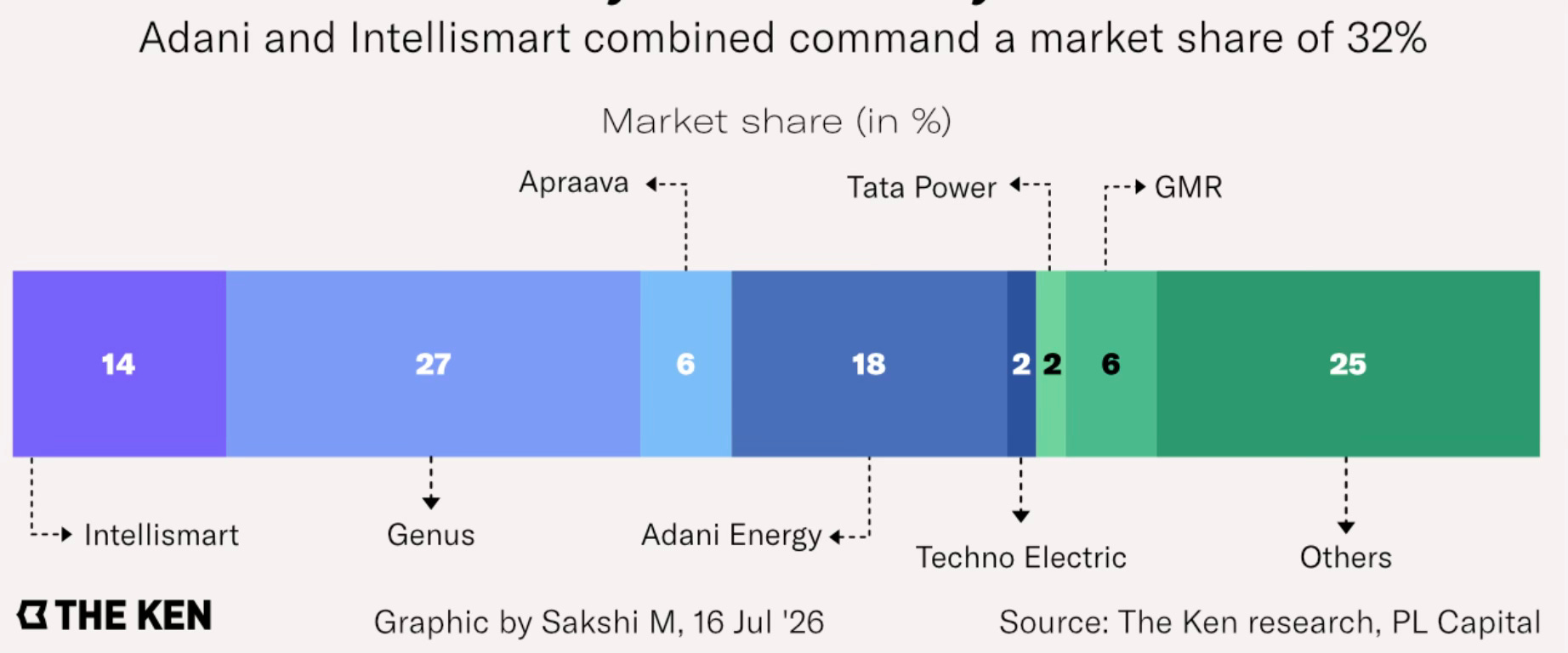
The meters are rolled out largely on a TOTEX model, where private Advanced Metering Infrastructure Service Providers (AMISPs) finance, install and operate the meters over 8-10 year contracts, paid per meter per month (of around Rs 60-80). The AMISPs, in turn, procure the meters from OEMs like Secure Meters, HPL, Schneider, Landys+Gyr, and Genus. The major AMISPs are Adani Energy, Intellismart (now purchased by Adani Energy), Genus, GMR, Tata Power, and Techno Electric. This market concentration, on both the AMISPs and the meter manufacturers, while a risk, also makes it easier to implement any phased localisation policy. 

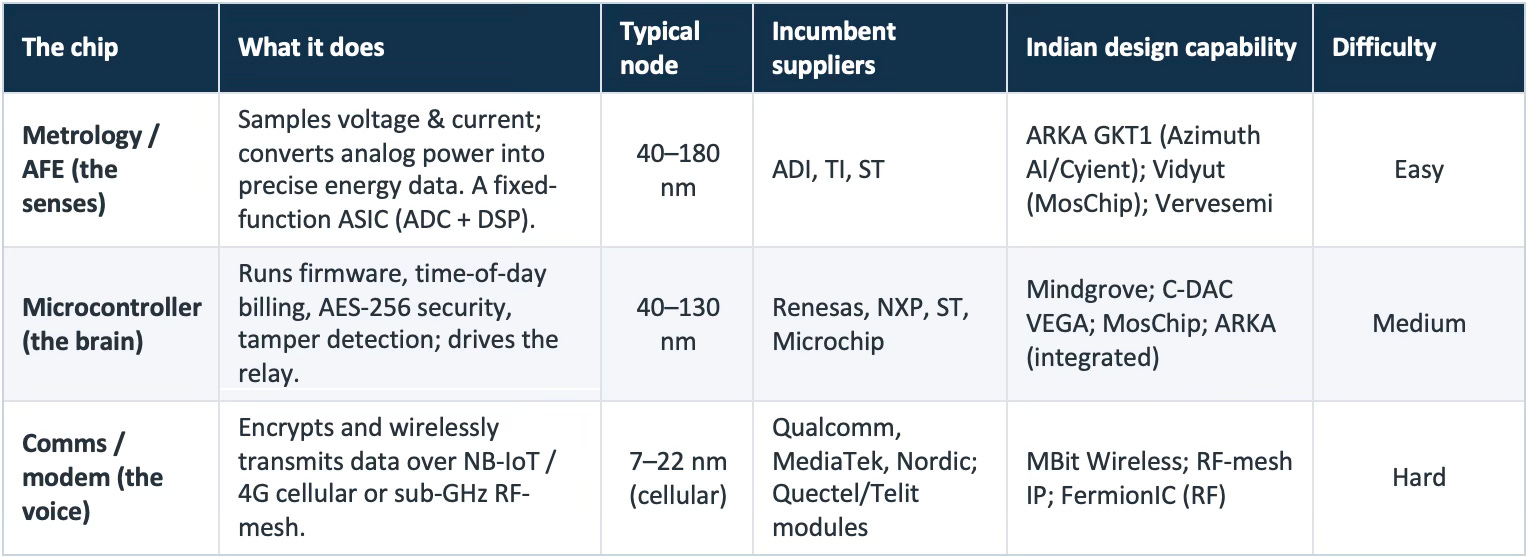
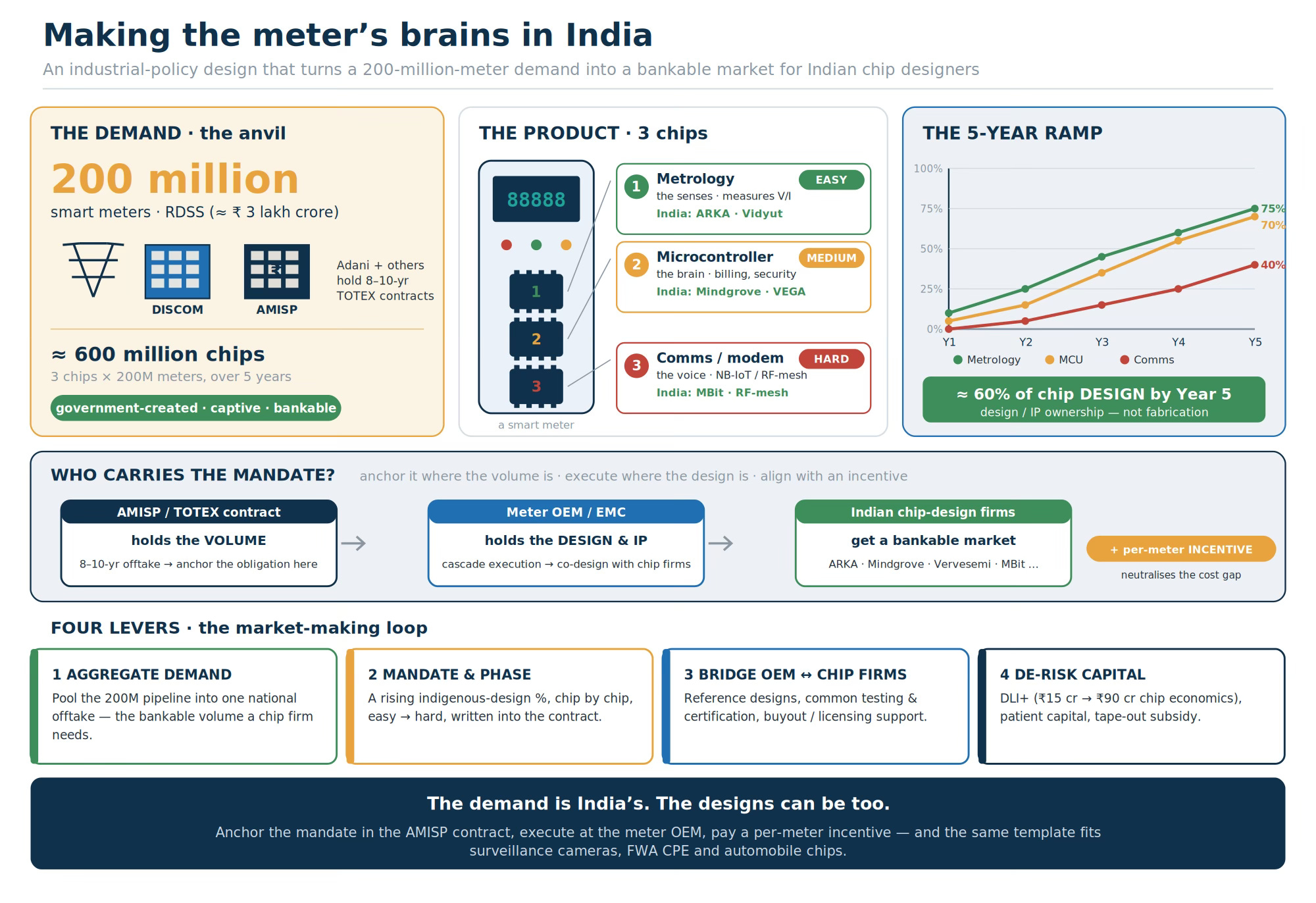
The smart meters are currently assembled in India, with all three major components being sourced externally from foreign suppliers. In terms of its technology, a smart meter is a rugged, always-on computer with three core integrated circuits (plus a latching relay, which is an electromechanical switch rather than a chip). They are the metrology IC (the sensor), the microcontroller unit (MCU) (the brain), and the modem (the voice) of the meter, and they differ sharply in complexity, which makes a phased localisation strategy possible. 

Fortunately, India has a few chip design startups who have already commercialised the metrology-plus-processing layer, and with credible domestic microcontroller unit design. The narrowband IoT/4G baseband for the modem is a genuinely hard one, though achievable in a phased manner given the commercial incentives that come with a policy. 

The table captures the smart meter components and the current market landscape. 

I have blogged here highlighting the entry barriers arising from financing challenges and deployment opportunities (given the lack of Indian OEMs) for indigenous chip design firms to break out in the chip design market. In this context, the massive volume of subsidised smart meters procured by discoms is an unmatched deployment breakthrough for the domestic chip design industry. 

This opportunity can be harnessed through a general “product-mission industrial policy” built on four levers: aggregate demand, mandate and phase, bridge OEMs to chip firms, de-risk capital. The 200 million meters (≈600 million chips) is the rarest asset in industrial policy: demand that is enormous, captive, and shaped by the state itself. India is already partway there, having commercialised indigenous meter silicon (Azimuth AI’s ARKA GKT1 and MosChip’s Vidyut).

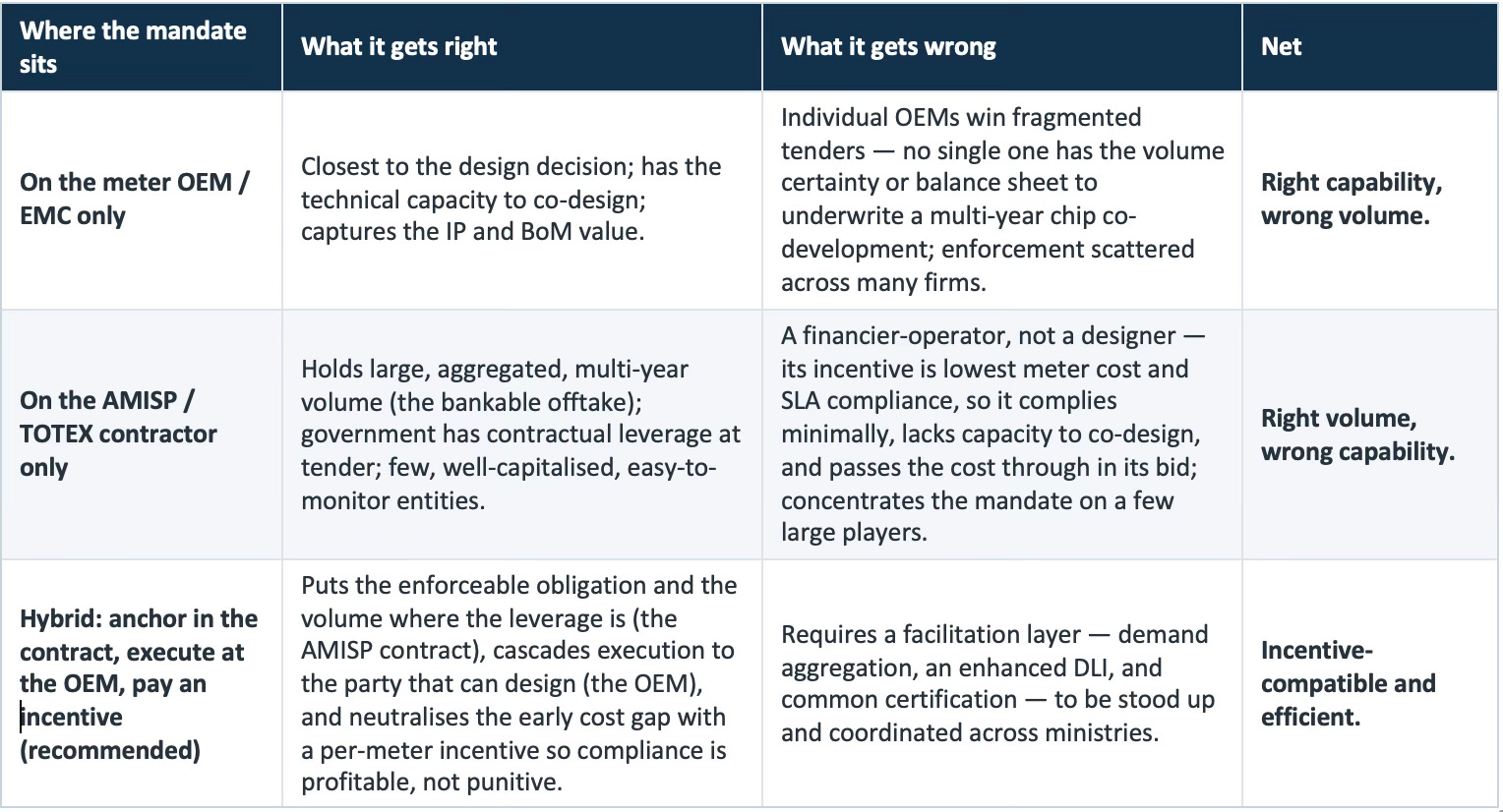
There are two commercial firms in the smartmeter contract - the AMISPs and the meter OEM. The two parties hold complementary assets - the AMISP holds the bankable multi-year volume and the government’s contractual leverage; the meter OEM holds the design capability and intellectual property (IP). The most incentive-compatible contracting arrangement would be to anchor the mandate in the AMISP/TOTEX contract, cascade execution to the OEM, and pay a per-meter incentive that neutralises the early cost gap. An OEM-only mandate fails on volume, and an AMISP-only mandate fails on capability and gets passed through as cost. 

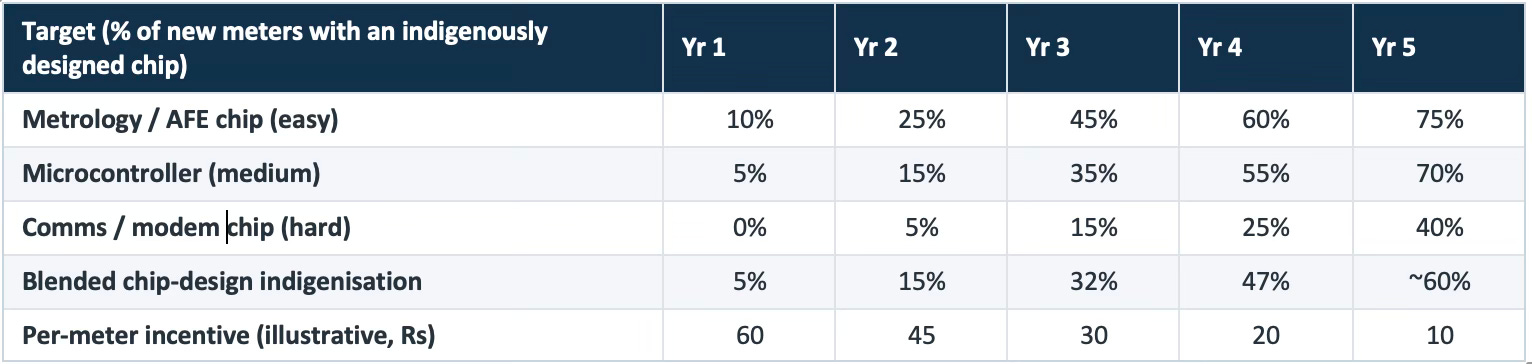
An illustrative localisation phasing and incentivisation is indicated, which would amount to a total subsidy of Rs 1000-1200 Cr, or less than 0.5% of the total project cost and about $1.6 billion of total chip cost over 5 years. The per-meter incentive neutralises the early cost gap, and it tapers off as volume rises. This would amount to localisation of 60% of the chip design for smartmeters. The numbers could be tweaked and finalised after consultations involving all stakeholders - OEMs, AMISPs, and chip design startups. 

I am assuming only the localisation of the chip design, and not the fabrication (amounting to about 60% of the chip cost), thereby enabling domestic capture of about $1 bn of chip value besides the development of invaluable chip design capabilities at scale. However, the central government could target even the fabrication of the higher-nanometer chips under the Semiconductor Mission. At the least assembly, testing and packaging (ATMP) could be localised in parallel.

This would be a genuinely end-to-end localisation achievement that can be emulated for certain other products like surveillance cameras, Fixed Wireless Access (FWA) and other customer premises equipment, automotive chips, etc.

The details are important. The target is chip design - ownership of the IP and the front-end engineering - not fabrication. An Indian-designed metrology or MCU chip can be fabricated at a foreign foundry (TSMC, UMC) or, increasingly, at an Indian one (Tata-PSMC, and the Micron and Kaynes/CG packaging lines) and still deliver the objectives of domestic IP, design jobs, security assurance and value capture. Fabrication indigenisation is a different decade-long, capital-intensive problem, albeit achievable now in some degree with the Indian Semiconductor Mission (ISM). For a country which originates 30-40% of the world’s chip-design talent, this is the natural place to start.

To prevent gaming and ‘badge engineering’, ‘indigenously designed’ must be defined tightly - the IP is owned by an Indian entity and the RTL design and tape-out are done in India, verified by a third party - and not an imported design with a domestic label.

The biggest challenge would be to support the domestic startups quickly build design and testing capabilities to meet the large volumes they must commit (including the continuous technology and standards updations). This will require the OEMs and AMISPs working closely with the chip design startups. They could offer some form of advance market commitments to the chip design startups that would allow them the runway to raise capital and finance their rapid capabilities development. 

The success of this will depend on its ownership by the Ministry of Power, which would need to work closely with the Ministry of Electronics and Information Technology, which currently run the electronic products and components schemes and the semiconductor mission.

As an important requirement, there should be no relaxation of the quality and standards requirement from the domestic chip designers. They should pass the same accuracy and reliability tests required by incumbents. In fact, they (either directly or through the meter makers) should also be nudged with soft targets on exports so as to create the incentives for maintaining global competitiveness. If they are unable to with all the support, then perhaps it might be justifiable for the government to throw up its hands and reconcile itself to the quality of Indian entrepreneurship.

Saturday, July 18, 2026

Weekend reading links

1. Are people overreacting to small struggles?

When asked if they would consider someone experiencing typical fluctuations in mood (described as broad happiness but occasional moments of worry, frustration or loss of confidence) as having a mental illness, more than half of young Americans say yes, up from just a fifth 15 years ago.

2. A picture of state finances.

3. The promise of quantum computing.
Quantum computers can transcend the limitations of the traditional binary computer bit, which can exist in two states, denoted by zero and one. By contrast, quantum bits, or “qubits”, can exist in both those states at once. This allows quantum machines to survey multiple potential solutions simultaneously, rather than dealing with them one by one like a conventional computer. One analogy is a maze. Where a quantum computer can examine the whole map to find a way through, a traditional machine will keep exploring dead ends until it finds the route. Quantum computers’ superior processing power should make them better able to generalise from small amounts of data and sift through multiple complex patterns...
But many companies are already experimenting with the technology because of its promised leap in capability, predicting early uses for the machines in areas such as chemistry and materials science. The idea is that because of their own workings and structure the computers will be better able to analyse and predict chemical behaviour determined by atomic and subatomic interactions governed by quantum rules. In a sense, they will be speaking the same language rather than translating an analysis into a string of ones and zeros as a traditional computer does. As a result, a sufficiently powerful quantum machine should in theory be adept at predicting the interactions between drugs and living cells that determine whether a new pharmaceutical will work. Such possibilities have already led tech companies to pair up with industrial groups.

4. India's trade account in a nutshell.

In 2025-26, its exports of services, at $421.3 billion, was close to the export of goods worth $446.1 billion. On the other hand, imports of goods ($783.4 billion) were way above the imports of services ($204.7 billion). Thus, while India recorded a merchandise trade deficit of $337.3 billion, it had a surplus of $216.6 billion on the services account.

5. Brilliant article by Simon Kuper on how football came to be dominated by Western Europe.

Western Europeans didn’t start by asking, “How can we win the World Cup?” Instead, they pursued a different goal: making amateur football cheap and widely available. The intended outputs were happiness, community and public health. Winning World Cups was a byproduct... I began playing football aged six, in 1976, after moving from London to Leiden in the Netherlands. Most Dutch boys I met belonged to a football club... The little Leiden region had dozens of football clubs. Some fielded 20 senior teams, seven teams of under-eights and so on. Many people built their identity and social life on being the right-back or linesman of the 14th team. The Netherlands in the 1970s reached two World Cup finals. Everyone played and understood how to play. Football is geometry — about creating space when you have the ball, and shrinking it when you don’t. That knowledge is all around you in western Europe, unlike in Asia, Africa, the US or Brazil... In 2017, the average Dutch person lived 1.6km from a football field. Neighbouring Germany’s football federation is the world’s largest sports association, with more than 7.7mn members...

As a father, I raised three footballers in Paris, now the game’s deepest talent pool. Almost all Parisian suburbs, or banlieues, have well-kept sports complexes, with artificial fields, used nonstop: at half-time of any amateur game, children storm on to the field for a kickaround. So structured is the system that my son had to earn a coaching diploma to train his little club’s under-eights. His own beloved coach, Mustapha Sangaré, who only joined a football club aged 15, now plays for Bulgaria’s Levski Sofia and Mali. He is far from an anomaly: almost 100 players across all squads in the current World Cup were born in France and just under 70 in the Netherlands.

In another article Tej Parikh looks at why China and India does so badly in football.

This is a striking statistic, pointing how globalised football has become and how the leading European clubs have become the feeding grounds for national teams. 

At this World Cup, more than 72 per cent of players appear for a club outside the country of their national team, and almost one in four are foreign born. (More than half of Cape Verde’s squad was born outside the nation and ply their trade in various European leagues.)

6. In what will prove to be a dramatic decision, DP World, which operates the Jebel Ali port that has been paralysed by the closure of the Strait of Hormuz, is reportedly planning to build a new port and a container terminal on the UAE's eastern coastal area of Fujairah. 

Shifting some of the port’s capacity outside Dubai marks a seismic change for the emirate, which has established itself as a global trade and finance hub partly off the back of Jebel Ali’s growth... But DP World’s plans align with a broader UAE government initiative to attempt to bulletproof its economy against future hostilities with Iran by reducing its dependence on the strait, where shipping has been disrupted by Iranian drones and missile strikes since the US-Israeli attack. The new project would deepen DP World’s presence on the Gulf of Oman, allowing containers to enter and leave the country without having to pass through the strait, before moving them on trucks overland to Dubai, Abu Dhabi and neighbouring Gulf countries. Since the war began at the end of February, Iran has fired nearly 3,000 drones or missiles at the UAE — more than any other country... DP World’s plans underline how the Iran war has forced governments and companies in the region to reconsider infrastructure and economic corridors developed on the premise that there would be uninterrupted passage through the strait.

7. Rote memorisation in schools is celebrated in China.

The guidelines to the gaokao, an exam for 18-year-olds and the world’s largest standardised test, describe memorisation as “the most basic level of ability”, placing it first among six traits that include comprehension, analysis and synthesis, appreciation and evaluation, expression and application, and inquiry. At the simplest level, the Chinese script itself, which operates at the level of the syllable and involves thousands of individually meaningful characters, requires years of memorisation... It is hard not to draw a contrast with the English-language west, where rote memorisation has taken on a faintly pejorative meaning. More than a century and a half ago, at the height of Britain’s industrial age, Charles Dickens was skewering the “facts alone are wanted in life” approach of fictional educator Gradgrind in the novel Hard Times.

8. Trump's makeover of the US State Department. 

Abandoning the precedent of the past 60 years, Trump has brushed aside the foreign service officers who have typically run at least two-thirds of embassies. Of the 101 nominations for ambassadorships in his second term, just nine were career diplomats. All this is against the backdrop of swingeing cuts to the department, whose workforce has shrunk by more than 3,000, over 20 per cent, since Trump resumed office.
9. China's remarkable success in reducing air pollution by 60% since 2013. 

10. Interesting that the IT sector explains half the difference in productivity growth between the US and EU.
Strikingly, even though the tech sector was only 9.2 per cent of US GDP, against 5.4 per cent of the EU’s, almost half of the difference in productivity growth between the two economies was explained by differences in the relative size of this one sector. Moreover, productivity growth in the EU’s (relatively small) tech sector was also measured as being lower than in the US one. So, overall, the tech sector alone accounts for well over half of the overall difference in growth of GDP per head.

This is important

Life expectancy for US men was 76.5 in 2024, against an average of 80.5 in comparable high-income countries. For women, it was 81.4 against 84.8. That is despite spending a far higher proportion of its GDP on health. The US homicide rate was 5.9 per 100,000 in 2023, against 1.3 in France and 0.9 in Germany. Its prison population was 542 per 100,000 in 2023, against 130 in France and 69 in Germany. Thus, if one takes a wider view of human welfare, the US is very far from superior.

11. China reports the lowest quarterly growth rate in decades at 4.3% for the second quarter of 2026. Industrial production and exports are propping up growth, even as consumption declines.

Retail sales added just 1 per cent in June from a year earlier, while fixed-asset investment was down 5.7 per cent year on year for the first half of the year, compared to 4.1 per cent in the first five months. Industrial production, one sign of strength, grew 5.3 per cent last month on a year earlier... Separate data on Tuesday showed exports soared 27 per cent year on year in June, adding to signs of reliance on trade to support economic activity... Julian Evans-Pritchard, head of China economics at Capital Economics, noted that the GDP data brought it “closer in line” with the consultancy’s alternative measure, which has been around 3 per cent.
Underlining the importance of exports, there was a surge in China's EV exports in June.
China’s monthly car exports rose to a record 1mn cars in June as part of an overall surge in trade that will heighten tensions with partners such as the EU. Shipments of cars rose 71.2 per cent from a year earlier to 1.06mn, putting the country on track to export more than 10mn cars this year, up from 7.1mn last year and more than double the 4.9mn in 2023. The surge in exports comes as domestic sales slow sharply following the phaseout of EV subsidies and a decline in demand for fuel-powered cars... The wave of Chinese exports has been driven by lower-cost cars boasting superior software, further threatening carmakers from Japan, South Korea, Europe and the US... China’s exports of rare earths in June fell 34 per cent year on year and 6.4 per cent in the first half, following tight export controls on the minerals, which are essential for high-technology products... The NBS’s Wang said China’s exports of green energy-related products such as lithium batteries and wind turbines increased 37.6 per cent and 35.6 per cent, respectively, during the first half.

And this highlights how production and exports have sustained growth.

Industrial production rose by 5.4 percent in the first six months of the year, versus the same period last year. High-tech manufacturing rose by more than 13 percent over that period. But fixed asset investment — which includes infrastructure, property construction and manufacturing — fell by 5.7 percent. Real estate development dropped 18 percent. The value of China’s exports surged by more than 20 percent in the first half. But consumer spending, which a Moody’s Analytics report said “remains the economy’s weakest link,” faltered. Retail sales of consumer goods increased by 1.3 percent over the first half of the year.
12. Ruchir Sharma holds that peak China was reached in 2021, and since then it has been a story of decline, papered over by exports and AI.

Since then, China’s share of global GDP has fallen in nominal terms from 18 to 16.5 per cent, while the US share has risen to 26 per cent. China’s growth rate has dropped below the rest of the world, including the US. In real terms, independent estimates now put China’s growth in real terms closer to zero than to the official target of 4.5 to 5 per cent... China’s population also peaked in 2021. Last year, births hit a record low, and deaths hit a record high. The working-age population is on pace to shrink by 75mn every decade this century... After adding little in the 2010s, net exports now account for about a third of the country’s growth, driven mainly by AI-related goods... And though every country now hopes for an AI-driven productivity miracle, the expected boost in China is about a third of a percentage point by 2030, hardly enough to halt its decline.

13. India agriculture statistics

If one looks at the growth areas in agriculture in the 12 years between 2011-12 and 2023-24, production of paddy and wheat rose by just 27 per cent. Fruit and vegetable production rose by 52 per cent, and milk production by 85 per cent, even though they did not receive any substantial support by way of subsidies or minimum support price procurement by the government. The true growth areas in agriculture are out of direct central government support and depend largely on producer enterprise... In 2023-24, the value of output of cereals (mainly paddy and wheat) was ₹8.5 trillion, while the value of the largely cooperative-controlled milk sector was ₹12.2 trillion.

14. Outbound corporate investments from India on the rise.

Indian companies have announced overseas equity investments worth more than $14bn in the first four months of the fiscal year that began on April 1, compared with $18.7bn in the previous 12 months. The outflows come as foreign investors flee India’s markets at the fastest pace ever this year, pulling out more than $23bn as of the end of June over a lack of AI champions.

15. Simon Kuper on Lionel Messi.
On the field, Messi sees everything. All his career, he ignored the ball for the first five minutes and instead walked around, memorising the position of each opponent and the spaces between them. But now he spends almost the entire game walking and scanning. When he breaks into a run, his teammates know he has seen an opening. They play to serve him. When he moved to the right wing against Egypt, seeing space there, the team remade itself around him. Argentina, two goals down after 78 minutes, won 3-2. Scaloni said afterwards: “We were not the ones who told him to go out to the right.” Messi moved right again against England and again Argentina came back to win.

16. The AI-boom is spilling over to energy sector.  

Initial public offerings for energy firms raised $12.6bn in the first half of this year, according to data firm Dealogic. That marks the highest half-year level since the peak of the dotcom bubble in late 1999 and the highest first-half figure on record. It is well above 2025’s full-year total of $4.3bn. The surge in fundraising comes as access to the vast amounts of energy needed to run data centres emerges as a bottleneck in a multi-trillion-dollar AI investment boom... US electricity demand is projected to increase 39 per cent between 2026 and 2035, according to consultancy ICF, in large part due to ballooning demand from data centres...
Companies that have been able to raise money on public markets include those involved in complex, capital-heavy projects such as nuclear and geothermal power plants, while investors have also been willing to back businesses trying to develop new technologies... “This is a moment in which speculative projects are being funded and underwritten,” said Julien Dumoulin-Smith, a Jefferies research analyst covering power, utilities and clean energy. “They’re not just limited to venture capital or private equity.”... Nearly two-thirds of the energy companies that floated this year and last are now trading below their offer price, according to Dealogic. That compares with less than 40 per cent of IPOs across all sectors that are underwater.

And Wall Street Banks are already AI trades. 

Four of the five big Wall Street banks reported yesterday: JPMorgan Chase, Bank of America, Citigroup and Goldman Sachs (Morgan Stanley chimes in today). The numbers were outstanding, as one would expect in a quarter when markets whipped around and big deals were done. In aggregate, equity and debt trading revenue at the four hit $38bn, up more than a third from a year ago and 60 per cent higher than two years ago. Investment banking fees, at $10bn on the quarter, have grown almost as much... It is AI that has markets churning and drives capital-raising. The banks are another example of the false “broadening” of the stock market that has also driven up industrial and utility stocks in the past few years. All these sectors have lived, and could die, with AI.

And their profits are not confined to the US, with even Asia becoming a major source.

Equities trading in Asia is helping power a record-breaking run from Wall Street’s banks, with the region on course to surpass Europe as the industry’s second-largest source of revenue behind the US. In the past 12 months, clients of large investment banks have ploughed into companies in Asia that provide critical infrastructure to the AI semiconductor industry, including South Korean SK Hynix, Taiwan’s TSMC and China’s Cambricon Technologies... In the most recent quarter, the largest investment banks collectively reported an unprecedented $25.7bn in earnings from equities trading and called out Asia as a crucial factor in the growth.

17. Even by the low standards of Trump 2.0, this is surely an outrageous example of private profiteering from public office. 

Donald Trump’s social media company has discussed charging traders and investors as much as $100,000 a month for faster access to the US president’s posts on his Truth Social platform. Trump Media & Technology Group (TMTG) has quoted the six-figure monthly sum in talks with prospective buyers of the “Truth API” data service, according to people familiar with the matter. Proprietary trading firms and hedge funds pay huge sums for ultrafast data feeds because every millisecond counts when reacting to market-moving news. Trump often makes major announcements on Truth Social that trigger huge fluctuations across global markets... TMTG, which is majority owned by the Trump family, controls Truth Social...
A pitch sheet circulated by TMTG to promote Truth API, seen by the FT, lists 10 “documented market-moving posts” from the president’s Truth Social account. On April 9 2025, for example, the document says Trump’s “THIS IS A GREAT TIME TO BUY!!!” post “restored” $4tn to the market capitalisation of the S&P 500. Trump’s post in early June that the US would hit Iran “very hard tonight” caused a 6 per cent intraday jump in oil prices, the document says. “When @realDonaldTrump Truths, the world reacts,” the document continues. “No comparable signal exists. No official API has ever been offered. Until now.” Trump has also touted specific stocks, complimenting companies such as Nvidia and Apple and fuelling rallies in their share prices. More recently after the outbreak of the war with Iran, Trump posted on March 23 that there had been “very good and productive conversations with Iran”, sending oil prices falling sharply.

Saturday, July 11, 2026

Weekend reading links

1. FT long read on how senator Deborah O'Neill, as chair of the Parliamentary joint committee on corporations and financial services, has single-mindedly exposed and brought the knees the Big Four auditing and consulting firms in Australia. 
Deborah O’Neill has led the charge against KPMG in Australia over a client confidentiality scandal that prompted the departure of the firm’s chair, chief executive, chief operating officer, audit leader and a senior partner over the past month... comes on the heels of a similar implosion at PwC. The rival Big Four firm came unstuck when a data leak led to the exit of senior management... An EY employee was charged with accessing the bank details of Prime Minister Anthony Albanese while working on contract at Australia’s biggest bank. Meanwhile, Deloitte partially refunded the Australian government after admitting that it used AI to compile a report...
In 2023, the Labor senator forced the publication of emails that implicated PwC partners in the tax leaks scandal. PwC partners were caught sharing secret government tax plans that one of them had obtained from his work on an advisory board in Canberra, in the hopes of winning business in the US. This year O’Neill used parliamentary privilege to air allegations made by a KPMG whistleblower that had been inadequately investigated by the firm. KPMG has now been exposed as having used confidential information from existing audit clients to try to win new business from rivals — some from PwC as its audit customers looked to switch in the wake of that firm’s woes...

She entered parliament in 2010 having spent her career in education. O’Neill soon discovered that some Big Four consultants acted like some of her former pupils — copying the answers from the back of the book and then marking their own work, as she puts it — and used her role to put the leaders of the firms under pressure.
2. Soumaya Keynes points to a fascinating study by Rebecca Diamond of Harvard University of the use of GLP drugs that appears to show increased confidence and employment rates among women in the US. The study finds, using data gathered between 2021 and 2023, that the poorest third of women in the US suffered an obesity rate 14 percentage points higher than the richest third, whereas the gap was negligible for men. 
The study's main findings:
After 18 months, women using GLP-1 drugs who start off without a job enjoy employment rates 27 percentage points higher than otherwise similar non-users. Women who start off with a job see their employment rate fall slightly, and although the data is too noisy to pick out effects on their earnings, it looks like their household income rises by 10 per cent. That second effect is a bit surprising, and possibly explained by parallel developments in these women’s love lives. Diamond estimates that GLP-1 drugs give single women a dramatic 29 percentage point increase in their chances of coupling up. On average, their new partners are richer than them, giving their household income a bump. Which could explain why a few of the women losing weight then feel able to drop out of work.
The study also points to a more disturbing consequence.
So far at least, GLP-1 drugs are disproportionately used by the rich. In Diamond’s study two-fifths of the women paid for the drugs out of pocket, at a median cost of $275 a month. Research based on Voy prescriptions shows how, adjusting for relative obesity rates, uptake is skewed towards more affluent areas. If obesity becomes an even stronger signal of economic disadvantage, the stigma attached could grow.

3. The rise of London's King's Cross area as perhaps Europe's AI capital.

Two decades ago, King’s Cross was central London’s most neglected district. Today, it is home to the main foreign outposts for several of the world’s wealthiest companies, from Big Tech giants Google and Meta to their richly funded AI challengers including OpenAI, Anthropic and Jeff Bezos’ Prometheus. AI researchers and entrepreneurs are packing out the area’s canal-side cafés so densely that venture capitalists prowling for their next deal are struggling to prevent their coffee meetings from being overheard by rivals.
For many, this resurgence can be traced back to one individual: Sir Demis Hassabis, the DeepMind co-founder and Nobel laureate who stayed in London to build his AI lab following its sale to Google in 2014 for £400mn. “Demis keeping DeepMind in London and resisting the gravitational pull of [America’s] West Coast is the most important thing that has ever happened to the London tech ecosystem,” says Tom Hulme, a tech investor at Alphabet’s GV venture capital unit... Just as PayPal helped launch the careers of a generation of Silicon Valley founders and investors including Elon Musk and Peter Thiel, a “DeepMind mafia” in London is pulling in billions of dollars to AI start-ups founded by Hassabis’s former lieutenants, including David Silver’s Ineffable Intelligence and Tim Rocktäschel at Recursive Superintelligence...
It was Hassabis’s pursuit of an “artificial general intelligence” capable of scientific research and a wide range of human tasks that in many ways kick-started the current AI boom. DeepMind’s sale to Google prompted Elon Musk to set up a research lab to counterbalance the internet group’s dominance of AI; that lab was OpenAI. DeepMind went on to make a series of AI breakthroughs including AlphaGo, which in 2016 beat the board game Go’s world champion Lee Sedol, and AlphaFold, which used deep learning to predict protein structures with superhuman speed.

King's Cross has emerged as the Canary Wharf of tech in UK, and this description is apt and underlines the continuing importance of personal interactions and connections. 

The density of AI talent in King’s Cross was why the government’s scientific research agency Aria took a “very conscious decision” to base itself there rather than Whitehall, says Pippy James, its deputy chief executive. “We were definitely inspired by Kendall Square in Boston,” she says, referring to the area surrounding MIT where Google, Microsoft and Amazon, as well as biotech companies Moderna and Novartis, have offices. “Value creation comes from those serendipitous collisions.” In recent weeks there has been a steady stream of American AI companies announcing moves into the area. OpenAI and Anthropic have signed leases for tens of thousands of square feet in King’s Cross. Others moving in include Bezos’s “physical AI” company Prometheus, Cursor, the AI coding company that recently agreed a $60bn sale to SpaceX, AI agent group Perplexity and open model developer Reflection. Google, which already has many researchers and engineers in the area, plans to start moving staff into its vast new “Platform 37” office this summer after almost a decade in development.

4. This is a striking factoid about the importance of chips now. 

With SpaceX going public, the list of the 10 most valuable US public companies is entirely made up of tech companies for the first time. Of those, three are semiconductor specialists. But with chips a key ingredient in AI, the other seven are also now all designing their own chips.

Some stats about the global chip squeeze.

... Elon Musk’s xAI to rent out spare capacity in its data centres. In recent weeks, Anthropic, Google and start-up Reflection AI have agreed to pay a total of around $2.3bn a month — or $28bn a year. This looks like a big return on Musk’s data centre investments. As of March this year, xAI’s total capital spending over its lifetime totalled $26.5bn... this surge in demand has already prompted a huge increase in supply, both of planned chipmaking capacity and newly minted chip stocks. One sign is the $600bn that memory chipmakers Samsung and SK Hynix said this week they plan to invest in Korea. Another is the $29bn that SK Hynix hopes to raise when its American depositary receipts begin trading in the US next week... TSMC has said it will boost its capital spending by as much as 37 per cent this year, as it did in 2025. But those increases follow two years of retrenchment and would leave 2026 capex only around 50 per cent higher than 2022. Contrast that with the biggest buyers of AI chips. Seven of the largest data centre operators are planning to spend an astounding $848bn this year, at least five times what they spent in 2022, according to a calculation by the newsletter Exponential View.

5. On the new bonds issued by SpaceX.

The bonds enjoyed very robust demand at the point of issuance, but some see that as a problem in itself. Allianz’s chief investment officer has described the market’s willingness to hand money over to Musk as a clear sign that we have moved from “a healthy boom, a stretched boom . . . into bubble territory”. Ominously, the bonds have weakened since they launched.

6. The AI LLMs scorecard. 

Where will Sarvam stand?

Also national scorecard.
7. The low-margin business of mobile phone assembly. Amber Industries which makes air conditioners for eight of the top 10 brands and more than a quarter of all ACs made in the country, now proposes to assemble smartphones for Oppo. 
Now, the company plans to sub-lease a part of Oppo India’s factory in Noida, set up SMT lines, and start assembling phones there... But smartphone assembly is one of the toughest businesses in electronics manufacturing... The target is to eventually assemble about a fifth of Oppo India’s volumes, scaling from roughly 8 million handsets in the first year to nearly 15 million in the second... Amber expects Ebitda margins of 1.5–2%, excluding benefits from the government’s production-linked incentive (PLI) scheme. That’s well below the 8.8% Ebitda margin generated by its broader electronics business in FY26, and the 7.1% operating margin recorded by its AC-heavy consumer-durables segment... Take Dixon, for instance. The company already accounts for nearly one-fifth of India’s smartphone output. Even at that scale, smartphone assembly, aided by PLI incentives, generates Ebitda margins of only about 3%.

8. AI boom compared with historical episodes.

9. On the rise of non-compete clauses in OECD countries and their adverse impact on productivity.
About 30 per cent of employers surveyed by the OECD said they had increased their use of the clauses in the past five years... It estimates that a 10 percentage-point increase in the prevalence of non-compete clauses in an industry was associated with a 1.9 per cent decline in the level of labour productivity, with workers stuck in sub-optimal jobs and firms less able to gain new skills. In many countries, non-competes have spread into parts of the labour market where the original justification of protecting sensitive information and firm-specific information is “weak or absent”, the research found, pointing to their use among entry-level fast-food staff in the US, manual workers in Italy and childcare workers or yoga instructors in Australia.

10. The market concentration in DRAM chips.

A market in which a monopolist owns 100 per cent gets an HHI of 10,000, a duopoly scores above 5,000, and a perfectly competitive market approaches zero... The US DoJ considers anything between 1,000 and 1,800 points to be “moderately concentrated”. Per Counterpoint Research, as of the first quarter of 2026 the memory market is 38 per cent Samsung (South Korea), 29 per cent SK Hynix (South Korea), 22 per cent Micron (US), 8 per cent CXMT (China), 2 per cent Nanya (Taiwan), and 1 per cent everyone else. This gives us an HHI of 2,838... Both Samsung and SK are two of Korea’s largest conglomerates (the so-called chaebols) which benefit from cosy relations with the state, so viewing them as fierce competitors in the same memory market might be wrong-minded in this case... And if the two companies function as a single economic entity in the global DRAM market, we should probably count them together for HHI purposes. And doing this we get a much higher HHI reading of 5,042. That’s above 5,000 —the HHI of a perfect duopoly.
11. China’s excess capacity in manufacturing requires something similar to what was done by the former Prime Minister Zhu Rongji. 

In the late 1990s and early 2000s… under Zhu’s slogan of “zhua da, fang xiao” or “grasp the large, let go of the small”, Beijing retained its grip on key strategic industries while relinquishing control of a vast sea of smaller companies and factories…Thousands of mines, steel mills and other industrial sites were shut for good. An estimated 30mn to 40mn workers lost their jobs. The process was deemed painful but necessary: not only in setting up China’s accession to the World Trade Organization in 2001, but in freeing Beijing from supporting uneconomic industries… 

Over the past 15 years, as China’s share of global manufacturing surged to around one-third, the share of lossmaking industrial businesses jumped from about 10 per cent in 2010 to nearly 25 per cent last year, according to the MERICS China Overcapacities Monitor. This dynamic exists across everything from steel and cement to cars, computer chips and robots. Take the automotive sector for example. Domestic car sales last year totalled 23.9mn against estimated production capacity of 45mn to 50mn. Sales are highly concentrated among a clutch of leading companies. According to HSBC, more than 70 per cent of EV sales — including plug-in hybrids — are being soaked up by 10 brands, leaving 47 others jostling for the remainder. In the shrinking market for petrol and diesel cars, 10 brands have about 70 per cent of sales and 73 others compete for the rest.

12. South Korean capitalism and windfall profits sharing - SK Hynix and Samsung edition.

Soaring global demand for high-bandwidth memory chips used in AI systems has propelled SK Hynix and Samsung Electronics to record earnings. This week Samsung announced quarterly operating profit of Won89.4tn ($59.7bn). The windfall is being shared with employees. Last September, SK Hynix agreed to pay workers 10 per cent of annual operating profits for a period of 10 years. Samsung followed with a similar arrangement in May after its union threatened strike action. With both firms expected to earn hundreds of billions of dollars this year, average bonus payouts per memory chip worker could reach about Won600mn ($400,000) at Samsung and even more at SK Hynix. Such amounts are staggering in a country where the average worker earns Won50.6mn per year, according to Korea Enterprises Federation data. 

The Bank of Korea has warned of potential inflationary pressure as a result, and towns where many semiconductor workers live are undergoing property price jumps. Competition is intensifying for places at universities offering semiconductor “contract” programmes that guarantee jobs at Samsung Electronics or SK Hynix upon graduation. Admission scores required for some such courses now exceed the average for natural sciences at Seoul National University, the country’s top-ranked university, and are just below those needed for medicine... The boom is also reshaping Korea’s marriage market. Matchmaking agencies, which are known for using meticulously harsh metrics to rank clients, are now giving higher points to chip workers.

13. Data centres are consuming massive amounts of power and water.

Data hubs already devour more electricity globally than all but 10 countries. About 448 terawatt hours last year if you’re interested. The AI boom means that amount is on track to roughly double within four years... By 2030, they could be using enough water to meet the basic needs of all 1.3bn sub-Saharan Africans for a year, UN researchers estimate.

And it is provoking backlashes. Sample this from the US.

An unprecedented 75 US data centre projects worth around $130bn were blocked or delayed in the first three months of this year, nearly as many as in the whole of 2025, says the Data Center Watch research group. It reckons active opposition group numbers have grown from 396 at the end of 2025 to 833 by the end of March.

14. The Strait of Hormuz squeeze was not as bad as earlier episodes. 

15. Transformers are at the heart of power transmission, distribution, and use. Thanks to the AI and data centre boom, transformer prices have gone over the roof.
Specialist electrical steel — essential for transformer cores — is produced by only a handful of global suppliers, many of whom are struggling to keep up with the surge in demand. Market growth, price volatility and limited mining capacity have also strained supplies of copper, crucial to the conductivity of windingsaround a device’s core. But one of the most acute bottlenecks is the shortage of skilled workers needed to carry out complex, labour-intensive manufacturing tasks...
With up to 80,000 different designs, most transformers still have to be built largely to order, taking three to six months to make. The most demanding stage is the windings, when copper wire is applied around a transformer’s core — a “beautiful” process, according to Bruno Melles, an engineer now leading Hitachi’s global transformer business. Each winding is unique and is “still a human manual activity that we’re very proud of”, he says. The number and pattern of these windings dictate voltage — fewer turns lead to lower voltage while higher-voltage devices can have multiple windings stretching hundreds of kilometres. Once complete, the assembly is placed in a protective outer metal shell, where oil acts to insulate and cool the device...

The world’s biggest transformer manufacturers have reported tens of billions of dollars in backlogs in the first quarter of 2026... US developers are turning to imports. The EU, Mexico, South Korea and Brazil are the biggest suppliers of power transformers to the US, together accounting for more than three-quarters of imports by value last year.

Into this mix come innovations in the form of modular solid-state transformers that use modern power electronics and respond dynamically to changing power needs, enabling real-time monitoring and control (which legacy transformers with their steel and copper cannot do).