Substack

Showing posts with label Executive compensation. Show all posts

Wednesday, October 29, 2025

Narratives trump theory

It is a reality of life that narratives that are grounded in stories trump sophisticated theories grounded in logic and reason. 

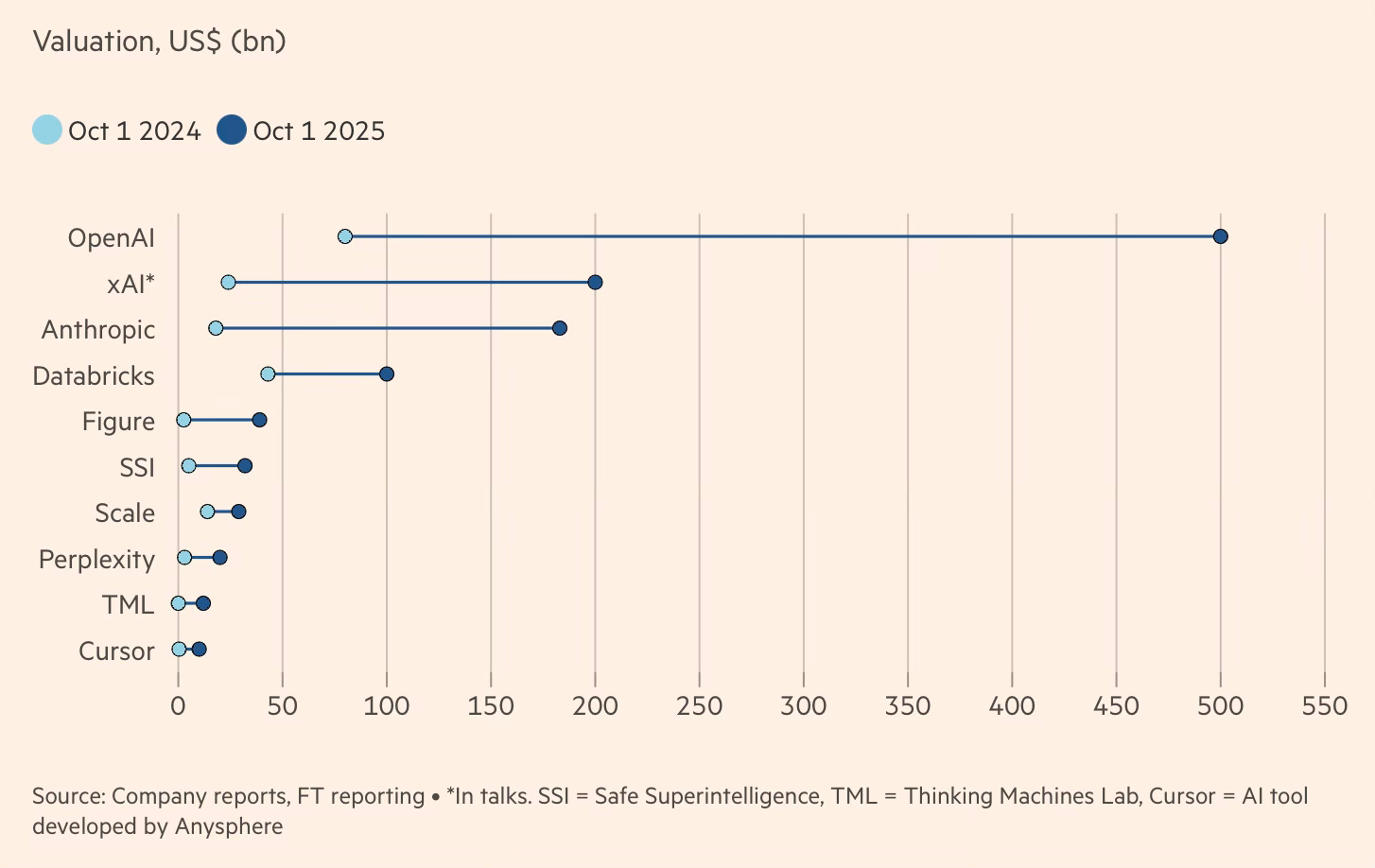
The booming hype cycle on AI is only the latest example. References to AI and ML have become de rigueur in any sales pitch about innovative solutions, regardless of the context. Everything from food delivery to manufacturing in the private sector is being claimed to be dramatically improved with some underlying AI engine. Notwithstanding the lack of any meaningful commercial success, the AI bubble continues to inflate at a rapid pace. 

As an illustration, over just the last 12 months, the top ten AI startups, all loss-making, have attracted $161 billion in VC capital (two-thirds of all US VC spend) and gained close to $1 trillion in valuation

The AI mania is not confined to areas of high technology and finance. Even within the more prosaic environments of public systems, it has become a norm to fit AI/ML into any new public policy idea or program or project for virtue signalling. Never mind its relevance and value, proponents put forth claims of using an AI/ML layer to embellish their ideas. Even simple data analytics solutions that are basically data description, without even basic analysis, are presented as having a layer of AI/ML. 

FT’s Gillian Tett points to the practice of “cargo cults” used to describe the phenomenon observed among the native inhabitants of the Melanesian islands that were invaded by Westerners in the 19th century and flooded with previously unseen consumer goods. Dimitris Xygalatas writes

When Indigenous communities throughout the area had their first encounters with colonial forces, they marveled at the material abundance the foreigners brought with them. During World War II, when many Melanesians worked for U.S. and Australian military forces, they observed soldiers who never seemed to engage in any productive activities, such as fishing, hunting, working the land, or crafting anything. All they did was march up and down, raise flags, chant anthems, and signal toward the sky. And when they did that, metal birds appeared and dropped all kinds of goods for them. The Indigenous observers concluded that the strange rituals were causing the cargo to arrive.

With the end of the war, the military bases were abandoned and the goods ceased to arrive. To get the cargo to return, local chiefs began organizing ceremonies that mimicked the rituals of the troops. Soon, elaborate myths and theologies developed around those rituals. Surely, the cargo must have been a gift from the gods—their own ancestors. After all, who else could be capable of producing such wealth? The foreigners had merely discovered the rituals that unlocked these treasures…

But the only airplane present is a full-size wooden replica of a light aircraft. On one side of the strip lies a control tower made of bamboo. On the other sits a satellite dish built of mud and straw. Undeterred by the apparent lack of any actual aviation technology, some of the men light torches and place them alongside the runway. Others use flags to wave landing signals. Everyone raises their gaze to the sky in anticipation.

Tett extends the cargo-cult phenomenon to the current AI mania.

Physicist Richard Feynman borrowed this metaphor to decry “cargo cult science”, cases where researchers “follow all the apparent precepts and forms of scientific investigation, but they’re missing something essential, because the planes don’t land”. The same analogy now applies to AI. Almost every business executive today is eager to tell investors about their AI strategy (even though 95 per cent of companies have not (yet) seen revenue gains) and every VC group is keen to show AI plays. Similarly every Big Tech executive is investing in massive data centres, even though Bain reckons some $2tn of revenue will be needed to fund this by 2030. And charismatic figures like Sam Altman, CEO of OpenAI, keep promising fresh magic. Or as Stephan Eberle, a software engineer, laments: “Watching the industry’s behaviour around AI, I can’t shake this feeling that we’re all building bamboo aeroplanes [like cargo cults] and expecting them to fly.”

In the case of investors, the cargo-cult phenomenon works through fear of missing out (FOMO).

The iconic example of our times of the narrative transcending all logic is how Tesla’s equity market valuation has become tied to the Elon Musk phenomenon. In substantive terms, Tesla has been falling behind in all its major markets and may now be technologically behind its Chinese competitor, BYD. The latter has a superior battery technology, is vertically integrated, and has not only caught up on automatic driver assistance systems (ADAS) but may even have pulled ahead. 

With more than 95% of its global deliveries coming from Model 3 and Model Y, and that too for nearly a decade, Tesla is now a two-trick pony. In contrast, BYD has a dozen models globally and is releasing new models each year. Tesla’s growth has been primarily driven by lowering the prices of its existing models, hoping to offset margin declines with volumes. Its gross margin, excluding regulatory credits, has declined sharply from nearly 30% in the fourth quarter of 2021 to around 17% in the second quarter of 2025. 

But in an inversion of all logic, this decline has been accompanied by an increase in its market valuation to $1.4 trillion, more than ten times that of BYD. Such valuations are built on the premises of high margins, and runaway hits like robotaxis and AI-powered robots. These premises are, in turn, built on the narrative of the cult of Elon Musk and the miraculous powers endowed on him. Tesla is one mega-giant bet on Musk, perhaps the biggest financial market bet on one individual in history, by some distance. 

In each of these cases, once the irrationality has taken hold thanks to the narratives, it tends to find rational explanations. A commonly cited one is that such bubbles may have become the only way to mobilise resources at the scale required to push the technology frontiers. Sample this.

“There will be casualties. Just like there always will be, just like there always is in the tech industry,” said Marc Benioff, co-founder and chief executive of Salesforce, which has invested heavily in AI. He estimates $1tn of investment on AI might be wasted, but that the technology will ultimately yield 10 times that in new value. “The only way we know how to build great technology is to throw as much against the wall as possible, see what sticks, and then focus on the winners,” he added.

This explanation also syncs with the dominant VC model of financial intermediation and allows them, in turn, to raise the massive amounts of capital required to fund the bubble. 

In the case of the AI bubble, there’s also a powerful strategic imperative. As Gillian Tett has pointed out, given the threat to America’s technological superiority posed by China’s state capitalism, such bubbles may well be “the only way American capitalism can ever amass the scale of investment needed to create this type of ambitious infrastructure”.

While it may sound heretical, the AI bubble also highlights the unique nature of American capitalism, which has shown an unmatched appetite to assume excessive risk in the expectation of windfall returns. It is only the latest, albeit far bigger, in the line of irrational exuberance and risk assumption that has distinguished the US economy even in the last five years - WeWork, GameStop, NFTs, cryptocurrency assets, SPACs, etc. As Andrew Ross Sorkin has pointed out, “there is no innovation without speculation” and “speculation built America”. So he writes, 

“Speculation isn’t a bug in America’s economic code, but a crucial component part of the engine… Speculation is often caricatured as gambling. But at its core, it is belief plus risk. It is the act of investing capital in a highly uncertain outcome, hoping for reward.”

In Tesla’s case, too, the irrationality gets justified in terms of Musk’s superhuman talent. This is nicely captured in Tesla’s battles with courts and shareholders to get approval for Musk’s astronomical $1 trillion pay package. 

Tesla management has sold it in terms of binding Musk to remain sufficiently committed to the company, amidst his other multiple business interests. In fact, Board Chair, Robyn Denholm, has justified it, calling Musk a generational talent who would have to expend “time, energy, and effort beyond what most humans can do.” She said, ‘There’s just not anybody, either inside or outside the organisation, that is Elon today.” In what is effectively a blackmail/bluff, Musk himself has said he’ll leave Tesla if he does not get the pay package and gain greater control over the company to protect it from hostile takeovers that can detract from its efforts to develop AI technology and humanoid robots. 

The Musk compensation issue would be unimaginable in any other country. In the US, as Denholm suggests, astronomical compensation packages have become part of an entrenched narrative that those CEOs deserve these amounts. There’s no logic, both in terms of substance (the expertise brought in by the CEO) or market demand (the scarcity of such executives), that can justify even remotely close to these amounts. Numerous studies have consistently shown no correlation between executive compensation and shareholder returns

Instead, the phenomenon of such excessive CEO pay is fuelled by narratives (and the market structures and incentives) that have become part of the US corporate culture. Narratives shape cultures. 

In this context, it is important to remember that the central role of narratives in shaping the biggest mainstream economic trends is a big gap in economic thinking. These narratives, which stand in complete opposition to orthodoxy and logic, must be an essential component of any college or university economics curriculum. 

To some extent, the mainstream economists have grudgingly accommodated parts of it in the guise of behavioural economics and finance. In this reading, while rational economic agents continue to dominate the economic decision-making, human cognitive failures and idiosyncrasies result in some occasional deviations. 

Given how pervasive these deviations are in the real world, this reading must be revised to provide a more central role for narratives that deviate sharply from logic and orthodoxy. Economic decisions, both in corporations and by governments, are also cultural and political choices, and these preferences often dominate. While those choices are grounded in logic and orthodoxy, other considerations also inform them. These considerations are shaped by the specific narratives surrounding them. 

Interestingly, many economic orthodoxies themselves have become narratives sans any empirical basis. I have blogged here about 25 such orthodoxies that dominate the discourse without any empirical basis. 

Saturday, February 24, 2024

Weekend reading links

1. The Times has an article on the spectacular rise of BYD as the world's leading electric vehicle manufacturer. 

The Swiss bank UBS found last year that a BYD Seal electric hatchback sedan cost 35 percent less to make than a slightly smaller Volkswagen ID.3 of similar quality made in Europe. The savings came only partly from the cheaper lithium iron phosphate batteries. BYD makes three-quarters of the Seal’s parts. Like Tesla, BYD uses only a few electronic systems in each car. By contrast, VW outsources up to two-thirds of its components. BYD also has benefited from lower labor costs in China, although those have risen as factories compete to hire skilled workers.

Interesting that BYD uses iron and phosphate batteries and mostly sells cheaper and plug-in hybrid vehicles with lower ranges. Plug-in hybrids make up nearly half of its sales. In contrast, Tesla sells costlier and purely electric vehicles for larger ranges. Given the smaller ranges of typical urban commuters, Indian electric car manufacturers should focus on hybrids with lower ranges that are cheaper and can be used to expand the demand for these vehicles. 

2. Some facts about the Indian equity markets

Currently, we have about $35 billion entering the markets from domestic investors (mutual funds, insurance, Employees Provident Fund Organisation and National Pension System ). This number will rise to at least $60 billion in the next five years. Combine this with a normalised $20 billion from foreign portfolio investors and we have a structural bid of $80 billion annually for equities.

3. China may never match TSMC in its domestic semiconductor chip manufacturing mission.

At the forefront of the many incredibly complex supply chain challenges Chinese companies will need to overcome is photolithography equipment. Arguably, ASML’s EUV machine is not one but three separate technological challenges - light source/laser, optics, and the instrument worktable - all of which combine to create a machine with over 450,000 components. In etching a semiconductor, a laser in a photolithography machine does not just have to be capable of firing an accurate beam. To create a 13.5nm chip, the laser must hit its target (30 millionths of a meter in diameter) at 50,000 times a second while the target is traveling over 200mph. The many lenses used in the machines must be smooth on the atomic level. Zeiss, the leading (and only) German optical manufacturer capable of providing lenses and mirrors to ASML, likens the challenge of creating mirrors for ASML to “enlarging the mirror to the size of Germany, with elevations no greater than 0.1 mm”. The last major component of an EUV machine is the precision instrument worktable, which in an ASML machine takes over 55,000 components to control the transistors' carving into the silicon accurately.

Shanghai Micro Electronics Equipment (SMEE) is the most advanced Chinese photolithography company, founded in 2002. It’s advanced for China but not for Taiwan or South Korea: its current SSA600 series machines can be used to create 90nm, 110nm, and 280nm chips, generations behind ASML technology. SMEE previously announced plans to release a machine capable of manufacturing 28nm chips, with the initial release scheduled for 2021. As of January 2024, it has still not released a device... Contrary to the Chinese government's goals of establishing an indigenous semiconductor manufacturing industry, SMEE's suppliers depend on foreign parts, with Chinese companies UP Optotech, Focuslight Technologies, and MLOptic Corp sourcing equipment from abroad. In 2022, UP Optotech revealed that German company iC-Haus was their second-biggest supplier. Doubtlessly, there will be dozens of other examples demonstrating the very high barriers to an entirely de-Westernized semiconductor supply chain... Attaining its own semiconductor industry or leapfrogging TSMC or ASML to become the leader in fabrication or photolithography are both extremely unlikely. 

4. Very good article in Livemint about restrictive building regulations limiting the extent of land utilisation of factory lands. It points to a study of regulations in 10 states by a think tank Prosperiti that finds factories can lose over 50% of their land to comply with them. The full report is here. Setbacks, parking, ground coverage, and FAR are the four reasons for the loss of land. 

The restrictions vary across states in their degrees.

The opportunity costs of these restrictions are prohibitive,
An industrial entrepreneur has to shell out large sums of money to keep part of their plot fallow forever. Based on Prosperiti’s estimates, factories in these 10 states stand to lose between ₹2.67 lakh in a micro-factory to ₹3.16 crore in a mega factory. These regulations may be driving an irrational location of factories. Factories should ideally go where land prices are lower. However, restrictive regulations in cheaper areas may drive factories to more expensive locations... Even if the land loss on account of regulations was halved, states could generate between 30-74 jobs in a medium-sized factory. These losses at the factory level can compound to millions of job opportunities lost. For instance, large factories in Maharashtra could have space for 563,000 more industrial jobs had the state reduced the land lost by half. This is 38% of the factory workers currently employed in Maharashtra generating more than ₹500 crore per month in additional wages.

I'm not sure about some of these numbers, but the scale of losses from such restrictions are nevertheless very high. 

5. The warmest winter on record coupled with surging production (which hit a record 105 bn cubic ft a day in December) has left US natural gas prices close to their lowest levels since 1995 at $1.61 mmBTU. 

US natural gas production has mirrored petroleum production, driven by shale gas.
6. FT reports that the EU is set to announce a nearly 500 million euro penalty on Apple for placing restrictions on Apps that inform iPhone users of cheaper alternatives to access music subscriptions outside the App Store. The action follows a complaint by Spotify in 2019. 
The Commission will say Apple’s actions are illegal and go against the bloc’s rules that enforce competition in the single market, the people familiar with the case told the Financial Times. It will ban Apple’s practice of blocking music services from letting users outside its App Store switch to cheaper alternatives. Brussels will accuse Apple of abusing its powerful position and imposing anti-competitive trading practices on rivals, the people said, adding that the EU would say the tech giant’s terms were “unfair trading conditions”. It is one of the most significant financial penalties levied by the EU on big tech companies... Companies that are defined as gatekeepers, including Apple, Amazon and Google, need to fully comply with these rules under the Digital Markets Act by early next month. The act requires these tech giants to comply with more stringent rules and will force them to allow rivals to share information about their services.

7. A new renewable energy race has begun - the tapping of naturally available hydrogen, estimated at 5 trillion tonnes in underground reservoirs. While only a small proportion is likely to be available for tapping, even a small percentage share will be enough to meet the annual demand of around 500 million tonnes for centuries. 

The demand for hydrogen as a fuel and industrial raw material, particularly to make ammonia for fertiliser production, has been mainly met so far by chemically reforming gas that is made up largely of methane, known as “blue hydrogen” when the carbon emissions are captured or “grey hydrogen” when they are not. A smaller amount is made by splitting water through electrolysis using renewable energy sources, known as “green hydrogen”. But Mengli Zhang of the Colorado School of Mines said tapping natural hydrogen — also known as geologic or gold hydrogen — would be cleaner and cheaper than blue or green hydrogen. “A gold rush for gold hydrogen is coming,” she told the conference. The prospect is beginning to attract interest from investors. US start-up Koloma raised $91mn last year from funds including Bill Gates’s Breakthrough Energy Ventures... Previous scientific opinion held that little pure hydrogen was likely to exist near Earth’s surface because it would be consumed by subterranean microbes or destroyed in geochemical processes. But geologists now believe hydrogen is generated in large quantities when certain iron-rich minerals react with water

8. China's spectacular rise as the world's leading automobile exporter and its dominance of the global EV value chain may well be a defining moment in the world trade agenda for the coming decades. 

Chinese companies today dominate the entire value chain of EVs - EV chassis, autonomous driving software, CoNi batteries etc. - as well as the vehicle production itself.  
Paul Li, founder of Chinese electric vehicle parts supplier U-Power, claims working with the country’s EV sector, which is by far the world’s biggest, can mean foreign companies developing cars years faster than they have traditionally and reducing costs by as much as half. As evidence that foreign carmakers are realising the advantages, he points to Volkswagen’s $700mn tie-up with Chinese rival Xpeng last year. That deal was soon followed by a €1.5bn investment in Chinese EV start-up Leapmotor by Stellantis, which makes Jeep cars in the US and owns the Fiat and Citroën brands in Europe... Li’s company... designs and sells EV chassis — known as skateboards. U-Power last month signed a deal to supply New York-based EV start-up Olympian Motors with its skateboards. The company is also working with Singapore-based FEST Auto to sell EVs to the European logistics market. In another example, Shenzhen-based Appotronics, which provides laser projectors for nearly half of China’s cinemas, will supply BMW with laser technology for some of the German group’s latest in-car displays. And Shenzhen-based DeepRoute.ai, which already has a US office, is now setting up one in Europe to sell its mapping technology for driverless cars.

This is a defining moment for US and European trade policy. Corporate interests will mount pressure to allow them to tap the Chinese suppliers for their EV businesses. But this in turn will only end up amplifying the leverage China already has on the global EV industry. The Chinese firms are trying to overcome US restrictions by establishing factories in Eastern Europe and Mexico and then exporting to the US. Some are even establishing JVs with European manufacturers. 

9. Nvidia's $740 share price is nuts? FT Alphaville hints it might be.

This week Nvidia’s market cap passed the $1.8tn mark, leapfrogging Alphabet — whose 2023 net income was greater than Nvidia’s 2023 revenues — to become the third most valuable US company after Microsoft and Apple... To get to a $740 share price simply requires that the company maintain a monopolist-like operating profit margin of 55 per cent for the next decade, while also growing sales tenfold, from $60bn a year to more than $600bn. For context, the entire industry sold $527bn worth of chips last year, according to the the Semiconductor Industry Association. Over the past decade Nvidia did admittedly achieve a similar level of growth: in 2014 its sales were a mere $4bn... Nvidia’s unusual profitability is a recent phenomenon related to the very high prices pushed through in response to overwhelming demand: The EBIT Margins were all over the place from 2014-2023 (range of 12-37 per cent) and certainly nowhere near a steady 55 per cent... At a 15 per cent growth rate and 30 per cent sustainable margins his antiquated model cranks out a share price of $176!

The share has since surged following its latest quarterly earnings report. It added $277 bn in market capitalisation in a single day, which is bigger than the entire market capitalisation of Reliance Industries of $243 bn!

10. A health check of Indian banks presents some very promising numbers.

Believe it or not, 21 of 32 listed banks, including SBI, HDFC Bank, ICICI Bank, Bank of Baroda, Axis Bank, Kotak Mahindra Bank, IDBI Bank and IDFC First Bank have less than 1 per cent net NPAs. Indian Bank has the lowest net NPAs (22 basis points), followed by HDFC Bank and CSB Bank (31 basis points each). One basis point is a hundredth of a percentage point. Lower bad loans have led to lower provisions. In fact, provisions in the December quarter Y-o-Y have dropped 39.51 per cent, from Rs 38,852 crore to Rs 23,503 crore. As a result, collectively the net profit of all listed banks has grown 15.29 per cent to Rs 74,976 crore even though the operating profit growth is just 2.05 per cent at Rs 1.31 trillion.

11. Cory Doctrow has an excellent essay on how social media platforms have degenerated through a process that he describes as enshittification

It’s a three-stage process: first, platforms are good to their users. Then they abuse their users to make things better for their business customers. Finally, they abuse those business customers to claw back all the value for themselves. Then, there is a fourth stage: they die... Facebook arose from a website developed to rate the fuckability of Harvard undergrads, and it only got worse after that. When Facebook started off, it was only open to US college and high-school kids with .edu and K-12.us addresses. But in 2006, it opened up to the general public. It effectively told them: Yes, I know you’re all using MySpace. But MySpace is owned by a billionaire who spies on you with every hour that God sends. Sign up with Facebook and we will never spy on you. Come and tell us who matters to you in this world. 

That was stage one. Facebook had a surplus — its investors’ cash — and it allocated that surplus to its end users. Those end users proceeded to lock themselves into Facebook. Facebook, like most tech businesses, had network effects on its side... But Facebook didn’t just have high network effects, it had high switching costs... So Facebook’s end users engaged in a mutual hostage-taking that kept them glued to the platform. Then Facebook exploited that hostage situation, withdrawing the surplus from end users and allocating it to two groups of business customers: advertisers and publishers. To the advertisers, Facebook said: Remember when we told those rubes we wouldn’t spy on them? Well, we do. And we will sell you access to that data in the form of fine-grained ad-targeting. Your ads are dirt cheap to serve, and we’ll spare no expense to make sure that when you pay for an ad, a real human sees it. To the publishers, Facebook said: Remember when we told those rubes we would only show them the things they asked to see? Ha! Upload short excerpts from your website, append a link and we will cram it into the eyeballs of users who never asked to see it. We are offering you a free traffic funnel that will drive millions of users to your website to monetise as you please. And so advertisers and publishers became stuck to the platform, too. 

Users, advertisers, publishers — everyone was locked in. Which meant it was time for the third stage of enshittification: withdrawing surplus from everyone and handing it to Facebook’s shareholders. For the users, that meant dialling down the share of content from accounts you followed to a homeopathic dose, and filling the resulting void with ads and pay-to-boost content from publishers. For advertisers, that meant jacking up prices and drawing down anti-fraud enforcement, so advertisers paid much more for ads that were far less likely to be seen. For publishers, this meant algorithmically suppressing the reach of their posts unless they included an ever-larger share of their articles in the excerpt. And then Facebook started to punish publishers for including a link back to their own sites, so they were corralled into posting full text feeds with no links, meaning they became commodity suppliers to Facebook, entirely dependent on the company both for reach and for monetisation... Facebook now enters the most dangerous phase of enshittification. It wants to withdraw all available surplus and leave just enough residual value in the service to keep end users stuck to each other, and business customers stuck to end users, without leaving anything... But that’s a very brittle equilibrium.

They argue that in the pre-enshittification era, there were restraining forces like competition, regulation, self-help and worker power that prevented uncontrolled enshittification. over time each of these constraints have eroded and enhittification has been happening unchecked. The author argues in favour of restoring each of these restraints to reverse the process of enshittification. 

This is a good example,

When Diapers.com refused Amazon’s acquisition offer, Amazon lit $100mn on fire, selling diapers way below cost for months, until Diapers.com went bust, and Amazon bought them for pennies on the dollar.

12. The post-Cold War peace dividend enjoyed by Europe

Estimates suggest the continent would have spent an additional $8.6tn on defence over 30 years had they maintained cold war levels of military expenditure.

This, as JD Vance writes, is also an implied tax on US citizens to ensure European security.

13. Amidst geopolitical uncertainties, crackdowns on foreign consultancies and an increasingly hostile environment for foreign firms, foreign investment in China has fallen to its lowest level in 30 years

China’s direct investment liabilities, a gauge of foreign capital flowing into the country, totalled about $33bn in 2023, according to data released late on Sunday by the State Administration of Foreign Exchange. This was an 82 per cent decline from the previous year and the lowest annual figure since 1993.
14. Good set of graphics about the struggling Pakistani economy. This is about the very large share of revenues going into debt-servicing.
15. The Red Sea ship attacks have imposed large costs and increased shipping times, thereby creating shipping fleet shortages.
Diversions to a route round the Cape of Good Hope have added 10 days to two weeks to each voyage between Asia and north Europe and vastly complicated the task of serving some parts of the world... The 102-day time required to complete a loop between Asia and north Europe and back via the Cape of Good Hope means a line needs to deploy 16 ships for a weekly service, instead of the normal 12.
17. This week the Nikkei surpassed the level it reached 34 years back in 1989. The FT article describes the changes in Japan over this time.

The IMF expects Japan’s ratio of public debt to gross domestic product to reach 256 per cent in 2024, compared with 65 per cent in 1989... In 1989 Japanese companies, particularly banks, dominated the global top 10 by market capitalisation. No Japanese companies make the top 10 now. Today, Toyota has risen to become the world’s largest carmaker by sales and the most valuable company in Japan. Sony, which is now more famous for its entertainment business and PlayStation games than the Walkman portable music player, is ranked third while semiconductor equipment maker Tokyo Electron is fifth... In 1989, six of the world’s 10 richest people were Japanese. At the top of the list was Yoshiaki Tsutsumi, the former owner of Seibu Railway, whose wealth Forbes estimated at $15bn. Now, only three Japanese people are ranked among the world’s top 100 billionaires, with Tadashi Yanai, founder of Uniqlo owner Fast Retailing, and his family ranked 30th with an estimated net worth of $40bn... Decades of deflation and economic stagnation, however, have also sapped the appetite for investment, leaving companies sitting on a massive cash pile of ¥343tn... 

By 1989, Japan had also begun to make its name as one of the world’s pre-eminent exporters of soft power, and of the idea that Japan as a country and a culture had something unique to share with the world. Hello Kitty, Mario, Gundam and Sonic enthralled, and Japan’s power to entertain became one of its best-known superpowers. As the stock market neared its peak, Nintendo released the handheld Game Boy console — a machine that would go on to sell more than 100mn units worldwide and physically put Japanese games, a Japanese pop-culture aesthetic and Pokémon in pockets around the world. Just three days before the Nikkei peak, US audiences had their first glimpse of Akira, the seminal anime that would create a global generation of Japanese cartoon fans. In 2024, Japan retains much of this soft power and a significant store of wealth but has lost much of its pre-eminence.

Arguably the biggest change has been with the country's demographics - nearly 30 per cent of the population is over the age of 65!

18. Finally, David Solomon's unreasonable 24% pay rise as Goldman CEO while presiding over one of the firm's weakest performances has naturally triggered discontent within the firm. The firm has already seen several high-profile bankers leave and is now facing the threat of more departures. 

Saturday, February 17, 2024

Weekend reading links

1. On the Taylor Swift economy

It’s been estimated Swift’s Eras tour generated US$5bn in the US economy; the US Federal Reserve even singled her out for stimulating the national tourism industry. “If Taylor Swift were an economy,” said Dan Fleetwood, the president of QuestionPro, the research company that made that estimate, “she’d be bigger than 50 countries.” 

Her impact can already be felt in Australia, where Sydney and Melbourne are busy preparing for her arrival next week. It is expected that Swift’s seven concerts in the two cities – three in Melbourne and four in Sydney – will generate $140m, according to state government modelling. More than 85% of the hotels and motels in Melbourne city are booked during her first two shows; a similar capacity is expected in Sydney. Qantas added an extra 11,000 seats on flights to both cities. Australian bead sales are reportedly through the roof, as Swifties prepare friendship bracelets to exchange at her shows.

On her marketing strategy,

While the Eras tour was moving through the US, one estimate suggested that while every US$100 spent on a live performance would typically result in US$300 in ancillary spending on things like hotels, dining, merch and transport, Swifties were spending US$1,300. Part of this stems from their devotion to her, but also her practice of releasing multiple versions of one item: there are more than 20 versions of her album Midnights available to buy, for instance, with extra tracks and different covers. “If any other artist sold eight different vinyl versions of the same album, people would think they were ripping us off. When it is Taylor, it’s like, ‘amazing, I’ll buy them all’. It’s part of the fan identity in a way that nobody else has really mastered,” says Caroll.

This statement by the Japanese embassy in Washington reassuring fans that Swift would be able to complete her last Eras concert in Tokyo and still be able to make it to cheer her boyfriend Tavis Kelce at the Super Bowl final exemplifies the phenomenon she has become. 

2. As India opens up its G-Sec market to foreign portfolio investors in June, this snapshot of the foreign ownership of Indian bonds.

It's being estimated that with the activation of the inclusion of India into the JP Morgan Bond Index, about $18-22 bn in portfolio flows are likely in the last three quarters of 2024-25. 

3. Tamal Bandopadhyay captures the governance issues at the heart of Paytm Payments Bank Ltd (PPBL).
When a payments bank is being punished for “persistent” non-compliance with regulations, nowhere are its managing director (MD) and chief executive officer (CEO) to be seen. Instead, its majority stakeholder has taken up the responsibility of doing everything – convincing customers to stay put, the regulator to go slow and even the finance minister to influence the regulator.

The RBI's actions are the culmination of a long series of defaults and non-compliances by the Bank despite clear directions by the regulator. 

Serious irregularities have been found with respect to the KYC norms and how much money a payments bank can keep as day-end balance in a customer account. Besides, the RBI has found several instances of a single PAN linked to thousands of customers for transactions worth crores of rupees. This even raises concerns of money laundering as an unusually high number of dormant accounts are prone to be used as mule accounts. On many occasions, PPBL has allegedly submitted false compliance reports, fooling the regulator. Finally, it has not stayed at an arm’s length with the promoter group entities and got involved in significant intra-group and related-party transactions, which have reportedly not been disclosed. Who knows if bank customer data was shared with the group companies?... A diluted KYC norm was followed for people involved in P2P transactions, but many of these transactions turned out to be P2M transactions. They have overshot the limit many times. Ideally, the bank should have filed suspicious transaction reports to the financial intelligence unit, which collects financial intelligence about offences under the Prevention of Money Laundering Act.

The article is an excellent primer om the whole issue.

4. Hong Kong stocks are back to the levels of the 1997 handover!

In the spring of 2019 at the onset of the democracy protests, the Hang Seng index was trading at nearly 30,000. It is now more than 45 per cent below that level at 15,750... a three-year bear market that has taken China’s broad CSI 300 index down more than 40 per cent from its spring 2021 peak. Reflecting collateral damage on Chinese enterprises listed in Hong Kong and the city’s China-sensitive services sector, the Hang Seng has fallen 49 per cent over the same period.

And things are likely to get worse. FT reports that the second largest global law firm, Latham & Watkins is cutting off automatic access to its international databases for its HK-based lawyers. HK is effectively being treated by global firms as the same as mainland China. 

5. Meanwhile Chinese deflation, as seen in their export prices, are at their highest since the financial crisis.

BYD, China’s biggest carmaker, recently announced price cuts of between 5 and 15 per cent for its electric vehicles in Germany, after Mercedes-Benz warned late last year that its profits were being hit by a “brutal” price war in electric vehicles. Nearly every other manufacturing company in Germany surveyed by the Bundesbank in the past year relied on Chinese supplies for critical intermediate inputs whether directly or indirectly, the central bank said in a report last month. “China spent 20 years destroying emerging-market competitors in the manufacturing space, or at least squeezing them out of global markets. Now it’s threatening to do the same to advanced economies’ manufacturers,” said Charles Robertson, head of macro strategy at FIM Partners.

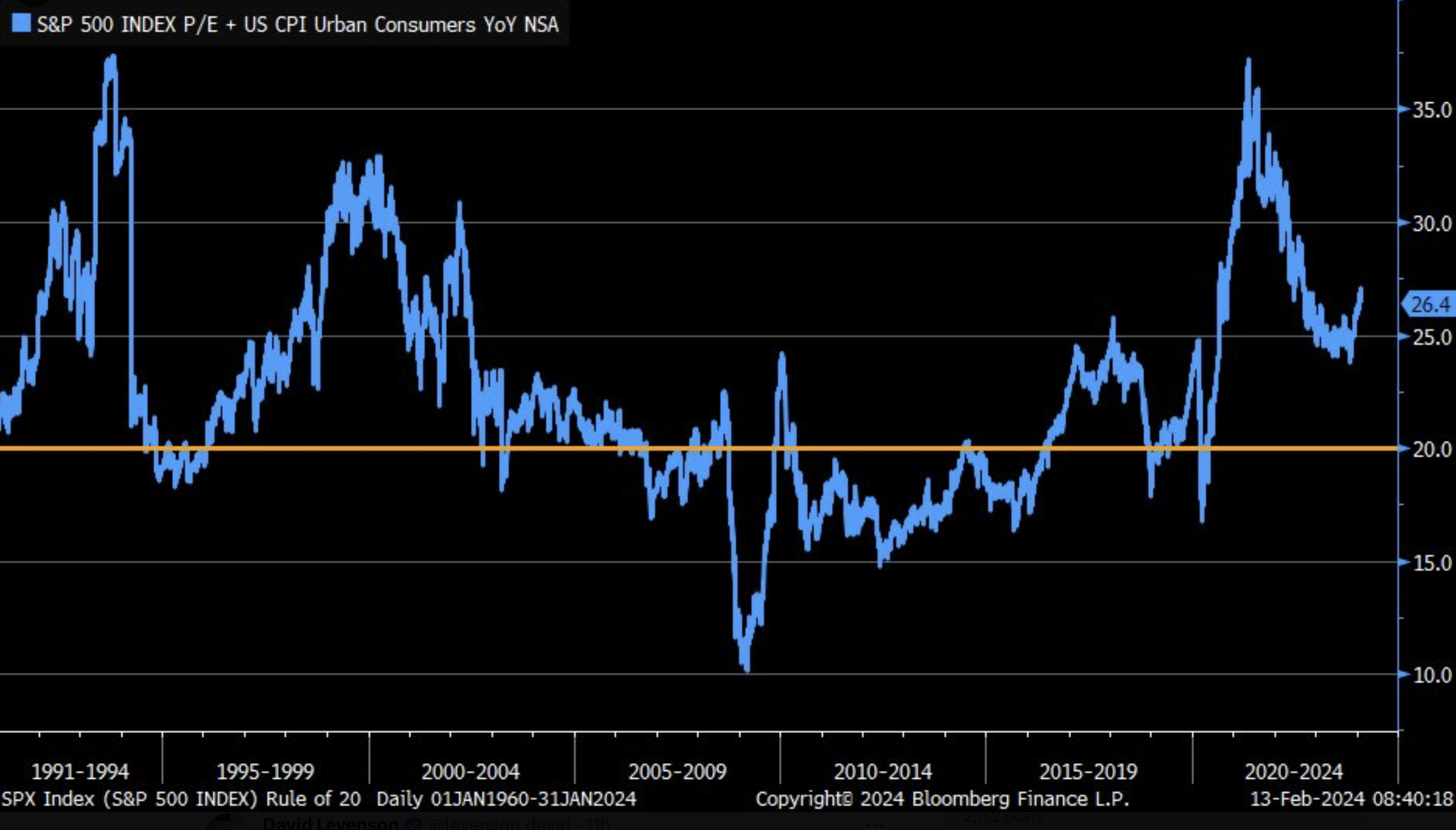
5. US market frothiness on the rise, as seen by the Rule of 20 (which suggests market is fairly value when P/E + CPI year/year is equal to 20)!

6. Shyam Saran has a good summary of the economic and political headwinds facing China.

7. David Solomon, the controversial CEO of Goldman Sachs, is rewarded with a compensation of $31 million, and increase of 24%, despite the bank reporting its lowest profits in four years.
Last year was the most challenging of Solomon’s five-year tenure leading Goldman. He faced a string of critical news articles about his leadership style, while the bank also cut thousands of jobs and suffered from a slowdown in investment banking activity... His remuneration was up from $25mn in 2022, making 2023 his second-most lucrative year running Goldman behind the $35mn he earned in 2021. Solomon’s pay rose more than overall expenses on remuneration at Goldman, which were up only 2 per cent last year. The bank’s headcount fell by 3,200 employees in 2023 to just over 45,000 and average pay expense per employee was up almost 10 per cent... Net income at the bank fell 24 per cent in 2023 to $8.5bn, the lowest since 2019. Goldman also reported a return on equity, a key gauge of profitability, of 7.5 per cent, well short of the bank’s target of 14 per cent to 16 per cent.

What was the justification for such increase despite the poor performance?

But the board rewarded Solomon for paring back a lossmaking push into retail banking, re-emphasising Goldman’s strategy around its core investment banking and trading business and expanding in asset and wealth management... “While these strategic actions negatively impacted short-term performance, the compensation committee believes that the actions of senior management were critical to reorienting the firm with a much stronger platform for 2024 and beyond,” Goldman wrote in the filing announcing Solomon’s pay.

How did other banks reward their CEOs?

JPMorgan’s Jamie Dimon, whose bank reported record profits for 2023, had his pay rise about 4 per cent to $36mn, while Morgan Stanley’s James Gorman, who stepped down as CEO at the start of 2024, was paid $37mn, up 17.5 per cent. Bank of America cut the pay of its top executive Brian Moynihan by 3 per cent, or $1mn, to $29mn.
One executive compensation in the top US companies has nothing to do with performance. It's more a cartel of price fixing where the compensation stays in a small band. 

Instead of free-market and talent competition, the market for executives is a closed cartel of price fixing with no correlation with outcomes.

8. FT has an article which points to the reversal of trend in the covid-induced shift towards online apparel retail in the UK. Since the pandemic though the trend has reversed - physical shops have rebounded and the fortunes of the online retailers have dipped. This is reflected in the sharply dipped share prices of online retailers (Asos, Boohoo, Sosander, Zalando) and strong increases in that of physical stores (Marks & Spencers, Fraser). Offline-online apparel retail share is 60:40.

Nobody knows with any reasonable certitude as to the fate of the online-offline battle.
“What we’re seeing is a rebalancing of the online and in-store channels,” says Tamara Sender Ceron, a fashion retail analyst at Mintel. That has left all retailers with questions about which channel will be more profitable and where to prioritise investment. Even Next, a UK mid-market operator that has been more successful than most at combining stores with online operations, admits it is hard to predict where things will settle. “Our view is that we don’t know,” says its long-serving chief executive Lord Simon Wolfson. “But we don’t want to precipitate a retreat from [physical] retail necessarily, because, you know, it does appear to be stable for now.”... Sender Ceron believes that Generation Z and millennials’ shopping habits were transformed by the pandemic. “They’re hot between channels, so it’s not as clear cut as online and in store anymore . . . They’re using smartphones to compare prices and check stock availability while they’re actually in store.”
... The substantial fixed costs of operating stores have in the past been a millstone for traditional retailers. But many areas in the UK have experienced steep falls in store rents in recent years while business rates — a property tax linked to rents — were recalibrated last year, resulting in reductions for many. At the same time, online retailers have been hit with higher prices for everything from freight to marketing. “Online is a much more expensive place to trade than it’s ever been,” says John Edgar, chief executive of department store group Fenwick. “That’s the Google costs, the logistic costs, and those costs vary with sales.”

The rapid surge in online retail, turbo-charged by the pandemic induced lockdowns, is a feature of new markets. But once the pent-up (or latent) demand is met in a surge, reality sets down. 

But as these companies reach maturity, they face a series of challenges that raises questions about the scalability and longevity of their business models. As physical shops reopened, online orders in Europe’s main markets slowed down for likely the first time in modern retail history, according to Forrester Research. It expects overall online sales in major markets to remain flat in 2023.

9. I have blogged earlier that interest rates will not go back to the pre-pandemic ultra-low levels.

The so-called neutral rate of interest — the borrowing rate that keeps economies growing steadily, with full employment and inflation around 2 per cent. After falling to rock-bottom levels before the pandemic, the neutral rate has, by some measures, edged up more recently. This could suggest official rates will not head as low as their pre-pandemic levels, even as inflation eases... The neutral rate is not directly set by central banks, and they cannot reliably observe where it is. But for many economists the inflation-adjusted neutral rate — known by a range of other labels including the natural or equilibrium rate or R-star — is a valuable guiding light. If the official interest rate sits above it, central bankers consider policy to be restricting economic activity; below it, policy is deemed to be expansionary. The neutral rate’s value is highly contested...
 
The lower neutral rates of recent decades were driven by a range of long-term factors, including subdued productivity growth, a glut of savings swilling around the world and an ageing population that boosted the stockpiles of cash stored away for retirement. One widely used estimate, from the New York Fed, points to a multi-decades-long decline in inflation-adjusted neutral rates in both the US and euro area that shows no sign of reversing... This put R-star in the US at the third quarter of last year at 0.9 per cent before inflation — a big fall from levels approaching 4 per cent at the start of the millennium. Canada’s inflation-adjusted neutral rate was 1.5 per cent and the eurozone’s was -0.7 per cent, according to their model. Other methodologies for estimating the neutral rate point to similar declines... Directly before the pandemic, the so-called “central tendency” estimates for the longer-run federal funds target range lay between 2.4 per cent and 2.8 per cent, implying policymakers believed R-star lay between 0.4 per cent and 0.8 per cent when taking into account the Fed’s 2 per cent inflation goal. But the most recent projections show a range between 2.5 per cent and 3 per cent, or 0.5 per cent and 1 per cent for R-star.

In Europe, the neutral rate appears to have risen more than in the US. 

ECB executive board member Isabel Schnabel told the Financial Times this month: “There are good reasons to believe that the global R-star is going to move up relative to the post-financial crisis period.” She predicted that higher investment to tackle climate change, increased defence spending, the fragmentation of the global trading system and higher government debt would all push up the neutral rate of interest... ECB officials published a paper this week outlining how the median of the various measures of the neutral rate that it tracks had risen 0.3 percentage points since before the pandemic hit in 2020.

Saturday, December 30, 2023

Weekend reading links

1. Taylor Swift economic multiplier,

For every $100 spent on live performances, an estimated $300 in ancillary local spending is usually created. In contrast, Swifties — fans of Taylor Swift —are shelling out $1,300-$1,500 for the Eras Tour. Over the same period last year, hotel rates in the cities where the Eras Tour is being held increased by an average of 7.2 per cent. Over 300 employment are supported by the approximately $36 million in direct and indirect spending that each Eras show brings to the local economy.

FT has a profile of Swift

Next week, she is set to tie Elvis Presley for the second-highest number of weeks holding the top-selling US album. From there, she trails only The Beatles. For Taylor Swift, 2023 was one of the biggest years for any artist in music history. Earning some $2bn, her utter domination has been compared by industry magazine Billboard to the “fab four” in 1965, or Michael Jackson in 1983. At a time when record executives agonise over how difficult it is to hold listeners’ attention, Swift has come to exist on her own planet. The Federal Reserve noted her tour had bolstered the economy through hotel bookings, with cities such as Chicago and Minneapolis breaking records for hotels rooms occupied during her visits. One sentence towards the end of a song — about making friendship bracelets — boosted sales at craft stores across the US. Several universities, including Harvard, have created classes about her. In Argentina, fans queued on rotation for five months to get as close to the stage as possible for Swift’s concert. For nearly two decades, Swift’s life has been dissected extensively. She narrates every phase, each one packaged into an album with its own sound and aesthetic... 
Early on, she displayed the defiance and ambition that have defined her career. After the success of her 2008 album Fearless, some critics questioned whether she wrote her own lyrics. She wrote her next album, Speak Now, alone, without co-writers. This defiance reared its head again a decade later, when her music catalogue was sold to one of her enemies, Scooter Braun, in a deal financed by private equity groups. Swift slammed the deal as: “very powerful men, using $300mn of other people’s money to purchase, like, the most feminine body of work”. She has spent the past few years painstakingly recording duplicate copies of her first six albums... Before the pandemic, music executives had begun to whisper that Swift was past her peak. Instead, isolation provided a massive boost for her career: she couldn’t stop writing songs, releasing two surprise albums in 2020... Since then, she has entered a supercharged pop-star mode, releasing seven albums in the past three years. In an industry whose executive ranks are dominated by men, Swift’s power has surpassed them all.

2. Scott Galloway makes some powerful points in his weekly posts. Sample this one reposted from 2020

This country was built by titans of industry even wealthier than billionaires today — Vanderbilt, Rockefeller, Carnegie, and J.P. Morgan. But 1 in 11 steel workers didn’t need to die for bridges and skyscrapers to happen. We are a country that rewards genius. Yet no one person needs to hold enough cash to end homelessness ($20 billion), eradicate malaria worldwide ($90 billion), and have enough left over for 700,000 teachers’ salaries. Bezos makes the average Amazon employee’s salary in 10 seconds. This paints us as a feudal state and not a democracy... Steve Jobs, Donald Trump, and Jeff Bezos have 13 kids by 6 women. One denied his blood under oath to avoid child-support payments, another mocks the disabled, and the third steals from school districts (demand tax/budget cuts) to cling to power and wealth. We need a generation of men who emerge from this crisis with a commitment to being better fathers, husbands, and citizens.

3. FMCG majors are seeing decline in rural retail demand and signatures of rural stress on the back of erratic monsoon and other factors. More here

4. Katie Martin has a very good article explaining the various factors contributing to heightened financial market risks and uncertainty about Federal Reserve's monetary policy decisions. The surge in equity markets and steep fall in bond yields following Jay Powell's press meet on December 13 have increased market risks and made the timing of the Fed's rate cut critical. The Fed risks being led by the markets and jumping the gun, thereby running the risk of both further inflating the bubbles and also reversing the inflation trend.

5. Pakistan has one of the lowest tax to GDP ratios.

6. Paul Krugman points to how economists got their prediction so wrong about inflation and the economy. We should not be surprised by this, but instead should be surprised as to why we still expect economists to get predictions right. They have rarely got predictions right. He writes
As recently as March, the Federal Reserve committee that sets monetary policy projected that we’d end this year with 4.5 percent unemployment and with core inflation, the Fed’s preferred measure, running at 3.6 percent. Last week, the same group projected year-end unemployment of only 3.8 percent and core inflation at only 3.2 percent. But actually the news is even better, because that last number is inflation for the year as a whole; over the six months ending in October, core inflation was running at 2.5 percent, and most analysts I follow believe that when November data comes in this week, it will show inflation down to around 2 percent, which is the Fed’s long-run target.

Krugman had consistently been in the team transitory camp. 

Economists who argued that the inflation surge of 2021-22 was transitory, driven by disruptions caused by the Covid pandemic and Russia’s invasion of Ukraine, appear to have been right — but those disruptions were bigger and longer lasting than almost anyone realized, so “transitory” ended up meaning years rather than months. What happened in 2023 was that the economy finally worked out its postpandemic kinks, with, for example, supply chain issues and the mismatch between job openings and unemployed workers getting resolved.

See also Tyler Cowen here

7. Executive compensation fact of the day

From 1978 to 2022, US CEO pay based on realised remuneration grew by 1,209 per cent, adjusting for inflation. This was well above the 932 per cent growth in the S&P 500 in the same period, and the 465 per cent rise in incomes in the top 0.1 per cent of earners. The median US worker’s annual remuneration rose by a puny 15.3 per cent.

8. Excellent set of graphics to explain the challenges associated with the conversion of office buildings to residential units in the aftermath of the pandemic-induced relocation of people away from large and associated lowering of demand for office spaces. 

The deep interior of the modern office building, which is perfectly useful for windowless meetings and supply closets, is now largely useless for apartment living... The exterior window system on a building like this would need to be replaced at major expense, because these windows don’t actually open. These buildings have far more elevators than an apartment of the same size would want (adding either more expense in conversion or more wasted space). And in many downtown markets, a modern building like this is worth more per square foot in office rents than in apartment rents... As offices, these buildings can also rent 100 percent (or even more) of their total square footage, according to the quirky math of commercial real estate. That’s because some companies rent entire floors, but also because office tenants — unlike apartment renters — typically pay additional rent for shared building spaces beyond their suites. To convert any of these properties to apartments, you’d have to add common corridors, bike storage, lounges, a gym — features that take up space but don’t collect rent (at least, not explicitly). In a typical residential building, only 80 to 85 percent of all square footage is considered rentable. That makes conversions particularly unappealing to many office owners.

9. The English Premier League dominates broadcast revenue takeaways.

When Norwich City finished in last place in the 2021-22 Premier League, they earned more broadcast revenue for their league appearances than Bayern Munich, AC Milan or Paris St Germain, the German, Italian and French champions. The Premier League’s pulling power is so great that across the whole of Europe only Barcelona and Real Madrid made more money from televised league games than England’s bottom-ranked team, with the result that the biggest clubs on the continent now increasingly find themselves outbid on transfers not only by fellow giants but also by Premier League minnows.
10. The Tesla-Swedish unions face-off is a litmus test for Europe. Without getting lost in its nitty gritties, this is essentially about whether the Europeans will allow a central aspect of one of the most important features of their economic system, the collective bargaining between owners and labour, to give way when faced with onslaught from buccaneering US capitalism.

It's one thing to reject unreasonable demands of unions, but altogether different thing to openly oppose the right of their workers to unionise. It's a sad state of affairs that companies like Tesla and Big Tech can get away by taking a view that they'll not allow their workers to unionise not only in the US but globally too. Where are the liberals in this debate?

11. Fascinating story about Secunda mines-to-refining complex of South African chemical company Sasol, which alone emits more carbon dioxide than Portugal, and is now under pressure to decarbonise faster than originally planned. Sasol is the country's largest taxpayer and also claims to account for 5% of South Africa's GDP. 
Sasol, which is listed in New York as well as Johannesburg with a market value of about $7.6bn, produces one-third of South Africa’s fuel, exports speciality chemicals worldwide, and employs more than 30,000 people. Secunda drives about 40 per cent of its earnings. Now two South African institutional investors, Old Mutual and Ninety One, which together own about 5 per cent of Sasol, have openly revolted over its emissions-reduction timetable — breaking with a tradition of quiet shareholder engagement in the country. Environmental protesters stormed Sasol’s annual general meeting last month, forcing it to abandon proceedings. Shareholders have questioned Sasol’s ability to meet its goal of cutting emissions by 30 per cent by 2030 and, beyond that, of reaching net zero by 2050. The acid test will be whether Secunda can decarbonise, or if it will ultimately have to shut down.

12. Novo Nordisk Foundation as an alternative to shareholder corporations.

The Novo Nordisk Foundation is the controlling shareholder of Danish drugmaker Novo Nordisk, currently Europe’s most valuable company thanks to soaring sales of weight loss and diabetes drugs Wegovy and Ozempic. The foundation holds 77 per cent of Novo’s voting rights and 28.1 per cent of its shares... Thanks largely to Wegovy and Ozempic, the foundation’s assets under management have risen 300 per cent in the past 10 years... Foundation ownership is common in Denmark: brewer Carlsberg and shipping company Maersk are also partly owned by foundations. In Novo Nordisk’s case, thanks to the success of GLP-1s, its owner is now bigger than the Bill & Melinda Gates Foundation or the Wellcome Trust, the two other powerhouses of medical research funding and philanthropy. In the past 10 years in particular, the money Novo Nordisk pays to it in dividends and through share buybacks has soared, rising about 180 per cent over the period to DKr14.2bn ($2.1bn) last year. As of the end of last year, the foundation had DKr805bn or $116bn of assets... 

One of its aims is to try to tackle the root causes of obesity and diabetes. It also funds research on stem cell science and climate change and gives to humanitarian causes, such as providing shelters and essential medicines to Ukraine... The foundation is funding a Center for Basic Metabolic Research, a collaboration with the genomics-focused Broad Institute in Boston, and has set up a Centre for Childhood Health that aims to promote healthy weight for children. In parts of India and east Africa, it is teaching healthcare professionals to improve the prevention and treatment of noncommunicable diseases like diabetes. It recently opened its first office in Delhi... Many of the foundation’s aims have long time horizons. Last year, it launched reNEW, the Novo Nordisk Foundation Center for Stem Cell Medicine, supporting research in Denmark, Australia and the Netherlands.

13. Toby Nangle points to new research that raises more questions about the equity risk premium, the higher returns demanded by equity holders compared to bondholders. While instances of bonds outperforming equities over long periods are not uncommon elsewhere in developed world, the equity risk premium has generally been accepted to hold in the US. 

Edward McQuarrie, an emeritus marketing professor, has spent the past seven years taking a closer look at US exceptionalism. His conclusion, published in the Financial Analyst Journal this month, is that the data is dud. Building on bond figures assembled by financial historian Richard Sylla, McQuarrie conducted city-by-city searches of digitised archives for details of dividends and share counts to expand the American historical financial record. The result is a new resource containing more than three times as many stocks and five times as many bonds. His account captures many more failures, reducing survivorship bias, and a stunningly different long-term story. The impact of survivorship is no small detail... the new historical record still favours equities, but less so. 

This downward re-evaluation of old American financial returns has form. In 2002, Research Affiliates founder Rob Arnott co-authored a paper with Peter Bernstein concluding that the historical average equity risk premium was about half of what most investors believed and stood at only 2.4 percentage points a year. The quantum of stocks’ median outperformance over long-term holding periods is roughly halved again in the new data. And the incidence of equity underperformance over fifteen-year holding periods more than triple.

14. Finally, an FT article points to research by Allianz Research which finds that a 

Allianz Research has disaggregated the 9 percentage point drop in America’s quarterly annualised inflation since the second quarter of 2022 using regression analysis. It finds 5.5pp of the drop was indeed driven by supply-chain snags simply unwinding. But it also attributes 2.7pp to the Federal Reserve’s signalling, which helped to re-anchor inflation expectations. Another 2.2pp comes from the impact of higher rates squeezing demand, which was needed to counteract the inflationary impact of supportive fiscal policy and labour shortages. Maxime Darmet, Allianz’s senior US economist, said without the Fed’s actions and its tough words, quarterly annualised inflation would be 6.1 per cent in the fourth quarter of this year compared with the previous three months, instead of 0.7 per cent.

Wednesday, November 8, 2023

25 economic orthodoxies that should be discarded

Angus Deaton has set the cat amongst the pigeons by writing a book lamenting the state of economics in America. He has written that economists have been unmoored from realities with their dogmatic attachment to theories that are based on markets and efficiency maximisation. He has a chapter that goes to the heart of the issue titled, "Is economic failure a failure of economics?". I look forward to reading it. 

In this backdrop, this post will point to twenty-five insights from the real world that demand a break from theoretical orthodoxy. This blog has covered all of them in different posts (though I've not linked to them here). 

1. Just as there are no frictionless surfaces, there are no free markets in this world, ones that have perfect competition. Nor can there ever be any such markets. All markets, embedded as they are in the real world with people having widely varying and idiosyncratic preferences, suffer from imperfections and failures. The markets cannot self-correct these. Policy interventions are essential in those markets where failures impose significant social costs. 

2. The untrammeled pursuit of efficiency should not be valorised. Efficiency trades off against other important factors like resilience, fairness, democracy, community, etc. It invariably results in the marginalisation of these factors. The desirable objective function on any public issue is dependent on all these factors. The pursuit of efficiency maximisation is the driving force of capitalism, and manifests mainly as profits maximisation for a handful while inflicting large social costs. These social costs generate political consequences that cannot be ignored. 

3. Trade produces powerful winners and powerless losers. The losers are also often diffused across the population. The adjustment costs are both prohibitive and long-drawn, if at all. And the winners are powerful enough to prevent any meaningful redistribution. This limits the case for theoretical trade liberalisation. 

4. There's no level playing field in international trade and trade liberalisation has gone too far that its aggregate costs have become prohibitive. A rebalancing is not only politically inevitable but also desirable. Instead of describing it as protectionism, a more appropriate framing would be the reversal of a trend that had gone too far for the public good. There's enough evidence from economic research by the likes of Dani Rodrik that tariff levels are well into the state of diminishing economic returns. As David Autor and others have shown, there's indeed a China effect that causes local suffering and discontent. 

5. Like with trade liberalisation, the pendulum on globalisation too has swung to an extreme. Business trends like outsourcing, off-shoring, and unbundling of value chains in pursuit of efficiency have reached a stage where their private transaction costs exceed their benefits, and where their social costs far exceed their private benefits. Besides, they pose resilience risks and create disturbing strategic concerns. There has to be a recalibration of globalisation.

6. As Dani Rodrik has described, global citizens are national shirkers. Immigration is not an unalloyed good. At a time when good jobs are getting scarcer, let's acknowledge that immigrants compete with locals for jobs. In this context, beyond a certain level of immigration, its aggregate benefits start to be outweighed by its localised (or concentrated among certain geographies or population groups) costs. At a social level, it has to be recognised that immigration beyond a certain level strains communities. Opinion makers and academic scholars cannot wish away the real-world pressures faced by politicians due to immigration. 

7. The agenda of capital account convertibility must be replaced with capital flow management (aka capital controls), especially for developing countries. Financial market deregulation has gone so far that private benefits far exceed its social costs. Global financial markets suffer from the problem of recurrent cycles of capital flows and sudden stops that destabilise and devastate whole economies. Finance loses its disciplining powers in good times and engenders irrational exuberance which in turn inflates bubbles. 

8. Marginal tax rates should be increased to account for the extraordinary growth in wealth and incomes at the top percentile or so. High marginal taxes have been the norm for much of the last century and during the entire period in the fifties and sixties of the longest-ever post-war economic expansion and broad-based prosperity. Besides, there's nothing to suggest that people will reduce effort and investment if marginal tax rates are raised. 

9. The preferential treatment given to capital gains should be eliminated. It has distorted financial intermediation and created a world where capital gains are the major source of wealth creation globally. It also amplifies the pre-existing biases towards capital (and against labour) and ends up creating a self-reinforcing spiral of ever-widening inequality. 

10. The tax deduction on interest expenses should be restricted to a certain upper limit, beyond which it should be taxed. There's a market failure in the provisioning of capital when firms with the largest cash reserves leverage up and undertake share buybacks. The largest firms and those too big to fail enjoy an implicit market subsidy in their cost of capital. Besides, it distorts the capital allocation process by encouraging firms to leverage up excessively. 

11. Governments should not shy away from imposing windfall taxes when it's clear that the companies did nothing to earn their out-sized profits. Mining and oil companies at times of geo-political tensions, financial institutions in times of extraordinary monetary accommodation, and shipping companies during the recent pandemic lockdowns are examples. Windfall profits are an unearned increment. They are acts of God. Just as companies rush to governments seeking bailouts when faced with negative shocks, it's only natural that windfall profits be socialised.

12. It's a reality that tax arbitrage and avoidance are pervasive among multinational corporations. They incorporate entities in tax havens and transfer profits to them. They also create shell companies and exploit tax arbitrage opportunities like Double Irish with a Dutch Sandwich to minimise their tax outgo. In the globalised world Corporate tax arbitrage Tax havens, off-shore and on-shore, are a negative externality on the world economy. They are a good example of beggar-thy-neighbor policy. Such tax base erosion by profit shifting should be curtailed if not eliminated. 

13. Financial markets have come to assume a disproportionate share of the economy and corporate profits. It's already a magnet that crowds out talent from other important economic sectors like manufacturing. Businesses tend to find financial market opportunities and revenue streams more attractive than their core businesses. Financial structures and instruments that raise capital by converting private risks into systemic risks whose costs have to be borne by taxpayers should be strictly regulated. These are all market failures. How much financialisation is too much?

14. There should be deep reform of the institutional plumbing of global financial markets. These should include credit rating agencies, auditing and accounting firms, and international arbitration systems. Instead of being gatekeepers and intermediaries to ensure the effective functioning of the financial markets, they have been captured by vested interests.

15. Fraudulent practices, especially in financial, legal, and consulting services should attract criminal liabilities. No senior Wall Street executive went to jail in the US for having brought the economy to its knees with their financial engineering. Executives and employees of firms in these industries currently pursue such practices, having internalised the belief that if detected they'll get away with a slap on the wrist and (relatively) small financial penalties. They have internalised these penalties as the cost of doing business. 

16. There should be limits to executive compensation, one that's benchmarked to the median salary of the corporation's employees. There's no evidence to suggest that the spectacular salaries that many chief executives pay themselves generate anything close to value for money, nor is there anything to suggest that these executives will stop working and putting in their best efforts if all their salaries come down by a few orders of magnitude.

17. The regulatory arbitrage enjoyed by technology platform companies over their brick-and-mortar counterparts should be eliminated. Now that these platforms have grown into dominant and well-established companies, and the social costs from their arbitrage are prohibitive, it's time to level the playing field. It's time to end the delusion of being contractors and not employers, content providers and not publishers, private carriers and not common carriers, and being marketplaces without any responsibilities.

18. Data is today's oil, and there's a deep failure in the market for data. Consumer data (specifically the digital trails left behind by consumers on their platforms) is a free feast for large Tech companies. In a perversion of property rights, the rightful owners of those digital trails are not only deprived of their property rights but also do not get any compensation for their commercial exploitation by Big Tech. Entire lucrative business models and massive revenue lines have emerged from these digital trails that have enriched corporations while its generators are, at best, left with deeply discounted crumbs in the form of conveniences and addictive pleasures.

19. Technological choices have to be collective socio-political choices and cannot be left to the whims and fancies of a few large corporations and individuals. Left to the incentives of commercial interests, technological evolution will be determined purely by considerations of revenue expansion and profit maximisation. The examples of Social Media and Artificial Intelligence (AI) illustrate that a purely commercially driven direction may pose existential challenges to human society. As Daron Acemoglu and Simon Johnson have shown in their book Power and Progress, historically there's nothing automatic about the trajectory of technologies. Those trajectories are conscious social and political choices. 

20. Automation is already looming as an existential threat to humanity. Where will the jobs to absorb the expanding global population come from? How much automation is too much? In these circumstances, the adoption of technologies like driverless cars should not be left to the commercial considerations of the market. Similarly, in developing countries with an abundance of cheap labour, industrial promotion policies should step back from supporting capital-intensive industries towards labour-intensive ones. 

21. The practice of contracting labour and outsourcing services has gone too far. Businesses now see contract hiring and outsourced labour services as a cost minimisation strategy. But such labour market practices impose externalities by forcing society to bear the costs like the provision of social security. It's the exact opposite of what Henry Ford did in the early part of the twentieth century in creating good jobs that support mutually beneficial self-reinforcing economic growth. At a time when technology and the dynamics of capitalism threaten to shrink the pool of good jobs, it's important that firms be prevented from exploiting regulations to exacerbate the problem. 

22. The scope of anti-trust actions should expand beyond mere consumer welfare to include anti-competitive practices, technology, and business models that are likely to cause future harm and business concentration. There are now too many examples from the business practices of Big Tech companies to incontrovertibly demonstrate their intentions to do whatever it takes to kill off any emerging competition and retain their now deeply entrenched market power. The world of network effects and high entry barriers demands a revision of the prevailing narrowly conceived anti-trust paradigm. 

23. In the world of too big to fail (TBTF), there's a compelling case for putting limits on how large a company can become in any industry. It'll be very hard in practice to determine what's a threshold for TBTF. However, market regulators and policymakers should keep this in mind while designing and implementing policies. Apart from the market power exercised by dominant corporations, they also end up capturing the political process that formulates the rules of the game. It destroys the social compact and corrodes democracy itself. Very early Adam Smith recognised this potential for market abuse and political capture.

24. The patent protection regime should undergo change to prevent abusive and restrictive practices. Patents, especially in the pharmaceutical industry, have become a high-stakes rent-extraction system. There's little to suggest that this degree of protection is required to sustain innovation nor that without it the incentives for innovation would be significantly blunted. 

25. Lack of affordable housing is already perhaps the biggest threat to urban growth, especially in developing country cities. Affordable housing requires a combination of orthodox policies like easing zoning restrictions and also policies like public housing construction and, in some cities, appropriately calibrated rent controls even if for short periods of time. It's also required to disincentivize the practice of buying residential property purely as an investment by increasing its cost (of such purchases and holding them) with tax and other policies. 

I'll also list three general principles that should inform public discourses on issues of public interest.

1. We live in the real world with its social constraints, messy politics, scarce resources, and weak institutional capabilities. These means that reality deviates considerably from theory and logic, and this cannot be wished away. Policy prescriptions and ideas should therefore take into account these realities. Advocating policies that deviate from realities is at best ignorance, and at worst, misleading. 

2. Related to this is the insight that the solutions to complex and intractable public policy problems are rarely technocratic in nature. They require combining the smartness of technical expertise with more importantly the wisdom of experience. The former without the latter is most often misleading or plain wrong. But experience is gained through an immersive and accretive process and its acquisition cannot be short-circuited or learned in a classroom setting. 

Effective solutions emerge from the exercise of good judgment that combines technical expertise with experiential knowledge. The ancient Greeks had a word for this, phronesis, the wisdom relevant to practical action. Technical experts rarely have the experiential knowledge to be able to exercise good judgment on complex issues. In order to bring accountability, the credibility of technical experts should be determined based on how their career prophecies held up when faced with realities. 

3. The essence of equilibrium in any system is balance. The Greeks had a word for this, meson, or the middle. Unfortunately, the innate dynamic of most phenomena generates a gravitation or swing to the extreme. This is just as true of social systems as it is of physical systems. Any trend - capitalism, socialism, statism, globalisation, liberalisation, privatisation, deregulation, financialisation, automation, etc - if left to itself follows a self-reinforcing feedback loop that ends up destroying countervailing forces and creates its excesses. There's therefore the need to consciously create or encourage countervailing forces to achieve a dialectical balance.