Substack

Showing posts with label Behavioural Economics. Show all posts

Saturday, January 24, 2026

Weekend reading links

Over the past decade, India’s top five outsourcing companies have managed to raise labour productivity by less than 2 per cent annually because of their squeamishness to put more fixed capital behind human effort: The average value added by an employee has risen to roughly $40,000 a year, from $34,000 in 2015. The modest gains are going to labour, although not at the entry level where salaries have been stagnant. Profit per worker, in my calculations, has been practically unchanged in dollar terms.


The top 10 most valuable private companies, including OpenAI, ByteDance, Anthropic and SpaceX, have been sucking up funding mega-rounds and are collectively valued at $2tn. The top 10 most active VC funds, including General Catalyst, Andreessen Horowitz, Sequoia and Accel, are heavily focused on AI. “The most influential investors are essentially running concentrated AI funds, not diversified portfolios,” CB Insights concluded. 

One other significant difference today is how the Big Tech companies are reshaping the start-up universe given their overlapping roles as suppliers, customers, competitors, funders and acquirers. The Magnificent Seven US tech companies — Nvidia, Alphabet, Microsoft, Amazon, Apple, Meta and Tesla — dominate the tech landscape in a way that was not the case at the dawn of the internet era. These giant companies are massive allocators of capital in their own right, investing almost as much as the entire VC industry. They also provide start-ups with AI software, cloud computing services and direct investment funding through their own sizeable corporate venture capital arms. But they are furiously rolling out AI themselves in sectors as varied as video generation, healthcare, autonomous driving and scientific discovery. Every time a giant AI company releases a new generative AI model, scores of undifferentiated start-ups shrivel up and die.
Oil executives seem to not only be balking at the risk of having assets nationalized but also expressing a view that has become standard across the sector: Big new projects have to survive intense scrutiny. Venezuela’s tar-like oil has to be diluted to flow through a pipeline. It has to be upgraded locally before it even gets to a refinery. That’s a multi-billion-dollar expense. For most of the past 15 years, Big Oil was focused on projects — such as drilling for North American shale oil — that have a quick and predictable payback, even though their production drops off steeply after the first year. To some extent, the companies deprioritized projects such as those in offshore oil, or heavy crude deposits like Venezuela’s, that keep producing at low cost for 10 to 20 years but require more upfront investment to bring online.

So a lot of oil came from fields that were low in risk but relatively high in cost. According to Rystad Energy, a research company, in 2024 North American shale had a break-even cost of $45 a barrel. That was expensive compared with offshore deepwater ($43), offshore shelf ($37) and onshore Middle East ($27). From 2014 to 2024, daily crude production in the United States increased 71 percent, while production in the rest of the world actually decreased a couple of tenths of a percent, according to data in the Statistical Review of World Energy 2025. That’s changing a bit. North American shale is beginning to be tapped out, although the oil majors are using advanced technology to get more oil out at lower costs. Since around 2022, when Russia invaded Ukraine and oil prices spiked, the oil majors have shifted some of their interest back toward higher-risk, longer-payout projects in parts of the world where the oil is cheapest — not North America. Exxon and Chevron have explored bidding on exploration opportunities in Libya. Last year, Chevron signed an agreement in principle to develop Iraq’s vast Nasiriyah oil field and other assets. Exxon is also in discussions with Iraq.

Interesting that Trump is forcing his oil companies to invest in a country that has historically been univestable despite its abundance of oil reserves, one reason being the high cost of extraction of the country's heavy crude (costs $70 to extract a barrel, when oil sells for $58). 

4. In 2017 when Donald Trump said he was going to pull the US out of the Paris Agreement, this was the reaction of corporate America.  

“Today’s decision is a setback for the environment and for the US’s leadership position in the world,” wrote Lloyd Blankfein, Goldman’s then chief executive, in his first post on what was then Twitter. Facebook’s Mark Zuckerberg agreed, saying the move was “bad for the environment, bad for the economy, and it puts our children’s future at risk”. Tesla’s Elon Musk and Walt Disney’s Bob Iger both quit White House business advisory councils. At Apple, Tim Cook said he had tried but failed to persuade Trump to abandon a move that would have “no impact on Apple’s efforts to protect the environment”. And other corporate leaders spoke out with equal force.

Last week he announced US exit from both the 34-year old parent of the Paris Agreement, the UN Framework Convention on Climate Change, and the UN's 38-yar-old Intergovernmental Panel on Climate Change, it was met with silence from the same people. 

5. China violates Taiwan's airspace with a drone for the first time,

A Chinese surveillance drone entered the airspace of Pratas, a Taiwan-controlled island in the South China Sea also known as Dongsha, for four minutes on Saturday. The unmanned aerial vehicle was a WZ-7 known as ‘Soaring Dragon’ according to a Taiwanese national security official. It flew at an “altitude outside the range of our air defence weapons and left following warnings Taipei broadcast via international radio channels”, Taiwan’s defence ministry said in a statement... “China has found another soft spot,” said Kitsch Liao, an associate director at the Atlantic Council’s Global China Hub. “They can repeat this to demonstrate that they can enter Taiwan airspace with impunity. And what do you do if they start flying lower and lower? If you decide to shoot the drone down when it comes into range, China can blame Taiwan because it didn’t do anything before.”

6. Ishan Bakshi makes some very important points on the central government's tax revenues on the back of the lowering of corporate taxes in 2019, the rejigging of the personal income tax slabs in the Union Budget of 2025-26, and the GST rate rationalisation of late 2025.

The net impact of these fiscal steps — even as the direct and indirect tax base has significantly expanded over the past decade — is constrained finances, forcing governments to restrain expenditure, despite the bluster of lavish spending. The estimates of the extent of revenue foregone due to these tax cuts vary considerably. Nonetheless, they are quite significant. For the corporate tax cuts, the initial estimates pegged the revenue foregone at Rs 1.45 lakh crore, while in the case of the income taxes, it was around Rs 1 lakh crore. For GST, while precise estimates are difficult to arrive at, they will reflect slowly in tax collections... Over the past decade, the Centre’s tax collections have barely inched upwards – net tax revenues were 7.2 per cent in 2014-15 and were budgeted at 7.9 per cent in 2025-26. Collections may, in fact, end up being lower this year.

7. Tim Harford writes about smart fitness tracker watches and their health behaviour tracking. 

...in a study conducted with behavioural scientists Linda Chang, Erika Kirgios and Sendhil Mullainathan. The researchers asked a simple question: “Do we decide differently when some dimensions of a choice are quantified and others are not?” The answer emerged loud and clear from a series of experiments: yes, we do. Whenever experimental subjects were offered a choice between two options, they would tend to favour whichever option looked better on numerical measures and overlook qualities that were expressed as graphical elements, letter grades, star symbols or in words (“moderate”, “excellent”, “highly likely”). This was true whether the choice was between hotels, job applicants, conference locations, public works projects, restaurants or charitable causes. Numbers loomed large. What was quantified, got attention. This matters because fitness trackers purport to excel at quantifying some things and do not pretend even to quantify others. If quantification fixation applies, we would expect to see such trackers systematically pushing people towards the quantified behaviour at the expense of other things.

And the perverse incentives generated from such health behaviour tracking.

Larger studies strongly suggest that fitness trackers do not usually hinder weight loss, but the surprising and disheartening finding is an example in miniature of the quantification-fixation problem. In this case, both groups were equally active, but those using a fitness tracker were getting automatic, effortless validation of their effort, which they could then use to justify more indulgent eating. The lead researcher, John Jakicic, speculated at the time: “People would say, ‘Oh, I exercised a lot today, now I can eat more.’ And they might eat more than they otherwise would have.” Calorie counting is joyless, easily fudged — and not automated by the watch. We’re all familiar with the tendency to be virtuous in one aspect of our behaviour, then let ourselves off the hook somewhere else — choosing a healthy salad, then using it as permission to order dessert. Psychologists call this behaviour “self licensing” and fitness trackers encourage it by supplying us with asymmetric data. We are told how much we moved, but not what we ate. We get stark feedback on heart rate and step count, but the tracker looks the other way if we order french fries and a glass of beer.

8. Tej Parikh thinks that China will win the AI race with the US. I think this piece is one of the least persuasive ones from Parikh.

9. As anti-immigration and nationalism trends rise, it is likely that US companies will show increasing preference for US-born chief executives
Foreign-born CEOs already face a more difficult time than native ones. Academic research shows they are held to a higher standard for performance and are more likely to be dismissed when things are going wrong. They also have to work harder to prove their legitimacy and trustworthiness. In politicised environments, the margin for error becomes smaller.

10. The continuous weakening of rupee despite the combination of low inflation, high GDP growth rates, and low current account deficit (around 1% of GDP) can be traced to the worsening trade balance and weak FDI inflows

Merchandise imports averaged about $62 billion a month in 2025, far exceeding exports of roughly $37 billion and leaving a $25 billion trade deficit. Although services exports offset much of this gap, weak goods exports and a rising import bill — driven in part by higher gold and silver prices — have skewed demand towards dollars... In 2025, foreign portfolio investors (FPIs) withdrew about $19 billion from Indian equities on a net basis — the worst outflow on record... Gross FDI inflows have been stuck at around 1.7 per cent of GDP since early 2023, well below the 3 per cent seen in the mid-2000s... Between January 2024 and October 2025, gross FDI inflows averaged about $7 billion a month, while withdrawals ran close to $4 billion, leaving net inflows of barely $3 billion — negligible for a $4 trillion economy. Once rising outward investment by Indian firms, averaging $2-3 billion a month, is taken into account, the picture worsens. In effect, India has received close to zero net FDI each month over the past 22 months.
Data shows that net FDI in November was negative $446 million, compared with negative $1.67 billion in October.
Lowering the government’s stake to 51 per cent in 78 listed public-sector enterprises (PSEs) could unlock value worth about ₹10 trillion.

12. Ashok Gulati has a summary of the food subsidy.

In the case of rice, the economic cost hovers around Rs 42/kg, and for wheat, it’s around Rs 30/kg to FCI. It gives 5 kg of free rice or wheat to about 813 million people under the PM Garib Kalyan Yojana. Roughly 56 per cent of the country’s population of around 1.5 billion is covered. The introduction of point of sale (POS) machines in more than 5 lakh fair price shops (FPS) was a significant reform of the Modi government. It helped to reduce massive leakages in PDS. But how rational is giving free food to 56 per cent of the population, when, according to the World Bank’s extreme poverty criteria — $3 per capita/day/in purchasing power parity (PPP) terms at 2021 prices — India’s poverty came down to just 5.3 per cent of the population in 2022? Even at a higher poverty line of $4.2/per capita/day, poverty in India was about 24 per cent. One can argue that the extremely poor need to be given free food (antyodaya). Viewed from this perspective, only about 5 per cent of the country’s population needs free food, while others should pay at least half of the MSP. If not, then this policy is nothing but the biggest political revdi (dole) the government is giving consumers for votes.

13. FT Alphaville suggests that the threat of pulling out from the $35 trillion foreign holdings of US financial assets is not a credible option for Europeans and others trying to exercise leverage over the US. 

While the US’s large current account deficit suggests that in theory there is the potential for the USD to drop should international savers stage a mass retreat from US assets, the sheer size of US capital markets suggests that such an exit may not be feasible given the limitations of alternative markets.

14. Amidst China's real estate crisis, this stands out

China had about 440 square feet of housing for each man, woman or child living in cities in 2024, up from 340 square feet only 15 years earlier. It was less than 100 square feet per person before Mao Zedong’s death in 1976.

15. In a ruling that has far-reaching implications for how India applies tax treaties to offshore transactions, the Indian Supreme Court has ruled on the tax treatment of Tiger Global's capital gains from the sale of its investment in Flipkart (done through three Mauritius-based entities) to Walmart for about $1.6 billion in 2018. 

Tiger Global had argued that capital gains on the transaction should only be taxed in Mauritius and not India, in line with a treaty in place between both countries for decades. While a significant amendment in 2017 to the treaty had made capital gains on transactions in Indian shares taxable in India, it also exempted share purchases that were made before the change came into force. The Delhi High Court agreed with this view at the time. Last week’s ruling essentially strikes down this interpretation and makes all transactions vulnerable to being taxed in the country. The exact amount Tiger Global will have to pay the tax authorities is unclear, but some estimates suggest that tax plus penalties may be close to $1.5bn... 

The court said holding a tax residency certificate was not a “magic wand” that automatically bestowed the benefits of the treaty, and that Indian tax authorities could examine whether the structure of an investment had been created primarily to avoid taxes. In his concurring opinion, one judge wrote: “Taxing an income arising out of its own country is an inherent sovereign right. Any dilution of this is a threat to a nation’s long-term interest.” This signals that the court could take a similar approach if presiding over other investments. Foreign investors typically use Singapore, Mauritius, the Netherlands or other treaty jurisdictions to structure their investments into India. The supreme court’s order will force a rethink on this.

16. China is influencing the course of the Russia-Ukraine war by informally supplying drones to both sides

China already makes 70-80 per cent of the world’s commercial drones and dominates production of critical elements such as speed controllers, sensors, cameras and propellers, according to analytics provider Drone Industry Insights. That has made it a hidden fulcrum in the conflict. “It just puts into perspective how much control the Chinese actually have over the outcome of this war,” says Catarina Buchatskiy of the Snake Island Institute, a Kyiv-based military think-tank. “They could just choose to supply or not to supply the Ukrainians. I mean, the drone is such a definitive battlefield weapon now. It underlines how China has kind of evolved into a really influential player.” China’s Ministry of Foreign Affairs said the country had “always maintained an objective and just position on the Ukraine crisis” and had “never supplied lethal weapons to any party to the conflict and strictly controls the export of dual-use items, including drones”.

17. AI-related capex contributed as much to the US economic growth in H1 of 2025 as consumer spending, which makes up 70% of the economic output.

18. This sort of sums up Trump's presidency
Trump’s behaviour seems to be becoming even more erratic. Since the beginning of the year, he has staged a military operation in Venezuela; promised to intervene in Iran; threatened to annex Greenland; dispatched hundreds of masked federal agents to Minnesota; and launched law suits against the head of the Federal Reserve, Jerome Powell, and the head of JPMorgan, Jamie Dimon. That is in just three weeks and there are three years of his presidency left to go.

Wednesday, October 29, 2025

Narratives trump theory

It is a reality of life that narratives that are grounded in stories trump sophisticated theories grounded in logic and reason. 

The booming hype cycle on AI is only the latest example. References to AI and ML have become de rigueur in any sales pitch about innovative solutions, regardless of the context. Everything from food delivery to manufacturing in the private sector is being claimed to be dramatically improved with some underlying AI engine. Notwithstanding the lack of any meaningful commercial success, the AI bubble continues to inflate at a rapid pace. 

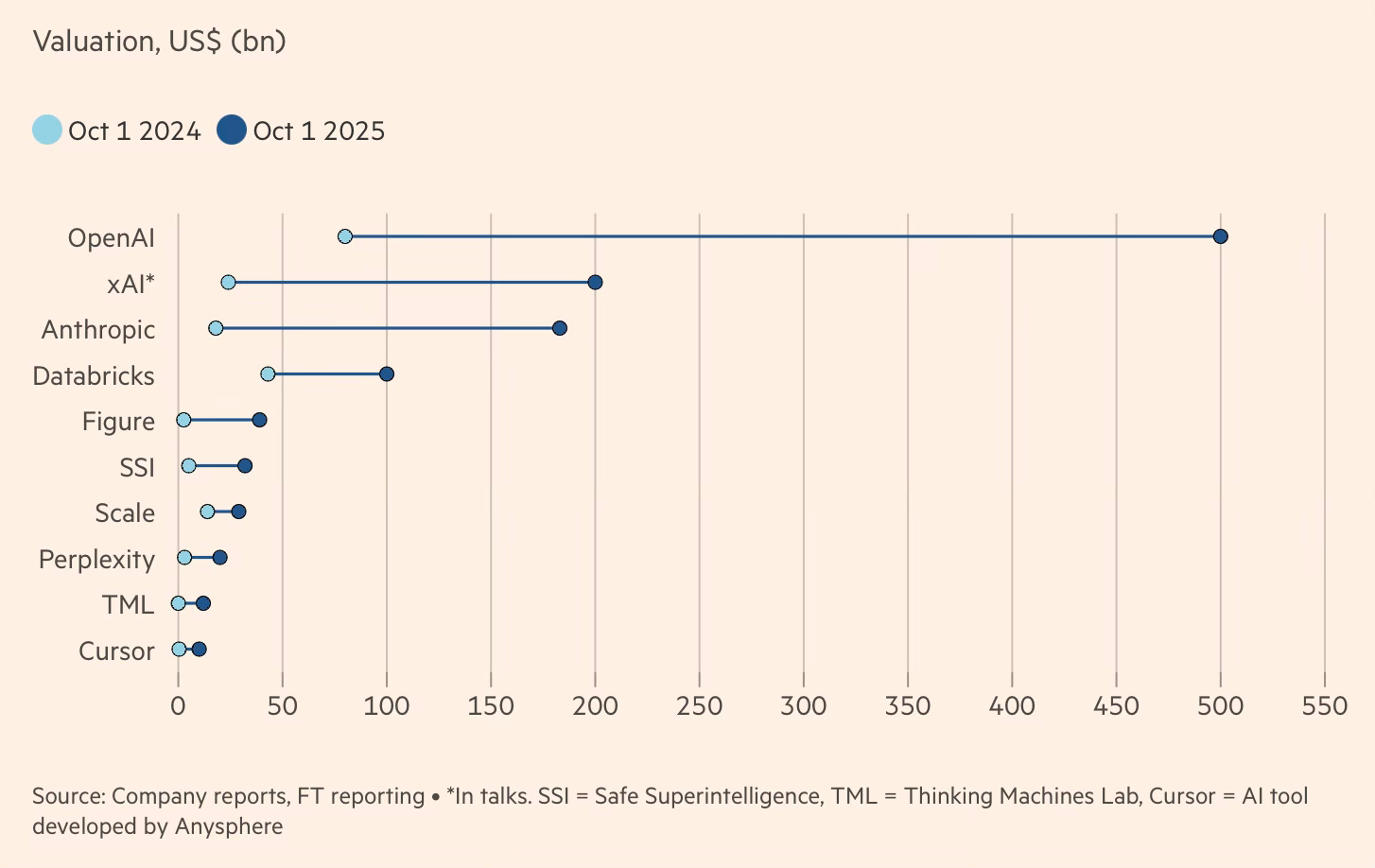
As an illustration, over just the last 12 months, the top ten AI startups, all loss-making, have attracted $161 billion in VC capital (two-thirds of all US VC spend) and gained close to $1 trillion in valuation

The AI mania is not confined to areas of high technology and finance. Even within the more prosaic environments of public systems, it has become a norm to fit AI/ML into any new public policy idea or program or project for virtue signalling. Never mind its relevance and value, proponents put forth claims of using an AI/ML layer to embellish their ideas. Even simple data analytics solutions that are basically data description, without even basic analysis, are presented as having a layer of AI/ML. 

FT’s Gillian Tett points to the practice of “cargo cults” used to describe the phenomenon observed among the native inhabitants of the Melanesian islands that were invaded by Westerners in the 19th century and flooded with previously unseen consumer goods. Dimitris Xygalatas writes

When Indigenous communities throughout the area had their first encounters with colonial forces, they marveled at the material abundance the foreigners brought with them. During World War II, when many Melanesians worked for U.S. and Australian military forces, they observed soldiers who never seemed to engage in any productive activities, such as fishing, hunting, working the land, or crafting anything. All they did was march up and down, raise flags, chant anthems, and signal toward the sky. And when they did that, metal birds appeared and dropped all kinds of goods for them. The Indigenous observers concluded that the strange rituals were causing the cargo to arrive.

With the end of the war, the military bases were abandoned and the goods ceased to arrive. To get the cargo to return, local chiefs began organizing ceremonies that mimicked the rituals of the troops. Soon, elaborate myths and theologies developed around those rituals. Surely, the cargo must have been a gift from the gods—their own ancestors. After all, who else could be capable of producing such wealth? The foreigners had merely discovered the rituals that unlocked these treasures…

But the only airplane present is a full-size wooden replica of a light aircraft. On one side of the strip lies a control tower made of bamboo. On the other sits a satellite dish built of mud and straw. Undeterred by the apparent lack of any actual aviation technology, some of the men light torches and place them alongside the runway. Others use flags to wave landing signals. Everyone raises their gaze to the sky in anticipation.

Tett extends the cargo-cult phenomenon to the current AI mania.

Physicist Richard Feynman borrowed this metaphor to decry “cargo cult science”, cases where researchers “follow all the apparent precepts and forms of scientific investigation, but they’re missing something essential, because the planes don’t land”. The same analogy now applies to AI. Almost every business executive today is eager to tell investors about their AI strategy (even though 95 per cent of companies have not (yet) seen revenue gains) and every VC group is keen to show AI plays. Similarly every Big Tech executive is investing in massive data centres, even though Bain reckons some $2tn of revenue will be needed to fund this by 2030. And charismatic figures like Sam Altman, CEO of OpenAI, keep promising fresh magic. Or as Stephan Eberle, a software engineer, laments: “Watching the industry’s behaviour around AI, I can’t shake this feeling that we’re all building bamboo aeroplanes [like cargo cults] and expecting them to fly.”

In the case of investors, the cargo-cult phenomenon works through fear of missing out (FOMO).

The iconic example of our times of the narrative transcending all logic is how Tesla’s equity market valuation has become tied to the Elon Musk phenomenon. In substantive terms, Tesla has been falling behind in all its major markets and may now be technologically behind its Chinese competitor, BYD. The latter has a superior battery technology, is vertically integrated, and has not only caught up on automatic driver assistance systems (ADAS) but may even have pulled ahead. 

With more than 95% of its global deliveries coming from Model 3 and Model Y, and that too for nearly a decade, Tesla is now a two-trick pony. In contrast, BYD has a dozen models globally and is releasing new models each year. Tesla’s growth has been primarily driven by lowering the prices of its existing models, hoping to offset margin declines with volumes. Its gross margin, excluding regulatory credits, has declined sharply from nearly 30% in the fourth quarter of 2021 to around 17% in the second quarter of 2025. 

But in an inversion of all logic, this decline has been accompanied by an increase in its market valuation to $1.4 trillion, more than ten times that of BYD. Such valuations are built on the premises of high margins, and runaway hits like robotaxis and AI-powered robots. These premises are, in turn, built on the narrative of the cult of Elon Musk and the miraculous powers endowed on him. Tesla is one mega-giant bet on Musk, perhaps the biggest financial market bet on one individual in history, by some distance. 

In each of these cases, once the irrationality has taken hold thanks to the narratives, it tends to find rational explanations. A commonly cited one is that such bubbles may have become the only way to mobilise resources at the scale required to push the technology frontiers. Sample this.

“There will be casualties. Just like there always will be, just like there always is in the tech industry,” said Marc Benioff, co-founder and chief executive of Salesforce, which has invested heavily in AI. He estimates $1tn of investment on AI might be wasted, but that the technology will ultimately yield 10 times that in new value. “The only way we know how to build great technology is to throw as much against the wall as possible, see what sticks, and then focus on the winners,” he added.

This explanation also syncs with the dominant VC model of financial intermediation and allows them, in turn, to raise the massive amounts of capital required to fund the bubble. 

In the case of the AI bubble, there’s also a powerful strategic imperative. As Gillian Tett has pointed out, given the threat to America’s technological superiority posed by China’s state capitalism, such bubbles may well be “the only way American capitalism can ever amass the scale of investment needed to create this type of ambitious infrastructure”.

While it may sound heretical, the AI bubble also highlights the unique nature of American capitalism, which has shown an unmatched appetite to assume excessive risk in the expectation of windfall returns. It is only the latest, albeit far bigger, in the line of irrational exuberance and risk assumption that has distinguished the US economy even in the last five years - WeWork, GameStop, NFTs, cryptocurrency assets, SPACs, etc. As Andrew Ross Sorkin has pointed out, “there is no innovation without speculation” and “speculation built America”. So he writes, 

“Speculation isn’t a bug in America’s economic code, but a crucial component part of the engine… Speculation is often caricatured as gambling. But at its core, it is belief plus risk. It is the act of investing capital in a highly uncertain outcome, hoping for reward.”

In Tesla’s case, too, the irrationality gets justified in terms of Musk’s superhuman talent. This is nicely captured in Tesla’s battles with courts and shareholders to get approval for Musk’s astronomical $1 trillion pay package. 

Tesla management has sold it in terms of binding Musk to remain sufficiently committed to the company, amidst his other multiple business interests. In fact, Board Chair, Robyn Denholm, has justified it, calling Musk a generational talent who would have to expend “time, energy, and effort beyond what most humans can do.” She said, ‘There’s just not anybody, either inside or outside the organisation, that is Elon today.” In what is effectively a blackmail/bluff, Musk himself has said he’ll leave Tesla if he does not get the pay package and gain greater control over the company to protect it from hostile takeovers that can detract from its efforts to develop AI technology and humanoid robots. 

The Musk compensation issue would be unimaginable in any other country. In the US, as Denholm suggests, astronomical compensation packages have become part of an entrenched narrative that those CEOs deserve these amounts. There’s no logic, both in terms of substance (the expertise brought in by the CEO) or market demand (the scarcity of such executives), that can justify even remotely close to these amounts. Numerous studies have consistently shown no correlation between executive compensation and shareholder returns

Instead, the phenomenon of such excessive CEO pay is fuelled by narratives (and the market structures and incentives) that have become part of the US corporate culture. Narratives shape cultures. 

In this context, it is important to remember that the central role of narratives in shaping the biggest mainstream economic trends is a big gap in economic thinking. These narratives, which stand in complete opposition to orthodoxy and logic, must be an essential component of any college or university economics curriculum. 

To some extent, the mainstream economists have grudgingly accommodated parts of it in the guise of behavioural economics and finance. In this reading, while rational economic agents continue to dominate the economic decision-making, human cognitive failures and idiosyncrasies result in some occasional deviations. 

Given how pervasive these deviations are in the real world, this reading must be revised to provide a more central role for narratives that deviate sharply from logic and orthodoxy. Economic decisions, both in corporations and by governments, are also cultural and political choices, and these preferences often dominate. While those choices are grounded in logic and orthodoxy, other considerations also inform them. These considerations are shaped by the specific narratives surrounding them. 

Interestingly, many economic orthodoxies themselves have become narratives sans any empirical basis. I have blogged here about 25 such orthodoxies that dominate the discourse without any empirical basis. 

Saturday, October 14, 2023

Weekend reading links

1. Tim Harford points to the practice of people subscribing to services they don't use.

A new working paper from economists Liran Einav, Benjamin Klopack and Neale Mahoney attempts an answer. Using data from a credit and debit card provider, they examine what happens to subscriptions for 10 popular services when the card that is paying for them is replaced. At this moment, the service provider suddenly stops getting paid and must contact the customer to ask for updated payment details. You can guess what happens next: for many people, this request reminds them of a subscription they had stopped thinking about and immediately prompts them to cancel it. Relative to a typical month, cancellation rates soar in months when a payment card is replaced — from 2 per cent to at least 8 per cent. Einav and his colleagues use this data to estimate how easily many people let stale subscriptions continue. Relative to a benchmark in which infallible subscribers instantly cancel once they decide they are no longer getting enough value, the researchers predict that subscribers will take many extra months — on average 20 — to get around to cancelling.

This is a rare free lunch, one that exploits people's cognitive failures.  

2. Chinese EV makes enjoy large subsidies from the government. Sample this about Nio

Nio lost $835 million from April through June, or $35,000 for each car it sold. Nio and other companies in China’s sprawling electric car sector have formidable government backing that allows them to withstand such losses and keep growing. When Nio nearly ran out of cash in 2020, a local government immediately injected $1 billion for a 24 percent stake, and a state-controlled bank led a group of other lenders to pump in another $1.6 billion.

3. The Economist has an article on the emergence of consultants like McLarty Associates, Hakluyt, and Albright Stonebridge who offer geopolitical advice to multinationals. 

Lee Feinstein, a one-time ambassador who now works for McLarty, notes that many clients value advice from those who have been “in the room where it happens”. The exact services these firms offer are opaque and vary between them, but generally range from gauging the policy intentions of foreign governments to helping open doors for companies that want to sell or manufacture in a new market.

The management consultants like McKinsey too have established their geopolitical consulting arms. The opaque and secretive nature of the work of these consultants raises several concerns. In many respects, this is effectively legalisation of cross-border spying. And we already know the problems with just management consulting itself. 

4. The Economist examines the erosion of authority and credibility of the Palestinian Authority and the further strengthening of Hamas as the de facto leadership of the Palestinian people. A combination of leadership weakness, corruption within the ruling Fatah party, and Isreali high-handedness have rendered the PA to be nothing more than a municipal authority, and that too one which does a bad job of even that.

This is a timeline of the region's history. 

5. Bond markets have been in turmoil, driving up treasury yields and accumulating MTM losses in bond portfolios 

Paper losses on the most opaque part of US banks’ bond portfolios are now close to $400bn — an all-time high, and 10 per cent above the peak at the start of the year that caused the collapse of Silicon Valley Bank — according to Matthew Anderson, an analyst at bond data firm Trepp. Most banks, and in particular the largest ones, will not have to sell and so will never realise those losses... If paper losses on bond portfolios were realised they would have caused a 200 basis point hit to the common equity tier 1 ratios — a measure of financial strength — of the largest US lenders at the end of June, according to Stuart Graham, head of banks at Autonomous Research.

6. Suyash Rai has an excellent assessment of Make in India initiative by numbers. 

At 14.7 percent, the share of manufacturing in GVA in 2022–23 was the lowest since 1968–69. Even in 2019–20, the year just before the pandemic, it was only slightly better—14.72 percent... Even if we do not consider the pandemic years, when capital investments were difficult to make, there has been no progress on gross fixed capital formation in manufacturing since the Make in India initiative was announced... Between 2016–17 and 2022–23, the number of persons employed in manufacturing fell by almost 1.57 crore. Part of this seems to have happened due to the pandemic, but even before that, there was a large decline... In the eight full financial years since the launch of the initiative, the FDI has averaged 1.76 percent of the GDP, while in the preceding eight years (2007–08 to 2014–15), it had averaged 2.14 percent of the GDP... India’s merchandise exports have declined for much of the last one decade, except for a few quarters in 2021 and 2022, when opportunities temporarily created in developed economies led to a spike in exports, which have since declined.

7. Rai also points to a paper by Chang-Tai Hsieh and two others who argue that China's extraordinary economic growth comes from "special deals" cut by local governments with favoured private firms. They claim that local leaders derive personal benefits, either political or monetary, from these, and competition among local governments limits the predatory effects. 

Its simplicity is striking.

Given the effectiveness of this system depends on the discretion of local officials, on incentives being appropriately aligned among local officials to ensure that they not only maximise investments and job creation but also limit rent-seeking at sustainable levels, and on minimising the damage borne by firms not getting special deals, the authors call this strategy a "high wire act". 

8. Ruchir Sharma points to the difficulty of smart money investors

Since 2000, there have only been three years in which a majority of large cap funds outperformed. In the 2010s, on average, 8 out of 10 mutual funds and 9 out of 10 institutional funds underperformed in the US markets, after fees. The share of pros who beat the market was only slightly better before fees and was equally low in the stock markets of Europe, Asia and the rest of the world... Within the community of retail punters, the most active 20 per cent of traders earn returns far lower than the least active 20 per cent. The losses are not just for day traders in individual stocks. Through bad timing, active amateurs lower their returns by 20 per cent when they are pulling in and out of mutual funds.

He also points to the value of insider information

One of the more interesting insights on information superiority comes from studies of (legal) trading by company insiders. Senior executives tend to sell ahead of abnormal declines and buy ahead of abnormal surges in a company’s shares. Chief executives and chief investment officers tend to do better than less senior executives, probably because they have more complete information. In this well-informed circle, following the herd can work. Local information can provide a similar edge. In emerging markets, big global funds have often assumed they can teach the locals a thing or two about investing, only to learn humility the hard way. In the run-up to currency crises, my research has found that locals often pull out well ahead of foreign investors and then are the first to return, sniffing an economic turnaround. Superior on-the-ground knowledge gives them an edge.

9. The Azerbaijani ethnic cleansing of Armenians in Nagorno Karabakh with the support of Turkey has hardly received any global attention. 

After a 10-month blockade, Azerbaijan launched an attack on Sept. 19, claiming the enclave in a day and causing nearly the entire ethnic Armenian population to flee... For Armenians, a classic relic ethnic minority whose Christianity and peculiar alphabet date to the epic struggles between the Romans and the Parthians, it was another genocide. For the Azerbaijanis, Turkic in language and historically Shia Muslim, a great triumph... in its emboldening of traditional regional powers like Turkey, scrambling for geopolitical spoils after the retreat of superpowers, it’s a harbinger of the coming world disorder.

Nagorno-Karabakh, a mountainous region in the South Caucasus, is perennially contested. Ceded by Persia to Russia in the 19th century, it fell into dispute with the emergence of the Soviet Union, Armenia and Azerbaijan both claiming it. In 1921, Stalin attached the enclave to Azerbaijan, home to oil resources and a thriving intellectual culture... By 1994 the Armenians, mobilizing around the traumatic memories of genocide, succeeded in expelling scores of Azeris from the enclave.

The region is also at the centre of a major geopolitical tussle

President Recep Tayyip Erdogan, a master of vertiginous visions, has already tried Islamic liberalism, joining Europe, leading the Arab revolts, challenging Israel and negotiating peace in Ukraine. He now has another dream: opening a geopolitical corridor from Europe through Central Asia, all the way to China. This is the “Zangezur corridor,” a 25-mile-long strip of land to be carved through Armenia as part of a peace deal imposed at gunpoint.

Iran is not happy with Azerbaijan’s victory. As openly as the Iranians ever do, they’ve threatened to use force against any changes to the borders of Armenia. Iran, a millenniums-old civilization central to a whole continent, cannot tolerate being walled off behind a chain of Turkish dependencies. India, similarly, is on Armenia’s side and has been sending a regular supply of weapons. One spur for such support, no doubt, is Pakistan’s joining the Azeri-Turkish alliance. In the jargon of American lawyers, this opens a whole new can of worms. Then there’s Russia, whose absence from the denouement in Nagorno-Karabakh was striking. Even after the 1990s, Moscow still remained by far the biggest supplier of weapons to both Armenia and Azerbaijan. Their economies and societies, above all the elites and their corruption networks, were until very recently molded together. What we are seeing now, as both nations slip out of Russia’s orbit, might be the second round of Soviet collapse.

10. Good list of 40 companies in developing markets that are beating western multinationals in their markets. 

11. The shocks of 2020-22 have been greater on the low-income countries, as reflected in their GDP shortfall.

Real domestic demand as reflected in private consumption and capital formation too has taken a big hit in the low-income countries. The biggest hit on private consumption has been in China.
And the economic growth projections going forward are not encouraging
12. This is a telling snippet about how financial markets lost all their discipline
In 2017 Argentina’s new president Mauricio Macri was keen to show that the country had changed, and celebrated its return to the fixed income market by selling a $2.75bn bond maturing in 2117, with a yield of 7.9 per cent. The then-finance minister crowed that “such an issuance is possible thanks to our recovery of the world’s credibility and confidence in Argentina and in the future of our economy”. It went about as well as you might expect. Macri was out by 2019 and Argentina defaulted on and restructured the century bond in 2020... Argentina’s creditors received on average 54.5 cents on the dollar. But the 2117 bond was actually sold at 90 cents on the dollar to entice investors, and paid at least a few chunky coupons before it was restructured and exchanged for a lower-value new bond, which would have ameliorated the pain somewhat... It turns out that if you bought at issuance and reinvested the coupons back into the 2117 bond you would have lost about 30 per cent going into the restructuring, and roughly 53 per cent on the other side of it. (NB, the gap is unusually large, which means the Bloomberg data might be a bit shonky.) If you held on to the restructured exchange bonds that mature in 2046 and reinvested the new coupon payments into that, you’d today be staring at a ca 63.7 per cent loss.

But the Alphaville report also points to the fate of the 100 year bonds issued by Austria at the same time. 

That’s an almost 40 per cent loss in price since inception. The miserly semi-annual 2.1 per cent coupon payments helps only a little, crimping the total loss is 31.27 per cent, according to Bloomberg data. If you were unlucky/foolish enough to buy the Austrian century bond at its peak price/record low yield in 2020 then you’re looking at close to a 75 per cent loss. There are few better examples of the explosive power of duration when the interest rate cycle turns.
13. Voting share in WB/IMF and respective national outputs for the major economies

14. Katharina Pistor makes two important observations about Finance 
Finance is no longer just an intermediary that channels money from savers to borrowers... finance is now in the driver’s seat, setting the agenda for others, including governments. There are two big problems with this: finance is both dumb and dangerous. It is dumb because it can only read numbers, unable to understand, much less assess, difficult social problems or complex business or engineering strategies. And it is dangerous because the people at the helm of financial institutions think they are smarter than they are, which leads them to assume that they should steer the ship.

If you are looking only at price tags, ruling the world seems easy. Everything becomes comparable, and you need only buy low and sell high to make a profit. Unless you are one of the few moral investors who wants to feel good about where you direct your money, the nature of what you are buying or selling matters little. The price mechanism dispenses with the need to understand an asset’s real-world qualities, negative attributes, or possible side effects. In fact, the less investors know or care about such matters, the more liquid the market.

15. Finally, there's more emerging troubling trends on climate change. Latest data show that September was 0.5 degree celsius hotter than the prior record, and July and August were around 0.3 degree hotter since reliable global records began in the mid-1800s and probably for the past 2000 years. 

There has been a sharp acceleration in global warming in the last 15 years. 
The rate of warming we’ve measured over the world’s land and oceans over the past 15 years has been 40 percent higher than the rate since the 1970s, with the past nine years being the nine warmest years on record.

Monday, June 17, 2019

The challenges with exercising good judgement

I have blogged earlier about decision-making as essentially an exercise in good judgement.

Such judgements face formidable challenges. For a start, most often agents face incomplete information and have inadequate experience. After all good judgement is about inductive reasoning - draw on data points or experiences and draw generalisable inferences. Second, agents are captives of their own prejudices and preferences, which brings in bias to their judgements. Such biases can offset even experience and information.

Finally, such judgements, even when processed based on comprehensive information and free of biases, are inherently inconsistent, with wide variances, something which Daniel Kahneman et al have described as noise. They write,
Professionals in many organizations are assigned arbitrarily to cases: appraisers in credit-rating agencies, physicians in emergency rooms, underwriters of loans and insurance, and others. Organizations expect consistency from these professionals: Identical cases should be treated similarly, if not identically. The problem is that humans are unreliable decision makers; their judgments are strongly influenced by irrelevant factors, such as their current mood, the time since their last meal, and the weather. We call the chance variability of judgments noise. It is an invisible tax on the bottom line of many companies.
Some jobs are noise-free. Clerks at a bank or a post office perform complex tasks, but they must follow strict rules that limit subjective judgment and guarantee, by design, that identical cases will be treated identically. In contrast, medical professionals, loan officers, project managers, judges, and executives all make judgment calls, which are guided by informal experience and general principles rather than by rigid rules. And if they don’t reach precisely the same answer that every other person in their role would, that’s acceptable; this is what we mean when we say that a decision is “a matter of judgment.” A firm whose employees exercise judgment does not expect decisions to be entirely free of noise. But often noise is far above the level that executives would consider tolerable—and they are completely unaware of it.
Their conclusion,
Where there is judgment, there is noise—and usually more of it than you think.

Thursday, January 4, 2018

The farm story repeats...

I have lamented here and here at the daunting challenge posed by India's agriculture. Indian Express has this article on the increased jeera cultivation acreage in Gujarat following record prices this year. Consider this,
Prices of jeera (cumin seed) hitting record Rs 21,000 per quintal levels at Gujarat’s Unjha market... In a year marked by low realisations for most agricultural commodities — be it cotton, groundnut, potato or tobacco —... jeera has been an exception... The above spike in prices has led farmers in Gujarat to plant 3.48 lakh hectares (lh) under jeera in the current sowing season, which extends from November to early December. This area, which is subject to upward revision, is significantly more than the 2.79 lh of last year. All the major growing districts have recorded higher coverage: Patan (from 40,700 to 68,100 hectares), Banaskantha (from 64,900 to 67,800 hectares) and Ahmedabad (from 12,400 to 19,800 hectares) in north/central Gujarat; Porbandar (from 12,100 to 23,200 hectares), Rajkot (from 4,900 to 22,000 hectares) and Devbhumi Dwarka (from 4,800 to 20,400 hectares) in Saurashtra; and Kutch (from 23,200 to 29,600 hectares)... Ram Patel has sown jeera in seven out of his 10-bigha holding this time. Last year, he grew the crop only on three bigha, while dedicating the remaining seven bigha for mustard (six bigha make a hectare). Jeera is extremely sensitive to weather fluctuations, making its cultivation riskier relative to wheat, chana (chickpea) and dhaniya (coriander), which are the other major rabi season crops in Gujarat. Overcast skies or dew at the time of maturity — jeera is harvested from February to March — can sometimes even lead to complete crop loss.
It is unlikely that policy actions can nudge farmers away from such herding based on previous year's prices.

The binding constraint against shifting in response to such trends is unlikely to be information. After all a farmer is likely to have seen several such cycles in his lifetime. It is more likely a deep behavioural bias that attaches excessive weight to the immediate experience over the less immediate experiences. Accordingly, the high incomes from the past season weighs so heavily on the mind of the farmers that they are willing to gloss over the memories of pain from earlier experiences of market cycles. What can be done to overcome this cognitive bias?

I would say precious little. Unless the farmer's state of poverty is alleviated, information supply will remain largely ineffective. This excessive preference most likely is a result of poverty and the desperation and insecurity arising from it. The farmer behaves like a poor person who fancies lottery tickets. It is the prospect of the windfall and the perceived favourable odds that make them take the bet.

This is a cautionary note for those who are bought into the story that providing (some even claim to want to sell) information to farmers or the poor can be a solution to many of their deep underlying reasons for distress. They are most likely to be disappointed.

Update 1 (06.01.2018)
A comment informs that the Agriculture Department of the Government of Andhra Pradesh succeeded with an information and awareness campaign to moderate the extent of cotton crop sown this year based on an assessment that cotton is not likely to do well this year.

Now there is a difference between good old public information campaigns (effectively done) and nudging  privately with information. The post was in the context of the latter, and did not make the distinction. Privately providing information as a nudge to farmers is qualitatively different from a massive public information campaign that targets the farmers as a collective. With the latter, mobilising a few influencers (or a platform like farmers groups) can swing the collective resolve towards the change.

So let me reiterate - privately nudging individual farmers with information to shift entrenched patterns or behaviours is unlikely to be effective especially given the (cognitively biased) perceptions of costs and benefits associated with status quo and change.

The problem with the standard information and awareness campaigns of government is that in systems with weak state capacity they are generally executed badly in a routine manner and to that extent becomes ineffectual. In the instant case, I have little hesitation that the outstanding individual heading the State's Agriculture Department made the difference.

Saturday, November 11, 2017

Tax Avoidance Nudge of the day

In the backdrop of the Paradise Papers which draws attention to the pervasive nature of tax avoidance strategies by the large corporates, Merryn Somerset Webb writes in FT,
In the meantime, if I were in charge, I would amuse myself by forcing all companies operating in the UK to list in their annual report how much tax they would pay in the UK if they were to simply subtract their UK-based expenses from their UK-earned revenues (no allowances and no profit shifting included) and how much they actually pay. It’s a small thing — but rather like forcing publication of pay ratios and gender ratios it might concentrate minds.
Talk about nudging to curb tax avoidance. Small step, but may be very useful, as she says, to "concentrate minds" and generate popular indignation.

And very nice illustration of corporate and individual tax avoidance strategies by Gabriel Zucman in Times.

Saturday, October 14, 2017

Weekend reading links

1. Government intervention to make strategic purchases to both catalyse markets and lower prices is logical. The most cited example of such intervention in recent times has been the procurement of 770 million LED lights by 2019 as part of India's Domestic Efficient Lighting Program (DELP), which has resulted in a steep drop in the prices of LED lights.

Buoyed by the success, the government company, Energy Efficiency Services Ltd (EESL), is seeking to procure 5 million smart electricity meters and drive down prices. Livemint reports that L&T have won a Rs 13.61 billion contract to supply 5 million meters over three years to discoms in UP and Haryana at Rs 2722 a piece, 40-50% lower than the current market rate. 
Power distribution companies will not have to make an upfront investment to deploy these meters. EESL is investing in procuring smart electricity meters and the services of the system integrator. Utilities can pay back through savings resulting from enhanced billing efficiency and avoided meter reading costs. EESL will also appoint a firm, a “system aggregator”, to manage the installation of smart electricity meters and to collect and store data on power consumption for analysis.
A very rare example of innovation and big-scale public policy thinking in India. The challenge, in this case, will be to hold the supplier honest and make them deliver good quality meters, and have the "system aggregator" be able to actually collect and make available the required data for energy audit. The matter of getting stuff done. But a very good initiative. 

2. Much of the analysis about the ongoing movement against informality glosses over the demand side of the equation. Manas Chakravarthy writes in Livemint,
One consequence of the introduction of GST and some of the other measures to tackle black money will be increased market share for the corporate sector. Stockbrokers have been celebrating the opportunities opened up. A Citibank research report says: “The Indian government’s ongoing structural initiatives (and the GST rollout) will accelerate the transition toward the organized sector. Moves towards a less-cash economy, indirect tax changes through GST, direct tax compliance, e-commerce, and some progress on labour law reforms, among others, will prove disruptive to traditional structures in the medium term and result in accelerated formalization as well as economies of scale in the long term.” It’s no surprise that big business has backed these changes to the hilt.
Let me repeat what I have said earlier many times, the informal economy is not going to disappear. It will linger on and only gradually shrink over decades.

Formality introduces costs, which the producer will have to pass on to the buyers. But we need buyers who can afford to pay the higher price to access that good or service. This affordability can come only with increased incomes, a function of economic growth.

Barbers sitting on roadside and on makeshift arrangements offering haircuts for Rs 10-30 will form the vast majority of haircuts in India for the foreseeable future. In contrast, salons where the haircuts cost Rs 75-100 or more, likely to be in the formal sector, form only a very small proportion of haircuts. Governments can do whatever it wants to force these barbers to become formal, but they will not. The simple reason is that there is only so much demand that can be generated for salon haircuts! The shift to salons will happen only with economic growth.

3. In the best GST article I have read, Indira Rajaraman, draws attention to a weakness of the current GST architecture and how it affect the risk sharing mechanism in India's retail eco-system. She writes,
The principal culprit is the monthly frequency of reporting required under the GST (for businesses with annual turnover more than Rs75 lakh). Within each month, there are three dates in sequence for voucher uploading, consolidation and claims, with a daily penalty beyond deadlines crossed, added to interest on any tax credits denied. This formal voucher-based monthly reporting has dealt a death blow to the risk-sharing mechanism underpinning the efficiency of the Indian retail supply chain as we know it. And that is what has hit growth. Take a retailer of non-perishable items like garments or footwear. Retailers order a consignment from upstream wholesalers according to their best judgement of what clients will buy. The traditional practice was that if a retailer overestimated the appeal of a new style to his client catchment area, he returned unsold stock to the wholesaler, and finally paid the wholesaler a few months later only for his net purchase, net of returned stock.


Risk cover does best when risk is pooled across many locations with diversified patterns of incidence. The wholesaler is able to bear the risk of sale reversal because he can re-distribute returned stock. A new style in garments or slippers may lie unsold in one location, but fly off the shelves in another. Wholesalers in turn spurn retailers who return stock beyond some percentage limit of the gross purchase, thus leaving enough risk with the retailer to incentivize him to judge his market correctly and put in his best sales effort. If goods are defective, the wholesaler in turn returns the stock to the manufacturer, which again assigns risk to the only level where defects can actually be addressed.

When there is a switch to monthly reporting, a wholesaler uploads the initial gross sale to each retailer, with GST charged on a numbered invoice lodged in the system. Although the GST system does permit reversal of sale through issue of a credit note which can be offset against the next sale to the same retailer, it adds to the procedural burden, and is not something wholesalers are willing to touch. In effect, sale reversal has become impossible under GST, even for defectives. Retail buyers are now being asked to take a consignment at their own risk, and thereafter hold their peace. The traditional risk-sharing mechanism lies shattered.

Given that the retailer can no longer (in effect) reverse any part of an uploaded transaction, he minimizes risk by reducing his gross purchase from the wholesaler to the floor of his expected range of retail sales. This is what has hit growth. Wholesalers faced with reduced retailer offtake in turn place lower orders from manufacturers. Manufacturers have responded by sharply lowering production, some operating at as little as 25% of capacity.
She proposes doing away with the voucher uploading and matching process and replacing it with rigorous sample audits. I am inclined to agree.

4. A great stall is on in India's construction sector, the second largest employer after agriculture. Sample this,
For three consecutive quarters, the stalling rate in the realty sector has been in double digits, with the total value of stalled realty projects touching Rs1.27 trillion in the September quarter. The stalling rate (or value of stalled projects as a percentage of projects under implementation), at 12.7%, was at its third-highest level in nine years, only marginally better than in the June quarter, when the stalling rate hit a nine-year high of 13.3%. The commercial real estate sector has been the worst-hit, with a fifth of such projects getting stalled.
5. Talking of stalling, stalled infrastructure projects are no longer news. The latest on them shows limited progress in addressing the chronic problem. The value of stalled projects reached its highest level of Rs 13.22 trillion for the September quarter and stalling rate was 13.3% of all projects under implementation.
The reasons for stalling were the usual suspects - lack of clearances, fuel supply, finances, land etc.
A total of 39.04% of the projects are in the power sector and 25.59% in manufacturing. But the most disturbing news is in the declining new investment announcements. Sample this,
The value of new private sector project announcements in the quarter ended September was Rs31,000 crore. This value was Rs1.79 trillion and Rs1.69 trillion in the quarters ended September 2016 and 2015. 
6. This is a nice graphic that captures the fact that average commuter trip lengths rise with increase in city population size.

The article laments about the political difficulty of increasing urban mass transit fares and the resultant subsidy gaps.

While raising mass transit fares periodically is important, we should also bear in mind that farebox ratios are less than 50% in most metro rail systems across the world. In other words, more than half the operating expenses are subsidised. Therefore a more serious issue for consideration than cost-recovery may be to mark metro ticket prices as a percentage share of the median commuter wages.

The report states that the Railways subsidised Mumbai suburban railway commuters to an extent of Rs 33.94 bn over the past three years. That's not at all bad. An annual subsidy of Rs 11.3 bn for ferrying over 2.5 bn commuters (or 7.5 million per day), especially when seen as the cost of keeping them off Mumbai's roads, is actually a very good deal! In terms of efficiency, it would easily be the most cost-effective urban mass transit operation anywhere in the world. Managing a city is not just about recovering costs, it is about creating the conditions for creating growth, jobs, and wealth. And Mumbai mass transit does it better than most other enablers that the government has put in place.

7. Just like with anything else, too much competition is bad. As Andy Mukherjee writes, India's telecoms market is the best example. The race to the bottom with call and data tariffs have left everyone bleeding, and threatens to make this the latest addition to the bad debt problem for Indian banks. Mukherjee suggests that the carnage will not stop till the industry undergoes more consolidation and failures and reduces to four players.

However, I do not think that even then it is unlikely to be much different. As I blogged earlier, the elimination of interconnect charges on grounds that it would lower profits may not, in retrospect, turn out to have been a very good decision. 

8. Aeon has a fantastic essay on the evolution of higher education system in the US. It talks about the role of property speculators trying to use the College/University as a cultural centre and anchor to attract property buyers; competition among towns, state, and even church to establish colleges; the modest government funding forced colleges to charges fees and thereby compete to make college valuable for students; the limited regulation beyond grant of charter which allowed colleges lot of autonomy to innovate to attract students; the practicality associated with attracting middle class fee-paying students meant offering job-oriented course-work (engineering, agriculture etc) and accord importance to things like football.

And for those countries trying to replicate the US model of higher education, the author has this advise
Since it’s a system that emerged without a plan, there’s no model for others to imitate. It’s an accident that arose under unique circumstances: when the state was weak, the market strong, and the church divided; when there was too much land and not enough buyers; and when academic standards were low. Good luck trying to replicate that pattern anywhere in the 21st century.
9. The week Richard Thaler won Nobel Prize in Economics, comes this report from SCMP on the use of nudges (or, are they "shoves" here?) to get people to pay their taxes
Local governments have been told to set up name-and-shame databases – which will be searchable by anyone – by the end of the year... In the southern city of Guangzhou, the personal details of some 141 debt defaulters have so far been displayed on screens in buses, commercial buildings and on media platforms at the request of local courts. Meanwhile in Jiangsu, Henan and Sichuan provinces, the courts have teamed up with telecoms operators to create a recorded message – played every time someone calls – for those who fail to repay their loans. The message tells the caller: “The person you are calling has been put on a blacklist by the courts for failing to repay their debts. Please urge this person to honour their legal obligations.”
10. Finally, the award for risk diversification best practice has to go to LIC. It has been reported to have made a bid for shares worth Rs 7000-8000 Cr in the IPO of reinsurer General Insurance Corporation (GIC) Re. Talk about insurer buying exposure into a reinsurer who also insures some part of LIC's own portfolio! Or is it a case of LIC as the buyer of last resort in disinvestments.