Substack

Showing posts with label Gender issues. Show all posts

Saturday, September 12, 2026

Weekend reading links

1. A bond market story of the last two weeks has been the rise of the 10-year Japanese government bond yield above 3% for the first time since September 1996, following a weakening yen and an unprecedented bilateral market intervention with the US Treasury to shore up the currency.

The market expects a rate hike by BoJ from its current 1% to prop up the yen and also quell rising inflation. However, this would clash with the commitments of Prime Minister Sanae Takaichi for fiscal spending to boost the economy. 

The pressure on yen and rising bond yields are also a matter of concern for the US, since it could trigger repatriation of the massive Japanese investments in dollar assets, including the holding of US Treasury bonds.

Japan is the top foreign holder of US government debt, with more than $1tn, much of it held by financial institutions... market concern that Japan’s enormous pension funds and life insurers, nursing tens of billions in paper losses on their bond holdings, could shift their investment strategies as yields at home become more attractive... Citi’s Takashima said life insurers had been waiting for yields on 20-year JGBs to hit 2.5 to 3 per cent but were still not buying at scale as they feared that prices could drop further.

2. This is an excellent article on baby diaper manufacturing in India. The two costliest items are not manufactured in India and are imported.

Further, there's an inverted tax structure.
At the 56th GST Council meeting on 3 September 2025, diapers were moved from 12% to 5%, effective 22 September 2025... But SAP sits under HSN 3906, taxed at 18%... Output at 5%, inputs at 12% to 18%... input tax credit piles up faster than it can ever be set off against output tax. The credit is not lost. It is refundable under Section 54(3), and from 1 October 2025 the government began granting 90% of such refunds provisionally. But refundable is not the same as available.

Diapers are covered under PLI, and it is ending up supporting contract manufacturers who import SAP. 

Until an Indian chemical major commits to commercial SAP capacity, every rupee of PLI is subsidising the assembly of imported chemistry. We are building the world's fastest converting industry on someone else's molecules.

In this case, the PLI should target the SAP manufacturing in India. Supporting contract manufacturers to make what they are already doing does not require PLI. It underlines the point that PLI needs to focus on domestic value addition and not merely investment and sales. This requires more detail-based policy making. 

3. Tata Capital Healthcare Fund appears to be doing what public innovation funds ought to be doing, de-risking new market segments in healthcare. 

TCHF is not really in the business of spotting the next unicorn and riding it to a listing. It is in the business of manufacturing acquisition targets. It finds a chronic, non-negotiable demand, dialysis, cancer, joint replacement, wraps a proven clinical model in Tata credibility, scales it into Bharat where nobody else will do the asset-heavy work, de-risks the operations, and hands a finished, cash-generating, regulation-cleared asset to a global consolidator or a domestic roll-up desperate to enter that exact niche...

TCHF works because of a stack of things that have nothing to do with money: extreme sector focus, operational depth, brand-as-regulatory-passport, a structure that insulates it from its own parent, and the patience to build assets strategic buyers are forced to buy. Take any one away and the model wobbles... The winners in corporate venture will look... more like TCHF: narrow, patient, operationally heavy, and quietly building things the giants of their industry will one day have to acquire.
Jayant Mundhra's Substack is excellent.

Also on AI, the latest PISA student learning outcomes survey findings show uniform declines in reading and math. 
The new report shows that reading scores across the OECD have fallen by 25 points and maths by 22 points since 2018. “Given that 20 score points is roughly equivalent to a year of learning, this implies that a majority of 15-year-old students across the OECD in 2025, on average, were performing at a level typically expected of 14-year-olds,” according to Pisa. Schleicher linked the decline in the latest scores to the dominance of distracting short-form videos on platforms such as Instagram and TikTok, as the report suggested that “digital distraction” is harming education across the world. “We cannot say for sure, but skimming social media feeds and rapidly processing information may be contributing to worsening ability and motivation to engage with complex texts and data,” the report said.

5. US labour-capital share of output - rising corporate profits amidst falling wage share

Pre-tax earnings hit an annualised $4.8tn in the second quarter, or 18 per cent of national income, according to Bureau of Economic Analysis data, the highest share since the aftermath of the second world war. Employees’ share from wages and benefits fell to 60 per cent, the lowest level since the 1950s... Bumper returns largely benefit richer Americans, who receive much of their income from investments, while middle- and lower-income households rely more heavily on pay cheques. Inflation has also outpaced wage growth, causing real hourly earnings to fall by 0.2 per cent in July versus a year earlier.
6. A global whisky glut, or whisky loch, amidst rising consumption in India.
The amount of whisky maturing in casks has soared from less than 400mn litres a decade ago to around 1.4bn litres this year, or 389mn cases — enough to meet current consumption levels for three years, according to Martin Purvis and Duncan McFadzean’s Commercial Spirits Intelligence newsletter. That has caused many of Scotland’s distilleries to curtail output by more than a third, insiders say... Today’s glut is the result of increasing production during the 2010s, which led to an excess of casks maturing during times of global economic uncertainty.

7. California, the bastion of liberalism, struggles to build. 

A high-speed rail line that voters approved in 2008 but that has yet to lay a track. A large housing project outside Los Angeles and the redevelopment of a Navy yard, both in planning stages for decades. The state has arguably the nation’s worst housing crisis, with rent and home prices that far exceed the national average. The high cost of living, combined with strict environmental and land-use regulations, has led to a steady migration of companies and residents to less expensive states. The main problem, Mr. Metcalf continued, is that California’s overlapping regulatory processes, scattered among state and local agencies, make it nearly impossible to approve — or even outright deny — a project. Even when the governor or state legislators get behind an idea, local governments often have effective veto power. Delay becomes the normal course of nonaction.

8. London's experience in reducing knife crimes.

Knife crime rose dramatically in Britain from 2017, especially among teenagers... Hospitalisations for “assault by sharp object” have fallen by a third in London since their peak. Knife-related homicides have shrunk by a half. Last year teenage homicides in the capital fell to their joint lowest level (similar to 2012) in almost 30 years... As English politicians scrambled for answers during the 2017-19 “epidemic”, Lord Sadiq Khan looked to Scotland. In the previous decade Glasgow, once labelled Europe’s murder capital, had achieved impressive reductions in violent crime. One reason was the roll-out of the Scottish Violence Reduction Unit (VRU), which aims to prevent violent crime by bringing the police, schools, hospitals and sports clubs together to identify at-risk children and direct them away from crime. Between 2008 and 2018 Scotland’s VRUs were credited with bringing about a 38% fall in homicides and a 43% drop in attempted murders and serious assaults—many of them knife-related. 

Lord Khan announced England’s first VRU in London in 2018. Today there are 20 such units across England and Wales, covering areas that account for 80% of all knife crime. A recent Home Office review found that England’s VRUs caused a 12% fall, since 2019, in hospital admissions for violent assault among the under-25s. That is modest compared with Glasgow, but the Home Office looked only at the national average. Violent crime has fallen most in cities like London—dense urban areas where the model is easiest to implement.

9. The state of gender empowerment.

In India violence against women is so normalised that nearly 40% even of women think a husband is sometimes justified in beating his wife. In Mali the figure is nearly 70%... In South Asia only a third of women are in the labour force; in the Middle East and north Africa, only a fifth are. Since 1990 the share of labour income that accrues to women has risen from 35% to 44% in liberal France; in patriarchal Pakistan, from 1.5% to a still-woeful 9%. Removing the barriers to women working would raise income per person by a fifth in many countries, estimates the World Bank—a bigger economic benefit than avoiding a typical civil war...

Yet even the most sexist laws can be scrapped, as Saudi Arabia has shown. Before a series of reforms that started in 2011, women there were barred from all but a handful of jobs and not even allowed to drive. Now they are free to work, drive and shun the hijab if they choose. The share of women in the labour force has nearly doubled since 2010, from 18% to 34%. That is startling progress for a kingdom many thought hopelessly stuck in the past—even if there is still a long way to go.

See also this

10. Nvidia is the central bank of AI?

Over the past three years it has pledged over $70bn in investment in startups and offered $300bn in financial support to its customers... It has promised around $25bn in future equity investments. It owes around $33bn in debt. Its potential liabilities to customers amount to about $300bn, but only come into play in a downturn and so do not appear on its balance-sheet. These include the $105bn guarantee behind Open­AI’s data centre; as much as $125bn through the Wall Street partnership; and around $67bn in other backstops.

Also this

Nvidia’s financial engineering is partly a response to its biggest customers’ transformation into rivals. “Hyperscalers”, tech giants such as Amazon, Google, Meta and Microsoft, account for roughly half of Nvidia’s revenue. This year they are projected to invest around $800bn, largely on AI infrastructure. But most of them have begun designing their own chips, which puts their future purchases from Nvidia in doubt. For the hyperscalers, these custom chips are much cheaper, costing between a fifth and a third as much as Nvidia’s...
Hyperscalers have investment-grade credit ratings, which keep their borrowing costs low. Upstart neoclouds have similar spending needs, but little revenue. Their loans are naturally much more expensive. Alphabet, Google’s parent company, sold $2.75bn of 50-year bonds in November, at an annual interest rate of 5.7%. The rate at which CoreWeave, the biggest neocloud, borrowed $2.6bn in July was almost double. It is this gap, between hyperscalers’ borrowing costs and everyone else’s, that the bank of Nvidia would like to narrow. One way it does that is by taking equity stakes in startups that will be customers themselves or that will help fuel demand for Nvidia’s chips indirectly. Last year Nvidia made about 90 such investments, nearly twice as many as two years earlier. This year it has already agreed another 60-odd. 

Some of these cheques aim to propagate open-weight AI models, which users can download free of charge and adapt, unlike proprietary offerings from firms like Anthropic, OpenAI and Google, which users tend to access via subscriptions and whose inner workings are hidden. In August Nvidia agreed to pay Poolside, a startup building AI coding models, $6bn to license its software and a further $1bn for a stake. It has also agreed to buy Hugging Face, a platform hosting open-weight models, for $12.9bn. The intention behind such investments is to fuel demand for Nvidia’s chips by creating a proliferation of AI products and companies that are independent of the hyperscalers... In early July it announced a new stratagem in which it promises to top up neoclouds’ income from new data centres to an agreed floor. These undertakings, the exact terms of which vary from deal to deal, often last for six years. Throughout that period, Nvidia promises to pay a set price for “compute”, as the jargon has it. If the neocloud manages to sell the capacity in question at a higher price, Nvidia receives a share of the difference. This safety-net makes neoclouds’ future revenues much more predictable and so lowers the cost of the debt they take on to build new data centres. That, in turn, spurs demand for Nvidia’s processors.

In the graphic below, red are neoclouds, yellow are AI labs, and blue are financial firms. Also, the dashed circles are equity stakes, and the black boxes indicate guarantees and purchase commitments. 

But things may still be under control.
Morgan Stanley, an investment bank, reckons Nvidia’s “all-in” debt will rise from $53bn early next year to $200bn by the beginning of 2029 as guarantees come into effect. But that is offset by a stash of cash and liquid securities currently worth $99bn, and a business that will generate about $200bn in cash this year. Only a cataclysmic downturn that caused all Nvidia’s guarantees to come due and its profits to evaporate almost entirely would imperil the company—as things stand. The picture may change, however, if Nvidia’s commitments keep growing.

See also this

11. Friendships across classes matter for life outcomes. 

Recent research suggests... having pals across class boundaries appears to be one of the strongest predictors of upward mobility for people in low socio-economic groups... What’s more, children who grow up in areas with more cross-class mixing go on to earn more on average, controlling for parents’ income. To isolate the effect of the county itself, the researchers tracked families who moved. Assuming those moves were not related to their children’s future prospects — a reasonable assumption — the analysis found that people who spent a larger portion of their childhood in a better-connected county went on to earn more.
12. The graduate premium is reversing in US and UK.
13. The Indian space ecosystem is a reform success.
India’s space ecosystem has expanded significantly, with more than 450 space industries and over 440 startups now engaged in the sector. Isro is facilitating greater private-sector participation through the government-owned, company-operated (GOCO) model, under which private industry can manufacture, test and supply components and subsystems using its own facilities and infrastructure. Isro has facilitated nearly 440 technology transfers so far, enabling wider adoption of space technologies.

14. The victory of the far-right Alternative for Germany (AfD) in the Saxony-Anhalt province in the east of Germany was expected. Though it has fallen short of a majority by just three seats, an FT editorial calls for allowing it to form the government.

The firewall, a well-intentioned policy of non-cooperation with the far right, which is considered a threat to democracy, has turned into a trap for the mainstream parties, particularly the Christian Democratic Union of Chancellor Friedrich Merz. As support for the CDU shrinks, it is forced to share power invariably with its leftwing opponents in dysfunctional coalitions, whose quarrelling and meagre results drive votes to the AfD, further reducing the scope for compromise between the centrist parties. The firewall has failed to stem the AfD’s advance and is probably furthering it. The alternatives, though, are all bad given the far right’s current strength... 

The least bad outcome there would be for the party to take power with the backing of the Bündnis Sahra Wagenknecht (BSW), a small leftwing nationalist movement that rejects the firewall approach. An AfD regional government would lack the powers to enact some of its more outlandish policies, such as abolishing the right to asylum or renewing energy imports from Russia. To be sure, it could be an extremely uncomfortable time for Germans of immigrant backgrounds and other minorities living in the state. But extra vigilance from the courts and civil society could help to keep a far-right regional government in check. The far right would pose less danger in power regionally than nationally and executive responsibility could deflate its support. In any case, its opponents lack the seats to form an alternative majority. To try to do so would look undemocratic, given AfD’s vote share, and could backfire electorally.

15. Despite all its ubiquity, India's media and entertainment industry is a small revenue earner in proportion to its size.

Last year, IT accounted for 7.3 per cent of India’s GDP, against 0.8 per cent from M&E. The figure is 7 per cent for the US and 4.6 per cent for China... At $32 billion in revenues, the Indian M&E business is abysmally small. It is about a third the size of the Walt Disney Company or roughly equal to that of Tata Consultancy Services. Given the numbers, almost 700 million smartphone users, 650 million television viewers, and 421 million newspaper readers — the size of the firms in any of these segments doesn’t even scale up to Indian standards, let alone global ones... There are only two large media firms with any scale — JioStar and Google India — both at roughly $4 billion in top line. For a country that loves to chat and debate, there is no news brand that has found traction elsewhere. Ninety per cent of all that is watched in theatres, on TV or streaming is Indian stories. Yet there is no global entertainment firm of any heft from India... there is talk about Indian cinema’s soft power globally. But our presence in the global market is a blip compared with, say, Hollywood or Korea. The Indian movie business has been stuck at $1.5-$2 billion in domestic revenues for years. Indian studios simply do not have the money or distribution heft to attempt full-fledged global releases. It is only when the domestic market hits $10 billion or more will you have Indian studios that can have the strength and appetite to go global.

16. This contradicts the oft-repeated claim that a generous social safety net has made Europe a region of shirkers.

17. Huw van Steenis channels Charles Goodhart on the importance of practical wisdom in monetary policy.

Goodhart once put it to me, “every Monetary Policy Committee should have members who have a real-world understanding of the plumbing of financial intermediaries”. In my shorthand: the PhDs need the plumbers.

18. The latest PISA school test scores, where Swedish student scores declined, draws attention to the debate on the country's decision to encourage private schools. Contrary to public perception, Sweden has gone the farthest among continental European countries in privatisation of schools, healthcare, and elderly care, through a series of reforms in the 1990s and 2000s. 

About one in five Swedish children now goes to an independent school... This week’s scores in the international Pisa survey revealed the country’s worst-ever rankings of levels of reading, maths and science of 15-year-olds... The Swedish system is as distinct as it is extreme. Unlike most countries with private schools, Sweden’s system is meant to be egalitarian — so the schools are open to all, through the same free system as state-funded institutions. The private schools receive funding from the state in a voucher system that means they get the same amount of money per pupil as state schools, but can make profits from it if they run things efficiently.

19. Chinese exports have been growing faster than world imports since the turn of this decade. 

20. Finally, an excellent long read on how Javier Milei is taking deregulation to boost Argentina's oil and gas and mining sectors. 

Friday, November 8, 2024

Female labour force participation and marriage penalty

Arguably one of the biggest constraints to sustained high economic growth rates in India is the low female labour force participation rate. Much has been written on the topic, analysing the possible causes and proposing solutions.

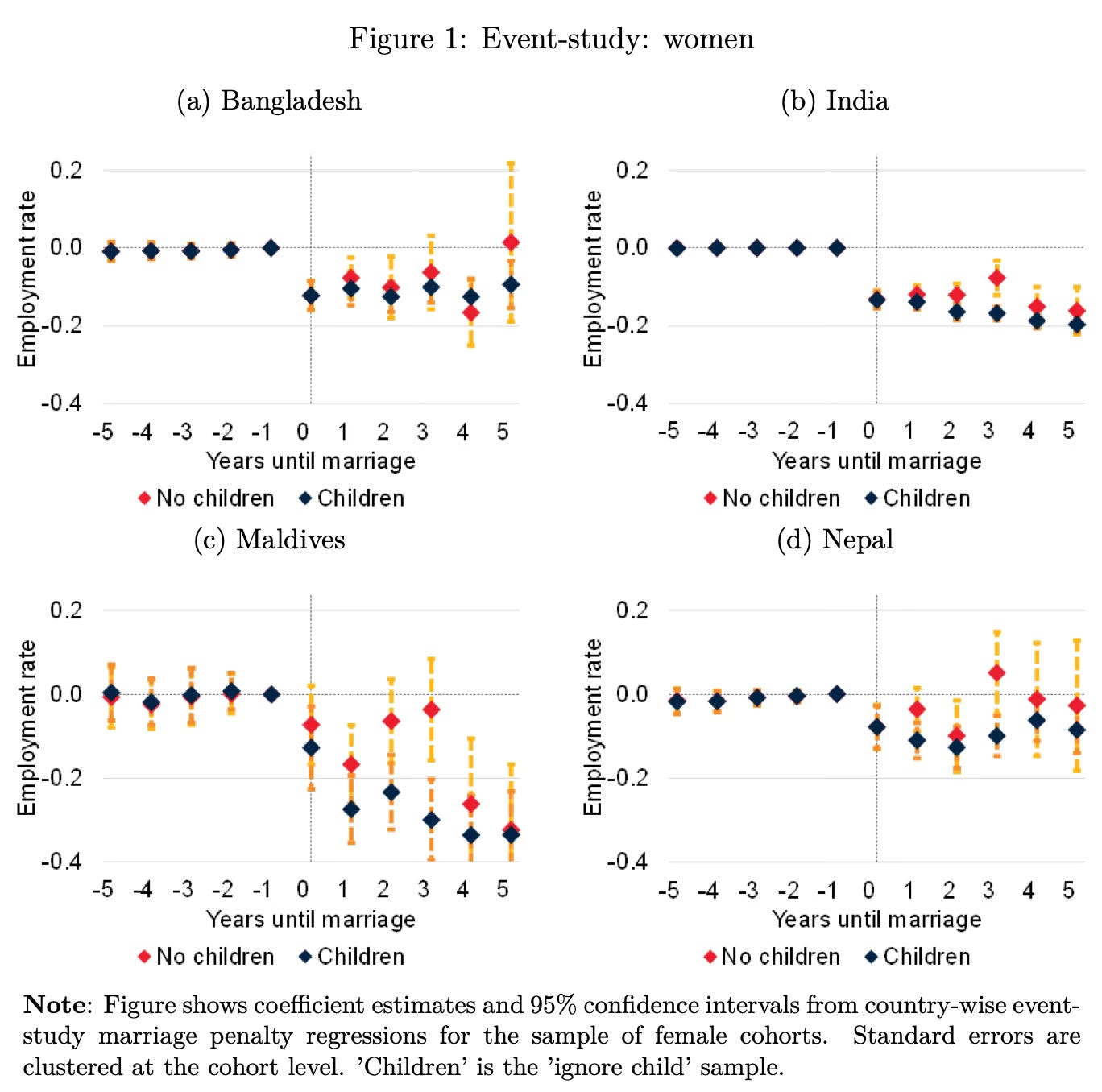
A new World Bank working paper by Maurizio Bussolo, Jonah Rexer, and Margaret Triyana points to a marriage penalty. This penalty forces women to drop out of the labour force post-marriage. They used statistical techniques on data from multiple rounds of the nationally representative Demographic and Health Surveys (DHS) from Bangladesh, India, Maldives, and Nepal and isolated the marriage and child penalties for women. They find that the penalty is highest in India. 

These two events are correlated in time for a given individual. As such, estimates of the marriage penalty are obscured by the presence of children, and estimates of the child penalty are likewise capturing at least in part a marriage penalty… We find that South Asian women reduce their labor force participation by 12 percentage points (p.p.) following marriage, even before childbearing. Among women with children, this rises just 4 p.p to 16 p.p. As such, 75 percent of the combined family formation penalty is driven by marriage itself, rather than the burden of childbearing, at least in the first five years of marriage. 

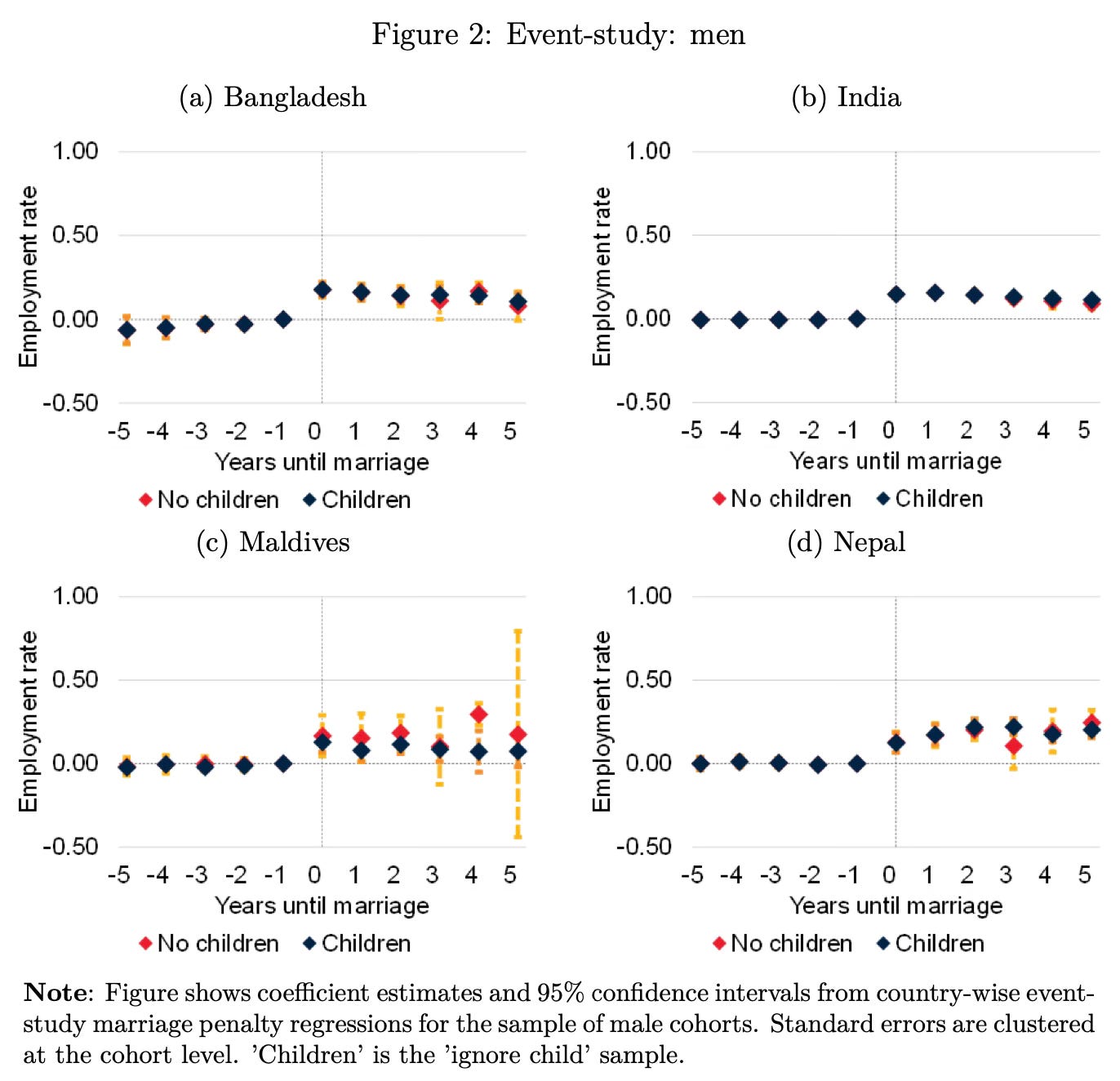
The largest effects are observed in India, while more muted effects are observed in Nepal, where the majority of the combined penalty is driven by children. Dynamic event-study estimates reveal flat trends in employment status leading up to the marriage date, and sharp drops in employment in the first year of marriage. These trends lend additional support to the notion that these estimates represent the causal effect of marriage. Men, in contrast, enjoy a marriage premium. This premium does not depend on the presence of children, consistent with the existing literature showing no child penalties for men… We find that educated women have much smaller marriage penalties, with post-secondary education erasing nearly half the baseline marriage penalty. 

They examine the possible causes

The marriage penalty may represent an optimal solution to a joint household maximization problem. If women have limited outside options in the labor market relative to their husbands, then specialization in home-based tasks might be economically efficient, even without children. However, the value of women’s home production is greatly diminished without children, suggesting a role for social norms in driving the marriage penalty, particularly those that constrain women’s mobility outside the home… Despite the fact that gender norms are more progressive in urban areas in South Asia, we find no significant difference between urban and rural marriage penalties… we argue that a woman’s education affects both household gender norms and her outside employment options. In contrast, her husband’s education affects household norms, but does not directly affect her employment prospects. This suggests that outside options at least in part play a role in determining the marriage penalty… We find strong evidence that women in households with more liberal gender norms experience smaller marriage penalties. The effects of education and social norms appear to be independent, suggesting that both opportunity costs and social norms play a role in driving the marriage penalty.

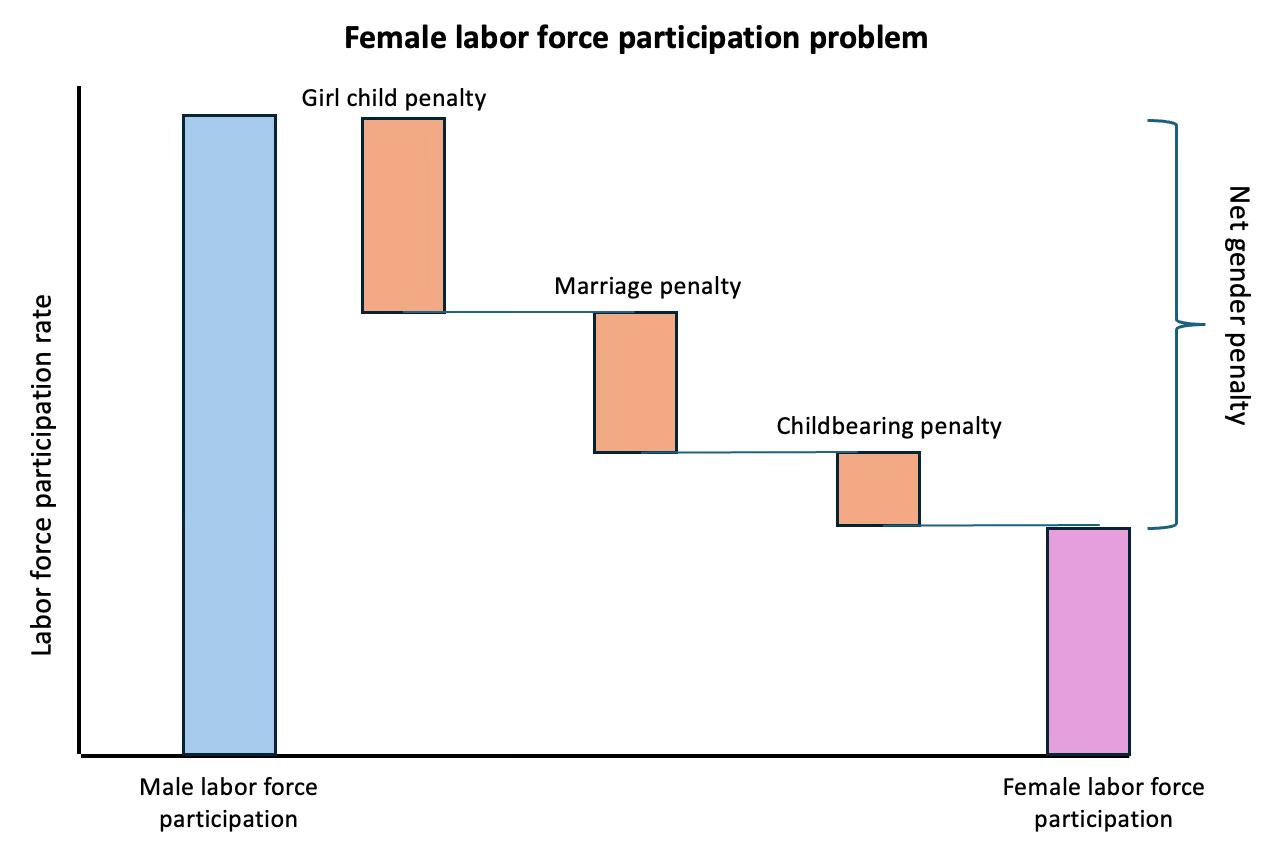
As a framework, the net penalty on female labour force participation can be considered as a cumulative result of three effects, as captured below.

The marriage penalty is clearly higher in India compared to even its South Asian counterparts like Nepal and Bangladesh, pointing to historical and cultural factors. When faced with such entrenched legacies, public policy might be able to only do so much. Measures like establishing creches at workplaces or providing free bus passes might at best be tinkering at the margins. 

Even a significant increase in access to girl children’s school education might not be sufficient to overcome these penalties. This possibly explains the lack of meaningful improvements in the female labour force participation rate in India despite the considerable improvements in girl’s school enrollment and retention rates. 

Meaningful change in the status quo will require changes in cultural (within the family) and social (in society) norms and sharply increasing access to higher education for girls and good jobs. 

Higher education can enable women to get higher-paying and higher-status jobs and, over time, increase their now negligible proportion in senior management levels in public and private sectors. This kind of economic mobility/status, with several examples of aspirational models across small communities, might be required to have a significant impact on cultural and social norms. The factory-floor jobs in manufacturing, while very important, are more likely to take the long route to change in revising cultural and social norms. 

Public policy should pursue ways to increase access to higher education for female students - scholarships, preferential policies in admissions etc. Simultaneously, the private sector needs to become sensitive to increasing the share of women in senior management positions. 

Saturday, July 6, 2024

Weekend reading links

1. Larry Summers is Exhibit A of how the Democratic Party has been captured by the elite interests, both Wall Street and Big Tech. His views about Open AI is representative.

OpenAI board member Larry Summers says the recursive self-improvement aspect of AI will have a "transcendent" impact and any attempt to slow or stop development will play into the hands of America's enemies.

It's the unqualified embrace of AI (and specifically as a spokesperson of a private company with several questionable corporate governance concerns) that's a matter of deep concern. 

2. Good primer that describes India's entry into the JP Morgan Emerging Markets Bond Index (EMBI) from June 28.

India will gain a 10 per cent weight in the GBI-EM Global Diversified Index in phases, with 1 per cent added each month, reaching the limit by March 2025... Launched in June 2005 as the first comprehensive global local emerging markets index, GBI-EM tracks local currency bonds issued by emerging market governments. It took a long time for India’s $1.3 trillion government bond market, the largest among emerging economies after China and Brazil, to enter the global index... the trigger for the inclusion is more to do with Russia’s exclusion from the index... Russia had around an 8 per cent weight in the GBI-EM index. After its exclusion, Indonesia, Mexico, China, Malaysia, and Brazil – five of the 18 countries in the index – each have a 10 per cent weight. India, the 19th nation with access to the index, will be the fifth member of the 10 per cent-club by March 2025. India will eat into the shares of Malaysia and Brazil, apart from Thailand, South Africa, Poland, Czech Republic, Colombia, and others. Serbia, Uruguay, and the Dominican Republic have the least share – less than 1 per cent each... 

In 2020, the RBI removed limits on foreign ownership in certain bonds by introducing the Fully Accessible Route (FAR). Eligible bonds for JP Morgan indices must have a notional outstanding amount of at least $1 billion and two-and-a-half years to mature. So, only those government bonds that are designated FAR and maturing after December 31, 2026, will be eligible to enter the GBI-EM global index suite. There are currently 29 such bonds... Along with the GBI-EM Global Diversified Index, India is also expected to enter other JPMorgan bond indices such as the Asia (ex-Japan) local currency bond index called JADE Global Diversified Index, Jade Broad Diversified Index, and other aggregate suite of local currency indices. In these indices, India’s weight will be close to 15-20 per cent over the 10-month period until March 2025. Overall, JPMorgan government bond indices for emerging markets have $236 billion in assets under management (AUM)... foreign investors have used just 14.17 per cent of their allowed limit in the general category. Their investment in state development loans (SDLs) is 2.41 per cent of the limit. The aggregate holding of foreign investors in the FAR category is also very low – around Rs 1.86 trillion out of an outstanding portfolio of Rs 40.56 trillion...

One can expect $23-24 billion in foreign funds to flow in over the next 10 months – around Rs 17,000 crore a month. Once Bloomberg and FTSE Russell follow JPMorgan, the flow will increase. The inclusion will also facilitate passive flow to the Indian bond market, similar to index fund investment in Nifty, where every stock of a particular index gets investment according to its weight in the index.

3. Indonesia's EV industrial policy on the back of its vast nickel reserves is starting to bear results. FT reports that Hyundai and LG Energy Solutions have opened a $1.1 bn battery cell plant in Indonesia, the country's first, and with an annual production capacity of 10 GW hours. China's BYD and Vietnam's VinFast have already announced that they will begin making EVs in the country, and China's CATL, the world's largest EV battery maker, has already started construction of a battery plant. 

Hyundai and LG will invest a total of Rp160tn ($9.8bn) in Indonesia’s EV ecosystem in stages, he added. Investment minister Bahlil Lahadalia said the South Korean companies would begin constructing the second phase of the battery cell factory, which will have an annual production capacity of 20 gigawatt hours, with an investment of $2bn. The battery cells from the Indonesian plant will be used in Hyundai and Kia’s EV models. Indonesian officials have also said about 90 per cent of the factory’s products will be exported to South Korea and India...

Widodo’s ban on nickel ore exports in 2020 forced foreign companies to invest onshore. The bulk of that investment has come from Chinese companies into the nickel processing sector. But Indonesia has been offering incentives such as tax breaks to woo nickel and EV-related investments from around the world. Hyundai said in 2021 that the Indonesian government had agreed “to offer various incentives and rewards to support the stable operation” of its battery cell plant.

This graphic captures Indonesia's nickel market dominance.

4. The staggering and disturbing rise of futures and options trading in India

Nithin Kamath, founder of stockbroking firm Zerodha, said on X: “We are in the middle of a period of excess in options trading. Volumes in index options have gone up from Rs 4.6 lakh crore (Rs 4.6 trillion) in 2018 to Rs 138 lakh crore (Rs 138 trillion) in 2024, and, more importantly, the share of retail has gone up from 2 per cent to 41 per cent.

5. Climate change is deeply impacting foodgrain yields and thereby leading to food price inflation.

Over the next decade, some of the world’s most globally important crops may be in short supply as rising temperatures and more frequent extreme weather events hamper harvests. Wheat yields, for example, are drastically reduced once spring temperatures exceed 27.8C, yet a recent study found that the major wheat-growing regions of China and the US were experiencing temperatures well in excess of this increasingly frequently. Heatwaves that were expected to occur once every hundred years in 1981 are now expected every six years in the Midwestern US and every 16 years in northeastern China, according to the research by the Friedman School of Nutrition Science and Policy at Tufts University. Rice, soyabeans, corn and potatoes are among other staples that could see yields plummet. For many crops, higher temperatures mean lower yields...
The changes in climate and weather patterns are also altering growing seasons and creating new pressures from pests and diseases. In Ghana and Ivory Coast, which produce two-thirds of the world’s cocoa beans, heavy rainfall last summer created the humid conditions perfect for black pod disease — a fungal infection which rots cocoa pods — to thrive. This, coupled with other diseases and poor weather, knocked yields and led to a global crop more than 10 per cent smaller than the year before... The ECB researchers, for example, found that temperature increases prompted a sharp decline in productivity and rise in inflation once they exceeded a certain threshold. Depending on the crop, a temperature increase of 5C, from 20C to 25C, might have less impact on yields and inflation than one of 2C, from 34C to 36C, for example.

6. The new-found love for stock market investing among Indians shows no signs of letting up.

7. Shein and Temu the low-cost Chinese clothing and home items retailers who have built their e-commerce business models by selling cheap Chinese imports to households in the US and elsewhere and have captured a rapidly expanding market share may be staring at an end-game. 

Temu and Shein are able to charge low prices partly by shipping items in small packages direct to consumers, thereby avoiding customs duties. The EU, US, and UK apply “de minimis” rules which set a monetary threshold below which imported items are able to avoid duties. The allowances are designed to avoid placing onerous costs on small businesses and households for low-value consignments. Customs procedures for such items are often uneconomical. The European Commission is now exploring scrapping its €150 threshold. American politicians have been considering lowering or removing its generous $800 ceiling too... The strategy gives consumers — especially at a time when they are stretched by a cost of living crisis — access to cheaper products and wider choice... Indeed, while the Chinese retailers compete well on price, deliveries take longer, and the products are not always the most durable... A European toy industry body recently found that 18 out of 19 toys it test-bought from Temu posed a real safety risk for children. “De minimis” rules should not be a back door for unethically sourced items to enter western markets. Shein has faced allegations of forced labour in its supply chain, which the company denies.

And this about sustainability

Shipping $10 dresses from China to the US for free adds up. One estimate puts Temu’s cost of shipping and handling per package at around $11. Between that and the billions spent on marketing, Bernstein thinks Temu made an operating loss of $4.6bn last year. This does not look sustainable.

Instead of letting the two companies burn themselves out, Amazon has announced plans to compete with them by launching its own direct from China retail service.  

8. The UK elections once again highlighted a wildly problematic issue with first-past-the-post voting systems.

Four and a half years ago, Jeremy Corbyn’s Labour party received just over 10mn votes in the UK’s 2019 general election — a third of all that were cast. This performance resulted in Labour winning 202 seats in the House of Commons, its lowest tally since the 1930s. Wind forward to yesterday and Sir Keir Starmer’s Labour party received half a million fewer votes than in 2019, again a third of the popular vote. This performance has been rewarded under our first-past-the-post electoral system with a huge majority and 412 seats so far, the second-highest tally in the party’s history.
As John Burn-Murdoch writes, Labour's sweep should not be mistaken as a conclusive verdict for Labour.
A huge 48 per cent of those who intended to vote for Starmer’s party said the main reason was to get rid of the Tories, with far fewer giving a positive motivation relating to Labour and its policies. Seat counts have dominated the narrative of this election more than any before it, facilitating comparisons to Tony Blair’s 1997 landslide. Look deeper, though, and the similarities with 1997 fade. Starmer has much less public goodwill than the incoming Blair, and is inheriting a country in a far worse state.
This is an apt conclusion.
Labour’s towering majority is capturing attention for now, but it is built on weak foundations. As James Kanagasooriam, chief research officer at polling firm Focaldata puts it, the coalition of voters that has put Starmer in 10 Downing Street is better understood not as a skyscraper but a sandcastle. As the tide comes in over the next few years, it could well be washed away, just as the Conservative party’s has been this week.
“Over the past 20 or 30 years, [geopolitics] has been deflationary, created lower risk and made it easier to invest,” says Ali Dibadj, chief executive of Janus Henderson, the British-American investment group that manages about $280bn in assets. “Going forward it is the complete opposite: it is probably inflationary; it is probably going to create more risk; and it is going to make it harder to invest.” An industry that over the past two decades has been hoovering up mathematicians to devise new trading strategies is now leaning on political scientists for guidance... Last year BlackRock, the world’s largest asset manager, added “geopolitical fragmentation” to its list of the most important trends impacting on global growth and markets, putting it on a par with new technology, global demographic shifts and climate change. When Optiver, the market making firm, kicked off 2024 with a list of “top tail risks” for financial markets, more than half were focused on politics, from a contested US presidential election result to escalation in the war between Russia and Ukraine... Theodore Bunzel, head of geopolitical advisory at Lazard, says the firm set up a dedicated political unit in 2022 as clients were increasingly demanding advice on how to navigate investments in regions such as China... Goldman Sachs followed suit last year with a geopolitical advisory unit.

As to why investors seem to shrug off geopolitical risks and keep pouring money, blame it on the industry's incentive structure.

If the entire market tanks in response to a sudden event, an individual portfolio manager probably would not suffer reputational damage for missing a risk that few people noticed. But if their caution causes the fund to miss out on a marketwide rally, they will be blamed. 

10. Interesting factoid about the rise of manufacturing and women's labour force participation rate

In many Asian economies over the last half-century, the rise of manufacturing has been a powerful force of upward mobility. Incomes rose, poverty lessened and working opportunities opened. Women were at the center of this transformation. In Vietnam, where a factory boom has been especially momentous, more than 68 percent of women and girls over 15 are working for some form of pay, according to data compiled by the World Bank. In China, the rate is 63 percent; in Thailand, 59 percent; and in Indonesia, 53 percent. Yet in India, less than 33 percent of women are engaged in paid work in jobs counted in official surveys.

Saturday, August 26, 2023

Weekend reading links

1. Fascinating article by Sandeep Goyal on the retromania in sneakers, where Addidas is raking in the moolah with its Samba and Gazelle retros. This is interesting about Nike Air Jordans
The Nike Jordans were so popular for so long because they were hard to get. You couldn’t walk into a store and pick one up at the retail price, so your only option was to go to a reseller who would sell the shoes at a premium. Nike figured this out early, and for a long time, they would only produce a limited number of the new Jordan shoes to make sure demand outpaced supply. In the last couple of years, Nike got too greedy and produced too many shoes at too high a price point. It was a kiss of death for Nike’s Jordan.

2. On a possible reason for the mystery of India's low female labour force participation rate

“Once you run out of men, you have to employ some women,” said Alice Evans, a senior lecturer at King’s College London. “But those labor shortages never materialized in India.” Economists say a boom in jobs could help overcome the social stigma that remains a barrier to more women working. Japan and South Korea both had female labor participation rates below 50% before their economies began to take off in the 1970s and ’80s. China’s rise, too, was bolstered by women who joined its labor force. As millions of women flocked to factories in the cities, its female participation rate soared to over 70% by the early 1980s, according to data from the United Nations’ International Labor Organization... Bangladesh had a female labor-force participation rate of 38% last year, up from 28% in 2000.

3. Ireland should be called a rogue economy whose tax policies impose serious negative externalities. This graphic, which highlights how Ireland steals other countries (mostly US) tax returns is stunning.

While a double-digit percentage move in industrial production is rare for most countries, Ireland has recorded 14 of them in the past 24 months.
4. NYT and FT have articles on mispricing of climate risks. The former has an article which describes the consequences of an increase in the pricing of climate risks by reinsurers
Reinsurers’ increased prices have accelerated changes in an industry grappling with a new sense of uncertainty. The world is warming; storms are getting more intense; inflation has increased the cost of rebuilding after a disaster; and a global increase in interest rates is making money itself more expensive. Since the beginning of the year, insurance companies have paid out $40 billion to U.S. customers, putting them on track for another record in yearly losses. At every level, the costs of guarding against risk are rising and everyone... Prices for reinsurance rose as much as 40 percent on Jan. 1 from a year earlier... 

The price increases jolted insurers, who then made changes to where and for what they offered coverage... State Farm announced in May that it would stop accepting new applications for certain policies in California... Allstate... paused some of its activities in California. Last month, reinsurers specializing in agriculture insurance announced that they were pulling out of Iowa, where, three years ago, a severe windstorm caused nearly $4 billion in damage. As a result of rising reinsurance costs, insurers also raised prices where regulations allowed. The cost of insuring big new developments of stick-frame housing... skyrocketed... Severe thunderstorms in the United States have caused nearly 70 percent of the losses that insurance companies around the world have incurred this year from natural disasters.

The FT article talks about a possible 'Minsky Moment' for asset values as they get repriced downwards as climate risks become increasingly apparent. It points to a recent study that explored how a portfolio of 60% of global equities and 40% of bonds would fare over the next 40 years under different climate policies compared to the baseline returns (without assuming these climate risks).   

Morgan Stanley estimated in a report last year that at least 44 per cent of wheat, 43 per cent of rice, 32 per cent of maize and 17 per cent of soyabean production comes from at-risk areas. Climate change-induced disasters could put at least $314bn of annual production in jeopardy... Unilever estimates that extreme weather events could increase palm oil prices by 12-18 per cent by 2050, depending on the extent to which rising temperatures can be limited, and other food and commodities ingredients by 14-21 per cent...

Recently published research suggested that US residential properties exposed to flood risk are overvalued by between $121bn and $237bn... insurance premiums for wildfire protection were just $1.5bn in 2021; damages were six times bigger. A move by insurers to close that gap could result in a drop of up to $495bn in property values... One cubic metre of desalinated water can cost between 40 cents and $1 compared with 10-25 cents for the same measure of normal tap water... For southern Europe, intolerable summer temperatures will force writedowns of hotels and resorts in countries including Spain, Italy, Cyprus, Portugal, France and Greece.

A very high proportion of manufacturers of various kinds are exposed to climate change.

5. Services "shrinkflation" in Japan as the country grapples with labour shortages. 

6. Some facts about the global Lithium ion battery market. About a third of the cost of an EV is in the battery,
Invented in the 1970s by US-based scientists and commercialised in 1991 by Japan’s Sony to power its Handycam video cameras, lithium-ion cells pack far more punch in smaller and lighter units than the lead acid or nickel cadmium units that previously dominated the rechargeable battery market. Having helped give birth to the portable electronics industry, lithium-ion batteries have fought off competing technologies to become the dominant force in electric cars after a 90 per cent drop in cost over the past decade. Total global deployment of the technology could top 1 terawatt-hours this year, equivalent to 17mn average-sized electric cars, according to London-based battery consultancy Rho Motion... Global lithium ion battery revenues will grow to $700bn a year by 2035, according to consultancy Benchmark Mineral Intelligence, by which time $730bn will have to be poured into battery plants, mines and processing facilities to meet the need not just for lithium but for other ingredients including nickel and cobalt.

7. The end of Yevgeni Prigozhin and the putsch within the Russian military leadership has been swift and chilling. 

8. Profile of Jackson Lake Lodge, 30 miles from Jackson town in Wyoming, built by John D Rockefeller Jr on the land he donated to the Grand Teton National Park, which has since 1982 been the site of the Kansas City Fed's annual conference. The Conference is today popularly known as the Jackson Hole meeting of central bank leaders and economists.  

The town was once so remote that it was a go-to hideaway for outlaws. In 1920, when Jackson’s population was about 300, The New York Times harked back to a not-so-distant era when “whenever a serious crime was committed between the Mississippi River and the Pacific Coast, it was pretty safe to guess that the man responsible for it was either headed for Jackson’s Hole or already had reached it”... High on its list of charms, the Jackson Lake Lodge was close to excellent fly fishing — a surefire way to appeal to the Fed chair at the time, Paul A. Volcker. He came, and between the A-list attendees and the location’s natural beauty, Jackson Hole quickly became the Fed event of the year... 

Teton County, home to Jackson (now a bustling town of 11,000) and Jackson Hole, hosts more millionaires than criminal cowboys these days. It has become the most unequal place in America by several measures, with gaping wealth and income divides. The event, billed as rustic, now struggles to pretend that its backdrop isn’t posh. And the Fed gathering itself has gained more and more cachet. Alan Greenspan delivered the opening speech at the conference in Jackson Hole in 1991, when he was Fed chair, and then kept up that tradition for 14 summers until he stepped down. His successors have mostly followed suit.

9. Interesting snippet about ISRO

What draws broad support for ISRO’s missions — with Wednesday’s landing welcomed with prayers, music and special screenings in schools across the country — is a culture of humility, teamwork and efficiency... India has a number of large and famed state-funded technology institutes, whose graduates dominate Silicon Valley. But many of the leaders of the lunar mission are graduates of smaller, more modest engineering schools. The leaders, in their humble tucked-in shirts and plain saris, and the hundreds of scientists clapping for them at the moment of touchdown made for an image that middle-class India could easily relate to... After the successful landing, Indian television channels broadcast emotional images from inside the simple home of P. Veeramuthuvel, the project director. His father, P. Palanivel, a former railway employee, sat in front of his television set wiping tears of joy before visitors came with sweets.

10. Subway, the family owned sandwich chain with more than 37,000 stores, has agreed to sell itself to the US PE group Roark Capital for more than $9 billion in upfront payment and $600 million over the next three years. The sale marks the end of more than 50 years of family ownership of the company, a pioneer in the use of franchised stores to grow quickly with minimal capital costs. 

Over the past decade, Roark has spent more than $10bn to buy restaurant chains including Arby’s, Buffalo Wild Wings and the parent company of Dunkin’ Donuts, among others. The privately held investment group, which is controlled by Neal Aronson, has $37bn in assets under management. It is named after Howard Roark, the protagonist of Ayn Rand’s libertarian novel The Fountainhead, and is known for turnaround efforts that focus on the use of franchises for expansion. The private equity group also owns Driven Brands, a conglomeration of recognisable auto service brands such as Maaco, Meineke and 1-800 Radiator. In addition, it has invested in gyms, fitness centres and petcare clinics that rely on franchises. Roark emerged the winner from a process that included several other private equity bids after Subway hired JPMorgan earlier this year to manage a sale process... Roark will consider options such as securitising some of Subway’s stores after the takeover closes.

Watch this space on the fortunes of Subway going forward.

11. FT long read on three initiatives of Xi Jinping government to build an alternative world order. They are the Global Development,

The key to China’s blueprint is to steadily institutionalise its leadership over the developing world by creating, expanding and funding a raft of China-led groupings of countries, according to Chinese officials and commentators. They add that the aims of this strategy are largely two-fold: to ensure that a broad swath of the world remains open to Chinese trade and investment and to use the voting power of developing countries at the UN and in other forums to project Chinese power and values... Global Development Initiative, which is now gaining recognition as a foundation stone in China’s blueprint for an alternative world order to challenge that of the US-led west... is a Chinese-led multilateral programme to promote development, alleviate poverty and improve health in the developing world... along with two follow-up initiatives also announced by Xi — the Global Security Initiative and the Global Civilisation Initiative — it represents China’s boldest move yet to enlist the support of the “global south” to amplify Beijing’s voice on the world stage and build up China’s profile in the UN, Chinese officials and commentators say... 

A study by AidData, a US-based research lab, shows that the 20 countries... have displayed impressive loyalty to China in the form of votes at the UN. Between 2013 and 2020, each of them have voted with China on at least 75 per cent of occasions in the UN General Assembly, the main policymaking body which issues recommendations on global crises, manages internal UN appointments and oversees the UN’s budget... In the case of Cambodia, Pakistan, Tajikistan, Uzbekistan and Zimbabwe — all of which owe hefty debts to China — their voting alignment with China in the UN General Assembly registered at 80 per cent or above... The correlation between increased lending and greater voting fealty was consistent across the sample. “When countries vote with China in the UN General Assembly, they are richly rewarded,” says Bradley Parks, executive director of AidData. “Beijing is dusting off an old playbook and using its largesse to purchase foreign policy favours. “On average, a 10 per cent increase in voting alignment with China in the UN General Assembly yields a 276 per cent increase in aid and credit from Beijing,” he adds, quoting research on voting patterns from a new book by Axel Dreher and colleagues called Banking on Beijing.

12. Fascinating graphics from John Burn-Murdoch on transportation infrastructure construction costs across countries

If phase 1 of HS2, the high-speed rail project connecting Britain’s capital to its second-largest city, is ever finished, it will be the world’s most expensive such scheme, coming in at a cool £396mn for each mile of track... When neighbouring France opened a new 188-mile stretch of its high-speed network in 2017, it cost £46mn per mile in today’s money, just over a tenth as much, and took 12 years to deliver from the start of planning to the first passenger-carrying train, half the anticipated 23 years for the initial phase of HS2... Averaged over a dozen recent major rail projects, and adjusted for inflation, British schemes cost £262mn per mile, compared with £145mn per mile for Japan’s bullet train network, £92mn in Sweden, £74mn in Italy, £42mn in France, and £34mn in Germany. And it’s a similar picture for roads, where new motorway bridges in the UK cost more than three times as much per lane mile than in France, Denmark or Norway, and additional lanes on existing British roads are twice as expensive as in Germany. In both cases, only the US faces even higher costs.
On the coverage of mass transit services across large cities
And on public transport usage
Sam Dumitriu and Ben Hopkinson have a blog post explaining in detail why it costs much more to build infrastructure in the UK. 

Saturday, July 9, 2022

Weekend reading links

1. Residential real estate prices in major Indian cities have gone nowhere since 2014. Except Hyderabad.

Some interesting facts about housing prices

According to real estate consultancy Knight Frank India, for every 100 basis points increase in interest rates, the EMI (equated monthly installment) on home loans goes up by 7.76%, while the affordability index (EMI/household income) reduces by 2.23%. Not to mention, construction costs have also shot up with the high inflation... the annualised rise in weighted average prices of builder projects in the Mumbai region was about 17% in the 2009 to 2014 period. Between 2014 and 2022, however, it is a negative 1%.

This stagnation has had a positive effect on housing affordability, defined in terms of ratio of EMI to household income, across Indian cities

The rising interest rates threaten to reverse the affordability trend.

2. Debashis Basu points to serious corporate governance issues in India's newly listed startup companies,

A few days ago, online food delivery platform Zomato acquired quick-commerce grocery delivery platform Blinkit (earlier Grofers) for Rs 4,447 crore (about $568 million) in an all-stock deal. The deal has raised a lot of eyebrows. For one, Zomato has just about Rs 1,250 crore on its balance sheet and is badly haemorrhaging, losing Rs 750 crore of cash from its operations in 2021-22 alone. Second, the acquisition comes at a time when Zomato’s own future is cloudy. Last year, it reported a loss of almost Rs 1,100 crore and under the current business model, there is no chance that it will make a profit soon. If so, its own existence is in doubt unless it can find new cash to carry on. Third, there are various conflicts of interest in the Blinkit deal. The chief executive officer (CEO) of Blinkit, Albinder Dhindsa, was the head of international operations in Zomato and is the spouse of Zomato’s cofounder (and former chief financial officer) Akriti Chopra. Zomato owned more than a 9 per cent equity in Blinkit. Zomato and CEO Deepinder Goyal was himself a 10 per cent shareholder of Blinkit until last year before selling it to Tiger Global. Finally, the valuation seems to be based on just two months of unaudited results when even a small-time valuer insists on audited results to even start valuation work.

3. India's impressive export growth rate may be deceptive,

India’s merchandise exports increased strongly to an all-time high of $421 billion in 2021-22... an annual growth of 44.7%, the highest ever since independence... Based on 25 major commodity groups that account for more than 90% of total exports, our calculations suggest that... while nominal exports grew by 25.5% year-on-year in April and May, following a surge of 44.7% in 2021-22, real exports rose by only 2.9% during the two month period, following a growth of 21.4% in 2021-22. Further, although nominal exports have posted a growth of 8.5% in fiscal years 2020-22 (during the covid period), compared with 8% in the pre-covid period (fiscal years 2017-19), real exports have grown slower at 1.2% compared with 3% in the corresponding period... 

It suggests that global inflation has played a very important role in pushing India’s nominal exports higher. This conclusion is also confirmed by the fact that while India’s exports have risen very strongly, its share in global exports moved up only slightly from 1.71% in 2019 to 1.77% in 2021. It means that higher prices have led to higher export numbers almost everywhere in the world... Our analysis suggests neither real exports nor real imports have grown at an exceptional rate in recent months or during the past three years, as inflation has played a major role in driving Indian trade figures to record highs.

4. Rana Faroohar points to the declining labour force participation of women in the US,

Indeed, female labour force participation in the US was 1.4 percentage points lower at the end of 2021 than it was before 2000. This puts America very much at odds with the rest of the rich world. During that same period, women’s labour force participation increased 5.3 percentage points in France, 5.4 points in Canada, 6.7 points in the UK, and a whopping 14.3 points in Japan... What’s going on? To sum it up in a word, childcare — or more particularly, a lack of decent, affordable childcare. Commerce department statistics show that mothers with children under the age of five at home generally have lower participation in work outside the home, but that’s particularly true for women with less education and lower pay.

5. MLA salaries across Indian states

And how it compares with percapita income of the state

6. Interesting graphic from this FT Long Read on the largest private polluters in history.
7. India trucking industry facts of the day
According to a NITI Aayog report of 2021, commercial activities in India generate about 4.6 billion tonnes of freight annually, which results in over 3 trillion tonne-km of road transportation demand at a cost of ₹9.5 trillion. The logistics sector employs more than 20 million people. According to trucking industry estimates, there are nearly 15 million operational commercial vehicles across India... Eight out of 10 trucks that run in the country are owned by small fleet owners, who own just five trucks or less. A fragmented market implies that small fleet owners are unable to optimise driving patterns nor bring in required efficiencies. India is a long-distance trucking market, with 95% trucks moving intercity. But truck productivity is low: a truck travels 300 km a day on an average in India compared to the global average of 500-800 km a day. Much of that—40%—is dead miles. This is a measure of empty trucks out on the road, either because they have no shipment or are travelling empty to pick up freight, or are returning after delivering a consignment but have not found a return load.

In this fragmented market, aggregators like Blackbuck, Truckbhejo, and Raaho have an important role in matching customers wanting to transport goods by road with fleet owners who have ready capacity. 

8. The Economist highlights vertical integration within Tesla through its "digger-to-dealership" control,

Tesla’s industrial system is at first glance an embrace of Silicon Valley’s “full stack”—internalising all aspects of production, and therefore all the profits... In an echo of Fordism, Tesla has struck recent deals with lithium miners and graphite suppliers, and last month confirmed a deal with Vale, a Brazilian mining giant, to purchase nickel... It plans to make more cells on its own at its three other gigafactories around the world... Tesla has also pulled other bits of the powertrain in-house. It makes its own motors and a lot of its own electronics, giving it more control over costs as well as over the technology... Tesla designs its own semiconductors and has closer links than other carmakers with those who manufacture them. That has helped it weather the global chip shortage better than rivals. Tesla’s software engineers have created a centralised computing architecture to run on those chips, ensuring smooth integration with the four-wheeled hardware. Mr Musk has even ditched the dealership-based sales model, instead opening his own swanky Tesla stores... This reverses decades of outsourcing to big suppliers such as Bosch, Continental and Denso in order to concentrate on managing supply chains, integrating separate parts, design and marketing... Mercedes-Benz estimates its value-added split at 70-30 in favour of suppliers. Established car firms now want their ratios to more closely resemble Tesla’s, which Philippe Houchois of Jefferies, an investment bank, puts at 50-50 and rising in favour of in-house.  

9. The student learning loss due to school closures during the pandemic may well turn out to be its longest lasting legacy. It's impact is already very bad.

South Asia was the worst impacted by closures