Substack

Showing posts with label Informality. Show all posts

Saturday, July 13, 2024

Wekend reading links

1. Niall Fergusson points to some interesting divergence between the elites and the working class.

To see the extent of the gulf that now separates the American nomenklaturafrom the workers and peasants, consider the findings of a Rasmussen poll from last September, which sought to distinguish the attitudes of the Ivy Leaguers from ordinary Americans. The poll defined the former as “those having a postgraduate degree, a household income of more than $150,000 annually, living in a zip code with more than 10,000 people per square mile,” and having attended “Ivy League schools or other elite private schools, including Northwestern, Duke, Stanford, and the University of Chicago.” 

Asked if they would favor “rationing of gas, meat, and electricity” to fight climate change, 89 percent of Ivy Leaguers said yes, as against 28 percent of regular people. Asked if they would personally pay $500 more in taxes and higher costs to fight climate change, 75 percent of the Ivy Leaguers said yes, versus 25 percent of everyone else. “Teachers should decide what students are taught, as opposed to parents” was a statement with which 71 percent of the Ivy Leaguers agreed, nearly double the share of average citizens. “Does the U.S. provide too much individual freedom?” More than half of Ivy Leaguers said yes; just 15 percent of ordinary mortals did. The elite were roughly twice as fond as everyone else of members of Congress, journalists, union leaders, and lawyers. Perhaps unsurprisingly, 88 percent of the Ivy Leaguers said their personal finances were improving, as opposed to one in five of the general population.

2. Interest payments take up a staggering 57% of central government revenues in Pakistan.

India's 28% is a matter of concern. Compare with Indonesia's 15%. 

India's high public debt will appear fine as long as the economy grows by 7-8%. Once it slows down to 4-5%, the debt-to-GDP ratio will balloon, as also the interest payments as a share of revenue. Then we are set for the perfect storm.

3. The formal-informal sector wage gap in India is significant, in excess of 70%.

4. China has been the standout beneficiary from globalisation over the 1990-2018 period.
India's GDP per capital gain from globalisation has been less than one-third of that of China over the same period.

5. It's surprising how much of Blackstone's assets centre around real estate. The latest is data centres
After its $10 billion takeover of data center operator QTS in 2021, the world’s largest private equity firm is fueling rapid growth at one of the top landlords for tech giants. It’s bankrolling the development of massive structures that will handle crucial computing needs, while also reshaping communities across America. It’s part of the classic Blackstone playbook for real estate, the largest piece of its $1 trillion empire. The firm identifies where there’s a rising need for properties but too few to meet demand. It then directs billions of investor dollars to build giant landlords poised to capture big rents and market share, a move it has deployed in everything from warehouses to suburban homes...
Blackstone now says QTS could be one of the best investments in its history. The company has parlayed its land reserves to profit on a short supply of space and power in key markets. QTS has $15 billion of properties in development, up from $1 billion at the time of its acquisition. It’s become North America’s largest provider of leased data center capacity based on megawatts under contract, after ranking No. 4 just three years ago, according to research firm datacenterHawk... Blackstone President Jon Gray, the firm’s former real estate chief and now heir apparent as CEO, has corralled the company into the thematic bets where demand is running up against constraints. He now sees AI making a data center shortage all the more acute — and said those with land and capital will be at an advantage.

6. Long read on how the RN moved from the far-right fringes to the mainstream right in France. 

Long a fringe opposition party with little local presence, the RN has gradually stitched together a national network — initially helped by a dozen or so mayorships in small cities and towns like Hénin-Beaumont, Perpignan, and Fréjus... The effort was turbocharged in 2022 by an unprecedented election of 89 deputies to the National Assembly. With the MPs came money from the state funding system for political parties, a change for the usually cash-strapped RN, allowing them to hire more staffers. Le Pen then told her troops to fan out every weekend in their districts to attend local events to be what she called the “advocates of citizens” who often feel neglected amid the perceived retreat of public services, such as post offices or hospitals... Le Pen’s own election as the local constituency MP in 2017, her third attempt to enter the assembly. The following year, having lost the presidential election to Macron, she rebranded the Front National party to the Rassemblement National, aiming to make voters forget the racist and antisemitic excesses of her father and his contemporaries...
Such local presence has furthered Le Pen’s decade-long mission to “detoxify” the far-right movement co-founded in 1972 by her father, Jean-Marie Le Pen, and Pierre Bousquet, a journalist and former soldier in the French unit of the Waffen-SS during the second world war. Kévin Pfeffer, RN party treasurer, says... “Officials like the prefect, deputy prefect, police chief, and head of the unemployment office — they wanted to meet us,” ... whereas before the RN was largely shunned by local bigwigs. Slowly RN support evolved to cover a wider swath of the electorate allowing them to rack up more votes: women, white-collar workers and older people. The RN vote has evolved from one previously made out of protest or anger to one of confidence in the party’s agenda and its leaders Le Pen and her 28-year-old lieutenant Jordan Bardella... Studies have shown that people back the RN for multiple reasons, some ideological and rational, and others that are more subjective, such as a sense that the French “way of life” is in danger or that they do not “feel at home” in France anymore.  

7.  Graphic that shows how solar generation has continuously kept exceeding expectations.

8. Important point about the problem of slow deposit growth rate in banks.
Banks, influenced by societal hype about the primacy of digital outreach, halted the expansion of brick-and-mortar branches. Many bank chief executives, who had their bonuses linked to margin growth and market cap increases, also went slow on branch expansion to lower costs and boost bottomlines. There is now a belated realization that physical branches play a critical role in customer acquisition and deposit growth. Many leading banks are now making amends by setting aside capital expenditure to aggressively expand their physical footprint, to go hand-in-hand with increased investments in direct marketing and digital outreach... Within the banking system, the nature of the deposit mix is changing and moving towards high-cost deposits. Banks have traditionally relied on cheaper current-account-savings-account (CASA) deposits as a source of perennial low-cost funds. However, RBI data shows that CASA’s share has been shrinking in the overall mix, which has been compensated by some growth in costlier term deposits. The resulting pressure on margins may have also impelled bank management to revive CASA’s share by focusing on branch networks.

9. China does not have a KGB or Stasi but still maintains the most effective surveillance state in history.

A more significant secret-police agency lurks within the Ministry of Public Security, China’s regular police service, Mr Pei writes. This force-within-a-force is known as the political-security protection unit (zhengbao for short). The total number of Chinese police officers is not made public, but is thought to be over 2m. Drawing on provincial, municipal and county yearbooks and publications, Mr Pei estimates that 3-5% of all police work for the zhengbao at the national and local level. That equates to 60,000-100,000 zhengbao officers, or one for every 14,000-23,000 citizens. They are complemented by the wenbao, a police unit that watches cultural and educational establishments, especially universities. Another elite outfit is the Political and Legal Affairs Commission, a party body. It runs surveillance operations and “stability-maintenance offices" tasked with smothering strikes and protests before they start. A powerful agency, it oversees security policy generally, and vets police and legal officials for political reliability... 

its surveillance state rests on other pillars that offer part-time but invaluable help. The first is rank-and-file officers in neighbourhood police stations. In Chinese propaganda, there is nothing sinister about such police. They are hometown heroes who battle crime and keep the public safe. But tracking political dissent or public discontent is their job, too... Police stations also watch millions more “key individuals", a group that includes rights activists, religious believers and people petitioning the government for legal redress. All of that involves a second pillar of the surveillance state: informants.

10. An Indian Express editorial makes the case for maintaining buffer stocks on important food grains.

Last year, in February-March, dairies were paying farmers Rs 37-38 per litre for cow milk. The same dairies have today slashed procurement prices to Rs 26-27 because of SMP realisations crashing to Rs 200-210 per kg, from their February-March 2023 peaks of Rs 315-320. These low prices, discouraging dairies from procuring and farmers from feeding their animals properly, could be a precursor to milk shortages and inflation next year.

But the editorial could not have been more wrong in its conclusion.

A buffer stocking policy in food items will also do away with the need for regressive anti-farmer measures such as banning exports or imposing stock limits on private traders and processors.

India sits on a rapidly growing pile of excess rice buffer stock that it's now desperately seeking to liquidate. This did not prevent the government from banning exports!

11. Interesting snippet about the thicket of regulations in India to get permission to sell fertiliser.

Registering a new fertiliser product takes an average of 804 days in India, according to the World Bank’s ‘Enabling the Business of Agriculture 2019’ report. This is against 570 days in Russia, 528 in Brazil, 356 in Pakistan, 270 in China, 225 in Canada, 210 in Argentina, 100 in Thailand, 90 in the US, 30 in Japan, and zero in the European Union countries. The sheer time taken — from the filing of application and field-testing at multiple locations for one or more cropping seasons, to the final notification under the Fertiliser Control Order as suitable for use by farmers and state-level approvals — hinders the introduction of new nutrient products into the country.

The article also suggests the liberalisation option

“The government should grant automatic registration for any new product meeting two requirements — a minimum content of total plant nutrients, and a maximum limit of heavy metals and other contaminants. This, along with mandatory label claims [open for testing by enforcement agencies], is what most advanced countries follow. They do not have agronomic or bio-efficacy trial requirements,” Sanjiv Kanwar, managing director, Yara Fertilisers India Pvt. Ltd, said. This procedure of automatic registration, subject to the product confirming to basic quality parameters and truthful labeling, is already being implemented in water-soluble fertilisers (WSF)... The specifications required WSFs to have a minimum 30% content of total nutrients — 25% primary (NPK), and the balance secondary (S, calcium, magnesium) and micro (zinc, boron, manganese, iron, copper, molybdenum) — and maximum prescribed limits for contaminants (lead, cadmium, arsenic, total chloride and sodium). Companies can market any WSF meeting these specifications (with legible labeling on bags/containers) after 30 days of intimating the relevant government authorities about “the details of the product and their intention to sell”.

12.  Judicial activism in the US triggered by their ideological preference for deregulation.

In the US... late last month, six conservatives on the Supreme Court handed corporate America a scythe. The high court majority shredded a 40-year-old precedent known as the “Chevron deference” that required judges to defer to government experts when laws were ambiguous. They also ruled in a separate case that even long-settled rules can be challenged by new industry players. But CEOs should be careful what they wish for. Those decisions, known as Loper Bright and Corner Post, are already reverberating across the country. The justices sent nine cases about wetlands, renewable energy and a range of other regulations back to lower courts to be reconsidered. A federal judge in Texas said last week that plaintiffs seeking to invalidate a Biden administration ban on non-compete agreements were likely to win now that judges rather than agencies have the final word on regulations. Then on Tuesday, a federal appeals court asked how the Loper decision should affect the future of a different Biden rule that allows pension plans to use environmental, social and governance factors when choosing among investments with similar financial profiles. Environmentalists, and investor and consumer groups are despairing, while lawyers predict that US regulators will have to become more cautious about imposing new rules on everything from money managers to social media platforms and pharmaceutical groups. That is just the start. Hospitals, utilities and even gun rights advocates are already lining up to use the decisions as a club to beat back new rules and challenge existing ones. Some corporate law firms are putting together kill lists of regulations they want to attack.

Monday, February 19, 2024

Some thoughts on India's economic challenges

Every country, at least the larger ones, faces its unique development challenges. India is striving to reach the upper middle-income status in the coming decade. But it has to realise this while also encumbered with a low capital base - human, physical, and financial - and poor quality of human resources. All this has created an economy with a very narrow productive base and not broad-based enough economic growth. 

This context appears to have created the conditions for an economy that will continue to grow at a fair pace but on two tracks - a small highly productive world-class economy that powers ahead at a rapid rate, creating its own relatively big consumption class; the vast majority of the economy, with a predominant informal sector, grows at a much slower pace and whose transition to the former will follow the trickle-down trajectory. The China or North-East Asia-type growth will require the latter to transition much faster to the former than what’s happening now. 

Against this backdrop, what are the possible drivers of high and rapid economic growth? 

I can point to some important factors that could drive rapid growth in India. One, its macroeconomic fundamentals are strong, much stronger compared to its peers. Two, when compared to all its peers and many higher-income countries, it has a very good track record of balanced macroeconomic management and fiscal prudence, and this looks most likely to continue. Three, it has largely pursued prudent growth-enabling policies, and those like Production-linked Incentives (PLIs), for all its critiques, may just have done enough to shift manufacturing to a productive and scale growth trajectory. 

Four, its banks have recovered from their stresses and are well-capitalised and the corporate sector by and large is in very good health. Five, it has pockets of business dynamism which are large enough to contribute significantly to aggregate growth - a group of high productivity and high growth companies, a high-skills services sector exemplified by the Global Capability Centres, a large and growing IT sector, a vibrant start-up ecosystem, an emerging landscape of large contract manufacturing etc. Six, it has a small group of national champions with access to finances, risk appetite, and capabilities to rapidly scale up its infrastructure. Seven, it’s well placed to benefit from the geo-political tailwinds arising from US-China tensions and the trend of diversification away from China. Finally, it’s well positioned to reap the significant collateral benefits (like FDI and portfolio capital flows) from being a massive economy and also being the fastest-growing big economy for the foreseeable future.

In this context, this post will point to some issues that will be important factors for the country’s economic prospects and growth trajectory. 

1. Limits to formalisation. An important focus of India’s macroeconomic policy in recent years has been the aggressive push to formalise the economy. The demonetisation, the Goods and Services Tax, and digital payments have been high-profile policies in this direction. A feature of this focus has been its reliance on the supply side, i.e., creating the conditions to ensure supply is formalised. 

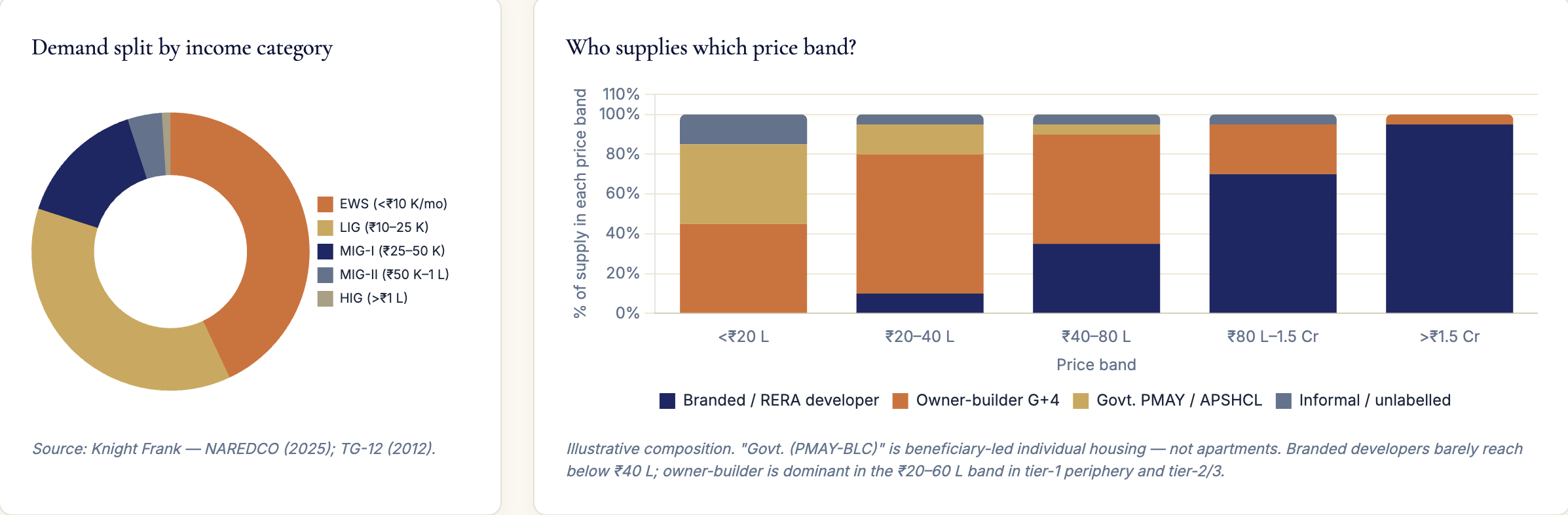
While this formalisation push is undoubtedly required, there are also limits to it. In theory, formalisation increases productivity, which in turn leads to efficiency improvements, technological upgradation, higher wages etc. But this supply-side focus overlooks the demand-side. A formal supply side requires the demand side that can absorb that supply. But formality ends up increasing prices, thereby making the product unaffordable for a very large segment. 

It’s for this reason that formalisation has historically been a slow process and closely linked to economic growth. Therefore, instead of forcing the informal firm/sector to become formal, the objective should be for new activities to start formal and thereby shrink the share of the informal over time. It also means there’s a need to ensure that economic growth is broad-based and productivity-enhancing so that there’s a proportionate increase in the consumption class.

In simple terms, the push to formalise supply should be complemented with demand-broadening economic growth. 

2. Green transition. A strategy similar to formalisation has been adopted for green transition. The belief is that India can leapfrog the green transition, shifting rapidly from internal combustion engines to electric vehicles, fossil fuels to renewables, and old energy to new sources like green hydrogen. 

But like with formalisation, there are several problems with this strategy. The green transition comes with costs and financing requirements. Who bears the costs of the transition - the phasing out of the current investments before their economic life-cycle, the adoption of more costlier and rapidly evolving technologies, taxes on climate change causing externalities etc? How can companies, banks, and governments absorb the losses and finance the new investments, and households afford the higher-priced green products and services? 

Again, like with any economic transition, the green transition too will have to take its time. For sure, it can and should be expedited. But only to the extent that the economy can support - the supply side can meet the requirements, and the demand side can absorb the supply. This means it’s required to be practical and opportunistic and phase the transition in all aspects, including the adoption of appropriate technologies (natural gas, plug-in hybrids and small battery vehicles, nuclear fuels etc).

3. Size of the productive economy. As I have blogged here, arguably the biggest concern about the Indian economy is whether it has the base to sustain high growth rates for long periods. But on the positive side, it can be argued that despite its narrow productive base, the continental size of the Indian economy might mean that this narrow base is large enough in absolute value to provide the momentum for attaining a high growth path. Once it attains this path, it can ride opportunistically on tailwinds to sustain the growth trajectory. 

However, this would depend on the absolute value of the productive slice of the economy - the number of people, the segmentation of their purchasing power, the types of economic activities they are engaged with, the geography of these people and their economic activities etc. Unfortunately, there are no reliable data on any of these. In its absence, we can only speculate based on anecdotal evidence. 

In any case, it’s hard to refute that the Indian economy has a skewed structure - a high-productivity small. segment co-existing with a predominantly low-productivity economy. This skew has widened since the liberalisation. It can be argued that while economic growth has largely improved all lives, its gains have been very disproportionately concentrated in a small segment (relative to the population). 

4. Anchor industries to trigger manufacturing scale. India’s efforts through Make in India and Production-linked Incentives (PLIs) at catalysing manufacturing have not yielded expected returns in terms of an increased share of manufacturing in economic output. But the PLI scheme may be a catalytic game-changer not because of the magnitude of the financial incentives it offers, but in terms of generating investor interest and bringing focus on a few prioritised sectors. PLI Scheme is the policy instrument to complement the marketing campaign of Make in India. Its most important success to date may be the platform it has provided for the intense courting of Apple and Foxconn in mobile phone manufacturing. Similar anchors in solar and wind power generation, electric vehicles and their batteries, and electronic equipment may just about be enough to push the economy into a higher trajectory in manufacturing. 

Investments to establish a handful of mega global-scale manufacturing facilities including the creation of their supplier ecosystems may be the most practical strategy to give a significant boost to manufacturing. It creates the conditions for economy-wide productivity improvements and technology diffusion through learning by doing. Contrary to orthodoxy, it’s about picking winners at both the sectoral and firm levels. This has to be followed with highest-level courting, and long-drawn and credible facilitation of the preferred investors. Apple and Foxconn is the best example. 

However, this policy needs to be pursued with care, especially given the high tariff barriers erected against inputs to protect domestic manufacturers against cheap Chinese imports. In the case of mega-brands like Apple, quality and global competitiveness is not a problem. But in the case of others, industrial policy must incentivise export competition or risk ending up supporting mediocrity protected by high tariffs. The global competitiveness-reducing effects of high import tariffs on inputs can be offset by subsidies like the PLIs which are linked to exports. 

5. Services-led structural transformation. The spectacular success of India’s IT sector has created a belief that India’s structural transformation pathway lies through the services sector. There are several well-known reasons to doubt this strategy. I have blogged here. Services are mostly non-tradeable, therefore not amenable to benefit from technology diffusion and productivity improvements, and also constrained by limited demand. Manufacturing is an essential pathway for large-scale structural transformation, especially for a massive economy like India’s. Increasing manufacturing should be the primary pursuit of public policy. 

6. An industrial policy that supports jobs over capital-intensive manufacturing. It’s becoming increasingly evident that technological advancements have the potential to automate many, even a majority, manufacturing shop-floor jobs. The only reason for retaining shop-floor workers is the favourable unit economics in terms of the availability of cheap labour. This will change with time in favour of automation. 

Against this backdrop, in time it may become necessary to design an industrial policy to disincentivise automation and subsidise labour-intensive manufacturing. But its implementation will be challenging. For example, how to incentivise labour-intensive manufacturing without discouraging technological upgradation? Then there’s the challenge of its implementation.

7. Overcoming human capital constraint. There’s nothing more important than human capital quality in determining the economic growth trajectory of a country. But arguably the biggest constraint to India’s economic growth is the poor quality of its human capital and the acute deficiency of good-quality senior talent. Improving learning outcomes and creating a genuinely educated workforce is perhaps the most wicked of problems. While there’s a clear realisation of the importance of improving student learning outcomes in schools and colleges, I’m not sure we are doing anywhere enough to address the problem in any significant manner. 

This constraint binds across the economy. Large manufacturing firms struggle to access skilled and (at least nearly) employable labour at the scale they require. There’s an acute scarcity of good enough quality middle and senior managers, product managers, designers, scientists etc. Further, the large supply of new labour market entrants from technical institutions should not be conflated with good quality of supply. There are no easy answers to solve this constraint. And it can bind very quickly as the economy starts to grow at very high rates.

Monday, October 23, 2023

The challenges with forced formalisation of the economy

The informal economy has been an important topic of discussion in this blog. I have written here with my co-author about the problems with forced formalisation. History teaches us that informal to formal transitions happen not by way of informal sector firms becoming formal but in terms of expansion of the share of formal sector firms. Informal sector workers and firms face the binding constraints of deficient capabilities and resources to be able to transition to the formal sector. 

I have also blogged about how formality introduces layers of costs that the economy cannot support and thereby ends up dampening aggregate demand. Formalisation of all barbers does not take away from the stark fact that there are only so many Rs 100 haircuts that the economy can support. The vast majority of demand is for Rs 50 and below haircuts, which the informal economy cannot ever provide. 

Take the example of iron/metal scrap dealers. This economy involves hundreds of thousands of poor scrap pickers collecting scrap and selling it to local scrap dealers, who in turn sell it to upstream aggregators, who in turn sell it to re-rolling mills where the scrap is processed and converted into steel for construction and other lower end requirements. The chain from the scrap picker to the re-rolling mill often consists of several aggregators. Some of these aggregators are pure shell entities established to obfuscate and claim input tax credits (ITC) and evade the goods and services tax. 

Apart from these aggregators, there are also several other intermediaries - transportation companies, storage godowns, credit providers etc. But almost the entire network operates in the informal economy. Whilst it suffers from several inefficiencies, this informal sector provides livelihood for millions, including all the different kinds of intermediaries and their employees. This formal economy also exists because of the regulatory and legal arbitrage opportunities that help drive down aggregate costs for the upstream formal economy. 

Now consider the formalisation of this sector through Goods and Services Tax (GST). This would entail capturing transactions at different levels of aggregators and intermediaries and ending at the re-rolling mills. Further, a share of the value generated in this economy which was previously captured only by those in the informal sector now gets subtracted as tax revenues. 

Further, the re-rolling mill is now able to drive efficiencies by having greater visibility on its supply chain, being able to better monitor this supply chain, and contracting with fewer intermediaries. In the process, redundant layers and intermediaries are eliminated. All this increases the profit margins of the re-rollers and also the few large intermediaries (notwithstanding the loss suffered from difficulty to now indulge in fake ITC claims). 

The balance sheet of this transition is that the re-rollers and big intermediaries are likely to undoubtedly benefit. They'll expand and hire more people, and the more skilled and enterprising people in the informal sector will transition into formal sector employees. The government tax revenues from the sector will rise. However, a large portion of existing informal sector workers in the iron and metal scrap industry are likely to lose their livelihoods and be forced into penury and search for new livelihoods. 

In the partial equilibrium, the economic pie of the sector does not expand, but its distribution gets even more skewed towards the larger entities, and a share goes to the government. It's only natural that the pie going to the informal sector workers etc declines. In the general equilibrium, the pie will expand and the scrap sector will become more productive. But it'll both take time and the adjustment costs will be significant for a large share of those who were part of the informal economy. And in that time we're all dead or the costs are prohibitive enough to render the adjustment impossible!

In practice, such transitions are about the enrichment of some and the immiseration of others. Whether the former is a majority or not depends on the nature and pace of the transition. Are there sufficient interlinkages, capabilities, and restraints (on the mindless pursuit of efficiency and profits) to minimise the adjustment times and costs? What's the emerging structure of the formal sector in scrap collection, aggregation and trading? Are there adjoining or newly emerging sectors into which those forced out can be accommodated quickly? Is there enough time for these adjustments to happen? Forced formalisations, any change in general, more often than not end up failing and causing misery and suffering. 

Formality also introduces efficiency improvements which in turn eliminates redundant layers and intermediaries, technology that introduces transparency and leaves digital trails, and adds cost layers to the activities of intermediaries (they have to pay minimum wages, employment benefits, adhere to standards, pay taxes etc). This is the driving force behind the delayering and consolidation among aggregators. Over time, and it can sometimes be a long time, these trends have the effect of improving productivity and aggregate output. 

The example of iron or metal scrap trading applies to all informal sectors. They can be similarly disaggregated to identify the value chain and create a balance sheet of outcomes from formalisation. 

The point here is not an argument against formalisation, but to put the transition in perspective and draw attention to the complex nature of such transitions. As I wrote here with the example of climate change, economic transitions come with their costs.

I'll argue that any forced transitions to formality or higher labour or environmental standards is a supply shock induced demand compression, which invariably lowers the output. In general, any economic transition increases costs which if not supported by associated increases in demand, will necessarily lower output... formality introduces layers of production costs which increases the market prices, which in turn reduces market demand. At the higher price, only a smaller number of customers can afford the good or service. The cost structure of the formal market can be met by only a small proportion of the total demand. The market settles down to a lower equilibrium output. 

It's important to keep in mind these effects when we discuss and formulate policies on the issue of formalisation. 

Monday, December 19, 2022

A model of economic transitions

I'll argue that any forced transitions to formality or higher labour or environmental standards is a supply shock induced demand compression, which invariably lowers the output. In general, any economic transition increases costs which if not supported by associated increases in demand, will necessarily lower output.  

I have blogged earlier in the context of formalisation of the economy that formality introduces layers of production costs which increases the market prices, which in turn reduces market demand. At the higher price, only a smaller number of customers can afford the good or service. The cost structure of the formal market can be met by only a small proportion of the total demand. The market settles down to a lower equilibrium output. 

In fact, it can create perverse incentives. In case of goods and services which are essential (or which have inelastic demand), the reduced affordable formal supply has to invariably result in substitution with lower cost informal supply. If formality is tightly enforced (as in case of certain goods and services), the informal market supply becomes an illegal (or harmful) market supply. 

Supporters will point out that increased formality will raise wages, productivity, profits, and quality which in turn will benefit workers, firms, and consumers in a virtuous loop. But this simplified belief assumes away the considerable adjustment requirements on all sides, which in the real world takes an inordinate time, and in many cases never materialises. It's for these reasons that such transitions have historically taken time, as with the developed countries of today. This ain't an area for leapfrogging. 

The supply will be constrained at both the intensive and extensive margins. At the intensive margin, the informal workers will not be able to acquire the skills required and the informal businesses will not be able to put up the capital for the increased production costs. At the extensive margin, supply of both new sets of workers and businesses will not expand as required. And, in any case, demand cannot expand enough in quick time to create a market which can absorb the higher production costs. 

This dynamic is just as true of labour or environmental or any other set of standards, which can all be seen as dimensions or aspects of formality. Each of these standards adds a layer of production and supply cost to the industry. And these costs must be passed through in the form of higher costs. 

In fact, we can extend this logic to economic growth itself. Economic output can grow sustainably only if the demand side can grow at the same pace as the expansion in supply. While it's possible for the supply to expand rapidly (say, with foreign capital), it cannot do much in the short-run to increase demand. In other words, sustained high economic growth requires the growth to be broad-based enough as to support growth in demand. 

The exception, which China and East Asian economies benefited from, is if the increased demand can come from an external market. In this case, the local economy can benefit with more investments and jobs, and greater productivity and higher incomes, without the proportionate expansion in demand. This positive supply shock will, in course of time, create the foundations for sustained broad-based economic growth. But this opportunity appears to have shrunk considerably. 

In the circumstances, any action plans for economic transitions, like that involving informality or renewables, should acknowledge its limitations and financial costs.

Sunday, April 18, 2021

Weekend reading links

1. In the context of the new Production Linked Incentive (PLI) scheme of the government, the Business Standard examines the air conditioners market in India. 

This is a good summary of India's manufacturing challenge, the much smaller size of local market than expected,

Currently, in the Rs 18,000-crore local AC market, 70 per cent of the cost material used in assembly are imported. Key parts like compressors, variable speed motors in indoor units, and high quality copper pipes, among others, are imported. But with no incentive for incremental assembly, manufacturers are now hoping that large global component makers set up shop here. Since key components that are being imported require huge investments to manufacture locally, setting up such facilities will not be a viable business proposition for entities in India, clarified companies. To turn such investments profitable, the kind of scale that is required does not exist in the local market. At 6 million units a year, India’s AC market is much smaller, compared to leading global markets like China (50 million units), the US (17 million), and Japan (12 million).

2. On the importance of manufacturing to developed economies, Rana Faroohar writes,

In the US, for example, although manufacturing represents just 11 per cent of gross domestic product and 8 per cent of direct employment, it drives 20 per cent of the country’s capital investment, 30 per cent of productivity growth, 60 per cent of exports and 70 per cent of business R&D, according to figures from the McKinsey Global Institute... A fascinating study by MGI, to be released on April 15, examines 30 main manufacturing sectors in the US. It finds that 16 of them stand out for their economic and strategic value, as measured by their contribution to national productivity and economic growth, job and income creation, innovation and national resilience. Apparel is not on the list. But semiconductors, medical devices, communications equipment, electronics, autos and auto parts, and precision tools are.

And this very interesting snippet about China

Chinese producers exported 71 per cent of finished apparel goods in 2005. By 2018, it was just 29 per cent.

3. I've never understood the case for lowering corporate tax rates in India. This is a good set of graphics.

4. Larry Summers makes a very persuasive critique of the post-Covid fiscal policy in the US,

If you look at the economy at the beginning of this year, prevailing forecasts were that Covid would reduce wages and salaries to American households by $20bn-$30bn a month, with that figure declining over the year. So, that would be a $250bn-$300bn hole in wages and salaries over the course of the year. So, I look at this hole and then I see $900bn of stimulus in the December package, $1.9tn of stimulus in the recently passed package and $2tn in the savings overhang, which is also likely to be spent. I see the Fed with its foot on the accelerator as hard as any Fed has ever done... That could manifest itself, as a much smaller period of excess did during the Vietnam war, in rising inflation and a ratcheting-up of inflation expectations. It could, as has often happened, manifest itself in the Federal Reserve feeling a need for a sharp and surprising increase in interest rates, and the subsequent deceleration of the economy into recession. It could manifest itself in a period of euphoric boom and optimism that leads to unsustainable bubbles, or it could all work out well... 

There’s not much argument that the 2009 stimulus, in retrospect, was too small. It was 4 to 5 per cent of GDP over a couple of years, so it was 2.5 per cent of GDP in the first year, against a gap that was 6 or 7 per cent of GDP and growing, so it was perhaps a third or half of that gap. Today’s stimulus is above 10 per cent of GDP in the face of a gap that is 3 or 4 per cent of GDP. Relative to the gap, this stimulus is already of the order of five or six times as large as in 2009... I could have been comfortable with a headline figure well in excess of $1.9tn if it had been a large-scale, multiyear programme of public investment responding to our deepest societal concerns. But that’s not what this is. It transfers to state and local governments that don’t have any new budget problem, according to the latest figures. It’s paying people, who have been unemployed, more in unemployment insurance than they earned when they were working. It’s giving cheques to families in the 90th percentile of income distribution. It doesn’t seem prudent on resource allocation grounds, as well as being problematic on macroeconomic grounds.

5. Mahesh Vyas points to the informal market distress,

As people lost jobs and jobs became scarce in 2020-21, labour that lost jobs moved from one kind of occupation to another. Large numbers eventually migrated to agriculture, apparently, when all other possible occupations failed. As a result, employment in agriculture in March 2021 was nearly 9 million higher than it was in 2019-20. This implies an eight per cent increase in labour in agriculture. Agricultural output is estimated to have increased by 2-3 per cent in almost each of the four quarters of 2020-21. The 8 per cent increase in labour implies a sharp fall in labour productivity. We believe that this huge influx of labour into agriculture is largely disguised unemployment. It hides the greater employment challenge in March 2021 than the 5.4 million net jobs lost. The biggest loss of employment in 2020-21 was among the salaried employees. As of March 2021, there were 76.2 million salaried employees. This was 9.8 million less than the 85.9 million salaried jobs observed in 2019-20.

Salaried jobs are mostly in urban India. Urban India accounted for 58 per cent of all salaried jobs in 2019-20. But it accounted for only 38 per cent of the 9.8 million salaried jobs lost. Over 6 million salaried jobs were lost in rural India. Most of these are likely to have migrated to farming. Rural India also saw nearly 3 million business persons being rendered unemployed. These could also have migrated to farming. Farming saw an increase of 9 million jobs in rural India. So, the churn in rural India seems to have been people losing salaried jobs and losing their business and these unemployed people moving into agriculture for unproductive employment. The increase in agricultural jobs in March 2021 was essentially a migration of people who lost non-farm jobs in rural India into farming. This was not an urban to rural migration.

6. More disturbing news, which points to outright fraud, about Sanjeev Gupta's business activities,

Last week the FT reported that several loans to Liberty Commodities, part of GFG, were based on suspect invoices and that Credit Suisse executives were becoming increasingly concerned that their clients were victims of fraud. Several European metals businesses told the FT last week that they had not carried out any business with Gupta’s groups, despite invoices linked to them being repackaged as notes by Greensill and sold to Credit Suisse investors.

7. The Government of India has approved the Russian vaccine Sputnik V for use in India. It has also accepted a recommendation by the National Expert Group that vaccines approved by health regulators in the EU, US, Japan, and the UK and by WHO should be granted emergency-use approval in India. Till now India had insisted that these vaccines had to still conduct additional 'bridging' trials in India before use.

This decision, which ought to have been taken much earlier and is now precipitated by the acute shortage of vaccine stocks, is a precedent for several other areas. Regulators in other sectors could explore the possibility of using the regulatory approvals in other countries to allow use in India. 

8. Interesting contrast between the employee attrition rates of TCS and Infosys. The rates for the last quarter of 2020-21 was 7.2% and 15.2% respectively for the two companies, both being all-time lows and highs. Is there something about their respective business models which explains this big differential? Or does it tell us something about work cultures in the two companies?

9. Noushad Forbes points to an interesting fact,

In January 2021, India approved its first vaccines for use. The Ken Nutgraf tells us that between July 2020 (before any vaccines had passed testing) and January 2021, the US ordered (and paid for) over 600 million doses. That’s for a total population of 300 million. In the same period, India ordered 11 million doses, for a country of 1,300 million.

Indian Express has an article which points to how India did not put forward at-risk capital (or advance market commitment to purchase vaccines) to promote vaccine manufacturing. 

From all available accounts, India did not invest “at-risk” in SII and its first commercial agreement on vaccine offtake only came in mid-January 2021. And the pricing of Covishield is a factor in SII’s struggles to keep up with demand as the private, unlisted firm has committed to deliveries under AZ’s deals and through multilateral arrangements such as COVAX. SII has now sought “roughly” Rs 3,000 crore from the government to expand its “very stressed” capacity, SII CEO Adar Poonawalla told NDTV. “The globe needs this vaccine and we are prioritizing the needs of India…we’re still short of being able to supply to every Indian that needs it,” he said. “At the moment, the price (Rs 150 per dose) that is set is profitable. However, it is not profitable enough to re-invest substantially in building capacity, innovating new vaccines — including the new variants that we may need to develop and make and go into clinical trials and other things,” he added.

10. Ed Luce on tax avoidance by US companies,

Last year, 55 of America’s largest companies, including Nike and FedEx, paid nothing in corporate taxes in spite of collectively making about $40bn in profits. The headline US corporate income tax rate is 21 per cent, which Biden wants to lift to 28 per cent. However, the official rate is not the point. The effective US corporate tax rate is just 11.2 per cent, which is below that of Ireland. The US Chamber of Commerce and the Business Round Table complain that the nation’s corporate taxes are higher than the western average. In practice, they end up close to the lowest. US tax collections amount to 1 per cent of gross domestic product, compared with a 3.1 per cent OECD average. All such avoidance is entirely legal.

11. As Covid relapses and schools start to shut down, a good report on where India stands with respect to schooling.

Learning and future prospects of a cohort of children may be the biggest long-term casualty from Covid 19 lockdowns.

12. Interesting change in the IBC, for MSMEs, which now allows promoters to remain in control during the restructuring negotiations with creditors.It may be an appropriate response for the Covid 19 induced business stress, but given India's business environment, it remains to be seen how this will work out. 

13. Progress in a graphic


Saturday, July 18, 2020

Weekend reading links

1. It is a sign of times that the IMF has advocated the once unthinkable idea of governments taking equity stakes in private companies instead of offering them debt. This is what the Chief Economist, Gita Gopinath had to say,
Because there's a bigger insolvency issue here, government support would have to shift more towards being equity-like as opposed to debt-like. Otherwise, you would end up with a lot of firms that exit this crisis with a huge amount of debt over-hang. If the lending takes form more like equity ... then that's less onus on the firms. That will make it easier for firms to recover from the crisis.
2. Ajay Shah writes about the value of informal traditional business relationships (landlord and tenant, lender and borrower, large firm and suppliers etc) in times of crises like the Covid 19. They act as automatic stabilisers, with the parties negotiating revised contracts on leases, payment dues etc.

3. The less discussed migrant problem is one of returning migrants from the Gulf. While Covid 19 has hastened the process, there are also localisation forces at play in the Gulf countries. Kuwait recently took the decision to limit migrant population from 70% to 30%. India received $83 bn in remittances in 2019, the largest among countries. It also creates major labour market concerns,
Since the global financial crisis of 2008, the number of Indian workers travelling to West Asia has fallen from 762,484 to 321,721 in 2018, according to the Ministry of External Affairs. At least part of this has to do with falling wages, which have prompted skilled workers from Kerala and Tamil Nadu to search for jobs in India (since the wage differential has narrowed considerably) even as West Asian locals have moved up the skills value chain to occupy those jobs in their own countries... Kerala accounts for a fifth of remittances... Since 2009, it is the investment-poor states of Uttar Pradesh, Bihar, and West Bengal that have accounted for the bulk of the migration to West Asia. The first two states alone accounted for 145,454 workers in 2018 — mainly for the hard-scrabble blue-collar jobs that locals are loath to do. Many of them come from India’s poorest districts.
4. The Mumbai-Ahmedabad bullet train project faces the usual issues of land acquisition and other delays, with implications of cost overrun, as it races against its 2023 deadline.

Alon Levy had a very informative post which raises questions on the use of standard gauge Shinkansen technology, when Indian Railways runs on broad gauge.  

5. Good Livemint status report on the Covid 19 vaccine development. This is one huge challenge, if precedents are any indication,
An analysis of all vaccine projects in development from 1998 to 2009 found that the average vaccine took 10.71 years to be developed from the preclinical phase, and had a market entry probability of 6%.
6. Very good essay on how Amul managed to ensure that its supply and distribution chains for milk and milk products remained unaffected during the Covid 19 lockdowns. 
The Gujarat Cooperative Milk Marketing Federation or GCMMF, which sells its products under the Amul brand, is owned by 3.6 million farmers. Of these, around 2.6 million farmers bring their milk twice daily to 18,600 village societies from where chilled milk is transported to district milk unions for processing into packaged milk and value-added products. The products then reach over a billion consumers daily via 10,000 distributors and a million retailers.
This is a summary of the basic things that Amuld did right,
Soon after the lockdown was in place, Amul announced cash incentives for dairy plant workers, drivers, sales executives, distributors and retailers. While casual workers received between ₹100 to ₹125 extra cash support for working during a pandemic, distributors got an extra 35 paisa incentive per litre of milk. Food and stay arrangements were made for workers inside dairy plants to avert any labour shortages. Simultaneously, the company reached out to the Union home ministry and state animal husbandry departments to arrange passes for its workers and ensure that empty trucks were allowed to return (after delivering milk products). To ensure uninterrupted supply of packaging materials, it engaged with district collectors where packaging factories were located. Amul even arranged for cattle feed to be transported from states like Punjab and Haryana for its farmers in Gujarat. Close to 45% of its products were moved via freight trains, which cut down transit time.
With hotels and restaurants closed, demand naturally fell. But Amul bucked the trend,
As unorganized trade and small dairies withdrew from milk procurement, Amul received 15-17% more milk from farmers. Demand for Amul’s liquid packaged milk went up by 5-7% compared to pre-covid times as households chose a trusted brand over loose milk. Demand for cheese and paneer is at least 30% more despite closure of hotels and restaurants, while butter and ghee sales are up by 10-20%. Demand for ice creams nosedived during the lockdown but Amul was quick to divert its distribution network for ice creams to other product segments... Amul is likely to gain market share. In 2020-21, Sodhi is expecting an enviable 15-16% revenue growth, only marginally lower than the 17% CAGR seen in the past years.
Amul has several lessons to improving India's agriculture. It has also lessons for the Indian private sector firms, including e-commerce ones which struggled during the pandemic. 

7. As commentators hype up the Indian digital commerce economy in the aftermath of the pandemic, it is useful to keep in mind this,
In 2019, of the 583 million internet users in India, only 232 million people paid for any service or product online at least once (the rest used the internet primarily for messaging and browsing), according to RedSeer. And even among the 232 million, only 135 million bought products from e-commerce platforms, indicating the relative shallowness of the internet economy. According to RedSeer, it is largely the same set of users that has driven the recovery in the internet economy since May. What’s different is that users who were earlier only buying something once or twice a year in the past have now been forced to buy both more frequently and a wider range of goods and services. “There hasn’t been much expansion in the overall number of transacting users, but there is a steep growth in the number of serious or holistic users who are shopping on multiple platforms," said Mrigank Gutgutia, an associate director, RedSeer.
Covid 19 and the banning of the Chinese apps means that there cannot be a opportunity for Indian developers to bring out something original or global scale in the digital domain. This will be a test for the much hyped Indian start-up eco-system. 

The race seems to have started in great earnest. An Indian TikTok or Facebook, but which is not a mere clone?

8. Shyam Saran makes the case for India to devise a strategy to respond to the Chinese two steps forward, one step backward approach at the India-China border.

9. Jugal Mahapatra and Siraj Hussain argue in favour of extending the additional allocation under National Food Security Act (NFSA) till March 2021 and also expanding its coverage by another 10 million. This is an important point to be borne in mind,
If there are no reports of starvations, even from the poorest districts of India, despite loss of income of crores of people, the credit should go to National Food Security Act, 2013.
10. Far too often policy targets are completely unrealistic. But even by those standards, this needs revision big time,
The production target in the electronics sector for 2025 is $190 billion, with a 30 per cent share in global value creation, as distinct from the current figures of $29 billion and 5 per cent, respectively. This is massively ambitious, and can only be achieved through export promotion.
11. Important area for expediting policy action is the regulatory space on digital economy, especially on data protection and privacy. This from a Business Standard editorial highlights the concerns,
The draft legislation has been pending since 2018, when the B N Srikrishna Committee submitted it, and has been amended by a Parliamentary committee. The new draft has no safeguards against blanket surveillance by government agencies. In addition, the government is pushing for complete access to non-personal data, which means the commercial secrets of businesses would be at risk. It would also like access to source codes of telecom equipment, including mobile devices, and has reportedly asked for social media data to be stored on local servers and deciphered on demand, breaking end-to-end encryption. These demands might retard the development of this huge market and put citizens’ privacy at risk. Therefore, the government should get the data protection law passed with adequate protection. A more robust legal framework will increase activity in the sector and attract investment.
12. Madan Sabanvis makes the important point about exiting the stimulus in India, especially on the liquidity support and debt forbearance side measures. These will not be easy and the government and RBI will have to carefully plan for them.

13. Bari Weiss (HT: Ananth), an editor with the New York Times has a scathing indictment of the culture of self-sensorship and political correctness within the Times. Her resignation letter captures the issues nicely.
A new consensus has emerged in the press, but perhaps especially at this paper: that truth isn’t a process of collective discovery, but an orthodoxy already known to an enlightened few whose job is to inform everyone else... Stories are chosen and told in a way to satisfy the narrowest of audiences, rather than to allow a curious public to read about the world and then draw their own conclusions... Why edit something challenging to our readers, or write something bold only to go through the numbing process of making it ideologically kosher, when we can assure ourselves of job security (and clicks) by publishing our 4000th op-ed arguing that Donald Trump is a unique danger to the country and the world? And so self-censorship has become the norm.

What rules that remain at The Times are applied with extreme selectivity. If a person’s ideology is in keeping with the new orthodoxy, they and their work remain unscrutinized. Everyone else lives in fear of the digital thunderdome. Online venom is excused so long as it is directed at the proper targets. Op-eds that would have easily been published just two years ago would now get an editor or a writer in serious trouble, if not fired. If a piece is perceived as likely to inspire backlash internally or on social media, the editor or writer avoids pitching it. If she feels strongly enough to suggest it, she is quickly steered to safer ground. And if, every now and then, she succeeds in getting a piece published that does not explicitly promote progressive causes, it happens only after every line is carefully massaged, negotiated and caveated.
In this context, this from JS Mill assumes relevance (via Walter E Block)
“He who knows only his own side of the case, knows little of that. His reasons may be good, and no one may have been able to refute them. But if he is equally unable to refute the reasons on the opposite side; if he does not so much as know what they are, he has no ground for preferring either opinion. . . . Nor is it enough that he should hear the arguments of adversaries from his own teachers, presented as they state them, and accompanied by what they offer as refutations. . . . He must be able to hear them from persons who actually believe them; who defend them in earnest, and do their very utmost for them.”
14. Sanjaya Baru writes about the brain drain problem facing India. This may turn out to be true for a majority of elite-children,
Children of business leaders, politicians, government officials, diplomats and just about every influential section of society are seeking exit visas. The next generation of the Indian elite is increasingly domiciled overseas.
15. Andy Mukherjee examines Reliance's plans to become a competitor to Tencent (digital platform), Huawei (5G equipment and telecommunications), and Xiaomi (mobile phone). In the context of the 5G race, The Economist writes,
On July 15th Reliance Industries, an Indian conglomerate, announced that its Jio network, which uses a Samsung 4G network, will be building its own 5G infrastructure and selling it to others. Jio is likely to follow in the steps of some other carriers, most notably Rakuten Mobile in Japan, which are betting on networks based on advanced software, off-the-shelf hardware and open standards, thus side-stepping the need for systems integrators like Ericsson, Huawei or Nokia.
This is a sceptical look at Reliance's claims. V Sridhar feels that Reliance may be talking about 5G-like network. It is likely to be the case.

16. Interesting that the UK government and Bill Gates Foundation are the largest funders of WHO in 2020-21.

Wednesday, June 19, 2019

Dynamics of informality and migration

Consider this parable. There are two countries in Planet Earthopia. Productopia is the richer country whose citizens have a higher standard of living and are more productive. Barrenopia stands at the other end on incomes, standard of living and productivity.

Consider two scenarios. One, both countries decide to ease border restrictions and liberalise migration. Two, both countries go nationalist and clamp down on cross-border migration.

In the first case, there is likely to be an increase in migration from less productive and poorer Barrenopia to Productopia. This, by composition effect, would naturally lower the average productivity of Productopia while raising the net welfare of both countries combined.

In the second case, outcomes vary based on the rigour of enforcement. Strict enforcement limits migration and thereby lowers welfare gains, and perhaps even the combined output in so far as it lowers even efficient and productive migration.

Replace the two countries with formal and informal sectors, or urban and rural, and we can expect similar results.

An excellent paper by Gabriel Ulyssea examines the impact of various barriers to entry at both the extensive (expansion of formal sector by entry of informal firms) and intensive (formal sector firms hiring workers formally) margins. It finds that,
Reducing entry costs eliminates wasteful barriers to entry, increasing the mass of firms, total output, and wages. However, the intervention has a negative effect on aggregate TFP via composition effects, as it increases the presence of low-productivity firms in the formal sector. In contrast, increasing enforcement on the extensive margin generates a positive composition effect, as it eliminates many low-productivity informal firms, which increases TFP. The net effect is a 3% increase in total output. In terms of welfare effects, reducing entry costs leads to the largest gain (5.5%), followed by the payroll tax policy (4.4%). In contrast, higher enforcement on the extensive margin leads to a loss of 6.7%, which is a consequence of enforcing costly and inefficient regulations on all firms. These results thus show that lower informality can be, but is not necessarily, associated with higher TFP or welfare... At the aggregate level, I find that increasing enforcement is highly effective in reducing informality but it reduces welfare in the economy. Reducing formal sector’s entry costs is not as effective in reducing informality but generates welfare gains and leads to greater output and wages. 
Or in case of rural to urban migration, Martin Ravallion writes about the extensive margin,
Rural poverty measures tend to fall more rapidly in countries with higher rates of population urbanization. Urbanization appears to be having a compositional effect on the urban population, in that the new urban residents tend to be poorer than the previous urban population. Naturally, this slows the pace of urban poverty reduction, even though poverty is falling in rural areas and for the population as a whole.

Saturday, October 14, 2017

Weekend reading links

1. Government intervention to make strategic purchases to both catalyse markets and lower prices is logical. The most cited example of such intervention in recent times has been the procurement of 770 million LED lights by 2019 as part of India's Domestic Efficient Lighting Program (DELP), which has resulted in a steep drop in the prices of LED lights.

Buoyed by the success, the government company, Energy Efficiency Services Ltd (EESL), is seeking to procure 5 million smart electricity meters and drive down prices. Livemint reports that L&T have won a Rs 13.61 billion contract to supply 5 million meters over three years to discoms in UP and Haryana at Rs 2722 a piece, 40-50% lower than the current market rate. 
Power distribution companies will not have to make an upfront investment to deploy these meters. EESL is investing in procuring smart electricity meters and the services of the system integrator. Utilities can pay back through savings resulting from enhanced billing efficiency and avoided meter reading costs. EESL will also appoint a firm, a “system aggregator”, to manage the installation of smart electricity meters and to collect and store data on power consumption for analysis.
A very rare example of innovation and big-scale public policy thinking in India. The challenge, in this case, will be to hold the supplier honest and make them deliver good quality meters, and have the "system aggregator" be able to actually collect and make available the required data for energy audit. The matter of getting stuff done. But a very good initiative. 

2. Much of the analysis about the ongoing movement against informality glosses over the demand side of the equation. Manas Chakravarthy writes in Livemint,
One consequence of the introduction of GST and some of the other measures to tackle black money will be increased market share for the corporate sector. Stockbrokers have been celebrating the opportunities opened up. A Citibank research report says: “The Indian government’s ongoing structural initiatives (and the GST rollout) will accelerate the transition toward the organized sector. Moves towards a less-cash economy, indirect tax changes through GST, direct tax compliance, e-commerce, and some progress on labour law reforms, among others, will prove disruptive to traditional structures in the medium term and result in accelerated formalization as well as economies of scale in the long term.” It’s no surprise that big business has backed these changes to the hilt.
Let me repeat what I have said earlier many times, the informal economy is not going to disappear. It will linger on and only gradually shrink over decades.

Formality introduces costs, which the producer will have to pass on to the buyers. But we need buyers who can afford to pay the higher price to access that good or service. This affordability can come only with increased incomes, a function of economic growth.

Barbers sitting on roadside and on makeshift arrangements offering haircuts for Rs 10-30 will form the vast majority of haircuts in India for the foreseeable future. In contrast, salons where the haircuts cost Rs 75-100 or more, likely to be in the formal sector, form only a very small proportion of haircuts. Governments can do whatever it wants to force these barbers to become formal, but they will not. The simple reason is that there is only so much demand that can be generated for salon haircuts! The shift to salons will happen only with economic growth.

3. In the best GST article I have read, Indira Rajaraman, draws attention to a weakness of the current GST architecture and how it affect the risk sharing mechanism in India's retail eco-system. She writes,
The principal culprit is the monthly frequency of reporting required under the GST (for businesses with annual turnover more than Rs75 lakh). Within each month, there are three dates in sequence for voucher uploading, consolidation and claims, with a daily penalty beyond deadlines crossed, added to interest on any tax credits denied. This formal voucher-based monthly reporting has dealt a death blow to the risk-sharing mechanism underpinning the efficiency of the Indian retail supply chain as we know it. And that is what has hit growth. Take a retailer of non-perishable items like garments or footwear. Retailers order a consignment from upstream wholesalers according to their best judgement of what clients will buy. The traditional practice was that if a retailer overestimated the appeal of a new style to his client catchment area, he returned unsold stock to the wholesaler, and finally paid the wholesaler a few months later only for his net purchase, net of returned stock.


Risk cover does best when risk is pooled across many locations with diversified patterns of incidence. The wholesaler is able to bear the risk of sale reversal because he can re-distribute returned stock. A new style in garments or slippers may lie unsold in one location, but fly off the shelves in another. Wholesalers in turn spurn retailers who return stock beyond some percentage limit of the gross purchase, thus leaving enough risk with the retailer to incentivize him to judge his market correctly and put in his best sales effort. If goods are defective, the wholesaler in turn returns the stock to the manufacturer, which again assigns risk to the only level where defects can actually be addressed.

When there is a switch to monthly reporting, a wholesaler uploads the initial gross sale to each retailer, with GST charged on a numbered invoice lodged in the system. Although the GST system does permit reversal of sale through issue of a credit note which can be offset against the next sale to the same retailer, it adds to the procedural burden, and is not something wholesalers are willing to touch. In effect, sale reversal has become impossible under GST, even for defectives. Retail buyers are now being asked to take a consignment at their own risk, and thereafter hold their peace. The traditional risk-sharing mechanism lies shattered.

Given that the retailer can no longer (in effect) reverse any part of an uploaded transaction, he minimizes risk by reducing his gross purchase from the wholesaler to the floor of his expected range of retail sales. This is what has hit growth. Wholesalers faced with reduced retailer offtake in turn place lower orders from manufacturers. Manufacturers have responded by sharply lowering production, some operating at as little as 25% of capacity.
She proposes doing away with the voucher uploading and matching process and replacing it with rigorous sample audits. I am inclined to agree.

4. A great stall is on in India's construction sector, the second largest employer after agriculture. Sample this,
For three consecutive quarters, the stalling rate in the realty sector has been in double digits, with the total value of stalled realty projects touching Rs1.27 trillion in the September quarter. The stalling rate (or value of stalled projects as a percentage of projects under implementation), at 12.7%, was at its third-highest level in nine years, only marginally better than in the June quarter, when the stalling rate hit a nine-year high of 13.3%. The commercial real estate sector has been the worst-hit, with a fifth of such projects getting stalled.
5. Talking of stalling, stalled infrastructure projects are no longer news. The latest on them shows limited progress in addressing the chronic problem. The value of stalled projects reached its highest level of Rs 13.22 trillion for the September quarter and stalling rate was 13.3% of all projects under implementation.
The reasons for stalling were the usual suspects - lack of clearances, fuel supply, finances, land etc.
A total of 39.04% of the projects are in the power sector and 25.59% in manufacturing. But the most disturbing news is in the declining new investment announcements. Sample this,
The value of new private sector project announcements in the quarter ended September was Rs31,000 crore. This value was Rs1.79 trillion and Rs1.69 trillion in the quarters ended September 2016 and 2015. 
6. This is a nice graphic that captures the fact that average commuter trip lengths rise with increase in city population size.

The article laments about the political difficulty of increasing urban mass transit fares and the resultant subsidy gaps.

While raising mass transit fares periodically is important, we should also bear in mind that farebox ratios are less than 50% in most metro rail systems across the world. In other words, more than half the operating expenses are subsidised. Therefore a more serious issue for consideration than cost-recovery may be to mark metro ticket prices as a percentage share of the median commuter wages.

The report states that the Railways subsidised Mumbai suburban railway commuters to an extent of Rs 33.94 bn over the past three years. That's not at all bad. An annual subsidy of Rs 11.3 bn for ferrying over 2.5 bn commuters (or 7.5 million per day), especially when seen as the cost of keeping them off Mumbai's roads, is actually a very good deal! In terms of efficiency, it would easily be the most cost-effective urban mass transit operation anywhere in the world. Managing a city is not just about recovering costs, it is about creating the conditions for creating growth, jobs, and wealth. And Mumbai mass transit does it better than most other enablers that the government has put in place.

7. Just like with anything else, too much competition is bad. As Andy Mukherjee writes, India's telecoms market is the best example. The race to the bottom with call and data tariffs have left everyone bleeding, and threatens to make this the latest addition to the bad debt problem for Indian banks. Mukherjee suggests that the carnage will not stop till the industry undergoes more consolidation and failures and reduces to four players.

However, I do not think that even then it is unlikely to be much different. As I blogged earlier, the elimination of interconnect charges on grounds that it would lower profits may not, in retrospect, turn out to have been a very good decision. 

8. Aeon has a fantastic essay on the evolution of higher education system in the US. It talks about the role of property speculators trying to use the College/University as a cultural centre and anchor to attract property buyers; competition among towns, state, and even church to establish colleges; the modest government funding forced colleges to charges fees and thereby compete to make college valuable for students; the limited regulation beyond grant of charter which allowed colleges lot of autonomy to innovate to attract students; the practicality associated with attracting middle class fee-paying students meant offering job-oriented course-work (engineering, agriculture etc) and accord importance to things like football.

And for those countries trying to replicate the US model of higher education, the author has this advise
Since it’s a system that emerged without a plan, there’s no model for others to imitate. It’s an accident that arose under unique circumstances: when the state was weak, the market strong, and the church divided; when there was too much land and not enough buyers; and when academic standards were low. Good luck trying to replicate that pattern anywhere in the 21st century.
9. The week Richard Thaler won Nobel Prize in Economics, comes this report from SCMP on the use of nudges (or, are they "shoves" here?) to get people to pay their taxes
Local governments have been told to set up name-and-shame databases – which will be searchable by anyone – by the end of the year... In the southern city of Guangzhou, the personal details of some 141 debt defaulters have so far been displayed on screens in buses, commercial buildings and on media platforms at the request of local courts. Meanwhile in Jiangsu, Henan and Sichuan provinces, the courts have teamed up with telecoms operators to create a recorded message – played every time someone calls – for those who fail to repay their loans. The message tells the caller: “The person you are calling has been put on a blacklist by the courts for failing to repay their debts. Please urge this person to honour their legal obligations.”
10. Finally, the award for risk diversification best practice has to go to LIC. It has been reported to have made a bid for shares worth Rs 7000-8000 Cr in the IPO of reinsurer General Insurance Corporation (GIC) Re. Talk about insurer buying exposure into a reinsurer who also insures some part of LIC's own portfolio! Or is it a case of LIC as the buyer of last resort in disinvestments.