Substack

Showing posts with label crony capitalism. Show all posts

Monday, January 19, 2026

The rule of law and predictability underpins effective markets

The US invasion of Venezuela and capture of Nicolas Maduro is the signature intervention under the emerging Donroe Doctrine. However, Venezuela’s oil reserves, precisely the reason the US intervened, may end up complicating matters. For a start, despite the President’s exhortation to US oil majors to line up and invest in the country, they appear to bereluctant. 

Ricardo Hausman hits the nail on the head with this brilliant articulation of the paradox - the manner in which the whole thing has been executed undermines the credibility of the objective itself.

Capitalism is not simply private ownership. It is voluntary exchange under predictable rules — rules that bind the powerful as well as the weak, and that survive electoral transitions. Those rules are what make long-horizon investment possible. Predation is what happens when power writes the rules opportunistically, then demands they be treated as law. That distinction matters most when it comes to oil. Reviving Venezuela’s energy sector would require large, frontloaded capital spending to repair and expand infrastructure. Those expenses would have to be followed by many years of positive cash flows to repay sunk costs and earn a return. 

Oil is the opposite of a quick-turn business. Its economics hinge on whether rights will be respected long enough to recover the initial outlays. These rights do not emanate from threats. They come from a legitimate state: a government that can claim consent; a legislature that can authorise commitments; regulators and courts that can enforce them; and a political system that investors believe will honour yesterday’s deal tomorrow. Unpredictability may occasionally be an asset in international affairs, but trust is the real strategic currency. And trust is precisely what a coercive interim arrangement cannot supply. Delcy Rodríguez, Venezuela’s interim president, has no electoral mandate and inherits institutions whose legitimacy is contested. Contracts signed now — especially if shaped under foreign pressure — will be politically and legally fragile. A future democratic government would have reasons to revisit them, if not repudiate them outright. In anticipation, US oil majors will not invest. 

Investors can price commodity risk. They can hedge operational risk. What they cannot hedge is foundational illegitimacy: the risk that the very basis of a contract will later be judged void because it did not emanate from an authorised government. If Washington’s message is that legality follows power rather than constraining it, capital will rationally assume that every deal is hostage to the next shift in power, whether in Caracas or Washington. The political sequencing is also backwards. It is not prosperity that creates legitimate government; it is legitimate government — namely, democracy and the rule of law — that empowers people to create prosperity. With these foundations, markets can do what they do best: decentralise initiative, mobilise investment and reward productive effort rather than proximity to power.

This is brilliant and has resonance elsewhere. Two markets in particular come to mind: infrastructure and technology. 

Predictability arising from the sanctity of the rule of law is the most important requirement for the functioning of private markets. It is this confidence that allows investors to invest their money, and just as importantly, entrepreneurs to put their efforts. Predictability extends not only to business creation and ease of doing business, but also to retaining control of their businesses. The latter is important given trends in industries like emerging technologies and infrastructure, where a dominant industry leader swoops in to forcibly take over a promising emerging firm. 

Ambitious entrepreneurs are driven by their belief in scaling their businesses and leading their industries. And in many sectors, especially but not only infrastructure, these are also long-drawn journeys spanning decades. In other words, building one enduring and dominant business is an endeavour of a lifetime. 

In this backdrop, any threat of being forcibly ousted and taken over can be a serious, if not prohibitive, deterrent to entrepreneurship. Why would an ambitious entrepreneur put in his sweat and toil to build a business if he runs the imminent threat of being forced out by a dominant rival precisely at the time his business starts to show promise and reaches the scaling pathway? Similarly, why should investors put their money in such risky and long-drawn projects when they know that they run the risk of seeing the entrepreneurs they backed being ousted and their upside being capped? 

Thanks to network effects and resultant market structures, the commanding heights of the digital technology industries are oligopolies or monopolies. Therefore, in the technology industry, once a promising startup comes up with a new or disruptive idea in any of the frontier areas like AI, chip design, or robotics, they run the risk of being harried and bullied into being absorbed by the Big Tech firms. Apart from snuffing out any potential competitor, Big Tech firms want to deepen their moats by capturing all innovations in their ecosystem. These pressures and threats are triggered through multiple channels - product development ecosystem, market access, investors, legal notices, and so on. 

Infrastructure sectors, being deeply enmeshed in the political economy and where the dominant incumbents formulate the rules of the game, are rife with crony capitalism and regulatory capture. Therefore, in the infrastructure industry, once a firm builds up a good portfolio of projects after several years of hard work and persistence, they run the risk of the dominant market leader swooping in and taking over by ousting the management. 

The new entrants are vulnerable to being coerced off their assets, even without a fair return or compensation, and often with the active support of the governments. In addition, in the context of Indian states, it is not uncommon to find the ownership of prime infrastructure assets changing hands (or shareholding patterns shifting) from the contractors preferred by the previous government to those favourable to the incoming government. 

All these act as significant deterrents for investors and entrepreneurs. Sectors like infrastructure and information and communications technology (ICT) are critical drivers of economic growth, and incentive distortions that discourage investors and entrepreneurs can be binding constraints on economic growth. 

Saturday, January 3, 2026

Weekend reading links

After scaling India’s renewable energy landscape faster than anyone else, across solar parks, transmission networks and green hydrogen, the Adani Group now wants to manufacture wind turbines not just for itself, but for the market... Adani has said it wants to deploy around 30GW of wind capacity by 2030, or a third of the country’s 100GW target by then. Until recently, Adani’s turbine manufacturing was widely assumed to be a captive exercise, designed primarily to feed the group’s own rapidly expanding power needs... For Suzlon Energy Ltd, India’s largest wind turbine maker and one of the few global survivors in a brutally cyclical industry, the timing is unsettling. The company has only just emerged from a long financial winter. It is debt-free, profitable again, and benefiting from a renewed policy and market push for wind as India confronts a structural mismatch in its power mix... Apart from Adani, the JSW Group and Reliance Industries Ltd have also disclosed their intent to manufacture turbines. These are conglomerates that can absorb early losses, compress supply chains and tolerate long gestation periods.

2. Italian and Spanish bond yields have declined as markets reward them for measures taken for fiscal discipline. 

Government borrowing costs paid by Italy and Spain have fallen to their lowest level relative to Germany in 16 years, as investors reward Rome and Madrid for belt-tightening and grow more worried about surging debt elsewhere in the Eurozone. The extra yield on 10-year Italian debt compared with German Bunds — a closely watched measure of the risk associated with lending to Italy — narrowed to within 0.7 percentage points this month, the lowest since late 2009. Strong economic growth in Spain has helped to cut its 10-year spread with Germany to less than 0.5 percentage points. That is also the lowest since before the Eurozone crisis, when high debt loads drove up both countries’ borrowing costs and stoked worries about the currency bloc breaking up... Investors point to Spain’s improving economic trajectory and Italy’s prudent fiscal policies under a politically stable government, as part of a broad reduction in fiscal risks for these countries as well as for other previous debt hotspots such as Greece.

3. Roger Federer's commencement speech at Dartmouth College is a classic. He makes the point by invoking the fact that, though he won almost 80% of his 1526 singles matches, he only won 54% of all points. 

“When you lose every second point, on average, you learn not to dwell on every shot,” he told the crowd. “You teach yourself to think, ‘OK, I double-faulted. It’s only a point.’ When you’re playing a point, it has to be the most important thing in the world, and it is. But when it’s behind you, it’s behind you. This mindset is really crucial, because it frees you to fully commit to the next point and the next point after that, with intensity, clarity and focus.”

This has resonance elsewhere. 

It’s an easy concept to apply to almost any field. In 2022, Ronald van Loon, a portfolio manager at BlackRock, authored a paper on the percentage of investment decisions that need to be correct to beat market benchmarks for returns. He researched markets, crunched the numbers and came up with a number: As low as 53 percent.

4. Men's athletics records dating back to the 20th century.

Jonathan Edwards (triple jump, 18.29m, 1995), Mike Powell (long jump, 8.95m, 1991), Jan Železný (javelin, 98.48m, 1996), Javier Sotomayor (high jump, 2.45m, 1993) and Yuriy Sedykh (hammer throw, 86.74m, 1986)

5. Frothy US equity markets

The so-called Shiller cyclically adjusted price-to-earnings ratio of the US stock market, which is ending 2025 just shy of 40, an extremely high level relative to history. The only time the S&P 500 has had a higher ratio was just prior to the dotcom bubble bursting in the early 2000s. Starting from valuations at this level, Adler said, the market has never generated a return above inflation for investors.

6. The Big Three IPOs expected in 2026

OpenAI, which is currently valued at $500bn, is engaged in discussions with investors about a new fundraise at a valuation of $750bn or more... SpaceX is working on a secondary stock sale which would value it at $800bn, according to multiple people with knowledge of the deal. Anthropic is also in talks for new funding, which investors expect will value the company at more than $300bn... Figma, Klarna, CoreWeave and Chime were among the technology groups to list in 2025, contributing to a total of more than $30bn in US IPO proceeds in the first nine months, the bulk of it from technology groups, according to EY. This year’s total is likely to dwarf that sum, if even one of the three big start-ups goes public. SpaceX alone is widely expected to surpass Saudi Aramco’s $29bn raise in 2019 to become the largest public listing.
7. Good interactive graphic of President Trump's epic conflicts of interest in his government deal-making.

8. Japanese scallop exports have become the latest victim of China's weaponisation of trade. 
As China has emerged as a global economic power, its 1.4 billion citizens have become critical consumers of international goods. Beijing has dangled market access to its growing middle class as a diplomatic lever, imposing import restrictions for Taiwanese pineapples, Australian wine, American soybeans and Lithuanian beef in recent years... 
The latest trade spat between Japan and China began in August 2023, when Beijing suspended imports of Japanese seafood after the release of treated wastewater from the decommissioned Fukushima Daiichi nuclear plant. While Japanese officials and U.N. regulators defended the move — noting the water was filtered and heavily diluted — Beijing protested. Before the freeze, China was the top buyer of Japanese seafood, with scallops accounting for most of that trade. Hokkaido’s scallops, harvested from the region’s nutrient-rich, frigid waters, are prized for a distinct buttery flavor and deep umami. They command a premium in China, where they have become a staple luxury at high-end celebratory banquets... In 2022, the year before the halt, Japan exported roughly $641 million worth of scallops, with China accounting for more than half of all sales. Scallop exports plunged 30 percent in 2023 from a combination of China’s trade ban and a fallow period of production... 

Japan’s prime minister, Sanae Takaichi, stated in the National Diet that a Chinese attack on Taiwan could be a “survival-threatening situation,” a legal trigger implying Japan could use military force. It was a rare public declaration regarding an island that Beijing considers a breakaway province. Within two weeks, Beijing abruptly froze all new seafood export applications.

9. Nokia's successful reinventions.

By 2000, Nokia had 26.4 per cent of the global handset market, according to CCS Insight. At its peak in 2000, amid the mania of the dotcom bubble, Nokia was worth about €286bn and was estimated to be contributing about 4 per cent of Finland’s GDP… However, Nokia’s failure to grasp the signficance of the smartphone era, ushered in with the release of the first iPhone in 2007, ultimately cost it dearly… With the writing on the wall, Nokia sold its devices and services division — which housed its once world-beating mobile phone business — to Microsoft for €5.4bn in 2014. Its revenues had fallen from a peak of €37.7bn in 2007 to just €10.7bn by the time it was sold…
With the Nokia brand rapidly disappearing from consumers’ minds, it fell to new chief executive Rajeev Suri to chart a new course for the company. Nokia’s €1.7bn acquisition of Siemens’ stake in a networks joint venture in 2013 suddenly made up about 90 per cent of Nokia’s revenues after it got out of the handset business. “That had to be the foundation because you cannot invent a company on a weak core,” Suri, who left Nokia in 2020, told the FT, adding that his “first priority” was to “remove any ambiguity about what Nokia was going to be”. To turn Nokia into a major player in the networks business. Suri made the biggest acquisition in Nokia’s history: a contentious €15.6bn deal for French network provider Alcatel-Lucent in 2015.

10. BSE Sensex

The BSE Sensex has compounded at just over 13.5 per cent annually over the past four decades, making the Indian stock market one of the best performers globally in US dollar terms.

11. Another K-shaped signature of the US economy (HT: Adam Tooze)

12. Finally, the audacious US invasion of Venezuela and capture of President Nicolas Maduro and his family will be discussed much in the days ahead. The NYT has an early editorial that highlights one aspect.
Mr. Trump’s recently released National Security Strategy... claimed the right to dominate Latin America: “After years of neglect, the United States will reassert and enforce the Monroe Doctrine to restore American pre-eminence in the Western Hemisphere.” In what the document called the “Trump Corollary,” the administration vowed to redeploy forces from around the world to the region, stop traffickers on the high seas, use lethal force against migrants and drug runners and potentially base more U.S. troops around the region.

Venezuela has apparently become the first country subject to this latter-day imperialism, and it represents a dangerous and illegal approach to America’s place in the world. By proceeding without any semblance of international legitimacy, valid legal authority or domestic endorsement, Mr. Trump risks providing justification for authoritarians in China, Russia and elsewhere who want to dominate their own neighbors. More immediately, he threatens to replicate the American hubris that led to the invasion of Iraq in 2003.

For India, the National Security Strategy, and its operationalisation through actions like the above, should be a wake-up call that the US can no longer be relied on in any meaningful manner in case of any conflict with China. 

Saturday, December 13, 2025

Weekend reading links

The Saudi Crown Prince Mohammed bin Salman, for example, is engaging in sensitive national security conversations with President Donald Trump, even as the Trump family real estate business is in talks with the Saudis about a big construction project. Trump’s artificial intelligence and crypto tsar, David Sacks, has hundreds of tech investments poised to benefit from policies Trump is pushing... While the Trump family’s tentacles have worked their way into many industries, from finance and technology to real estate and defence, digital assets are perhaps the most obvious place to look for conflicts of interest that could infect the larger economy. Consider one complicated example involving the stablecoin of the Trump family crypto venture World Liberty Financial, which was used by Abu Dhabi’s MGX in a $2bn transaction linked to Binance. That company was co-founded by Changpeng Zhao, who received a presidential pardon in late October, after previously pleading guilty to a criminal charge relating to lax money laundering controls. Then there are Trump supporters like the Winklevoss brothers, whose Gemini platform was charged with the unregistered sale of assets during the Biden administration, only to settle with the Securities and Exchange Commission this year. The Winklevoss twins are big Republican donors (they’ve even chipped in for the construction of a new White House ballroom) and, not surprisingly, their platform is embedding itself deeper and more quickly into the US crypto infrastructure than many competitors. This autumn, Gemini announced a Nasdaq partnership.

2. As President Trump fights a weak economy, the largest share of Americans in more than 50 years is saying that the government is mishandling the economy. 

The signature economic achievement of Trump 2.0, the One Big Beautiful Bill, is contributing to the emerging K-shaped economic growth trends. 
3. America's K-shaped economy in a graph showing the divergence between the S&P 500 and the University of Michigan Consumer Survey trends. (HT: Adam Tooze)

A K shaped economy describes a post-crisis recovery where different parts of the economy and society are performing at sharply diverging rates, forming the two arms of the letter “K.”:
  • The upper arm (going up): Sectors, companies, assets, and people that benefit from the recovery and, in many cases, are wealthier than before the pandemic. This includes investors in technology stocks, big tech companies, the luxury sectors, high-income professionals, and asset owners.
  • The lower arm (going down): Sectors, small businesses, and people that continue to decline or stagnate even as the overall economy appears to improve. Examples include: the hospitality and travel industries, many lower-priced retail outlets, low-wage service workers, small businesses, and many middle-class and lower-income households.

4. China's trade surplus hits $1 trillion in just 11 months.

 
5. Important point about the Indigo fiasco.
In operational terms, the new flight duty time limitation (FDTL) rules were the most consequential development for any domestic airline heading into 2025. Yet, as The Indian Express has reported, the airline’s Annual Reports for 2023-24 and 2024-25 did not mention the new rules at all, nor did they figure in the airline’s Risk Management Report. This implies that the airline’s management did not anticipate operational challenges arising from these new rules and did not prepare for them adequately, which raises questions about its basic executive capabilities.

6. Indian equity market facts

India has been the worst-performing major equity market in the world. Flat in US dollar (USD) terms, we have been left behind by global emerging-market (EM) indices, which are up 29 per cent in USD as of end-November 2025. This is the worst relative performance for India since 1993. India has now dropped to third place in terms of EM weighting and is just about half the weight of China... India has also been shunned by foreigners, with foreign portfolio investors (FPIs) selling over $18 billion in 2025 year-to-date, marking five years of zero flows. The saving grace has been domestic flows, which continue to power ahead, with $80 billion invested by domestic institutional investors to date and the number of investors crossing 135 million... Despite 15 months of no returns, mutual fund retail flows continue to track about $3 billion per month.

7. Mexico imposes tariffs of up to 50% on about 1400 goods imported from China and other Asian countries with which Mexico has no trade deal. Chinese cars will be the hardest hit. Mexican imports from China have ballooned by 75% since 2020 to $130 bn in 2024. 

8. Oren Cass writes that the Trump administration's greatest challenge is Trump himself.

Is China an adversary or a partner? Sometimes, US policy prohibits the sale of AI chips to China and pushes allies to keep China out of their markets. Other times, Trump promotes the sale of more powerful chips, or muses about Chinese firms setting up shop stateside. Are cheap foreign workers good for the US economy or bad? Sometimes the administration is forcing them out, other times trying to bring more in. Trump’s repeated suggestion to admit 600,000 Chinese students to the same US higher education system he has attacked is a particular head-scratcher. Is industrial policy to rebuild critical domestic production capacity wise? Sometimes the president trashes the Chips Act, other times he celebrates its results and goes even further in his market interventions.

This graphic shows how all the bluster on China, its exports are now on similar tariff lines compared with those from other countries (HT: Adam Tooze). 

9. Striking graphic that is a pointer to why the US leads globally in innovation (HT: Adam Tooze)

10. Important example of how preemptive anti-trust actions have valuable innovation effects.

When Nvidia attempted to acquire Arm in 2020 — a deal that would have locked down the fundamental architecture of chips used for AI — the FTC sued to block it and the deal was abandoned. Because Arm remained independent, Google is now able to compete with Nvidia in the production of AI chips, using Arm’s technology to build its own processors.

11. Electrification in South Asia is a true development success to be celebrated, just as its failure in Africa is one to be deeply disturbed. 

12. Sobering tale of how BP and Shell terribly misread their industry trajectory and ended up betting prematurely on renewables. Both owed their positions to leadership, Bernard Looney and Ben Van Burden. The article charts how the former, assisted by McKinsey, forced through changes at BP.
The green revolution at BP began on February 12 2020, in Bernard Looney’s second week as chief executive. Looney, a charismatic BP lifer who had run the company’s oil and gas operations, embraced the energy transition with the zeal of a convert... Two former executives claim Looney had been working with consultants from McKinsey for months but had not shared the plan with the other 11 members of BP’s executive team before unveiling it. “It was a big bang approach,” one of them says... 

To consolidate control and prepare BP for disruption, Looney and McKinsey dismantled the company’s traditional “upstream” and “downstream” divisions, which explored and produced oil and gas and then refined, traded and sold it. Instead, there were 11 new business units, some of which left staff baffled. One new team was called “Cities and Regions” and its job was to imagine how urbanisation would change energy use and consult with cities on what opportunities there might be for BP to play a role. “It looked like a consulting job on a piece of paper rather than something that was really going to fly,” admits one former BP executive. Last year, BP reorganised again to get rid of the Cities and Regions unit and “reduce duplication”.

“You could see the mis-steps happening live. The degrees of change were just too fast,” says another. “Changing the CEO is one degree of change. Then the CEO changes the strategy overnight. Then he decimates anybody in divisions that he didn’t think were important.” Later in 2020, Looney set out more details. BP went beyond Shell, and any other oil company, in pledging to actually reduce the oil and gas it produced, with an initial target of a 40 per cent cut by 2030. “No other company followed, so either you are a prophet and others did not get it, or you are the lonely guy on top of a mountain,” observes the second executive. With McKinsey teams embedded across the organisation to offer rebuttals, and amid the chaos of the reorganisation, insiders say it was hard to speak out against the plan. “You could not have a dialogue about this being the wrong thing. If the numbers did not work, you would fit them,” the executive adds.
This is the reversal
Both companies increased their spending on green technology rapidly, to a peak in 2022 of nearly a third of overall investment, or $4.9bn, for BP, and nearly a fifth, or $4.3bn, for Shell. BP promised to spend a further $55bn to $65bn between 2023 and 2030... Today, Shell and BP have retreated to be more in line with their US rivals, though still with targets to have net zero emissions by 2050. The grand narrative of transformation has been discarded for renewed focus on shareholder returns. While the world continues to electrify, and to grow the share of solar and wind power generation, the two companies are now focusing on other parts of the transition, such as moving from heavy fuels with high emissions to gas and eventually biofuels and hydrogen. In the first nine months of this year, BP cut its spending on clean energy by 80 per cent compared with last year, to just $332mn. Shell says it is now “focused on disciplined capital allocation in our areas of competitive strength while driving improved returns”.

Monday, November 10, 2025

The emerging market of mega batteries to serve electricity grids

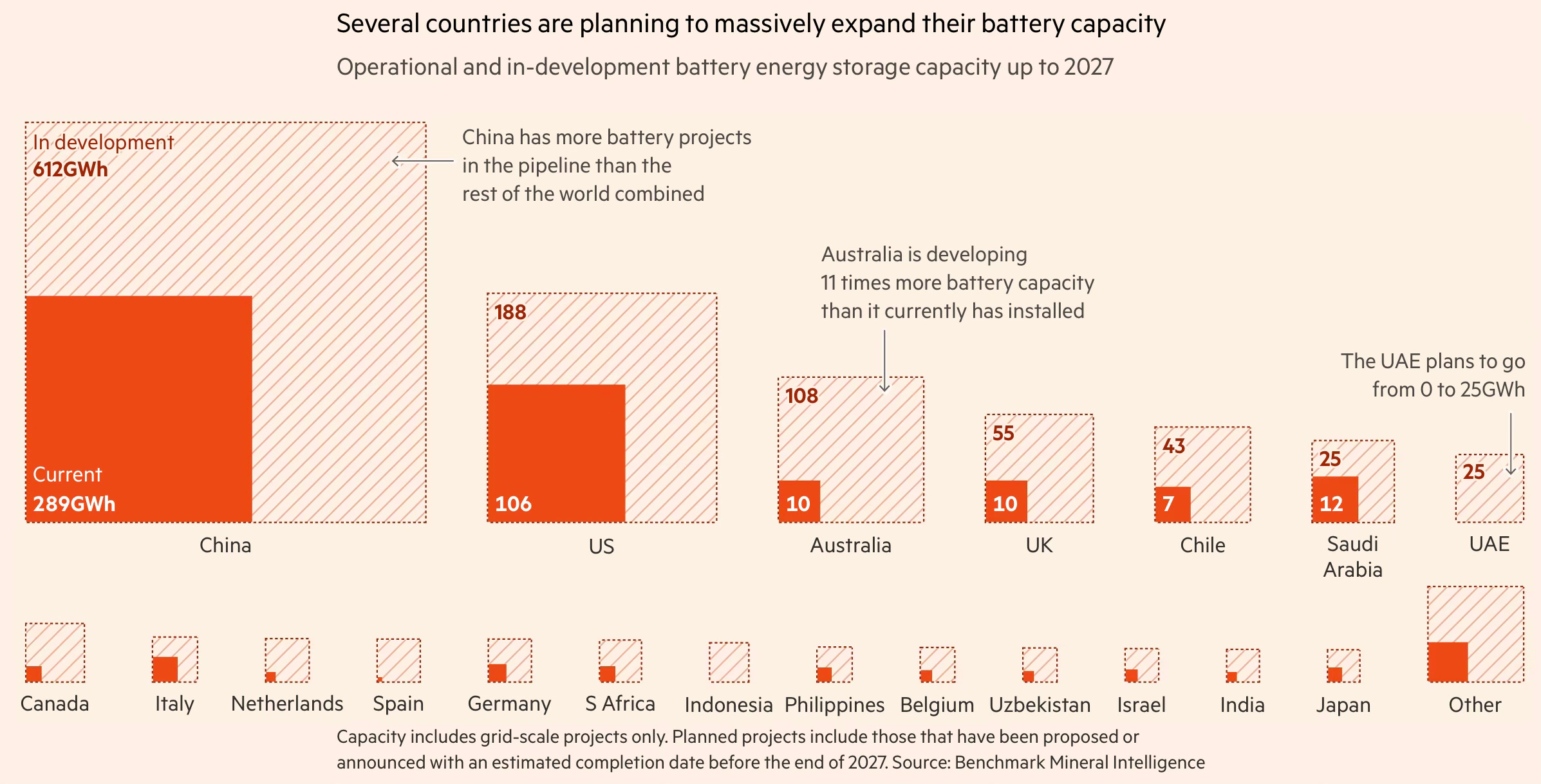
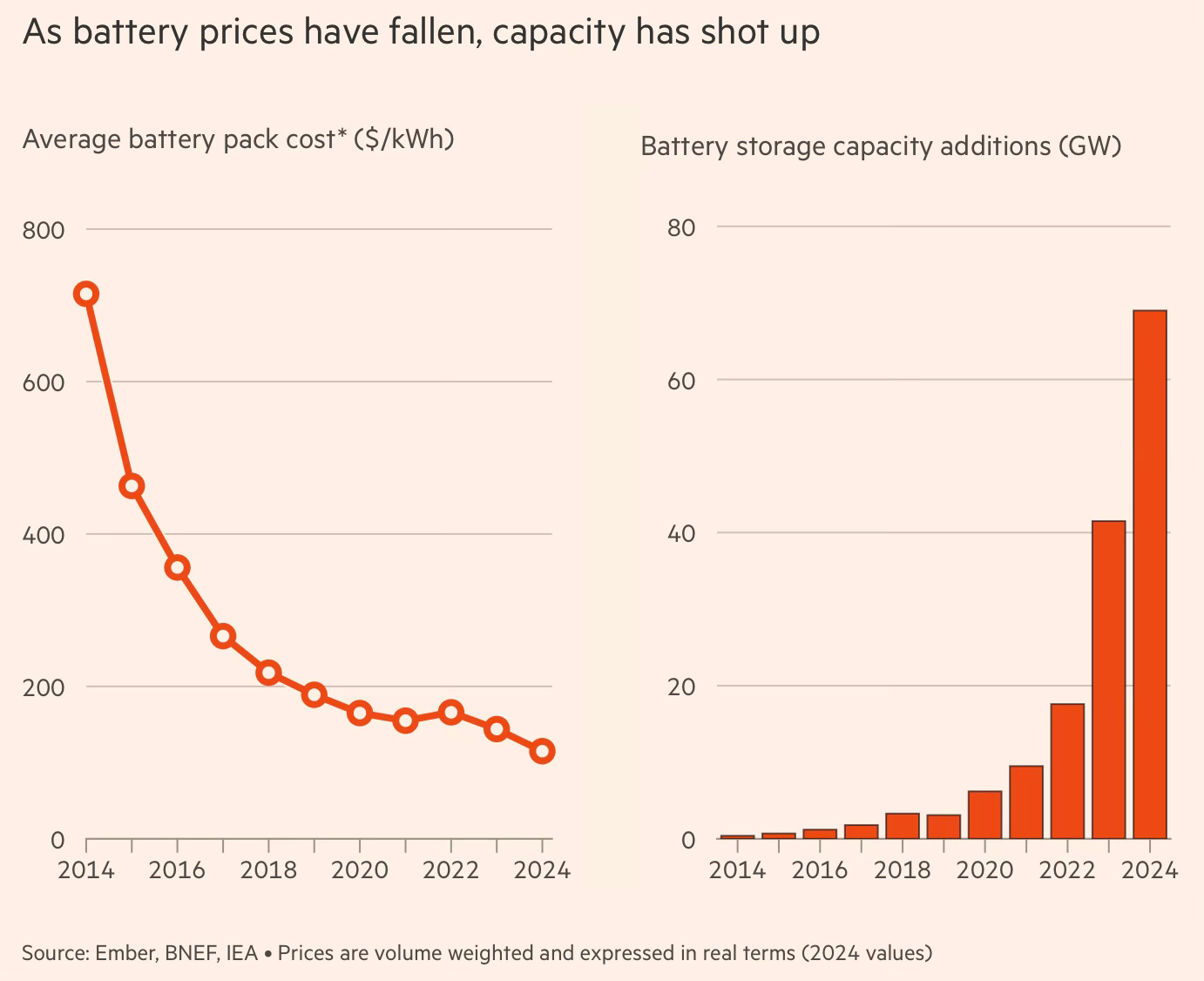
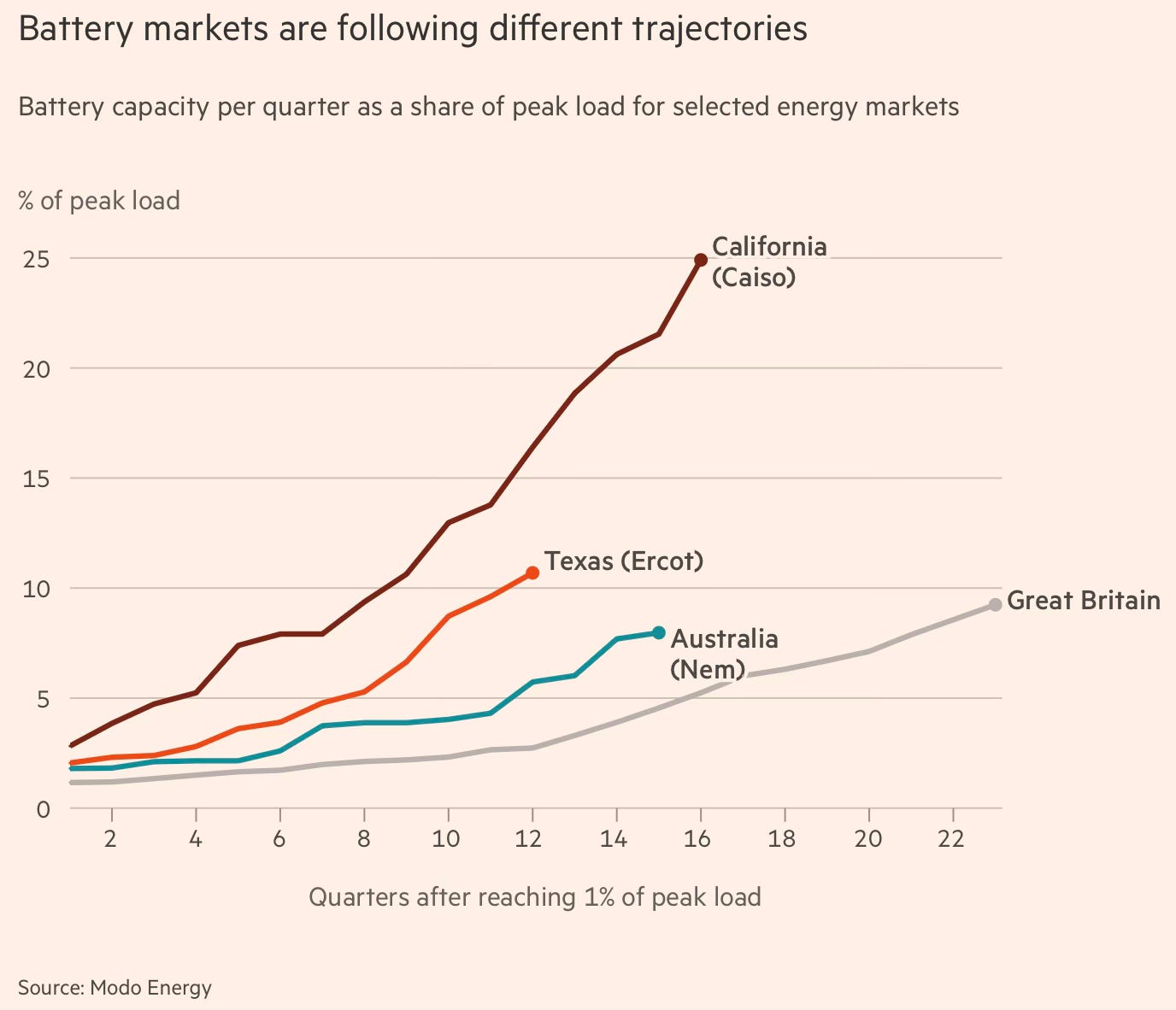
FT has an excellent interactive graphical feature on the growth of mega batteries that store electricity for grids. The growth in grid-scale batteries since 2021 has been spectacular. 

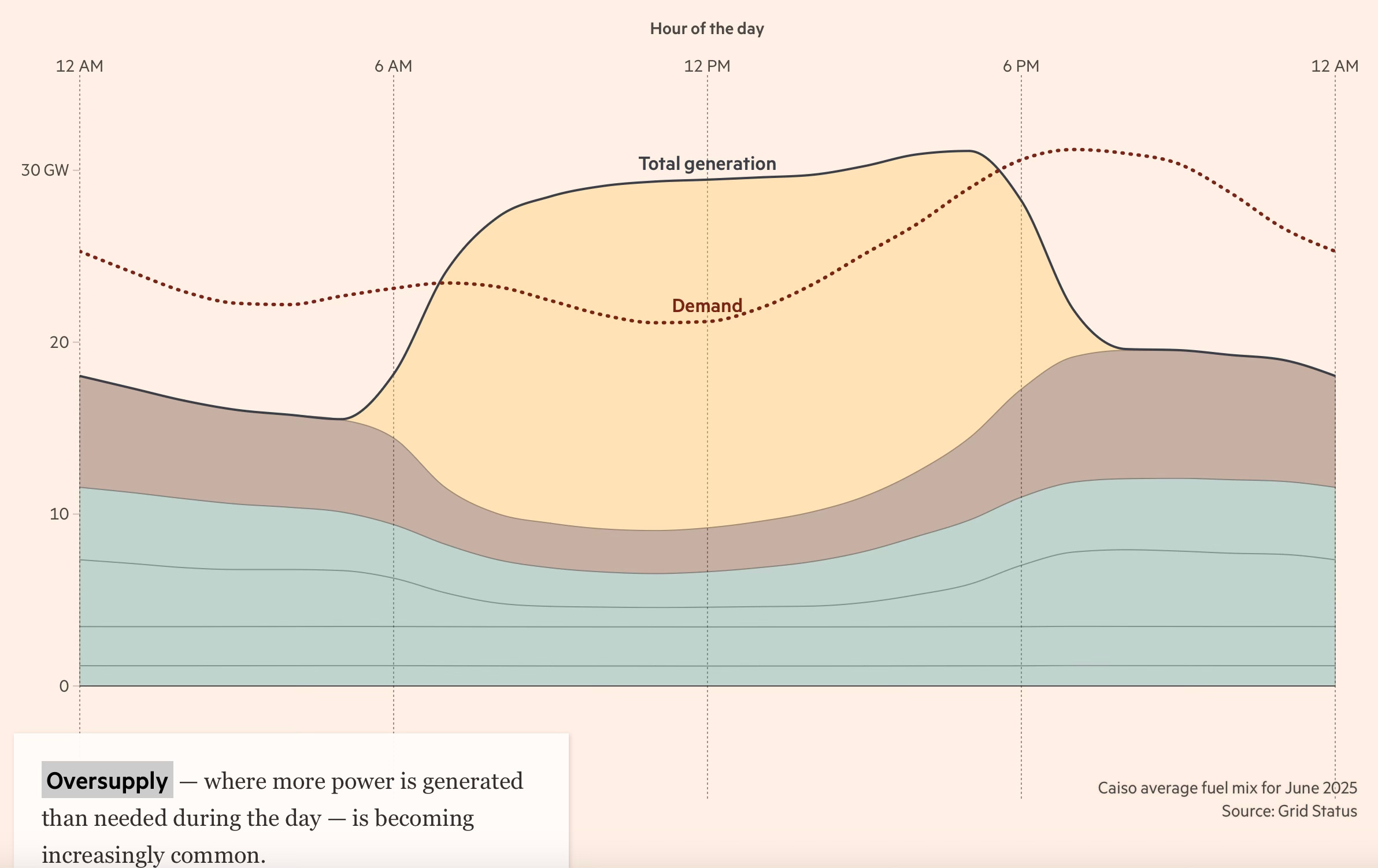
This graphic shows the load mix profile of California’s electricity grid on a typical summer day. 

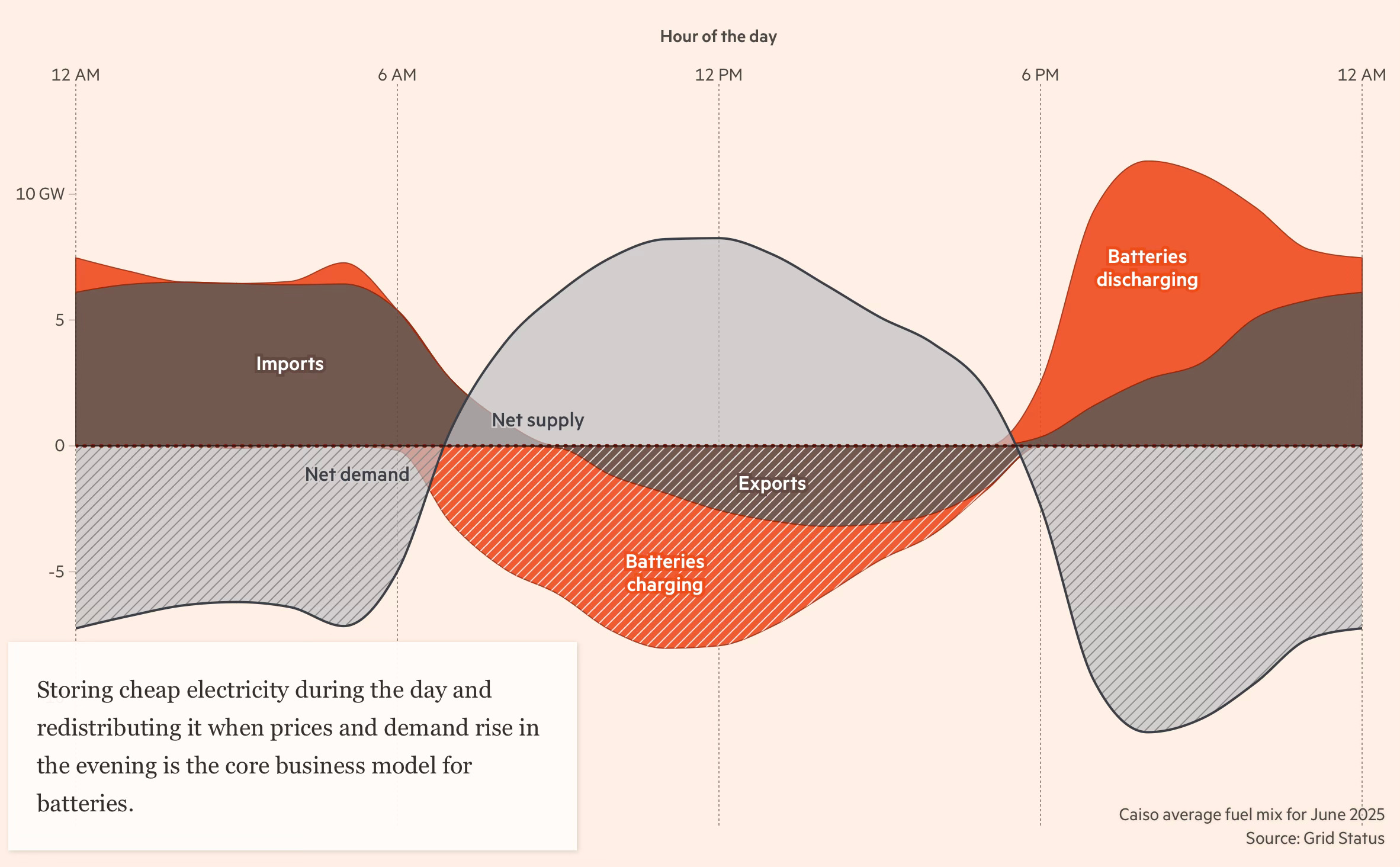
Enabled by state policies, California’s battery storage capacity has more than tripled to 13GW of power, with plans to add another 8.6GW by 2027. Now, as cheap, plentiful solar power floods the grid in the middle of the day, hundreds of battery installations bank the energy and discharge it in the evening when people return home from work and demand — as well as prices — spike. This has shored up the grid, extended the state’s use of renewable energy and reduced its reliance on fossil fuels.

The global battery storage market is dominated by China and the US, with over 70% of the projects by capacity. Most batteries in use today can discharge power for 2-4 hours.

Global battery prices have fallen by more than half over the last two years.

Lithium-ion battery costs have also fallen — by 90 per cent since 2010 — a drop that Artem Abramov, deputy head of research at energy consultancy Rystad, says is likely to continue. Packed full of hundreds of powerful batteries, a standard 20-foot storage unit once provided 3-4 megawatt hours (MWh). Now they typically deliver 5-6MWh, with several suppliers developing 10MWh containers — enough to power around 30,000 UK homes for an hour.

There has been explosive growth in the number of 1 GW battery farms. 

In 2022, there wasonly a single gigawatt-scale facility — defined as having a capacity of at least1GWh, able to supply roughly 3mn UK households for an hour — inoperation worldwide. Today there are 42 such sites. Five times as many giga-projects are set to come online in the next couple of years, including in the UK, the Netherlands, Chile and the Philippines.

As in other clean technology segments, China is the undisputed global leader.

China, which produces over three-quarters of batteries sold globally, has played a crucial role in the energy storage boom. Chinese companies, supported by state backing, have brought down costs through mass production. Domestic demand in China is also skyrocketing, with Bernstein predicting a 90 per cent year-on-year rise to 335GWh by the end of 2025… Driven by both strong power consumption growth — from data centres, electric vehicles and air conditioning — and the country’s long-term replacement of coal with renewable energy, battery storage demand in China is expected to reach 652GWh by 2030, at a compound annual growth rate of 14 per cent, according to Bernstein data… China’s battery makers, benefiting from sustained policy support and amid fierce market competition, are investing in options which can store more energy, such as solid-state batteries. 

Mega batteries stabilise the grid by balancing supply and demand, restarting the system in emergencies, providing back-up capacity when required, etc. 

“What grid operators and utilities value from batteries is flexibility,” says Mark Dyson, a managing director at the Colorado-based nonprofit RMI. “They can be a ‘swiss army knife’ and do whatever is needed on the grid, when and where that is required.”

But the volatile nature of the electricity demand profile makes for a great trading opportunity for battery owners.

Battery owners can buy low when supply exceeds demand, and sell high when demand kicks in.

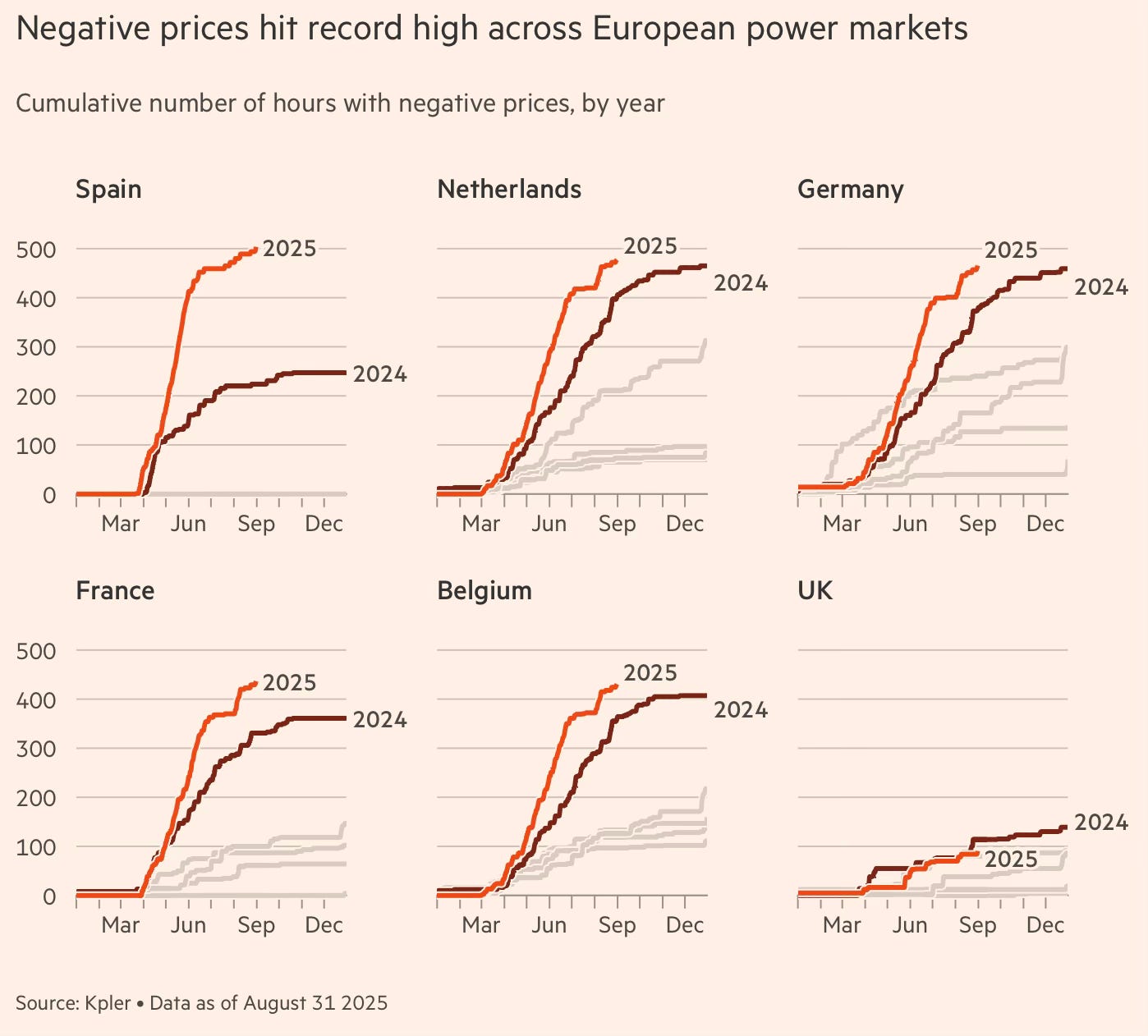
It is common for wholesale electricity spot market prices to fall below zero on especially sunny or windy days, forcing producers to either pay wholesale customers or storage operators to offtake the excess power, or switch off. 

Spain, where nearly a third of summer supply came from solar power, logged more than 500 hours of prices below zero this year, having never experienced them before 2024.

Battery operators can capitalise on this price volatility. 

Outside of China, California has been at the forefront of battery storage. 

In California, batteries consistently supplied more than a quarter of electricity during this year’s spring and summer peaks, data from energy analytics platform Grid Status shows. In the first eight months of 2025, gas generation was down 37 per cent from 2023, according to climate academic Mark Jacobson of Stanford University. In Australia, several battery farms are being installed at the sites of retired coal plants. The country’s grid-scale battery storage power capacity has more than tripled since the start of 2024 and in early May, batteries contributed more than 5 per cent of power in the evening peak for the first time.

Batteries are especially likely to be useful for countries with abundant solar power.

Research by the Energy Transitions Commission (ETC) shows that in “sunbelt” locations — countries from India to Mexico with ideal conditions for solar power — batteries could meet almost all power balancing needs. In these regions, solar follows a predictable daily pattern and is relatively consistent between seasons, enabling batteries to play a role on a daily basis. This presents a “huge economic opportunity”, says Elena Pravettoni, head of analysis at the ETC, a global coalition of companies working towards a net zero economy by 2050. “The combination of solar and batteries means clean power costs in sunbelt regions could be 50 per cent lower than today’s fossil-based systems.” In countries more reliant on wind power — such as the UK, Germany and Canada — batteries alone will not suffice, according to the ETC. Wind is less consistent, and current battery technology cannot fill the gap over multiple days.

The feature also talks about an important requirement for investments in batteries - policy certainty.

“These projects aim to be online for around 15 to 20 years, but if you only know the policy for the next one to five years then that causes a big issue,” he says. “This creates a lot of uncertainty for investors and developers.” In some countries, batteries are subject to double-charging, having to pay fees to draw power from the grid as well as when injecting energy back into it. This illustrates the complicated regulatory and policy frameworks developers must navigate. The US has seven wholesale power markets, each with their own rules, policies and price signals, while the EU’s patchwork of regulations poses its own challenges.

It points to emerging business models.

To manage risk and lock in a stable source of income, some developers are turning to tolling agreements, particularly popular in Germany’s burgeoning market. Under these contracts, the developer effectively hands over control of the battery to a third party — typically a large utility or energy company with a broad portfolio of assets — in exchange for a fixed price.

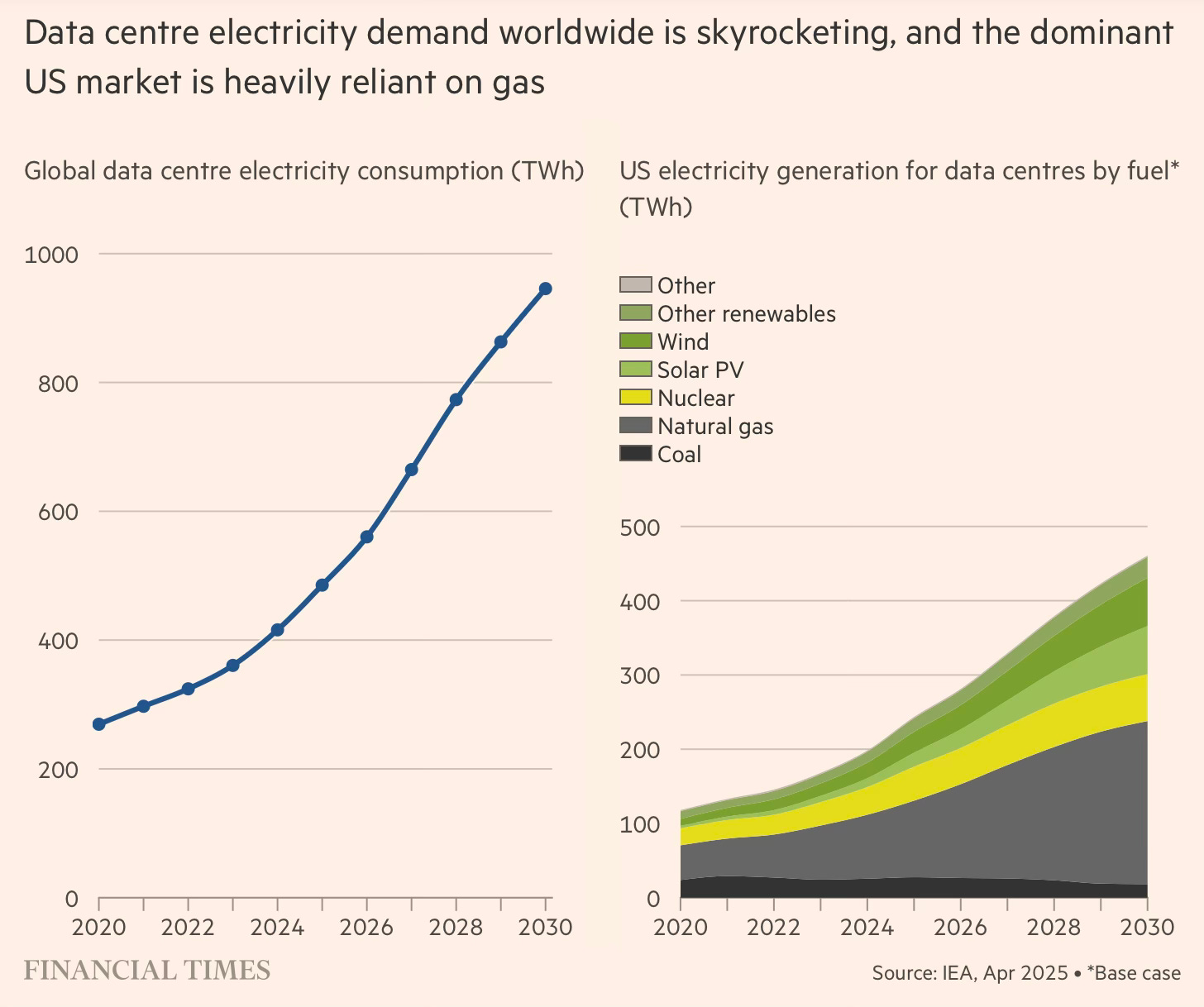
Battery storage assumes added importance given the explosive demand for energy-intensive data centres. As in the US, much of this new demand is being met with natural gas. The International Energy Agency estimates that globally, data centres’ electricity usage would double to 945 terrawatt hours by 2030. 

In this context, some observations of relevance for India’s power sector.

I can think of four aspects of grid-scale battery adoption in any market: battery manufacturing, installation by developers, business models for developers, and financing by investors. It is important to shape public policy to promote these aspects. 

India will need to depend on foreign battery manufacturers for some time. Also, given the dominance of China in the market, dependence on it is unavoidable. Like earlier with the BTG equipment for thermal plants, solar panels, and wind turbines, it will be prudent for India to rely on China in the early stages. 

But there are lessons from those earlier examples that India must incorporate into its battery manufacturing engagements. India missed the big opportunity to leverage its massive solar demand to force wafer and cell manufacturing in the country (in a phased manner from module to cell to wafers/ingots to polysilicon), and allowed developers to import even modules. The result is that Indian manufacturers still do only module assembly using imported cells. 

For a start, India must use the leverage of scale to negotiate with the likes of BYD and CATL to establish manufacturing facilities in India through joint ventures with Indian firms. These deals must include both a clearly defined trajectory of progressively increasing value addition in manufacturing, including battery R&D facilities, and the development of an ecosystem of Indian suppliers. These are matters of detail. The Indian JV partners should be supported to acquire the capabilities and strike out on their own gradually. Industrial policy incentives should be tailored accordingly, taking into account all these glide paths. 

As an illustration, Brazil raised tariffs on all car imports to compel Chinese automakers like BYD and Great Wall Motors to set up plants inside Brazil. Indonesia’s policies on capturing value from Nickel extraction by banning exports of unprocessed nicket and forcing refiners and processors to establish factories locally is another example.

The Government of India must engage actively behind the scenes to ensure that the developers contract with Chinese and other battery manufacturers only on these conditions. In this regard, the large thermal and renewable energy generators like Adani Power, Tata Power, JSW Energy, Renew, Azure, Greenko, etc., should be encouraged to take the lead in this effort and develop partnerships with potential Indian manufacturers who can collaborate with the foreign battery suppliers. 

Market dynamics and incentives on their own will not achieve the desired objectives. It will be required for the Ministry of Power to aggregate the battery demand on a continuing basis, bring together the foreign manufacturers and developers, and actively facilitate the negotiations. 

Power sector policies should be formulated to both facilitate and make it attractive for battery developers to contract long-term with power generators and distribution companies, captive users, and also sell in the power exchanges. If not already done, the Central Electricity Authority could formulate model purchase agreements with multiple tenures for Gencos and discoms to contract with battery developers. 

The industrial policy support should be tailored to achieve the manufacturing side objectives. Accordingly, it is important to target subsidies and other concessions in a manner that aligns the incentives of all sides. Given the need to progressively increase domestic value addition and build domestic manufacturing capabilities, the subsidies and concessions could be a combination of upfront (capex incentives) and recurring (supply-based) subsidies. 

It is also one more opportunity for India’s private sector, especially the large companies, to step up and build a globally competitive grid-scale battery manufacturing ecosystem. The Adani Group, the standout leader in such large infrastructure projects, and with the advantages of a conglomerate spanning the entire market segment from manufacturing to generation, is best placed to show the way.

There are two other important policy requirements that governments must keep in mind. One is that of policy predictability. The commercial risks for manufacturers and developers from state and central government policies should be identified and mitigated. 

For example, like renewables generation, battery costs will continue to decline in the years ahead, and there will also be technological obsolescence. This will create incentives among discoms and other contracting parties to resile from these contracts over time, as happened with solar and wind projects. Political considerations will always be around as governments change. It may therefore be useful for the Government of India to work out mechanisms to bind state governments and their contracting entities into these agreements. This will be a big risk mitigation measure for developers. 

The second risk is of commercial expropriation. The infrastructure sector, apart from national highways, is dominated by a few corporate groups. India is too big a country to be able to meet its massive and rising requirements from just them. It needs the presence of several large manufacturers and developers in the infrastructure sectors. But the experiences of sectors like airports, ports, power, etc., disincentivise the mid-level infrastructure entrepreneurs to bite the bullet and assume risks to grow if they believe that the conditions allow the behemoth incumbents to swallow them up if they become successful. This must change.

Saturday, August 23, 2025

Weekend reading links

1. After all the bluster about "reclaiming the Panama Canal" from Chinese owners, it now emerges that the Chinese authorities have not yet cleared the $23 bn sale from HK-based CK Hutchison and a Blackrock-backed consortium. And apparently, China’s state-owned shipping conglomerate Cosco is now seeking at least a 20-30 per cent stake in the deal. 

2. Spain is taking a contrarian path. 
Spain is having a moment bucking Western political trends. The country has recently recognized Palestine as a state, resisted President Trump’s demand that NATO members increase their defense spending to 5 percent of gross domestic product and doubled down on D.E.I. programs. But there’s no better example of Spain going its own way than immigration. At a time when many Western democracies are trying to keep immigrants out, Spain is boldly welcoming them in. The details are striking. In May, new regulations went into effect that eased migrants’ ability to obtain residency and work permits, and the Spanish Parliament began debating a bill to grant amnesty to undocumented immigrants. These reforms could open a path to Spanish citizenship to more than one million people. Most of them are part of a historic immigration surge that between 2021 and 2023 brought nearly three million people born outside the European Union to Spain.

3. Domestic Institutional Investors (DIIs) are driving Indian equity markets, having replaced the role of Foreign Institutional Investors (FIIs).

Investments by DIIs grew at a much higher rate of 55.4 per cent from 2014-15 to 2019-20, compared with 37 per cent in the post-Covid period (2021-22 to 2024-25)... In absolute terms, investments by DIIs reached an all-time high of ₹14 trillion at end-March 2025. In contrast to the rapid growth of DII investments over the past decade, FII investments grew at only 4.9 per cent. Consequently, their outstanding investments, at ₹10 trillion at end-March 2025, were about 29 per cent lower than those of DIIs...
The co-movement (correlation) between FII investments and the equity market (BSE Sensex), which was 0.37 from January 2000 to March 2014, fell to a negligible (–) 0.03 from April 2014 to June 2025, implying that over the past decade, FIIs have had virtually no impact on the equity market. In contrast, the correlation between DII investments and the equity market, which was (-) 0.20 during January 2000 to March 2014, rose sharply to 0.59 during April 2014 to June 2025, suggesting that over the past decade, DIIs have predominantly influenced the equity market.

4. DeepSeek further delays the release of its new model after failing to train it using Huawei's chips, exposing the limits of China's indigenous chips.

DeepSeek was encouraged by authorities to adopt Huawei’s Ascend processor rather than use Nvidia’s systems after releasing its R1 model in January, according to three people familiar with the matter. But the Chinese start-up encountered persistent technical issues during its R2 training process using Ascend chips, prompting it to use Nvidia chips for training and Huawei’s for inference, said the people... Training involves the model learning from a large dataset, while inference refers to the step of using a trained model to make predictions or generate a response, such as a chatbot query... Industry insiders have said the Chinese chips suffer from stability issues, slower inter-chip connectivity and inferior software compared with Nvidia’s products. Huawei sent a team of engineers to DeepSeek’s office to help the company use its AI chip to develop the R2 model, according to two people. Yet despite having the team on site, DeepSeek could not conduct a successful training run on the Ascend chip, said the people. DeepSeek was still working with Huawei to make the model compatible with Ascend for inference, the people said.

5. India's wealth and income landscape.

6. GST notices issued by Karnataka Commercial Taxes Department to informal traders who use UPI payments system forces some of them to turn back on UPI.
The trigger was a series of Goods and Services Tax (GST) notices sent to street vendors who have been using the Unified Payments Interface (UPI) to accept payments. The state’s GST department had flagged them as unregistered traders whose turnover exceeded the limit over which GST registration is mandatory—Rs 40 lakh per annum for the supply of goods and Rs 20 lakh for services. These notices have set off a wave of fear rippling through small traders in several states where governments have taken similar action. In Karnataka, over 14,000 street vendors recently threatened to go on strike over the issue. The strike was called off after the state government hit pause on 6,000-odd notices following the backlash, but reports say other states like Andhra Pradesh, Uttar Pradesh, Tamil Nadu, and Gujarat have also begun requesting merchant turnover data. UPI may have brought simple, instant digital payments to India’s streets, but as the country’s small traders are finding out, it’s also brought fully traceable transactions—putting them directly under the lens of tax authorities for the first time.

7. The Bola Tinbu administration in Nigeria devalued the Naira sharply after taking charge in 2023, plunging the economy into chaos. Impressively, things seem to be looking up now, especially in manufacturing.

Facing ever-rising input costs and the threat of stock shortages, some companies used last year’s shock as a catalyst to reduce their reliance on imported materials... The use of local raw materials in the manufacturing sector increased to an average of 57.1 per cent last year, up five percentage points from 2023, according to MAN... In instances where some key raw materials are not available domestically, companies are finding other clever ways of keeping costs down... Regulatory uncertainty still bedevils business, although executives are hopeful that a new tax law signed by Tinubu and set to take effect next year would streamline the onerous burdens on them. Even so, the fight to localise supply chains has been worth it for those that succeeded. The naira has also stabilised since last year’s devaluation, as Tinubu’s reform agenda shows signs of bearing fruit.

One more example from recent times of how sharp devaluations have yielded quick wins. Argentina is the other example.

8. From a review of Breakneck, a book by Dan Wang, a Chinese-Canadian tech analyst.

Wang’s central contention is that China is run as an engineering state that excels at construction while the US has become a lawyerly society that favours obstruction. By 2020 all nine members of the Chinese Politburo’s standing committee had trained as engineers. By contrast, the US has turned into a “government of the lawyers, by the lawyers and for the lawyers.” The result is that the country’s legal aristocracy prioritises process over outcomes and systematically favours the well-off, Wang argues. From 1984 to 2020, every single Democratic presidential and vice-presidential nominee had attended law school. The consequences of these differing approaches can be seen in how the two countries have built high-speed railways. In 2008 Californian voters approved funding for an 800-mile rail link between San Francisco and Los Angeles, while China began construction on a similar length railway between Beijing and Shanghai. Three years later the Chinese line opened at a cost of $36bn and carried 1.4bn passengers in its first decade of operation. The first segment of California’s train line may open some time between 2030 and 2033 at an estimated cost of $128bn.

The book has some very striking statistics

For example, in 1990 there were just half a million cars in China. By 2024 there were 435mn, many of them electric. China now has the (over) capacity to build 60mn cars a year out of a total global market of 90mn cars sold. The country has emerged as a world leader in drones, precision manufacturing, industrial robotics and solar and wind energy, and is rapidly deepening its expertise in artificial intelligence, where the US probably still retains an edge. China also has 31 nuclear power stations under construction, compared with just one in the US. By 2030, China will account for 45 per cent of the world’s industrial capacity compared with 38 per cent for all the world’s other high-income states, including the US, Europe and Japan, according to the United Nations Industrial Development Organisation... Although 50 per cent of China’s economy may be dysfunctional, Wang argues 5 per cent performs superbly well with its leading tech companies now challenging the best in the world.

9. Tej Parikh writes that the rise of intangibles (IP, brand value, code, content, talent etc.) is responsible for four major trends in the US equity markets - high concentration, exceptionalism, volatility and bubble-like valuations. American investment in intangible assets surpassed tangible ones and its intangible investment of $4.7 trillion in 2024 is nearly twice that of combined France, Germany, the UK, and Japan. 

He also writes that intangible assets make up 90% of the total enterprise value of the 15 largest US companies, considerably higher than that of the broader US corporate sector. 

For US stocks, Kai Wu of Sparkline estimates that accounting for intangible assets would cut perceived overvaluation by about 25 to 50 per cent, relative to headline valuation metrics. “While the market is by no means cheap, once firms are given credit for their intangible assets, valuations look far less frothy than the headlines imply,” he says.

This graphic compares the US and European high-tech companies.

Until around 2010, India held the second spot in global apparel exports, but its slow growth through the 2000s allowed Bangladesh to overtake it... During this period, many large Indian companies, too, expanded their manufacturing ecosystem to Bangladesh. Trade-policy analyst S Chandrasekaran indicates that roughly 25 per cent of textile manufacturing units in Bangladesh are Indian-owned — including brands like Shahi Exports, House of Pearl Fashions, Jay Jay Mills, TCNS, Gokaldas Images, and Ambattur Clothing. As they grew in size and faced labour issues here, they moved to a place where this problem could be addressed, said Kumar of Premier Agencies. While the average salary of employees in Tiruppur is over $180-200 (about ₹15,500-17,500) a month, in Bangladesh, it is around $100-115 (about ₹8,500-10,000). Despite these challenges, industry players believe India retains an edge due to its strong raw material base. The country is the world’s largest cotton producer and has an abundant supply of polyester, silk, jute, and man-made fibres, while Bangladesh relies on imports from India and China.
11. Two graphics from Unhedged on the extent of market concentration in the US equity markets.
And this
12. Peter Navarro takes aim at India for its Russian oil and arms purchases. 

13. SpaceX survives on government contracts and pays no taxes.
SpaceX has most likely paid little to no federal income taxes since its founding in 2002 and has privately told investors that it may never have to pay any, according to internal company documents reviewed by The New York Times... SpaceX can seize on a legal tax benefit that allows it to use the more than $5 billion in losses it racked up by late 2021 to offset paying future taxable income. President Trump made a change in 2017, during his first term, that eliminated the tax benefit’s expiration date for all companies. For SpaceX, that means that nearly $3 billion of its losses can be indefinitely applied against future taxable income... In 2020, federal contracts generated about $1.4 billion, or 83.8 percent, of the company’s total revenue that year. The next year, federal contracts brought in about $1.7 billion, or 76 percent, of the total revenue.

14. A summary of Indonesia's economy.

Official figures suggest annual GDP growth is still close to 5 per cent, a number that has remained largely stable over the past decade other than during the Covid-19 pandemic. But more granular economic data indicates that Indonesia’s once-burgeoning middle class is shrinking, the economy is creating more informal jobs than formal jobs, underemployment is rising, car and motorcycle sales are plummeting, and credit growth is at a three-year low... The economy is growing more slowly and creating fewer quality jobs, both of which are eroding the purchasing power of the country’s 280mn citizens. Manufacturing’s share of GDP has slid from a peak of 32 per cent in 2002 to 19 per cent last year, though it remains the biggest contributing sector to GDP... At the heart of the problem is Indonesia’s focus on developing its cyclical and capital-intensive commodities sector over labour-intensive manufacturing, which generates more employment and higher wages. Although the resource-rich archipelago is the world’s top exporter of nickel products, palm oil and coal, it is the country’s factories that have created more high-paying jobs and underpinned middle-class employment...

Indonesia was once home to a thriving manufacturing industry that created millions of stable jobs and formed the foundation of the country’s aspiring middle class. For years it ranked among the world’s top producers of apparel, footwear and furniture. Its success came despite a late start relative to its south-east Asian neighbours. Modernisation only began in earnest during the 1960s as a result of the industrial policies of former dictator Suharto. The industrial sector grew by an annual average of 10.7 per cent in the three decades starting from 1967, when he took office. In 1993, the World Bank described Indonesia as one of the “east Asian miracles” for its rapid growth, and declining inequality and poverty. But the glory days ended in 1997, when Indonesia and several of its neighbours suffered rapid capital flight during the Asian financial crisis and had to be bailed out by the IMF. Suharto was toppled in 1998. Growth plummeted, and between 2000 and 2024, the manufacturing sector averaged 4.3 per cent a year, less than half the previous rate. That period coincided with an increased focus on boosting Indonesia’s resources sector amid a global commodities boom driven by industrialisation and urbanisation in China. Successive governments introduced protectionist policies such as the local content rule, which requires manufacturers to source a certain percentage of products from the domestic market, to support domestic companies.