Substack

Showing posts with label Entrepreneurship. Show all posts

Wednesday, June 24, 2026

Comparing the R&D expenditures by Indian firms and their global peers

This blog has been a consistent critic of corporate India’s reluctance to invest in R&D. With the emergence of AI applications that are disrupting software development, the big Indian IT companies have been criticised for their low R&D expenditures. There has been a slew of commentary in recent days bemoaning India’s deficient private sector R&D spending and urging corporate India to embrace innovation. See this, this, this, and this. 

This blog has argued that the nature of India’s market, with its price-sensitive customers and small premium market segments, may not allow Indian firms the cash flow cushion required to invest in R&D. Others have pointed to cultural and other factors as being responsible. There are problems with each of these lines of reasoning. 

I used Claude and analysed the annual accounts and statements for the last five years of the 3-4 top Indian companies and their like-to-like peers in Europe, Northeast Asia, and the US on revenues, profits, margins, and R&D expenditures across eight industries. Specifically, how do the sizes (by turnover) of the median Indian companies and their peers compare? How do they compare on PAT margins and R&D as a share of revenues?

The headline takeaway is that Indian companies tend to be more profitable than mature Western peers (services, autos, pharma, telecom) but smaller in scale and far less R&D-intensive than the global leaders in product/innovation-driven sectors (consumer electronics, software products, EMS modules, speciality chemicals). 

While it confirms the low R&D spending of Indian companies, it also points to a more nuanced narrative. While Indian companies are much smaller than their global peers, they are either the leaders or are at the top in profitability.

Let’s examine the headline findings.

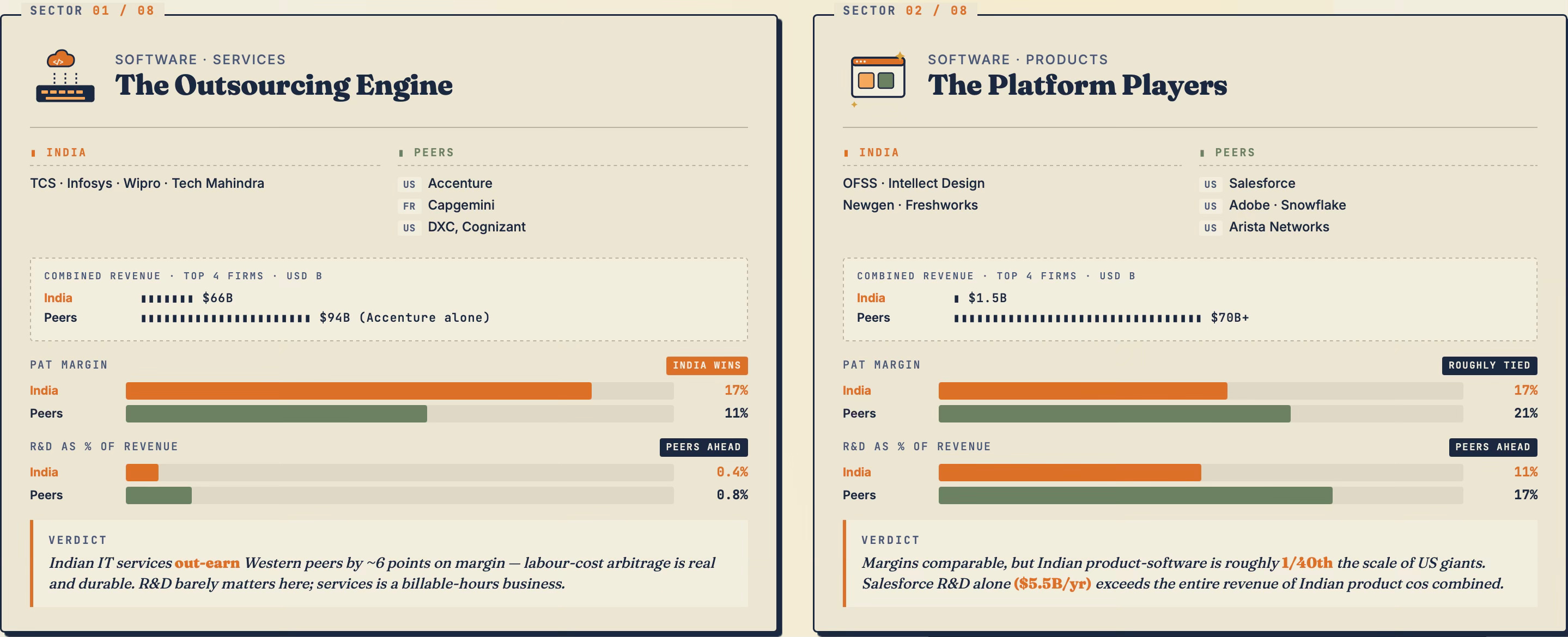
The big IT consulting/services firms are the main targets of the growing chorus of criticism in the mainstream media on the lack of dynamism and low R&D spending. It is worth noting that while Indian software service firms have margins that are significantly higher than their peers (arising not from any innovation or efficiencies but from the labour-cost arbitrage), their R&D spending lags. The R&D as a percentage of revenue runs 0.3-0.5% at Indian firms vs 0.8-1.0% at say, Accenture, a 2-3 multiple gap. Further, while the R&D spending shares of the likes of Accenture have been rising, those of the Indian firms have been stagnant or even declining (Infosys) in recent years. 

Also, the R&D expenditures of the big software service firms in the US do not include the significant amounts spent on acquisitions each year. For example, Accenture deploys $2-5bn annually in 30-40 acquisitions per year, many in AI specialities (data engineering, vertical-domain AI, ML platforms), whereas the largest Indian firms do 2-5 acquisitions per year, usually smaller and more conservatively-priced. Accenture treats acquisition as a substitute for internal R&D, while Indian firms treat it as a supplement to organic build-out. The cumulative effect is that Accenture has accumulated dozens of niche AI consulting practices acquired pre-2024, whereas Indian firms have built mostly organically and more slowly.

However, it must also be said that some of the criticism also reflects a tendency to conflate what is an inherently low R&D industry with the R&D-intensive product-focused Big Tech and AI firms. IT services have never been an innovation-focused industry. Further, compared to several other industries (as we shall see), the R&D spending of Indian IT services firms is not that far behind their Western peers. 

While Indian software product firms hold up on margins, they too lag on R&D. The 5-6 percentage-point gap between US and Indian product company R&D spending is the closest real number to “the innovation gap” people often talk about. On size, if you take out OFSS, which is a subsidiary of Oracle, there is no Indian company with even $300 million in revenues. The four Indian product companies combined generate ~$1.5 bn in revenue. Salesforce alone does $38 bn. Adobe does $21 bn. They are dwarfs to their global peers. This is the real software industry gap. 
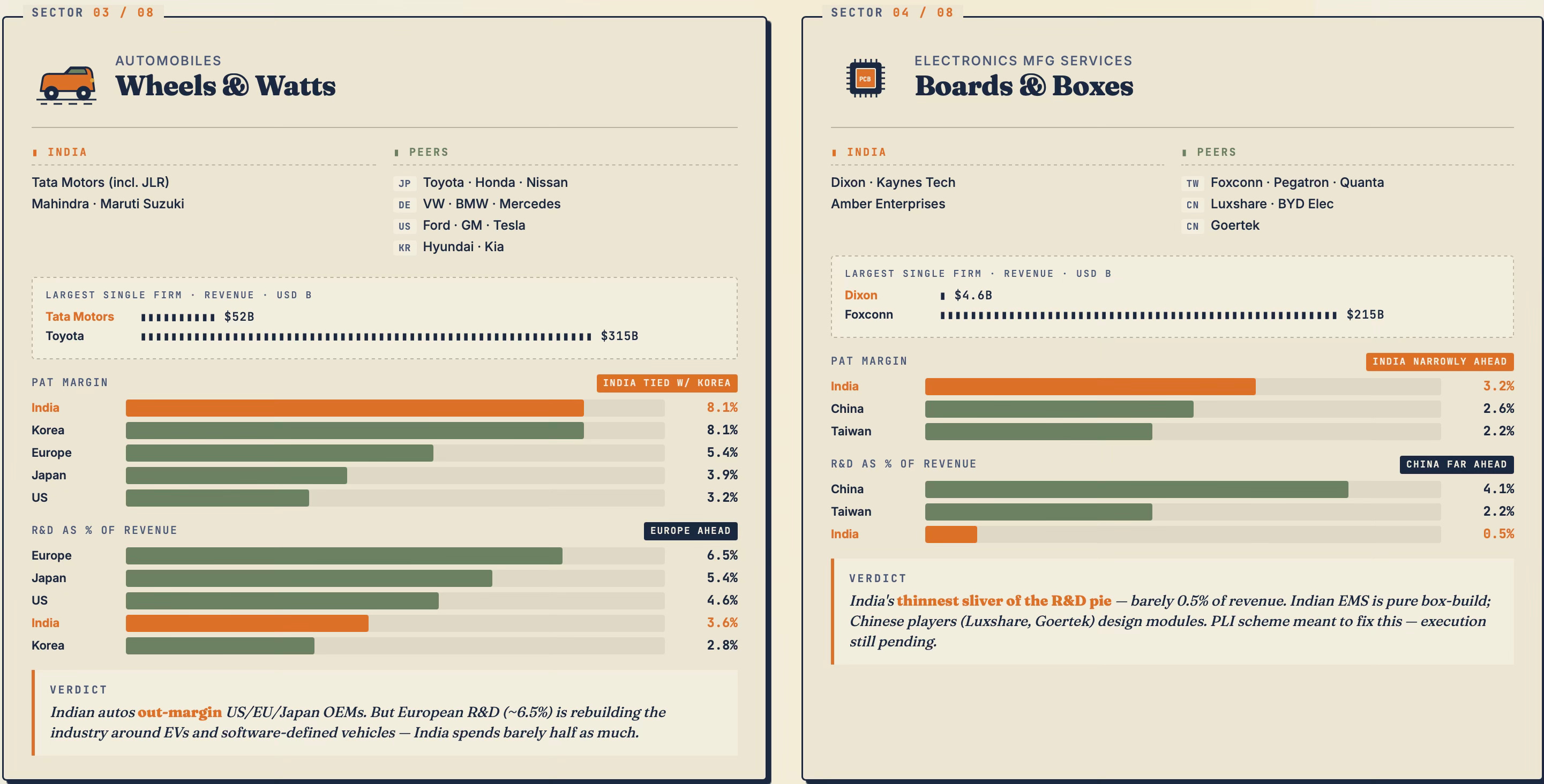
In the automobile industry, Indian OEMs outperform their global peers on profitability. The R&D intensity at 3.6% is half of Europe's but comparable to Japan and the US. This conceals the fact that, despite being in the business for decades, the big Indian OEMs continue to depend on foreign designers and engines. They have been comfortable doing business by licensing technology and importing engines. Further, where India really lags is in the frontier technologies like batteries and electric vehicles. All these point to an ambition or aspiration gap. 

Indian EMS profitability is again slightly better than that of Chinese and Taiwanese, but the R&D gap is the starkest in the entire analysis. Indian EMS spends 0.5% of revenue on R&D vs Chinese 4.1% vs Taiwanese 2.2%. Indian players are doing pure box-build assembly, whereas the Chinese players are designing modules. This is the value-capture gap. This is an area where the market is at the cusp of a massive expansion, and it is disappointing that Indian EMS’s have not sought to move up the value chain despite the promising opportunities that they face. 
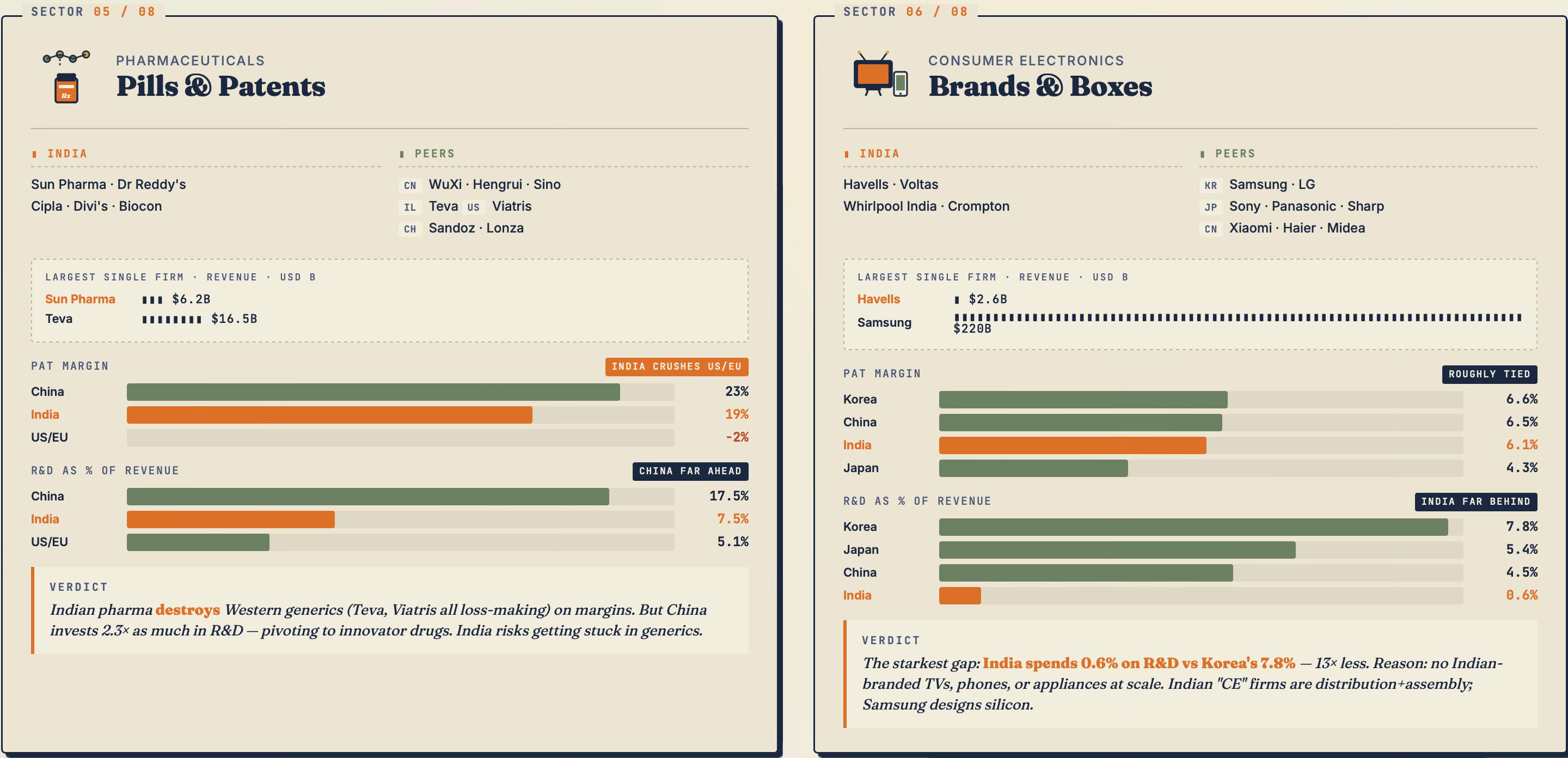
Indian pharma companies fare better than their software counterparts in both margins and R&D spending compared to their Western peers. Here, however, the Chinese are far ahead. Chinese pharma R&D intensity (17.5%) is more than double Indian (7.5%), with Hengrui, Sino Biopharm aggressively pivoting to innovator drugs. India's generics-and-biosimilars model is very profitable today but less R&D-intensive, raising the question of where margins go in 5 years.

The consumer electronics industry must count as one of the biggest disappointments. There is essentially no Indian consumer electronics industry comparable to its global peers. Even the biggest Indian firms are tiny when compared to their global peers. Indian companies (Havells, Voltas, Whirlpool India, Crompton) are appliance brands relying on outsourced electronics, explaining the 0.6% R&D figure compared to Korea's 7.8% or Japan's 5.4%. No Indian brand has any comparable R&D capability. Most of what's made in India is for foreign brands (Apple via Foxconn, Samsung via Dixon).
Chemicals is one of India's better stories. While the top Indian firms are large and their margins are second only to Chinese firms, their R&D expenditures again lag. 

On the telecom side, Indian service providers are now the most profitable in the world, driven entirely by Jio and Airtel post-Indus-Towers consolidation. Verizon and AT&T look mediocre by comparison. The R&D number for telecoms is essentially zero everywhere except China Mobile and NTT since telecom is considered a capex/spectrum business, not an R&D business.

So what do all these mean?

The failure to produce even a mid-sized IT product firm, even after five decades of being a leader in the software services industry, is more an indictment of India’s entrepreneurship than of the IT services firms themselves. The IT product industry has had several favourable factors confluencing - the IT services industry produced enough talent and experienced professionals to supply both entrepreneurs and team leaders, there is an abundant low-wage workforce, it does not suffer regulatory failures like an inverted duty structure, high input costs or taxes, and there’s a large global market to serve. But even this combination was not enough to make even a one-billion-dollar IT product firm. 

More than the IT services industry, it is perhaps the Indian pharma industry that is emblematic of the lack of business dynamism and entrepreneurship. The country has had a serious pharma industry, with several large generics manufacturers, for over six decades. Many of the leading firms of today were established by entrepreneurs who worked in the public sector entities. They had the opportunity to move up the value chain by building massive integrated industrial facilities. Even in contract manufacturing, they have remained stuck at the small-molecule synthesis and have struggled to move up the value chain to complex therapeutics and contract research. 

Alongside the software product industry, consumer electronics should perhaps count as corporate India’s biggest failure. India has had a consumer electronics industry for several decades. With a very large market, Indian firms had the opportunity to ride the economic liberalisation, expansion of the middle class, and the global export market. 

Interestingly, the Korean and Japanese OEMs (LG, Samsung, Daikin, Hitachi) have deeper Indian manufacturing (in terms of value addition in products like refrigerators, air conditioners, and washing machines) than most Indian brands because they invested in component plants in the 2000s-2010s when Indian brands were happy to rebrand imports. 

One structural reason for this difference also points to the lack of ambition and reluctance to pursue the export markets. The Korean and Japanese OEMs treat India as a manufacturing base for both the domestic market and exports (LG exports refrigerators to the Middle East from India; Daikin to Southeast Asia). That export-anchored manufacturing economics justifies deeper component investment. Indian brands have historically been domestic-market-only and saw little case for backward integration when components were cheap to import from China.

It is therefore an unfortunate reality that the vast majority of AC and refrigerator compressors, and higher-end motors (for front-load washing machines) are imported. 
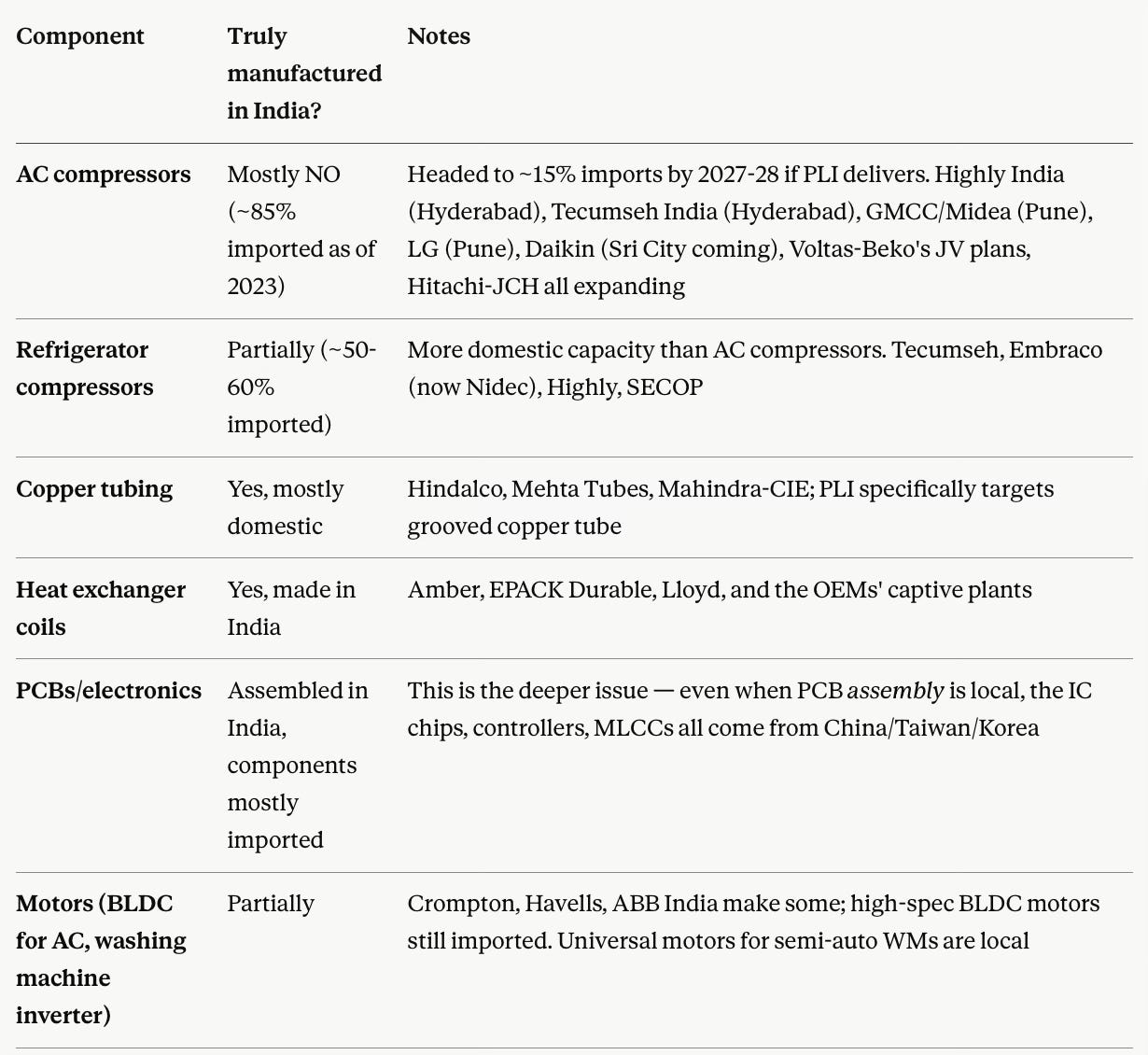
The above analysis points to a corporate world that is stuck in a comfort zone, reluctant to assume risks by trying to move up the value chain or push aggressively into the next generation of products or technologies. There is a strong preference to stay on the sidelines and wait for technologies and products to emerge elsewhere. I’m not sure whether there is even one industry where Indian firms have been pioneers in showing the way with the next generation of products. Across industries, they always follow the trends in developed markets by copying and imitating. 

The large captive market (domestic and foreign) is considered a safe enough moat (thanks to a combination of price-sensitive customers and import protections) that would allow these firms to grow for a long time to come. There is little incentive (apart from inclination) to explore and expand beyond this comfort zone. 

In a globalised market, across industries, competitiveness is critically dependent on continuously moving up the value chain. It is a treadmill where, like the Red Queen, firms must run hard to retain their global competitiveness. And Indian firms, across industries, have shown consistent reluctance on this. It points to a problem of what I have described earlier as an entrepreneurship deficit.

With this entrepreneurship deficit comes a low risk appetite. This reflects in the reluctance to deploy capital. Moving up the value chain and expanding to foreign markets, essential requirements to becoming globally competitive, demand assuming significant risks by making large capital investments with long-term bets. These investments would also include cultivating supplier ecosystems, funding and nurturing startups, and long-term partnerships in general. Indian firms, especially the largest ones, have shown great reluctance to assume the risks and make these investments.

The reluctance to invest despite the consistently high margins across industries may be a symptom of the entrepreneurship deficit. As we have observed, firms are satisfied with their domestic markets and have limited or no appetite to expand into export markets. Further, the tepid growth of the domestic market (a reflection of the low aggregate demand growth, in turn a reflection of the narrow base of the consumption class) also discourages significant investments. All this manifests in a preference for short-term gains and avoidance of long-term competitiveness. 

This is a nice summary of the motivations driving Indian firms.

India has a large domestic market, and the economy is growing at 6–7%. So, you can bring what has worked elsewhere, deploy it in the market, and make a lot of money. It’s less risky. That’s what corporates have been doing. It’s the cycle of development. But when you want to compete internationally, you need to think about your own ideas.

Another reason to invest more and pursue export markets is to increase size. As the analysis shows, even the largest Indian firms across the eight sectors are small compared to their global peers. Despite being more profitable than their global peers, their much smaller size is an important obstacle to global competitiveness. 

The argument that government policies have been a binding constraint is not convincing. For one, the software industry, despite largely serving the global market and not being significantly constrained by public policy, did not produce any product firm or product of note despite several technological trends sweeping the industry in the last three decades. Second, even among the leaders in different industries, there has been little appetite to move up the value chain, expand into global markets or pursue new generation technologies and products. Third, even in localising manufacturing by nurturing local supply chains and partners, storied Indian OEMs have been behind foreign OEMs who have entered the market much later. 

Fourth, the argument that import restrictions have prevented Indian firms from becoming competitive flies against the reality that the Northeast Asian economies built their manufacturing successes in highly restricted markets. Instead, as Joe Studwell has written, they gained competitiveness by competing in the export markets. 

Now the government has thrown caution to the wind and, through the Rs 1 lakh Cr Research Development and Innovation Fund (RDIF), is funding even large corporates on their R&D endeavours. This may be the most that governments can do to push their industries towards innovating. It remains to be seen whether even this is sufficient. 

In conclusion, it appears that Indian firms suffer from an entrepreneurship deficit, risk aversion, and a lack of intrinsic desire to think big (by moving up the value chain, pursuing next-generation technologies, and expanding into export markets). They seem satisfied with serving their captive local markets, continuing their existing product lines and business models, and following global leaders in technology and product trends. This is a reality, borne out strikingly by evidence. Whether it is culture or something else can be a matter of debate. 

PS: On the issue of entrepreneurship, Claude had this comment on the prospects for India’s software services industry. 

Accenture sells outcomes and prices its services on the value of the transformation. Indian firms sell capacity and price on the cost of the underlying labor. Generative AI threatens the capacity-pricing model directly because it compresses the labor hours needed. It enhances the outcome-pricing model because AI-enabled transformations are higher-stakes and command premium fees.

This is why the next 2-3 years will be the real test: not whether Indian firms have AI capabilities (they clearly do), but whether they can shift their pricing and packaging model fast enough before Generative AI deflation hits their core managed-services contracts. Accenture has already crossed that bridge; TCS, Infosys and Wipro are mid-bridge with the macro tailwind weakening.

This is a test of entrepreneurship and reinvention of business models for the Indian IT services firms.

Monday, January 19, 2026

The rule of law and predictability underpins effective markets

The US invasion of Venezuela and capture of Nicolas Maduro is the signature intervention under the emerging Donroe Doctrine. However, Venezuela’s oil reserves, precisely the reason the US intervened, may end up complicating matters. For a start, despite the President’s exhortation to US oil majors to line up and invest in the country, they appear to bereluctant. 

Ricardo Hausman hits the nail on the head with this brilliant articulation of the paradox - the manner in which the whole thing has been executed undermines the credibility of the objective itself.

Capitalism is not simply private ownership. It is voluntary exchange under predictable rules — rules that bind the powerful as well as the weak, and that survive electoral transitions. Those rules are what make long-horizon investment possible. Predation is what happens when power writes the rules opportunistically, then demands they be treated as law. That distinction matters most when it comes to oil. Reviving Venezuela’s energy sector would require large, frontloaded capital spending to repair and expand infrastructure. Those expenses would have to be followed by many years of positive cash flows to repay sunk costs and earn a return. 

Oil is the opposite of a quick-turn business. Its economics hinge on whether rights will be respected long enough to recover the initial outlays. These rights do not emanate from threats. They come from a legitimate state: a government that can claim consent; a legislature that can authorise commitments; regulators and courts that can enforce them; and a political system that investors believe will honour yesterday’s deal tomorrow. Unpredictability may occasionally be an asset in international affairs, but trust is the real strategic currency. And trust is precisely what a coercive interim arrangement cannot supply. Delcy Rodríguez, Venezuela’s interim president, has no electoral mandate and inherits institutions whose legitimacy is contested. Contracts signed now — especially if shaped under foreign pressure — will be politically and legally fragile. A future democratic government would have reasons to revisit them, if not repudiate them outright. In anticipation, US oil majors will not invest. 

Investors can price commodity risk. They can hedge operational risk. What they cannot hedge is foundational illegitimacy: the risk that the very basis of a contract will later be judged void because it did not emanate from an authorised government. If Washington’s message is that legality follows power rather than constraining it, capital will rationally assume that every deal is hostage to the next shift in power, whether in Caracas or Washington. The political sequencing is also backwards. It is not prosperity that creates legitimate government; it is legitimate government — namely, democracy and the rule of law — that empowers people to create prosperity. With these foundations, markets can do what they do best: decentralise initiative, mobilise investment and reward productive effort rather than proximity to power.

This is brilliant and has resonance elsewhere. Two markets in particular come to mind: infrastructure and technology. 

Predictability arising from the sanctity of the rule of law is the most important requirement for the functioning of private markets. It is this confidence that allows investors to invest their money, and just as importantly, entrepreneurs to put their efforts. Predictability extends not only to business creation and ease of doing business, but also to retaining control of their businesses. The latter is important given trends in industries like emerging technologies and infrastructure, where a dominant industry leader swoops in to forcibly take over a promising emerging firm. 

Ambitious entrepreneurs are driven by their belief in scaling their businesses and leading their industries. And in many sectors, especially but not only infrastructure, these are also long-drawn journeys spanning decades. In other words, building one enduring and dominant business is an endeavour of a lifetime. 

In this backdrop, any threat of being forcibly ousted and taken over can be a serious, if not prohibitive, deterrent to entrepreneurship. Why would an ambitious entrepreneur put in his sweat and toil to build a business if he runs the imminent threat of being forced out by a dominant rival precisely at the time his business starts to show promise and reaches the scaling pathway? Similarly, why should investors put their money in such risky and long-drawn projects when they know that they run the risk of seeing the entrepreneurs they backed being ousted and their upside being capped? 

Thanks to network effects and resultant market structures, the commanding heights of the digital technology industries are oligopolies or monopolies. Therefore, in the technology industry, once a promising startup comes up with a new or disruptive idea in any of the frontier areas like AI, chip design, or robotics, they run the risk of being harried and bullied into being absorbed by the Big Tech firms. Apart from snuffing out any potential competitor, Big Tech firms want to deepen their moats by capturing all innovations in their ecosystem. These pressures and threats are triggered through multiple channels - product development ecosystem, market access, investors, legal notices, and so on. 

Infrastructure sectors, being deeply enmeshed in the political economy and where the dominant incumbents formulate the rules of the game, are rife with crony capitalism and regulatory capture. Therefore, in the infrastructure industry, once a firm builds up a good portfolio of projects after several years of hard work and persistence, they run the risk of the dominant market leader swooping in and taking over by ousting the management. 

The new entrants are vulnerable to being coerced off their assets, even without a fair return or compensation, and often with the active support of the governments. In addition, in the context of Indian states, it is not uncommon to find the ownership of prime infrastructure assets changing hands (or shareholding patterns shifting) from the contractors preferred by the previous government to those favourable to the incoming government. 

All these act as significant deterrents for investors and entrepreneurs. Sectors like infrastructure and information and communications technology (ICT) are critical drivers of economic growth, and incentive distortions that discourage investors and entrepreneurs can be binding constraints on economic growth. 

Wednesday, February 19, 2025

Agriculture needs more dynamic entrepreneurship

I blogged here that supporting enterprising farmers is perhaps the highest value for money investments in agriculture and their activities have the highest local economic multipliers. 

Harish Damodaran has another story of agriculture entrepreneurship involving processing potatoes to make french fries and exporting them. He points to a stunning transformation in the market for french fries.

As consumption of the crispy straight-cut deep-fried potatoes grew, so did imports – crossing 5,000 tonnes annually by the mid-2000s and peaking at 7,863 tonnes in 2010-11 (April-March). But cut to 2023-24, when not only have imports practically ceased, India actually exported 135,877 tonnes of FF valued at Rs 1,478.73 crore. During April-October 2024, exports were 106,506 tonnes and worth Rs 1,056.92 crore. This turnaround – from an importer to an exporter of a highly western fast-food product – has been thanks to opportunity-seizing domestic entrepreneurs, who also harnessed the potential of processing potato varieties suitable for making FF and cultivating them in India…

The Ahmedabad-headquartered HyFun Foods Pvt. Ltd. accounted for about 85,000 out of the 175,000 tonnes of FF – plus another 8,000 out of 12,000 tonnes of potato hash browns – exported from India in the last calendar year. Other major exporters are Iscon Balaji Foods, Funwave Foods and ChillFill Foods (all from Gujarat) and the US-based J.R. Simplot (it also has a plant in the state). India’s export of FF exceeds its estimated domestic consumption of 100,000 tonnes. Roughly 80% of that comprises sales to businesses (the likes of McDonald’s, KFC and Burger King, besides hotels, restaurants and caterers) at an average Rs 125/kg realisation and the rest to the retail segment at Rs 200/kg, adding to a total market size of Rs 1,400 crore… 

In the 2023-24 season – potato is sown in October-November and harvested in February-March – HyFun procured 300,000 tonnes from 6,000 farmers in Banaskantha, Sabarkantha, Gandhinagar and Mehsana districts of Gujarat. For the current season, the company plans to buy 400,000 tonnes from 7,250 farmers growing in 30,000 acres of Gujarat, 1,500 acres of Madhya Pradesh and 500 acres of Uttar Pradesh… HyFun provides good quality disease-free seeds of Santana, Frysona and FryoM potato to its farmers. It sources their mini-tubers grown in tissue-culture labs by seed-potato companies: ITC Technico Agri Sciences, Mahindra HZPC and KF Biotech. These are multiplied first in 250-plus acres of HyFun’s corporate farms and then over two generations through contract seed growers in Punjab, Haryana and UP. The third-generation seed is what farmers like Patel plant for supplying back as commercial potato to HyFun.

The article informs how these firms contracted with farmers to grow potato varieties with higher dry matter (lower moisture content), high-reducing sugars, and large oblong-shaped that are best suited for fries by enabling the supply of seeds of Kufri variety developed by the Central Potato Research Institute, Shimla. It also highlights how HyFun collaborated with farmers to improve their productivity and bring down their cost of cultivation. This collaboration covered inter-cropping practices to improve soil fertility, demonstration plots to optimise planting space and depth, optimise fertiliser use, and adopt drip irrigation. 

Agriculture sector interventions by the government have hitherto been to create public goods - irrigation infrastructure, post-harvest facilities including godowns and cold storages, public procurement, and extension services - and provide subsidised inputs - seeds, fertilisers, power, credit, etc. By their very nature, all these are targeted to benefit all farmers. 

Instead, there’s a need for a complementary policy that looks at unlocking enterprise among farmers. The examples of HyFun, Sahayadri Farms in Nashik (grapes), shrimp farmers in the coastal districts of Andhra Pradesh, and Pomegranate farmers in Rajasthan show that successful examples arise from persistent problem-solving and seizing of emerging market opportunities by enterprising farmers.

Public policy should indulge in similar problem-solving in a focussed manner so as to catalyse at least hundreds, if not thousands, of such successes over a five-year period. 

What do entrepreneurs in agriculture and agri-processing need? What are the specific facilities or facilitations that they need? What regulatory enablers and financial and other forms of support are required? What market access support can be provided?How can existing markets be leveraged to provide those? What are the market-making requirements? What financial instruments can achieve the objectives? In general, what coordination failures can be addressed by governments and how? 

These are the kind of questions that must be explored in the design of this policy.

Public policy has focused on supporting entrepreneurs and their startups, and their successes, though mostly confined to those engaged in technology-based activities, have been celebrated. This salience should extend to the agriculture sector, and supporting agriculture entrepreneurs should occupy primacy in public policy. 

As a cautionary note, this policy initiative should stay clear of infrastructure and other publicly provisioned support to avoid any mission creep and remain focused. It should also steer clear of the politically sensitive regulatory reforms. In fact, it should avoid macro-interventions unless otherwise essential to meet its objectives. 

Instead, it should seek to support entrepreneurial farmers to access market facilities and incentivise the market to deliver services required by these farmers. Such support would involve facilitating market access to good quality seeds (including subsidies), affordable and timely credit, coordinating on accessing various post-harvest services, facilitating trade-related clearances and permissions, and generally supporting on market access interventions. 

A low-hanging fruit would be to harness the services of the several non-profits and for-profit startups engaged with the agriculture sector. This can be done by creating platforms systems that perform the market access and matching role - expose entrepreneurial farmers to these entities and allow enterprising startups to engage with similarly enterprising farmers. It should designed to encourage problem-solving and iteration by entrepreneurs to develop business models and access markets and similarly encourage market service providers to engage with entrepreneurial farmers. 

The central (or some state) government could consider a mission to unlock rural entrepreneurship by identifying and supporting enterprising farmers and rural startups in commercial agriculture production and agri-processing, which can localise value capture, increase farm-related incomes, and create productive jobs in rural areas. This would be expanding Startup India which is currently confined largely to technology-related sectors to cover agriculture, Startup India for Rural Entrepreneurs.

This initiative should avoid the pitfall of spreading the butter thin and trying to cover the entire country. Instead, it might have to be confined to a few prioritised geographies with potential for agricultural entrepreneurship.

Wednesday, February 12, 2025

Long reads - fish market, airplane parts, North Vietnam, BYD, and social capital

This post is a compilation of a few good long reads.

1. A fascinating article on Tokyo’s Toyosu, the “world’s greatest fish market”, employing 42000 people, transacts more than a quarter of all fish sold in Japan, and with an average daily sales of ¥2bn ($12.9m). The market, which opened in 2018 to replace the old Tsukiji market, aggregates the finest fish from all over the world and conducts auctions where chefs from across the world are bidders. 

Many assume that tuna bought from Japan is superior because of the species, or where they are caught. That is partly true: bluefin tuna, which tend to be fattier than other species, fetch higher prices than the leaner bigeye and yellowfin, while skipjack and albacore often end up in cans. But holding species equal, the way a fish is caught and processed matters immensely to how it tastes—and therefore to its value. 

Expert tuna fishermen avoid nets, which make the creature thrash around in fear, producing lactic acid and adrenaline that mar its taste and texture. Instead, they reel it in slowly, and then begin a process called ikejime. First, they drive a spike into its brain, killing it instantly to avoid a stress reaction that ruins the meat. Then they remove the tail fin and slice beneath the gills to bleed the fish while its heart is still beating. Blood contributes to spoilage through bacterial growth; properly bled fish will last longer… With the tail fin removed, they run a long, stiff wire into the fish to destroy its spinal cord and prevent rigor mortis. Once killed, bled and paralysed the fish goes into the freezer—or, if sold fresh, is submerged in an ice-and-water slurry.

This is a nice description of the auctions process

Before the auction, the floor is a hive of silent activity… Atop each frozen tuna sits a sticker detailing provenance and weight, as well as a thick slice cut from the tail so buyers can see the colour. Some use hooked picks to dig out small chunks of flesh, kneading it as they walk around to determine the fat content through feel. Most carry clipboards; some acknowledge each other with a brief nod. Mekiki, experts in fish evaluation, set the floor price for each fish. 

Around 5.30am an auctioneer rings a bell and sales begin. Fresh bluefin tuna fetch the highest prices: an average of $25 per kilo between January and August 2024, with the priciest fish fetching $750,000 on January 5th. Auctioneers chant rhythmically, keeping up a patter as buyers show interest with idiosyncratic hand signals and, because two houses often hold auctions simultaneously right next to each other, with eye contact. Buyers wear baseball caps with plastic plackets bearing the names of their firms; officials from Tokyo’s government, which owns the market, wear blue caps and watch out for collusion. The action is hard to follow, relying on subtle gestures and clues… By 7am the auction floor is mostly empty and being hosed down… By 8am the tuna has been butchered and sent on its way: some to restaurants across Japan; some, still frozen, stuffed into styrofoam boxes and flown to New York, Sydney or Singapore. But some, perhaps, will find its way upstairs, to the first-rate sushi joints on the fourth floor, which open just after the tuna auction ends and close by mid-morning.

This is about the market participants, which makes it a form of managed capitalism. 

Only five companies are allowed to sell, and only certain species are flogged. Wholesalers are quick to say that they do not want to put their rivals out of business. Threats to their livelihood come not from neighbours, but from retailers bypassing the market and buying directly from fishing firms. Many outfits at Toyosu stretch back generations, often linked through kinship and marriage. Good behaviour and bad are remembered, and in time rewarded and punished.

In his magnificent book “Tsukiji: The Fish Market at the Centre of the World”, Ted Bestor, an anthropologist, argued that intermediate wholesalers “define much of the character of the marketplace”. The seven big wholesalers deal with shippers and suppliers; intermediates sell to restaurant groups, supermarkets and chefs. Many are family firms. The smallest may have just two employees: the husband or son who handles the fish, and the wife or mother who keeps the books. (Toyosu remains very male; book-keeping is the only job mostly held by women.)

The number of intermediate wholesalers has fallen from nearly 1,700 in the mid-1960s to 457 today. Many small firms refused, or were unable, to move to Toyosu. Others have merged. They are laid out on what look like streets that line their building’s ground floor: cheek by jowl, with some large enough to have hefty fish tanks, a dozen workers and butchering tables big enough for an entire tuna and an arm-size knife to cut it. Some specialise, selling just tuna or eel, but many are generalists… Relationships between wholesaler and buyer can last years, even generations. The former’s success depends not just on expertise in choosing fish, but on knowing clients’ tastes and anticipating their needs… most chefs have long relationships with specific wholesalers, and the former would no more desert the latter to save a few yen than the latter would overcharge the former.

This is similar to the traditional relationships that exist in many settings in India, none more so than that of the Arhatiyas, traders, and farmers in Punjab and Haryana. While mainstream discourse tends to demonise Arhatiyas for exploiting farmers, it glosses over a more nuanced and layered set of relationships and the useful roles performed by them.

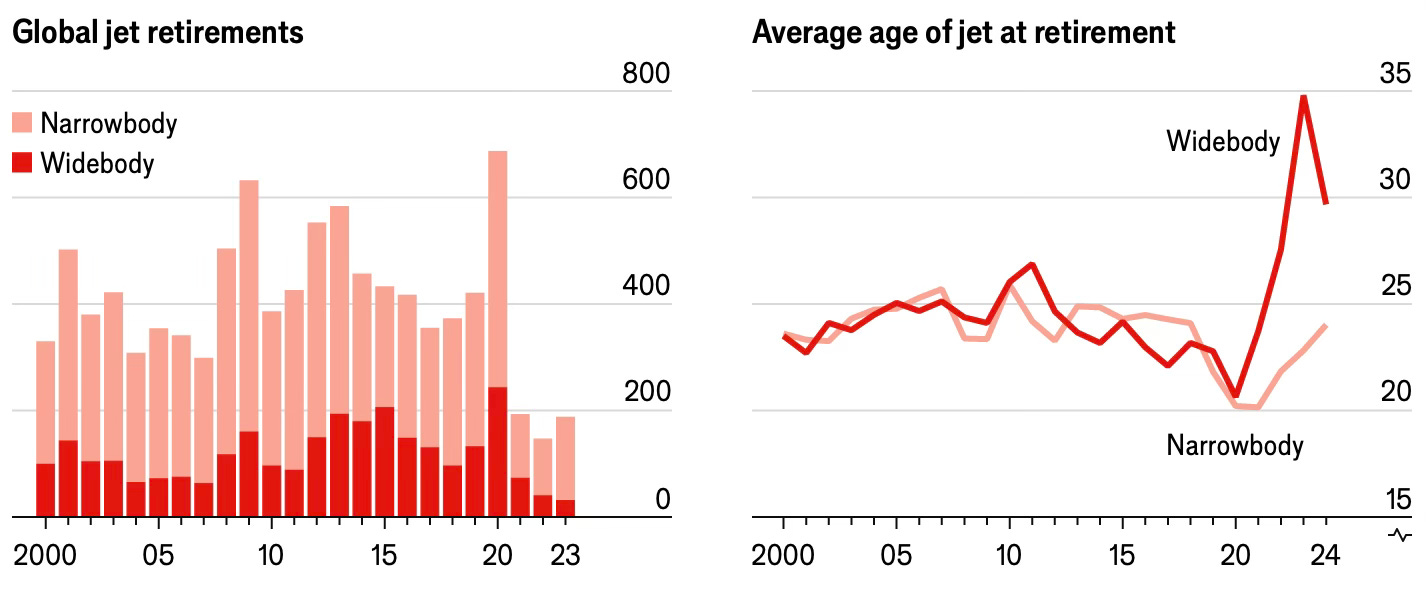
2. On the after-life of retired airplanes.

A Boeing 747 has 6m parts, many of which can be reused. Parts need to be certified and have a comprehensive maintenance history, or else their provenance becomes suspect and value plummets. The robust-looking outer covering is in fact a millimetre-thin “skin” of aluminium alloy covering a metal frame, insulated with foam. That skin is harvested by firms such as Planetags, which turns it into keychains and other keepsakes. The most valuable part is the engine, usually the first thing to be harvested… Cockpit instruments can be removed and reused in other aircraft of the same type. Sometimes the entire cockpit is repurposed as a simulator for pilot training… Higher-class seats may be sold to other airlines or hobbyists but economy seats are, on the ground as in the air, the least desirable things on a plane.

Consider the Boeing 777. It has 132,500 unique parts and some 3m in total, including bolts and rivets. Beneath the soft, rounded surfaces of the passenger cabin is a bewildering tangle of sensors, radars, pumps, pistons, cylinders and drums. Miles of wires connect avionics to the cockpit. Hydraulic systems move the rudder or wing flaps or brakes. Airlines need a reliable supply of all these bits and pieces. The global aviation industry would grind to a halt without them… The industry’s insatiable appetite for parts is fed by retired planes…

The first things to come off when a plane arrives in Arizona are the engines. Next to go is the landing gear. Avionics, instruments, hydraulics and other components are either harvested and stored or removed gradually on the basis of need. Cockpits are sometimes removed to be converted into flight simulators for pilot training. Luxurious seats at the front of the plane find new homes with second- or third-tier airlines or in the basements and garages of aviation aficionados… Once everything—engines, components, interiors—has been stripped out, the metal structure is all that remains. Made of high-quality aluminium alloy, it commands premium prices in scrap. Airbus and Boeing both estimate that around 90% of their aircraft by weight is recycled or reused in some form. 

On modern aircrafts

The latest generation of long-haul planes—Boeing’s 787 “Dreamliner” and the Airbus A350—is less noisy and more stable in turbulence. The new jets can manage higher humidity levels, lowering the chances of dehydration for travellers, and maintain higher cabin pressures that feel closer to conditions on the ground… New planes are also more efficient. Fuel is the single largest cost for any airline. Engines and weight are major factors in determining consumption. The biggest modern aircraft have just two engines compared with four on the 747 or the enormous Airbus A380 double-decker, and much of the airframe is made of light composite materials, such as carbon fibre, instead of heavier aluminium alloys. Airbus boasts that the A350 consumes 25% less fuel per seat than its predecessors, producing comparably fewer emissions. 

3. By any yardstick, Vietnam should count as one of the most remarkable economic successes in history. The New York Times has an excellent article that describes how North Vietnam broke away from the prosperous and industrialised South to lead the country’s spectacular economic success over the last two decades. 

This is a very good description of the transformation

In 1954, after separating from France to become an independent nation, it was one of the poorest and least-developed countries in Asia, relying almost entirely on subsistence farming. Haiphong, the north’s main port, was pounded by the U.S. military with some of the heaviest bombing raids of the war, and in the decade after unification in 1975, all of Vietnam became what one scholar called “a poverty-stricken society beset by a stagnant economy.” Today, double-digit growth rates in the north are the norm, and Haiphong is a modern metropolis of two million people connected to Hanoi by a new highway. Cranes swing like weather vanes above more than a dozen construction sites. New bridges cross a river twisting through the city, where piers at industrial parks help ships move to one of the busiest ports in the world.

The election of Donald Trump in 2016 and his tariffs on Chinese imports and other trade restrictions were triggers for North Vietnam’s take-off. Now, with the re-election of President Trump, the wheel may have turned the full circle.

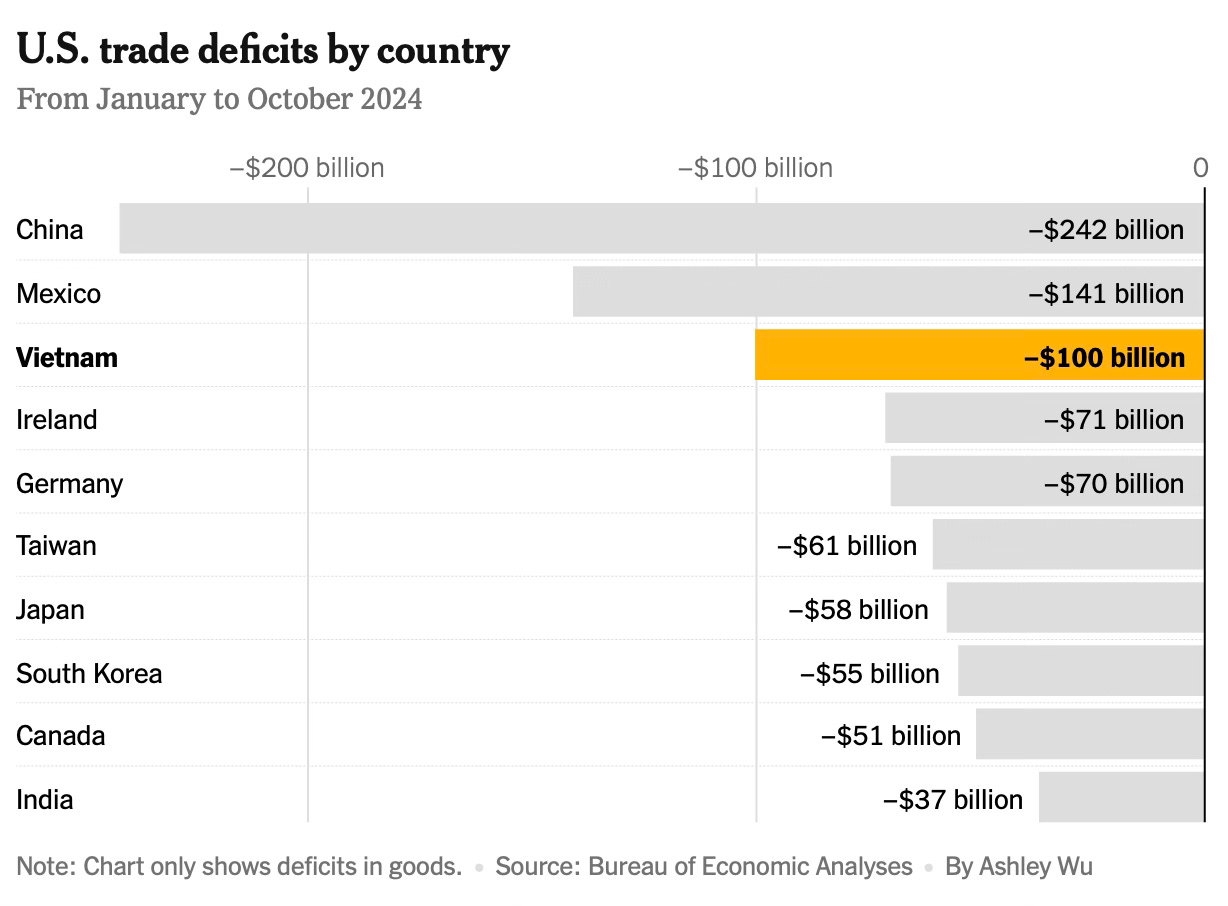
Six years ago... President Donald J. Trump hit China with tariffs, igniting a global search for alternatives to Chinese manufacturing. Few nations, if any, have benefited more than Vietnam from the scramble that followed — especially north Vietnam, historically an economic laggard compared to the more cosmopolitan south. Around Haiphong, a few hours’ drive from China, factories bloomed. The LG plant expanded exponentially; the industrial park nearby filled up with Chinese companies adding production abroad. Rural hamlets... grew almost overnight into boom towns of 30,000... Mr. Trump has vowed to punish countries that have large trade surpluses with the United States, and Vietnam now ranks third on that list, behind only China and Mexico. Officials in Hanoi say they worry... that Vietnam will be singled out for tariffs while competitors avoid Mr. Trump’s blacklist. South Korean companies (including LG and Samsung) are Vietnam’s biggest foreign investors, and some have already paused expansion plans, waiting on Washington... No matter what happens next, America’s once-and-future president can safely say he helped make north Vietnam great again.

Vietnam’s worry comes from a graphic that drives most of President Trump’s foreign and trade policy actions 

While Vietnam may have become a victim of its success, it may be simplistic to lay the blame on the relabeling of Chinese products. 

Between 2017 and 2023, foreign investors committed $248.3 billion to Vietnam for 19,701 projects, according to an analysis by Le Hong Hiep, coordinator of the Vietnam studies program at the ISEAS-Yusof Ishak Institute in Singapore. That’s more than half of all foreign investment since Vietnam opened its economy in the late 1980s. Vietnam’s growing trade surplus with the United States — reaching $104 billion last year, up from $38 billion in 2017 — has led to accusations that China uses Vietnam as a warehouse, rerouting its products to avoid tariffs. Chinese imports and investment have soared... Of the roughly 120 Japanese companies using government diversification subsidies, over 50 claimed them for Vietnam, more than any other country, according to Japanese officials... 

But in a country as wary of its neighbor as Vietnam, where 1,000 years of Chinese colonization lingers in national memory, the boom is by no means owned or operated by Beijing... A recent Harvard Business School study showed that illegal tariff avoidance was more rare than the trade imbalance might suggest — representing between 1.8 and 16.1 percent of exports to the United States in 2021. Researchers found that most exporters were making new products with inputs from many locations and local investment, not just relabeling Chinese products as Vietnamese.

What explains the success of the North?

Bruno Jaspaert, chairman of the European Chamber of Commerce in Vietnam and the chief executive of DEEP C, which runs industrial parks around Haiphong, said the waterway was just one regional advantage. Northern provinces have also had leaders better connected to Hanoi, yielding more infrastructure investment, plus more open, affordable land. Compared to the south, where an industrial base left over from the war made it easier for companies like Nike to get going in the 1990s, Mr. Jaspaert said the north “started later, they can plan better and they are also much faster.”

Pointing out the window of his office to Haiphong’s new city hall, surrounded by new apartment complexes, he emphasized that none of that was there when he moved to Vietnam in 2018. Northern Vietnam was already growing then, in a country that lifted 40 million people out of poverty from 1993 to 2014. But American tariffs became an economic accelerant — lighter fluid poured on a steady flame. And in the north, an epicenter of ancient Vietnamese civilization and Communist revolution, government officials’ quick action coincided with foreign investors’ own sense of capitalist urgency. Mr. Jaspaert said production decisions that once took 18 to 24 months now take six to nine. And while the south stagnates somewhat (Ho Chi Minh City’s subway line remains incomplete after 20 years of construction), the north races on. DEEP C’s revenues and profits have quintupled since the Trump tariffs…

Villages like Mr. Van Thinh’s have been transformed. When the LG plant expanded in 2019, the narrow streets of nearby hamlets quickly turned into commercial strips with restaurants and bold-colored barbershops for workers who make a solid local wage of around $400 to $550 a month. Every spare piece of land has been turned into worker housing. Mr. Van Thinh now manages 35 rooms with his family. Nearby, Pham Thi Cham, 55, drained a backyard pond where she raised fish to build eight rooms that she rents out for about $60 a month. Many of the workers come from central Vietnam. Instead of going south, they came north.

4. Bloomberg has a long read on the spectacular rise of Chinese automaker BYD, Build Your Dreams.

After increasing its annual sales in China 15 times over, to 3 million cars in only three years, BYD is now exporting to roughly 95 markets, including 20 new ones this year. The company is building, has recently opened or has announced plans for assembly plants outside China in 10 countries on three continents. The speed and scope of this expansion have caught the global auto industry off guard and triggered protectionist tariffs in the US and EU… BYD’s electric and hybrid vehicle car sales rocketedfrom just under 180,000 in 2020 to 1.86 million in 2022, giving (it)… the cash to fund a new overseas push… 

BYD, which stands for “Build Your Dreams,” is the brainchild of Wang Chuanfu, a 58-year-old battery scientist who in the 1990s saw an opportunity to start a rechargeable battery company to challenge Japan’s hold on the industry. It began by focusing on batteries for mobile phones and power tools, but in 2003 it decided to pursue cars. Wang’s battery and manufacturing innovations, cushioned by China’s EV-friendly government policies and the scale of its domestic auto market, have helped BYD do what Tesla Inc., Ford Motor Co. and the rest of the auto industry haven’t: build an affordable electric car for the masses and make money doing it. Since introducing a new battery technology in 2020, BYD has gone from being an also-ran in China’s crowded car market to cracking the top 10 automakers in the world…

It also wants to do what no Chinese carmaker has ever done: become a globally recognized consumer brand. It’s hoping to transcend geopolitics through the appeal of a plug-in hybrid sedan that can go 1,200 miles without stopping at a pump or a charger. Stella Li, BYD’s executive vice president and the face of its global expansion, says she wants consumers to see BYD as “a technological pioneer in changing the world.”… a playbook she has used whenever entering a new market: Do intensive market research; win hearts and minds on the ground; then tap BYD’s vast product portfolio to deliver whatever the locals want. One city might want a rail transit system, another an electrified municipal bus fleet. In London she started out with electric city buses to introduce the brand, then moved on to passenger cars. She did the same in Jakarta. In Brazil the playbook was jobs… As in Brazil, Li formed a partnership with taxi drivers through a ride-hailing app in Mexico City. She sold electric work trucks to Mexican conglomerates such as Grupo Bimbo SAB de CV and Cemex SAB de CV, and cut a deal with El Puerto de Liverpool, Mexico’s ubiquitous luxury department store chain, to sell EVs and at-home chargers at the mall.

The stories of Wang and Li are inspiring

Wang was thinking about cars as early as the 1990s. To him, BYD had always been more than just a low-cost battery manufacturer. It was a research and development machine that would use rechargeable batteries as a launchpad for products that could change entire industries. The orphaned son of farmers in rural Anhui province, he was raised by his siblings and earned an undergraduate degree in metallurgical physical chemistry in 1987, then a master’s from the Beijing Non-Ferrous Research Institute, where he became a government researcher… Wang started BYD in 1995 with a $350,000 loan from his cousin. He reasoned he could replace expensive automated Japanese manufacturing systems with one that made use of an abundance of low-cost Chinese workers to assemble batteries manually. But cheap labor was just a piece of the puzzle; the goal was to be as vertically integrated as possible, making not only batteries but also the components, tools and equipment necessary to produce and test them… In 2023, UBS AG did a teardown of the BYD Seal sedan, a challenger to the Tesla Model 3, and found that about 75% of the parts were made in-house, giving BYD a 25% cost advantage over American and European carmakers.

The company got its first big break thanks to a young saleswoman named Li Ke, known outside Chinese-speaking circles as Stella Li. If Wang is the visionary engineer guiding BYD’s elaborate skunkworks, Li, the company’s No. 2, is the driving force behind its expansion, representing BYD in meetings with customers such as Apple Inc. or leaders including the president of Brazil. She graduated from China’s prestigious Fudan University with a degree in statistics and joined BYD in 1996 as a marketing manager for global exports. Wang sent her to Europe and the US to set up offices, and her efforts in that role are the stuff of company lore. In her mid-20s and with a rough grasp of English, Li showed up with a box of battery samples and spent months courting the procurement team at Motorola’s battery R&D campus in the Atlanta suburbs. Motorola executives thought she was a pest, according to one who dealt with her at the time, but the cost savings she was promising were so great and Li was so persistent that they eventually agreed to test BYD’s battery cells. It took two years of evaluation to win the contract. At one point Motorola was so impressed with Li that the company tried to hire her for its sales team…

A year after taking BYD public in 2002, Wang bought a majority stake in a failing state-run car company, Xi’an Qinchuan Auto Co. Angry investors called BYD, appalled that it was wading into a market it knew nothing about—Wang didn’t even know how to drive at the time. But he saw cars as a natural extension of BYD’s battery business. In 2004 he gave a speech at the Beijing auto show declaring his intention to use batteries to change the future of the auto industry. It took almost 20 years for Wang to prove he was right. In 2008, BYD became the first company to produce a plug-in hybrid at commercial scale… Wang continued to pour money into product development, eventually building 11 R&D centers and a vertically integrated company that made everything including batteries, solar panels, printed circuit boards and semiconductors… BYD has equity stakes and long-term agreements with lithium miners, refiners and makers of cathode material, a key battery component… 

If the Motorola deal transformed BYD once, the Blade battery, unveiled in 2020—and now powering all of the company’s cars—would do it again. Most researchers outside China were trying to improve EV range by experimenting with nickel-based batteries. Wang chose lithium iron phosphate, or LFP, which was cheaper and less fire-prone but had been largely dismissed because it lacked energy density. Using LFP allowed Wang and his team to streamline the battery pack, do away with some of the clunkier fire-prevention components and fuse cells directly to the chassis. These improvements proved LFP could be harnessed for longer-range EVs, drastically reducing overall cost. It was so competitive that Toyota uses it in its cars in China, as do many Chinese carmakers.

5. One of the great paradoxes of our times is the co-existence of historically high levels of interconnectedness (trade, finance, migration, idea flows, social media etc.) amidst the growing economic, social, political, and geopolitical polarization. 

Andy Haldane finds an explanation in the work of Robert Putnam whose book at the turn of the millennium, Bowling Alone, sought to document the weakening of community ethics among Americans since the Second World War. He explained it in terms of the loss of social capital - an erosion of the social networks of trust and relationships and the fraying of the social fabric, within and between communities. Haldane writes ,

Putnam’s recent documentary, Join or Die?, shows that these patterns have worsened over the course of this century — and not just in the US. Unravelling of the social fabric has become an international norm. Research has shown just how large and lasting are the costs of bowling alone. From sub-par growth to stalling social mobility, from the epidemic in loneliness to the crumbling of communities, the erosion of social capital goes a long way to explaining some of our greatest scourges. 

He writes about the importance of social capital, compared to the conventional capitals, at individual, community, social, and even national levels.

At the national level, cross-country evidence points towards a strong, causal link between social capital and growth, even once the other “capitals” more often focused on by economists (human, physical and, infrastructure) are taken into account. A 10 percentage point boost in trust raises an economy’s relative economic performance by 1.3-1.5 per cent of GDP. If the UK could achieve Scandinavian levels of trust, this could add £100bn per year to our growth. One key mechanism through which social capital boosts growth is by unlocking opportunity. Recent research by Harvard economist Raj Chetty et al suggests social connectivity may be the single most important determinant of social mobility. Providing a poor (typically disconnected) child with the network of a rich (connected) child boosts their lifetime income prospects by 20 per cent, according to Chetty’s estimates. Few, if any, policy interventions, education or otherwise, yield so high a life-long return. 

These effects are just as large and lasting for non-financial measures of health. Century-long US studies tell us that the single best predictor of someone’s longevity and happiness is the quality of their relationships or social capital. As US Surgeon-General Vivek Murthy has observed, bowling alone is the equivalent of smoking 15 cigarettes a day, shortening lifespans and eroding mental health and wellbeing. What is true for individuals and nations is also true for communities. In the poorest, security and solidarity sit at the top of residents’ hierarchy of needs, Maslow-style. Social cohesion and connection are known to reduce crime and antisocial behaviour and build pride in place and belonging. That makes social capital an essential foundation in making successful places. Without it, they atrophy or, worse still, riot. The depletion of social capital matters in one further key dimension — the effectiveness of government. Government legitimacy and effectiveness requires public trust. This is currently in short supply.

Haldane advocates a focused endeavour to develop social cohesion and capital. 

Our current education systems are more often a recipe for social stratification than mixing. That calls for a radical rethink of curricula and extracurricular activities, and educational access criteria, to make social connection a fore rather than afterthought. Next, unplanned urban sprawl has contributed significantly to the Balkanisation of communities. In future, social cohesion should be at the heart of spatial planning. LSE professor Richard Sennett has proposed sociable housing, connecting disconnected communities through mixed tenure residences, communal spaces and an improved public realm… Social capital is built on strong social infrastructure — faith-based institutions, youth clubs, community centres, parks, sports and leisure facilities, libraries and museums. Yet investment in social infrastructure is meagre relative to physical and digital infrastructure. Reprioritisation and reinvestment are overdue. 

If citizen trust is to be rebuilt, new models of governance are needed too. Citizen panels and juries are effective in building trust and cohesion in diverse communities. Yet they are far from the democratic mainstream. In a return to the original Greek model of democracy, community-led coalitions could play a central role locally. In addition, mainstream and social media are a key conduit for both social connection and, increasingly, social division. Many countries are legislating to avoid online harm. But too little is being done to support online good where it nurtures social cohesion. Public service broadcasters and regulators have a vital role to play in doing so.

Thursday, October 17, 2024

Constraints to large manufacturing facilities in India

The conventional wisdom on firm size in India is that labour regulations on hiring and firing (specifically the Industrial Disputes Act, IDA) hinder its growth. I have blogged here and here pointing to research that raises doubts about this argument and here pointing to the importance of the lack of entrepreneurial appetite and dynamism as a contributor. My co-authored paper here dwelt extensively on the problem of firm size and productivity. This post will discuss the issue. 

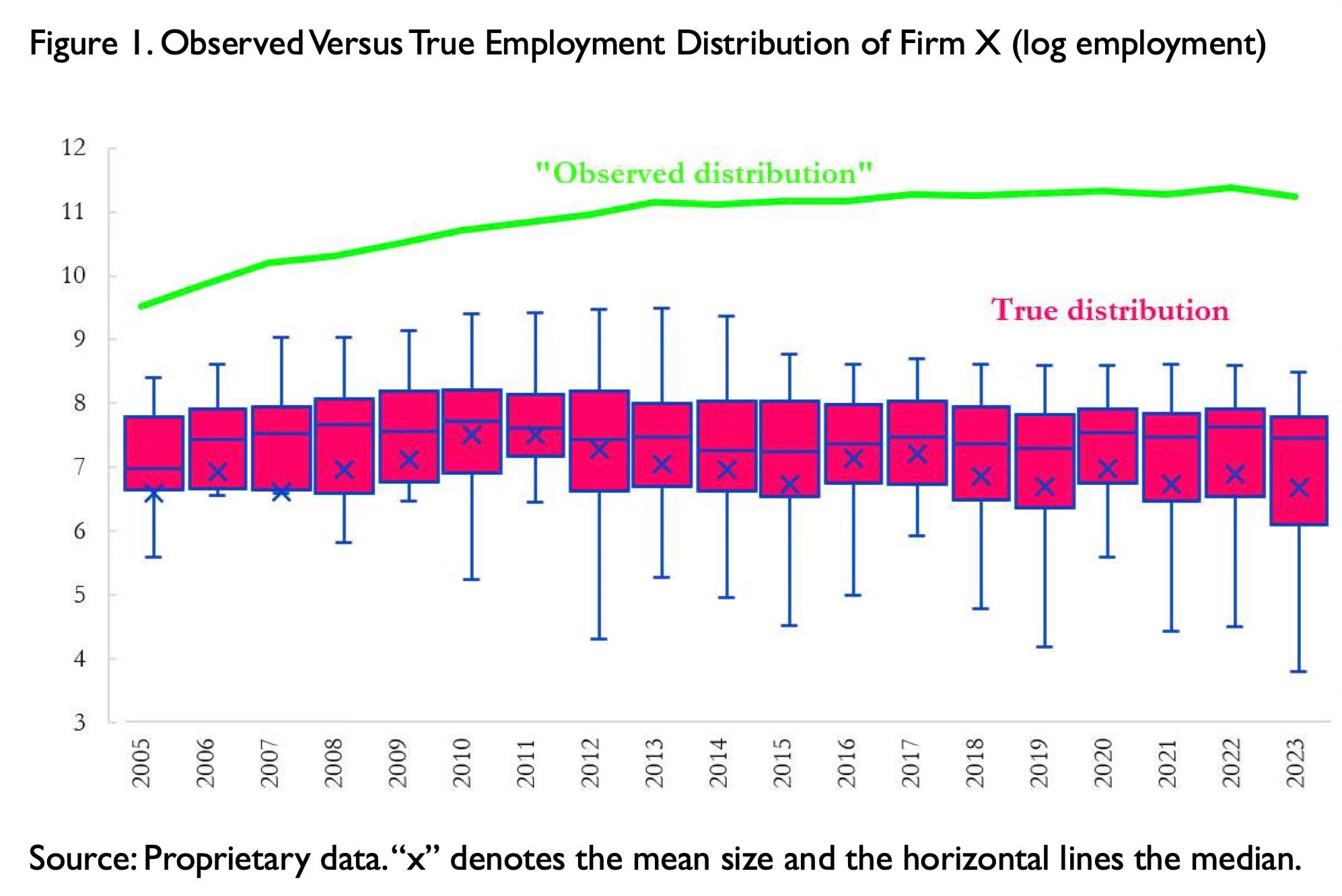
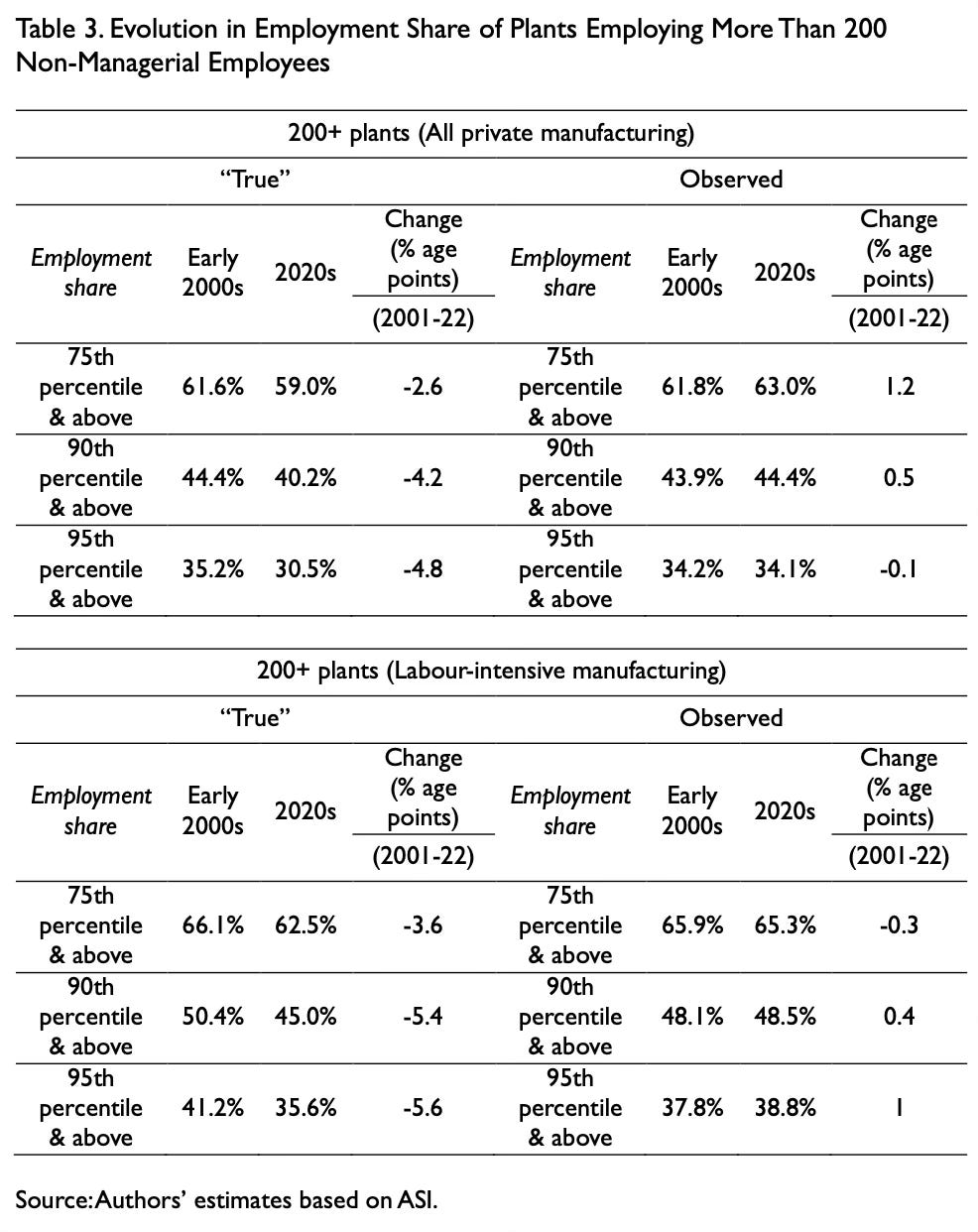
Abhishek Anand, Arvind Subramanian, and Naveen Thomas have a paper with some useful quantitative insights on firm-size. They show that the real problem is not the IDA, large plants are more productive, and that there are very few large globally competitive plants. These are already well-known facts, though not the reasons and the paper does little to explain them. But the contribution of the paper is to draw attention to a flaw on how the ASI data on firm size is captured which might be overestimating the firm size distribution in India. 

For documentation of the numbers, I’ll extract some of their findings. These are the three headline findings.

First, that this phenomenon of multi-plants has been growing over time and is quantitatively significant, accounting today for over 25.16 percent of total employment in all plants and 35.48 percent of employment in large plants. Second, ignoring it leads to over-stating the change in the size of plants since the early 2000s. It is popularly believed that Indian plants have become larger but we show that that is not the case and on some metrics large plants may have even become smaller… Third, that the multi-plant phenomenon seems to be a response to some underlying friction. It seems to be an endogenous device for Indian capital to keep their operations small, presumably as a way of coping with the regulatory burdens and risks imposed not, or not just, by labor laws but the broader political environment, shaping capital-labor relations.

Some other findings

The contract labour phenomenon is much greater—almost twice as large—in single plants compared to multi-plants… Single plants are both more “productive” than multi plants for any given level of employment and this differential increases as employment size increases. For example, at employment of 200 workers, single plants are about 9 percent more productive and at 1000 worker plant size, that wedge increases to over 21 percent… even in 2022, the 75th percentile plant in India employed about 53 workers, and the 90th percentile firm employed 128 workers. These cannot be considered large by any means…

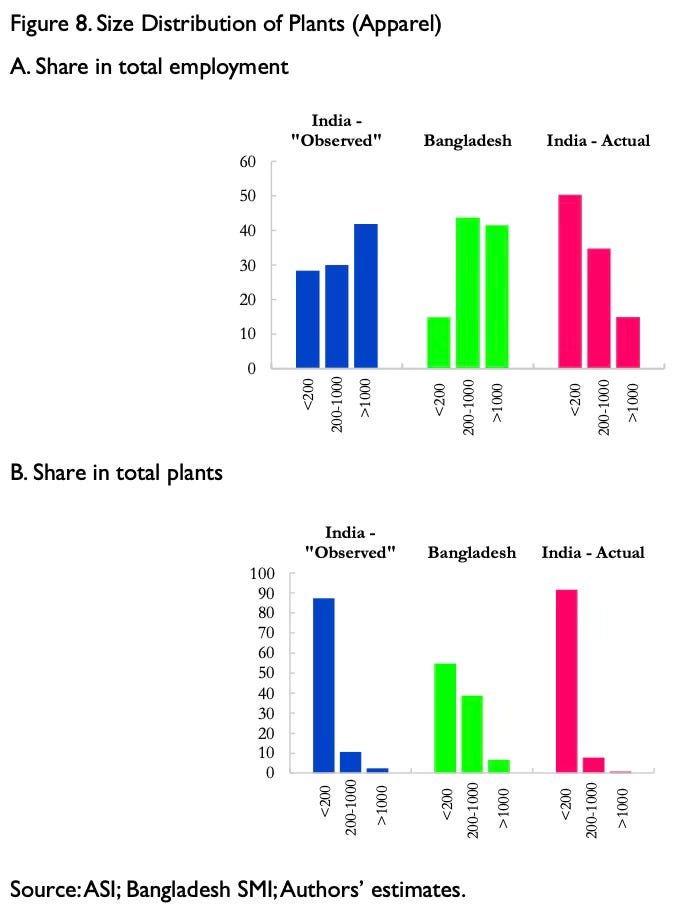
Bangladeshi plants export on average 95 percent of their output compared to 37 percent for India… if we compare plants size in India and Bangladesh, we find that Bangladeshi plants are consistently bigger at every threshold with the size differential rising as we go to higher thresholds for size: for example, the 95th percentile firm in Bangladesh is about 40 percent larger than its Indian counterpart… Plants employing more than 200 workers account for roughly 85 percent of all employment in Bangladesh. In India, the comparable correct number is 50 percent. And plants employing more than 1000 workers account for roughly 41 percent of all employment of Bangladeshi plants. In India, the comparable correct number is 15 percent.

They also write on labour regulations

Much of the literature on employment size has focused on the Industrial Disputes Act (IDA) and on examining whether the thresholds in them have shaped plant size. This has been a distraction, impeding our understanding of plants size and the labor market… We find that there is a clear tendency for plants to remain small even beyond the 100 worker threshold set in the IDA so that it is not the law per se (which is after all legally irrelevant beyond the threshold) but other factors that shape firm behaviour.

The authors also discusses how labour hiring and management decisions may interact with the firm size, but different from the conventional wisdom on the restrictions of the IDA, in a two-part oped here and here.

Rising contractualisation of labour — from about 22 to 41 per cent over the first two decades of this century — has been an important response of Indian firms and their management to the regulatory environment. Firms such as TeamLease act as brokers, taking upon themselves the burden of complying with labour laws so that manufacturing firms themselves do not have to. But somewhat puzzlingly, we find that contractualisation is lower in labour-intensive industries than in non-labour intensive ones. This is puzzling because if contractualisation is a response to labour laws and their burdens, the incentives to do so should be greater in labour-intensive industries. For example, in labour-intensive industries, the share has risen from about 23 per cent to 31 per cent over two decades, but in other industries from 19 per cent to 47 per cent. Unpacking this further, we find that recourse to contractual labour is greater in single plants than multi-plants. We also find that at the margin, the incentive to substitute contract labour for full-time employees rises with employment size in single plants but does not do so uniformly for multi-plant units.

One explanation is simply that in multi-plant units, flexibility in hiring and firing labour comes from the fact of having many plants. In single plants, there is no such flexibility, which renders the use of contract labour more important. We were told by the CEO of a large exporting firm that in the event of, say, a drop in orders from one client that affects one plant, the firm can redeploy labour in another plant without having to terminate their employment, which would be the only option in a single plant establishment. In other words, multi-plants and contract labour are both devices that increase flexibility but in different ways and for different situations and work as substitutes. According to the CEO, it would be more competitive internationally if its plant sizes could be greater. But it chooses not to grow as a matter of diversifying policy and legal risks and because of onerous regulations. 

The risks may not be the law per se but stem from the broader political environment in which the firm feels it would be vulnerable to the whims of the Centre and state governments, and also to labour in the event of frictions or disputes. A dispute in a big plant would entail greater risks relative to that in a smaller plant: In an extreme situation shutting down a plant with 500 employees is less costly than one with 5,000 employees… The constraints imposed by the thresholds in the Industrial Disputes Act are not the only deterrents to scaling up; it is the pervasive uncertainty in the business and regulatory environment that seems to compel firms to fragment their operations regardless of scale.

The conventional wisdom on firm growth in India is that they are constrained by labour laws that discourage expansion beyond certain employment levels. While there’s some truth in this, there are other (perhaps more difficult to overcome) glass ceilings that Indian firms encounter in their growth trajectories, that go beyond even the political and regulatory risks imposed by labour size alone in a plant.

While the paper discussed above goes beyond the narrow instrumentality of the labour hiring and firing constraints posed by the IDA, and points to the uncertainties in the country’s political and regulatory environments that deter labour expansion, the problems may go much deeper. 

Large size is not just about labour. Let’s explore this a bit more. A few questions are in order.

Is it the case that instead of some unique Indian contextual reasons, the very nature of the political and regulatory risks of large plant size by itself, irrespective of the country but especially so in developing countries, are too onerous as to discourage firms in general from establishing large plants? Is it possible that the large manufacturing plants, of the kind we are interested in, emerge only through special circumstances (and not through the general market dynamics of demand, competition and firm growth)? Is it possible that irrespective of the general political and regulatory environment, such large-sized factories can emerge only through proactive support from the government? Is it the case that governments in India while not explicitly against large size have not been active promoters of large-sized plants in particular and large firms in general, preferring instead to support small and medium-sized firms?

There’s nothing automatic or market-based about the growth of successful firms from small to medium, and from medium to large, especially in the manufacturing sector. Firms hit binding statutory, economic, and entrepreneurial constraints when they reach a certain size. For example, as I blogged here and here, there might be significant risk-appetite bounds to be crossed in such transitions, which many, if not most, successful entrepreneurs struggle with.

Apart from the political and regulatory uncertainties relating to labour discussed above, large size is associated with generally more onerous compliances, firm growth requires adding new factories, hiring good professional executives besides expanding the labour force, revisiting ownership holding and corporate form, changing management structure and practices, tweaking business models, acquiring new customers, assuming more debt, etc. Firm size also invites greater external scrutiny of all kinds in general. Each of these imposes significant requirements on the owners and the management, including decisions that require overcoming entrenched norms. 

For example, many successful family-owned firms struggle to trust professional executives and prefer to avoid assuming more debt. The smaller size of the enterprise helps them control their business without relying on outsiders and professional managers. It also limits the commercial risk exposure from a business downturn. They can rely on some local and loyal staff to manage the business. Scaling also requires investments in greater automation and adherence to greater standards, which demands capital and debt. All this creates the danger of losing control and assumption of greater business risks.

Further, as firms become large, they must compete with their more aggressive national and foreign competitors to acquire and retain customers and iterate continuously to improve their products, business lines, and delivery models. Any growth that involves expansion into foreign markets demands continuous productivity improvements, agility, and a high risk appetite. The firm cannot stay static and must be dynamic in all aspects. All this requires a growth mindset - an appetite to assume risk and an ambition to expand and become an industry leader. However, most Indian firms appear happy and content with their current market share, at best growing marginally, and strive only to retain it. The low R&D investments of even the leading corporates in the country are a reflection of this mindset. 

The growth bounds are perhaps amplified for Indian entrepreneurs with their struggles of doing business in environments that are sometimes downright hostile and mostly not-so-easy. These constraints manifest in the general inability of large numbers of very good small and medium enterprises to break out and emerge as large-scale firms.

So what are the policy takeaways to address this complex and binding constraint?

A headline takeaway that should be strongly internalised among policymakers in India is that scale manufacturing does not emerge on its own and requires government support. This is important since the current guidances and norms are not only to support SMEs but also to avoid supporting larger firms. There are some other misplaced but widely held beliefs, amplified also by the fear of vigilance agencies - once the SME grows the industrial policy support should cease, and firms once supported must not benefit again etc. 

It must be noted that government support has been central to the emergence of scale manufacturing in China and all the North East Asian economies. The zaibatsus and chaebols of Japan and South Korea respectively created the culture of world-class scale manufacturing in those countries, with considerable support from their governments. 

The likes of Morris Cheung of TSMC and Grace Wong of Luxshare Precision Industry got extraordinary levels of support from the governments of Taiwan and China. Thanks to the support the Chinese government provided to help her company emerge as a leader, the latter has in a little over a decade emerged to become Apple’s second biggest supplier, coming only behind her previous employer Foxconn. The government virtually forced Apple to enlist and grow Luxshare as a contract manufacturer for Apple products. The Chinese government has focused on the creation of large-scale manufacturing giants, especially but not only among state-owned enterprises. 

A general feature of the successful North East Asian industrial policy has been to weed out the weak and double down with support for the strong firms and let them grow in size.

A big positive about India’s scale manufacturing strategy is the arrival of large foreign contract manufacturers and domestic corporate groups like Tata. These were perhaps the only ways scale manufacturing could have emerged in India. Tata has taken the lead on electronics manufacturing in India, with active government encouragement and PLI and other facilitation support by central and state governments. It’s incumbent on the other large conglomerates with manufacturing legacy to step up and emulate their East Asian counterparts and establish scale manufacturing facilities.

It would now be interesting to closely study at least three possible future trends over the coming 5-10 years. One, are these large contract manufacturers spawning a large and growing ecosystem of component manufacturers and sub-assemblers in India? Two, is the initial cohort of contract manufacturers engendering emulation by domestic corporates and entrepreneurs, especially those with existing medium-sized firms in the industry? Three, is the presence of large contract manufacturers resulting in knowledge and technology spillovers across the regional economies and contributing to productivity improvements? 

I can foresee one important problem with the realisation of these objectives. The aforesaid trends require significant AND increasing value addition by the contract manufacturers. It provides the market signals of market and value-addition growth to both foreign component manufacturers and those dynamic and ambitious domestic entrepreneurs to set up shop. Firms look for growth both at the extensive (volume of the same business) and intensive (increasing value addition and shift to adjacent market segments) while making long-term investment decisions. It’s possible that the contract manufacturers, especially but not only the foreign ones, could largely remain stuck in the lower-value assembly stage and not have the incentives to continually move up the value chain. 

It’s therefore important that public policy closely watch the emerging trends and engage to achieve the objectives above. The current success in mobile phone assembly should not blind us to the need to quickly move up the value chain by doing more component manufacturing domestically. 

The PLI scheme is a good place to start. The next round of PLI-scheme incentives could be linked to domestic value addition as against sales (even with all the challenges of its accurate measurement). It may even be useful to consider extending the incentives on the existing PLI scheme beneficiary firms for another five years, but this time on the incremental value addition over a baseline. There should not be any limits on the number of times a firm can access PLI scheme benefits (in the different scheme rounds). 

These and other policy interventions might be necessary to achieve the objectives underlying the three aforesaid desirable trends.