Substack

Showing posts with label Trade. Show all posts

Saturday, October 17, 2026

Weekend reading links

1. The labour market effects of AI is not clear.
Even at the entry level, graduate unemployment has been rising since 2015, pointing to factors beyond AI.


China’s total population peaked at 1.4 billion in 2021 and is now falling by three to four million people per year—roughly equivalent to losing one Los Angeles each year. By the 2040s, if China continues to follow East Asia’s descent to ultralow fertility rates, it will shed around one percent of its population annually—roughly ten million people, more than the population of New York City. At the same time, the proportion of China’s population aged 65 and older will surge, doubling from 15 percent today to around 30 percent in the 2040s, and then rising to well over 40 percent by the late twenty-first century. The size of that cohort in the United States, by contrast, is projected to rise far more gradually, from around 19 percent of the population today to just over 23 percent in 2060.

The essay by Carl Minzner  talks of how the centralisation, a paranoid state, and suppression of dissent is creating the conditions for discontent and social instability. Sample this. 

In 2023, Beijing created the Central Social Work Department and charged it with monitoring those suffering from any of the “four lacks” (no spouse or children, no job or stable income, no normal social interactions, or no financial assets, such as a house or car) or any of the “five losses” (failed investments, career or life setbacks, emotional imbalances, mental illness, or failed personal relationships). Beijing views such individuals as potential security threats capable of mass attacks, such as the November 2024 rampage in which a 62-year-old man, dissatisfied with the property settlement after his divorce, drove his car into a crowd and killed dozens.

3. Only 6.6% of Indians earn a middle class monthly salary of Rs 25,000. Even this is likely on the higher side, and I am not even talking about the low baseline. 

4. China and EU agree tacitly on an arrangement whereby EU will impose a quota ceiling on Chinese hybrid car imports without any retaliatory action by China. 
The agreement would more than halve projected exports over the next four years, reducing the number of hybrids shipped by China by “several millions”. On the current trajectory, Chinese exports to the EU would hit 800,000 this year. In 2027 alone, the deal would reduce imports by between 500,000 and 700,000 vehicles, cutting the EU’s expected trade deficit by between €10bn and €14bn, according to an EU official. The 2027 annual quota was expected to be initially about 350,000 vehicles, increasing by 6 per cent a year for the following three years, the official said. The EU’s trade deficit in goods with China hit €360bn in 2025 and has increased since. In the second quarter of 2026, it was €103bn, up from €93bn in the same period last year. Vehicles and machinery were the biggest contributors... The share of the EU market for plug-in hybrid electric vehicles controlled by Chinese imports rose to 25 per cent in the first half of this year and for other hybrid electric vehicles to 14 per cent, both up from 2 per cent in 2024.
Debt servicing payments alone are expected to account for 19.2 per cent of the central government’s general public budget this year, up from 12 per cent in 2014, according to a new study from the Conference Board. The problem is especially acute at the local government level, where debt interest payments have risen 16 per cent annually over the same period. Together, central and local government debt interest payments are projected to amount to Rmb1.4tn ($209bn) in 2026, up from about Rmb348bn in 2014... Public debt-to-GDP is set to hit 122 per cent by the end of 2026, up 48 percentage points from its pre-pandemic level, according to Morgan Stanley analysts... Economic growth slipped to 4.3 per cent in the second quarter, below the official full-year target range of 4.5 to 5 per cent, on the back of weakening retail sales and sharp falls in fixed-asset investment... While the central government runs a fiscal deficit of about 4 per cent, the augmented deficit, a wider measure of state spending, is running at about 10 per cent of GDP, according to Goldman Sachs... “Spending on debt interest payments rose 341 per cent” between 2013 and 2025, according to the Washington-based Center for Strategic and International Studies, “faster than any other major budget category”. The think-tank noted that about 14 per cent of US government spending went towards interest payments this year while Japan, one of the world’s most indebted governments, spent almost 26 per cent.

6. The remarkable stability of occupations.

Long-established ones are far more durable — more than 70 per cent of workers today are employed in occupations that existed in the late 19th century. Rather than eliminating these occupations, technology has transformed them.

7. Forward guidance (among other things) wins Nobel Prize precisely in the year the new Fed Chairman is taking steps to reverse it.

8. China clocks a 36.3% growth in dollar terms in its exports in September over the same month last year, the biggest increase since January-February 2021. Trade surplus for the first nine months was $938.1 bn, compared to $875 bn last year. 

This comes even as economic growth slows, reporting 4.3% in the second quarter, one of the lowest quarterly growth rates in decades and below the full year target band of 4.5-5%. 

9. While subsidies were a major contributor to Chinese companies becoming dominant in manufacturing, they have been far sighted enough to sharply increase their R&D spending and move up the value chain and become global manufacturing leaders across the value chain. 

10. Richard Waters puts the AI investment in perspective.
To take one recent estimate, from the Brookings Institution: Spending on the AI services produced by all those data centres would need to account for an astounding 9.2 per cent of US GDP by 2032 for their operators to make a decent economic return... The five biggest hyperscalers — Alphabet, Amazon, Meta, Microsoft and Oracle — have raised their capex budgets throughout the year and currently expect to spend $800bn, nearly twice as much as last year. That is set to eclipse their combined forecast cash flow of around $700bn... according to the Brookings report, it will take an extraordinary jump in AI demand to justify the construction boom. By 2032, customers would need to spend $3.7tn a year (the 9 per cent of US GDP). Tech research firm Gartner came up with a similar calculation this week, estimating that $8.5tn of AI revenue will be needed between now and 2030 to produce decent investment returns on all the new data centres. The actual AI revenue Gartner forecasts over that period: $3.6tn.

Monday, September 7, 2026

Some thoughts on Chinese manufacturing dominance and deglobalisation

Richard Baldwin has multiple blog posts that mine the data to add nuance to the Chinese manufacturing dominance, which, while undoubted and growing, includes some important subplots. 

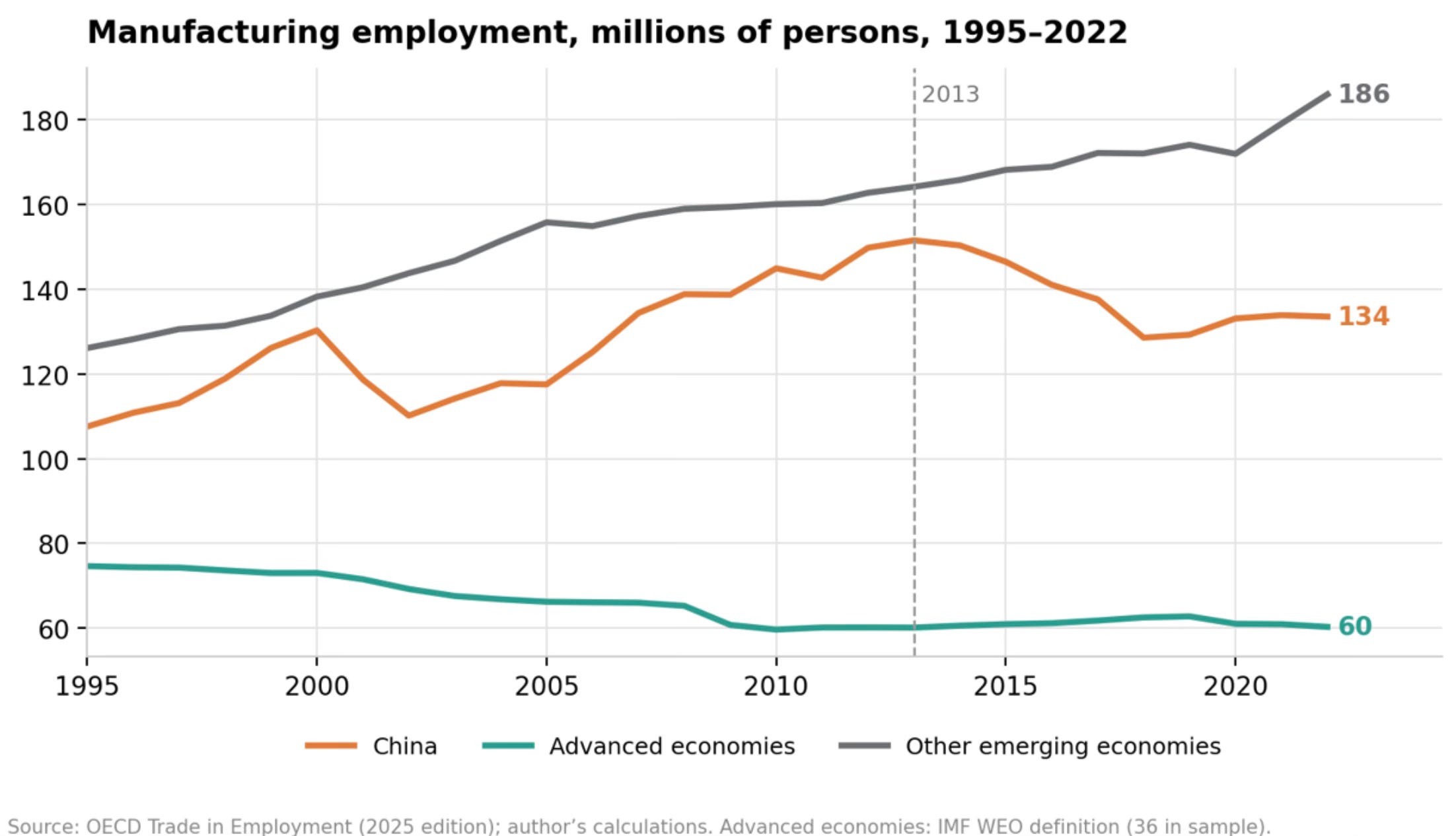
For one, rapid productivity gains have widened China’s competitiveness gap but also reduced manufacturing employment, though it appears to be reversing slightly or stabilising since 2019, with Xi Jinping’s push toward high-technology industries and the Make in China 2025 campaign. But while manufacturing employment has been declining in the advanced economies, it has been rising in the emerging economies (excl China). 

The rise in emerging economies is especially pronounced since the pandemic. It has also been inching upwards in the advanced countries too.

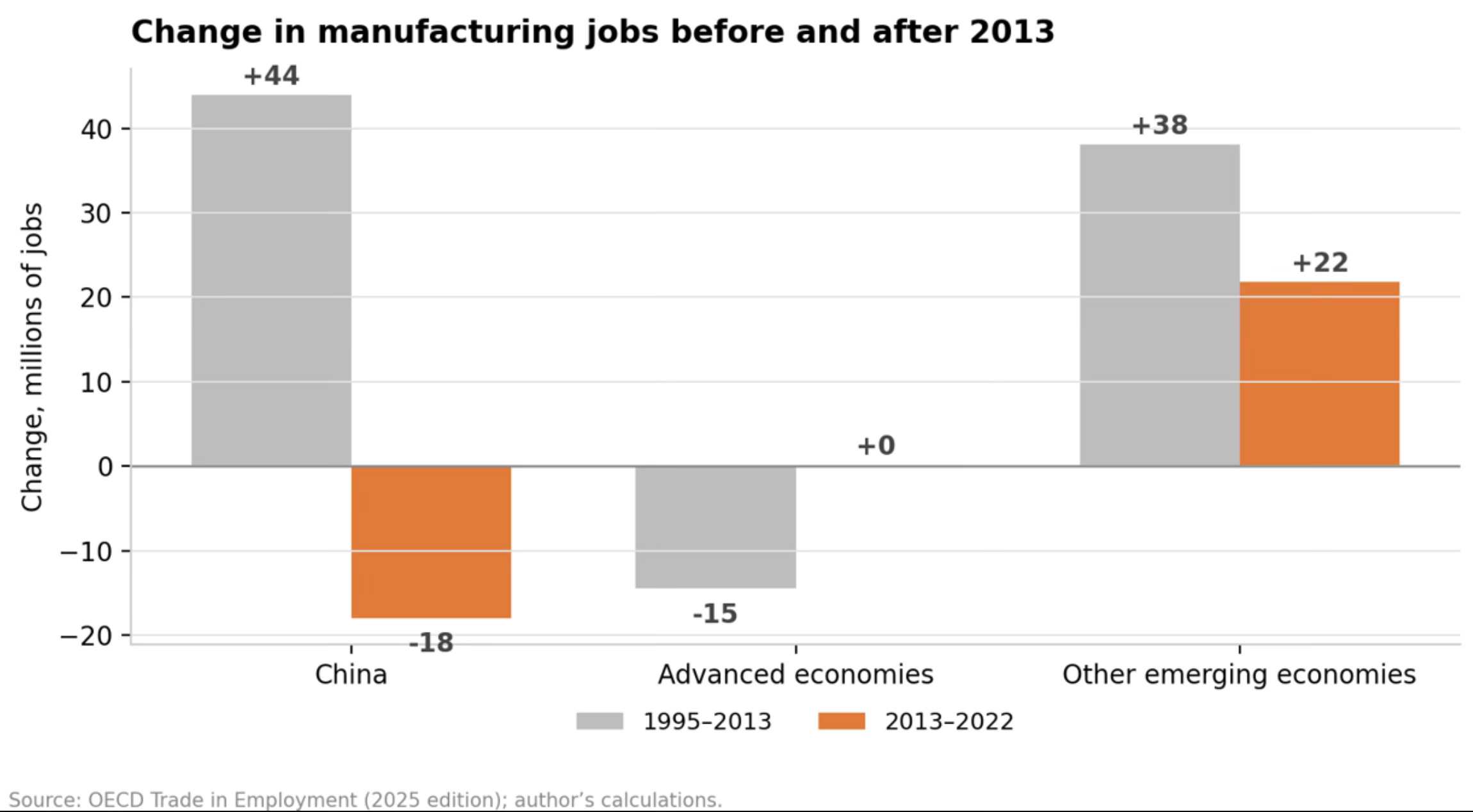
Putting both together, Baldwin makes the case that since 2013, while China has been shedding manufacturing jobs, losing about an eighth of its base, emerging economies have been gaining and advanced economies have plateaued. However, with 134 million factory workers, China has twice more than the advanced countries combined.

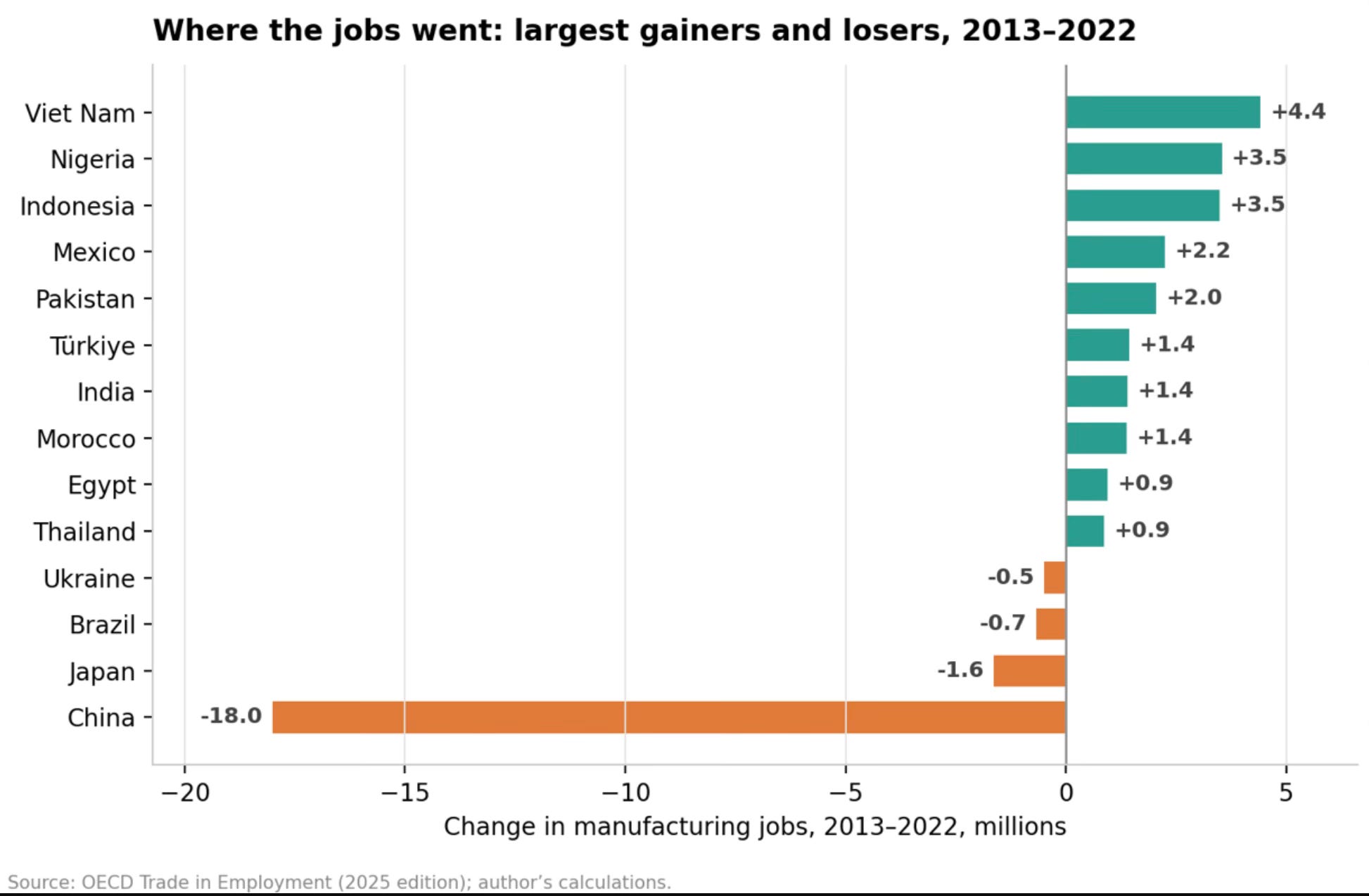
Among the gainers in this giant manufacturing jobs reallocation, Vietnam, Nigeria, and Indonesia lead. Nigeria and Pakistan are surprising candidates. India has been a notable laggard. Together, the developing countries added 22 million. 

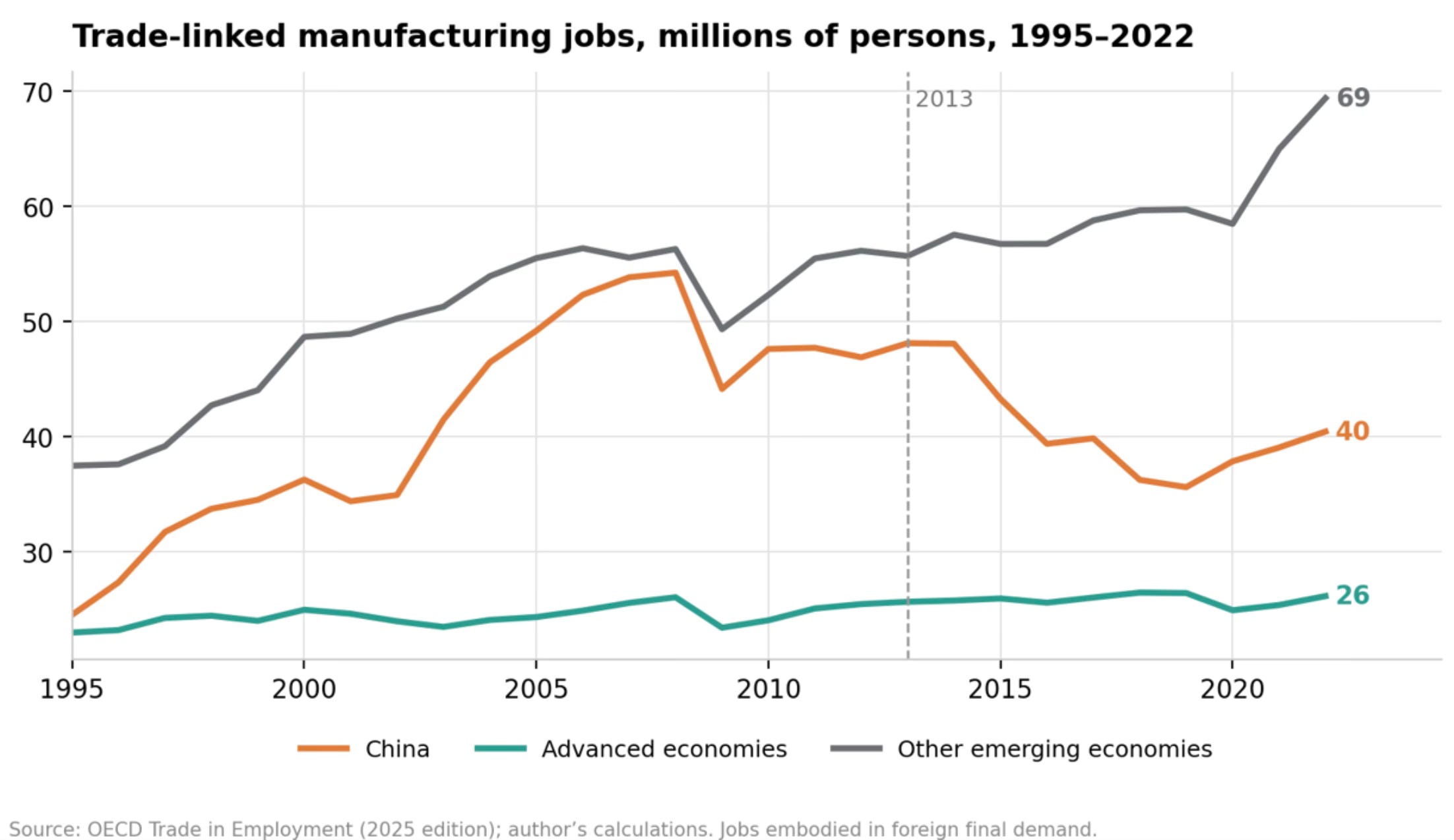
China’s export-supported factory employment is down 16% since 2013 and its share of the world total has fallen from 37% to 30%… China’s factory employment is now doing what the advanced economies’ did decades earlier: shrinking as productivity rises and as labour-intensive stages migrate to lower-wage locations.

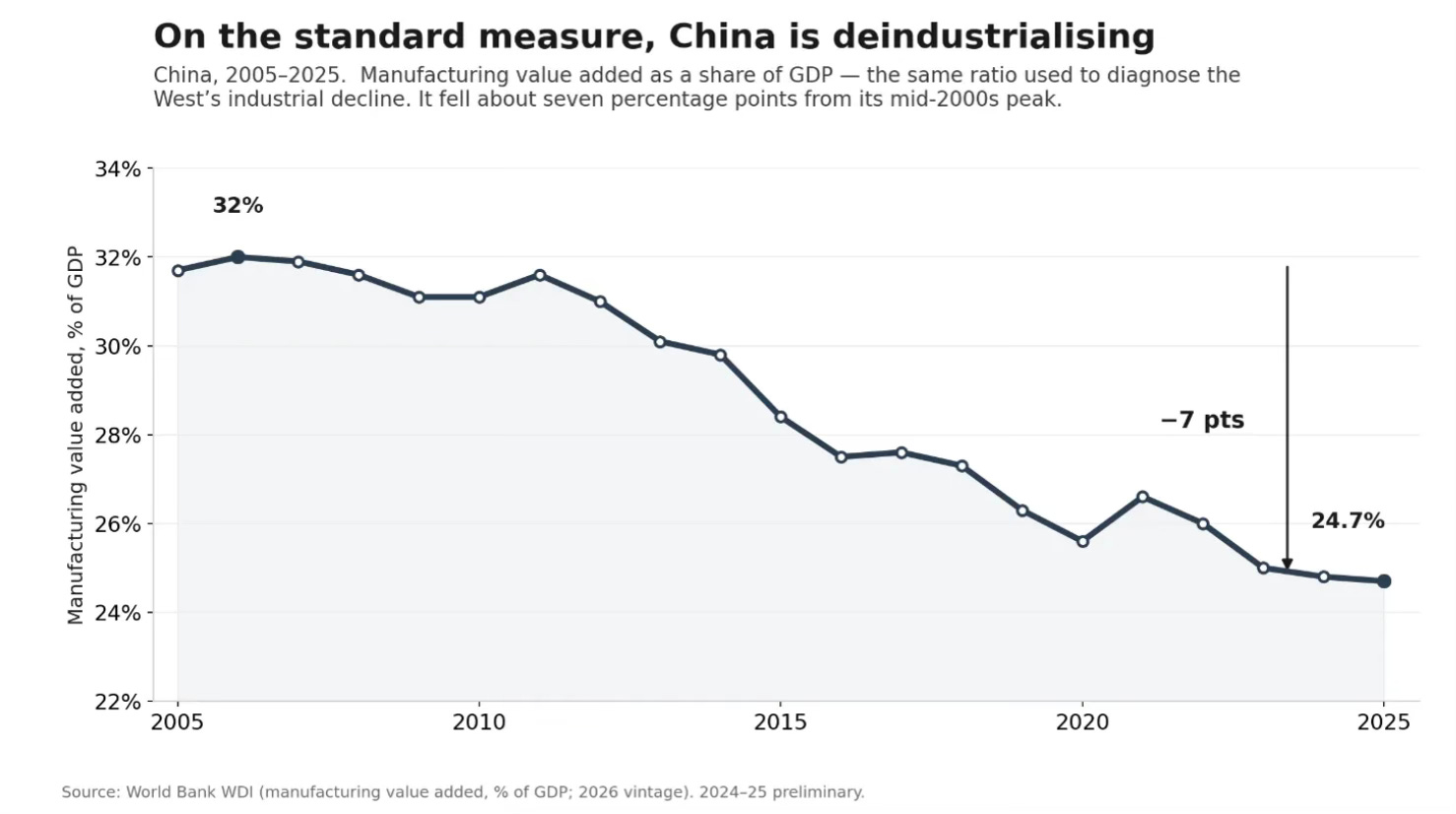
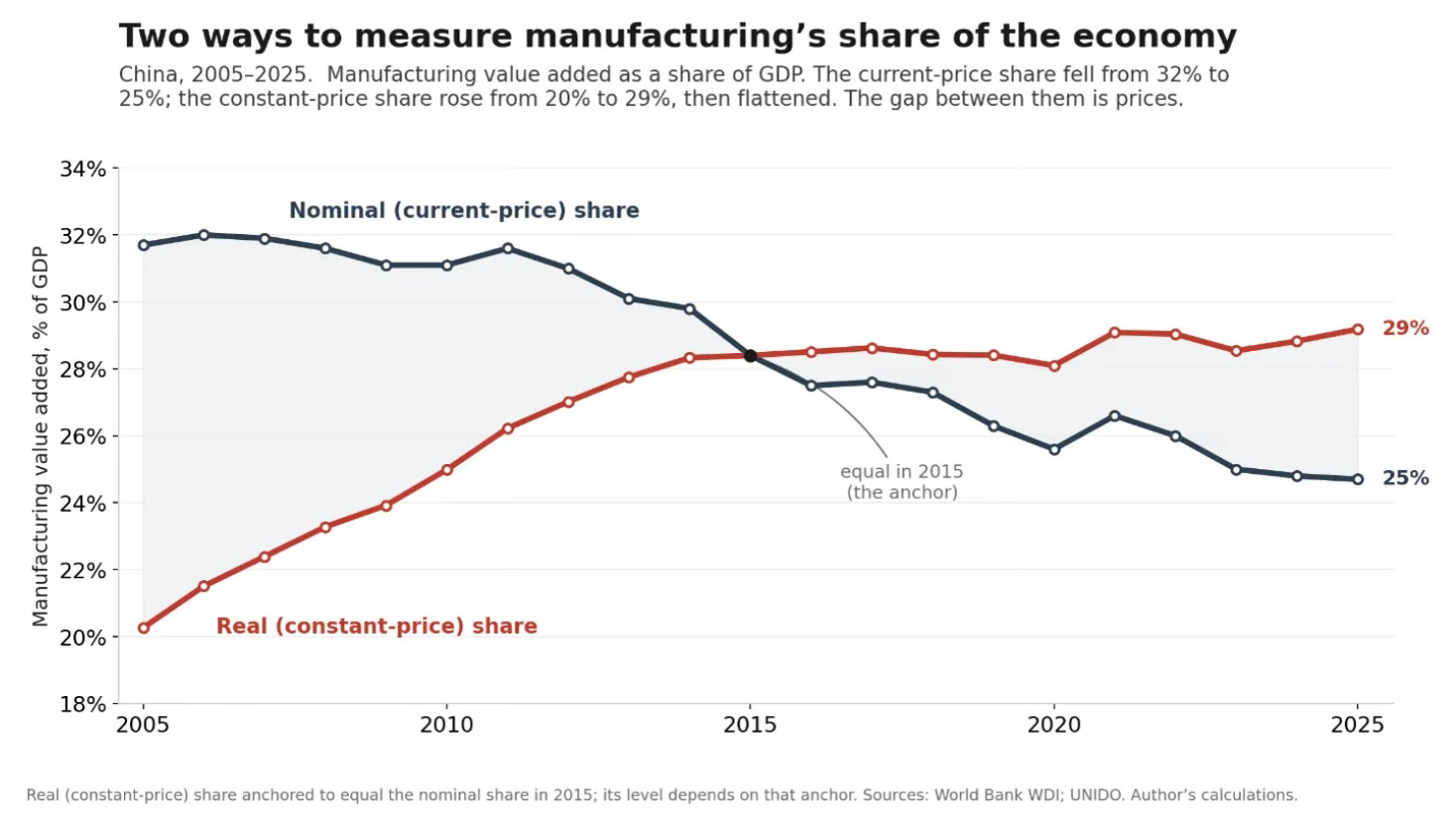
This decline in Chinese manufacturing employment comes alongside a steeper decline in its manufacturing value added as a share of GDP. Its manufacturing GDP share has fallen over 15 years, from a peak near 32% in the mid-2000s to under 25% today. 

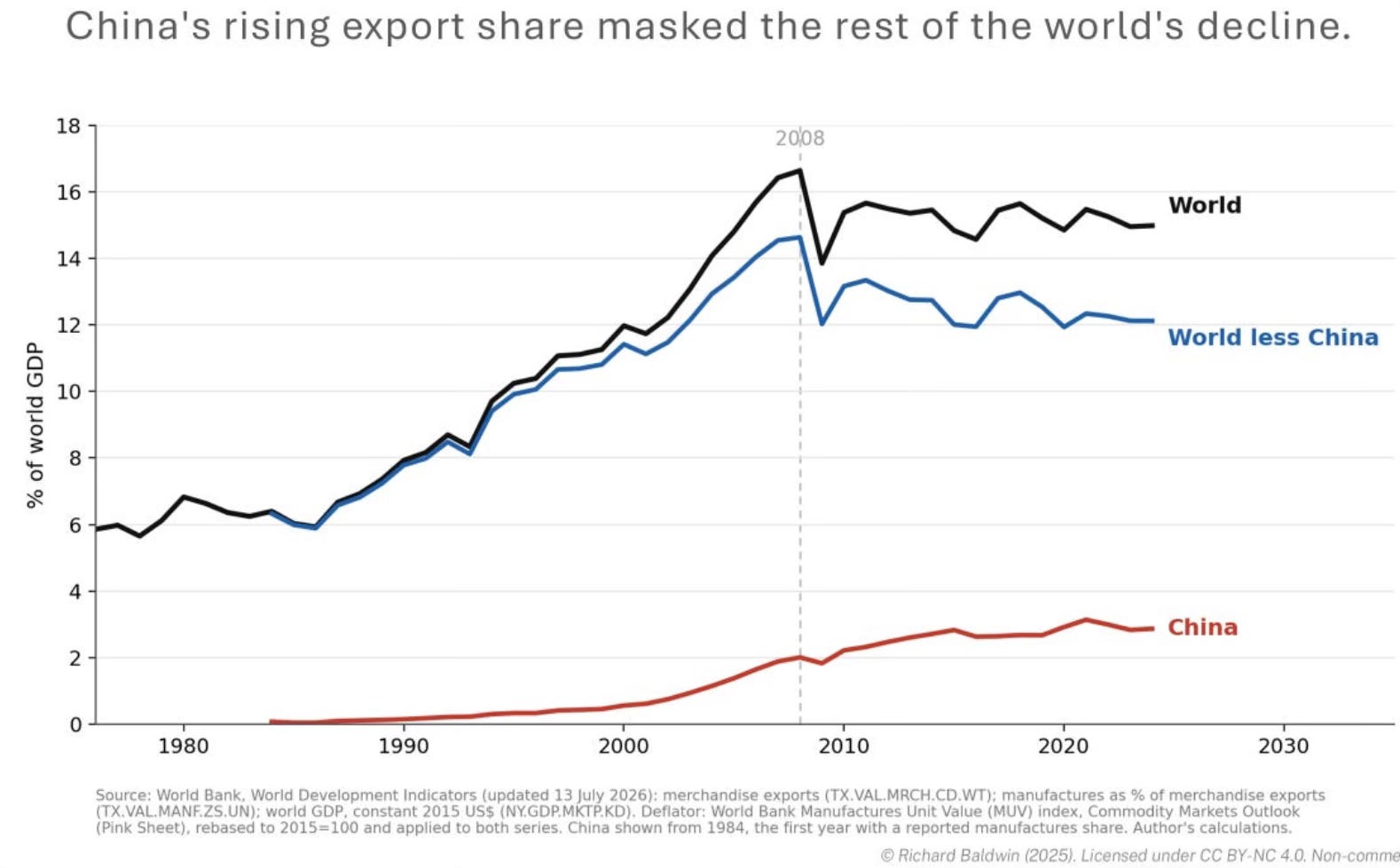
However, declines in manufacturing employment and share of value addition do not mean China’s dominance and vice-like grip on manufacturing is on the way down. Far from it. In fact, China’s manufacturing merchandise exports as a percentage of world GDP have been rising, even as they have declined for the rest of the world. 

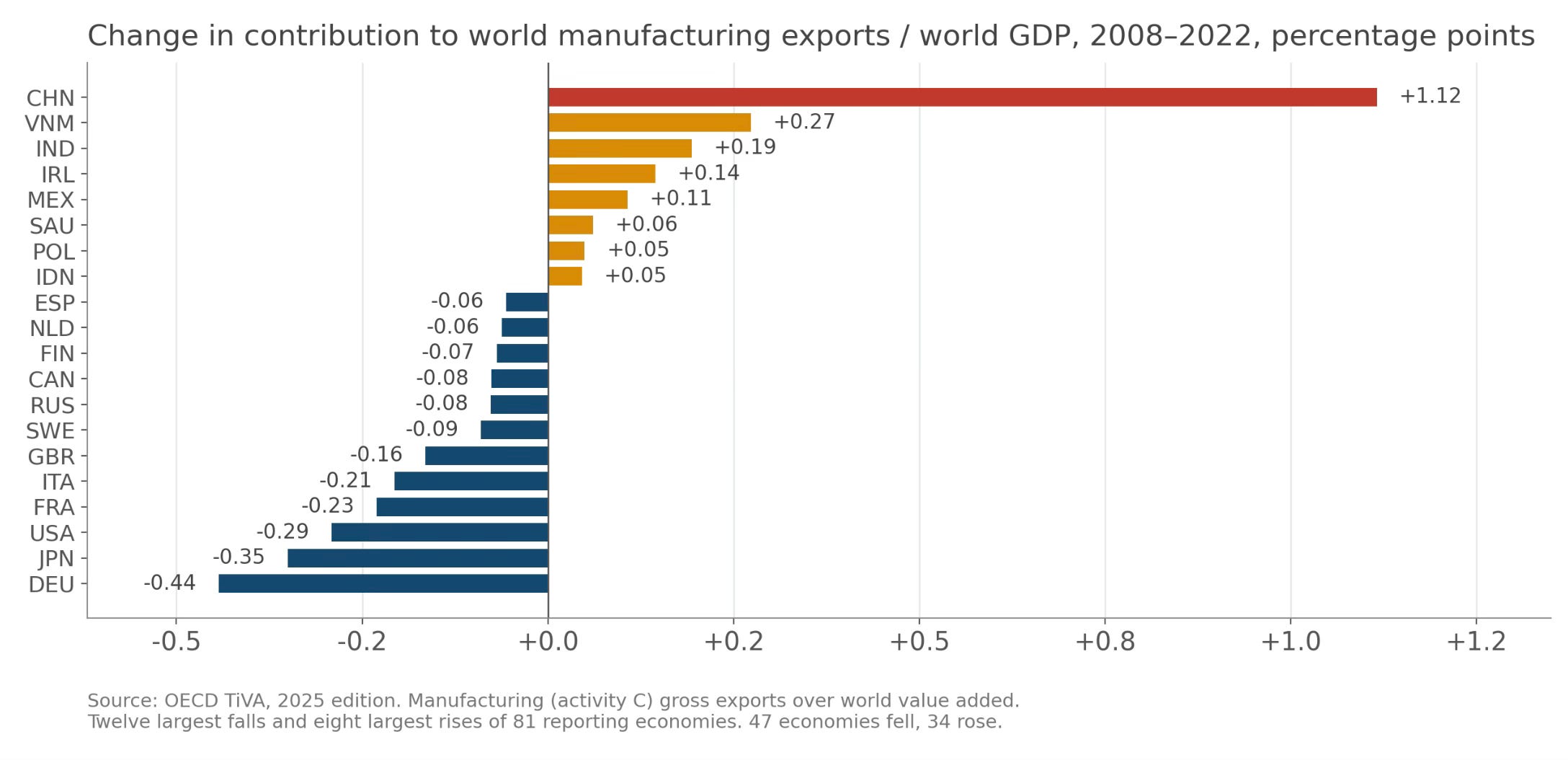
In fact, the percentage has nearly doubled in the same period. It has also risen for Vietnam and India. The advanced countries have been the clear losers.

So, what explains this apparently contradictory trend of deindustrialisation in employment and value addition, co-existing with the doubling of global manufacturing export share?

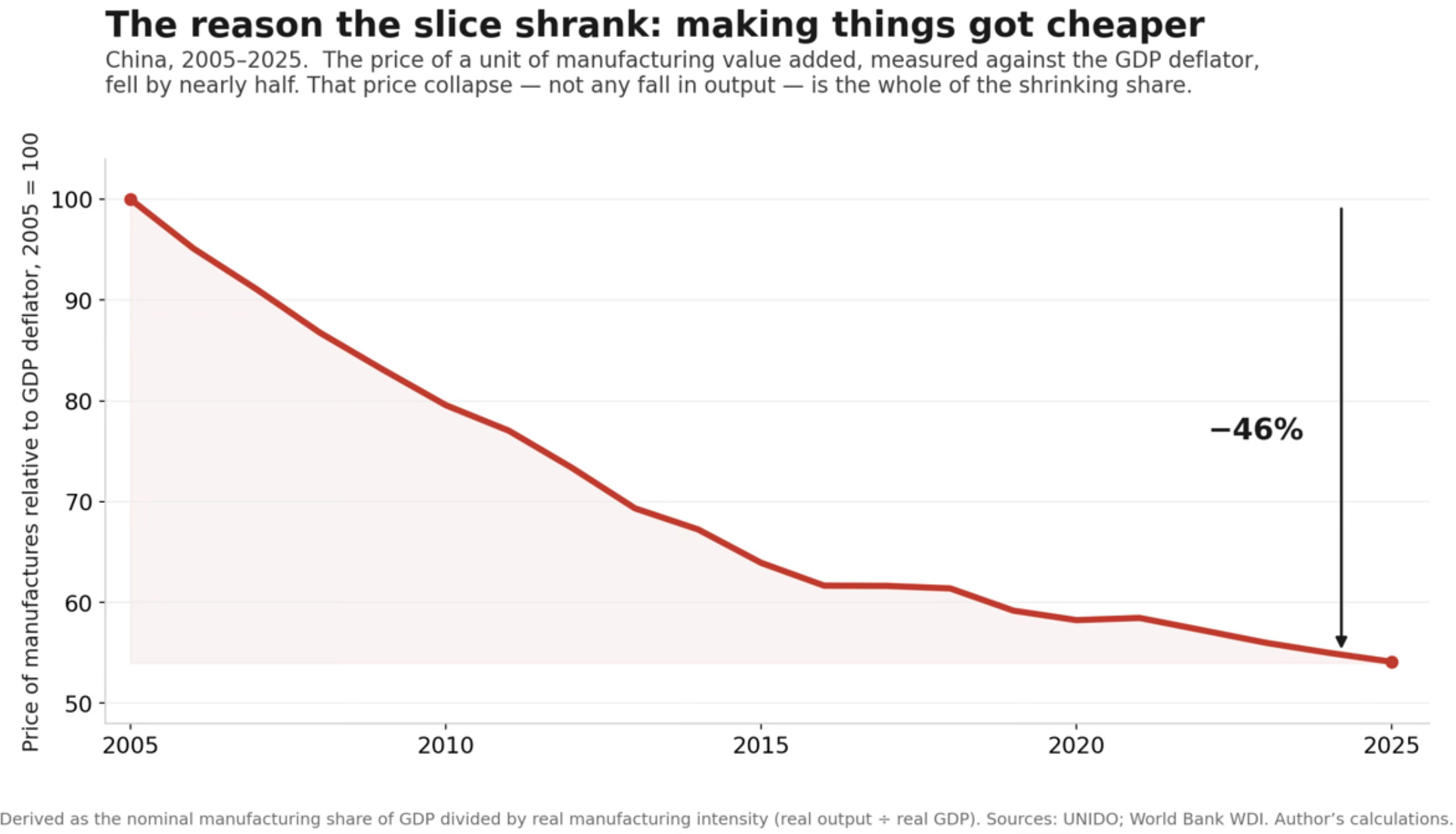
The answer appears to lie in productivity. Over two decades, the price of a unit of China’s manufacturing value added fell by nearly half, which explains the whole of the decline in value addition by manufacturing. 

It reflects the most consequential fact about Chinese manufacturing: Chinese goods are getting cheaper at an astounding pace. Fast enough to distort the whole economy, maybe even the whole world economy. That price collapse is also why the Chinese are such fearsome competitors globally. It is why the rest of the world’s industry feels squeezed, and why politicians are responding with plans to hobble Chinese exports.

… there is a China-specific factor that is driving down manufacturing prices even faster. In China they call this competition “involution.” If you think the competition is tough outside of China, you should see it inside the country. China experts talk about the ruinous internal scramble in which too many domestic firms, egged on by rival local governments, drive down prices until nobody makes money.

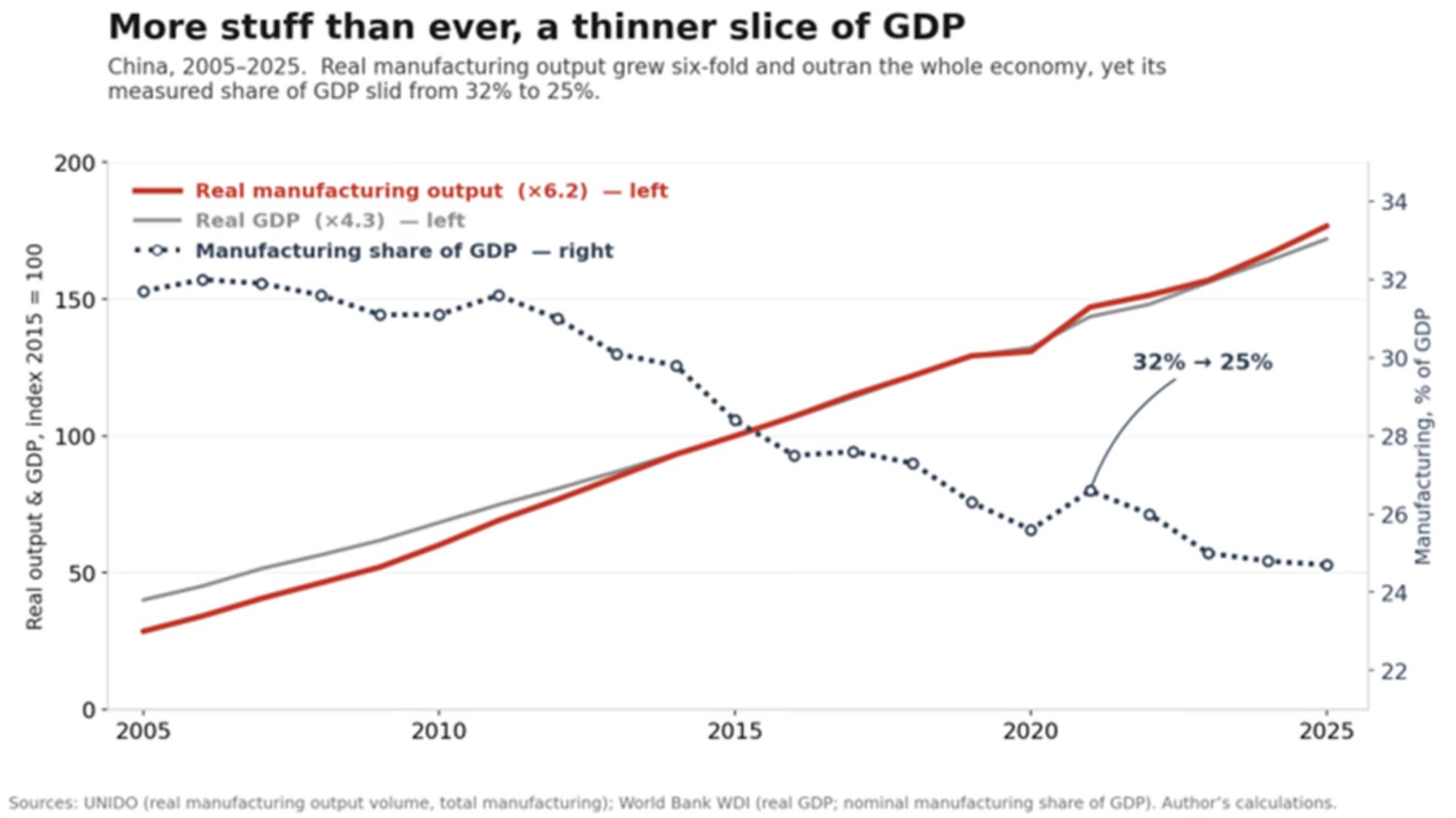
This comes out clearly if we map the nominal and real price shares of manufacturing value addition. Since about 2014, the manufacturing sector has grown at the same real rate as the economy as a whole. 

The Chinese economy has made much more with a smaller set of resources. 

There is no doubt that the expansion of the Chinese manufacturing sector has been an era-defining phenomenon. The rise can be seen in the red line in the chart below. Real manufacturing output in 2025 is more than six times its 2005 level. That’s amazing. That’s the China shock 1.0 and 2.0 in a nutshell. Over the same twenty years, the whole economy (the grey line) grew only four-and-a-third times. So, manufacturing did outrun the economy. But only up to the mid-2010s.

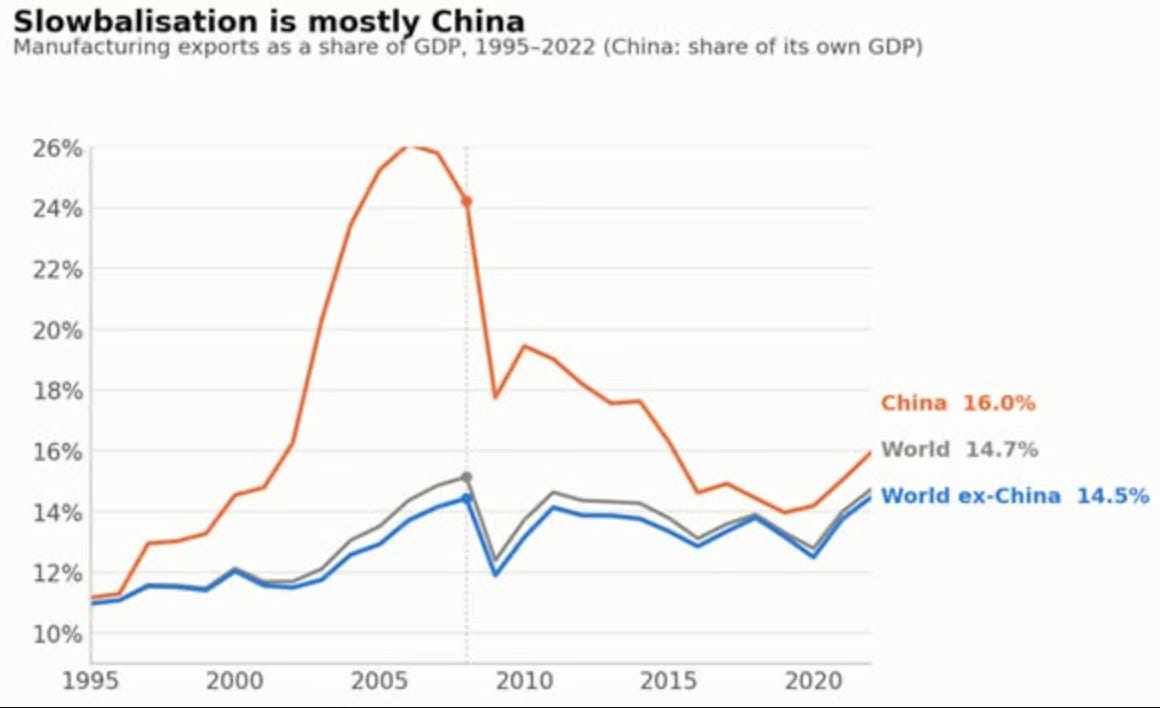
Finally, he disputes the oft-cited deglobalisation argument. He points out that while the global manufacturing trade ratio fell by 2.6% in the 2008-22 period, it rose slightly by 0.3% if we exclude China. 

The main contributor was China’s GDP growing faster than its manufacturing exports.

China’s manufacturing exports boomed, but its GDP boomed more. China’s share of world manufacturing exports rose from 11.5% in 2008 to 19.3% in 2022. China’s share of world GDP went from 7.2% to 17.9%. Exports relative to China’s own GDP fell from 24.2% to 16.0% as it morphed into a normal mega-economy and became its own best customer.

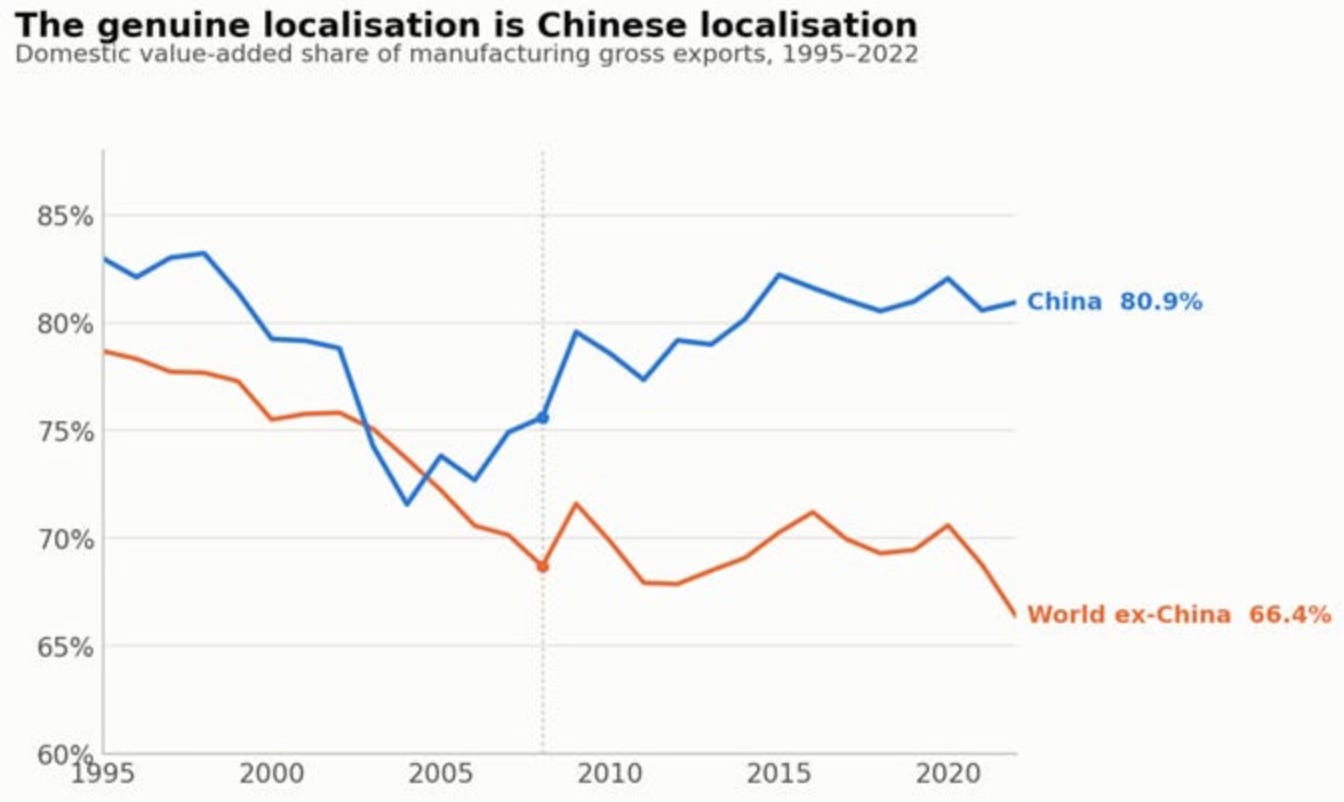
Another driver of this was the reshoring of supply chains into China. However, this deglobalisation by China did not mean similar trends elsewhere. The rest of the world expanded the global value chains in their manufacturing. 

China’s domestic value-added share fell from 83% in 1995 to 72% in 2004, as the processing-trade boom stuffed Chinese exports with imported parts. It then climbed steadily to 81% by 2022. From the 2004 trough, that is nine percentage points of genuine input localisation… For the world excluding China, the domestic value-added share moved the other way: 68.7% in 2008 to 66.4% in 2022. Everyone else’s manufacturing exports became slightly more dependent on foreign inputs, not less. If you special-case China, there hasn’t been any localisation of manufacturing. The domestic content share has not risen and seems to be continuing to fall.

It would be useful to disaggregate the value addition destinations of the manufacturing exports of countries excluding China. It will not be surprising that a significant share of that value addition is coming from China. 

So, not only is China increasing the localisation of its own manufacturing, but it is also capturing a greater part of the value addition of its trade partners’ exports. 

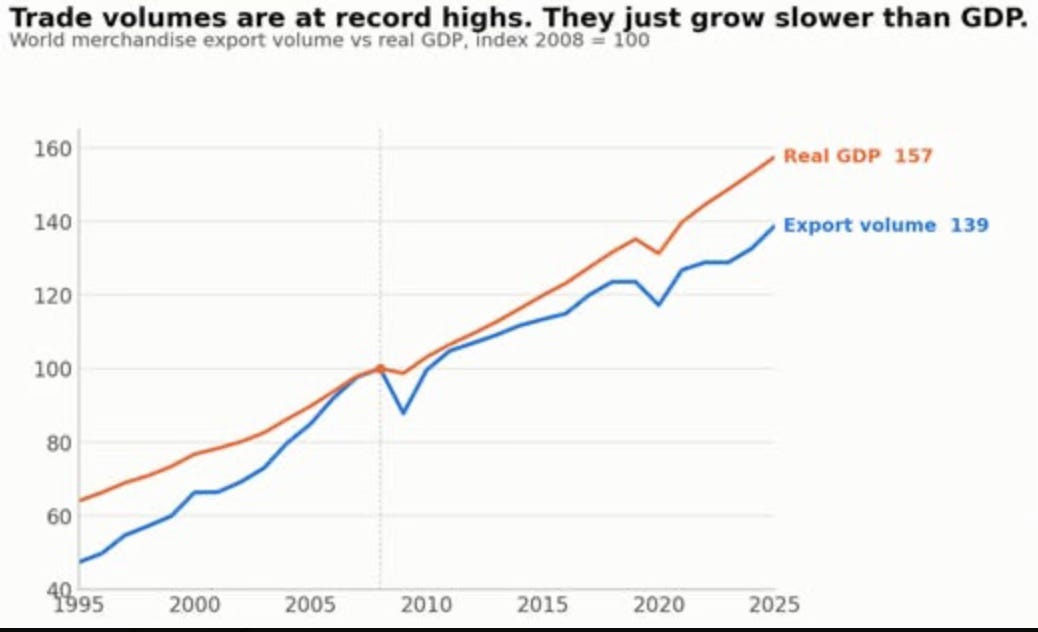
Baldwin also points to how global export volumes continue to rise unabated, thereby contradicting talk of deglobalisation. He says that world trade never stopped growing, but only stopped outgrowing the world economy, pointing to a deceleration but not a reversal. 

None of these nuances and qualifications take away from the reality of the world economy’s China problem. Its manufacturing dominance and export dumping is among the biggest problem facing the world economy. 

China inverts the conventional wisdom of a large developing country in its development trajectory being a large importer of goods and services. Instead, even as its own market remains largely walled off, it has become a massive exporter of components and goods spanning the full spectrum of sophistication.

China also contradicts the orthodoxy of developing countries vacating lower-skilled industries and moving up the value chain as they develop. Apart from some limited vacation of space, as discussed above, China has uniquely retained its competitive advantage across the value chain of industries. Its competitive advantage spans across sectors, supply chains, and value chains.

This has also meant that even as the world has globalised supply chains, China has ended up increasing its localisation. As mentioned above, this means that China’s manufacturing dominance is boosted by both the localisation of its own manufacturing and by capturing an increasing share of the rest of the world’s supply chains. 

All this has meant that China neither offers its large consumption market nor vacates any significant part of the manufacturing landscape for its trading partners. Further, it wants to use the rest of the world as a dumping ground for its heavily distorted manufacturing industry. Furthermore, it is now showing an increased willingness to weaponise its manufacturing dominance not only for national security and strategic reasons, but to also prevent efforts to diversify supply chains away from the excessive dependence on China.

Saturday, August 15, 2026

Weekend reading links

1. The solutions proposed by Andy Haldane to address housing supply in the UK is universally valid.

Public land developed for public purpose but privately operated; co-financing by municipal bonds and private capital; a bespoke planning regime; and a transformative method of new construction — these are the base elements needed to ease the constraints suffocating the UK’s housing market and to tackle the housing crisis in every postcode.

2. Talk about a company mobilising debt for others to buy its products, and look no further than Nvidia.

The world’s largest financial groups are working with Nvidia to assemble a funding package of more than $500bn for AI infrastructure development, in one of Wall Street’s most ambitious lending efforts to date. A consortium of groups including Apollo Global, Blackstone, BlackRock, Brookfield Asset Management, Goldman Sachs and KKR is entering a partnership with Nvidia to invest in the AI build-out... Nvidia said on Monday afternoon that it has signed memorandums of understanding with the six Wall Street firms to “mobilise over $500bn of third-party capital for the build-out of AI infrastructure over time”. Under the deal, which is still subject to final agreement, the firms will create dedicated pools of capital to finance Nvidia’s AI ambitions “at attractive rates for Nvidia customers”... Morgan Stanley projects so-called hyperscalers will spend $3.5tn between 2026 and 2028.

3. India manufacturing output trends.

But services exports have doubled in less than four years.

Weeks into the latest conflict, defence minister Israel Katz invoked a different approach, one used with devastating consequences after Hamas’s October 7 2023 attack: the “Rafah and Beit Hanoun model”, a reference to Israel’s wholesale levelling of cities in Gaza. “All homes in Lebanese villages near the border will be destroyed,” Katz said. By July, Katz claimed his threat had been carried out. “Twenty-four Lebanese villages, hundreds of years old, we destroyed all the buildings,” he said, boasting that up to 20,000 homes had been demolished. “Not house by house, but entire villages.”...

Israeli evacuation orders forcibly displaced some 1.2mn people in the war’s first 10 days, the vast majority from Hizbollah-dominated southern Lebanon, as Israeli forces advanced. Fighting raged for weeks, but most of the destruction documented by the FT and Lighthouse came after an initial Israel-Lebanon ceasefire on April 17. While the truce did not hold and some clashes have continued even past the latest ceasefire in June, Israeli forces — who had already established control over many emptied villages — continued to lay waste to the south through air strikes, controlled detonations, bulldozers and the use of white phosphorus. Israel’s occupation is now deeply entrenched, the area under its control demarcated by what it calls “the yellow line”. The zone covers about 6 per cent of Lebanese territory and stretches roughly 10km inland from the two countries’ informal border...

Israel has also done extensive damage to historic monuments and Unesco-listed sites, including 16th-century mosques, 19th-century libraries, religious shrines, ancient Roman ruins and Crusader castles. “It is an attempt to make the areas unrecognisable . . . to sever people’s connection to their land and their history,” said Joanne Farchakh Bajjaly of Biladi, an organisation dedicated to preserving Lebanon’s cultural heritage. “How can they rebuild their communities if everything is gone?”... Lebanon’s environment ministry and rights groups have documented Israel’s widespread use of white phosphorus — an incendiary chemical that triggers fires and can leave contamination in soil and water — in both populated and agricultural areas. Israel says it uses white phosphorus lawfully to clear brush and create smokescreens, but use over populated areas can violate international law.

5. Janan Ganesh is on to something.

If a politician could decouple socialism from the set of cultural ideas known as “woke”, he or she would be difficult to stop... The one place that might have produced a culturally conservative or at least culturally neutral socialism is continental Europe, but even the French left has absorbed American woke jargon, perhaps recognising in it the authorial stamp of Michel Foucault. And so capitalism glides on, never quite facing what would be its sternest political test. The question is why the left allows it to happen... Woke has been such a godsend for capitalism — making its enemies look ridiculous — that it can seem almost engineered for that purpose.

6. Purchase commitments of the hyperscalers jumped from a trillion dollars to 1.5 trillion from Q1 to Q2 of 2026. These are debt in another form. 

7. Guy Chazan describes elite capture of the political system in the US.

In America’s Gilded Age, millionaire robber barons operated from the shadows, bribing pliant lawmakers to do their bidding. Under President Donald Trump, billionaires have gone one better. Some are in his cabinet... No longer content to lobby from afar, ultra-rich tycoons — especially from Silicon Valley — have infiltrated the capital’s ecosystem, taking on advisory roles in government, cultivating ties on Capitol Hill and weighing in on the most important issues of the day, from AI to industrial policy. They attend glitzy dinners, donate millions to White House fundraising projects and are photographed with Trump promising eye-popping investments in the US. Many have enjoyed regulatory relief, policies that benefit their businesses and, in some cases, lucrative government contracts worth billions of dollars. But unlike the robber barons of the past, who were often charitably minded and gave generously to public institutions, the tech billionaires of the present show a “complete indifference” to any kind of “social contract” and any need to “compensate people for the disruption they have brought into their lives”, says Quinn Slobodian, a historian of capitalism at Boston University...
If there was a trigger for the growing influence of the ultra-rich in America’s political system, it was the Supreme Court’s 2010 Citizens United ruling, which held that independent political spending on elections by business was protected by the First Amendment. The judgment opened the floodgates to big money in politics. America’s rich had spent $31mn in the 2010 elections, according to liberal advocacy group Americans for Tax Fairness (ATF). In the 2024 election cycle, the 100 largest billionaire donor families gave $2.6bn. A huge proportion of that came from just a handful of individuals. Three billionaires — Elon Musk, Miriam Adelson and Timothy Mellon — accounted for more than a third of the roughly $1.5bn spent to elect Trump.

8. C Thi Nguyen has a brilliant essay on the value of doing something for its own sake or as labour of love (play, as he describes it), and doing something as part of a requirement (work, as he describes it). He channels Aristotle (through Bernard Suits' The Grasshopper) to describe it as the core of a meaningful life. 

For Suits, play is not just a side dish for the main meal of work. Play is at the core of a meaningful life. Underneath the hood, Suits’ argument is Aristotle to its bones. For Aristotle, a good life — a truly meaningful life — lay not in the creation or accumulation of stuff or the achievement of outcomes, but in the process of doing itself, in the rich exercise of our full human capacities. Suits found the deepest illumination of Aristotle’s point in the simplest human activity: playing games. Suits provides, and defends, his definition. To play a game, he says, is to voluntarily take on unnecessary obstacles to make possible the struggle to overcome them. To play a game, therefore, is to be inefficient on purpose. When you run a marathon, you are trying to get to a particular spot in space, but you avoid the most efficient ways to get there. You do not take a subway or a taxi or a bicycle. You force yourself to run, and you try to run as quickly as possible. Which means, for Suits, that the struggle must be an essential part of the true value. What you care about can’t just be the bare outcome by itself. You can’t just care about being at that spot in space. Otherwise you’d just take the most efficient path. But if you took the subway then it doesn’t count — not for the game of marathon-running, anyway...

To understand games, distinguish between two things: the goal of a game and your purpose for playing it. The goal is what you pursue inside the game; the purpose is why you played it... For some people, the goal and purpose are one. They want to win, period. Call those people achievement players. The Olympic runner wants to win the marathon by running it — but they do truly care about winning it. But for other people, goal and purpose come apart. We try to win because we are interested in the struggle, and it is the struggle itself that we truly care about. Call us striving players. It’s all right if we try and we lose, if the attempt was beautiful. In ordinary, practical life, we take the means for the sake of the ends. In striving play, we take the ends for the sake of the means. What is the point of life? Is it to make stuff? Or is it to take difficult actions, think rich thoughts, weigh subtle decisions? Is it having a pile of stuff — or does the stuff just support our quest for interesting action?... Suits argues... that play itself is the point, and that we work in order to survive so that we might play...

Rephrase Suits’ definition this way: play is wasting resources for fun. But also: the whole point is that, deep down, it’s not a waste. A truly wasted life would be one spent working hard, stockpiling goods like the ant and never using them to support joyous play. And to truly waste humanity would be to push people so hard to work productively, to make more stuff, to the point where nobody had time to play. Let me try my own fusion of these two definitions. “Work” isn’t distinguished from “play” by difficulty, suffering or practicality. You can make pottery, knit scarves or grow a garden as play. The true difference between work and play is the reason you have, and the control you have, over what it is you’re doing and why. Here’s my suggestion: to “work” is to perform activities to create outcomes that are set by something external. When you work, you are making what the world tells you to make. Maybe you’re gathering food, because biology tells you you have to eat. Maybe you’re earning money, because the world says you need money to buy food and shelter and medicine. Maybe you’re making products, because the world wants something specific from you — planks of wood, a ride to the airport. But “play” is different. You still have goals and struggles, but your goals are up to you.

9. Two important graphics on the Chinese economy. One, the great job squeeze resulting in the rise of the gig economy, whose workforce has increased by 10 million in just two years.

Second, the persistence of negative household sentiment for the fifth successive year.

10. Andrew Puzder, the US ambassador to the EU, draws attention to the substantive equivalence between US tariffs (50% tariffs on primary steel) and the EU's CBAM on their respective steel and aluminium imports. 
Protesting against US national security measures while erecting protectionist barriers reveals a striking double standard... The US approach is direct and transparent. Primary steel faces a 50 per cent tariff (with some rates recently increased), and aluminium a comparable duty. To stop circumvention through finished goods, the tariffs extend to derivatives... CBAM differs in form but not in substance. Importers of iron, steel, aluminium and related products must report embedded emissions and relinquish a corresponding number of CBAM certificates priced at the EU’s carbon price — currently around €80 per tonne of CO₂... At root, both policies are adjustments to protect domestic producers from unfair competition, whether from lax environmental rules or subsidised excess capacity. US Section 232 tariffs address foreign overcapacity that threatens to hollow out its metals sector; CBAM is designed to combat carbon leakage, when production shifts to jurisdictions with less stringent climate standards... In both cases, the measures raise the cost of imports to safeguard local production. The parallels are unmistakable. A shipment of steel-containing machinery faces extra US duties based on metal content. In the EU, the same goods face fees based on production emissions under CBAM. One is framed as security policy; the other as climate policy. Both increase the price of targeted imports relative to domestic options.

11. The US equity market today in perspective. 

Saturday, July 18, 2026

Weekend reading links

1. Are people overreacting to small struggles?

When asked if they would consider someone experiencing typical fluctuations in mood (described as broad happiness but occasional moments of worry, frustration or loss of confidence) as having a mental illness, more than half of young Americans say yes, up from just a fifth 15 years ago.

2. A picture of state finances.

3. The promise of quantum computing.
Quantum computers can transcend the limitations of the traditional binary computer bit, which can exist in two states, denoted by zero and one. By contrast, quantum bits, or “qubits”, can exist in both those states at once. This allows quantum machines to survey multiple potential solutions simultaneously, rather than dealing with them one by one like a conventional computer. One analogy is a maze. Where a quantum computer can examine the whole map to find a way through, a traditional machine will keep exploring dead ends until it finds the route. Quantum computers’ superior processing power should make them better able to generalise from small amounts of data and sift through multiple complex patterns...
But many companies are already experimenting with the technology because of its promised leap in capability, predicting early uses for the machines in areas such as chemistry and materials science. The idea is that because of their own workings and structure the computers will be better able to analyse and predict chemical behaviour determined by atomic and subatomic interactions governed by quantum rules. In a sense, they will be speaking the same language rather than translating an analysis into a string of ones and zeros as a traditional computer does. As a result, a sufficiently powerful quantum machine should in theory be adept at predicting the interactions between drugs and living cells that determine whether a new pharmaceutical will work. Such possibilities have already led tech companies to pair up with industrial groups.

4. India's trade account in a nutshell.

In 2025-26, its exports of services, at $421.3 billion, was close to the export of goods worth $446.1 billion. On the other hand, imports of goods ($783.4 billion) were way above the imports of services ($204.7 billion). Thus, while India recorded a merchandise trade deficit of $337.3 billion, it had a surplus of $216.6 billion on the services account.

5. Brilliant article by Simon Kuper on how football came to be dominated by Western Europe.

Western Europeans didn’t start by asking, “How can we win the World Cup?” Instead, they pursued a different goal: making amateur football cheap and widely available. The intended outputs were happiness, community and public health. Winning World Cups was a byproduct... I began playing football aged six, in 1976, after moving from London to Leiden in the Netherlands. Most Dutch boys I met belonged to a football club... The little Leiden region had dozens of football clubs. Some fielded 20 senior teams, seven teams of under-eights and so on. Many people built their identity and social life on being the right-back or linesman of the 14th team. The Netherlands in the 1970s reached two World Cup finals. Everyone played and understood how to play. Football is geometry — about creating space when you have the ball, and shrinking it when you don’t. That knowledge is all around you in western Europe, unlike in Asia, Africa, the US or Brazil... In 2017, the average Dutch person lived 1.6km from a football field. Neighbouring Germany’s football federation is the world’s largest sports association, with more than 7.7mn members...

As a father, I raised three footballers in Paris, now the game’s deepest talent pool. Almost all Parisian suburbs, or banlieues, have well-kept sports complexes, with artificial fields, used nonstop: at half-time of any amateur game, children storm on to the field for a kickaround. So structured is the system that my son had to earn a coaching diploma to train his little club’s under-eights. His own beloved coach, Mustapha Sangaré, who only joined a football club aged 15, now plays for Bulgaria’s Levski Sofia and Mali. He is far from an anomaly: almost 100 players across all squads in the current World Cup were born in France and just under 70 in the Netherlands.

In another article Tej Parikh looks at why China and India does so badly in football.

This is a striking statistic, pointing how globalised football has become and how the leading European clubs have become the feeding grounds for national teams. 

At this World Cup, more than 72 per cent of players appear for a club outside the country of their national team, and almost one in four are foreign born. (More than half of Cape Verde’s squad was born outside the nation and ply their trade in various European leagues.)

6. In what will prove to be a dramatic decision, DP World, which operates the Jebel Ali port that has been paralysed by the closure of the Strait of Hormuz, is reportedly planning to build a new port and a container terminal on the UAE's eastern coastal area of Fujairah. 

Shifting some of the port’s capacity outside Dubai marks a seismic change for the emirate, which has established itself as a global trade and finance hub partly off the back of Jebel Ali’s growth... But DP World’s plans align with a broader UAE government initiative to attempt to bulletproof its economy against future hostilities with Iran by reducing its dependence on the strait, where shipping has been disrupted by Iranian drones and missile strikes since the US-Israeli attack. The new project would deepen DP World’s presence on the Gulf of Oman, allowing containers to enter and leave the country without having to pass through the strait, before moving them on trucks overland to Dubai, Abu Dhabi and neighbouring Gulf countries. Since the war began at the end of February, Iran has fired nearly 3,000 drones or missiles at the UAE — more than any other country... DP World’s plans underline how the Iran war has forced governments and companies in the region to reconsider infrastructure and economic corridors developed on the premise that there would be uninterrupted passage through the strait.

7. Rote memorisation in schools is celebrated in China.

The guidelines to the gaokao, an exam for 18-year-olds and the world’s largest standardised test, describe memorisation as “the most basic level of ability”, placing it first among six traits that include comprehension, analysis and synthesis, appreciation and evaluation, expression and application, and inquiry. At the simplest level, the Chinese script itself, which operates at the level of the syllable and involves thousands of individually meaningful characters, requires years of memorisation... It is hard not to draw a contrast with the English-language west, where rote memorisation has taken on a faintly pejorative meaning. More than a century and a half ago, at the height of Britain’s industrial age, Charles Dickens was skewering the “facts alone are wanted in life” approach of fictional educator Gradgrind in the novel Hard Times.

8. Trump's makeover of the US State Department. 

Abandoning the precedent of the past 60 years, Trump has brushed aside the foreign service officers who have typically run at least two-thirds of embassies. Of the 101 nominations for ambassadorships in his second term, just nine were career diplomats. All this is against the backdrop of swingeing cuts to the department, whose workforce has shrunk by more than 3,000, over 20 per cent, since Trump resumed office.
9. China's remarkable success in reducing air pollution by 60% since 2013. 

10. Interesting that the IT sector explains half the difference in productivity growth between the US and EU.
Strikingly, even though the tech sector was only 9.2 per cent of US GDP, against 5.4 per cent of the EU’s, almost half of the difference in productivity growth between the two economies was explained by differences in the relative size of this one sector. Moreover, productivity growth in the EU’s (relatively small) tech sector was also measured as being lower than in the US one. So, overall, the tech sector alone accounts for well over half of the overall difference in growth of GDP per head.

This is important

Life expectancy for US men was 76.5 in 2024, against an average of 80.5 in comparable high-income countries. For women, it was 81.4 against 84.8. That is despite spending a far higher proportion of its GDP on health. The US homicide rate was 5.9 per 100,000 in 2023, against 1.3 in France and 0.9 in Germany. Its prison population was 542 per 100,000 in 2023, against 130 in France and 69 in Germany. Thus, if one takes a wider view of human welfare, the US is very far from superior.

11. China reports the lowest quarterly growth rate in decades at 4.3% for the second quarter of 2026. Industrial production and exports are propping up growth, even as consumption declines.

Retail sales added just 1 per cent in June from a year earlier, while fixed-asset investment was down 5.7 per cent year on year for the first half of the year, compared to 4.1 per cent in the first five months. Industrial production, one sign of strength, grew 5.3 per cent last month on a year earlier... Separate data on Tuesday showed exports soared 27 per cent year on year in June, adding to signs of reliance on trade to support economic activity... Julian Evans-Pritchard, head of China economics at Capital Economics, noted that the GDP data brought it “closer in line” with the consultancy’s alternative measure, which has been around 3 per cent.
Underlining the importance of exports, there was a surge in China's EV exports in June.
China’s monthly car exports rose to a record 1mn cars in June as part of an overall surge in trade that will heighten tensions with partners such as the EU. Shipments of cars rose 71.2 per cent from a year earlier to 1.06mn, putting the country on track to export more than 10mn cars this year, up from 7.1mn last year and more than double the 4.9mn in 2023. The surge in exports comes as domestic sales slow sharply following the phaseout of EV subsidies and a decline in demand for fuel-powered cars... The wave of Chinese exports has been driven by lower-cost cars boasting superior software, further threatening carmakers from Japan, South Korea, Europe and the US... China’s exports of rare earths in June fell 34 per cent year on year and 6.4 per cent in the first half, following tight export controls on the minerals, which are essential for high-technology products... The NBS’s Wang said China’s exports of green energy-related products such as lithium batteries and wind turbines increased 37.6 per cent and 35.6 per cent, respectively, during the first half.

And this highlights how production and exports have sustained growth.

Industrial production rose by 5.4 percent in the first six months of the year, versus the same period last year. High-tech manufacturing rose by more than 13 percent over that period. But fixed asset investment — which includes infrastructure, property construction and manufacturing — fell by 5.7 percent. Real estate development dropped 18 percent. The value of China’s exports surged by more than 20 percent in the first half. But consumer spending, which a Moody’s Analytics report said “remains the economy’s weakest link,” faltered. Retail sales of consumer goods increased by 1.3 percent over the first half of the year.
12. Ruchir Sharma holds that peak China was reached in 2021, and since then it has been a story of decline, papered over by exports and AI.

Since then, China’s share of global GDP has fallen in nominal terms from 18 to 16.5 per cent, while the US share has risen to 26 per cent. China’s growth rate has dropped below the rest of the world, including the US. In real terms, independent estimates now put China’s growth in real terms closer to zero than to the official target of 4.5 to 5 per cent... China’s population also peaked in 2021. Last year, births hit a record low, and deaths hit a record high. The working-age population is on pace to shrink by 75mn every decade this century... After adding little in the 2010s, net exports now account for about a third of the country’s growth, driven mainly by AI-related goods... And though every country now hopes for an AI-driven productivity miracle, the expected boost in China is about a third of a percentage point by 2030, hardly enough to halt its decline.

13. India agriculture statistics

If one looks at the growth areas in agriculture in the 12 years between 2011-12 and 2023-24, production of paddy and wheat rose by just 27 per cent. Fruit and vegetable production rose by 52 per cent, and milk production by 85 per cent, even though they did not receive any substantial support by way of subsidies or minimum support price procurement by the government. The true growth areas in agriculture are out of direct central government support and depend largely on producer enterprise... In 2023-24, the value of output of cereals (mainly paddy and wheat) was ₹8.5 trillion, while the value of the largely cooperative-controlled milk sector was ₹12.2 trillion.

14. Outbound corporate investments from India on the rise.

Indian companies have announced overseas equity investments worth more than $14bn in the first four months of the fiscal year that began on April 1, compared with $18.7bn in the previous 12 months. The outflows come as foreign investors flee India’s markets at the fastest pace ever this year, pulling out more than $23bn as of the end of June over a lack of AI champions.

15. Simon Kuper on Lionel Messi.
On the field, Messi sees everything. All his career, he ignored the ball for the first five minutes and instead walked around, memorising the position of each opponent and the spaces between them. But now he spends almost the entire game walking and scanning. When he breaks into a run, his teammates know he has seen an opening. They play to serve him. When he moved to the right wing against Egypt, seeing space there, the team remade itself around him. Argentina, two goals down after 78 minutes, won 3-2. Scaloni said afterwards: “We were not the ones who told him to go out to the right.” Messi moved right again against England and again Argentina came back to win.

16. The AI-boom is spilling over to energy sector.  

Initial public offerings for energy firms raised $12.6bn in the first half of this year, according to data firm Dealogic. That marks the highest half-year level since the peak of the dotcom bubble in late 1999 and the highest first-half figure on record. It is well above 2025’s full-year total of $4.3bn. The surge in fundraising comes as access to the vast amounts of energy needed to run data centres emerges as a bottleneck in a multi-trillion-dollar AI investment boom... US electricity demand is projected to increase 39 per cent between 2026 and 2035, according to consultancy ICF, in large part due to ballooning demand from data centres...
Companies that have been able to raise money on public markets include those involved in complex, capital-heavy projects such as nuclear and geothermal power plants, while investors have also been willing to back businesses trying to develop new technologies... “This is a moment in which speculative projects are being funded and underwritten,” said Julien Dumoulin-Smith, a Jefferies research analyst covering power, utilities and clean energy. “They’re not just limited to venture capital or private equity.”... Nearly two-thirds of the energy companies that floated this year and last are now trading below their offer price, according to Dealogic. That compares with less than 40 per cent of IPOs across all sectors that are underwater.

And Wall Street Banks are already AI trades. 

Four of the five big Wall Street banks reported yesterday: JPMorgan Chase, Bank of America, Citigroup and Goldman Sachs (Morgan Stanley chimes in today). The numbers were outstanding, as one would expect in a quarter when markets whipped around and big deals were done. In aggregate, equity and debt trading revenue at the four hit $38bn, up more than a third from a year ago and 60 per cent higher than two years ago. Investment banking fees, at $10bn on the quarter, have grown almost as much... It is AI that has markets churning and drives capital-raising. The banks are another example of the false “broadening” of the stock market that has also driven up industrial and utility stocks in the past few years. All these sectors have lived, and could die, with AI.

And their profits are not confined to the US, with even Asia becoming a major source.

Equities trading in Asia is helping power a record-breaking run from Wall Street’s banks, with the region on course to surpass Europe as the industry’s second-largest source of revenue behind the US. In the past 12 months, clients of large investment banks have ploughed into companies in Asia that provide critical infrastructure to the AI semiconductor industry, including South Korean SK Hynix, Taiwan’s TSMC and China’s Cambricon Technologies... In the most recent quarter, the largest investment banks collectively reported an unprecedented $25.7bn in earnings from equities trading and called out Asia as a crucial factor in the growth.

17. Even by the low standards of Trump 2.0, this is surely an outrageous example of private profiteering from public office. 

Donald Trump’s social media company has discussed charging traders and investors as much as $100,000 a month for faster access to the US president’s posts on his Truth Social platform. Trump Media & Technology Group (TMTG) has quoted the six-figure monthly sum in talks with prospective buyers of the “Truth API” data service, according to people familiar with the matter. Proprietary trading firms and hedge funds pay huge sums for ultrafast data feeds because every millisecond counts when reacting to market-moving news. Trump often makes major announcements on Truth Social that trigger huge fluctuations across global markets... TMTG, which is majority owned by the Trump family, controls Truth Social...
A pitch sheet circulated by TMTG to promote Truth API, seen by the FT, lists 10 “documented market-moving posts” from the president’s Truth Social account. On April 9 2025, for example, the document says Trump’s “THIS IS A GREAT TIME TO BUY!!!” post “restored” $4tn to the market capitalisation of the S&P 500. Trump’s post in early June that the US would hit Iran “very hard tonight” caused a 6 per cent intraday jump in oil prices, the document says. “When @realDonaldTrump Truths, the world reacts,” the document continues. “No comparable signal exists. No official API has ever been offered. Until now.” Trump has also touted specific stocks, complimenting companies such as Nvidia and Apple and fuelling rallies in their share prices. More recently after the outbreak of the war with Iran, Trump posted on March 23 that there had been “very good and productive conversations with Iran”, sending oil prices falling sharply.