Substack

Showing posts with label Energy. Show all posts

Saturday, August 29, 2026

Weekend reading links

1. Good long read in the Indian Express about the ridership deficit facing metro railway systems in India. This is a good website for network maps.
Radhika Shenoy, 28, a working professional in Hyderabad’s Secunderabad, points out that last-mile connectivity is a major challenge when she uses the Metro. “Neither my house nor my office is close to a Metro station. So, taking public transport becomes more expensive than using my own scooter or hiring a cab or auto,” she says... Manvika Shivhare, a 29-year-old lawyer based in Lucknow, says most people she knows never use the 23-km-long city Metro to get round the city, preferring to travel in an auto or two-wheeler instead. “The Metro is useful for going to the Airport, for which it would cost Rs 70, while the auto would take Rs 400. But none of us uses it for our daily commutes, since Lucknow is such a small city.” Shivhare says this won’t change even with the upcoming 11-km-long Line-2, connecting Charbagh Railway Station and Vasant Kunj in Lucknow.

2. India's crude oil imports from Russia rise to more than 2.6 million barrels per day in June and July.

For decades, South Korea’s brightest students gravitated towards medicine, and private tutors focused on helping students gain admission to elite universities. Now, some semiconductor departments sponsored by Samsung and SK Hynix — which guarantee employment after graduation — are attracting growing interest, and cram schools are catering to job seekers pursuing lucrative chipmaking careers. In the 2026 admissions cycle, SK Hynix-linked semiconductor programmes at several leading universities recorded higher application rates than medical schools, whose applicant numbers fell by nearly a third to a five-year low. 

Kwon Seok-joon, an engineering professor at Sungkyunkwan University, said generous chipmaker bonuses had altered how students viewed the trade. “For 20 years, medicine was the only path that guaranteed both wealth and prestige in Korea,” he said. “The Hynix bonus broke that monopoly. For the first time, chip engineers are in the same league as doctors when families discuss a safer future.”... In May, Samsung reached a landmark profit-sharing agreement with its 78,000 semiconductor employees, with average payouts expected to approach $400,000 in the memory chip division. Rival SK Hynix agreed last year to distribute 10 per cent of operating profits to workers over the next decade, implying average bonuses of about $500,000 this year based on projected earnings.

4. More evidence of lagging salary growth amidst rising sales growth.

Growth in net sales of 3,057 non-finance companies in the June quarter was 22.18 per cent year-on-year, according to a Business Standard analysis of the numbers from the Centre for Monitoring Indian Economy... Salaries in the June quarter went up at less than half the pace at which sales have grown — at less than 9 per cent... The starkest contrast was in the mining sector, where sales grew 40.83 per cent and salaries and wages 1.04 per cent. Lower growth in wages has likely he­lped operational profits, where margins had come under pressure because of higher costs of raw materials.

5. Labour market expectations from the PLFS 2023 survey data.

Our job seekers expect up to 40 per cent higher salary than actual earnings reported in the PLFS for the same occupation. Male job seekers, in particular, show greater over-optimism in salary expectations relative to women, expecting almost Rs 8,000 more per month than the actual average earnings for these jobs and Rs 8,500 more per month for salaried jobs. Altogether, salary expectations diverge from reality by more than 30 per cent. When we assess the job aspirations and expectations of job seekers who are below 25 years of age in our sample, we find that expectations are even more skewed – again, more so for young men than young women... 

So we set out to inform and expose a random subset of our 3,000 job seekers to the real world and re-surveyed both the informed and the non-informed a year later. Twelve months after receiving information, we find that providing accurate information about job opportunities significantly dampened job seekers’ labour-market expectations of landing their ideal job relative to those who were not informed. Men, in particular, were less likely to report that they were on their ideal career path. This disillusionment is accompanied by a decline in men’s job-search intensity. Thus, as preferred job offers fail to materialise, job seekers adjust their expectations downwards and either remain in the same jobs or drop out of the labour market and enrol at educational institutions.

6. Is fusion energy, the process that energises stars and sun, about to become a reality?

Privately held fusion companies raised $4.5bn over the past year alone, according to the Fusion Industry 2026 report. There are now more than 50 such companies. Last month, General Fusion, a Canadian outfit backed by Jeff Bezos, became the first publicly listed fusion company. These signals hint at an important shift: fusion energy is gradually being perceived less as a scientific challenge and more as an economic one.

7. Made in Switzerland.

Switzerland, where manufacturing still accounts for almost 19 per cent of GDP, twice the contribution from its celebrated financial services industry. The white cross on a red background, emblazoned on products from Heule precision tools to Caran D’Ache pencils, is both a guarantee of quality that is understood worldwide, and a valuable marketing device for Swiss manufacturers... Switzerland has the highest proportion of high-tech manufacturing of any of the OECD’s 38 member countries...
A landlocked country of 9mn people, with few natural resources and some of the world’s highest wages, is not an obvious starting point for a manufacturing success story. But the Swiss made it work. Companies responded to high wages and an appreciating currency by becoming more productive, more specialised, more sophisticated and more expensive, while focusing on global markets rather than their small pool of domestic consumers. “Swiss Made” became shorthand for the result: watches, machinery and precision tools good enough that customers around the world would pay extra for them. One of the results is an economy unusually rich in relatively small companies that dominate particular niches. A study published this summer identified 100 such Swiss businesses, together generating more than SFr40bn in annual revenues. They range from VAT, a maker of vacuum valves used in semiconductor production, to Burckhardt Compression and specialist manufacturers such as Rondo, whose machines shape dough into pastries in bakeries around the world...
That strength is underpinned by an unusually deep apprenticeship system. About two-thirds of young Swiss pursue vocational education and training, most learning partly inside companies — supplying manufacturers with generations of machinists, technicians and other skilled workers. Bern pushed its commitment to open markets still further in January 2024 when it unilaterally abolished all tariffs on imports of industrial goods. The government argued that such protection had become counter-productive: cheaper imported components would reduce costs for Swiss factories embedded in global supply chains... at least 60 per cent of manufacturing costs must generally be incurred in Switzerland and an essential manufacturing step must take place there for the product to qualify as “Swiss Made”.  

But protectionism and the appreciating franc are denting the country's competitiveness and manufacturing base. 

8. The changing face of economics research. First, the dominant fields of research are changing.
Second, it is reaching out to other disciplines.
A research paper by Tom Harris, an economics PhD student at the London School of Economics, bears this out. Aggregating the literature published in 24 leading economic journals between 2000 and 2025 and NBER working papers between 2021 and 2025, he found the share of papers written by teams spanning different fields had jumped 16 points to 35 per cent between 2000 and 2025, while solo-authored papers fell as a proportion of the literature from 34 per cent to 15 per cent.
Third, economics research is becoming more empirical.
Research from Prashant Garg, a postdoctoral researcher at Bocconi University, and Thiemo Fetzer, economics professor at Warwick University, finds causal claims in economics have jumped. In 1990, 7.7 per cent of claims made in the literature were causal. In 2023, that hit 32.6 per cent. Additionally, papers with more causal claims are more likely to receive citations and wind up in top five journals, the research suggests.
And this turn to empiricism has had not so good consequences.
Results derived from real-world data and experiments are hard to replicate under the same conditions and methodology, with research suggesting that up to 70 per cent of recently examined economics papers contain some results that cannot be reproduced. Sometimes this is simply because the data is broken or otherwise unavailable to other researchers, although other theories abound: pressure to publish, data manipulation, patterns of funding and structural incentives in the academy, for instance. There are also cynical explanations, such as questionable research practices or fabricated data sets.
9. Israel's economic squeeze on Palestine is less reported but adds one more dimension to the genocide.
Israel quickly canceled permits for tens of thousands of Palestinian laborers to reach their workplaces in Israel... Since the start of the Gaza war, unemployment in the West Bank has skyrocketed to 28 percent, more than double the rate before the conflict... Then, in May 2025, Israel started confiscating hundreds of millions of dollars per month in import taxes that it collects on the Palestinian Authority’s behalf. This revenue stream accounts for about two-thirds of the West Bank government’s budget for 2026 of about $6 billion, according to Palestinian officials. That deficit has forced the Palestinian Authority to lower the salaries of 140,000 civil servants and security officers, shorten school weeks to three days and accumulate billions of dollars in debt... 

Israel has also erected new roadblocks across the West Bank, stifling the movement of goods within the territory... Israel has also limited the amount of shekels that Palestinian banks are allowed to send to Israeli banks, a crucial process that helps enable Palestinian merchants to buy goods from Israel and the rest of the world. The Netanyahu government permits quarterly transfers of about $1.5 billion from Palestinian to Israeli banks — far less than previous administrations allowed. The restrictions have resulted in about $5.7 billion languishing in bank vaults in the West Bank, according to Palestinian government and banking officials.

10. The public sector dependency in the UK

In Britain 50-60 per cent of the electorate works in the public sector or gets benefits or a state pension, suggesting a tipping point has been hit.

11. India's labour market facts of the week.

A new NITI Aayog report notes that about 87 million people aged 15-29 are outside education, employment or training, while only 8.25 per cent of graduates are employed in jobs aligned with their qualifications.

12. The Economist has an excellent article that points to research about the impact of AI on students. David Stromberg of Stockholm University and Victor Lei and Wu Yanhui of the University of Hong Kong tracked 27,000 pupils aged 12-18 in China, where AI adoption has been fast. Around 80% reported using models such as Doubao and DeepSeek, and the other 20% formed the control group.  

After six months, pupils using AI saw their average homework score rise by 18% across all subjects. The time they took to complete each assignment fell from an average of 64 minutes to 45. But come exam time, the same students scored 20% below their classmates who had not called on AI’s help. Homework scores once predicted exam performance; now those who score highest are, perversely, more likely to do worse in exams.
The drop in exam scores was concentrated among students who rushed their homework. Those who used AI but spent as long on assignments as non-users paid little penalty. What matters, then, is how pupils use the technology. Those whose exam results remained strong were not simply copying and pasting answers to save time. More likely they used the chatbots as a personal tutor, perhaps to explain difficult concepts or help solve specific problems.
John Burn-Murdoch says this finding underlines the importance of conscientiousness (or self-discipline) in this modern digital age with all its distractions and access to shortcuts. 

Saturday, March 28, 2026

Weekend reading links

1. Jemima Kelly calls out the delusion among the successful Silicon Valley venture capitalists about the limits to their knowledge.
“If you go back, like, 400 years ago it never would have occurred to anybody to be introspective,” said a great sage of Silicon Valley last week, during the modern-day equivalent of a Socratic dialogue (a podcast). “Great men of history didn’t sit around doing this stuff.” The sage was none other than Marc Andreessen — venture capitalist, crypto enthusiast, devoted Democrat turned Donald Trump adviser, and author of the 2023 late-capitalist cry for help, the “Techno-Optimist Manifesto” (“love doesn’t scale . . . let’s stick with money”). The man who bet big on Web3 (remember that?) and NFTs (remember them?), and who once described criticisms of the metaverse as “reality privilege”. (Meta, on whose board Andreessen sits, announced this week it was all but pulling the plug on the metaverse.) The a16z founder was proudly explaining to Founders podcast host David Senra that he had “zero” levels of introspection. “Move forward. Go,” was his own anti-introspective mantra. “I’ve found that people who dwell on the past get stuck in the past. It’s a problem at work and it’s a problem at home.” He went on to claim that the very concept of the individual was only invented a few hundred years ago and that it wasn’t until the start of the 20th century that we started to believe in guilt and self-criticism.

She says something which more people should be talking about.

Andreessen seems to conflate the idea of overthinking, and even of guilt, with introspection, a word deriving from Latin that simply means “looking within”... He also fails to realise that the current era is the only one in which we would even have the option of not being introspective; the only one in which the a16z-backed merchants of the attention economy have made non-optional boredom extinct. In a recent X post, Andreessen described his “information consumption” thus: “1/4 X, 1/4 podcast interviews of the smartest practitioners, 1/4 talking to the leading AI models, and 1/4 reading old books. The opportunity cost of anything else is far too high, and rising daily.” (One wonders whether he reads the old books, or asks those leading AI models for their summaries.) My main issue with Andreessen is not so much that he’s wrong; it’s that he’s so confident about it. He sounded similarly confident when he told us that bitcoin represented a breakthrough akin to the internet, that Web3 was the future and that we shouldn’t fear AI because “the moral of every story is the good guys win”. We seem to believe, as a society, that wealth, influence and confidence can be equated with wisdom.

2. The market does not think that the war is about to end anytime soon.

In the last two weeks, there has been a big build-up of call options — which give a holder the right, but not the obligation, to buy an underlying futures contract — compared with put options, which give the holder the right to sell a futures contract. In the first week of the conflict, the opposite was true. That suggests the market believes we are in for further upside in oil prices rather than downside. The average strike for call options expiring in June expiration was $126 a barrel of oil whereas for put options it is $81. Worth noting, there is a small build in call options with a June strike price of $450 a barrel.

3. Off-grid energy is on the rise in the US to power data centres.

By the end of 2025, an estimated 39 percent of the gas power capacity being developed in the United States was designed to serve data centers on-site, according to the Global Energy Monitor, a nonprofit organization that tracks energy projects. That is up from 5 percent at the end of 2024...

Wait times vary by region, but it now takes an average of four years or more for data centers to connect to U.S. grids, according to JLL, a real estate services firm... Companies are gravitating to gas because it can theoretically generate electricity all day, unlike the wind or sun. And smaller gas generators and engines can be installed much faster than nuclear power plants... Industry analysts and executives also question whether power plants built alongside data centers will remain competitive if it becomes easier to connect to the grid.
3. Paul Graham has a brilliant essay on how the brand has become the product itself, illustrated with the example of Swiss watch makers. 
The most striking thing to me about the brand age is the sheer strangeness of it. The zombie watch brands that appear to be independent and even have their own retail stores, and yet are all owned by a few holding companies. The giant, awkwardly shaped watches that reverse 500 years of progress in making them smaller. The business model that requires a company to rebuy their own watches on the secondary market to catch rogue customers. The very concept of rogue customers. It's all so strange. And the reason it's strange is that there's no function for form to follow.

Up to the end of the golden age, mechanical watches were necessary. You needed them to know the time. And that constraint gave both the watches and the watchmaking industry a meaningful shape. There were certainly some strange-looking watches made during the golden age. They weren't all beautifully minimal. But when golden age watchmakers made a strange-looking watch, they knew they were doing it. In fact they give the impression of having done it as a deliberate exercise, to avoid getting into a rut.

That's not why brand age watches look strange. Brand age watches look strange because they have no practical function. Their function is to express brand, and while that is certainly a constraint, it's not the clean kind of constraint that generates good things. The constraints imposed by brand ultimately depend on some of the worst features of human psychology. So when you have a world defined only by brand, it's going to be a weird, bad world.

4. Interesting correlation between Truth Social posts of President Trump and oil market actions.

Traders made bets worth half a billion dollars in the oil market about 15 minutes before Donald Trump’s post touting “productive” talks with Iran sent the price of crude tumbling and ignited volatility in other assets. Roughly 6,200 Brent and West Texas Intermediate futures contracts changed hands between 6.49am and 6.50am New York time on Monday, just a quarter of an hour ahead of the US president’s post on Truth Social that there had in recent days been “productive conversations” with Tehran to end the war in Iran. The notional value of those trades was $580mn, according to FT calculations based on Bloomberg data... It was not known whether one entity or several entities were behind Monday’s trades. Trump’s announcement at 7.04am triggered a sharp sell-off across global energy markets and jumps in S&P 500 stock index futures and European equities as investors dialled back bets of a prolonged conflict.
The well-timed trades echoed the flurry of large highly profitable bets made on prediction market Polymarket on the timing of the US’s attacks in recent months on Iran and Venezuela... Several hedge funds noted that this was one of a number of examples in recent months of large trades being made ahead of official US government announcements. One trader at a major hedge fund said energy consultants had recently noticed several large block trades that they found to be unusually timed. Another portfolio manager said a series of large and well-timed trades had created a “level of frustration” among investors. “My gut from watching markets for the last 25 years is this is really abnormal,” he added. “It’s Monday morning, there’s no important data today, there aren’t any Fed speakers you’d want to front run. It’s an unusually large trade for a day with no event risk . . . Somebody just got a lot richer.”

See also this by Paul Krugman.

After the War broke out, the statements of Trump and his team have sharply lowered prices. Researchers somewhere are surely working on these to scrutinise market actions emerging alongside these decisions. 

5. Ed Luce brilliantly points to a striking home truths about the war in the Middle East.

One moment, Trump is threatening “an amount of strength and power that Iran has never seen or witnessed before”. Then, roughly 36 hours later, he declares that the US and Iran have been having “very good and productive conversations”. Few took the latter on trust. It is a strange situation where the world must await a statement from Iran to check whether there was any truth to what a US president said. Iran replied that no talks had taken place. Who were we to believe? 

... Trump will dial the invective up or down depending on Iran’s apparent negotiating position. The one offer Iran will never make is to give up its ability to disrupt the global energy markets. Yet that is the one thing Trump must have. Indirect talks are thus geared to swing from wild threat to outsized promise in line with Trump’s mood. Each time he is exposed as having made an empty threat that failed to push Iran into the desired concession, he will need to step up his threat level. This used to be known as the credibility gap. It does not take a seer to guess that at some point he will hint at using nuclear weapons.

6. A less discussed risk associated with the Gulf war is that on the semiconductor industry. Tej Parikh writes that the chip industry will face supply chain squeezes as the war drags on. 

7. Mohammed El Erian writes about how the Gulf war could impact global financial markets. 

The GCC countries have generated a current account surplus of more than $800bn in the past four years... Over the years, the GCC countries have expanded the scale and scope of their strategies to invest their patient capital, embracing the full spectrum of public and private markets, direct investments and more. Along the way, the countries have built deep financial relationships around the world and, most recently, the GCC has been at the vanguard of investments in AI, life sciences and robotics.

He points to reduced revenues and increased war reconstruction expenditures as likely to lower surplus flows into the global markets. This would come at a time when the global financial markets are feeling the pressure of sharply increased government deficit financing, refinancing of maturing debt, and a massive surge in AI investment-related borrowings. He says that the net impact on bond yields, even if in the short- to medium-term, can be significant. 

8. It can have adverse long-term impacts on the energy markets.

Critical Gulf energy infrastructure that was presumed to be safe is now seen as vulnerable, he said. A precedent has been set. “Buyers will price that risk for longer than the initial outage itself,” Jan-Eric Fahnrich, a senior analyst at Rystad Energy, wrote in an analysis. Countries in Asia and Europe, which depend on L.N.G., are likely to face more expensive gas prices long after the Strait of Hormuz reopens.

And this

“This is by far the largest disruption of crude oil and refined products that we’ve ever seen in history,” said Jason Miller, a professor in supply chain management at Michigan State University. “Petroleum goes into everything,” he said, so the inflationary impact could be enormous… Higher energy prices tend to slow economic growth, increase unemployment and speed inflation. It is also important to note that the price of diesel and jet fuel — which are processed differently — generally rise faster than the gasoline that drivers buy at the pump. And that has a disproportionate effect on moving goods around the globe, whether by plane, ship or truck. Those elevated energy prices could eventually increase the priceof practically every avocado, automobile, pair of sneakers, cellphone and drug that is bought and sold around the world.  

9. Nice article that points to how much of Trump's current actions are a replay of what he said and did nearly four decades back. 

He sketched out the first outlines in 1987, spending $94,801 to place a full-page ad in three US newspapers. The world was “laughing” at America’s leaders over the Gulf crisis triggered by the Iran-Iraq war, Trump declared. As the US escorted tankers through the Strait of Hormuz, he said Washington was trying to “protect ships we don’t own, carrying oil we don’t need, destined for allies who won’t help”. It is a line that his tirades echo today. But back then, as he tested the waters for a possible presidential run, Trump had concluded the problem was a lack of “backbone”. Appearing a few weeks later at a New Hampshire rotary club event in 1987, Trump sneered at how the Iranian navy — “little runabouts with machine guns” — had held America to ransom. “Why couldn’t we go in there and take some of their oilfields near the coast?” he asked. The then 41-year-old businessman put it even more starkly in a 1988 interview with the Guardian: “One bullet shot at one of our men or ships, and I’d do a number on Kharg Island. I’d go in and take it.”

This is similar to his belief that tariffs should be used to correct trade deficits, which he advocated in the case of Japan in the 1980s. 

10. Saudi Arabia may be a bigger proponent of regime change than Israel. A NYT report suggests.

Prince Mohammed, the people familiar with the discussions said, has argued that Iran poses a long-term threat to the Gulf that can only be eliminated by getting rid of the government. Prime Minister Benjamin Netanyahu of Israel also views Iran as a long-term threat, but analysts say Israeli officials would probably view a failed Iranian state that is too caught up in internal turmoil to menace Israel as a win, while Saudi Arabia views a failed state in Iran as a grave and direct security threat... 
Prince Mohammed has argued that the United States should consider putting troops in Iran to seize energy infrastructure and force the government out of power, according to the people briefed by U.S. officials... while Prince Mohammed probably preferred to avoid a war, he is concerned that if Mr. Trump pulls back now, Saudi Arabia and the rest of the Middle East will be left to confront an emboldened and furious Iran on their own. In this view, they say, a half-finished offensive would expose Saudi Arabia to frequent Iranian attacks. Such a scenario could also leave Iran with the power to periodically close the Strait of Hormuz.

11. German railways fact of the week.

Last year, Deutsche Bahn’s punctuality fell to the lowest level recorded in the 190 years since the first railway line was opened between Nuremberg and Fürth in Franconia. A mere 60 per cent of all long-distance trains arrived with less than six minutes delay, compared with 90 per cent two decades earlier. But this data excludes all of the trains that were cancelled. Deutsche Bahn now underperforms even the worst British train operator.

12. Sanctioned oil, where it used to go and where it goes now.

13. Fascinating account of China's genius-class students.
An estimated 100,000 talented Chinese teenagers are selected every year to enter a network of science-focused talent streams run across the country’s top high schools. The genius classes, also called “experiment” or “competition” classes, coach gifted students to compete in international competitions in maths, physics, chemistry, biology and computer science... For decades, genius classes have been turning out the leading lights of China’s science and technology sectors... Genius-class graduates include the founder of TikTok’s parent company, ByteDance, and the core developers behind its powerful content recommendation algorithm. Both leaders of China’s two biggest ecommerce platforms, Taobao and PDD, came from the genius stream, as did the billionaire who started the food delivery “super-app” Meituan. The two brothers behind the chipmaker Cambricon, now one of the leading Chinese rivals to Nvidia, were in genius classes. So were the core engineers behind leading large language models at DeepSeek and Alibaba’s Qwen, not to mention Tencent’s celebrated new chief scientist, poached from OpenAI late last year...

China’s genius classes differ in important ways from talent streams in the west. First, the system dwarfs its international competitors in scale. Second, it is state-driven. China graduates around five million majors in science, technology, engineering and maths every year, according to the state media Xinhua, compared with about half a million in the US. Tens of thousands of these graduates are genius-class students, taken out of regular classes for an intense period of study between the ages of 16-18. While others swot for China’s feared college admissions exams, the gaokao, those on the genius path have the chance to bypass that fate altogether, bagging places at top universities before they are out of high school, depending on their results in starry international competitions. The best students continue to more advanced talent schemes at the top Chinese universities, such as the elite computer science programmes at Tsinghua and Shanghai Jiao Tong universities... Starting in the 2000s, university admissions were reformed, giving more flexibility to colleges to allocate places without relying solely on the results of the gaokao. National competitions were set up for students at the end of their sophomore year of high school. Those who won top prizes in the national exam could receive direct admission to one of the 985 Project universities, China’s 39-member Ivy League equivalent...

The chance to skip the gaokao was a strong incentive for students to participate in the genius stream. The traditional pathway for high-school students in China is three years of study in the gaokao’s mandatory subjects of Chinese, English and Maths, as well as three more chosen subjects from physics, chemistry, biology, history, geography and politics. Exams in all six subjects are taken at the end of the third year. Genius-class students, on the other hand, focus on their “competition subjects”. A student competing in the International Physics Olympiad, for example, needs to not only finish three years of high-school physics but also at least half of the college-level syllabus, in order to be competitive enough to take the national exam.

Should it be any surprise then that Chinese teams sweep most of the gold medals at Olympiads, with 22 out of the 23 contestants sent in 2025 winning gold medals.  

14. Energy consumption responds to prices.

After the Russian energy price shock, German households and industry used 17 and 26 per cent less gas respectively. A study of Britain’s response by economists at the Institute for Fiscal Studies found that a 45 per cent rise in residential energy prices triggered a 14 per cent drop in households’ consumption.

15. Some staggering statistics about the age of omniscalers and extreme business concentration. A new MGI report identifies nine "super-wizard" companies, omniscalers - Alphabet, Amazon, Apple, Microsoft, Meta, Tesla/SpaceX, Alibaba, Huawei, and Samsung - that are set to dominate many of the 18 fastest growing markets of the future. 

Collectively they generated $2.7tn of revenue in 2025, a sum larger than the GDP of Italy. They also invested more than $800bn in research and development and capital expenditure, a share of revenue three times greater than at companies in traditional industries... In 2024, the six US omniscalers generated $550bn of operating cash flow. That was 2.5 times the money raised on US equity markets that year and not far shy of the $600bn of total bank lending to the non-financial sector... Over the past 20 years, these nine companies have been active acquirers of smaller businesses, with Alphabet and Microsoft snapping up more than 200 companies apiece. Even when a US judge found Google to have been operating an “illegal monopoly”, he refrained from breaking up the company.

Wednesday, July 19, 2023

Graphical summary of the China risk in the global energy transition

This post will provide a graphical summary of China's overwhelming importance in achieving the global energy transition. It covers renewables manufacturing, renewables generation, critical minerals refining, batteries, and electric vehicles. This, this, and this are three reports in recent times by US think tanks examining the Chinese dominance of critical minerals for the energy transition and how to address it. 

Let's start with renewables manufacturing. Graham Allison writes on China's dominance of the solar generation industry
China manufactures 80 per cent of all the solar panels produced globally. And, as the IEA notes, China’s dominance is even more pronounced when one examines the entire supply chain. It produces 85 per cent of the global supply of solar cells, 88 per cent of solar-grade polysilicon, and 97 per cent of the silicon ingots and wafers that form the core of solar cells. China’s rise to dominance in solar has been rapid. In 2005, Europeans led this race, with Germany accounting for a fifth of global solar manufacturing. By 2010, while Europe installed eight out of every 10 solar panels in the world, it produced only one. This year, China will make eight of every 10 solar panels produced worldwide and add five of those to its grid. In 2023 alone, China will install more new solar capacity than the US has deployed since Americans bought their first panels in the early 1970s.
It dominates poly silicon production
Its dominance of the clean energy manufacturing investment has only increased over time
So has the market share of clean energy technology exports
This is a staggering level of dependence,
China for example last year exported 86.6GW of solar panels to Europe, a 112 per cent increase on 2021’s figure, according to InfoLink Consulting. “If we are going to hit our 2030 [climate] targets we need China,” says Jacob Kirkegaard of the Peterson Institute.
The SCMP has a four part series on China's dominance of the electric vehicle supply chain. 
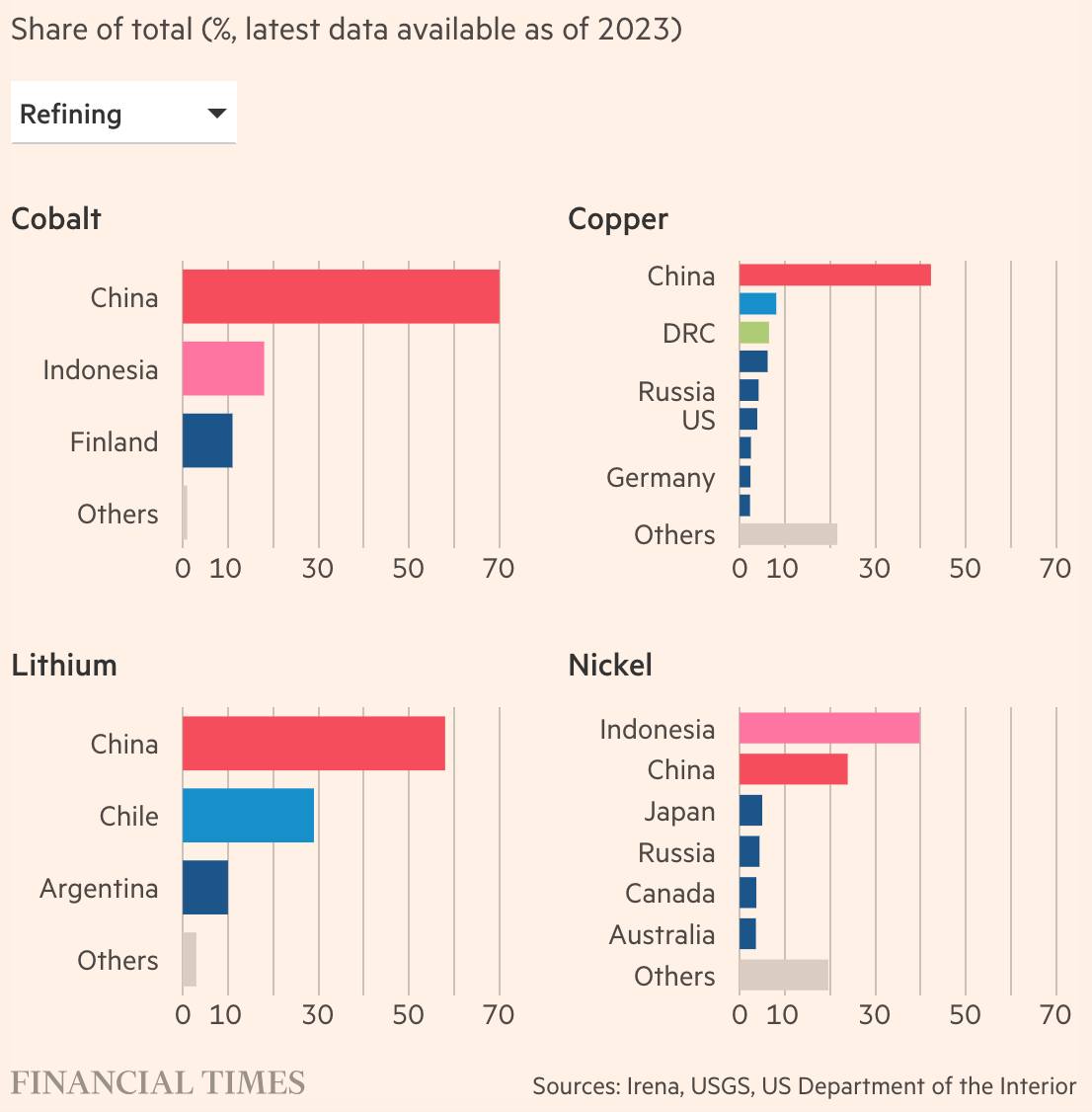
China dominates the EV supply chain as 76 per cent of the world’s production capacity for batteries – they make up 40 per cent of a typical EV’s sticker price – is in the country, with Contemporary Amperex Technology Limited (CATL) and BYD among the world’s top three producers. Fujian-based CATL alone controls a third of the entire global battery market... The country also controls more than two-thirds of the components needed to make them... China is also home to 70 per cent of the global production capacity for cathodes and 85 per cent for anodes, both key battery components, according to the International Energy Agency (IEA). Over half of the world’s lithium, cobalt and graphite processing and refining capacity is located in China... Two-thirds of the 10 million EVs sold worldwide last year were in China, helped by a slew of government policies dating back to 2009 that include subsidies, tax breaks and procurement contracts.
This illustrates the dominance of electric vehicle components and batteries.
And this points to the dominance in the processing of the critical minerals used in EVs
This is a good illustration of China's importance to the EV supply chain
And more on processing capacity

The Times primer captures the entire value chain, right up to final EV production, where China makes 54% of global EVs. 

This is a good summary of the different kinds of support the Chinese EV industry has gotten over the years. It has included a ten-year consumer subsidy program that ended in 2022 which reimbursed consumers as much as 60,000 yuan (~$8000), waiver of a 10% levy on smaller EVs till 2025, other tax breaks, manufacturing subsidies, government-funded charging infrastructure (6.36 million chargers, the largest in the world, and 649,000 chargers added in 2022, which is more than 70% of global additions). Several hurdles have been put to disincentivize ICE vehicles - license plate prices in auctions in Shanghai averaged 92,780 yuan last year whereas green license plates can be easily obtained; a tradeable dual-credit system for automobile manufacturers since 2017 that awards points for making clean cars and penalties for those with high fuel consumption, and producers with negative scores may be taken off the market. These were complemented by large purchases by governments at all levels and public transport networks. 

The result is that EVs made a quarter of all car sales last year, compared to one in seven in the US and one in eight in Europe. Including plug-in hybrids, clean-car sales hit 5.67 million in 2022, more than half of all global deliveries and 60% of the world’s 14.1 million new passenger EV sales this year. 

Rana Faroohar points to a German Marshall Fund paper that points to China's dominance of the rare earths market
As the GMF report notes, China controls 61 per cent of global lithium refining, and 70 per cent of the global supply of cobalt for lithium ion batteries comes from mines in the Democratic Republic of Congo, many of which are owned by the Chinese. China controls 100 per cent of the processing of natural graphite used for battery anodes, and 80 per cent of the total rare earth production and processing.
China's dominance of the supply chain for critical minerals is captured in the graphic below
This is a good summary of the drivers of the country's dominance in these markets, 
The factors driving China’s success in this arena are the same ones that have made it the uncontested manufacturing workshop of the world. These include low-cost capital, rapid regulatory approvals, protection from foreign competition, lower labour costs, an unparalleled network of suppliers, and fast-growing domestic demand.

In addition, China also dominates the supply chain for critical minerals used for defence purposes, or "war minerals". They include minerals like gallium, germanium, and indium that are critical for military equipment like lasers, radars, and spy satellites. These minerals have little commercial value and are mined and refined only in very small quantities. Sample this from The Economist

Antimony, known in biblical times as a medicine and cosmetic, is a flame retardant used in cable sheathing and ammunition. Vanadium, recognised for its resistance to fatigue since the 1900s, is blended with aluminium in airframes. Indium, a soft, malleable metal, has been used to coat bearings in aircraft engines since the second world war... Long before cobalt emerged as a battery material, nuclear tests in the 1950s showed that it was resistant to high temperatures. The blue metal was soon added to the alloys that make armour-penetrating munitions. Titanium—as strong as steel but 45% lighter—also emerged as an ideal weapons material. So did tungsten, which has the highest melting point of any metal and is vital for warheads. Tiny amounts of beryllium, blended with copper, produce a brilliant conductor of electricity and heat that resists deformation over time... Gallium goes into the chipsets of communication systems, fibre-optic networks and avionic sensors. Germanium, which is transparent to infrared radiation, is used in night-vision goggles. Rare earths go into high-performance magnets. Very small additions of niobium—as little as 200 grams a tonne—make steel much tougher. The metal is a frequent flyer in modern jet engines.

Beyond their varied properties, this group of mighty minerals share certain family traits. The first is that they are rarely, if ever, found in pure form naturally. Rather, they are often a by-product of the refining of other metals. Gallium and germanium compounds, for example, are found in trace amounts in zinc ores. Vanadium occurs in more than 60 different minerals. Producing them is therefore costly, technical, energy-intensive and polluting. And because the global market is small, countries that invested in production early can keep costs low, giving them an impregnable advantage. This explains why the production of war minerals is extremely concentrated. For each of our 13 war minerals, the top three exporters account for more than 60% of global supply. China is the biggest producer, by far, for eight of these minerals; Congo, a troubled mining country, tops the ranking for another two; Brazil, a more reliable trading partner, produces nine-tenths of the world’s niobium, though most of it is sent to China. Many minerals are impossible to replace in the near term, especially for cutting-edge military uses.

The combination of concentrated production, complex refining and critical uses means trading happens under the radar. The volumes are too small, and transacting parties too few, for them to be sold on an exchange. Because there are no spot transactions, prices are not reported. Would-be buyers have to rely on estimates. These vary widely. Vanadium is relatively cheap: around $25 per kilogram. Hafnium might cost you $1,200 for the same amount. All this makes building new supply chains much more difficult.  

On July 4, China announced restrictions on exports of gallium and germanium, that are important in semiconductors, solar panels, and missile systems. This has strategic significance since it highlights the vulnerability of US and other western militaries to such sanctions. In the aftermath of the Cold War, the US has run down its large stocks of strategic minerals and confined its strategic stockpiles to only commodities like oil and gas. 

Such global market-wide dominance by any one country, leave alone by one that's so belligerent and willing to exercise its power as China, should be a matter of serious concern to anyone outside China. 

Update 1 (11.08.2023)

This FT article describes how China came to control the renewables supply chain, focusing on promoting "the whole of supply chain" through a combination of purchases of mines, and the marriage of private sector enterprise and industrial policy in manufacturing and usage.
China is responsible for the production of about 90 per cent of the world’s rare earth elements, at least 80 per cent of all the stages of making solar panels and 60 per cent of wind turbines and electric-car batteries. In some of the materials used in batteries and more niche products, China’s market share is close to 100 per cent... China’s grip on raw materials is “more than it appears”. This is thanks to equity investments in overseas mining operations by Chinese companies such as metals group Huayou Cobalt, carmaker BYD and battery giant CATL. In lithium, for instance, China only has a small share in mining, yet by next year Chinese interests will control more of the resource than the country needs for domestic purposes... 

The country’s overseas metals and mining investments are on track to hit a record this year, according to data published last week by Fudan University in Shanghai. Spending in the first six months of 2023 hit $10bn, more than the total in 2022, and investments this year are likely to surpass the previous annual record of $17bn in 2018... China is the leading producer of at least one stage of the supply chain for 35 of the 54 mineral commodities that are considered critical to the US... China produces a “staggering” 98 per cent of the world’s supply of raw gallium, according to CSIS, despite the product’s US military applications, including in next-generation missile defence and radar systems. In electric-car batteries, for example, China’s share of the raw materials they require is lower than 20 per cent but it holds a 90 per cent share of the market for processed versions of the same materials... The production of graphite, used in the anodes in the heart of a lithium-ion battery, is instructive. While China’s market share of graphite reserves is just over 20 per cent, its market share for graphite processing is nearly 70 per cent... 

More than half of all new wind turbines installed this year will be in China, according to the Global Wind Energy Council, an industry lobby group. In the production of nacelles, which house the turbine’s power generation equipment, China has a market share of 60 per cent. It is currently building more than 60 new nacelle assembly facilities, adding to the 100 already in operation. Further down the turbine supply chain, the GWEC data shows China has more than 70 per cent market share of many crucial components including castings, forgings, slewing bearings, towers and flanges.

This about industrial policy,

Beijing’s cumulative state spending on the EV sector is more than $125bn between 2009 to 2021. Domestic industry was prioritised with heavy-handed local requirements, and from 2016 South Korea’s leading battery makers, LG, SK and Samsung, were cut off from accessing generous subsidies, setting up a boom in CATL and BYD’s battery production. 

This about the inherent advantages that completely distort the playing field for foreign competitors,

The advantages that China now boasts when it comes to manufacturing clean tech products are underpinned by massive economies of scale benefits. Goldman data suggests that China can build an EV factory in about a third of the time it takes in other countries while a battery factory in the US will cost nearly 80 per cent more than in China. Bernstein says the cost of some manufacturing in the US can be three times more than in China. This highlights how China’s rivals must grapple with not only limited access to resources and upfront technology costs, but also labour shortages, wage inflation and higher environmental standards...
Buoyed by massive domestic demand, Chinese manufacturing of polysilicon and its processing results in costs that are two-thirds the price of a European-made product, the IEA says. Chinese wind turbines are half the price of western rivals, according to S&P data. Across these industries, Mazzocco says it is important to credit the role of intense private sector competition. “It is something we miss from the outside: we think it’s just about the subsidies. But in reality, it’s also because [companies] have been able to overcome their competitors within China in an extremely cut-throat environment,” she says. “They are the best of the best at squeezing every cent out of their operations.”

And as if extraction and processing was not enough, China is now seeking to control the trading of clean energy metals. 

China is making a push to dominate the trading of lithium carbonate futures, as it seeks to wrest the financial plumbing linked to metals vital to the clean energy revolution away from the western dollar-based financial system. Last month the Guangzhou Futures Exchange became the fourth global commodities exchange to launch contracts tracking the price of lithium carbonate, a mineral used in the manufacture of electric-vehicle batteries. 

Within three weeks open interest — a key measure of the size of the market — had risen to more than 20,000 lots and far outstripped activity at rivals London Metal Exchange, Singapore Exchange and the US’s CME Group, which had launched its own version just days earlier. The proliferation of futures contracts on crucial elements of electric-vehicle products such as nickel, copper and lithium carbonate in part reflects the growing importance of the industry, as companies up and down the supply chains seek to hedge against price swings. But the early lead established by Guangzhou has underscored how China is seeking to seize greater control over trading in what it sees as a group of metals critical for the 21st century. By establishing its own trading hubs and benchmarks priced in renminbi, the drive is part of Beijing’s efforts to lessen the commodities market’s reliance on the US dollar...

Even so, China’s drive to convert its dominance over the flow of commodities into global pricing power faces substantial hurdles, including using a currency that cannot be freely traded, and the absence of a global warehousing network for any of China’s five domestic futures exchanges. The LME, which is owned by Hong Kong Exchanges and Clearing, does have a network of warehouses outside of China. It also argues its nickel futures contract — which represents the worst quality piece of metal in the worst part of the world — is more representative of the global market. Its pricing system is based on the value traded on its exchange, supplemented with “regional premiums” to reflect local problems such as distribution.

Wednesday, May 3, 2023

The economic growth-regulation trade-off

How much regulation is too much? 

Works in Progress has a very good article that highlights the trade-off between regulation and economic growth in the context of developed economies in infrastructure construction. The case in point is environmental and other safeguards-related permissions required for infrastructure projects in developed countries. 

Consider this on the prohibitive costs of environmental and other safeguards documentation required to obtain permissions for large infrastructure projects in the US,
1,961. That’s the number of documents contained within a single planning application for a wind farm off the northeast coast of England – capable of powering around 1.5 million homes. The environmental impact assessment and environmental scoping documents alone totalled 13,275 pages. To put that into context, that’s 144 pages longer than the complete works of Tolstoy combined with Proust’s seven volume opus In Search of Lost Time... EDF Energy had to produce 44,260 pages of environmental documentation for Sizewell C, a new nuclear power station to be built on the same site as two existing nuclear power stations in Suffolk, England.... a Freedom of Information request from New Civil Engineer magazine recently revealed that the UK’s National Highways agency spent £267 million preparing a planning application to build a 23-kilometer road. The planning application, which featured 30,000-plus pages of environmental documentation, was the longest ever prepared... 

It takes, on average, ten years for an electricity transmission project to be completed. But before you get to that point, it can take as long as 13 years just to get approval for the project. For example, Harvard’s Belfer Center cites the case of the 732-mile Transwest Express high-voltage transmission line. It applied for its permit in 2007, but did not receive full approval for construction to begin until 2020. It’ll come online in 2026, 19 years after that first permit application was filed... Using the average environmental page count from a sample of 18 projects (11,756) gives us an average per-project cost of £98 million. And that’s before the projects have put a single spade in the ground and before any spending on environmental mitigations has taken place. Think what could be achieved with even half of that nearly £100 million cost per project.
In stark contrast, sample this from history
France responded to the oil shock of 1973 with the beautiful slogan: ‘In France, we do not have oil, but we have ideas’. Over the next 15 years, the French built 56 nuclear reactors. To this day, France gets more than two thirds of its electricity from nuclear power... consider the construction of Britain’s national electricity grid in the 1920s–1930s. In the space of three years, Britain devised a plan to connect over 100 of the UK’s most efficient power stations into seven local grids across the country, and passed legislation needed to enable the plan and begin work on it. It took five more years for the project to be completed, with 4,000 miles of cables running across 26,000 pylons around the country. A year after the seven local grids were built, a group of impatient and rebellious engineers decided it was easier to ask for forgiveness than permission, and switched on the connections between the seven grid areas themselves to form a single national system. That national system remains to this day. It is hard to imagine projects of similar scale taking place today at similar speeds.
This debate has important relevance in the context of developing countries. In many areas, developing countries tend to adopt state-of-art regulations from their developed counterparts - labour standards, environmental protection, corporate and financial markets regulation, etc. In fact, they are actively encouraged to do so by multilateral lending agencies. But this has consequences that adversely impact their growth. 

Regulation is an incremental cost that gets added to the cost of production. It manifests in the form of additional equipment or building or infrastructure, slack or redundancies, increased construction times, etc on the grounds of safety, pollution abatement, employee welfare and working conditions, community welfare, social inclusiveness etc. This is a simple model of how regulation increases costs, lowers demand, and reduces economic competitiveness. 

Therefore, historically, the scope of these regulations has expanded progressively with the country's development. In fact, the historical trajectories of economic growth of today's developed economies point to a Maslowian hierarchy of values. The values associated with a subsistence economy are very different from that of an aspirational middle-income economy or a rich post-modern economy. 

The early development pathway of all today's developed countries, including that of China recently, have been characterized by large-scale externalisation of costs by all economic agents. The industrial revolution happened in a very loosely regulated world. In fact, it could not have happened with the modern world regulations. 

While gains are privatised, environmental and social costs are externalised on the society. Looser regulations and their enforcement, corruption, crony capitalism, etc are inevitable accompaniments to rapid economic growth from a low baseline. Once countries reach a certain income level and command adequate tax revenues, they venture into the higher levels of the values hierarchy. This is a messy reality of development. Nothing has changed to warrant a revisit of this theory of change.

Many developing countries, or regions there, continue to remain in the pre-industrial stage of economic development. Forget the fourth, they are still to fully realise the benefits of the second industrial revolution. In this debate, the irony of developed countries that have enjoyed lighter regulations during their growth phases now turning around and forcing developing countries to adopt tighter regulations should not be missed. 

Further, the commentators and opinion makers in developing countries, who inhabit the post-modern world, too tend to foist the social and economic values they share with the developed countries on the collective choices of their nations. Politicians and policymakers in developing countries should keep this in mind while making policy decisions on regulations.

The problem with this is that once we accept lower regulation, there is a slippery slope of exploitation by all kinds of economic interests. The markets are not known for restraint and social responsibility. So the challenge is to get regulation right. This has to be borne in mind as policymakers in developing countries adopt progressive regulations. 

These aspects should also inform global policy formulation on such issues. The energy transition debate where developing countries are being asked to sharply cut their carbon footprints at a very early stage in their economic growth is a case in point. Steep cuts and rapid changes by developing countries will erode their global competitiveness, besides also raising questions of affordability and market demand (see this and this). It's also an existential issue for people in many developing countries - poverty will get you before climate change can. I'll write about this in the coming days.