Substack

Showing posts with label Inflation. Show all posts

Saturday, May 30, 2026

Weekend reading links

1. This captures the big problems with Chinese exports to Europe.
In the early 1970s workers at Dongfeng, or “East Wind”, imported American trucks to inform their early attempts at making off-road vehicles destined for the People’s Liberation Army. Nearly 60 years later Stellantis, the European owner of the Jeep brand, is partnering with Dongfeng to produce a new battery-powered version of the iconic American light utility vehicle for consumers in China, the Middle East and south-east Asia... International carmakers, struggling for survival amid an expensive transition to electric vehicles, are turning to China’s technologically advanced and cost-efficient factories as manufacturing bases for their global businesses. Foreign companies already account for around two-fifths of China’s car exports to Europe, when joint ventures with local groups are included, according to the Rhodium Group, a US consultancy... Indeed, Volkswagen, BMW, Nissan, Hyundai and others are increasing exports from Chinese factories with spare capacity to markets other than Europe and the US.

2. A new approach to making clean hydrogen

Most of the hydrogen the world uses today — mainly for fertilizer and refining — is produced using natural gas in a process that creates lots of emissions. In recent years, the United States and other countries have invested billions of dollars trying to make “green” hydrogen with wind and solar power, but it has proved difficult and expensive. Now a growing number of companies think a better answer could lie underground. Dozens of start-ups are trying to find large reservoirs of natural hydrogen thought to exist below the surface. Others, like Vema, are trying to stimulate the processes that generate that hydrogen, without any emissions. It’s a field often referred to as “geologic hydrogen.”...
Hydrogen is the most abundant element in the universe, and it gets made naturally in the Earth’s crust when certain iron-rich minerals react with water and rust. This process, known as serpentinization, often leaves behind rocks with a mottled green color. For a long time, many geologists believed that any natural hydrogen produced this way was unlikely to accumulate in large underground deposits because the tiny molecules would slip away through cracks in rocks. Lately, that conventional wisdom has been upended... By the 2020s, scientists were publishing papers estimating that natural hydrogen deposits underground could supply the world’s needs for hundreds of years. One promising location was North America’s Midcontinent Rift, an enormous formation of iron-rich basalt that stretches 1,200 miles from Kansas to Michigan... The Energy Department has estimated that geologic hydrogen could be produced for less than $1 per kilogram. That would be cheaper than hydrogen made from fossil fuels and one-sixth the current cost of making hydrogen from wind and solar power.

It has started attracting private capital.

Companies are racing to find the fuel. One of the best-funded start-ups, Koloma, has raised $400 million from investors including Amazon and United Airlines and has drilled exploratory wells in Iowa. HyTerra, an Australian firm, is searching for hydrogen and helium in Kansas and Nebraska. Not everyone thinks the best strategy is to search for natural deposits underground. A better idea, some say, is to create them. In Quebec, a startup called Vema Hydrogen plans to spend the rest of the year injecting water into its underground test wells to see if it can speed up the process of serpentinization that creates natural hydrogen underground... Vema has already raised $15 million and is working to raise more. There are ophiolites all over the Earth, including a ridge stretching from Costa Rica to Alaska, and the company is looking at sites in Oregon and California as well. Other start-ups, including one out of M.I.T. called GeoRedox, are developing their own approaches.

3.  Semiconductor chips are one area where China lags badly.

Chinese companies will most likely make just 2 percent as many A.I. chips as foreign firms do this year, said Tim Fist, a director at the Institute for Progress, a think tank in Washington. The production gap between Chinese and foreign manufacturers is especially big for memory chips, which are essential for the large calculations done by A.I. Companies outside China will make 70 times as much memory storage capacity this year as Chinese chip makers will, Mr. Fist said...The inability to get essential tools from ASML has been a major chokehold for Chinese chip makers. Since U.S. officials led an effort to lobby the Dutch government to block shipments to China, no Chinese company has been able to buy ASML’s most advanced tools. Instead, Chinese chip makers have recruited engineers with experience using those machines at TSMC, the world’s top chip maker. And now, Chinese start-ups are trying to make their own chip manufacturing equipment... China’s A.I. companies are trying to get the computing power they need by strapping together numerous less powerful chips. Huawei has taken such an approach... The chips Huawei does produce are prone to defects and use more electricity than cutting-edge foreign ones.

4. This is one of the greatest messages from a student to a teacher, Albert Camus to his elementary school teacher Louis Germain after he won the Nobel Prize.  

5. Japanification in demographics.
And this impact of smartphones is striking.
6. Soumaya Keynes has a good read on the history of export restrictions and their impact, and why trade wars will endure. 

7. Southeast Asian economies struggle on the face of rising inflation from the War.
Their currencies have weakened.
The Philippines and Indonesia have already raised interest rates. 

This is a good illustration of the extent of damage from the Strait of Hormuz closure.
In a sign of Bab el-Mandeb strait’s strategic importance, Djibouti – whose coastline runs along the waterway – is home to military bases of several major countries, including the US, Italy, France, Japan, and the sole People’s Liberation Army base outside China. The Bab el-Mandeb strait is among several trade chokepoints that, when blocked, require vessels to travel more than 8,000 miles. These also include the Strait of Gibraltar and the Suez and Panama Canals...
The knock-on effects of a blockage can be much more significant where there is no alternative route to fall back on, as with the Strait of Hormuz, the Øresund between Denmark and Sweden, and the Turkish straits, comprising the Dardanelles and the Bosphorus, which act as the gateway between the Black Sea and Mediterranean. With the Hormuz strait, says Jasper Verschuur, co-author of a study into the risks of the world’s 24 narrow straits, “there is no alternative for 80 per cent of the trade”.

This is India's exposure to various maritime routes

9. Sajjid Chinoy writes that India's economic problem is less of a current account and more a capital account problem, arising from the sharp decline in FDI and FPI inflows. In the circumstances, he argues that demand compression can be counterproductive by slowing growth. He suggests a combination of depreciation and augmentation measures for foreign capital inflows.
The objective must be to attract a large-enough quantum of near-term capital inflows across multiple avenues — even if it involves a subsidised swap — to change exporter, importer and investor behaviour, and prevent a destabilising overshooting of the Rupee.

I am not sure how this is at all possible precisely when capital is flowing the other direction.  

10. For all talk of private participations and efficiencies, the long-distance railway networks in continental Europe is largely state-owned - Deutsche Bahn (Germany), Ferrovie dello Stato (Italy), Renfe (Spain), SNCF (France), and SBB (Switzerland). The Economist writes about how Italo, the private high-speed rail operator co-founded by Luca Cordero di Montezemolo, is trying to disrupt the German network. 

11. Securitisation and deepening of financial intermediation in Europe. 

The securitisation market in Europe remains moribund, comprising around 0.3 per cent of GDP compared with 4 per cent in the US.

12. SpaceX's IPO prospectus takes the widest liberties with US securities law. 

13. K-shape in US economy.

And now in wage decline
14. Ukraine's drones are inflicting massive damage and casualties on Russia as the country forces its way into its most favourable situation since the war began.
Some intelligence reports indicate that a staggering 1.2mn Russian soldiers have been killed or wounded since February 2022, a casualty figure no major power has suffered in a single conflict since the second world war... Backed by some €90bn in EU loans, Kyiv is pouring resources into domestic arms production in a bid to reduce dependence on western weapons and the political constraints that often accompany them. It has moved at breakneck speed to scale up the manufacture of land, sea and air drones, artillery systems, electronic warfare equipment, and even ballistic and cruise missiles.

15. The consulting industry is threatened by AI.  

Few industries are debating AI’s implications more intensely than consulting, whose core work of research, summarising data and producing neatly designed PowerPoint presentations is highly automatable. Richard Susskind, co-author of The Future of the Professions, says consultants are more vulnerable than other mainstream professions in part because the work of junior staff “can now be taken on, with mild supervision, by increasingly capable AI systems”. The sector now has two new competitors, he adds: “the AI-empowered client and disruptive start-ups. Both challenge the conventional model.”... AI also threatens one of professional services’ foundational economic models: billing by time. When a bot can review thousands of contracts in minutes and draft complex documents in seconds, the relationship between hours worked and value delivered begins to break down. Increasingly, clients are demanding pricing linked to outcomes rather than labour inputs.

16.  

Saturday, August 30, 2025

Weekend reading links

1. US equity markets fact of the day!
Nvidia, is now worth $4.3tn, or one-and-a-half times the UK’s entire FTSE 100 index, give or take... The 10 biggest companies in the US, which are mostly tech-flavoured, with some finance bolted on at the bottom, now account for some 40 per cent of the S&P 500 and for a third of the revenue growth across the index over the past year. Big tech has done all the heavy lifting for investors in the US this year, hence why the S&P 500 is up 9.5 per cent so far in 2025 while the Russell 2000 index, which tracks smaller stocks, is up a more modest 4.2 per cent.

2. Manufacturing reverses course in East Asia.

3. The days of independent central bankers may be closing, even as their credibility among the public is waning. 

Inflation targeting, a system pioneered in New Zealand in the 1990s under which rate-setters pledged to do whatever it took to hit their price goals, grounded independence with an intellectual framework... Volcker helped lay the foundations for governments around the world to give greater independence to economic technocrats. The Maastricht treaty of 1992 created the framework for control over monetary policy to be handed to the European Central Bank at the end of the decade. In 1997, Tony Blair’s new Labour government finally gave the Bank of England, then a more than 300-year-old-institution, freedom to set interest rates without political meddling.
4. Who benefited in India from the Russian oil imports?

5. Spain's solar energy glut.
In 2023 and 2024, Spain added more solar power capacity than any other European country except Germany, whose economy is more than twice its size... At some times in spring, as much as 60 per cent of Spain’s electricity comes from the sun. That has enabled Spain to slash its use of gas and coal-fired power stations. Consumers have reaped the rewards, as cheap electricity frees the country from the angst elsewhere in Europe over utility bills... Spain has built so much solar capacity that at certain times of day it produces far more electricity than it needs. Prices have plunged as a result, dragging down owners’ profits with them. Over the past year, “day ahead” wholesale electricity prices were zero or even negative 10 per cent of the time, according to data from grid operator Red Eléctrica. In May, they were at zero or below for one-third of the entire month... Today Spain has 36GW of total solar capacity...
No longer is the Spanish system centred on a few dozen fossil fuel and nuclear plants whose huge turbines are located close to urban demand hubs. Instead, it relies on a web of smaller renewable plants dispersed across rural areas, including 54,000 solar installations. They generate power intermittently, depending on cloud cover and the rotation of the earth, and do not help to stabilise grid frequency and voltage in the same way as giant gas and nuclear turbines. “This transformation has pushed the grid to the limits of the generation mix,” said José Bogas, chief executive of Endesa, a big Spanish utility, in May. But, he added, “we have continued to operate the system as we used to”. While Spain has championed investment in solar parks, the grid has been neglected. According to BloombergNEF, it has been Europe’s stingiest grid investor since 2020, putting only $0.30 into the grid for every $1 invested in renewables, versus a pan-European average of $0.70... As long ago as 2017 a group of European grid operators, Entso-e, warned that the growth of renewables risked creating instability in the grid and called for the deployment of devices that mimic the stabilising function of turbines, known as grid-forming inverters.

6. Good primer on where America gets its pharmaceutical active ingredients and drugs. This generally on drugs.

And this is on prescription drugs.

7. Top ten Indian exports to the US
Indian manufacturers are trying to adapt to the new tariffs by embracing a India+1 strategy of serving US markets from elsewhere.
Raymond might consider ramping up production in its Ethiopia factory for the US market. Ethiopia faces only a 10% tariff. He is not alone in considering a diversification of production outside India as a call of last resort. Godrej Interio, which exports office furniture, is also considering increasing production from its factories in Oman and Vietnam—countries with lower tariffs than India at present. The US has imposed a 10% tariff on Oman and 20% on Vietnam.

This is a good graphic that shows how India lost the labour intensive manufacturing race.

The data shows India’s share in global exports of apparel, leather, textiles and footwear (ALTF) initially grew from 0.9% in 2002 to a peak of 4.5% in 2013, but it subsequently declined to 3.5% in 2022. In contrast, Vietnam’s share has increased to 5.9% and Bangladesh reached 5.1% of global ALTF exports in 2022.

And this about India's failure to increase its textile exports

In 2010, China controlled 36 per cent of global exports; by 2018, its share slipped to 31.3 per cent due to rising wages. Vietnam and Bangladesh seized the opening, doubling their shares to 6.2 per cent and 6.4 per cent respectively. India’s share fell slightly, from 3.3 per cent to 3.2 per cent.  

8. Private equity faces strong headwinds as they struggles to raise money despite offering unprecedented enticements.

Private equity groups raised just $592bn in the 12 months to June: their lowest tally for seven years, data from Preqin show. The decline came even as firms offered more discounts such as management fee cuts, “early-bird discounts” for investors who commit quickly to new funds and other incentives... The industry’s fundraising has shrunk by nearly a third from its record levels in 2021. Higher interest rates and a slowdown in dealmaking have left firms unable to sell trillions of dollars in ageing investments, causing growing frustration from investors, many of whom are now refusing to back funds. Accentuating PE’s challenges are a flurry of newer entrants into the industry in the decade after the 2008 financial crisis, leaving the market oversaturated. It had left a record number of funds chasing every potential dollar of new investment, consultancy Bain said in June... As a result, more groups are offering discounts, such as pledging to return the transaction fees that were once charged to their clients, as well as volume-based discounts and novel terms such as caps on some legal and travel expenses. These types of enticements have reduced net management fees paid to PE groups by about half since the global financial crisis, Bain & Co. found.

9. Barry Scannell points to some important legal issues raised by the rise of AI.

Generative artificial intelligence poses two copyright puzzles. The first is the widely discussed question of compensation for work used to train AI models. The second, which has yet to receive as much attention, concerns the work that AI produces. Copyright is granted to authors. So what happens to work that has no human author? 

The US has drawn the clearest line in the sand to date. In 2023 the US Copyright Office granted copyright protection to the graphic novel Zarya of the Dawn but rescinded protection for any AI-generated images — protecting only the human-authored text and arrangement. More definitively, a federal appeals court ruled in March that the pretty, purple and green AI-generated artwork “A Recent Entrance to Paradise” could not receive copyright protection because works must be “authored in the first instance by a human being”. The message is unambiguous: AI prompts, however sophisticated, are not enough alone to warrant authorship. China has taken the opposite path. In 2023, the Beijing Internet Court ruled that AI-generated images could receive copyright protection, finding that a user’s intellectual investment in selecting prompts and refining outputs constituted human creativity. So far, the UK and Ireland occupy a curious middle ground. Both jurisdictions provide copyright protection for “computer-generated works”. But this protection may be on shaky ground. A consultation from the UK government last year asked whether it should be removed. Ireland’s AI Advisory Council has made a similar recommendation. 

Global divergence in legal frameworks can create problems for businesses. The same AI-generated content could be legally protected intellectual property in Beijing while residing in the public domain in Boston. That means an AI-generated jingle or AI-generated marketing copy made in the US could, in theory, be used by anyone. .. Litigation against AI companies from the likes of Getty Images and The New York Times centre on exploitation of existing works. So far the ownership of AI-created content has remained largely untested before the courts. But that could soon change.

10. Indian capital markets and foreign investors in 2025.

Foreign portfolio investors (FPIs), spooked by sluggish earnings and a sliding rupee, sold Indian equities worth ₹210 billion ($2.5 billion) in the first half of August alone, bringing outflows to ₹1.16 trillion ($14 billion) in 2025 till now. Foreign institutional investors (FIIs) sharply reduced their exposure to Indian equities in July, making India the most underweight market among emerging market portfolios. India’s relative weighting fell to a negative 2.9 percentage points versus the MSCI Emerging Markets (EM) index. Meanwhile, China, Hong Kong, and South Korea saw increased allocations.

11. Tamal Bandopadhyay has a very good summary of India's financial inclusion success with digital banking.

The total number of PMJDY accounts in the first week of August 2025 stood at 561 million. Collectively, these accounts make for Rs 2.64 trillion, with an average account balance of Rs 4,726. The number of RuPay credit cards issued to such beneficiaries is 385.9 million. Linking RuPay cards to PMJDY accounts had multiplied digital transactions. Public sector banks have played a spectacular role in this movement. They have opened 435.1 million accounts – 77.55 per cent of the total PMJDY accounts; followed by regional rural banks (105.6 million; 18.80 per cent), private banks (18.4 million; 3.30 per cent), and rural cooperative banks (around 1 million; 0.35 per cent)… Of the total PMJDY accounts, 66.75 per cent, or 374.4 million, are in rural and semi-urban India, and 33.25 per cent (186.6 million) are in urban India. Importantly, women outnumber men as beneficiaries. There were 312.7 million (55.70 per cent) women beneficiaries in the first week of August… 

Together, they have enabled direct benefit transfers (DBT) that deliver subsidies and welfare with laser precision — no middlemen, no leakage. The DBT coverage exploded from 28 schemes in 2013-14 to 323 schemes in 2024-25, and the quantum of funds transferred zoomed almost 10-fold during this period – from Rs 7,400 crore to close to Rs 7 trillion. A contributing factor to the growth of digital transactions is the RuPay card. The 386.8 million such cards issued under the PMJDY scheme, the installation of millions of POS machines, and the mobile-based payment system have together boosted the financial inclusion drive. On an average, a bank’s branch now serves 7,100 people… As of January 2025, 21.17 per cent of PMJDY accounts were inactive.

12. India dairying facts of the day.

The average Indian milch cow, according to US Department of Agriculture data, produced 1.64 tonnes of milk in 2024. The corresponding numbers were 4.60 tonnes for New Zealand, 7.33 tonnes for the EU and 10.97 tonnes for the US... The US, incidentally, had a mere 24,470 dairy farms producing milk from 9.3 million cows in 2022. India has upwards of 50 million farmers engaged in dairying with some 110 million milch cows and buffaloes.

13. Very good article that makes that highlights why the US tariffs against India for purchases of Russian oil are hard to justify

Analysis of Chinese data by Energy Aspects estimates that China’s buying of Russian oil via various means increased from 1.5 mb/d before the war to above 2 mb/d, with several grades of oil bought above the price cap. China does not have the refining capacity to absorb significantly higher volumes of Russian oil than they used to buy. Thus, geographically India became the logical clearing country for the Russian barrels... Have Indian refiners gained somewhat from discounted Russian oil? Yes, they have, as initial discounts ballooned to above $20 versus the Dubai benchmark, although higher costs of shipping following sanctions reduced the discounts India received. However, these discounts were also enjoyed by China, Turkey and Brazil (which buys Russian diesel) alike. And since 2022, India’s refinery production has barely risen on average and product exports are fairly steady as domestic demand has been rising and absorbing the increase. The challenge is that, if the west is serious about sanctions on either Russia or Iran or both, it will have to contend with the loss of more than 6 mb/d of crude, a number that is much larger than Opec+ spare capacity. This would lead to a surge in oil prices, probably to well above $100 — a level that Trump and Europe would be likely to balk at.

14. Australian web-design software company Canva eyes an IPO.

Founded in 2013, Canva develops web-based design software that is widely used in schools and large companies to prepare presentations. It is one of Australia’s most valuable technology companies, alongside enterprise software developer Atlassian, and is backed by the country’s main venture capital funds including Blackbird, Square Peg and Airtree. Its latest share sale boosts its valuation from $32bn last October and comes after its rival Figma listed in the US last month, spurring rumours that Canva may be plotting an initial public offering soon. The company said in June it had 240mn active users a month and annualised revenue — a metric used by start-ups to project full-year revenue based on a recent month’s sales — of $3.3bn. Figma made $749mn in revenue last year and had 13mn active users a month in the first quarter of this year, according to its IPO filing. The company priced its shares at $33, and the stock now trades at $69.41, valuing it at $34bn.

Where's India's Canva equivalent?

15. End of Fed independence?

Trump’s imprint is already present at the Fed. Two of its seven board members, Christopher Waller and Michelle Bowman, were selected by him during his first term in office. This month, Adriana Kugler, who was tapped to be governor by former president Joe Biden, announced she was stepping down before the end of her term next year, prompting Trump to pick Stephen Miran, one of his closest economic advisers, to succeed her. If Trump succeeds in ousting Cook, whose term runs to 2038, it would give his nominees control of the seven-member board of governors. Moreover, the presidents of the 12 regional Feds, all of whom serve five-year terms, will need to be renewed at the end of February 2026. The decision to renew their terms lies with the Fed’s board.

16. The Netherlands leads the way with four-day week becoming common.

Average working weekly hours for people aged 20 to 64 in their main job are just 32.1, the shortest in the EU, according to Eurostat. It has also become increasingly common for full-time workers to compress their hours into four days rather than spread them over five... In spite of its shorter average working hours per person, the Netherlands is one of the richest economies in the EU in terms of GDP per head. That is because shorter working hours are combined with relatively high productivity per hour, and a high proportion of people in employment: 82 per cent of working-age people in the Netherlands were in employment at the end of 2024, according to OECD data, compared with 75 per cent in the UK, 72 per cent in the US, and 69 per cent in France. Women, in particular, have high employment rates in the Netherlands, especially compared with countries like the US, where average working hours are longer. In addition, people in the Netherlands tend to retire fairly late... children in the Netherlands rank as the happiest in the rich world.

17. On China's rare earths grip over the world economy.

China has built up this strategic strength over many decades. In 1987, Deng Xiaoping, then the country’s leader, remarked: “The Middle East has oil. China has rare earths.” In reality, rare earths are found all over the world. It is China’s willingness to commit to the often filthy business of mining and processing critical minerals — and the rare earths that are a vital subset of them — that has given Beijing its near monopoly. As a result, the country is thought to mine around 60-70 per cent of the world’s rare earths and control around 90 per cent of their processing and refining. The west has long been aware of the theoretical dangers of its reliance on Chinese rare earths. As one Trump administration official told me: “We’ve sat around admiring this problem for decades.” His view is that the west was stymied by a mixture of environmental concerns and a reluctance to sanction state intervention in the market.

18. Some facts on foreign portfolio investments in India.

India has now gone five years with zero net foreign inflows into the public equity markets, an incredibly long time. This year too, flows are running at a negative $13 billion. Foreign ownership of Indian equities is at a 15-year low. India is now a consensus sell, with regional, global, and emerging market (EM) funds all underweight. In the same five years, domestic flows have exceeded $185 billion. Just as foreign investors have lost interest, domestic investors have never been more bullish... 

A hundred dollars invested in EM equities 15 years ago is today worth $180, compared to almost $500 if it had been invested in global indices. Within this context, India has massively outperformed. Over the past five years, MSCI India delivered dollar returns of almost 15 per cent per annum, compared to just 5 per cent for the broader EM index. 
Many investors have lost faith in the EM asset class, cut exposure, and India has been a funding source, given its relative outperformance.

19. H1B Visa facts.

In fiscal year 2023, more than 72 per cent of approved H-1B petitions were for Indian nationals, far outpacing China at 11.7 per cent. Currently, the annual H-1B cap stands at 65,000, with an additional 20,000 slots reserved for holders of advanced US degrees, all allocated through a lottery system.

20. Finally, Nvidia valuation fact.

Add up analysts’ estimates of the next five years’ worth of free cash flows, discount them back at a 10 per cent rate, and they total just $650bn. In other words, the remaining $3.8tn of enterprise value represents cash arriving from 2030 onwards. That “terminal value”, in analyst-speak, would be justified if Nvidia’s free cash flow were to grow at a 6 per cent annual rate for the rest of time, Lex calculates. But that’s a punchy assumption. Some of Nvidia’s customers are already designing chips of their own. Its 72 per cent gross margin, far ahead of anything ever reported by Apple, is an open invitation to competitors... Huang is optimistic. He believes, for example, that companies could earmark $4tn for AI infrastructure by 2030, much of it to buy servers incorporating Nvidia’s Blackwell, Rubin and Vera chips.

Saturday, July 19, 2025

Weekend reading links

1. Heat impacts productivity and lot else. Therefore the need for airconditioning.

Once indoor temperatures rise above the low-twenties centigrade, or around 75 Fahrenheit, humans start to suffer. Sleep duration and quality fall rapidly when temperatures rise above 23C. Cognitive performance fares similarly, with scores in US high school tests dipping on hot days, and the affected students suffering a lasting impact on their prospects of graduation. The same is true of office workers’ productivity, which peaks at around 21C and rapidly deteriorates as the mercury rises. And that’s all before we get on to mortality, where death rates climb steeply once temperatures hit 30C.

2. Lessons for life from Roger Federer.

In tennis, a small, consistent edge over your opponent can translate into big margins in the long run. Nadal, for instance, also won exactly 54 percent of his points. And when Carlos Alcaraz defeated Jannik Sinner on Sunday in the French Open final — in one of the greatest matches since the 2008 Wimbledon final — Alcaraz, the champion, actually won one fewer point than Sinner. It’s an easy concept to apply to almost any field. In 2022, Ronald van Loon, a portfolio manager at BlackRock, authored a paper on the percentage of investment decisions that need to be correct to beat market benchmarks for returns. He researched markets, crunched the numbers and came up with a number: As low as 53 percent... Federer may have only won 54 percent of his points... but he always seemed to win the points that mattered most.

The three lessons offered by Federer - effortless is a myth; it's only a point; and life is bigger than the court

3. The US-Vietnam trade deal depends on how the Trump administration will define "transshipment" which attracts a 40% duty.

Experts say the Trump administration’s definition of transshipment could refer to a range of practices from simply repackaging Chinese goods with a counterfeit “made in Vietnam” label or to using Chinese raw materials in goods manufactured in Vietnam. “The impact may be more limited if these 40 per cent tariffs are enforced solely for the most egregious practices of plain diversion of trade to avoid US tariffs,” said MUFG analyst Michael Wan. “In contrast, if there is a stricter determination of transshipment defined as a certain threshold of foreign value added, the impact . . . may be pronounced.” Given the Trump administration’s interest in isolating China, businesses fear a wider definition. This would be extremely damaging for Vietnam, where many businesses rely on Chinese raw materials and components, and warned that removing them would be impossible.
4. As the use of electricity, especially from renewables, to replace natural gas and other fossil fuel sources increases, countries are finding that they are falling woefully short on the associated infrastructure. Sample this from Netherlands which has even started rationing power. 
The Netherlands already has some of the highest electricity costs in western Europe because of the grid bottlenecks... To cover the necessary investment, tariffs are expected to increase each year until 2034 by an average of between 4.3 and 4.7 per cent in real terms, a presentation from national grid operator Tennet said. To free up capacity, Tennet and regional grid operators have started to offer contracts to households that discount electricity used at non-peak times, such as between 11am and 3pm, and other flexible contracts that allow users to pay for electricity in time blocks. From April 1, operators could offer contracts where large industrial users are barred from using their connections at all during certain busy hours in exchange for lower tariffs. The Hague has also put out a “more conscious use of energy” advertising campaign across TV and social media that asks consumers to charge bikes and cars outside of the 4pm-to-9pm peak, when the grid comes under greatest strain...

“Everything is going electric and electricity infrastructure needs to grow massively everywhere,” said Jeroen Dijsselbloem, mayor of Eindhoven. The Brainport region around Eindhoven, covering 750,000 people in several municipalities in the southern Netherlands, had lost investment because it had to ration power supply, he said. Brainport is also home to a cluster of advanced technology companies led by ASML, the maker of the world’s most sophisticated chipmaking machines. No significant new grid capacity would be installed in the region until 2027, Tennet figures show. “We need more than 100 medium-size substations and 4,000 small substations,” Dijsselbloem said. Grid operators are also short of 28,000 technicians to install the necessary infrastructure, according to Netbeheer Nederland. Companies such as Thermo Fisher, a US medical business with a base in the Eindhoven area, have maintained their growth plans but invested in on-site battery storage and solar to counter the grid congestion issues.

5. Does the US suffer from Dutch disease?

The US has Dutch disease. Its export is the dollar... The dollar lost roughly 8 per cent of its value over the past six months, which has renewed the old discussion of whether holding the world’s reserve currency is an exorbitant privilege or an exorbitant burden... In 1999, Aaron Tornell, now at UCLA, and Philip Lane, now European Central Bank chief economist, offered a theoretical framework to explain (Dutch Disease). The commodity export changed the budgeting process, they argued. After a windfall, powerful groups will fight to get their hands on any new spending. If the country has strong institutions and social solidarity, this grab for spending will fail. With weak institutions, it will succeed: instead of going to things that increase productivity, such as roads and schools, new spending goes to powerful groups, as unproductive gifts. Tornell and Lane called this the “voracity effect”. 

They applied it to data from Nigeria, Venezuela and Mexico, but if we accept that the US is not magic, we can easily ask these questions of it, too. How voracious are its powerful groups? How strong are its institutions? The answers in order are: quite, and not as strong as we’d thought. The voracity effect does help explain the gobsmacking audacity of Donald Trump’s so-called “Big Beautiful” Bill, with a cost of $3.4tn over 10 years and the benefits going overwhelmingly to the wealthy. In the past, Republicans have attempted to present tax cuts for the rich as a policy to release productive investment. They’ve even attempted to model this idea as a process called “dynamic scoring”.

6. The balance sheet of six months of Trump tariffs.

Chinese exports to the US fell 9.9 per cent year on year in renminbi terms between January and June... Exports to countries in the Association of Southeast Asian Nations, which the US accuses of transshipment of Chinese exports, rose 14.3 per cent, while imports increased 2.3 per cent in the first half.

7. The Israeli economic miracle

In tech-driven Israel, GDP per head has nearly tripled since 2000 to more than $55,000, rising from 50 to 70 per cent of the level in the US... Its $550bn economy is now among the largest 30 in the world... Total factor productivity, which captures how well labour is using new machines, has grown four times faster in Israel than in other developed economies over the past 25 years... Perhaps the most telling sign of its dynamism is that Israel now spends more than 6 per cent of GDP on research and development — more than any other nation and over double the global average... Since the early 2000s, as most other developed governments have increased spending and debt, Israel has cut state spending from 50 to 40 per cent of GDP, and public debt from a high of 90 per cent to under 70 per cent of GDP. The government also made some smart investments, seeding the venture capital industry that helped to launch the nation’s vaunted tech sector... Spillovers from defence have made Israel a global leader in fields from air-traffic control to, above all, cyber security. With more start-ups per head than any other country, its business culture is closer to that of California than the Middle East. It has 73 start-ups in the hot field of generative artificial intelligence, the third largest in the world. Half of its exports are tech products.

8.  Akash Prakash on corporate India

One of the clear takeaways when speaking with senior people working with Apple is their disappointment at the lack of willingness among India Inc to step up and make the investments needed to bring the Apple ecosystem into India. While China is putting up obstacles, the profit focus of Indian entrepreneurs is also a stumbling block. Whether it is putting up the component supply chain or making large capital investments for display units, there is a lack of interest on the part of large Indian groups to commit capital. They cite the low margins on offer and the intense scrutiny that Apple demands on quality and scale. In effect, it would take years of sustained effort to earn a reasonable return on capital — if at all. Is it worth it? Many believe they would be derated by their shareholders, who would not accept the initial losses and question the ultimate return on capital. With a drop in margins will come pressure on valuations and market capitalisation — this is the common belief among Indian industrialists. Indian markets are hyper-focussed on profitability and return on capital.

9. FT long read on BYD, China's battery and EV champion. 

Until recently, the main advantage Chinese EV manufacturers had over Tesla was that their products were significantly cheaper. But in February, BYD’s founder Wang Chuanfu stood on stage in Shenzhen and unveiled “God’s Eye”, an advanced driver-assistance system that is a precursor to fully autonomous vehicles. A month later, Lian, who now heads BYD’s automotive engineering research institute, was on stage with Wang to announce a new battery charging system capable of adding a driving range of about 470km in five minutes — a fraction of the time it would take a Tesla to charge to that level. The startling technological advances made by BYD and others have sparked panic among legacy carmakers, who have responded by partnering with Chinese rivals to learn how to build vehicles faster and cheaper, and with better software.
10. Unless I'm missing something, the Chinese have definitively outsmarted Trump and the US by being able to link the relaxation of its export controls on rare earths with a similar US relaxation of restrictions on the export of advanced semiconductor chips. The latter has been in place since the Trump 1.0 and has progressively tightened. The Chinese export controls on rare earths were introduced in response to the Trump reciprocal and higher tariffs on China. The US ceded ground by both sharply reducing its steep tariffs (which would have been a significant blow to the Chinese economy) as well as making concessions on its export controls on advanced chips. 

Now that the linkage is established, the Chinese will use the rare earths instrument to combat both tariffs and export restrictions.

This is a good article about how Nvidia's Jensen Huang charmed Trump and convinced him to lift the ban on the export of its powerful H20 chips. One more example of how corporate America's commercial interests have trumped America's national interests. It also underlines the point that President Trump has no deep interest in containing China. 

11. As Donald Trump warms up to Ukraine, even suggesting that the US could supply missiles to Ukraine if it could target sites deep inside Russia, including Moscow, Janan Ganesh makes some very important points about Donald Trump.

Trump and Maga are no longer the same thing. His movement — the intellectuals, the donors, the more online of the grassroots — have intense beliefs. Besides a life-long conviction that running a current account deficit with another nation constitutes “losing”, he doesn’t. None of this is fatal to Trump himself. He papers over the differences with force of charisma, electoral success and the dutiful enactment of key Maga priorities. This will protect him from serious internal dissent... Still, we can now see what the future of the US right looks like. Unless the Republicans find another version of Trump — someone whose star power overwhelms all philosophical reservations about him or her — the next leader will have to be more in tune with the movement. That is, more Christianist, more nationalist, more paranoid. An extreme right-winger can put up with half a loaf under Trump because he provides so much else in dazzle and tribal leadership. You aren’t getting that with JD Vance. Ideological and even personal litmus tests, which have been waived for Trump, could return. In other words, we have to entertain the notion that Trump is a moderating influence on a movement that will become much more doctrinal once he is gone. He approaches the world through personal relations, which are malleable, not ideas, which aren’t. 

Consider Ukraine policy. In all likelihood, Trump has been soft on Putin because he appreciates the Russian’s well-aimed flattery and resents the cost to the US of protecting Europe from him. This is bad, but it isn’t dogmatic. Much of Maga, in contrast, backs Putin out of a belief that Russia is nothing less than Christendom’s frontline, whether against Islam or secular Chinese communism or the woke enemy within. Because it is practical, Trump’s position can be shaken, as seems to be happening now... There are worse things than a personality cult, such as an ideas cult. For a decade, conservatism has been whatever Trump says it is. He has made it possible to regard China as the threat of the century but admire Viktor Orbán, who is China’s biggest friend in Europe; to oppose vaccines but not the president who oversaw the Covid vaccine; to view Ukraine as another region’s problem but Iran as a core US interest. This is an intellectual farrago, but it might be preferable to hard, consistent doctrine... Trump doesn’t share the movement’s interest in the fate of “western civilisation” and other grandiose abstractions. He is not much of a China hawk: his concern is the bilateral trade data, not the grand strategy, much less the contest of values. As for religion, we can’t know another person’s inner life, but come on.

12. China is staring at zero interest rates.

The release of China’s second-quarter growth data this week... real economic expansion was strong and steady at 5.2 per cent but widespread falling prices meant nominal growth was much weaker, at 3.9 per cent... The central bank’s benchmark seven-day reverse repo rate, following a series of gradual cuts, now stands at 1.4 per cent... The yield on China’s 10-year government bond has been hovering around 1.7 per cent, near historic lows, suggesting investor expectations of persistent disinflation... The average interest margin at China’s top six state lenders fell to 1.48 per cent in the first quarter, its lowest level on record, compared with more than 2 per cent in 2021... At most Chinese banks, the interest rate on demand deposits is 0.05 per cent, while one-year term deposits yield less than 2 per cent.

13. Europe's rural depopulation

In the decade to 2024, the estimated number of people living in predominantly rural EU regions fell by nearly 8mn, an 8.3 per cent drop, while the urban population rose by over 10mn, or 6 per cent. Regions making up about 40 per cent of the EU’s land area and containing almost one-third of its population, are experiencing a sustained drop in residents. Dwindling numbers mean shops and bars are forced to close, buses run less frequently, doctors are harder to find, and classrooms become emptier. This fuels further departures, in what the OECD describes as a vicious cycle... Depopulation threatens Europe’s cultural heritage, local languages, cuisines, crafts, farmland, traditions and even national security... Attempts at reversing the trend range from selling houses for €1 to encourage new arrivals to restore them, to subsidising vital services and repurposing civic buildings so they can serve several different functions. Some areas are turning to tourism, encouraging second-home ownership even as some other areas turn against it... the EU’s rural population is forecast to shrink by 18 per cent by 2100, with some areas — including in Bulgaria, Croatia, Portugal and Lithuania — expected to lose one-third of their rural inhabitants or more.
 

14. China is snapping up mines across the world at record rates.

Chinese companies had become adept at snapping up mining assets from western rivals in recent years, often being willing to take a longer-term view on valuations and invest in riskier jurisdictions... The most active Chinese mining groups in overseas deals include CMOC, MMG and Zijin Mining. Chinese financial institutions have also issued billions in loans for minerals mining and processing projects in the developing world... Chinese companies were positioning themselves to benefit from resource nationalism in nations such as Mali. Some military governments in Africa have sought to take control of western mining assets and are demanding higher royalty payments. Chinese companies are often prepared to accept a less lucrative arrangement if they can take over the running of the asset.

15. As China grapples with overproduction and deflation, President Xi has warned against excessive production in EVs, computing power (data centres), and AI. 

“When it comes to projects, there are a few things — artificial intelligence, computing power and new energy vehicles. Do all provinces in the country have to develop industries in these directions?” Xi told the Central Urban Work Conference, a rarely held high-level Communist party meeting on urban development.

Since September 2022, Chinese producer prices have been in a deflationary trajectory.

In articles across state and party media, Chinese President Xi Jinping and other leading officials have attacked what they call neijuan, or “involution”, meaning excessive price competition... Beijing is growing increasingly wary that surging industrial output, coupled with weak consumer demand at home, is fuelling a race to the bottom in prices that is entrenching deflation and fuelling tensions with the country’s biggest trading partners. Official data is expected to show on Wednesday that factory gate price growth remained negative in June for a 33rd consecutive month, one of the country’s longest such falls in decades. Overcapacity is a sensitive issue for China, which has sought to dispel complaints that its industrial policy has flooded its partners’ markets with artificially low-cost goods.

16. Important decision by the University of California's $190 bn endowment fund to completely exit its hedge fund investments

UC Investments in a meeting on Tuesday approved a plan to reallocate its 10 per cent absolute return portfolio — or its investments in hedge funds — to public equities, finalising a wind-down that began five years ago. Jagdeep Singh Bachher, chief investment officer of UC Investments, one of the largest institutional investors in the US, sharply criticised the industry in a recent meeting for not delivering for clients... He added that UC Investment’s hedge fund positions had undermined its overall performance by introducing risks during market upheavals in 1999, 2008 and 2020. “In each of those three scenarios, hedge funds didn’t hedge us,” he said. “They exposed us to the opposite kind of risk, which actually meant they hurt us.” The move underscores concerns among asset allocators about hedge fund investments that come with unstable returns and high fees that have ballooned in recent years.

Thursday, March 20, 2025

The great middle class squeeze

I had been thinking of posting on this for some time. There’s now enough evidence to suggest that the middle class globally is feeling squeezed. 

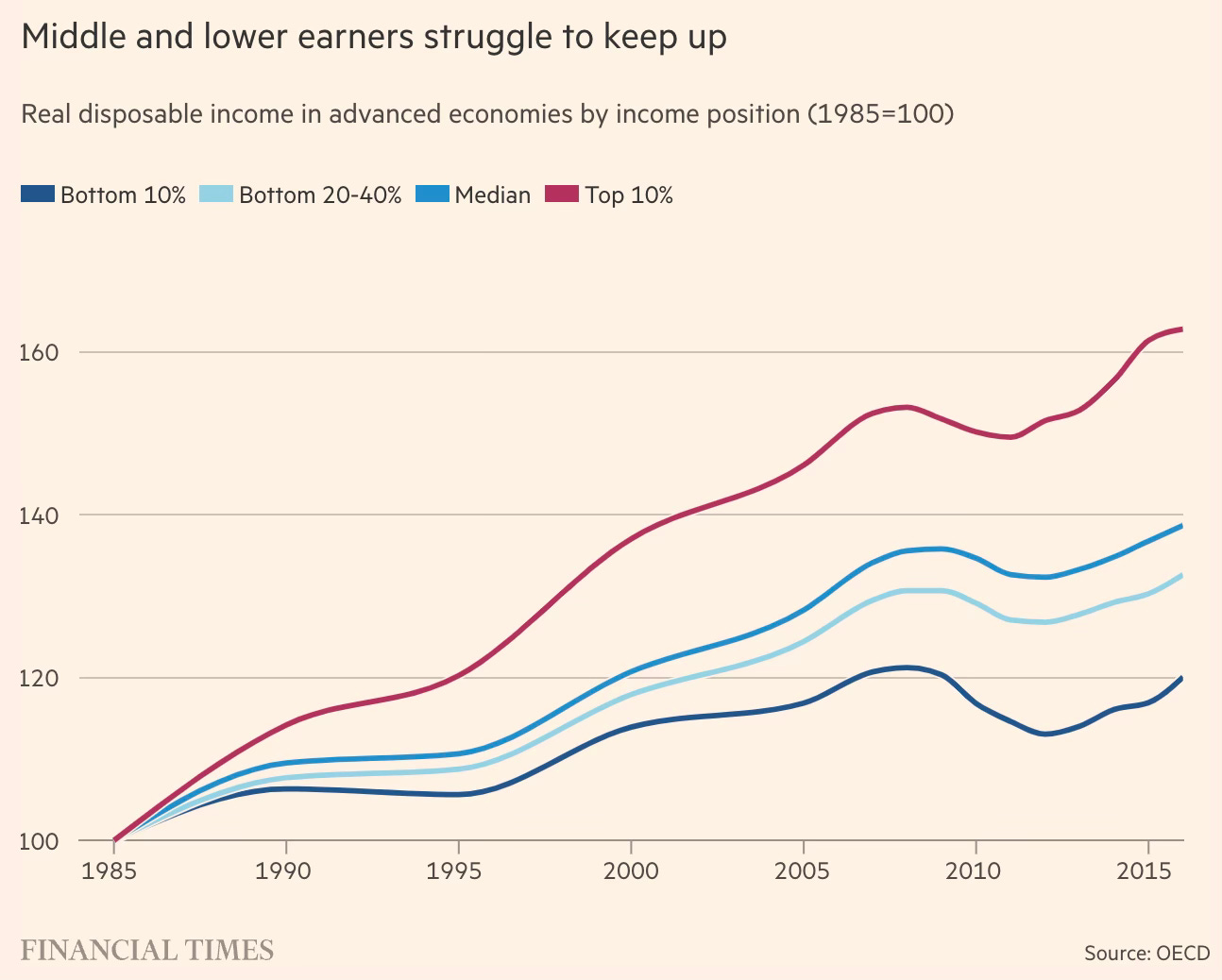
Tej Parikh has an excellent graphics-filled article on the problems being faced by the middle class in developed countries. Middle-class incomes have stagnated, their numbers have reduced, and inflation has worsened matters.

While real incomes at the top have risen, those at the middle and lower ends have stagnated since the financial crisis.

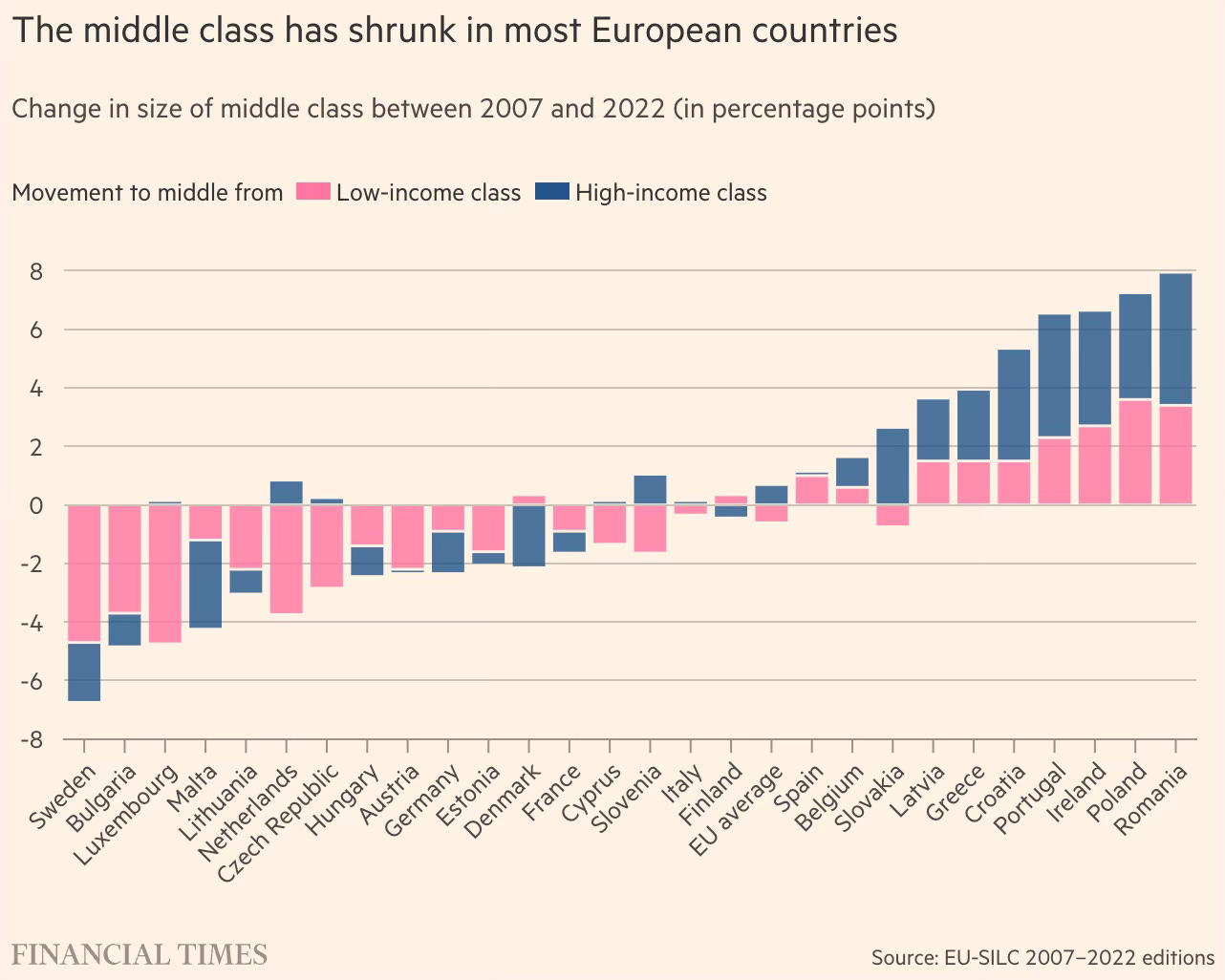
The result is that the middle class has shrunk in many countries. 

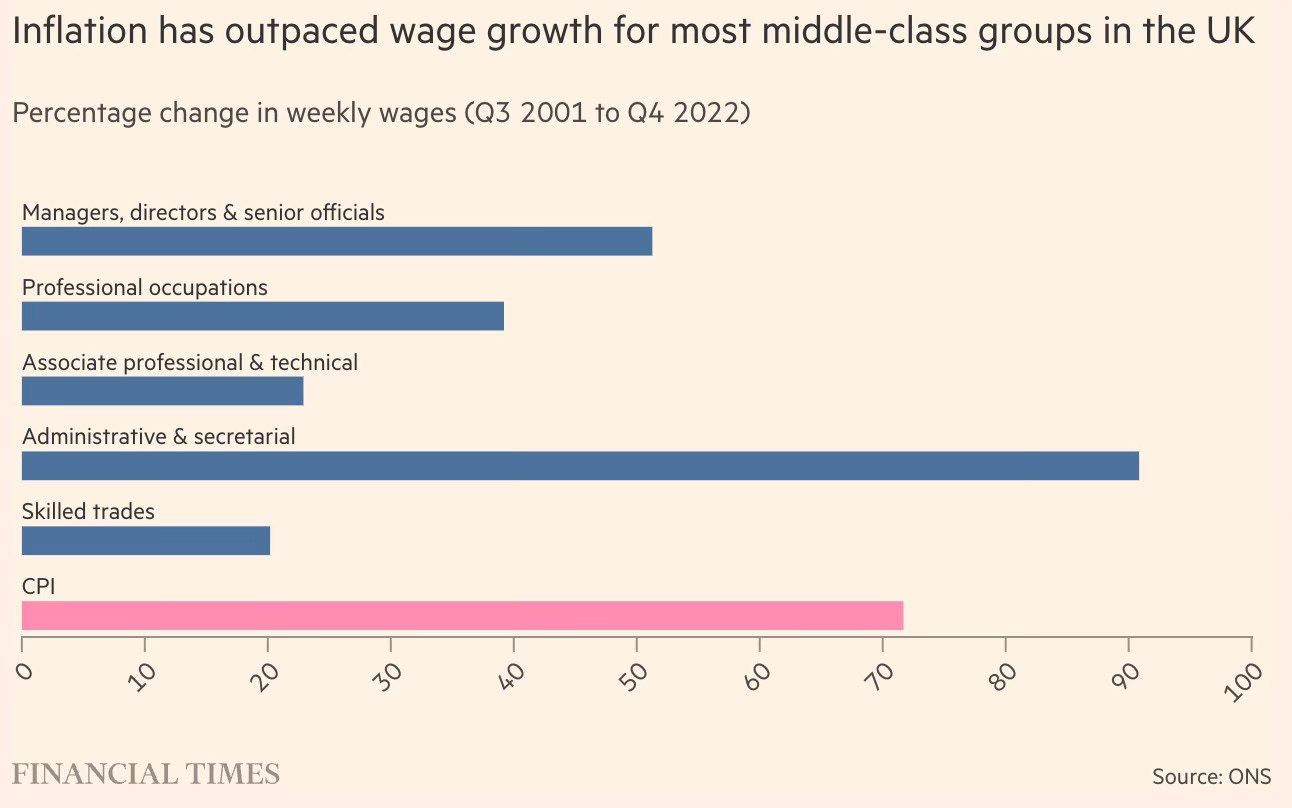
Inflation has been a major contributor. Here’s from the UK on how wage growth has lagged behind inflation.

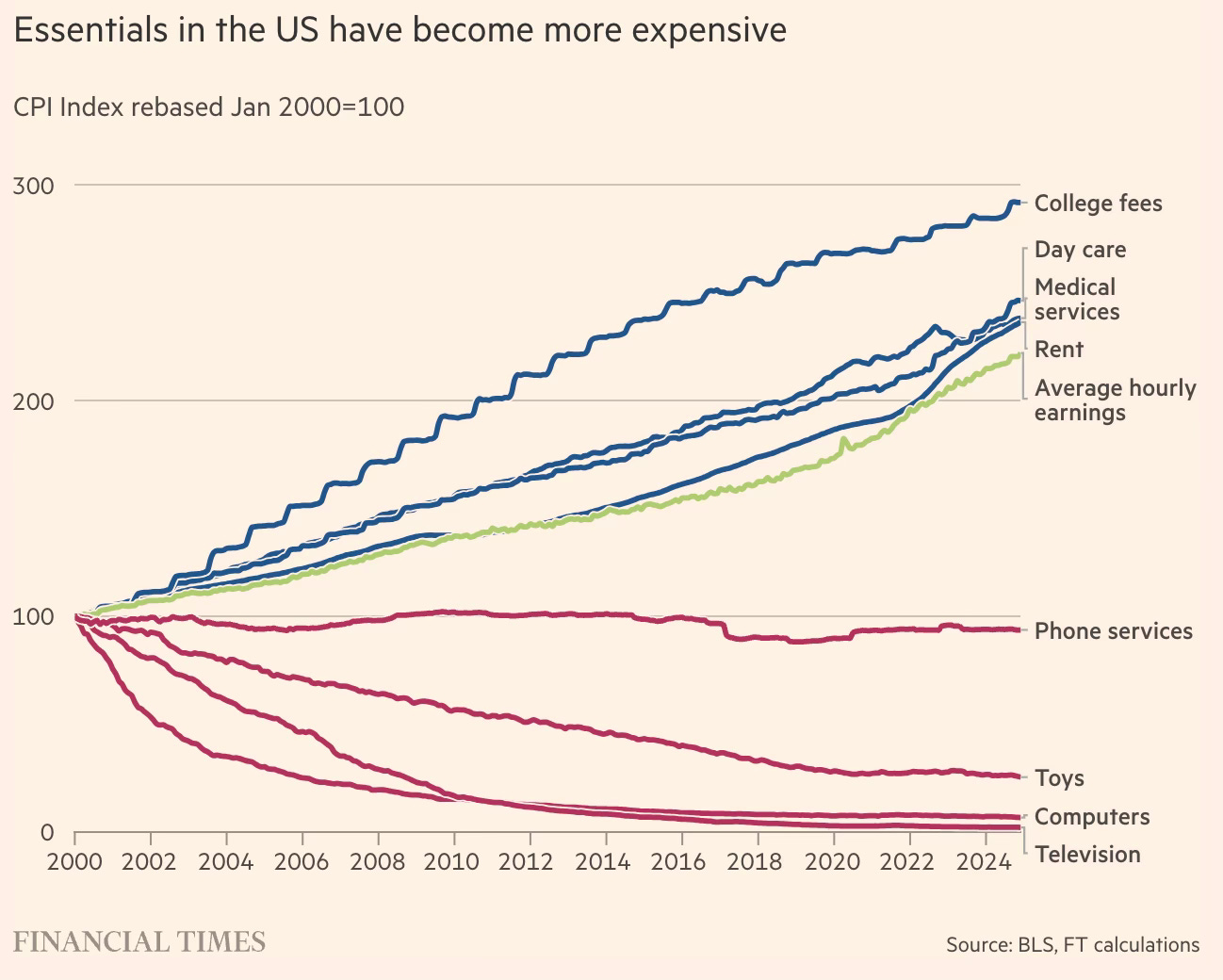
And below from the US, points out that while lower prices of tradeable products have held back inflation, rising costs of non-tradeable essential services have more than offset them. 

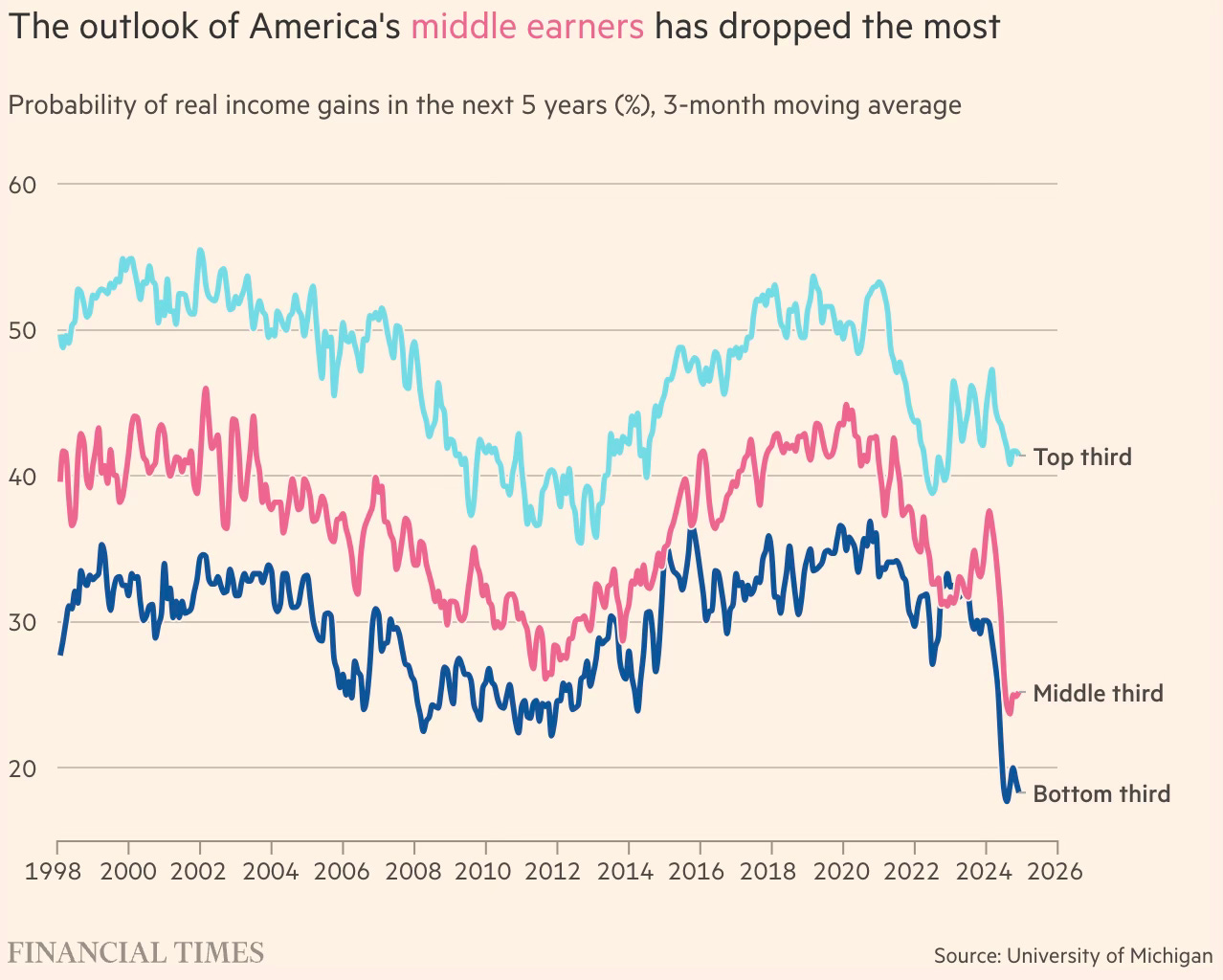
And all this is translating to a middle-class pessimism.

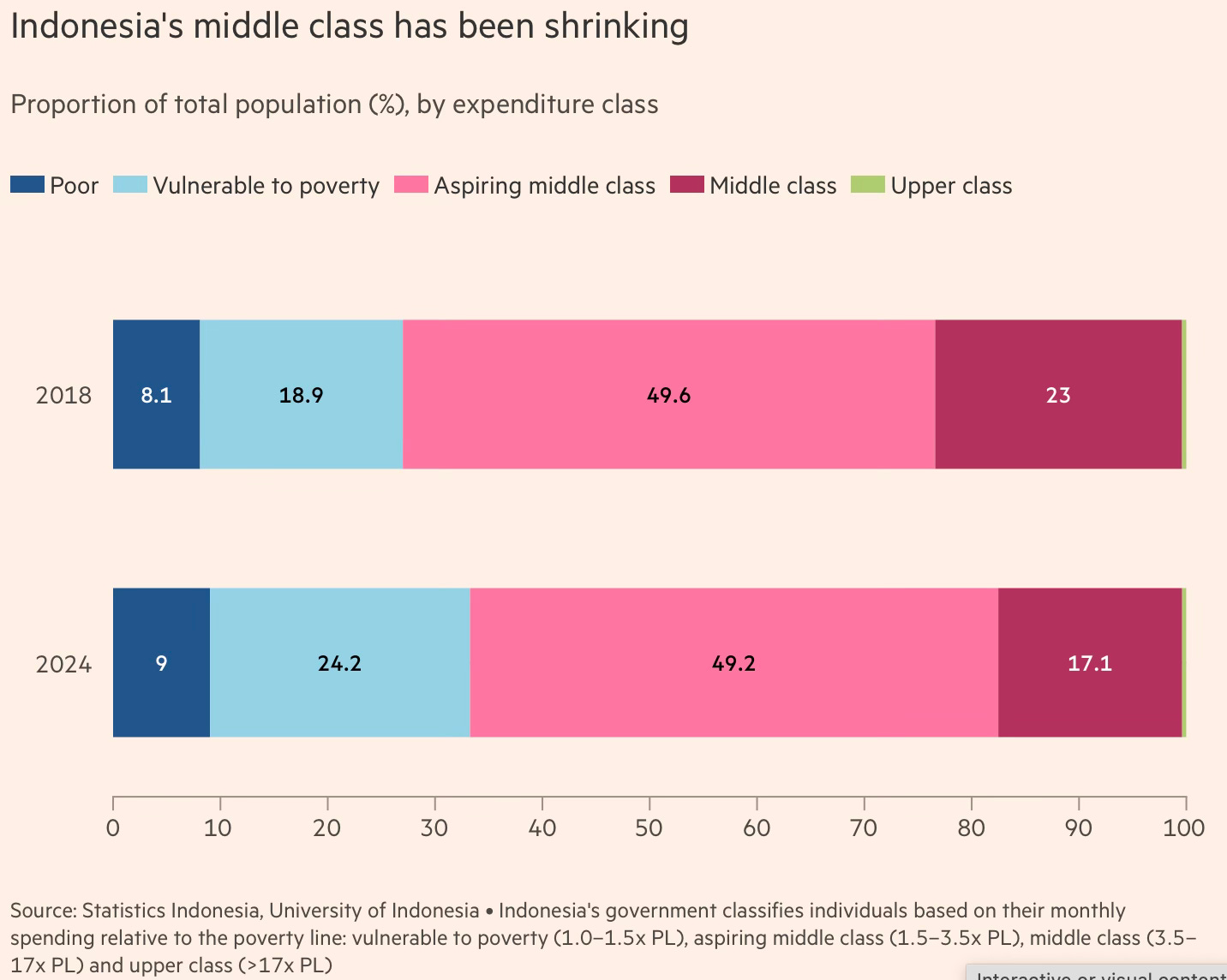
The trend of middle class woes goes beyond developed countries. Another article pointed to the case of Indonesia where middle class (monthly income of $122-605) fell from 47.9 m in March 2024 from 60 m in 2018, down from 23% of the population to 17%. 

See also this on Indonesia’s stock market which fell sharply early this week on the back of fears weakening purchasing power, consumer confidence, and economic growth.

The middle-class squeeze is being felt in India too. India’s fundamental economic problem of a narrow consumption baseis compounded by an economy which is not creating the number of good jobs required to quickly expand the middle-class base to support sustained high growth rates. As I blogged here, the vast majority of job creation is in gig work and the likes of construction, security guards, and housemaids, all of which generate monthly incomes in the range of Rs 15000-20000 and have limited productivity improvement opportunities and occupational mobility. 

See this about the shrinkage of the Indian middle class during the pandemic and this about the small size of its middle class. The problem is amplified by the acutely deficient dynamism in India’s corporate sector, the low level of R&D investments, and rising business concentration

A matter of great concern at the good jobs creation side is the growing share of non-regular workers. The ASI data tells us that in the 2001-02 to 2022-23 period, while the number of workers in formal manufacturing more than doubled from 5.96 m to 14.61 m, the share of contract workers rose from 21.8% to 40.7%. In Bihar, 68.6% of the industrial workforce is contractual, compared to 23.8% in Kerala. Capital-intensive industries have had a greater increase in the share of contractual workers. The Quarterly Employment Survey data tells us that the share of contract employees in nine major non-farm sectors doubled from 7.8% of total workers in April 2021 to 18.44% in July 2022. Even accounting for the cyclicality in certain industries which necessitate the hiring of contract labour, this level of increase is striking. 

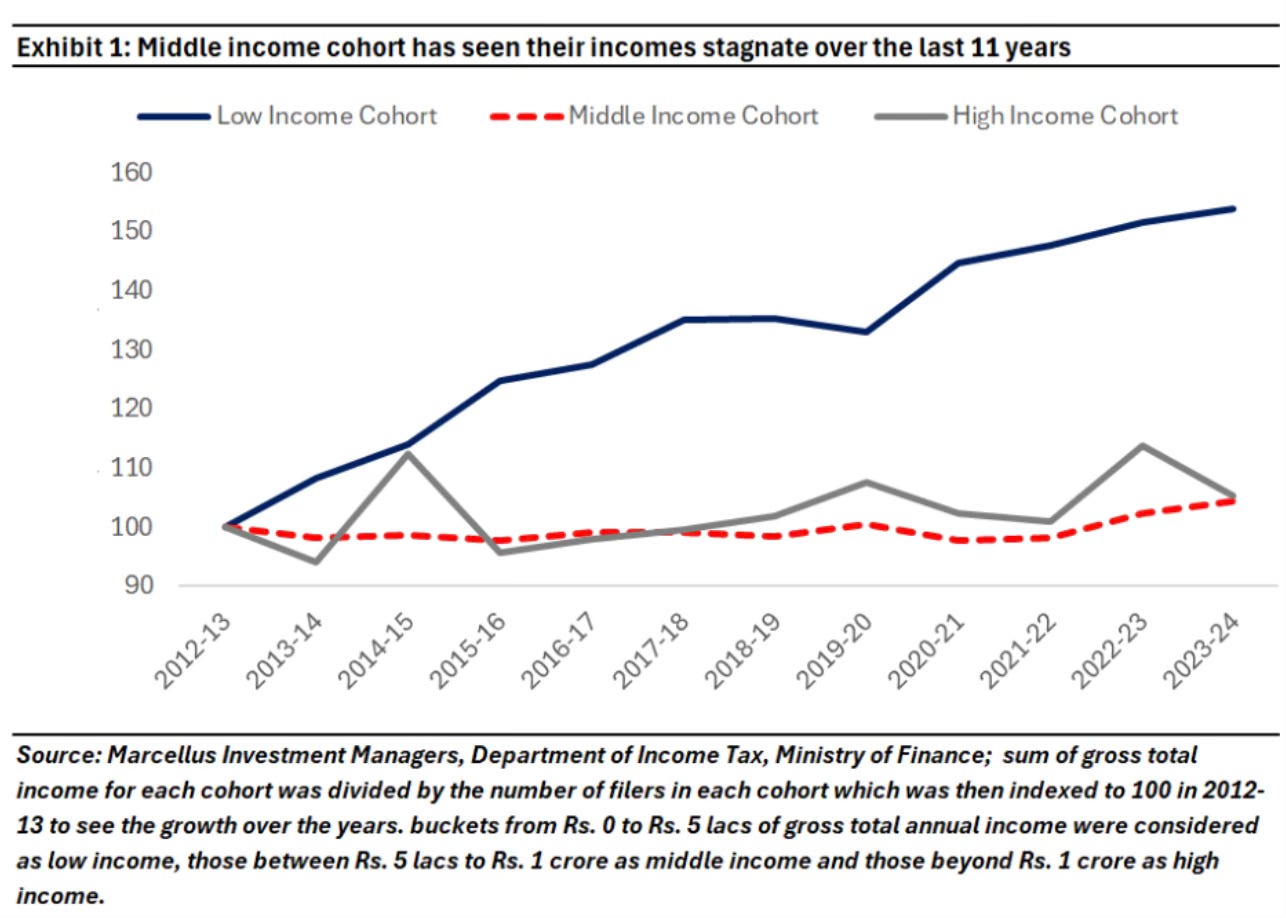
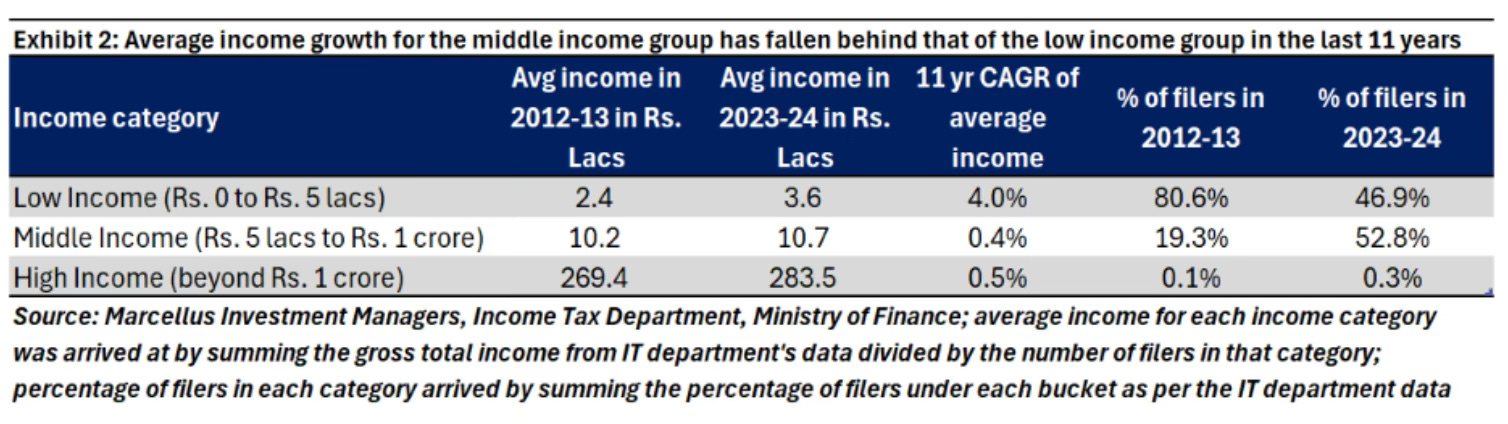
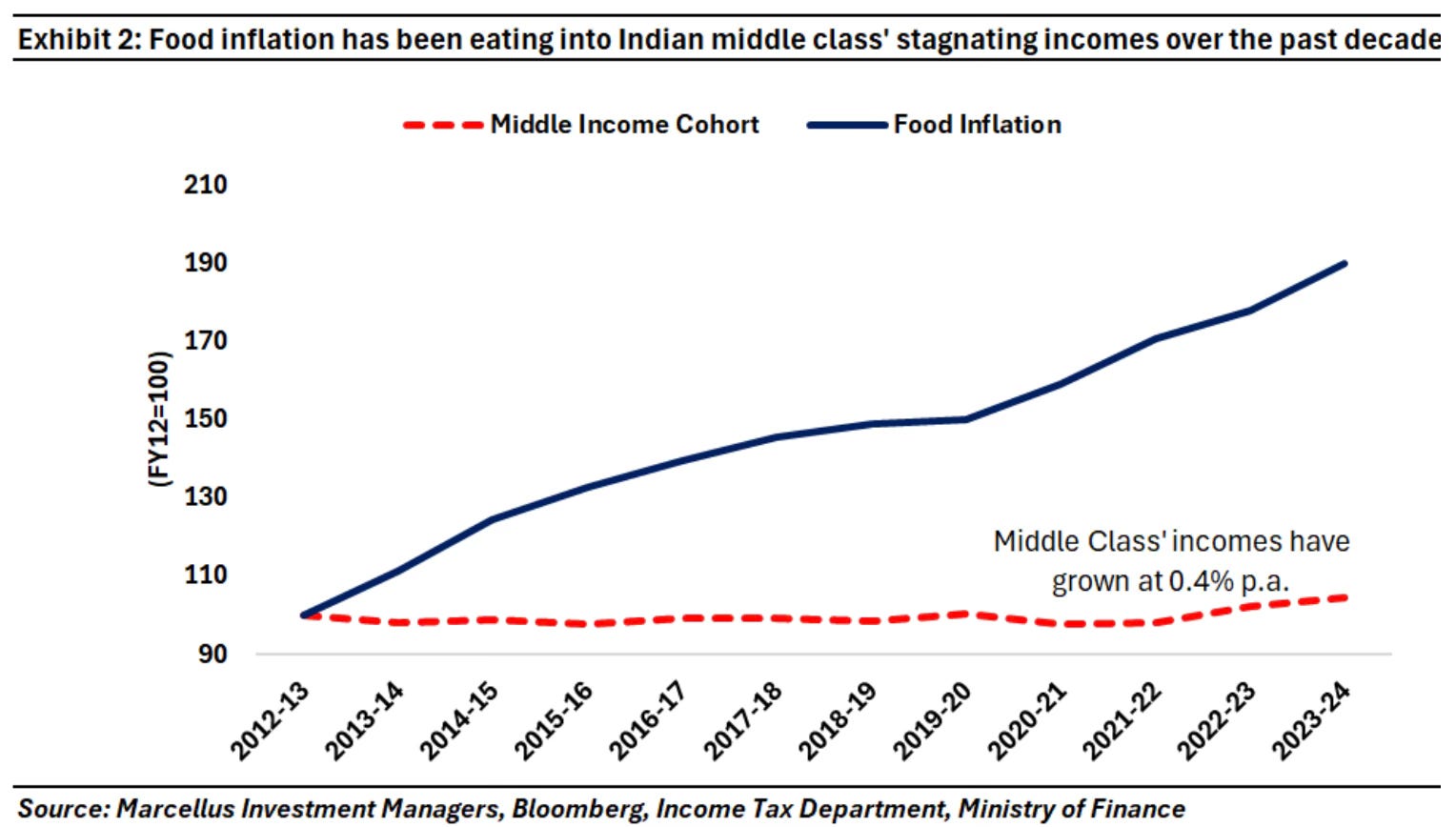
Marcellus Investment Managers provide data that points to stagnant middle-class incomes for more than a decade. 

A striking fact presented by them is that the average annual income of the 53% of the taxpayers (2023-24) who filed non-negative tax returns and earns between Rs 5 lakh to Rs 1 Cr per annum have seen their incomes stagnate - average annual income barely moving from Rs 10.23 lakh in 2012-13 to Rs 10.69 lakh in 2023-24!

They also point to how inflation has eroded middle class incomes…

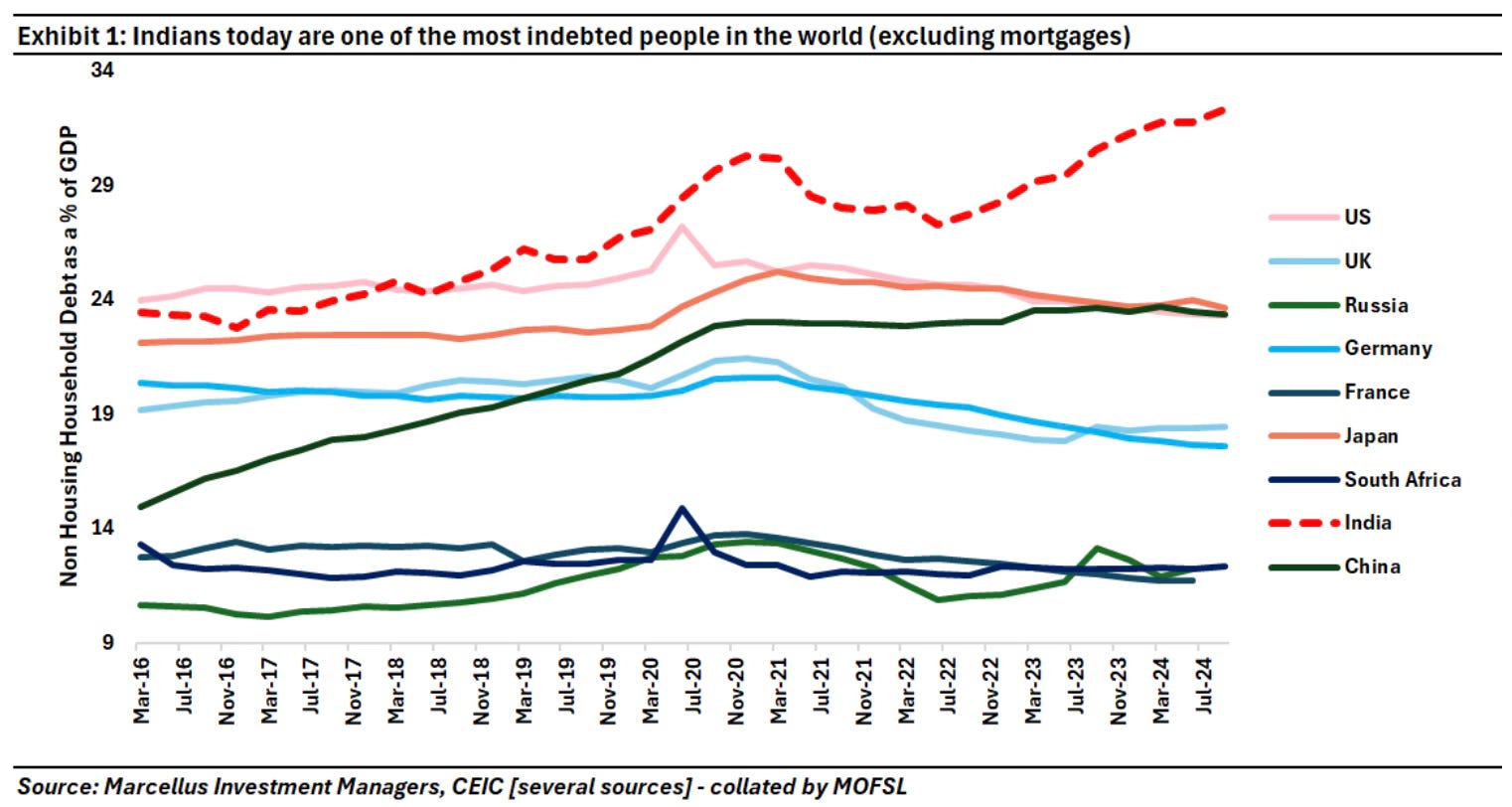
… leading to India having the highest level of household indebtedness if we exclude mortgages. 

This is also reflected in the steep decline in the net household financial savings to 5.1% of GDP in 2022-23, the lowest level since 1976, even as gross household savings hold steady at 10-11% of GDP. 

The middle-class squeeze is likely to be amplified in the days ahead as automation and AI take hold. One of the most disturbing possibilities is that AI models will virtually eliminate the basic coding jobs that have been an important source of middle-class entry for the Indian workforce. In this context, the new version of Agentic AI has the potential to be even more disruptive. 

AI agents, often referred to as ‘Agentic AI’ systems, are models capable of making decisions and taking actions to achieve specific goals without human intervention, making them truly autonomous. Think of a driverless car that adapts to traffic conditions, a smart home assistant that learns your habits, or an AI-driven financial bot that analyses market trends and makes stock trades. Other examples include AI-powered automation in finance and healthcare, policy claims processing, and software development. The distinction between a non-agentic and an agentic system lies in the level of autonomy and decision-making capabilities. For instance, a non-agentic workflow will respond only to specific inputs or commands, follow pre-defined rules and procedures, and need constant human intervention for most decision-making. 

A basic chatbot, for instance, will only respond with pre-programmed, scripted answers to specific questions. An agentic workflow, on the other hand, can initiate actions and take its own decisions… AI agents also learn continuously, refining responses and actions over time, as seen with Uniphore, which improves customer service by analysing call interactions. Unlike large language model-based chatbots, agentic AI integrates with business software such as customer relationship management (CRM) and enterprise resource planning (ERP) systems and handles multi-step workflows such as processing insurance claims or automating supply chains… This means that AI agentic systems go beyond chatbots by autonomously making decisions and executing tasks.

The trends in advanced economies, Indonesia, and India point to the same three aspects of middle-class discontent - scarcity in the creation of good jobs, stagnant wage growth, and erosion of purchasing power. 

Globally, good jobs are being displaced by automation and lower-paying temporary jobs. In the US, David Autor and others have pointed to the role of automation and cheap imports from China contributing to job losses and a hollowing out of middle-class jobs. I have argued here that cheap Chinese imports should be a bigger source of concern for developing countries (than developed ones) in so far as China is their direct competitor at the lower and middle ends of the manufacturing sector. As Artificial Intelligence (AI) emerges as the general purpose technology (GPT) of our times, another trend unfolding is that of automation and job losses. In their search for efficiency and maximisation of profits, businesses will increasingly adopt AI solutions.

Second, greater returns to capital coupled with weaker bargaining power has led to stagnant labour incomes. High and rising business concentration and financialisation raise the returns to capital at the cost of labour. This, coupled with incentives facing them - stock market expectations, a never-ending cycle of rising executive compensation, and weak labour bargaining power - means that businesses are loath to share profits. 

Finally, inflation is eroding incomes. Across the world, globalisation, trade liberalisation, and immigration integrated markets and lowered prices in the tradeable goods and non-tradeable services sectors. But the trend of rising protectionism and anti-immigration are strong headwinds that will start to bind with increasing intensity in future and raise prices. An additional inflationary factor is the compressed timelines on climate change policies. See the latest from Australia on a “cost of living crisis”.

There’s nothing on the horizon that’s likely to counteract these trends. Middle-class discontent will only grow. Any meaningful response must necessarily involve some (or all) of the following

1. In advanced economies, minimum wages must rise to levels that allow for some basic level of dignified life. Notwithstanding inflationary risks, such regulatory wage minimums can have knock-on upward pressures on wages. 

2. In both developed and developing countries, the sharing of returns between capital and labour should become more equitable. This will require that labour’s bargaining power be increased through institutional (unions, workplace management councils, etc.) and regulatory measures. At some time in future, broad caps on the salary and compensation ratios across levels becoming a norm cannot be ruled out. 

Measures in this regard are most effective when they emerge from internal deliberations and form part of an industry consensus. This requires serious debates in industry forums on this issue that both sensitise all stakeholders on its importance and lead to the emergence of constructive solutions to address it. As an example, benchmarks could be agreed upon, and businesses could be ranked on the equity of their recruitment modes and compensation structures. 

3. Gig work is rapidly emerging as the major source of formal sector job creation. It is estimated that there are over 12 million workers employed in the gig economy, and this number is rising rapidly. It poses economy-wide risks to allow such a large workforce to remain without access to basic social safety protections. Since the sector is now de-risked and mature, there’s a case for closing the regulatory arbitrage opportunities essential for its emergence and early growth. 

Further, such services cater to the top end of the income ladder, whose demand is unlikely to diminish significantly even with higher costs of service arising from closing the regulatory arbitrage opportunities. It also helps that these services are non-tradeable in nature. 

4. The practice of increasing contractual and other non-regular modes of recruitment too should be discouraged. As with wages, it’s most appropriate if there’s an industry consensus on these that creates the right industry-wide incentives to ensure balance on the modes of recruitment. To start with, it might be useful to have some light-touch regulation that provides non-binding guidance on the share of non-regular employment. This information for each company should become public and salient. This could be supplemented with mild incentives to encourage firms. 

In the East Asian economies, there are cultural and normative restraints that moderate the undesirable trends on issues like the sharing of profits, executive compensation structures, recruitment modes etc. There’s a danger that corporate India, with its weaker cultural restraints and closer affinities to the US capitalism, could end up imbibing practices arising from the single-minded pursuit of profit and efficiency maximisation. They must be consciously addressed. India could become a global leader in creating consensual industry benchmarks in these areas. 

5. Finally, governments must proactively engage with policies that guide the direction of technology adoption and associated changes. Industrial policy should prioritise incentives linked to employment over capital expenditure and production. Labour-intensive sectors should become the focus of industrial policy. Scarce resources should not be wasted on low-labour-intensity sectors like semiconductor fabrication or data centres. The only exception should be as a strategic requirement.

A strategy would be to double down on employment-linked incentives in various forms - internships, apprentices, reduction in EPF and other costs, wage support for new entrants, industrial policy support through employment generation-linked incentives, etc. The PM Internship Program is a good start. The learnings from the apprenticeship scheme should be used to improve its effectiveness and uptake. Existing schemes like reimbursement of EPF contributions should be simplified to facilitate ease of uptake and continue for an extended period. 

The implementation of all these is challenging, and its quality is critical, though the difficulties with eliminating leakages should not become an excuse for not doing these. After all, efficiency and effectiveness concerns have not deterred us from pursuing highly questionable schemes and projects with massive capital subsidies. 

All these will be effective only if they are complemented with policies that strive to improve human resource quality, lower the cost of capital, and reduce regulatory burdens. A highly ambitious objective for the government would be to discuss, debate, negotiate and arrive at a consensus on a grand compact with the corporate sector on these issues. 

As a final note, while bad choices by the government are certain to attract the ire of opinion makers and the electorate, allowing the market to create bad equilibriums in trade, immigration, inequality, and automation does not generate anywhere close to the same level of opprobrium. And counterfactuals of scenarios avoided by government intervention hardly get a mention.