Substack

Showing posts with label Forex markets. Show all posts

Saturday, September 5, 2026

Weekend reading links

1. Excellent essay by William Dalrymple about the East India Company, drawing parallels with Big Tech today.
By the end of the 18th century, the East India Company had created a vast and sophisticated administration in India and built much of the London Docklands. Its annual spending in Britain — around 8.5 million pounds — equaled about a quarter of the British government’s total annual expenditure. In India it collected taxes, minted coin, administered justice, ran its own courts and diplomatic service, flew its own flag, negotiated treaties and made war on sovereign states, all in pursuit of increased dividends. An international corporation that began trading spices ended up transforming itself into a colonial superpower... For much of the 18th century it was staffed with as few as 35 people, in a building five windows wide. Yet in India the East India Company owned a private army that by 1803 numbered some 200,000 men — roughly twice the size of the standing British Army. Its stock was a pillar of British public finance, and its profitability and solvency were matters of state...
Its lawyers and lobbyists and parliamentarian shareholders slowly and subtly worked to use its immense wealth to influence and subvert legislation in its favor. In 1693 the company was discovered to be using its shares to buy influence with prominent members of Parliament and ministers. The following parliamentary investigation, the world’s first corporate lobbying scandal, found the East India Company guilty of bribery and insider trading. After that, the company became more subtle and instead backed candidates favorable to its policies. It arguably invented corporate lobbying, that alchemy by which the interests of a company somehow magically become the policies of the state. Around one in 20 members of Parliament sat on the East India Company’s board, and more than a fifth of the company’s directors sat in Parliament at some point; about 40 percent of members of Parliament were shareholders.
2. The Netherlands is Ground Zero for electricity grids that are hitting capacity constraints to evacuate the renewable capacity becoming available. 
Since July 1, the grid operator has frozen new connections in Utrecht to avoid power cuts... Fewer housing projects can be developed, while plans to electrify local industry and install faster chargers for electric vehicles are on hold. Utrecht’s predicament could become the norm across the EU unless governments learn from its example and invest heavily in grids to support the bloc’s shift from fossil fuels to cleaner technologies... The EU’s fifth-largest economy has more solar panels and electric charging points per person than any other country in the region... But its failure to invest fast enough in pylons, cables and substations to support the transition means the queue of companies waiting for a power connection increased from 12,000 to 15,000 last year. Only 700 companies received a connection in 2025... Ember research suggests that in countries such as Austria, Poland, Portugal and Romania, there is enough grid capacity for less than 10 per cent of the renewables projects planned by 2030.

3. The FCNR(B) deposit scheme inflows in perspective.

Gross inflows on the current account are at $1.1 trillion a year. On the capital account, those are $1.7 trillion a year. Put together, we are getting inflows and outflows of about $2.8 trillion a year or about $11 billion a day. A comparison against conditions in the 2013-14 currency defence is instructive. At that time, gross inflows were $0.55 trillion and $0.52 trillion on the current and capital accounts, respectively, i.e. $4.3 billion a day. Today’s India is 2.6 times bigger. The FCNR (B) stratagem relies on using public money to defend the rupee. The state subsidises foreign borrowing to attract dollars. This tool requires large-scale borrowing to make a material difference against a gross external flow of $11 billion a day. A commensurately large fiscal cost falls upon the exchequer. The Ministry of Finance will choose how much it is willing to spend in exchange for this round number.

And its total cost could exceed $10 bn for the RBI

Under the Foreign Currency Non-Resident (Bank), or FCNR(B), program, the central bank agreed to shield banks from losses if the rupee weakens, through a favorable currency-swap facility estimated to cost 3 per cent-3.5 per cent a year. It will also need to absorb some of the extra cash pumped into the banking system as banks exchange the dollars they raised for rupees. The two operations could cost as much as ₹1.2 trillion ($12.7 billion) over five years, according to an analysis by Madhavi Arora, economist with Emkay Global Financial Services.

4. The rise and rise of bond yields.

The Sixteenth Finance Commission estimates that unconditional transfers by states increased from ₹73,099 crore in 2018–19 to ₹2.63 trillion in 2023–24 and are at ₹4.14 trillion in 2025–26. Large-group cash transfers alone are projected at ₹.96 trillion, accounting for 47.4 per cent of all unconditional transfers, up from roughly 16 per cent in 2018–19. Social-security pensions have also risen in absolute terms, from ₹44,453 crore to a budgeted ₹1.58 trillion, but their share of unconditional transfers has fallen from 60.4 per cent to 37.9 per cent; the share going to farmers has similarly declined from about 24 per cent to 14.7 per cent. This implies that states are not merely expanding welfare but are shifting their composition towards broad category-based payments that claim an increasing share of fiscal space.

6. Europeans pull out their gold reserves from the US.

The Dutch central bank has shifted more than 78 tonnes of gold from New York to London in a politically sensitive move, citing “increasing geopolitical unrest”. The transfer follows calls from European politicians and taxpayer lobbyists to repatriate gold reserves from the US, warning that an unreliable American government under President Donald Trump may otherwise seize them amid growing transatlantic tensions... The move follows a similar decision by France, which removed all of its gold from the New York Federal Reserve between July 2025 and January 2026. François Villeroy de Galhau, the governor of the French central bank at the time, said then that the move was not politically motivated. Gold last year overtook US government bonds as the world’s largest reserve asset, according to ECB data, but some central banks are becoming increasingly skittish about storing gold in the US.

7. Interesting trends in gold prices

For the first two decades of this century, a 1 percentage point move in US real rates typically coincided with a roughly 14 per cent move in gold in the opposite direction. That relationship ended in February 2022, when western governments froze Russia’s foreign exchange reserves. Reserve and asset managers globally were left confronting a simple question: if $630bn held in Treasuries, Bunds, gilts and other bonds could become inaccessible overnight, what constituted money? Their answer was gold. Emerging market central banks and sovereign funds have since increased gold allocations from 5 to 7 per cent of reserves in 2022 to 11 per cent today, still short of the 26 per cent held by developed-market peers. Between March 2022 and October 2023, US five-year real yields rose more than 4 percentage points. Based on historical relationships, gold should have fallen about 55 per cent; instead, it rose 7 per cent. Over the following two years, real yields fell less than 1 point while gold rallied 110 per cent. Gold is now far more responsive to falling real yields and less sensitive to their rise.
8. Early evidence of job losses in India's IT industry.
9. Shyam Saran describes the efforts being made by China to circumvent the US-controlled SWIFT and other cross-border financial flows management systems. 
The mBridge project is a network of the central banks of China, the Hong Kong Monetary Authority, Malaysia, Thailand, the United Arab Emirates, and Saudi Arabia, who have linked their central bank digital currencies (CBDC) on a blockchain ledger system pioneered by China, to allow virtually instant cross-border financial transactions. The pilot phase of mBridge is now over and its commercial launch is imminent... mBridge does away with the correspondent banking system... mBridge enables escape from sanctions... One should consider mBridge as only one component of the Chinese efforts to achieve the internationalisation of its currency, the yuan. There are parallel institutional and procedural tracks.
One is the Cross-Border Interbank Payment System (Cips), which provides both an inter-bank messaging system like SWIFT and a clearing and settlement system. It does not seek to supplant SWIFT, but provides an efficient alternative, taking advantage of China’s role as the world’s largest trading nation and increasingly as a significant source of investment. It makes sense for partner countries to opt for yuan-designated transactions to avoid exchange risk. Increasingly Cips also avoids sanctions risk since, unlike SWIFT, it is not subject to US or Western regulation and control. This is why both Russia and Iran now use Cips almost exclusively for their cross-border financial transactions.

10. Excellent op-ed by Ajanta Krishnamurthy about the premiumisation of everything we consume. 

A biscuit is no longer a biscuit. It is handcrafted, slow-baked, perhaps even inspired by some grandmother somewhere. The packet is brown, the lettering is tasteful and the quantity inside is just enough to make you wonder whether you have accidentally bought stationery. The same thing has happened to the rest of the kitchen and, increasingly, the bathroom. Detergent has become laundry care. Pickle is a small-batch preserve. Tea is a single-estate experience. Ice cream is slow-churned. Salt has become strangely ambitious. It can be Himalayan, smoked, pink, infused, mineral-rich, and important enough to deserve a place at the table. Water has perhaps had the greatest career transformation. For most of our lives, water was the one thing nobody had to explain. You drank it. You asked for more. Now there is water that sounds like a minor European aristocrat, comes in a glass bottle, is alkaline, and costs enough to make you briefly consider dehydration.

Saturday, August 22, 2026

Weekend reading links

1. Germany used to be the unquestioned global leader in chemicals, machinery, and automobiles. Now, thanks to the onslaught from China, it has fallen on bad times. Sample this on automobiles.
When German companies expand or build factories, it is often in places like Hungary, China or Mexico. The number of cars produced in Germany has fallen 28 percent since 2016, according to the VDA, the German automakers’ association, putting the country well behind China, the United States, Japan and India. Germany could soon also be overtaken by South Korea and Mexico... The German carmakers face an assault on two fronts. In China — the world’s largest car market — sales of foreign car brands are plummeting. And Chinese automakers are making big strides in Europe. In June, Chinese carmakers outsold Japanese carmakers in Western Europe for the first time, according to figures compiled by Schmidt Automotive Research.

China was once a lucrative market for the Germans, accounting for 37 percent of Volkswagen sales in 2019. But after Chinese automakers learned how to manufacture cars through joint ventures with foreign carmakers, the tables turned. BAIC Group, an automaker owned by the Chinese government, has become Mercedes’s largest shareholder, with a stake of almost 10 percent. Chinese companies like BYD and Geely Auto were quicker to develop electric vehicles that were heavily promoted by the Chinese government and are selling briskly in Europe. The Germans took too long to offer appealing electric vehicles. Volkswagen sold 26 percent fewer cars in China in the first six months of the year compared with a year earlier, while Mercedes reported a 28 percent decline and BMW a 20 percent slump.

2. The latest on AI's limitations on vertical use cases, explained with three illustrative use cases.

While A.I. can excel regularly at complex tasks, it can be unreliable when put in charge of an entire job. It can certainly add value to certain areas of the work force, but for now, A.I. still needs a human boss... In our experiment, we deployed A.I. “agents” to act as office workers and found that they were capable of performing some of the tasks we assigned, but not all of them. The agents, which can act autonomously and make decisions based on detailed instructions, excelled at problems they could solve by writing computer programs. But they struggled with understanding the nuances of human language and at navigating user interfaces like the Chrome web browser.

3. Important point about how wealth inequality has come to dominate income inequality as the reason for social discontent.

While wealth inequality has not changed much, the relative importance of wealth compared to income has. The median household’s disposable net worth (net property and financial wealth excluding pensions) in the UK, US, Germany and France has roughly doubled in real terms since the mid-1990s; incomes have grown by only around 30 per cent. The result is that where a generation ago it would have taken about 20 years of savings from the average salary to earn your way from the bottom quarter of the UK’s wealth distribution to the top quarter, it now takes 40. There are similar or even larger upward extensions to society’s economic ladder elsewhere.
This is all the more pernicious since the growing role of passive wealth gains (whether gifted by an asset price boom or one’s parents) relative to income in determining someone’s economic status is mirrored by their growing importance for wellbeing. In the 1990s income rank mattered more than wealth rank for life satisfaction or avoiding distress. Since then wealth has become steadily more influential and is now the larger driver. 

4. Ukraine has run out of Patriot air defence systems to shoot down incoming Russian ballistic missiles. 

5. Chrystia Freedland on Baumol's disease and public services.
Baumol’s assignment was to determine why in-person classical music performances seemed harder to fund. He found that the snag wasn’t that the musicians were getting worse — it was that the rest of the economy was getting better. It took four musicians one hour of work to perform a Schubert string quartet, exactly the same as it always had done. But four hours of human labour would produce roughly a hundred times as much wheat as it did in the pre-industrial era. For manufactured goods, the multiple is even greater. The same insight applies to taking a two-year-old on a walk in the park, or supporting a mother as she gives birth. As such, Baumol’s disease poses a knotty challenge for the state in liberal democracies because so much of what governments do is more like playing the violin than manufacturing a car.

6. Two points from John Burn-Murdoch's latest on the crisis of social isolation among youth. First, the share of those without any in-person contact during a typical day rose sharply during the pandemic and has not returned back to normalcy.

The least socially connected are increasing their disconnectedness. 

7. Rent controls are back as housing prices rise.
Rent controls, where a government sets price limits on rents or annual rent increases for certain types of housing, tend to be effective in their primary objective. A 2024 review of dozens of studies on the policy published globally between 1967 and 2023 found controls were effective in capping rents. The quid pro quo, say their critics, is that they increase rents on unregulated properties and reduce the overall supply and quality of housing in the long term... Of the 38 members of the OECD club of mostly richer nations, 23 already have some form of rent control. Ireland and Austria widened the scope of existing rules this year... In practice, rent regulation can encompass a wide range of measures. Outright freezes, such as in New York, tend to be temporary. More enduring limits can apply to existing or new tenancies, or both, and may apply nationwide or be focused on areas of high rental demand. There are often exemptions, such as for newly built properties, and a variety of yardsticks are used to determine the size of permitted increases... 
New Yorkers are the most burdened tenants in the US. Despite decades of regulation, new renters in the city spend an average of 40 per cent of their income on rent. Rent stabilisation — where annual increases are set by a city board based on its assessment of the market, inflation and other variables — is the main mechanism, applying to almost a million units. Households living in rent-stabilised apartments tend to have median incomes lower than overall renter households... In Berlin about 700,000 households, or a third of the total, spend more than 45 per cent of their income on rent, according to the Berlin Tenants’ Association. Like several hundred other high-demand areas in Germany, Berlin is subject to the Mietpreisbremse, or rental brake, a 2015 law that applies to new leases, and the Kappungsgrenze, introduced two years earlier, which limits rises on certain types of existing tenancies. Despite these guardrails, rents have risen almost 70 per cent over the past decade. 

Scotland has come up with new rent controls which have evoked interest globally.

The new controls are more precisely calibrated than before; they will apply only to specific areas, last for a maximum term of five years, and limit rent increases for both new and existing tenancies to consumer price inflation plus 1 per cent, up to a 6 per cent maximum. There are some exemptions, for instance properties that are coming to the rental market for the first time.

8. China's investment slump deepens in July.

Industrial output expanded 4.5 per cent in July on a year earlier, official statistics showed on Monday, short of the 4.8 per cent forecast by a Reuters analyst survey and growth of 5.3 per cent in June. Retail sales rose just 0.6 per cent last month, compared with analyst forecasts of 1.5 per cent growth and 1 per cent in June, as the waning effects of consumer goods trade-in subsidies weighed on household spending. Fixed asset investment declined 6.7 per cent for the first seven months of the year on the same period in 2025, deepening from a 5.7 per cent drop in the year to June. 
Over the last 10 years, across spot and forward markets, the RBI’s net annual currency intervention has averaged about $60 billion, or 2 per cent of gross domestic product (GDP). During FY21 and FY22, when India’s balance of payments generated surpluses, the RBI net purchased $157 billion. That effectively put a floor on the exchange rate. In contrast, the RBI sold a significant $118 billion in FY25, helping restrict the rise in USD/INR from 83.50 to 85.50. Between April 2025 and February 2026, the RBI sold another $37 billion, even as USD/INR moved up to 91. Following the outbreak of the Iran war, the RBI sold a further $37 billion in March 2026 alone, with USD/INR eventually ending the month around 93.50... Such interventions were not necessarily incorrect. But when sustained at this scale and over such timeframes, it inevitably influences currency levels, not just volatility...
The RBI also intervenes in bond markets and modulates banking liquidity to facilitate monetary-policy transmission. During FY26, India’s net government debt across central and state government bonds and Treasury bills grew by ₹17.8 trillion. About ₹10.6 trillion was net purchased by banks, insurers, and pension and provident funds, which have regulatory obligations to buy such bonds. The RBI’s own holdings net increased by the remaining ₹7.2 trillion, thus accounting for a substantial 40 per cent of the incremental government debt... The RBI’s large bond purchases and liquidity operations helped keep rupee-denominated interest rates below levels that might otherwise have been required to attract discretionary savings.

10. Israeli national security minister Itamar Ben-Gvir, a hardline settler previously convicted of incitement to racism, advocates killing Gazans each night. 

“I think we should be doing 30 to 40 targeted assassinations per night,” Ben-Gvir said. “Not just those who pose an immediate threat. There are people there who don’t deserve to live . . . They are not even people.” Ben-Gvir also called for the re-establishment of Jewish settlements in the Palestinian territory, saying he envisaged “all Gaza” belonging to Israel and reiterating his previous calls for Palestinians to “emigrate”. “I imagine settlements not just in Gush Katif but throughout Gaza, and encouraging emigration, the more the better,” he said, referring to settlements that were dismantled by Israel in 2005. “And for the terrorists, there should be no emigration. We should just kill them one by one.”

11. Fear of AI is uniting American politics.

Almost three quarters of Americans do not trust businesses to use AI responsibly, according to Gallup. More than 70 per cent oppose having data centres built in their area because of fears about water and electricity inflation. Eighty per cent or more distrust AI for driving, medical advice and corporate hiring decisions. As The New York Times recently put it, fear of AI is the “most bipartisan issue since beer”. That feeling is as strong in the centre as it is on the Maga right and the democratic socialist left. That such fears are often conspiratorial should be no surprise. Paranoia is a natural response to the unknown. Maga’s Steve Bannon calls data centres “weapons labs”. Marjorie Taylor Greene, the former pro-Trump lawmaker, refers to Big Tech as “Skynet” after the self-aware computer system that triggers nuclear holocaust in the Terminator movies. Progressives talk of AI killing US democracy and ushering in a Blade Runner-style dystopia.

12. The big economics story of the recent months is the return of interest rates.

13. For long the World Bank and IFC have tried to get African countries to capture value by investing in the processing of their natural resources. Nigerian billionaire Aliko Dangote is doing exactly that by constructing the world's second-largest petroleum refinery, which has allowed Nigeria to export refined oil to Europe and elsewhere, while also ensuring that Africa's largest crude producer does not need to import refined oil. 
His new $20 billion oil refinery in Lagos, which has seen a spike in demand for petroleum products — both in Africa and elsewhere — since the war began in February. Despite having abundant crude oil, Africa still relies heavily on imported fuel... Jet fuel shipments from the Dangote Refinery reached the U.S. market for the first time ever this year, according to the company. The Dangote Refinery was “the world’s single largest exporter of jet fuel” in April and May, said Daniel Evans, a vice president of S&P Global Energy, a market-research firm. Last month, the refinery was Europe’s largest supplier of jet fuel and diesel, according to Devakumar Edwin, a vice president of Dangote Industries. On Tuesday, Dangote Refinery said it had secured $1 billion in financial backing from a Dubai-based investment group to go public on the Nigerian stock exchange. If the listing goes through, it will be Africa’s largest-ever public offering.

14. The rise and rise of America's public debt.

The US’s national debt has hit a record $40tn as borrowing rises at a historic pace... It has grown by $3tn over the past year, its fastest ever pace outside the pandemic era... America’s national debt has surged over the past two decades, rising from less than $6tn (about $12tn in 2026 dollar terms) at the turn of the century as vast public spending during the financial crisis and Covid pandemic exacerbated yawning budget deficits. In the past 10 years alone, the overall debt burden has doubled. Debt held by the public — a key metric monitored by markets that excludes intragovernmental holdings — now exceeds $32tn, roughly equal to the size of the US economy. The Congressional Budget Office, a non-partisan watchdog, expects the debt held by the public to exceed the high of 106 per cent of GDP reached in the aftermath of the Second World War by the end of the decade and hit 120 per cent by 2036.

15. The moderation of Meloni...

As prime minister, Meloni’s cautious pragmatism has dismayed hardline Maga purists such as Bannon, who told Italian media she was “a total globalist” who had betrayed her “fundamental beliefs”. Meloni has paired tough measures to curb irregular migration with higher quotas for legal migrants, helping Italian businesses cope with labour shortages. She has also softened her anti-EU rhetoric and forged effective working relations in Brussels.

... and fall out with Trump.

After Trump’s return to the White House in 2025, Meloni — the only EU leader to attend his inauguration — sought to cast herself as Europe’s bridge to Washington, hoping it would strengthen her hand in Brussels and at home. Instead, Meloni has been tarnished in the eyes of many Italian voters by her close association with an unpopular US president. Trump has imposed high tariffs on EU imports, pressed Nato allies to sharply increase defence spending and attacked Iran — policies deeply damaging to Italian interests. “Her proximity to Trump has failed to give her any appreciable results,” said Riccardo Alcaro, research director at Rome’s Institute of International Affairs, calling her erstwhile friendship an “electoral albatross” as Meloni gears up for a bruising re-election campaign... analysts say Meloni’s difficulties with the White House reflect not only Trump’s personality but a Maga world view that appears to expect near-total subservience from its allies... Maga’s deep-rooted antagonism towards the EU as a political project also made it hard for any leader with a pan-European outlook “to cosy up” to the administration for long.

16. One of the biggest innovations of the 20th century, container shipping.

Seventy years ago it would take at least 10 days for a ship at London Docklands to be emptied and reloaded by around 50 dockers. Pilfering was rife, accidents were commonplace and port business was vulnerable to labour strikes. Then came the shipping container, an 8ft x 20ft steel box that needed increasingly vast vessels to carry an ever-expanding volume of goods... it takes cranes roughly 40 hours to empty and reload a large container ship — around 20,000 steel boxes lifted by 146-metre-high computerised cranes that move two containers every three to four minutes. That efficiency and scale is testament to the unglamorous steel container, an invention that has driven down shipping costs to such a low fraction of total manufacturing value that it has enabled the rapid expansion of global trade over the past 70 years... The box’s dimensions were standardised from 1968 — a step that is “frequently overlooked”, says Brian Slack, a professor in geography and planning at Concordia University, Montreal. Without it, “containerisation would not have been as revolutionary as it turned out to be”...
More than 280mn journeys were made by containers between world markets last year. They bear around two-thirds of global seaborne cargo — about 60 per cent of total world trade, according to UN Trade and Development. More than 7,000 container ships are currently operating. The largest can carry cargo equivalent to a 44-mile-long freight train with, for example, around 120,000 bananas or 10,000 pairs of jeans per box. The average size of the ships has more than doubled since 2000, according to the WSC... To service the demand for goods, shipping lines have ordered larger and larger ships. The current record size for a container ship is the so-called ultra-large container vessel MSC Irina, which has a carrying capacity of 24,346 twenty-foot equivalent containers, or TEUs. The number of new container ships on order is equivalent to around 40 per cent of the current sailing fleet — a record high.

17. Circular trading in China's humanoid robots industry.

China’s humanoid robot makers are generating much of their revenue from selling machines to government-backed training centres — which then collect and sell training data back to the robot makers, raising concerns about actual demand in an industry Beijing is keen to promote.

18. Data centre job creation facts.

At the peak of construction, according to a November 2025 study by the University of Southern California, a data centre in the US needs between 0.7 and 2 workers per megawatt. To build India’s targeted capacity of 10 GW by 2030, that works out to a peak construction workforce of 26,000... In direct employment, a 100 MW data centre supports 120–150 jobs. Take the generous end of that range and India’s 10 GW target yields 15,000 full-time, sustainable jobs. And these aren’t, for the most part, gold-collar jobs. A handful of C-suite roles rake in Rs 1 crore a year. Design and engineering workers make Rs 30–40 lakh. The staff who actually keep the lights on—on-site security and hands-on hardware engineers—earn around Rs 10 lakh. A recent study from the US—the world leader in data centres with an installed capacity of 55 GW—examined the employment records of 770 server farms going back two decades and concluded that the industry overstated their job impact by a factor of three at least. Apply the cut to India’s job-creation estimate and the promise wilts before a single server is switched on.

And who will use it.

Of the 10 GW capacity India intends to build by 2030, only a sliver is meant for the country. The industry estimates that 90–95% will be leased by foreign firms such as AWS, Microsoft Azure, Google Cloud, Oracle, and Meta. Even now, of the roughly 2 GW already installed, barely 30% is used by Indian players.

Saturday, July 4, 2026

Weekend reading links

1. Indian universities have come to dominate the global rankings for research paper retractions, following complaints of plagiarism, fake peer reviews, and other misdemeanours. According to the Retraction Watch database, India recorded 887 research paper retractions in 2025, form 21% of all retractions (second to China with 41%) despite contributing just 5% of all publications, and occupying six of the world's top 10 universities for retractions. 
2. Stunning statistic about the Algerian demographic dominance of the Les Blues, the French national soccer team.
Only two of France’s 26 players are of non-immigrant ancestry — 22 of them have African roots. Some, such as Mbappé, are deeply connected to their country of origin.

And this dynamic of reverse migration and migrant domination elsewhere.

Of England’s 26 players, eight have Caribbean forebears, 10 African, and 20 who were eligible to represent at least one other country because of their family heritage or birthplace. Belgium has players who trace their lineage to its former colonies — Congo, Burundi and Mali. The Portugal team has those of Cape Verdean, Angolan, and Guinean lineage. Those surplus to their requirements — players of African descent born and raised in Europe — in turn, populate most of the African teams. Ten of the 11 Senegalese players in the starting lineup against France in the opening game were born in France... Six of the players in the US national team are of Afro-Caribbean heritage... There are those from Nigeria, Ghana, and Jamaica. Three are from Hispanic backgrounds — Christian Roldan (Guatemala), Ricardo Pepi (Mexican-American) and Jesús Ferreira (Colombian-American). As many are from Europe, and three others have dual nationalities... For Australia's Socceroos, four players were born in refugee camps. The players represent 15 ethnic backgrounds and include a Malaysian with Sri Lankan roots. Eighteen other players have direct immigrant or refugee heritage. To contextualise, only one Black player (Sam Morris) and another of Caribbean descent (Andrew Symonds) have represented Australia in cricket.

This is a brilliant article by Sandip G about the magnificent quartet in the French team - Kylian Mbappe, Ousmane Dembele, Michael Olise and Desire Doue. 

3. The US military learns from Iran.

The US has, similarly, begun to build its production of drones. It used the Lucas, a one-way attack drone reverse-engineered by start-up SpektreWorks from an Iranian Shahed-136, for the first time in combat in February. The Pentagon is looking to begin mass-producing them, and has requested to triple its spending on drones and related technologies to over $74bn next year.

4. Shenzhen, with 400,000 taxi drivers licensed to provide services in 26 platforms, will permit robotaxis from July 1. The new rules will allow the Shenzhen government to promote the “orderly development” of robotaxi tests, demonstrations and commercial pilots either in select zones or citywide. 

5. Friedrich Merz's landmark pension reforms

Under proposals agreed by a bipartisan commission, a compulsory initial contribution of 0.5 per cent of employees’ pre-tax income, rising to 2 per cent by 2031, will go into a Swedish-style public pension fund managed centrally and invested in capital markets. Contributions are split 50/50 between employees and employers. The statutory minimum retirement age of 67 is set to rise in line with life expectancy; rights to early retirement for people with 45 years of contributions will be restricted.
Such measures have become vital to reduce the deficits of Germany’s unsustainable pay-as-you-go system. Some 16.5mn baby boomers will retire by 2036 with only 12.5mn new workers joining the workforce, according to some estimates. The government spent about a quarter of the total federal budget on plugging gaps in the system in 2024; economists say that could double to 50 per cent in two decades.
Linking the retirement age to life expectancy is projected to mean only a gradual increase — to 67.5 by 2041 and 70 by 2091. But economists say this is the only sound way to stabilise the system without spiralling payroll taxes or huge federal subsidies. Narrowing early retirement rights will address a drain of experienced workers amid acute skills shortages.

6. Important graphic that highlights the extent of renminbi depreciation since the beginning of 2022 and the surge in surplus.

7. China expands export restrictions on dual-use items against Japanese companies in the latest instance of weaponisation of its manufacturing dominance. 
The companies added to the export control list include subsidiaries of Mitsubishi Electric and Mitsubishi Heavy Industries. The restrictions will also apply to several Japanese government research organisations including the National Institute for Defense Studies. Chinese exporters are banned from selling to the entities on the restricted list, and foreign organisations or individuals are also prohibited from selling dual-use items that were built or originated in China. China last expanded the list to 40 companies in February. In parallel with the expanded export control list, China’s commerce ministry on Monday put 20 Japanese companies and organisations on its watchlist, meaning they will get closer scrutiny in any matters relating to potential dual-use technologies. The list includes subsidiaries of Fujitsu, Mitsui E&S, Hitachi, Komatsu and Terra Drone. Beijing’s targeting of Japanese companies is the latest example of China’s weaponisation of trade in recent years. The EU Chamber of Commerce in China in April has found that Beijing has nearly tripled its use of export controls in the past five years. While some instances have been in response to western measures, the researchers noted that Beijing’s controls have also frequently targeted trade chokepoints.

8. GST balance sheet.

Though average GST collections in absolute terms are almost 90 per cent higher than those in the pre-GST period, other parameters tell the real story. The average growth rate in tax collections and the tax-GDP ratio are lower under the GST regime compared to the pre-GST era. Collections were further marred by GST cuts starting September 22, 2025.
With high-skilled IT services under pressure, a financial sector with limited capacity to create low and medium skilled jobs and manufacturing struggling to gain traction, the one area where jobs are being created is low-end services. Delivery riders for Zepto, which has just filed its papers for an IPO, have gone up from 49,278 in 2024 to 2.21 lakh in 2026 — more than a four-fold increase. Zomato and Blinkit have almost doubled to 10 lakh riders in two years. Swiggy now has 6.1 lakh riders, while Uber, at 14 lakh active drivers, outstrips Indian Railways. The gig economy is emerging as an urban employment sink.
10. The Uniqlo-Toray partnership that underpins Fast Retailing's spectacular growth. 
In April 2000, Uniqlo founder Yanai paid a visit to the offices of Toray, a Tokyo-based chemicals and materials conglomerate he had read about in a magazine. It marked the start of a strategic collaboration that provided Uniqlo with arguably its most important advantage over rivals: access to high-tech, specialised fabrics. After testing 10,000 prototypes, Toray invented a material combining four types of synthetic yarn that absorbs moisture from the body and converts it to heat. Uniqlo branded it Heattech, and since 2003 has sold 1.5bn garments made from or containing it. Toray also helped develop the fabrics behind AIRism, used as a breathable base layer, and the Ultra Light Down ranges of packable jackets insulated with bird plumage... control over fibre shape and fineness, dubbed nanodesign, has helped to make highly water-repellent and durable $50 lightweight parkas, creating a far cheaper alternative to specialist outdoor brands such as Patagonia. The two sides are entering a fifth phase of collaboration that aims to combine synthetic fabrics with natural ones, such as introducing cashmere into Heattech products to make them softer. Okawa believes few other retailers have such deep relationships with their key suppliers.
11. Good FT long read about the Jamie Dimon succession struggle at JPMorgan. The things that stand out are the following: 

One, the appointment of someone to the top position in any organisation, public or private, is bound to be opaque and involve considerable discretion. The only disqualification would be the egregiously ineligible. For any others, there will always be ways to spin it as a fair process. This holds with greater effect as the stakes go up. 

Two, in the succession struggle, dominated as they are by a multiplicity of considerations, among those eligible or qualified, it is rare that the most professionally competent will emerge as the successor. 

Three strong leaders will always delay succession, and even when they choose to retire, will seek to retain enough levers to influence the decisions of their successors. Most often, it is about decisions involving the promotion of the interests of those in the organisation closest to them, their pet projects or initiatives, broader organisational strategic shifts, etc.

Wednesday, April 29, 2026

Some thoughts on the RBI's exchange rate management policy

The pressure on the rupee in the aftermath of the Gulf War has generated considerable attention and discussion. I have blogged here on the implications of the Gulf War on India’s external account. 

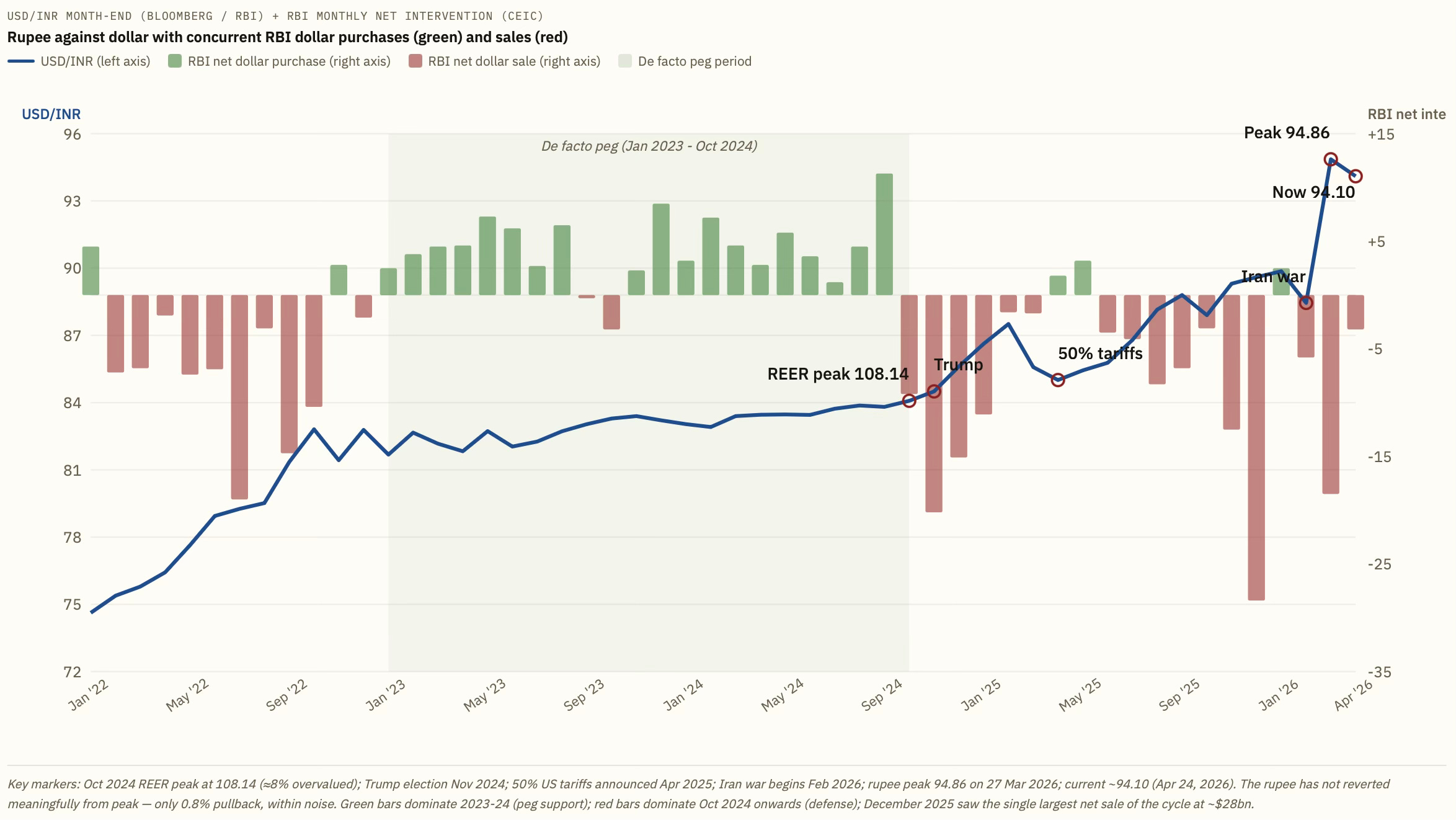
This may also be a good time to examine the dynamics driving the rupee downward. The rupee’s weakness is nothing new. Since the beginning of 2025, the rupee has been the weakest-performing EM currency, behind only the Turkish lira. As reported here, the rupee has weakened from 107 in early 2025 to 92 in the 40-country trade-weighted real effective exchange rate index, despite the RBI intervening heavily to backstop the decline. In fact, since October 2024, foreign investors have pulled out at least $45 billion, and their shareholding in Indian equities is currently at a 15-year low.

The graphic shows that the rupee held steady for two years, from at least the beginning of 2023 to the end of 2024, on the back of rupee purchases to prevent it from depreciating and find its level. In fact, compared to an annual USD-INR volatility of 5% in the 2000-22 period, the INR-USD volatility fell to just 1.8% during this period, the lowest in over 20 years, lower even than the 2000-2004 period when INR was effectively pegged! 

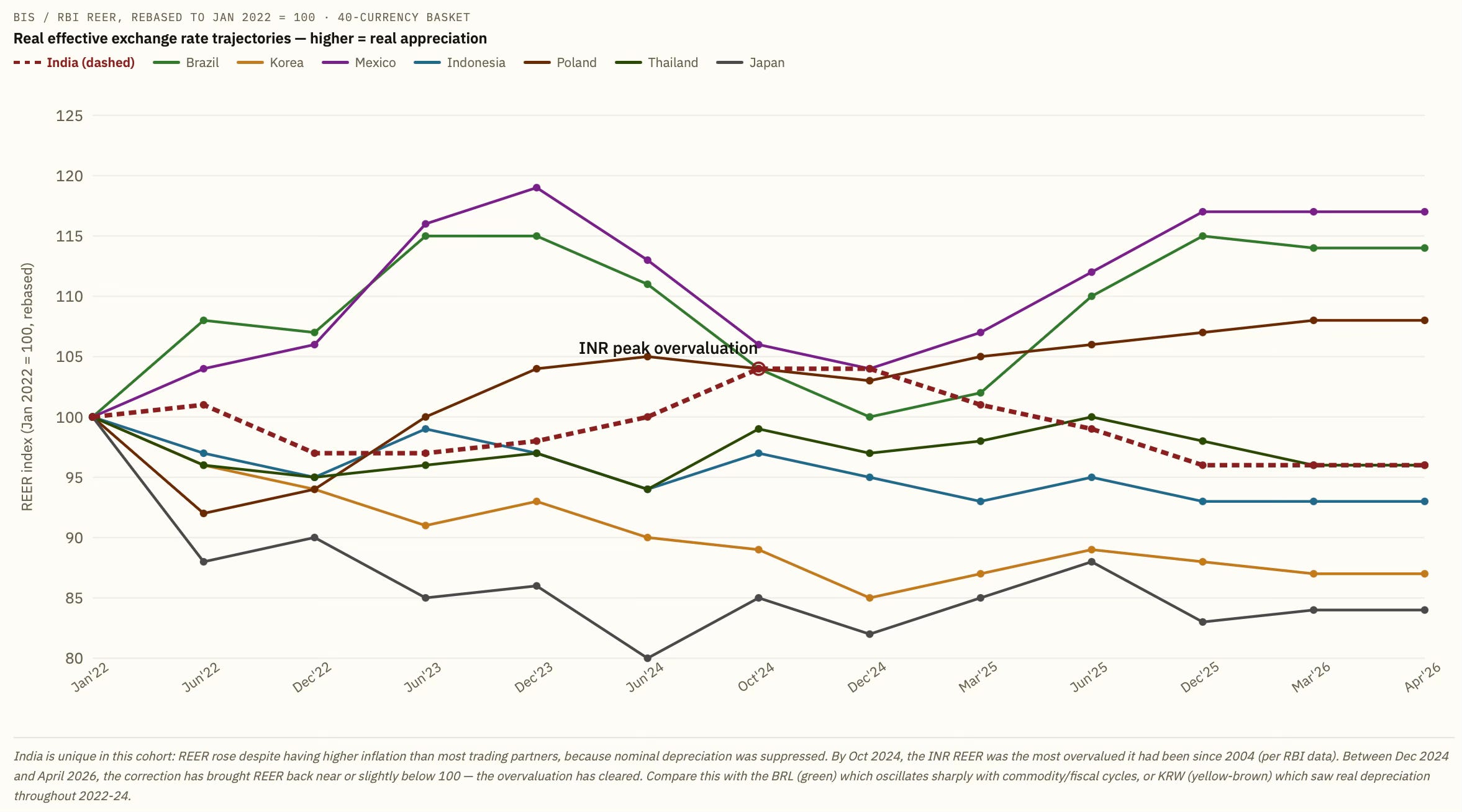
This drastic volatility suppression, combined with India’s higher inflation (CPI averaging ~5%) vs trading partners (2-3%), produced the biggest REER overvaluation build-up in the emerging-market universe during this cycle. The rupee’s 40-currency REER (base 2015-16) peaked at 108.14 in November 2024, and since then has depreciated sharply to below 95 by March 2026. This depreciation has been far in excess of any peer.

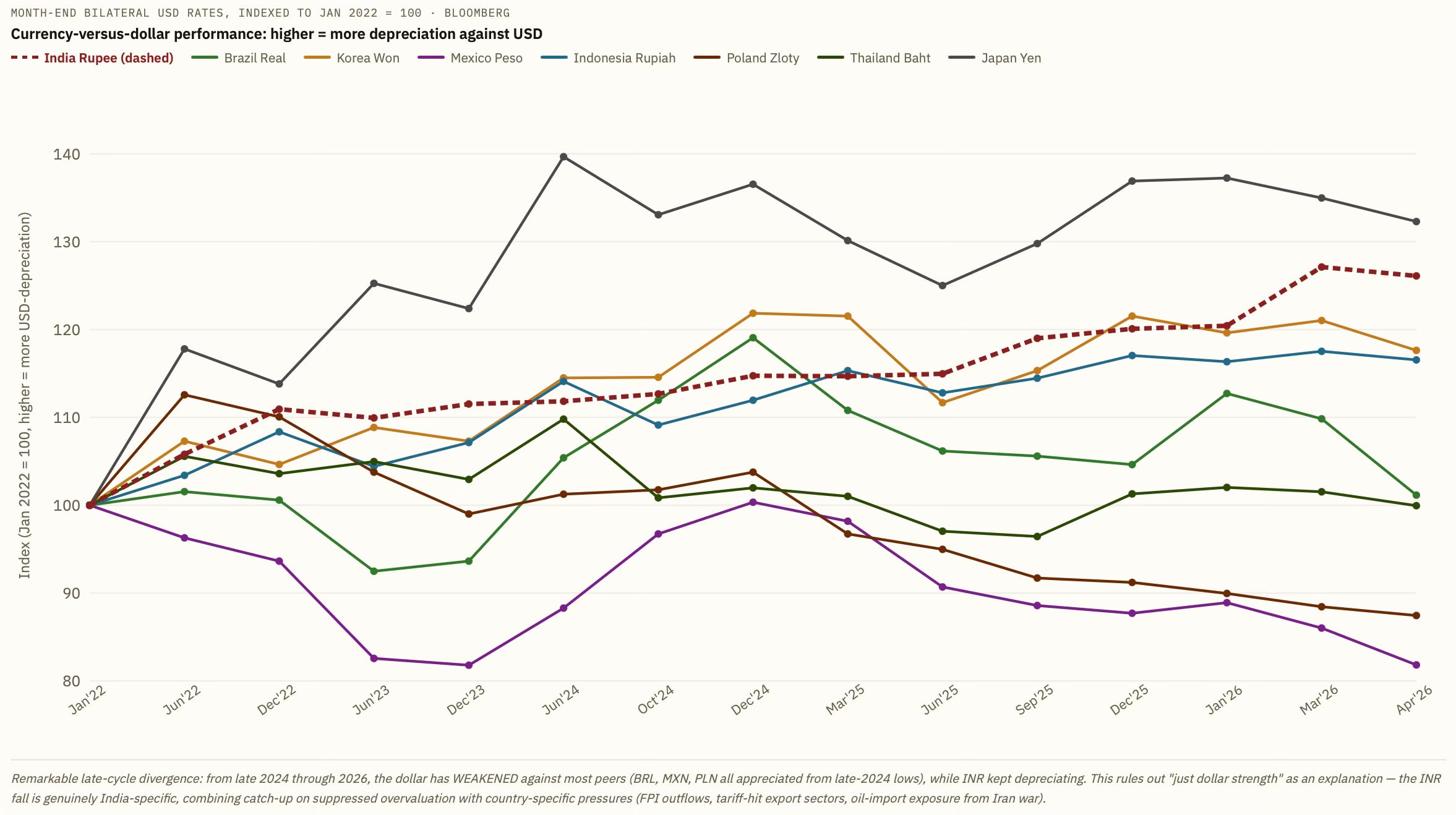
Similar trend is visible with respect to USD too. The rupee stands out for its unique flat trajectory through 2022-24 even as peers depreciated substantially in response to the Fed tightening cycle. However, since Oct 2024 the rupee has depreciated steeply, overtaking several peers.

It becomes clear that the rupee was held artificially overvalued for over two years. This, by itself, should have been reason enough that pressure mounted for a corrective depreciation. In addition, there was the pressure from the spike in oil prices (and associated worsening of the external account, already weakening from the tariffs and FPI repatriation) and the general trend of risk-off and capital flight to the safety and liquidity of the dollar. 

By itself, the Gulf War would have put enough pressure on the currency. But its combination with the stress built up due to the forced overvaluation amplified the capital flight induced by the Gulf War, thereby exacerbating the pressure on the rupee and worsening the depreciation when it happened. 

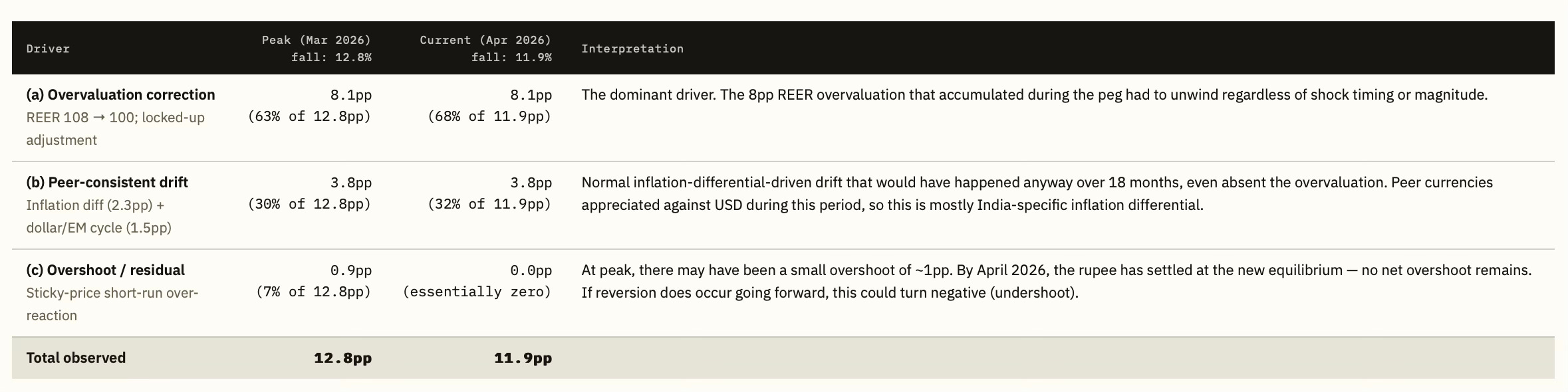
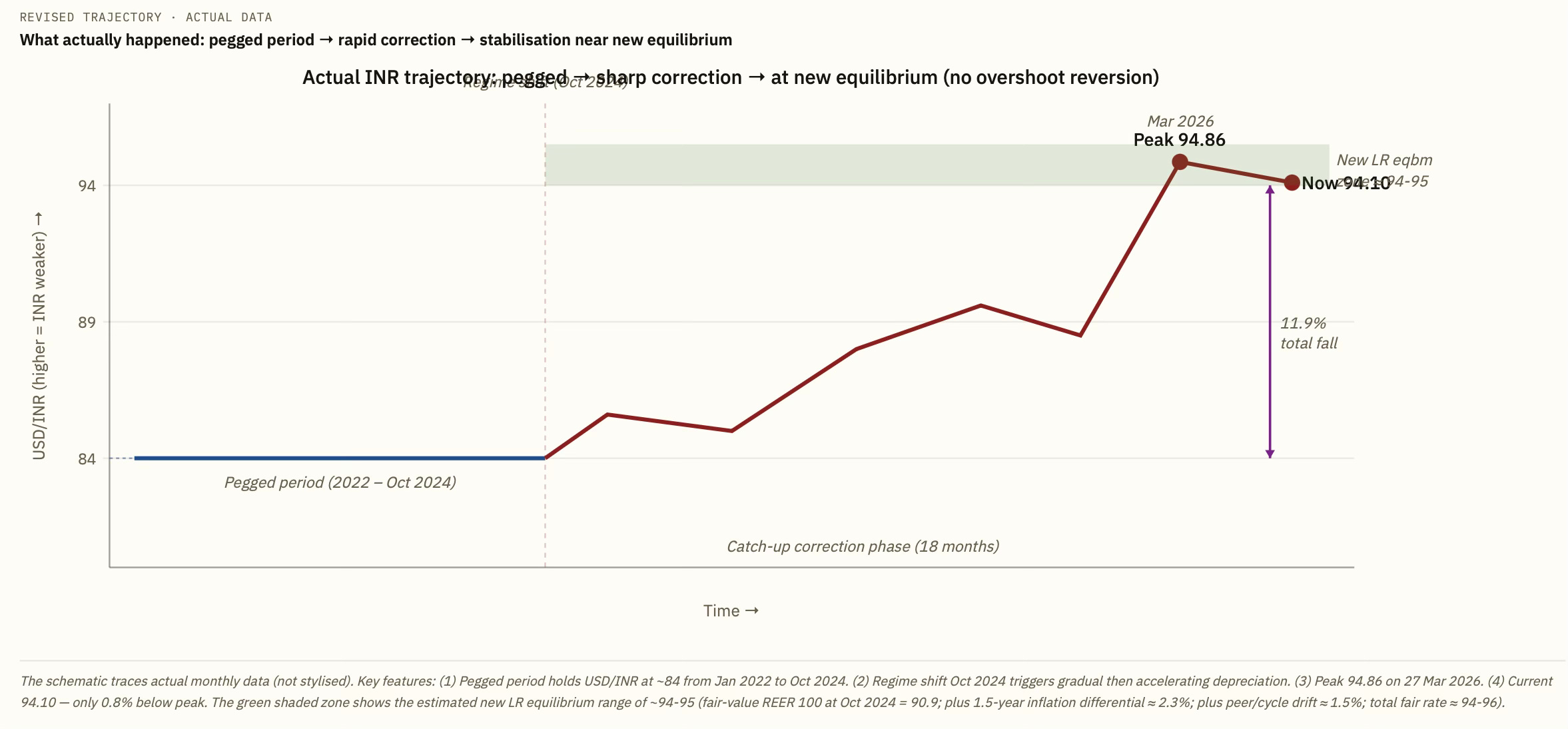
The table below is a quantified decomposition of what drove the 11.9% depreciation. It shows two alternative decompositions at the peak (Mar 2026), which capture the overshoot moment, and at current levels (Apr 2026), after partial reversion. 

At peak (Mar 2026), the biggest driver by far was the overvaluation correction (63% of the fall), which is the “hidden cliff” the RBI’s peg concealed and which was unique to the rupee. The general market volatility (36%), experienced by all peers, was a secondary driver, reflecting genuine dollar/EM repricing. The net overshoot, at least till now, has been negligible.

Has there been a Dornbush overshoot? Rudiger Dornbusch's 1976 overshooting model predicts that when exchange rates are flexible, but goods prices are sticky, a monetary or policy shock causes the exchange rate to overshoot its long-run equilibrium before reverting. In simple terms, if the currency has been artificially propped up, the "stickiness" is extreme, and therefore, when the adjustment finally comes, the overshoot magnitude is larger than in a regime of continuous flexibility. However, the Dornbusch overshoot and reversion are not yet visible. The reversion might happen in the coming weeks.

So what are the lessons?

By maintaining the rupee as a de facto pegged currency from 2023 to October 2024, the RBI accumulated an 8% REER overvaluation that had to be corrected. When the regime shifted — Trump election, FPI outflows, US tariffs, Iran war — the correction was both deeper and faster than peers experienced, precisely because the catch-up component (8pp) was additive to normal drift (3.8pp). The rupee is now at or near its new equilibrium of ~94-95, down 11.9% from Oct 2024.

The RBI’s 2022-24 intervention pattern - buying ~$400bn in forex reserves while keeping the rupee rigid - converted exchange-rate risk into reserve-allocation risk. When the regime shifted, reserves fell by $80bn in four months without preventing the correction. Further, the sharp Mar 2026 overshoot caused imported inflation, margin stress on exporters who had hedged at 84, and a sudden repricing of corporate foreign-currency debt. A gradual depreciation path through 2023-24 (releasing 3% per year against the peer-consistent rate) would have spread this adjustment at much lower systemic cost. The rupee has done exactly what a freely-floating currency would have done gradually over 3 years, but compressed into 18 months because the peg delayed adjustment, and with serious credibility cost (for investors). 

The speed of adjustment was consistent with Dornbusch dynamics (7.2% in a single month from Feb to Mar 2026 is unprecedented for INR). However, the second half of the Dornbusch pattern - reversion toward long-run equilibrium - has not so far materialised, though it could yet in the coming weeks. The rupee is currently 94.10, only 0.8% below its 94.86 peak. This is within noise, not meaningful reversion. 

This is a teachable moment on currency management for central banks. Policies that keep a currency overvalued are always counter-productive, especially for developing countries that are always at risk of being caught in an episode of sudden stop and capital flight. When such episodes are triggered, the overvalued currency invariably experiences a steeper slide and greater overshoot, with all attendant consequences. Most importantly, steep devaluations convey a macroeconomic instability signal to investors. It increases the country risk for investors, who must now factor in the likelihood of episodes of sharp depreciation risks while making their investments. It is a dent in the central bank’s credibility. 

The rupee is going through one such episode. The original sin may have been committed in the 2023-24 period. 

Saturday, April 18, 2026

Weekend reading links

 1. Net FDI from India has been negative for several months now.

2. WSJ graphics on US health care system. Cost of inpatient procedures are much higher than elsewhere.


Cost of pharmaceuticals too are much higher.
3. The rise and rise of iPhone manufacturing in India
The company assembled about 55 million iPhones in India in 2025, up from 36 million a year earlier, people familiar with the matter said, asking not to be named because the numbers aren’t public. Apple makes about 220 million to 230 million iPhones a year globally, with India’s share of the total increasing rapidly.

4. For those advocating currency depreciation as the response to a sharp increase in oil prices, Sachidanand Shukla has a cautionary note pointing to the importance of stability and credibility of the rupee.  

The allure of a depreciating exchange rate lies in its simplicity: It makes ones’ goods cheaper for foreigners. However, this is often a Faustian bargain. For many emerging and developed markets alike, the reality of a currency in freefall is not a boom in exports, but often a harsh blow to purchasing power and investor confidence. Imagine yourself in the shoes of a big global financial investor. How confident will you be in investing a billion dollars if you lose 9-10 per cent in a year due to depreciation?

On a related note, as the RBI deploys an expansive toolkit to stabilise the rupee, Rajeswari Sengupta writes that RBI has engaged strongly in the forex markets, selling over $30 bn in the spot markets in March. Its other actions were intriguing. 

It imposed regulatory restrictions —barring banks from taking positions in the offshore non-deliverable forward (NDF) market and capping their daily onshore FX exposure to $100 million each... The RBI did not merely restrict new positions; it required banks to unwind existing ones, reportedly at a cost of ₹4,000–5,000 crore. In effect, banks were penalised for actions that were fully legitimate at the time. Such retrospective costs risk undermining confidence and making banks more cautious in FX markets. Lower participation could reduce liquidity. And when liquidity dries up, currencies tend to become more volatile, not less.

5. The human cost of Israel's bombings of Lebanon.

On the day the cease-fire came into shaky effect — and most civilians across the region began to breathe a sigh of relief — Israel proceeded to launch one of the deadliest strikes on Lebanon ever, including in the heart of densely populated Beirut, without any warning. The operation, which the Israel Defense Forces sayattacked Hezbollah command centers, hit 100 targets in 10 minutes, killed over 350 people and wounded well over 1,000, many of them civilians... over the past six weeks, Israeli strikes in Lebanon continue, and have forced more than a million people from their homes and have left over 2,000 people dead and multiple villages in ruins.

6. The rise of China's export control measures.

China announced restrictions on exports 30 times between 2021 and 2025, the report by the EU Chamber of Commerce in China found, up from just 11 in the previous five years. Since 2020, Beijing had turned to “geoeconomic” controls — measures aimed at achieving geopolitical goals, it said. These include 10 that made use of global chokepoints in supply chains, such as China’s rare-earths exports, and 10 others aimed at coercing other countries using economic measures.
China has also announced sweeping new regulations to punish foreign companies that are trying to decouple their supply chains from China by increasing reliance on non-Chinese suppliers. These measures are part of the government's efforts to counter rising protectionism and decoupling from China. 
The 18-point regulations, described in state media as an effort to “prevent security risks in industrial and supply chains,” supplement the already formidable authority afforded to Chinese regulators to investigate multinational corporations for moving supply chains out of China. Under the new rules, regulators can question employees and examine corporate records during investigations. The regulations also allow authorities to bar companies and individuals from leaving China if they are suspected of moving supply chains elsewhere under foreign pressure... The State Council, China’s cabinet, justified the measures as necessary to protect the country’s economic stability and national security — a rationale it has previously used to expand its ability to pressure companies. China has also adopted sweeping state secrets laws to prevent information from leaving the country.
During the pandemic, Beijing vowed to invest $400 billion in the country in the coming decades in exchange for a steady supply of oil. In 2024, it purchased 90 percent of Iran’s oil exports, according to the International Energy Agency. China also accounted for roughly a quarter of Iran’s non-oil exports from 2019 to 2024, according to data compiled by Harvard University’s Atlas of Economic Complexity, purchasing billions of dollars of Iranian chemicals and metals.
Payments are made in renminbi, China’s currency, avoiding the use of dollars and the need to involve American banks, which are often the primary entities used to help enforce sanctions violations. China, in return, appears to provide nearly 30 percent of the commodities that Iran imports, selling everything from furniture to sunflower seeds. There is another crucial layer of trade between the nations not recorded in official statistics. Both countries have engaged in a complicated barter system that involves secret financing channels. Iran ships oil to China and in return, Chinese state-backed construction companies have built airports and other infrastructure.

8. The new fragile European countries - Britain, Italy, and France (or Bifs).

Europeans still trust the EU over their national political systems, and the margin is wider than it has been since the noughties. (More on this later.) Support for the euro, which was as low as 51 per cent in 2013, has grown to a record high of 74 per cent in the EU, and 82 per cent in the Eurozone. To repeat, that is a near-consensus in favour of the single currency at a time of economic malaise in much of the continent. As for the country-by-country findings, 21 per cent of Austrians think membership is a bad thing. That makes them the most Euro-sceptical people in the union.

10. India reached peak college education premium in 2011?

11. Jason Bordoff makes the important point that, unlike earlier, the risk of oil shocks is a less restraining factor on US supplies.

In 2012, the US was far less equipped to absorb even a small disruption. US crude production averaged just 5mn barrels a day in 2009; last year it approached 14mn. Two decades ago, the US imported about 60 per cent of its oil consumption. Today it is a net exporter and the world’s largest exporter of liquefied natural gas.
12. The data centre construction boom in the US is being held back by construction and other delays, with almost 40% of those due this year at risk of falling behind schedule

13. Finally, excellent description of the regressive nature of income taxation especially for the richest Americans.
In 2021, ProPublica published an investigation built on a bunch of leaked tax documents revealing what the richest Americans really pay — or don’t. Warren Buffett had a true tax rate of 0.1 percent; Jeff Bezos had 0.98 percent; Michael Bloomberg had 1.3 percent... Let’s focus on Jeff Bezos because he’s much more of a classic case. Jeff Bezos started his own business. He owns a dominant amount of the stock. And over the course of the years, he has taken a salary that is no higher than $82,000. It’s been more than 20 years now, and his salary is always capped at $82,000.

You might say: Well, why would it be? He started the company — he’s the man. Why isn’t he taking a huge salary to reflect all that he put into the company? The reason is: Salaries are for suckers. When people take a salary, they’re subject to high income taxes and payroll taxes, and Jeff Bezos and a lot of our other multibillionaires have no interest in paying those taxes.

So instead, they take their benefits through the growing value of their stock — and their stock has grown enormously. And that massive growth of stock happens entirely tax free — with no time frame under our current system in which that stock will ever be subject to tax. That is because we only impose a tax if the stock is sold, and Bezos never has to sell the stock because he can simply borrow against the stock and use that money to support his lifestyle and to pay any interest that’s due on the loan... you’re just taking out one loan after another, sometimes paying one loan back with another, and you’re just doing this again and again.

The interview also makes a reference to Andrew Mellon's views on capital gains (or investment returns) taxation.

The fairness of taxing more lightly incomes from wages, salaries and professional services than the incomes from business or from investments is beyond question. In the first case, the income is uncertain and limited in duration; sickness or death destroys it, and old age diminishes it. In the other, the source of income continues; the income may be disposed of during a man’s life, and it descends to his heirs.