Substack

Showing posts with label Capital controls. Show all posts

Thursday, November 6, 2025

Next target for economic nationalism - capital flows?

The restrictions imposed on the inflows of people and goods into the US have ushered in a new era of economic nationalism. It’s unlikely that these trends will reverse even after President Trump demits office. 

Amidst this new wave of economic nationalism, it is only a matter of time before capital flows become the focus of attention and attract restrictions. This is already evident in President Trump’s policies that mandate foreign countries to make massive investment commitments in the US and directives to US multinationals to invest in the US. It’s only a small step to force US companies to restrict investments outside. Don’t be surprised if one of the high-profile investment commitments abroad by a US company triggers resentment and policy measures in this direction. Capital controls may well be the next big Trump policy action. 

This comes on top of growing restrictions on capital flows due to national security and strategic reasons, on the back of rising geopolitical tensions. US outbound investments in critical technologies like AI, quantum, and semiconductors are being subjected to scrutiny and permissions. The US, for example, tightly controls outbound sales of the latest Nvidia chips (and associated investments) that are a major part of the data centre boom. 

This is not a US phenomenon. The general reversal in the trend of offshoring will invariably reduce investments in developing countries. In addition, there are already signs of countries questioning the trend of their pension funds lowering domestic exposure while chasing returns outside. 

The Canadian Industry Minister, Melanie Joly, has called on its C$3tn (US$2.1tn) pension system to boost domestic investment as it seeks C$500bn in new finance to reboot the economy and lower its dependence on the US. 

The Canada Pension Plan Investment Board, the country’s largest fund with C$714bn of assets, revealed its total allocation to Canadian assets dropped to 12 per cent of the fund in March from 14 per cent two years earlier, although the total value of Canadian assets still increased… Last year more than 90 Canadian corporate executives signed an open letter calling on the government to amend rules which would allow them to increase domestic investments, saying the amount they allocated to Canadian equities had dwindled from 28 per cent in 2000 to 4 per cent by 2023. Ottawa in December lifted its 30 per cent cap for investments in Canadian entities at a time when Trump was threatening tariffs and trade wars against its major trading partner… CPP Investments has nearly 50 per cent of all its assets invested in the US, despite pressure from Ottawa to invest more in its home market. Similarly Omers, the pension fund for Ontarian municipal workers with C$141bn of assets, had 16 per cent invested in Canada and 55 per cent invested in the US at the end of June.

A similar trend is emerging in the UK for raising domestic equity allocations for British pension funds.

Targets of 5 per cent, 8 per cent and 10 per cent were discussed as reasonable thresholds to consider, and there was broad agreement that defined contribution schemes should be prioritised over defined benefit schemes… Pension funds are expected this month to sign a voluntary compact — an update of the 2023 Mansion House compact signed under the last Conservative government — to invest 10 per cent in private assets by the end of the decade, with half of that in the UK.

Chancellor Rachel Reeves has announced that she will create a “backstop” power to compel investment in British assets if voluntary efforts fall short. 

She vowed to unleash more than £50bn of investment in domestic infrastructure, housing and fast-growing businesses. The highly contentious move towards “mandation”… will feature in new pensions legislation later in the year. The chancellor hopes creating pension “megafunds” with more than £25bn in assets, coupled with a voluntary accord with industry to boost allocations to private assets, will reverse long-term falls in investment in the UK… It is the first time the Treasury has publicly confirmed it will legislate to create a backstop power to mandate pension funds on their investment strategy.

In both countries and elsewhere, there are growing pressures on pension funds to reduce foreign exposures and mandate higher domestic investment requirements. Australia’s National Reconstruction Fund and other infrastructure initiatives incentivise, in various forms, domestic institutional funds to direct capital into domestic projects. France and several other EU members have similar incentives and regulatory frameworks to direct insurance and pension funds into domestic projects, and these trends are on the rise. 

Given the massive infrastructure replenishment requirements across developed countries, there will be increased pressure on long-term funds to prioritise domestic deployments of capital. The already small share of long-term capital—institutional funds and private equity—flowing to infrastructure in developing countries will decrease further. 

This trend in finance squares with the broader shift towards protectionism elsewhere. There’s nothing about economic nationalism that ought to confine it to only goods and services, and people. Capital will inevitably join the list. Given these trends, we may well be at peak global financial integration, too. 

An IMF paper from 2024 finds empirical evidence indicating that capital controls on outflows (CCOs) are associated with crises and declines in GDP growth. Given the emerging situation of macroeconomic and financial distress in many developed economies, the likelihood of the implementation of CCOs is growing stronger. 

In the circumstances, developing countries like India should be prepared for a reduced flow of foreign direct investments (FDI). This is more likely to be pronounced in technology areas. While financial markets will always pursue returns, domestic political economy factors are likely to hold back outflows of long-term capital like pension funds and insurers.

Saturday, July 20, 2024

Weekend reading links

1. Nigeria can lay claim to the dubious honour of being the worst-governed big country in the world and the most consistent global economic under-performer. The FT has a long read.

During the eight years Muhammadu Buhari was in office, Nigeria’s GDP shrank, in per capita terms, as he pursued ineffective economic policies with an interventionist theme. Decades before that, Nigeria fell to the so-called resource curse: though oil contributes a relatively small amount to the country’s GDP, it plays an overweening role in state finances, making up 80 per cent of government revenue.

President Bola Tinbu, who's entering his second year, has pursued a shock therapy policy of austerity, Tinbunomics, which involves cutting subsidies (the fuel subsidy of $10bn in a total budget of $34 bn) and two sharp devaluations. The result has been a tripling of oil prices and inflation climbing to a three-decade high of 34%.

Food prices are rising faster, putting even basic staples like rice, milk and maize beyond the reach of many and sending malnutrition levels soaring. The Food and Agriculture Organization estimates that 26.5mn of Nigeria’s 220mn people are food insecure with at least 9mn children at risk of wasting, a medical condition that stunts development. 

Desperate groups of hungry people have raided warehouses storing food. There have been deadly stampedes for the bags of emergency rations being handed out by some states, largesse that goes by the name of “palliatives”. Nigeria, which for years took pride in being Africa’s biggest economy, has tumbled to fourth place in dollar terms. Without a strong recovery, the IMF predicts it is likely to slip to fifth by the end of 2024, behind South Africa, Egypt, Algeria and Ethiopia — a huge blow to Nigeria’s self-image as “the giant of Africa”.
See also this article on how the IMF austerity policies resulted in riots and protests in Kenya. This is a good long read on Kenya by Ken Opalo.

2. John Burn-Murdoch has a very good insight into populism.
The most successful such parties in Europe — Fidesz in Hungary and the conservative nationalist Law and Justice in Poland — are left-leaning on economics while rightwing on social issues, positioning themselves squarely in the quadrant inhabited by most voters. In France, RN has moved in a similar direction, as has Geert Wilders’ PVV party, which now forms part of the Dutch government. Giorgia Meloni’s ruling Brothers of Italy party (FdI) is no crusader for free markets.
3. Fascinating article about how the high cost of elevators in apartment complexes in the US has become an example of the challenges with the broader construction industry in the country.
The problem with elevators is a microcosm of the challenges of the broader construction industry — from labor to building codes to a sheer lack of political will. These challenges are at the root of a mounting housing crisis that has spread to nearly every part of the country and is damaging our economic productivity and our environment. Elevators in North America have become over-engineered, bespoke, handcrafted and expensive pieces of equipment that are unaffordable in all the places where they are most needed. Special interests here have run wild with an outdated, inefficient, overregulated system. Accessibility rules miss the forest for the trees. Our broken immigration system cannot supply the labor that the construction industry desperately needs. Regulators distrust global best practices and our construction rules are so heavily oriented toward single-family housing that we’ve forgotten the basics of how a city should work. 

Similar themes explain everything from our stalled high-speed rail development to why it’s so hard to find someone to fix a toilet or shower. It’s become hard to shake the feeling that America has simply lost the capacity to build things in the real world, outside of an app... With around one million of them, the United States is tied for total installed devices with Italy and Spain... In Western Europe, small new apartment buildings of just three stories typically include a small elevator (and sometimes buildings of just two stories as well). These types of buildings have almost never had elevators in America, and developers are planning and building new five- and six-story walk-ups in some cities. When a developer in Philadelphia or Denver comes across a piece of land zoned for a few stories, elevator expenses are often one reason they build townhouses rather than condos — fewer in number and with higher price tags. 

Behind the dearth of elevators in the country that birthed the skyscraper are eye-watering costs. A basic four-stop elevator costs about $158,000 in New York City, compared with about $36,000 in Switzerland. A six-stop model will set you back more than three times as much in Pennsylvania as in Belgium. Maintenance, repairs and inspections all cost more in America, too. The first thing to notice about our elevators is that, like many things in America, they are huge. New elevators outside the U.S. are typically sized to accommodate a person in a large wheelchair plus somebody standing behind it. American elevators have ballooned to about twice that size, driven by a drip-drip-drip of regulations, each motivated by a slightly different concern — first accessibility, then accommodation for ambulance stretchers, then even bigger stretchers. The United States and Canada have also marooned themselves on a regulatory island for elevator parts and designs. Much of the rest of the world has settled on following European elevator standards, which have been harmonized and refined over generations... Not only do we have our own elevator code, but individual U.S. jurisdictions modify it further.

4. Another example of market failure, in the US home insurance market.

Higher premiums are being charged in states where regulators apply less scrutiny to requests for rate increases, compared with states where officials question the justifications offered by companies and try to keep rates low, the research shows. The effects of those state-by-state regulatory differences are only now becoming clear. In a separate paper, new data makes it possible for the first time to see what households pay for home insurance by county and ZIP code, across the United States. The average premium jumped 33 percent between 2020 and 2023, far more than the rate of inflation, the data show. But in some places, homeowners are paying more than twice as much for insurance, as a share of home value, than people who live elsewhere and face similar exposure to severe weather. As a result, America’s home insurance market is increasingly distorted, said Ishita Sen, a professor of finance at Harvard Business School who studies why insurance rates diverge from risk. In communities where insurance rates exceed the actual risk, homeownership can be unaffordable. And in places where insurance prices are too low, it encourages people to move into homes in areas likely to be hit by wildfires or other disasters that could deliver financial ruin, Dr. Sen said...
After big losses in those tightly regulated states, such as California, national insurers tend to raise rates in more loosely regulated states. In other words, homeowners in states with weaker rules may be overpaying for insurance, effectively subsidizing homeowners in states with tougher rules, she said. If California makes it especially hard for insurers to increase premiums, Oklahoma makes it much easier... the home insurance market is far less competitive than it might seem. After choosing an insurer, people often stick with that same company, even if their premiums go up, she said. Three insurers — State Farm, Farmers, and Allstate — collectively wrote more than half of all home insurance in Oklahoma last year.

5. Manufacturing for exports has replaced real estate as the primary destination for credit flows in China.

Net new bank loans to industrial borrowers reached $614 billion in the 12 months through March. That was six times the annual lending to those borrowers before the pandemic, as lending to industries has almost exactly replaced the loans that previously went to the real estate sector.

This shift to manufacturing is showing up in the trade surpluses.

China’s already formidable exports surged in June, China’s customs administration reported on Friday. But imports shrank, with Chinese companies and households becoming more cautious about spending money. The result was a record monthly trade surplus of just over $99 billion... China’s trade surplus last month broke a record set in July 2022, when the country’s factories and ports were racing to catch up with global demand after a stringent Covid-19 lockdown in Shanghai had crippled output throughout much of central China... Factories in China already make almost a third of the world’s manufactured goods.

5. Matt Stoller has a profile of JD Vance, the Vice President pick of Donald Trump. Despite this Republican and VC background, Vance comes out as a very interesting politician, a populist who tries to bridge the left-right divide and one whose professions appear to take on the rich power elites. 

This bit of bipartisanship could be regarded as sage advice for any incoming government anywhere in the world.
A lot of what will determine Trump administration and interest policy is who ultimately takes the reins and the senior roles in the Trump administration, because they're going to be the ones who are executing on this stuff… So when I think about how to solve how to put those instincts into policy, a lot of it's going to be getting the right people in some of these roles and making sure we don't get rid of some of the good people from the previous administration who are doing the right thing. So I think that's the question, how do we get proper personnel rights so that we can get policy right the next Trump administration?
6. I can't see many positives in having private equity investing in sectors like school education, neither for PE and not certainly for the schools. 

FT reports that in one of the largest European deals of the year at upto $15 bn, Bain Capital, Permira, and Veritas Capital are competing to buyout a majority stake in the London-based school operator Nord Anglia. The operator is currently owned by Swedish PE group EQT and Canada Pension Plan Investment Board (CPPIB). It has 87 international day and residential schools in 33 countries, including China, India, Middle East, and Americas, and has over 85,000 students up tp the age of 18 and 11,000 teachers and thousands of support staff. It added 10 schools over the last two years, mainly through acquisitions. 
Education has proved a popular sector for investment in the private markets.
A consortium led by the Canadian investment group Brookfield agreed a deal last month to invest in the Dubai-based education company GEMS. Meanwhile, the French investor Wendel earlier this month took a 50 per cent stake in the European primary and secondary school group Globeducate for €625mn, acquiring part of current shareholder Providence Equity Partners’ interest.

7. Nguyen Phu Trong, Vietnam's most powerful leader since Ho Chi Minh and who oversaw the country's emergence as a manufacturing powerhouse, passed away at the age of 80. 

Trong consolidated power into his hands during his tenure and weakened the other parts of Vietnam’s four-pillar leadership system — which includes not only his post as Communist party chief, but also the president, the prime minister and the chair of the National Assembly... As party chief from 2011 and the country’s president between 2018 and 2021, he played a central role in Vietnam’s economic rise. Vietnam has attracted billions of dollars in foreign investment from companies across the world, becoming an important link in the supply chain for companies such as Apple and Samsung. Trong deftly balanced Hanoi’s relationship with the global superpowers, maintaining close ties with the US, China and Russia. He forged ties with Vietnam’s former foe, the US, by upgrading the relationship between the two countries to a “comprehensive strategic partnership” — the highest level of diplomatic ties afforded by Hanoi. He also drew criticism because during his leadership the Vietnamese government tightened control over news media, social media and civil society. In 2021, he was elected party chief for an unprecedented third term after the party decided to exempt him from the two-term rule. His defining policy was an anti-corruption drive called “blazing furnace”, in which thousands of government officials were disciplined and many prosecuted. Two presidents and two deputy prime ministers quit after being accused of violations, triggering political instability that has paralysed government activity and affected economic growth.

8. A sample of big state interventionism likely in the UK under Keir Starmer

Sir Keir Starmer’s government looks set to be the most interventionist since the 1970s. He plans to force through housebuilding, nationalise the railways, create an industrial council and a state-backed energy company, roll back curbs on trade unions and usher in new employment rights. Renters will get more rights and there will be new state agencies — including a football regulator — added to the alphabet soup of acronyms.

9. China housing prices graphic of the day

Three years on from a crackdown on excess leverage in the industry, the official measure of new home prices is falling at its fastest pace in almost a decade while the number of foreclosed houses listed for auction in the first quarter increased 35 per cent from a year ago, according to the China Index Research Institute. Official figures show about 10mn of China’s 300mn migrant workers left the construction industry in 2022 and 2023.

Sunday, November 6, 2022

Weekend reading links

1. Tamal Bandopadhyay draws attention to the workforce decline in the banking industry,

In 2005, clerks and subordinates combined had at least 63 per cent share of employees in scheduled commercial banks. By 2021, this figure has more than halved — 30 per cent. A large part of the shrinkage happened in the past decade. Till 2010, clerks and subordinates formed at least 55 per cent of total banking employees. Blame it on technology. As digitisation progresses, more and more jobs of the clerical cadre are turning redundant... As a result of the core banking solution (CBS), customers no longer bank with a branch; they bank with a bank (at any branch across the nation)... The number of branches has gone up by more than one-fourth in the past decade but the number of employees has fallen.

2. FT has a long read which highlights how Taiwan's strategic interests may be coming in the way of America's desire for TSMC to diversify quickly by building facilities in US. 

TSMC has grown into a giant with an effective stranglehold on the global chip supply chain. Taiwan sees this dominance as a crucial security guarantee — sometimes referred to as its “silicon shield”. The government believes that the concentration of global semiconductor production in the country ensures the US would come to the rescue if China were to attack. “Everyone needs more advanced [ . . . ] semiconductors,” economy minister Wang Mei-hua said during a visit to Washington this month. Being a key global player in this way will “make Taiwan [ . . . ] safer and [secure] peace”, she added. But Taiwan’s determination to keep as much of the industry as it can on the island is clashing with US strategic goals and its fears of China... As competition between the US and China heats up and the risk of a military conflict over Taiwan increases, Washington is seeking to both cut Beijing off from supplies of key advanced semiconductors and reduce its own dependency on Taiwan for chip supplies. Both of those objectives potentially undermine TSMC, whose success is built on serving customers in all markets and on doing so from a cost-efficient cluster of plants almost entirely in Taiwan.

Its dominance of the market is complete

Taiwan now accounts for 20 per cent of global wafer fabrication capacity, the single largest concentration in one country, and a staggering 92 per cent of capacity for the most advanced chips. The US share in global chip manufacturing has dwindled from 37 per cent in 1990 to 10 per cent in 2020.

3. Another aspect of Japanification is the hollowing out villages and empty houses

Next year, according to a recent estimate, Japan will have roughly 11mn unoccupied residences — slightly more than the entire residential stock of Australia. By 2038, under one scenario in the same forecast, just under a third of Japan’s dwelling units could lie empty. A gloomy prognosis for Japan, where spooky, semi-abandoned rural villages already abound, but a portent of much bigger trouble, potentially, for China. For many economies, Japanification may be a vague worry; where bubbles are concerned there is danger. And there’s a warning klaxon that Japan may now be sounding for China relating to the effect of demographics.

4. Arvind Subramanian makes one of the strongest yet cases on restricting capital flows. 

... cross-border flows of private financial capital do not foster sustained economic growth. The substantive benefits from financial globalisation, if any, are too few to offset the costs of sudden shocks, capital flight, and loss of policy control... Developing and emerging-market countries must impose constraints on the cross-border flow of certain forms of capital, particularly volatile portfolio flows. Only “good capital”— for example, foreign direct investment that has a long-term stake in the recipient country and brings technology, skills, and ideas to it — should enjoy the right to move across borders.

Instead of panic-driven capital controls when capital flows reverse, developing countries should eschew the temptation to further liberalise capital flows, especially for short-term gains. 

5. After the struggles with overcoming its gas dependency on Russia, Germany grapples with the challenge of derisking its economic fortunes away from China. But Chancellor Olaf Scholz appears as yet not ready to take harsh decisions with the country's China relationship. 

The FT writes about the controversy around and tensions created within Germany about the recent purchase of a minority stake in a Hamburg container terminal by a Chinese shipping company Cosco,

Rarely has a deal encountered such strong government opposition. Six German ministries came out last month against Chinese shipping company Cosco’s planned acquisition of a stake in a Hamburg container terminal. But it went through anyway. The man who ensured its safe passage through the German cabinet was Chancellor Olaf Scholz. He insisted on a compromise — Cosco would have to make do with a 25 per cent stake, rather than the 35 per cent that was initially proposed. But the German foreign ministry remained opposed, even after Scholz pushed it through. State secretary Susanne Baumann wrote an angry letter to Scholz’s chief of staff, Wolfgang Schmidt, saying the transaction “disproportionately increases China’s strategic influence over German and European transport infrastructure and Germany’s dependence on China”. Scholz, however, clearly could not afford to see the deal collapse. On Friday he will become the first G7 leader to hold talks in Beijing with Chinese president Xi Jinping since the start of the Covid-19 pandemic. Nixing the Cosco transaction would have cast a long shadow over a trip with huge symbolic importance to both Beijing and Berlin...

The coalition agreement negotiated last year by Scholz’s Social Democrats, the Greens and the liberal Free Democrats was notable for its critical tone on China and its focus on human rights. But the Hamburg deal shows deep divisions persist between the Greens and parts of the SPD about the future of the relationship. Green scepticism about China has only grown since last month’s Communist party congress, during which President Xi stacked the Politburo Standing Committee with loyalists and cemented his position as the most powerful Chinese leader since Mao Zedong... The Ukraine war exposed the folly of Germany’s decades-long reliance on Russian gas. Now, the pessimists fear, it may be about to pick up the tab for its even deeper dependence on China, a country that has long been one of the biggest markets for German machinery, chemicals and cars. Thomas Haldenwang, head of German domestic intelligence, summed up the concern at a hearing in the Bundestag last month. China, he said, presented a much greater threat to German security in the long term than Russia. “Russia is the storm,” he said. “China is climate change.”

Interestingly, even as the smaller companies are tapering down their China operations, it's the bigger ones that appear reluctant, with some like BMW and BASF even expanding operations despite the obvious risks. A clear example of the divergence between national interests and those of multinational corporations. 

Scholz's reluctance to bite the bullet with China is surprising since China may be needing Germany more than the other way round given China's deepening rift with the US. The Times writes,

China now makes a very wide range of factory equipment that it used to buy from Germany. Covid lockdowns and a wave of nationalism have also hurt consumer spending on imports in China. At the same time, Germany has gone on buying ever more goods from there. The result is that Germany’s longtime trade surplus with China vanished late last year and has been replaced by a steadily widening deficit. Many German companies now see China as a competitor at home instead of an opportunity abroad. “People always talk about how China is a big market — no, China is a huge economy with a small accessible market,” said Jörg Wuttke, the president of the European Union Chamber of Commerce in China. Overall, E.U. exports to China are only slightly larger than those to Switzerland... President Emmanuel Macron of France had urged Mr. Scholz not to travel to Beijing on his own but as part of a joint delegation. The head of Germany’s foreign intelligence agency warned that the country was “painfully dependent” on China.

6. Even as Germany prevaricates on China, there are signs that Europe may be succeeding faster than expected in weaning itself away from Russian gas. The price at Dutch-based virtual natural gas trading point, TTF, has declined.

Natural gas prices have dropped by 65% since the August all-time peak, storage caverns across the continent are filled to the seams and set to meet at least two months demand, and sea-borne LNG tankers are plentiful so much so that there are traffic jams outside European terminals as ships wait to unload cargoes. But there is more to go,
Prices remain eye-wateringly high, particularly for early next year, and when the cold weather finally hits there remain concerns Europe could quickly burn through its gas reserves, potentially still leading to extreme tightness in supplies after Christmas. Gas at around €115 per megawatt hour is still equivalent to almost $180 a barrel in oil terms. Contracts in December and January are above $230 a barrel equivalent... 
But weather’s dominance over the gas market means Henning Gloystein at Eurasia Group is not quite prepared to say the worst is definitely over. If the winter is mild, then Germany, Europe’s biggest economy, could end the season with its storage facilities almost half full. But if it is just slightly colder than normal, then “German gas inventories would be virtually depleted by end-March, possibly requiring late winter rationing or supply cuts”, Gloystein said.

Whatever the final outcome in the months ahead, the European collective resolve to wean away from Russia is succeeding. Germany led this effort. It now needs to lead a similar effort to de-risk from China. 

7. Martin Wolf writes about deglobalisation.

Interestingly, rich countries with greater trade integration are associated with lower inequality, pointing to possible gains from trade which benefits the entire economy.

Thursday, September 29, 2022

Spillovers in the global over-kill with inflation-fighting

I had blogged earlier expressing hope that the unmistakably clear and co-ordinated monetary tightening by central banks could have the effect of shaping inflation expectations downwards. 

But like with all such actions, there is also the possibility of over-shooting with the tightening. Excessive tightening and associated reshaping of expectations could have the effect of tipping the world economy over into a recession. This is what the World Bank worries in its latest report about the possibility of a global recession. 

But this is also a teachable moment in understanding macroeconomics in a financially integrated and globalised world economy. 

Adam Tooze points to some graphs from the latest World Bank report. On the monetary policy side, the report informs that we are now seeing the most widespread tightening of monetary policy since early 1970s.
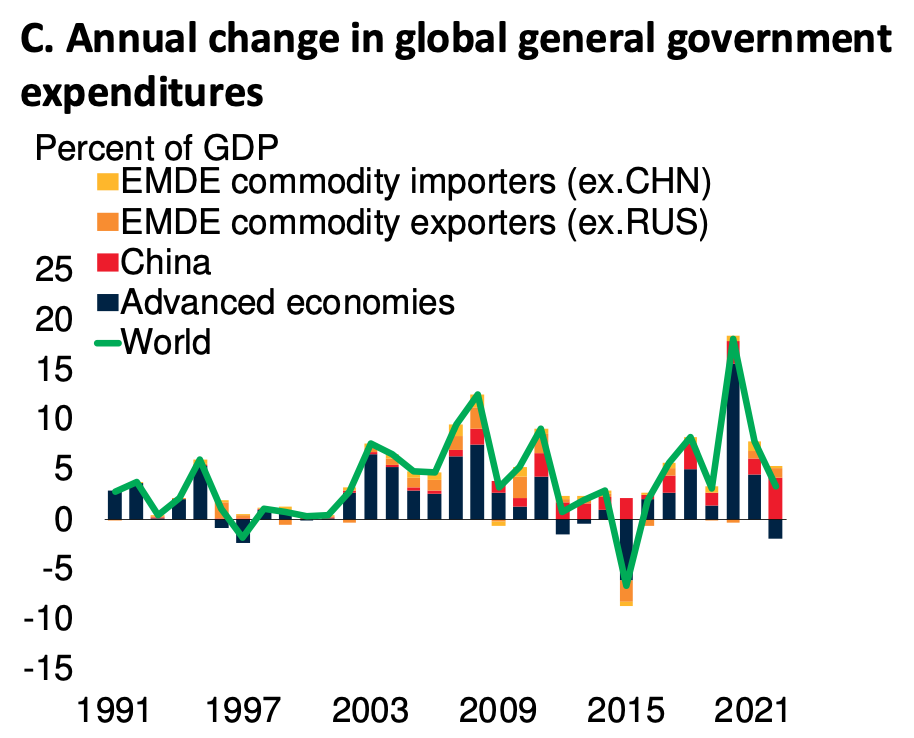
On the fiscal policy side too, the share of countries tightening their fiscal spending is greater than ever.
And the fiscal tightening is universal
Tooze writes,
The level of real interest rates - nominal rates adjusted for inflation - remains low. But this is the most dramatic shift in the stance of policy we have witnessed since the 1980s. The risk is that it will be excessively contractionary and will trigger a worldwide recession.

But this global over-kill towards monetary (and fiscal) tightening can be traced to the US Federal Reserve's delayed reversal of its monetary accommodation. After falling behind the curve big time, the Fed has been catching up with some vengeance. Its collateral damage has been in the form of spillovers to developing countries, forcing those central banks to respond with their own tightening. The spillovers have not spared even those central banks who responded early enough to the inflationary trends and tightened. In fact, those countries, like Brazil, are now being forced to respond with further tightening, thereby adversely impacting domestic growth. Not to speak of the inflationary effects from depreciating currencies. 

There is nothing new in this script. The globalisation of the US monetary policy and its spillovers (especially on developing economies) was a central theme in The Rise of Finance. This is just one snippet,

BIS economists Peter Hordahl, Jhuvesh Sobrun and Philip Turner find that ‘central banks in small economies have only a very limited ability to influence the long-term interest rate in their own currencies’. In other words, taken together, the monetary policy autonomy of small open economies has been progressively declining. They not only have less ability to influence their own interest rates but their long-term interest rates are also vulnerable to shifts in US long-term yields. Another paper by Robin Koepke of the Institute of International Finance (IIF) examined the impact of changes in US monetary policy in 27 emerging economies, specifically in terms of currency and banking crises and sovereign defaults. The paper studied 154 such crises over the 1973–2014 period and claimed that ‘US monetary policy is often just as important as domestic factors in explaining the incidence of EM crises, if not more important’. In other words, US monetary policy is not just a trigger, but one of the underlying factors that amplify EM vulnerabilities. More specifically, it finds that the ‘probability of crises is substantially higher when the federal funds rate is above its natural level (stance), during Fed policy tightening cycles (direction), and when market participants are surprised by signals that the Fed will tighten policy faster than previously expected (surprise)’.

Claire Jones summed it up very nicely,

In March 2021, when the US Federal Reserve was still buying $120bn-worth of securities a month, Brazil’s central bankers raised their benchmark rate by 0.75 percentage points on the back of concerns that a surge in global commodity prices would trigger inflation. It took another year for the US central bank to catch on to the fact that price pressures would prove far from transitory and finally raise the federal funds target from near zero. By then, Brazil had increased borrowing costs to 11.75 per cent. Time has proven Brazil’s monetary guardians right. Yet the Fed’s tardiness in keeping inflation in check is unlikely to leave the South American country — or, indeed, anywhere — unscathed.

The Fed, which on Wednesday made its third 75 basis point increase in a row, is playing catch-up. While that may be the best course of action for the US economy, its aggression is triggering what Maurice Obstfeld, of the Peterson Institute for International Economics, labels “beggar-thy-neighbour” policies. The consequences of the Fed‘s mistakes are effectively exported from the US, burdening America‘s trade partners. Higher US rates have bolstered the dollar, exacerbating inflation elsewhere by raising the cost of commodities which are, more often than not, priced in the greenback. A “reverse currency war” is in full flow, with monetary authorities across the world now ditching their standard quarter-point increases in favour of 50, 75 and — in the case of Sweden and Canada — 100 basis point moves in order to stem dollar declines. Rate rises, while necessary to quell inflation, have become so aggressive the World Bank warned last week they risk sending the global economy into a devastating recession that would leave the world’s poorest countries at risk of collapse. The World Bank described the situation now as akin to the early 1980s, when the surge in global interest rates and slump in world trade sparked the Latin American debt crisis and a wave of defaults in sub-Saharan Africa.

Tooze points toADB's Chief Economist Shang-Jin Wei,

For the 66 smaller economies that peg their currencies to the US dollar – especially those without significant capital controls, like Hong Kong, Panama, and Saudi Arabia – local interest rates tend to rise automatically whenever the US raises its interest rate, even when higher rates are harmful to their economic prospects... an interest-rate hike by any major central bank has the effect of exporting inflation to other countries, forcing other central banks to raise interest rates more than they otherwise would have done... The result is an interest-rate spiral that is more damaging to world output and employment than these countries may wish to see collectively.
And this excellent graphic from Peterson Institute 
This is only the latest example of how the dominance of the US Fed and the Dollar has led to the demise of monetary policy autonomy of central banks elsewhere. The impossible trilemma has been replaced by the impossibility of monetary policy autonomy. This also means that exposure to vulnerabilities have to be reduced in the first place. Based on this reality, this was our conclusion in The Rise of Finance,
Given integrated capital markets and the unipolar importance of the US dollar to the international payment system, commodities and capital markets, spillovers from policies pursued in developed countries to developing countries is inevitable. Developing countries lack instruments and coercive power to dissuade advanced nations from pursuing domestic policies that have negative spillover effects for them. Since the world has no alternative to the US dollar presently, the only option left to avoid spillovers is to reverse integration of capital markets and free capital flows. In the absence of restrictions on capital flows, both the impossible trinity and the financial market trilemma have been reduced to the impossible duality and financial market dilemma, respectively. Therefore, capital controls cannot be the policy of last resort to be deployed in the event of financial instability. It is central to ensuring financial stability. Developing countries must be cautious in liberalizing external commercial borrowings for their domestic borrowers and in inviting foreigners to invest in domestic debt.

This episode is a cautionary note to policy makers in countries like India. Policy makers, entrusted with protection of national interests, should be cautious with the advice and wary of lobbying on capital account liberalisation from market intermediaries and ideological enthusiasts whose incentives are aligned differently. This is especially important since the pressure from foreign institutional investors and their domestic supporters to liberalise capital account in the guise of deepening bond markets will be the highest now, also because India appears to be the only big EM game in the town for now. Policy makers should resist this temptation. 

Update 1 (01.10.2022)

Central bank real rates are negative across most countries

Update 2 (03.10.2022)

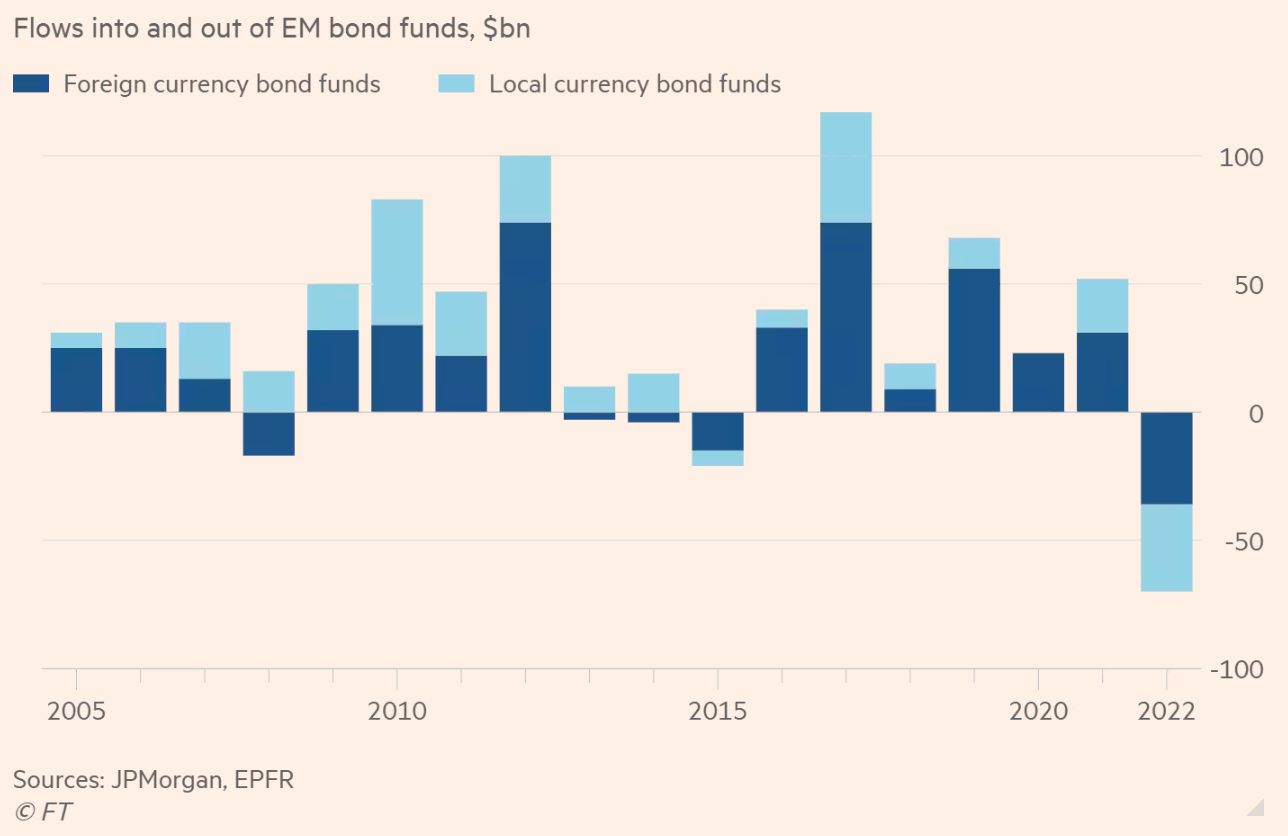
FT reports that bond investors have pulled out over $70 bn from EM bond funds this year, the highest ever.
The investor flight underscores how emerging markets are facing mounting risks from surging interest rates in developed markets, which make the typically high yields on EM debt look less attractive... Rather than weighing the relative risks of currency exposure, investors are simply getting out. It marks a sharp turnround: flows were positive into both types of bond funds for each of the previous six years, at a combined average of more than $50bn a year.
No matter how strong the domestic economic fundamentals, sudden stops and capital flights from developing countries to the safe haven of dollar assets are inevitable in times of global economic crisis. This cannot be avoided. The only way to mitigate its adverse effects is to limit exposure to the global financial markets in the first place to only what's required to manage macroeconomic balance. This is a cautionary note on capital account liberalisation.

Tuesday, January 31, 2017

The nuanced case for labor migration

It has taken Donald Trump and Brexit to make the intellectuals realise that unfettered trade is not desirable. In the aftermath of the global financial crisis, the IMF cautioned against unqualified capital account liberalisation. As I blogged earlier, the same realisation is also dawning on the adverse consequences of automation. Another area that is equally contentious is the impact of migration from developing countries on labor markets in developed economies.

There is a constant in all the four issues - Dani Rodrik. Even as intellectuals and the mainstream academia dug their heels in and refused to acknowledge mounting evidence on the first three, Rodrik was at the leading edge in urging caution. He has now become the mainstream in the first three areas. The fourth one is playing itself out, with the mainstream view downplaying the potentially adverse effects of migration. But there is little to feel that this is going to be any different.

His position on labor migration is articulated nicely in a new paper. The short answer is that significant migration will be bad for low-skill workers in developed economies, but less harmful than further trade liberalisation.

Rodrik puts the magnitude of the barrier to labor migration in perspective, drawing from the work of Clemens et al which documented "place premiums" of gains for migrants from different countries in moving to the US,
Assuming transport costs and cultural disamenities aside, a wage multiple of six for Pakistani workers implies that the ad-valorem equivalent of labor visa restrictions is around 500 percent. In other words, it is as if Pakistani workers were free to move but had to pay a 500 percent tax on their earnings once in the U.S. Contrast this to average U.S. tariffs on manufactured goods, which is about 3 percent, or the prevailing import barriers on sugar, which is the archetypal highly-protected industry with domestic prices exceeding world prices by 80 percent on average – and the asymmetry between freedom to trade in goods and the restrictiveness of trade in labor services becomes strikingly clear. 
Rodrik's case for easing labor restrictions is made in comparison to trade liberalisation. While acknowledging the adverse effect on low skilled labor, he makes the point that the impact in terms of redistribution of income from labor to capital (in developed countries) is likely to be far lower with easing migration restrictions than with trade liberalisation.
While there would likely be adverse effects on low-skill workers in the advanced economies, international labor mobility has some advantages compared to further liberalizing international trade in goods.
He uses a political cost (redistribution of income away from labor) benefit (efficiency gains) ratio is argue that given the very high barrier (a migration tax equivalent many times higher that import tariffs) to migration, the income redistribution needed to achieve a unit of efficiency gain is much smaller. At an intuitive level, while an imported good helps the importer capture all the gains in bulk, in case of a migrant labor, the production cost structure of the developed economy still applies when he produces something as a migrant. Thus the case for easing migration over trade liberalisation. 

Stripped off all empirics and stuff, this is insightful and applies to many other areas of debate on social policies,
Institutions are maintained either through solidarity (I care for you, so I am willing to share with you); social trust (I trust you, and know that you would do for me what I am doing for you), or enforcement (government coercion, requiring in turn legitimacy). All of these things are likely to be undermined by greater heterogeneity and inequality within countries – especially if the numbers involved are large.
So his proposal,
I have proposed elsewhere a temporary work visa scheme, administered bilaterally on the basis of specific home-country quotas. To maximize home country benefits and spread the gains around, the visas would be for a fixed period, say 3-5 years. They would not entail a path to citizenship, although guest workers would have the full protection of host country labor standard and regulations. A mix of sticks and carrots might be employed to ensure the bulk of workers do choose to return to their home countries when their visas run out. For example, a portion of guest workers’ pay may be docked in forced saving accounts, to be returned only upon repatriation. The quotas of home countries could be adjusted in relation to their success in attracting their workers back home. This would give home countries an incentive to provide repatriation inducements, just as they do with foreign capital or skilled expatriates.
I am inclined to agree. 

Tuesday, December 20, 2016

IMF's prudent assessment of globalisation

IMF continues the post-crisis revisionism of some of the central tenets of economic orthodoxy in its latest edition of F&D magazine. 

Sebastian Mallaby makes the most prudent assessment of globalisation and free trade. He decomposes cross-border capital flows and shows that cross-border lending has declined dramatically since 2007. 
To some extent—indeed, probably to quite a large extent—the retreat from cross-border lending represents a healthy correction... there has been a reappraisal of the case for cross-border finance. For one thing, some of its theoretical advantages appear to be just that: theoretical. In principle, financial globalization allows savers in rich countries to reap high returns in fast-growing emerging market economies, thus easing the rich-country challenge of paying for retirement. Meanwhile, it supplies foreign capital to emerging market economies, allowing them to invest more and thereby catch up faster with the rich world. But in reality, many large emerging markets have grown by mobilizing domestic savings, exporting capital rather than importing it. The textbook case for financial globalization exists mostly in textbooks.


If the upside of financial globalization has been elusive in practice, the downsides have grown more obvious. First, global capital tends to rush into small open economies during good times, aggravating the risk of overinvestment and bubbles; it flees in bad times, exacerbating recession. That has led middle-income nations to experiment with capital controls. Second, cross-border banking involves large, complex, and hard-to-regulate lenders, which poses risks to society that became evident during the 2008 bust. Because of those risks, regulators in the rich world have discouraged banks from foreign adventures, which has added materially to deglobalization. Forbes, Reinhardt, and Wieladek (2016) show that, in the case of Britain, regulatory discouragement of foreign lending can be remarkably powerful, accounting for about 30 percent of the attrition in cross-border lending by U.K. banks during 2012–13.
Although there is no denying that finance is less international than it used to be, it is debatable whether this retrenchment is best described as “deglobalization,” with its connotations of retreat, or as something more positive—“sounder global management.” After all, the new regulatory restrictions are at least partly a response to the risks of cross-border financing, which suggests a desirable level of flows considerably lower than the 9.9 percent of global output during 2002–04. If the optimal ratio were, say, around 5 percent, today’s degree of financial globalization might be just about right.
He argues that the apparent slowdown in global trade since 2008 may be due to statistical illusion (lower dollar price of commodities like oil), shifts in supply chains (China makes more intermediate goods itself instead of importing them), increased consumption of services as against manufactures as economies develop, and shrinking current account balances. To that extent, he finds that the decrease may not be something to be alarmed about. 

Maurice Obstfeld makes a long delayed case for having policies that redistribute the gains from trade to cushion those adversely affected. However, the focus on safety nets seems to be confined to developed countries, whereas one would argue that developing countries need them more. He also makes the distinction between safety nets (which protect those subject to job loss) and trampoline (which offer a springboard to new jobs, through trainings etc), and favours the former. 

But Paul Krugman is disappointing in his assessment. Two examples. The first is a benign assessment of international trade till eighties,
And for a long time—from the 1940s into the 1980s—trade liberalization proceeded remarkably smoothly. The losers from growing trade didn’t seem that obvious or numerous, largely because much of that growth took the form of intra-industry flows between similar countries, which had minimal effects on distribution.
I think the fundamental reason why there is a backlash against trade liberalization now is because the shoe (in terms of being at the receiving end of terms of trade) is on the feet of the developed economies. When unfettered free trade was critiqued in the eighties and nineties by those in developing countries as being detrimental to their economies and societies, the very same people used to mock the critics as marxists and socialists!

On the more prudent response to anti-globalisation sentiments, he writes,
The best attitude might well be to treat globalization as a more or less finished project, and turn down the volume on the whole subject.
Really! What about the third wave of globalisation, in terms of migration? 

Tuesday, August 9, 2016

The coming rush of capital inflows - this time will be no different

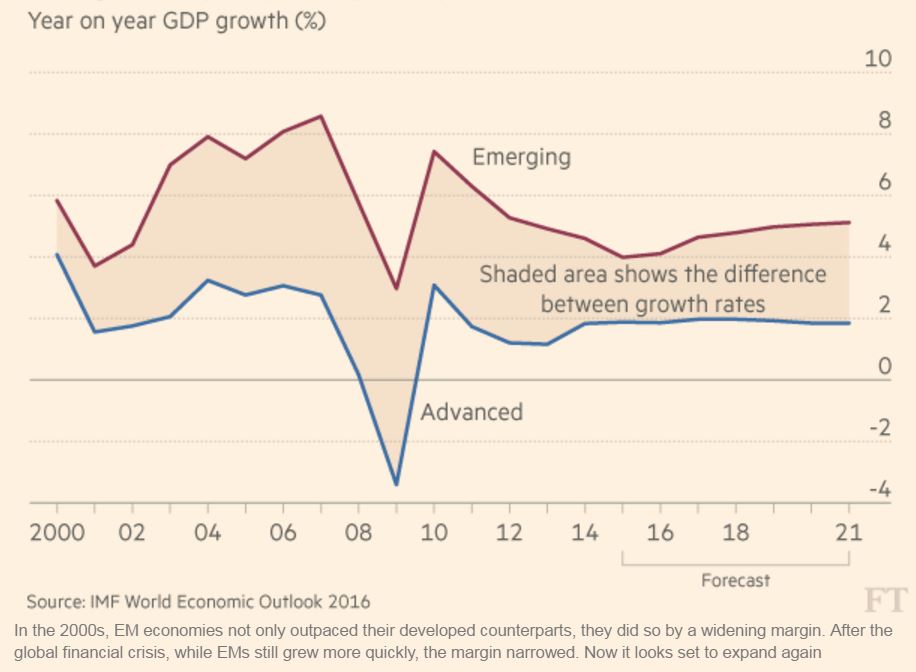
As investors scramble for yield in a negative rate environment in developed economies, emerging markets (EMs) are becoming the natural attraction. Institutional investors like BlackRock, the world's largest fund manager with $4.6 trillion in assets under management, who are struggling to give back the required 7-8% annual returns for US public pension funds, have become cheerleaders for EMs. The IMF estimates EM growth to increase every year for the next five years, even as developed economies stagnate.

This is a sudden reversal of fortunes for EMs. Consider this,
Until this year, nobody would have taken seriously the idea that emerging markets could make up the shortfall in economic growth. EM stocks spent much of 2015 in free fall, losing more than a third of their value from a peak in April to a trough in January 2016. Economic growth in these countries has been a serial disappointment. As the IMF figures show, aggregate GDP growth in emerging markets has fallen every year since 2010, while the developed world has spent the past three years in post-crisis recovery.
So, what's changed, and that too in such quick time? Nothing fundamentally,
Ruchir Sharma, head of EM equities and chief global strategist at Morgan Stanley Investment Management... says investors in emerging markets are less concerned about whether these economies are growing more quickly than those in the developed world. Rather what excites them is whether the differential between GDP growth in the two is actually increasing. “EM has been growing faster than DM for the past five years and yet EM has underperformed because the differential has been collapsing. This year the differential has stopped collapsing. It has stabilised"... 
He dismisses any suggestion that this heralds a return to the glory days of the 2000s, when emerging markets consistently outperformed those in the developed world by a wide margin and foreign capital flooded in. In 2007 — the peak of the boom for emerging markets — there were 60 economies in the world that were growing annually at a pace of more than 7 per cent, Mr Sharma notes. “Today, that number is down to eight or nine countries,” he says... During those boom years, China was the powerful driver of growth, sucking in exports from other emerging markets, especially commodity producers, to sustain a frantic pace of investment and urbanisation. This model has run its course and today... the effort required to make China’s economy “pop” each time is getting bigger and bigger. Before the global financial crisis, says Mr Sharma, China needed one dollar of credit to deliver one dollar of growth. Now the ratio is six to one. "They are finding it impossible to grow without increasing quantities of debt,” he says. “It is the kiss of debt.
This is a critical inflection point for EMs. In the months ahead, capital inflows into EMs as an investment destination will increase. The better performing ones like India are likely to get more inflows. Foreign capital borrowings will appear very cheap for their non-financial corporates. The stability of rupee is also likely to encourage these borrowers to go unhedged. As the tide rises, the domestic cheerleaders of foreign capital inflows are likely to up the ante, demanding further deregulation by removing withholding tax etc. Will the new Central Bank Governor resist the temptation and run the risk of being accused of hindering growth by depriving the country of ultra-cheap foreign capital? 

For an economy of its size, India has disproportionately lower exposure to global financial markets. That may be about to change. And for sure, it will bring benefits in its wake in the form of access to cheaper capital. But, the costs can be prohibitive. The risks are especially so given the small size and limited depth and breadth of the country's financial intermediation, the fragility of its regulatory institutions, the very poor general corporate governance standards, and a deeply populist political economy. And, the first exposure to such critical transitions will generally always leave excesses in its wake. 

It requires rare courage to cut through the illusions of being the "next big thing" and understand the dynamics of such capital inflows. As I've blogged earlier, such capital flows are dictated by the attraction or otherwise of EMs as a collective asset class. Among them, capital would show a greater preference for those which are more attractive at that point in time. So, given its current economic prospects, India is likely to be a beneficiary. But very little of these flows are motivated by long-term bets. Once the tide turns, as it must, sudden stops and flows reversals follow. Nothing, including sound macroeconomic fundamentals, can cushion against such reversals. Those swimming naked, with unhedged bets and excessive exposures, as there will be many corporates including from India, will get shown up. But by then, it would have been too late.

As recent IMF research has shown, capital controls are far more effective in managing inflows than outflows. There is little that can be done to limit the vulnerabilities from EM capital flow reversals after gorging massive volumes of foreign capital. Therefore, the central bank should exercise the greatest caution before any relaxation of restrictions on capital inflows, influenced by the availability of cheap global capital. 

Wednesday, June 1, 2016

IMF questions neo-liberalism

John Maynard Keynes said, "When facts change, I change my views. What do you do sir?" The latest adherent to this appears to be the IMF. In the ferment that followed the sub-prime crisis and which continues till date, the IMF has been the undisputed thought leader in revisiting many fundamental tenets of conventional wisdom in economics.

It has initiated debates on a higher inflation target, bigger fiscal deficit, some form of capital controls to stem flows volatility, and expressed concern at the distributional consequences of competitive policies and free trade.

The latest salvo comes in the form of an article in the latest edition of its F&D magazine which can only be construed as the formal obituary of the neo-liberal order, popularly embodied in the Washington Consensus. The two central tenets of this were competition, achieved through extensive deregulation and globalization, and shrinking the role of the state, through large-scale privatization and fiscal consolidation. The article questions two of the important elements of this policy push - elimination of capital controls (financial openness) and fiscal consolidation. Its findings are three-fold,
One, the benefits in terms of increased growth seem fairly difficult to establish when looking at a broad group of countries.­ Two, the costs in terms of increased inequality are prominent. Such costs epitomize the trade-off between the growth and equity effects of some aspects of the neoliberal agenda.­ Three, increased inequality in turn hurts the level and sustainability of growth. Even if growth is the sole or main purpose of the neoliberal agenda, advocates of that agenda still need to pay attention to the distributional effects.­
The headline finding on unrestricted capital flows is,
Some capital inflows, such as foreign direct investment—which may include a transfer of technology or human capital—do seem to boost long-term growth. But the impact of other flows—such as portfolio investment and banking and especially hot, or speculative, debt inflows—seem neither to boost growth nor allow the country to better share risks with its trading partners... Although growth benefits are uncertain, costs in terms of increased economic volatility and crisis frequency seem more evident. Since 1980, there have been about 150 episodes of surges in capital inflows in more than 50 emerging market economies... about 20 percent of the time, these episodes end in a financial crisis, and many of these crises are associated with large output declines  

And on fiscal consolidation is,
The need for consolidation in some countries does not mean all countries... Markets generally attach very low probabilities of a debt crisis to countries that have a strong record of being fiscally responsible. Such a track record gives them latitude to decide not to raise taxes or cut productive spending when the debt level is high. And for countries with a strong track record, the benefit of debt reduction, in terms of insurance against a future fiscal crisis, turns out to be remarkably small, even at very high levels of debt to GDP... The costs of the tax increases or expenditure cuts required to bring down the debt may be much larger than the reduced crisis risk engendered by the lower debt... Faced with a choice between living with the higher debt—allowing the debt ratio to decline organically through growth—or deliberately running budgetary surpluses to reduce the debt, governments with ample fiscal space will do better by living with the debt.

Austerity policies not only generate substantial welfare costs due to supply-side channels, they also hurt demand—and thus worsen employment and unemployment... in practice, episodes of fiscal consolidation have been followed, on average, by drops rather than by expansions in output. On average, a consolidation of 1 percent of GDP increases the long-term unemployment rate by 0.6 percentage point and raises by 1.5 percent within five years the Gini measure of income inequality.
It is impressive that IMF has been willing to revisit such holy cows, for very long the central tenets of its own policies, and widely and aggressively prescribed by the institution. 

Tuesday, August 11, 2015

Another orthodoxy falls - foreign exchange interventions may be effective

Olivier Blanchard has presided over arguably the most tumultuous period in the IMF's history. His tenure as Chief Economist has seen several dramatic reversals in the conservative institution's long-held positions. Even as he enters his last lap, the latest reversal comes from an acknowledgement that foreign exchange interventions may after all be useful.

Capital flows management has emerged as one of the biggest challenges facing emerging economies. As the evidence from recent events show, no country can insulate itself from cross-border capital flows volatility. Irrespective of their economic fundamentals, markets tend to lump all emerging economies into one category. And cross-border flows are characterized by episodes of massive capital inflows followed by sudden-stops. 

The orthodoxy on capital flows, long espoused and propagated by the IMF, has advocated capital account convertibility and floating exchange rates, and the futility of policies that seek to manage capital flows. In 2011, the edifice started to crumble with the acceptance that capital controls may be useful on occasions. Now, in a just released NBER working paper, Blanchard and two others go one further step to support foreign exchange interventions to manage currency volatility arising from capital flows. They write,
Many emerging market economies have relied on foreign exchange intervention (FXI) in response to gross capital inflows. In this paper, we study whether FXI has been an effective tool to dampen the effects of these inflows on the exchange rate. To deal with endogeneity issues, we look at the response of different countries to plausibly exogenous gross inflows, and explore the cross country variation of FXI and exchange rate responses. Consistent with the portfolio balance channel, we find that larger FXI leads to less exchange rate appreciation in response to gross inflows... The magnitude of the effect is relevant from a macroeconomic perspective, suggesting that FXI can be a valid policy tool for macroeconomic management.
Comparing the respective exchange rate performances of countries following floating exchange rate (floaters) and those intervening in forex markets (interveners) in response to exogenous shocks, they find,
The difference in FXI responses between the two groups is sizeable, close to 1 percent of quarterly GDP (0.25 percent of annual GDP) on impact. Interveners display a smaller appreciation of their currencies in response to the gross inflows. Specifically, we find a 1.5 percentage point differential in appreciation between interveners and floaters over the first 3-4 quarters. The differential fades afterwards. This difference is significant, both statistically and economically... Moreover, comparing the differential between the two groups of FXI and ER responses suggests a large effect of FXI: a quarterly annualized intervention of 1 percent of GDP (0.25 percent non annualized) leads to about 1.5 percent lower appreciation on impact. There is no evidence of a different interest rate behavior between the two groups, at least on average, suggesting that neither interveners nor floaters rely on the interest rate to ‘defend’ their exchange rates in response to exogenous capital flow shocks... Consistent with the predictions of the simple model presented earlier, gross capital inflows respond equally or more markedly in intervening countries, in comparison to floaters. Gross outflows increase for both groups, pointing to an offsetting role by domestic investors, but more in floaters.
They interpret the negative correlation between the sizes of FXI and gross capital outflows as being explained by causality running from FXI to outflows. Central banks indulge in sterilized foreign exchange market interventions, which limit exchange rate depreciation, and thereby contains capital outflows. 

Saturday, May 9, 2015

The four globalization trilemmas

Michael Bordo and Harold James have a paper where they explain the challenges of globalization, especially that arising from cross-border capital flows, facing countries in terms of four distinct policy constraints or trilemmas. They write,
The analysis of a policy trilemma was developed first as a diagnosis of exchange rate problems (the incompatibility of free capital flows with monetary policy autonomy and a fixed exchange rate regime); but the approach can be extended. The second trilemma we describe is the incompatibility between financial stability, capital mobility and fixed exchange rates. The third example extends the analysis to politics, and looks at the strains in reconciling democratic politics with monetary autonomy and capital movements. Finally we examine the security aspect and look at the interactions of democracy with capital flows and international order. The trilemmas in short depict the way that domestic monetary, financial, economic and political systems are interconnected with the international. They can be described as the impossible policy choices at the heart of globalization. Frequently, the trilemmas conjure up countervailing anti-globalization tendencies and trends.
Countries trade-off among these choices as they pursue their macroeconomic policies. Consider the case of India. It has adopted a regime of floating exchange rates, partial capital controls, and monetary policy autonomy, as its strategy to achieve financial market stability. As regards the political dimension, it is currently grappling with the tension between democratic politics and monetary autonomy of the central bank. The recent Union Budget even usurped some of the Central Bank's powers in managing cross-border capital flows. 

The last trilemma is the newest and assumes great significance in view of the challenges thrown up by the Global Financial Crisis. It is amply clear that global financial market stability requires close co-ordination among atleast all the major economies. The quantitative easing policies pursued in US, Europe, and Japan, motivated by domestic economic considerations, have generated large-scale negative externalities, especially by way of enhanced cross-border capital flows volatility, with considerable destabilizing effects. Developing countries, which faced the brunt of these effects, have expressed their concern at the absence of international co-ordination in the management of effects of such domestic policies. However, the achievement of such co-ordination to mitigate the externalities arising from cross-border flows would require trade-offs between democratic politics, both within countries and among nation states. 

This squares up with another framing of this conundrum outlined a few years back by Dani Rodrik. He argued that full democracy, national sovereignty and global economic integration may be incompatible. The major fault lines on this include the adverse impact of international trade on certain sections of the population. Faced with the pressure from their constituents, democratic governments have generally preferred to hold back on full economic integration.