Substack

Showing posts with label NREGA. Show all posts

Saturday, January 15, 2022

Weekend reading links

1. Simon Kuestenmacher points to the spread of Industrial Revolution (HT: Adam Tooze)
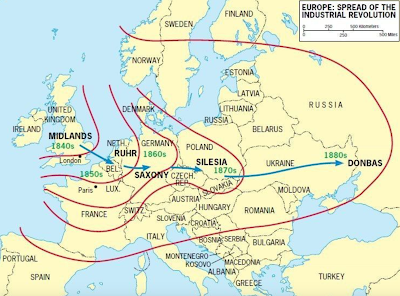

The twitter account here is excellent.

2. Tamal Bandopadhyay has a story on the super-charged growth at all costs strategy pursued by RBL Bank under its earlier leadership, which invited the attention of the regulator. 

If true, there may be parallels with Vishal Sikka at Infosys, in so far as the management styles and strategies of the two US executives came to be at odds with the more conservative Indian corporate and regulatory cultures and environments. 

3. Informative article about the challenges with privatisation of BPCL. The article points to the 2017 sale of a much smaller Essar Oil by Rosneft for $12.9 bn,
At its $11 billion-plus valuation, BPCL is a risky proposition especially if the government, under pressure from unions, places onerous terms on retrenchment or resale of certain assets and interferes in fixing petrol and diesel prices. BPCL trades at Rs 391. The government expects a much higher valuation factoring in a control premium of Rs 300-Rs 400 a share considering that Rosneft paid more for a less-endowed Essar Oil. That deal included a 400,000 barrels per day (b/d) modern refinery at Vadinar, a captive port and power plant, and 3,500 retail outlets. Compare that to BPCL, which operates 24 per cent of India’s 80,458 retail outlets, 23 per cent each of the 263 aviation fuel stations and of the 21.3 million tonnes of LPG bottling capacity, and a combined 550,000 b/d of refining capacity at Mumbai and Kochi. It also has petrochemical units, stakes in city gas distribution in India and a 10 per cent stake in a $20-billion Mozambique LNG project.

4. FT has a long read on the end of the Chinese lending spree in Africa,

From almost nothing, Chinese banks now make up about one-fifth of all lending to Africa, concentrated in a few strategic or resource-rich countries including Angola, Djibouti, Ethiopia, Kenya and Zambia. Annual lending peaked at a whopping $29.5bn in 2016, according to figures from the China-Africa Research Initiative at Johns Hopkins University, though it fell back in 2019 to a more modest, if still substantial, $7.6bn.

For all its claims of being the largest development finance lender in Africa, its official development aid (at least 25% grant component) share is smaller than that of all major western countries.

5. Striking facts about Kerala's internal migrants,

According to state planning board estimates, the state had 3-3.5 million migrant workers, though the actual number could be 4 million, around 12 per cent of Kerala’s total population. This could swell to 5.5 million by 2030. Other-state migrants now account for 26.3 per cent of Kerala’s total workforce; in districts such as Ernakulam, the share could be as high as 57 per cent. Of this number, close to 2 million are employed in construction, followed by manufacturing, agriculture and low-paid service sectors such as hotels and the retail trade. Based on another planning board study, these migrant workers in Kerala are estimated to be remitting Rs 750 crore annually from Kerala to their native states. It pegs the average monthly income per migrant at Rs 16,000, around Rs 3,500 less than their local counterparts.

Compared to Kerala's own external migrants,

According to the state government’s Norka (Non-resident Keralites Affairs) department, around 4 million people from the state live overseas, 1.3 million in other Indian states. Overseas Keralites account for around 20 per cent of India's remittances of $87 billion as of 2021 (World Bank estimates). Remittances constitute 35-40 per cent of Kerala’s Net State Domestic Product.

This is an important observation,

Benoy Peter, executive director of Centre for Migration and Inclusive Development, an NGO working among migrants says, “In terms of wages, though they earn less than locals, the informal sector workers in Kerala are getting the highest wages in the entire subcontinent... It is almost like West Asia for Keralites, the only difference is the majority of them are not properly educated.”

6. MGNREGA demand continues to far outstrip demand. The real requirement for next year may well be over Rs 1,50,000 Cr, far beyond the Rs 95000 Cr of this years revised allocation. 

7. Shankar Acharya writes about the contribution of the Kenyan Leakey family to the discovery of human origins in Africa,

By some estimates, the collective contribution of fossil discovery and analysis by the Leakey family cumulates to around half the total available fossil evidence relating to human evolution. There are several striking conclusions one can draw from the post-1940 work in this area. First, the origins of man (including various species of hominids) stretch back six million years or more. Second, because the fossil record is, in its nature, still quite fragmentary, our understanding of man’s origins is a work in progress despite the enormous advances of the last few decades. Third, the 300,000-year long history of Homo sapiens is actually a short time span compared to the longevity of various other species, including several lines of hominids. Fourth, it is noteworthy that in recent centuries, the explosive growth of the Homo sapiens population has come at the expense of thousands of other species. Last, and most worrying, sapiens has been the most deadly species not only for others but quite possibly for itself, as the cumulative consequences of its actions pave the way towards the Sixth Extinction.

8. Covid induced consumption shift and its knock-on effects on global trade volumes,

About 60 per cent of spending by a US consumer typically goes to goods and the rest to services, but that has risen to 65 per cent, according to Bernstein. As a result, US imports were up almost 20 per cent in September and October 2021 over the same months in 2019.

Freight shipping rates have rocketed during the pandemic,

The New York Fed has a new index for supply chain disruptions.

9. Excellent FT primer here on the natural gas crisis facing Europe. This graphic captures the sources of India's natural gas imports.

10. Fascinating article in NYT about how ordinary officials and people in China in general and Xi'an province in particular have helped the government impose the draconian lockdowns and other restrictions with great effectiveness during the pandemic. 

11. A South African government judicial investigation has found the consultancy Bain & Co a corporate enabler of graft in the country during the regime of Jacob Zuma. In a damning report, it documented how Bain colluded with Zuma and his cronies to weaken the South African Revenue Service (SARS) and crippling its ability to carry out investigations of tax evaders. It has accused Bain, which was hired as a consultant to advise SARS, of supporting President Zuma with "state capture" by corporate and other interests.  

Bain follows in the footsteps of McKinsey and KPMG who have all been accused or at least tacitly acknowledged guilt in colluding with the previous government to promote rent-seeking. Consider this,

Vittorio Massone, the firm’s former South African managing partner, forged a close relationship with Zuma, meeting him on average every six weeks between 2012 and 2014, according to the report. An event management company owned by a soap-opera producer close to Zuma became Bain’s second-highest paid local adviser around the world, the report said... Between 2012 and 2015, Bain laid plans “to restructure entire sectors of the South African economy” and centralise state procurement, the report said... “In cozying up to [Zuma], I think they [Bain] saw even more money to be made” and Massone was not a rogue actor... “In management consulting in particular, it is impossible to work in a vacuum. The [intellectual property] that Bain developed . . . Massone would have drawn on.”... Bain’s quest for influence even extended to Massone attending meetings to discuss the manifesto of the ruling African National Congress, according to the report. Yet beneath these grand ambitions, “across Africa Bain had no tax authority experience” and “knew that they did not have the necessary expertise”, the report said.

It's most certain that the entire Bain leadership in Boston knew about this. These smells spread quickly across any organisation. And they were culpable in condoning such practices in a distant African country with a promising market. 

More worryingly, it's certain that most of the people in Bain associated with this would have personally been party to some rent-seeking, either cash or in-kind. Does anyone speak about it? Massone, who had become the symbol of the Bain-Zuma partnership, was allowed a dignified exit from Bain. This served the purpose of sweeping things under the carpet and ensuring that others and the company itself does not get dragged any more into the mess. 

12. In some ways, it's good news that India lost to South Africa. The team's collective behaviour on the third day of the last test was despicable. A victory would have given them undeserved bragging rights as being the best Indian team ever, having won in Australia, England, and South Africa. 

As to those claims, it can be said that this team has perhaps the best bowling attack in the last thirty years (or ever), and the weakest batting line-up over the same period. The former has been aided by very weak batting line-ups across countries. The first 6-7 of Australia, England, New Zealand, Pakistan, and South Africa (and all others) are remarkably weak, perhaps the weakest uniformly in decades. 

It needs to be born in mind that India's biggest problem in the last two years has been its 3, 4, and 5 batters. All of the three average 25-28 in 15-20 tests. Pujara was critical in winning in Australia, whereas the other two, Kohli and Rahane, have been bystanders. 

Saturday, November 6, 2021

Weekend reading links

1. The late Ezra Vogel compares Xi Jinping and Deng Xiaoping. He points to the need to evaluate them in their respective contexts. 
Because of the changes introduced by Deng, Xi Jinping inherited a China that was far stronger than China during Deng’s era. Deng’s approach for dealing with foreign relations, ‘taoguang yanghui, juebu dangtou, yousuo zuowei’ (avoid the limelight, never take the lead, and try to accomplish something) was well-known. In the 1980s, Deng held back on increasing military expenditures in order first to build up an economic base. After 1995, the Chinese began to increase military expenditures even more rapidly than the economy was growing. Thus by the time that Xi Jiping came to power, since China had much greater economic and military power than during the period of Deng’s rule, he could take a much stronger stand in dealing with foreign countries.

His summary is apt,

To summarize my perspective as one views Xi from the perspective of Deng, I conclude that Xi could be considered a stronger leader than Deng in three senses. He ruled a stronger country that could take a stronger stance in dealing with other countries. Secondly, as a micro-manager, he personally exercised more direct personal control over daily activities. Thirdly, he spent more time and effort in controlling developments in local areas. But I would argue that in three areas Deng was a stronger leader. As one with such a broad background in so many areas, he had more personal knowledge and confidence in shaping broad overall policies. Secondly, as a person who had held so many high positions and had so many former subordinates, he could achieve more through macro-management because of his experience and the readiness of former subordinates to implement Deng’s policies. Thirdly, as one who had such broad experience and such broad perspective, he conceived and implemented changes that had far more impact on the course of China’s development and thus had a far greater role in shaping the course of China’s history.

2. Anna Weiner has a fascinating profile in The New Yorker of the polarising figure of Peter Thiel. This is interesting,

Dodge the rules, skirt the law, shiv your business partner, abandon your friends: Chafkin argues that the Silicon Valley edition of this playbook was written at PayPal.

3. One signature of the distress in the rural and informal sector is the persistently high demand for NREGA jobs. 

Data available on the MNREGS portal show that 2.07 crore households availed of the scheme in September — which was 3.In fact, the monthly figure for households availing of the MNREGS has been hovering over two crores since December last year. In the last 18 months, or since the pandemic hit, the numbers have been below the two-crore mark only thrice — in April 2020 (1.10 crore), October 2020 (1.99 crore) and November 2020 (1.84 crore). In pre-Covid times, the number of households availing of the MNREGS would cross two crores only in the months of May and June.85% higher than for the same month in 2020 (coming after the first wave and the severest restrictions of the pandemic), and as much as 72.30% higher than September 2019, the last non-Covid year. The monthly average figure for households availing of the MNREGS was 2.36 crore in the first half of the financial year 2021-22 — higher than the monthly average of 2.28 crore for the whole of 2020-21. In 2019-20, the figure stood at 1.56 crore.

On a different note, Business Standard reports of a new study which points to delays in timely payments of NREGA wages.

Wage payments were delayed for 71 per cent of the transactions beyond the mandated seven days, 44 per cent of the transactions beyond the mandated 15 days and 14 per cent of the transactions beyond the mandated 30 days. The study was conducted on about 1.8 million transactions between April 2021 and September 2021 by randomly sampling 10 percent of the Fund Transfer Orders (FTOs) from one block per district per state for 10 states... 

Normally, the MGNREGA payment process consists of 2 Stages. After work is completed, a Funds Transfer Order (FTO) with worker details is digitally sent to the Central Government by panchayat/block. This is called Stage 1 and it’s the state’s responsibility. The Central government then processes the FTOs and transfers wages directly to the workers’ accounts. This is called Stage 2 which is entirely the Central government’s responsibility. As per the Act’s guidelines, Stage 1 must be completed in 8 days and Stage 2 must be completed within 7 days after Stage 1. Workers are entitled to delay compensation for each day’s delay beyond 15 days.

4. Some graphics about India's telecoms market. Spectrum charges are among the highest in the world.

While data charges are the cheapest.

And average revenues per user remains woefully small.

It is believed that the industry can become sustainable only if the near-term monthly ARPU rises to about Rs 200. 

5. Vivek Kaul writes that India's covid recovery may be a case of glass half full. 

The total priority outstanding home loans of banks as of August 2021 had stood at ₹4.71 trillion. A year back, in August 2020, this stood at ₹4.73 trillion. This means that in the past one year, banks have largely funded non-priority sector home loans... Further, as of August 2021, the outstanding loans of banks against gold jewellery have gone up by a whopping 66% to ₹62,926 crore compared to August 2020. Between August 2019 and August 2021, these loans have gone up by 137%... A recent survey by the National Restaurant Association of India stated that around 25% of the restaurants across India may have shut down permanently during the last financial year. Around 230,000 jobs may have been impacted... As per the Centre for Monitoring Indian Economy (CMIE), the labour participation rate—the size of India’s labour force as a proportion of the population aged 15 years or above—stood at 37.88% in urban India in September this year. It was 40.48% in February 2020, before the start of the pandemic. When it comes to rural India it was at 42.08% in September and 43.67% in February 2020.

6. FT on Korean halyu,

In turns saccharine, brutal, and dazzlingly original, Korean content has since bulldozed its way into the global cultural consciousness. Girl group Blackpink has the most YouTube subscribers of any musical artist in the world, while boy band BTS has a following so organised and devoted that Chinese authorities have come to regard it with the kind of suspicion historically reserved for religious groups like Falun Gong. More recently, South Korea’s merciless social satires have conquered the heights of film and television respectively. Bong Joon Ho’s Oscar-winning Parasite and Netflix sensation Squid Game — the streaming service’s most-watched show ever — have given global exposure to traditional Korean preoccupations with economic precarity and social violence.

7. The airports, alongside national highways and ports, are a great example of successful infrastructure PPPs. Sample this,

The Airports Authority of In­dia (AAI) can make over Rs 650 crore annually as concession fee from the six brownfield airports that have been won by the Adanis... This is more than four tim­es the income that AAI made in 2019-20 from the same airports, at Rs 142.72 crore, by running them on their own... AAI has also earned Rs 29,300 crore in 13 years from the concessions of the greenfield Delhi and Mumbai airports under the private-public partnership (PPP) model. How­ever, in both these airports, the concession model was not based on bid per passenger as has been the case for new PPP airports but on a revenue-share model. So, while Delhi pays 45.99 per cent of its annual revenues, Mum­bai forks out 38.7 per cent. In contrast, the earnings (profit from operations) that AAI made from these airports when it was running them between 2001 and 2007 was collectively only Rs 3,000 crore. However, in just one year (2019-20), under the PPP model, AAI’s earnings from Delhi and Mumbai together was at Rs 3,052 crore. And, this of course does not include the increase in valuation of the 26 per cent equity that it holds in these two airports.
8. The arrest of former SBI Chairman, Pratip Chaudhuri, supposedly a very honest official, on very questionable and flimsy grounds is sure to exacerbate decision-paralysis within the banking sector. Most worryingly it goes to the heart of decision-making on NPAs in their valuation, transfers, and resolution. 

Consider this. An asset becomes NPA. It's taken up for resolution. The lender follows the due process and sells the asset to an ARC. The original promoters (the borrowers) question the transaction at DRT, NCLT, High Court, and Supreme Court. All were dismissed. Now the promoters press a fraud charge and get one Director of the ARC arrested without even issuing a summons! 

This raises the question of accountability. One cannot but help wondering whether the Chief Judicial Magistrate of Jaisalmer will be held accountable for this decision, and the damage it does. 

Two very good articles on the issue here and here. 

9. India's exports may hit the $400 bn mark.

Business Standard reports that the fact that it's significantly contributed by rise in exports of sugar, cotton, and iron ore means its sustainability is doubtful. 

10. The Federal Reserve finally announced the beginning of the long-awaited tapering of its massive $120 bn monthly bond purchase program. The FOMC announced that it will keep reducing its purchases of Treasuries by $10 bn a month and of agency mortgage backed securities by $5 bn every month. The process will start in mid-November and the stimulus will cease in June 2022. It also said it'll calibrate the taper based on changes in the economic outlook. It however said nothing about rate hikes, saying the economic bar for the was much higher. 
“It is time to taper, we think, because the economy has achieved substantial further progress toward our goals,” Powell said. “We don’t think it’s time yet to raise interest rates. There is still ground to cover to reach maximum employment, both in terms of employment and in terms of participation.”
In recent days, the Reserve Bank of Australia and the Bank of Canada have led the way in reversing monetary accommodation and raising rates. The Bank of England is expected to follow suit next week by raising rates for the first time since 2018. 

11. FT has a long read on the rise of green parties.
Green parties now have a share of power in six European coalition governments: Austria, Belgium, Sweden, Finland, Ireland and Luxembourg. They are on track for an even bigger prize in Germany, Europe’s largest economy, where they are in talks to form a three-way coalition government after winning 14.8 per cent of the vote in September’s election. That is more than double the 6.7 per cent of votes the Greens won in 1998, when they first entered a ruling coalition with Gerhard Schröder’s Social Democrats, in a move that made their leader, Joschka Fischer, foreign minister.

Green activism is heightened by the increasing trend of floods, droughts, and forest fires across the world. Scientists have shown that emissions must halve by 2030 and reach net zero by 2050 to limit global warming to 1.5 degree celsius, the safest temperature goal in the Paris agreement.

Crucially, scientists have shown that emissions must nearly halve by 2030 and reach net zero by 2050 to have a good chance of keeping global warming to 1.5C, the safest temperature goal in the Paris agreement. 

12. It hard not to feel that Mark Carney, as UN special envoy on climate and finance, is doing a great dis-service to the cause of climate change activism by leading the mother of all greenwashing with his claim that "we have all the money needed" to achieve net zero greenhouse gas emissions. He is leading $130 trillion of private sector assets, supported by more than 450 banks and Wall Street titans, committed to achieving net zero emissions by 2050 through the Glasgow Financial Alliance for Net Zero, or Gfanz.

13. In a brilliant article Simon Kuper points to a fascinating phenomenon - climate gentrification. 

The Little Haiti neighbourhood is barely five miles from glitzy Miami Beach, but it feels a world away. There’s no whiff of ocean here. Miami remains largely segregated and almost all the people sweating their way down Little Haiti’s streets are black... A new high-end development, Magic City, is arising on top of what used to be a mobile-home park. Hipster shops are opening: Scarab handmade cycles and Booktanica, a wine bar that sells books. House prices are shooting up. In 2012, according to Zillow, the average home in Little Haiti cost $99,600, just 38 per cent of Miami Beach. Today the price is $414,000, fractionally more than Miami Beach. Many new buyers in Little Haiti are investors using limited-liability corporations. They are betting on a future when this neighbourhood will benefit from a previously disregarded asset: its elevation. An average of seven feet above sea level, Little Haiti should outlive Miami Beach. If so, today’s poorer residents will be priced out. Miami is Ground Zero for a new phenomenon that will reshape the world’s coastal cities: climate gentrification...
Miami real estate agents used to ignore rising sea levels, then pretended the problem had been fixed by what look like waist-high garden walls. But lately Miami market thinking is shifting from “Location, location, location” to “Elevation, elevation, elevation”... What starts in Miami will go global. About 40 per cent of humanity lives within 100km of a coast, and many coastal cities share Miami’s social structure: rich neighbourhoods on the beach, poor ones inland. Think of Rio de Janeiro, Los Angeles or Cape Town. As seas rise, the most expensive places are at the highest risk. In Istanbul, for instance, the choicest coastal bits of the Kadiköy neighbourhood could go under.

Miami, built on porous limestone, is described as the world's most vulnerable major coastal city, and may be gone by 2100. 

14. Is Ethiopia going the Afghanistan way with the Tigray People's Liberation Front going to do a Taliban on the Oromo dominated government of President Abiy Ahmed? 

On the one-year anniversary of war between the federal government and the Tigray People’s Liberation Front, Tigrayan forces are intimating they could march on Addis Ababa, the capital, and eject Abiy from power. The TPLF, which ran the country for 27 years until 2018, is no Taliban, however brutally it governed and whatever its detractors say. But like the Taliban, banished from government and criminalised, it could now bludgeon its way back to power.

Ethiopia's recent history has been complicated,

Most of the regions into which Ethiopia is divided — including Tigray, Amhara and Oromia — regard themselves as nations with their own languages, cultures and competing versions of history. Transfer of control involves profound shifts in the balance of power between constituent nations of the “Ethiopian empire” and is rarely less than traumatic. Haile Selassie, who oversaw a feudal system, was deposed and later executed after a student-inspired, Marxist-led uprising in 1974. The regime that followed, the Derg, dismantled feudal land structures but imposed a “red terror” that culminated in man-made famine. After decades of perceived Amhara domination, it was a rebel army from Tigray that led the 1991 overthrow of the Derg. The TPLF, though it represented a region with only 6 per cent of Ethiopia’s population, held power until 2018. Abiy is from Oromia, the most populous region with more than one-third of Ethiopia’s population, but which has traditionally stayed on the margins of government. His election followed years of protests against Tigray’s outsized influence on politics. He promoted national unity. To some, that promised modern, ethnic-neutral democracy; to others, it spelt a return to the suppression of ethnic rights.

15. As inflationary pressures mount, on the back of rising energy prices comes the sharp rise in food prices. 

Global food prices have surged because of bad weather, such as droughts in North and South America and heavy rain in Europe, and the supply chain problems that came with the easing of coronavirus restrictions. The FAO food price index rose at an astonishing annual rate of 31 per cent in October. The IMF’s food and beverages commodity index rose at a similar rate. In real terms, after taking into account inflation, global food commodity prices are now higher than their 2008 and 2011 peaks, just before the Arab spring protests that were partly caused by soaring food costs.

16. Interesting snippet about how migration of high tariff consumers through open access and captive power plants is shrinking the cross-subsidy margin available for discoms, 

According to research by Prayas (Energy Group), with high tariff consumers beginning to move away, the share of cross-subsidy in discom tariff support (the other part being state subsidy) has declined from 29 per cent in 2017-18 to 23 per cent in 2018-19 — a decline of 6 percentage points in one year.

With the increased share of renewables, this trend will only hasten. And this is a stunning statistic,

As of March 2020, the net worth of all public sector distribution utilities in the country put together was a negative Rs 61,757 crore (though it was positive in states like Gujarat and Maharashtra). In comparison, the combined net worth of the few private sector discoms that exist in the country was a positive Rs 24,965 crore.

Saturday, September 12, 2020

Weekend reading links

1. John Thornhill points to this paper by Hendrik Bessembinder which questions the conventional wisdom on stock market returns,
While the overall US stock market has handily outperformed Treasury bills in the long run, most individual common stocks have not. Of the nearly 26,000 common stocks that have appeared on CRSP from 1926 to 2016, less than half generated a positive lifetime buy-and-hold return (inclusive of reinvested dividends) and only 42.6% have a lifetime buy-and-hold return greater than the one-month Treasury bill over the same time interval. The positive performance of the overall market is attributable to large returns generated by relatively few stocks... When stated in terms of lifetime dollar wealth creation to shareholders in aggregate, approximately one-third of 1% of the firms that issued common stocks contained in the CRSP database account for half of the net stock market gains, and slightly more than 4% of the firms account for all of the net stock market gains. The other 96% of firms that issued stock collectively matched one-month Treasury bill returns over their lifetimes.
Further, as Thornhill writes pointing to James Anderson of Baille Gifford,
All the excess returns in world markets since 1990 have come from just 1.3 per cent of companies.
2. It is reported that six out of the top 10 infrastructure companies in India are struggling on the back of high debt and persistent economic weakness.
3. Amidst all the hype around technology and cash transfers, the two saviours of India during the ongoing Pandemic have been good old food distribution and local public works in the form of Public Distribution System (PDS) and NREGS respectively.

As a counterfactual, if India had a UBI which either disbanded all other welfare programs or even marginalised them, we would have seen massive starvation deaths and hunger during the pandemic.

Since acknowledging their failures and learning from evidence is rare among development economists, it is no surprise that none of the UBI supporters have acknowledged this reality.

4. This is a very good article about mental health challenges in India in the context of Covid 19. One of the biggest failings so has been the near complete lack of efforts to de-stigmatise and reassure people about the disease. Surprising since one would think this would have been good politics.

5. The RBI's revisions to the priority sector lending guidelines have evoked some concern. The decision to include start-ups in PSL is superfluous,
It betrays a lack of understanding of how the start-up — and the venture finance — sector works. This is a sector in which the mortality rate is abnormally high. It needs to be funded by risk capital, not by banks. What processes can a bank put in place to lend to a sector where collateral is usually unavailable? In fact, bank debt would drag a start-up down and reduce the efficiency of the sector overall — and perhaps have the counter-productive effect of increasing the mortality rate.
We've had earlier policies too like tax exemptions for start-ups which too betrayed lack of knowledge about startups.

The other reform in the PSL guidelines is the attempt to deal with regional disparities,
The RBI has ranked districts depending on per capita priority sector credit, and to dis-incentivise priority sector lending to the better-performing districts. This will not just cause progress in the areas that are serving as engines of growth in the country to stall, but it will raise questions about federalism once again — almost every district in Tamil Nadu, for example, will see lending “dis-incentivised”. If the broader concern is that agricultural credit in particular is being taken up by larger borrowers in semi-urban areas, that is one thing. But if some areas, for example, are seeing a better performance by renewable energy or infrastructure or other priorities, then it is a bad idea to dis-incentivise them.
6. As the loans repayment moratorium ends, good analysis of the likely problems of the banking sector from Tamal Bandopadhyay. Shankar Acharya points to a painful road ahead, with medium-term growth projections in the 3-5% range.

7. As the GST compensation controversy boils, Thomas Issac, Finance Minister of Kerala, makes the case for states here. Indira Rajaraman makes the wise point that the centre should make a lumps transfer to states as a disaster relief grant. The Secretary Expenditure's interview here clarified several things.

8. This new study from Kenya about Covid 19 fatalities being far less than feared,
Policy makers in Africa need robust estimates of the current and future spread of SARS-CoV-2. Data suitable for this purpose are scant. We used national surveillance PCR test, serological survey and mobility data to develop and fit a county-specific transmission model for Kenya. We estimate that the SARS-CoV-2 pandemic peaked before the end of July 2020 in the major urban counties, with 34 - 41% of residents infected, and will peak elsewhere in the country within 2-3 months. Despite this penetration, reported severe cases and deaths are low. Our analysis suggests the COVID-19 disease burden in Kenya may be far less than initially feared. A similar scenario across sub-Saharan Africa would have implications for balancing the consequences of restrictions with those of COVID-19.
9. Two part data series in Mint about RBI and government relationship and on the impact of inflation targeting on growth. One graph in particular stood out for me, in the backdrop of claims that inflation targeting was responsible for taming inflation in India.
Inflation was on a low plateau well before the MPC was constituted. And the RBI appears to have systematically over-estimated inflation, thereby biasing it towards keeping the policy tighter than perhaps should have been the case.
Andy Mukherjee argues that the central bank kept interest rates higher than they should have been. There is simply no evidence to confidently claim that inflation targeting has worked in India or anywhere.

10. The pandemic has opened a window of opportunity for education technology firms. See this from India,
With the sector booming, investors have pumped in $795 million in the first half of 2020 compared with $108 million in the previous year, and the trend is set to continue. Over 50 new edtech companies were evaluated by Bengaluru-based Orios Venture alone over the past six months, and currently, there are 4,450 edtech companies in the country, according to DataLabs, a resource centre for start-ups.
It's difficult to believe that apart from bridging a gap due to school closures, and that among the small share of those who can afford this, this is unlikely to have any effect on learning outcomes. After all, the learning outcomes from regular classrooms was limited, and to expect online instruction, with all its problems, to deliver learning outcomes is a bit of stretch.

11. A partial explanation for the rise of stock market in India despite the economic problems,
The number of individual investor accounts rose 20 per cent from the start of the year to 24m in July, according to Indian securities depository CDSL, which tracks Asia’s fourth-biggest stock market by capitalisation after mainland China, Hong Kong and Japan.
12. Unintended consequences of agriculture market deregulation,
Off-market transactions between farmers and traders which are going unrecorded could be fueling food inflation as traders engage in speculation and hoarding, experts said... The sharp fall in crop arrivals was expected since trade inside regulated wholesale markets or agriculture produce market committees (APMCs) attract 2-5% taxes levied by states. In June, the Centre brought in a new set of ordinances which allowed tax-free trade outside mandis and free movement of produce across states. It also amended the Essential Commodities Act and removed stock limits on traders. It remains unclear whether farmers benefitted from this liberal trade regime in agriculture; but as higher volumes of trade shift outside mandis, the government is set to lose track of transactions between farmers and traders. All aspect of trade inside mandis—such as the price farmers are receiving for a particular grade of produce and quantities sold— are recorded, but there is currently no mechanism to record prices and trade volumes for transactions outside mandis.
13. Power sector balance sheet in the backdrop of a new scheme to reduce losses and improve discom health,
The new scheme proposes to release grants under the DDUGJY and IPDS, the funds for which have already been sanctioned, in proportion to the discoms achieving mutually agreed efficiency targets — a reduction in AT&C (aggregate technical and commercial) losses (a rubric that covers everything from power theft to the provision of mandated subsidised power) to 15 per cent and bringing the ratio of the average cost of supply and revenue realisation (ACS-ARR) to one —both to be achieved by 2024-25. But none of these targets was met under the UDAY scheme. For instance, AT&C losses under UDAY were to be brought down to 15 per cent (from 26 per cent in 2015) and the ACS-ARR ratio to one by 2020, the final year of the scheme. Today, AT&C losses stand at 23.9 per cent and the ACS-ARR ratio at 0.53. The cumulative losses of discoms in FY20 of Rs 18,000 crore remain a potent pointer to the failure to achieve meaningful efficiencies.
14. This article advocating consolidation of agriculture land holdings by the Secretary Rural Development, Government of India, is baffling. This is the rationale,
Given its benefit in terms of enabling more investment, reducing litigation, facilitating the setting up of new institutions and enterprises, the country must make consolidation an important part of development and factor reforms agenda.
For systems which has not even been able to undertake serious land reforms, struggles to identify tenant farmers, and even map and maintain land records, how is this, much more challenging task, going to be achieved?

15. Viral Acharya goes beyond regulatory capital and finds that the capital shortfalls of Indian banks may be in the range of $75 billion. He writes,
Since the global financial crisis, my colleagues and I have been estimating measures of capital shortfall of financial firms on a daily basis were such a stress scenario to materialise. We estimate downside exposure of a financial firm’s equity returns to aggregate stock market declines, using state-of-the-art econometric methods that capture the notion that volatility and correlations both rise during stress (“the risk that risk will change”). Next, using the knowledge of balance-sheet data on non-equity liabilities (retail and wholesale deposits, commercial paper, bonds, etc.), we assess which firms will have an equity capital shortfall under stress relative to a requirement of maintaining it at a minimum of 8 per cent of the balance sheet... The aggregate capital shortfall of the financial sector under stress is then the sum of the capital shortfalls for all deficient firms. The graph above plots this statistic for the Indian financial sector from September 5, 2006 to September 5, 2020; at present, the estimated capital shortfall is around $75 billion, relative to being virtually zero at the end of 2007.
Barring a few short-lived periods of improvement, the financial sector’s capital shortfall has remained at an elevated level during 2014-2020; it has simply not reverted to the healthy pre-GFC phase, i.e., the financial sector is not yet on a definite path of recovery. This stagnant phase coincides with the “silent crisis” in which credit growth for the economy has been anaemic due to zombie lending and lazy lending, notably by public sector banks (PSBs). The post-demonetisation boom-bust cycle of NBFC lending has only accentuated this problem. Digging into estimates for individual firms, the top 15 capital-deficient entities (out of the 45 entities we track) are all in the public sector (12 PSBs, two power finance companies, and one housing finance company), whose capital shortfall together constitutes more than 90 per cent of the aggregate shortfall. At the other end, the top 15 capital-surplus entities are all in the private sector; collectively, their capital surplus is greater than the deficiency of the rest of the system. This is consistent with their higher profit margins and market-to-book ratios, and persistently lower ratios of non-performing loans to assets. Interestingly, in spite of being surplus, these are the firms that have raised equity capital to guard against Covid-19-induced losses.
16. Sample this direct personal threat (HT: Ananth) by the Chinese Foreign Minister Wang Yi on the Czech Senate Speaker, Milos Vystrcil, who's currently leading a delegation to Taiwan,
“The Chinese government and Chinese people won’t take a laissez-faire attitude or sit idly by, and will make him (Vystrcil) pay a heavy price for his short-sighted behaviour and political opportunism."
Such undignified "wolf warrior" rattles on an insignificant official, and that too by the Foreign Minister, is one reason why China is not going to win too many friends as it rises.

17. The news around Reliance Industries points to the reality of foreign firms throwing in the towel in trying to break into the Indian market on their own. This is also a good example of how national policy has unwittingly or otherwise helps a conglomerate. However, it goes to the credit of Mukesh Ambani that it has completely capitalised on all the opportunities that have opened up. The appetite to assume massive risks and such extraordinary ambitions are not for even the largest businesses. 

It has also helped that by both design and chance, the company has accumulated over time the critical  ingredients of brick and mortar warehousing and retail footprints and last mile optical fibre network. The opportunity that this combination presents is not available for anyone else, and also if Reliance then decides to exhibit the ambition and business nous to capitalise on these assets, then it's also impossible for any competitor to take them on. Add in India's regulatory environment and political connectedness, and the die is cast. 

This about how foreign tech companies, all behemoths globally, may have realised that it is better to piggyback on Reliance. This about how two $2 per customer revenue businesses (ARPU from digital and revenue per square feet per day from retail footprint) form the backbone of Reliance's business model. This about the financial engineering behind the stake sales.

In fact, the Reliance stock rise has created problems in even the mutual funds industry,
The run up has increased the company’s weighting in the S&P BSE Sensex to 17.4 per cent, from 11 per cent at the end of 2019. Money managers have hit a regulatory wall because of the surge. They can’t buy more of India’s most valuable company as actively-run plans aren’t allowed to own more than 10 per cent of a single stock. This means funds can’t add rising stocks, such as Reliance, and therefore risk trailing the market.
18. Finally, a fascinating briefing in the Economist on the impact of Covid 19 on future of the work place. This about how much inertia dictates prevailing practices and how mutations like Covid can be useful,
Before covid-19 the world may have been stuck in a “bad equilibrium” in which home-work was less prevalent than it should have been. The pandemic represents an enormous shock which is putting the world into a new, better equilibrium. Brent Neiman of the University of Chicago suggests three factors which prevented the growth of home-working before now. The first relates to information. Bosses simply did not know whether clustering in an office was essential or not. The past six months have let them find out. The second relates to co-ordination: it may have been difficult for a single firm unilaterally to move to home-working, perhaps because its suppliers or clients would have found it strange. The pandemic, however, forced all firms who could do so to shift to home-working all at once. Amid this mass migration, people were less likely to look askance at companies which did so.
The third factor is to do with investment. The large fixed costs associated with moving from office- to home-based work may have dissuaded firms from trying it out. Evidence from surveys suggests that firms have in recent months spent big on equipment such as laptops to enable staff to work from home; this is one reason why global trade has held up better than expected since the pandemic began. Such investments are made at the household level too. In many rich countries the market for single-family houses is stronger than for apartments. This suggests that people are looking for extra space, possibly for a dedicated home office.
And this about how many of entrenched narratives may be false, 
... a study in 2017 by Matthew Claudel of the Massachusetts Institute of Technology (MIT) and his colleagues. Their study looked at papers and patents produced by MIT researchers and the geographical distribution of those researchers. In doing so, they found a positive relationship between proximity and collaboration. But when they looked at the buildings of MIT, they found little statistical evidence for the hypothesis that “centrally positioned, densely populated and multi-disciplinary spaces would be active hotspots of collaboration”. In other words, proximity can help people come up with new ideas, but they do not necessarily need to be in an office to do so... Not much evidence exists that serendipity is useful for innovation, even though it is accepted by many as a self-evident truth. “A lot of people made a lot of money selling this watercooler idea,” says Mr Claudel of MIT, referring to the growth in recent decades of open-plan offices, co-working spaces and trendy “innovation districts”.

Saturday, June 6, 2020

The resilience and efficiency trade-off in public policy

I blogged yesterday about the pursuit of efficiency in modern economic systems which has marginalised all other factors. But John Mauldin points out, Covid 19 has highlighted the importance of resilience as an equally important decision-making factor in public and private sectors,
“Resiliency” is suddenly a buzz word. We are seeing how ultra-optimized global supply chains are actually quite fragile when unexpected events occur. We pushed too far in trying to save the last penny. Now we’ll have to not just rebuild, but rebuild differently, and it’s the opposite of everything known to generations of engineers and consultants.
In recent decades, efficiency had come to occupy the primary factor in corporate decision-making, marginalising other considerations. But Covid 19 has exposed the limitations of this primacy of the pursuit of efficiency. Two earlier posts here and here in the context of internet companies pointed to how the relentless quest for efficiency to the exclusion of all else has exposed Amazon when faced with Covid 19.

Sample this from a recent article in The Economist that highlighted the importance of resilience with manufacturing supply chains which are now excessively concentrated on China,
That companies have been aflurry over their supply chains is not in doubt. From January to May supply-chain disruption was mentioned nearly 30,000 times in the earnings calls of the world’s 2,000 biggest listed firms, up from 23,000 in the same period last year. Mentions of “efficiency” declined from 8,100 to 6,700. Managers know that supply chains are good conduits of economic pain.
The fetish with efficiency is confined not just to businesses. Never mind its realisation being questionable, efficiency has emerged as a pre-eminent consideration in public policy.

The Thatcher-Reagan ideological turn of the eighties mainstreamed the New Public Management approach of using private sector practices in managing the public sector. A central feature of this approach was the elevation of efficiency as the primary consideration in public management over all other factors like fairness, equity, safety, workers rights, inclusiveness, access barriers, and, not to speak of, resilience. A complementary factor which assumed great significance was that of harmonisation or standardisation. 

Take the example of cash transfers or UBI and the contrast with in-kind transfers like food grains through India's public distribution system (PDS). The former is efficient and easy to administer. The latter is inefficient, prone to leakages, and challenging to administer.

But the Covid 19 has been a very good wake up call on the importance of other factors that must determine public policy on issues like food security in a continental sized country with recurrent episodes of natural and man-made disasters and vast numbers of ultra-poor. Sample this from a Dalberg Survey,
BPL Households that report they could access and use their respective benefits easily: Ration: 46%: Cash: 25%, Buying supplies: 41%. BPL Households that report difficulties: Ration: 17%: Cash: 36%, Buying supplies: 58%... 55% of households with BPL/AAY cards received free rations; 28% of households with JDY account received the Rs 500 cash transfer.
A Yale University study finds that 53% of poor women (below $2.50 per capita PPP per day) (176 million) did not have JDY account, and 21% (70 million) lacked even a ration card. It writes,
In order to reach the most vulnerable, universal distribution of food rations through systems such as PDS shops and community kitchens could be expanded in all states with the release of additional grain. 
A Chicago University study points to dire statistics and writes,
These figures suggest that the rapid distribution of in-kind or cash transfers is needed to prevent a sharp increase in malnutrition and severe deprivation. Such transfers will also likely promote a more robust recovery as the country is able to reopen. 
An LSE blog had this to say,
In India’s current crisis, the Public Distribution System (PDS) – the programme of distribution of subsidised goods that constitute the main food security net in the country – is of fundamental importance for the poor households that access it. Still operational during lockdown, the PDS ration shops will supply essential food items to households that, while already in poverty, will be bearing the severe economic impact of lockdown. The PDS provides subsidised goods to below-poverty-line (BPL) households throughout the country, as well as those classified as Antiyodaya Anna Yojana (AAY) – the poorest of the poor – who access enhanced rations. In the serious economic downturn of the lockdown, it is key that the national food security network works at its best capacity... The ongoing crisis requires a reshuffling of priorities: with the lockdown and its serious impact on the poor, the PDS has become an even more fundamental resource for subsistence.
It is safe to say that without the PDS, India would have witnessed starvation deaths now. Quite apart from citizens accessing the food grain benefits, local governments would have struggled to operate community kitchens. See this on PDS and NREGS.

A similar comparison exists between digital money and physical cash, and the unqualified embrace of  the former. It is important to keep in mind factors like exclusions and access barriers that bedevil digital money channels, a problem which people like Jean Dreze have demonstrated repeatedly over the years.
What about the respective reliability of NREGA and JDY payments? There have been significant issues (e.g. delayed, rejected, blocked or diverted payments) with NREGA payments, often related to Aadhaar. But then, numerous “direct benefit transfer” schemes (social security pensions, scholarships, maternity benefits, among others) have faced similar problems, also reflected in official transaction data. Both the Aadhaar Payment Bridge System(APBS) and the Aadhaar-enabled Payment system (AePS) are shot through with technical glitches, possibly exacerbated by the recent surge in transactions, and especially unkind to the powerless. Transfers to women’s JDY accounts are unlikely to be more reliable than transfers to job-card holders. 
In fact, as far as effective payment is concerned, there is a further argument in favour of the NREGA job-cards list: unlike JDY accounts, it lends itself to the “cash-in-hand” method (on-the-spot payment in cash, instead of bank payments) as a possible fallback. The reason is that the job-cards list is a transparent, recursive household list with village and gram panchayat identifiers, while the list of JDY accounts is an opaque list of individual bank accounts. Cash-in-hand may seem like the antithesis of JAM, but this option may become important in the near future if the banking system comes under further stress.
I blogged here highlighting the limitations of digital technologies in addressing problems of financial inclusion and targeting of social program beneficiaries.

Much the same logic applies to the debate on privatisation of services compared to public provisioning. Again the underlying theme is simple - efficiency over all other factors - and like with cash transfers, Covid 19 has exposed the limitations of the private sector focused approach.

In the context of shortages of PPE like face masks, Gillian Tett mused the unthinkable,
... a much bigger question for a country such as the US: how far should it rely on the free market to supply basic goods? And how far should it tolerate (or encourage) state intervention in a time of crisis?

... When coronavirus hit, America was tragically ill-prepared... at the start of the pandemic, the Department of Health and Human Services only had 42 million masks in its stockpile, of which 30 million were medical masks and a mere 12 million were the prized N95. That was a scant 1 per cent of what the department itself calculated would be needed in a bad pandemic. Worse still, it did not have any way to quickly produce more, since about 80 per cent of mask production has occurred in China in recent years and key materials in the supply chain, such as the gauze inside N95 masks, are made in countries such as Germany. All this has created a massive gap in the market. The result has been a wave of price gouging and quasi-piracy as institutions have scrambled to get hold of scarce supplies. That has left countless front-line workers dying needlessly because they have lacked proper PPE.
The Covid 19 pandemic has once again highlighted the importance of public systems.

A strong bipartisan consensus has emerged in the US around active industrial policy, especially to combat the threat from China,
And yet, with a wary eye on China and public nervousness about stretched global and domestic supply chains for food and medical products, Republicans are starting to join Democrats in advocating for a stronger government hand in directing America’s industrial resources. Republicans who just a few years ago regularly scorned any idea of Big Government’s intervening in business and picking “winners and losers” are now happily calling for a national strategy to identify key sectors to protect and promote. In both Congress and the White House they’re discussing tax incentives and other ways to spur businesses to bring manufacturing home from China. Progressives, centrists, and right-wing economic nationalists alike are threatening government strictures on a corporate America that’s spent decades building sprawling “just in time” supply chains around the world in the name of economic efficiency and expansion into new markets.
Closer home in India, take the example of private health care. An editorial in Indian Express highlighted the private sector's abdication of their role in the fight against the pandemic,
Private enterprise owns almost three out of every four hospital beds in India, and almost eight out of 10 ventilators, but they are handling less that 10 per cent of those critically ill with novel coronavirus. States like Bihar, where private capital owns about twice as many beds as government hospitals, have seen the private sector in complete rout. The reluctance to engage is so great that they have been turning away coronavirus patients and other patients in need of aid. In Delhi and Maharashtra, the state government has had to issue orders so that they do not turn any more away.
As a series of reports in this newspaper showed, numerous factors have been at play in this failure — pay cuts, employee reluctance, the fear of sealing, the future consequences to brand value of hospitals identified with the pandemic, the lack of established protocols and protective gear, and bureaucratic instructions, like those issued in Telangana, to refer viral patients to government facilities. Underlying all this is the economic reality of falling revenues and footfalls, accompanied by new expenses and risk. While the central and state governments should offer to underwrite the risk, the fact remains that a sector which has benefited hugely from government concessions and encouragements, and which has tried to take over healthcare in India, has abdicated its public responsibility and remains isolated from the national effort.
Instead, much neglected public health functionaries like ANMs, community health workers like ASHAs have been the saviours. Sample this,
The nearly 26,000 ASHAs across the state have... become the eyes and ears of the government on the ground, constantly flitting through their jurisdictional areas like a detective, scouring for people with infections and keeping a stern vigil on their quarantine. If someone coughs or sneezes, hers is the phone that rings first. If someone entered the ward after travelling from another district, she would be the first to know... Kerala’s health department is essentially banking on such interpersonal connections between ASHAs and the communities around them to help cast its surveillance net and keep close track of those who can potentially get infected with the coronavirus.
Similarly critical have been the roles of panchayat and local government institutions in combating the pandemic. In fact, as P Sainath says, several foot soldiers of the economy in general,
We have always had one standard for the poor, and one for others. Even though, when you list essential services, you are finding out that it is only the poor people who are essential, apart from doctors. Many of the nurses are not well-off. Besides them, there are sanitation workers, ASHA workers, aanganwadi workers, electricity workers, power sector workers, and factory workers. Suddenly you are finding how inessential the elite are to this country. 
The large scale transportation of internal migrants and Indians stranded abroad would not have been possible without Indian Railways and Air India. This is not to argue against private participation in these sectors nor even their privatisation. It is only to point out that these factors need to be kept in consideration alongside efficiency when we debate issues like privatisation in the context of a country like India.  

In the UK, it will turn out to be one of the biggest ironies that the Prime Minister who began his term with the intention of squeezing the NHS further will now end up being the leader who started the revival of NHS.

Update 1 (30.06.2020)

The impact of NREGA,
Person days of jobs provided under MGNREGA had reached an all-time high of 568 million in May 2020. This was 54 per cent higher than the level of May 2019. Data for June 2020 accessed on June 29 from the official site of the scheme at 348 million was 66 per cent higher than it was for the month exactly a week ago. This either implies a sharp increase during the week or substantial revisions for the month. Either ways it implies a continued increase in MGNREGA spending into June. Person days of jobs in June 2020 were already 8.4 per cent higher than they were a year ago. Kharif sowing till June 26 was more than twice it was a year ago. There is no overlap between MGNREGA work and sowing work. The two together therefore have evidently powered the rural employment surge in June.
Update 2 (03.09.2020)

Around 24.2 million households have demanded work under the scheme in August 2020 as per MGNREGA website accessed on September 2 which is a staggering 66 per cent more than the same month in 2019 and the highest in last seven years for August.
Update 3 (06.09.2020)

Sunita Narain writes on NREGA,
In these darkest days of Covid-19 — when jobs and economies have collapsed — 56 million households got work in the past three months and these jobs provided relief. This was under the Mahatma Gandhi National Rural Employment Guarantee Act (MGNREGA), which perhaps is the largest social net scheme in the world. Down To Earth reporters, who travelled to different regions of the country, found there was a surge in employment and in many places, the most skilled and educated turned to this programme. It effectively put a floor to poverty — people got jobs, though unskilled and manual — but the jobs gave them money, albeit only a daily wage, and the money provided them the ability to buy food to feed their families... Between April and August, when Covid-19 had driven economies to the ground, under the MGNREGA 15.5 million individual works were done. This included everything — from making cattle-sheds and farm ponds to even fencing on lands. Poor people improved their ability to secure their futures and they were paid for this labour — which, in turn, gave them that critical safety net.
Update 4 (12.09.2020)

Good article on how NREGS and PDS saved India from hunger and starvation during the pandemic. More stats on the demand for the NREGS,
From April to August, over 83 lakh additional households or 1.6 crore persons joined the NREGA labour force by getting job cards, taking the number of families under the scheme to an all-time high of 14.36 crore... Data show 5.79 crore households availed NREGS between April 1 and September 10 during the current financial year — the highest since the scheme was launched on February 2, 2006.
And this on how PDS performed. 

Saturday, May 30, 2020

Weekend reading links

1. China is using the Covid 19 pandemic to push through a legislation that would allow it to establish national security institutions. The legislation, which would by-pass Hong Kong's Legislative Council and be an annex to the Basic Law, the city state's constitution. It would allow the government to target people indulging in "splitting the country, subverting state power" etc.

A similar attempt in 2003 to insert a new national security law, Article 23, was shelved after massive pro-democracy protests.

2. Pakistan has awarded the first phase of the construction of the Diamer Bhasha dam project in Gilgit-Baltistan in occupied Kashmir to a joint venture between Power Construction Corporation of China and Pakistan Army's Frontier Works Organisation. The total project, estimated to now cost between $8.77-14 bn, will be funded from Chinese loans drawn from the China-Pakistan Economic Corridor (CPEC). The project is estimated to finally generate 4.5 GW of power and store 8.1 million acre feet of water.

3. The NAR reports of threats from China to retaliate against US actions on Huawei,
"Based on what I know, if the U.S. further blocks key technology supply to Huawei, China will activate the 'unreliable entity list', restrict or investigate U.S. companies such as Qualcomm, Cisco and Apple, and suspend the purchase of Boeing airplanes," said Hu Xijin, editor-in-chief at the Chinese Communist Party-affiliated Global Times, which published such a report Friday... After U.S. intentions to double down on its Huawei ban had become known in March, Huawei's rotating chairman Eric Xu said he does not think "the Chinese government would sit and watch Huawei be slaughtered" and warned of rippling ramifications if Washington went ahead with such a move.
This would effectively trigger the start of a tit-for-tat round of actions, whose end-game can be very unpredictable.

For a start, such retaliation will almost certainly force President Trump, facing an election, into even greater belligerence. And in the short and even medium-run the costs to China can be prohibitive. Besides, it would further entrench the new Cold War mentality in the US as a bipartisan consensus.

4. The China diversification game is easier said than done. Even as President Trump is urging US companies to diversify away from China, Apple appears to be yoking itself even deeper into China. In what is being seen as an attempt to diversify its supply-chain dependence on Taiwan's Foxconn, Apple has been propping up a fast growing Chinese competitor, Luxshare ICT.
Apple has advised one of its Chinese AirPods assemblers to make a major investment in an iPhone and MacBook metal casing provider, a move the California tech titan hopes will create a formidable alternative to another of its longtime suppliers, Taiwan's Foxconn. Luxshare-ICT, a fast-rising Chinese tech company known for its aggressive growth strategy, has been in talks with Catcher Technology, the world's second-largest metal casing provider, for more than a year and has recently entered a deeper round of negotiations... The deal, if realized, would give Luxshare the ability to produce high-quality metal casing as well as access to smartphone assembly know-how, which would take it a step closer to becoming the Chinese version of Foxconn -- a single company with operations that span nearly the entire electronics supply chain. Such a move could ultimately help Luxshare grab a share of iPhone production, which ships around 200 million units each year. Foxconn, the world's largest contract electronics manufacturer, has long been Apple's biggest supplier, accounting for more than 50% of iPhone production since the device's debut in 2007. 
5. Graphic details of Chinese encroachments into Indian territory gradually over the years by Phunchok Stobdan. This article by Sekhar Gupta has a nice description of the Chinese strategy on the border. 
Everything, from 1962 to Doklam, fits a pattern: Deliver a message, add leverage, and return. All the stand-offs after that, including recent ones such as Chumar, Depsang Plains, and Doklam, have ended the same way. The message is, see, who’s the boss out here.
6. Saudi Arabia's $325 bn SWF, Public Investment Fund (PIF) is on a bargain hunting spree to invest in the assets distressed by the pandemic.

This is even as the country is facing a fiscal crunch from low oil prices, which has forced deep cuts in government spending, new debts, painful austerity measures and a tripling of VAT to 15%.

7. How quickly food tastes change, from the US yogurt market,
Greek yogurt occupied 1 percent of the yogurt market in 2007; that jumped to 44 percent by 2013.
8. The Economist has a profile of Princeton economist Leonard Wantchekon,
In 2014 Mr Wantchekon founded the African School of Economics in Abomey-Calavi, Benin. Its aim is to offer African students the highest standards of mathematics and economics teaching, ensuring they can compete with graduates overseas. It is refreshingly drab, with no splurging on a flashy campus or needless technology. The 100 or so students pay $2,400 per year, about the same as at a public university. “This is not about doing something grandiose,” says Mr Wantchekon. It is a model that can be replicated. Another campus was opened this year in Ivory Coast. The school draws on several influences. The name nods to the London School of Economics. Princeton is one of more than a dozen “academic partners”.
This is a mighty impressive achievement. The School has campuses in Benin and Cote d'Ivoire.

This is a good example of what reputed academic researchers based in US universities can do for their native countries - promoting academic pursuits there, instead of just using them as platforms to promote their professional careers. 

9. Has Covid 19 ushered in the return of the permit raj in India? The number of notifications and guidelines issued by the central and state governments in India is 4890 and counting. Naushad Forbes has a good listing of the new regime faced by his company here.

10. Good chronicle of a migrant student's misery in a journey from Ahmedabad to Warangal on the Shramik Special train. Sensitivity is not a trait that Indian state shows even in best of times. For sure, there are reasons. But the reality cannot be denied.

11. The Economist has a fascinating article on overseas Chinese diaspora billionaires. 
According to The Economist’s analysis of data from Forbes magazine, last year more than three-quarters of $369bn in South-East Asian billionaire wealth was controlled by huaren (a Mandarin term for “overseas Chinese” who are citizens of other countries). A lot resides in Singapore, a rich majority-huaren city-state. But plenty is spread from Indochina and Indonesia to the Philippines. Malaysia’s Robert Kuok oversees an empire that spans everything from sugar to Shangri-La hotels. In Indonesia Lippo Group, owned by the Riady family, is active in banking, property and health care. On last year’s list 15 of 17 Filipino billionaires were ethnic Chinese; SM Group, run by the Sy clan, has high-end malls across China. Myanmar is too poor for billion-dollar fortunes, but many of its leading businessmen are Chinese-Burmese, like Serge Pun of Yoma, a property-to-banking concern, or Aik Htun of Shwe Taung Group, with interests in infrastructure and real estate...
Although Chinese settlers first arrived in South-East Asia in the 15th century, many founders of today’s top huaren business dynasties fled south to escape poverty and violence in the early 1900s. Most assimilated culturally and, like Chia, took local names. They prospered first as traders, then in some cases by cosying up to power. Liem Sioe Liong of Salim Group, a noodles-to-finance conglomerate, enjoyed famously close ties with Suharto, Indonesia’s dictator from 1967 to 1998, picking up lucrative monopolies and licences in areas from flour-milling to clove imports. Around the region such links helped the tycoons build vast, vertically integrated groups as Asia boomed in the 1990s. Together these constituted what has sometimes been described as a “bamboo network” of firms with Chinese roots, united by Confucian values of diligence and thrift. Trading and feuding with one another in turn, their bosses ended up dominating industries from farming to finance.
And as with everything that has a Chinese connection, there is plenty to be concerned about,
The Overseas Chinese Affairs Office was recently folded into the Communist Party’s shadowy United Front propaganda division. Many suspect that Mr Xi Jinping wants to muddy the distinction between huaren and huaqiao (Chinese nationals living abroad). Some huaren business leaders are handed roles on Chinese state bodies, such as the Chinese People’s Political Consultative Conference, a talking shop. Politicians in South-East Asia worry in private about “influence operations” from Beijing.
12. Jean Dreze argues in favour of a dramatic expansion of the NREGS and making it a true demand-driven program,
This situation calls for large-scale opening of NREGA works on a proactive basis. Every village needs at least one major worksite, where a good number of people can work at short notice (with adequate distancing precautions). Ideally, workers should be allowed to enrol at the worksite... Much can be done to facilitate this: expanding the list of permissible works, hiring more gram rozgar sevaks (employment assistants), simplifying the implementation process, mobilising para-teachers for work application drives, and so on. And of course, top-down orders to expand the scale of works could work wonders... It is also worth considering a return to cash payment of NREGA wages, at least as an option for the duration of the crisis. This would not only help to ensure timely and reliable payment of wages, but also spare workers the ordeal of extracting their wages from overcrowded banks or business correspondents. Further, cash payment of wages would act as a tremendous incentive for rural workers to demand NREGA work, whatever it takes. 
13. Business Standard has an article examining the case for private prisons. This is an area where the tide has already turned in countries ranging from US, UK, Australia etc, as stories of problems with prison privatisation mount. An editorial in the Financial Times, no less, threw in the towel on privatised prisons last year. Another example of how trends which have played itself out and become discredited in developed economies continue to enjoy credibility among commentators in India (developing countries).

14. Finally, there is growing evidence of Indian lenders becoming over-cautious due to the mounting Covid 19 distress and turning away borrowers.