Substack

Showing posts with label Airline industry. Show all posts

Saturday, December 13, 2025

Weekend reading links

The Saudi Crown Prince Mohammed bin Salman, for example, is engaging in sensitive national security conversations with President Donald Trump, even as the Trump family real estate business is in talks with the Saudis about a big construction project. Trump’s artificial intelligence and crypto tsar, David Sacks, has hundreds of tech investments poised to benefit from policies Trump is pushing... While the Trump family’s tentacles have worked their way into many industries, from finance and technology to real estate and defence, digital assets are perhaps the most obvious place to look for conflicts of interest that could infect the larger economy. Consider one complicated example involving the stablecoin of the Trump family crypto venture World Liberty Financial, which was used by Abu Dhabi’s MGX in a $2bn transaction linked to Binance. That company was co-founded by Changpeng Zhao, who received a presidential pardon in late October, after previously pleading guilty to a criminal charge relating to lax money laundering controls. Then there are Trump supporters like the Winklevoss brothers, whose Gemini platform was charged with the unregistered sale of assets during the Biden administration, only to settle with the Securities and Exchange Commission this year. The Winklevoss twins are big Republican donors (they’ve even chipped in for the construction of a new White House ballroom) and, not surprisingly, their platform is embedding itself deeper and more quickly into the US crypto infrastructure than many competitors. This autumn, Gemini announced a Nasdaq partnership.

2. As President Trump fights a weak economy, the largest share of Americans in more than 50 years is saying that the government is mishandling the economy. 

The signature economic achievement of Trump 2.0, the One Big Beautiful Bill, is contributing to the emerging K-shaped economic growth trends. 
3. America's K-shaped economy in a graph showing the divergence between the S&P 500 and the University of Michigan Consumer Survey trends. (HT: Adam Tooze)

A K shaped economy describes a post-crisis recovery where different parts of the economy and society are performing at sharply diverging rates, forming the two arms of the letter “K.”:
  • The upper arm (going up): Sectors, companies, assets, and people that benefit from the recovery and, in many cases, are wealthier than before the pandemic. This includes investors in technology stocks, big tech companies, the luxury sectors, high-income professionals, and asset owners.
  • The lower arm (going down): Sectors, small businesses, and people that continue to decline or stagnate even as the overall economy appears to improve. Examples include: the hospitality and travel industries, many lower-priced retail outlets, low-wage service workers, small businesses, and many middle-class and lower-income households.

4. China's trade surplus hits $1 trillion in just 11 months.

 
5. Important point about the Indigo fiasco.
In operational terms, the new flight duty time limitation (FDTL) rules were the most consequential development for any domestic airline heading into 2025. Yet, as The Indian Express has reported, the airline’s Annual Reports for 2023-24 and 2024-25 did not mention the new rules at all, nor did they figure in the airline’s Risk Management Report. This implies that the airline’s management did not anticipate operational challenges arising from these new rules and did not prepare for them adequately, which raises questions about its basic executive capabilities.

6. Indian equity market facts

India has been the worst-performing major equity market in the world. Flat in US dollar (USD) terms, we have been left behind by global emerging-market (EM) indices, which are up 29 per cent in USD as of end-November 2025. This is the worst relative performance for India since 1993. India has now dropped to third place in terms of EM weighting and is just about half the weight of China... India has also been shunned by foreigners, with foreign portfolio investors (FPIs) selling over $18 billion in 2025 year-to-date, marking five years of zero flows. The saving grace has been domestic flows, which continue to power ahead, with $80 billion invested by domestic institutional investors to date and the number of investors crossing 135 million... Despite 15 months of no returns, mutual fund retail flows continue to track about $3 billion per month.

7. Mexico imposes tariffs of up to 50% on about 1400 goods imported from China and other Asian countries with which Mexico has no trade deal. Chinese cars will be the hardest hit. Mexican imports from China have ballooned by 75% since 2020 to $130 bn in 2024. 

8. Oren Cass writes that the Trump administration's greatest challenge is Trump himself.

Is China an adversary or a partner? Sometimes, US policy prohibits the sale of AI chips to China and pushes allies to keep China out of their markets. Other times, Trump promotes the sale of more powerful chips, or muses about Chinese firms setting up shop stateside. Are cheap foreign workers good for the US economy or bad? Sometimes the administration is forcing them out, other times trying to bring more in. Trump’s repeated suggestion to admit 600,000 Chinese students to the same US higher education system he has attacked is a particular head-scratcher. Is industrial policy to rebuild critical domestic production capacity wise? Sometimes the president trashes the Chips Act, other times he celebrates its results and goes even further in his market interventions.

This graphic shows how all the bluster on China, its exports are now on similar tariff lines compared with those from other countries (HT: Adam Tooze). 

9. Striking graphic that is a pointer to why the US leads globally in innovation (HT: Adam Tooze)

10. Important example of how preemptive anti-trust actions have valuable innovation effects.

When Nvidia attempted to acquire Arm in 2020 — a deal that would have locked down the fundamental architecture of chips used for AI — the FTC sued to block it and the deal was abandoned. Because Arm remained independent, Google is now able to compete with Nvidia in the production of AI chips, using Arm’s technology to build its own processors.

11. Electrification in South Asia is a true development success to be celebrated, just as its failure in Africa is one to be deeply disturbed. 

12. Sobering tale of how BP and Shell terribly misread their industry trajectory and ended up betting prematurely on renewables. Both owed their positions to leadership, Bernard Looney and Ben Van Burden. The article charts how the former, assisted by McKinsey, forced through changes at BP.
The green revolution at BP began on February 12 2020, in Bernard Looney’s second week as chief executive. Looney, a charismatic BP lifer who had run the company’s oil and gas operations, embraced the energy transition with the zeal of a convert... Two former executives claim Looney had been working with consultants from McKinsey for months but had not shared the plan with the other 11 members of BP’s executive team before unveiling it. “It was a big bang approach,” one of them says... 

To consolidate control and prepare BP for disruption, Looney and McKinsey dismantled the company’s traditional “upstream” and “downstream” divisions, which explored and produced oil and gas and then refined, traded and sold it. Instead, there were 11 new business units, some of which left staff baffled. One new team was called “Cities and Regions” and its job was to imagine how urbanisation would change energy use and consult with cities on what opportunities there might be for BP to play a role. “It looked like a consulting job on a piece of paper rather than something that was really going to fly,” admits one former BP executive. Last year, BP reorganised again to get rid of the Cities and Regions unit and “reduce duplication”.

“You could see the mis-steps happening live. The degrees of change were just too fast,” says another. “Changing the CEO is one degree of change. Then the CEO changes the strategy overnight. Then he decimates anybody in divisions that he didn’t think were important.” Later in 2020, Looney set out more details. BP went beyond Shell, and any other oil company, in pledging to actually reduce the oil and gas it produced, with an initial target of a 40 per cent cut by 2030. “No other company followed, so either you are a prophet and others did not get it, or you are the lonely guy on top of a mountain,” observes the second executive. With McKinsey teams embedded across the organisation to offer rebuttals, and amid the chaos of the reorganisation, insiders say it was hard to speak out against the plan. “You could not have a dialogue about this being the wrong thing. If the numbers did not work, you would fit them,” the executive adds.
This is the reversal
Both companies increased their spending on green technology rapidly, to a peak in 2022 of nearly a third of overall investment, or $4.9bn, for BP, and nearly a fifth, or $4.3bn, for Shell. BP promised to spend a further $55bn to $65bn between 2023 and 2030... Today, Shell and BP have retreated to be more in line with their US rivals, though still with targets to have net zero emissions by 2050. The grand narrative of transformation has been discarded for renewed focus on shareholder returns. While the world continues to electrify, and to grow the share of solar and wind power generation, the two companies are now focusing on other parts of the transition, such as moving from heavy fuels with high emissions to gas and eventually biofuels and hydrogen. In the first nine months of this year, BP cut its spending on clean energy by 80 per cent compared with last year, to just $332mn. Shell says it is now “focused on disciplined capital allocation in our areas of competitive strength while driving improved returns”.

Saturday, September 13, 2025

Weekend reading links

1. Some facts about how increasing intermittent renewable power is upending the electricity market in India. 
Real time market (RTM) volumes exceeded Day Ahead Market (DAM) volumes for the first time ever in Q1FY26 – a reversal, since DAM volumes have been much higher than RTM volume in the past. In June of Q1FY26, DAM prices fell from record peaks of around ₹6.95/unit in Q2FY24 to below ₹4/unit. Nine of the last 10 months have seen month-on-month declines in DAM prices. In the RTM market, prices dropped to nearly ₹0/unit between 7 am and 1 pm, and spiked to as high as ₹5/unit between 8 pm and midnight. This seems to be the norm during April-October. The diurnal variations are huge. On the same days, RTM units were sold at a few paisa/unit and also at above ₹5/unit... During sunlight hours, there are big surpluses. At night, shortfalls occur as solar no longer contributes and price surges. Peak RTM demand in summer typically occurs between 2000 and 2400 hours (8pm and midnight). Solar is off at that time. On most days in Q1FY26, night-time supply was 10 per cent below demand, with shortfalls reaching 90 per cent sometimes. Conversely, during peak solar hours (0700–1700 or 7 am–5 pm), supply was nearly three times the demand. RE capacity is scaling up at 25-30 Gw per year. There’s a case for a big push on the storage front, to ensure surplus solar units can be used at night.

2. Distribution of teachers between different school management.

3. India's cost advantage in medical procedures is clear.
4. FT long read about how a wave of middle-class Chinese migrants to Tokyo, described as Run-ri, seeking permanent residency in Japan, is slowly transforming the city. 

Chinese buyers propel Tokyo property prices beyond the reach of many Japanese. The government has been pushed to tighten the requirements for the “business manager” visas on which so many Chinese secure their residencies. Some predict a full nationalist backlash, pointing to the klaxons of xenophobia audible in July’s upper-house election campaigns… The number of foreign residents rose by an average of roughly 1,000 per day over the course of 2024, of which about 10 per cent were Chinese. By next year, according to some projections, the total Chinese population of Japan is likely to hit a million… 

There has also been a surge of Chinese enquiries for places in Tokyo’s international schools, to as much as 60 per cent of the total in some cases… the Branz tower, a huge block of high-end flats overlooking Tokyo Bay, of which about 20 per cent are believed to have been sold to people with Chinese names, according to local estate agents. A listing for a three-bedroom flat in a nearby tower displayed in the window of a Chinese-owned estate agent in Roppongi, has an asking price of ¥350mn ($2.4mn). Other newly built developments nearby, including a vast complex built as the athletes’ village for the Tokyo 2020 Olympics, have similar ratios of Chinese buyers…

As the Chinese community in Bunkyo has expanded, the children have begun to group together and do not speak Japanese outside school. Within school, it is already becoming a distraction… The most tangible impact has been on property prices in Tokyo — one issue over which populist Japanese politicians have been able to stoke public anger. The prices of higher-end apartments in the capital, and the land in central wards on which low-rise houses can be built, has risen significantly since 2022.

5. More from the brilliant John Burn-Murdoch, this time on how the progressives may be ceding ground to the conservatives by having less children.
Recent studies find that the left’s lack of concern over falling birth rates is likely to be pushing societies in a more conservative direction. Extending previous analysis of the interplay between political ideology and family formation, I find that the assumption that birth rates are falling across society in general is not really true. From the US to Europe and beyond, people who identify as conservative are having almost as many children as they were decades ago. The decline is overwhelmingly among those on the progressive left, in effect nudging each successive generation’s politics further to the right than they would otherwise have been. This may ultimately mean more curtailing of individual freedoms, not less. Of course, children do not inherit their parents’ politics wholesale, and each successive generation has historically tended to be more liberal than the last on social issues. But it is well established that children’s values are strongly shaped by those of their parents. A growing left-right birth rate gap will slow that liberalising conveyor belt, and could result in societies and politicians that are less liberal and less concerned with the environment than would otherwise be the case.
6. China dominates EV sales across the developing world, with Vietnam and India being the exceptions. This is data from 2023 and 2024. 
7. The rise and rise of government bond yields.
8. Nvidia's market cap now exceeds FTSE, CAC, and DAX! (HT: Adam Tooze)
In a 2023 report, Mr. de Boer and a colleague estimated that Delta’s SkyMiles program was the world’s most valuable loyalty plan, worth about $28 billion. Investors value Delta itself at around $40 billion, based on its stock price. The loyalty program at American is worth about $24 billion, while United’s is worth $22 billion, according to the report. At Southwest Airlines, which started as a low-fare airline but has become one of the country’s biggest carriers, the loyalty program is worth around $9 billion.

The airlines share little publicly about their loyalty programs, but American and Delta each received about $7 billion from frequent-flier programs last year and United about $6 billion, according to an analysis of financial filings by Jay Sorensen, who runs IdeaWorksCompany, a consulting firm that works for airlines and other aviation businesses. Those programs are supported in part by the millions of people who use airline credit cards and then earn airline points for spending. The banks that issue those cards buy those points from the airlines in bulk, typically spending many billions of dollars every year... Banks recoup that money by charging interest and fees to card users and from fees paid by retailers, restaurants and other merchants every time customers pay with credit cards. For the banks, airline cards bring in many customers who fly and spend a lot.

Last year, consumers spent about $186 billion on Delta-branded credit cards, according to an analysis of securities filings of American Express, the airline’s credit card partner. That was about 12 percent of global spending on cards issued by the bank. Delta said in a financial filing that cash sales of loyalty points to American Express were $7.4 billion in 2024, an 8 percent increase from the year before. 

Many travelers love the cards and loyalty programs. By earning status, they can board planes early, enter airport lounges and enjoy other perks. Racking up points for dream vacations or seat upgrades is a powerful motivator, too. Those benefits create what Dwight James, Delta’s senior vice president of loyalty, calls “an emotional bias” toward the airline... Loyalty programs have become so valuable that during the pandemic, American, United and Delta each used their programs as collateral to borrow billions of dollars. The companies were struggling because they had to ground many planes and others flew largely empty.

10. New York City is a big outlier among US cities, thanks to its intra-city mass transit and high FAR.  

These numbers point to large amounts being taken out by foreign investors who invested earlier and have been exiting their positions.  
A lot of FDI that flowed into India from roughly the middle of the last decade, peaking in 2020-21, were in the form of private equity (PE) and venture capital (VC) investments – in diverse sectors, from retail, e-commerce and financial services to green energy, healthcare and real estate. Those who put in this money are now cashing out by selling the shares they had originally bought, either to other firms engaged in the same business or via initial public offerings by the investee companies. Such exits by investors seeking to monetise their profitable “mature positions” were valued at $24 billion in 2022, $29 billion in 2023 and $33 billion in 2024, according to Bain & Company. The American management consulting firm reckons about 59% of PC/VC exits in 2024 to have been through public markets that were, in turn, enabled by the rich stock valuations in India.

12. Labour-intensive exports made up 35% of India's exports to the US in FY25, down from 50% in FY19. However, the share of the US in each of them have risen in the period. 

Textlies and food processing, in particular, are major employers.

And also forms a major share of manufacturing wages.
13. Tej Parikh writes that the US economy is already in recession based on several of NBER's economic indicators. 
While private investment has shrunk, AI investments have propped up net investment. Total private fixed investment rose by about 3 per cent year on year in the second quarter, but it would have fallen by around 1.5 per cent if AI-related components were excluded.
Health care and social assistance jobs made up 86% of the 598,000 jobs created in this Trump term till date.
And household spending has been propped up by the well off households who also have been the beneficiaries of the stock market boom. 
14. China and the US compared economically.
Its economy, while slowing, is still nearly 30 percent larger than America’s when one accounts for purchasing power. China has twice the manufacturing capacity, producing vastly more cars, ships, steel and solar panels than the United States and more than 70 percent of the world’s batteries, electric vehicles and critical minerals. In science and technology, China produces more active patents and top-cited publications than the United States. And militarily, it has the world’s largest naval fleet, a shipbuilding capacity estimated to be more than 230 times as great as America’s and is fast establishing itself as a leader in hypersonic weapons, drones and quantum communications.

The balance changes when compared with allies.

Together with economies such as Europe, Japan, South Korea, Australia, India, Canada, Mexico, Taiwan and others, there is no competition. This coalition would be more than twice China’s G.D.P. when adjusted for purchasing power, more than double its military spending, the top trading partner of most countries in the world, and would represent half of global manufacturing to China’s one-third. It would possess deeper talent pools, create more patents and top-cited research, and wield a degree of market power that could deter Chinese coercion. Allied scale would win the future.

Saturday, September 6, 2025

Weekend reading links

Thailand’s Prime Minister Paetongtarn Shinawatra has been removed from office... The country’s constitutional court on Friday found Paetongtarn guilty of ethics violations over a phone call with Cambodia’s former leader Hun Sen, in which she criticised the Thai military in the run-up to the border violence... she is now the fifth holder of that office to be removed by the constitutional court in the past 17 years... Paetongtarn, a political novice, assumed office last year after her predecessor, property tycoon Srettha Thavisin, was dismissed by the constitutional court for appointing a previously jailed lawyer as a cabinet member, an ethical violation... The constitutional court has dissolved more than 100 political parties over the past 30 years, including Move Forward, which received the most votes in the last nationwide election in 2023.

2. Boeing and Airbus

The success of the A320 family has been the driving force behind Airbus’s ascendancy in its five-decade rivalry with its US competitor. For years, the two companies had a roughly 50:50 split of the market for commercial single-aisle aircraft. But by the end of last year, Airbus held a market share of 61 per cent measured by order backlog and 72 per cent by deliveries... Boeing delivered 348 jets in 2024, fewer than half the 766 that Airbus managed, as 737 Max output remained subject to a 38 per month cap pending improvements to quality control. A shortage of engines has been one of the most persistent challenges for both companies. CFM International, a joint venture between France’s Safran and GE of the US, and Pratt & Whitney have struggled to keep up with demand. Both companies’ engines for the A320neo have also had durability issues.

3. India uses half the capital to raise output by one unit compared to China.

4. FT effectively calls out corporate America as a bunch of bullies who flaunt their muscle before the weak and prostrate when they are in turn bullied.

When Zohran Mamdani resoundingly won the Democratic mayoral primary for New York in June, Wall Street and Silicon Valley erupted in outrage at his promises of free buses, rent freezes and city-run groceries. Hedge fund billionaires Bill Ackman and Dan Loeb, Jamie Dimon of JPMorgan Chase and tech entrepreneur Brian Armstrong of Coinbase all warned about the risk of heavy-handed interference in the city’s economy. David Solomon, chief executive of Goldman Sachs, took to LinkedIn to slam Mamdani’s proposal to freeze city-controlled rents. “When New York tried it in the 1920s and 1960s, it limited affordable housing, narrowed investment in new housing, and made housing outside the control area more expensive,” he wrote. The reaction over the past few weeks as US President Donald Trump has unveiled a series of blunt interventions into the workings of both the financial system and the operations of private companies has been very different... 
Yet as Trump has stepped up his attacks on the Fed, Wall Street’s leading figures have offered only limited criticism. And while many of his corporate interventions amount to the sort of European-style dirigisme that the US business elite once loved to deride, the response to Trump’s agenda has been near silence. Indeed, some business leaders have offered praise of the president’s attempts to direct the economy... The juxtaposition with Mamdani is striking: vociferous criticism of the frontrunner to be New York’s mayor from business leaders, but calculated restraint as the president reshapes the rules of free enterprise in America... the principal explanation lies in fear. Criticising Trump, they argue, is risky business. “They’re more afraid of the guy in power in Washington than of the potential mayor of New York,” says Ilya Somin, a law professor at George Mason University and scholar at the libertarian Cato Institute. “Even if Mamdani does become mayor of New York, he will not have the kind of power that the president of the US has.”... Jamie Dimon, who last month dismissed Mamdani’s economic views as “the same ideological mush that means nothing in the real world” and criticised “idiots” in the Democratic party, has stopped short of criticising Trump directly.  

5. India is now becoming a more expensive mobile services market. 

6. The Ken has a nice story on how India’s private sector is making UAE as a choice investment destination.

Personal-care and pharmaceutical company Himalaya Wellness; electric-vehicle maker Omega Seiki Mobility (OSM); electric-bus manufacturer (and subsidiary of commercial-vehicle giant Ashok Leyland) Switch Mobility; and iron-and-steel-pipe manufacturer Jindal Saw. These are just a few among Indian companies who’re planning to set up fully-operational manufacturing bases across free-trade zones in the UAE. Others, such as consumer-goods company Dabur, eyewear company Lenskart, and conglomerate Tata already have operations there. Tata’s presence, in particular, is sprawling—from hospitality ventures such as Taj Exotica and The Palm Dubai, to Tata Steel Middle East’s downstream facility to manufacture steel flooring in Jafza. Of the total 11,000 companies in the Jafza free-trade zone, 2,300 are Indian… While India currently has 276 operational SEZs with around 6,300 companies, the UAE—which is smaller than the state of Bihar in area—has 40 free-trade zones boasting over 200,000 companies… The incentive comes in the form of financial backing from UAE’s sovereign-wealth funds, joint ventures, or loans. For instance, before Lenskart’s Dubai factory became operational in 2024, it had received $500 million from the sovereign wealth fund Abu Dhabi Investment Authority (ADIA)… Similarly, Himalaya Wellness secured $80 million in loans in 2023 from the Emirates Development Bank for its upcoming plant in Dubai’s free-trade zone. Spanning 225,000 sq ft, it is expected to create jobs for 250 professionals and produce 3 billion tablets, 15 million syrup bottles, and 3 million ointment units a year by 2030.

The numbers are truly disturbing. There are 2300 Indian companies in just one UAE FTZ, compared to 6300 firms in all of India’s 276 SEZs! Even with all the obvious attractions of UAE - tax-free zones, ports and logistics facilities, and access to international institutional finance - this scale of exit should be a matter of concern. 

7. Gartner's annual "digital automaker index" which compares carmakers on their potential to monetise their software has the following line up

Clearly, the traditional car makers have fallen behind, being overtaken by the new American and Chinese firms focusing on electric vehicles. 
Ultimately, analysts warn that the auto industry is likely to go in the same direction as smartphones and PCs, with a small number of operating systems like iOS and Android eventually dominating the software space. They add that the transition will fundamentally tilt the industry’s modus operandi away from designing, building and selling cars — a business model characterised by mechanical engineering and relatively thin profit margins — and towards software and services. Toyota and its peers are aiming to use these to create new sources of revenue as the industry shifts to autonomous electric cars. Investment across the industry is already shifting from superior engines and external design to the computer systems that will control everything from batteries to safety features and, eventually, self-driving functions.

8. Unit economics of food delivery e-commerce.

Both Swiggy and Zomato typically charge restaurants a commission ranging from 15-30%, depending on the scale of the business, with smaller businesses often paying higher commissions. Most restaurants say nearly half the order value disappears before it even reaches them. Explaining the math, restaurateurs indicated to Mint that on an order of, say, ₹300, about ₹75- ₹90 goes to the aggregator as commission, while about ₹60- ₹90 is lost in discounts; ₹15- ₹30 goes towards marketing on the platforms just to stay visible. In the end, a restaurant is left with only ₹150- ₹90 out of an order worth ₹300. This is a generalized estimate and the actual numbers can be higher or lower depending on each restaurant’s commissions and ad spends. “Pre-covid, commissions were as low as 8-12%. Now, the base commission is 33% and with payment gateway charges, marketing costs, taxes, the sky's the limit. Cost-per-click (the cost a restaurant pays when a user clicks on the ad listing by a restaurant) used to be around ₹1.25 but now it is more than ₹7," the owner of a restaurant chain based in Assam told Mint... Spiralling costs aren’t the only concern for restaurants. Owners are also upset over arbitrary discounts, hidden features and a near-total lack of communication from the platforms. Several restaurateurs allege that Swiggy and Zomato launch discounts or even enable dine-in reservations without their consent.

9. Ajai Srivastava of GTRI points to how Quality Control Orders (QCOs) worsens the business environment in India. Sample this.

A recent example is the steel ministry’s June 13 order. It requires not only finished and semi-finished steel products, but also the raw materials used to make them, to have a BIS quality certificate. The rule took effect with barely one working day’s notice, causing shipments to be stuck at ports, contracts to be cancelled, and court cases to be filed... Now, every upstream raw material supplier — even if located in a third country — must also be BIS-certified... This policy imposes a double-certification requirement. The first certification — the one that matters — is for the final product, which is already in place under FMCS. The second, newly mandated certification is for upstream raw material suppliers, often in third countries far removed from the Indian market. Getting BIS certification takes 6 to 18 months, involves substantial fees, and requires performance guarantees and compliance audits. Small overseas mills producing modest volumes for an intermediary exporter have no incentive to invest the time and money needed for certification. This means limiting the number of foreign suppliers for Indian buyers...
Additional licensing for raw material suppliers adds no meaningful quality assurance. Existing safeguards — mill test certificates, port-level Positive Material Identification (PMI) tests, and customs inspections — already prevent substandard imports... No major steel-producing economy — the United States, European Union, or Japan — requires separate raw material certification if the final product meets national standards. Instead, they rely on traceability through Mill Test Certificates, accredited third-party testing, and mutual recognition agreements. India’s double-certification model diverges sharply from these norms and risks being classified as a non-tariff barrier (NTB) under World Trade Organization (WTO) rules... By forcing upstream suppliers with no commercial interest in India to undergo a burdensome certification process, the government has added avoidable costs, and jeopardised India’s reliability as a manufacturing partner.

10. Interesting that Cantor Fitzgerald, an investment bank run by the sons of Howard Lutnick, has been buying up tariff refund rights in the expectation that the US courts will finally rule the tariffs illegal and force the government to refund them. 

11. Palantir may be the most over-valued firm in history!

Palantir’s market value has already soared to $430bn, more than 600 times its past year’s earnings and nearly triple the equivalent multiple for Cisco (or, indeed, Nvidia) at its peak. Software firms often prefer to express their valuation in terms of underlying sales, which puts Palantir’s multiple at around 120. For comparison, in 2005, the year before the Oxford English Dictionary added the verb “Google”, Google’s price-to-sales ratio peaked at 22... Adam Parker of Trivariate Research, an investment firm, has published a note entitled “Could Palantir be the best short idea?” Writing in late May, he examined the ratio of enterprise value (which adjusts market value to account for debt and cash on the balance-sheet) to forecast sales for the coming year. On this measure Palantir then scored 73 and now scores 104. Mr Parker looked for other listed companies that had hit a multiple of 70 since 2000. Excluding financial firms and those with annual revenue of less than $50m, he found 14, the largest of which has a market value around a quarter of Palantir’s... To reduce its price-to-sales valuation to “only” Google’s at its peak in 2005, while maintaining its current share price, Palantir needs to multiply its revenue by 5.6—substantially more than the barnstorming progress it has made over the past five years. Doing this over the next five would require an annual growth rate above 40%.

12. Staggering statistic about electoral support for Trump.

According to Gallup, just 1 per cent of Democrats approve of Trump’s job performance, while 93 per cent of Republicans do — equalling the biggest split since this survey started in 1979.

13. Fascinating graphic that shows the over-representation of extreme views in social media.

Recent work by US researchers Claire Robertson, Kareena S del Rosario and Jay van Bavel among others… find that social platforms’ inbuilt tendency to reward indignant and hostile content creates incentives that systematically reward the production of simplistic messages and extreme positions, while rendering moderate views less visible… with social media we essentially have a plethora of fiercely anti-establishment and ruthlessly eyeball-chasing broadcasters, and they’re reaching much larger and broader swaths of the population. This proliferation of views and narratives formerly considered beyond the pale, spread via individuals and platforms outside the control of erstwhile political and media powers, has shattered norms that previously kept radicals on the fringe... 

A 2019 study found that communities in Italy and Germany that received broadband internet access earlier than others also saw earlier upticks in support for populist parties. In his 2024 book The Normalization of the Radical Right, Vicente Valentim shows that support for many populist positions and politicians has long been higher than widely appreciated, and that the discovery that many others share these views — a process facilitated by the internet and social media — has led to them being voiced more confidently, and embodied at the ballot box.

14. Excellent article about the rise of high-bandwidth memory (HBM) chips as the "new frontier of the AI revolution" and how SK Hynix has become the dominant maker of such chips. 

For decades, memory chips were the unglamorous end of the semiconductor industry, overshadowed by the logic or processor chips designed and produced by companies such as AMD, Qualcomm, Nvidia and TSMC to conduct calculations and control an electronic device’s operations. But HBM designs, such as the HBM3E produced at the Icheon factory, are transforming the memory industry. Joon-yong Choi, vice-president and head of HBM business planning at SK Hynix, notes that whereas in conventional dynamic random-access memory (Dram), “cost was prioritised by customers over power and performance, with HBM power and performance are prioritised over cost”. They are helping developers of so-called large language models alleviate the effects of the “memory wall” — where limitations in storing and retrieving data are an impediment to improving performance — as well as boosting efficiency and lowering costs at thousands of data centres under construction around the world...
Intel began life in the 1960s as a memory chip company, but exited the Dram sector in the 1980s under pressure from Japanese rivals Toshiba and NEC. They, in turn, were supplanted in the 1990s by Samsung and the chip division of Hyundai Electronics, or Hynix, which would later be acquired by the SK conglomerate. The two Korean groups and Micron, of the US, have dominated the sector ever since. Samsung was until recently the undisputed leader of the heavily commoditised market in Dram chips, which are powered and store data temporarily while a processor is running. It used its superior scale to invest in production capacity during the cyclical industry’s regular downturns...
HBM chips, which Hynix began developing in 2013... involved stacking layers of Dram units connected by copper wires a tenth of the thickness of a human hair, like a multistorey library with lifts to quickly transport piles of books between floors. That means HBM chips can offer 1,024 pathways for sending data to and from a processor, Choi explains, compared with 64 for conventional advanced Dram chips. “Think of it like the number of taps filling a water tank, or the number of lanes on a highway,” he says. “When it comes to the memory requirements of AI, nothing comes close to HBM.”... Hynix’s early adoption of an advanced bonding technology called mass reflow-molded underfill, or MR-MUF, as key to its HBM success. It involves the use of a special resin-based insulation material to prevent overheating, crucial when stacking up to 16 Dram chips on top of each other...
HBM chips offer profit margins of about 50-60 per cent, compared with about 30 per cent for conventional Dram units. Because each HBM chip needs to be designed to fit the specific AI graphics processing unit to which it is paired, orders must be placed a year before production, typically on one-year contracts... while compute performance is more important for training AI models, memory is widely considered more important for deployment, also known as inference.

Monday, July 14, 2025

Business concentration - airport services edition

A feature of the efficiency-maximising (American version) capitalism is the trend of business concentration at the extensive and intensive margins. The former involves horizontal integration, whereby a handful of firms make up an increasingly major market share in their respective industries. It’s a phenomenon that spans industries and countries in varying degrees. The latter refers to the trend of vertical integration, where the dominant firm tends to capture an increasing share of value addition within the industry. This feature is pervasive in certain sectors like IT, healthcare, infrastructure, etc.

The Ken has a story on the rapid changes in business models in the airport services industry due to the increasing dominance of the Adani Group. The predominantly outsourced model of services in the airport industry in India is giving way to a more vertically integrated model. 

Traditionally, the various non-aeronautical services in the airport, like lounges, food and beverages (F&B), retail, etc., were outsourced to specialised service providers who in turn contracted with aggregators who brought together brands (like banks for lounges, retail brands for F&B and retail space, etc.). This is now giving way to a strategy where the real-estate concessionaire (Adani Group) is seeking to maximise value capture from airport services by creating its own service companies and squeezing out the outsourced service providers. 

The article narrates the story of Dreamfolks Services.

Dreamfolks Services, a publicly traded company that has quietly built a 90% monopoly in the lucrative business of getting Indian credit-card holders into airport lounges. It sits in the middle of a four-way handshake among banks, card networks, lounge operators, and travellers… TFS and Encalm ran the physical lounge spaces. But it was aggregators like Dreamfolks that unlocked access by bundling lounge networks and partnering with banks and credit-card issuers. If a lounge visit costs Rs 100, the aggregator might charge Rs 115, pass Rs 5 back to the operator, and keep the rest. Banks liked the convenience. Aggregators liked the margins… Around them, a cottage industry of brands and partners grew…

Liberatha Peter Kallat, the company’s founder and chairperson, appeared on CNBC TV-18 and accused Adani Airport and the second-largest airport operator, GMR Airports—without naming them directly—of pressuring banks like ICICI and Axis to abandon aggregators like hers in favour of themselves… Travel Food Services (TFS) and Encalm Hospitality, both prominent lounge operators, have since cut out Dreamfolks and signed directly with Adani. Banks are following suit… As tech infrastructure improved, there was no longer a strong reason to maintain the middle layer… every airport and lounge operator is now building its own backend.

It describes how in-sourcing is happening across service verticals.

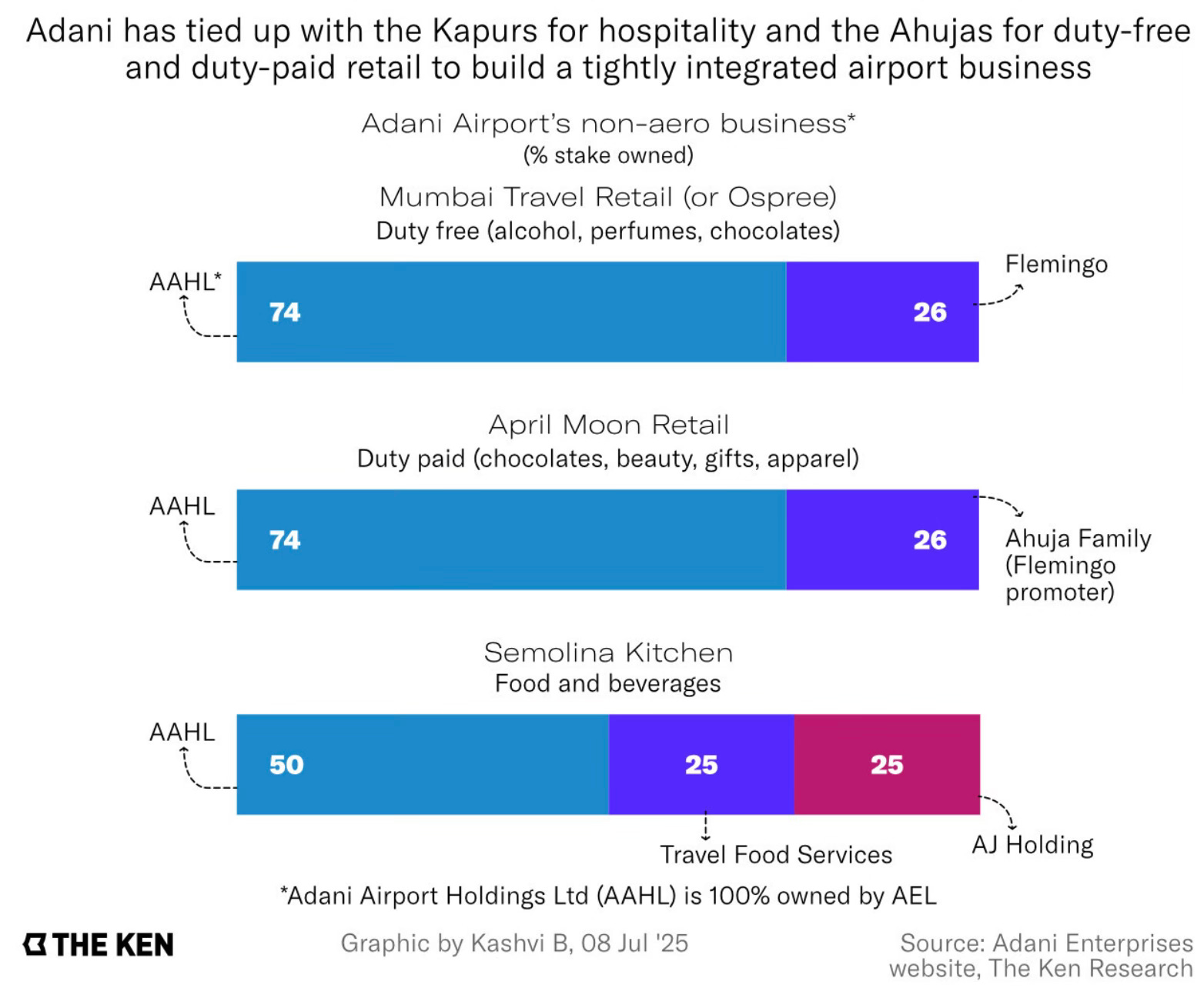
Unlike Adani’s other airports, where retail concessions are often managed by third parties, in the Mumbai airport, Adani directly runs the non-aero business… Adani Airport has moved to a franchisee model—a shift from the earlier system, where brands paid rent (fixed or revenue-linked) to concessionaires who had won competitive bids for spaces. Now, instead of paying rent, they are licensing their brand to the airport and letting it run the show… 

In Mumbai, three large players—TFS, Lite Bite Foods, and Devyani International—used to dominate F&B. That has changed. Last March, Adani acquired a majority stake in Semolina Kitchens, a TFS subsidiary. TFS, now aligned with Adani, is emerging as the primary F&B operator at the airport. Lite Bite’s share has reportedly fallen from 50% to under 20%, said F&B operators in the know. Both it and Devyani are expected to exit entirely once their contracts expire later this year… 

Of the eight lounges at the Mumbai airport, at least five are now managed by TFS. Through Semolina, TFS has lounge and Quick Service Restaurant (QSR) concession rights at six Adani-operated airports, as well as Goa (operated by GMR), according to its pre-IPO documents. The roles are consolidating. The partners are getting fewer. The integration is getting tighter… So if a brand is trying to operate at the airport, they can’t be surprised if the space goes to TFS’s in-house brands like Caffecino, Curry Kitchen, or Dilli Streat instead… 

Over the past 18–24 months, categories like watches, apparel, cosmetics, salons, and even convenience stores have seen a shift in how business is done at Adani-run airports. The model is familiar by now: migrate the old setup into a new one, run by a close partner. In this case, that partner is April Moon Retail, claimed multiple brand owners. Stores at these airports still carry their logos and branding, but the backend has moved, they said. Employees are now on April Moon’s payroll. Bills carry the brand’s name, but the GST number belongs to April Moon… 

April Moon has begun launching in-house formats across categories. Stores like Bon Voyage, which sell everything from snacks and books to travel accessories, now operate across multiple Adani Airports… What’s really taking off is the retail-cloning strategy. When something sells well at the airport, it doesn’t take long for a lookalike to show up—all run by April Moon. A luxury watch counter resembling Ethos or Helios? That’s Meridiem. A beauty and cosmetics outlet that looks like Nykaa? Meet Amara Luxe. Something that feels like Lenskart or Titan Eye+? It’s probably Vue De Luxe. Handicrafts à la Rare Planet? That’d be Pravasi. There’s even talk of a Hamleys knockoff said to be in the works.

This trend, in turn, creates several disturbing concerns.

TFS, whose IPO opens on 7 July, was founded by the Kapur family—the same folks behind Copper Chimney, Bombay Brasserie, and The Irish House… TFS could eventually be replaced, too. Adani is reportedly talking to Plaza Premium, the global lounge operator, for future airport lounge ops… 

April Moon began appearing around 2021. Its role was to take over the duty-paid retail at airports. That September, Adani acquired a 74% stake in Flemingo Travel Retail—a global duty-free operator founded by Atul Ahuja—for just Rs 2.8 crore. This, for a company that had clocked nearly Rs 900 crore in revenue in FY19. The deal, struck mid-pandemic when travel retailers were reeling, came at a throwaway price. And it gave Adani near-total control over both duty-free and duty-paid retail. For brands, that left little room to negotiate: either go through April Moon, or lose access to airport shelves… “If we made Rs 15 lakh in monthly sales at a store, we’d only be allowed to record Rs 5–6 lakh,” said one retailer. After costs, they say, the effective take-home margin is 5–6%. “Retailers who spent decades building these brands are now effectively just vendors.”

Strong financial incentives are driving these trends

At AAI airports, non-aeronautical revenue makes up maybe 10% of the pie. At private airports like Mumbai or Delhi, that jumps to 62%, per data cited by Crisil in TFS’s IPO documents. And within that, F&B alone account for as much as 40%. For instance, the top five Starbucks outlets in India by revenue are all located at airports, according to an F&B operator. A single store can bring in Rs 1.5 crore a month; that’s 3–4X more than a high-street outlet. And margins are nothing to sneeze at. A Rs 400 latte at an airport (Rs 350 at other outlets) contains roughly Rs 20 worth of ingredients.

Business concentration through horizontal and vertical integration may be inherent to the dynamic of capitalism with its profit-maximising firms. And there are doubtless efficiencies to be realised from both these trends. 

But the case of the airport sector in India, representative of trends across several sectors, raises questions about the stifling of entrepreneurship and innovation, and business dynamism in general. 

For example, what’s the incentive for entrepreneurs to start something like Dreamfolks Services, or April Moon Retail, or TFS, if there’s an imminent threat of being squeezed out of the market or being taken over by the dominant airport operator? Wouldn’t such trends deter investors from putting their money behind entrepreneurs whom they would otherwise have supported? More generally, is business concentration at the extensive and intensive margins likely to scare risk capital away from these sectors?

In addition, there’s a compelling argument that vertical integration under a corporate behemoth would lower innovation, service quality, and sector-wide dynamism. There’s a strong likelihood that once these services are taken in-house, like with all monopolies, the airport operator will have diminished incentives to pursue innovation and service quality and instead will have increased incentives to maximise profits. 

In any case, it’s unlikely that large infrastructure groups or their subsidiaries will be as innovative or driven to improve service quality (say, cater to all market segments), expand service portfolios (including interoperability with similar services globally), explore adjacent market synergies, and so on. This has been the global experience from across sectors, especially but not only in the infrastructure sector, over time.

It’ll be easy for the airport industry in India to become entrapped in a sub-optimal equilibrium of a horizontally and vertically integrated market dominated by a couple of operators. Given the inevitable growth in traffic due to economic growth starting from a low baseline, the associated inefficiencies can be papered over for a long time. But its opportunity cost can be considerable. 

Vertical integration also creates problems with the transparency of accounting for all those involved. Being part of the same corporate group means that there will be incentives to indulge in manipulation of accounts to minimise statutory payments and taxes, besides also maximising leverage. The operator can show lower revenues by over-invoicing and shifting profits to subsidiaries. Entities within a corporate group can do tax arbitrage by shifting profits among themselves. 

There’s also the case that horizontal integration creates the incentives for vertical integration. Adani Airport will have the incentive to in-source hitherto outsourced airport services only if it enjoys the economies of scope and scale from operating multiple airports. This underlines the importance of controlling market shares in such technically monopolistic markets (which also include those in IT, which benefit from network effects).

However, concerns about business concentration must be balanced with the need for large capital, a high risk appetite, and business ambition, especially if the objective is to scale big and rapidly. The country’s rapid and high growth ambitions require massive investments. The government is expanding airports at a rapid pace, and the airline industry is expected to grow fast for several years. Given their long gestation and deep exposure to the business cycle, only businesses with a high risk appetite and access to patient capital will invest in these sectors. 

Take the example of smart meters. The Government of India wants to install bi-directional smart meters in all 250 million households by the end of 2026. Even at a very conservative Rs 10,000 per smart meter (and its allied components), this would require a staggering investment of Rs 2500 billion (or about $28 bn). Given that regulatory conditions would restrict the discoms from recovering the cost of these new meters from existing metered customers, this cost must be borne by the government or the discoms. 

Since mobilising upfront capex of this scale would have been impossible, a totex model was adopted where the major share of capex would be borne by the concessionaires who would recover it over the eight years of the contract. This also means that the concessionaires would have to bear the significant risks (technology obsolescence, political economy of electricity tariffs, policy shifts, and local politics) involved and carry them in their balance sheets over the contract period. Only a few firms with the deepest pockets and highest risk appetites can assume such risks and make money from these contracts.

In conclusion, business concentration poses a dilemma for policy-making in many sectors. Its harms are well-known and often salient in a bad way, but its benefits are less known. When it unleashes a dynamic that confines an increasing and dominant share of the benefits in the hands of a few corporate groups, then there will be problems. 

Econ 101 would have it that such monopolistic trends should be formally regulated. But regulation is fraught with problems, given its inefficiencies and the political economy. Besides, there are limits to the extent of regulation required to control these business dynamics. 

From another perspective, the reliance on large corporate groups to drive high-growth aspirations is essentially a legitimate political economy choice that many countries, including those in the West, have made in their growth trajectories. Therefore, it’s only natural that a recognition of the problems that accompany the pervasiveness of large corporate groups be met with a similar political economy choice to force some form of restraints on their overreach.

Saturday, June 21, 2025

Weekend reading links

No-frills airlines, of which Indigo is one of the world’s best examples, accounted for half the total seat capacity in 2014. A decade later, their share had shot up to over two-thirds, helped in no small measure by full-service carrier Jet Airways’ collapse in 2019... China has seen a bigger decline in airfares since 2011—45%—than India. That’s partly a function of how competitive the market is. China has 146 operating airlines, including global ones, compared with 91 in India. The latter had over 100 pre-Covid. Go First, formerly Goair, was the last prominent airline to bite the dust when it declared bankruptcy in 2023. Over 15 Indian airlines have failed in the past two decades, according to IATA.

2. The Ken has a story on Indian automaker's rare earths dependence.

India imported about 2,270 tonnes of rare earth minerals in FY24, up 15% from the previous year. According to Volza, a platform that tracks import data, there were 42 Indian buyers in 2024, sourcing from 43 suppliers around the world.

Rare earths have a critical role in EV manufacturing

Rare earth elements (REEs) include 17 elements, mostly placed on one side of the periodic table. These are what make permanent magnet synchronous motors (or PMSMs) go. PMSMs are the de facto standard for EVs, especially in two- and three-wheelers. Other REEs like Yttrium and Lanthanum quietly show up in your battery cathodes and electrodes... Electric vehicles are powered by lithium batteries. But to actually move, they need magnets. Not just any magnets—rare-earth permanent magnets made from things like neodymium and praseodymium. They sit inside motors and quietly make everything spin... the rare-earth permanent magnet is the invisible hero of modern mobility—sitting inside motors, power steering systems, infotainment units, even automatic window mechanisms. Basically anything that makes EVs feel like tomorrow’s tech instead of just today’s transport.

General Electric. Procter & Gamble. IBM. For years, those companies and a handful of others were held aloft as “CEO Factories,” admired for their ability to recruit and mold corporate chiefs. Over a 20-year span, just three dozen companies produced one-fifth of the chief executives in the entire S&P 1500 index... the dominance of the traditional CEO factories is fast becoming a thing of the past. The companies most notably taking their place: consulting firms. Alumni of Accenture, Deloitte, PwC, EY and even little-known Swiss staffing firm The Adecco Group have all grabbed a bigger share of global CEO roles over the past 15 years, according to an exclusive analysis of the career paths of the CEOs at more than 4,300 global public companies. Meanwhile, the influence of storied CEO factories like GE and IBM has diminished, according to the analysis by Live Data Technologies.
According to the Reserve Bank of India’s (RBI’s) projections, a 10 per cent increase in oil prices from the baseline assumption can push up the inflation rate by 30 basis points and reduce the growth rate by 15 basis points. A substantially higher increase in oil prices would inevitably have a bigger impact. The RBI’s Monetary Policy Report in April had a baseline assumption for crude oil (Indian basket) at $70 per barrel for 2025-26.

5. India's use of anti-dumping duties (ADD) to combat "material injury" to domestic industries arising from dumping.

From 1995 to 2023, India initiated over 1,100 investigations — more than the US or European Union — targeting not only China but also the EU, Switzerland, South Korea, Japan, and others. In 2024 alone, India launched 47 trade remedy investigations — 37 aimed at Chinese products like aluminium foil, vacuum flasks, and steel... In the past five years, India has imposed 133 anti-dumping measures on 418 products, many in the chemicals sector. Firms that rely on these chemicals as inputs face a constant threat of sudden duties, resulting in price volatility and supply disruptions.

6. Indian economy facts

Private final consumption expenditure (PFCE), which makes up nearly 60 per cent of India’s GDP, fell from a growth rate of 6.8 per cent in the pre-Covid years to 4.1 per cent in 2019-20 (FY20). After a brief post-pandemic recovery, it fell again: To 5.6 per cent in FY24, according to the RBI, and an even weaker 4.4 per cent, according to the National Statistics Office... Since mid-2023, growth in personal loans has fallen off the cliff — from 22 per cent then or 10 per cent or so now — reducing consumption... merchandise exports, which fell 12.8 per cent in FY24 and are expected to grow by only 2 per cent in FY25... According to the Forward-Looking Survey of the Ministry of Statistics and Programme Implementation, actual intended private-sector capex will fall from ₹6.56 trillion in FY25 to ₹4.9 trillion in FY26, a fall of 26 per cent... According to the government data, net payroll addition under the Employee Provident Fund was -5.1 per cent in FY24 and -1.3 per cent in FY25. The Naukri Jobseek Index of white collar jobs has flattened since FY23.

7. Disturbing data on a surge in Chinese exports despite all the trade war restrictions.

This year so far, China’s trade surplus with the world is nearly $500 billion — a more than 40 percent increase from the same period last year... China has made 45 percent more electric vehicles this year, even as Chinese companies are engaged in a vicious price war at home because of flagging consumer appetite. Exports of electric vehicles have soared 64.6 percent this year, according to the Chinese Association of Automobile Manufacturers.