Substack

Showing posts with label Unemployment. Show all posts

Monday, August 17, 2026

A graphical summary of India's labour market challenge

I have blogged earlier (see here and here), highlighting the importance of broad-based economic growth and the creation of good jobs as essential requirements for India’s sustained high-growth prospects. 

This post has been triggered by two articles. First, a recent op-ed in Business Standard by Kavitha Rao of the NIPFP, which analysed the Periodic Labour Force Survey (PLFS) for the composition of jobs in India and found,

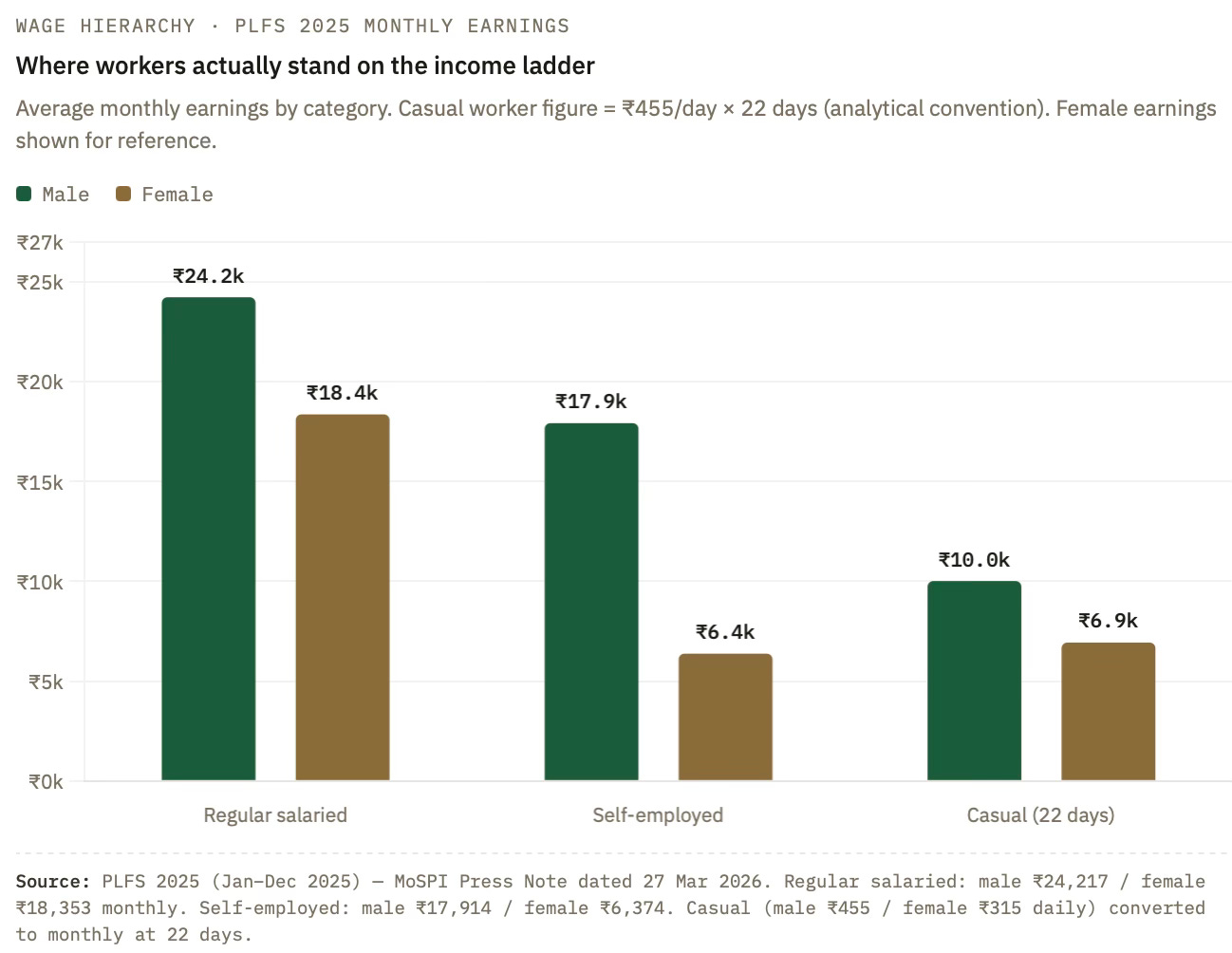
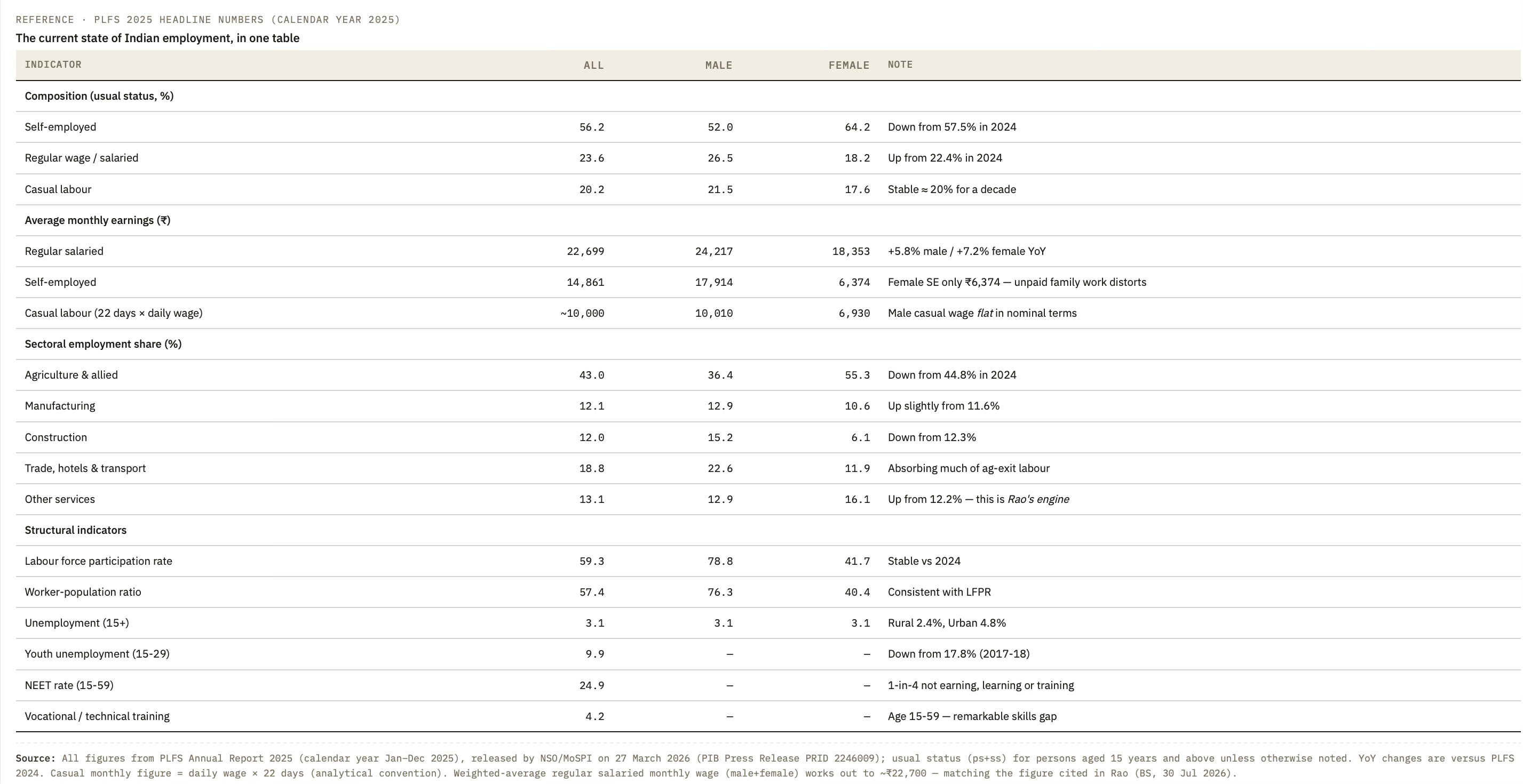
The PLFS classifies information on the composition of workforce into regular workers, self-employed and casual workers and the corresponding wages. The share of regular workers in total workforce was 23.6 per cent in 2025, a little more than half being in government or public enterprises. The self-employed account for more than half (56 per cent), with the remaining being casual workers. The average wage for regular worker was reported to be at ₹22,699, which is higher than the monthly earnings of self-employed ₹14,861, and of casual workers at ₹10,000, assuming a worker works for 22 days in a month. Even among the regular workers, there is considerable variation — over 50 per cent have no written job contract and no social security benefits. 

To understand the differences in wages across activities, the survey reports a number of occupation divisions — the ratio of the highest to the lowest wages within regular workers is 4:1. Juxtaposing the highest-wage-earning occupation with casual workers, the differential is 7.4 times, assuming that casual workers get to work 22 days in a month. To top this off, there is a public-sector premium, especially in lower-level jobs. On the other hand, the self-employed category includes a number of unpaid family workers, suggesting significant underemployment in the economy and poor returns to effort. Fewer well-paying jobs and a wage premium for public-sector jobs drive a sharp demand for these jobs.

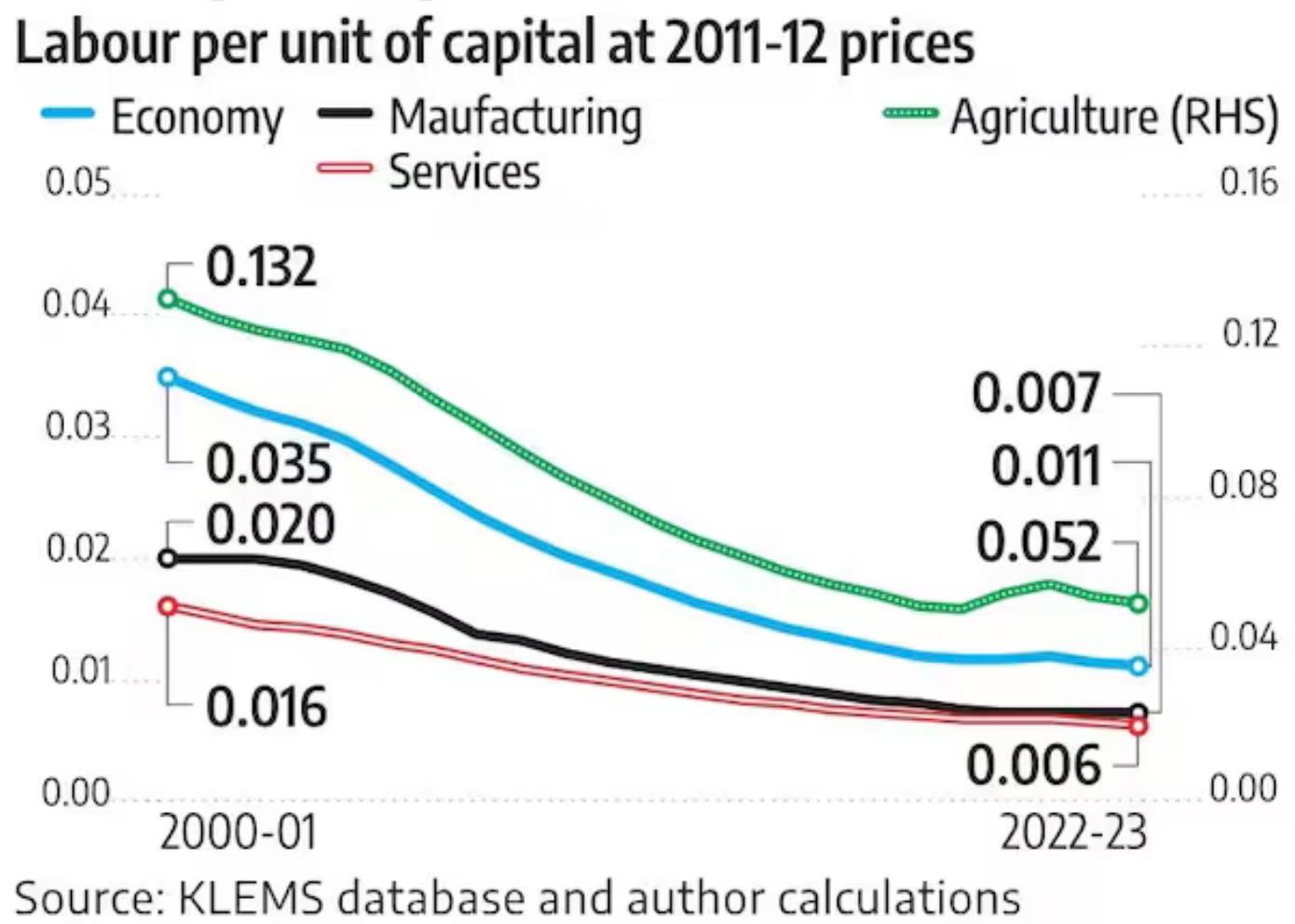
She also points to the increasingly capital-intensive nature of job creation across sectors, and the convergence of labour intensity in manufacturing with that in services.
Second, The Economist had this graphic on the rising number of graduates and their declining monthly salaries. 
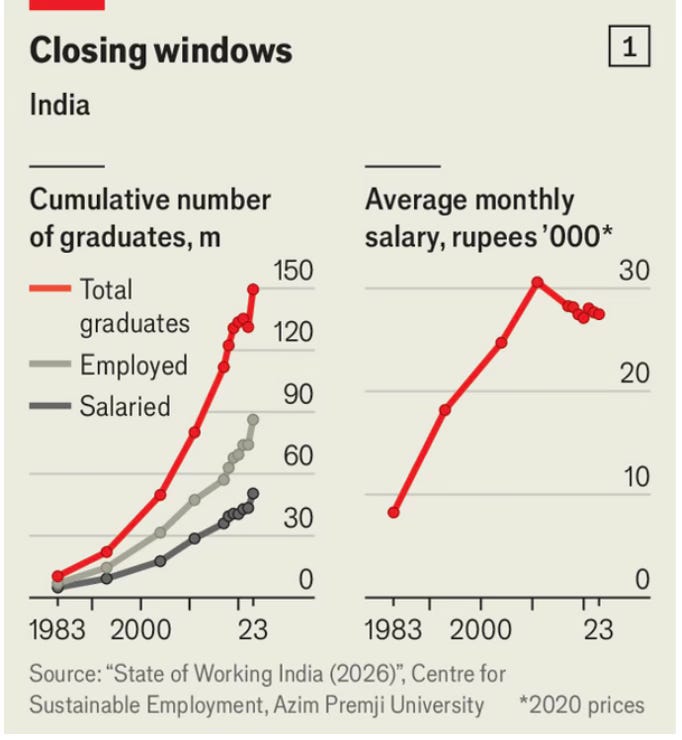
Research by the Azim Premji University in Bangalore shows that each year between 2004 and 2023 roughly 5m graduates were added to the workforce; but the number in employment rose by only about 2.8m… Of the young people who report themselves unemployed, fewer than 7% of graduates find permanent salaried work within a year…Education-fuelled aspirations have pushed enrolment in tertiary education to 30% of 18- to 23-year-olds, while the number of higher-education institutions has grown from 6,000 to around 70,000 in the span of 30 years, thanks to a boom in private education… around 45% of Indian graduates have degrees in arts or commerce rather than, say, engineering or medicine. A report by a business body in 2024 estimated that only 55% of India’s graduates were employable.

With this backdrop, I used Claude to dig a bit deeper into the economic growth and labour market. As a framework, broad-based economic growth works at the intensive margin of the labour market to raise disposable incomes, and good job creation works at the extensive margin to expand the meaningful consumption base. 

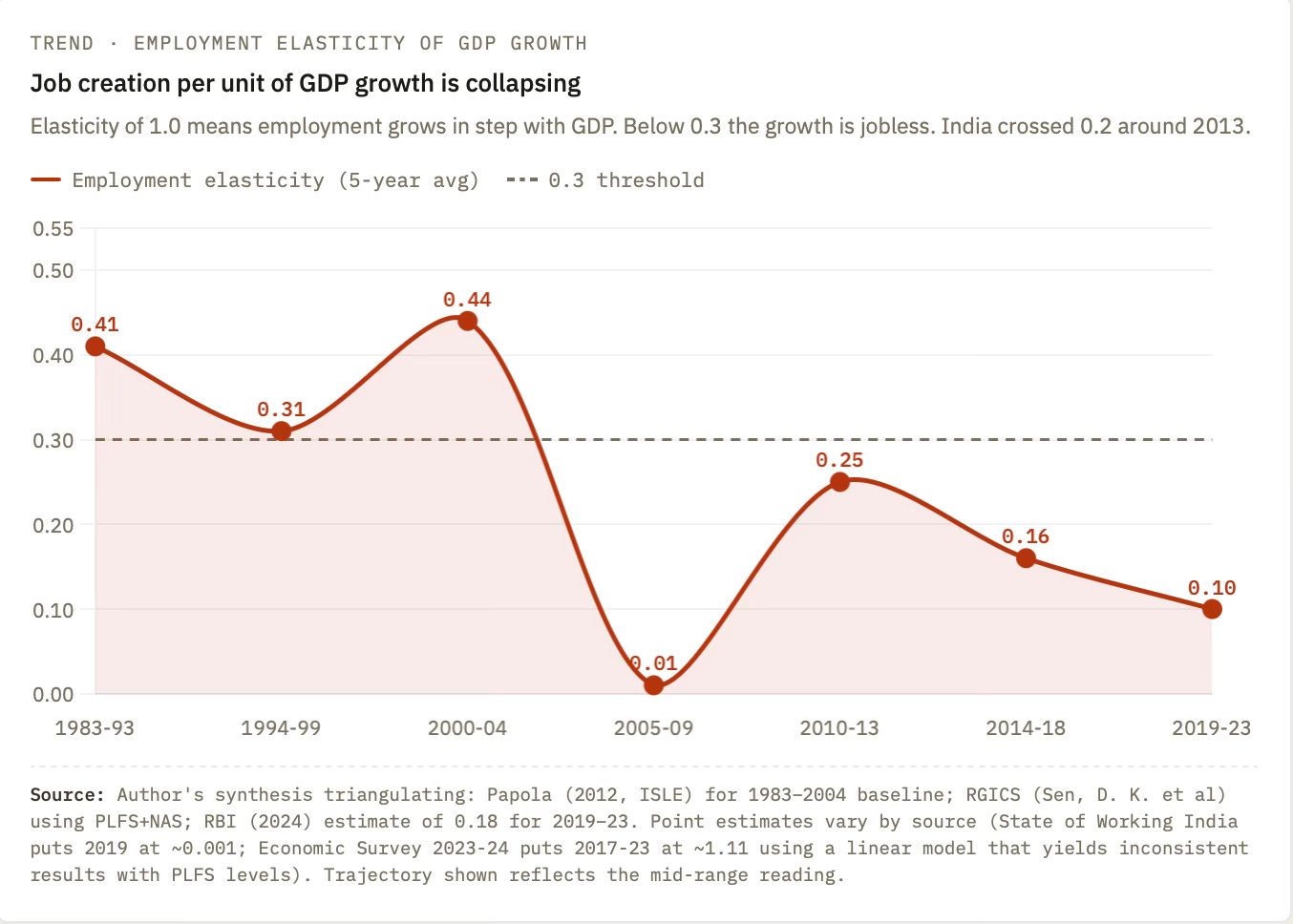
Consider the headline numbers. The employment elasticity of GDP growth has fallen from ~0.4 in the 1980s to 0.26 for 2000–2012 and near-zero by 2019 (RBI 2024 estimate: 0.18). 
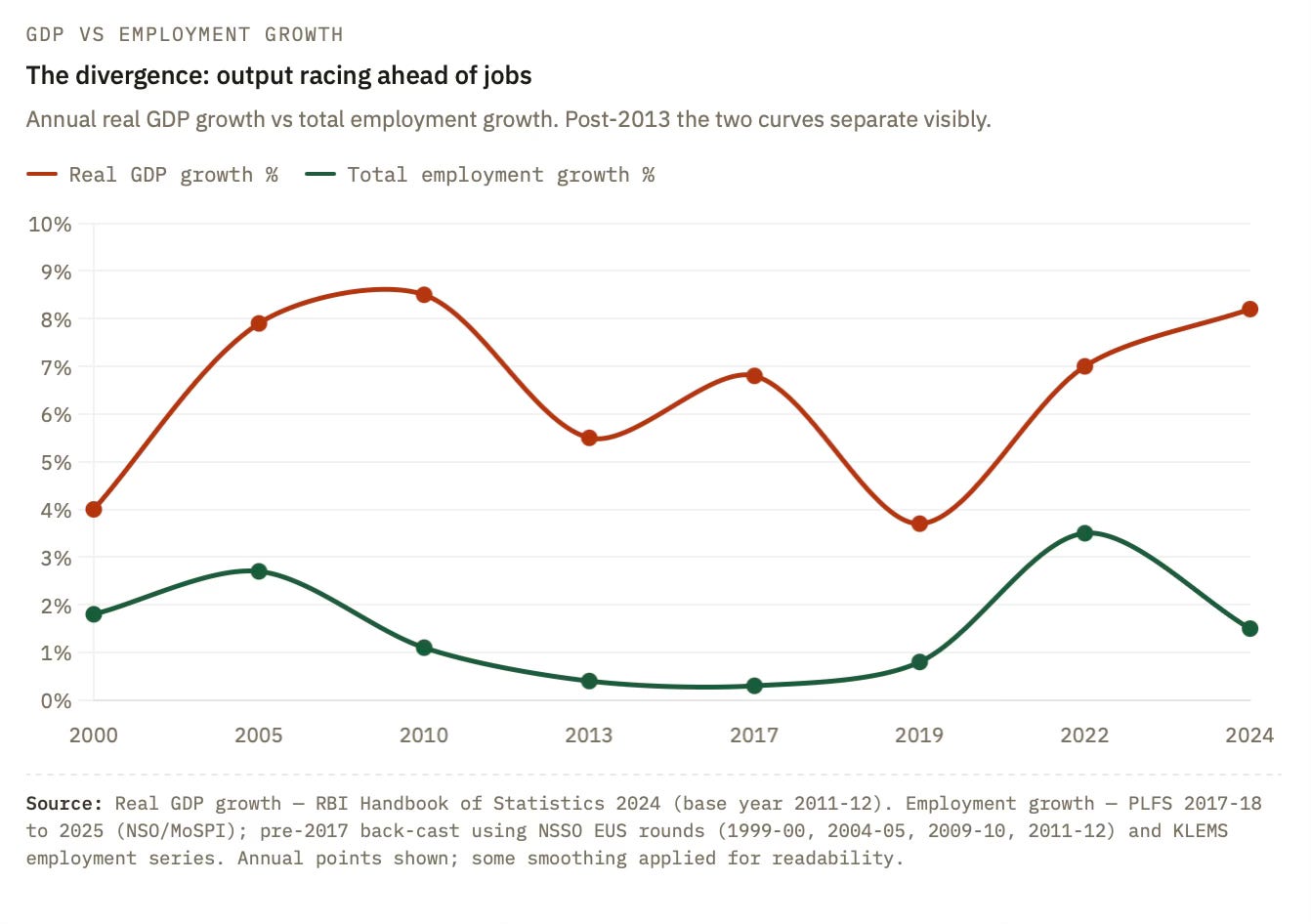
This is also borne out in the widening wedge between aggregate output and employment growth rates.
The economy needs roughly 20 million new non-farm jobs a year to absorb the demographic bulge, whereas formal-sector job creation runs at about 4 million. 
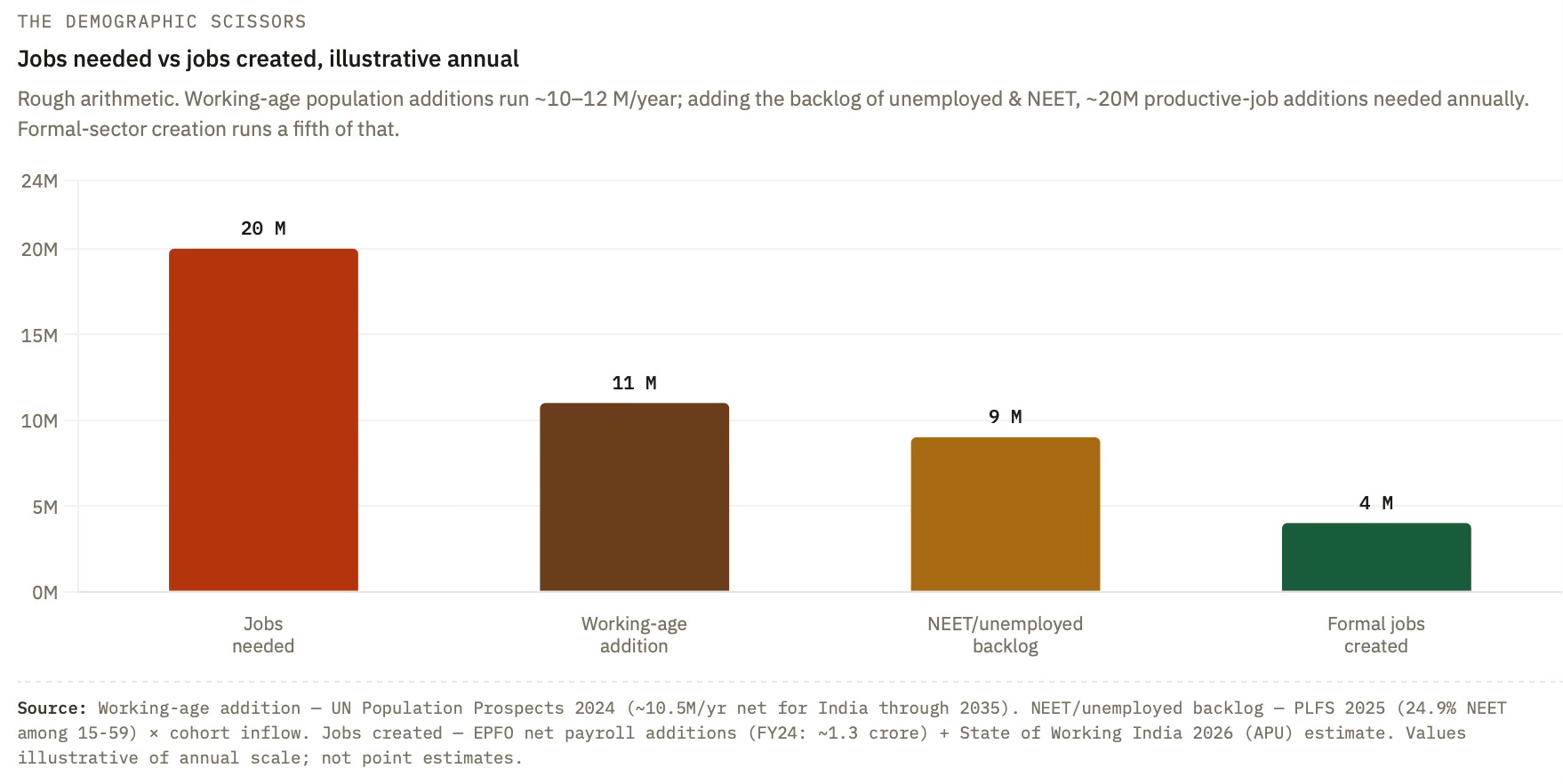
It should be a matter of concern that India, one of the world's largest economies, has one of the smallest formal-sector labour-absorption engines relative to size. It does not help, as I blogged here, that manufacturing’s employment share is stuck at 12%, and every export dollar now buys less domestic employment than a decade ago. As mentioned earlier, the State of Working India 2026 report documents that just under 7% of male graduates secure a permanent salaried job within a year of graduation.

In addition to quantity, another dimension of the extensive margin is the quality of jobs created - i.e., those that pay enough, and reliably enough, to enter the consuming class. Seven rounds of PLFS data (2017-18 to 2023-24) reveal a labour market where employment quantities are rising but quality (measured by contract security, social protection, paid leave, and income sufficiency) has stagnated or worsened for most workers. As a headline number, only 23.6% of workers are regular salaried. 
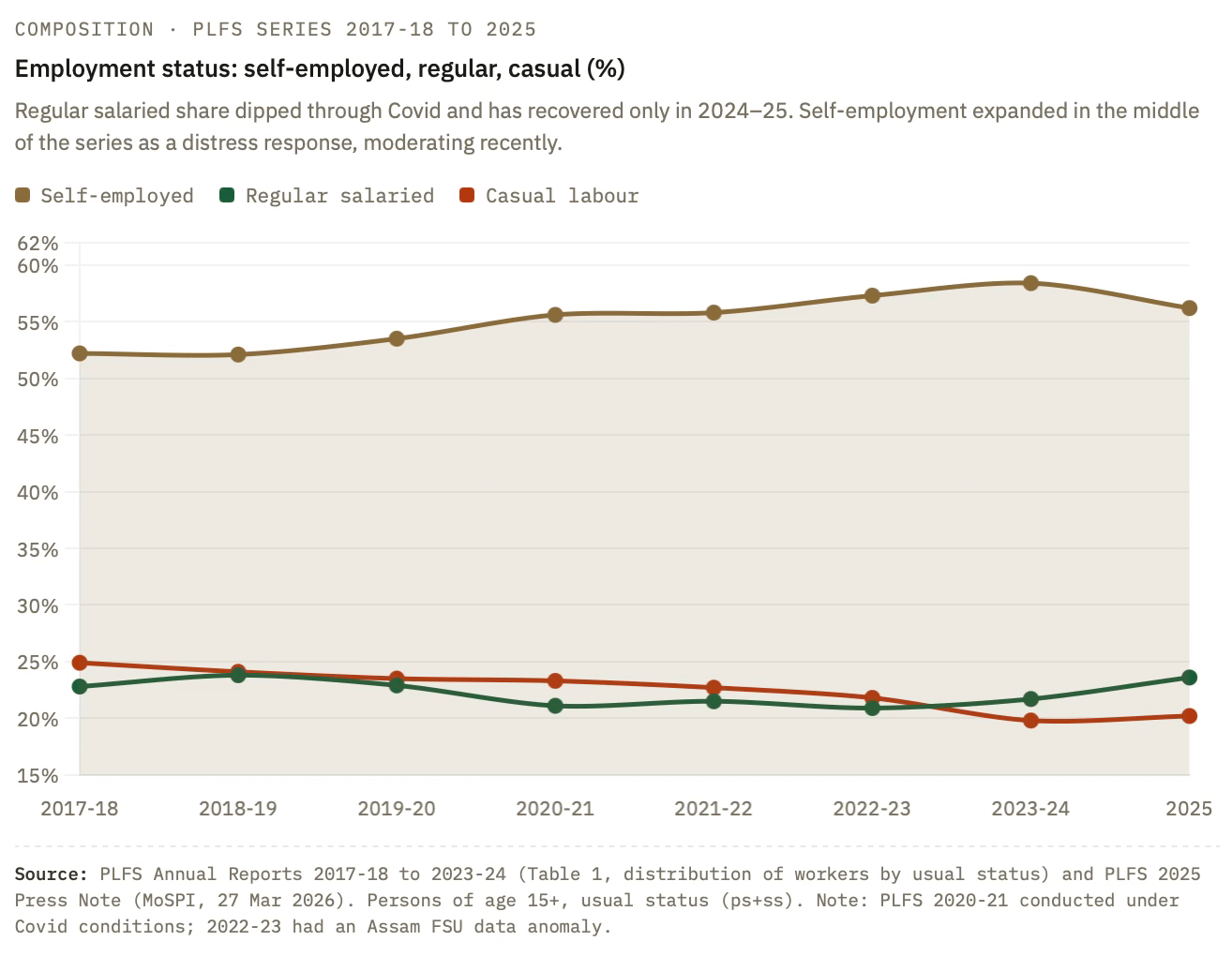
Further, only about 11% are regular salaried with a written contract and social security. Everyone else is either self-employed at very low earnings (56%), a casual daily-wage worker (20%), or a regular worker without protection.
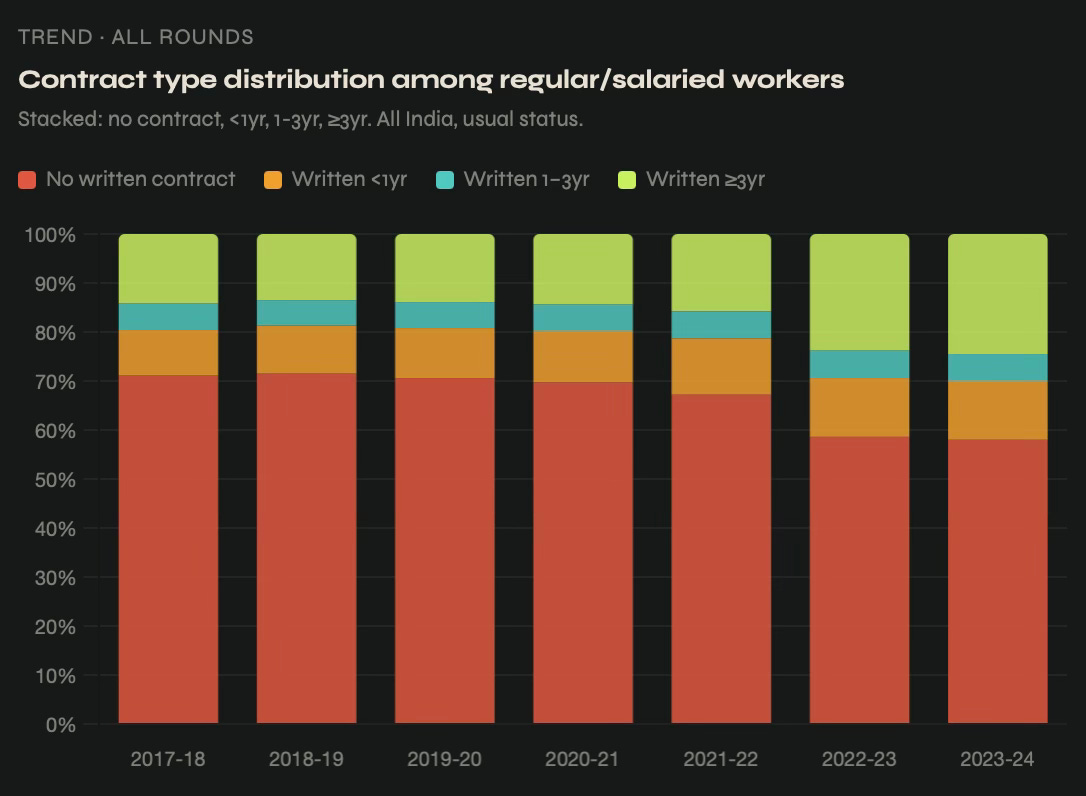
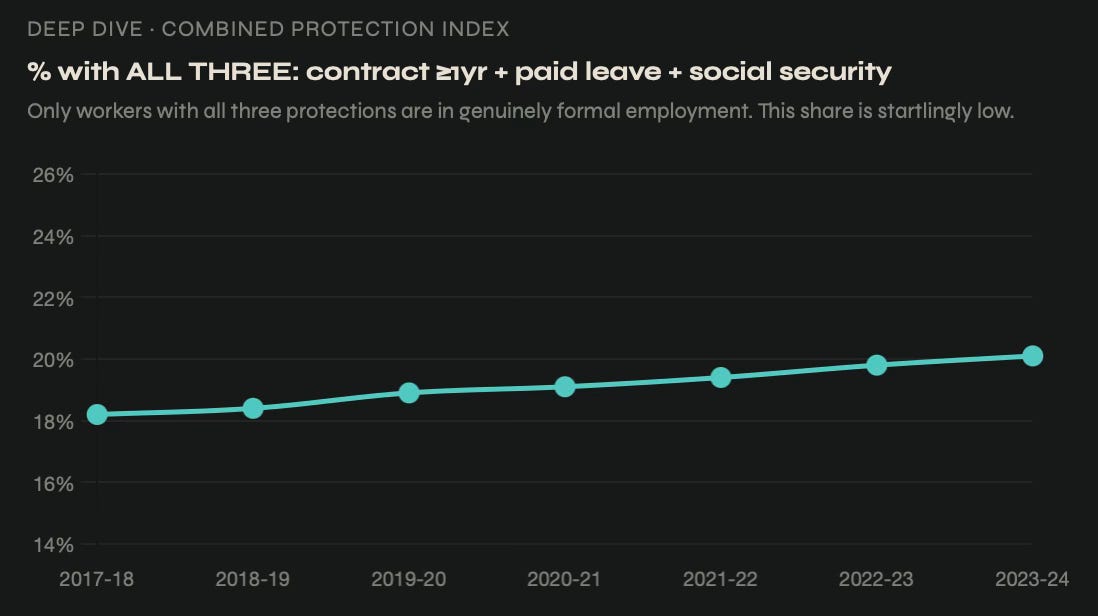
Of the 23.6% who are regular salaried, more than half have no written contract and no social security. It is good that the share of those in regular employment with all three protections has been rising gradually.
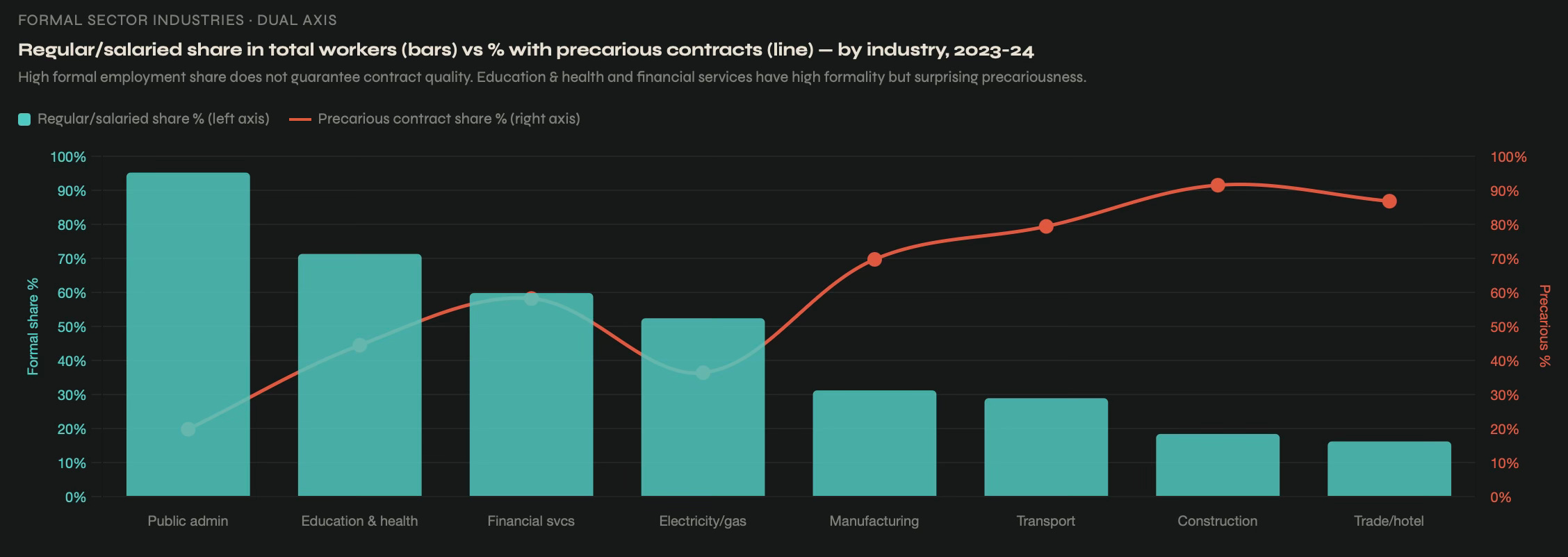
The problem is compounded by the quality problem not sparing even the well-educated, and even worsening for them. From 2017-18 to 2023-24, among graduates, precarious contracts (no contract or less than a year) rose from 49.3% to 53.9%; among post-graduates it rose from 38.7% to 44.1%; among technical diploma holders (who should command skill premiums) it rose to 65.8%. 

The numbers on quality are likely to be even worse if we exclude government jobs. They have high shares in public administration, education and health, financial services, utilities, and transportation. 
On salaries, the average monthly earnings across categories are low enough and vary sharply. The ratio of the wages for regular workers in their highest-paid occupation vs lowest-paid occupation is 4:1, and that for the highest regular vs casual worker earnings is 7.4:1. 
The table below captures the summary statistics on India’s employment market today. Only about 11% of India's workersare in the genuinely formal employment cell (regular salaried with a written contract and social security). And within regular salaried work, the 4:1 within-category wage ratio (for regular workers) and the 7.4:1 regular-to-casual ratio mean that even the "good" tier splits sharply. 
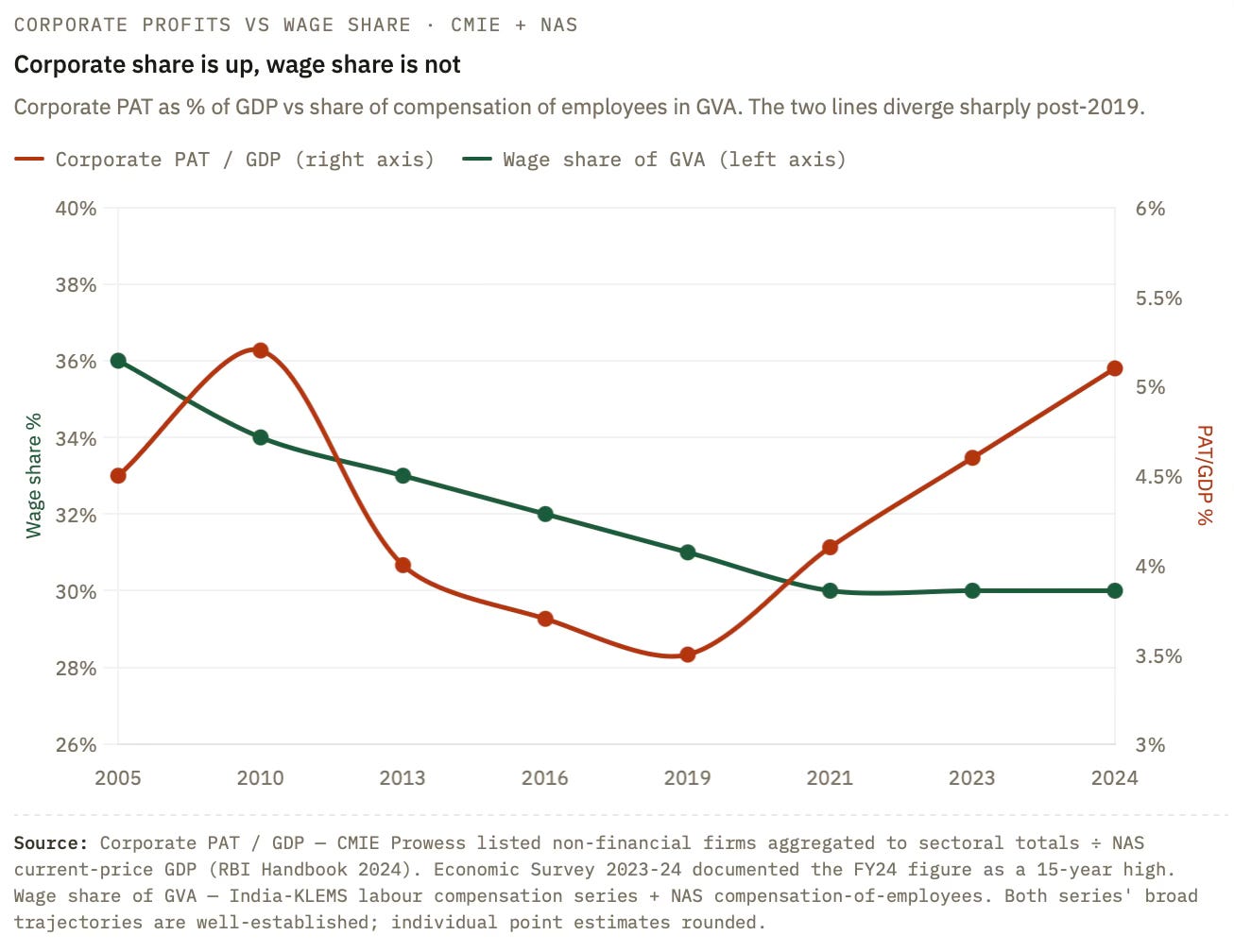
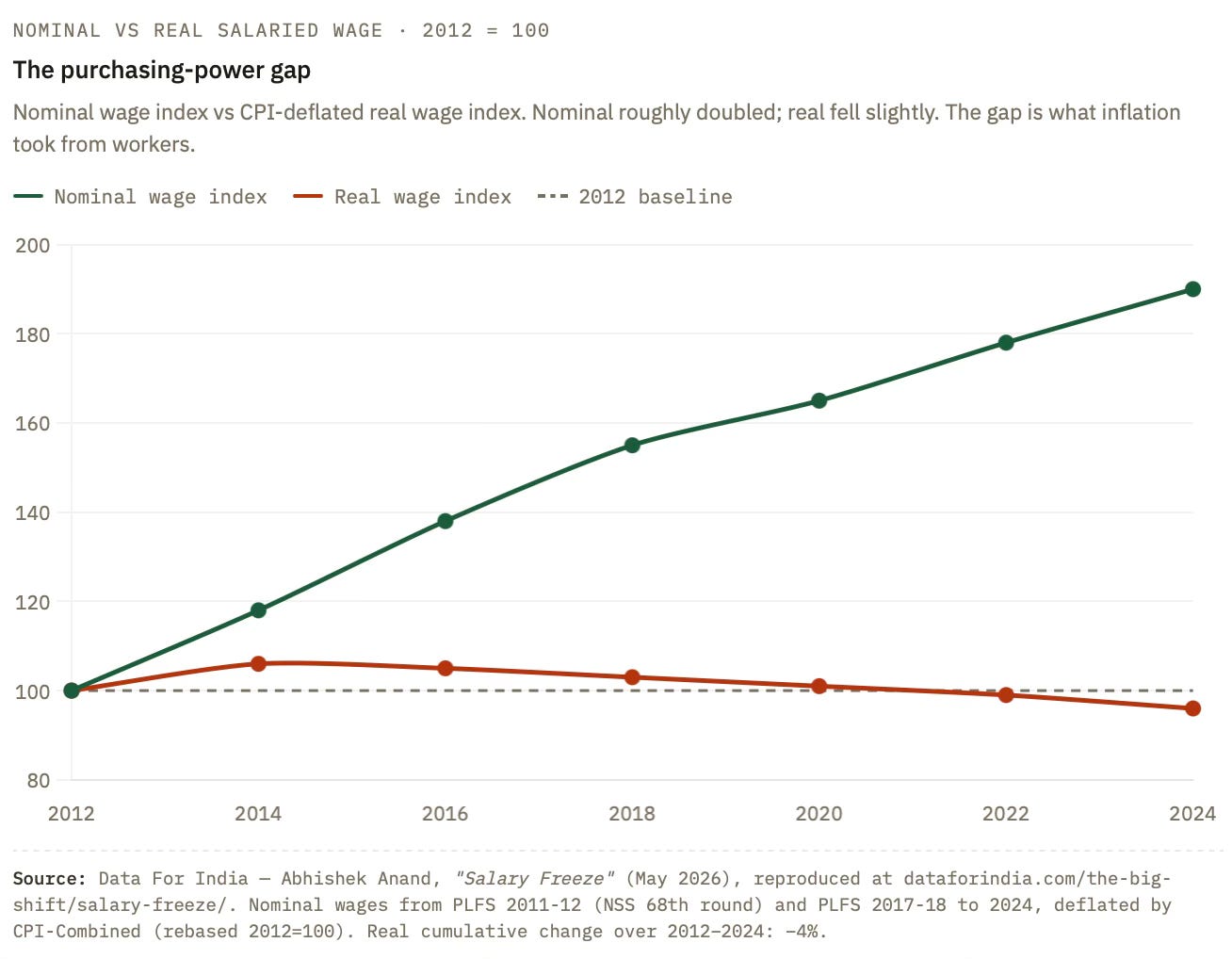
This brings us to the intensive margin, involving wage trends of existing employees. Are incomes rising for those already in work? Nominal wages roughly doubled 2012–2024 but inflation ate almost all of it. In FY24 corporate profits grew 22.3% and reached a 15-year high. 
Real salaried wages fell -4% cumulatively 2012–2024. Real wages for salaried workers were -1.7% lower in Q2 2024 than Q2 2019. 
Rural real wages grew about 7% annually in the 2010–2015 period and have been near-zero since.
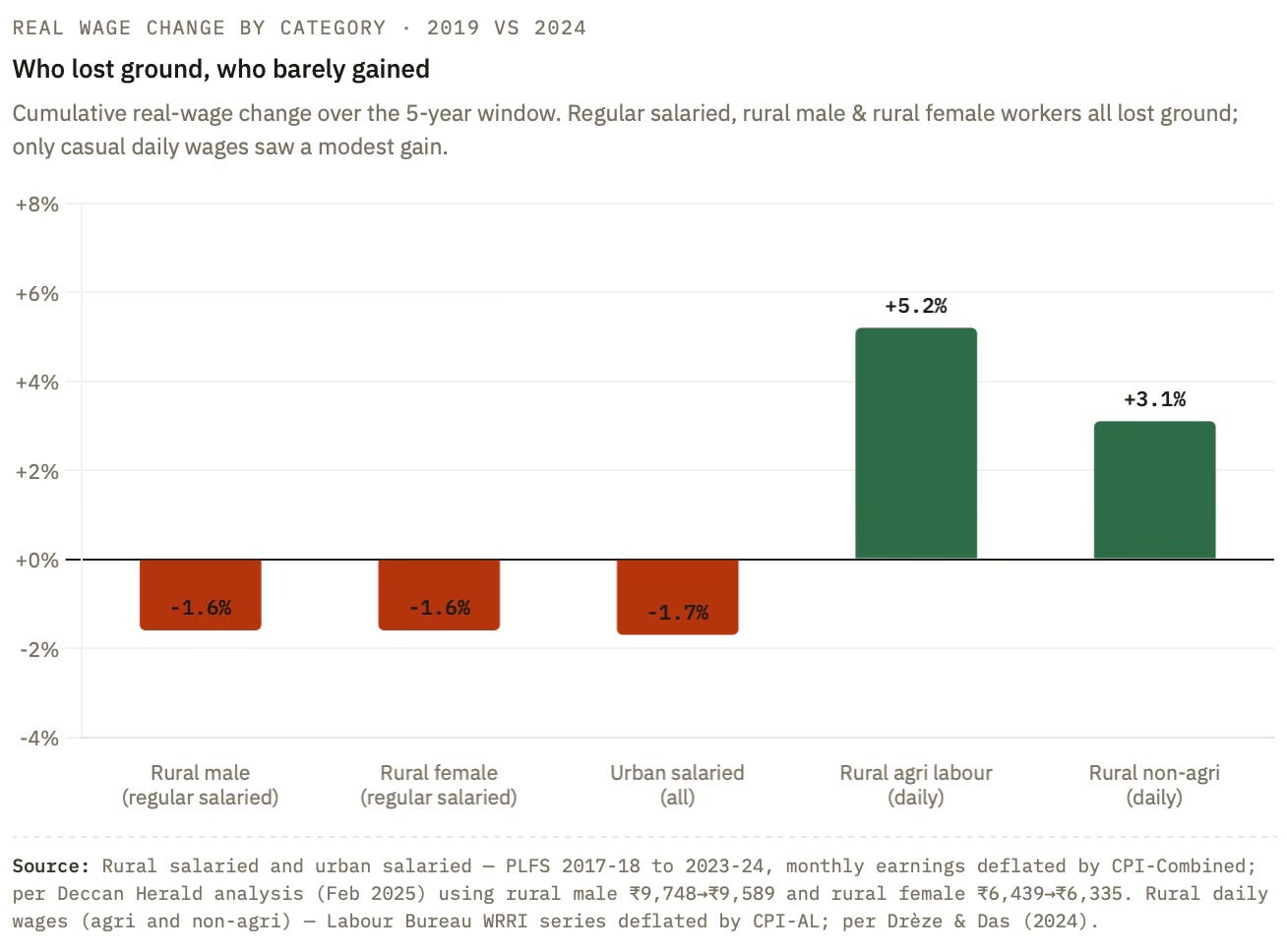
A decade of near-zero real wage growth means that even the workers who are employed are not getting the income-per-hour gains they need to expand consumption. The corporate sector is booking those productivity gains as profit rather than passing them into wages. This is the "consumption slowdown" that FMCG, auto and durables companies have been reporting from mid-2024 onwards, and is likely caused by the intensive-margin failure documented above. This failure at the intensive margin is a binding constraint to broad-basing economic growth and expanding the consumption class in a substantial manner. 

Let’s round things off with the labour-intensity point raised in the Rao oped. The India-KLEMS database shows that labour per unit of capital has fallen steadily across all major sectors, and manufacturing and services have converged to a broadly similar labour intensity. In earlier decades, manufacturing was the obvious job-creation engine because it was more labour-intensive than services. That is no longer true and to that extent diminishes manufacturing value in absorbing agricultural surplus labour. 
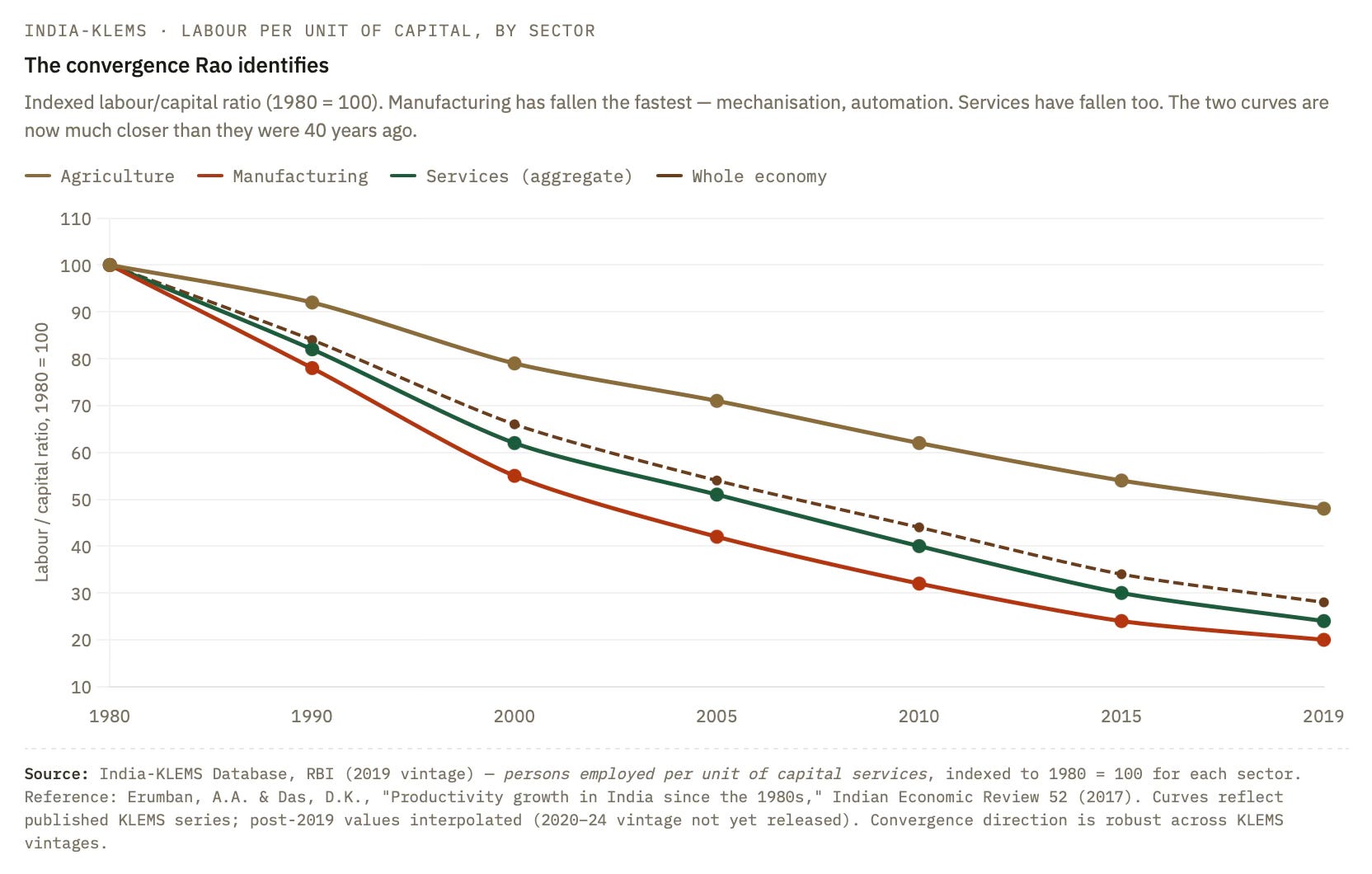
If labour intensities are similar, the sectors that expands the fastest are the natural venue for large-scale job creation. This points to the importance labour-intensive services like construction, trade, hotels, education, health, etc, as articulated by Rao.
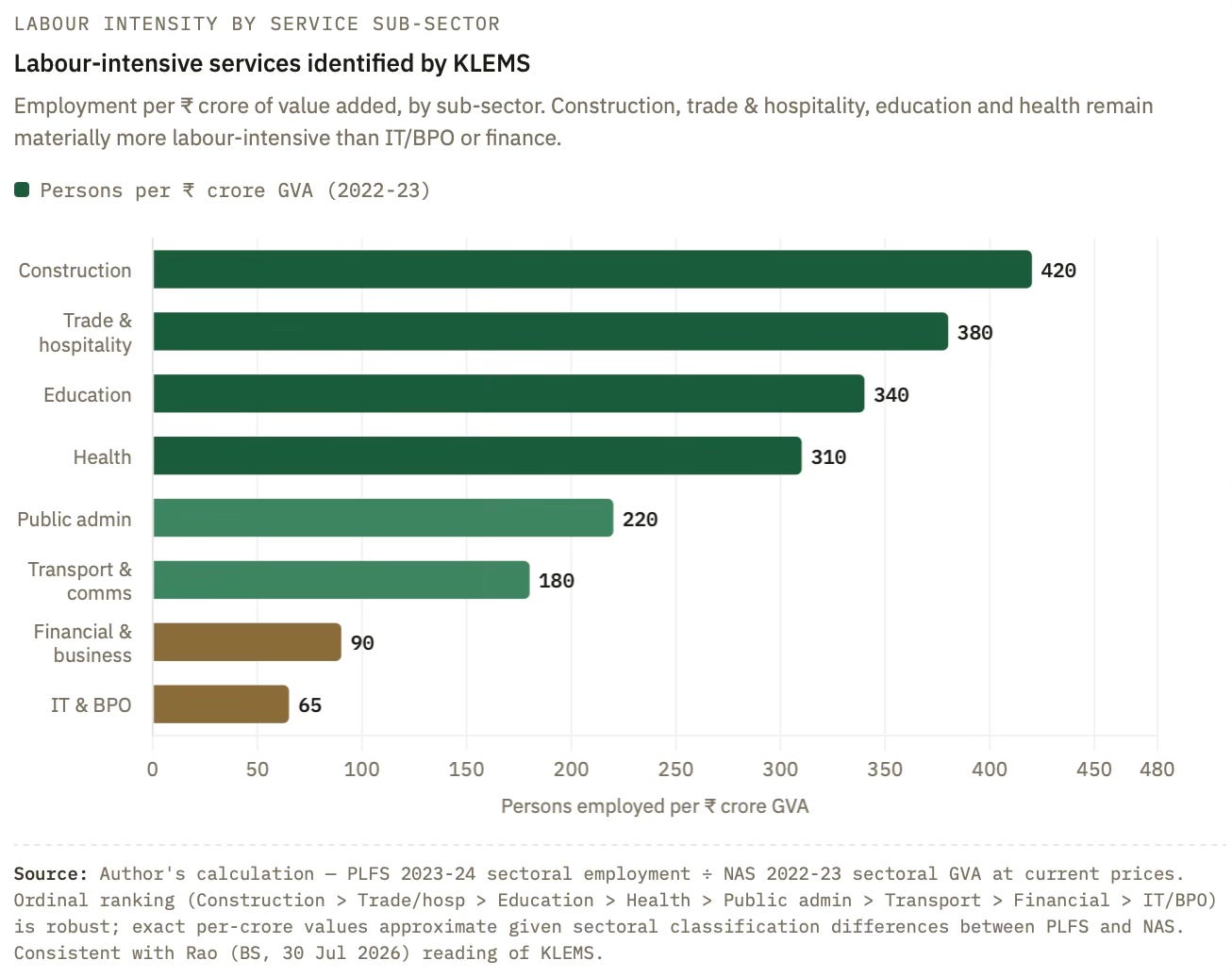
This reality demands a policy strategy that targets improving the quality of education and health services, and increasing their labour productivity. The quality of regulation and formalisation are two instruments in this regard. 

To summarise, neither margin is currently operating as India is stuck with quantities of the wrong kind of jobs, qualities that are eroding, and flat real incomes. 
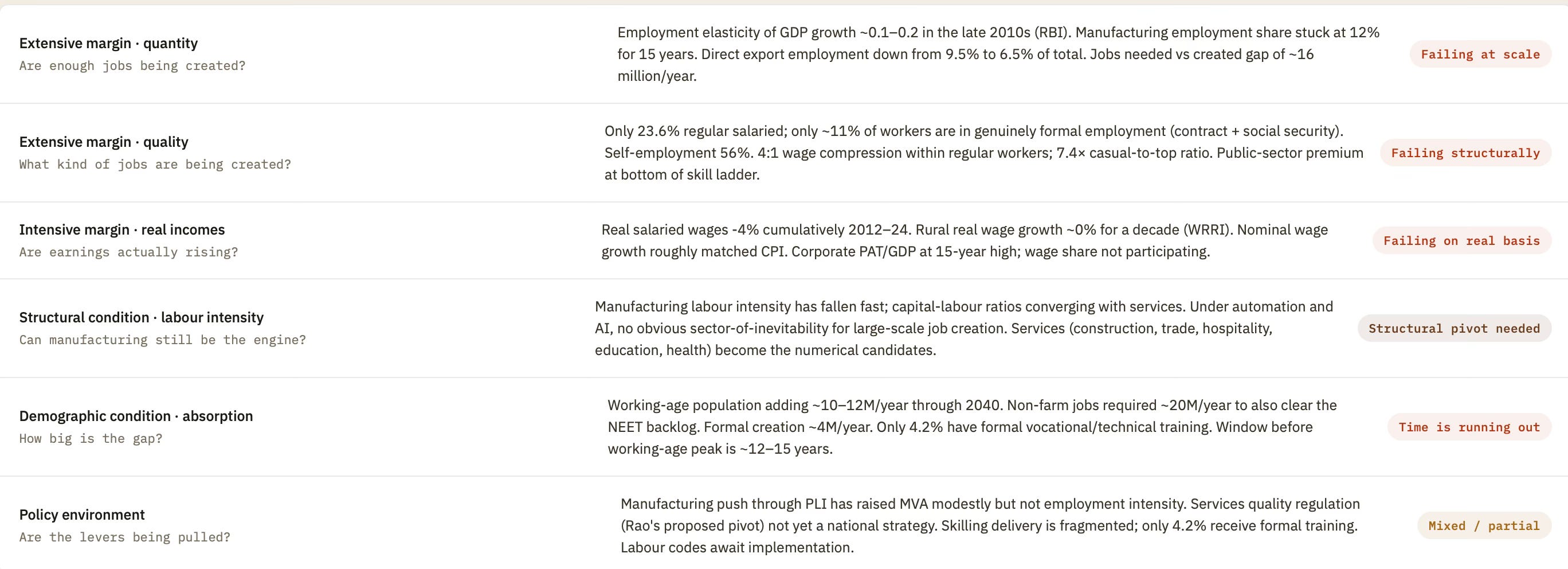
India is currently producing high GDP growth without producing either broad-based real income growth or broad-based good-job creation. This means that the growth is not translating into a widening consumption base, which in turn is a binding constraint on the private investment cycle that would generate more good jobs. 

Breaking that loop requires action on both margins simultaneously: raising real incomes for those already in work (through productivity gains genuinely passed to wages, and formalisation) and expanding the base of good jobs (prioritising the sectors where labour-intensity remains, and through selective labour-intensive manufacturing where the global window has not fully closed).

India has company in China on the issue of good job creation. An FT long read highlights China’s “great job squeeze”, driving people into low-paying jobs like ride-hailing and food-delivery. This contrasts starkly with the productive factory and construction jobs that underpinned the emergence of China’s middle class and the country’s sustained high-growth era. 
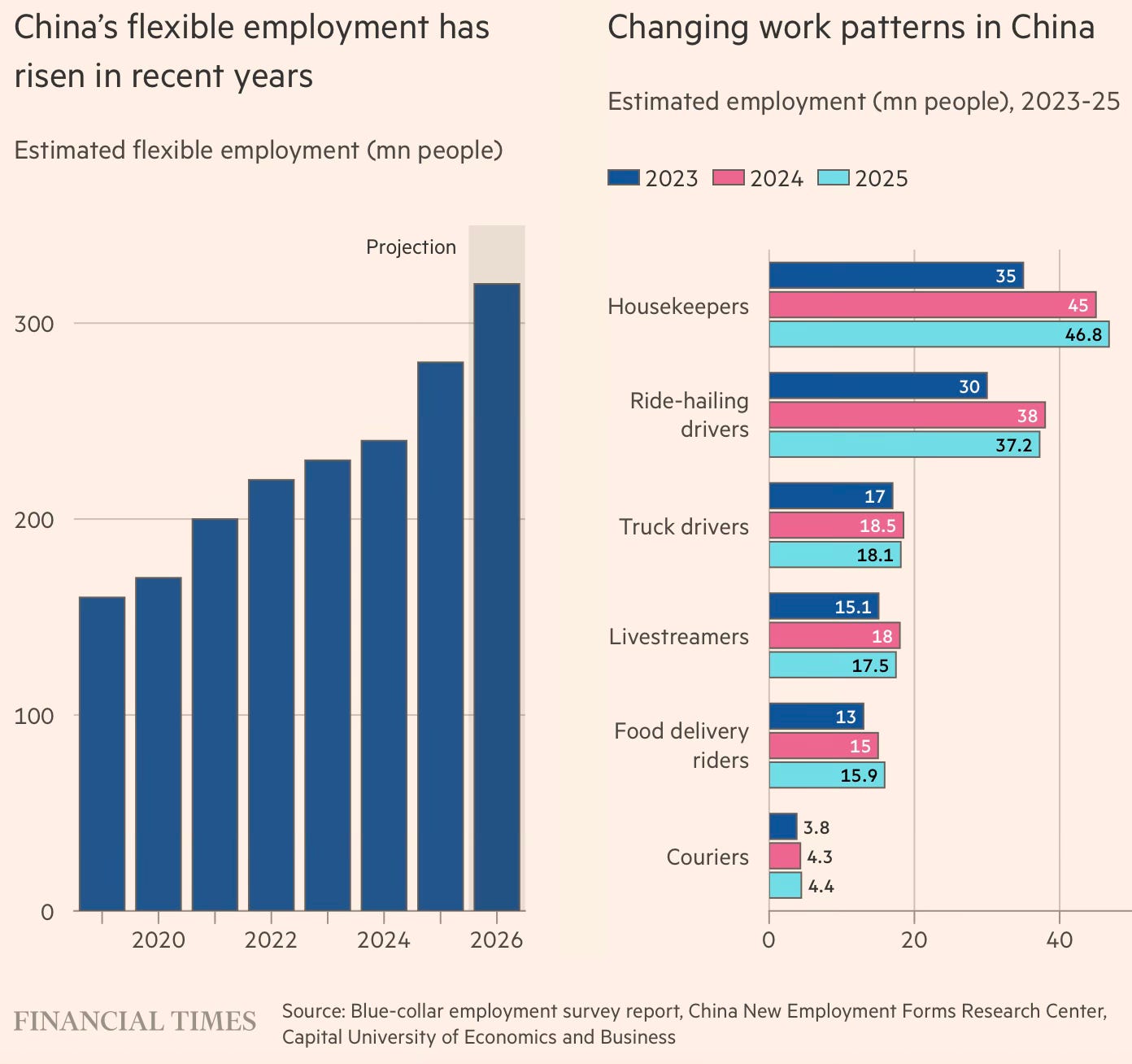
The property bust, consumer spending slowdown, and prolonged deflation have taken a toll on job creation. In this backdrop comes the backlash against exports, a major contributor to jobs and economic growth. The result of these trends is a labour market where low-paying gig jobs have become the major source of labour absorption. The number of gig workers has risen by 10 million in just two years. 

A precarious gig economy of ridesharing drivers and delivery couriers has been soaking up China’s surplus labour. The labour market has long been at the heart of the social contract between China’s government, eager to maintain stability, and a vast population yearning for economic betterment. Today it is under strain as rarely before. While flexible work has served as an economic escape valve, it too now risks becoming overloaded by more people than it can provide jobs for… More than 53mn people as of 2025 work as food delivery or ridesharing drivers in China, up 10mn in two years… Several municipalities have reported an oversupply of ride-hailing drivers and in June, the southern city of Shenzhen declared its ride-hailing market saturated…“I would say the demand for labour is falling faster than the supply of labour is declining,” says HSBC’s Frederic Neumann, citing automation in factories, the property slowdown and the as-yet unquantified impact of AI…

Andrew Batson, China research director at Gavekal, an economic research firm, suggests flexible employment and gig work are “more of a symptom of broad-based labour market weakness in China than a totally independent development”, even if technology has aided the growth of platform workers. “Because aggregate demand is low, the bargaining power of workers is weaker and they have to accept more underemployment and less favourable working conditions,” he says… “The anecdotal evidence suggests that gig worker incomes are trending towards subsistence levels, given the competition among workers in China for jobs,” says Neumann… Gig work is increasingly drawing in graduates, of whom there are more than 12mn entering the labour market this year, as well as offering options for migrant workers.

In this context, John Burn-Murdoch has an excellent article of relevance which highlights the contrasting tales of US and UK labour markets. He makes the point that while the UK has done better than the US in school learning outcomes and adult skill acquisition (30 per cent of US adults have literacy skills typical of a 10-year-old), the latter has done well in labour market outcomes. 
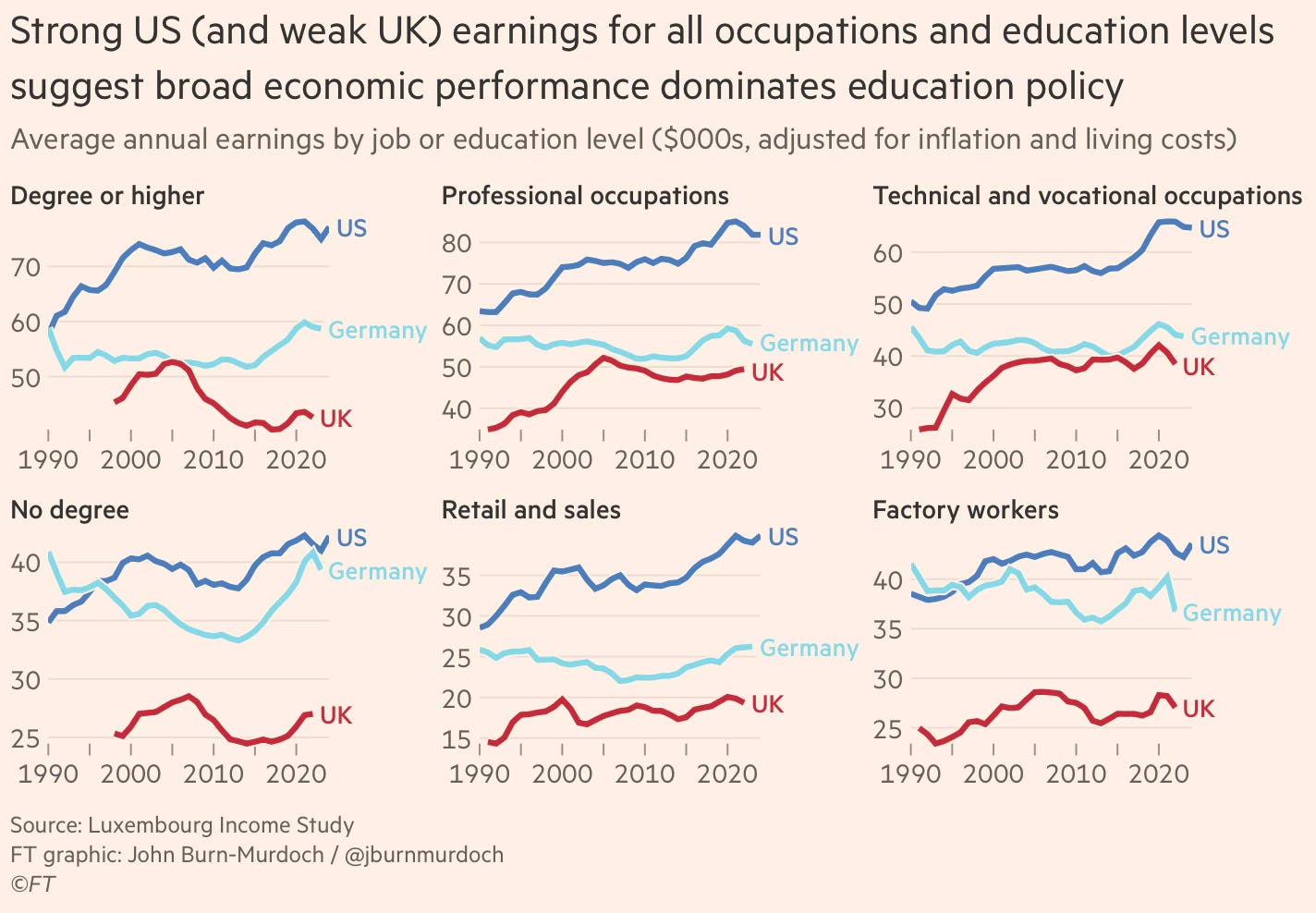
And this shows the higher wages received by US workers (it remains to be disaggregated as to how much of this is due to higher productivity, and how much due to labour market distortions).
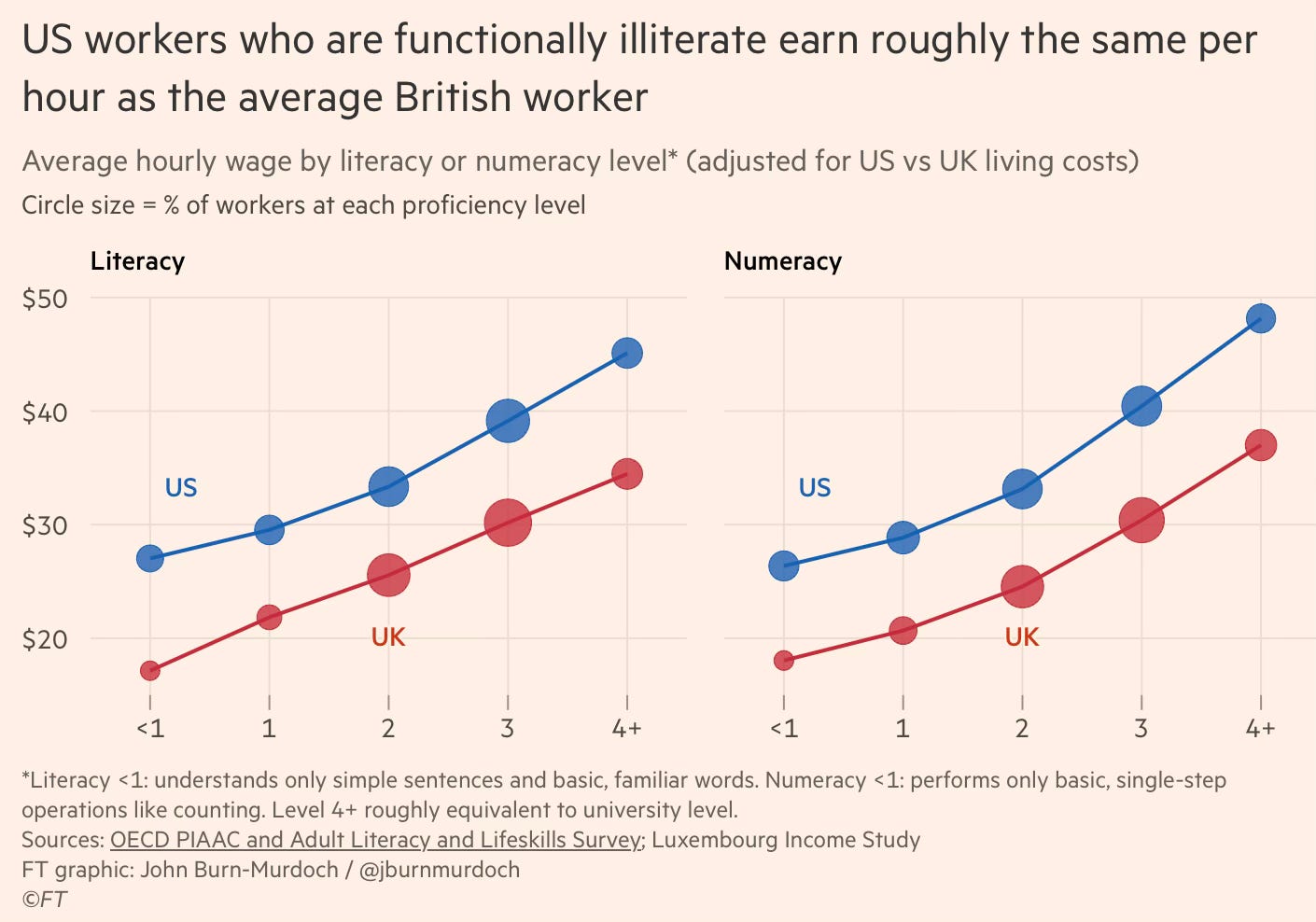
Similar to Germany, factory workers in the US earn 60 per cent more than in the UK after adjusting for differences in living costs. Plumbers and electricians earn 90 per cent more, and retail workers earn double. The same proportion of US workers who score stunningly low on literacy earn an average of almost $30 per hour, and two-thirds of them are in work. Their British counterparts make the equivalent of $20 and fewer than half are employed.

Like India, Britain has invested heavily in skill development, and Burn-Murdoch makes a very important point, of relevance to India.

But if we really want to deliver better outcomes, we must stop thinking of particular qualifications or forms of education as things that produce particular economic outcomes and deliver respect. Rather, we should view education as creating potential that a strong economy unleashes (and a weak one disappoints).

The main point is that, if you cut through everything, good job creation is all that matters. And India has much to do on this front, especially with all the headwinds from geopolitics, trade, technology, climate change, and antecedent problems.

Saturday, October 11, 2025

Weekend reading links

1. India might need to look for a Tom Barrack equivalent to open informal doors with Donald Trump. Barrack, a private equity magnate and long-time confidant of Trump, has swung the rapprochement between Erdogan and Trump. People like Barrack, Steve Witkoff, Joshua Kushner etc., seem to have an outsized influence in engaging with the Trump administration. 

2. In the meantime, Pakistan is throwing a series of goodies at Trump to entice deeper engagement with it. The latest is a proposal to construct a port at Pasni for $1.2 billion with Pakistani federal government and US-backed development finance, linked to a new railway to transport critical minerals from the country's interior. Pasni is just 100 miles from Iran and 70 miles from the Pakistani city of Gwadar, which has a China-backed port.

3. John Burn-Murdoch points to peak social media.
Time spent on social media peaked in 2022 and has since gone into steady decline, according to an analysis of the online habits of 250,000 adults in more than 50 countries carried out for the FT by the digital audience insights company GWI. And this is not just the unwinding of a bump in screen time during pandemic lockdowns — usage has traced a smooth curve up and down over the past decade-plus. Across the developed world, adults aged 16 and older spent an average of two hours and 20 minutes per day on social platforms at the end of 2024, down by almost 10 per cent since 2022. Notably, the decline is most pronounced among the erstwhile heaviest users — teens and 20-somethings... The shares of people who report using social platforms to stay in touch with their friends, express themselves or meet new people have fallen by more than a quarter since 2014. Meanwhile, reflexively opening the apps to fill up spare time has risen, reflecting a broader pernicious shift from mindful to mindless browsing.

The trend appears not to be the case with North America where it's still rising.

Fixed-line telephony, the very cornerstone of 20th-century communication, took a staggering 25 years to reach 1 million users in the United States. Pagers took a decade, and the mobile phone slightly less. The internet, a seismic shift in itself, took about five years, and Facebook less than a year. But the most breathtaking leap came with ChatGPT — the world’s current favourite generative AI tool. It took a mere five days to cross the one million user threshold globally.

5. Palantir could be the makings of the 'mother of all bubbles'! (HT: Adam Tooze)

Once more for the record … Palantir is not some world-bestriding titan of reactionary capitalism that merits inclusion alongside the true giants of big tech. Palantir is a medium-sized business, enormously pleased with itself if it generates as much as $1 billion in revenue per quarter, 55 percent of which comes from modestly sized government contracts.
6. Fascinating profile of Bari Weiss, the former NYT journalist who quit in protest at lack of freedom to express there and founder The Free Press as an independent media outlet. Paramount has announced her appointment as the new editor in chief of the CBS News and acquisition of her startup The Free Press for $150 million.

6. Ruchir Sharma describes the US economy, and especially the equity markets, as one giant bet on AI.
The hundreds of billions of dollars companies are investing in AI now account for an astonishing 40 per cent share of US GDP growth this year... AI companies have accounted for 80 per cent of the gains in US stocks so far in 2025. That is helping to fund and drive US growth, as the AI-driven stock market draws in money from all over the world, and feeds a boom in consumer spending by the rich. Since the wealthiest 10 per cent of the population own 85 per cent of US stocks, they enjoy the largest wealth effect when they go up. Little wonder then that the latest data shows America’s consumer economy rests largely on spending by the wealthy. The top 10 per cent of earners account for half of consumer spending, the highest share on record since the data begins. 

No nation has seen an immigration boom-bust cycle near the scale of the one roiling America. Net immigration nearly quadrupled after 2020 to peak at well over 3mn in 2023, but the backlash led by President Donald Trump sent that figure into freefall. This year only around 400,000 net new arrivals are expected, and that could be the trend in the coming years. This labour force squeeze alone will reduce America’s growth potential by more than a fifth, Goldman Sachs analysis suggests.

This is an interesting snippet about the US equity markets. 

Foreigners poured a record $290bn into US stocks in the second quarter and now own about 30 per cent of the market — the highest share in post-second world war history. Europeans and Canadians have been boycotting American goods but continue buying US stocks in bulk — especially the tech giants. In a way, then, America has become one big bet on AI. Outside of the AI plays, even European stock markets have been outperforming the US this decade, and now that gap is starting to spread. So far in 2025, every major sector from utilities and industrials to healthcare and banks has fared better in the rest of the world than in the US.

7. China seeks to expand its influence in South Asia.

FT research shows Chinese officials have held at least seven high-profile meetings with Bangladeshi politicians in the 14 months since the interim government of Muhammad Yunus, a former social finance entrepreneur, took office. This compares with eight meetings in the last five-year term of Bangladesh’s long-standing autocrat, Sheikh Hasina. Beijing officials, meanwhile, have held 22 high-profile meetings this year with counterparts from Pakistan — on track to match last year’s 30. Among the smaller countries surrounding India, Beijing has conducted at least six high-profile meetings with Nepali officials this year and at least five in Sri Lanka.

8. French sovereign bond yields shoot up following the collapse of another government. 

The yield on the benchmark 10-year French OAT is now trading above its Italian counterpart (BTP) — a once unthinkable inversion. This financial penalty places the Eurozone’s second-largest economy behind a market sometimes characterised in the past as one of the bloc’s “peripheral” economies. This is more than a metric of fiscal imbalance; it is a loss of confidence in the French political system’s ability to govern decisively. Meanwhile, the sovereign spread between the 10-year French OAT and the benchmark German Bund has widened dramatically, pushing it to more 0.85 percentage points... The widening spread between French and German bonds threatens the ECB’s ability to ensure its single monetary policy is transmitted well across the bloc. When dispersion in yields increases, it risks the type of market fragmentation and stress that could become a systemic threat... The bond markets are losing patience with political paralysis.

9. OpenAI has signed up for 20GW for computing capacity.

OpenAI has signed about $1tn in deals this year for computing power to run its artificial intelligence models, commitments that dwarf its revenue and raise questions about how it can fund them. Monday’s deal with chipmaker AMD follows similar agreements with Nvidia, Oracle and CoreWeave, as OpenAI races to find the computing power it thinks it will need to run services such as ChatGPT. The deals would give OpenAI access to more than 20 gigawatts of computing capacity, roughly equivalent to the power from 20 nuclear reactors, over the next decade. Each 1GW of AI computing capacity costs about $50bn to deploy in today’s prices, according to estimates by OpenAI executives, making the total cost about $1tn... OpenAI is burning through cash on infrastructure, chips and talent, with nowhere near the capital required to fund these grand plans. The deals also involve circular arrangements between the world’s most valuable start-up and its partners, as well as complex financing terms that have in most cases yet to be agreed...
OpenAI’s deals with Nvidia and AMD could cost up to $500bn and $300bn respectively, according to Financial Times calculations, although both include incentives that could also help OpenAI pay for the chips it buys. Oracle’s deal will cost OpenAI another $300bn, while data centre group CoreWeave has disclosed computing deals with OpenAI worth more than $22bn. OpenAI also launched an initiative with SoftBank, Oracle and others in January known as Stargate that pledged to invest up to $500bn in US infrastructure for OpenAI. It is not clear how the Nvidia and AMD deal will fit into the Stargate plans. The ChatGPT maker has not disclosed whether it will buy chips directly or through its cloud computing partners, and is expected to lease some Nvidia chips.

This is an intriguing financing arrangement

AMD will give OpenAI warrants entitling it to buy up to 10 per cent of the company for just a cent a share, depending on their project hitting certain targets, including some linked to AMD’s share price. AMD shares were worth nearly $204 when markets closed on Monday. If they keep rising, OpenAI could sell its stock to fund its spending on AMD’s chips.
10. Leo Lewis points to Japan's demographic problem of labour shortages, which he describes as 'enshortification'!

Take carpenters — essential in a country where a great deal of construction uses wood. Their numbers have more than halved since 2020, while more than 43 per cent of those still working are over 65. Many projects, large and small, are being delayed. A shortage of bus drivers has caused operators in Tokyo to cut over 200 services. The military cannot get close to its recruitment targets. The Foreign Ministry revealed earlier this year that it cannot hire enough Japanese chefs for its embassies. In some parts of the countryside, home deliveries of certain goods are undertaken by scooter riders in their mid-80s. There are genuine concerns across industry that companies are going to run into trouble because Japan no longer has enough tax accountants.  

11. Ahead of the meeting between US and Chinese Presidents in Seoul later this month, China announces sweeping export controls on rare earths and related technologies, where China controls 70% of mining, 90% of separation and processing, and 93% of magnet manufacturing. 

Under the new rules, foreign companies will need Beijing’s approval to export magnets that contain even trace amounts of Chinese-sourced rare earth materials, or that were produced using the country’s extraction methods, refining or magnet-making technology. The restrictions announced on Thursday by China’s commerce ministry will for the first time create a Chinese version of the US foreign direct product rule, a measure Washington has used to block semiconductor-related exports to China from third countries. The rules give Beijing more leverage to exert control over the global rare-earth supply chain. Rare earth minerals and magnets are critical to technologies from smartphones to electric vehicles and fighter jets.

It has drawn a predictably strong reaction from President Trump, who has now threatened to cancel the meeting and raise massive tariffs on China. He has announced the imposition of 100% tariffs on all products from China and export controls on critical software. 

It's hard not to come away with the feeling that China has made a significant miscalculation with this decision. After having won Round One, it now risks squandering those early gains. 

12. Declining birth rates (18 million births in 2016 to 9 million in 2023) and a preference for inshoring (Nestle has won approval for a factory in Suzhou in eastern China to make and sell a similar product) have led to the shutdown of a Nestle factory producing formula for Chinese newborn babies and employing 540 workers in Askeaton, a small town in the Irish county of Limerick with a population of 1100. 

13. William Buiter on the rise and rise of gold.

Of the total 216,265 tonnes of above-ground stock of gold at the end of 2024, jewellery accounted for 97,149 tonnes (45 per cent). I believe that much of this “consumer demand” — indeed most of it — is in fact investment demand. Only gold coins and bars (including exchange traded funds) are counted as investment demand. At the end of 2024, this accounted for 22 per cent of the total stock. Central bank holdings were 17 per cent. Gold’s use in technology accounts for part of the 15 per cent of the global stock, classified as “other”... The flow supply of new gold in 2024 was 4,975 tonnes... Gold, extracted underground at material cost, was turned into gold bars and then put back underground at additional cost. Globally, gold reserves (ore deposits that can be economically extracted) are estimated at 54,770 tonnes and gold resources (ore deposits where the profitable extraction is more doubtful) at 132,110 tonnes. The only gold production strategy that makes socio-economic sense is to leave it all in the ground... At the end of 2024, gold holdings accounted for 20 per cent of central bank reserves, more than euro reserves (around 16 per cent). Gold’s price surge since would have pushed its relative share higher.
14. John Burn-Murdoch questions the narrative of the great graduate unemployment crunch, where new graduate entrants to the labour market are being squeezed by the rise of AI among other trends.