Substack

Showing posts with label Globalization. Show all posts

Monday, April 28, 2025

Global trade order after the China shock and resultant Trump tariffs

The China shock and the resultant Trump tariffs have surely ended the three decades of WTO-based global trade order. It sets the stage for the emergence of a new global trade order. In this context, commentators have pointed to a Mar-a-Lago accord on the lines of the Plaza Accord of 1985. What are the possible contours of the new trade order?

This post examines four proposals and makes certain observations on the way forward. 

Since the victory of Donald Trump, two of his close associates have advocated institutional solutions to address the problem of persistent large trade deficits. 

Robert E Lighthizer has advocated a new trade regime among countries with democratic governments and mostly free economies to achieve a long-term trade balance. The countries outside the regime will pay a higher tariff while those within would pay lower tariffs, which, however, could be adjusted over time to ensure balance. If a country runs large and persistent surpluses, others would raise tariffs on it so as to bring it down over a reasonable time. This would ensure balance within the entire group over time, and not across country pairs or smaller groups every year.

Stephen Miran has pointed to the dilemma faced by a country whose currency serves as the global reserve currency between maintaining its economic competitiveness and ensuring global liquidity. The global demand for dollars keeps the currency overvalued, which erodes manufacturing and export competitiveness and leads to persistent deficits. To lower the deficit without diminishing the dollar’s global influence, he proposed a deal between the US and its trade partners. The deal will involve the foreign holders of US Treasuries switching from short-term to perpetual dollar bonds, in return for access to the US market and its security umbrella. This monetisation of the American role in the post-war Western alliance is effectively a “protection racket”. 

In a Foreign Affairs article, Michael Pettis argues that any sustainable solution to America’s large trade deficit is to “reverse the savings imbalance in the rest of the world” or to “limit Washington’s role in accommodating it”, and that tariffs do neither. 

He places the blame for the global economic imbalance on wage suppression in certain countries, which allows them to attract investment and produce far more than their suppressed demand. 

Businesses that shift production to countries where labor costs are lower relative to workers’ productivity can produce goods more cheaply, making their products more attractive globally… wage suppression puts downward pressure on domestic consumption while subsidizing domestic production. This results in a rising gap between production and consumption which, if it remains within the economy, must be balanced by raising domestic investment (which can further exacerbate the gap between production and consumption). Otherwise, the gap invariably reverses, either via raising wages or by cutting back on production.

But in a globalized economy, there is another option: running a trade surplus. This allows the country to export the cost of the gap between consumption and production to trade partners. This is why, in 1937, the economist Joan Robinson referred to the trade surpluses that resulted from suppressed domestic demand as the consequences of “beggar-my-neighbor” policies. It is also why, at the Bretton Woods conference in 1944, Keynes opposed a global trading system that allowed countries to run large, persistent trade surpluses. A system that accommodated these surpluses, he said, would encourage countries eager to expand manufacturing to subsidize it at the cost of domestic demand. The result, Keynes explained, would be downward pressure on global demand as countries fought to remain competitive by suppressing wage growth. The countries most successful at doing so would become the winners of global trade. Their share of global manufacturing would expand while that of their trade partners contracts.

At the time that Keynes and Robinson were writing, the cost of beggar-thy-neighbor policies came mainly in the form of higher unemployment, as higher exports—unbalanced by higher imports—undermined manufacturers in trade deficit countries and forced them to lay off workers. But after the world abandoned the Bretton Woods system in the early 1970s, governments—including the U.S. government—learned to allay the costs of unemployment either by lowering interest rates to encourage consumer lending or through unrestricted deficit spending. The United States thus disguised the employment consequences of running a consistent trade deficit, but it did so through surging household and fiscal debt…

Some major economies exert less control over their domestic economies in favor of more global integration, whereas others choose to retain control over their domestic economies, perhaps by controlling wage growth, or determining domestic prices and allocation of credit, or restricting trade and capital accounts. To the extent that the latter set of states intervene to prevent their domestic economic imbalances from reversing, they effectively impose their internal imbalances on countries that retain less control over their trade and capital accounts. If they choose industrial policies aimed at expanding their manufacturing sectors, for example, they are also implicitly imposing industrial policies on their trade partners, albeit ones that result in a relative contraction in those partners’ manufacturing industries.

If globalization is to thrive, the world must revert to a kind of globalization where countries export in order to import and where a country’s production, consumption, and investment imbalances are resolved domestically—not foisted on to trade partners. The world requires, in other words, a new global trade regime where countries agree to restrain their domestic imbalances and match domestic demand with domestic supply. Only then will states no longer be forced to absorb one another’s internal imbalances.

He therefore proposes a customs union, starting with a small group of like-minded countries that will expand gradually to include more countries.

The best outcome would be a new global trade agreement among economies that commit to managing their domestic economic imbalances rather than externalizing them in the form of trade surpluses. The result would be a customs union like the one proposed by the economist John Maynard Keynes at the Bretton Woods conference in 1944. Parties to this agreement would be required to roughly balance their exports and imports while restricting trade surpluses from countries outside the trade agreement. Such a union could gradually expand to the entire world, leading to both higher global wages and better economic growth… 

States that join would agree to keep trade between them broadly balanced, with penalties for members that fail. But they would also erect trade barriers against countries that don’t participate in order to protect themselves from imbalances outside the customs union. Trade would not be expected to balance bilaterally, of course, but rather across all trade partners. Its members would have to commit to managing their economies in ways that would not externalize the costs of their own domestic policies. In that system, every country could choose its own preferred development path, yet it could not do so in ways that inflict the costs of domestic imbalances on trade partners…

Many countries, especially ones that have structured their economies around low domestic demand and permanent surpluses, might initially refuse to join such a union. But organizers could start by gathering a small group of countries that make up the bulk of global trade deficits—such as Canada, India, Mexico, the United Kingdom, and the United States—and bringing them into it. These states would have every incentive to join, and once they did, the rest of the world would eventually have to participate.

He also makes the provocative argument that the “US would be better off without the global dollar”. 

The most effective way is likely to be by imposing controls on the US capital account that limit the ability of surplus countries to balance their surpluses by acquiring US assets. While this may at first seem to go against current US policy under Trump, who wants to increase foreign direct investment, if done correctly capital controls would in fact have little effect on direct investment. A less effective way is through controls on the US trade account, with bilateral tariffs an especially clumsy way of addressing the root causes of trade imbalances.

The dominance of the dollar in global trade and finance has long been assumed to be a net benefit for the American economy, but this assumption is increasingly being challenged. While it benefits Wall Street and global owners of moveable capital, these benefits come at a cost to American manufacturers and farmers. In a world where some countries actively manage their external imbalances and others do not, the US dollar’s role as the primary safe currency has made America the chief enabler of global economic distortions. Addressing these imbalances requires a fundamental re-evaluation of the rules governing global trade and capital flows.

In another article in Foreign Affairs, Kurt Campbell and Rush Doshi offer a very comprehensive proposal to build an alliance against China. They argue in favour of America forging alliances with like-minded partners to create a meta-economy that can outcompete China. 

They place China's economic strengths in perspective.

If one looks narrowly at goods rather than services, China’s productive capacity is three times as large as that of the United States—a decisive advantage in military and technological competition—and exceeds that of the next nine countries combined. In the two decades after China joined the World Trade Organization, its share of global manufacturing quintupled to 30 percent while the U.S. share halved to roughly 15 percent; the United Nations has estimated that, by 2030, the imbalance will grow to 45 percent and 11 percent. China leads in many traditional industries—producing 20 times as much cement, 13 times as much steel, three times as many cars, and twice as much power as the United States—and increasingly in advanced sectors as well...

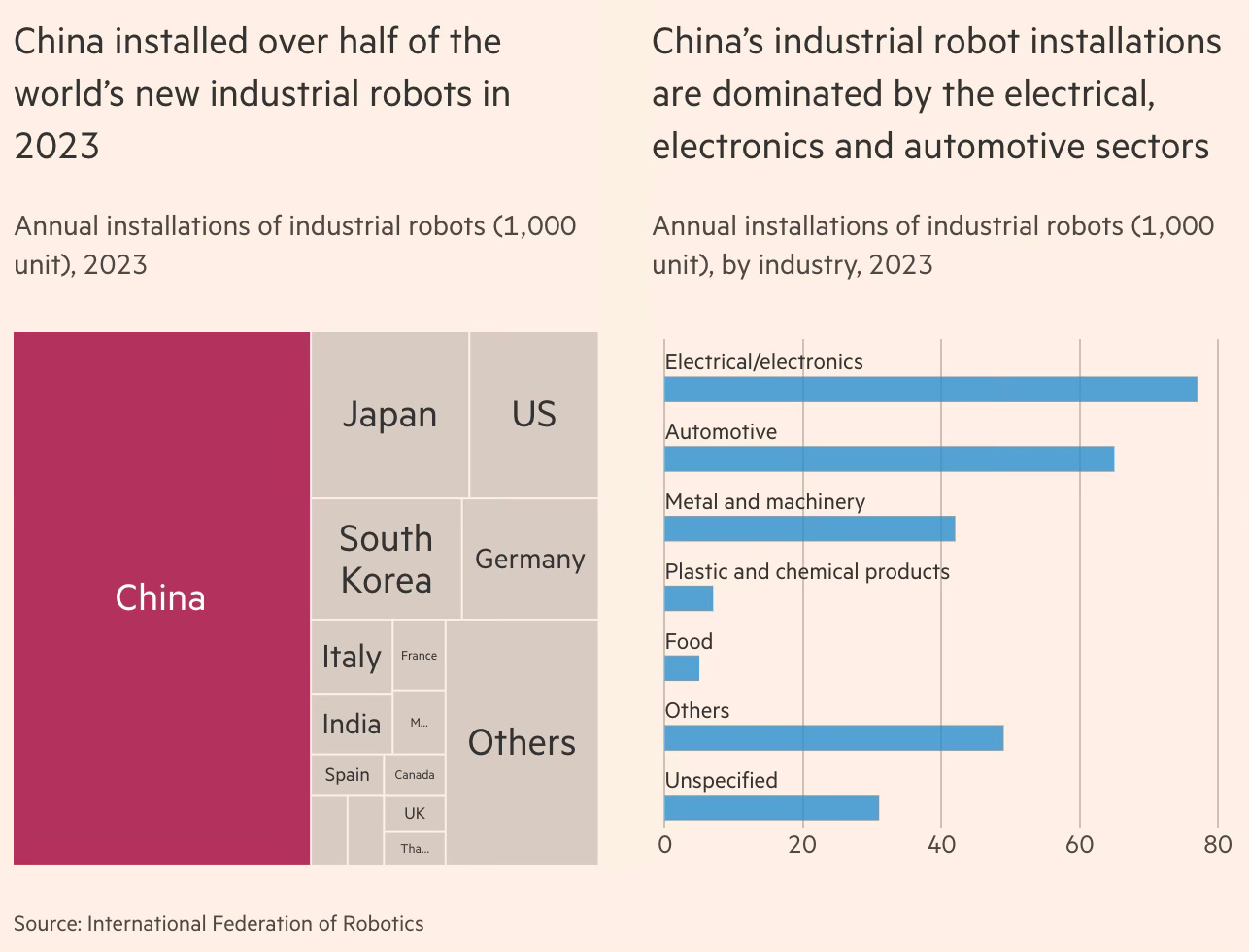
China—thanks in part to ambitious industrial policy efforts such as Made in China 2025—produced almost half the world’s chemicals, half the world’s ships, more than two-thirds of electric vehicles, more than three-quarters of electric batteries, 80 percent of consumer drones, and 90 percent of solar panels and critical refined rare-earth minerals... China was responsible for half of all industrial robot installations worldwide (seven times as many as the United States), and it is a decade ahead of anyone else in commercializing fourth-generation nuclear technology, with plans to build over 100 reactors in 20 years. The last great power to so thoroughly dominate global production was the United States, from the 1870s to the 1940s… 

This industrial and innovative strength can be activated for military purposes. China’s navy, already the largest in the world, will add a staggering 65 vessels in just five years, reaching a total size 50 percent larger than the U.S. Navy—roughly 435 vessels to 300. It has rapidly increased its ships’ firepower, surging from one-tenth of the United States’ vertical launch system cells a decade ago to likely exceeding U.S. capacity by 2027. Although China lags the United States in aviation, it has broken a long-standing technical barrier by building jet engines at home and is now rapidly closing the production gap, with the ability to build more than 100 fourth-generation combat aircraft annually. In most missile technologies, China is probably the world’s leader: it boasts the first antiship ballistic missile, impressive air-to-air missile range, and the largest stockpile of conventional cruise and ballistic missiles. And in a growing number of military fields, from quantum communications to hypersonics, China is ahead of any competitor. These advantages, built over decades, will persist even if China stagnates.

They write about the perils of underestimating China.

American observers tend to underestimate China’s ability to innovate, mistakenly assuming it simply copies and reproduces Western innovations. Like the United Kingdom, Germany, Japan, and the United States before it, China’s manufacturing strength creates a foundation for innovative advantage. State investment helps, too; it now rivals the United States’ investment in science. And China’s large population provides a deep talent pool and competitive scale. In ten industries of the future, according to a recent report from the Information Technology and Industry Foundation, China is near the leading edge of innovation (or better) in six.

They argue that despite all its challenges, in the medium-term China will be able to manage them enough to remain strongly competitive with the US.

Even if its weaknesses prove more severe than projected, China will remain vastly more powerful than any past U.S. competitor on the metrics most relevant for competition. Washington may have overestimated past rivals, including Germany, Japan, and the Soviet Union. But China is the first to outmatch the United States in size alone, as well as in several strategically relevant areas. Stagnant or not, Beijing will remain more formidable than any past challenger.

So what should America do? They argue that America must draw on its vast network of allies to achieve scale and outcompete China. 

To achieve scale, Washington must transform its alliance architecture from a collection of managed relationships to a platform for integrated and pooled capacity building across the military, economic, and technological domains. In practical terms, that might mean Japan and Korea help build American ships and Taiwan builds American semiconductor plants while the United States shares its best military technology with allies, and all come together to pool their markets behind a shared tariff or regulatory wall erected against China. This kind of coherent and interoperable bloc, with the United States at its core, would generate aggregate advantages that China cannot match alone...

For Washington, three realities must be central to any serious strategy for long-term competition. First, scale is essential. Second, China’s scale is unlike anything the United States has ever faced, and Beijing’s challenges will not fundamentally change that on any relevant timeline. And third, a new approach to alliances is the only viable way the United States can build sufficient scale of its own. Altogether, this means that Washington needs its allies and partners in ways that it did not in the past. They are not tripwires, distant protectorates, vassals, or markers of status, but providers of capacity needed to achieve great-power scale. For the first time since the end of World War II, the United States’ alliances are not about projecting power, but about preserving it. 

During the Cold War, the United States and its allies outclassed the Soviet Union. Today, a slightly expanded configuration would handily outclass China. Together, Australia, Canada, India, Japan, Korea, Mexico, New Zealand, the United States, and the European Union have a combined economy of $60 trillion to China’s $18 trillion, an amount more than three times as large as China’s at market exchange rates and still more than twice as large adjusting for purchasing power. It would account for roughly half of all global manufacturing (to China’s roughly one-third) and for far more active patents and top-cited journal articles than China does. It would account for $1.5 trillion in annual defense spending, roughly twice China’s. And it would displace China as the top trading partner of almost all states. (China is today the top trading partner of 120 states.) In raw terms, this alignment of democracies and market economies outscales China across nearly every dimension. Yet unless its power is coordinated, its advantages will remain largely theoretical. Accordingly, unlocking the potential of this coalition should be the central task of American statecraft in this century.

In terms of operationalising this alliance, they make specific suggestions.

The starting point for the United States can be long-standing bilateral alliances (such as those with Japan and South Korea) and multilateral alliances (such as NATO), along with newer partnerships (such as the AUKUS defense technology agreement with Australia and the United Kingdom) and less institutionalized groupings (such as the Quad, which also includes Australia, India, and Japan). But rather than simply celebrating these frameworks or expanding their membership, the task ahead is to deepen their function—to make them foundations for capacity-centric statecraft across multiple domains. These relationships have too often operated on the assumption that the United States provides security while others contribute political support or, at best, niche capabilities. It has been largely security-centric, too—focused on deterrence, access, and reassurance—while leaving economic coordination, industrial integration, and technological collaboration as emerging but still secondary concerns. The traditional model was simply not designed to compete with a systemic rival on the order of China. It is dangerously inadequate to the demands of the moment.

The U.S. approach to alliances and partnerships in recent decades has been shaped by a combination of strategic habit and structural hierarchy. Now, it must become a platform for generating shared capacity across all critical domains—not just military ones. That will require a level of coordination and codependence that is unfamiliar and will at times be uncomfortable for both the United States and its partners. For military power, creating scale requires capacity to flow in both directions, including investment in the weaker parts of the U.S. defense industry and more generous provision of advanced U.S. military technologies to allies who historically have not received it. For the economy, scale means building a shared tariff and regulatory wall against China’s excess capacity while constructing new mechanisms to coordinate industrial policy and pool allied market share. For technology, the challenge will similarly be to erect common investment rules, export controls, and research protections to prevent technology transfer to China while undertaking joint investment. These steps mark the difference between a coalition that is aligned in principle and one that is fused in practice. That shift—toward shared capacity as the foundation of strategy—will allow the United States and its partners to compete at scale and at speed…

The United States needs to construct what the historian Arthur Herman has called an Arsenal of Democracies: a networked defense industrial base built on joint production, shared innovation, and integrated supply chains… More ambitious efforts might involve joint ventures with Japanese and South Korean shipbuilders (which are two to three times more productive than U.S. firms); partnerships between Europe’s missile manufacturers and U.S. companies; or recruiting Japanese or Taiwanese firms to build legacy microelectronics in the United States… The United States’ own capability must also flow outward to allies… Sharing technology quickly is the key to ensuring that Australia builds nuclear submarines, that Asian allies have sufficient antiship cruise missiles and ballistic missiles, that Taiwan can deter Chinese invasion, and that India is able to turn the Andaman Islands to its east into a fortress that Beijing cannot ignore. In practice, this could mean harmonizing export-control laws, aligning procurement standards, and coordinating investment in chokepoint components, from semiconductors to optical equipment…

South Korean weapons can help Europe rearm and reindustrialize. French nuclear technology can support India’s submarine program. Norwegian and Swedish missiles can help Indonesia and Thailand defend their waters. Pooling capacity requires thinking across alliances, with the United States facilitating collective action.

This alliance would have geopolitical dimensions… 

Globally, the United States could pursue a new version of U.S. President Richard Nixon’s “Guam Doctrine,” which devolved responsibilities to partners after the Vietnam War. That would empower regional states—what former Australian Prime Minister John Howard called “deputy sheriffs”—to take the lead on security challenges in their neighborhood: Australia in the Pacific islands, India in South Asia, Vietnam in continental Southeast Asia, Nigeria in Africa. In practical terms, the next time a South Asian country faces challenges, the United States would defer to India’s judgment on what might serve regional stability or counter China’s influence rather than seek to advance its own preferences.

… and economic dimensions.

Instead, the United States and its allies and partners must find scale together, through a defensive moat against Chinese exports. Building a protected common market could start with coordinated tariffs on Chinese goods. But because tariffs can be easy to circumvent, a better approach might be to use coordinated nontariff barriers, including regulatory tools… Another tool is “preferential plurilateralism”—selectively opening allied and partner markets while creating higher barriers for Chinese goods. This approach, broadly supported by figures across the political spectrum, from Robert Lighthizer, the U.S. trade representative during Trump’s first term, to prominent Democratic legislators, echoes aspects of the early post–World War II trading system, which gave preferential treatment to members of the free world over autocratic rivals. If the era of free trade agreements is over for now, then sectoral agreements with allies could offer promising avenues for pooling markets while avoiding political sensitivities. Coordinated industrial policy instruments would also be useful, such as a new international industrial investment bank that would make loans to firms in strategic sectors to diversify supply chains out of China, especially in key sectors such as medicine and critical minerals. And coordinated efforts to remove barriers to allied and partner investment could, for example, allow the bypass of national security review.

A few observations:

1. All four proposals mentioned above have a common feature. They require the mobilisation of allies and, effectively, the creation of a new alliance against China. I’m not sure that, after all that has happened in the last 100 days, the Trump administration has the capital, much less the inclination, to mobilise this alliance. It would want an imperial alliance with it at the centre, with the vassals surrendering to its hegemony. The Plaza Accord and other instances of Western alliance did not emerge under such hostile circumstances. 

I’m not sure of any kind of Mar-a-Lago accord being done and implemented in good faith during the Trump regime. However, it’s quite possible that if the Trump administration wreaks havoc on the world economy and is succeeded by a Democrat President, it might trigger a cathartic mobilisation among the US and its allies. That might be the Overton Window to create a new global trade order. However, it’s most likely that the Trump administration’s policies would have created irreversible norms in areas like decoupling from China, the reshoring of US manufacturing, and burden sharing on defence by allies. Most importantly, it would have stigmatised the practice of egregiously subsidised export-led growth. This may well be the best outcome to hope for.

2. The proposal made by Doshi and Campbell is comprehensive and is the ideal configuration. Their case for an alliance among like-minded countries to combat China’s scale is particularly important and even an essential precondition for any meaningful effort to combat China’s manufacturing dominance. It would be a throwback to the immediate post-war era of alliance-building and collective commitment to combat communism and the Soviet Union. Here, though, the primary objective would be to create the economic scale in markets, supply chains, and manufacturing to outcompete China. 

It would also be a full-scale open declaration of Cold War 2.0 between a new alliance of democracies led by the US and another of autocracies led by China. Perhaps this ideological framing, with all its associated values, can be the glue to mobilise and cohere this new coalition. 

3. Even if an alliance materialises, the operationalisation of any proposal to continuously pursue balanced trade among allies will itself be an immense challenge. The distortions arising from such complicated forced incentives can be unpredictable and self-defeating. Perhaps the biggest political economy challenge would be in getting countries to exercise voluntary self-restraint and raise tariffs. Why would emerging economies voluntarily give up their comparative advantages and forego one of their major drivers of economic growth and job creation? 

4. If trade deficit is the issue, then why should it be confined only to merchandise trade and exclude services trade? Would the US force its Big Tech and Wall Street firms to exercise similar self-restraint and refrain from exporting their services to other countries and running up large trade surpluses? 

5. As mentioned earlier, merchandise trade deficits cannot be seen in isolation and are a function of the stage of development (Engel’s law) and structure of the economy, its comparative advantage, and the role of the US Dollar as the global reserve currency. If the US wants to continue its exorbitant privilege (unlimited borrowing in its currency), then the dollar (and Treasuries) must be the global reserve currency and (therefore) default safe-haven asset, and it should not be averse to running large trade deficits. This effectively means that the US cannot achieve a trade balance without also balancing capital flows, which comes in the way of its role as the holder of the global reserve currency. 

6. The US multinational corporations and technology firms have been among the biggest beneficiaries of globalisation and the dollar’s role as a reserve currency. A major share of their benefits has come at the cost of the US domestic manufacturers and the American labour. It’ll be America’s political choice on whether it wants to enjoy the exorbitant privilege by continuing policies that support Big Business at the cost of labour or reconcile itself to a reduced role for the US dollar with policies of the kind advocated by the likes of Michael Pettis. 

7. It’s common to find an idea itself becoming discredited due to its unbridled or unqualified pursuit or poor execution. China leveraged the forces of outsourcing and unbundling of supply chains, advances in ICT, the long period of global economic and political stability, trade liberalisation, and the emergence of the WTO and its membership there to push the boundaries of trade and manufacturing. Its state-directed capitalism used a combination of economy-wide repression (of wages, financial markets etc.), massive subsidies, and disciplined industrial policy to pursue manufacturing and merchandise trade dominance at a staggering and unprecedented scale. 

Its consequences for the world economy have been devastating, not only in destroying the manufacturing bases globally but also in discrediting the very idea of comparative advantage and global trade that has been one of the main sources of post-war economic prosperity. The Trump administration’s single-minded focus on imports and trade deficits owes almost entirely to China’s beggar-thy-neighbour trade policy. 

8. Developing countries like India should be careful not to lock themselves into a trade deal that centres on balancing bilateral trade deficits. India’s aspiration for sustained high growth is critically dependent on exports. The US is the world’s largest market, and it’s natural for emerging economies to run merchandise trade surpluses with developed economies. The proposals of Lighthizer, Miran, and Pettis do not even acknowledge these realities and instead propose a one-size-fits-all trade balancing. 

If India’s manufacturing push succeeds, it’ll invariably run large surpluses with the US. For example, if Apple decides to source all its 60 million US iPhones from India, that alone will significantly increase India’s trade surplus with the US which is already reasonably high at around $40 bn even without too much manufacturing exports. Add in more such exports from the reconfiguration of other supply chains, and it’s most likely that India emerges among the top five countries with which the US has a trade deficit. Will it then not require India to try to balance Therefore, it cannot bind itself to a treaty that caps its trade balance with the US. 

One tactical approach would be to ride out the Trump regime. It could target an opportunistic trade deal with the Trump administration without committing to any long-term binding targets. A tactical deal to buy time for a comprehensive bilateral or multilateral deal in four years!

9. India’s trade negotiation strategy is also weakened by its recent trade policies involving increased tariffs and non-tariff barriers (like the Quality Control Orders). President Trump is right in some ways in calling it the “tariff king”, at least among the major economies. It will now have to make significant concessions in many sectors in terms of liberalising its trade policy. 

This immediately creates two problems. One, on the economic side, having raised high protective barriers, even a normalisation of tariffs and removal of the recently erected non-tariff barriers would be a step change and abruptly expose the domestic manufacturers to foreign competitors. Two, on the diplomatic side, since negotiations are going on with others, most notably the EU, there will be pressure from them to offer the same terms given to the US.

Saturday, April 26, 2025

Weekend reading links

1. Revival of manufacturing in the US faces a collective action problem! It's good as long as I'm not working in manufacturing.

Interestingly, real value-added by US manufacturing has risen sharply even as employment has fallen.
This is also reflected in the shift up the value chain in the sectors involved. 
Since 1990 America has lost over 5mn manufacturing jobs. In that time, it has gained 11.8mn roles in professional and business services, and 3.3mn in transportation and logistical activities, linked to multinational supply chains.

2. One of the most important requirements for a deal between two parties is the space available to negotiate and their credibility as negotiating partners (preferably in terms of track record). If you present the other side with an egregiously unacceptable deal, then it virtually eliminates the likelihood of a deal even before the negotiations have started. 

The Trump administration appears to have erred in two very high-profile negotiations. The magnitude of the tariffs imposed on China and the subsequent public posturing may have made it impossible for the Chinese to not retaliate. On the same lines, the contents and the tone of the letter to Harvard and the track record of Columbia's submission failing to win reprieve on the release of funds meant that Harvard could not but reject the proposal. This tweet describes it nicely. 

Bullies can't make deals. 

3, Tyler Cowen makes a good point

The inconvenient truth, for China, is that its scale relies upon American power and influence. The Chinese export machine, for instance, requires a relatively free world trading order. The recipe to date has been “mercantilism for us, free trade for everybody else.” Yet Trump threatens to smash that framework. If the world breaks down into bitterly selfish protectionist trading blocs, China will be one of the biggest losers. After all, where will the Chinese sell the rising output from their factories?

4. Financial markets and Liberation Day

5. Daron Acemoglu looks ahead to America in 2050 and finds an empire that has collapsed. He explains the foundations of the American century. 

American economic success in the era after the second world war depended on innovation, which in turn relied on strong institutions that encouraged people to invest in new technologies, trusting that their inventiveness would be rewarded. This meant a court system that functioned, so that the fruits of their investments could not be taken away from them by expropriation, corruption or chicanery; a financial system that would enable them to scale up their new technologies; and a competitive environment to ensure that incumbents or rivals couldn’t block their superior offerings. These kinds of institutions matter under all circumstances, but they are especially critical for economies that rely heavily on innovation... A basic pillar of the American century was the country’s ability to shape the world order in a way that was advantageous for its own economy, including for its financial and tech industries... Democracy’s bargain everywhere, and especially in the US, was to provide shared prosperity (economic growth out of which most people benefited), high-quality public services (such as roads, education, healthcare) and voice (so that people could feel they were participating in their own government). From around 1980 onwards, all three parts of this bargain started to fall away.

Unsurprisingly, given his research focus on institutions, he traces America's decline to the erosion of its institutions, which gathered pace during the Trump administration. He foresees increasing business concentration and dominance by the Big Tech firms which come to a head in early 2030s resulting in a massive crash and economic collapse. 

But the real extent of the damage became clear only with the tech meltdown of 2030... After Trump lifted all roadblocks ahead of AI acceleration and cryptocurrency speculation, there was initially a boom in the tech sector. But within a few years the industry had become even more consolidated than before, and both insiders and outsiders came to realise that only companies favoured by the administration could survive. Gargantuan incumbents began crushing rivals, first by using their financial might, then by luring competitors’ workers and innovators (who curiously stopped producing valuable patents once they had joined these mega-firms) and ultimately by stealing their intellectual property. By this point, US courts had lost most of their objectivity, and because the mega-firms were the administration’s friends and allies, they benefited from favourable rulings even when they were blatantly stealing from smaller competitors and engaging in predatory pricing and vertical foreclosure to drive them out of the market. By late 2029, many commentators were questioning what was going on in the tech industry, which had invested heavily in AI but had little to show for this in terms of innovation or productivity growth.

6. In a brilliant essay, Sarah Churchwell compares today's America to that of the Great Gatsby's.  

During the novel’s composition, Fitzgerald immersed himself in reading about Oswald Spengler’s The Decline of the West. Spengler wouldn’t be translated into English until after Gatsby’s publication; Fitzgerald was gleaning his ideas for it from other writers. But he assimilated Spengler’s vision of a world where power-hungry leaders rose from cultures grown cynical and spent — ideas the Nazis later appropriated. Fitzgerald recalled responding to Spengler’s sense of civilisational senescence — what he described as “gang rule . . . the world as spoil”. Fitzgerald absorbed from these sources a pervasive sense of cultural decline, where hope feels both essential and doomed... Gatsby reaches beyond the moral failures of its characters to expose carelessness as a political force. This includes not only the oligarchy’s immunity from consequence, but also the way extraction was equated with success. The unheeding brutality of so-called world-builders has returned most recently in the dark fantasies of Trumpism, and in Silicon Valley’s fatuous motto, “move fast and break things”...

Exploiting anxieties about cultural collapse and demographic shifts, Trumpism frames progress as decline, insisting America must forcibly reshape itself to resemble a mythologised past. If there is a philosophical undercurrent to this panic, it is the same ambient declinism revived by today’s “Dark Enlightenment” ideologues — neo-reactionaries who dress authoritarian nostalgia and rigid hierarchy in the guise of pragmatism. These movements posture as intellectually serious but offer only recycled grievance, cherry-picked from a deeply unserious reading of history. ​The Dark Enlightenment advocates for replacing democratic institutions with authoritarian governance led by a powerful executive, often likened to corporate management... Some Dark Enlightenment thinkers tout “accelerationism”, which seeks to hasten the breakdown of current systems to pave the way for authoritarian governance... People such as Thiel, Elon Musk and Donald Trump seem to find democracy vexatious because it is a theory of power-sharing. Tech moguls who glorify efficiency and advocate “exit” from democratic accountability imagine themselves natural rulers, reasserting hierarchies that protect their privilege. Ironically, of course, it is the very democratic and economic infrastructures they scorn as obsolete that enabled their rise.

7. Good primer on wealth tax, with focus on the UK.  

8. Rote learning and concepts remain the focus of India's school education system. 

9. Globalised supply chain as illustrated by car manufacturing in the US (HT: Adam Tooze). 
11. Ruchir Sharma makes an important point about how US multinationals have been among the biggest beneficiaries of globalisation. 
The big losers are likely to be the biggest beneficiaries of globalisation — American multinationals. As barriers to trade and capital fell in recent decades, US corporations increased profits much faster abroad than at home. Profit margins for S&P 500 companies had held steady since the 1960s. Then margins nearly doubled to around 13 per cent after 2000, coinciding with China’s entry into the WTO. Many US giants generated “supernormal” profits, far higher than their developed world rivals, by cashing in on the appeal of American brands and outsourcing production to nations with the cheapest costs. Today, US multinationals generate more than 40 per cent of their revenue abroad. The biggest gainers were manufacturers, which on average pay their workers overseas 60 per cent less than staff at home. 

Now, American businesses will think twice before setting up new factories abroad and decisions will not be driven by the straightforward logic of maximising profitability. The large multinationals in particular will see profit margins under constant pressure. Amid anger over tariffs, “Made in America” is attracting more controversy than customers. Two in three Germans say they are avoiding US products. Social media campaigners are organising boycotts in Sweden and France. No nation is more irate than Canada, where consumers are switching from US to Japanese whisky, cancelling US streaming services and calling off trips to their southern neighbour.

12.  The rise and rise of gold

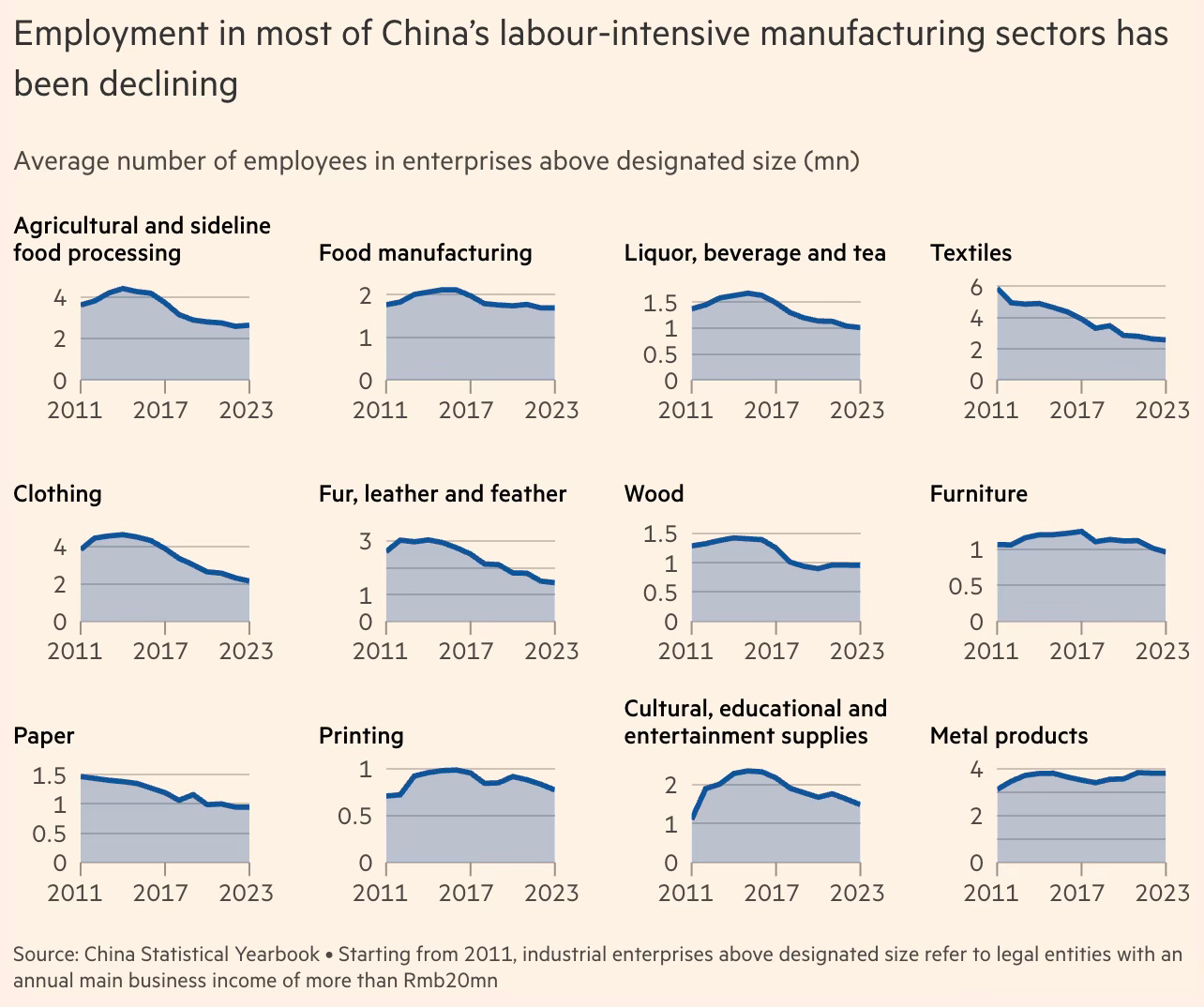
13. Amidst the Trump trade war and the backlash against Chinese imports across countries, Beijing must accommodate a similar ‘China Shock’ underway in the Chinese domestic economy due to the decline in its labour-intensive manufacturing. Rising wages, increasing automation, and stiff overseas competition, coupled with the trade wars are strong headwinds. As an illustration, China’s share of footwear exports has slipped from 70 per cent by 10 percentage points over the decade. 

Vietnam and Indonesia have been big beneficiaries of the migration of labour-intensive manufacturing, gaining more than 10 million jobs since 2011. Their exports have grown at 12.3% and 8.2% respectively from 2019-23. 

Analysis of 12 labour-intensive manufacturing industries between 2011 and 2019 by academics at Changzhou University, Yancheng Teachers University and Henan University found that average employment shrank by roughly 14 per cent, or nearly 4mn roles, between 2011 and 2019. Roles in the textile industry shrank 40 per cent over the period. An FT analysis of the same 12 sectors between 2019 and 2023 found a further decline of 3.4mn jobs… China shares of the export of 10 labour-intensive products — including home fixtures, furniture, luggage, toys and others — peaked at nearly 40 per cent in 2013, according to figures compiled by Hanson at Harvard Kennedy School. Hanson’s figures show that China’s share of the combined 10 goods had fallen to less than 32 per cent by 2018…

Beijing risks experiencing the same “China shock” that it imposed on advanced manufacturing nations after its entry to the World Trade Organization in the early 2000s, when orders migrated en masse from more expensive hubs to the cheap and efficient factories of Guangdong and other provinces. Now, the cheaper factories are in countries like Vietnam and Indonesia where exports have surged… Gordon Hanson, a professor at Harvard Kennedy School… points to the example of Martinsville, in the US state of Virginia, the onetime “sweatshirt capital of the world”, where in 1990 as many as 45 per cent of working-age adults were involved in manufacturing. The majority of those jobs “just disappeared” as the town failed to reposition its economy, he says — and today the poverty rate is double that of the nation.

Amidst the declining labour intensity, automation and robots have taken off in China, encouraged by President Xi’s vision of “new productive forces” - high-tech machines run by smart systems to develop sophisticated products. Besides, automation also improves productivity and allows Chinese companies to remain competitive. 

Amplifying automation are demographic trends. China’s working-age population peaked at over 900 million in 2011 and is estimated to decline to 700 million by 2050. The decline, coupled with rising education levels, means that youth are reluctant to work on production lines. While all this creates employment opportunities and consumption, the problem is with the large numbers of workers who will be displaced and are not equipped to seize the emerging opportunities.

14. The death of Pope Francis has been accompanied by articles on his legacy. For a start, he was unique in many ways.

The Argentine prelate was the first pope from the Jesuit order, bearer of a centuries-old tradition of challenging authority and operating with relative independence from the Vatican. He was not only the first pope from Latin America and the western hemisphere, but the first non-European pontiff since the Syrian-born Gregory III (731-741). In this respect, his elevation to the Holy See on March 13 2013 reflected the steady movement of Roman Catholicism in modern times from its historical heartland of Europe to the Americas, sub-Saharan Africa and Asia.

More importantly, his 12-year tenure saw intense debates on several important areas like sexual behaviour, clerical morality and the liturgy. 

In the last months of his reign, Francis lashed out at the Trump administration’s plans for “mass deportations” of migrants... Another powerful example was his 2015 encyclical, Laudato sì (On Care for Our Common Home), a document that for the first time placed concern for the environment on the same level as human dignity and social justice in Vatican doctrine... If such language was guaranteed to raise the hackles of climate change sceptics, no less heated was the conservative response to Amoris Laetitia (The Joy of Love), an apostolic exhortation that Francis published in 2016. Less authoritative than an encyclical, in that it set out a possible course of action rather than binding Vatican doctrine, this document raised the possibility of allowing divorced and remarried Catholics to receive the sacraments — a significant break with Catholic tradition... Francis came under frequent conservative attack for his decision to reverse a 2007 initiative of Benedict and reimpose restrictions on the celebration of some sacraments according to old Latin rites. Yet Francis was no darling of progressive Catholics, either. Many regarded his approach to issues such as homosexuality and the role of women in the Church as too cautious.

His tenure, however, was widely critiqued among the conservative Maga Catholics in the US who were worried that the reforms were deviating from the Bible and the original teachings. They denounced Francis as a spokesman for a liberal cosmopolitan elite and hope that the death of the pope will mark an end to his reformism.  

Distrust of Francis was particularly widespread among the “Maga” Catholics, a group that combines support for Trump’s populist, nationalist agenda with an embrace of Christian orthodoxy and deep suspicion of liberal trends in the church... “Trump has boosted Catholicism by reaffirming some essential things, such as border protection, the defence of human life and the fact there are only two genders,” said John Yep, leader of Catholics for Catholics, a political campaign group. “That was good for Catholics and that’s why 58 per cent of Catholics voted Republican in November.”... Traditionalists were particularly angered by Amoris Laetitia, his 2016 apostolic exhortation, which raised the possibility of allowing divorced and remarried Catholics to receive the sacraments. They also denounced his 2023 decision to approve blessings for same-sex couples, his advocacy of action against climate change and his welcoming approach to migrants. For conservative Catholics who had always been uncomfortable with the reforms of Vatican II, his hostility to the Latin mass was particularly hard to accept.

The rise of MAGA populism among Catholics is an indicator of certain long-term rightward shifts in the US. 

“The clergy that has graduated from seminaries in the last 10-20 years [in the US] tends to be more conservative,” said Janna Bennett, chair of the Department of Religious Studies at the University of Dayton, Ohio. She noted the role played by institutions such as the Franciscan University of Steubenville, in Ohio and Ave Maria University in Florida, both of which have a conservative reputation and have provided a pipeline of aspirant priests and lay ministers with a traditionalist mindset. According to a survey published in 2023 by the Catholic Project, a research group at the Catholic University of America, more than 80 per cent of priests ordained since 2020 described themselves as theologically “conservative/orthodox” or “very conservative/orthodox”. The researchers said that while theologically “progressive” and “very progressive” priests made up 68 per cent of new ordinands in the 1965-69 cohort, that number had today “dwindled almost to zero”. It is no surprise, then, that Pope Francis became such an irritant to many American Catholics.

15. Chris Miller makes the case for component-based tariffs in the case of semiconductor chips.

An iPhone might be assembled in China, but most of the key components are from elsewhere. There is a precedent here in watches, where the tariff rate is calculated based on components like batteries and wrist-straps. The Biden administration previously considered imposing component tariffs on Chinese chips, before backing off, worried about the complexity. Yet imposing component tariffs on chips from China — which produces less than 3 per cent of chips in US supply chains — is far easier than imposing tariffs on all foreign chips.

16. Finally, China's policies with its neighbours are an important reason for the hard limits to its influence in Asia. Consider the example of setting up fish farm installations in international waters in the Yellow Sea, which are part of the country's 'grey zone' tactics to bully neighbours in their territorial waters and establish claims

Chinese companies started building large-scale deep-sea fish farms in 2016 for Norwegian companies raising salmon in the Atlantic Ocean. Construction on the first Yellow Sea installation, the Shenlan 1, began in 2018 in the “provisional measures zone”, a disputed area in the Yellow Sea where Chinese and South Korean exclusive economic zones overlap. It was built by Wanzefeng Group, a fisheries company based in eastern Shandong province. A second structure, the Shenlan 2, was installed last year in the PMZ by a joint venture between Wanzefeng and state-owned Shandong Marine Group, despite Seoul’s protests. South Korea dispatched a marine research vessel last month to investigate but was forced to turn back after an hours-long stand-off... some observers warned that such actions in disputed waters could be a precursor for more solid territorial claims. “They put their fishing vessels and fish farms there with subsidies and infrastructure support, and after a while they use the fact of that presence to underpin a historic claim,” said a senior government official in the Philippines, which has repeatedly clashed with China in the South China Sea. 

That stance has also been endorsed by some Chinese observers. Current affairs blogger Shijiu Chen Nianhuashe wrote last month: “On the surface, we are building ordinary fish farms. But in fact, this is a smart move to increase our actual control in these disputed waters.” Nam Sung-wook, a professor at the Graduate School of Public Administration at Korea University, said a chain of Chinese structures in the Yellow Sea could ultimately obstruct South Korean or Korea-based US naval vessels from accessing the East China Sea in the event of a conflict in the Taiwan Strait. “We should have taken action sooner,” Nam said. “If any country doesn’t respond to such territorial issues immediately, it becomes a fait accompli.”

Saturday, April 12, 2025

Weekend reading links

1. Good NYT oped about Mexico's President Claudia Sheinbaum, perhaps the most popular leader currently among all electoral democracies. 

2. Starbucks runs into rough weather in its India growth plans. The same story of the large consumption class not turning out as expected.

Starbucks has sharply slowed its ambitious expansion in India as hard-pressed middle-class consumers cut spending at the coffee chain’s stores. The US company announced in January last year it would nearly triple its Indian outlets to 1,000 by 2028, but in the last three months of 2024, it opened just over half the 30 targeted for the quarter... Starbucks, which currently has 473 outlets in 74 Indian cities, opened only a net 16 stores in the three months through December, down from a post-pandemic peak and quarterly record of 29 in the January-March period last year.

3. Trump's irreversible destruction of trust in America.

One of the great advantages that the US has over China or Russia is that it has a global network of allies, created over the long term. Countries like Japan, Germany, Australia, Canada and Britain have often had doubts about the wisdom of particular US policies. But they have stuck with America because they believed, in the last resort, that their alliances were based on a firm bedrock of shared interests and values. The tariff war launched by the US — combined with the often hostile language of the Trump administration — has shaken that trust to the core. Mark Carney, the new prime minister of Canada, says that the US is “no longer a reliable partner”. Friedrich Merz, the next chancellor of Germany, has called for Europe to “achieve independence” from America. Anthony Albanese, the Australian prime minister, says the Trump administration’s tariffs on Australia are “not the act of a friend”.

4. Gideon Rachman compares Trump's approach to global markets as that of a "mob boss". 

There is a distinct whiff of Don Corleone in Donald Trump’s approach to trade and diplomacy. Like a movie mob boss, Trump knows how to switch between menace and magnanimity. Treat him with respect and he might invite you to his house, where you can mingle with his family. But the menace never disappears. As Trump once explained to Bob Woodward, he believes that “real power is — I don’t even want to use the word — fear.” Back in the Oval Office, Trump has employed fear and threats as a tactic for shaking down some of America’s top law firms and Ivy League universities. Like respectable members of the professional classes, unexpectedly threatened by the mob, Trump’s targets paid up quickly in the hope that all the unpleasantness would swiftly go away. Law firms like Paul Weiss and Skadden Arps agreed to do pro bono work for the administration to avoid being targeted by Trump’s executive orders.

He argues that this approach has limitations when faced with tariffs and sovereign countries. 

Trump’s assumption seems to have been that if he punched America’s trade partners hard enough, they would have no option but to make a deal. His son, Eric, urged targeted countries to see sense and to quickly buy off his dad. “I wouldn’t want to be the last country that tries to negotiate a trade deal with @realDonaldTrump,” he wrote. “The first to negotiate will win — the last will absolutely lose,” he continued. “I have seen this movie my entire life.” But the real world and the global economy turn out to be much more complex than the movies that Eric Trump was brought up on. The White House has started a trade war with every major trading nation simultaneously. It has also taken an axe to the supply chains of many of the world’s leading multinationals. There are simply too many actors involved for Trump’s mob boss tactics to work. There are all the investors who have rushed to sell their shares, causing stock markets to tank. There are the manufacturers who simply cannot do business under the conditions created by Trump — and who are shutting down production lines. And, as for Chinese President Xi Jinping’s mob, they have decided to fire back rather than buckle. This is getting extremely messy... Trump’s approach to America’s allies is to treat them like errant members of a protection racket. Some of them have fallen behind on their payments to Nato? They better fix that fast or, says Trump, he will encourage Russia to do “whatever the hell they want”... 

Trump treats Russian leader Vladimir Putin and Xi Jinping as if they are the heads of rival mafia families. There will be times when the families clash. Some foot soldiers and bystanders might get hurt. But, in the end, the goal is to reach a deal so that everybody can go back to making money. Geopolitical theorists might rationalise a carve-up like this as the division of the world into rival spheres of influence. But, it also resembles an agreement between different mafia families, to give each other a free hand on their own turf. The local godfather is then free to push around the smaller players in the neighbourhood — such as Taiwan, Ukraine or Canada — without comment from the rivals.

5. A peek into China's ultra-competitive and dynamic EV market.

From cars with roof-fitted drones to free self-driving software and five-minute battery charges, the rapid pace of electric vehicle innovation by China’s BYD is powering what some analysts believe is the most intense period of competition in the car industry... sales in China, the world’s biggest EV market, are forecast to rise about 20 per cent to 12.5mn cars this year. As EVs start to outsell cars with internal combustion engines, 78 per cent of those sales are being soaked up by just 10 companies, including 27 per cent solely by BYD, according to HSBC data. That leaves about 52 car brands fighting for the remaining 22 per cent of the Chinese market, including more than 30 marques that produce fewer than 30,000 cars a year and might soon face oblivion, according to Yuqian Ding, a Beijing-based analyst with HSBC. With a new car model released on average every two days in China, keeping pace with cutting-edge technology — such as assisted driving functions and the latest infotainment systems — has become crucial for survival as the market inevitably consolidates... Features such as automatic highway lane changing and automated parking were already becoming commonplace in China. But local carmakers are also increasingly developing more sophisticated autonomous driving software earlier than many analysts forecast, thanks to the help of AI-based large language models.
6. Tara Zahra writes about how globalisation and its consequences led to the World Wars. 
In 1913 the value of exported goods made up 14 percent of the world economy. By 1933, shattered by World War I and the Great Depression, it had slumped to 6 percent, and it did not recover until the 1970s. The backlash propelled the rise of right-wing authoritarian and fascist movements that promised to reverse or seize control of the forces of globalism. It ended in a catastrophic world war.

7. Challenges for iPhone manufacturing due to the Trump tariffs.

iPhone assembly is currently done in mainland China by companies such as Taiwan’s Foxconn and Pegatron and to a lesser extent in India, where Tata is building capacity as an Apple supplier. It is the final step in a vast chain of Apple suppliers, most of which are currently based in Asia. There are 387 individual parts involved in final assembly of an iPhone 16, according to market research group TechInsights, which include chips, circuit boards, batteries, wires, lenses, screens and metal and plastic parts. Apple’s most recent public supplier list, which covers the 2023 fiscal year, shows the 187 companies responsible for 98 per cent of the company’s direct spend that year. Of these companies, 169 had a manufacturing presence in mainland China and Taiwan.

Apple's efforts to relocate manufacturing to the US raises several questions. Given the reality of globalised supply chains, tariffs by the US on imports from Vietnam, Taiwan etc., not to mention China, would naturally make it impossible for US manufacturing to be competitive. Then there's the cost. 

It would probably cost Apple “several billions” of dollars to shift even a portion of its iPhone supply chain to the US, according to estimates by Morgan Stanley analysts. Wedbush analyst Dan Ives estimated it would take Apple three years and $30bn to move just 10 per cent of its supply chain from Asia to the US. “This is a company that has embedded itself in China and south-east Asia for decades, now seemingly looking at the prospect of being forced to change the entire way in which they think about building and pricing an iPhone,” says Erik Woodring, analyst at Morgan Stanley. The pressure comes despite Apple pledging in February to hire 20,000 staff as part of a $500bn US spending plan for the next four years that includes a new facility manufacturing servers for artificial intelligence in Texas. The fact that Apple does not currently run its own manufacturing facilities, but outsources them to Asia-based companies it has spent two decades and billions of dollars nurturing with specialist equipment, adds an additional layer of complexity.

8. This week saw the mother of all U-turns by President Trump on reciprocal tariffs, when he put them on hold for 90 days to negotiate deals with all trade partners except China (with who he ratcheted the tariffs to 125%) after having firmly ruled out any reversal on multiple occasions. 

Trump’s announcement, with the blue-chip S&P 500 closing up 9.5 per cent and the Nasdaq Composite surging more than 12 per cent. It was the best day for the S&P 500 since 2008 and the strongest for the Nasdaq since 2001. The massive rally in stocks added about $4.3tn to the market value of the S&P 500, according to Financial Times calculations based on FactSet data. The gains reversed some of the heavy losses for US stocks since Trump announced his wide-ranging tariffs a week ago.

The Bond markets did their bit to force the Trump reversal. While the stock markets unravelled in the face of tariffs, it was expected that the bond markets would in line with theory respond upwards. However, the opposite happened as the bond markets too tanked amidst signs of poor demand in a Treasury auction. A possible reason is the unwinding of "basis trades" (involving leveraged bets, often up to 100 times, so as to profit from the convergence between the futures price and the bond price) by hedge funds that had to exit US Treasuries in large volumes. 

Another factor driving the reversal was the push back from the plutocrats. Paul Krugman is spot on here

9. Elon Musk and DOGE conflicts of interest.

Job cuts at the US traffic safety regulator instigated by Elon Musk’s so-called Department of Government Efficiency disproportionately hit staff assessing self-driving risks, hampering oversight of technology on which the world’s richest man has staked the future of Tesla. Of roughly 30 National Highway Traffic Safety Administration workers dismissed in February as part of Musk’s campaign to shrink the federal workforce, many were in the “office of vehicle automation safety”... The NHTSA, which has been a thorn in Tesla’s side for years, has eight active investigations into the company after receiving — and publishing — more than 10,000 complaints from members of the public. Morale at the agency, which has ordered dozens of Tesla recalls and delayed the rollout of the group’s self-driving and driver-assistance software, has plunged following Doge’s opening salvo of job cuts, according to current and former NHTSA staff... 

Musk has promised customers and investors that Tesla will launch a driverless ride-hailing service in Austin, Texas by June and start production of a fleet of autonomous “cybercabs” next year. To do so, Tesla needs an exemption from the NHTSA to operate a non-standard driverless vehicle on American roads because Musk’s cybercabs have neither pedals nor a steering wheel... After a spate of incidents, the NHTSA in 2021 introduced a standing general order that requires carmakers to report within 24 hours any serious accidents involving vehicles equipped with advanced driver assistance or automated driving systems. Enforcing the order has been a vital tool for the agency to launch investigations into Tesla and other carmakers because there is no federal regulatory framework to govern cars not under human control. It was critical for a recall of 2mn Teslas in December 2023 for an update that would force drivers to pay attention when its autopilot assistance software was engaged.

10. Costs of Brexit

A variety of studies by the National Institute of Economic and Social Research, the Economics Observatory and the Centre for Economic Reform suggest that by 2022, business investment would have been 10-12.4 per cent higher but for Brexit. Former Bank of England Monetary Policy Committee member Jonathan Haskel said lost investment had already cost the UK £29bn. Other studies are less downbeat — the strength of UK service industries has softened the impact — but all point in one direction. The Office for Budget Responsibility continues to predict a 4 per cent permanent hit to UK productivity and a 15 per cent long-run fall in exports and imports. Even a more hopeful recent report by the LSE’s Centre for Economic Performance found that 16,400 businesses had simply stopped exporting to the EU after 2021.

11. Big Law deserves the Trump treatment. The decision by Paul Weiss, a storied US Law firm, to cut a deal with the US Government has saved it from an executive order by President Trump that in effect banned it from appearing in federal courts and cases over claims that its work on progressive causes undermined the judicial system. 

Paul Weiss is not the only firm to have been targeted by the Trump administration, and judges have since frozen critical parts of similar orders against Jenner & Block, WilmerHale and Perkins Coie for being illegal. But rather than litigate, Karp cut a deal with Trump that cancelled the executive order in exchange for concessions including $40mn worth of pro bono legal services on issues important to the president... Skadden Arps, an arch-rival to Paul Weiss for many of its corporate clients, reached a deal with Trump to offer $100mn worth of pro bono services to avoid being hit by an executive order. And this week, the deals kept apace. On Tuesday and Wednesday, Willkie Farr & Gallagher and Milbank, respectively, reached similar agreements to the one Skadden struck, meaning four major firms have now forged deals with the White House. In the Willkie and Milbank deals, the firms agreed to perform $100mn worth of pro bono legal services to Trump’s pet causes... some such as Perkins Coie, Jenner & Block and WilmerHale have resisted.... “No one is willing to go on the record because everyone’s concerned. I don’t want to pop my head up because you don’t know how it’s going to get smacked. But that’s very different from saying we don’t support what was done.” Another corporate adviser is more blunt: “It was a mafia-like shakedown . . . There was no choice. Do you have a choice whether to pay the mob?”
... While a large number of small and medium-sized firms are willing to support Perkins Coie in its legal effort to fight sanctions imposed by the Trump administration, the Financial Times revealed at the weekend that not one of the 20 top law firms in the US — most of which have large dealmaking businesses — has so far given their “unconditional support” to the effort... Shortly after Trump targeted Perkins Coie and Covington, Karp contacted the heads of several law firms to try to organise support for them. The response was almost non-existent, and also failed to materialise when the White House issued an executive order against Paul Weiss. “Disappointingly, far from support, we learned that certain other firms were seeking to exploit our vulnerabilities by aggressively soliciting our clients and recruiting our attorneys,” he wrote in the email to employees of the firm after he reached a deal with Trump... Some clients warned the firm’s partners that unless the matter was resolved swiftly, they would move their business elsewhere... During the meeting at the Oval Office, in a move that was not expected by Karp, the president patched in on speaker Robert Giuffra, the co-chair of rival firm Sullivan & Cromwell and a Trump donor, to help hammer out a truce. Karp swallowed his pride and agreed to the terms imposed by Trump...

Paul Weiss is one of a handful of firms that has created a thriving free-agent market for lawyers. Partners a decade ago would make perhaps $3mn or $4mn a year and would enjoy lifetime employment and generous pensions. With the growth of private equity firms, hard-knuckled hedge funds and a regular churn of multibillion-dollar corporate acquisitions, a small set of lawyers now command eight-figure pay packages and have no reluctance about jumping firms for the highest bidder... today’s lavishly paid top talent are less likely to display allegiance... One lawyer who has gone up against Paul Weiss put it more bluntly: “There’s too much fucking money. When a Big Law partnership is $2mn a year, people can have some principles because the fall isn’t so bad.” The calculation changes entirely, the person says, “when they are making $20mn a year”. Under Karp’s leadership, the firm has often been a ruthless advocate for the powerful. Its biggest clients include Apollo Global Management and Goldman Sachs, while it has also represented members of the Sackler family, who founded Purdue Pharma, the pharmaceutical behemoth that has been accused by prosecutors of stoking the US opioid crisis. Indeed, one of the considerations for the firm was its stable of private equity clients, many of whom are Republicans. As one partner puts it, if the firm only acted for clients whose ethics they agreed with then they would have no clients.

Arizona is experimenting with a reform to break the stranglehold of Big Law.

Since 2021, Arizona has been dishing out law licences under an “alternative business structure” programme that allows non-lawyers to own and run law firms. In February, the state’s Supreme Court issued a licence to global accounting firm KPMG, which plans to challenge major law firms for low-margin, high-volume work such as reviewing contracts. It’s a notable departure from previous practice, whereby state regulators restricted ownership of law firms to practising lawyers and strictly forbade non-lawyers from sharing in the fees or profits from legal work... The state has already granted over 100 other ABS permits to businesses that range from a unit of cut-price legal adviser Rocket Lawyer to Axiom, a nationwide staffing company that rents out lawyers on demand, like an Uber. Texas, Utah and Washington are considering similar systems. Together, these add up to a significant shifting of the ground underneath the feet of traditional law firms in the US, and the list will soon be swelled by more accounting and wealth management firms of national renown, according to advisers working on those applications. Arizona’s initiative follows liberalisation of law firm ownership in the UK and other countries, and is turbocharging innovation in the business of law across the US, with entrepreneurs and investors already testing the limits of existing state bar rules... the UK, which opened up its legal sector to outsiders in 2011. Law firms there are permitted to accept outside investment or float on the stock exchange, while non-law firms can also add legal practices to their offerings.

12. US corporate profits are at record highs.

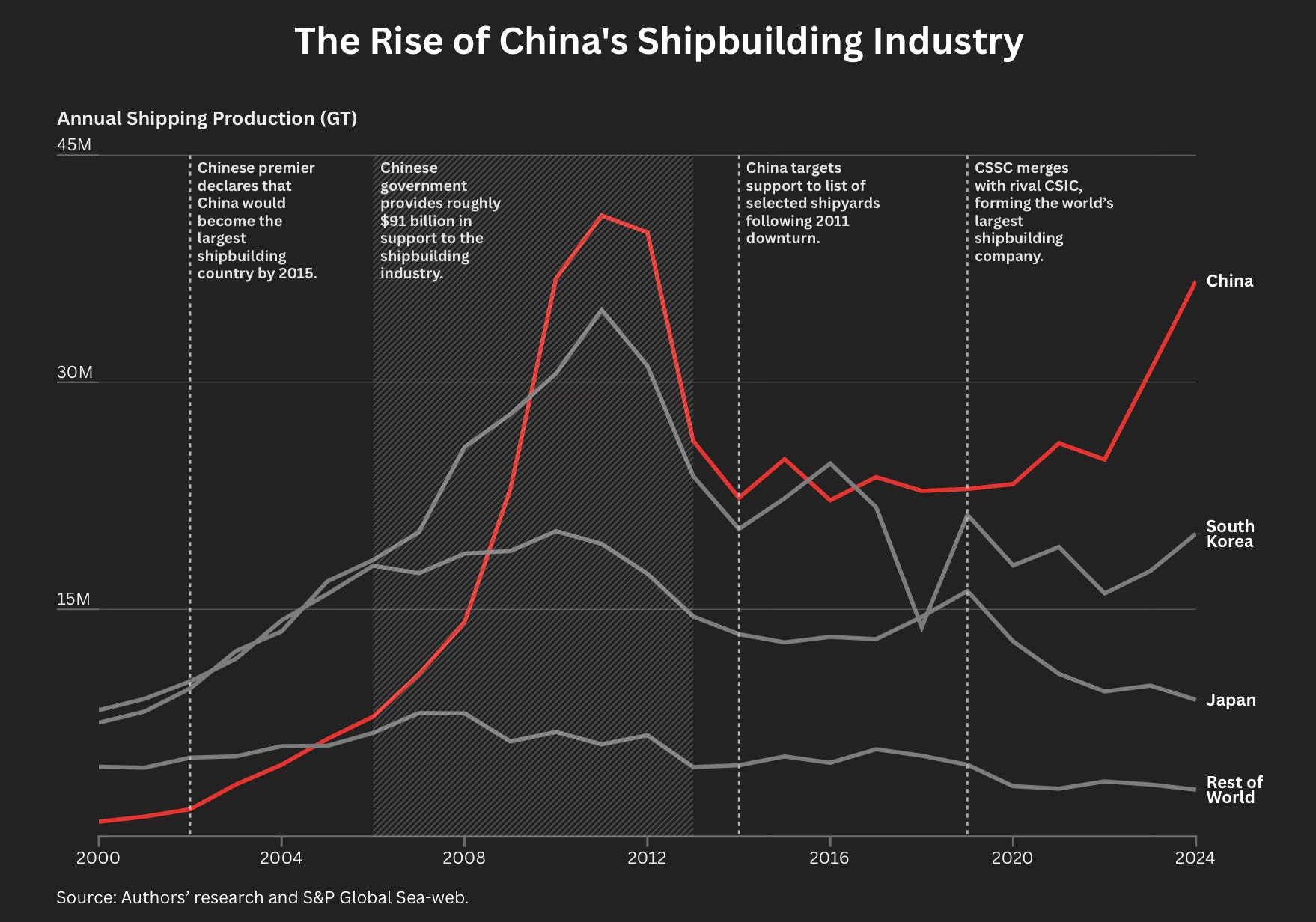
Shipyards across the United States built just five large ocean-going merchant vessels in 2024, combining to a volume of 76,000 gross tons (GT). In the same year, just one Chinese shipbuilder, the state-owned China State Shipbuilding Corporation (CSSC), delivered over 250 ships, adding up to a staggering 14 million GT. That is more vessels by tonnage than the entire U.S. shipbuilding industry has produced since the end of World War II combined. When adding in the rest of China’s shipyards, the scale of the challenge before the United States and its allies becomes impossible to ignore… China’s rise in the global commercial shipbuilding industry has been extraordinary. The country’s market share surged from a mere 5 percent of the world total in 2000 to over 53 percent in 2024. South Korea and Japan, the only two other prominent players in the industry, have seen their combined share slip from 74 percent to 42 percent over the same period.

There’s an important strategic dimension to shipbuilding industry, especially the way China has structured its industry.

Many of the shipyards that support China’s commercial production also produce warships for the Chinese navy. The ability to leverage dual-use technologies, infrastructure, and materials for both commercial and naval shipbuilding provides cost savings and strategic benefits. In peacetime, orders for merchant ships sustain demand that keeps dual-use production lines humming, and during economic downturns naval ship orders can help offset downswings in commercial markets. In wartime, commercial production lines can be converted to naval production, rapidly scaling up the ability to churn out and repair warships.

The article describes how a tightly interlocked web of private and state-owned shipbuilders has enabled China to build this dual-use industrial complex. Foreign buyers have been central to building and sustaining this Chinese industry at such scale.

Foreign firms—many of which are based in countries with close defense relationships with the United States—are pouring billions of dollars of ship orders and transferring key technologies to China’s military industrial base. As a result, they are inadvertently bolstering China’s naval modernization… Between 2019 and 2024, foreign firms (outside of China and Hong Kong) purchased over 70 percent of all ships produced in China. Despite the visible ties between China’s Tier 1 shipyards and China’s navy, foreign buyers have ordered heavily from these yards. Between 2019 and 2024, foreign firms purchased 305 commercial vessels from Tier 1 shipyards alone, collectively bringing in tens of billions of dollars in revenue and pushing China’s naval yards further into the forefront of the global commercial shipbuilding market… Taken together, the hundreds of orders placed by foreign companies into Chinese shipyards have amounted to a massive injection of funds. According to China’s national shipbuilding industry association, the country’s commercial ship exports brought in a staggering $43 billion in 2024.