Substack

Showing posts with label Central Banking. Show all posts

Saturday, February 21, 2026

Weekend reading links

1. On the origins of infrastructure financing in the UK.

In the summer of 1858, Britain’s parliamentarians soaked the curtains in the Palace of Westminster with lime chloride in an attempt to counter the “Great Stink” emanating from the river Thames. It failed. The prime minister demanded the Metropolitan Board of Works construct a sewerage system, legislating to allow the board to raise £3mn. This was to be repaid by a three-penny levy on all London households for 40 years. By 1900, the municipal bond market in England was about 50 per cent of the market for UK government debt. Today it is just 4.7 per cent. Back then, most infrastructure projects were not only financed by the private sector but also backed by hypothecated cash flows from money raised locally. For example, the debt for the 1892 Elan Valley Aqueduct to pipe water into Birmingham was funded by an increase in water rates on businesses and households there. So the residents of, say, Manchester were not funding infrastructure elsewhere.

2. India is marching ahead on adoption of electrotech.  

3. Germany is the poster child for central bank independence.

4. Spurred by surging data centre loads, electricity demand is rising sharply in the US.

Data centre power demand will surge from 34.7 gigawatts in 2024 to 106GW by 2035, according to BloombergNEF, a research group, equivalent to more than 80mn homes. Overall US electricity demand is forecast to jump by a quarter by 2030 and by 78 per cent by 2050, compared with 2023, according to consulting firm ICF... Between January and November, the latest month for which data is available, the cost of electricity for residential customers in the US increased by 11.5 per cent.

5. Most Indian state boards focus on memory and conceptual understanding, as opposed to analysis and application. 

6. At 16%, US after tax corporate profit margins are at historic highs.
7. Nick Bloom, Paul Mizen, Gregory Thwaites et al have an estimate of the costs of Brexit (HT: Adam Tooze)
These estimates suggest that by 2025, Brexit had reduced UK GDP by 6% to 8%, with the impact accumulating gradually over time. We estimate that investment was reduced by between 12% and 18%, employment by 3% to 4% and productivity by 3% to 4%. These large negative impacts reflect a combination of elevated uncertainty, reduced demand, diverted management time, and increased misallocation of resources from a protracted Brexit process.
8. Some data on students and migrants from Asia in the US. Even as enrolment of Chinese students has declined, that of Indian students has taken off since 2014. While Chinese students were mainly for the UG programs, Indian students have been mostly for PG studies. (HT: Adam Tooze)
Indian students dominate the workforce of computer science workers. 
Similarly, Indians dominate physicians and Filipinos dominate nursing. 
9. India has one of the lowest free floats in its equity markets.
10. Japan's public debt at 237% of GDP is way off the charts, and considerably constrains Sanae Takaichi's room to manoeuvre. 
11. Tej Parikh writes that UK's biggest economic challenge is its political instability.
The UK doesn’t have a productivity puzzle. The causes of Britain’s weak underlying growth are well known and discussed ad nauseam. Why policymakers aren’t delivering is the bigger conundrum. Instability undermines business investment, hiring and planning decisions, and absorbs the political bandwidth that could be used to address lacklustre growth... Uncertainty and slow growth weaken the appeal of UK assets too. Pound sterling and British stocks have underperformed relative to peers over the past decade. Long-term UK government borrowing costs have remained elevated compared with other G7 nations, having come under frequent selling pressure thanks to fiscal mishaps... For all the turbulence, Britain remains attractive. London remains the leading European destination for foreign direct investment. The country’s strengths in finance, university research, tech and life sciences are draws. Cheap assets add to the allure.
12. Fascinating account of China's largest hotel chain, H World, with 12,700 hotels, adding 1700 hotels in 2025, aiming for 20,000 hotels by 2030, and took in 8.3 m guests during last year's Lunar New Year holiday. As a reference, Marriot has 10,000 hotels worldwide. 
H World was launched in 2005 by Ji Qi, co-founder of online travel booking site Ctrip, after he took inspiration from the multi-brand French group Accor... Its Hanting Inn brand, a fixture of the streets of major Chinese cities, often charges well below Rmb300 ($43) a night, while mid-range Ji Hotels typically cost slightly more. H World has several other brands, while internationally it also operates German brand Steigenberger. Its franchise model mirrors an approach that other Chinese businesses have used to expand in consumer sectors from bubble tea to fast food. For the “vast majority” of its franchised hotels, H World retains a degree of control, sending in hotel managers on its own payroll under what it calls a “manachise” approach. In the US, “typically the franchisees decide almost everything . . . we think in China this would not work,” said He. “A lot of people would not abide by your rules.”
13. VC funding for India's tech startups has fallen 73% since 2021, which also coincided with the rise of Byjus.
14. Fascinating account of the Jeffrey Epstein world

15. Shruti Rajagopalan has a good essay on India's AI ambitions, and more. This on regulation.
The EU went first and went heavy, a binding cross-sector AI Act with tiered risk categories, compliance obligations, and a governance apparatus that could employ a small city. China took the authoritarian-efficiency route. Regulate fast, regulate specifically, and make sure the state retains control over what models can say and do. The US, characteristically, has been light touch at the federal level, leaving governance to a patchwork of executive orders, state laws, and vibes. India, with these guidelines, has landed somewhere interesting, closer to the US in its instinct to avoid a standalone AI law, but far more deliberate in articulating why it is choosing not to regulate horizontally yet. The framework’s core bet is that India’s existing legal infrastructure (the IT Act, the Digital Personal Data Protection Act, sectoral regulators like the RBI and SEBI) can handle most AI risks if enforced properly and updated where needed...

Do not regulate the technology itself, govern its applications through the regulators who already understand those domains. Build incident databases so you learn from failures instead of pretending to prevent them through preemptive compliance theater. Use “techno-legal” mechanisms (standards, system-architecture-level controls, provenance tools) so that compliance scales without armies of auditors. Create sandboxes so regulators can see what actually goes wrong before writing rules. The explicit preference for “innovation over restraint,” listed as a core principle, rejecting the EU’s precautionary posture. Both committees looked at Brussels and decided that regulating AI the way you regulate pharmaceuticals, before you know what the side effects actually are, is a bad trade for a country where AI adoption is still nascent and unevenly distributed... The liability framework it recommended is graded. The regulated entity remains liable to consumers for any losses, but first-time failures where the entity followed prescribed safeguards and reported promptly would not automatically trigger full supervisory penalties. A rigid liability regime that punishes every probabilistic error will cause institutions to constrain AI capabilities to the point of uselessness.

16. Shyam Saran writes about Marco Rubio's speech at the Munich Security Conference, describing it as an "unabashed white, racist manifesto". 

His remarks celebrated the history of conquest, exploitation, barbarity, and even ethnic cleansing, which has marked the history of Western imperialism and colonial empire-building across Asia, Africa, and Latin America. He wants this to be a source of pride and inspiration, not something to “atone for purported sins of past generations”. What is perplexing is that the history of the world after the Second World War, which is often described as an American era, is instead seen as a period of Western decline: 
“But in 1945, for the first time since the age of Columbus, it [i.e. the West] was contracting. The great western empires had entered into terminal decline accelerated by godless communist revolutions and by anti-colonial uprisings that would transform the world and drape the hammer and sickle across vast swaths of the map in the years to come.” Anti-colonial uprisings, which would include our own against British colonialism, are not celebrated as struggles for freedom and human dignity but as evidence of the abdication of the Western will to rule. Strange that this should come from a representative of a country that is celebrating 250 years of its own successful war of independence against British colonialism.

17. AI is leading to changes in software industry business models, resulting in less predictability and more uncertainty.

Software companies have, for decades, sold their wares on a “per seat” basis, where an employee gets unlimited use of a package of tools. Think of the traditional Microsoft 365 licence... In a world of AI “agents” carrying out duties autonomously, that model makes less sense. The unit of account will no longer be users but tasks completed, queries undertaken, and data “tokens” used. Sticky, predictable, year-round software-as-a-service revenue — the kind of thing that private equity firms love because it makes companies easier to load up with debt — may become an endangered species. Some are already embracing the post-seat era. Snowflake, a data management software maker, charges based on consumption, as does Databricks, an unlisted hotshot valued at $134bn, according to Crunchbase. ServiceNow is one of many working on hybrid models, where monthly fees meet pay-as-you-use add-ons... consumption-based pricing... Software companies’ predictability was an asset that contributed to high valuations.

18. Europe telecom industry facts of the day

Europe has more than 44 mobile operators that each have more than 500,000 subscribers compared with eight in the US and just four in China, according to industry group Connect Europe’s State of Digital Communications 2026 report.

19. China high-speed railway facts.

China’s railways have in recent days been ferrying about 20mn passengers a day, with half a billion train trips expected over the 40-day lunar new year period... Nearly three-quarters of passengers will travel at speeds of greater than 200kph, streaking across the country in the white and silver high-speed trains that have become a defining symbol of China’s industrial might. In December, China reached 50,000km of high-speed rail, enough track to circle the globe, compared with 8,500km in the whole of the EU as of 2023. Just over two decades after it was launched, the network now links 97 per cent of cities with populations of more than half a million... China opened its first high-speed passenger line in 2003 between Qinhuangdao and Shenyang in the north-east, with speeds of 200kph. The World Bank estimated in 2019 that China spent about $17mn to $21mn per kilometre on high-speed rail... Another 20,000km of track is planned by 2035... 

China has benefited from a combination of relatively cheap land, enormous scale, standardised designs and a permissive regulatory environment, experts say. The country’s rail project is now overseen by China State Railway Group, a huge state-owned enterprise that operates the network and helps fund new line development. The group plans to invest Rmb520bn ($75bn) this year... The group’s total liabilities have mounted to Rmb6.4tn. China State Railway reported a modest profit of Rmb11.7bn in the first three quarters of 2025, following several years of losses during the Covid-19 pandemic. Analysts said profits from the freight network helped offset losses from passenger high-speed rail. Local governments typically share the burden of building and operating the tracks. But many are struggling with their own shaky finances following the pandemic and the collapse of the property market.

20. Finally, the US Supreme Court has struck down the tariffs imposed by Donald Trump under the International Economic Emergency Powers Act. Also this

Saturday, February 7, 2026

Weekend reading links

1. Dame Sarah Mullally, 63, becomes the 106th Archbishop of Canterbury, the first woman to serve as the senior-most bishop of the 85 million-strong Anglican Communion since the role's creation for Augustine of Canterbury in 597 AD!

2. Kevin Warsh as Fed Chairman may pursue significant changes to the way the Fed sets monetary policy.

The Fed’s vast bond-buying programmes, which Warsh initially supported as a Fed governor during the financial crisis, are at the centre of the Trump administration’s allegations that the central bank is acting far beyond its remit to keep prices in check and maximise employment. The... quantitative easing, expanded the Fed’s balance sheet from less than $900bn in 2008 to a peak of almost $9tn. The balance sheet now stands at $6.6tn, following a three-year reversal of QE — dubbed “quantitative tightening” — that the rate-setting Federal Open Market Committee has recently paused amid signs banks were falling short of reserves. Warsh has said he would like to shrink it much further... Warsh in April said successive QE programmes meant politicians found it “considerably easier appropriating money knowing that the government’s financing costs would be subsidised by the central bank”... 

Warsh’s claims that the response to the pandemic “was the biggest monetary policy error in 45 years”... Along with shrinking the balance sheet, Warsh would like to change the Treasury-Fed Accord, a 1951 agreement seen as the foundation for the US central bank’s freedom to set interest rates free from political pressure. Warsh has said he wants a “recommitment” to the accord that would entail a smaller, less powerful central bank, with some control of its balance sheet handed to the Treasury... Trump’s nominee will push the Fed’s staff to gather more “real-time information” to rely less heavily on official government data that comes on a longer lag... He could also deploy economists to find out whether his view is right that an AI-led productivity boom can boost US workers’ pay without stoking inflation — a move that could potentially pave the way for more interest rate cuts.

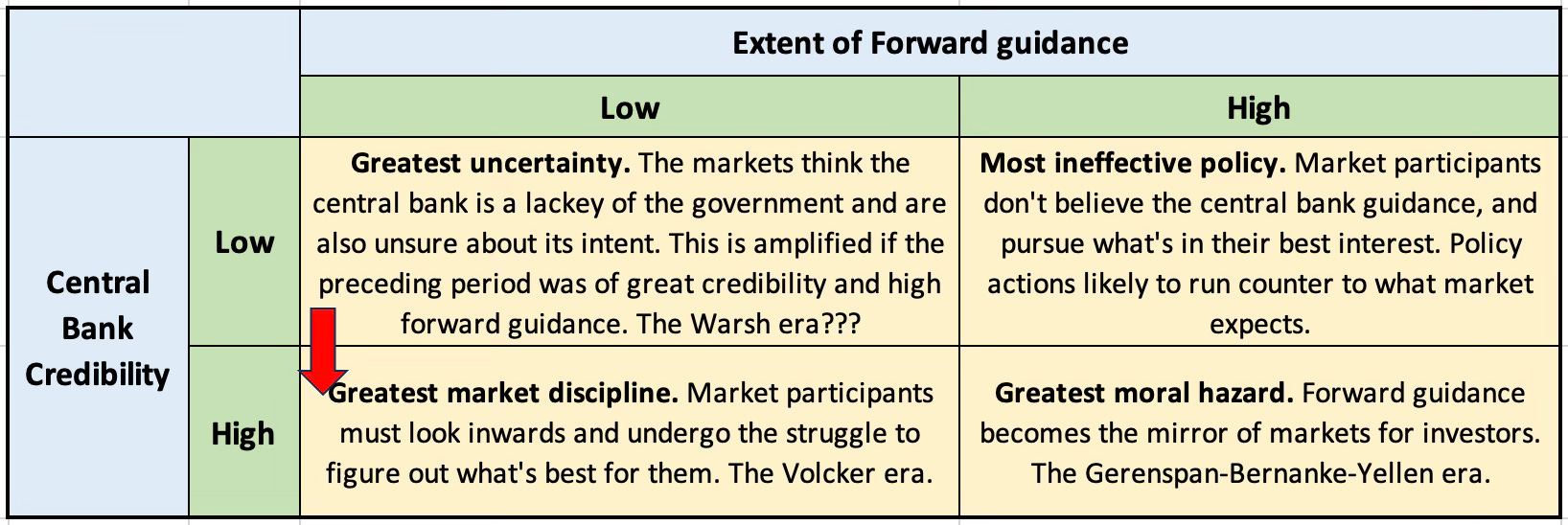
This is Warsh's WSJ op-ed of March 2023, where he called for an "economic regime change", including stopping the practice of providing forward guidance and stopping the provision of forecasts of the path of interest rates. The expectation now is that Fed may dispense with its widely followed dot plot showing the interest-rate projections of each participant of the FOMC, and end the tradition of press conferences by Fed chair following every FOMC meeting. 

3. Soumaya Keynes points to new research that links commerce and markets to the shaping of cultural norms.

One 2010 study ran money-sharing experiments across a diverse mix of communities, including smaller ones where people foraged or hunted for food. In those less marketised societies, norms around fairness towards strangers seemed weaker... A new study by Max Posch of the University of Exeter and Itzchak Tzachi Raz of Hebrew University takes a different approach, exploring the US economic transformation between 1850 and 1920. Thanks in part to a vast expansion of railroads, internal commerce became much easier. Mail-order catalogues served remote communities with items including shoelaces, suitcases and booze. The researchers compared places and people gaining more and less market access. Unsurprisingly, they found that in the places that enjoyed juicier connections, work shifted to involve co-operation with more distant partners...

Compiling many metrics, they found that on at least three dimensions, new markets did seem to affect culture. First, commercial opportunities made people more outward-looking. In places that became more connected, Americans became more likely to marry someone outside their local community and parents more likely to pick out nationally common names for their children. Second, access to markets raised tolerance levels, as measured by higher religious diversity and greater variation in family size, as well as mothers’ ages at their first birth. (The logic being that more dispersion should reflect more of a “you do you” attitude.) Third, greater market access came with higher trust towards others, as extracted from language in local newspapers. This measure wasn’t perfect, but reassuringly matched trends in more recent survey data, and fell during wars... Instead, they emphasised a story of rapid cultural adaptation among people who were most engaged with impersonal, anonymous exchanges. The changes in naming practices, for example, were concentrated among migrants working in industries that were more exposed to trade with other parts of the country. For those working in construction and entertainment, the market access had no effect.

4. Paul Blustein questions claims about the dollar's dethronement. 

Participants in this market are international banks, securities firms, multinational corporations, insurance companies and pension funds — the biggest private actors in the financial system. Their globe-girdling operations require the movement of immense amounts of money across borders on a constant basis. They use the market to hedge themselves against currency fluctuations by trading a pair of currencies (say, the dollar and Japanese yen) twice, first at the current exchange rate and then swapping back later at an agreed rate. Japanese life insurance companies, for example, invest their portfolios heavily in US Treasuries and other dollar securities. Because they have obligations in yen to their policyholders, they need to protect themselves against movements in the yen-dollar rate and they use swaps to do so. These sorts of transactions occur at such a huge scale that, according to data from the Bank for International Settlements, the amount of outstanding swaps currently stands above $100tn. Some 90 per cent involve the dollar, reflecting the myriad ways it is used. Unwinding all of this activity and subbing in another currency would be staggeringly costly and difficult.

The $12.6 trillion European holdings of US Treasuries confer less leverage to the Europeans than they appear.  

Europe’s US government debt holdings don’t translate into usable leverage, because most of them can’t be politically co-ordinated and selling would be self-defeating. The reason is simple. “Europe” may hold a lot of US assets, but that doesn’t mean Europe can control them or deploy them as a co-ordinated political tool. Much of Europe’s exposure actually sits in private portfolios — pension funds, insurers, banks, and asset managers — not in a single public balance sheet that can be mobilised strategically.

But while a deliberate and coordinated weaponisation is difficult, "a slow, decentralised buyers' strike, as investors gradually stop adding to US assets" is a distinct possibility.

5. Singapore's acclaimed public housing model.

More than three-quarters of its citizen and permanent resident population live in 1.1mn government-built flats, bought at subsidised rates... Rising property costs, notably in the resale market, have sparked concern over affordability, while the lottery system for allocating flats, which favours traditional nuclear families, is being tested by changing social norms. Over the longer term, property values are also being eaten away by the 99-year leases on which they are sold. “The main thing that worries me is that . . . as the lease clock ticks down and as the stock ages, housing equity drops to zero,” Gee added...

When Singapore introduced national service after gaining independence in 1965, home ownership was also encouraged as an incentive for conscripts to fight for their country. Today, more than 90 per cent of Singaporeans live in an owner-occupied home — among the highest rates in the world. Properties are allocated to would-be buyers via a lottery system to applicants who are typically required to be married, engaged or older than 35. Prices are eased through a raft of government subsidies based on personal circumstances. Singaporeans can also dip into their mandated savings and pension plans and obtain mortgages and loans from the HDB directly. But critics have said that the lottery system is unfair to singles and non-traditional families, for whom it is harder to get a flat. Singapore’s marriage rate has been steadily falling in recent decades, dropping from 57 per 1,000 unmarried males in 1994 to 42 in 2024. The HDB system has also been used by Singapore’s government to promote multicultural integration by setting limits on the proportion of different ethnic groups in the same estate. However, this policy has caused problems for some in the resale market by restricting potential buyers... Construction ground to a halt during the Covid-19 pandemic... Wait times to move into a property rose from three years to as many as six. As a result, more buyers turned to the resale market, where HDB owners can sell properties after five years of occupancy. This led to a sharp rise in resale prices, especially in more desirable estates.

6. FT has a long read on Latin America's rightward turn.

“Crime and violence is clearly the top concern of Latin Americans today,” says Jean-Christophe Salles, Latin America chief executive at pollster Ipsos. “It is the biggest concern in almost every country.” Some 55 per cent of Latin Americans name crime and violence as their prime worry, according to Ipsos data, against just 34 per cent worldwide. In Chile, the figure rises to 62 per cent. Fear of crime propelled arch-conservative José Antonio Kast to a landslide presidential election victory last month in Chile over a Communist opponent, Jeannette Jara. His broader rightwing message had failed in two previous elections, but this time he won by focusing on pledges to erect border fortifications, deport illegal migrants and reduce crime...
El Salvador’s President Nayib Bukele is the inspiration for many rightwing challengers across the region. His extraordinary success in transforming El Salvador from one of Latin America’s most murderous countries to one of its safest — albeit through mass incarceration and authoritarian rule — is firing up anti-establishment conservatives across the region just as it enters a major election cycle... Bukele’s newly built giant prison, the Centre for Confinement of Terrorists (Cecot), which has capacity to hold about 40,000 inmates, many detained indefinitely... Even Costa Rica, a country so peaceful that it decreed the abolition of its army in 1948, has been shaken by record levels of drug-related murders. Ahead of elections on February 1, its outgoing president, Rodrigo Chaves, appeared with Bukele to lay a foundation stone for Costa Rica’s own version of Cecot, a $35mn maximum security jail project with capacity for 5,100 prisoners... In Peru, which is set to go to the polls in April, leading presidential contender and former mayor of Lima Rafael López Aliaga is promising to fight what he calls “urban terrorism” with life sentences for serious crimes... In Mexico and Uruguay, leftwing incumbents are cracking down on violent crime to curry favour with voters.

7. The rising share of debt raising by hyperscalers (companies like Alphabet, Amazon, Meta, Microsoft, and Oracle) to finance their AI infrastructure rollouts.

8. What does the India-EU FTA mean for Europe?
9. Ed Luce has this description of the breadth of the Jeffrey Epstein network.
This includes the sitting US president and a previous one, big Wall Street figures, a network of Ivy League luminaries, Silicon Valley entrepreneurs, foreign government officials, Democrats, Republicans, a Maga influencer, a far left scholar, British and Norwegian royals, wives and girlfriends of powerful men, government lawyers, heads of law firms, movie directors and endless celebrities. Epstein’s network is an MRI of the establishment. The idea that anyone did not know about Epstein’s conviction as a sex abuser is absurd. Some people spurned his social approaches. Having been invited in 2010 to an Epstein dinner with Woody Allen and then Prince Andrew in New York, the magazine editor, Tina Brown, replied: “What the fuck is this . . .? The paedophile’s ball?” Brown’s reaction should have been everyone’s. So should that of Melinda Gates, the now ex-wife of Bill Gates, who stepped into Epstein’s home once and immediately regretted it. Alas, their reaction was all too rare.

10. Fascinating account of the egregiously one-sided US-Japan trade deal.

Proposed projects are screened for “strategic and legal considerations” by a committee of US and Japanese members, according to a joint MOU and a document prepared by Japanese officials. Projects are then sent to an investment committee headed by US commerce secretary Howard Lutnick, who chooses which proposals to send to the US president for approval. Donald Trump has the final say on which projects are “deemed to advance economic and national security interests”. Japan and its state-backed bank can delay or refuse to proceed but face potential penalties, including higher tariffs. Funds for approved projects — from JBIC or with guarantees from Japan’s insurance corporation — then flow into an SPV alongside “the provision of land, water, power, energy, offtake agreements, regulatory support, etc” from the US. Free cash generated by projects will be split equally until the Japanese loans are paid back, according to officials. After that, the US will receive 90 per cent. Officials believe Japanese companies outside the project can also make agreements with it separately, with terms negotiated that are different from the US-Japan split of cash flow... The way the agreement with the US is structured also means that if Japan delays or refuses to fund a project recommended by Trump, it could be liable for “catch-up” payments or an increase in tariff rates.

11. Elon Musk may have pulled off the biggest bluff of the century by merging SpaceX with xAI to create the most valuable private company at a combined valuation of $1.25 trillion. xAI, which had revenues in the low hundreds last year and is burning through $1 billion a month, was bought by SpaceX at an eye-popping valuation of $250 billion. Musk says that the move was needed to launch data centres into space, build factories on the moon and colonise Mars. Musk controls both the private companies, whose combined valuation has increased by over $1 trillion in 18 months. To pay for the deal, SpaceX will issue $250 bn in new shares, thereby diluting the existing shareholders.

This from the comments section sums up the deal

You set your own price for a company you own, sell it to another you own and, miraculously you can then leverage the hell out of it.
South-east Asia’s second-largest economy has been stuck at about 2 per cent growth for the past five years, with its pivotal drivers of consumption, manufacturing and tourism all in decline... Making matters worse are prolonged political instability and frequent changes in leadership. The royalist-military establishment has been locked in a stand-off with reformist parties that have won the past two elections but have been blocked from power. Thailand has had three prime ministers in as many years... Signs of economic malaise are increasing. Banks worried about defaults are lending less, the property market is in its worst slump in three decades and headline inflation turned negative last year, signalling weak demand. Thailand’s stock market has been the worst performer in Asia over the past 12 months, declining 10 per cent in 2025 in local currency terms. The government has projected 2 per cent growth this year, but the IMF has forecast just 1.6 per cent, the slowest among major south-east Asian economies...
Manufacturing has been on the decline for years, weighed down by weak domestic demand, an influx of cheaper Chinese goods and intense competition from newer manufacturing hubs such as Vietnam. That has also taken a toll on Thailand’s once mighty auto sector. The country was a regional hub for car manufacturing but Nissan, Honda, Suzuki and others have shut down factories or scaled back production in recent years... Household debt-to-GDP is close to 90 per cent, among the highest levels in Asia, as wages have remained stagnant. And Thailand’s population has been shrinking for four years, with the birth rate hitting a 75-year low in 2025... Tourism, another economic engine, is sputtering and this has had a knock-on effect on retail, agriculture and hotel construction... Thailand recorded 32.9mn foreign visitors in 2025, a 7 per cent fall from the previous year and still below the pre-pandemic peak of 40mn tourists in 2019.

13. US federal debt is at pre-war highs.

14. With the purge of General Zhang Youxia and Gen Liu Zhenli, Xi Jinping has removed all the six members of the Central Military Commission (apart from himself), 35 out the 43 generals in leadership positions of the PLA.
While the Ministry of Housing and Urban Affairs recommends 40-60 buses per 100,000 people, India’s cities together have only about 47,650 buses, nearly 61 per cent of which are concentrated in just nine mega cities.

16. Primer on Project Vault, the $12 bn US program to procure and develop a reserve of critical minerals for civilian and other purposes through a public-private partnership involving the US federal government and US companies. 

Project Vault is a public-private partnership that will buy and store critical minerals and rare earth elements. These include gallium and cobalt, which are essential for modern technology and defence equipment. It will combine $1.67 billion in private seed funding with another $10 billion from the US government’s Export-Import Bank... Companies will make an initial commitment to buy materials later at a fixed inventory price. They will also pay some upfront fees. Based on these commitments, companies can give Project Vault a list of the materials they need. The project will then purchase and store those materials. Manufacturers will pay a carrying cost that covers loan interest and storage expenses.

16. Mihir Sharma has an excellent op-ed that raises the questions about the emerging international order arising from the US National Security Strategy released in December and the more recent National Defence Strategy. Both are anchored around an America First approach that narrowly defines its interests in terms of drug trade, energy security, immigration, etc. 

The rest of the world matters only as a market or as a source of certain raw materials that are not specifically available in the US. This is not a status-quoist view of the world, nor is it radical or aggressive. It is essentially defensive. US interests are defined far more narrowly than earlier, and are more localised. But they will be as aggressively and unilaterally defended as ever, perhaps more.

I'll blog on this in due course.

17. Some staggering numbers in the Big Tech capex plans announced this week, along with their quarterly earnings which have spooked the markets. 

Big Tech stocks sold off heavily after unveiling plans to spend $660bn this year on AI, as investors fret that the “breathtaking” capital expenditures are outpacing the earnings potential of the new technology. Amazon, Google and Microsoft are set to lose a combined $900bn in market value since filing their quarterly earnings over the past week... Along with social media giant Meta, their proposed outlay on data centres and specialised chips needed to train and run advanced AI models would mark a 60 per cent rise from the $410bn they spent in 2025 and a 165 per cent increase from $245bn in 2024... Even a 14 per cent boost to their combined annual revenue to $1.6tn was not enough to overcome the pessimism.
18. Big infrastructure deal in the UK, as Canadian pension fund majors CPPIB and Omers announced sale of their 34% and 33% stakes in Associated British Ports (ABP) in a deal estimated to value the UK's biggest port operator, owning 21 ports in the UK, at more than £10bn. ABP was taken private in 2006 by a group of investors including Goldman Sachs' infrastructure arm and Omers, for £2.8bn. Ownership has chaged over the years, with CPPIB taking stake in 2015, along with others like Singapore's GIC and Kuwait Investment Authority's Wren House Infrastructure. CPPIB manages C$777.5bn ($568bn) of assets and Omers manages C$141bn of assets.

Saturday, September 27, 2025

Weekend reading links

1. For all talk of AI focus, it does not appear to be showing up in Infosys's personnel hiring over the last six months. 
Amidst all the investment frenzy in the US and elsewhere over AI, Infosys is spending Rs 18,000 Cr buying back its shares, on top of spending Rs 95,000 Cr on buybacks and dividends over the last five years. 

2. China's dominance of the wind turbines market increased sharply since 2020! (HT: Adam Tooze)
As recently as 2020 the global wind turbine market was still a two-horse race with the US not out of the running. Today, China produces more than double the turbines built by the US and Europe put together.
3. It must remain a matter of big concern that even as the world economy has financialised, the cost of sending hard-earned and pitifully small amount of remittances remains elevated at an astronomically high 7.9% for Sub-Saharan Africa (HT: Adam Tooze). 
Additionally, the cost of sending remittances to Africa remains the highest in the world, which dampens the benefits from migration that accrue to Africa. Remittances are one of the most tangible ways for countries of origin to realize the development benefits of migration. Despite the technological advancements in recent decades, the cost of sending remittances remained at 6.2 percent globally in the second quarter of 2023, more than twice the Sustainable Development Goal target of 3 percent. This is largely due to the fees and foreign exchange margins that migrants and their families must pay in origin and destination countries. SubSaharan Africa was the region with the highest cost of remittances in 2023, at 7.9 percent, whereas South Asia had the lowest cost, at 4.3 percent. Figure 3.3 shows that in 18 of Africa’s 29 core countries and seven of Africa’s nine periphery countries for which data are available, the cost of sending remittances is higher than the global average.

The low rate for South Asia is one of the less discussed successes of India's financial market evolution. 

4. France's public debt has risen alarmingly since the GFC.

5. Adam Tooze points to the scale of Friedrich Merz's fiscal stimulus (via TS Lombard). 
Clearly, Germany is stimulating its economy with vengeance, and it appears to have enough space to do so.

6. Unit economics of AI solutions in India is not very attractive.
Netflix, a video-streaming service, costs as little as $1.69 a month in India, compared with $7.99 in America. For cloud services with a low marginal cost, this is no great sacrifice. But running AI queries is expensive. Processing costs for typical users currently hover at around $0.07 per million “tokens” (the units of data processed by AI models) and the response to a single query can run to hundreds or thousands of tokens. That expense is the same whether the user is in Bangalore or the Bay Area.

7. This sums up the challenge with making money in India.

While India’s large population offers scale, it is a difficult market to monetise. According to digital market researcher Sensor Tower, Indians led the world in 2024, downloading 24.3bn apps and spending 1.13tn hours on them. However, their spending was not even in the top 20, at less than $1bn.

8. Palestine is rapidly disappearing.

9. The Economist has an issue focusing on gig workers, who number 200 million in China (40% of urban workforce) of whom about 84 million rely on platform-based employment (delivering parcels and food, and driving bikes and cars) and another 40 million are freelance factory workers. There are some emerging trends in gig work in China.
Lately gig work in China has spread to its vaunted manufacturing sector. The regimented proletariat is gradually being replaced by millions of casual workers who fill jobs “on-demand”, flitting from one factory floor to another at the direction of giant recruitment platforms. The jobs often require no skills beyond a knowledge of the Roman alphabet. The workers may stick with them for no more than a few weeks or even days. Researchers put their number at perhaps 40m, a third of China’s manufacturing workforce—and more than three times the size of America’s.

One reason for the rise of this gig army is that firms want flexibility. Employers prize the freedom to scale their business up or down, responding to seasonal demand, the vagaries of the market and the shifting winds of geopolitics. Technology has played a role, too. Smartphone apps help match customers’ orders with available delivery drivers; in manufacturing, technology has automated away many tricky tasks that used to need experience. Even as this has created jobs for highly skilled engineers, it has left gaps in assembly, packaging and inspection that any warm body can fill. Flexible employment of all kinds suits many workers. Those who are adept at navigating the platform economy can earn more by job-hopping than they could from a single employer.

This is an important snippet about the gig workers.

The average age of factory gig workers is 26. About 80% are male; 75-80% are single and childless. In manufacturing hubs increasing numbers of young workers sleep in parks and under overpasses.

10. FT reports of failures by subprime auto lender Tricolor Holdings and car parts supplier First Brands Group that raise questions about lending and gatekeeping standards. 

Tricolor had won pristine triple-A ratings as it borrowed in credit markets, while First Brands may have amassed as much as $10bn in debt and off-balance sheet financing and was close to raising even more last month... Both companies made use of asset-backed debt, with Tricolor bundling up subprime car loans into bonds and First Brands tapping specialist funds to provide credit against its invoices. At its core, asset-backed finance is the ability to lend against a specific asset or loan, including consumer credit card balances, leases on railcars and solar panels, aircraft and music royalties...
US investment firms have in recent years pushed deeper into asset-backed debt, often pitching it as a safer product than the loans to junk-rated companies that are their bread and butter. But Tricolor is now being probed over fraud allegations by the US Department of Justice, while some investors have long had questions around First Brands’ financial reporting and use of invoice factoring, with lenders now concerned that they lacked visibility about the scale of off-balance sheet financing... Several large banks have also been caught up in the collapse, including JPMorgan Chase and Fifth Third, which are exposed to losses on hundreds of millions of dollars' worth of auto loans. A second investor who has since sold their position in packaged-up Tricolor loans said they had no idea how potential financial irregularities went unnoticed by JPMorgan Chase, one of the banks that underwrote debt offerings.

These kinds of news are now a recurrent staple of financial markets.

11. Michael Moritz comes out all guns blazing at the decision to levy $100,000 fees for H-1B visas.

Every day the Oval Office seems closer to becoming the equivalent of what the sidewalk outside Satriale’s Pork Store used to be for Tony Soprano: a place where a dubious cast of characters spawns brutish extortion schemes and hit jobs... As usual with the Trump administration, the announcement was chaotic and half-baked... Set aside the drama, the announcement demonstrated yet again the fragile grasp the president and his acolytes have about why the US — especially its technology sector — has worked so well. The large tech companies hire foreign nationals because they possess particular skills. They also retain them to perform tasks in areas where the US has labour shortages.

12. New Zealand appoints Anna Bremen, a Swedish economist who has been the first deputy governor of the Sveriges Riksbank since 2019, to head its central bank, the Reserve Bank of New Zealand. 

13. Akash Prakash has some striking numbers about the AI boom in equity markets in the US.

The Magnificent Seven (Mag-7) holds a 32 per cent weight in the S&P 500. In January 2023, just after ChatGPT was launched, this number was only 18 per cent. Nvidia, with an 8 per cent weight in the S&P 500, now has the largest single-stock weight in the history of the index. Its current market capitalisation is equivalent to 15 per cent of US gross domestic product... If we look at the top 10 companies in the S&P 500 (basically the Mag-7, Broadcom, Berkshire and JPMorgan), they account for a record 40 per cent share of the index and 25 per cent share of corporate earnings. We have never seen such concentration of company size and earnings... Since January 2021, 55 per cent of the entire gain in the S&P 500 was accounted for by the top 10 stocks... In 2023 and 2024, the Mag-7 saw earnings growth of about 35 per cent within the S&P 500, while earnings for the remaining 493 stocks grew only 3 per cent...

The Mag-7 and Oracle account for over 35 per cent of total S&P 500 capex. US hyperscalers (the major tech companies) have doubled their share of private domestic investment since 2023. For these hyperscalers, capex has now crossed 20 per cent of sales, compared with under 10 per cent previously. Even on operating cash flow, they are using over 65 per cent to fund data centre buildouts. To put this in perspective, their capex-to-sales ratio is 20 per cent, and research & development-to-sales is 15 per cent, meaning 35 per cent of sales is being reinvested into growth. Truly unprecedented numbers... At their peak in 2000, telecom companies’ capital expenditure accounted for 0.8 per cent of US gross domestic product. Today, hyperscalers’ capex is already at 1.2 per cent of US gross domestic product (GDP), with the current projection being that this number will cross 1.4 per cent by 2028.

14. Countries that have managed to increase their tax to GDP ratio significantly between 2000 and 2022.

15. Very interesting snippet about the impact of superstitions.

In 1966 — a hinoeuma, or “fire horse”, year under an astrological superstition — the fear of giving birth to a wild, destructive and unmarriageable daughter induced a nationwide collapse in pregnancies... The number of babies born in Japan in 1966 plummeted by 463,000 from the previous year, representing a 25 per cent drop. To reduce opportunity risk, marriages also tumbled by 10 per cent. By the end of 1967, with the threat lifted, births had rebounded by an astounding 42 per cent. On historic charts, the spasmodic V-shape makes 1966 look like a colossal data error... Hinoeuma years, which combine the animals of the Chinese zodiac with 10 celestial signs, come around on a 60-year cycle. The next one is 2026.

16. The Magnificent Seven now make up a third of the US stock market capitalisation. 

Nvidia's $4.3 trillion capitalisation exceeds the $3 trillion value of UK FTSE 100.

17. A China Labour Watch (CLW) report has found that more than half the factory staff assembling iPhones at Foxconn's largest factory at Zhengzhou were seasonal staff known as "dispatch workers", despite Chinese law capping their use at 10% of companys workforce. 

US-based CLW also found that dispatch workers faced staggered payment schedules that withhold part of their wages to deter them from quitting during peak production. These staff were not entitled to the same benefits as full-time employees, such as paid sick leave, paid holiday and social insurance that includes medical coverage and pension contributions. CLW also claimed that there is systematic discrimination in hiring certain ethnic minorities and pregnant women... Foxconn uses the flexibility afforded by temporary contracts to adjust to fluctuating demand cycles and, in recent years, to respond to Apple’s shifting requirements about where iPhones should be made... Dispatch workers get a base salary of Rmb2,100 per month, the minimum wage in Henan, but the bonuses make their salaries competitive in the manufacturing sector. These bonuses are typically paid out after three to four months to ensure retention. Many workers preferred the flexibility of short-term contracts and higher hourly wages. However, many said that they had to work a lot of overtime to bolster their hourly wages, which can be as low as Rmb12 for some workers, but range between Rmb25 and Rmb28 for most, depending on experience levels and hiring cycles. CLW found that many staff work 60 hours per week and others up to 75 hours.

18. Stunning graphic that shows the scale of Nvidia stock's performance.  


Saturday, August 30, 2025

Weekend reading links

1. US equity markets fact of the day!
Nvidia, is now worth $4.3tn, or one-and-a-half times the UK’s entire FTSE 100 index, give or take... The 10 biggest companies in the US, which are mostly tech-flavoured, with some finance bolted on at the bottom, now account for some 40 per cent of the S&P 500 and for a third of the revenue growth across the index over the past year. Big tech has done all the heavy lifting for investors in the US this year, hence why the S&P 500 is up 9.5 per cent so far in 2025 while the Russell 2000 index, which tracks smaller stocks, is up a more modest 4.2 per cent.

2. Manufacturing reverses course in East Asia.

3. The days of independent central bankers may be closing, even as their credibility among the public is waning. 

Inflation targeting, a system pioneered in New Zealand in the 1990s under which rate-setters pledged to do whatever it took to hit their price goals, grounded independence with an intellectual framework... Volcker helped lay the foundations for governments around the world to give greater independence to economic technocrats. The Maastricht treaty of 1992 created the framework for control over monetary policy to be handed to the European Central Bank at the end of the decade. In 1997, Tony Blair’s new Labour government finally gave the Bank of England, then a more than 300-year-old-institution, freedom to set interest rates without political meddling.
4. Who benefited in India from the Russian oil imports?

5. Spain's solar energy glut.
In 2023 and 2024, Spain added more solar power capacity than any other European country except Germany, whose economy is more than twice its size... At some times in spring, as much as 60 per cent of Spain’s electricity comes from the sun. That has enabled Spain to slash its use of gas and coal-fired power stations. Consumers have reaped the rewards, as cheap electricity frees the country from the angst elsewhere in Europe over utility bills... Spain has built so much solar capacity that at certain times of day it produces far more electricity than it needs. Prices have plunged as a result, dragging down owners’ profits with them. Over the past year, “day ahead” wholesale electricity prices were zero or even negative 10 per cent of the time, according to data from grid operator Red Eléctrica. In May, they were at zero or below for one-third of the entire month... Today Spain has 36GW of total solar capacity...
No longer is the Spanish system centred on a few dozen fossil fuel and nuclear plants whose huge turbines are located close to urban demand hubs. Instead, it relies on a web of smaller renewable plants dispersed across rural areas, including 54,000 solar installations. They generate power intermittently, depending on cloud cover and the rotation of the earth, and do not help to stabilise grid frequency and voltage in the same way as giant gas and nuclear turbines. “This transformation has pushed the grid to the limits of the generation mix,” said José Bogas, chief executive of Endesa, a big Spanish utility, in May. But, he added, “we have continued to operate the system as we used to”. While Spain has championed investment in solar parks, the grid has been neglected. According to BloombergNEF, it has been Europe’s stingiest grid investor since 2020, putting only $0.30 into the grid for every $1 invested in renewables, versus a pan-European average of $0.70... As long ago as 2017 a group of European grid operators, Entso-e, warned that the growth of renewables risked creating instability in the grid and called for the deployment of devices that mimic the stabilising function of turbines, known as grid-forming inverters.

6. Good primer on where America gets its pharmaceutical active ingredients and drugs. This generally on drugs.

And this is on prescription drugs.

7. Top ten Indian exports to the US
Indian manufacturers are trying to adapt to the new tariffs by embracing a India+1 strategy of serving US markets from elsewhere.
Raymond might consider ramping up production in its Ethiopia factory for the US market. Ethiopia faces only a 10% tariff. He is not alone in considering a diversification of production outside India as a call of last resort. Godrej Interio, which exports office furniture, is also considering increasing production from its factories in Oman and Vietnam—countries with lower tariffs than India at present. The US has imposed a 10% tariff on Oman and 20% on Vietnam.

This is a good graphic that shows how India lost the labour intensive manufacturing race.

The data shows India’s share in global exports of apparel, leather, textiles and footwear (ALTF) initially grew from 0.9% in 2002 to a peak of 4.5% in 2013, but it subsequently declined to 3.5% in 2022. In contrast, Vietnam’s share has increased to 5.9% and Bangladesh reached 5.1% of global ALTF exports in 2022.

And this about India's failure to increase its textile exports

In 2010, China controlled 36 per cent of global exports; by 2018, its share slipped to 31.3 per cent due to rising wages. Vietnam and Bangladesh seized the opening, doubling their shares to 6.2 per cent and 6.4 per cent respectively. India’s share fell slightly, from 3.3 per cent to 3.2 per cent.  

8. Private equity faces strong headwinds as they struggles to raise money despite offering unprecedented enticements.

Private equity groups raised just $592bn in the 12 months to June: their lowest tally for seven years, data from Preqin show. The decline came even as firms offered more discounts such as management fee cuts, “early-bird discounts” for investors who commit quickly to new funds and other incentives... The industry’s fundraising has shrunk by nearly a third from its record levels in 2021. Higher interest rates and a slowdown in dealmaking have left firms unable to sell trillions of dollars in ageing investments, causing growing frustration from investors, many of whom are now refusing to back funds. Accentuating PE’s challenges are a flurry of newer entrants into the industry in the decade after the 2008 financial crisis, leaving the market oversaturated. It had left a record number of funds chasing every potential dollar of new investment, consultancy Bain said in June... As a result, more groups are offering discounts, such as pledging to return the transaction fees that were once charged to their clients, as well as volume-based discounts and novel terms such as caps on some legal and travel expenses. These types of enticements have reduced net management fees paid to PE groups by about half since the global financial crisis, Bain & Co. found.

9. Barry Scannell points to some important legal issues raised by the rise of AI.

Generative artificial intelligence poses two copyright puzzles. The first is the widely discussed question of compensation for work used to train AI models. The second, which has yet to receive as much attention, concerns the work that AI produces. Copyright is granted to authors. So what happens to work that has no human author? 

The US has drawn the clearest line in the sand to date. In 2023 the US Copyright Office granted copyright protection to the graphic novel Zarya of the Dawn but rescinded protection for any AI-generated images — protecting only the human-authored text and arrangement. More definitively, a federal appeals court ruled in March that the pretty, purple and green AI-generated artwork “A Recent Entrance to Paradise” could not receive copyright protection because works must be “authored in the first instance by a human being”. The message is unambiguous: AI prompts, however sophisticated, are not enough alone to warrant authorship. China has taken the opposite path. In 2023, the Beijing Internet Court ruled that AI-generated images could receive copyright protection, finding that a user’s intellectual investment in selecting prompts and refining outputs constituted human creativity. So far, the UK and Ireland occupy a curious middle ground. Both jurisdictions provide copyright protection for “computer-generated works”. But this protection may be on shaky ground. A consultation from the UK government last year asked whether it should be removed. Ireland’s AI Advisory Council has made a similar recommendation. 

Global divergence in legal frameworks can create problems for businesses. The same AI-generated content could be legally protected intellectual property in Beijing while residing in the public domain in Boston. That means an AI-generated jingle or AI-generated marketing copy made in the US could, in theory, be used by anyone. .. Litigation against AI companies from the likes of Getty Images and The New York Times centre on exploitation of existing works. So far the ownership of AI-created content has remained largely untested before the courts. But that could soon change.

10. Indian capital markets and foreign investors in 2025.

Foreign portfolio investors (FPIs), spooked by sluggish earnings and a sliding rupee, sold Indian equities worth ₹210 billion ($2.5 billion) in the first half of August alone, bringing outflows to ₹1.16 trillion ($14 billion) in 2025 till now. Foreign institutional investors (FIIs) sharply reduced their exposure to Indian equities in July, making India the most underweight market among emerging market portfolios. India’s relative weighting fell to a negative 2.9 percentage points versus the MSCI Emerging Markets (EM) index. Meanwhile, China, Hong Kong, and South Korea saw increased allocations.

11. Tamal Bandopadhyay has a very good summary of India's financial inclusion success with digital banking.

The total number of PMJDY accounts in the first week of August 2025 stood at 561 million. Collectively, these accounts make for Rs 2.64 trillion, with an average account balance of Rs 4,726. The number of RuPay credit cards issued to such beneficiaries is 385.9 million. Linking RuPay cards to PMJDY accounts had multiplied digital transactions. Public sector banks have played a spectacular role in this movement. They have opened 435.1 million accounts – 77.55 per cent of the total PMJDY accounts; followed by regional rural banks (105.6 million; 18.80 per cent), private banks (18.4 million; 3.30 per cent), and rural cooperative banks (around 1 million; 0.35 per cent)… Of the total PMJDY accounts, 66.75 per cent, or 374.4 million, are in rural and semi-urban India, and 33.25 per cent (186.6 million) are in urban India. Importantly, women outnumber men as beneficiaries. There were 312.7 million (55.70 per cent) women beneficiaries in the first week of August… 

Together, they have enabled direct benefit transfers (DBT) that deliver subsidies and welfare with laser precision — no middlemen, no leakage. The DBT coverage exploded from 28 schemes in 2013-14 to 323 schemes in 2024-25, and the quantum of funds transferred zoomed almost 10-fold during this period – from Rs 7,400 crore to close to Rs 7 trillion. A contributing factor to the growth of digital transactions is the RuPay card. The 386.8 million such cards issued under the PMJDY scheme, the installation of millions of POS machines, and the mobile-based payment system have together boosted the financial inclusion drive. On an average, a bank’s branch now serves 7,100 people… As of January 2025, 21.17 per cent of PMJDY accounts were inactive.

12. India dairying facts of the day.

The average Indian milch cow, according to US Department of Agriculture data, produced 1.64 tonnes of milk in 2024. The corresponding numbers were 4.60 tonnes for New Zealand, 7.33 tonnes for the EU and 10.97 tonnes for the US... The US, incidentally, had a mere 24,470 dairy farms producing milk from 9.3 million cows in 2022. India has upwards of 50 million farmers engaged in dairying with some 110 million milch cows and buffaloes.

13. Very good article that makes that highlights why the US tariffs against India for purchases of Russian oil are hard to justify

Analysis of Chinese data by Energy Aspects estimates that China’s buying of Russian oil via various means increased from 1.5 mb/d before the war to above 2 mb/d, with several grades of oil bought above the price cap. China does not have the refining capacity to absorb significantly higher volumes of Russian oil than they used to buy. Thus, geographically India became the logical clearing country for the Russian barrels... Have Indian refiners gained somewhat from discounted Russian oil? Yes, they have, as initial discounts ballooned to above $20 versus the Dubai benchmark, although higher costs of shipping following sanctions reduced the discounts India received. However, these discounts were also enjoyed by China, Turkey and Brazil (which buys Russian diesel) alike. And since 2022, India’s refinery production has barely risen on average and product exports are fairly steady as domestic demand has been rising and absorbing the increase. The challenge is that, if the west is serious about sanctions on either Russia or Iran or both, it will have to contend with the loss of more than 6 mb/d of crude, a number that is much larger than Opec+ spare capacity. This would lead to a surge in oil prices, probably to well above $100 — a level that Trump and Europe would be likely to balk at.

14. Australian web-design software company Canva eyes an IPO.

Founded in 2013, Canva develops web-based design software that is widely used in schools and large companies to prepare presentations. It is one of Australia’s most valuable technology companies, alongside enterprise software developer Atlassian, and is backed by the country’s main venture capital funds including Blackbird, Square Peg and Airtree. Its latest share sale boosts its valuation from $32bn last October and comes after its rival Figma listed in the US last month, spurring rumours that Canva may be plotting an initial public offering soon. The company said in June it had 240mn active users a month and annualised revenue — a metric used by start-ups to project full-year revenue based on a recent month’s sales — of $3.3bn. Figma made $749mn in revenue last year and had 13mn active users a month in the first quarter of this year, according to its IPO filing. The company priced its shares at $33, and the stock now trades at $69.41, valuing it at $34bn.

Where's India's Canva equivalent?

15. End of Fed independence?

Trump’s imprint is already present at the Fed. Two of its seven board members, Christopher Waller and Michelle Bowman, were selected by him during his first term in office. This month, Adriana Kugler, who was tapped to be governor by former president Joe Biden, announced she was stepping down before the end of her term next year, prompting Trump to pick Stephen Miran, one of his closest economic advisers, to succeed her. If Trump succeeds in ousting Cook, whose term runs to 2038, it would give his nominees control of the seven-member board of governors. Moreover, the presidents of the 12 regional Feds, all of whom serve five-year terms, will need to be renewed at the end of February 2026. The decision to renew their terms lies with the Fed’s board.

16. The Netherlands leads the way with four-day week becoming common.

Average working weekly hours for people aged 20 to 64 in their main job are just 32.1, the shortest in the EU, according to Eurostat. It has also become increasingly common for full-time workers to compress their hours into four days rather than spread them over five... In spite of its shorter average working hours per person, the Netherlands is one of the richest economies in the EU in terms of GDP per head. That is because shorter working hours are combined with relatively high productivity per hour, and a high proportion of people in employment: 82 per cent of working-age people in the Netherlands were in employment at the end of 2024, according to OECD data, compared with 75 per cent in the UK, 72 per cent in the US, and 69 per cent in France. Women, in particular, have high employment rates in the Netherlands, especially compared with countries like the US, where average working hours are longer. In addition, people in the Netherlands tend to retire fairly late... children in the Netherlands rank as the happiest in the rich world.

17. On China's rare earths grip over the world economy.

China has built up this strategic strength over many decades. In 1987, Deng Xiaoping, then the country’s leader, remarked: “The Middle East has oil. China has rare earths.” In reality, rare earths are found all over the world. It is China’s willingness to commit to the often filthy business of mining and processing critical minerals — and the rare earths that are a vital subset of them — that has given Beijing its near monopoly. As a result, the country is thought to mine around 60-70 per cent of the world’s rare earths and control around 90 per cent of their processing and refining. The west has long been aware of the theoretical dangers of its reliance on Chinese rare earths. As one Trump administration official told me: “We’ve sat around admiring this problem for decades.” His view is that the west was stymied by a mixture of environmental concerns and a reluctance to sanction state intervention in the market.

18. Some facts on foreign portfolio investments in India.

India has now gone five years with zero net foreign inflows into the public equity markets, an incredibly long time. This year too, flows are running at a negative $13 billion. Foreign ownership of Indian equities is at a 15-year low. India is now a consensus sell, with regional, global, and emerging market (EM) funds all underweight. In the same five years, domestic flows have exceeded $185 billion. Just as foreign investors have lost interest, domestic investors have never been more bullish... 

A hundred dollars invested in EM equities 15 years ago is today worth $180, compared to almost $500 if it had been invested in global indices. Within this context, India has massively outperformed. Over the past five years, MSCI India delivered dollar returns of almost 15 per cent per annum, compared to just 5 per cent for the broader EM index. 
Many investors have lost faith in the EM asset class, cut exposure, and India has been a funding source, given its relative outperformance.

19. H1B Visa facts.

In fiscal year 2023, more than 72 per cent of approved H-1B petitions were for Indian nationals, far outpacing China at 11.7 per cent. Currently, the annual H-1B cap stands at 65,000, with an additional 20,000 slots reserved for holders of advanced US degrees, all allocated through a lottery system.

20. Finally, Nvidia valuation fact.

Add up analysts’ estimates of the next five years’ worth of free cash flows, discount them back at a 10 per cent rate, and they total just $650bn. In other words, the remaining $3.8tn of enterprise value represents cash arriving from 2030 onwards. That “terminal value”, in analyst-speak, would be justified if Nvidia’s free cash flow were to grow at a 6 per cent annual rate for the rest of time, Lex calculates. But that’s a punchy assumption. Some of Nvidia’s customers are already designing chips of their own. Its 72 per cent gross margin, far ahead of anything ever reported by Apple, is an open invitation to competitors... Huang is optimistic. He believes, for example, that companies could earmark $4tn for AI infrastructure by 2030, much of it to buy servers incorporating Nvidia’s Blackwell, Rubin and Vera chips.