Substack

Showing posts with label gig economy. Show all posts

Saturday, February 14, 2026

Weekend reading links

1. Gig economy may create over a million jobs in FY26, taking the total workforce to 14 million.

According to data from TeamLease Services, ecom and qcom are likely to add nearly 1 million jobs this year, followed by the logistics and warehousing sector. Balasubramanian A, senior vice president, TeamLease, said: “Qcom and ecom are estimated to generate 900,000 to 1 million jobs as they expand into Tier-II, -III cities; logistics and warehousing are expected to create nearly 500,000 roles driven by new multi-modal parks and electric vehicle fleets.” A similar trend was evident last year (CY25) when ecom and qcom firms created 600,000 jobs, logistics players generated 400,000, and the banking, financial services, and insurance (BFSI) sector added nearly 200,000 new gig roles for field sales and digital verification. Similarly, data from jobs and career platform Apna, for financial year 2026-27, said that hiring is expected to be driven largely by qcom expansion into Tier-II and Tier-III cities with around a million jobs. Kartik Narayan, chief executive officer of jobs marketplace at Apna, said: “The top three sectors— qcom, retail, and logistics — will continue to dominate the space. Qcom would add nearly 1 million jobs and logistics may generate approximately 500,000-700,000 jobs.”

On wages

On whether an increase in demand will lead to a rise in salaries or incentives of gig workers, Apna said, “Salaries are variable payout given the job but are approximately between ₹12,000-₹25,000 with the mean being ₹15,000 for nearly 40 per cent of these employees. Gig worker payouts might remain flattish due to intense competition and any increase would be attributed to incentivising festival period delivery and other holidays than the actual pay-out per delivery.”

2. Sanae Takaichi wins the largest majority for the LDP in the 465-seat Japanese lower house since its formation in 1955, securing 310 seats in the snap polls. The result saw the Nikkei rise sharply and bond yield climb in expectation of increased borrowings to fund Takaichi's committed spending program. 

3. Contrary to all the talk of a declining US economy, investors are flocking to US assets.

Last year foreigners poured around $1.6tn into US financial assets, including nearly $700bn into stocks, both new records and significantly higher than the levels of recent years. The story is much the same for US corporate bonds, with foreign purchases up sharply... From Singapore to Seoul, they are staying up all night to trade on increasingly popular after-hours US trading platforms. Among the few foreigners sitting out this buying spree were central banks, which have been moving money from the dollar into gold... Foreign institutions alone now own nearly 15 per cent of US stocks, a record share and up by half from the level a decade ago... Notwithstanding all the America bashing, foreigners now own nearly $70tn in US assets, double the level a decade ago. And in the last year, most of those flows arrived as “hot money”. Foreign direct investment in factories and businesses, which cannot withdraw quickly, was much weaker than portfolio flows into assets such as stocks and bonds, which can reverse in an instant.

4. US plans tariff carve-outs to chip makers, especially the likes of TSMC, who make investments in the US. 

The size of the potential rebate programme would be linked to the recent US-Taiwan trade agreement. The White House has agreed to slash tariffs on imports from the island to 15 per cent in exchange for a $250bn investment in the chip industry in the US. Under the deal, Taiwanese companies including TSMC that invest in the US will be exempt from the forthcoming tariffs in proportion to their planned US capacity. The White House said it would allow Taiwanese companies building semiconductor plants in the US to import 2.5 times the new facilities’ planned capacity tariff-free during the construction period, according to an outline of the trade deal released by the commerce department. Taiwanese companies that have already built plants in the US will be allowed to import 1.5 times their capacity. TSMC would be able to allocate the exemptions it earns under the trade deal to its Big Tech clients in the US, allowing them to import chips from the company tariff-free. The size and scope of the rebates for US hyperscalers depend on the production capacity that TSMC forecasts it can reach in the US in coming years.

5. China is treating data as an asset.

In 2024, China became the first country to allow enterprises to classify data as intangible assets on their balance sheets. Beijing had already declared data a “factor of production” alongside land, labour, capital and technology. The National Data Administration now oversees dozens of data exchanges. China Unicom, one of the world’s largest mobile operators, reported Rmb204mn ($29mn) in assets in its first filing under the new rules. The motivation isn’t purely philosophical. Local government financing vehicles — the off-balance-sheet entities Chinese municipalities use to fund infrastructure — are drowning in debt. Some use data as collateral for fresh loans.

6. The rising Apple margins

7. Mirroring the changing trends, as EV sales slump across the US, EV battery plants are being converted into energy storage systems (ESS) for the surging demand to power data centres. Sample this
Tesla, which incorporates batteries from a range of suppliers including CATL and LG into its Megapack and Powerwall energy storage systems, reported that energy and generation storage revenues grew 27 per cent year-on-year to $12.8bn — up from $2.8bn in 2021, while its revenues from EV sales fell 9 per cent to $64bn. The shift to ESS has been accelerated by weakening government support for EVs, after the Trump administration slashed tax credits established in the Biden-era Inflation Reduction Act and moved to cut tailpipe emission rules and state clean-air standards intended to encourage drivers to switch to EVs... These policy rollbacks led analysts at BloombergNEF to revise down their forecast for EVs’ total share of 2030 car sales from 48 per cent to 27 per cent. EVs currently account for about 8 per cent of US new car sales. Stellantis is selling its 49 per cent stake in a battery plant just over the Detroit River in Windsor, Ontario, to Korean battery giant LG for just $100, after the European car group announced a €22bn writedown last week tied to its aggressive expansion into EVs. It had invested $980mn in the Windsor facility...
While the administration has cut consumer tax credits for EVs, President Donald Trump’s flagship One Big Beautiful Bill Act passed last year retained generous production credits for battery manufacturers. They include a $35 per kilowatt-hour manufacturing credit for battery production, and a 30 per cent investment tax credit for energy storage that will be phased out starting in the 2030s. The credits, along with US tariffs on Chinese energy storage batteries of close to 60 per cent, mean ESS cells can be produced in the US at prices close to parity with the Chinese imports that dominate the market.

8. Migrants make a disproportionately large share of successful US startup founders. 

Some 44 per cent of the 1,078 founders who created a US tech start-up valued at more than $1bn between 1997 and 2019 were born outside the country, according to a Stanford Graduate School of Business study. The top five grey matter exporters to the US were India, Israel, Canada, the UK and China.

9. AK Bhattacharya points to some facts about the Government of India's capital expenditure trends. 

Between 2005 and 2020, a period of 15 years, capital expenditure crossed 2 per cent of GDP only twice — in 2007-08 and in 2010-11... Between 2020-21 and 2024-25, she grew capex by 26 per cent on average every year... As a percentage of GDP, capital expenditure rose from 1.67 per cent in 2019-20 to 3.2 per cent in 2024-25... Interest-free 50-year loans to states... in 2020-21... accounted for only 2.8 per cent of the total capex outlay of the Centre. Over the years, this share has gone up and, in 2025-26, it was 13 per cent and is set to go up to 15 per cent in 2026-27... Almost 41 to 52 per cent of the government’s capital outlay is allocated to PSUs. In other words, the Union government depends not just on the states for executing its capex plan, but also on PSUs... almost half of the government’s capex is dependent on providing equity and loans to PSUs.

10. Martin Sandbu points to Michael Sandel's prophetic warning in 1996 in his book, Democracy's Discontent.

“To the extent that contemporary politics puts sovereign states and sovereign selves in question, it is likely to provoke reactions from those who would banish ambiguity, shore up borders, harden the distinction between insiders and outsiders and promise a politics to ‘take back our culture and take back our country’, to ‘restore our sovereignty’ with a vengeance.”

11. London has the lowest new housebuilding among all major cities in the world!

London has been set a target of building 88,000 new homes per year over the next decade. Last year construction started on just 5,891 — 94 per cent below target, a 75 per cent year-on-year decline, the steepest drop in the country, the lowest tally since records began almost 40 years ago and the lowest figure for any major city in the developed world this century... New starts by private developers were down 79 per cent over the past two years, compared with collapses of 85 and 94 per cent for affordable and council housing respectively, with work started on just 100 council-funded homes in 2024-25 by one estimate.

And rising costs due to regulatory changes are behind this. 

This is a good example of how well-intentioned policies to discourage foreign investors from buying up properties in London (and thereby squeeze out the local residents) may have had a perverse impact. 
Such investors are frequently blamed for worsening affordability, but a 2017 report led by the LSE’s Kath Scanlon found that these investors “had a positive net effect on the availability to Londoners of new housing, both private and affordable”, warning that “there would be real costs to the London housing market if overseas investment . . . began to feel unwelcome”. That is precisely what has happened over a decade of increased charges on owners of second homes and foreign investors.

This about the regulatory layers added in response to the 2017 Grenfell Tower fire. 

This has taken two forms: significant costs of upgrading existing homes to new standards, and the introduction of a new body — the Building Safety Regulator (BSR) — which has added a lengthy and exacting step between planning approval and starting construction, with inadequate resources quickly creating a logjam. This has placed a particular squeeze on the finances of affordable housing providers, who cite “additional costs and delays as a result of new building safety regulations” as a key reason for low build rates, leaving £120mn worth of council-funded homes on hold. Tens of thousands of provisionally approved homes in the capital are waiting on supplementary review by the BSR, which green-lights only a third of cases and takes an average of eight months to do so. These delays — at a point when developers have typically already poured large sums into a project — add huge financing overheads, in some cases expanding projects’ overall cost by more than 15 per cent. Adding to these are enhanced environmental regulations that are far more stringent than those in other European countries and levies requiring developers to invest in local infrastructure.
12. Tej Parikh has an excellent graphical summary that explains how the combination of an extended period of monetary and fiscal accommodation has led to plentiful cheap financing, eroded financial market discipline, kept zombie companies going, lowered business entry and exit, delayed recessions, and led to the accumulation of ever-increasing risks across the economy. 

Saturday, September 27, 2025

Weekend reading links

1. For all talk of AI focus, it does not appear to be showing up in Infosys's personnel hiring over the last six months. 
Amidst all the investment frenzy in the US and elsewhere over AI, Infosys is spending Rs 18,000 Cr buying back its shares, on top of spending Rs 95,000 Cr on buybacks and dividends over the last five years. 

2. China's dominance of the wind turbines market increased sharply since 2020! (HT: Adam Tooze)
As recently as 2020 the global wind turbine market was still a two-horse race with the US not out of the running. Today, China produces more than double the turbines built by the US and Europe put together.
3. It must remain a matter of big concern that even as the world economy has financialised, the cost of sending hard-earned and pitifully small amount of remittances remains elevated at an astronomically high 7.9% for Sub-Saharan Africa (HT: Adam Tooze). 
Additionally, the cost of sending remittances to Africa remains the highest in the world, which dampens the benefits from migration that accrue to Africa. Remittances are one of the most tangible ways for countries of origin to realize the development benefits of migration. Despite the technological advancements in recent decades, the cost of sending remittances remained at 6.2 percent globally in the second quarter of 2023, more than twice the Sustainable Development Goal target of 3 percent. This is largely due to the fees and foreign exchange margins that migrants and their families must pay in origin and destination countries. SubSaharan Africa was the region with the highest cost of remittances in 2023, at 7.9 percent, whereas South Asia had the lowest cost, at 4.3 percent. Figure 3.3 shows that in 18 of Africa’s 29 core countries and seven of Africa’s nine periphery countries for which data are available, the cost of sending remittances is higher than the global average.

The low rate for South Asia is one of the less discussed successes of India's financial market evolution. 

4. France's public debt has risen alarmingly since the GFC.

5. Adam Tooze points to the scale of Friedrich Merz's fiscal stimulus (via TS Lombard). 
Clearly, Germany is stimulating its economy with vengeance, and it appears to have enough space to do so.

6. Unit economics of AI solutions in India is not very attractive.
Netflix, a video-streaming service, costs as little as $1.69 a month in India, compared with $7.99 in America. For cloud services with a low marginal cost, this is no great sacrifice. But running AI queries is expensive. Processing costs for typical users currently hover at around $0.07 per million “tokens” (the units of data processed by AI models) and the response to a single query can run to hundreds or thousands of tokens. That expense is the same whether the user is in Bangalore or the Bay Area.

7. This sums up the challenge with making money in India.

While India’s large population offers scale, it is a difficult market to monetise. According to digital market researcher Sensor Tower, Indians led the world in 2024, downloading 24.3bn apps and spending 1.13tn hours on them. However, their spending was not even in the top 20, at less than $1bn.

8. Palestine is rapidly disappearing.

9. The Economist has an issue focusing on gig workers, who number 200 million in China (40% of urban workforce) of whom about 84 million rely on platform-based employment (delivering parcels and food, and driving bikes and cars) and another 40 million are freelance factory workers. There are some emerging trends in gig work in China.
Lately gig work in China has spread to its vaunted manufacturing sector. The regimented proletariat is gradually being replaced by millions of casual workers who fill jobs “on-demand”, flitting from one factory floor to another at the direction of giant recruitment platforms. The jobs often require no skills beyond a knowledge of the Roman alphabet. The workers may stick with them for no more than a few weeks or even days. Researchers put their number at perhaps 40m, a third of China’s manufacturing workforce—and more than three times the size of America’s.

One reason for the rise of this gig army is that firms want flexibility. Employers prize the freedom to scale their business up or down, responding to seasonal demand, the vagaries of the market and the shifting winds of geopolitics. Technology has played a role, too. Smartphone apps help match customers’ orders with available delivery drivers; in manufacturing, technology has automated away many tricky tasks that used to need experience. Even as this has created jobs for highly skilled engineers, it has left gaps in assembly, packaging and inspection that any warm body can fill. Flexible employment of all kinds suits many workers. Those who are adept at navigating the platform economy can earn more by job-hopping than they could from a single employer.

This is an important snippet about the gig workers.

The average age of factory gig workers is 26. About 80% are male; 75-80% are single and childless. In manufacturing hubs increasing numbers of young workers sleep in parks and under overpasses.

10. FT reports of failures by subprime auto lender Tricolor Holdings and car parts supplier First Brands Group that raise questions about lending and gatekeeping standards. 

Tricolor had won pristine triple-A ratings as it borrowed in credit markets, while First Brands may have amassed as much as $10bn in debt and off-balance sheet financing and was close to raising even more last month... Both companies made use of asset-backed debt, with Tricolor bundling up subprime car loans into bonds and First Brands tapping specialist funds to provide credit against its invoices. At its core, asset-backed finance is the ability to lend against a specific asset or loan, including consumer credit card balances, leases on railcars and solar panels, aircraft and music royalties...
US investment firms have in recent years pushed deeper into asset-backed debt, often pitching it as a safer product than the loans to junk-rated companies that are their bread and butter. But Tricolor is now being probed over fraud allegations by the US Department of Justice, while some investors have long had questions around First Brands’ financial reporting and use of invoice factoring, with lenders now concerned that they lacked visibility about the scale of off-balance sheet financing... Several large banks have also been caught up in the collapse, including JPMorgan Chase and Fifth Third, which are exposed to losses on hundreds of millions of dollars' worth of auto loans. A second investor who has since sold their position in packaged-up Tricolor loans said they had no idea how potential financial irregularities went unnoticed by JPMorgan Chase, one of the banks that underwrote debt offerings.

These kinds of news are now a recurrent staple of financial markets.

11. Michael Moritz comes out all guns blazing at the decision to levy $100,000 fees for H-1B visas.

Every day the Oval Office seems closer to becoming the equivalent of what the sidewalk outside Satriale’s Pork Store used to be for Tony Soprano: a place where a dubious cast of characters spawns brutish extortion schemes and hit jobs... As usual with the Trump administration, the announcement was chaotic and half-baked... Set aside the drama, the announcement demonstrated yet again the fragile grasp the president and his acolytes have about why the US — especially its technology sector — has worked so well. The large tech companies hire foreign nationals because they possess particular skills. They also retain them to perform tasks in areas where the US has labour shortages.

12. New Zealand appoints Anna Bremen, a Swedish economist who has been the first deputy governor of the Sveriges Riksbank since 2019, to head its central bank, the Reserve Bank of New Zealand. 

13. Akash Prakash has some striking numbers about the AI boom in equity markets in the US.

The Magnificent Seven (Mag-7) holds a 32 per cent weight in the S&P 500. In January 2023, just after ChatGPT was launched, this number was only 18 per cent. Nvidia, with an 8 per cent weight in the S&P 500, now has the largest single-stock weight in the history of the index. Its current market capitalisation is equivalent to 15 per cent of US gross domestic product... If we look at the top 10 companies in the S&P 500 (basically the Mag-7, Broadcom, Berkshire and JPMorgan), they account for a record 40 per cent share of the index and 25 per cent share of corporate earnings. We have never seen such concentration of company size and earnings... Since January 2021, 55 per cent of the entire gain in the S&P 500 was accounted for by the top 10 stocks... In 2023 and 2024, the Mag-7 saw earnings growth of about 35 per cent within the S&P 500, while earnings for the remaining 493 stocks grew only 3 per cent...

The Mag-7 and Oracle account for over 35 per cent of total S&P 500 capex. US hyperscalers (the major tech companies) have doubled their share of private domestic investment since 2023. For these hyperscalers, capex has now crossed 20 per cent of sales, compared with under 10 per cent previously. Even on operating cash flow, they are using over 65 per cent to fund data centre buildouts. To put this in perspective, their capex-to-sales ratio is 20 per cent, and research & development-to-sales is 15 per cent, meaning 35 per cent of sales is being reinvested into growth. Truly unprecedented numbers... At their peak in 2000, telecom companies’ capital expenditure accounted for 0.8 per cent of US gross domestic product. Today, hyperscalers’ capex is already at 1.2 per cent of US gross domestic product (GDP), with the current projection being that this number will cross 1.4 per cent by 2028.

14. Countries that have managed to increase their tax to GDP ratio significantly between 2000 and 2022.

15. Very interesting snippet about the impact of superstitions.

In 1966 — a hinoeuma, or “fire horse”, year under an astrological superstition — the fear of giving birth to a wild, destructive and unmarriageable daughter induced a nationwide collapse in pregnancies... The number of babies born in Japan in 1966 plummeted by 463,000 from the previous year, representing a 25 per cent drop. To reduce opportunity risk, marriages also tumbled by 10 per cent. By the end of 1967, with the threat lifted, births had rebounded by an astounding 42 per cent. On historic charts, the spasmodic V-shape makes 1966 look like a colossal data error... Hinoeuma years, which combine the animals of the Chinese zodiac with 10 celestial signs, come around on a 60-year cycle. The next one is 2026.

16. The Magnificent Seven now make up a third of the US stock market capitalisation. 

Nvidia's $4.3 trillion capitalisation exceeds the $3 trillion value of UK FTSE 100.

17. A China Labour Watch (CLW) report has found that more than half the factory staff assembling iPhones at Foxconn's largest factory at Zhengzhou were seasonal staff known as "dispatch workers", despite Chinese law capping their use at 10% of companys workforce. 

US-based CLW also found that dispatch workers faced staggered payment schedules that withhold part of their wages to deter them from quitting during peak production. These staff were not entitled to the same benefits as full-time employees, such as paid sick leave, paid holiday and social insurance that includes medical coverage and pension contributions. CLW also claimed that there is systematic discrimination in hiring certain ethnic minorities and pregnant women... Foxconn uses the flexibility afforded by temporary contracts to adjust to fluctuating demand cycles and, in recent years, to respond to Apple’s shifting requirements about where iPhones should be made... Dispatch workers get a base salary of Rmb2,100 per month, the minimum wage in Henan, but the bonuses make their salaries competitive in the manufacturing sector. These bonuses are typically paid out after three to four months to ensure retention. Many workers preferred the flexibility of short-term contracts and higher hourly wages. However, many said that they had to work a lot of overtime to bolster their hourly wages, which can be as low as Rmb12 for some workers, but range between Rmb25 and Rmb28 for most, depending on experience levels and hiring cycles. CLW found that many staff work 60 hours per week and others up to 75 hours.

18. Stunning graphic that shows the scale of Nvidia stock's performance.  


Saturday, June 24, 2023

Weekend reading links

1. Golf is a test bed for what happens when financial interests end up driving its course. The sport has been hit by three competing global leagues/tours each of which trying to lure players into it and barring non-members from playing its events. The two largest, LIV Golf and US-based PGA tour, have even at each other in recent months and have taken their dispute to the courts.

Into this comes Saudi Arabia, whose SWF Public Investment Fund (PIF) has now infused $3 billion to merge LIV Golf and PGA tour, and also brought the commercial operations of the Europe-based DP World Tour under the umbrella of the joint entity created for the merger. The Saudis were the promoters of the breakaway LIV Golf, which had broken away from the PGA Tour and lured top stars by paying massive signing bonuses. The new entity's Board will be chaired by the CEO of PIF, though the US PGA Tour will have majority voting rights. This is an explainer of the deal. 

This is part of Saudi Arabia's push into global sport. In football, it recently handed over ownership of its top four football clubs to PIF, which also owns Newcastle United. It also has significant interests in Formula One. At a global scale, this is also part of Prince Mohammed Bin Salman's efforts to project the Kingdom on the global stage, something which critics have denounced as "sports-washing". An FT article writes

Sport is one of 13 “strategic” sectors identified by the PIF, partly to deliver more entertainment options for a youthful domestic population, but also to champion Saudi Arabia’s brand overseas... this week’s investment gives Saudi Arabia for the first time partial control of a professional sport circuit. The PIF will have a significant minority stake in the new entity that will unify the commercial operations of the PGA, the European DP World Tour and LIV.

From being a risk-averse vehicle to park the country's reserves, the PIF has grown into a brash international investor with investments in Uber, SoftBank's Vision Fund, gaming companies, and a lot more. But its main focus has been to help boost and shape the domestic economy.

It has created 79 companies, ranging from a coffee producer, to a new airline, a waste-recycling business, a defence firm and even a vape business. The fund and its subsidiaries are responsible for everything from Riyadh’s renewable energy goals to urban regeneration and food security. As well as establishing new industries, the PIF has been tasked with developing a string of megaprojects. The most eye-catching — and controversial — is Neom, a $500bn scheme to create a massive futuristic development along the Red Sea coast with a 170km-long linear city in the desert, known as the Line, at its heart... Some analysts have described the fund — which committed to invest $200bn in Saudi Arabia in the five years through to 2025 — as a state within a state.
2. Interesting oil industry facts - the industry's net income in 2022 rose to $4 trillion, more than double the average for recent years; dividends and share buybacks formed 39% of its spending, a 15 year high; but just 1% of its cash went into clean energy investments; and less than half the cash available was invested into new oil and pipeline, the first time in at least 15 years.

3. With its dependency ratio (the number of people aged 65 and above as a share of its working age population) expected to treble to 75% in the next three decades, South Korea is ground zero for ageing societies. 
4. Couple of graphics on Indian Railways from an FT article. The first on electrification, 
The length of electrified railway lines in India has more than doubled since 2014, from 21,000km to more than 50,000km in 2022. The proportion of electrified lines reached 65.8 per cent in 2021, higher than France’s 60.3 per cent and the UK’s 38 per cent.

And this on the impressive reduction in accidents, notwithstanding the recent tragedy


5. Ruchir Sharma writes that luxury is to European stock markets what Big Tech is to the US
Contrast Europe to the US, where over the past 12 months 10 of the biggest tech firms accounted for 65 per cent of stock market returns — which is itself an alarming sign of industry concentration. The similar signs of concentration are even more concerning in Europe. There, 10 of the biggest luxury stocks, from LVMH to Ferrari, have accounted for about 30 per cent of returns — a share unmatched since records began...
Europe’s list of top 10 companies by market capitalisation, which has historically been dominated by banks, utilities and industrial conglomerates, now features four luxury names, up from zero at the start of the 2010s. Its big luxury brands are even more profitable than big US tech, with earnings amounting to nearly 25 per cent of revenue... The top European brands now account for a third of global sales, up from a quarter in 2010. Europe’s top four luxury companies, by market cap, are all French: LVMH, L’Oréal, Hermès, and Christian Dior (which is owned by LVMH)...

Increasingly, the global luxury industry is based on goods that are still made by small Italian firms but sold by big French conglomerates. Gucci, Bulgari, Fendi — all are Italian brands now under French owners. While US tech firms overshadow all rivals, the same can be said of French luxury. Among the top luxury firms, the French have annual sales three times higher than the Swiss, more than four times the Americans and Chinese and 12 times the Italians.

Sharma argues that the dominance of luxury, in contrast to technology in the US, highlights the problems faced by European economies in terms of productivity growth and economic dynamism.  

6. Daron Acemoglu and Simon Johnson may well have made the most definitive argument against the unimpeded progress of AI evolution. 

Tech giants Microsoft and Alphabet/Google have seized a large lead in shaping our potentially A.I.-dominated future. This is not good news. History has shown us that when the distribution of information is left in the hands of a few, the result is political and economic oppression. Without intervention, this history will repeat itself... The fact that these companies are attempting to outpace each other, in the absence of externally imposed safeguards, should give the rest of us even more cause for concern, given the potential for A.I. to do great harm to jobs, privacy and cybersecurity. Arms races without restrictions generally do not end well. History has repeatedly demonstrated that control over information is central to who has power and what they can do with it... 

This technology is in the hands of two companies that are philosophically rooted in the notion of “machine intelligence,” which emphasizes the ability of computers to outperform humans in specific activities... This philosophy was naturally amplified by a recent (bad) economic idea that the singular objective of corporations should be to maximize short-term shareholder wealth. Combined together, these ideas are cementing the notion that the most productive applications of A.I. replace humankind. Doing away with grocery store clerks in favor of self-checkout kiosks does very little for the productivity of those who remain employed, for example, while also annoying many customers. But it makes it possible to fire workers and tilt the balance of power further in favor of management. We believe the A.I. revolution could even usher in the dark prophecies envisioned by Karl Marx over a century ago... Our future should not be left in the hands of two powerful companies that build ever larger global empires based on using our collective data without scruple and without compensation.

They have three proposals to control these data monopolies and future of civilisation

Congress needs to assert individual ownership rights over underlying data that is relied on to build A.I. systems. If Big A.I. wants to use our data, we want something in return to address problems that communities define and to raise the true productivity of workers. Rather than machine intelligence, what we need is “machine usefulness,” which emphasizes the ability of computers to augment human capabilities. This would be a much more fruitful direction for increasing productivity. By empowering workers and reinforcing human decision making in the production process, it also would strengthen social forces that can stand up to big tech companies. It would also require a greater diversity of approaches to new technology, thus making another dent in the monopoly of Big A.I.

We also need regulation that protects privacy and pushes back against surveillance capitalism, or the pervasive use of technology to monitor what we do — including whether we are in compliance with “acceptable” behavior, as defined by employers and how the police interpret the law, and which can now be assessed in real time by A.I. There is a real danger that A.I. will be used to manipulate our choices and distort lives.

Finally, we need a graduated system for corporate taxes, so that tax rates are higher for companies when they make more profit in dollar terms. Such a tax system would put shareholder pressure on tech titans to break themselves up, thus lowering their effective tax rate. More competition would help by creating a diversity of ideas and more opportunities to develop a pro-human direction for digital technologies. If these companies prefer to remain in one piece, the elevated tax on their profits can finance public goods, particularly education, that will help people cope with new technology and support a more pro-human direction for technology, work and democracy.

7. On a related note, another article points to a recent strike by over 11000 film and TV writers in the Writers Guild of America Union which went, calling for among other things, studios to guarantee them weeks of work at a time instead of hiring by the day.

This protest yet again highlights the biggest problem with the gig economy. Labour is an important cost in any industry, but especially so in the services sectors. But services sectors also allow for flexibility to employers in the management of their workforce. This flexibility gets enabled by technology. For workers, the same flexibility also proved the attraction, though it has now soured with instability and low wages.

8. Byju's, the eponymous Edtech firm, is hurtling towards what should be its inevitable denouement. First,  it missed a $40 million repayment due on June 5 and cheekily sued its lenders over alleged harassment in the loan recovery. The lenders have accused Byju's of moving $500 million out of Byju's Alpha, the US borrower. The company's $1.2 billion debt is trading at 64 cents. Second, its auditor since 2016 and re-appointed for another five years in 2020, Deloitte, has quit with immediate effect citing "long-delayed" financial statements. The auditor also said there was a "significant impact" on its ability to perform the audit according to standards and that it has "not received any communication on the resolution of the audit report modifications for 2020-21. The auditor's statement is a damning indictment,

The financial statements of the company for the year ended March 31, 2022 are long delayed. In accordance with the Companies Act, 2013, the audited financial statements for the year ended March 31, 2022 were due to be laid before shareholders in the Annual General Meeting by September 30, 2022.

We have also not received any communication on the resolution of the audit report modifications in respect of the year ended March 31, 2021, status of the audit readiness of the financial statements and the underlying books and records for the year ended March 31, 2022 and we have not been able to commence the audit as on date.

As a result, there will be significant impact on our ability to plan, design, perform and complete the audit in accordance with the applicable auditing standards. In view of the aforesaid, we are tendering our resignation as statutory auditors of the company with immediate effect.

Third, its three largest investors, Sequoia, Naspers, and Chan Zuckerberg Initiative, have quit the company's Board, leaving it with only family members - husband, wide, and brother. The resignation came just after Byju's firmly denied any resignations, thereby clearly pointing to problems with all its investors. 

Byju's should count alongside the likes of WeWork in having acutely deficient corporate governance  standards, promoters with questionable integrity, and defrauding investors. I'm inclined to believe that the only reason the Government is not actively pursuing the various investigations, including by the Serious Fraud Investigations Office (SFIO), is that it does not want the unravelling to rock the Indian start-up ecosystem. In other words Byju's is too big to fail, and therefore its end game has to be a gradual phase down. 

On Edtech, Andy Mukherjee is spot on in his assessment of the market potential
As it has always been, the real money is in coaching 16-year-old Indians from big cities and small towns, helping them get into a top engineering, medical or management program. Most will fail because of the sheer demand-supply gap, but all will pay to try. For this segment, online resources like question banks are valuable, but only as a supplement. They are no substitute for talented teachers whose reputations fill stadium-sized classes.
9. A bribes for jobs scandal has erupted in TCS, India's largest software firm. It has been uncovered, following a whistleblower complaint, that a few senior personnel at the company were accepting bribes from staffing firms for giving jobs to their candidates, for years. The company's internal investigations appear to have confirmed the practices and the global head of recruitment has been sacked and debarred from coming to the office. It's estimated that the officials may have earned atleast Rs 100 Cr through commissions in the last three years when the company hired 300,000 people. 

This does not involve any loss of public money, so does not attract indignation in the media. But I'm strongly. inclined to believe that such practices are not uncommon in almost all the major Indian companies in procurements and recruitments. After all the social norms, which allow such corrupt practices, are the same whether in the public or private sectors. 

10. Donald Shoup proposes replacing the free street parking slots in New York City with paid parking. His idea is to recover parking charges and use it to pay for benefits in the area.  

Several US cities have established parking benefit districts that charge demand-based prices for curb parking within a selected area and use the resulting revenue to pay for public services on the metered blocks. The purpose of a parking benefit district is to convince stakeholders they want to charge for their curb parking, by connecting those fees to visible neighborhood amenities. If stakeholders see substantial local benefits from the meter revenue, a new golden rule of parking prices may emerge: Charge others what they would charge you.

Revenue generated by the meters can be used to pay for public services, such as repairing sidewalks, planting street trees or providing other improvements. Few will pay for curb parking but all will benefit from public services. For example, Boulder, Colorado, uses its downtown meter revenue to buy transit passes for all downtown workers. Drivers who park on the street subsidize commuters who ride the bus. If the meter revenue pays for public services that residents and area business owners want and will get only if the city charges for curb parking in their neighborhood, market prices begin to make political sense.

He estimates this to generate $237 million a year in revenues if implemented in New York's Upper West Side district's 12300 free curb spaces.  

Suppose the city spends this revenue to buy an MTA transit pass ($33 a week) for each of the Upper West Side’s 111,000 households. The total cost would be $189 million a year. The remaining revenue could be used to clean and maintain the Upper West Side’s 14 subway stations. Curb parkers would improve life for many more transit riders. Parking revenue would pay the transit fares, and the fare-free transit for residents would boost MTA ridership.

The FT has an article which describes US cities as one big parking lot. This is striking

“At the centre of our biggest cities, some of the most valuable public land on earth has been exclusively reserved for the free storage of private cars,” writes Henry Grabar, author of Paved Paradise: How Parking Explains the World. There are more square feet of housing in the US for each car, he notes, than there are for each human... The authors of A Pattern Language, the classic 1977 study of livability and urban design, note that cars require a thicket of infrastructure useless to carless humans — driveways, garages, asphalt. When there are too many cars, residents feel "that the outdoors is not meant for them, that they should stay indoors, that they should stay in their own buildings, that social communion is no longer permitted or encouraged". The authors suspected that 9 per cent of an area's land devoted to parking was the threshold. Yet fully 30 per cent of central Detroit is devoted to parking. So is 28 per cent of Louisville, 24 per cent of Dallas and 21 per cent of Phoenix. Swaths of city centres across the country exist solely to house cars. Some 20 per cent of all studied city centres were parking lots.

This is a stunning map of downtown Detroit 

And this of downtown Dallas
11. China may be set to reglobalise, as the share of its manufacturing output set for exports is expected to grow.
12. As Nvidia goes past one trillion dollar market capitalisation, Brad Setser points to the fact that the company pays negligible federal income tax in the US! Its effective tax rate was 1.9%, 1.7% and 5.9% in 2022, 2021, and 2020 respectively. 

Monday, May 1, 2023

Is the "convenience" economy displacing the "productive" economy

It's now widely acknowledged that the consumer-facing innovations of the digital economy - social media, e-commerce, food delivery, sharing services etc - have dramatically improved our productivity. This post will seek to question this view and raise a few questions. 

How much substantive impact have they had on human productivity? Do they always lead to aggregate improvements in productivity? More importantly, have they adversely impacted productivity? Is there an opportunity cost to the production and consumption of these innovations? Do these impacts and costs vary between developed and developing countries? Who's actually setting the agenda on such global trends?

E-commerce in retail and food delivery can be viewed as an industry that has monetised convenience. People prefer to pay that marginal rupee to get the convenience of having things delivered to their homes. Similarly ride-hailing and many parts of the sharing economy. A major part of social media too is about the convenience of connecting with others. For these reasons and for simplicity, I'll describe these innovations as conveniences. As I've blogged here, they will also include areas like Edtech. All of them can be broadly described as being part of the "convenience" economy. They make life simpler. But for those who can afford it - with the time and money to spare. 

Given that the main users of e-commerce and consumer technologies in India are those with sufficient disposable incomes and this is a small sliver of the consumer class and also the main domestic risk capital providers for investments, it's relevant to ask the question of whether these are good uses of the scarce risk capital. 

Take the example of e-commerce. India's e-commerce logistics industry is set to exceed 10 billion parcels in deliveries by 2027-28, according to Redseer Strategy Consultants, up from 4 billion in 2022-23. One estimate is that it's set to increase in value from $2.9 bn in 2019 to $11.5 bn by 2027. In simple terms, by 2027, there will be an $ 11.5 bn monetisation of conveniences. In other words, in 2027 a disposable income of $11.5 bn would be spent on these conveniences.

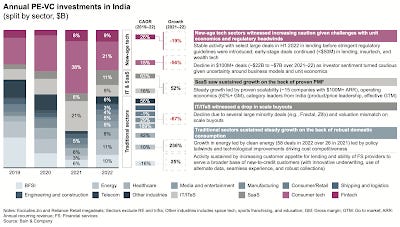
This misallocation reflects at the macro-level in terms of where scarce risk capital is flowing into the economy. The latest Bain Capital report on private equity and venture capital in India shows that consumer technology and fintech have formed the largest destinations for PE/VC flows.

In a country with scarce investible savings (financial, long-term, and risk capital), there is an opportunity cost to such resource allocation, even if market-directed. Is this a good use of the scarce savings? Are more productive economic activities being displaced by this allocation of consumption on this convenience? Agreed that foreign capital will flow into areas where it perceives high returns. But to the extent that this foreign capital also leverages domestic capital, are the disproportionately large flows into these 'convenience' sectors crowding out the scarce risk capital that would have otherwise gone into more productive areas like manufacturing? 

Supporters of the convenience economy will point to several reasons to critique this line of thinking. This allocation of resources is market-based, reflecting what people want; it provides employment to millions of people; it fosters innovation in the logistics market, etc. But each has its set of equally compelling responses - we now know (especially, but not only, from financial markets) market-based allocation can be terribly inefficient and undesirable (anyways, who wants 30-minute delivery?); the quality of these gig jobs are not very good and poses many negative social externalities; among the countless competing use-cases is e-commerce logistics the best use of the scarce capital available for innovation, etc. Note that I'm not even talking about the philosophical and social concerns that these innovations raise. 

In general, instead of reflexively accepting these trends as good and inevitable, there should be serious public debates on the opportunity cost in terms of capital deployment, nature of jobs created, types of innovation pursued, etc. 

Why should governments provide tax and other concessions to research and development spending that pursues automation across the board or certain kinds of generative artificial intelligence which not only only benefits a few firms but also inflicts potentially large social costs? For example, there's a need to start differentiating between good and bad R&D so that public policy can be used to incentivize the former and discourage the latter. There's a case for limiting all benefits like tax benefits, interest expense deductions, etc for businesses that engage with such activities and force them to internalize their social costs. 

Such innovations are examples of how the progress agenda of the world is being set by the priorities and concerns of developed countries. Interestingly, even within developed countries, agendas are being set less by elected governments and more by corporate interests. 

Unfortunately, this agenda often conflict with the development interests of developing countries. Consider the example of automation, which is part of the cost-reduction strategy for efficiency and profits maximizing corporates and perhaps a priority for some demographically challenged developed economies. In a recent Foreign Affairs article, economist Lant Pritchett wrote, 

In the world’s most productive economies, the capital and energies of business leaders (not to mention the time and talents of highly educated scientists and engineers) get sucked into developing technology that will minimize the use of one of the most abundant resources on the planet: labor. Raw labor power is the most important (and often the only) asset low-income people around the world have. The drive to make machines that perform roles that could easily be fulfilled by people not only wastes money but helps keep the poorest poor.

The issues of technology-related changes like automation should become an agenda in global forums just as climate change is today. After all, who decides what are global problems? Who decides on the strategies to address these problems? What's the basis for such decisions? 

Why should climate change be a global problem, while labour mobility is not? Why should the increase in temperatures due to building new coal plants in India be worthy of global restrictions (and therefore a priority to cap and reverse) whereas the increased use of Sport Utility Vehicles and several kinds of high-carbon footprint luxury consumption by consumers in the US is not subject to any similar restraints? Why should tax avoidance by multinational corporations and regulatory arbitrage by technology companies when facilitated by pin-stripe-suited consultants be any less repugnant than tax evasion by small businesses and regulatory avoidance by informal sector businesses? 

These are issues with large distributional consequences, which impact developing countries adversely. 

Further, there are certain values and considerations which underpin this progress agenda set by corporates and others based in developed countries. They include maximization of convenience, efficiency, and profits. Missing here are other equally important ones like resilience, equity, community, and sustainability. 

Monday, June 7, 2021

Thoughts on mechanisation and the gig economy

I came across this article about mechanised kitchens in Bangalore making dosas, biriyanis, and other Indian food. Such automated 'cloud kitchens' which offer takeaways, while still only a handful, have become attractive in Covid times. The author, while covering all other aspects, is oblivious to the labour market effects of such technologies.

I am referring to the issue of the problems with promotion of labour saving technologies in a labour abundant country like India. The reality of the next generation having to face a labour market dominated by low-paying, low-skilled, and limited labour mobility jobs of the gig economy, instead of the productive, skilled, and higher paying jobs in manufacturing and services is already on us. And its consequences for long-term economic growth prospects cannot be salutary. 

This raises some questions about whether public policy should encourage such labour destroying innovations. For example, why should the favourable tax concessions and other incentives that are provided to startups be offered to labour saving technology startups? Agreed that it's not easy to make the distinction between labour saving and productivity enhancing technologies, and that any structural transformation necessarily involves movement greater mechanisation.

But the core issue cannot be overlooked. And, as I have blogged on multiple occasions, there are at least three reasons to be concerned:

1. The breadth and depth at which the mechanisation is happening is striking. Greater mechanisation is penetrating not only all the largest labour markets but also deeper into those markets which supply most of the lesser skilled good jobs that are on offer in any modern economy. 

2. The pace at which the mechanisation is happening is much faster, thereby depriving markets and societies the time to adjust and accommodate the labour displaced by such mechanisation. Equitable and sustainable  change always happens at a certain measured pace, not as disruptive breaks. 

3. While there have always been low-paying and lower skilled jobs, unlike the gig workers, they've always enjoyed some form of, even if inadequate, labour market protections and job security. The gig-work, both by regulation and also by the nature of the work and worker acquisition channels, offer no such safeguards.

BCG has a study which does a comprehensive examination of India's gig economy. While the consultant's enthusiasm is debatable, the report offers quantitative assessments on several areas overlapping with the gig economy. The major categories of gig work involves ride-sharing (Uber, Ola etc), food/parcel delivery (Amazon, Zomato etc), task parcelling (TaskRabbit, Urban Company etc), care and wellness etc.

India's gig economy is dominated by lower skilled jobs, more than other economies.

The report sees a potential for 90 million gigable jobs, mainly in construction, transportation, logistics, and personal services, involving over $250 bn in volume of work. 

The report explores the universe of personal services that are demanded by middle class urban households (annual incomes above Rs 5 lakh). This is a fascinating graphic which shows that maids, cooks, and drivers form more than 85% of the average of one full time equivalent (FTE) of workers required by these households. It assesses a market demand of 50 million FTEs (or jobs) in this space of which 12 million are potentially gigable!

Given the part-time nature of the demand with these services, they fit neatly into the gig economy framework. However, the big challenge is with the likely reluctance of households to hire workers from the gig economy world for many of these activities.
Talking about the 90 million gigable jobs, the report writes,
The vast majority of these are jobs (around 87 million) that could migrate to technology platforms from their current offline mode of matching workers and jobs from discovery to fulfillment. In addition, we estimate that approximately three million net new jobs could be created, servicing constrained gigable jobs and latent demand for services in households. Delivering these jobs as ‘gigs’ via technology platforms will contribute to better demand-supply discovery, price transparency, productivity improvement, compliance with worker benefits and protection, and effective public policy design. Even at a conservative estimate of INR 16,500/month in earnings, India’s gig economy could transact over USD 250 billion of work, and the gig economy could potentially contribute an incremental 1.25 percent (approximately) to India's GDP over the long term.

This is where the sell-side part of such studies, which gloss over the real world challenges of informal labour market matching, takes over. 

Take the example of personal services. The unwillingness of households to hire such workers from the gig economy and instead rely on their word-of-mouth informal network points to the importance of credibility and trust in such services. For gig service providers, this demands going much beyond their current mostly digital platform-based jobs market matching model towards a greater brick-and-mortar approach of recruiting, training, accrediting, and managing their workers. This is orders of magnitude harder than developing a technology solution. 

It's therefore unsurprising that despite all talk about jobs market matching platforms for nearly two decades, India does not have service providers actually offering significant numbers of the aforementioned personal services demanded by households in any city or town. Though there are many claimants, even a cursory glance at their websites would expose those claims.

There is another important factor - affordability. A combination of platform and feet-on-the ground adds layers of costs, which limits the addressable market. It's the old story of limits to formality - there are only so many Rs 100 haircuts going around!
Barbers sitting on roadside and on makeshift arrangements offering haircuts for Rs 10-30 will form the vast majority of haircuts in India for the foreseeable future. In contrast, salons where the haircuts cost Rs 75-100 or more, likely to be in the formal sector, form only a very small proportion of haircuts. Governments can do whatever it wants to force these barbers to become formal, but they will not. The simple reason is that there is only so much demand that can be generated for salon haircuts! The shift to salons will happen only with economic growth.
Much the same set of problems apply to construction, logistics, transportation, and most other sectors. Even a cursory study of the nature of the current almost completely informal construction labour contracting market will reveal the daunting nature of social, cultural, and other challenges to be surmounted for a technology platform to succeed. 

Another problem with all these gigable services is that they suffer from an acute deficit of standards and credentialing. While most of these services do not even have any standards much less credentialing and certification, even where such standards are available they demand excessive qualification requirements. In light of all the above, the binding constraint to the development of a market enabling ecosystem and unlocking of millions of gigable jobs is not jobs market matching using technology platforms. 
But to the extent of the realistically available market, even if much smaller than the 90 million proposed, an approach that combines technology with feet on the ground holds promise. It has the potential to not only provide mere gig jobs, but also reasonably better paying jobs in the firms which manage the service delivery. 

There is no question that gig work has its share of beneficial effects. It could also emerge as a welcome income augmentation opportunity for those working in an increasingly wage-stagnant regular labour market. Besides, at a macro-level, for example, if physical stores are being displaced by virtual stores, those retail floor workers are now being displaced towards delivery. And as discussed, there are opportunities for higher paying jobs associated with gig economy businesses. Therefore instead of pushing back, it should be managed to maximise its benefits and limit its adverse consequences.