China’s economy is unique in multiple respects. And its economic growth presents a conundrum.
Arguably, the biggest structural anomaly with the Chinese economy is its ultra-low consumption share compared to any other country. The other side of this is the very high investment share.
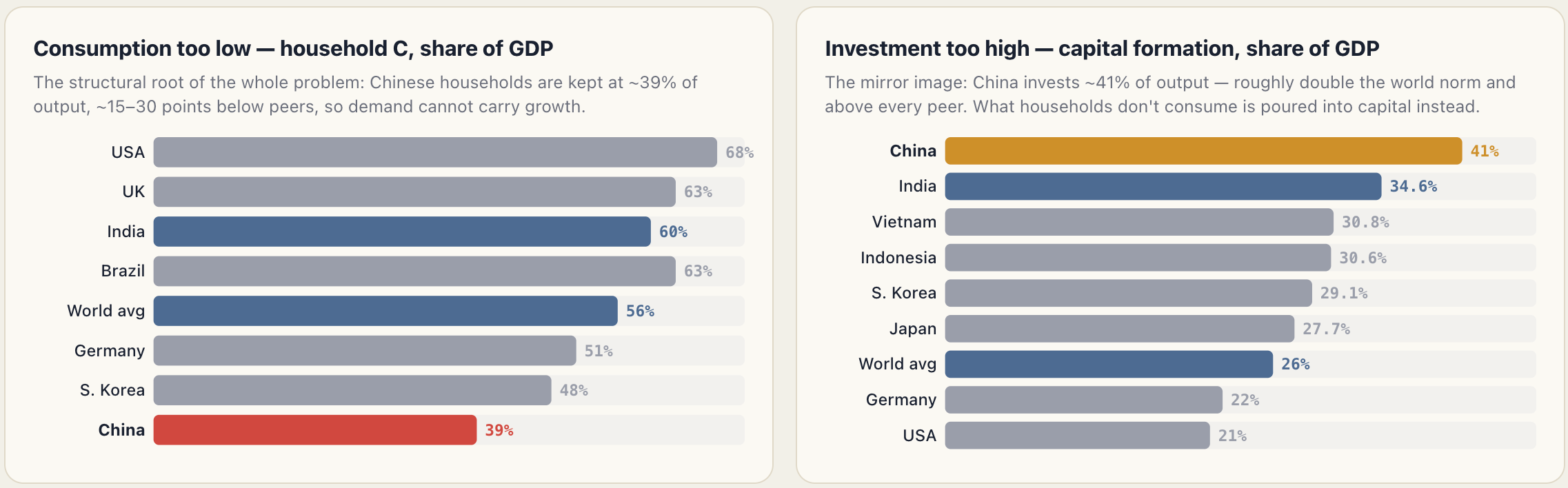
Ken Rogoff has this anecdotal measure of the investment-driven growth reliance.
China has built more square metres of residential property per capita than either the United Kingdom or France, despite still being a much poorer country. Its road and railway networks are on par with those of the world’s most advanced economies and, in many ways, far superior to America’s.
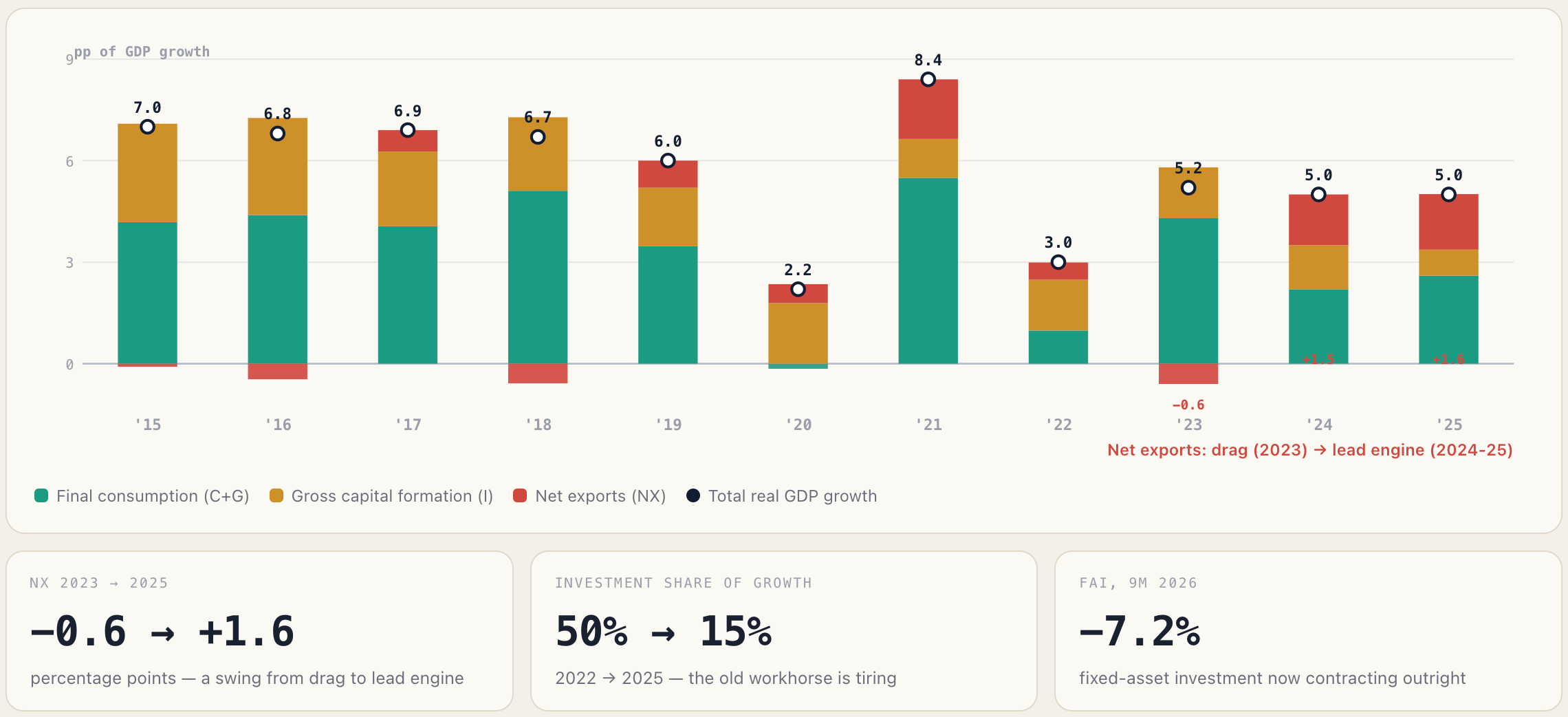
But this investment-based growth is a diminishing returns story and finds its limits. This is clearly reflected in its declining contribution to the GDP growth. Not only is the investment rate itself declining, but its incremental impact on output growth is falling too.
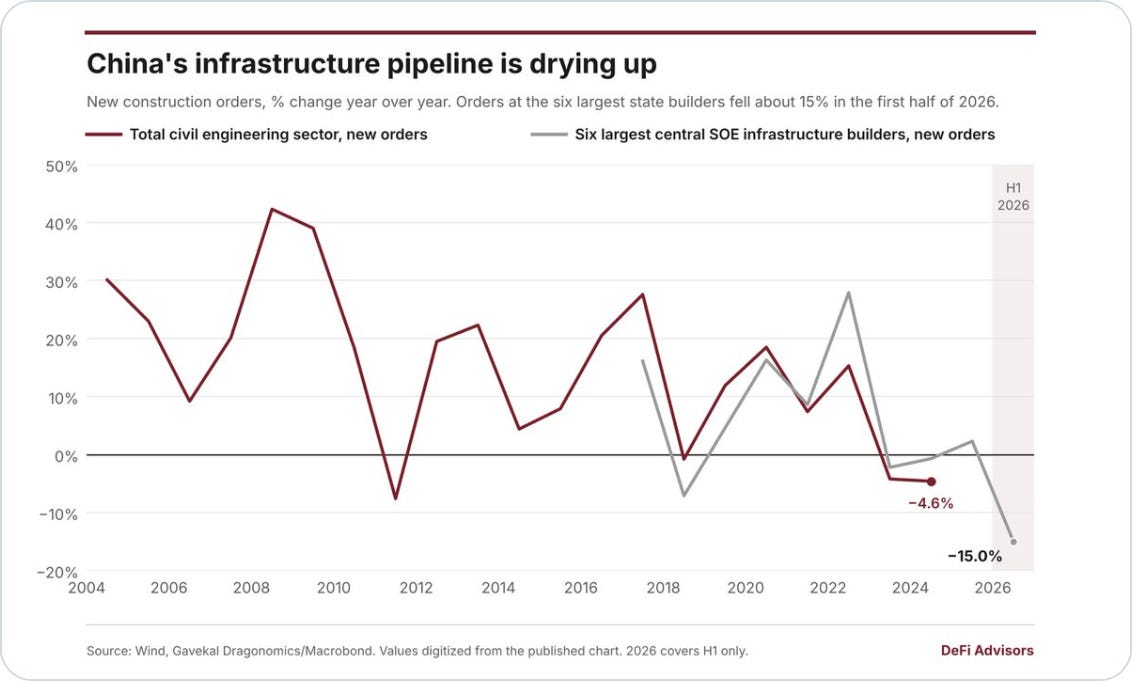
Fixed asset investment declined 7.2 per cent year on year in the first nine months of 2026. Assuming fixed investment at 40% of GDP, this means that the rest of the economy must grow at 3 percentage points more just to prevent contraction. Even the traditional workhorses, like infrastructure investment, are declining.
The new driver of growth is exports, where the trade surplus hit $1.2 trillion in 2025. Net exports supplied a staggering 32.7% of 2025 growth (it was 30% in 2024), and the value-added embodied in exports is ~17–18% of GDP and underpins tens of millions of jobs. More on this latter.
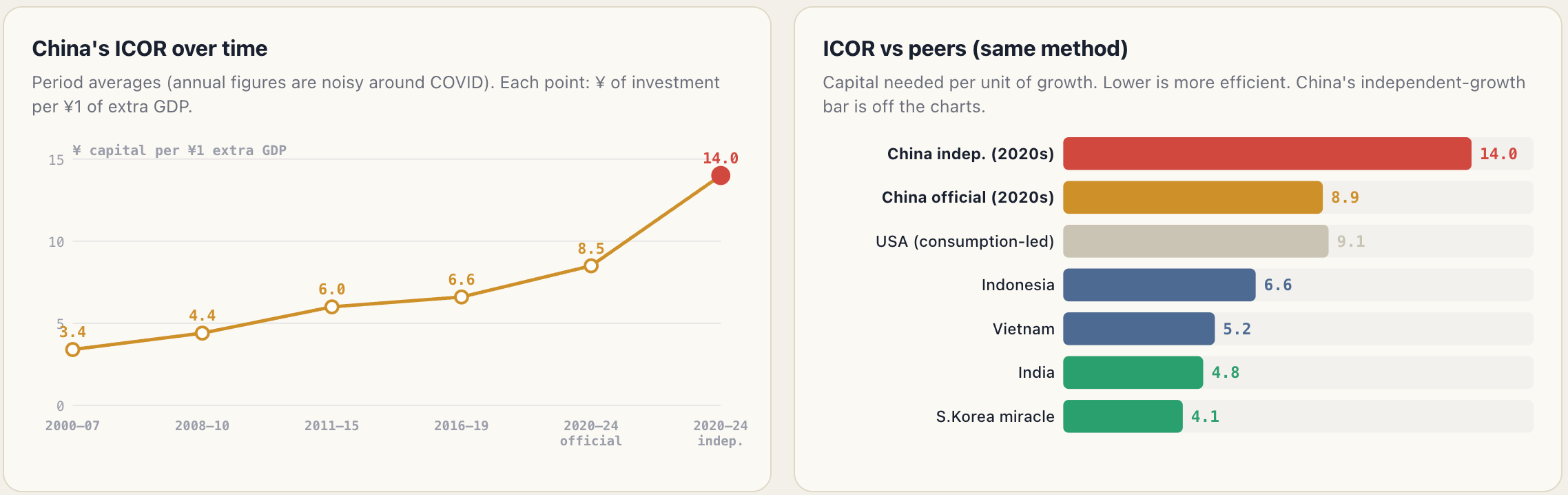
The declining investment contribution to GDP growth also points to less and less efficiency in capital utilisation. This is captured in the incremental capital-output ratio (ICOR), what a unit of investment buys in terms of GDP growth. The ICOR has more than doubled since the 2000s. China is now roughly twice (or thrice if independent estimates are taken) as capital-hungry as Korea or Taiwan at the same stage, or as India today.
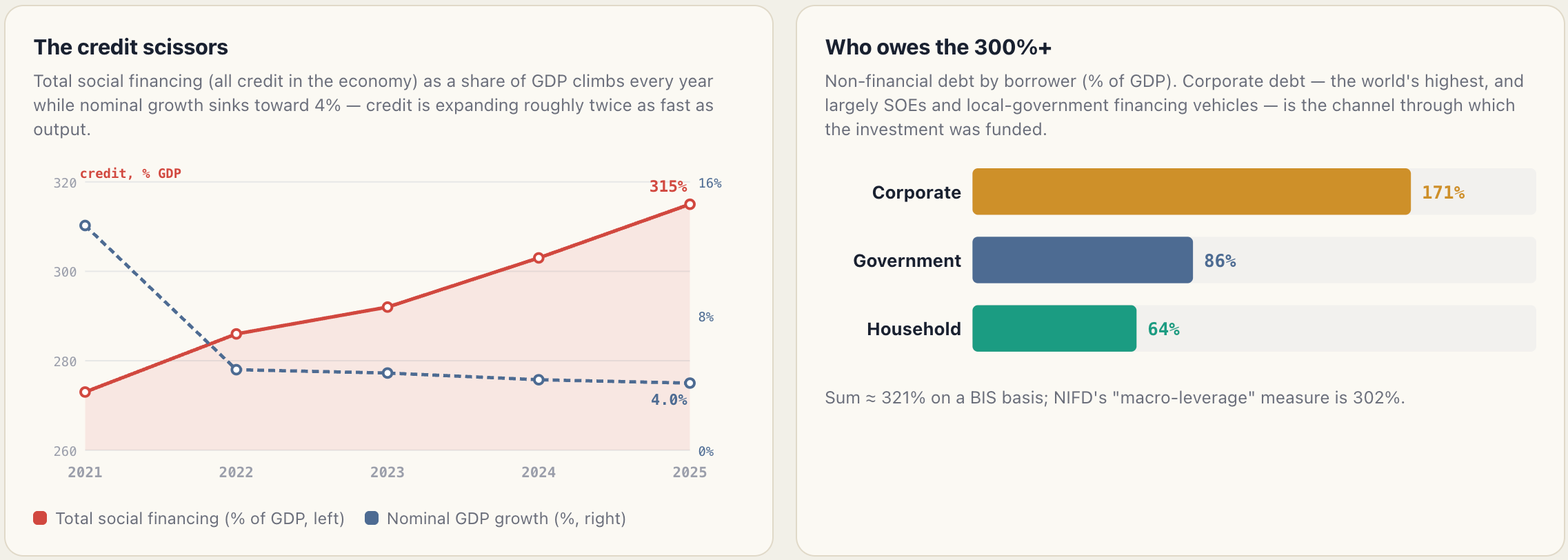
This investment is increasingly being funded by debt. The total social financing (TSF) has reached 315% of GDP. And this debt sits overwhelmingly in corporates, state firms, and local-government vehicles, hitherto the drivers of investment and growth.
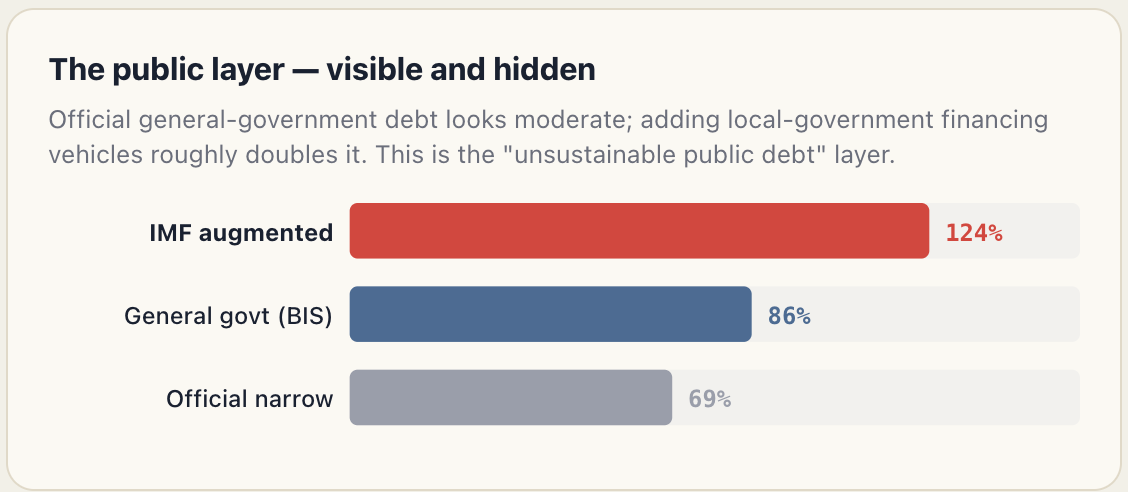
The public debt is much higher if the off-balance sheet vehicles of the local governments are added. A new study from the Conference Board says that debt servicing payments alone are expected to account for 19.2% of the central government’s general public budget this year, up from 12% in 2014. Local government debt interest payments have risen 16% annually over the same period. Morgan Stanley estimates the public debt-to-GDP ratio to hit 122% by the end of 2026.
To put this debt accumulation in a global perspective, China now accounts for more than half the rise in the world’s debt-to-GDP ratio since 2008.
The danger is that once it reaches these levels, each incremental unit of credit buys less and less. Unsurprisingly, in 2025, one yuan of GDP required ¥6 of credit, as credit growth was double the nominal GDP growth rate. New lending increasingly refinances old liabilities rather than funding new output. Local-government vehicles alone owe ¥60tn (48% of GDP), much of it against land whose value has fallen. The credit boom's real legacy is a banking system propping up unproductive firms.
All this cascades into output growth trends.
The government has targeted the 2026-27 growth target at 4.5-5%, and the official estimates indicate that the economy grew 4.5% in the third quarter of 2026 and 4.6% for the first nine months. But several independent reconstructions put China’s true 2025 growth at roughly half the official figure.
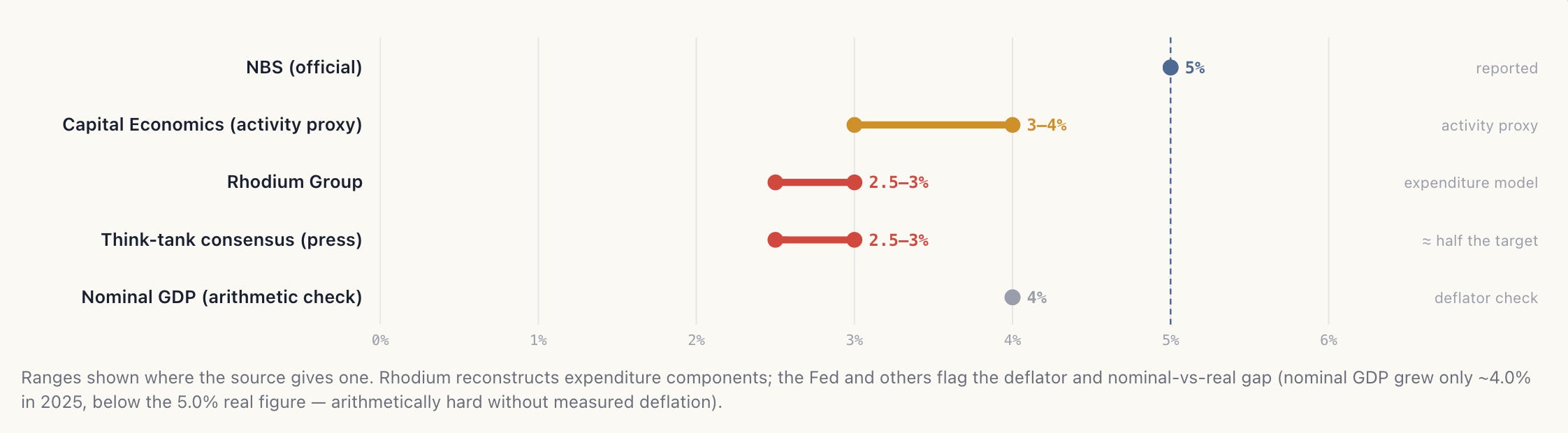
One estimate is this.
Capital Economics estimates that growth in China in the third quarter was 2%, dragged down by declining industrial activity, particularly in construction and petrochemicals. Its model draws on hundreds of lower-profile official data series, like intercity passenger traffic and industrial electricity consumption, which the firm says makes them less susceptible to manipulation.
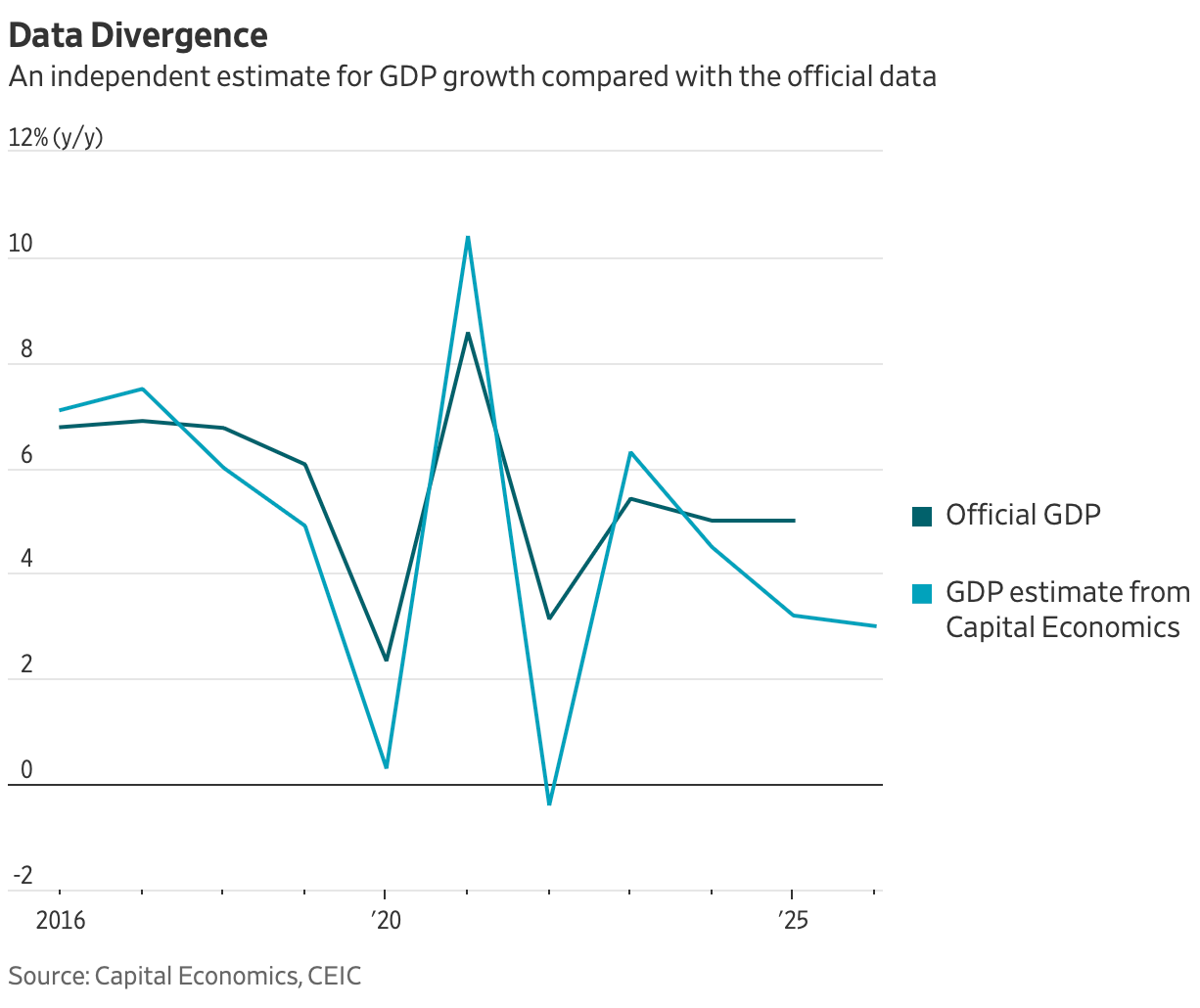
Another puts it lower still.
Rhodium Group estimates that full-year GDP will be around 0% in 2026, arguing that it is impossible for China to hit 4.5% growth with sluggish retail sales growth and steep drops in fixed-asset investment.
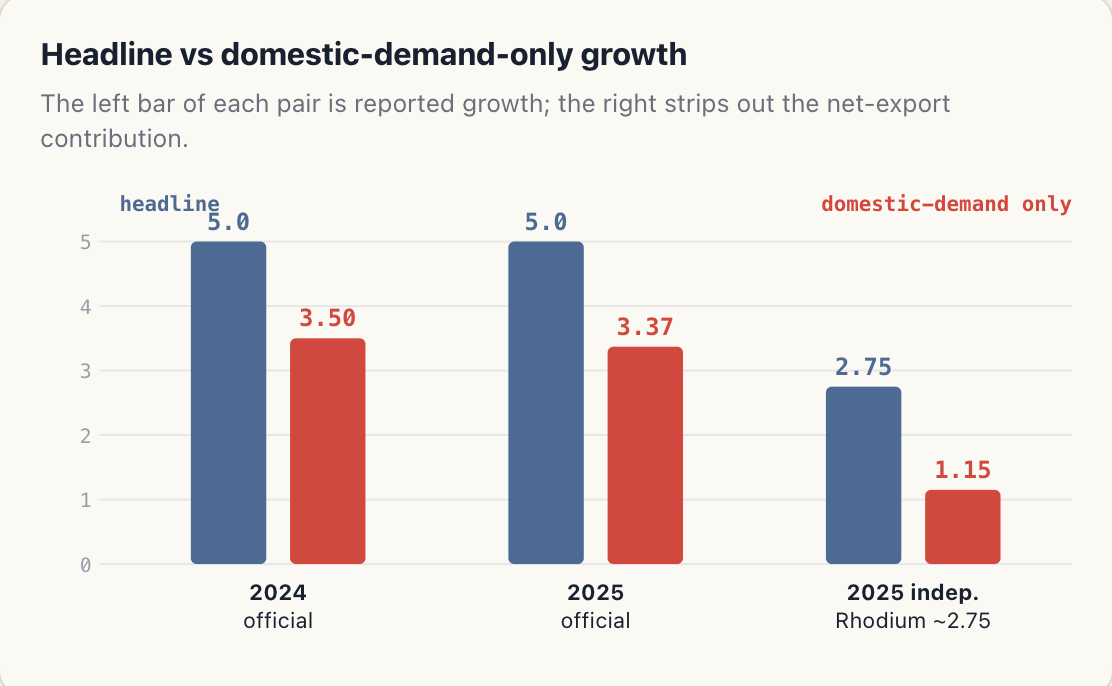
On NBS accounting, net exports added about 1.5–1.6 points to growth in 2024 and 2025. But that is inflated by collapsing imports. If we strip that out, the genuine external contribution is between a fifth and a quarter. Either way, remove net exports and domestic-demand growth falls to 3.4–4.0% on official data, and to 1–1.8% on independently-estimated growth.
But this reliance on exports is a big vulnerability, given the rising backlash against cheap Chinese imports destroying manufacturing bases in both developed and developing countries, and the protectionist barriers that are being erected by them. It is safe to say that the export markets will be squeezed in the immediate future.
Besides, the race to capture export markets has also spawned an unhealthy race to the bottom among companies, also spurred by equally intense competition among local governments.
The electric vehicle (EV) market is emblematic of this trend, with local governments pouring billions into creating local champions, resulting in a staggering 143 EV brands selling at least one model at the end of 2025. Since factory closures mean job losses and admission of failure, besides also impacting the promotion prospects of senior city leaders, cities are reluctant to pull the plug and continue to support them. Exports have emerged as a convenient outlet to channel the excess capacity, and production has continued to rise. Exports are expected to touch 12 million units of passenger vehicles, up from less than a million units at the turn of the decade, thereby overtaking Japan as the world’s biggest auto exporter.
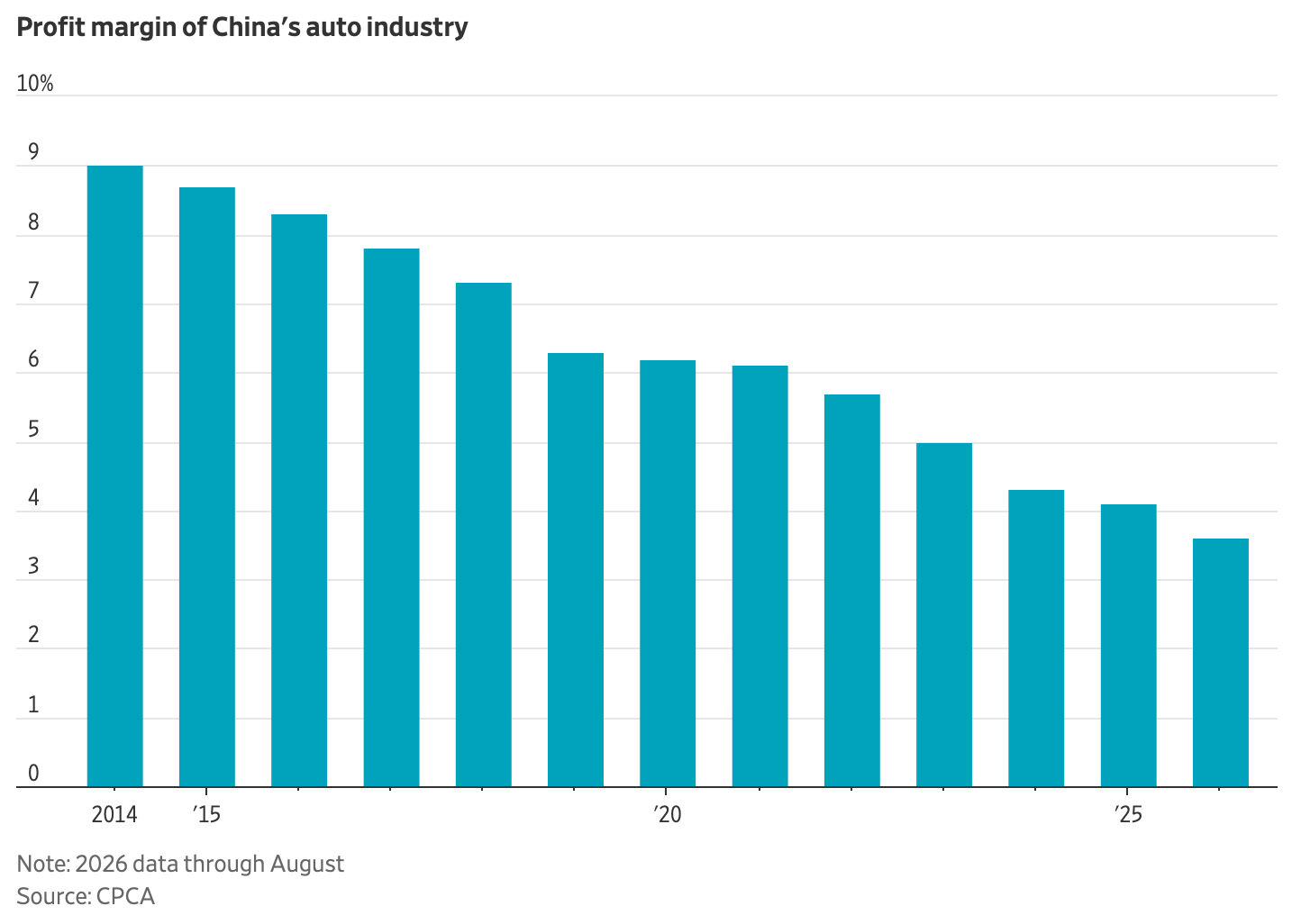
However, the intensity of the competition has meant that even as Chinese EVs are capturing the global market, their EV companies are struggling to remain profitable. As an example, NIO, one of the leaders, has been losing more than a billion dollars each year since 2021, and its share price has fallen by 95%. In the first eight months of this year, the industry’s profit margin fell to a multiyear low of 3.6%, as companies compete in a pricing race to the bottom. Chinese officials call this price competition neijuan or involution.
Worse still, globally, the cut-throat pricing has also forced price reductions by Western car makers, thereby triggering a race to the bottom globally in the industry. For example, BYD is selling its flagship Seal hybrid sedan for the equivalent of around $44,000 in the UK, more than $10,000 less than a similarly equipped Volkswagen Passat.
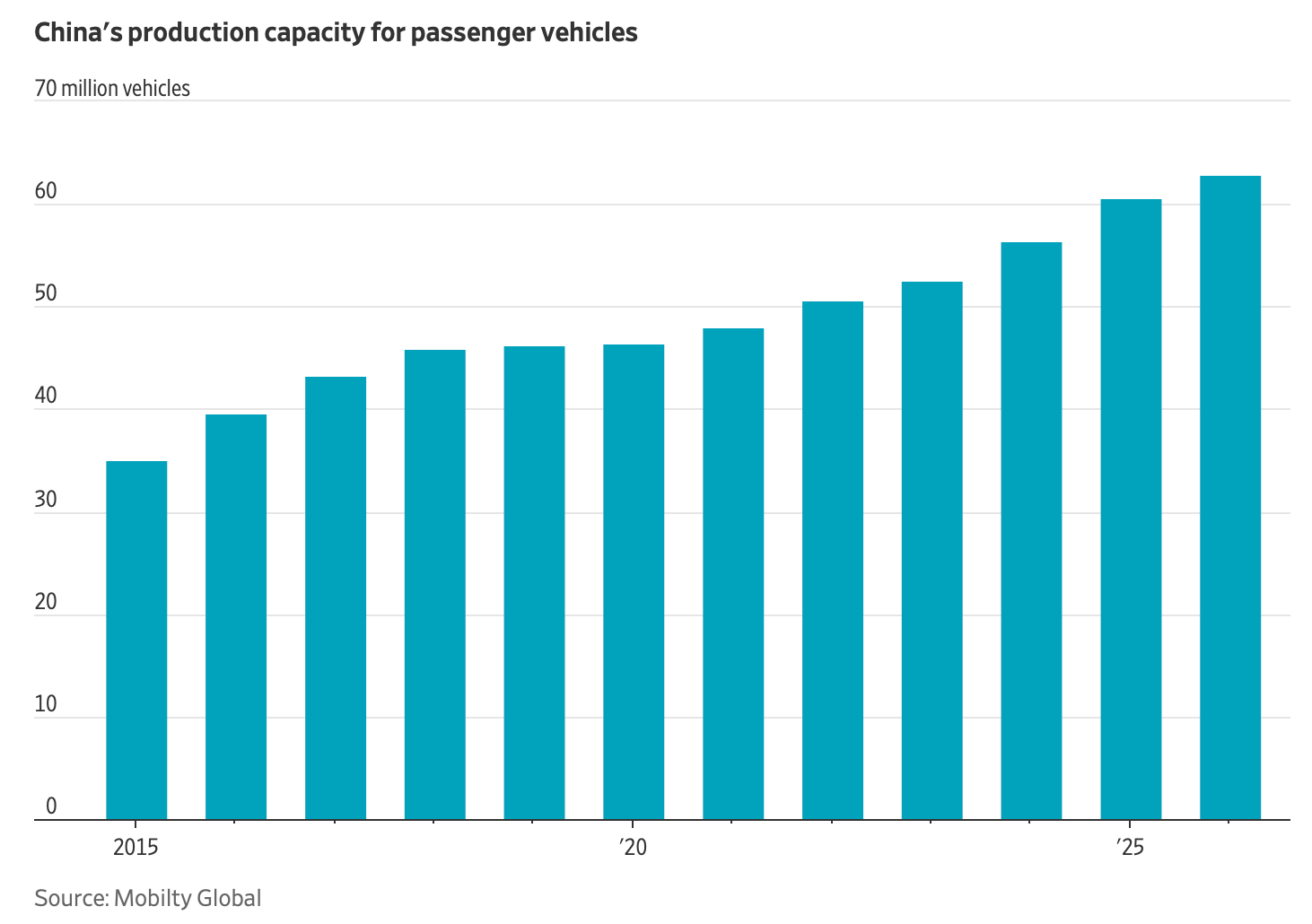
On the one hand, there is the weakening consumer demand, which has resulted in 22% decline in the domestic sales of passenger vehicles in September (compared to the same period last year), and sales for the full year are estimated to reach only 18.5 million units, the worst performance since 2014. This must be seen against the backdrop of an annual production capacity of around 63 million light vehicles, more than triple the number of cars expected to be sold in the domestic market.
So what does all this portend for China’s future?
China is facing a prolonged real estate slump, dismal consumer expectations, falling retail sales (and that too in a country with private consumption at two-thirds of peers), declining fixed investment, and struggling corporate profitability (due to intense competition).
A recent FT essay argued that the combination of persistent deflation, weakening economy, dismal consumer sentiments, rising public and private debt, and ageing population means that China is facing its Japanification.
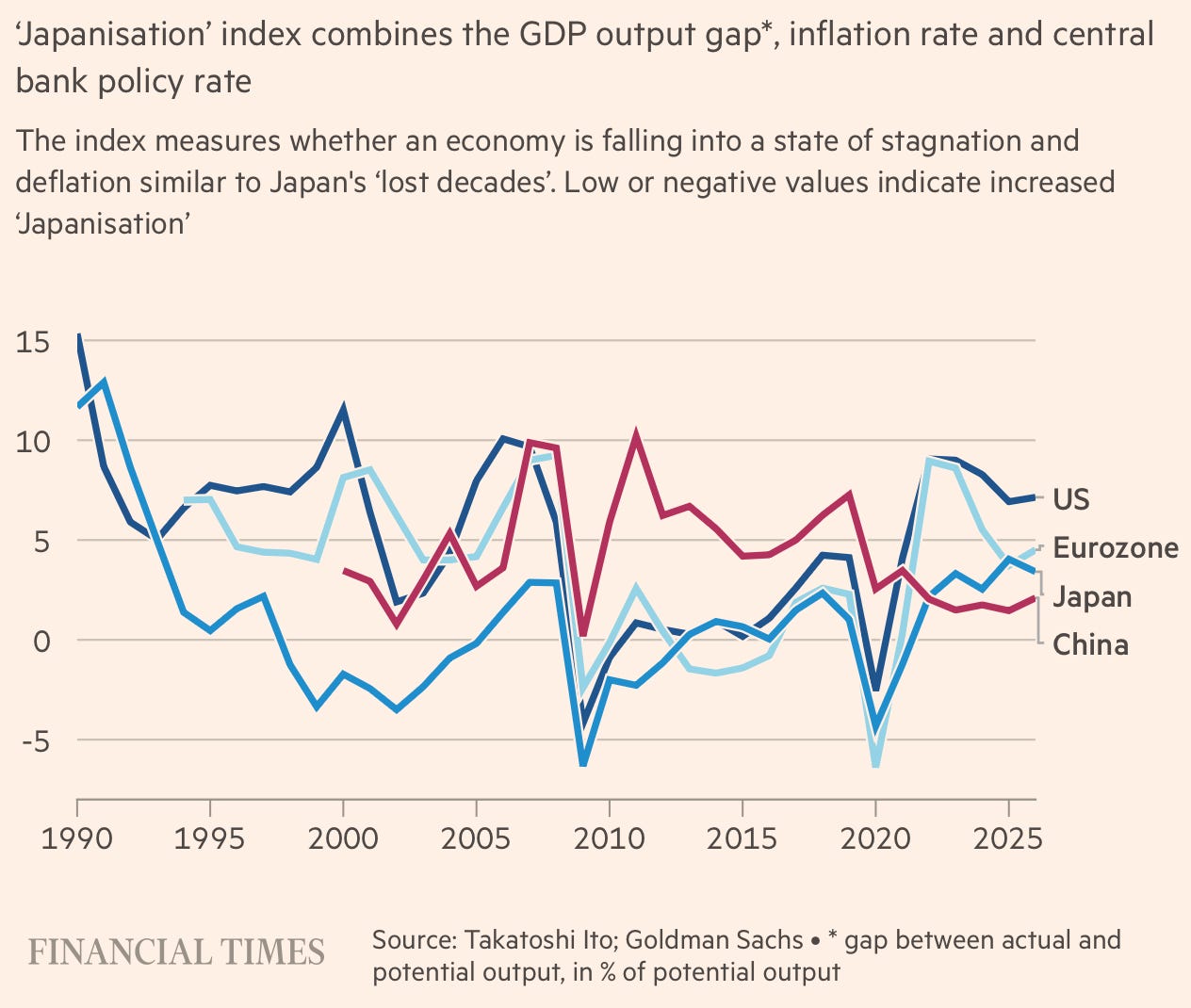
According to Goldman Sachs, an updated version of the Japanisation index — a gauge originally devised by the late economist Takatoshi Ito — shows that for the past five years, China has been consistently more “Japanised” than Japan itself… Japan’s population started to shrink in 2009; China’s decline began in 2022 and is on track to be steeper, worsening the country’s economic prospects... In another echo of Japan’s post 1990s-slump, the IMF warned last week of growing numbers of “zombie” companies across Asia, kept alive only by lenient banks. This is now evident across China’s heavily subsidised manufacturing economy. Outside favoured sectors, companies are increasingly refusing to invest while households hoard cash instead of spending... Consumers are deleveraging, with bank lending to households as of August this year declining outright for the first time in history... China’s weakening economic conditions meant that up to 10.6 per cent of the adult population had overdue loans last year, compared with about 7.8 per cent a year earlier, according to a report by Gavekal Dragonomics analyst Xiaoxi Zhang...
Phrases coined in 1990s Japan, such as “job hunting ice age” and “price destruction”, are creeping into China’s vernacular... economists can see the signals of Japanification in the data... Restaurants across China are competing to offer meals for under Rmb10 ($1.50). This too is redolent of Japan, where restaurants entered a margin-crushing price war to attract an ever-shrinking pool of consumer spending as deflation took hold. The price of a basic bowl of rice and beef at the nation’s leading gyudon chain hit a high of ¥400 ($2.50 at current exchange rates) at the end of 1990 before falling. It only reached ¥400 again in 2021... The “expectation channel”, where households and businesses saw no prospect of longer-term growth, created a vicious circle of reduced consumption and investment in Japan which in turn lowered expectations...
China’s real estate bubble was the largest in history, outpacing even Japan’s speculative frenzy of the late 1980s and at its peak accounting for a third of the country’s economy. The contraction since it burst in 2021 has been dramatic, with new housing starts down 78 per cent from their peak, according to Macquarie. That compares with a 73 per cent fall in the US between 2005 and 2009 and Japan’s 65 per cent drop between 1996 and 2025. The collapse of the property market has set off what Richard Koo, the Nomura Research Institute’s chief economist, calls a “balance sheet recession” — a term he originally coined in the 1990s to describe the tendency of Japanese companies and individuals to pay down debt rather than borrow to invest or spend. Weaker demand and deflation then worsen the debt burden, leading to a vicious cycle. Investment opportunities decline, the labour market calcifies and salaries stagnate... The ultimate sign of China’s weak credit demand is the 1.7 per cent yield on 10-year government bonds, which Nomura’s Koo describes as “absolutely ridiculous”...
One reason for Beijing’s reluctance to resort to domestic stimulus, economists believe, is China’s strong export performance. The trade surplus hit $1.2tn last year — the biggest recorded by any country, ever — and may meet or exceed that level this year. Policymakers in Beijing think the country’s export performance will buy China time while it waits for the property market to stabilise. In the meantime, they are pursuing investment in areas such as chipmaking and AI as the country competes with the US for geopolitical dominance... Gross fixed capital formation — the acquisition of assets for the production of goods and services — was 40 per cent of GDP in 2024 against Japan’s 28 per cent and the OECD average of 22 per cent, fuelled by an augmented fiscal deficit that Goldman Sachs forecasts will hit 11 per cent of GDP this year. No one knows when this debt will become unsustainable.
Michael Nicoletos has an excellent post whose conclusion is worth reproducing.
Household debt is rising, defaults are accelerating, the population is shrinking and aging, and precautionary savings behavior suggests Chinese citizens understand their economy better than policymakers do. The question is not whether China can rebalance. Structurally, it can, if it allows wealth redistribution to work, implements genuine pension reform, and expands healthcare spending. The question is whether it will. Current policy signals suggest the answer is no.
Until that changes, China will remain trapped in the same pattern: high investment, low consumption, rising debt, shrinking population, slowing growth, and increasing vulnerability to external pressure on its export lifeline… The demographic projections make this even more dire. A country that is losing 3 million people per year now will be losing 14 million per year by 2062. A workforce that shrinks by 225 million cannot sustain the growth rates Beijing demands. An aging population that nearly doubles its dependency ratio cannot suddenly transform into a consumption-driven economy…
The Chinese government will have a tough time boosting domestic consumption. Consider what it is up against: households that are over-indebted, scared, and saving at record rates; a population set to shrink by up to 280 million by 2050 and potentially by half by 2100; a dependency ratio that will nearly double, leaving just 1.2 workers to support each retiree; an export machine that relies on rerouting through third countries to avoid tariffs, with that loophole closing; and an energy import bill exceeding $450 billion a year, payable in foreign currency… Demographics make this worse, not better. You cannot boost consumption when your population is shrinking and aging. You cannot grow your way out of debt when your labor force is declining by 225 million workers. You cannot fund pensions and healthcare when the worker-to-retiree ratio collapses from 4:1 to 1.2:1.
All this means that catching up with the US GDP will most likely remain elusive, unless the US GDP itself starts falling. Even escaping the middle-income trap may become a challenge.
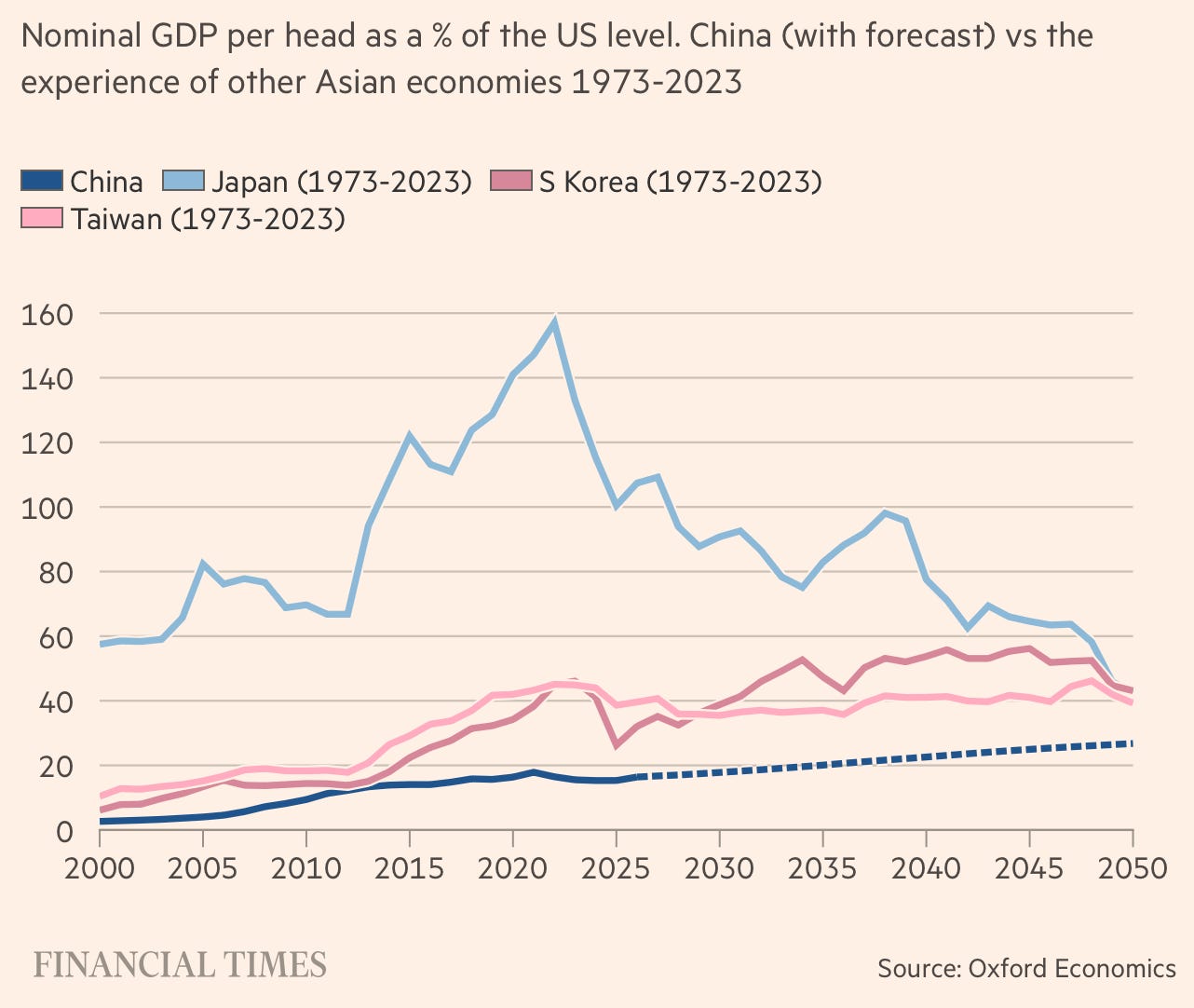
China’s investment-led growth model started with the likes of textiles and footwear, and gradually moved up into more sophisticated products like consumer durables, heavy equipment, renewables, transportation, and now technology goods. Heavy doses of financial repression, massive subsidies, and real estate revenues financed this model. The prolonged real estate market downturn has seriously strained the model and now threatens to upend it.
In conclusion, it is hard not to argue that any economy which has seen over ten quarters of deflation, an enduring property bust (housing starts down 78% from peak), total debt past 300% of GDP, a population shrinking ~3mn/year, and ageing toward 1.2 workers per retiree, is facing a reckoning. Each raises the ICOR further and shrinks the base that services the debt. The investment led growth model has run its course. Goldman’s Japanisation index already reads China as more “Japanised” than Japan. The export surplus is merely buying time and kicking the can down the road. Even that, too, is already getting squeezed. Factory closures and job losses are not far away. When that starts to happen in a meaningful manner, the tenuous contract between the Party and the citizens will be strained. It remains to be seen how China will navigate this inflection point. In the circumstances, Carl Minzner points to a long twilight.


No comments:
Post a Comment