Substack

Showing posts with label philanthropy. Show all posts

Saturday, August 10, 2024

Weekend reading links

1. Fascinating tweet thread by Ed Conway about the Bretton Woods System that pegged the exchange rates of 44 countries with the IMF entrusted the responsibility of managing it. This graphic illustrates the remarkable currency stability among these countries in the 29 years of its existence.

This currency stability combined with a few other things resulted in a period of remarkable economic prosperity. This is a striking graphic about productivity and compensation in the US.
2. Good article that evaluates the semiconductor chips making in India, specifically the partnership between Tata Electronics and PSMC, one of the smaller Taiwanese chip manufacturing companies.
This is unlike the venture the other big player, Taiwan SemiconductorManufacturing Company (TSMC), is undertaking abroad – the company’s new fab in the Japanese city of Kumamoto, two $40 billion facilities in Phoenix, Arizona, and a commitment to invest nearly $4 billion to build a fab in Dresden, Germany. In these new fabs, apart from significant equity investment, TSMC, the ninth-most valuable business in the world, is an equity partner, and has invested in the ecosystem; it has taken along its key vendor base of some 25-30 companies to each of these locations, and is also undertaking large-scale training of manpower on the nuances of chip fabrication, a high tech-intensive job. In the Tata-PSMC venture, much of the heavy lifting is done by the Tatas, who have no real experience in chip manufacturing so far... The fact is, for TSMC to be successful outside Taiwan, it takes more than just its expertise. It takes its suppliers along so that an ecosystem develops locally for the construction expertise, material supplies, and equipment deliveries. For instance, TSMC has moved around 40 Taiwanese companies to Japan (for the new plant in Kumamoto), and taken around 30 of them to Arizona for the new plants.

3. NYT has an interview with Robert Putnam.

We looked at long-run trends in connectedness, trends in loneliness, that sort of thing, over the last 125 years. And the short version is, it’s an upside-down U curve. We were socially isolated and distrustful in the early 1900s, but then there was a turning point, and then we had a long upswing from roughly 1900 or 1910 till roughly 1965, and that was the peak of our social capital. People were more trusting then, they were more connected then, they were more likely to be married then, they were more likely to join clubs then, etc. And then for the next 50 years, that trend turned around...

That trend in political depolarization follows the same pattern exactly that the trends in social connectedness follow: low in the beginning of the 20th century, high in the ’60s and then plunging to where we are now. So now we have a very politically polarized country, just as we did 125 years ago. The next dimension is inequality. America was very unequal in what was called the Gilded Age, in the 1890s and 1900s, but then that turned around, and the level of equality in America went up until the middle ’60s. In the middle ’60s, America was more equal economically than socialist Sweden! And then beginning in 1965, that turns around and we plunge and now we’re back down to where we were. We’re in a second Gilded Age. And the third variable that we look at is harder to discuss and measure, but it’s sort of culture. To what extent do we think that we’re all in this together, or it’s every man for himself, or every man or woman? And that has exactly the same trend.

He makes the distinction between bonding and bridging social capital.

Ties that link you to people like yourself are called bonding social capital. So, my ties to other elderly, male, white, Jewish professors — that’s my bonding social capital. And bridging social capital is your ties to people unlike yourself. So my ties to people of a different generation or a different gender or a different religion or a different politic or whatever, that’s my bridging social capital. I’m not saying “bridging good, bonding bad,” because if you get sick, the people who bring you chicken soup are likely to reflect your bonding social capital. But I am saying that in a diverse society like ours, we need a lot of bridging social capital. And some forms of bonding social capital are really awful. The K.K.K. is pure social capital — bonding social capital can be very useful, but it can also be extremely dangerous. So far, so good, except that bridging social capital is harder to build than bonding social capital. That’s the challenge, as I see it, of America today.

4. In an interesting reversal of fortunes, developing countries have become more fiscally prudent compared to their developed counterparts, and central banks across developing countries are exhibiting greater responsibility and independence. Sample this from Gavekal.

Across the emerging markets, political leaders with populist leanings are calling for looser fiscal policy. Many are also berating local central banks for failing to do more to support growth, and leaning on them to loosen monetary policy. For the most part, central bankers, jealous of their independence, are pushing back and keeping monetary conditions relatively tight to counter inflation. This raises the prospect of loose fiscal, tight monetary policy settings in a number of key emerging markets, argues Udith Sikand. It also throws the contrast between emerging and developed market central banks into sharp relief. Arguably, developed market central banks have caved in to fiscal dominance, keeping real rates for the most part low or negative over recent years to prevent public debt burdens from becoming unsustainable. By contrast, emerging market central banks are likely to maintain positive real rates in order to attract funding to cover growing fiscal deficits. The bottom line is that this sets up conditions for a potential triple merit scenario in emerging markets over the coming years, with local risk assets and currencies rising strongly.
5. India's long tail of corporate tax distribution

A total of 353 companies earning above Rs 500 crore accounted for 55.7 per cent of the Rs 14.7 trillion in gross total income recorded by all companies in 2018-19. A total of 842 companies made more than Rs 500 crore in 2023-24 and accounted for 62 per cent of the Rs 34.6 trillion in gross total income recorded by all companies.
India's textile industry, valued at USD 250 billion, provides jobs to 50 million people. The sector is divided into three broad categories - Textiles (fibre, yarn, and fabrics); Garments and; Made-ups (Bed sheets, curtains etc.). India is present across all parts of the value chain. In 2023, China exported USD 114 billion worth of garments, followed by the EU (USD 94.4 billion), Vietnam (USD 81.6 billion), Bangladesh (USD 43.8 billion), and India with just USD 14.5 billion. From 2013 to 2023, Bangladesh's garment exports grew by 69.6 per cent, Vietnam's by 81.6 per cent, and India's by only 4.6 per cent. "As a result, India's global market share in garment trade has declined from 2015 to 2022. The share of knitted apparel dropped from 3.85 per cent to 3.10 per cent, and the share of non-knitted apparel decreased from 4.6 per cent to 3.7 per cent," GTRI founder Ajay Srivastava said. He said that the garment imports too surged by 47.90 per cent, from USD 1.06 billion in 2018 to USD 1.56 billion in 2023. Textile imports also saw a notable increase of 20.86 per cent, from USD 5.77 billion to USD 6.97 billion. 

7.  A new NBER working paper points to more evidence of price markups in the US economy. It uses data on price data from more than 100 distinct product categories in the US in the 2008-19 period. 

We estimate demand with flexible consumer preferences and recover time-varying markups for individual products under the assumption of profit maximization. Our results indicate that markups increased by about 30 percent during our sample period. This reflects within-product changes and is primarily due to reductions in marginal costs, rather than increases in (real) prices. Changes in marginal costs, along with declining consumer price sensitivity, account for the vast majority of the time series variation in aggregate markup changes between 2006 and 2019. Our model indicates that consumer surplus has increased despite rising markups, though the increases are concentrated among higher-income consumers.
Between 2006 and 2023, Mr. Buffett had given more than $39 billion to the Gates Foundation. By comparison, Mr. Gates and Ms. French Gates gave $39 billion between 1994 and 2022, including $22 billion to get the foundation going in 2000. In some years, the former couple gave less than half a billion. In 2021, they pledged $15 billion to the foundation’s endowment, and the following year, they transferred that money, as well as another $5 billion Mr. Gates had contributed.

9. Important point made by Richard Rorty (HT: Rana Faroohar)

National pride is to countries what self-respect is to individuals: a necessary condition for self-improvement. Too much national pride can produce bellicosity and imperi­alism, just as excessive self-respect can produce arrogance. But just as too little self-respect makes it difficult for a person to display moral courage, so insufficient national pride makes energetic and effective debate about national policy unlikely.

10. An important trend to be kept in mind as we follow China, the sharply increasing Chinese emmigration.

The number of Chinese citizens living in Malaysia has almost doubled over the past three years, driven by a jump in students and new investors, according to government officials, academics, schools, and business and community associations... China’s slowing economic growth as well as a more heavy-handed approach to business have driven more of its citizens to seek new lives abroad. Wealthy Chinese citizens have flocked to destinations such as Singapore and Malta where they have acquired citizenship through investment, and they make up the largest source of golden visa applicants in Portugal and Greece. Chinese citizens also form one of the largest groups of illegal migrants attempting to enter the US from Latin America...

Malaysia... is home to a centuries-old Chinese diaspora that makes up about 23 per cent of its 34mn citizens. Most new Chinese arrivals are middle-class families who see south-east Asia as a more affordable destination, or students shying away from anti-China sentiment in the west, making Chinese people the largest group of foreign students and long-stay residents in Malaysia. Universities and international schools in Malaysia are reporting soaring demand. The nation’s higher education institutions had 44,043 Chinese students enrolled last year, up 35 per cent from 2021, according to the education ministry... the number of Chinese pupils in international schools more than doubled in the same timeframe from 2021 to 2023. More than 56,000 Chinese immigrants now hold Malaysia My Second Home long-stay visas, more than double last year’s number. Chinese investors are also contributing to the boom in expatriate numbers. There are about 45,000 owners, managers and workers of Chinese companies in Malaysia, up from an estimated 10,000 in 2021, according to a Chinese trade official... The rise in Chinese residents mirrors an earlier trend in Thailand. Sivarin Lertpusit at Thammasat University in Bangkok said the number of new Chinese immigrants in Thailand was “rapidly increasing”, reaching 110,000-130,000 living in the country in 2022, most of them entrepreneurs, employees, students and their family members as well as lifestyle migrants.

11. The week saw a US federal judge ruling on a DoJ suit that Google spent billions of dollars on exclusive deals to maintain an illegal monopoly on search, a sector where it handles more than 90% of online queries. The judge, Amit Mehta, of the US District Court for the District of Columbia, said, "Google is a monopolist, and it has acted as one to maintain its monopoly."

The DoJ argued the search giant paid tens of billions of dollars a year for anti-competitive deals with wireless carriers, browser developers and device manufacturers — and in particular Apple. These payments, which cemented Google as the default search engine, totalled more than $26bn in 2021, according to the decision... The proceedings will now enter a second phase in which the court will determine what remedies Google needs to take. The DoJ has not yet indicated what penalties it would seek, but it may focus on curbing Google’s ability to strike the deals at issue in the case. The decision is the biggest win against Big Tech by US antitrust enforcers in decades... the DoJ’s antitrust division, led by Kanter, has sued Apple and has a second case pending against Google, accusing it of allegedly exercising monopolistic control of the digital advertising market. The second Google trial is set to begin next month. The Federal Trade Commission, chaired by Big Tech critic Lina Khan, has also filed lawsuits against Amazon and Meta. 

Google’s years-long agreement with Apple to make it the default search engine on the iPhone’s Safari browser has long drawn scrutiny. Unsealed court documents showed that Google paid Apple $20bn in 2022 alone. This would amount to a substantial portion of Apple’s $85bn-a-year services business, which includes its App Store and Apple Pay... Also at issue in the case were contracts the tech giant reached over the years with browser developer Mozilla, Android smartphone makers Samsung, Motorola and Sony, and wireless carriers AT&T, Verizon and T-Mobile... The ruling strikes at the heart of Google’s most prominent business. The company made $175bn in revenue from its search-based advertising last year, more than half its $307bn of total revenue... Google’s “distribution agreements foreclose a substantial portion of the general search services market and impair rivals’ opportunities to compete”, Mehta said in the ruling. “Google has not offered valid pro-competitive justifications for those agreements.” The deals deny competitors “scale”, he said, which is “the essential raw material for building, improving, and sustaining” a general search engine. Google benefits from a “feedback loop” in which parties “routinely renew” exclusive distribution deals with the company, Mehta added. “That is the antithesis of a competitive market.”

Judge Mehta pointed to three ways in which Google distorted competition

The company’s grip over 90 per cent of the search market enabled it to make super-profits from advertisers. Its business model, based on surveillance advertising, compromised user privacy, which rival search engines might otherwise prioritise. And its massive payments to Apple, and other tech companies, for default distribution of Google search on their devices and services in effect buy off potential competitors, stifling innovation.

This about the extent of Google's dominance

According to Mehta’s decision, nearly 90 per cent of US search queries flowed through Google in 2020, and 95 per cent for mobile. It has no serious rivals — the next closest, Microsoft’s Bing, accounted for just 6 per cent. The advertising business Google has built around its search business generates enormous revenue: $175bn last year, more than half its $307bn total. It has spent lavishly to protect its cash cow: Google’s total payments to the likes of Apple and Mozilla to make it their default search engine reached more than $26bn in 2021 alone, Mehta said.

This is a summary of the cases against the other Big Tech companies. 

12. This blog has long held that India's objective should be to grow at 6% for the next 30 years, and use the occasional tailwinds to opportunistically engage for episodes of slightly higher rates. TT Rammohan points to the WDR 2024 and makes this important point.

The WDR 2024 report complements the findings of a study carried out by the World Bank in 2008 under the leadership of Nobel Laureate Michael Spence. That study showed that growth of over 7 per cent for over 25 years from any starting point, not just from a MIC starting point, is a tall order — only 13 economies had been able to do so. Of these, nearly half were small economies. The economies that had grown rapidly had had the benefit of a post-World War II world environment that was substantially open to free trade.

M Govinda Rao points to the accounting challenges with India's growth aspirations

According to the World Bank’s definition, a developed country in fiscal 2025 has a per capita gross national income (GNI) of $14,005. India’s GNI is estimated at $2,600, implying that to leapfrog into the developed country club, India must multiply its per capita GNI by 5.3 times. This translates into an average annual growth of about 7.5 per cent in per capita GNI or about 9 per cent per year in overall GNI for the next 23 years... Accelerating growth requires the economy to enhance both investments and productivity. At the present incremental capital-output ratio of 5, the investment rate must increase to 40 per cent of gross domestic product (GDP) from the prevailing 34 per cent. Any shortfall will have to be compensated by increasing productivity.

13. Some striking numbers about the role of state in today's capitalist society.

Sovereign Wealth Funds (SWFs) controlled more than $11.8 trillion in 2023, beating hedge funds and private equity firms combined, up from $1 trillion in 2000. State-owned enterprises (SOEs) had assets worth $45 trillion in 2020, the equivalent of half of global gross domestic product, up from $13 trillion in 2000. The Organization for Economic Cooperation and Development calculates that half of the world’s 10 biggest companies and 132 of its 500 biggest are SOEs...

For the most part, these SOEs are different from the state-owned bureaucracies of old. The state acts as a passive shareholder (sometimes with a majority but often with a minority share) rather than as a hands-on owner. The chief executives tend to have MBAs from fashionable schools and, in many cases, experience in the private sector. And the companies participate fully in global markets rather than, like old fashioned state-owned companies, hiding behind national walls... Big European SOEs have been buying up smaller private companies across Europe: France’s SNCF and Deutsche Bahn AG have purchased British railway companies, creating the oddity of foreign state companies running Britain’s privatized railways, while Spain’s Telefonica SA has expanded across Europe and the Americas. The Norwegian sovereign wealth fund is so big, controlling more than $1.7 trillion in assets, that it owns almost 1.5 per cent of the shares in all the world’s listed companies.

14. Some interesting snippets about China's priortisation of science education and applied research in areas close to the country's strategic priorities. 

A majority of undergraduates in China major in math, science, engineering or agriculture, according to the Education Ministry. And three-quarters of China’s doctoral students do so. By comparison, only a fifth of American undergraduates and half of doctoral students are in these categories, although American data defines these majors a little more narrowly... China’s lead is particularly wide in batteries. According to the Australian Strategic Policy Institute, 65.5 percent of widely cited technical papers on battery technology come from researchers in China, compared with 12 percent from the United States. Both of the world’s two largest makers of electric car batteries, CATL and BYD, are Chinese. China has close to 50 graduate programs that focus on either battery chemistry or the closely related subject of battery metallurgy. By contrast, only a handful of professors in the United States are working on batteries...

The roots of China’s battery successes are visible at Central South University in Changsha, a city in south-central China and a longtime hub of China’s chemicals industry. Central South University has nearly 60,000 undergraduate and graduate students on an extensive, modern campus. Its chemistry department, once in a small brick building, has moved to a six-story concrete building with labyrinths of labs and classrooms. In one lab, which is filled with glowing red lights, hundreds of batteries with new chemistries are tested at the same time. Electron microscopes and other advanced equipment occupy other rooms... Peng Wenjie, a professor, has set up a battery research company nearby that employs more than 100 recent doctoral and master’s program graduates and over 200 assistants. The assistants work in relays for each researcher so that the testing of new chemistries and designs continues 24 hours a day... Building and equipping an electric-car battery factory in the United States costs six times as much as in China, said Robin Zeng, the chairman and founder of CATL. The work is also slow — “three times longer,” he said in an interview.

It would be useful to go back and check on similar articles that compared the scientific research focus in the Soviet Union and its comparison with the US. The Communist Party recognised the importance of higher education and research, and the USSR was a leader in basic sciences education and in applied research, competing on level terms in many of the cutting-edge areas of technology. We now know that it didn't go much far. 

Not saying that the same fate awaits China. But it's useful to keep history in mind and judge such trends with some perspective, and not in any absolute terms. 

Sunday, March 17, 2024

Weekend reading links

1. Graphic on India's semiconductor chips manufacturing ambitions

On Thursday, the Union Cabinet app­ro­ved Rs 1.26 trillion worth of investments in three semiconductor plants, including one by the Tata group to build India’s first major chip fabrication facility at Dholera in Gujarat. The Cabinet also cleared a separate Tata proposal for a chip assembly and testing plant in Morigaon, Assam, and another by CG Po­wer in Sanand, also in Gujarat. Work on all three is expected to begin within 100 days. The Tata group’s Dholera plant entails an investment of Rs 91,000 crore and will churn out 28-nanometre and above chips — known for high performance and low power consumption — beginning with 50,000 wafter starts per month. It has tied up with the third- largest Taiwanese chip maker, PSMC, for the crucial technology. PSMC might take equity. Tata’s Assam project, for which Rs 27,000 crore is earmarked, will do semiconductor assembly, testing, marking, and packaging (ATMP). Deploying indigenous technology, it will process the wafers manufactured in Dholera, as well as wafers made by other companies, into “make in India” chips. 

This is the global landscape of chip manufacturing

After the slowdown of 2023, says SEMI, 82 fab plants, including new ones and capacity expansion, will be operational during 2022-24 — the majority in 28 nanomet­res. In 2024 alone, 42 fab plants will join the fray, raising concerns about a possible oversupply. Companies including TSMC, Intel, Mic­ron, and Samsung are investing over $500 billion by the year-end in building fabs in their home countries as well as in the US and Europe, where the supply chain is establis­h­ed, instead of looking at newer countries. India’s investment in fab and ATMP tog­ether would account for a mere 3.6 per cent of what the big guns are investing. The country’s subsidy incentive scheme is only 18 per cent of what the US offers ($52 billion). Also, the US and China are locking horns. About 40 per cent of the new plants are being built in the US, of which six will be operatio­nal in 2024. But China is moving faster, with 18 new plants slated to go on stream this year.

2. Office space demand in major Indian cities to top 50 million sq ft. 

Gross leasing of office space stood at 58.2 million square feet across six major cities namely Bengaluru, Chennai, Delhi-NCR, Hyderabad, Mumbai and Pune... In a realistic scenario, the gross leasing of Grade-A office space is estimated at 50-55 million square feet this year across these six cities.

3. Elon Musk and the art of tax evasion in the name of philanthropy.

Since 2020, he has seeded his charity with tax-deductible donations of stock worth more than $7 billion at the time, making it one of the largest in the country. The foundation that houses the money has failed in recent years to give away the bare minimum required by law to justify the tax break, exposing it to the risk of having to pay the government a substantial financial penalty. Mr. Musk has not hired any staff for his foundation, tax filings show. Its billions are handled by a board that consists of himself and two volunteers, one of whom reports putting in so little time that it averages out to six minutes per week. In 2022, the last year for which records are available, they gave away $160 million, which was $234 million less than the law required — the fourth-largest shortfall of any foundation in the country...

A New York Times analysis found that, of the Musk Foundation’s giving in 2021 and 2022 — the latest years for which full data is available — about half of the donations had some link to Mr. Musk, one of his employees or one of his businesses. Among the donations the Musk Foundation has made, there was $55 million to help a major SpaceX customer meet a charitable pledge. There were the millions that went to Cameron County, Texas, after the rocket blew up. And there were donations to two schools closely tied to his businesses: one walled off inside a SpaceX compound, the other located next to a new subdivision for Musk’s employees.

4. China is circumventing sanctions against it by shipping more to Mexico. 

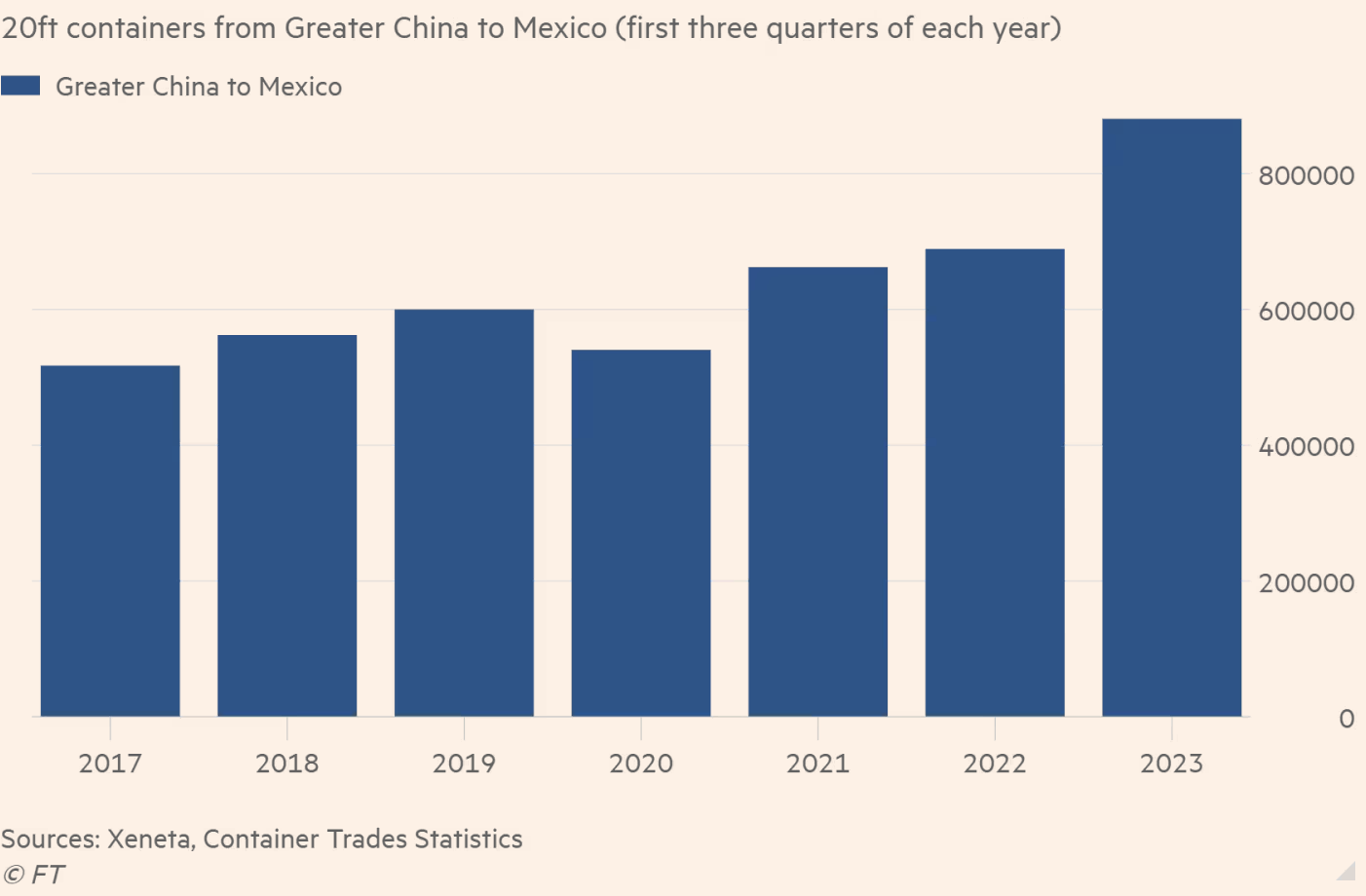
Chinese companies are seeking to circumvent US and EU tariffs in a number of different ways. One of these ways is transshipment, a method that is fully on display in Mexico, which as a member of North American Free Trade Agreement (Nafta) can export goods to the US market at much lower tariffs than China can access. An FT analysis of trade data shows a sharp rise in 20ft containers shipped from China to Mexico in the first three quarters of 2023 compared with the same period a year earlier. The rise came as Mexico overtook China as the biggest exporter of goods to the US last year, and as truck shipments across the border into the US have continued to increase quickly.

Sample this

Figures from Container Trades Statistics, analysed by Xeneta, show the number of 20ft containers shipped from China to Mexico hit 881,000 in the first three quarters of 2023, the most recent period for which data is available, up from 689,000 in the same period of 2022. The rise came as Mexico overtook China as the biggest exporter of goods to the US last year, and as truck shipments across the border into the US have continued to increase quickly.
5. As the WTO stalls and countries are pursuing bilateral deals, this is a good status report on India's bilateral FTA negotiations.
6. Some interesting facts about the dominance of the Magnificient Seven in the US equity markets and the general concentration of market capitalisation.
Today, the top decile of stocks in the US account for more than 75 per cent of total market capitalisation. The only other time we have seen this level of concentration was at the bubble peaks of 2000 and 1929. Worryingly, in both the prior periods, this ratio eventually mean-reverted to 60 per cent. Since 1926, the median ratio of concentration for the US has been 63 per cent. If we look at the top five stocks, at 25 per cent of the S&P 500, this ratio is back to the peak of the Nifty 50 era of the late 1960s. Even the top 10 stocks, constituting 34 per cent of the S&P 500, have never been a bigger part of the market than today. Driven by the Mag Seven, concentration, whichever way you cut it, has never been higher...
Taken together, the Mag Seven stocks, with a market capitalisation of $13 trillion, would be on their own the second-largest stock market in the world, larger than China and more than double the third-largest market, Japan. The single largest stock, Microsoft, at a market capitalisation of over $3 trillion, would on its own be the fifth-largest market in the world (just after India). Today, Microsoft and Apple individually have market capitalisation greater than the UK stock market... Even on the basis of profits, we are in a different world. Taking trailing 12 months profits, the Mag Seven have a total net profit of $361 billion—almost equal to the total profits of corporate Japan and half the profits of all the companies listed in China. Their profits on an absolute basis are more than double the profits of all the companies listed in India ($151 billion: Source DB). Apple alone over the last 12 months, delivered a net profit of $101 billion, 70 per cent of the profitability of all listed Indian corporations (source: DB). Combined, Apple and Microsoft deliver 20 per cent more profit than all the listed companies in India. I don’t think we have ever seen a phenomenon of companies with market capitalisation and profitability equal to large countries before... The US has had an incredible 15 years of both absolute and relative performance, and currently represents 62 per cent of global market capitalisation. It was higher than this in the mid-1960s, when there was no China and emerging markets. This relative performance dominance will reverse at some stage. The US cannot outperform forever...
All other global markets are far more concentrated. Most have a ratio of top 10 stocks over 50 per cent, and many have single stocks at over 25 per cent, compared to 8 per cent for the US. The size and profitability of these platform companies is also due to their network effects, global penetration and the inability of regulators until recently to rein them in. How do you compete against a company spending more than $30 billion a year each in terms of capex and research and design (R&D), as all the global platform stocks do? And how does one compete against Nvidia, which has the software/hardware integration, head start in graphics processing units (GPUs), and has locked much of TSMC’s leading edge Fab capacity?

7. A feature of today's capitalism is the extreme concentration of wealth and therefore power in the hands of a few. This threatens to destroy the social contract. There's a good FT interview of Peter Turchin where he makes this point.

In the modern period, elites have sometimes staved off the worst outcomes. Britain, Turchin argues, suffered decades of instability from the 1830s to the 1860s, but avoided revolution by abolishing food tariffs, widening the suffrage and allowing labour unions. For Turchin, these helped to address the root cause of instability: the fact that real wages had fallen between 1750 and 1800. Wealthy Americans checked their own power between the 1930s and 1960s, accepting income tax rates of more than 90 per cent. But today’s elites — by which Turchin means the richest 10 per cent — are unwilling to follow suit. “We are back to very similar attitudes that were prevalent during the Gilded Age.”

Saving capitalism from capitalists! 

8. Two striking graphics on China. The first is the steep fall in economic data disclosures as the economy worsens.

The second is the surge in Chinese manufacturing surplus during the pandemic that contradicts the conventional wisdom on global decoupling. 
9. FT long read on perhaps the biggest beneficiary yet of the Chip wars, Malaysia. Penang, a state in Northern Malaysia, has become the epicentre of the country's flood of semiconductor chip investments. 
The state attracted RM60.1bn ($12.8bn) in foreign direct investment in 2023, more than the total it received from 2013 to 2020 combined... Malaysia has a 50-year history in the “back end” of the semiconductor manufacturing supply chain: packaging, assembling and testing chips. But it has ambitions to move up to the front end of a $520bn global industry that powers everything from televisions to smartphones and electric vehicles. That includes higher value activities such as wafer fabrication and integrated circuit design.

The region and the country has a history in the industry is well placed to benefit from the diversification away from China,

In 1972, a muddy paddy field in Penang became the first production facility outside the US for Intel. Lured by a new free trade zone and a busy shipping port in the Malacca Strait, Intel, alongside AMD, Renesas (formerly Hitachi), Keysight Technologies (formerly Hewlett-Packard) and several other tech multinationals were the pioneers of what used to be called the “Silicon Valley of the East”. Malaysia became a well-oiled machine in the packaging assembly and testing of chips, until recently considered a fairly low-end, labour intensive but necessary part of the semiconductor manufacturing supply chain. It is already the world’s sixth largest semiconductor exporter and holds 13 per cent of the global semiconductor packaging, assembly and testing market. It is the origin for 20 per cent of US semiconductor imports annually, more than Taiwan, Japan or South Korea. But there hadn’t been much of a catalyst for it to move up the value chain in semiconductors — until now.
Demand for ever more high-powered chips in sectors such as electric vehicles and artificial intelligence means so-called advanced packaging — which connects chips to their circuitboards and protects them from contamination — is regarded as key to improving performance. A previously labour-intensive process now often takes place in highly automated factories. Intel, the world’s largest chipmaker by revenue, is spending $7bn on new facilities in Malaysia, including a “3D” advanced packaging site due to be finished later this year. The cutting-edge technology stacks chips on top of each other to improve performance. It is also building another chip assembly and testing factory in Kulim, which borders Penang... Micron and Germany’s Infineon are also in expansion mode. US-based Micron last year launched its second facility for assembly and testing in Penang, while Infineon, a former subsidiary of German engineering conglomerate Siemens, said it would spend up to $5.4bn to expand over the next five years. It is building the world’s largest production site for the silicon carbide chips widely used by makers of electric vehicles.

The sudden spurt in activities in Penang has come with all the problems:

Prices of industrial land have gone from about RM50 per square foot in 2022 to as much as RM85 per square foot... Across south-east Asia, Penang’s residential property price growth in the first half of 2023 was second only to the expensive city-state of Singapore... Traffic jams have become a regular feature... The country’s engineering staff shortage has also become more acute. Zafrul, the trade minister, says the electrical and electronics sector alone requires 50,000 engineers, but only 5,000 engineering students graduate each year — and many of them slip across the causeway to Singapore, where they are paid much more. Engineering salaries, especially for starting graduates, are still below most other professional sectors in Malaysia and experts say there is a lack of specialised expertise crucial for moving up to the front end of the supply chain... Malaysia does not have a national champion in semiconductors like Taiwan’s TSMC.

The US crackdown on China has been the trigger for Malaysia,

Since the US began imposing trade restrictions on Chinese technology under the Trump administration, and especially since they were tightened by current US President Joe Biden, Penang started to see a flood of interest from mainland groups like Fengshi, according to InvestPenang’s Loo. Many of these are companies with global suppliers or western customers hedging against further US restrictions, she says. InvestPenang estimates there are now 55 mainland companies in Penang operating in manufacturing, mostly in semiconductors. That compares to just 16 before the American crackdown began. US restrictions do not currently apply to advanced chip packaging services, but Chinese businesses fear potential future curbs, says one Hong Kong-based analyst for a Chinese company, who asked to remain anonymous. Some are de-risking by partnering with Malaysian firms to assemble a portion of their high-end chips, they added.

The most interesting thing is that the wave of chip investments in Malaysia has come without too many incentives and active pursuit by the government. In other words, there has been not too much industrial policy contribution to these investments. 

10. Sajjid Chinoy urges caution on reducing interest rates in India pointing to several conflicts trends and patterns in the economy.

Credit growth has been running at almost 16 per cent for the last year, almost twice as strong as nominal gross domestic product (GDP) growth of 9 per cent -- a multiple last seen in 2007... Uncertainty about neutral rates with the prospect they have increased, negative output gaps, but also forecasted inflation still above target... India’s policymakers are currently confronting several cross currents. Growth has surprised to the upside even as the economy remains below its pre-pandemic path. Core inflation is at multi-year lows, but credit growth is at multi-year highs. Private investment is yet to broaden out but public investment has been strong. GDP growth is strong but GVA growth has slowed.

11. Interesting graphic about the historical trend of GDP.

12. This year's meeting of the Chinese National People's Congress, the country's parliament, and the Chinese People's Political Consultative Conference, the top advisory body, (collectively called the "Two Sessions") set growth rate at an ambitious 5% and resolved to fight the country's high local government debt, property crisis, and persistent disinflation

The ballooning local government debt has been a rising source of major concern. 
Chinese local government debt, including off-balance sheet financing vehicles and shadow credit, was probably equivalent to between 75 and 91 per cent of national GDP in 2022, according to a paper last year by Victor Shih and Jonathan Elkobi of the University of California San Diego. Twelve province-level governments had outstanding bonds alone equivalent to more than 50 per cent of their GDP, they wrote. China says its total central and local government debt is less than 51 per cent of GDP.
The biggest worry is the pace at which indebtedness has grown. 
The deeply indebted province of Guizhou is a totemic example of the problems with debt-based infrastructure development.
Fixed-asset investment was expected to fall this year by 60 per cent for the western province of Guizhou... Guizhou, one of China’s poorest provinces, is now home to nearly half of the world’s 100 highest bridges, including four of the top 10. Yuekai Securities estimates the province’s infrastructure building spree has left it with total debt, including off-balance sheet liabilities, at 137 per cent of its gross domestic product.

13. Finally, an article on the increasing mothballing of conventional car factories as they give way to electric vehicles highlights both the risks of foreign investment in China and more importantly how China is bearing the costs of the green transitions. 

In 2017, Hyundai invested $1.15bn in a new factory in Chongqing, southwestern China, with the goal of reaching an annual output of 300,000 internal combustion engine cars. But six years later, the rapid switch by Chinese consumers to electric vehicles has stalled sales, forcing the carmaker to sell the factory in December for less than a quarter of the investment value... That plant is one of the hundreds of zombie factories that analysts are predicting over the next decade in the Chinese car market, the world’s biggest across sales, production and, since last year, exports. In 2023, China produced 17.7mn internal combustion engine cars, a 37 per cent fall from its prior peak in 2017, according to data from Automobility, a Shanghai consultancy. Bill Russo, the former head of Chrysler in China and founder of Automobility, said the “precipitous decline” of internal combustion engine car sales meant as much as half of the industry’s installed capacity — about 25mn out of 50mn units’ annual capacity — was not being used. While some older factories will be repurposed for plug-in hybrids or pure battery electric vehicles, others will never produce another car, posing a problem for both foreign and Chinese companies.

This has increased the pressure on foreign car makers in China who are now using China as a base for their exports, thereby undercutting their factories elsewhere. 

Until recently, foreign carmakers could only enter the Chinese market as a joint venture with a local partner. Of 16 joint ventures between Chinese and foreign groups, only five had a capacity utilisation rate higher than 50 per cent while eight were below 30 per cent, according to a report by Chinese media outlet Yicai Global. In response to the worsening domestic market situation, Chinese companies have been ramping up exports of cheap petrol-powered cars to Russia, a market that many international carmakers have quit in the wake of that country’s full-scale invasion of Ukraine. Yet analysts question whether those sales deliver meaningful profits to the Chinese groups, for how long they can continue, or if other developing markets can help soak up Chinese non-EV exports. Foreign brands, too, are increasingly trying to export more from their Chinese factories. But, experts say, in doing this companies risk undercutting their own factories in other markets.

Wednesday, October 4, 2023

Problems with international development - I

The biggest problem I have observed with the mainstream international development discourse is its obsession with the search for innovation and big new ideas AND its near-complete neglect of the pursuit of doing better what have been the staple human development policies historically across countries. 

This obsession arises from the belief that there are several new and big ideas that can help countries leapfrog their development trajectories. This belief is part of the general narrative of progress as the adoption of new ideas and doing things differently. This narrative is amplified by the rapid changes, especially in the field of digital technologies (e-commerce, ride-sharing, social media, etc.), and their adoption in the private sector. 

There are at least three other contributors to this obsession with new ideas and innovations. One, aid agencies (bilateral and multilateral development finance institutions) and philanthropic foundations, especially but not only the latter, are for a variety of reasons primed to view the success of their interventions in terms of of (measurable) impact they create. This comes primarily from their program-driven approaches that seek to target the achievement of outputs and outcomes within finite time periods. The institutional principal-agent problems of these entities also bias them towards time-bound programs with quantifiable impact creation. 

Second, the opinion formation on international development is disproportionately influenced by the outputs of narrow quantitative economic research, which too are inherently biased towards new ideas and innovations. It has not helped international development that its ideology is captured by the field of economics, especially quantitative economics. As an example, I have struggled to understand why the World Bank should have a Chief Economist, and not a Head of Research drawn from a multi-disciplinary pool. 

Third, aid agencies, philanthropies, and opinion makers are all primarily based out of developed countries and despite their genuine best efforts struggle to appreciate the complex realities of the development contexts (the problem, the social milieu, the political economy, and state capability). Many also suffer from what Courtney Martin has called "the reductive seduction of solving other people's problems". 

Sometimes international development actors stumble on the right direction of engagement in development. The idea of systems transformation is an example. But these endeavours struggle to quantify or evaluate impact, thereby leaving them difficult to be packaged as a program or project that can be funded by aid agencies or philanthropists. In fact, there may be a fundamental problem with such framing - systems, especially those involved with messy and complex development challenges, rarely get transformed. Instead, they evolve and change, the pace of which can be hastened with appropriate policies/programs and their committed implementation. 

For policymakers and politicians in developing countries, this narrative of innovation and new ideas helping to leapfrog the entrenched bad equilibriums offers the misleading comfort of being able to do something in a finite time (specifically in their limited 2-5 year tenures) to address chronic and persistent problems and make perceptible enough (if not transformative) impact. 

So, everyone wants to support Edtech or Development Impact Bonds to improve student learning outcomes instead of engaging with teachers to motivate and capacitate them, and building the system's supervision and monitoring capabilities. Or support biometric or facial recognition attendance systems to monitor teacher or nurse/doctor attendance instead of nurturing the governance capabilities and local accountability to monitor and ensure compliance. Or support health insurance (or micro-insurance) or Medtech to improve health care instead of the hard slog of improving public health and primary health care delivery. Or erect smart meters to reduce electricity distribution losses instead of addressing the political economy of regular tariff increases and doing basic energy audits and enforcement. Or support cash transfers instead of running a good public distribution system for the provision of food items or building a well-targeted and cost-effective social safety net. Or support Agtech and micro-insurance to improve farm productivity and incomes instead of working with farmers to change behaviors by demonstrating good practices and working with them to adopt those practices. 

This search for new ideas and innovation is a serious distraction from the deep and tortuous struggle that societies, polities, and bureaucracies in developing countries have to undergo to figure out how best they can realise their development objectives. It weakens democratic accountability by distorting the development processes of prioritising objectives, selecting policies, and allocating scarce resources by governments. It comes in the way of the internal debates and struggles that are essential to creating the social and political consensus and collective commitment to national development objectives. 

At a purely operational level, the implementation of any new idea and innovation, how much ever simple its design, imposes non-trivial change management challenges and significant implementation costs on the frontline functionaries who are implementing the change and their immediate supervisory levels. It ends up displacing a disproportionate amount of time and effort from their regular and routine activities, with the result that final outcomes often turn out to be lower than earlier. 

Even if you disagree with everything I have said till now, and we were to indeed focus on new ideas and innovations, it still remains to be addressed as to how these new ideas and innovations will be implemented. And implemented with enough fidelity to create the expected impact. Here again, we will come back to the problems that come in the way of implementation of the existing programs. Just because we have a new idea does not mean that the chronic problem of the general implementation deficit in developing countries disappears. 

Now, I'm not saying we should swing to the other extreme and neglect innovation and new ideas. For sure ideas and innovations have their relevance at the margins and in some cases, especially with digital technologies, significant role to play in improving service delivery. And they should be encouraged and funded. But at a broader level, the argument is for a recalibration towards a different perspective of international development. One that prioritises getting the basic things right and good governance, and opportunistically adopting new ideas and innovation at the margins as required. 

Then there's the point about whether there are indeed great new ideas and innovations with the potential to have transformative or even significant impacts on development outcomes. I have long argued that there are no big untapped ideas in human development in developing countries. I'll discuss this in another post. 

Friday, February 24, 2023

Some thoughts for philanthropic donors working with governments in India

This final post draws on two earlier posts this week on the value of evidence and the role of innovation  in development. 

Given these observations, how should philanthropic donors and the organisations they support engage with governments to maximise their effectiveness? I'm specifically talking about support to implement ongoing programs, enhance state capabilities etc. 

For a start, it's worth always keeping in mind that in the Indian context most persistent public policy challenges are too complex for the marginal philanthropic funding to make a meaningful difference within reasonable time. The objective then should be to identify the highest leverage in terms of the activity or intervention, implementation unit, and the process proposed. 

This identification is a critical aspect whose importance is not adequately recognised. It demands a discovery process which donors and non-profits generally overlook. Even when they undertake some embedded initial exploration, it's soon becomes a routine and opportunistic engagement. For donors and implementation partners, this discovery process demands their highest level engagement for some period of time. It has to be also borne in mind that even when discovered, the scope and outcomes from such engagements will be modest and not as grandiose as the donor/partner may want. 

I believe the biggest challenge comes from the ideological priors of the donors or their implementation partners. Most donors come with their priors about the theory and process of change. As I have blogged on numerous occasions, these perceptions are deeply flawed and does not reflect the messy realities of development and public administration. 

In fact, this ideological cloud results in atleast two important distortions among the donors (and their partners).

1. They start to look for problems and solutions which fit into their priors. So they tend to look for those issues and solutions which are amenable for reasonably quick resolution. But these are often marginal to the larger problem, and/or not the priority of the government, and/or detracts from scarce administrative bandwidth. 

2. Strong priors marginalise the requirements of the government stakeholders. It's not uncommon for donors and their partners to pay lip-service to the requirements of the government agency and pursue their agendas. The absence of clear articulation of their objectives and priorities by the government stakeholder is often the convenient excuse. The result is limited government participation, interest, and ownership in the outcomes of the intervention. This problem is exacerbated by many donor/partner's proclivity to engage at their highest levels with only the political and bureaucratic leadership and not cultivate mid-level officials (the actual permanent implementers) within their government department partners. 

In this context, I can think of four common mistakes that donors make while engaging with governments:

1. There are very few important public issues where governments would require external support and which can be resolved in finite time. It's therefore important to be cautious on guarding against confusing psychological satisfaction at the appearance of having solved a problem without actually having solved it. Donors should shape their expectations about the ambiguities and uncertainties associated with their engagements and what can be achieved from them. This would also influence their own shaping of the expectations of their government partners from the engagement. 

It's easy to confuse and/or delude yourself into believing that you've made a difference when all you've done is staged an event or put a nice looking band-aid. Or done a small pilot. This is what most philanthropic interventions end up doing. 

2. A few high level photo-ops should not be mistaken for genuine government interest in the partnership. If someone offers support in addressing a complex public issue, then very few governments are likely to refuse it. The government has nothing to lose and no skin in the game. But getting important government leaders actively engaged and owning up the partnership is very hard and demands immense effort. The form of top-level ownership should not be confused with the substantiveness required. 

3. While top leadership engagement is important, the sustainability and success of any intervention is critically dependent on ownership by the Department or implementing agency. This requires active engagement and ownership of the senior and middle-level Departmental officials. They are the internal champions of change. Donors and their partners rarely spend the required efforts to cultivate Departmental officials. 

4. Most often, the external support ends up doing hygiene activities that are a source of nagging irritation for the primary stakeholder - like routine program/project management, recording meeting minutes and other documentations, preparing presentations etc. These routine things crowds out change requirements on serious issues. 

In light of all the above, I'll prescribe four essential requirements for any engagement by a philanthropic donor with governments (nothing new, but just putting it out there nevertheless)

1. Identify a stakeholder who is committed to the cause and has the administrative agency to decide and execute the decisions that emerge from the intervention. It's no good to have a high level approval of the Chief Minister or some high functionary who's not the Head of the administering Department. In fact, I'll venture that an engagement led by the Chief Minister's Office is most likely to fail for several reasons. Nobody wants to give up a photo-op on being seen to be doing something new, though very few are committed to actually being engaged actively in doing it. 

2. Let the stakeholder articulate the problem statement with hypotheses, about issue(s) agitating him/her and for which she/he wants external support. It's important that the individual concerned goes through the struggle of articulating the problem statement. Many times, the stakeholders themselves are not clear on what they want. Even more problematic is that (due to incentive compatibility issues) most often the researchers/donors have priorities which are marginal to the concerns of the stakeholder. 

Even if the donor/partner identifies a problem and solution through embedded or other exploration, it has to necessarily be validated as being a felt-need of the government leader. This is hard and requires conscious and intense effort. It's required to directly or through a very high quality consultant engage intensively with the individual leader to elicit and articulate the problem statement and hypotheses. Donor's should eschew the temptation to identify the problem and formulate the hypotheses for the government leader. 

3. The government leader should be actively engaged throughout the process with ideation and co-creation of the intervention. In simple terms, the successful implementation of the intervention is closely correlated with the intensity of engagement by the government leadership. This can be hard given the scarce time available for top officials for active engagement in such marginal partnerships. 

4. Finally, it's important for the partner to embed within the government agency and work with a team of officials identified by the government to execute the intervention/plan. In course of the engagement, donors and their partners would do well to keep in mind the four common mistakes outlined above and avoid them. 

Needless to say, like with any generalisations as above, there will always be exceptions. And it's also possible that I'm using too high a standard in making these suggestions.  

For these reasons, the simplest entry-point for donors/partners lies with supporting the implementation of specific programs. The task is clear and ring-fenced. The platform offered by these programs can then be used to consciously prioritise the building of implementation capacity in a purely opportunistic manner. 

Monday, September 19, 2022

A Note for funders of development impact evaluations

This post will provide a list of suggestions and checklist for funders of international development impact evaluations. 

First, the suggestions:

1. An important parameter for categorising impact evaluations should be whether they emerged from the primary policy maker’s side or not. Funders should make this an important point of diligence when they are funding impact evaluations. They should incentivise researchers to engage closely with policy makers, understand their real needs (as against hypothesising their perceived needs), and work together to design and present the evaluation proposal. Is the evaluation arising as a demand from a policy maker and whose outputs will feed into a program design or redesign? Or, is it primarily a proposal from a researcher, which also happens to have taken the consent of the policy maker? 

2. In the normal course, the highest priority impact evaluations should be those arising directly from policy makers about impact evaluation issues agitating them and whose evaluations can be done within their expected time frames. In this context, the highest value impact evaluations are of the quick but rigorous A/B testing kind which help with changing the design of an intervention to improve its operational efficacy or implementation fidelity. 

3. Also, in the normal course, concurrent evaluations which feed into program design or implementation should have greater preference than post-facto evaluations of headline efficacy. For example, an evaluation question which emerges from a deep-dive of an ongoing implementation and on a proximate cause of likely implementation effectiveness (say, the periodicity or the manner of a cash transfer; or converging an intervention in agriculture with another ongoing program; or a procedural change or small add-on to an ongoing program) should be considered high value and prioritised. Such evaluation proposals also reflects active engagement by the researchers with policy makers to surface an important factor which impacts the program effectiveness. 

4. Any impact evaluation of an intervention/idea in a context should necessarily be preceded by a deep-dive that also includes examination of the history of same or similar interventions/ideas in the particular local context (and not merely based on theory and evidence from other contexts). What are the examples of such interventions in that context in the last three decades? What have been their outcomes? Do the government and other local stakeholders know about them? How have they been received by the system?

5. Impact evaluation should always be associated with qualitative research (key informant interviews, focus group discussion etc), which should help in interpreting the quantitative study findings relating to design and implementation issues.

6. Encourage (or in certain cases mandate) enlisting a local researcher as Principal Investigator in impact evaluations. Despite all its possible flaws and distortions, this is perhaps the only way in which local researchers can become involved in a meaningful enough manner in impact evaluations in their own countries and develop evaluation expertise. 

7. On a similar note, philanthropic donors like BMGF should prioritise local researchers, and that too working in local institutions, in the impact evaluation projects they fund. 

8. Large scale and long-drawn research projects (eg. RISE, Young Lives etc) should necessarily enlist a local institution as the anchor/host institution in the country. Encouraging local researchers and institutional capacity building in developing countries should be an explicit primary objective of such funding. 

9. Large funders should also incorporate some features and parameters that capture capacity building and knowledge transfer when they approve impact evaluation proposals. For example, funders should insist that outsourced services like surveys should be given on open competitive bids to preferably local providers instead of being given on nomination to captive foreign partner institutions. Or a clear plan (with accountability) that explains how the government partner is actively engaged in the evaluation design, the conduct of the evaluation, and how the evaluation findings are used. 

10. Encourage and incentivize studies to explore and reference impact evaluations and studies of impact evaluations done by researchers, government agencies, and non-government institutions in developing countries (and not just those in foreign think-tanks and by foreign researchers). For example, the Directorate of Monitoring and Evaluation Office (DMEO) in India has a rich expertise on the challenges and issues with impact evaluations, and have very useful things to say about what type of evaluations could be used where and when. 

11. Multilateral and bilateral funders, who have the credibility of government backing, should make available model procurement documents and contracts for hiring evaluation agencies; and templates of evaluation designs, survey instruments etc which can be drawn by evaluation agencies of governments and local evaluation providers. There should be something similar to the World Bank’s PPIAF in case of impact evaluations. This will help atleast those interested government leaders who are committed to undertaking impact evaluations, thereby also creating a local supply-side for it. It’s important that this be housed in a bilateral or multilateral institution (and not in a philanthropic entity or think tank) to allow government leaders the freedom to draw and use. 

A checklist for diligence of proposals considered by funders of impact evaluations

1. Is the primary demand arising from policy makers, with a commitment to incorporate the results? What are its signatures and how credible are they?

2. Has there been extensive stakeholder engagement by the impact evaluators?

3. Is cost-effectiveness of the intervention a consideration in the evaluation?

d. Is bureaucratic feasibility (or state capacity consideration) a factor in the evaluation?

4. Is the evaluation to improve design/implementation or to assess headline efficacy?

5. Is it a concurrent or post-facto evaluation?

6. Does the evaluation team have a local PI based in the subject country?

7. Does the evaluation proposal have meaningful partnerships with local institutions?

8. Does the evaluation involve some signatures of capacity building or some form of knowledge transfer?

9. Does the evaluation involve procurement of services from local providers?

10. Does the report reference and document the work done by local researchers, government agencies, and non-government institutions?

Friday, December 31, 2021

A graphical look back at 2021

1. Performance of various financial asset categories over the year - bitcoin tops.

2. US equity markets topped among the major economies.

3. Corporates globally raised over $12.1 trillion in 2021 through loans and capital markets.

The cash raising is 17% up from 2020 and equity issuance at $1.44 trillion is up 24%. The real talking point was the emergence of SPACs.
For the first time ever, more money was raised by special purchase acquisition companies in the US than through traditional IPOs. Issuance has slowed down since a bumper first quarter, but a steady stream of blank-cheque companies — which raise money from investors then seek a company to acquire — have come to market through the final months of the year, collectively raising more than $152bn this year.

Reflecting the froth in financial markets, global M&A for 2021 soared to their highest ever levels at $5.8 trillion, a 64% rise from last year. 

The most egregious manifestation of the times has been the rise of SPACs from being a derisive curiosity to an important contributor to the financial market.
A total of 334 Spac deals — where a company is created to list and merge with a privately held business and bring it to the stock market — were announced, for companies valued at a combined $597bn, or 10 per cent of global deals by value. 

4. Indian markets benefited from the liquidity glut and search for yields. Another positive factor was the re-direction of capital away from China. It was a record breaking year for IPOs in Indian markets

Sixty-three companies raised Rs 1.19 trillion through initial public offerings (IPOs) in calendar year 2021 — a record for any year. This is nearly 4.5x the Rs 26,613 crore raised through 15 IPOs in 2020 and almost double the previous best of Rs 68,827 crore raised in 2017, according to PRIME Database. Overall, public equity fundraising — that includes qualified institutional placements, follow-on offerings, as well as infrastructure investment trusts/real estate investment trusts — stood at Rs 2.02 trillion — higher than the previous high of Rs 1.76 trillion in the preceding year... The average deal size for IPOs was Rs 1,884 crore... Of the 59 IPOs for which the data is available, 36 IPOs received mega responses of more than 10x (of which, six IPOs more than 100x), while eight IPOs were oversubscribed more than 3x. The balance 15 IPOs were oversubscribed between 1x and 3x.
In general, it was a record year for equity fund raising in India.

The biggest jump was in IPOs, where it topped the previous best by nearly 100%. Of the IPOs, 38.7% by deal value was cornered by digital companies.  

Retail interest as manifest in inflows into mutual funds too was at a record high.

Arguably the financial market trend of the year in India was the emergence of an extraordinary 39 unicorns

The country overtook China to become the second most happening VC market after the US. 

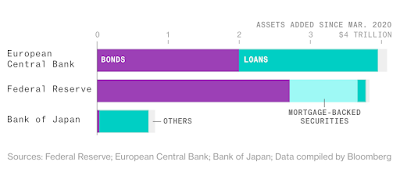
5. The driving force behind the liquidity glut has been the extraordinary decade and more long monetary accommodation by central banks in developed countries, which got amplified during the pandemic. Reflecting this, the market capitalisation of the biggest global companies is dwarfed by the combined balance sheets of the major central banks. Since the start of the pandemic, the balance sheet of US Fed, ECB, and BoJ has swollen by $9 trillion to $24 trillion

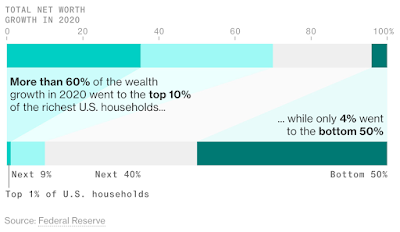
This has had distributive consequences.

However, it can be now safely stated that the era of quantitative easing may have ended and the era of "quantitive tightening" has begun. 

6. Good set of graphics from McKinsey here. This captures the remarkable pace of pandemic vaccine development times in perspective

7. Income loss due to the pandemic was steepest for the poorest.


8. One of the biggest stories of the year concerned the supply chain disruptions which impacted everything from groceries to consumer goods to semiconductor chips and cars. The Council of Foreign Relations has a very good primer here

The pandemic, aided by the rise in household savings during lockdowns and the generous stimulus measures, triggered a spurt in demand for consumption goods. The abrupt nature of the positive demand shock coupled with the pandemic disruptions in China and elsewhere meant that supply got constrained. The available supply itself struggled to find shipping fleets and port operations too slowed down. 

The result was that shipping times nearly doubled, and global shipping costs surged spectacularly, especially the China-US route.

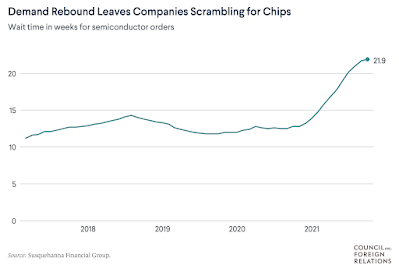
The most salient impact was on semiconductors. This captures the globalised nature of its supply chain. 
The wait times for chips doubled in 2021.
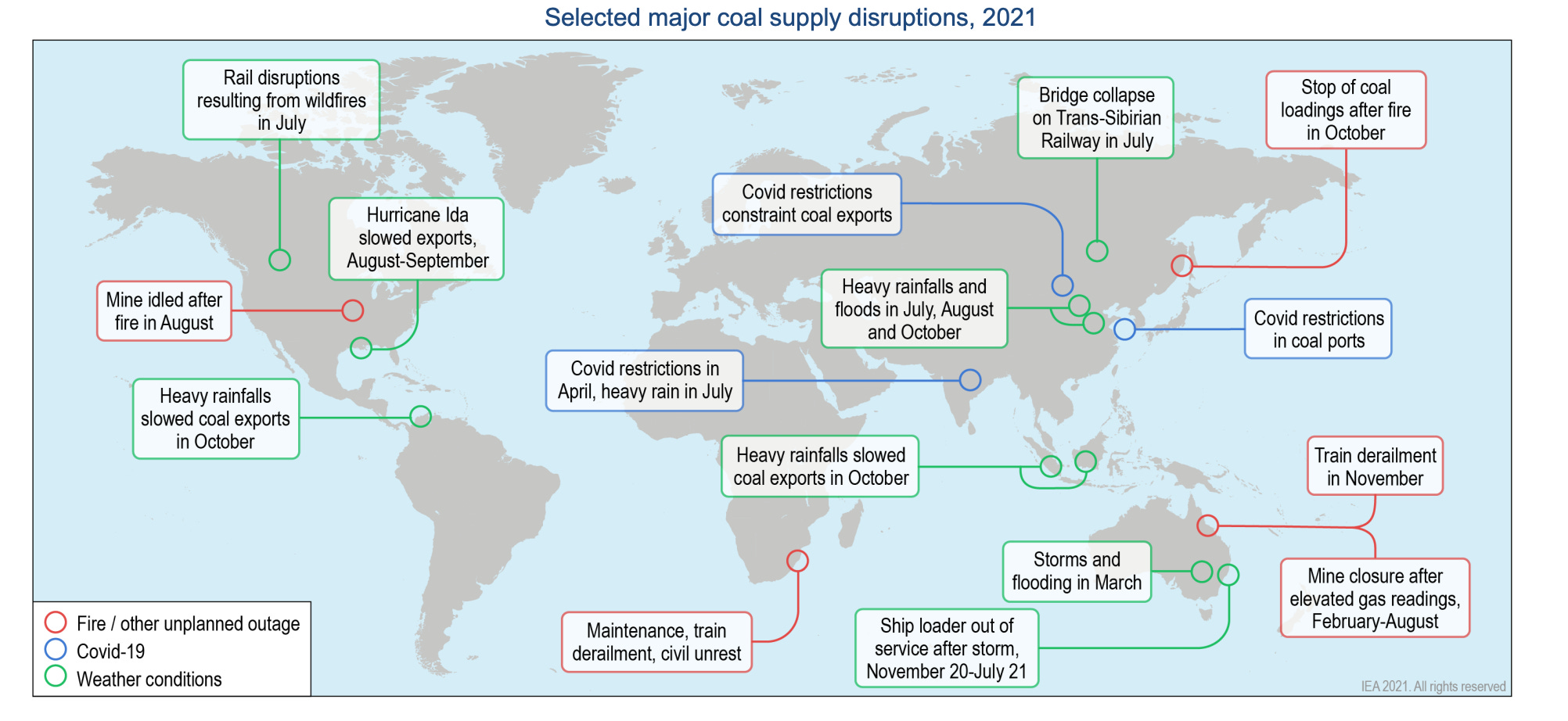
Another salient example was in power generation, with coal supply disruptions in 2021 shown below
See graphics here and here.

9. McKinsey Scott, the ex-wife of Jeff Bezos, has shaken up the philanthropy world
With almost $8.6 billion in gifts announced in just 12 months, Scott has vaulted to the tippy top of philanthropic giving, outspending the behemoth Gates and Ford Foundations’ annual grants — combined... For nearly 90% of organizations that responded to a Bloomberg survey, Scott’s gift was the largest they’ve ever received, with donations ranging from $750,000 to $60 million.
10. Finally, 2021 may well be remembered as the year when inflation returned.