Substack

Showing posts with label Real estate. Show all posts

Wednesday, July 15, 2026

Higher FARs, but very few plots can avail them

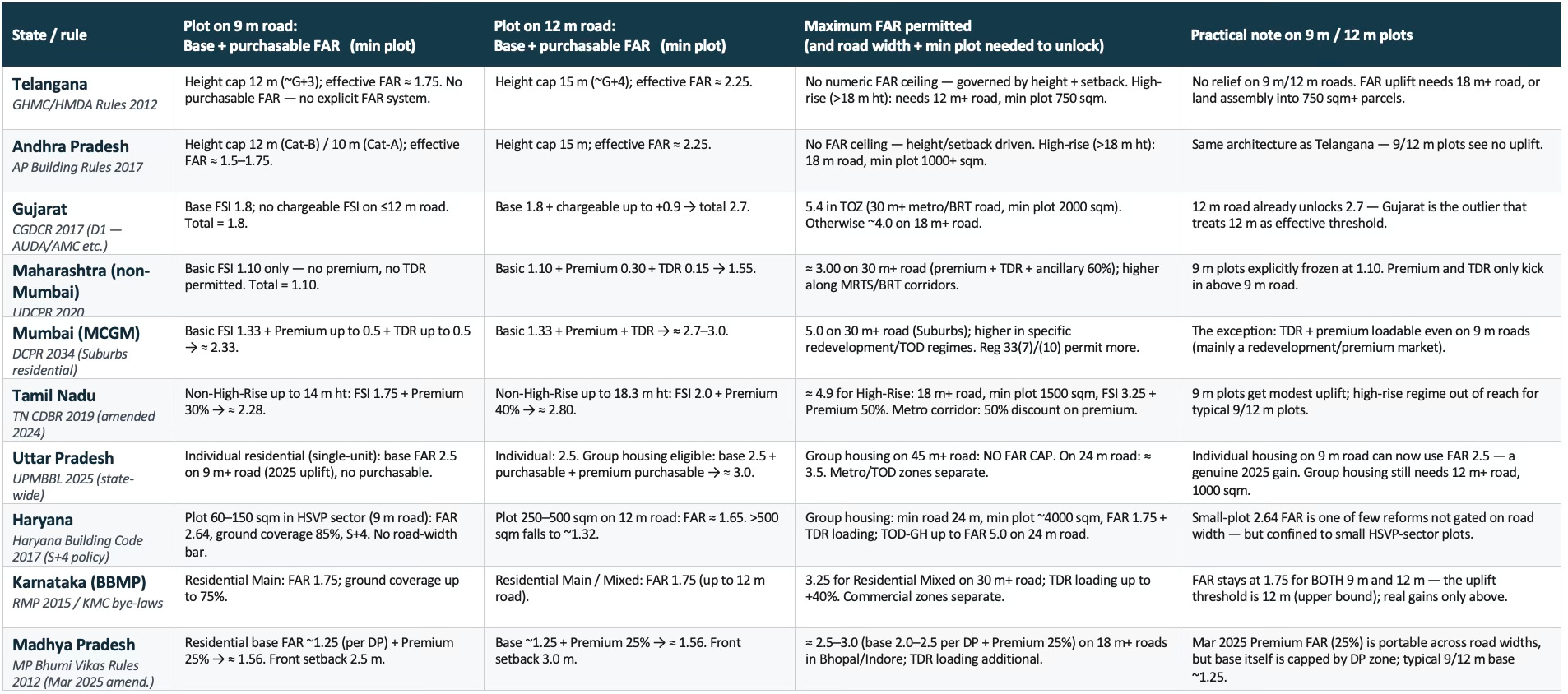
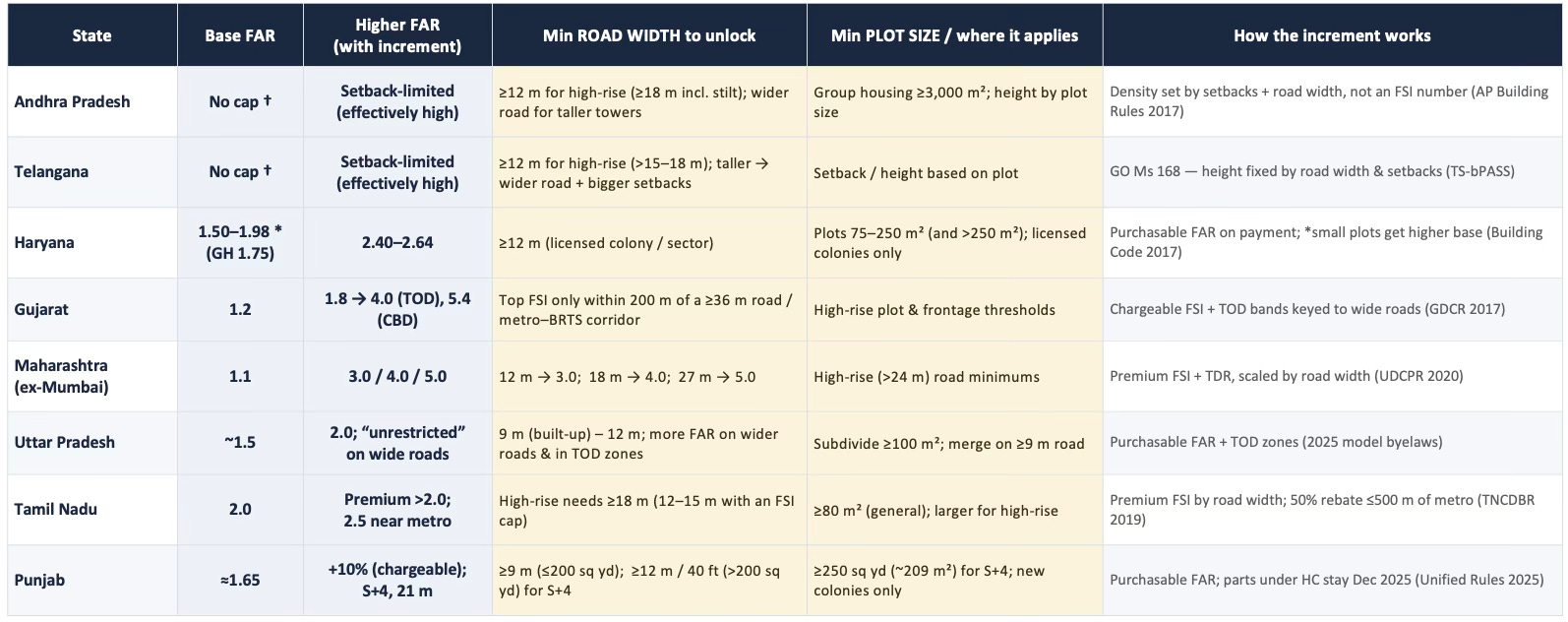
Many state governments in India have issued executive directions increasing the permissible Floor Area Ratios (FARs) in their cities. However, these upzoning reforms are likely to struggle to meet the objective of densification due to restrictive conditions to avail the increased FAR. Specifically, three gate-keeping elements - minimums on road width and plot size, and a maximum on height - leave the upzoning reforms largely stillborn. 

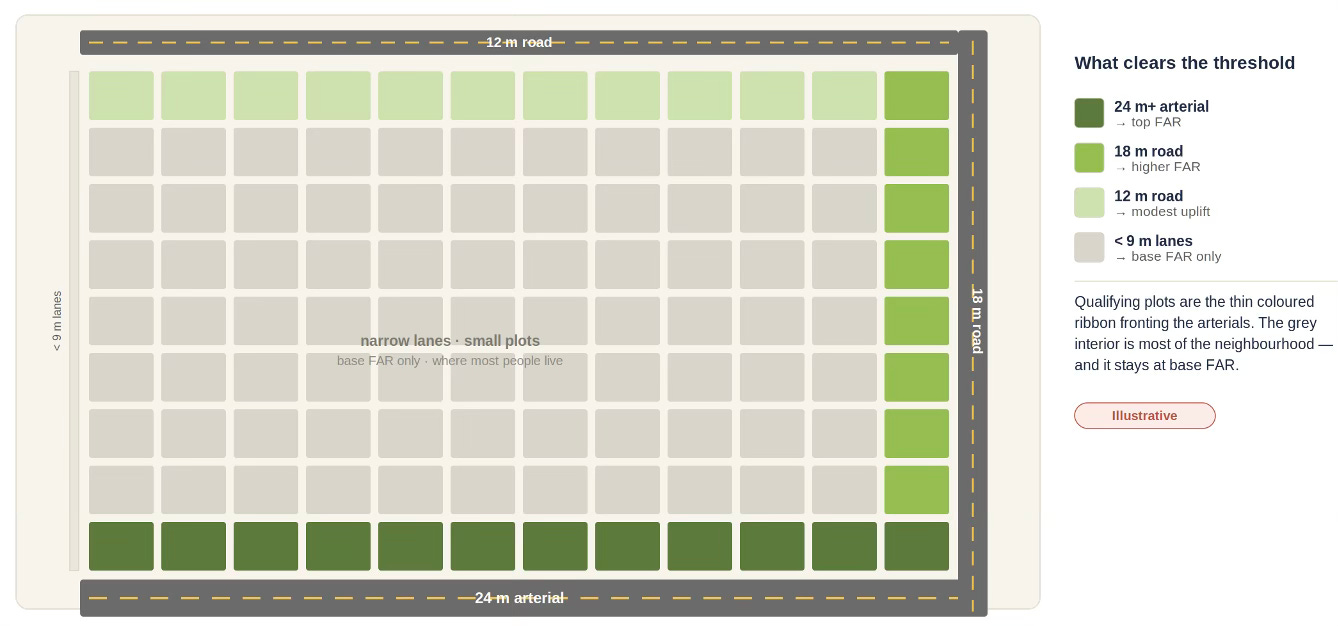
To understand why, we need to keep in mind the street layout of the typical Indian city. The colony street widths are typically 9 m (30 ft) or less, and at best 12 m (40 ft). Even the connecting roads are no more than 12 m. In any city, a very small proportion of properties, and an even smaller proportion of residential land use, will have road widths greater than 9 m. Only the arterial roads, which are in any case mostly commercial and higher-valued, are above 12 m.

A comparison of upzoning reforms across the ten biggest states reveals some interesting insights. For a start, the upzoning itself is generally marginal, and even where significant, the higher FARs can be realised only on wider roads. In simple terms, the upzoned FAR apply to a tiny minority of parcels - greenfield layouts and edge plots on arterial roads. Every state except Gujarat, UP (individual) and Haryana (small plot) sets the FAR uplift threshold above 12 m - typically 18 m, 24 m or 30 m. But even for the three, the uplift is marginal and only for a few categories of properties. Also, none of the three touches group housing or vertical redevelopment on narrow-road plots.

Further, plot size and setbacks compound the problem of a minimum road-width gate. Even where a 12 m road technically qualifies, high-rise / group-housing rules require minimum plot sizes of 750–2000 sqm and setbacks of 6–12 m. In existing settlements, individual plots average 60–150 sqm, and assembling five to twenty of them is legally and commercially nearly impossible without a TDR/land-pooling instrument. Even then, practical challenges are daunting.

This also means that even the TOD zones cannot benefit from the upzoning. In existing town cores, which are where TOD catchments actually sit, FAR reform delivers almost nothing until the road-width and plot-size gates are lifted or bypassed. 

In other words, the upzoning reforms largely bypass the built-up city and are relevant only to the greenfield areas. In these areas, the uplifts linked to higher road widths end up benefiting only the large developers. They, in turn, build high-rise gated communities of higher-end housing, mostly unconnected to mass transit and with multiple car-users in each household. Ironically, this also ends up expanding the sprawl, flooding the roads with cars, thereby worsening traffic and increasing pollution.

On the other hand, it does nothing for the smaller developers who are likely to develop affordable mid-rises (say, 6-12 floors) inside the existing colonies. Instead, they end up constructing low-rises (up to 4-5 floors). Further, the unit economics given high land prices mean that even these low-rises gravitate towards the suburbs. 

It is these mid-rises that are likely to contribute meaningfully to expanding supply and addressing the affordable housing problem. Unless the upzoning covers the 9 m road width and smaller plots (which make up the vast majority of the potential developable properties in any city), there cannot be any significant impact on housing supply and the affordable housing problem. 

Further, to realise the full potential of such upzoning, it must be complemented with sharply increased mass transit services, especially buses, that cover these colonies. The quality, frequency, and connectivity of the bus network must be high enough to induce people to shift from car usage.

Saturday, January 24, 2026

Weekend reading links

Over the past decade, India’s top five outsourcing companies have managed to raise labour productivity by less than 2 per cent annually because of their squeamishness to put more fixed capital behind human effort: The average value added by an employee has risen to roughly $40,000 a year, from $34,000 in 2015. The modest gains are going to labour, although not at the entry level where salaries have been stagnant. Profit per worker, in my calculations, has been practically unchanged in dollar terms.


The top 10 most valuable private companies, including OpenAI, ByteDance, Anthropic and SpaceX, have been sucking up funding mega-rounds and are collectively valued at $2tn. The top 10 most active VC funds, including General Catalyst, Andreessen Horowitz, Sequoia and Accel, are heavily focused on AI. “The most influential investors are essentially running concentrated AI funds, not diversified portfolios,” CB Insights concluded. 

One other significant difference today is how the Big Tech companies are reshaping the start-up universe given their overlapping roles as suppliers, customers, competitors, funders and acquirers. The Magnificent Seven US tech companies — Nvidia, Alphabet, Microsoft, Amazon, Apple, Meta and Tesla — dominate the tech landscape in a way that was not the case at the dawn of the internet era. These giant companies are massive allocators of capital in their own right, investing almost as much as the entire VC industry. They also provide start-ups with AI software, cloud computing services and direct investment funding through their own sizeable corporate venture capital arms. But they are furiously rolling out AI themselves in sectors as varied as video generation, healthcare, autonomous driving and scientific discovery. Every time a giant AI company releases a new generative AI model, scores of undifferentiated start-ups shrivel up and die.
Oil executives seem to not only be balking at the risk of having assets nationalized but also expressing a view that has become standard across the sector: Big new projects have to survive intense scrutiny. Venezuela’s tar-like oil has to be diluted to flow through a pipeline. It has to be upgraded locally before it even gets to a refinery. That’s a multi-billion-dollar expense. For most of the past 15 years, Big Oil was focused on projects — such as drilling for North American shale oil — that have a quick and predictable payback, even though their production drops off steeply after the first year. To some extent, the companies deprioritized projects such as those in offshore oil, or heavy crude deposits like Venezuela’s, that keep producing at low cost for 10 to 20 years but require more upfront investment to bring online.

So a lot of oil came from fields that were low in risk but relatively high in cost. According to Rystad Energy, a research company, in 2024 North American shale had a break-even cost of $45 a barrel. That was expensive compared with offshore deepwater ($43), offshore shelf ($37) and onshore Middle East ($27). From 2014 to 2024, daily crude production in the United States increased 71 percent, while production in the rest of the world actually decreased a couple of tenths of a percent, according to data in the Statistical Review of World Energy 2025. That’s changing a bit. North American shale is beginning to be tapped out, although the oil majors are using advanced technology to get more oil out at lower costs. Since around 2022, when Russia invaded Ukraine and oil prices spiked, the oil majors have shifted some of their interest back toward higher-risk, longer-payout projects in parts of the world where the oil is cheapest — not North America. Exxon and Chevron have explored bidding on exploration opportunities in Libya. Last year, Chevron signed an agreement in principle to develop Iraq’s vast Nasiriyah oil field and other assets. Exxon is also in discussions with Iraq.

Interesting that Trump is forcing his oil companies to invest in a country that has historically been univestable despite its abundance of oil reserves, one reason being the high cost of extraction of the country's heavy crude (costs $70 to extract a barrel, when oil sells for $58). 

4. In 2017 when Donald Trump said he was going to pull the US out of the Paris Agreement, this was the reaction of corporate America.  

“Today’s decision is a setback for the environment and for the US’s leadership position in the world,” wrote Lloyd Blankfein, Goldman’s then chief executive, in his first post on what was then Twitter. Facebook’s Mark Zuckerberg agreed, saying the move was “bad for the environment, bad for the economy, and it puts our children’s future at risk”. Tesla’s Elon Musk and Walt Disney’s Bob Iger both quit White House business advisory councils. At Apple, Tim Cook said he had tried but failed to persuade Trump to abandon a move that would have “no impact on Apple’s efforts to protect the environment”. And other corporate leaders spoke out with equal force.

Last week he announced US exit from both the 34-year old parent of the Paris Agreement, the UN Framework Convention on Climate Change, and the UN's 38-yar-old Intergovernmental Panel on Climate Change, it was met with silence from the same people. 

5. China violates Taiwan's airspace with a drone for the first time,

A Chinese surveillance drone entered the airspace of Pratas, a Taiwan-controlled island in the South China Sea also known as Dongsha, for four minutes on Saturday. The unmanned aerial vehicle was a WZ-7 known as ‘Soaring Dragon’ according to a Taiwanese national security official. It flew at an “altitude outside the range of our air defence weapons and left following warnings Taipei broadcast via international radio channels”, Taiwan’s defence ministry said in a statement... “China has found another soft spot,” said Kitsch Liao, an associate director at the Atlantic Council’s Global China Hub. “They can repeat this to demonstrate that they can enter Taiwan airspace with impunity. And what do you do if they start flying lower and lower? If you decide to shoot the drone down when it comes into range, China can blame Taiwan because it didn’t do anything before.”

6. Ishan Bakshi makes some very important points on the central government's tax revenues on the back of the lowering of corporate taxes in 2019, the rejigging of the personal income tax slabs in the Union Budget of 2025-26, and the GST rate rationalisation of late 2025.

The net impact of these fiscal steps — even as the direct and indirect tax base has significantly expanded over the past decade — is constrained finances, forcing governments to restrain expenditure, despite the bluster of lavish spending. The estimates of the extent of revenue foregone due to these tax cuts vary considerably. Nonetheless, they are quite significant. For the corporate tax cuts, the initial estimates pegged the revenue foregone at Rs 1.45 lakh crore, while in the case of the income taxes, it was around Rs 1 lakh crore. For GST, while precise estimates are difficult to arrive at, they will reflect slowly in tax collections... Over the past decade, the Centre’s tax collections have barely inched upwards – net tax revenues were 7.2 per cent in 2014-15 and were budgeted at 7.9 per cent in 2025-26. Collections may, in fact, end up being lower this year.

7. Tim Harford writes about smart fitness tracker watches and their health behaviour tracking. 

...in a study conducted with behavioural scientists Linda Chang, Erika Kirgios and Sendhil Mullainathan. The researchers asked a simple question: “Do we decide differently when some dimensions of a choice are quantified and others are not?” The answer emerged loud and clear from a series of experiments: yes, we do. Whenever experimental subjects were offered a choice between two options, they would tend to favour whichever option looked better on numerical measures and overlook qualities that were expressed as graphical elements, letter grades, star symbols or in words (“moderate”, “excellent”, “highly likely”). This was true whether the choice was between hotels, job applicants, conference locations, public works projects, restaurants or charitable causes. Numbers loomed large. What was quantified, got attention. This matters because fitness trackers purport to excel at quantifying some things and do not pretend even to quantify others. If quantification fixation applies, we would expect to see such trackers systematically pushing people towards the quantified behaviour at the expense of other things.

And the perverse incentives generated from such health behaviour tracking.

Larger studies strongly suggest that fitness trackers do not usually hinder weight loss, but the surprising and disheartening finding is an example in miniature of the quantification-fixation problem. In this case, both groups were equally active, but those using a fitness tracker were getting automatic, effortless validation of their effort, which they could then use to justify more indulgent eating. The lead researcher, John Jakicic, speculated at the time: “People would say, ‘Oh, I exercised a lot today, now I can eat more.’ And they might eat more than they otherwise would have.” Calorie counting is joyless, easily fudged — and not automated by the watch. We’re all familiar with the tendency to be virtuous in one aspect of our behaviour, then let ourselves off the hook somewhere else — choosing a healthy salad, then using it as permission to order dessert. Psychologists call this behaviour “self licensing” and fitness trackers encourage it by supplying us with asymmetric data. We are told how much we moved, but not what we ate. We get stark feedback on heart rate and step count, but the tracker looks the other way if we order french fries and a glass of beer.

8. Tej Parikh thinks that China will win the AI race with the US. I think this piece is one of the least persuasive ones from Parikh.

9. As anti-immigration and nationalism trends rise, it is likely that US companies will show increasing preference for US-born chief executives
Foreign-born CEOs already face a more difficult time than native ones. Academic research shows they are held to a higher standard for performance and are more likely to be dismissed when things are going wrong. They also have to work harder to prove their legitimacy and trustworthiness. In politicised environments, the margin for error becomes smaller.

10. The continuous weakening of rupee despite the combination of low inflation, high GDP growth rates, and low current account deficit (around 1% of GDP) can be traced to the worsening trade balance and weak FDI inflows

Merchandise imports averaged about $62 billion a month in 2025, far exceeding exports of roughly $37 billion and leaving a $25 billion trade deficit. Although services exports offset much of this gap, weak goods exports and a rising import bill — driven in part by higher gold and silver prices — have skewed demand towards dollars... In 2025, foreign portfolio investors (FPIs) withdrew about $19 billion from Indian equities on a net basis — the worst outflow on record... Gross FDI inflows have been stuck at around 1.7 per cent of GDP since early 2023, well below the 3 per cent seen in the mid-2000s... Between January 2024 and October 2025, gross FDI inflows averaged about $7 billion a month, while withdrawals ran close to $4 billion, leaving net inflows of barely $3 billion — negligible for a $4 trillion economy. Once rising outward investment by Indian firms, averaging $2-3 billion a month, is taken into account, the picture worsens. In effect, India has received close to zero net FDI each month over the past 22 months.
Data shows that net FDI in November was negative $446 million, compared with negative $1.67 billion in October.
Lowering the government’s stake to 51 per cent in 78 listed public-sector enterprises (PSEs) could unlock value worth about ₹10 trillion.

12. Ashok Gulati has a summary of the food subsidy.

In the case of rice, the economic cost hovers around Rs 42/kg, and for wheat, it’s around Rs 30/kg to FCI. It gives 5 kg of free rice or wheat to about 813 million people under the PM Garib Kalyan Yojana. Roughly 56 per cent of the country’s population of around 1.5 billion is covered. The introduction of point of sale (POS) machines in more than 5 lakh fair price shops (FPS) was a significant reform of the Modi government. It helped to reduce massive leakages in PDS. But how rational is giving free food to 56 per cent of the population, when, according to the World Bank’s extreme poverty criteria — $3 per capita/day/in purchasing power parity (PPP) terms at 2021 prices — India’s poverty came down to just 5.3 per cent of the population in 2022? Even at a higher poverty line of $4.2/per capita/day, poverty in India was about 24 per cent. One can argue that the extremely poor need to be given free food (antyodaya). Viewed from this perspective, only about 5 per cent of the country’s population needs free food, while others should pay at least half of the MSP. If not, then this policy is nothing but the biggest political revdi (dole) the government is giving consumers for votes.

13. FT Alphaville suggests that the threat of pulling out from the $35 trillion foreign holdings of US financial assets is not a credible option for Europeans and others trying to exercise leverage over the US. 

While the US’s large current account deficit suggests that in theory there is the potential for the USD to drop should international savers stage a mass retreat from US assets, the sheer size of US capital markets suggests that such an exit may not be feasible given the limitations of alternative markets.

14. Amidst China's real estate crisis, this stands out

China had about 440 square feet of housing for each man, woman or child living in cities in 2024, up from 340 square feet only 15 years earlier. It was less than 100 square feet per person before Mao Zedong’s death in 1976.

15. In a ruling that has far-reaching implications for how India applies tax treaties to offshore transactions, the Indian Supreme Court has ruled on the tax treatment of Tiger Global's capital gains from the sale of its investment in Flipkart (done through three Mauritius-based entities) to Walmart for about $1.6 billion in 2018. 

Tiger Global had argued that capital gains on the transaction should only be taxed in Mauritius and not India, in line with a treaty in place between both countries for decades. While a significant amendment in 2017 to the treaty had made capital gains on transactions in Indian shares taxable in India, it also exempted share purchases that were made before the change came into force. The Delhi High Court agreed with this view at the time. Last week’s ruling essentially strikes down this interpretation and makes all transactions vulnerable to being taxed in the country. The exact amount Tiger Global will have to pay the tax authorities is unclear, but some estimates suggest that tax plus penalties may be close to $1.5bn... 

The court said holding a tax residency certificate was not a “magic wand” that automatically bestowed the benefits of the treaty, and that Indian tax authorities could examine whether the structure of an investment had been created primarily to avoid taxes. In his concurring opinion, one judge wrote: “Taxing an income arising out of its own country is an inherent sovereign right. Any dilution of this is a threat to a nation’s long-term interest.” This signals that the court could take a similar approach if presiding over other investments. Foreign investors typically use Singapore, Mauritius, the Netherlands or other treaty jurisdictions to structure their investments into India. The supreme court’s order will force a rethink on this.

16. China is influencing the course of the Russia-Ukraine war by informally supplying drones to both sides

China already makes 70-80 per cent of the world’s commercial drones and dominates production of critical elements such as speed controllers, sensors, cameras and propellers, according to analytics provider Drone Industry Insights. That has made it a hidden fulcrum in the conflict. “It just puts into perspective how much control the Chinese actually have over the outcome of this war,” says Catarina Buchatskiy of the Snake Island Institute, a Kyiv-based military think-tank. “They could just choose to supply or not to supply the Ukrainians. I mean, the drone is such a definitive battlefield weapon now. It underlines how China has kind of evolved into a really influential player.” China’s Ministry of Foreign Affairs said the country had “always maintained an objective and just position on the Ukraine crisis” and had “never supplied lethal weapons to any party to the conflict and strictly controls the export of dual-use items, including drones”.

17. AI-related capex contributed as much to the US economic growth in H1 of 2025 as consumer spending, which makes up 70% of the economic output.

18. This sort of sums up Trump's presidency
Trump’s behaviour seems to be becoming even more erratic. Since the beginning of the year, he has staged a military operation in Venezuela; promised to intervene in Iran; threatened to annex Greenland; dispatched hundreds of masked federal agents to Minnesota; and launched law suits against the head of the Federal Reserve, Jerome Powell, and the head of JPMorgan, Jamie Dimon. That is in just three weeks and there are three years of his presidency left to go.

Saturday, September 20, 2025

Weekend reading links

1. Emaar, the Dubai property developer whose major shareholder is Dubai Investment Corporation, is considering expanding outside UAE. And an interesting possibility in India.
Emaar already has a sizeable presence overseas, owning more than 175mn sq ft of land outside the UAE at the end of 2024, excluding a 1.1bn sq ft “economic city” project in Saudi Arabia. Alabbar said Emaar’s current total land bank — an industry term referring to land owned by developers and reserved for future use — was at 1.87bn sq ft, including the UAE. India, where Emaar owned 122mn sq ft of land at the end of 2024, could provide a testing ground for Emaar’s overseas strategy and its subsidiary there was discussing a potential joint venture with local developers, including the Adani Group, Alabbar said. Alabbar dismissed reports that Emaar had been discussing the sale of its business in India to Adani. “We’re not selling,” he said. “We actually were looking for local partners to do a local [joint venture].” Adani did not respond to a request for comment.

2. An illustration of how worsening demographics are going to hit Japan's logistics industry.

In the first half of this year, private equity firms sold companies they owned back to themselves at a record-setting pace, providing a way out of (or back into, whichever you prefer) some $41bn of investments in the first six months of 2025, according to investment bank Jefferies. That is close to a fifth of all sales in the industry, and is 60 per cent above the level last year, and it comes as private equity groups find themselves sitting on $3tn worth of assets that they are unable to get out of, either by selling to another company or by listing them... Torsten Sløk at private markets group Apollo, noted this week that on top of the steady flow of companies delisting from public stock markets, those companies that do opt for an IPO “are getting older and older”. (Sigh, aren’t we all?) “In 1999, the median age of IPOs was five years,” he wrote. “In 2022, it was eight years, and today, the median age of IPOs has increased to 14 years.”
4. France is facing a pensions crisis. However, the political economy of reform is perilous
Not only do French pensioners receive larger cheques from the government than their counterparts anywhere else in the west, they start getting them several years earlier. The result is a situation in which over-65s now have higher average incomes than the working age population — unique both internationally and in France’s own history. Even the rumour of threats to this arrangement is met with mass public outrage and opposition from left and right. Macron’s proposal to nudge the retirement age up towards the lower end of western norms was met with nationwide protests. Barnier’s suggestion of a six-month delay to the latest scheduled increase in pension payments led to the first of two collapsed governments in the past 10 months. Bayrou’s refusal to scrap the same pledges brought about the second. In a particularly stunning statistic highlighted by French political analyst François Valentin, pensions play such an outsized role in the country’s public finances that they accounted for one-sixth of the ministry of defence budget last year, and without them France would not meet Nato’s 2 per cent target for military spending.

5. The latest ASI data show that the share of contract labour in India's organised manufacturing sector workers has reached 42% in 2023-24, up by 8 percentage points in the last ten years. Such contract labour have lower wages and no benefits (paid leave, social security benefits, longer tenure), and are typically hired through third-party agencies. 

Global studies have shown varying levels of contract employment in different countries. A 2023 study pegged it at 10.8 per cent in the US. Latin American countries like Brazil and Argentina have seen numbers ranging from under 10 per cent to 20 per cent at various times, according to a 2016 study, which pegged the number in Europe at 12.3 per cent.

7. As Pakistan and Saudi Arabia sign a landmark mutual defence pact, this is an important insight.
Since the 1960s, Pakistan has received more aid from Saudi Arabia than from any nation outside the Arab world, the Brookings Institution estimated. The funding — which was never directly for support of Islamabad’s covert nuclear programme — included direct aid to the government as well as financing for schools, mosques and other Islamist charitable programmes.

8. Trump finally imposes a $100,000 fee for H1B visa applications for skilled foreign workers, the main pathway through which Silicon Valley firms hire engineers and IT professionals. The current visa charge is $215 to register for a H-1B visa lottery and an additional $780 for employers that sponsor visa applicants. Abut 400,000 such visa applications were approved last year, with the majority for those renewing their visas and 75% in 2023 being from India. 

Between October 2022 and September 2023, 72 per cent of the nearly 4 lakh visas issued under the H-1B programme went to Indian nationals. During the same period, top four Indian IT majors with a presence in the US — InfosysTCSHCL, and Wipro — obtained approval for around 20,000 employees to work on H-1B visas, as per the latest US Citizenship and Immigration Services (USCIS) data. The share of IT workers in the H-1B program grew from 32% in 2003 to an average of over 65% in the last five fiscal years.  Given the average salary of the H1-B visa holder is $66,000, the fee is certain to almost finish the use of these visas. 

Goes to the point I have been making on Trump's completely transactional policy making. It's important that India keeps this in mind as it navigates a modus vivendi with the US under DJT. Unlike China or Russia, India is not big enough either economically or militarily to deter Trump from acting on his core agenda. Besides, India falls in the firing line on many of those core areas. We should not be surprised if GCCs are the next. 

9. One of the definitive legacies of the Russia-Ukraine war will be the emergence of drones as an important weapon. This is a good summary of how the war evolved in terms of what weapons were being used.
Back in 2022, when Russia started its full-scale invasion, Kyiv had to use its existing Soviet-style kit plus Javelin shoulder-fired anti-tank missiles. Then came western donations of weaponry like Abrams tanks and Himars (high mobility artillery rocket systems). Next, Ukraine’s army of software engineers started using hobby drones, made by Chinese companies such as DJI, first for surveillance, then attacks and defence. Now they are innovating to dramatically extend drone flight range, increase attack capabilities, “swarm” and avoid electronic jamming by using fibre optic cables, balloons and (most crucially) AI. The Russians are doing the same. And that has transformed the nature of war: a world where cheap drones can destroy ultra-expensive ships and planes changes the power dynamics and economics of combat...

Equally startling, while China has been responsible for 80 per cent of global drone production, Ukraine is now racing to become “China free”... Last year it produced more than 2mn drones. It could go above 10mn next year, if it has the funds. That means over half of Ukraine’s drones are now domestically sourced — and China is no longer the only global drone king. This is critical for Ukraine’s defence, and might generate badly needed future export revenues too. Indeed, Ukraine is already considering exporting underwater drones, which it has used to push Russian ships out of the Black Sea so successfully... Nato officials now want to collaborate with Ukraine via partnerships, licensing and private capital investments. They are particularly keen to access the treasure trove of data collected by its drones to train future AI models.

10. A rare example of an infrastructure project completed on time and without much cost overrun is the Thames Tideway Tunnel, a 25 km sewage tunnel passing under Thames. It took nine years of construction and cost £5 billion, and used an innovative financial model, where a surcharge on customer bills will fund the construction cost over 50 years. 

Tideway was project managed by US group Jacobs, while each of the three geographical sections was overseen by a different engineering consultancy. Each employed “hundreds and hundreds” of contractors and subcontractors supplying the labour. All 25,000 people working on the project were fully employed and paid the London living wage as a minimum, in contrast with much of the industry, where staff are employed on zero-hour contracts or by the day. Workers were also kitted out in full Tideway uniform and protective equipment and given training and holidays... Juliano Denicol, director of the Megaproject Delivery Centre at UCL, said Tideway would be studied for decades as an “exemplar case of ‘how’ to deliver multibillion infrastructure programmes”...

Tideway, which as a company was able to lure investors including Allianz, Dalmore Capital and Amber Infrastructure after the government offered guarantees against any cost overruns. The 16mn households served by Thames Water have paid £617mn towards the project since construction began nine years ago, more than the £510mn in equity injected by Tideway shareholders in 2015. The shareholders also loaned the company £764mn at an interest rate of 8 per cent, which has grown to £972.6mn, while the company’s total debts have risen to £4.6bn, with the remaining borrowings held by third-party lenders. Although construction is complete, Thames Water’s households will continue to pay for the project through a surcharge on their bills — now £26 a year — potentially for the 120-year lifespan of the tunnel. The cost — drawn up under a modified version of the Regulated Asset Base model — piles pressure on customers, who are already faced with steep bill increases from the UK’s largest water company, which could yet be renationalised.

Saturday, August 9, 2025

Weekend reading links

1. Impact of Trump tariffs, car manufacturing edition.
Ahead of Trump’s self-imposed August 1 deadline to slap even higher tariffs on trading partners, the US has signed a flurry of trade deals with the EU, Japan and South Korea that have brought down the tariff rate on cars to 15 per cent. Yet as of Friday, Mexico and Canada, which have highly integrated automotive supply chains with the US through a 2020 USMCA trade agreement, have not reached new deals with Trump. That means cars produced in those two countries would have a higher overall tariff of 27.5 per cent than those built in Japan, the EU or South Korea. Antonio Filosa, the new CEO of Stellantis, which owns the Fiat, Jeep and Opel brands, pointed out to investors that 8mn of the 16mn vehicles sold in the US each year are built at plants in Mexico and Canada using many components from US suppliers. Meanwhile, he added that the other 4mn units that come from Europe and Asia have “virtually zero US content”... 

Car parts from Mexico and Canada, for example, that comply with the rules of the USMCA trade agreement created under the first Trump administration in 2020 are tariff-free, while non-compliant vehicles will face a maximum tariff of 25 per cent. Complete vehicles compliant with the USMCA will have the 25 per cent tariff applied only to their non-US parts content. The administration is also offering those that assemble their vehicles in the US small rebates — up to 3.75 per cent of the retail value of the car for the next year — to offset the cost of the levies. When all of these factors are applied, the average tariff cost per vehicle for cars imported from the EU, South Korea or Japan would be around $5,600 — higher than the $4,900 for vehicles imported from Canada and Mexico, according to Erin Keating, executive analyst at Cox Automotive, a car services and data group.

Updated primer on Trump tariffs

2. Future of India's IT sector job hiring?

Between 2021 and 2025, average bench size (workers on payroll but not assigned to any billable projects) has shrunk from 15–20% to less than 10%, according to data from Teamlease. Meanwhile time on the bench has reduced from 45–60 days to 35–45. Companies are also moving from bulk hiring to an on-tap model—which means they’re hiring only the bare minimum required for current projects.

This is coupled with salary stagnation.

3. Indian youth's civil services obsession in a graphic.

In the decade up to FY23, the latest year for which data is available, the number of applicants for the preliminary exam more than doubled, to 1.1 million. But the number of applicants fighting for each vacancy almost tripled. The surge is startling, especially when the ranks of new college graduates only expanded 40% in roughly the same period.

4. Lenskart is going global. Will it be the first global Indian consumer brand?

The company now operates 656 stores outside India, which together pull in around 40% of its total revenue. Its footprint is sprawling, including 28 subsidiaries, two joint ventures, and three associate companies spanning 14 countries... It wants to be the Essilorluxottica of the east, the company behind eyewear giants like Ray-Ban and Oakley, but with the agility of a digital-first, vertically integrated brand... What gave Lenskart a unique edge was partnering with or acquiring local players. Instead of spending millions building ground-up... 

Since setting foot abroad in 2019, the company has acquired Japanese eyewear brand Owndays, and made strategic investments in San Francisco-based immersive product visualisation startup Metadome, Israel-based 6Over6 that develops AI-powered solutions for the optical industry, and France’s Le Petit Lunetier. It has even set up a joint venture Bao Feng Framekart in China to manufacture frames... Late in July, the Indian multinational eyewear company acquired an 80% stake in Spanish fashion-eyewear brand Meller for Rs 407 crore... Lenskart’s entry into Paris that year with a 29% stake in French eyewear brand Le Petit Lunetier.

But it still has some way to go before it can compete with global leaders. 

And fortunately, it's making India its manufacturing hub.

The company currently runs two manufacturing facilities in India—in Gurugram, Haryana and Bhiwadi, Rajasthan—with a third plant in the works in Telangana. Apart from this, it also has plants in Singapore, the UAE, and China (through a JV). It’s also building a greenfield manufacturing facility with an investment of Rs 1,500 crore to expand frame production at its Bhiwadi unit. Together, this means that a majority of Lenskart’s global manufacturing happens in India. Apart from the obvious cost savings of such an arrangement, it brings production close to the teams that design and engineer the eyeglasses—leading to improved delivery times and tight quality control.

It has some serious competitive advantages.

The real moat is vertical integration, according to the senior analyst from Crisil. Lenskart controls everything from manufacturing, to omni-channel delivery, to customer support. This is the perfect leverage, bolstering its pricing power, agility in product launches, and consistency across markets, added the analyst. It also helps that prescription glasses are Lenskart’s bread and butter, comprising 80% of its revenue. As anyone who wears them knows, these aren’t impulse buys; they’re healthcare essentials. Which means margins are healthy, replacements are predictable, and customer loyalty is high.

5. Milan's property boom has brought in its wake allegations of corruption in the real estate sector. The transformation has been spectacular. 

Two decades ago the drab suburban district north-east of central Milan — once characterised by railway yards and factories making Pirelli tyres and Breda steel — was so desolate and plagued with crime that regular Milanese would never think to visit. Today it is the city’s most exclusive neighbourhood, home to global bankers and billionaires. Its curved and gleaming UniCredit tower was designed by the late architect César Pelli, renowned for Kuala Lumpur’s Petronas towers. Nearby is the Bosco Verticale, a pair of skyscrapers where apartments sell for up to €25mn to private equity executives, footballers and Middle Eastern investors. The glitzy Porta Nuova district was masterminded in large part by one man: Manfredi Catella, who led the Italian arm of US property asset manager Hines, then acquired the former Hines division through his family’s real estate vehicle Coima in 2015, building up the district with backing from Qatar’s sovereign wealth fund.

Its origins are less than a decade old. 

In 2015 Milan hosted the Universal Exposition, seizing the chance to demonstrate that the once provincial and austere financial capital of Italy was morphing into a vibrant global city, thanks in large part to the 340,000-square-metre urban regeneration plan. Since the Expo, whose director-general was Sala, the city’s property market has attracted €30bn in investment and thousands of wealthy international residents, lured to Italy by generous tax breaks. Since 2016 Italy has offered new residents a flat-tax charge on unlimited overseas income, a fee that rose from an annual €100,000 to €200,000 last year. The country has enticed wealthy expats who deserted the UK after its Labour government last year scrapped the popular “non-dom” regime, which offered residents whose permanent home was abroad up to 15 years without paying tax on money held overseas. Expats were drawn to Milan for its convenient location at the foot of the Alps and its dolce vita lifestyle. New London-style members’ clubs, such as Casa Cipriani and The Wilde, housed in Santo Versace’s old mansion, and lavish restaurants launched to cater for the new arrivals, who poured money into its real estate market. Milan is due to hold the Winter Olympics next year; Coima teamed up with Prada Holding, controlled by the fashion family, to build the Olympic Village at the Scalo di Porta Romana, a former railway yard across from Prada’s suburban headquarters.

The breakneck pace of property development has exposed a corrupt nexus between politicians, local officials, and real estate developers. 

This week Milanese prosecutors called Catella’s dream into question. They demanded he be placed under house arrest alongside five other people — including a city councillor — involved in the city’s redevelopment. Another 15 individuals, including mayor Giuseppe Sala, are under investigation as part of a sprawling probe into Milan’s rapid real estate expansion... prosecutors allege the Coima boss bribed public officials to obtain fast-tracked building permits that overlooked rules governing the height of buildings and their impact on the landscape. The investigation “uncovered a system whose purpose is to facilitate the issuance of illegal building permits for the realisation of highly speculative real estate transactions”, the document said.

See also this.

6. This is a stunning fact about the scale of data centre investments and its impact on the economy.

Spending on data centres means the firms (Alphabet, Meta and Microsoft) possess property and equipment (accounting-speak for hard assets) worth more than 60% of their equity book value, up from 20% over the same period. Add the capital expenditure of these firms during the past year to that of Amazon and Oracle, two more tech giants, and the sum is greater than the outlay of all America’s listed industrial companies combined. Jason Thomas of Carlyle, an investment firm, estimates that the spending boom was responsible for a third of America’s economic growth during the most recent quarter. This year companies will spend $400bn on the infrastructure needed to run artificial-intelligence (AI) models. Predictions of the eventual bill are uniformly enormous. Analysts at Morgan Stanley reckon $2.9trn will be spent on data centres and related infrastructure by the end of 2028; consultants at McKinsey put it at $6.7trn by 2030...
Since 2023 Alphabet, Meta and Microsoft have divided $800bn of operating cashflows roughly evenly between capex and shareholder returns. This goldilocks capital allocation, which combines a building boom with a trip to the bank, is unprecedented even among their own ranks. Amazon’s shareholders are paying for huge capex bills but have been starved of returns; Apple investors have benefited from vast share buy-backs but are worried that the company’s lack of investment means it is falling behind on AI. But capex is growing faster than cashflows. Morgan Stanley’s calculations indicate a $1.5trn “financing gap” between the two over the next three years. It could be bigger if advances in the technology escalate spending further and kill existing cash cows. Conversely, if companies are slower to adopt AI than consumers, big tech will struggle to earn a quick return on its investment; shareholders might then demand a greater portion of their earnings to compensate for this sluggish growth.

But this capex boom is increasingly being funded by credit, not from banks, but from private equity investors in the form of private credit.

During the first half of the year investment-grade borrowing by tech firms was 70% higher than in the first six months of 2024. In April Alphabet issued bonds for the first time since 2020. Microsoft has reduced its cash pile but its finance leases—a type of debt mostly related to data centres—nearly tripled since 2023, to $46bn (a further $93bn of such liabilities are not yet on its balance-sheet). Meta is in talks to borrow around $30bn from private-credit lenders including Apollo, Brookfield and Carlyle. The market for debt securities backed by borrowing related to data centres, where liabilities are pooled and sliced up in a way similar to mortgage bonds, has grown from almost nothing in 2018 to around $50bn today... 

CoreWeave, an ai cloud firm, has borrowed liberally from private-credit funds and bond investors to buy chips from Nvidia. Fluidstack, another cloud-computing startup, is also borrowing heavily, using its chips as collateral. SoftBank, a Japanese firm, is financing its share of a giant partnership with Openai, the maker of Chatgpt, with debt... After raising $5bn of debt earlier this year xai, Mr Musk’s own startup, is reportedly borrowing $12bn to buy chips... Private-equity firms are refashioning themselves as lenders to the real economy... Data centres produce large amounts of debt. This sits easily on the huge balance-sheets managed by these outfits, which are often funded by life-insurance policies... For some it is also a warning sign. Lenders may find themselves taking technology risk, as well as the default and interest-rate risks to which they are accustomed... Capex booms frequently lead to overbuilding, which leads to bankruptcies when returns fall. Equity investors can weather such a crash. The sorts of leveraged investors, such as banks and life insurers, who hold highly rated debt they believe to be safe, cannot.

7. Nepal is on the fast track of EV adoption. 

Over the past year, electric vehicles accounted for 76 percent of all passenger vehicles and half of the light commercial vehicles sold in Nepal. Five years ago, that number was essentially zero. The E.V. market share in Nepal is now behind only those of a few countries, including Norway, Singapore and Ethiopia. The average for all countries was 20 percent in 2024. The swift turnover is the result of government policies aimed at leveraging Nepal’s wealth of hydropower, easing dependence on imported fossil fuels and clearing the smog. It has been fed by an intense push from Nepal’s biggest neighbor, China, the world’s dominant manufacturer of battery-powered vehicles.

8. India's consumption class captured in a graphic.

Only a tiny proportion of the market demand is for branded eggs. This share is 70% in developed countries. 

9. One more illustration of how DJT is being inexplicably soft on China at the cost of its own allies. 

“China — not India — is the largest buyer of Russian oil. In 2024, China imported $62.6 billion worth of Russian oil, compared to India’s $52.7 billion. But Mr Trump appears unwilling to criticise China, perhaps because of geopolitical calculations, and instead targets India unfairly,” think tank GTRI said.

10. Edward Luce is spot on about Trump being the "last China dove in Washington" and, unfortunately, "his is the only voice that counts". 

11. Worker attrition in manufacturing jobs.

Long-distance migration is not easy, especially if it involves moving from an informal and flexible work environment to the strict discipline of factories. Attrition is alarmingly high, with over half of contract workers leaving within a year, according to staffing firm Teamlease; about a tenth of labourers drop off within the first three months of joining, it added... India had about 68.5 million manufacturing jobs in 2022-23, according to household survey estimates analyzed by Data For India... The reasons for high factory attrition are complex and manifold. Factory owners have heard it all: frustration over long hours, strict factory operating procedures, homesickness, inability to adjust to a new state’s cuisine, long commutes, and poor accommodation, especially on the outskirts, where factories are located. Sometimes, workers don’t have the money to survive the first month before their salaries hit their bank accounts.
12. The Warren Buffet premium enjoyed by Berkshire Hathway stock.
Buffett is in the home stretch of a six-decade tour de force atop Berkshire, transforming a struggling textile mill into a financial conglomerate spanning sectors from insurance to natural gas pipelines. His returns, built on a buy-and-hold, value-driven strategy since he took over Berkshire in 1965, have outperformed the benchmark S&P 500 by more than 5mn percentage points.

The premium is now at the risk of disappearing as Buffet prepares to stand down, dragging down Berkshire shares in recent weeks.

13. Russian exports to EU.

14. Janan Ganesh feels that we are at "peak Trump".
In all likelihood, this summer is Trump’s peak. Life for the US president goes downhill from here. For one thing, inflation is going to rise. To an extent, it already has. If prices haven’t gone up faster and earlier, that is because some businesses stocked up on inventory from abroad before the tariffs set in. Others chose to absorb the increase in costs for a while rather than pass it on to customers. Neither of these cushions will be there for long... Other things being equal, tariffs on this scale should lead to higher prices over time... public sentiment is about to edge left again, especially if Trump overdoes the deportations and the crusade against universities. It is not that Christian nationalists are going to convert to the teachings of Michel Foucault. Rather, voters in the middle who gave Trump a reluctant go might decide, “This is too much”, and tilt the other way... The right’s moment of cultural leadership, in which Sydney Sweeney can make a conservative-coded advertisement for some jeans, and perhaps some genes, is likely fleeting.

15. India's Russian oil imports problem might become a general petroleum trade problem.

India buys about 90 per cent of its crude oil from overseas and has been the biggest market for Russian seaborne crude since 2023, according to ship tracking data compiled by Kpler. India imports about 5mn barrels of oil a day, of which 2mn come from Russia. “Where would India find 2mn barrels a day of crude just like that?,” said Sumit Ritolia, a lead Kpler analyst... A sudden halt of Indian purchases of Russian oil could also affect global markets. Premasish Das, head of analysis of oil markets in Asia at S&P Global Commodity Insights, said if India suddenly turned to other suppliers, it would create “a significant tightness into the market”, potentially pushing the price of crude to more than $80 a barrel, from current levels of about $67.
See this as Trump imposes an additional 25% tariffs on India. Interesting that the standout second largest buyer of Russian crude, China, gets away with nothing. 
16. Amidst the sacking of its Director by President Trump, the US BLS is facing several serious technical challenges. For one there's the increasing share of prices data is not directly observed.
A rising number of prices collated as part of the CPI report are no longer directly observed by the BLS’s field staff. This has lifted the proportion of data points in which the value of an item in one city is used to estimate another to 35 per cent in June, from 10 per cent at the start of 2025.
Survey response rates have declined sharply since the pandemic.
Then there's the issue of shrinking budgets and workforce.
These issues have come at a time when the BLS is facing a funding crunch, with a Department of Labor document showing the agency is facing an 8 per cent budget cut next year. It will also have to do its job with more than 150 fewer staff, according to the projections, bringing the total to about 1,850. Former and current staff say the workforce reduction is likely to worsen data standards and delays. The Quarterly Census of Employment and Wages, a vast and detailed survey of the US labour market, is already being published with longer lag times. Labour-intensive data collection, in particular, has become harder as the BLS’s workforce shrinks.
Saturday, May 3, 2025

Weekend reading links

1. Blackstone is Spain's biggest residential property landlord

Over the past decade, Blackstone has become Madrid’s largest private owner of residential real estate, and the second largest in all of Spain. Ms. Riquelme’s apartment is one of 13,000 that Blackstone currently owns in Madrid, and among 19,600 it owns nationwide. Across Spain, around 185,000 rental properties are now owned by large corporations, half of those by firms based in the United States, according to a review of property registries by the nonprofit Civio. Rental prices have increased 57 percent since 2015 and home prices 47 percent, according to PwC, in large part because the country has failed to build enough homes for its growing population, even as more than 4 million homes sit empty. After the pandemic pushed Spain’s unemployment rate up to 15 percent, evictions nationwide spiked. In Madrid, tenant groups estimate that 20,000 renters in the city currently face the threat of eviction.

Ms. Riquelme, a bookkeeper by trade, emigrated from Chile in 2000 and bought her apartment for 56,000 euros during the housing bubble, making mortgage payments to CaixaCatalunya, a now defunct bank. After she and her husband split, she could no longer keep up, and the bank eventually foreclosed. CaixaCatalunya sought €150,000 ($170,000) in fees and mortgage arrears, then sold her apartment at auction for just €40,000 ($45,000) to a subsidiary of Blackstone... Ms. Riquelme’s apartment was one of 400,000 private units across the country bought a decade ago by three American equity firms: Blackstone, Cerberus and Lone Star. Blackstone oversees at least 27 different domestic subsidiaries and investment funds in Spain that use a variety of models to buy both private and public housing. Some funds have focused on buying foreclosed residences, often converting entire buildings into short-term rentals. Others have scooped up public-housing units from cash-strapped city governments and then privatized them. Still more bought up homes as the government cleared its books of troubled assets after nationalizing several banks amid the Eurozone debt crisis...

For Blackstone, it was an expansion of a real estate plan that took root in the wake of the 2008 housing crash... In 2013, Madrid’s city government sold 5,000 public-housing units to Blackstone and to another American investment bank, Goldman Sachs. Blackstone bought 1,860 apartments in 18 complexes for €128.5 million ($146 million) — including hundreds of units in the PAU development in Carabanchel. That amounts to just €69,500 (about $78,000) per unit, on average. A court-mandated audit of the deal later revealed that the sales were made at well below market rates... These days, just 2 percent of Spanish homes available for rent are public housing, according to the Organization for Economic Cooperation and Development. In France it’s 14 percent; in the Netherlands it’s 34 percent.

2. The Chairman of Maruti Suzuki India Ltd (MSIL), the largest car maker in India, has said that car purchases in India are largely limited to the top 12% of households with an annual income of over Rs 12 lakh. MSIL reported a 4.3% year-on-year decline in net profit for Q4 FY 25. While overall passenger sales for 2024-25 grew by 2% to 4.3 million units, the sale of small cars declined by 9%. He said

“We have seen that in this current year, the sale of small cars (sedans and hatchbacks) has declined by about 9 per cent. So, if there is a 9 per cent decline in the car segment that is bought by 88 per cent of the people in this country, from where will you get the growth?” he added. Bhargava further noted that India has penetration of cars of just 34 of 1,000, “probably the lowest among any country around this area of the world”. “For a country that is growing, this PV sales growth rate of just 2-3 per cent a year is not going to increase the penetration of cars at all... especially because 2025-26... growth has been foreseen at 1-2 per cent.” The MSIL chairman expressed doubts on whether the major income tax relief, given by the Union government in the latest Budget, is going to boost small car sales in 2025-26.
“The cost of the car has gone up by an average of ₹80,000-90,000. How much cash will the income tax relief give? People are not going to put all the income tax savings aside and use it to buy a car. They have other priorities too. I mean, these are small households and they have many requirements. Their children have requirements. A car is not going to be the top requirement for these people,” he said. The small car segment has been declining over the past few years. In 2024-25, the Indian car industry sold 1.353 million sedans and hatchbacks, which was about 12.6 per cent lower year-on-year, according to Siam. Bhargava said it is a fallacy to think that the decline in the small car market and the growth of the SUV (sport utility vehicle) market is a result of people’s aspirations changing, and people wanting to buy big cars. “It's not true. What is happening is that people can’t afford small cars,” he added.

3. Is there a bond market "put" that's a boundary for President Trump's policies?
Nouriel Roubini, the economist, telling his clients that “traders [now] trump Trump”. Or, to put it another way, there now seems to be a bond market “put”, or a level of price swings that will force the White House to modify policy, at least verbally — probably around 4.5 per cent for 10-year yields.

4. The world of Trump in a graphic!

Adam Posen says
“China at present imports very few things from the US that it can’t get from others, including money. The US imports all kinds of things that we can’t get from anyone other than China at speed, or at affordable prices.”

Wonder why he does not ask where China will sell all its $300 bn odd goods that used to go to the US, and how those factories will remain open?

5. Robots are largely born in Asia

In June 1941, and in response to a proposal by the MIT engineer Vannevar Bush, Roosevelt established the Office of Scientific Research and Development. Bush was its head, reporting directly to the president. The results of its work — mass production of penicillin for battlefield wounded, proximity fuses that transformed anti-aircraft fire, and, not least, the Manhattan Project — made an unarguable case for the partnership between government and university-based research science... Largely forgotten now beyond histories of science, he was one of the 20th century’s most remarkable visionaries, not least for his conviction that peacetime federal governments had an obligation to fund basic scientific research, liberated from the demands of commercial profit...
Bush argued that since colleges were “the wellsprings of knowledge and understanding”, they should be parties to research contracts with the government that would provide the necessary stability of funding for sustained experimental work. This would guarantee the “free play of free intellects working on subjects of their own choice, in the manner dictated by their curiosity for exploration of the unknown”. The National Science Foundation, created by Congress and signed into law by President Harry S Truman in May 1950, owed much to Bush’s eloquence and vision.

7. The US Treasuries have not been a risk-free asset for several decades, as this graphic's volatility shows. 

This is a good long read on the US Treasury basis trades of hedge funds.  

8. Vietnam's problems in two graphics. China's share of its imports doubled to 32% between 2005-22. 
And in the same period, US share of its exports rose from 18% to 29.5%!
Vietnam's merchandise trade (imports plus exports) as a share of its GDP rose from 96% in 2000 to 158% in 2023!

But most economists agree that the decline in manufacturing jobs is mainly the result of rising productivity. New technologies have boosted output per worker, pushing down the relative price of manufactured goods. One study by Michael Hicks and Srikant Devaraj at Ball State University in Indiana estimated that 88% of the decline in manufacturing jobs in America between 2000 and 2010 can be attributed to productivity improvements. Trade accounted for only 13%.

Changing consumption patterns are also a factor. When incomes rise in poor countries, individuals tend to spend less on food and more on manufactured goods, a phenomenon known as Engel’s law. When incomes rise in rich countries, consumption shifts away from manufactured goods towards services. In 1950 goods accounted for around 60% of American consumption; today they represent just a third of spending with services accounting for two-thirds.

10. Some statistics on India's life and health insurance markets. 

Health and general insurance companies covered 572 million lives in FY24. The industry settled claims worth Rs 83,500 crore in FY24, up 17.7 per cent from FY23. It processed 26.8 million claims that year, up from 23.5 million the previous year, and 21.8 million in FY22. The stand-alone health insurance companies improved their claim ratio to 89 per cent in FY24, from 84 per cent in FY23. The industry had an agent network of 1.9 million and assets under management of Rs 4.75 trillion in FY24. There were 25 general insurance companies in FY24, including four public sector undertakings. The number of stand-alone health insurance companies was five. Overall, the non-life insurance penetration in India, which includes health insurance, is just 1 per cent of GDP. This includes health coverage by different government schemes. Globally, the US has the maximum non-life insurance penetration (9.3 per cent), followed by the Netherlands (7.2 per cent), Canada (4.7 per cent), Germany (3.4 per cent), and Australia (3.3 per cent). Insurance penetration is measured as the percentage of insurance premium to gross domestic product (GDP)... 

Medical inflation was 14 per cent in FY24, the highest in Asia... the growth rate in health insurance dropped in FY25 to 8.98 per cent from 20.25 per cent in the previous year, with the gross premium income of insurers at Rs 1.18 trillion against Rs 1.08 trillion in FY24... The stand-alone health insurance industry operated on around a 3.5 per cent profit margin in 2023-24 (FY24). For the overall general insurance industry, it’s slightly higher. The private general insurers enjoy a much higher margin; the public sector players much lower. The average margin for hospitals could be at least 30 per cent.
Some China-based firms hit hard by US tariffs are reaching out to Indian exporters to fill orders on their behalf and help them retain their American customers as they navigate a trade war causing seismic shocks in global commerce. At the Canton Fair that runs through May 5 in Guangzhou — the world’s biggest trade fair — several Indian firms were approached by Chinese companies to supply goods to their US customers... In return for the sales, the Indian firms would pay a commission to the Chinese businesses... Indian firms at the Canton Fair were instead approached to supply goods to US companies under the brands of the Chinese firms, or co-branded with the Indian firms... Most of the queries came in sectors like hand tools, electronics and home appliances... The commission paid to the Chinese firms would be negotiated between the buyers and suppliers.

12. India healthcare facts of the day.

India’s out-of-pocket expenditure (OOPE), as a percentage of total health expenditure (THE), declined from 62.6 per cent in 2014-15 to 48.2 per cent in 2018-19, the year when Ayushman Bharat was launched. Since then, it has dropped down further to 39.4 per cent in 2021-22. Such reduction in OOPE has gone hand-in-hand with increased public spending in healthcare from 29 per cent of THE in 2014-15 to 48 per cent in 2021-22.

Over half of those admitted in the Ayushman Bharat authorised hospitals for treatment under the scheme were above 45 years.

90% of the 36,118 empanelled hospitals have less than 50 beds. 

13. Good article that brings out the issues likely in the India-US FTA negotiations. Important point that the value add in India on an iPhone retailing for $1000 is less than $25, compared to $450 captured by the US. 

14. FT graphics on 100 days of Trump. 
Market reactions and electoral support will likely be the two restraining forces on Trump. His pause on reciprocal tariffs in reaction to the Treasury market convulsions is definitive evidence. The stock market performance in the first 100 days of Trump has been the worst in five decades!

15. World trade facts of the day
Between 1995 and 2023, world trade (goods and commercial services) registered strong growth, averaging 5.8 per cent per year, resulting in almost a fivefold increase... (it) outpaced growth in global gross domestic product (GDP), which increased by an average of 4.4 per cent per year over the same period. The global trade-to-GDP ratio showed a significant upward trend, rising from 20 per cent in 1995 to 31 per cent in 2022.

16. Finally, the collapse of the Spanish and Portuguese electricity grids is a stark reminder of the challenges with electricity grid management once intermittent renewables assume a high share of the energy mix.  

At 12.33pm local time on Monday, the frequency on Spain’s electricity grid suddenly dropped, from the 50 hertz level at which the grid’s operator tries to maintain it, to 49 hertz, according to Aurora Energy Research, a consultancy. A move bigger than 0.1 hertz forces many power stations to automatically switch off for safety reasons. Any loss of power in Spain has an immediate knock-on effect in Portugal, which relies heavily on its neighbour for electricity supplies... Frequency fluctuations are not uncommon, but grid operators normally overcome them by asking power generators to increase or decrease their output, or by using batteries. However, in this case, not enough additional generation capacity could be brought online fast enough...

Renewables are weather-dependent, but solar panels lack the big turbines that can help keep the system running if there is a power failure somewhere along the line — a process known as “inertia”. About a fifth of Spain’s annual electricity supply comes from solar, on average, but at lunchtime on Monday the proportion was far higher — at more than 55 per cent. Aurora said the lack of inertia “contributed to the instability”... Greater use of batteries, as well as cables that import and export power to other countries, can also help balance out intermittent supplies. Spain’s relatively poor connection with France has long been a source of complaint in Madrid.

In fact, it's reported that of the scheduled 26 GW of electricity supply on Monday, just 5 GW came from non-intermittent sources.