Substack

Showing posts with label Colonialism. Show all posts

Saturday, August 17, 2024

Weekend reading links

1. The Economist points to the troubles facing Chinese manufacturing companies. The percentage of loss-making industrial enterprises is now even beyond the level of 1998 when reforms to the SOEs started.
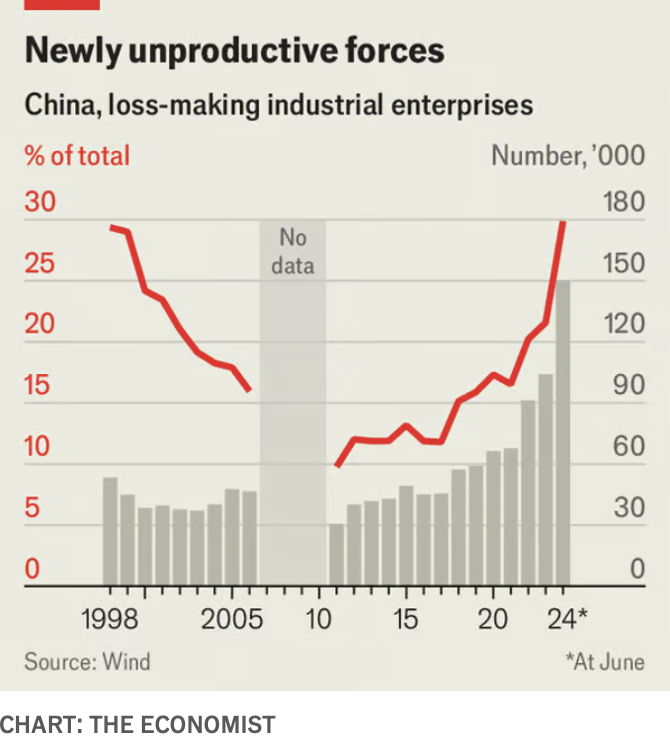
At least eight large makers of the cars have shut down or halted production since the start of 2023. The ripples are visible throughout the supply chain... Some 52,000 ev-related companies shut down in China last year, an increase of almost 90% on the year before, according to one estimate. China’s solar industry is also grappling with oversupply. This year the prices of most components of solar modules have fallen below their average production cost. Many companies in the industry are scaling back manufacturing. Others have scrapped plans to enter the market... A shakeout is occurring in the semiconductor industry, too. Local governments have focused their investments on low-end chip components in an effort to “easily win market share”, notes an industry insider. Those parts are now in great oversupply and many of the companies producing them are failing. In 2023 nearly 11,000 chip-related firms went out of business, roughly 30 a day, according to Qichacha, a company that collects corporate data.

2. Nice graphic that captures China's latest investment priorities - solar, EV, batteries, and semiconductor chips.

3. Unintended consequences of public policy actions - in Germany, carbon emissions from power generation rose sharply in 2022 as it shut down nuclear plants.
4. You can do such market micro-management actions only if you are China
China has adopted an unusual tactic to discourage banks from buying government bonds, as authorities try to halt an uncomfortable decline in yields and prevent a bubble forming: naming and shaming the buyers... While buying of their sovereign bonds may be welcomed by many countries, the People’s Bank of China has repeatedly warned that a bubble is forming in the sovereign bond market, with regulators saying that regional banks’ appetite for long-term government debt risks triggering a Silicon Valley Bank-style crisis if there is a sudden surge in yields. “The local PBoC branch called us and advised us not to buy bonds when state lenders are selling,” one bond trader at a local lender in Jiangsu province said this week. “They blamed a few rural banks in Suzhou for acquiring bonds sold by the state banks.” On Monday, large banks sold a net Rmb22bn of long-dated bonds, 10 times the daily average last week, according to BNP Paribas’ securities market data. The government is also trying to spur economic growth by pushing regional lenders away from parking their money in ultra-safe bonds and instead lending it out.

5. Some facts about the trends in low tech manufacturing and China.

Apparel, footwear and furniture accounted for 9 per cent of China’s exports in the first eight months of last year, according to a Bank of America Global Research report, down from 20 per cent in 2001. Car and machinery’s share of total exports increased to 33 per cent from 16 per cent over the same period. China’s share of global footwear and apparel sales has slipped in recent years, with its portion of overall supply for brands Nike and Adidas falling from 20-27 per cent in 2017 to 16-20 per cent in 2022, according to the BofA report. While it remains the world’s largest supplier, China’s share of global footwear exports has declined by more than 10 percentage points over the past decade, according to figures from the 2023 World Footwear Yearbook. Much of that capacity has shifted to south-east Asian countries, particularly Indonesia and Vietnam, the report added. Vietnam, now the world’s second-biggest exporter, has been the biggest beneficiary, with its share rising from 2 per cent to about 10 per cent.

6. About the UK's Teacher's Pension Scheme (TPS)

State schoolteachers (and some university academic staff) are automatically enrolled into the Teachers’ Pension Scheme. The TPS requires contributions of at least 7.4 per cent of gross salary but guarantees an inflation-protected retirement income linked to career-average salary. Like most public-sector schemes it is unfunded; current pensions are paid out of current contributions and if they are insufficient then taxpayers are on the hook. It is also expensive for employers, who currently make contributions of about 28 per cent of salary.

7. Nice Ed Conway X thread on the challenges with replacing existing materials and technologies.

Part of the problem here - one which crops up again and again throughout *Material World* - is that it turns out the suite of materials we tend to use these days are simply VERY good at doing what they do. Kerosene is really hard to beat as an aviation fuel. Methane is a brilliant source of the hydrogen for making, among other things, fertilisers. Concrete might not be the only strong building material, but it’s incredibly easy to lay and also phenomenally cheap... All these things create significant carbon emissions. But they are central to modern life. They are a large part of the explanation for how we've been able to urbanise and feed billions of people in recent decades. Finding low carbon replacements will be HARD.

8. Two good Ed Conway X threads, here and here, on how countries got locked into the single pipe system where the outflows from sewerage and storm water drainage flows through one pipe (instead of separate pipes).

9. Very good graphical article in NYT that shows how China has established nearly 50 new villages and expanded another 100 villages all along its south-western borders, some in areas claimed by India and Bhutan, in an effort to fortify its border claims. 

These villages are called "border guardians" and the villagers are paid to live there. 
Qionglin’s villagers are essentially sentries on the front line of China’s claim to Arunachal Pradesh, India’s easternmost state, which Beijing insists is part of Chinese-ruled Tibet. Many villages like Qionglin have sprung up. In China’s west, they give its sovereignty a new, undeniable permanence along boundaries contested by India, Bhutan and Nepal. In its north, the settlements bolster security and promote trade with Central Asia. In the south, they guard against the flow of drugs and crime from Southeast Asia. The buildup is the clearest sign that Mr. Xi is using civilian settlements to quietly solidify China’s control in far-flung frontiers, just as he has with fishing militias and islands in the disputed South China Sea... The mapping reveals that China has put at least one village near every accessible Himalayan pass that borders India, as well as on most of the passes bordering Bhutan and Nepal... The outposts are civilian in nature, but they also provide China’s military with roads, access to the internet and power, should it want to move troops quickly to the border. 

Villagers serve as eyes and ears in remote areas, discouraging intruders or runaways... in quietly building militarized villages in disputed borderlands, China is replicating on land an expansionist approach that it has used successfully in the South China Sea... To persuade residents to move there, Chinese Communist Party officials promised them their new homes would be cheap. They would receive annual subsidies and get paid extra if they took part in border patrols. Chinese propaganda outlets said the government would provide jobs and help promote local businesses and tourism. The villages would come with paved roads, internet connections, schools and clinics.

10. Livemint reports of declining fortunes of Kota, the coaching centre capital of India - the number of students declined from around 200,000 in 2022 to and estimated 70000-90000 this year.  

The primary reason for Kota’s decline today is coaching institutes opening centres in other cities in the last two years, which has had a cascading effect on local businesses. Allen Career Institute, for instance, now has centres in at least 60 cities across India, including Dibrugarh, Patna, Rohtak, Latur, Jodhpur and Durgapur. Unacademy’s website says it has 61 centres in 44 cities for offline preparation, including Ahmedabad, Bhopal, Bhubaneswar, Bengaluru, Dehradun and New Delhi. Physics Wallah has 124 centres in 105 cities, with its Kota centre opening in 2022. It has more than 200,000 students enrolled across these centres... The other reason for the drop in students in Kota is the image it has developed of being a “suicide and party" hub. According to a Hindustan Times report last month, at least 13 students preparing for NEET or the engineering Joint Entrance Examination (JEE) in Kota had taken their own lives as of July. Last year, 27 suicides were reported, which was the highest number since 2015, said officials.
11. Very interesting snippet in the context of Bharti Airtel's decision to invest £3.2bn and take a 24.5% stake in BT, India is the second largest FDI source for UK!
India is the country’s second-largest source of foreign direct investment: there are more than 950 companies with combined revenue of about $65bn operating in Britain — up from 900 in 2022, according to the UK India Business Council... Bharti Enterprises holds controlling stakes in satellite venture OneWeb and also owns prestigious hotel brands, including The Hoxton and the Gleneagles resort in Scotland, operated by a company founded by his son-in-law. Bharti’s Africa telecoms business is a member of the FTSE 100.

And the Empire strikes back again?

On a 1997 visit to Bengaluru, then-UK prime minister John Major hailed BT’s acquisition of a 21 per cent stake in a phone operator owned by Sunil Bharti Mittal as “an indication of the strength of our economy”. Now Indian politicians are cheering a dramatic reversal after Mittal’s Bharti Enterprises struck a deal to become the British former telecoms monopoly’s largest investor, agreeing to buy a 24.5 per cent, roughly $4bn stake from Franco-Israeli billionaire Patrick Drahi’s indebted Altice. Bharti Airtel, anchor of the 66-year-old Mittal’s conglomerate, has blossomed since its 1995 founding into one of the world’s biggest network providers and now dwarfs BT. With 550mn customers across 17 South Asian and African nations, the company commands a $100bn market value — more than five times that of the UK group, which has shed overseas assets in recent years.

12. Water desalination facts of the day

Christopher Gasson, publisher of Global Water Intelligence, which tracks the industry, figures that about 500 million people rely at least partly on purified salt or brackish water and that the number could rise sixfold to three billion by midcentury. Around the world, there are about 1,500 large plants — those that can produce about 2.6 million gallons a day — with roughly $14 billion being spent annually to operate the existing fleet and build new ones... Saudi Arabia is the largest market for these installations, followed by the United Arab Emirates... With nearly 100 big plants, Spain is the largest user of desalination in Europe and one of the world’s largest... the costs of operating the energy-intensive desalination technology — called reverse osmosis, which is standard at large plants including the one at Torrevieja — are being brought down by pairing water purification with cheap solar energy, encouraging the building of new plants.

13. It appears that Howard Schulz negotiated out several perks for himself from Starbucks that raise concerns about corporate governance and personal ethics.

In 2018, the man who built the Seattle coffee business into a global empire had negotiated an agreement to retain an chair emeritus role — for the rest of his life. The deal lets the 71-year-old attend and observe board meetings, according to Starbucks corporate filings... They range from Starbucks reimbursing Schultz when it uses his private jet for corporate purposes to him owning a stake in a business making extra virgin olive oil for one of the company’s coffee drinks... The deal — which can only be modified or waived if both parties agree... As Schultz was ending his third spell in charge, he was introduced while travelling in Sicily to the idea of eating a spoonful of olive oil every day. It inspired him to create Oleato, which Starbucks began rolling out to customers earlier this year. Corporate filings show that Schultz did not just originate the idea; he also owned 19 per cent of the family-controlled business from which Starbucks buys its oil. Starbucks paid the company, Partanna, about $26mn last year... Schultz’s air travel also remains intertwined with the coffee chain. He owns a jet used by Starbucks, according to filings, for which the company last year paid an entity he controlled about $1mn. He has also stored his plane in a Starbucks hangar, the filings show: in 2023, an entity controlled by Schultz paid Starbucks about $1.3mn to cover rent and other maintenance costs.

For those who scorn at public servants for their questionable integrity, imagine what would have been the case if the likes of much-worshipped Schulz were in the public sector!

14. US CPI inflation falls to 2.9%. Time to call an end to the war on inflation?

15. An emerging structural concern in the banking sector in India is the widening gap between the credit and deposit growth rates. 
In the last financial year, for instance, while credit expanded at about 20 per cent, deposit growth lagged at about 14 per cent. The gap was also highlighted in the RBI’s latest Financial Stability Report. This trend is reflected in the credit-deposit ratio, which has increased since September 2021. It peaked at 78.8 per cent in December 2023 before moderating to 76.8 per cent at the end of March 2024. The ratio is particularly high among private-sector banks.

Some thoughts here. One, the high ratio among private banks is reflective of the problems with efficiency maximisation pursuit of the private sector, and the need for regulation to bring in resilience to the banking system. Two, as the editorial alludes to, the sharp decline in household savings to a multi-decade low of 5.3% of GDP in 2022-23 may be a reason behind the lower deposit growth rate (apart from the emergence of alternative savings opportunities). Three, just as savers find alternative investment opportunities, the borrowers must also diversify away from banks to capital market avenues. 

16. Interesting snippets of Chinese trade data

While China’s share of US imports has slipped to 13.5 per cent today from 21.6 per cent in December 2017, its overall market share in global goods exports has risen from 12.8 to 14.4 per cent over the same period.
17. Tim Harford on luxury brands
The real trick that luxury brands have pulled off is that the two features of the brand — subtle excellence paired with conspicuous expense — reinforce each other. In its purest form, conspicuous consumption is crass and unattractive; it needs the cover story of excellence before it becomes appealing. Both excellence and expense are part of the brand promise, then, but the difference between them matters. If the brand is mostly about excellence, the purchaser of the fake is the obvious loser: they are getting shoddy goods masquerading as something much better. But if high-end brands are largely about expense for the sake of expense, then counterfeit brands are like counterfeit banknotes. Their ubiquity debauches the value of the once-exclusive brand and the suckers are not the people who buy the fakes, but the people who pay retail for the tarnished originals...
But is this inability to signal quality really a problem for luxury fashion brands? I doubt it. Those who walk into the Louis Vuitton shop down the street from Florence’s Duomo and pay €500 for a baseball cap will be confident that they are getting the real thing, and rightly so. Those who pay €12 in a Palermo street market are expecting a knock-off, and they are right too... The economist Karen Croxson, now at the Competition and Markets Authority, once published a theory of “promotional piracy”, in which companies would tolerate the copying of some products because it created demand for the real thing. Microsoft probably benefits if tens of millions of schoolkids familiarise themselves with pirated copies of PowerPoint and Excel. And while the possibility of counterfeit Gucci loafers seems unlikely to enhance the appeal of the real thing, maybe some brands might be happy to see influential young artists, musicians and trendsetters displaying their logos, fake or not. Or maybe the ubiquity of the imitations builds demand for the original? Over in the Uffizi, “The Birth of Venus” is so prized because it is so recognisable, and that is down to it having been duplicated, imitated and remixed so often. Perhaps this is as true for Versace as it is for Botticelli.

Tuesday, October 31, 2023

The need to reform ISDS and BITs

This post will question the wisdom of the provision of international arbitration granted to foreign investors from countries with which India has Bilateral Investment Treaties (BITs) or more generally the process of Inter-state Dispute Settlement (ISDS). I blogged on this here in the context of an essay by Columbia Professor Katharina Pistor that traced the legal origins of capital claims. 

It assumes significance in the backdrop of the ongoing India-UK trade deal negotiations where BIT is also on the table. Following a spate of high-profile arbitration reversals, India suspended BIT with 68 countries with a request to renegotiate based on the 2016 model BIT. The old BITs allowed for recourse to international arbitration. The argument is that local remedies are either weak or take too long, and therefore investors need international arbitration access to get them to invest in India. 

However, the newspaper report also mentioned that the Government of India may concede to the retention of international arbitration in its BIT with the UK. That would be a very bad idea. It's important that India stand its ground on the principle of BIT. Its quid-pro-quo concessions should not be on fundamental principles like BIT and instead focus on tariff lines.  

Rana Faroohar has an op-ed on the issue of ISDS and how it has become a feature of a global trade system that elevates the interests of multinational corporations over those of sovereign nations. She urges the US to take the lead and organise a multilateral exit from all ISDS arrangements. 

ISDS is a very common part of free trade agreements and bilateral investment treaties, in essence allowing foreign companies investing in particular nation states to sue governments for anything that stops them making profits — including climate regulations, financial stability measures, public health policy, and any number of other areas that are typically the purview of the state. The idea originated in the early 1990s, the era of nonstop globalisation, as a way to draw foreign investment into developing countries while also protecting rich country investors from the weak legal and governance systems in those nations. As of 2022, 1,257 ISDS cases had been launched, according to Unctad... 

The asymmetries of the system have always been stark. Only foreign investors have rights and only foreign investors can initiate claims. And claims can include not just actual losses but future ones, too. As a new white paper co-authored by academics from Georgetown and Columbia universities, as well as trade experts from the American Economic Liberties Project, points out, “corporations rarely invoke ISDS to protect against blatant expropriation or gross denial of justice”. Instead, they have been “consistently successful in exploiting the vaguely worded provisions within ISDS-enforced trade and investment agreements” to “initiate or threaten claims against democratic measures taken in the public interest that they believe have harmed their business interests.” 

Multinational airport operators have used ISDS to challenge Chile’s pandemic shutdown measures; a Canadian company has argued that mining rights should trump environmental protection measures in Colombia. Huawei has launched a case against Sweden over measures limiting its participation in 5G because of security concerns. In the US, the Keystone pipeline is the classic example. TransCanada sued the US during the Obama presidency because they weren’t allowed a permit to build, then revoked it under Trump (who allowed it) then sued again under Biden. So ISDS is also a pain for rich countries, but their companies usually benefit. For poorer countries, it can be devastating. Actions deemed to be in the public interest (such as raising health or labour standards) can lead to billions of dollars in claims that they can’t afford to pay. 

The big worry now is that such agreements could be used to prevent the clean energy transition. Fossil fuel companies and investors have filed numerous ISDS cases, totalling billions. Academics have estimated that global climate change efforts could result in $340bn of claims (the Keystone XL suit alone is for $15bn) Given all this, it’s little wonder that a lot of countries, including the US, Canada, Mexico, some EU member states, South Africa, India, Indonesia, and Ecuador are limiting or ending future ISDS agreements and even attempting to pull out of existing ones... According to Nobel laureate Joseph Stiglitz, there is little evidence that countries signing ISDS treaties saw more or better foreign direct investment than those that didn’t: “These deals just haven’t lived up to their promise.”
As an illustration of the egregiously bad nature of ISDS in BIT, consider this example. A foreign investor makes a commercial investment decision to take a stake in a project in India. The investor could be a private entity or a sovereign wealth fund. It subsequently transpires that the project is vitiated (by corruption or violation of local laws). The new development leads to a revision of the terms of the project, which is obviously less favourable to the investors. The investors respond by approaching the local courts. After exhausting the appellate process, the Supreme Court of India has upheld the revision. The domestic investors accept the verdict and move on. 

But the foreign investor now invokes the provisions of the BIT and takes the matter to international arbitration. The arbitration jury at London or Hague questions the revision and rules in favour of the investor and against the Government of India. It compensates the foreign investors for their commercial losses arising from the revision. 

Or consider the example of a taxation provision that's introduced afresh. Without getting into the merits of such an introduction, the fact remains that this is non-discriminatory and applies to all businesses operating in the country and it's a sovereign prerogative to tax. One can understand the Supreme Court of a country weighing in on the issue, but allowing an international arbitration jury to adjudicate on what's essentially a sovereign prerogative is deeply troubling. 

In the circumstances, we need to consider the following: 

1. International arbitration effectively becomes an appeal on the Indian judicial process. This is a direct and omnibus subordination of national law to international law. 

2. Any commercial investment decision is a contract. Such an omnibus international arbitration clause elevates contractual obligations above even sovereign law. 

3. The foreign investors enjoy a judicial recourse that domestic investors do not have. This forum shopping goes against fairness and equality. Foreign investors cannot have superior protections to what domestic investors enjoy. 

4. The BIT becomes an insurance against bad investment decisions and vitiated contracting. This generates moral hazard. It encourages businesses to invest without proper due diligence, and at worst nudges them to pursue dodgy deals to make quick and large profits. 

It’s time to seek revision of the boilerplate templates of BITs. There was a time when foreign investors needed the assurance of a BIT to invest in India. There are several reasons to argue that this insurance is no longer a requirement. 

Then there are the problems with the arbitration process itself. 

1. There’s an implicit bias among arbitration juries that developing countries tend to expropriate investors, and the default norm is to protect foreign investors. When the margins are thin, such cognitive biases invariably end up distorting jury decisions. 

2. International arbitration in places like London is dominated by a few global law firms that also compete for business from multinational corporations. This creates unavoidable conflicts of interests which all too often are apparent underneath the surface Developing country governments are constrained by having to rely on the same pool of law firms who also provide services to these private companies. 

3. Hamstrung by bureaucratic factors, governments cannot pursue these cases with the same intensity and focus as private investors can. Unlike private investors with the flexibility to undertake bilateral negotiations and settlements with various stakeholders, governments cannot cut corners in pursuing such informal pathways. 

4. Then there are the usual problems of nepotism, cronyism, and corruption within the worlds of law and finance, which further tilts the playing field against government interests. 

In light of all this, it's time to ease out the provision of BIT that allows foreign investors to do forum shopping and enjoy preferential treatment by way of access to international arbitration in their preferred locations that foreign (western) businesses enjoy while doing business in India. The BITs should be amended to this effect. India does not have a track record of expropriation of foreign assets to merit this undesirable layer of contract insurance against the Indian political, bureaucratic, and judicial system.

Update 1 (10.02.2024)

Times has a very good article illustrating the problems with international arbitration. In this case, two small-time Irish businessmen won $6.6 billion in damages from a London arbitration panel for the revocation of a corrupt contract won by them with the Nigerian Ministry of Petroleum Resources. Consider the contract.
The original contract said that Nigeria had to give P.&I.D. wet gas not for a year or two, but for 20 years. Nigeria had failed to do this. Even though P.&I.D. hadn’t yet spent a penny on construction, Nigerian law — like British law — held that the party who breached a contract had to make the other party whole by paying them the amount they would have made had the contract been fulfilled. What this meant: When Nigeria paused on the wet gas, a legal wire was tripped. Nigeria owed P.&I.D. for two decades of hypothetical future profits from the sale of gas byproducts they had never processed, in a facility they had never built. But how much was that?

P.&I.D. had commissioned a report by a consulting firm, Berkeley Research Group, which laid out estimates of revenue and cash flow if the project had come to fruition. Financiers use something called a “discount rate” to calculate the value of future profits, taking into account all the risks that might be involved. The greater the risk of an investment, the higher the discount rate, and the lower the present-day value. Investments in Nigeria were considered risky because of political instability and corruption, so the standard discount rate at the time was more than 10 percent; the Berkeley report used 2.6 percent. On another page of the report, Berkeley predicted that oil — whose price historically correlates with that of natural-gas byproducts — would rise steadily, year after year, to $115 a barrel in 2024; but commodity prices fluctuate for all sorts of reasons, and today oil trades for $75 a barrel...
They weren’t paying bribes to lubricate an otherwise-solid project; they seemed to be paying bribes because they barely had a project at all. An early drawing of the wet-gas unit was a ripped-out piece of lined paper with hand-drawn pipelines on it, squiggles of blue marker representing water. A later drawing — the one they showed the Ministry — was a screenshot they took from designs for a different facility. By the end, the 34 bundles of evidence told a story that one lawyer for Nigeria categorized as “industrial scale” fraud. The former band managers, they argued, had shaken down a sovereign state for $6.6 billion, for failing to fulfill an illegally procured contract that relied on copied plans for a different project... The company was essentially a financial abstraction, a piece of paper that might or might not be worth a fortune (the award was now $11 billion with interest). It all depended on the outcome of the trial.

The case exposed the problems with secret arbitration proceedings. 

Born estimates that about 1,600 arbitration cases are filed every year in which one party is an investor and the other party is a state or state-owned enterprise, but the opacity of the system makes exact figures impossible to get. In some arbitrations, we know the parties, but the specific details of the proceedings remain private. In a majority, however, the existence of the arbitration itself is never disclosed... “If it was in court, it would be public,” Stephan Schill, a professor of international law at the University of Amsterdam, says of the P.&I.D. affair. “The press would monitor it, and would immediately pick out problems. The confidentiality is a big problem. It makes it easier to hide corruption.”

In one of the rarest examples, a Civil Court in London over-turned the arbitration judgement.  

Wednesday, November 24, 2021

Inside the struggle to control mineral resources

The NYT has a very good article that examines the China-US rivalry in the race to control Cobalt supplies from its largest producer, Democratic People's Republic of Congo (DRC). The article highlights the intersection of two important global issues - the control of minerals vital for emerging industries like electric vehicles and batteries, and destruction of rain forests to facilitate their mining. 

The setting is the Kisanfu Cobalt mines, the world's largest untapped cobalt reserves in a country which accounts for two-thirds of the global mineral production. A narrative abstract from the article. 

1. These minerals are scarce, available in only a few places, and critical for the emerging technologies.
A Tesla longer-range vehicle requires about 10 pounds of cobalt, more than 400 times the amount in a cellphone.

2. The scale of Chinese control is staggering. 

As of last year, 15 of the 19 cobalt-producing mines in Congo were owned or financed by Chinese companies, according to a data analysis by The Times and Benchmark Mineral Intelligence. The biggest alternative to Chinese operators is Glencore, a Switzerland-based company that runs two of the largest cobalt mines there.

Tenke Fungurume — a 24-hour operation that employs more than 7,000 across a landscape the size of Los Angeles marked by deep craters and dust kicked up by earth-moving vehicles... In August, China Molybdenum announced plans to spend $2.5 billion at Tenke Fungurume to double production over the next two years. When the expansion is complete, the mine will produce nearly 40,000 tons a year. Last year, the United States produced just 600 tons... The ground underneath the Kisanfu site contains enough cobalt, according to China Molybdenum’s estimates, to power hundreds of millions of long-range Teslas.
3. More than anything, the Chinese efforts have been bankrolled by deep pockets of its government. 

The five biggest Chinese companies in Congo had been given at least $124 billion in credit lines for their global operations. All of the companies are state-owned or have significant minority stakes held by various levels of the Chinese government.

4. And a standard playbook - control of minerals in exchange for infrastructure. This is a good example,

African countries for years have been turning to China for help building infrastructure with loans or trades involving their natural resources — deals that analysts warn provide far more benefit to the Chinese. A blueprint for those deals, now common across the continent, was sketched out in 2005 when Joseph Kabila walked into the Great Hall of the People in Beijing... Mr. Kabila’s wish list was long: He wanted new roads, schools and hospitals as part of a revival plan that, he hoped, would endear him back home to a nation exhausted and dispirited by years of conflict and corruption. In exchange, he was prepared to offer up his country’s vast mineral wealth — unparalleled in much of the world. In the imposing hall on Tiananmen Square, the two presidents outlined a deal that would change Central Africa’s balance of power... Mr. Hu Jintao explained that many people in China’s western provinces lived in deep poverty. Developing the area was a cornerstone of his domestic policy, and he needed minerals and metals to build out new industries. Congo was ready to help, Mr. Kabila assured him... 

The Chinese used the opportunity to begin formal talks with Mr. Kabila that would result in a $6 billion agreement: China would pay for roads, hospitals, rail lines, schools and projects to expand electricity, all in exchange for access to 10 million tons of copper and more than 600,000 tons of cobalt... “2,000 miles of roadway linking Orientale and Katanga provinces, 31 hospitals, 145 health centers, two large universities and 5,000 government housing units are pledged,” according to a cable in 2008 from the U.S. embassy in Kinshasa to members of the Central Intelligence Agency, the secretary of state and other officials.

5. Finally, the Chinese government's invisible hand has actively guided any diplomatic and other manoeuvres required to control these mines. Take this example, 

In April 2016, China Molybdenum, a company whose biggest shareholders are a government-owned company and a reclusive billionaire, made its $2.65 billion offer to buy Tenke Fungurume, an American-owned mine atop one of the biggest cobalt reserves in the world. There was one complication. Freeport-McMoRan had a Canadian partner that had the right of first offer to buy its stake. China Molybdenum’s solution was to have a Shanghai-based private equity firm buy out the partner, but even that deal relied on money from the Chinese government. None of the $1.14 billion raised to buy the partner’s share came from private investors, company filings show. Instead, it came from Chinese state-controlled entities, including from bank loans guaranteed by China Molybdenum as well as cash brought to the deal through obscure shell companies controlled by government-owned banks, according to the filings.

6. The Chinese strategic intent to control these emerging technology minerals has been matched by ineptitude, abdication, and greed on the side of American policy makers, corporates, and interest groups. For example, China Molybdenum acquired the Kisanfu site from American mining giant Freeport -McMoRan which, within five years, has moved from being one of the largest producers of Cobalt in Congo to leaving the country entirely. 

In fact, the Times reports that Hunter Biden, the son of the President no less, through the China-based private equity firm he founded, helped China Molybdenum buy Tenke Fungurume, a cobalt and copper mine, from Freeport-McMoRan in 2016. Clearly, mammon has swept aside any other consideration for American investors and businesses. 
The board of the private equity firm, commonly known as BHR, was dominated by Chinese members but also included three Americans: Devon Archer, a businessman who later was convicted of defrauding the Oglala Sioux tribe in a case still working through the legal system, and James Bulger, son of the former president of the Massachusetts State Senate. Another was Hunter Biden, whose father was vice president at the time. 
7. However, having come to control these mines, the actions of the Chinese companies themselves may be working against their interests and stirring up discontent, 
Dozens of janitor and driver jobs once held by Congolese citizens went to the Chinese... Employees were concerned that the mine was also becoming more dangerous, according to interviews with workers in communities surrounding the mine, current and former safety inspectors, Congolese government officials and mining executives. Workers climbed into acid tanks to conduct repairs without checking the air quality. Others drove bulldozers and other heavy equipment without training or did dangerous welding jobs without proper oversight... All of it was an extreme departure from the company’s American predecessor, which had “zero tolerance” for risky activities and safety violations. Freeport-McMoRan, which had built the mine, had learned some hard lessons years before at its copper and gold mine in Indonesia, facing international protest over its dumping toxic mine waste into a river in the rainforest as well as violent conflicts over its operations there... When safety inspectors discovered violations after China Molybdenum took over, they were sometimes told to overlook them, or offered bribes to do so, workers and supervisors said. And when they did try to enforce the rules, violence sometimes followed.
8. Now in the race to limit the damage and claw back some of the lost ground, the Americans are supporting efforts to get the Congolese government to exercise greater vigilance on the activities of the Chinese miners and also scrutinise whether they have fulfilled their contractual obligations. 
Congolese officials are carrying out a broad review of past mining contracts, work they are doing with financial help from the American government as part of its broader anti-corruption effort. They are examining whether companies are fulfilling their contractual obligations, including a 2008 commitment from China to deliver billions of dollars’ worth of new roads, bridges, power plants and other infrastructure... the Congolese government, with financial assistance from the United States, is examining numerous mining contracts to determine whether Congo has been shortchanged more broadly. While the Chinese-funded infrastructure projects got off to a flashy start, many have not been built... During a visit to the cobalt-mining region this year, the president Felix Tshisekedi said, “Some of our compatriots had badly negotiated the mining contracts. I’m very harsh on these investors who come to enrich themselves alone. They come with empty pockets and leave as billionaires.”

9. This underlines the enormous risks that China faces with these contracts,

Congo’s president, Felix Tshisekedi, in August named a commission to investigate allegations that China Molybdenum, the company that bought the two Freeport-McMoRan properties, might have cheated the Congolese government out of billions of dollars in royalty payments. The company risks being expelled from Congo.

10. These risks are amplified by the most important aspect, the displacement and damage inflicted on the native people by mining activities. Social tensions caused by the presence of outsiders, perceived as exploitative, are never far away. 

It's most likely that this will be only the latest version of western-style resource extraction colonialism, with China being the colonial expropriator this time. Like previous episodes, the colonial resource control desire of China and the US-China Cold War will certainly make it very hard for the DRC to benefit from its resources this time too. 

This is a good explainer of the issue. 

Update 1 (20.12.2021)

This article examines the politics and economics of extracting Lithium, used in Lithium-ion batteries for electric vehicles, from the giant brine sea high up in the Bolivian Andes. 

The Indigenous Quechua people revere the Salar de Uyuni, 4,000 square miles of salt flats that their forebears believed were the mixture of a goddess’s breast milk and the salty tears of her baby... With a quarter of the world’s known lithium, this nation of 12 million people potentially finds itself among the newly anointed winners in the global hunt for the raw materials needed to move the world away from oil, natural gas and coal in the fight against climate change.

Sunday, April 7, 2019

Weekend reading links

1. Bloomberg has this on the ratio of out-bound to in-bound foreign capital in developing countries,
On China and Thailand, this is important,
When political institutions fail to act as pressure valves, capital wants to escape before it gets trapped.
2. Bloomberg has a very good article on how Narayana Hrudalaya is trying to drive down surgery costs, and Modicare may be a contributing factor. Sample this on cost-cutting without compromising anything on safety,
Shetty’s philosophy of thrift is everywhere. The surgical gowns are procured from a local company for about a third of the cost of international suppliers. The tubes that carry blood to heart-and-lung machines are sterilized and reused after each surgery; in the West, they’re thrown away. The machines themselves, along with devices such as CT and MRI scanners, are used well past their warranties, kept running by a team of in-house mechanics. The operating rooms, pieces of real estate so expensive that many hospitals bill for their use by the minute, are also part of the assembly line. Whereas preparing a U.S. surgical theater for the next patient can take 30 minutes or more, Narayana has gotten the process down to less than 15, in part by keeping turnaround teams with fresh instruments, drapes, and other supplies on immediate standby, ready to roll the moment a room is available. Even patients’ families are part of the upskilling model. Narayana trains them to bathe patients and change bandages in the hospital, as they’ll do when they get home. This allows paid staff to focus on more challenging work. Through all these methods and more, Narayana has been able to get the retail cost of a heart bypass, its most common operation, down to $2,000, about 98 percent less than the U.S. average.
3. A third Bloomberg article points to the declining current account surplus of China, and the prospect of the country competing with other emerging economies for cross-border capital inflows.

Sample this,
Contrary to President Donald Trump’s perception, China is no longer a frugal nation that sells a lot abroad and buys little in return. The country’s middle class is now traveling and swiping plastic overseas. Last year, more than 160 million Chinese visited foreign countries, spending $237 billion on everything from rice cookers in Japan to Gucci loafers in Italy. As a result, China’s current account surplus has collapsed. Edging dangerously close to twin deficits – both fiscal and current account – Beijing is now keen to attract foreign portfolio inflows to balance its external accounts. That’s why, all of a sudden, China is opening its financial-services industry, allowing global investment banks to take majority control of their local brokerage joint ventures.
4. Nice article in Indian Express on how Indore managed to become India's cleanest city for three years in a row. The investments in personnel, bins, equipments, vehicles, infrastructure etc to cover the entire city is impressive in itself. A testament to the government's commitment to the issue, and attendant willingness to commit resources, and the Corporation's ability to execute these initiatives in finite time. But the bigger achievement is with the behaviour change, essential for sustainability. Or is the story over-stating what has been achieved?

5. The Economist points to the breakdown of traditional safeguards involving regulation, litigation, and competition, which may have been responsible for rise in corporate scandals in the US,
Take regulation first. The system is a strange blend: there are pockets of laissez-faire attitudes here, thickets of rules there and lobbying everywhere. It is variously prone to laxity, capture and incompetence... Second, litigation may no longer be quite the deterrent it once was. Criminal cases leading to jail terms for top executives are as rare as socialists at Goldman Sachs. And civil law has lost its bite. America has long used class-action suits to punish firms and compensate consumers. Tort costs born by firms are equivalent to about 2% of gdp a year, higher than in other countries. Nonetheless, life has got easier for firms. Arbitration clauses, in which customers and staff forfeit the right to pursue class actions, have become more common. Firms are more likely to extend cases to appeal, which can take up to a decade... The final constraint is competition. It can drive firms to cut corners but in the long run should act to discipline careless or badly behaved firms, because customers shun them... But across the economy incumbent firms have got more powerful over the past 20 years, making it harder for customers to switch.
6. Revisiting this illustration of inequality,
Mr Piketty, Emmanuel Saez and Gabriel Zucman found that between 1980 and 2014 the bottom 50% of post-tax incomes in America increased by just 21%, compared with 113% for the top 10%. But the top 1% rose even more—by 194%—while the top 0.001% rose by 617%.
7. Bloomberg article on Chinese engagement in Djibouti. This tiny, but strategically important, country looks a Chinese colony in all but name.

8. Finally, this story about Blue Apron, the ingredient-and-recipe meal kit service, is another cautionary note on the modern start-up ambition and valuations, important as the flow of start-up IPOs planned for 2019 have begun with Lyft. The company's shares are trading 90% below its June 2017 IPO price. In fact the share price halved within just two months of the IPO. Sample this,
The company’s founders and their Wall Street bankers convinced stock investors, a group well represented in coastal cities, that the business was worth $3.2 billion in part based on the idea that they were going to expand operations all across the country. The goal, according to the IPO prospectus, was to eventually be able to sell meals to 99 percent of Americans. “Blue Apron’s mission is to make incredible home cooking accessible to everyone,” it said in the prospectus. But with a two-person meal that requires about 30 minutes of preparation in the kitchen costing about $23 with shipping, it’s not clear how realistic that ever was. As it turns out, the company is even struggling to maintain its current roster of clients on the two coasts... Blue Apron hasn’t posted a single profitable quarter. Neither has Lyft or Uber, which could be valued at as much as $120 billion.

Saturday, March 2, 2019

Weekend reading links

1. No surprises that the plumbing of Indian capital markets is of dubious quality. Sample this about credit ratings of Indian corporates,
While India has 70-odd companies that are rated highest quality, only two companies in the US enjoy this distinction. No company in Germany and UK enjoys AAA rating. Among emerging countries, China has only 14 AAA-rated entities. This implies a gulf between credit standards in India and elsewhere. The exacting standards observed in other countries are missing among domestic agencies.
2. Economist on African countries building up cash transfers based social protection programs,
From 2010 to 2015 the countries of sub-Saharan Africa launched an average of 14 schemes per year, up from seven per year between 2001 and 2009. These countries spend an average of 1.2% of GDP per year on social safety-nets, using a broad definition that includes pensions as well as support for children and the poor. That is only a little less than the average for developing countries (1.6%).
In countries where state capacity is chronically weak and public provisioning of services of appalling quality, cash transfers may not be a bad idea. And in any case, as a social safety net, it is a good idea. The only question is whether these countries have the fiscal space to provide this as well as the regular public goods.

3. Tax avoidance, Amazon edition,
The company, with nearly $11 bn in earnings in 2018 paid nil corporate tax. Unlike others who transfer profits to off-shore subsidiaries or undertake reverse mergers, Amazon takes advantage of Section 162 (m) of US tax code by expensing stock-based compensation.

4. The Adani Enterprises has bagged the 50 year concession for operating all the 5 currently AAI operated airports - Lucknow, Jaipur, Ahmedabad, Trivandrum, and Mangalore - which were put up for auction.  They quoted the highest per-passenger fee for all the five airports, bidding "aggressively" to bag the contracts in a very competitive race. The tender also includes rights for developing real estate projects and operating retail within the airports. Adani Enterprises, which has no experience of running commercial airports, also becomes the largest airport operator in India.
I am not sure this is a good turn of events for multiple reasons. Is the bid motivated by the secondary activity of real estate and commercial development of the airport assets or development of the airports themselves? Does the Adani group have the ability to develop the financial strength over the next 3-4 years to ensure that is effectively delivers on its short to medium-term contractual obligations (almost Rs 12,500 Cr investments in next five years), given their already big commitments on new ports, gas distribution, power transmission, and now airports, not to speak of its already over-leveraged (Rs 1.2 trillion group debt) legacy businesses? Finally, while perhaps too early, are competition authorities not concerned by the Group's dominance (or likely dominance) in several sectors?

Just 43 per cent of trade in textiles and apparel was based on labour-cost arbitrage in 2017 (defined as exports from countries whose GDP per capita is a fifth or less than that of the importing country), compared with 55 per cent in 2009, as the first chart shows. For furniture, toys and other labour-intensive goods, there has been a decline from 43 per cent to 35 per cent over the same period.... McKinsey calculated that trade intensity (the ratio of gross exports to gross input) rose rapidly from 1995 to 2007, when it peaked at 28.1 per cent. It has since fallen back to 22.5 per cent. In addition to this, trade has become more regional. The share of goods traded within the same region fell from 51 per cent in 2000 to 45 per cent in 2012, MGI said, but has rebounded to 47.7 per cent, led by Asia and Europe. This reduces the scope for emerging countries to sell to the rich west.
6. The International Court of Justice rules 13-1, in a non-binding judgement, that Britain's occupation of its 'last colony in Africa', the Chagos Islands in the Indian Ocean, is illegal. As FT writes,
In a non-binding opinion delivered in The Hague on Monday, the court said the UK’s half-a-century of rule over the islands, including expelling 1,500 inhabitants and hosting a US military base, was a “wrongful act” and not “based on a free and genuine expression of the people concerned”. “The UK is under an obligation to bring an end to its administration of the Chagos Archipelago as rapidly as possible"... Although advisory, the ruling will increase pressure on Britain to cede the islands to Mauritius, from which it split the territory... In what the court on Monday called an “unlawful detachment,” London split the Chagos Archipelago from Mauritius in 1965, three years before the end of colonial rule. From 1968 to 1971 UK authorities forced Chagossians to leave — gassing their pets — to make way for a US base on the largest island, Diego Garcia. At the time a British diplomat dismissed the islanders as “some few Tarzans or Man Fridays whose origins are obscure and who are hopefully wished on to Mauritius”.
7. David Leonhardt examines the trends associated with incomes of different income segments of the US population.
The incomes of the upper middle class have grown at the same rate as per capita income growth. His recommendation,
Politicians should recognize that there are three broad income groups, not just two. The bottom 90 percent of Americans does deserve a tax cut, to lift its stagnant incomes. The top 1 percent deserves a substantial tax increase. The upper middle class deserves neither. Its taxes should remain roughly constant, just as its share of economic output has.
8. MSCI announces an increase in China's weighting in its flagship $1.9 trillion EM index from 0.71% to 3.3% by November 2019, a decision that is expected to see an estimated $125 bn of offshore funds flowing into Chinese equities this year. 

9. Finally, a fascinating Simon Kuper peek inside the great Barcelona football club and how, through its Innovation Hub, the club is creating not just the "future of football" but an entire innovation eco-system focused on sports. Sample this,
Barça field men’s, women’s and children’s teams in sports from basketball to roller hockey. The start-ups or universities with which Barcelona are partnered can test their findings on athletes. Sometimes Barça’s staff help co-develop a product. If any of this work results in a breakthrough in, say, treating hamstring injuries, then Barça’s athletes will benefit first. After that, though, the club hope to spread any new products throughout global sport... If a company can market a product as “tested at FC Barcelona”, the club will charge royalties. And if the product is in sleep or nutrition, areas in which elite athletes and ordinary mortals have similar needs, revenues could be large. Now Barça plan to launch investment funds, with initial outside capital of €125m, to invest in tech and sports projects worldwide.
In terms of a match objective, this is stunning,
The team’s basic playing style barely changes from match to match. They aim to play a passing game in the opponent’s half and to lose the ball in dangerous positions no more than six times a match, allowing the opposition about three threatening attacks. More than six, and Barça aren’t playing well.
The remarkable thing is how much value is being attached to data analytics, at least for now, in the club's successes. In fact, given this, such humility of coach Ernesto Valverde stands out,
“This is a game where the coach has less margin than any coach in another sport, because I’m shouting to the player over there, and he doesn’t hear me, and the one by my side doesn’t either. This is a continuous sport in which the coach has barely any influence, or at least much less than in basketball: we only have three substitutions, the game never stops [for time-outs]. So, football belongs to the players. For 45 minutes at a time, non-stop, the player takes his own decisions. I have to say that the great players analyse the game better than I do.”
Sample this on the limitations of data analytics,
Attacking in football is about creating superiorities. These can be numerical (two of your players against one of theirs), positional (your player controls a space) or qualitative (Messi dribbling against an inferior opponent). Barça hope that tracking data can uncover ways to create superiorities. For now, the club’s analysts can barely help the players do that. On the contrary: the analysts learn about football by observing the most intelligent players. For instance, Barça’s midfielder Sergio Busquets, the team’s pivote, knows just how to draw an opponent towards him and then release a teammate into the space the man has left. No coach shouting instructions at him through an imaginary earpiece could advise him better. How to identify intelligent footballers? A Barcelona official fantasises about one day tracking players’ brains. For now, though, the analysts suspect that the most intelligent players — Busquets, Andrés Iniesta or Messi — are those who almost always face the right way on the field.
This is brilliant sports writing. Do read the whole article.

Sunday, November 22, 2009

Decline of empires

Superb graphical illustration of the decline of the Spanish, British, Portuguese and French colonial empires during the course of the nineteenth and twentieth centuries by Pedro M Cruz (via Economix).

Visualizing empires decline from Pedro M Cruz on Vimeo.


Such visualizing graphics are brilliant tools of illustration. See this one about Brownian motion, the scientific basis for Random Walk hypothesis that underpins much of modern finance.

Brownian motion with processing from Pedro M Cruz on Vimeo.