Substack

Showing posts with label Innovation. Show all posts

Wednesday, July 1, 2026

The problems of additionality and technology sector skew in the public funding of startups and innovation

Public risk capital funding of innovation and startups in India is done almost entirely through the VC-driven Fund of Funds (FoF). The RDIF is only the latest effort. 

However, as I have blogged earlier, there are two important concerns with public funding of innovation through the FoF approach. 

One, would it primarily expand the investable universe of startups (genuine additionality) or primarily subsidise returns on investments that would have happened anyway (returns-amplification for private investors)? Second, would it prioritise scalable digital technology innovations at the cost of manufacturing and industrial innovations

The evidence on both suggests returns amplification for private investors and the dominance of technology innovators. This should raise concerns about whether scarce public funds are being deployed most effectively. This post points to yet more evidence in this regard. 

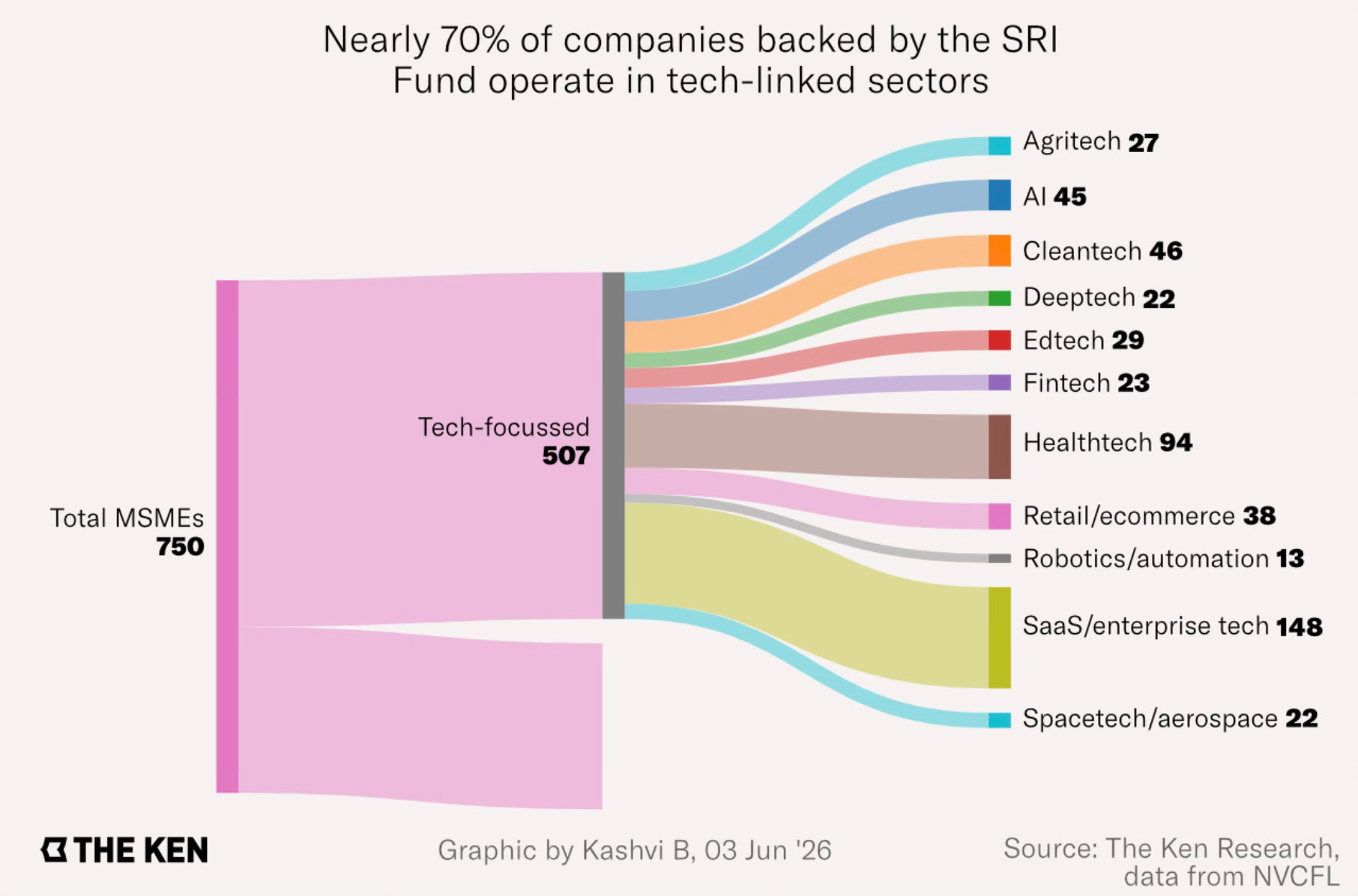
The Ken has analysed the performance of the Self-Reliant India (SRI) Fund, a Rs 50,000 Cr fund with 20% government contribution (the rest coming from VC and PE) to finance MSMEs, and found both concerns being validated. 

The SRI fund model is described here.

SRI Fund is being implemented by NSIC Venture Capital Fund Limited (NVCFL), which is an Alternative Investment Fund (AIF) of Category II registered with SEBI. SRI fund is oriented to provide the funding support through NVCFL to the Daughter Funds for onward provision to MSMEs as growth capital, in the form of equity or quasi- equity, for the following:

Since the start of the fund in 2020, it has backed around 750 companies and catalysed more than Rs 16,000 crore of investment. 

Nearly seven out of every 10 companies it has backed are tech-heavy businesses. Only three are in traditional manufacturing… In fact, several of these companies had already been backed by VC firms before the SRI Fund got anywhere near them. Truemeds, for instance, is backed by Accel, Peak XV, and Westbridge, while Chai Point is backed by Eight Roads Ventures and Saama Capital. Understandably, this dims, if not outright flouts, the proposition of the SRI Fund, which was supposed to scope out companies “ignored” by venture capitalists… 
“Fund managers get empanelled under SRI with the intention of backing underserved MSMEs,” said Ishaan Ajay, a development-and-sustainable-finance consultant. “But when faced with the choice between a profitable but slow-growing industrial supplier and a software platform capable of scaling rapidly, they tend to gravitate towards the latter. It’s what they understand the best.” Just consider the numbers. Suppose there’s a precision components manufacturer growing 15% annually with, say, 18% Ebitda margins. That may be a great business, but if you invest Rs 10 crore today, you’ll get only 2–3X your money over seven years. Contrast this with a spacetech company, which, if it succeeds, could be worth hundreds of crores.

“Venture funds are built around the second outcome,” said an analyst at a VC firm. This explains why SRI-funded companies tend to be tech-heavy. For every Bellatrix Aerospace in the portfolio, there’s an invisible machine-parts manufacturer outside it that was passed up… startups are generally more innovation- and tech-heavy, whereas MSMEs tend to be traditional, manufacturing-heavy businesses…

The government, for its part, tries its best to redirect funds towards their intended purpose. If it doesn’t agree with a fund’s investment choices, it expresses its objections, according to a VC with knowledge of the matter. But at the end of the day, it’s one LP among many. And when it can’t sway others, it ends up “recusing” itself from investing in that particular portfolio company, added the VC… “There is no prescription that a certain percentage of the fund must necessarily go towards traditional manufacturing or non-tech MSMEs,” a VC said. Which is the one thing that might have prevented all the confusion.

The point about returns amplification for private investors has also been highlighted in a study of IFC’s blended finance deals in the 2000-20 period, which found comparable financial returns to non-blended projects but “no statistically significant excess private mobilisation beyond what IFC’s standard lending would attract.” In other words, blending did not increase the quantum of private investment — it redistributed risk between IFC and private co-investors. 

This finding is echoed in a 2023 study of SIDBI’s Fund of Funds for Startups (FFS) 1.0 by the Impact and Policy Research Institute (IMPRI), India’s Startup Engine: A Policy Review of the Fund of Funds Initiative. It finds that most FFS 1.0 capital went to established VC funds that would have raised capital independently. It also found that “crowding-in effect was primarily reputation/signal, not financial additionality”; the government’s involvement functioned more as a validation of fund managers to private investors than as a necessary injection of capital. While FFS 1.0 delivered a 2x mobilisation ratio, it was mostly in already-functioning VC markets.

As I have blogged several times, the startup and innovation sector is going through the same journey that the infrastructure sector has undergone over the last three decades. Multiple policy experiments to catalyse DFIs - IDFC, IIFCL, NIIF, and now NaBFID - have struggled to crowd in private capital into the riskier infrastructure segments like water supply and sewerage, mass transit, solid waste management, street lighting, energy-saving companies, electricity distribution, etc. Instead, these institutions and instruments may have ended up competing and crowding out private capital in the entirely derisked segments of the infrastructure sector. 

In this context, it is also useful to ask the question whether the VC model is the right instrument for the funding of non-technology startups and innovations. 

Livemint has two long reads that describe the emergence of consumer food brands catering to the niche category of health-conscious people. Sample this

The past few years have seen a spurt in new food brands specializing in regional staples and cooking ingredients. From rural Bengal winter specialty date palm jaggery (nolen gur) to ancient emmer wheat flour (Khapli atta) from Maharashtra, regional staples are finding customers beyond their states of origin. Some brands like Gurugram-based Anveshan and Two Brothers Organic Farms from Pune have crossed a critical mass, with annual sales close to ₹200 crore in 2025-26… Anveshan sources ingredients from key growing regions—like Pollachi in Tamil Nadu known for its high-quality coconuts and aromatic varieties of groundnut from elsewhere in Tamil Nadu and Karnataka—suited to make cold-pressed oils. The ghee, made from the milk of native breeds like the Gir from Gujarat is made using the traditional bilona process where milk is first set to curd and later churned to separate the butter (this has resulted in a new category called ‘cultured ghee’)…

Venture capital funds are betting on these brands: in September last year, Two Brothers raised a $15 million round taking its total fundraise to $25 million (and its post-money valuation to $85 million or ₹781 crore as per data from market intelligence platform Tracxn)… In April this year, KisaanSay, which markets single-origin grocery items like cardamom from Idukki and black raisins from Nashik, raised ₹34 crore ($3.6 million), taking the total funding at the Gurugram-based startup to $5.6 million since it was set up in mid-2022.

In a way, these brands have also helped promote traditional farming practices with more farmers returning to heirloom grain varieties such as the fragrant, short-grain Kala Namak rice grown in eastern Uttar Pradesh and emmer wheat in Maharashtra and Karnataka. These grains have a low glycemic index (a measure of the spike in blood sugar levels from carbohydrate intake) making them suitable for diabetics and often have higher protein and fiber content compared to conventional hybrid varieties… Three distinct factors—growing consumer willingness to pay for clean food driven by a surge in lifestyle diseases, the rise of quick commerce (allowing brands to quickly test consumer response), and influence of social media platforms are reshaping the premium staples market.

All these businesses are distinct from the rapidly scalable technology startups. Take the story of the Two Brothers Organic Farms.

They use organic farming and traditional methods of primary processing to make ghee, jaggery, Khapli flour, and cold-pressed oils. The jaggery is made using native sugarcane with lady finger extract used as a coagulant. “In Khapli, we have created a revolution. We own a seed bank and pay farmers 2.5-times the price of regular wheat. More than 800 farmers grow this wheat for us in 3,000+ acres,” Satyajit said. “It took us ten years to build this brand. At the back-end, our farms are open to everyone (to visit). Consumers trust us and we have a 70% retention rate. But a proliferation of brands (offering traditional, hand-processed staples) also carries the risk of a dilution in quality standards,” he added with a note of caution.

Much the same can be said about most businesses outside of technology - food, textiles, footwear, manufacturing, recycling, etc. Building these businesses requires painstaking efforts for several years, and there are natural limits to their scalability. They are unsuitable for the VC model of funding, as the second Livemint story about the plant-based nutrition startup Oziva shows.

Venture funding, Aarti Gill (co-founder of Oziva) points out, comes with built-in expectations around exits within five to eight years. Unlike venture-backed software companies, consumer health brands compound slowly through trust, habit and repeat behaviour. “If you have investors willing to stay for 10 or 15 years, that changes the equation completely,” she adds. Gill broadly sees three paths for consumer brands: staying profitable and scaling independently over a long period, going public after reaching meaningful scale, or partnering strategically with a larger company. For Oziva, the third route eventually felt like the most practical one. And, that’s where HUL came in… For Oziva, the partnership offered distribution scale, capital and the ability to build beyond a digitally native audience.

Therefore, at a conceptual level and as a framework, it may be a prudent choice for public policy on the funding of startups to distinguish between technology and non-technology sectors. While VCs are appropriate for technology, with their smaller and rapid growth phase, the same may not be appropriate for non-technology startups, which require longer incubation and growth periods. However, in India, most public risk capital funding happens through the VC-driven FoF strategy, which raises concerns of returns amplification and a preference towards technology startups and innovations. 

This is also a concern since technology innovations, far from creating jobs, often also tend to destroy jobs, whereas the non-technology innovations, especially in manufacturing, create good jobs. The graphic below captures the problem.
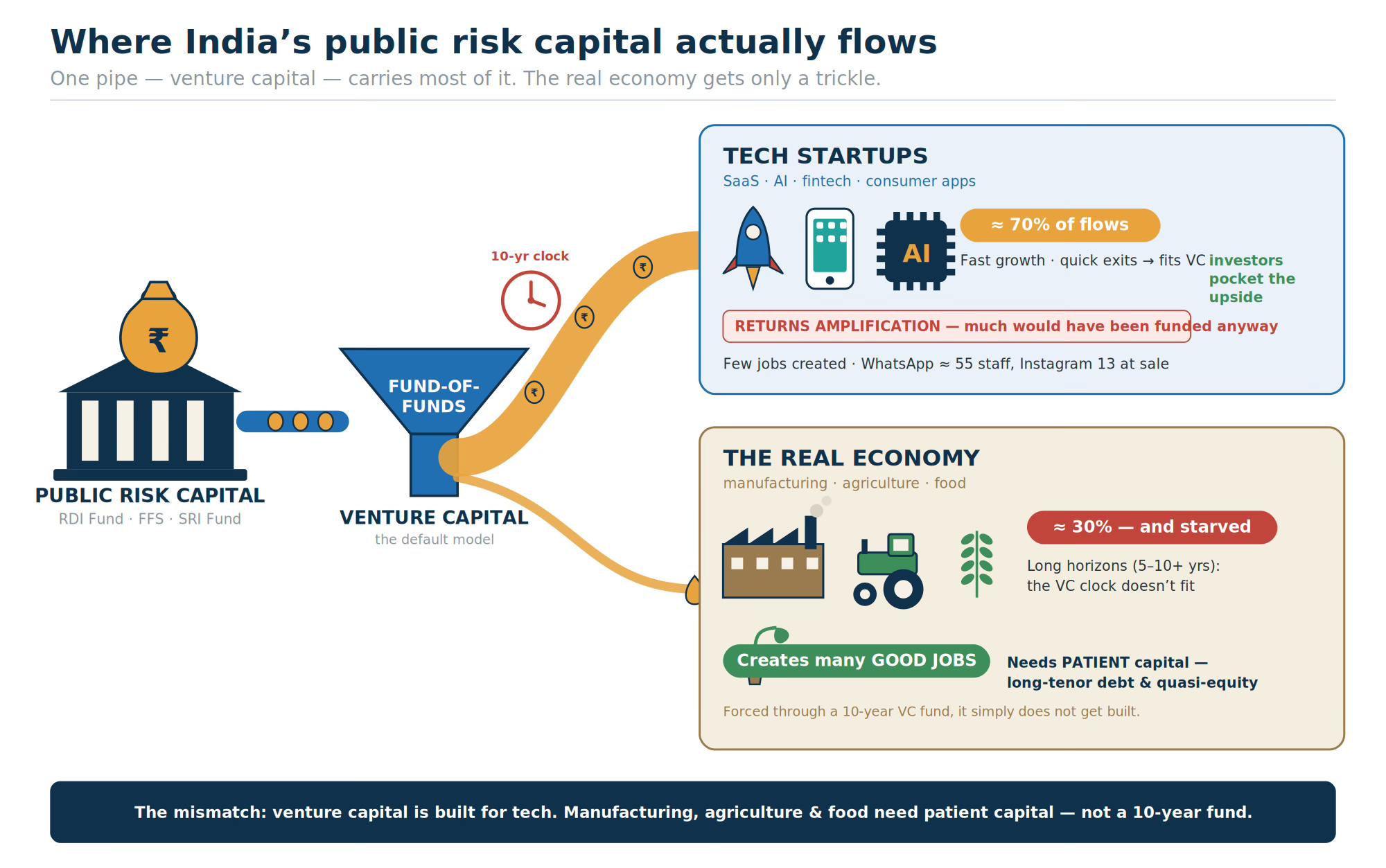
Note: The percentage breakup is probably even more skewed in favour of technology startups.

It also raises the question of effective strategies - instruments and institutions - for funding such non-technology innovations. How are such innovations funded globally? Are there institutional structures in India (state or central governments) that offer promise and can be adopted with tweaks? What are the lessons from the likes of the Maharashtra Aerospace and Defence Fund? What are actionable recommendations on funding of non-technology startups? If it also requires the government to directly fund them, what institutional structures are most practical and realistic? I’ll explore these in another post. 

Wednesday, June 24, 2026

Comparing the R&D expenditures by Indian firms and their global peers

This blog has been a consistent critic of corporate India’s reluctance to invest in R&D. With the emergence of AI applications that are disrupting software development, the big Indian IT companies have been criticised for their low R&D expenditures. There has been a slew of commentary in recent days bemoaning India’s deficient private sector R&D spending and urging corporate India to embrace innovation. See thisthisthis, and this

This blog has argued that the nature of India’s market, with its price-sensitive customers and small premium market segments, may not allow Indian firms the cash flow cushion required to invest in R&D. Others have pointed to cultural and other factors as being responsible. There are problems with each of these lines of reasoning. 

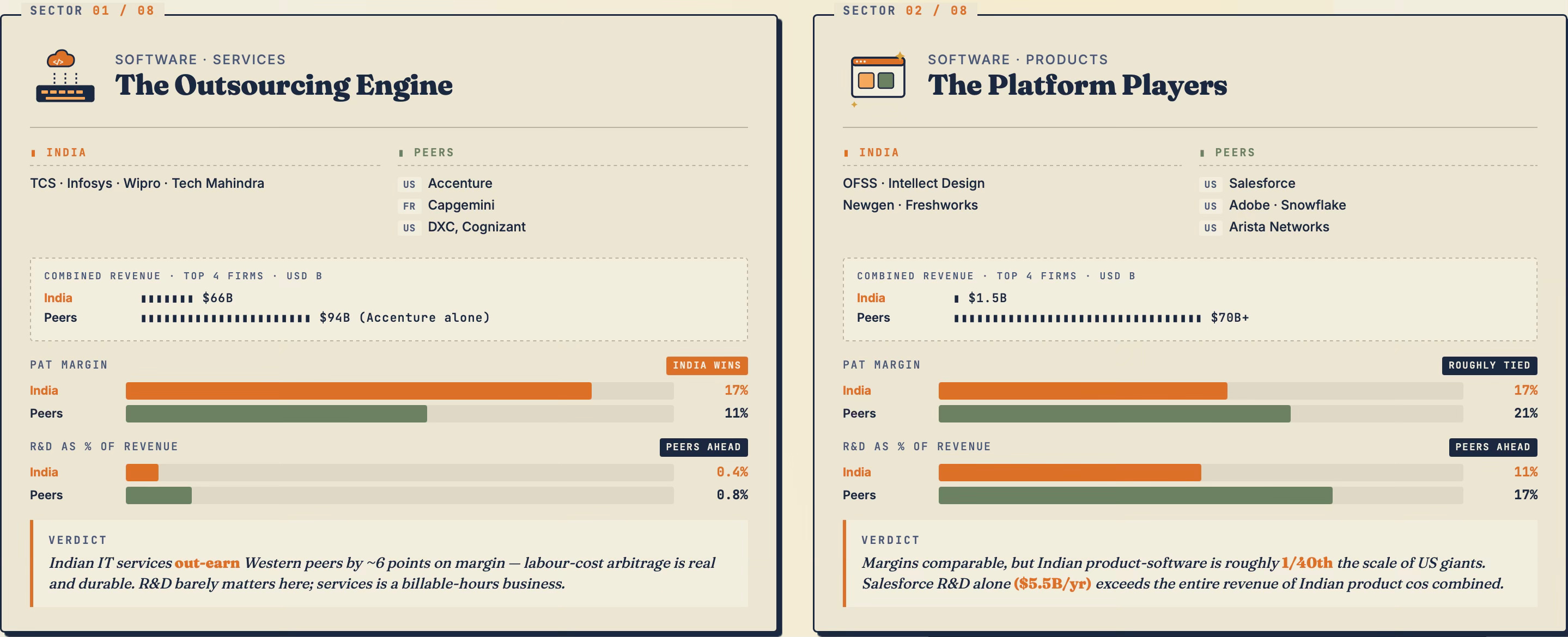
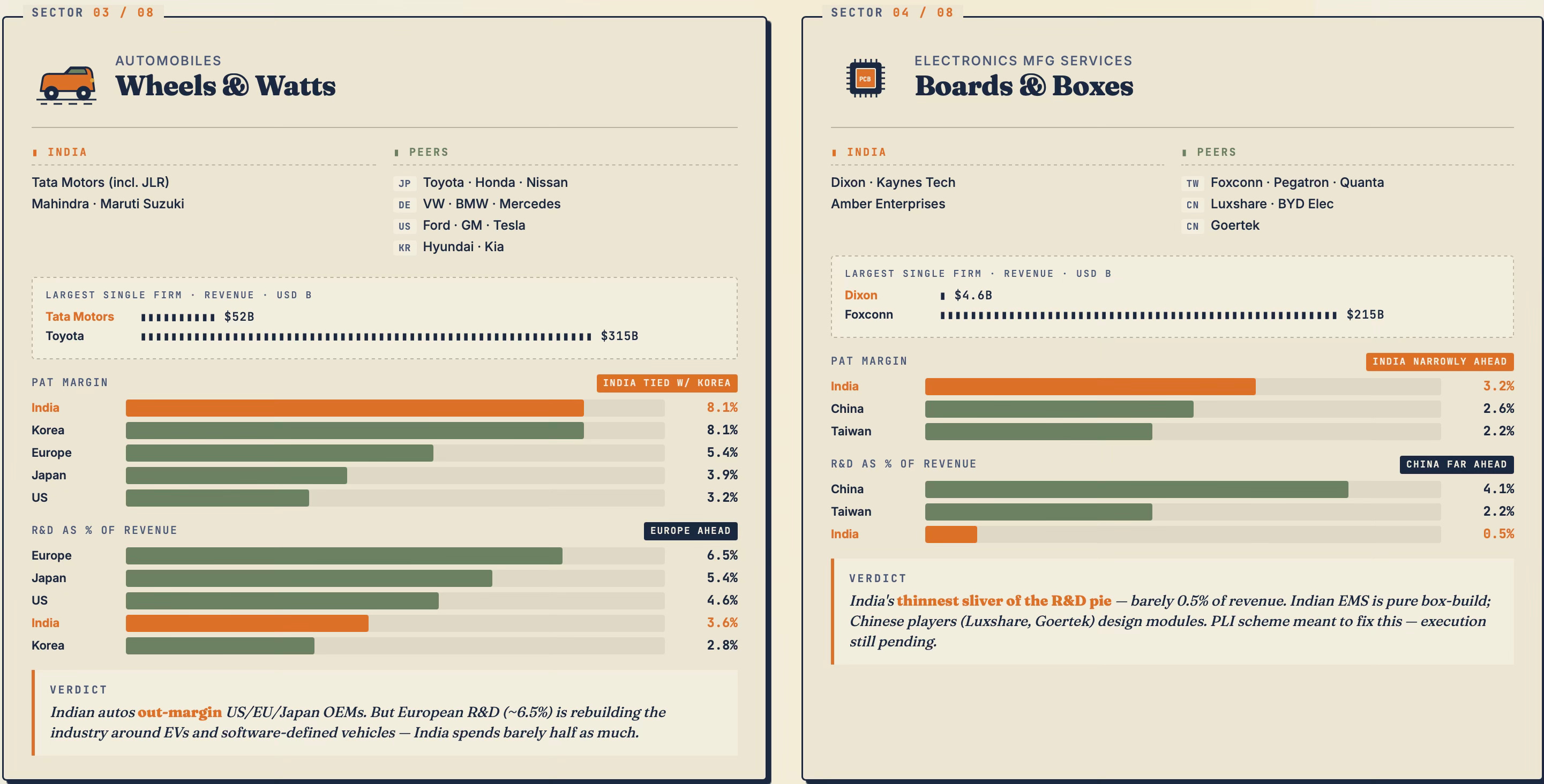
I used Claude and analysed the annual accounts and statements for the last five years of the 3-4 top Indian companies and their like-to-like peers in Europe, Northeast Asia, and the US on revenues, profits, margins, and R&D expenditures across eight industries. Specifically, how do the sizes (by turnover) of the median Indian companies and their peers compare? How do they compare on PAT margins and R&D as a share of revenues?

The headline takeaway is that Indian companies tend to be more profitable than mature Western peers (services, autos, pharma, telecom) but smaller in scale and far less R&D-intensive than the global leaders in product/innovation-driven sectors (consumer electronics, software products, EMS modules, speciality chemicals). 

While it confirms the low R&D spending of Indian companies, it also points to a more nuanced narrative. While Indian companies are much smaller than their global peers, they are either the leaders or are at the top in profitability.

Let’s examine the headline findings.

The big IT consulting/services firms are the main targets of the growing chorus of criticism in the mainstream media on the lack of dynamism and low R&D spending. It is worth noting that while Indian software service firms have margins that are significantly higher than their peers (arising not from any innovation or efficiencies but from the labour-cost arbitrage), their R&D spending lags. The R&D as a percentage of revenue runs 0.3-0.5% at Indian firms vs 0.8-1.0% at say, Accenture, a 2-3 multiple gap. Further, while the R&D spending shares of the likes of Accenture have been rising, those of the Indian firms have been stagnant or even declining (Infosys) in recent years. 

Also, the R&D expenditures of the big software service firms in the US do not include the significant amounts spent on acquisitions each year. For example, Accenture deploys $2-5bn annually in 30-40 acquisitions per year, many in AI specialities (data engineering, vertical-domain AI, ML platforms), whereas the largest Indian firms do 2-5 acquisitions per year, usually smaller and more conservatively-priced. Accenture treats acquisition as a substitute for internal R&D, while Indian firms treat it as a supplement to organic build-out. The cumulative effect is that Accenture has accumulated dozens of niche AI consulting practices acquired pre-2024, whereas Indian firms have built mostly organically and more slowly.

However, it must also be said that some of the criticism also reflects a tendency to conflate what is an inherently low R&D industry with the R&D-intensive product-focused Big Tech and AI firms. IT services have never been an innovation-focused industry. Further, compared to several other industries (as we shall see), the R&D spending of Indian IT services firms is not that far behind their Western peers. 

While Indian software product firms hold up on margins, they too lag on R&D. The 5-6 percentage-point gap between US and Indian product company R&D spending is the closest real number to “the innovation gap” people often talk about. On size, if you take out OFSS, which is a subsidiary of Oracle, there is no Indian company with even $300 million in revenues. The four Indian product companies combined generate ~$1.5 bn in revenue. Salesforce alone does $38 bn. Adobe does $21 bn. They are dwarfs to their global peers. This is the real software industry gap. 

In the automobile industry, Indian OEMs outperform their global peers on profitability. The R&D intensity at 3.6% is half of Europe's but comparable to Japan and the US. This conceals the fact that, despite being in the business for decades, the big Indian OEMs continue to depend on foreign designers and engines. They have been comfortable doing business by licensing technology and importing engines. Further, where India really lags is in the frontier technologies like batteries and electric vehicles. All these point to an ambition or aspiration gap. 

Indian EMS profitability is again slightly better than that of Chinese and Taiwanese, but the R&D gap is the starkest in the entire analysis. Indian EMS spends 0.5% of revenue on R&D vs Chinese 4.1% vs Taiwanese 2.2%. Indian players are doing pure box-build assembly, whereas the Chinese players are designing modules. This is the value-capture gap. This is an area where the market is at the cusp of a massive expansion, and it is disappointing that Indian EMS’s have not sought to move up the value chain despite the promising opportunities that they face. 

Indian pharma companies fare better than their software counterparts in both margins and R&D spending compared to their Western peers. Here, however, the Chinese are far ahead. Chinese pharma R&D intensity (17.5%) is more than double Indian (7.5%), with Hengrui, Sino Biopharm aggressively pivoting to innovator drugs. India's generics-and-biosimilars model is very profitable today but less R&D-intensive, raising the question of where margins go in 5 years.

The consumer electronics industry must count as one of the biggest disappointments. There is essentially no Indian consumer electronics industry comparable to its global peers. Even the biggest Indian firms are tiny when compared to their global peers. Indian companies (Havells, Voltas, Whirlpool India, Crompton) are appliance brands relying on outsourced electronics, explaining the 0.6% R&D figure compared to Korea's 7.8% or Japan's 5.4%. No Indian brand has any comparable R&D capability. Most of what's made in India is for foreign brands (Apple via Foxconn, Samsung via Dixon).

Chemicals is one of India's better stories. While the top Indian firms are large and their margins are second only to Chinese firms, their R&D expenditures again lag. 

On the telecom side, Indian service providers are now the most profitable in the world, driven entirely by Jio and Airtel post-Indus-Towers consolidation. Verizon and AT&T look mediocre by comparison. The R&D number for telecoms is essentially zero everywhere except China Mobile and NTT since telecom is considered a capex/spectrum business, not an R&D business.

So what do all these mean?

The failure to produce even a mid-sized IT product firm, even after five decades of being a leader in the software services industry, is more an indictment of India’s entrepreneurship than of the IT services firms themselves. The IT product industry has had several favourable factors confluencing - the IT services industry produced enough talent and experienced professionals to supply both entrepreneurs and team leaders, there is an abundant low-wage workforce, it does not suffer regulatory failures like an inverted duty structure, high input costs or taxes, and there’s a large global market to serve. But even this combination was not enough to make even a one-billion-dollar IT product firm. 

More than the IT services industry, it is perhaps the Indian pharma industry that is emblematic of the lack of business dynamism and entrepreneurship. The country has had a serious pharma industry, with several large generics manufacturers, for over six decades. Many of the leading firms of today were established by entrepreneurs who worked in the public sector entities. They had the opportunity to move up the value chain by building massive integrated industrial facilities. Even in contract manufacturing, they have remained stuck at the small-molecule synthesis and have struggled to move up the value chain to complex therapeutics and contract research. 

Alongside the software product industry, consumer electronics should perhaps count as corporate India’s biggest failure. India has had a consumer electronics industry for several decades. With a very large market, Indian firms had the opportunity to ride the economic liberalisation, expansion of the middle class, and the global export market. 

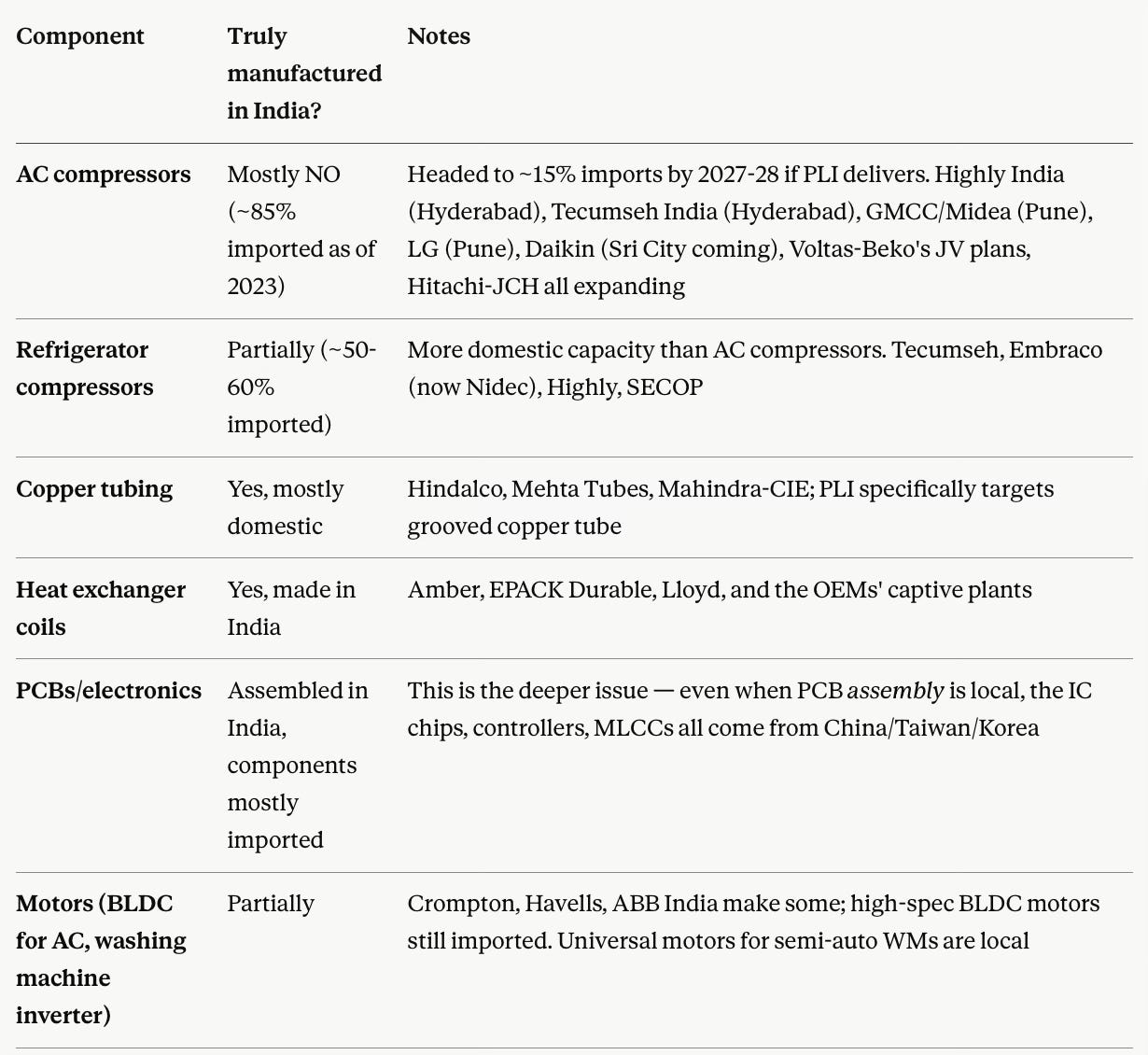
Interestingly, the Korean and Japanese OEMs (LG, Samsung, Daikin, Hitachi) have deeper Indian manufacturing (in terms of value addition in products like refrigerators, air conditioners, and washing machines) than most Indian brands because they invested in component plants in the 2000s-2010s when Indian brands were happy to rebrand imports. 

One structural reason for this difference also points to the lack of ambition and reluctance to pursue the export markets. The Korean and Japanese OEMs treat India as a manufacturing base for both the domestic market and exports (LG exports refrigerators to the Middle East from India; Daikin to Southeast Asia). That export-anchored manufacturing economics justifies deeper component investment. Indian brands have historically been domestic-market-only and saw little case for backward integration when components were cheap to import from China.

It is therefore an unfortunate reality that the vast majority of AC and refrigerator compressors, and higher-end motors (for front-load washing machines) are imported. 

The above analysis points to a corporate world that is stuck in a comfort zone, reluctant to assume risks by trying to move up the value chain or push aggressively into the next generation of products or technologies. There is a strong preference to stay on the sidelines and wait for technologies and products to emerge elsewhere. I’m not sure whether there is even one industry where Indian firms have been pioneers in showing the way with the next generation of products. Across industries, they always follow the trends in developed markets by copying and imitating. 

The large captive market (domestic and foreign) is considered a safe enough moat (thanks to a combination of price-sensitive customers and import protections) that would allow these firms to grow for a long time to come. There is little incentive (apart from inclination) to explore and expand beyond this comfort zone. 

In a globalised market, across industries, competitiveness is critically dependent on continuously moving up the value chain. It is a treadmill where, like the Red Queen, firms must run hard to retain their global competitiveness. And Indian firms, across industries, have shown consistent reluctance on this. It points to a problem of what I have described earlier as an entrepreneurship deficit.

With this entrepreneurship deficit comes a low risk appetite. This reflects in the reluctance to deploy capital. Moving up the value chain and expanding to foreign markets, essential requirements to becoming globally competitive, demand assuming significant risks by making large capital investments with long-term bets. These investments would also include cultivating supplier ecosystems, funding and nurturing startups, and long-term partnerships in general. Indian firms, especially the largest ones, have shown great reluctance to assume the risks and make these investments.

The reluctance to invest despite the consistently high margins across industries may be a symptom of the entrepreneurship deficit. As we have observed, firms are satisfied with their domestic markets and have limited or no appetite to expand into export markets. Further, the tepid growth of the domestic market (a reflection of the low aggregate demand growth, in turn a reflection of the narrow base of the consumption class) also discourages significant investments. All this manifests in a preference for short-term gains and avoidance of long-term competitiveness. 

This is a nice summary of the motivations driving Indian firms.

India has a large domestic market, and the economy is growing at 6–7%. So, you can bring what has worked elsewhere, deploy it in the market, and make a lot of money. It’s less risky. That’s what corporates have been doing. It’s the cycle of development. But when you want to compete internationally, you need to think about your own ideas.

Another reason to invest more and pursue export markets is to increase size. As the analysis shows, even the largest Indian firms across the eight sectors are small compared to their global peers. Despite being more profitable than their global peers, their much smaller size is an important obstacle to global competitiveness. 

The argument that government policies have been a binding constraint is not convincing. For one, the software industry, despite largely serving the global market and not being significantly constrained by public policy, did not produce any product firm or product of note despite several technological trends sweeping the industry in the last three decades. Second, even among the leaders in different industries, there has been little appetite to move up the value chain, expand into global markets or pursue new generation technologies and products. Third, even in localising manufacturing by nurturing local supply chains and partners, storied Indian OEMs have been behind foreign OEMs who have entered the market much later. 

Fourth, the argument that import restrictions have prevented Indian firms from becoming competitive flies against the reality that the Northeast Asian economies built their manufacturing successes in highly restricted markets. Instead, as Joe Studwell has written, they gained competitiveness by competing in the export markets. 

Now the government has thrown caution to the wind and, through the Rs 1 lakh Cr Research Development and Innovation Fund (RDIF), is funding even large corporates on their R&D endeavours. This may be the most that governments can do to push their industries towards innovating. It remains to be seen whether even this is sufficient. 

In conclusion, it appears that Indian firms suffer from an entrepreneurship deficit, risk aversion, and a lack of intrinsic desire to think big (by moving up the value chain, pursuing next-generation technologies, and expanding into export markets). They seem satisfied with serving their captive local markets, continuing their existing product lines and business models, and following global leaders in technology and product trends. This is a reality, borne out strikingly by evidence. Whether it is culture or something else can be a matter of debate. 

PS: On the issue of entrepreneurship, Claude had this comment on the prospects for India’s software services industry. 

Accenture sells outcomes and prices its services on the value of the transformation. Indian firms sell capacity and price on the cost of the underlying labor. Generative AI threatens the capacity-pricing model directly because it compresses the labor hours needed. It enhances the outcome-pricing model because AI-enabled transformations are higher-stakes and command premium fees.

This is why the next 2-3 years will be the real test: not whether Indian firms have AI capabilities (they clearly do), but whether they can shift their pricing and packaging model fast enough before Generative AI deflation hits their core managed-services contracts. Accenture has already crossed that bridge; TCS, Infosys and Wipro are mid-bridge with the macro tailwind weakening.

This is a test of entrepreneurship and reinvention of business models for the Indian IT services firms.

Wednesday, June 3, 2026

Deploying public finance to derisk private capital in innovation and infrastructure

As the heading suggests, this post points to a few thoughts on the challenge of deploying public funds to derisk and crowd-in private capital into those areas of innovation and infrastructure that are not attractive enough for commercial capital. 

I have blogged about public funding of innovation here and here, and this working paper is about public funding of infrastructure projects. The additionality with public finance arises from its risk-tolerantpatient, and concessional nature. 

An urban water supply or sewerage, or an industrial bulk water supply, or an electricity distribution, or a solid waste management, or a streetlight energy saving project, or a mass transit project, will not attract commercial capital on its own. Similarly, a fledgling startup making transceivers, or display and camera modules, or high precision resistors/inductors/capacitors, or compressors, or brushless DC motors, or anode materials, or aluminium extrusions, or designing a narrow band IoT chip or some other mid-value chip, will generally struggle to attract risk capital. 

But they can be derisked by blending with a layer of public finance. The challenge is how to do this derisking effectively. Specifically, the challenge is how public funds can be channelled to derisk these projects or sectors. 

This is less of a problem with grant funding involving smaller amounts, which is simple enough to be done through public entities. In infrastructure, such grants come in the form of viability gap financing (VGF), and in innovation, they are given to those in TRL 1-5/6 stages. The problem lies in the deployment of risk capital (debt and, especially, equity and structured instruments) by public entities. 

Given its administrative inflexibility and constraints, direct deployment of funds by the government itself is not only inefficient but also creates incentive distortions.

In the circumstances, the commonly suggested option is arms-length financing through Development Finance Institutions (DFIs). But this approach is seriously hampered by unreasonable expectations (about returns or at the least capital preservation) arising from a deficient understanding and acknowledgement that de-risking, by its very nature, entails a strong likelihood of losing money. It would involve investing in projects that would not attract commercial investors, by insuring for the additional risk borne by them. 

Further, even with an arm's-length institutional structure, a fully government-owned entity is subject to constraints that prevent efficient deployment of funds. 

The response to this problem has been to build institutional structures by partnering with private investors, even having majority private investors. This, it has been argued, will free them from the fetters and requirements faced by public entities. 

However, India’s disappointing experience with infrastructure DFIs starting from IDFC, IIFCL, and NIIF, as documented in detail here, raises questions about this response. In all these cases, instead of complementing private capital, the DFI has ended up competing with private investors in their choice of investments. Instead of funding those risky sectors, the DFIs chase the derisked sectors like power generation, renewables, transmission, highways, ports, and airports. 

In this backdrop, a commonly cited option, especially in the context of innovation financing, is to transfer public funds to commercial investment vehicles (or the Fund of Funds, FoF, strategy) and let the latter manage those investments. This looks great in theory, insofar as it aligns incentives and brings in private sector efficiencies. 

But it has one problem. The private investors will be primed to invest, at best, in those marginally risky projects rather than in genuinely risky projects (or sectors) that sorely need public finance to derisk them. So, instead of deriskingprojects or sectors, public funding will do returns amplification for private capital. 

Here, a big problem, a market friction, is the absence of a pipeline of such risky projects and sectors that investors can draw from. Their search costs are a significant enough deterrent for investors. In contrast, commercial investors have access to a widely known pipeline of investible projects or innovations. 

It is also the case that the envelope of such risk capital available to fund infrastructure and innovation is much smaller than the envelope of investible projects. Therefore, there is little incentive to go beyond the confines of the mainstream and search out and fund the riskier projects. 

In the circumstances, I can think of three options for the deployment of public funds such that we are able to realise its additionality, and not compete with and crowd-out private capital or end up being leveraged primarily for returns amplification.

1. Invest in FoFs, but with sharply defined funding mandates, almost prescribing the specific nature of projects to invest in, at least a part of their portfolio. However, this can be unsettling for the commercial investors and may turn away the GPs who sponsor the fund from accessing public funds. 

2. The DFI could announce its offering as a set of financing instruments that meet the derisking objective. They could include credit guarantees (in the form of first-loss buffers), longer tenor, lower interest rate or hurdle rate, lower liquidation preference and a lower charge on the waterfall, subordinate debt, and so on. The DFI should market these instruments and possible investment projects to commercial investors. 

3. The DFI could co-invest with private investors. This would entail the public entity scouting the project or entrepreneur, doing due diligence on it/them, and then shopping it to commercial investors with an offer of an attractive enough derisking financing layer. This would also require an acknowledgement of the fact that the role of public finance is to derisk and not maximise returns. This is perhaps the most ideal approach, one which mature entities like NIIF in infrastructure finance ought to be mandated to do.

The second and third options require highly capable and incentive-aligned institutions. Given weak state capability, that’s a demanding requirement. It is for this reason that even in developed countries, risk capital funding in infrastructure and later-stage innovations is largely deployed through FoFs, notwithstanding its aforesaid failings. 

But this reality should not be a reason to ignore the failings of the FoF strategy and step away from pursuing the second or third options.

Monday, March 16, 2026

A framework for public funding of innovation and startups

I blogged here exploring models of innovation funding generates the greatest bang for the buck in terms of achieving the primary objective of catalysing innovation. This post will provide some analytical frameworks to formulate a policy on innovation funding. This (on the importance of portfolio management activities), this (on an industrial policy for funding startup innovation largely through grants), and this (on the success of Maharashtra’s Defence and Aerospace Fund) are other recent blogs on the topic. This post will summarise all the takeaways and outline some guidance on startup innovation funding. 

The policy objective of startup financing is fundamentally to expand the envelope of investible startups and innovations and thereby crowd-in private risk capital. What is the best approach to achieve this objective?

Answering the question requires addressing the challenge of whether public innovation funding primarily expands the investable universe (genuine additionality) or primarily subsidises returns on investments that would have happened anyway (return-amplification / crowding-in of already-attracted capital). 

In the context of infrastructure, I have written here arguing that India’s efforts to crowd-in private capital into infrastructure sectors through the likes of IIFCL and NIIF, and IDFC earlier, have struggled to deliver the additionality (in terms of derisking sectors outside the traditional strongholds of public private partnerships) as the new institutions have ended up competing with the private sector for investments. 

What does the empirical evidence on these efforts globally report? 

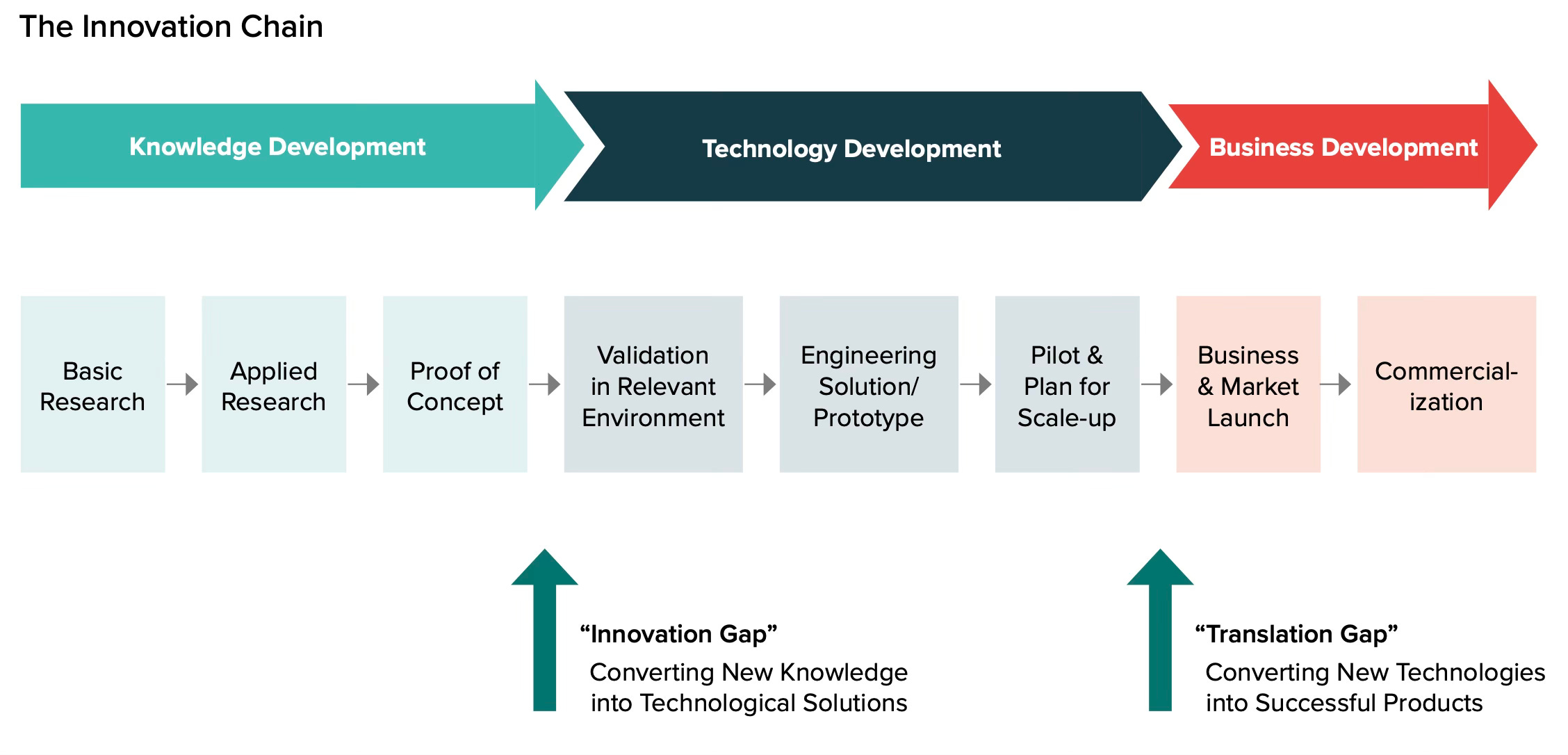
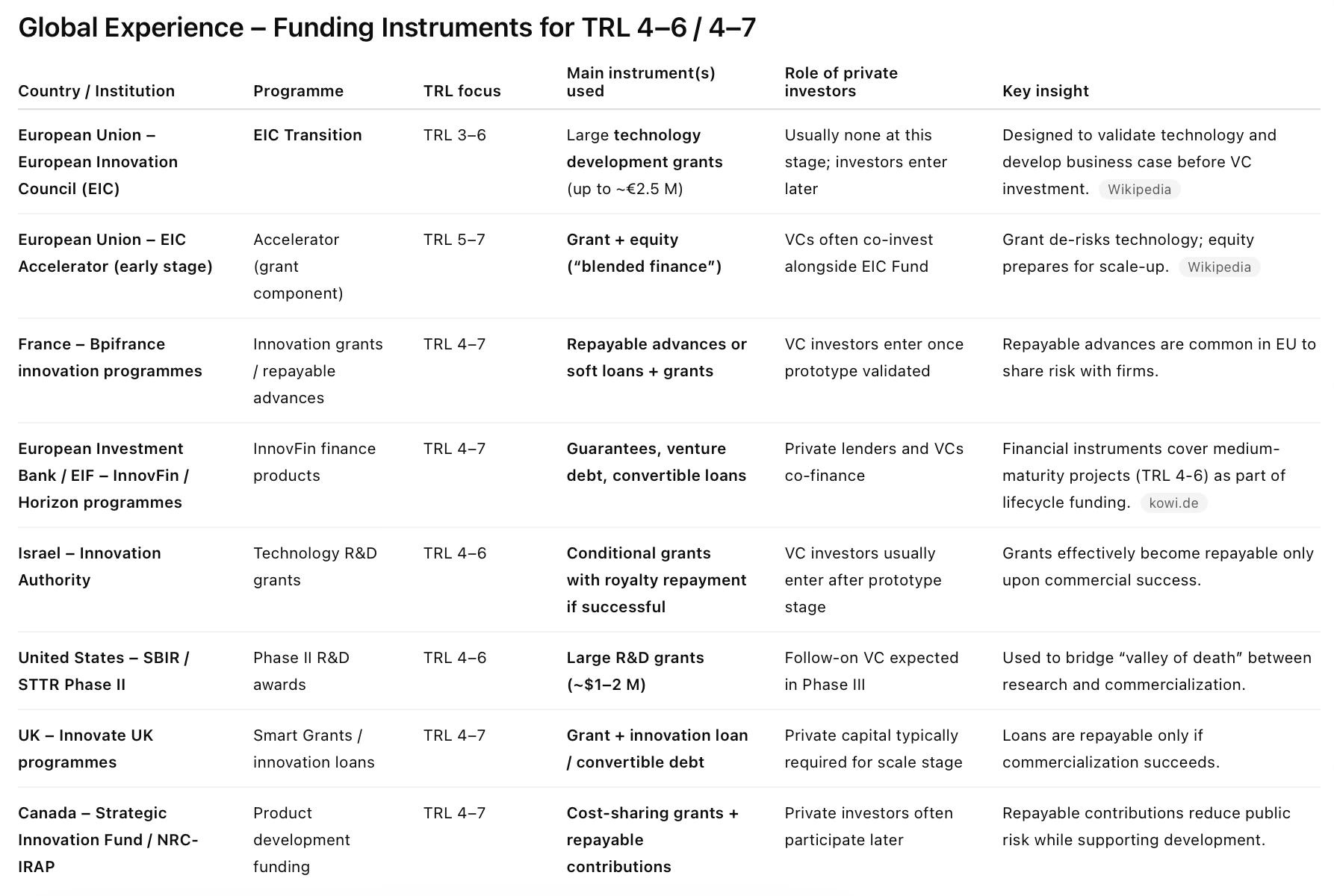
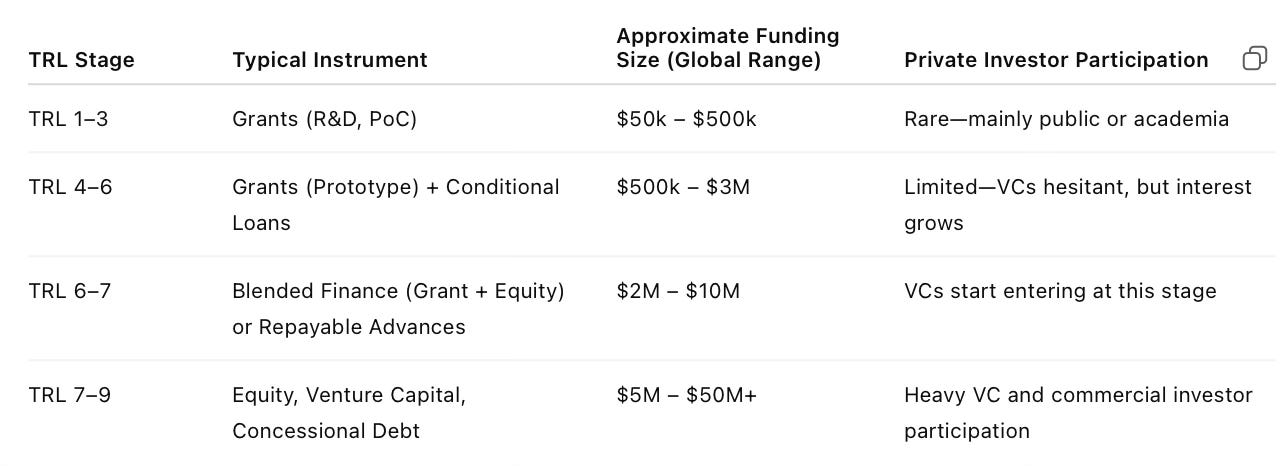
A useful framework for thinking about this would be to categorise funding into three buckets: seed/angel stage (one that leads to proof of concept and lab validation, TRL 2-4), technology/product development stage (includes prototypes and pilots, TRL 4-7), and commercial scaling stage (TRL 7-9). The first category is pure incubation of ideas through grants; the second is about expanding the pool of scalable innovations; and the third is about derisking and crowding in private capital to scale innovations. 

The first stage, being the riskiest, will have the greatest additionality from public funding. It is invariably grant-funded, and gets the biggest share of public funding focus across countries, also because it is essential to create the pipeline of startups that can be feedstock for VCs and other investors. It is no good to have a VC ecosystem without a strong investible startup pipeline in the prioritised technologies. 

In the second stage, being the “innovation valley of death”, grants may be the best option. While instruments such as a Simple Agreement for Future Equity (SAFE), popularised by Y Combinator, and other forms of convertible funding are commonly discussed in the context of technology/product development, the evidence from successful global cases points to grants, with at best hybrid forms like clawbacks or profit sharing. Interestingly, apart from India (BIRAC and MEITY MSH), no major country uses SAFE in public funding.

This is because while investors obviously favour equity instruments like SAFE in pure private market contexts, they create problems with the determination of future cap tables, significantly diluting entrepreneurs and diminishing their incentives at so early a stage of the startup’s journey, and also making them significantly unattractive for commercial investors (who generally prefer startups without the encumbrances from public shareholding). 

It can be observed that those with risk capital instruments tend to kick in only at the TRL 6-7 stages. 

In this context, it is worth briefly discussing the critiques of grant funding to startups. Those who critique giving grants to startups do not realise the central role of public funding in deepening the innovation ecosystem for commercial capital to then come in. In countries like India, where early-stage risk capital is tiny, public funding is critical to create a deep and broad pipeline of innovations. The concern of possible incentive distortions from giving away free money is largely minimised through milestone-based tranches or conditional grants. Critics also tend to conflate these two categories of funding with the third stage of commercial scaling capital, which we now turn to.

The dilemma between expanding the pool of capital and returns-amplification is most relevant to this stage of commercial scaling capital. The global evidence on this is mixed. The Israeli Yozma program, which deployed funds through Fund of Funds (FoFs), is thought to have catalysed the country’s vibrant VC industry

However, other examples point to returns-amplification. A study of IFC’s blended finance deals in the 2000-20 period finds comparable financial returns to non-blended projects but “no statistically significant excess private mobilisation beyond what IFC’s standard lending would attract.” In other words, blending did not increase the quantum of private investment — it redistributed risk between IFC and private co-investors. 

This finding is echoed in a 2023 study of SIDBI’s Fund of Funds for Startups (FFS) 1.0 by the Impact and Policy Research Institute (IMPRI), India’s Startup Engine: A Policy Review of the Fund of Funds Initiative. It finds that most FFS 1.0 capital went to established VC funds that would have raised capital independently. It also found “crowding-in effect was primarily reputation/signal, not financial additionality,” the government’s involvement functioned more as a validation of fund managers to private investors than as a necessary injection of capital. While FFS 1.0 delivered a 2x mobilisation ratio, it was mostly in already-functioning VC markets.

This brings us to the question of the most cost-effective approach to achieve the public finance objective while supporting commercial scaling. The options span the spectrum from directly investing in the startup to indirectly investing through FoFs

While the former allows for targeting the riskiest innovations/startups, it creates the challenge of due diligence, which can be addressed through co-investment with professional investors that piggyback on their diligence. While the latter limits the control over who/what is funded, it allows full play for professional investment practices. 

In either case, the nature of the entity that deploys the public funds is important. A fully public or majority public shareholding corporation, whether non-profit or for-profit, will struggle to deploy risk capital and will be hobbled by the restraints of the General Financial Rules (GFR) and the vigilance from oversight agencies. It is for this reason that there is no instance from India of a government-owned entity directly making risk capital investments (apart from the Maharashtra Defence and Aerospace Fund). Its alternative, a majority privately owned entity or a Category I Alternative Investment Fund (AIF) with private Limited Partners (LPs), cannot avoid the returns-amplification problem. 

In the circumstances, the most prudent and effective strategy would be the FoFs route with some sharply defined conditionalities. The funds could be committed at concessional terms - subordinate equity, first loss buffer to a certain threshold, capped returns, warrants with lower liquidation preference, etc. It should be complemented by broad mandates on the nature of investments made, specifically on the TRL stages of the innovations, and pre-defined technology areas. 

When public capital is subordinated to private capital in the waterfall through any of the aforesaid approaches, the public subsidy is targeted precisely at the risk premium that blocks private investment. Return-amplification is minimised because private investors bear disproportionate upside — they are not getting a free subsidy on already-viable deals.

In this context, the RDIF is instructive. For a start, all its funding is debt or equity and only for TRL 4 and above stages. It has three modes of investing based on where it stands in the returns waterfall. In the first mode, RDIF effectively absorbs the first losses and receives distributions after private investors have received their hurdle rate. In the second mode, it receives distributions pari passu with other contributors at the same hurdle rate and IRR. In the third mode, it receives distributions at a higher priority or higher IRR than private contributors. 

While the first mode is a good example of concessional lending as discussed above, the second and third modes may need to be justified on other considerations. Scarce public capital should flow to those areas where it has the highest additionality. While it prescribes the broad areas of investing, it may not suffice in pre-empting returns-amplification investing. 

In the circumstances, the RDIF runs the risk of ending up with the same problems as those with the likes of IDFC and NIIF in infrastructure (whose portfolios clearly indicate that they tend to compete and crowd-out rather than crowd-in private capital). It may struggle to realise the promised additionality. For instance, it is most likely that most of the funding will flow into the TRL 8-9 innovators in the less risky among the defined areas. Finally, I’m not sure how Focused Research Organisations (FRO) can deploy returnable capital in startups, unless they merely act as pass-throughs to FoFs. 

If the second-level fund managers (SLFMs) of RDIF are required to meet additionality criteria (invest in TRL 6-9 companies they would not otherwise fund; report on portfolio-level additionality; face consequences for drift towards safe/commercial deals), the public mandate will be preserved. But without this discipline, every SLFM will cherry-pick the best deals, and the public capital risks becoming a subsidy for private returns. At best, public capital ends up competing with private capital and marginally expanding the large enough and growing pool of risk capital. 

Finally, the biggest constraint to scaling is finding the deployment platform in a country where the indigenous product ecosystem, especially domestic OEMs, is very limited. In the circumstances, public policy must play an important role in value addition by facilitating the creation of scaling pathways. This could be through direct procurements (solar cells, smart meters, street lighting LEDs, etc.) or domestic content mandates (cameras, telecom equipment, etc.). This has been a very important pathway for commercial scaling in both the advanced countries and in China, but it will be a challenge for India’s public policy. It is also for this reason that investors should pursue proactive portfolio management in terms of actively facilitating the linking of startups with the public procurement pathways. 

In conclusion, a few points to be borne in mind. One, grants at Stage 1 (TRL 1-4) are the highest-additionality instrument globally. No other instrument produces a comparable expansion of the investable universe. The evidence is unambiguous. Two, since private capital will remain scarce, public capital is critical to develop the pipeline of risky innovations and startups. Three, this nature of funding and additionality will also largely apply to the stage of technology/product development.

Four, a blended fund with a derisking public tranche and a set of sharply defined target investment-related conditions, is the highest-additionality structured instrument for commercial scaling. The public tranche absorbs the risk premium, and private capital fills behind. Five, government procurement is the highest-additionality instrument for commercial scaling for hardware companies. Procurement creates more private capital crowding-in than any equity instrument, because it proves market demand.

Finally, as public policy interventions to realise the aforesaid objectives, there are perhaps two low-hanging fruits. One, there should be a portal that consolidates all the startups financed by state and central government departments, and it should become the primary universe of the pipeline for risk capital funding. This portal should be tightly integrated with the ecosystems of VCs and other investors. Second, there should be active portfolio management at the level of all departmental funds to facilitate access to larger public risk capital funds like RDIF and SIDBI FFS 2.0. The objective should be to ensure that promising publicly financed innovations do not remain stranded.

Thursday, March 5, 2026

Some thoughts on startup innovation scaling - hospital solutions

The Ken has an article on how the health systems in India are adopting AI applications, specifically ambient AI transcription apps (always-on AI systems that use contextual interpretation to transcribe speech without explicit prompts). The article highlights several important insights about not only AI-adoption but also generally startups in India. 

The idea is simple: use AI transcription tools as scribes to document patient consultations and integrate them into the patient and hospital management workflows, thereby improving efficiencies and quality of care. Besides, “ambient AI could become the layer on which a full AI stack in diagnostics, predictive health, and ICU optimisation” can be built. 

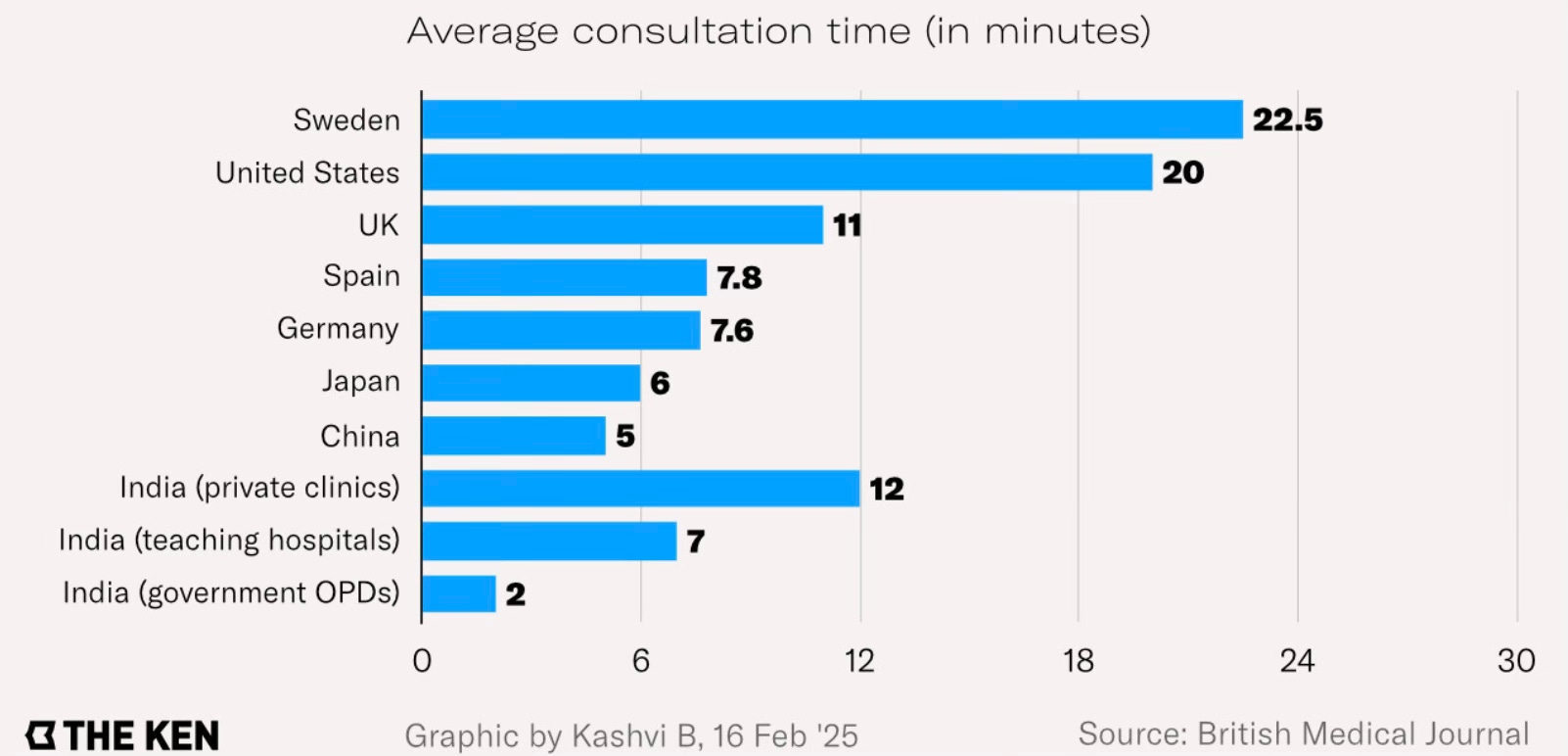
Apart from the inherent productivity-enhancing value of a digital scribe, the felt need in India is the sheer volume of patient load faced by doctors. An Indian doctor sees, on average, 30 patients compared to three for the US doctor.

This is also because India has a doctor for every 811 people, rising to nearly 11,000 in rural areas, compared to one for 300 people in the US. 

This patient load has naturally led to the search for methods to optimise consultations, especially by adopting ambient AI scribes. The well-heeled hospital chains have preferred to use the mature foreign solutions instead of relying on Indian startups. 

The article describes the challenges faced by ambient AI scribe startups in India.

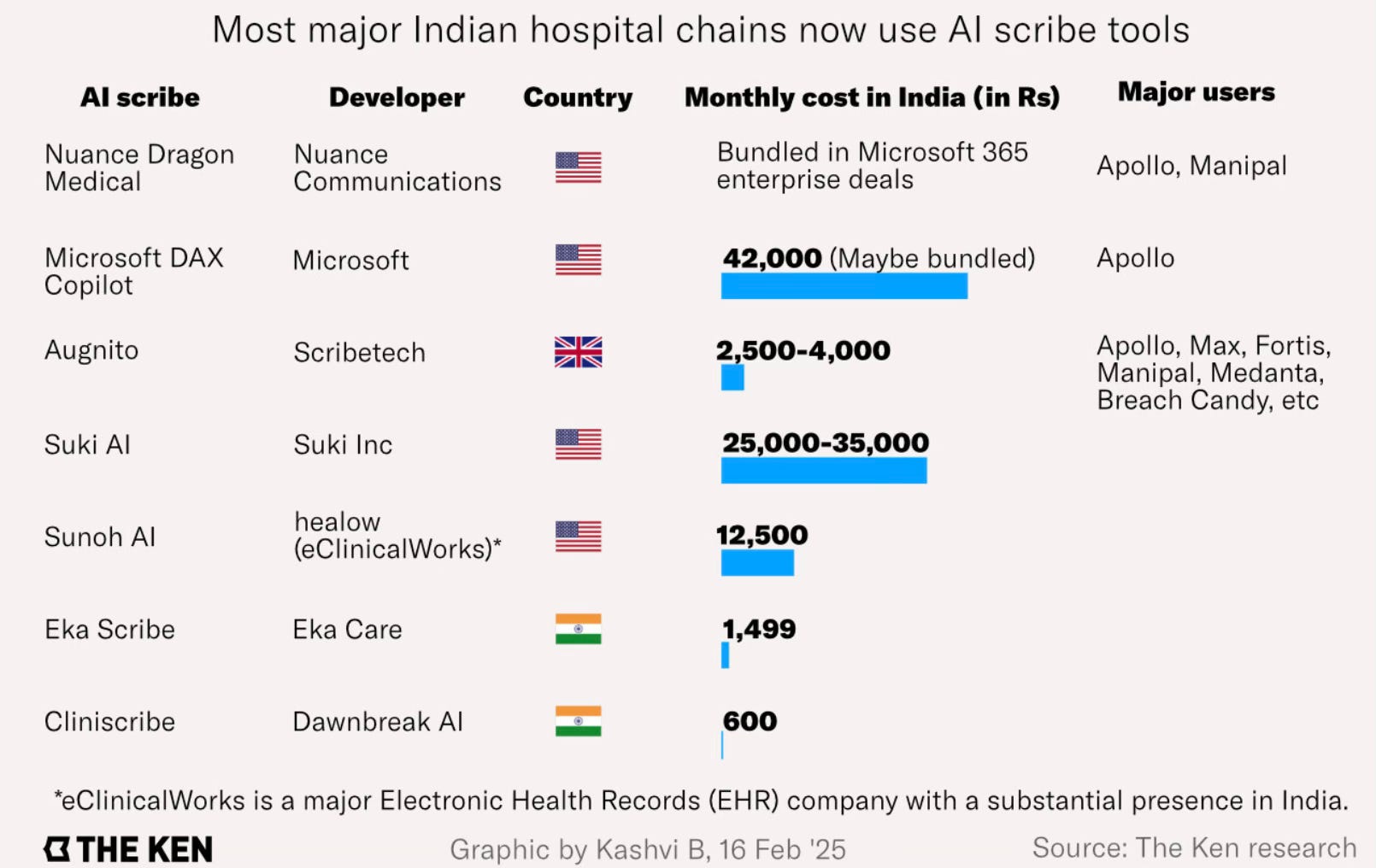
Most hospitals in the country do not have electronic health records, known as EHR, that can integrate such tools… Where EHR systems do exist—mostly in private hospital chains—they aren’t standardised, making the integration of AI-scribe tools into easy-to-use digital infrastructure a custom engineering project for each hospital… An AI scribe can… allow a doctor to see two to three more patients an hour, a tangible capacity gain for high-burden Indian hospitals... After adopting Augnito, a voice-to-text tool from the British firm Scribetech, 35% of Apollo’s doctors saw more patients in 2024… Apollo has deployed Augnito across 37 of its facilities since 2022–23, giving nearly 4,000 doctors access to it… 

The tools would need to be highly precise, though, and customised for the Indian context. Transcription errors can impact drug dosage, change patient outcomes, affect insurance claims, and even invite malpractice lawsuits… A medical journal estimated in 2024 that there had been a 400% increase in medical-negligence cases in the previous few years… At a price point of Rs 600–1,500 per doctor per month, AI scribes need wide adoption to break even. Building AI tools is expensive, as model training and GPU costs are high…

Beyond the big players, however, it will take much more to convince doctors to adopt these tools than just a promise of less clerical work... such tools are hardly affordable for a non-chain clinic… Selling to big chains is hard for a new company, however. “Apollo’s actual deal at a corporate level is with Microsoft,” a hospital industry expert says, requesting not to be named. “They have also bundled in another voice solution, Nuance Dragon, to improve documentation.”… So startups like Dawnbreak and Eka Care started with selling their tools to hospitals that didn’t have any EHR at all… Instead of integrating their tools into existing systems, ambient AI firms are looking to provide lightweight tools that hospitals can use piecemeal…

India’s hospital-information-system landscape is fragmented… there are some 2,000 EHR systems compliant with the Ayushman Bharat Digital Mission… Unlike in the US, where Epic and competitor Cerner command 70% of the market, each EHR system in India is different. For makers of AI scribes like Dawnbreak and Eka Scribe, this means building custom-integration solutions for each client rather than a mass product. Dawnbreak, in one year of its existence, has managed to build compatibility with four EHRs out of nearly 2,000… Indian EHR companies like Healthplix and Docpulse safeguard their databases. If they open their APIs up, they lose their competitive edge. Their clients are locked in long-term contracts, leaving them unable to change their systems or integrate any AI tools. 

This is a good case study on the problems with scaling startup innovation in India. 

1. AI has undoubted potential for significant productivity improvements, including in public systems. Like scribing, triaging of outpatient (OP) cases coming to a primary health centre (PHC), community health centre (CHC), district hospitals, and medical colleges is an area where AI can play a significant productivity enhancing role. In all these places, OP cases come to doctors with limited or no triaging. Further, as we have seen, the daily OP load in these hospitals (at least the better ones among them) is multiples of what a doctor can manage, leaving them overburdened and stressed. The result is inefficient use of the doctor’s time, inadequate diagnosis time, incorrect diagnosis, wrong OP referrals, and so on. 

An AI-based triaging application where the symptoms are entered at the OP-registration, nurse and doctor-level, can dramatically improve work conditions, increase hospital productivity, and enhance the quality of treatment. Triaging is already one of the early emerging successes of AI, with examples like Bank of America’s digital assistant “Erica”, which handles billions of client interactions and has reduced call centre volumes by 40 per cent. 

2. However, the promise of AI is most likely to be constrained in sectors like healthcare and others where health and public safety are critical factors. In these regulated areas, vertical use cases of AI adoption (agentic solutions that can be outsourced specific tasks) is likely to be slower. The regulatory struggles of autonomous driving systems is an illustration. 

Even a clear and credible demonstration that AI is more accurate than the current human-intermediated approach will not be sufficient. Notwithstanding all its flaws, the human psychology and political economy is such that society will demand a very high, near 100%, accuracy from any electronic/digital system that seeks to replace a human-intermediated system. 

3. There are some important market insights here. Econ 101 would have it that since health care has inelastic demand, and also given the sustained high economic growth rates, one would have imagined a large supply side of hospitals in India who deploy such solutions. Similarly, one would have imagined that Indian startups would have grabbed the opportunity presented by developing AI solutions on patient triaging, consultation scribing, diagnostics, EHR, etc. 

I’m not sure about whether the Indian market can support the demand for such apps and services at the price points required to sustain domestic innovation. Sample this on the limited consumption potential of the Indian economy, and the challenge of making money in the country.

While India’s population of 1.4bn offers enviable scale, its market has proven difficult to monetise. According to Sensor Tower, Indian internet users downloaded 24.3bn apps in 2024 and spent 1.13tn hours on them, but total spending was just $1bn.

The advantage domestic startups have is their lower price point. But any scaling pathway for startup innovation that relies on price point may be no scaling pathway at all. A business model that relies on a low price point does not generate the cash surpluses required to finance the significant R&D investments required to refine such products. The net result is that genuinely innovative companies remain elusive. 

I blogged here about the demand-side constraint arising from the deeply price-sensitive nature of consumers and the small size of the consumption class with disposable incomes. It also does not help that Indian firms, including startups, do not have a culture of investing in R&D beyond that required to grow their ongoing businesses. 

4. The dominant narrative on startups, shaped by the Silicon Valley giants, is that of scaling by growing exponentially. But contrary to this, apart from killer apps and the few platforms, the main scaling pathway for ambient scribing startups like Eka Care or Dawnbreak may well be through large IT companies already serving the same or similar market segments. The vast majority of these solutions, and not just in health, are limited in their scope as stand alone applications. But this changes dramatically once they are integrated with a larger ecosystem platform to leverage network effects. 

These startups will struggle to get the big users, large hospital chains like Apollo and Max, to replace their bespoke legacy solutions or those supplied by established foreign vendors. This is a daunting market access challenge that even the startups with great solutions will face in markets like India. 

It raises the important point about a model of the digital economy where startups develop innovations which in turns scales through large firms. This not only makes the large firms even larger, but also maximises value capture by them.

It also raises the question of whether the startups should pursue getting the big hospital chains to become their investors. This will also align the incentives of the hospitals to integrate these solutions with their EHR and legacy systems. 

5. It is here that the failure of India’s software behemoths to build on their first-mover and other competitive advantages assumes significance. Both TCS and Infosys have long experience in global hospital systems management, including multi-year, multi-billion-dollar contracts. Hospital tasks management applications should have been a natural area of business development for these IT majors. But Indian software firms have struggled to break out from their services-led business model and embrace products and solutions which require high R&D investments. 

IT services still dominate with exports set to reach $210bn this financial year, India Ratings and Research forecasts. It has been a powerhouse industry for India but as IT services presented so much low lying fruit, the sector sucked up tech talent and capital from elsewhere. India’s SaaS sector in particular punched below its potential as a result. Software majors treated their services businesses as cash cows, deploying a small share to intellectual property assets. The 10 largest IT services companies had consolidated profits of $114bn in the past decade; 75 per cent of this was paid out via dividends and buybacks.

While the top five Indian IT firms had free cash flows of nearly $13bn in the 2023-24, their R&D investment was a pitiful 0.88 per cent of sales

6. Finally, what can public policy do to solve some of the scaling challenges? An India Stack for digital payments is unlikely to work for the far more complex area of EHR. Public policy cannot solve market coordination problems (like sharing APIs to allow integration and inter-operability), except in some contexts by defining standards. Public sector driven demand-side channels like Ayushman Bharat can gently force some standards. 

The approach of supporting scaling by procuring for use in public systems runs into the problems of punishing public systems with second quality or inferior products and creating perverse incentives among the startups. Providing a small sample of public hospitals does not address the market scaling challenge arising from network effects, besides also creating procurement problems even if the solution is found effective.