Substack

Showing posts with label State Capability. Show all posts

Monday, October 19, 2026

Examining the structures and incentives of the Chinese administrative state

Zhuoran Li has a neat description of China’s frontline bureaucracy at the township level that resonates with many other accounts. It is worth extracting in detail and discussing its lessons for countries like India. 

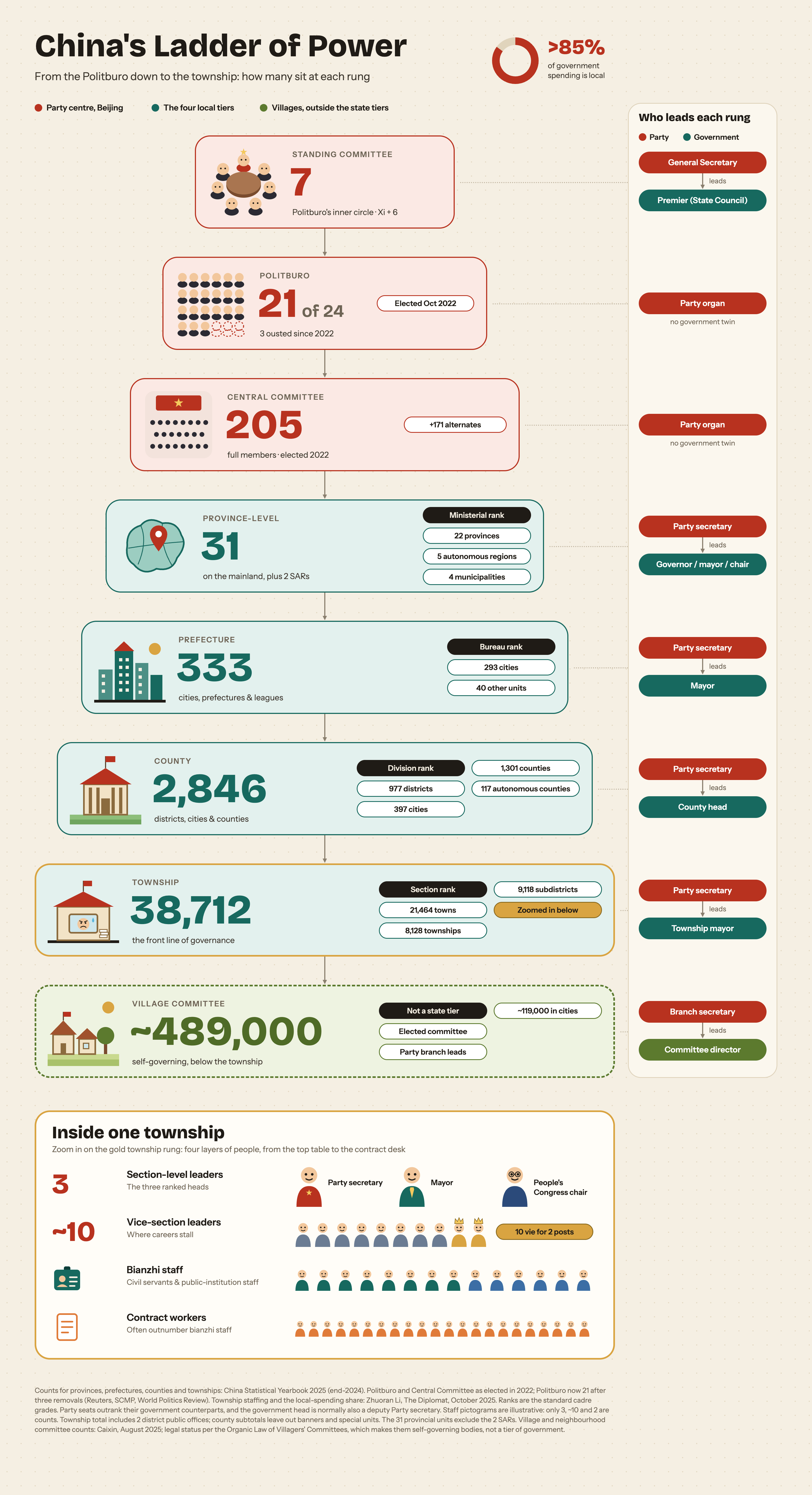
The township, which includes both the rural and urban areas, is responsible for the implementation of most functions of the government such as education, healthcare, public welfare, and municipal services. This is a description of the administrative hierarchy at the township level.

At the top of the township government hierarchy are local leaders, who are township cadres with administrative rankings. A township typically has three section-level (科级) leaders: the township Chinese Communist Party (CCP) secretary, the township mayor, and the chief of the Township People’s Congress, who is often the former township party secretary transitioning to retirement. In addition, there are approximately 10 vice section level (副科级) leaders, including vice party secretaries, vice mayors, the discipline inspection secretary (纪检书记), and the heads of several key offices. Officials heading less critical offices or serving as vice chiefs of any office do not hold administrative rankings and, therefore, are not considered leaders. 

The next level below government leaders are civil servants with no rank who hold bianzhi (编制), which refers to established posts within government offices. Bianzhi status grants significant benefits, including superior welfare compared to regular citizens and lifelong employment (unless the employee commits a crime). Within the bianzhi workforce, “cadres” and “officials” hold civil servant bianzhi, while other bianzhi workers have public institution bianzhi – the same designation given to teachers and doctors in public hospitals. Only those with civil servant bianzhi can reasonably expect opportunities for promotion. In contrast, those with public institution bianzhi have no career advancement prospects.
Li points to several career progression challenges at the township level. 

The path to promotion begins only when an official is elevated to the vice section level, becoming a township leader. Making it to vice section level is not difficult. Officials attest that almost all cadres can expect this promotion as long as they don’t make any serious mistakes. However, further promotion from here becomes extremely difficult. Therefore, most township leaders do not view promotion as a strong incentive and often describe themselves as “not caring much about promotion.”

Promotion opportunities at the township level are rare, as leaders face intense competition and strict age cutoffs. As Chien-wen Kou and Wen-Hsuan Tsai noted, the age cutoff for promotion to vice section and section levels is 40, while the cutoff for vice division (副处) level is 45. In reality, interviews indicate that in many places, the cutoff age for the vice section level can be as early as 35. Promotion opportunities are further constrained by the competition among vice section leaders, 10 of whom may vie for just two section-level positions. Moreover, township party secretaries and mayors are often not promoted from the pool of vice section leaders within the township. Instead, county-level governments may appoint section-level leaders through temporary transfers (挂职), effectively fast-tracking their promotion… As a result, township governments are often referred to as a “black hole for young cadres,” trapping many in perpetual vice section level assignments. They frequently surpass the promotion cutoff age and remain indefinitely in vice section positions. 

Promotion prospects do not improve for section-level leaders, as they face even fiercer competition. A county typically has only around 10 vice division (副处) level positions. Township and street (街道) party secretaries and mayors compete for these roles alongside section chiefs from the county government. As several cadres have concluded, promotion opportunities are largely reserved for those with the right connections…

The lack of promotion incentives is a widespread phenomenon. According to research by Jianxing Yu and Xiang Gao, more than 70 percent of surveyed officials in Zhejiang stated that they know their terminal position early in their careers. Therefore, since early in their career, many local officials decide not to participate in the promotion tournament.

This is a good nice description of how officials manage to work the system to get assigments of their choice. 

Since promotion opportunities are rare, township leaders have developed different career calculations. Some are primarily motivated by the goal of “escaping the township.” Many township leaders keep their families in the county center to access better housing and educational opportunities for their children, while residing in township government dormitories during the workweek. Consequently, they aspire to secure an administrative reassignment (平调) to the county government as a section chief, which would allow them to work closer to their families. Obtaining such a reassignment depends largely on strong personal connections with county leadership and the Organization Bureau. Others, however, prefer to remain in the township because they value the benefits of “holding real power” (大权在握). Many leaders enjoy the authority that comes with being “number one” (一把手) – and the ability to leverage this nearly unchecked power to enrich themselves. For such figures, an administrative reassignment to the county government is seen as a career downgrade.

The similarity with India’s district and below level bureaucracy is remarkable. 

This about contract workers.

Many township governments often employ more contract workers than official bianzhi workers. They perform similar tasks and often work closely with officials. In fact, township contract workers are often more competent than their counterparts. Unlike officials, who are required to rotate posts and localities under the Civil Servant Law, contract workers often remain in the same position for their entire career. This continuity allows them to develop a deeper understanding of local conditions and acquire specialized skills… In theory, a township government can terminate a contract worker’s position at any time. However, the specialized skills that contract workers possess make them irreplaceable, granting them de facto job security… township governments are highly reluctant to fire contract workers unless they commit a crime or a serious mistake.

The primary distinction between contract workers and regular officials is that contract workers do not receive the welfare benefits that officials are entitled to. They only receive basic wage, which is lower than bianzhi workers’, and do not enjoy any bonuses or subsidies… contract workers enjoy more freedom compared to officials. They are not subject to investigations by the commissions for discipline inspection at various levels, since many of them are neither civil servants nor CCP members. Additionally, they are exempt from sitting through the grueling meetings or participating in political activities that are typically reserved for officials and Communist Party members.

Li has this summary of the local government performance.

China’s township governments are best described with one word: stagnation. One cadre captured the reality of township government succinctly: “Everyone is stuck.” Such stagnation will inevitably lead to organizational decay. The resiliency of the CCP comes from its grassroots, and a stable Chinese state depends on local governments delivering services. Decaying local governments will lead to long-term social consequences.

So what are the lessons for countries like India from the Chinese administrative structure? 

1. In India’s administrative hierarchy, the township appears akin to the block, the county to the sub-division, and the prefecture to the district. However, unlike in India, the Chinese administrative units appear to have been created keeping in mind their size and functional importance. Accordingly, the largest cities like Beijing and Shanghai have province-level status, some larger cities have prefecture-level status, and some others have county-level status. This is in contrast with India where all municipalities and districts are alike in their administrative powers. In the Chinese administrative structure, Mumbai and Bangalore would have the powers associated with state governments. 

2. The bianzhi are similar to the field staff in local governments in India, and the Vice-Section level and above forms its leadership. In terms of career progression, in most states, their progression is limited to their local government. In this respect, their prospects are similar to their Chinese counterparts. Further, local governments in India are generally are headed by officials appointed from the state governments. 

The portrait of the bianzhi painted by Li is not flattering. They appear no more or less motivated or institutionally primed (to perform) than their Indian counterparts. As Yuen Yuen Ang and others have pointed out, these levels of government are also rife with petty corruption and speed money. This requires more understanding. 

It is possible that most of the government actions in terms of economic growth happens by way of policy decisions on economic growth and investment happens at the level of prefecture and provinces. The frontline bureaucracy, represented by the township level, may be merely delivering public services, for which China’s higher baseline of state capability may be sufficient. 

3. The role of contract workers appear similar to that in India. It is not uncommon across government levels in India for contract employees, or consultants, to have become more indispensable than the regular employees. The Chinese frontline state appears as much dependent on the non-regular employees as India’s. 

All these raises questions concerning the frontline functionaries and the state they represent. Is the median office clerk or teacher or nurse or tax inspector or policeman or land official in China more capable and/or more motivated than their Indian counterpart? Or is it that there are more of them than in India, thereby reducing the administrative burden? Or is the system less politicised at the frontline, given the single, unified Commuist Party in China? Or is it about greater administrative discipline and bureaucratic efficiency in monitoring and execution?

4. The Chinese officials at the larger county and at the prefecture levels appear similar to the IAS officers, who though enter laterally. The Xuandiaosheng, a Party-run track for top university graduates, but starting in village or township posts and then fast-tracked, appears the nearest to a selected elite stream. 

In fact, one study by Genia Kostka and Yu Xiaofan of career backgrounds of 898 municipal (or prefecture-level) Party secretaries between 1990-2011, found that only 5.4% had mainly county-level careers, and under 1% came directly from a county post. About 56% were mainly municipal, 32% provincial and 3% central. The study points to a “glass ceiling” for county cadres.

Our analysis finds that obstacles hindering leading county cadres from rising to the upper ranks of the municipal apparatus include age and education restrictions; limited positions at the municipal level; the lack of networks linking to provincial leaders; and provincial leaders’ appointment preferences. Limited career advancement opportunities for county cadres have important implications for understanding the incentive foundations of China’s bureaucracy. With only slim prospects for leading county cadres to rise to top municipal positions, the political incentives outlined in the cadre evaluation system might not be as effective in steering cadre behavior as currently claimed in the literature.

This trend is also reflected in the career profiles of top government and Party leaders like Xi Jinping and Li Qiang. 

5. The appointments and promotions into the government and Party at each level are managed by one level above, by the Organisation Department of that level. Interestingly, unlike other Departments, this Department functions as a Party body and not a government ministry. The centre appoints ministers, governors and provincial Party secretaries, and each Party committee manages cadres one level below it. So the province, not Beijing, picks prefecture heads. This points to a significant level of delegation of responsibilities in personnel management and a highly capable, objective, and professional Organisation Departments across levels.

Since most officials are also Party members, they move routinely between the Party and the government. As you go up, careers alternate between the two tracks. 

6. The mainstream accounts of China’s bureaucracy paints a picture of managed competition among local governments as the driver of its success. This calls for a highly capable set of leadership level officials, institutional capabilities, and strong alignment of institutional and personnel incentives. These accounts describe a highly competitive and empowered system that also aligns the career progression of officials to jurisdictional performance in expanding the economy and creating jobs. This requires a highly meritocratic set of incentives and their disciplined compliance and enforcement from the top. 

The deeper institutional innovation in China may be that of local governments (prefectures and provinces) being able to capture some of the returns to local economic development while their officials were simultaneously evaluated on that development and their career progression was dependent on the evaluation. This innovation has been underpinned by managed competition among local governments. 

7. Even with this administrative structure, the fuel that fired competition was financial resources - revenues from land sales (and the raising of debt through Local Government Financing Vehicles, LGFVs), share of tax revenues from local economic activity, the profits from ownership of stakes in State owned enterprises. This resource stream is also important since the local governments receive very little provincial or central support and are responsible for over 85% of the government spending. Further, China does not have property tax, and after 1994, the central government dispensed with the retention of marginal revenues beyond the contracted base and recentralised a substantial share of tax revenues. 

There are very few countries which can even remotely closely mimic this institutional structure and the scale of financial resource availability at the local government level. 

Imagine an Indian parallel, where larger cities and districts, headed by IAS officers, are empowered to sell lands, set up off-balance sheet entities to raise debt and finance infrastructure, establish companies and subsidise them, court private companies to build factories and provide them bespoke incentives, mobilise funds and invest in innovative sectors, etc. This would be far beyond their capabilities. Even if the capabilities were miraculously mobilised, creating the institutional and personnel incentives to do these activities with reasonable fidelity would be difficult, if not impossible. It must be borne in mind that even state governments in India struggle to do these activities with any degree of effectiveness. In fact, even the central government has struggled to effectively manage the disbursal of its flagship innovation fund. 

There are so many questions that come to mind. 

How does the Chinese adminstrative system maintain its discipline given, say, the discretion available to mayors and governors in picking winners and allocating them large amounts, or controlling state-backed venture funds (as outlined here)? How does this discipline co-exist with several accounts of widespread corruption and aggrandisement among senior officials at these levels? Or is it that the centre condones these excesses to some extent as long as the headline outcomes on economic output and jobs are delivered? Or is it that the extent of administrative powers and financial resources available endow local governments with the levers to generate economic outcomes even with the indiscipline? Or is it that the magnitude and scorching pace of economic growth has offset all the inefficiencies? 

How much of the success of the Chinese bureaucracy in delivering outcomes is due to the presence of a parallel Party structure, especially given that the Party Secretary outranks the mayor or governor? How much of the discipline within the government bureaucracy is due to the Party oversight? How much is it due to the personnel management of the government itself being done by the Party-controlled Organisation Department? How much of the discipline arises from the incentives on rising up the hierachy? How much of the motivation and drive to realise national goals among leaders is due to their Party membership and indoctrination? 

It is difficult to not come away with a strong belief that the Chinese administrative system is sui-generis and may offer limited lessons for others to emulate in both reforming their own less effective administrative systems and also in creating institutional structures to enable and sustain high growth rates. 

I had blogged here on China’s management of their public sector units, another sui-generis arrangement which might be difficult to replicate in countries like India.

Thursday, September 3, 2026

Improving ‘decision velocity’ in bureaucracy

Shashi Tharoor has a review of a new book, Decision Velocity: Rational Abdication, the Fear Tax, and the Road to Viksit Bharat, by retired IPS officer OP Singh. Singh describes a phenomenon of not taking decisions, or ‘rational abdication’, which imposes a “fear tax” that is extracted in the form of unconscionable delay. Tharoor writes

Singh’s “Fear Tax” is the price society pays when decision-makers conclude that the safest course is not to decide at all. It is the outcome of a sclerotic system where, for the desk-bound officer, the risk of a decisive signature far outweighs the perceived safety of a prolonged silence. As Singh so eloquently demonstrates, our current accountability frameworks audit the traceable action with inquisitorial rigour, yet remain blissfully indifferent to the absent decision. Hence, it’s safer not to act at all…

We have inherited, and subsequently ossified, a colonial-era machinery designed for control, not for velocity. In such a framework, a file that moves is a file that invites scrutiny; a file that rests in a dark corner of a cabinet is a file that poses no threat to its custodian. The result is a Kafkaesque reality where the paralysis of the pen is too often mistaken for the prudence of the professional. This is not merely an inconvenience; it is a profound failure of the social contract. When the state abdicates its responsibility to act, it does not merely delay a project or a permit; it stifles the latent potential of a citizenry waiting for the basic friction of governance to be removed.

Tharoor offers some suggestions.

We must move from an obsession with compliance to an obsession with outcomes… We must evolve our oversight mechanisms to distinguish between honest mistakes (the byproduct of necessary risk-taking in a complex environment) and true negligence. A system that does not tolerate the possibility of a wrong decision will rarely produce a right one.

Furthermore, we must incentivise administrative courage. This involves creating "safe spaces" for decision-making, where the rationale for action is documented and respected, and where the institutional culture shifts from "How can I avoid this?" to "How can this be made to happen?"

There cannot be any argument about these. The challenge is to operationalise tolerance of honest mistakes and creation of “safe spaces”. 

The operationalisation of these cannot happen by diktat or homilies. Instead, it requires building them into bureaucratic routines and institutional processes. The former involves changing norms within the government on taking risks, accepting failures, and even celebrating risk-takers. The latter involves wiring the institutional processes to accommodate these. 

I can think of three process safeguard reforms.

An important nudge in this direction would be to amend the Prevention of Corruption (PC) Act to clarify that no public servant shall be subjected to any enquiry, inquiry or investigation under this Act, nor prosecuted, solely based on an opinion, advice, recommendation or decision recorded or taken by him in the discharge of his official functions, unless there is independent material to show that the act was actuated by a corrupt motive or by the expectation or acceptance of an undue advantage. It should also be clarified that an error of judgment, or an unintended, unsuccessful, or sub-optimal outcome of such a decision, shall not constitute such material. This would go beyond the procedural safeguard provided by Section 17A of the PC Act (whose scope is currently not yet settled and awaiting a Supreme Court bench verdict) and provide a substantive threshold. 

Another would be to amend the Right to Information Act and insulate the contents of deliberative processes (opinions, advice, recommendations, notings, drafts or inter se deliberations recorded by the public servant) from any investigation or be made inadmissible in prosecution proceedings, unless there is evidence that the act itself was done with a malafide or corrupt motive. The US Freedom of Information Act insulates the deliberative process as a safe space from any scrutiny. This would allow people to express opinions freely without hedging for future recriminations. 

A third would be to amend the guidelines on performance audit by the Comptroller and Auditor General (CAG) of India to explicitly make the auditors accountable for examination of honest mistakes and unintended failures before making their performance audit comments. It should be clarified that audit shall assess a decision based on the information, circumstances and options reasonably available to the decision-maker at the time the decision was taken, and not with the benefit of hindsight or of facts that emerged subsequently. Where the decision was within the competence of the decision-maker, followed the prescribed process and consultations, was supported by reasons recorded at the time, and was one that a reasonable and prudent official could have taken on the information then available, the auditor should treat it as an honest exercise of judgment and let it rest. 

These enactments must be complemented with efforts to change the norms on such decisions. 

In this context, an important perspective is to view decision-making through the lens of public and private benefit. Many of the delayed decisions or undecided issues involve the likelihood of private benefit. Consider the following three norms and their implications:

1. There is a tendency to view public interest and private benefit as mutually exclusive and conflicting. Further, since the ethos of bureaucracy is the protection of public interest, any resultant private benefit is considered a matter of concern. 

2. There is a belief that denial of private benefit equates to protection of public interest. However, in many cases, this is not true. On the contrary, it is the opposite - it ends up with a back-ended public loss.

3. There is also the instinctive association of private benefit with corruption. This naturally stigmatises any act that results in private benefit. 

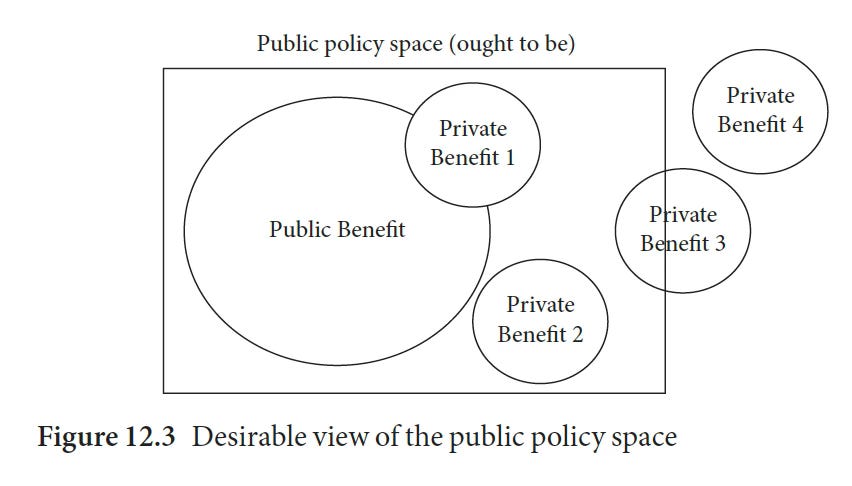
These norms overlook the reality that private benefit can co-exist with public benefit. 

The aforesaid norms are most deeply entrenched among auditors and investigative agencies. They tend to view public actions resulting in private benefit with extreme suspicion. 

For example, it is common to see decisions on procurements and contract management delayed due to these hesitations. Officers are regularly called upon to propose decisions on changes in technical specifications, qualification norms, condonation of delays and time extensions, waiver of liquidated damages, contract terms during renegotiations, and so on. All of them, even when justified, end up invariably benefiting some or other contractors, often also causing an increase in expenditure. This opens the decision to be scrutinised as having caused both private benefit and public loss. 

These entrenched cultural norms are reinforced by the circumstances. Compromises on public interest and promotion of private benefit through corruption have become pervasive. This complicates matters and allows righteousness, biases, and prejudices to enter the audit, investigative, and prosecutorial processes. 

In the circumstances, the challenge is to create a culture that destigmatises actions that confer private benefit, without letting it become permissive enough to encourage corrupt practices. This is hard! Most often, there are no shortcuts to doing the hard work of creating the conditions. 

Saturday, January 31, 2026

Weekend reading links

1. While the US tariffs are undoubtedly reducing US imports from China, the imports are substituting towards other developing countries. See this about the trends with mobile phone imports.
And, this about imports of wooden furniture.
The moot point is how much of these imports are merely repackaging and re-routing of supply chains. 

The country has become a solar champion thanks to abundant sunshine and the government’s pro-renewables policies. But a surge in power production has outpaced demand, depressing electricity prices and profits for generators. Some power producers are struggling to offload plants whose valuations have plunged as executives talk of solar “saturation”... Operational solar plants were valued at an average of €916,000 per megawatt in early 2024, but have now dropped to €648,000 per megawatt, according to nTeaser.

... the gloom is even greater over so-called ready-to-build projects, where land, permits and grid access have all been secured, but construction has not begun. A senior executive at an owner of Spanish solar plants said: “The market is flooded with ready-to-build projects that developers want to sell since they’re no longer good enough in the current market.” Some projects were up for sale for just €1, the executive said, reflecting developers’ desperation to avoid further spending, and potential government penalties for not executing agreed construction plans. The least attractive ready-to-build projects are often far from power grid nodes, requiring investment in expensive power lines.

... low prices are painful for producers. When they fall below zero, as they have for more than 500 hours in Spain this year, producers can end up having to choose between paying wholesale customers to take excess power off their hands or switching off. Many producers insulate themselves by selling electricity through long-term power purchase agreements (PPAs), which they sign at fixed prices with corporate clients for 10-20 years... Adding battery storage to solar plants helps to limit price plunges by enabling generators to store electricity when prices drop during the day, then sell it in the evening when demand and prices are higher.
3. John Burn-Murdoch points to a rising inflation in reported children with "special needs" in US and UK, with some distortions. 
38 per cent of undergraduates at Stanford this year are registered as having a disability, as are 21 per cent at Harvard — both up from 5 per cent in 2009... The bulk of the rise in special support for youngsters is cases of non-profound autism spectrum disorder (ASD), attention deficit hyperactivity disorder (ADHD) plus anxiety and mental health, all of which have flexible diagnostic criteria… we consistently see mild, not severe, cases driving the rise... As the number of more mild cases receiving support has climbed over the past decade, average funding per child (including the most severe cases) has fallen by a third in real terms… In 2010, 1 per cent of American young people from the poorest school districts were on plans that provide special support, and today that figure is unchanged. But among those in the richest areas, it has tripled from 2 to 6 per cent.
4. The Big 5 Indian IT firms have added just 17 net workers in the first three quarters of Fy26!
5. This is what industrialisation success looks like, the example of Hosur in Tamil Nadu, the leading EV and electronics manufacturing cluster in India.
6. India's industrial power prices are the highest.
7. Consumption's share of China's GDP is lowest among all major economies.
China’s decline in private final consumption expenditure is in sharp contrast to consumption-dependent economies like the United States (US) and India, with their share of private final consumption reaching 68.39 per cent (in 2022) and 61.38 per cent (in 2024) of their GDP, respectively. Among the top five economies of the world, China has the least share of private final consumption in its GDP. On the contrary, China has the highest share of fixed investment in its GDP – almost 10 percentage points higher than India’s share. Further, China has the largest share of net exports, after the EU.

8. The biggest trade promotion policy ever? The shipping container.

Nothing has done more to juice global trade than a simple receptacle—spanning about 40 feet on the long side and eight on the other two. It could be stuffed with cargo and hoisted onto lorries, trains, ships or planes with equal ease. That humble steel box—the standard shipping container—did “more than all trade agreements in the past 50 years put together” to boost globalisation

9. The US government has announced a $1.6 billion investment in USA Rare Earth, a listed Oklahoma-based miner that controls significant US deposits of heavy rare earths. 

One person said the government would get 16.1m shares in USA Rare Earth and warrants for another 17.6m, both at a price of $17.17. The government agreed to pay $277mn for the equity, giving it an implied gain of $490mn for the equity and warrants based on the current share price of $24.77. USA Rare Earth will also receive $1.3bn in senior secured debt financing at market rates from the government. The money will come from a finance facility created for the commerce department as part of the CHIPS and Science Act passed in 2022... A condition of the government investment in USA Rare Earth was that the company raise at least an additional $500mn from investors. It is on track to raise more than $1bn because of high demand for the financing deal, which uses a mechanism known as a private investment into a public equity, often called a “Pipe”...

USA Rare Earth, which has a market value of $3.7bn, is developing a huge mine in Sierra Blanca, Texas that it says contains 15 of the 17 rare earth elements underpinning production of cell phones, missiles and fighter jets. It also plans to open a magnet production facility in Stillwater, Oklahoma... Last year, the Trump administration invested in at least six minerals companies, including MP Materials, Trilogy Metals and Lithium Americas. Some of the investments overlapped with the financial interests of people associated with the administration. The government did a funding deal with Vulcan Elements, a rare earths start-up three months after the president’s son Donald Trump Jr’s venture capital group invested in the company... USA Rare Earth has separately tapped Cantor Fitzgerald, the Wall Street firm previously owned by commerce secretary Howard Lutnick and now run by his sons, to raise more than $1bn in fresh equity financing, the people said.

10. President Trump has announced his intention to cap credit card interest rates at 10% and has enlisted the services of an unlikely partner, Elizabeth Warren, to draft legislation in this regard. 

But a study by Liberty Street Economics found that spreads are high across all levels of credit ratings measured by so-called Fico scores and that default losses cannot explain the huge spreads above FFR... A recent Vanderbilt study concludes that at a 10 per cent cap, banks could continue profitably serving the vast majority of their customers... Americans pay about $160bn a year in credit card interest.

Sheila Bair, the former FDIC Chair, has this alternative proposal.

A better approach would be a permanent cap expressed as a spread over the FFR, say 10 per cent. This would be consistent with pre-crisis spreads. It would ensure that banks pass on the benefits when the Fed lowers rates but also allow them to raise rates when the FFR goes up. At the current FFR, it would bring credit card rates to just under 14 per cent.

11. Debashis Basu on the challenges with tripling exports by 2035, a CAGR of 13%. From history, South Korea increased its exports by a CAGR of around 18% between 1965-85, Taiwan by 16% in the 1965-80 period, Thailand by 14% in 1986-96, Malaysia by 14% in the 1987-2000 period, and Vietnam by 14% from 2005-24. 

History suggests that sustaining export growth of around 13 per cent for a decade requires these conditions: Cheap currency, strong central coordination and disciplined policy execution, a large surplus of labour at low wages, assured access to large and open markets, and a willingness to tolerate overcapacity and frequent failures. India currently possesses none of these in sufficient measure. Instead, it faces headwinds from rising protectionism, aggressive dumping by China, and reforms that are often procedural rather than outcome-oriented.

12. The non-profit only mandate for schools in India is among the biggest charades. 

India’s rules continue to insist that most private schools are “charities”. The result is a system that makes it hard to bring capital in openly or take returns out transparently. Founders instead resort to legal gymnastics. A single school is often split into three entities: a trust to hold recognition and collect fees; a land company to own the campus; and a services firm to run everything from transport to maintenance. Three entities mean three sets of books, audits, and compliance calendars. Even routine decisions, like paying salaries or upgrading infrastructure, require cross-entity coordination that adds weeks of delay. Hanging over all this is the lingering uncertainty of the government suddenly cracking down on the school or changing a rule about the trust... Every rupee that leaves the account must be defensible on paper. Salaries are routed as lease payments to a land-owning entity and as service fees to an operating company. Each transaction is vetted by his chartered accountant, ensuring no regulator can later accuse the school of making a profit—before it has even run payroll.

The arrangement is captured nicely here.

13. Tamal Bandopadhyay has an interesting article on the trends with central and state government borrowings.
In the current year, the central government’s gross borrowing is pegged at Rs 14.72 trillion, and net of redemptions, the net borrowings, at Rs 11.54 trillion... The gross SDL in the current year is Rs 11.83 trillion... Will there be demand for such a large borrowing programme? That’s the challenge before the RBI. In the current year, it has managed this by buying bonds from the market, popularly known as open market operations, or OMO. In FY26, a record Rs 6.45 trillion (till February 12) is being raised through this route, more than double of what the RBI had bought in FY25. The highest OMO before this was in FY21 – a little over Rs 3.13 trillion... 

Until the global financial crisis of 2008, the central government’s gross borrowing never crossed Rs 2 trillion. And SDLs were much lower – in thousands (for instance, Rs 20,825 crore in FY07). In FY09, the central government’s gross borrowing crossed Rs 2 trillion for the first time. The following year, it jumped to over Rs 4 trillion. The next big jump came in the Covid-hit FY21. From a little over Rs 7 trillion in the previous fiscal year, it rose to Rs 13.7 trillion that year. It crossed Rs 15 trillion in FY24, and is now set to cross Rs 16 trillion in FY27. Though the size of borrowing has increased over the years, as a percentage to GDP, it has remained largely in range... But SDL is becoming a burden. Before the global financial crisis, state loans were just 15-20 per cent of central borrowing every year. In FY27, these could be 75-80 per cent; and over the next few years, SDL may even exceed the centre’s annual borrowing. The oversupply of SDL has widened the spread between the yield of 10-year central government and state government papers to 85 basis points. Typically, it is about 40-50 basis points.

14. China is enhancing state capability by recruiting more tax officers to strengthen enforcement amid widening budget deficits. 

Central and local government tax departments plan to recruit 25,004 staff in 2026, accounting for two-thirds of the new bureaucrats to be appointed from among the millions taking part in fiercely competitive national exams, according to the state civil service administration. The plans mark a fourth successive year of heavy recruitment of tax officials, with the number of appointments set to marginally exceed a previous peak of 24,985 in 2023 to reach the highest level since at least 2012… Tax authorities have also announced moves to tighten tax enforcement and to scale back the use of corporate tax breaks by local governments… Authorities are also broadening the tax base by capturing more high-income earners, including those making capital gains on offshore equity investments… China’s tax revenues have fluctuated in recent years and fell 3.4 per cent year on year to Rmb17.5tn ($2.5tn) in 2024.
15. The rise and rise of Gold.

Housing accounts for 18 per cent of employment, making it the second-largest generator of jobs. It has deep linkages with more than 250 ancillary industries, creating powerful multiplier effects. Every investment in a housing unit generates 1.54 direct and indirect jobs and 4.05 induced jobs — much higher than employment multipliers in agriculture (0.8 and 1.2)... The average loan-to-value (LTV) ratio is a mere 65 per cent, compelling homebuyers to rely on other expensive borrowing sources for interiors and registration... less than 8 per cent of loan originations have an LTV greater than 80 per cent... even in a relatively safe asset class like mortgages, more than 75 per cent of lending is still to “prime” borrowers (bureau scores of 730 and above). The likelihood of a “near-prime” borrower (bureau score 650-700) getting a loan approval is just 40 per cent... housing finance to GDP ratio at 11-12 per cent is much lower than comparable economies.

17. What explains the weakness in East Asian currencies despite these countries running large surpluses, the general weakening of the US Dollar, and the smallest interest rate spread with the US in years?

Heavy buying of US assets, and concerns on how to fulfil the pledges from Japan, South Korea and Taiwan to invest $550bn, $350bn and $250bn in the US, and Sanae Takaichi's large spending plans are contributors. 

18. On the historic India-EU FTA deal.
Under the deal, Indian levies on EU cars will be gradually reduced from 110 per cent to 10 per cent, with a quota of 250,000 vehicles a year. Tariffs of up to 44 per cent on machinery, 22 per cent on chemicals and 11 per cent on pharmaceuticals will be mostly eliminated. Steel and iron levies of up to 22 per cent will also be phased out over a 10-year period... Tariffs of more than 36 per cent on EU food products will be reduced or removed, the bloc said, while those on wine will be slashed from 150 per cent to 75 per cent and eventually to levels as low as 20 per cent. Olive oil tariffs will also fall from 45 per cent to zero over five years. Those on processed agricultural products, such as bread and confectionery, of up to 50 per cent will be eliminated. In exchange, more than 99 per cent of Indian exports, worth about $75bn, will gain preferential entry status to the EU... The Indian dairy industry, a politically important constituency that New Delhi has sought to protect in the past, was excluded from the deal. Sensitive EU agricultural sectors, such as beef, chicken, rice, sugar and ethanol, were also carved out.

Friday, January 30, 2026

Individuals matter, and more so in public bureaucracies

I blogged here about the importance of strong public oversight and in-house expertise for the successful execution and management of infrastructure projects. 

Mainstream development discourse focuses disproportionately on institutional and systemic challenges, and overlooks the important role played by individual officials in effective public services delivery and the realisation of policy outcomes. 

Specifically, I am referring to the commitment and expertise of individual public servants in important positions at all levels of the government. By important, I’m not confining to leadership positions, but any position where they can make significant contributions to influence the agenda. 

The importance of individual officials in the success of development interventions is generally overlooked amidst systemic and institutional factors. This also comes from the belief that the success of development interventions is determined by good ideas, comprehensive planning, and rigorous monitoring. This theory of change overlooks the reality that successful development interventions tend to emerge iteratively over the course of their implementation. Such iteration, in turn, requires capable and committed leadership, especially important given weak state capabilities. 

In fact, it is no exaggeration to argue that capable, proficient, and committed officials are perhaps the most important ingredient of state capability. 

The importance of capable individual officials is also borne out by academic research. I blogged here, drawing attention to the work of Philipp Barteska and Jay Euijung Lee, who examined the impact of the bureaucratic capabilities (of export promotion officers) on the effectiveness of industrial policy in terms of export performance in South Korea. They found the following:

We exploit the three-yearly rotation of managers of South Korea’s export promotion offices in 87 countries between 1965 and 2000 to show that a one standard deviation increase in bureaucrat ability boosts exports by 37%. Under higher-ability bureaucrats, South Korean exports respond more strongly to a country’s import demand, suggesting a more effective transmission of market information.

An increase in exports by nearly two-fifths with just one standard deviation increase in bureaucratic capability tells us that the quality of officials might matter more than (or at least as much as) fiscal incentives and regulatory changes in trade promotion efforts. 

Alessandra Fenizia studied the impacts of managers in the public sector in Italy using a dataset containing an output-based measure of productivity. 

Exploiting the rotation of managers across sites, I find that a one standard deviation increase in managerial talent raises office productivity by 10%. These gains are driven primarily by the exit of older workers who retire when more productive managers take over. I use these estimates to evaluate the optimal allocation of managers to offices. I find that assigning better managers to the largest and most productive offices would increase output by at least 6.9%.

Cristobal Otero and Pablo Munoz study government managers in public health provision in Chile. 

Using novel data from public hospitals in Chile, we document that top managers (CEOs) account for a significant amount of variation in hospital mortality. We then use a staggered difference-in-differences design, and show that a reform which introduced a competitive selection system for recruiting CEOs in public hospitals reduced hospital mortality by approximately 8%. The effect is not explained by a change in patient composition and is robust to several alternative explanations. The financial incentives included in the reform—performance pay and higher wages—do not explain our findings. Instead, we show that the policy changed the pool of CEOs by displacing older doctors with no management training in favor of younger CEOs who had studied management. The mortality effects were driven by hospitals in which the new CEOs had managerial qualifications. These CEOs improved operating room efficiency and reduced staff turnover.

Michael Carlos Best, Jonas Hjort, and David Szakonyi analyse data on public procurements in Russia and find the value of bureaucratic effectiveness. 

Using data on 16 million public purchases in Russia, we show that 39 percent of the variation in prices paid for narrowly defined items is due to the individual bureaucrats and organizations who manage procurement. Low-price buyers also display higher spending quality. Theory suggests that such differences in effectiveness can be pivotal for policy design.

R D Metcalfe, A B Sollaci, and C Syverson

In this setting, managers move between stores but management practices are set by firm policy and largely fixed, allowing us to hone in on managers’ personal roles in determining store performance. We find: (i) managers affect and explain a large share of the variance of store-level productivity; (ii) negative assortative matching between managers and stores, which may reflect both firms’ decisions and a selection-driven bias that we characterize and argue might apply in other settings using movers designs; (iii) managers who move do so on average from less productive to more productive stores; (iv) female managers are less likely to move stores than male managers; (v) manager quality is generally hard to explain with the observables in our data, but is correlated with the ratio of full-time to part-time workers; (vi) managers who obtain high labor productivity also tend to obtain high energy productivity, revealing some breadth in managers’ skills applicability; (vii) high-performing managers in stable growth times are also high-performing during turbulent times; and (viii) exogenous productivity shocks improve the quality of initially low quality managers, suggesting managers can learn. We explain implications of these findings for productivity research.

Ricardo Dahis, Laura Schiavon, and Thiago Scot investigated the performance of state judges in Brazil. 

We investigate this question focusing on state judges in Brazil. Exploring monthly data on judicial output and cross-court movement, we estimate that judges account for at least 23% of the observed variation in number of cases disposed. With novel data on admission examinations, we show that judges with higher grades perform better than lower-ranked peers. Our results suggest competitive examinations can be an effective way to screen candidates.

On a slightly different note, Kevin Hawickhorst shows how technical expertise built up within public systems in the US allowed for the nurturing and flourishing of capable officials, created public confidence, and thereby enhanced the credibility of governments. 

However, over time, expertise has come to be crowded out due to the conscious shift in the way government bureaucracies came to be organised. 

At the turn of the twentieth century, agencies followed a distinct blueprint: they were organized by subject matter, not by abstract function. Each bureau focused on a single domain—such as soils, mines, or forests—and combined research, regulation, and grants under one roof. In the U.S. Department of Agriculture (USDA), the Bureau of Entomology, for example, studied insect-borne diseases, issued rules to contain them, and funded farmers to protect their crops, all as part of a single mission. This structure helped agencies recruit experts by offering broader, more meaningful work than corporations could, and it built a shared sense of mission rooted in a vocational community.

Today’s agencies look very different. After World War II, reformers dismantled the integrated subject matter bureaus and reorganized government along what they called “functional” lines. In this system, regulation is one bureau, research another, and grant administration still another; each bureau covers a wide range of subjects and is defined by its activity rather than its mission. It is the model we now take for granted. The Bureau of Entomology is gone, and USDA now houses all agricultural research in a single unit. New agencies were built this way from the outset: the Department of Housing and Urban Development, created in 1965, was designed as a grantmaking machine, never a vocational community.

The shift was a well-intentioned one and backed by a wide coalition of reformers, businessmen, and interest groups. Functional departments looked modern, rational, and efficient: they simplified charts, tightened chains of command, and promised to reduce duplication. But what seemed like sensible reform gradually hollowed out the structures that had made expertise durable. Once government agencies lost their vocational missions, they stopped drawing on networks of expertise and started looking like paper mills, less able to command political respect, and more vulnerable to capture and drift… logic of the Progressive-era model: that research and administration had to remain intertwined within a unified mission if expertise was to thrive.

However, this wealth of internal technical expertise has, over time, given way to the tribe of generalist managers. 

The core mistake was a shift in what we thought expertise was. The Progressive reformers built vocations that were tied to missions, visible to the public, and legible to politicians. Their successors redefined expertise as a credential: the knowledge of process rather than mastery of a craft. To businessmen and academic reformers alike, competence meant general managerial skill, not professional vocation. As this view took hold within the bureaucracy, “expertise” came to mean knowing the procedures rather than knowing the work. We have traded the civil engineer and the entomologist for the program analyst, the management consultant, and the diversity officer—experts who know how to manage the process but not how to do the work.

This redefinition of expertise hollowed out our idea of representation. We now equate representation with participation and diversity, as if the state were legitimate only when citizens can see themselves in its officials. The Progressives, by contrast, recruited from the country’s varied vocations and made that work visible to the nation. Expertise was representative not because it resembled the public but because it served the public, visibly and competently… Their institutions were built to make expertise endure, by recruiting promising candidates from vocational schools and professional societies, dressing them in uniform, and sending them to work alongside state engineers, agricultural agents, and university researchers…

The Navy cannot build ships. In 1940, faced with the same problem, Congress did the obvious: it created a Bureau of Ships, put engineers in charge, and got ships built. That bureau is gone, and we treat its return as unthinkable. Yet the remedy remains the same. If we want ships, we should once again have a Bureau of Ships to build them… Repairing our institutions will ultimately require returning to the vocational conception of expertise… We have built institutions that valorize process in place of vocation, producing a bureaucracy that neither embodies skill nor commands respect. What matters now is not saving “expertise” in the abstract but rebuilding the institutions where it can serve visibly and credibly.

Hawickhorst’s essay points to several individual public leaders in the US who built institutions and brought credibility and confidence in public agencies through their careers - George Uhler (headed Steamboat Inspection Service for 20 years from 1903), Logan Page (Office of Public Roads, founded in 1905), Joseph Kinyoun (headed the Hygienic Laboratory, a precursor to the National Institutes of Health), and Gifford Pinchot (founded the Forest Service). Every country has such leaders across levels. 

In their search for better outcomes in public policy, governments tend to expend effort and resources on interventions involving financial support, regulatory enablers, and technology adoption, while overlooking personnel choices. This bias is also reflected in public commentary and academic research that shapes public narratives. 

However, as the case of the South Korean export promotion officers starkly demonstrates, for governments intent on reform and impact, personnel choice decisions may be the lowest-hanging fruit. In most policy areas, the range between the opportunity cost of a bad personnel choice and that of a capable personnel choice may be much greater than that for any other policy intervention.

The private sector addresses the issue of the importance of capable individuals by incentivising them with extrinsic material motivations like financial rewards and fast-tracked promotions. While neither of these instruments is available to governments, it can appeal to the intrinsic motivation of public-spirited officials. 

This would require acknowledging capabilities and merit (as borne out strictly by performance track record, not merely in some narrow quantitative sense). This requires differentiating capable bureaucratic leaders from their larger peer group by entrusting them with higher responsibilities, appointing them to identified important positions, drawing on their expertise in various forms, recognising their work through different non-financial channels, and generally signalling their differentiation. 

An explicitly professed intent, let alone a rigorously implemented process, that seeks to differentiate among officials at all levels, can be a powerful force to shape expectations and align incentives within public systems.

Wednesday, January 21, 2026

State capability in construction management

This post will highlight that strong public oversight and in-house expertise are essential requirements for the infrastructure bid process, construction, and contract management. This goes against the conventional wisdom that infrastructure projects are best managed when done primarily by relying on expertise drawn from outsourced project management consultants and with limited public management. 

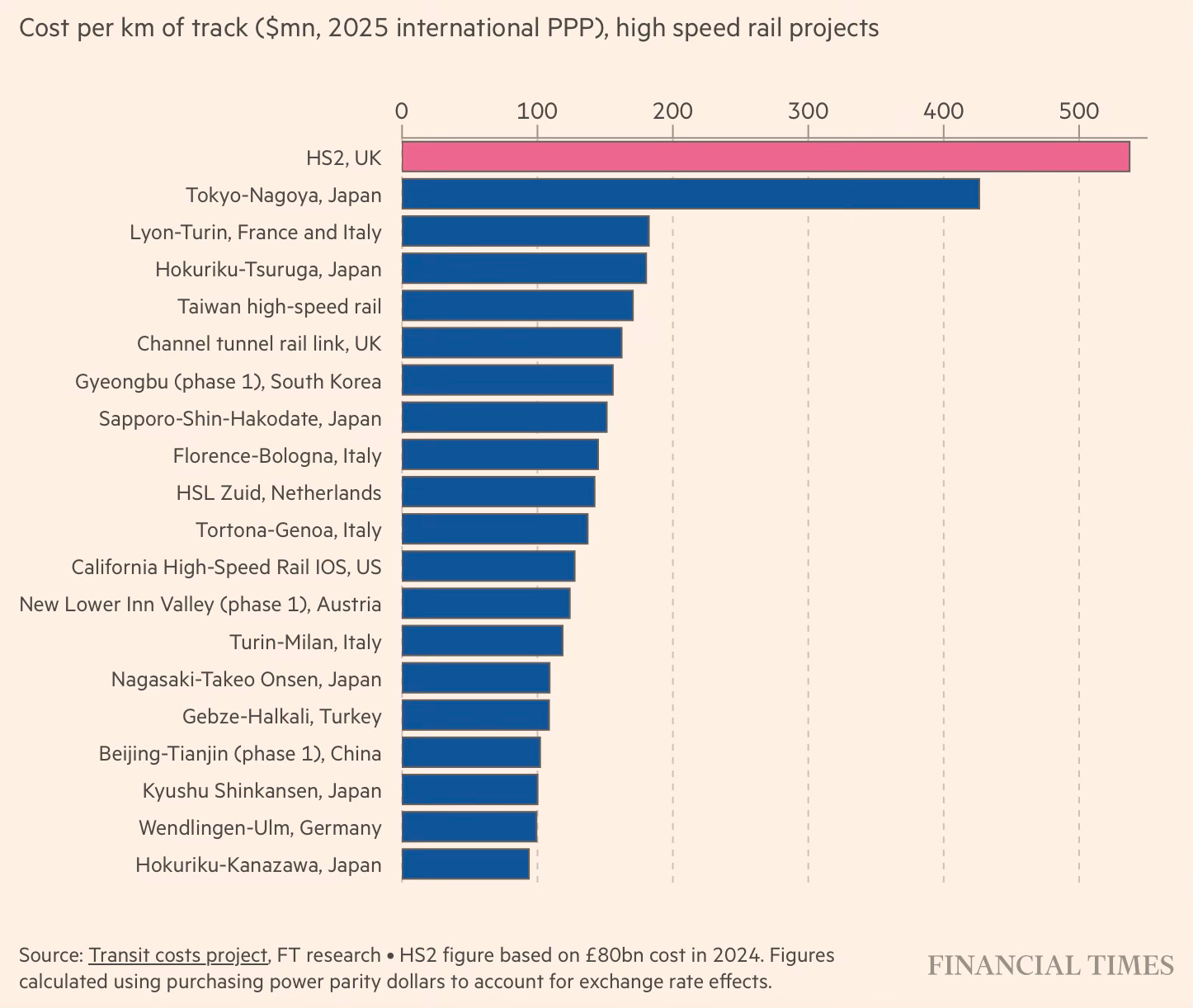
As an illustration, FT has a long read on how the much-awaited 225 km London-Birmingham High Speed (HS2) railway link, which was started in 2019 and is projected to be completed by 2035 at a total cost of £80bn (2024 estimates). At $537mn per km, it is easily the most expensive project in the Transit Costs Project research group’s dataset of 94 railway projects. Taxpayers are already paying about £7bn a year, or £140mn a week, for HS2, which is being built at barely half the length originally envisaged.

The FT article points to possible reasons for the cost increases. 

HS2, a taxpayer-funded body, was set up in 2009 to deliver the scheme, but contractors, who had lobbied for the railway, were embedded as project managers in the organisation’s offices at Canary Wharf. The Department for Transport as the sponsoring department was expected to provide oversight. Network Rail, which runs the country’s rail infrastructure, was sidelined but should have played a larger role, according to a government-commissioned report into HS2 in 2025... That left too much power in the hands of contractors and government officials without technical expertise.

In Japan, by contrast, the project management for new railway construction projects, including the Shinkansen high-speed lines, is handled by the Japan Railway Construction, Transport and Technology Agency (JRTT), a public body with technical capabilities. JRTT plans and determines the route, equipment and project costs and secures funding. It also carries out technical reviews once construction has started and adjusts the budget when there are design issues such as changes in groundwater and geology, which are common in large civil engineering projects…

At HS2, however, contractors signed off huge contracts on a “cost-plus” basis, where companies are paid a percentage of the total value of the work. This gave contractors an incentive to go over budget and “get more money as more money is spent”, the Stewart report found. In Japan, construction work is also outsourced, but bids that were too low were excluded to ensure the quality of the works, said Kanayama. The JRTT monitors the construction as it proceeds.

Closer to home in India, it has become a norm, especially (but not only) in state government projects, of project execution through teams with limited in-house expertise. The SPVs administering PPP concessions, and their respective infrastructure and industries departments in both central and state governments, have limited internal technical capabilities. 

Governments have become increasingly reliant on outsourced project management consultants to undertake feasibility studies and make detailed project reports, manage the bid process, finalise tenders, evaluate execution quality, manage contracts, and decide on emerging contractual issues (including renegotiations). These decisions often conform only to the form of due-diligence without the rigour and practical expertise that only in-house experience and associated expertise can bring. 

The exceptions in this regard are projects executed by the Indian Railways and the Department of Defence, which continue to rely primarily on in-house expertise on these activities. In contrast, the state government Public Works Departments (PWDs) are generally kept out of the conceptualisation, tendering, execution, and O&M of large infrastructure projects executed by many state governments through their infrastructure and industry ministries. 

While the PWDs are generally known for their failings, deficient expertise, and pervasive corruption, they also have competent officials with expertise and commitment whose services are often overlooked. In any case, the solution to the deficiency of capabilities in these entities is not to outsource critical project activities but to build up these capabilities internally. 

The article also points to another common reason for cost overruns in large infrastructure projects.

Very large rail schemes in Britain are typically authorised through their own bespoke parliamentary bills. That reduces the risk of subsequent legal challenge, which HS2 has indeed survived, but also limits the ability to make changes later, something that with a scheme this immature was to prove disastrous. The scope locked in through this process is now widely seen as excessive: the fastest conventional-tracked railway in the western world, with a speed of 400kph, one-third above the European high-speed standard even though distances between English cities are short. A faster line needs to be flatter and straighter, with more earthworks, tunnels and viaducts, and higher-quality track and structures, all of which cost more.

This is perhaps unavoidable in the case of massive multi-generational public-financed projects, even desirable to get the bipartisan consensus that’s essential for the sustenance of such long-drawn projects.

Saturday, November 8, 2025

Weekend reading links

1. Paul Krugman highlights that Trump tariffs are in practice, lower than the official rates. Tariffs on paper are the average tariff rate one would predict if we apply the announced tariff rates to what we were importing before the tariffs. The tariff rate in practice is the actual amount collected in tariff revenue divided by the value of imports. 

One illustration.
Imports from Canada are a case in point. Even under the Trump tariffs, most goods from Canada can enter duty-free if they’re “USMCA compliant” — that is, they qualified for zero tariffs under the free-trade agreement formerly known as NAFTA, rebranded but barely changed in practice during Trump’s first term. In 2024, only 38 percent of U.S. imports from Canada entered under the USMCA. That’s surprisingly low, but the main reason was probably paperwork: certifying that a good complies with the free trade rules requires a lot of documentation. For smaller exporters, in particular, that paperwork often wasn’t worth doing, because tariffs were low even for goods not certified as USMCA compliant. Now the tariffs are much higher, and there has been a rush to do the extra paperwork. In June 2025, 81 percent of imports from Canada entered duty free. Not incidentally, this points to a hidden cost of the tariffs: Companies are incurring significant administrative costs to deal with a vastly more complex tariff system.

2. Important point about Zohran Mamdani's victory in NYC.

More than 2mn New Yorkers cast ballots in the largest turnout in a mayoral race since 1969.

To put this in perspective, 1.1 million voters voted four years back! 

The Times has a very good account of this remarkable victory.

A backbench assemblyman who had immigrated to New York City at age 7, he had almost no citywide profile. Even fellow socialists thought his views on policing and Israel would put a hard ceiling on his support... Mr. Mamdani’s political rise may be remembered for what came first: the buoyant, flamboyant, rule-breaking primary run that united a new coalition of Brooklyn gentrifiers and Queens cabbies around the city’s growing affordability crisis and the birth of a megawatt talent... The arc of his success is nothing short of staggering. At the start of the year, Mr. Mamdani was polling at 1 percent, tied, as he likes to say, with the candidate known as “someone else.” Few New Yorkers recognized his name, and his own political team put the odds of winning as low as 3 percent. Now, at age 34, he will be New York City’s youngest leader in more than a century, amid a pile of historic firsts: the first Muslim mayor, the first South Asian and arguably the most influential democratic socialist in the country.

3. Nothing captures the essence of the first ten months of President Trump more than tariffs. The FT has a good graphic. 

The point to be noted is the difference between the notional tariff and the actual tariff.

4. European defence spending is on the rise, and is expected to be an important driver of economic growth and innovation. 
5. Japan's famed convenience stores, konbinis, are facing the consequences of the country's demographic problems.
FamilyMart, 7-Eleven and Lawson all rely on a franchise business model to operate stores, taking a cut of sales or gross profit as a royalty in return for store owners using their brand, products and supply chains. In 7-Eleven’s case, typically between 40 per cent to 70 per cent of gross profit — sales minus cost of goods sold — is paid to the company. 7-Eleven Japan does not recognise the Convenience Store Union because franchisees are not its employees... store owners were under pressure because they were struggling to hire more staff. They had little leeway to raise wages unless the companies share more of the profits... Japan’s big three convenience store chains are trying to introduce technology such as self-service tills, artificial intelligence-assisted ordering systems and cleaning robots to reduce the volume of work. If those efforts fall short, the companies could be forced to introduce new franchise contract terms in order to account for higher wages, said analysts. Or, if new franchisees cannot be found, they will have to close stores.

6. Venture capital fund returns

For many years, long-run venture capital returns reported by Cambridge Associates reflected the huge profits from the dotcom boom of the late 1990s, a time when the average VC fund returned more than 20 per cent a year. Last year, though, those funds finally faded into history. Cambridge’s 25-year view now only catches funds raised — and invested — as the 90s boom turned into a bubble. These showed an annualised return of only 8 per cent. For every other period measured by Cambridge since then, VC returns fall below returns from investing in companies trading on Nasdaq. These are averages, and the profits in VC have always been heavily skewed to a handful of successful firms, making it essential to get exposure to the right funds.

And the top VCs benefit from a Mathew Effect,

Startups struggling for attention are drawn to the investors with the best track records: winning the right financial backers acts as a strong signal for young companies with little else to validate their claims of future greatness. That means the most successful VC firms usually get first option on the smartest founders and the best deals.

7.  FT visual article on perhaps the grandest follies of our times, the Saudi Arabian futuristic city of Neom and its 170 km long 500 m tall mirror glass structure, The Line, conceived by Prince Mohammed Bin Salman.

The budget for The Line was $1.6tn, Neom executives were told in late 2021. But an updated internal estimate the following spring put the cost at around $4.5tn, according to a person familiar with the estimates. That is roughly the size of Germany’s annual economic output. Teams then began tackling the unprecedented design and engineering challenges raised: imagining what life would be like inside a 500 metre-high, 170km-long wall; sourcing the steel and cement that would consume much of global supply; and making water circulate in a manmade deepwater port with no current... Its staggering requirements for materials were enough to overwhelm both the capacity of its local infrastructure, and its pricing power... to make the concrete for the first 20 modules, the contractors would need a supply of cement every year that would be greater than France’s annual output. Each 800-metre module required, by design, about 3.5mn tonnes of structural steel, 5.5mn cubic metres of concrete and 3.5mn tonnes of reinforcement steel — the narrow steel bars twisted into cage forms to strengthen the reinforced concrete. “We were going to take something like 60 per cent of the global production of green steel [per year], which causes the price to go up,” said a senior design manager.

8. Ed Luce writes that peak Trump is over. He writes that the Democratic Party election victories owed significantly to their focus on rising prices, and that the deal with China postponing tariffs for one year may have won Trump some reprieve on the inflation front. 

Trump now has a strong incentive to declare similar wins on other trade wars. In that regard, Tuesday night was also a good one for Brazil, India, Canada and other targets of Trump’s ire. By a quirk of timing, the US Supreme Court on Wednesday held hearings on the legality of his tariff war. Was it coincidence that conservative justices sounded unusually bold in querying that? They too might possibly help Trump by striking the tariffs down.

9. John Burn-Murdoch points out that culture conflicts (and not economic differences) have been the drivers of political polarisation in the US.

In their pioneering paper The Business of the Culture War, published earlier this month, MIT and Harvard economists Shakked Noy and Aakaash Rao use second-by-second TV viewing data to show how the commercial incentives of cable news channels helped to sow discord not only among their viewers but across America more broadly.
Their key insights are that content relating to crime, immigration, race, gender and criticism of elites reliably increases viewing figures (while economics and healthcare cause people to switch away). This means there is a resulting shift in coverage towards more culture war issues and fewer socio-economic stories, which leads voters to rate these issues as more important. Politicians then respond by campaigning more on cultural hot button topics. All told, they estimate that the emergence and growth of cable news can account for fully one-third of the increase in US cultural conflict since 2000.
10. State capacity fact of the day, Competition Commission of India. 
It has exactly one active office. In New Delhi... CCI has no presence in Bengaluru, one small outpost in Navi Mumbai, and a “touch-and-go” office in Kolkata that lawyers say is barely functional. Markets regulator Sebi, by comparison, has 22 offices. The aviation regulator, DGCA, has around 20. When it conducts raids, it flies 25–30 officers to Mumbai. Every investigation means teams of lawyers and informants shuttling to Delhi for two years. “In India, such a large country, there is only one big agency for 28 states,” said Kumar. “Look at the US. There are competition agencies in all the states.” The costs add up. Filing a case itself can set a company back Rs 50,000 to Rs 6 lakh. Add multiple Delhi trips—three or four by the informant, three by lawyers, over a 2–2.5-year period—and justice becomes a luxury good... The Commission is still operating with roughly the same headcount it had in 2009. The Director-General’s office, sanctioned for around 20 officers, has seven. The merger-control team has six. Case disposals that once took three months now take six to eight—on a good day.
11. FT reports that the US has added "poison pill" termination clauses to recent trade deals with countries like Malaysia and Cambodia, which threaten to end the deals if either signs a rival pact that jeopardises "essential US interests" or "poses a material threat" to US security. This is a form of "loyalty test" for trade partners. 
Simon Evenett, professor of geopolitics and strategy at IMD business school in Lausanne, Switzerland, said the clauses were so broad that they handed the US unilateral powers to terminate the agreements, giving Washington fresh leverage across the region. The agreement with Malaysia also includes a provision requiring it to align with US sanctions and other economic restrictions. “Ultimately, poison pill provisions transform trade agreements from purely commercial instruments into tools for managing partner countries’ broader foreign economic policy orientation,” Evenett wrote in a paper this week. Although there is a partial legal precedent for poison pills in the 2020 US-Mexico-Canada Agreement, Evenett said the USMCA clause had legally defined triggers, in contrast to the broad conditions in the Malaysia and Cambodia pacts.

12. The rise and rise of US Government debt.