A negative feature of bureaucracies is the tendency to pass the buck, avoid decision-making, and indulge in formalism at the cost of outcomes. The silence of counterfactuals makes it difficult to measure, evaluate, and create accountability. China is now waging a war on this, and it has lessons for countries like India.
The FT has a long read on President Xi Jinping’s war on corruption that has seen large numbers of officials being purged and punished. The numbers are staggering.
Beijing tends to measure the progress of the battle against corruption by the number of officials disciplined. By that score it is a raging success. Nothing like it has been seen since Mao’s rule, according to Minxin Pei, professor of government at Claremont McKenna College in California. About 7.2mn Communist Party members have received some form of political, administrative or judicial punishment, Pei calculates. These include at least 632 “tigers” — senior officials at or above vice-ministerial or deputy governor ranks. Over the 11 of Xi’s 13 years of rule for which data is available, about 628,000 cadres have been criminally prosecuted and have probably received jail terms. (Generally, far fewer than 1 per cent of prosecutions in China fail to end in conviction.) Those convicted are thought to represent a sizeable portion of China’s 1.69mn jail population as of 2024, Pei says…
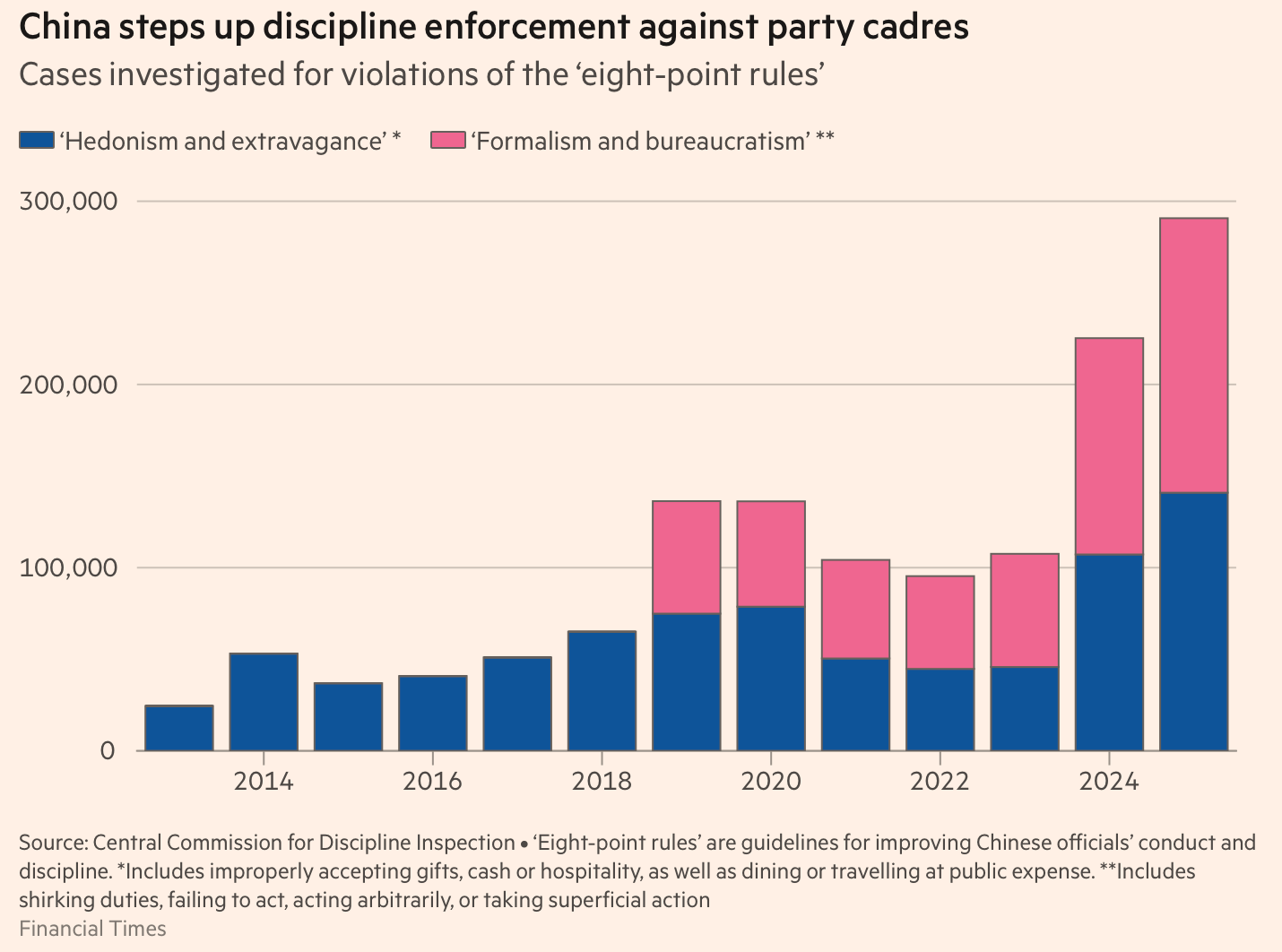
This war on corruption extends to bureaucratic lethargy and apathy.
In January this year, the Chinese president delivered a speech behind closed doors to the CCDI, the internal investigation body, signalling rising exasperation with top officials’ poor delivery of his policies… he lectured senior officials on the need for vigilance against “two-faced” cadres who, he said, “take many forms”. Xi listed six manifestations of duplicity. These include people who “quickly and loudly” expressed their commitment to carrying out the central committee’s plans only to “inwardly resist” and disobey orders. Then there are those, he said, who are “ideologically liberal”, adopting his doctrine — officially dubbed Xi Jinping Thought on Socialism with Chinese Characteristics for a New Era — “only when it suits them”. A further type is “factional” and pursues the interests of their small cliques. Others are concerned only with self-interest, or shift “with the political winds” or take a “laissez-faire” attitude towards their responsibilities, allowing problems to “fester and spread”. Xi said all six types were “extremely harmful to the party’s cause and image” as he urged the commission’s members to “resolutely eliminate them”.
The article also points to the perils of such disciplining in terms of distorting incentives within the bureaucracy. The fear of disciplining can have a paralysing effect on the bureaucracy and result in behaviours that seek to maintain the status quo and avoid decision-making.
It is remarkable that the Chinese bureaucratic performance management goes beyond the traditional performance measures and covers areas involving behaviours and attitudes. Accordingly, there is a category called “formalism and bureaucratism” in the country’s bureaucratic conduct rules. Formalism is considered any activity that produces a record rather than a result — documents, meetings, inspections, and photographs of compliance. Bureaucratism is detachment and non-performance.
It comes from the four work-style failings Xi Jinping named in 2013 — formalism, bureaucratism, hedonism, and extravagance. They are monitored and enforced under the Eight Point Regulation, and violations are reported monthly by the Central Commission for Discipline Inspection (CCDI).
The CCDI’s monthly reporting groups the two under four heads — failure to act on duties, covering neglect, inaction, and improper or false action; hollow compliance, where orders are nominally accepted but not implemented, with “grand statements and little follow-through”; unresponsive service, meaning passive, cold or rigid conduct toward the public; and the return of excessive documents, meetings, inspections, assessments and traceability requirements that burden subordinate units. It is a remarkable leap of faith that photographs as proof of work, study notes, login duration, likes, votes, shares, and installation rates are each named and prohibited as evaluation criteria. Imagine any government level in India biting the bullet and issuing a direction on these lines.
In January 2025, cases of inaction, misconduct, and falsified action alone made up 88.1% of all formalism and bureaucratism cases investigated that month.
The “three distinctions” (san ge qufen kailai), formulated in 2016, separate mistakes made in pursuit of reform from deliberate wrongdoing, acting for the public good from seeking personal gain, and exploratory error from knowing violation. These are operationalised through rongcuo jiucuo, fault-tolerance and error-correction mechanisms, with local implementation. It also outlines the exclusions — no protection where discipline or law was broken, or where serious safety, pollution, or public-order consequences followed.
In August 2024, the Party and State Council, with approval of the Politburo no less, issued China’s first intra-Party regulation on easing burdens at the grassroots, consisting of 21 articles in seven chapters, covering control over the number of documents and meetings, clearer delineation of what lower levels are and are not responsible for, and limits on data collection and redundant reporting.
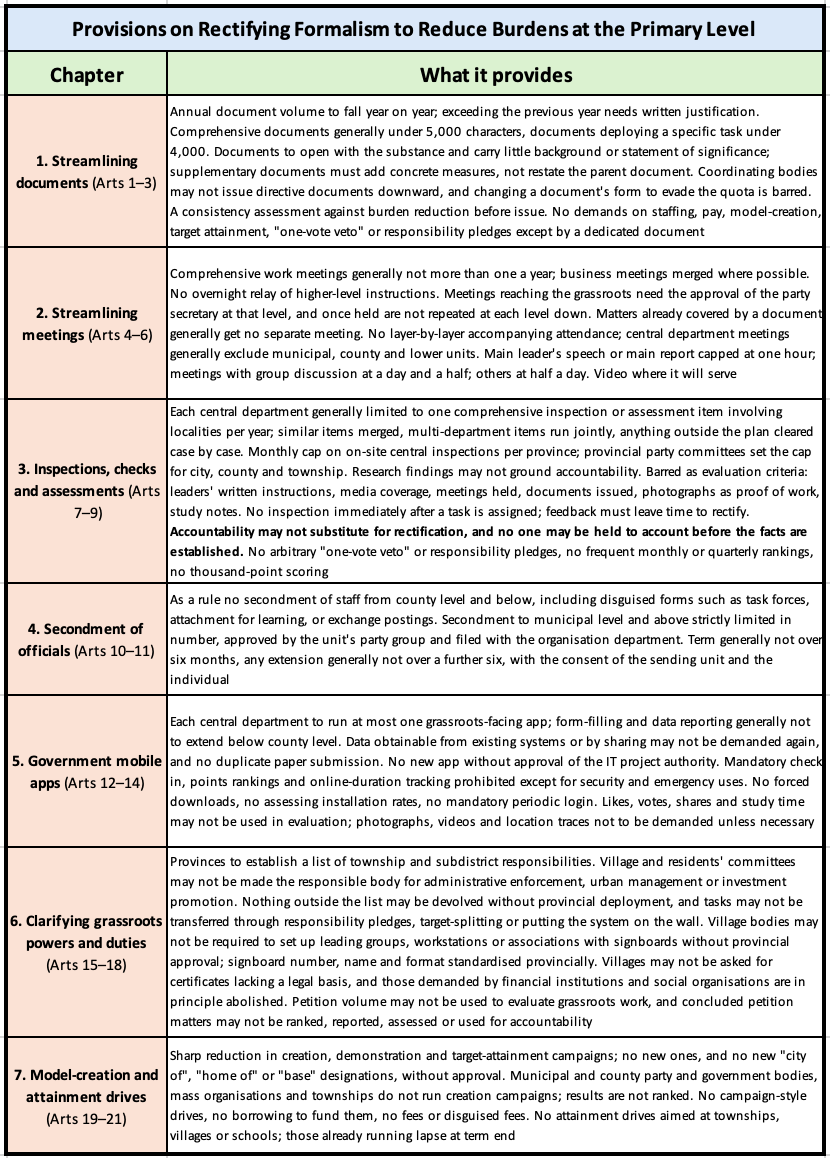
The details on streamlining documents and meetings, rationalisation of mobile Apps, and guidance on inspections and checks resonate strongly with the Indian context. In fact, here is a table that captures the Indian equivalent in terms of actions/omissions.
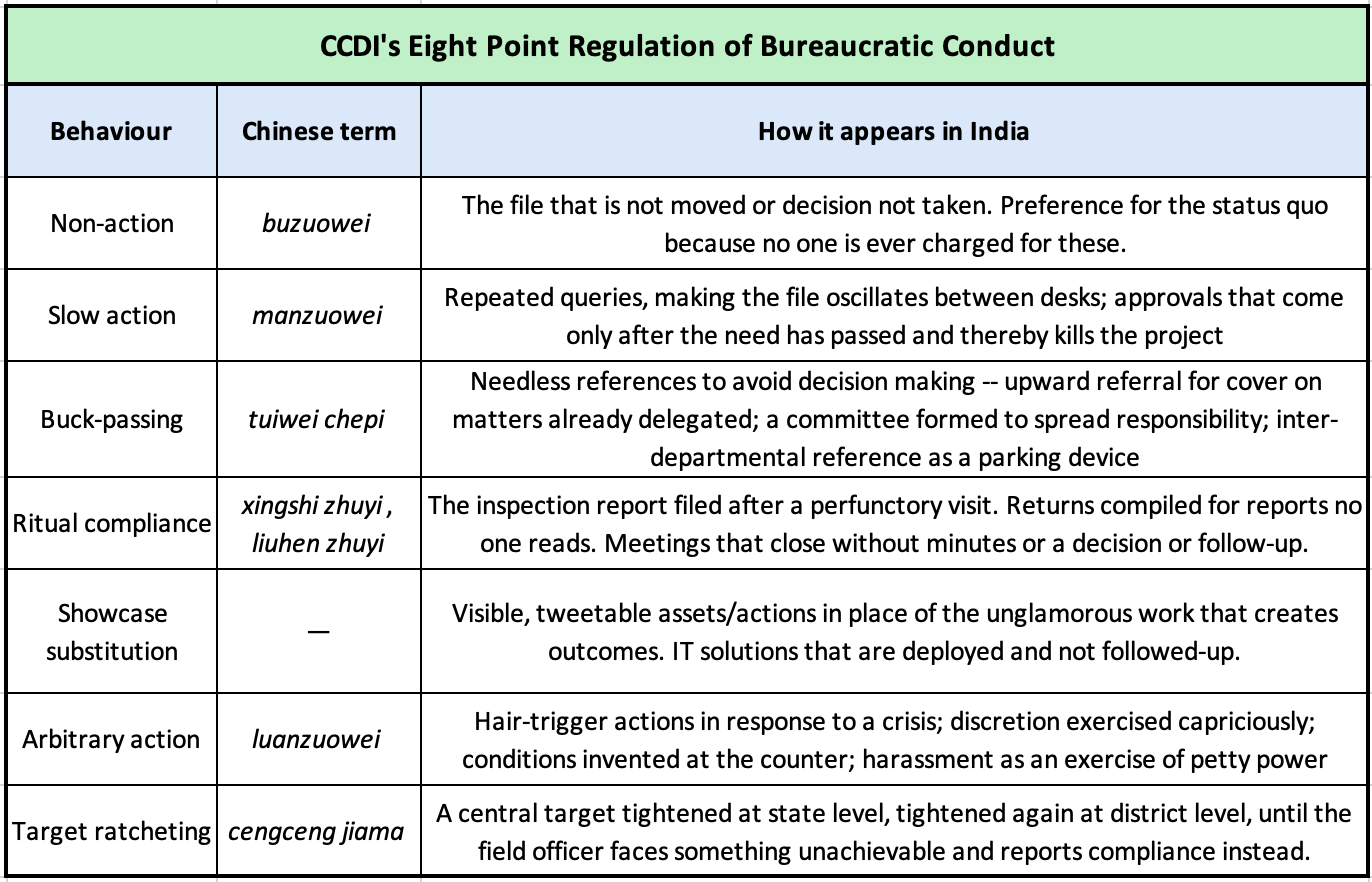
These behaviours are the predictable output of an accountability system that can observe activity but not results. As a framework, we can categorise any official’s work in terms of how much is visible and what its outcome is.
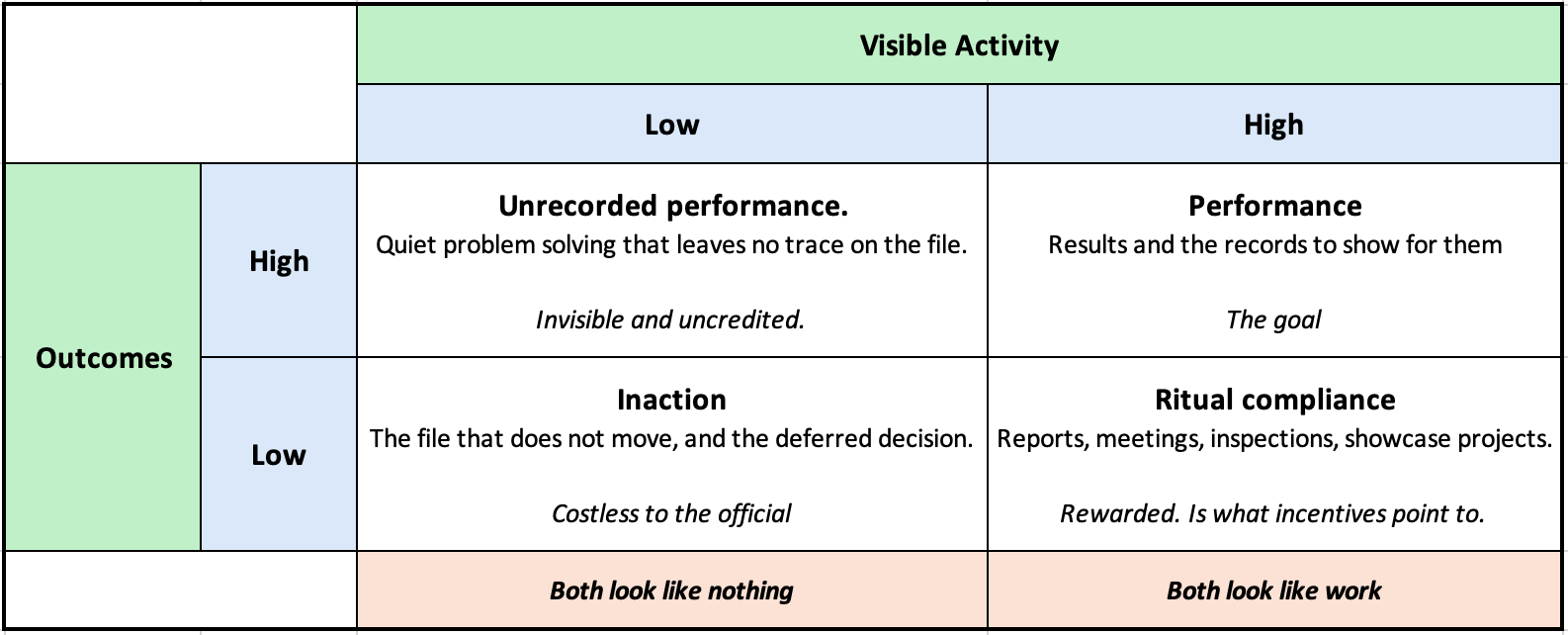
This framework exposes the fundamental problem. On the left, both the performers and ritual compliers have the traces of activity, and are scored equally since the outcome is not measured. Similarly, on the right, the officer who quietly solves a problem without generating paper is scored the same as the one who does nothing.
In the circumstances, ritual compliance becomes the rational strategy. It is cheaper than performance, scores the same, and carries none of the risk.
I can think of three drivers of such an accountability system. First, an asymmetric sanction means that an error of commission is visible, attributable, and punishable, whereas an error of omission is invisible and, to the individual, costless. This problem is exacerbated since a decision taken in good faith can be reopened a decade later by an investigative agency or an audit paragraph, with the benefit of hindsight and facts nobody held at the time.
Second, a measurement asymmetry means that measurable dimensions distort incentives. Since what is measurable in government is almost entirely process — files disposed, meetings held, inspections conducted, targets reported — the stronger the incentive, the more effort flows to the record and away from the result. Third, officials face an overload of responsibilities (and targets) than their staffing, financing, powers, and capabilities permit. When everything cannot be done, what is counted gets done, and the rest is reported as done.
So what can India do?
In the circumstances, I can think of a tiered performance management ladder.
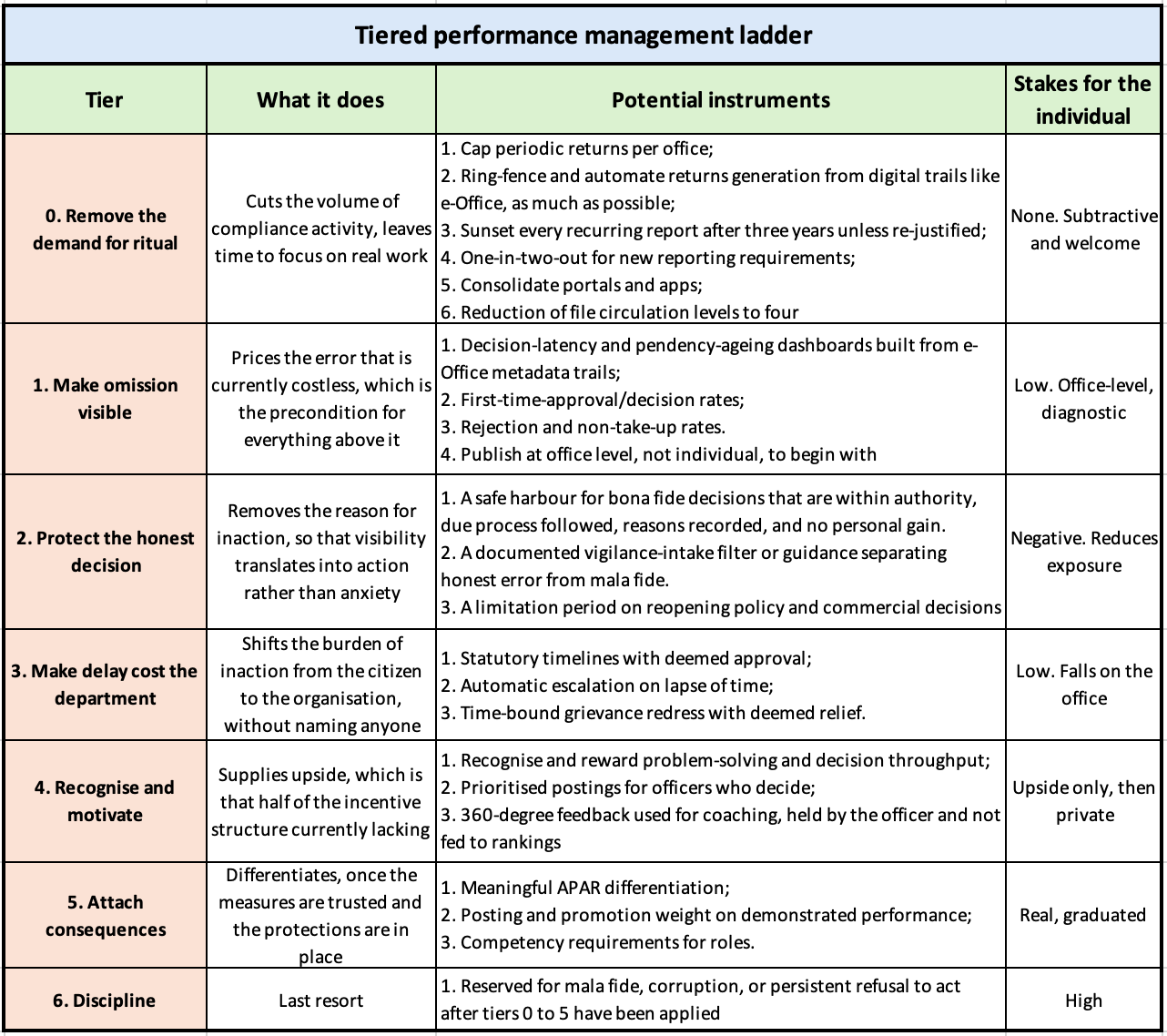
Four things can be done immediately to operationalise the above in the Indian context.
The simplest and essential step would be to adopt an operational classification of non-performance — inaction, delay, buck-passing, ritual compliance, target ratcheting — and report against it. The CCDI’s Eight Point Regulation outlined above is a good reference point. India currently does not have an equivalent to the Eight Point Regulation that identifies and categorises the kinds of bureaucratic conduct of relevance. This is a glaring gap and is the lowest-hanging fruit for India, and can have a significant impact on the efficiency and effectiveness at the frontline of public service delivery.
Second, a one-time standing burden reduction instrument, like that done by China in the August 2024 regulation on easing burdens at the grassroots, is another low-hanging fruit. Like there, it could cover administrative data collection, reporting, and clarity on what are not lower-level responsibilities. It is important to note that this regulation binds the principal, not the agent, and almost every provision constrains what a superior body may demand (how many documents it may issue, how long its meetings may run, how often it may inspect, what data it may ask for again). It can be done as a time-bound mission for 3 months and then issued as a Government Order.
Three, build the omission dashboard from e-Office data to detect decision latency, pendency ageing, referral loops, and first-time-right rates, published at the office level. This might require some tweaks and additional fields to the e-Office software, but it can be done with limited administrative effort. This information can be used for internal reviews that shine light on the counterfactuals and to create accountability.
Fourth, issue a clear directive on safe harbour that offers protection for bona fide decisions, a vigilance-intake filter, and a limitation on reopening old policy and commercial decisions. This should illustrate and guide by listing the commonly observed scenarios and situations.
It is important to start by avoiding using these for high-stakes performance appraisals. At most, they can be indicated in the performance appraisal reports, guided with illustrative examples, and be part of the qualitative appraisal by the reporting officers.
Yes, there will be challenges with the credible measurement of some of these behaviours. In such cases, a second-best proxy should suffice. But these inevitable challenges should not be a deterrent to putting in place some forms of such appraisals to prime the bureaucracy towards thinking individually and collectively on the costs of the counterfactuals.
Finally, one cannot help but marvel at the level of thoughtful engagement at the highest levels of the government in China on routine matters of administration, which are, however critical for state capability. Their codification is itself a great step, and the diligent enforcement, such as by way of the monthly reporting by the CCDI, points to a very high level of state capability (and Party discipline).


No comments:
Post a Comment