Substack

Wednesday, March 13, 2024

Some thoughts on digital markets regulation

I have blogged on several occasions on the market abuse problems associated with digital marketplaces. Amazon owns the biggest e-commerce marketplace and is also a seller on it. Facebook and Google provide links to news media content, thereby boosting platform value and traffic, but do not share their revenues with the news publishers. Apple restricts rival app stores on the iPhone and iPad. Apple’s Appstore charges an exorbitant transaction fee for purchases through Apple Pay and also restricts purchases through other payment Apps. All of them erect various kinds of entry barriers to service providers who compete with the platform-owned providers, and also generally try to kill off any kind of nascent competition.

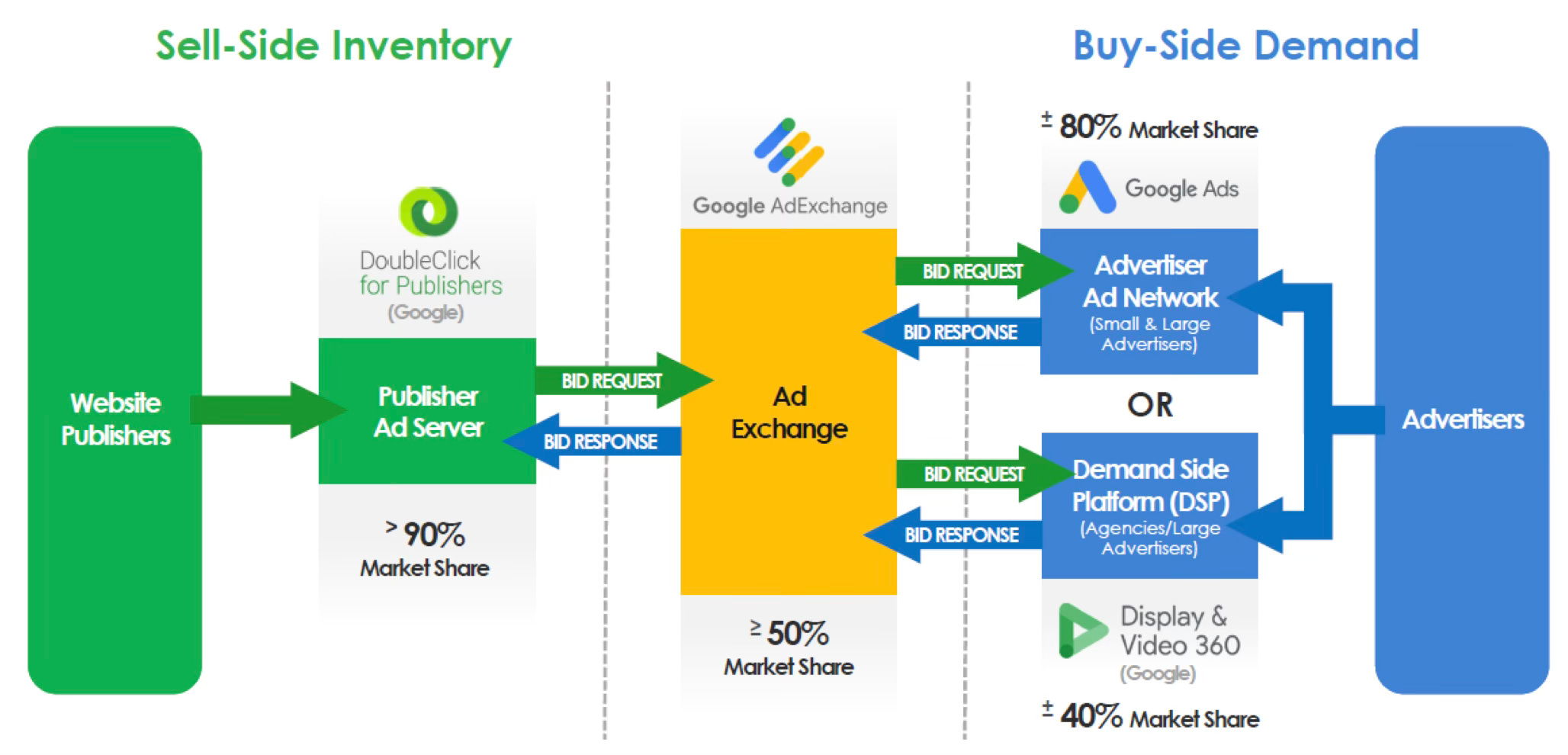
The US Department of Justice’s suit against Google outlines with great clarity how Google has positioned itself across the full value chain of internet advertising and systematically abuses its market dominance.

Every time an internet user opens a webpage with ad space to sell, ad tech tools almost instantly match that website publisher with an advertiser looking to promote its products or services to the website’s individual user. This process typically involves the use of an automated advertising exchange that runs a high-speed auction designed to identify the best match between a publisher selling internet ad space and the advertisers looking to buy it... One industry behemoth, Google, has corrupted legitimate competition in the ad tech industry by engaging in a systematic campaign to seize control of the wide swath of high-tech tools used by publishers, advertisers, and brokers, to facilitate digital advertising. Having inserted itself into all aspects of the digital advertising marketplace, Google has used anticompetitive, exclusionary, and unlawful means to eliminate or severely diminish any threat to its dominance over digital advertising technologies.

Google’s plan has been simple but effective: (1) neutralize or eliminate ad tech competitors, actual or potential, through a series of acquisitions; and (2) wield its dominance across digital advertising markets to force more publishers and advertisers to use its products while disrupting their ability to use competing products effectively... Google, a single company with pervasive conflicts of interest, now controls: (1) the technology used by nearly every major website publisher to offer advertising space for sale; (2) the leading tools used by advertisers to buy that advertising space; and (3) the largest ad exchange that matches publishers with advertisers each time that ad space is sold. Google’s pervasive power over the entire ad tech industry has been questioned by its own digital advertising executives, at least one of whom aptly begged the question: “[I]s there a deeper issue with us owning the platform, the exchange, and a huge network? The analogy would be if Goldman or Citibank owned the NYSE.”

By deploying opaque rules that benefit itself and harm rivals, Google has wielded its power across the ad tech industry to dictate how digital advertising is sold, and the very terms on which its rivals can compete. Google abuses its monopoly power to disadvantage website publishers and advertisers who dare to use competing ad tech products in a search for higher quality, or lower cost, matches. Google uses its dominion over digital advertising technology to funnel more transactions to its own ad tech products where it extracts inflated fees to line its own pockets at the expense of the advertisers and publishers it purportedly serves…

The harm is clear: website creators earn less, and advertisers pay more, than they would in a market where unfettered competitive pressure could discipline prices and lead to more innovative ad tech tools that would ultimately result in higher quality and lower cost transactions for market participants. And this conduct hurts all of us because, as publishers make less money from advertisements, fewer publishers are able to offer internet content without subscriptions, paywalls, or alternative forms of monetization. One troubling, but revealing, statistic demonstrates the point: on average, Google keeps at least thirty cents—and sometimes far more—of each advertising dollar flowing from advertisers to website publishers through Google’s ad tech tools. Google’s own internal documents concede that Google would earn far less in a competitive market.
This problem is not unique to digital technologies. Instead, it’s a common problem with all platforms or platform marketplaces. They are as old as markets and most markets are platforms. Shops, malls, roads, railways, utilities etc are all platforms. Even a school or college, clinic or hospital is also a platform. Imagine a highway monopolist dominating the markets for toll-gate operations, highway rest areas, vehicle manufacturing, ride-sharing, and so on.

All these are universally used markets, enjoy monopoly features, and benefit from network effects (more users result in greater value from its use). Besides, most often they are privately owned, thereby have monopolistic exploitation incentives. They are classic market failures. Therefore the case for their regulation. 

As illustrations, consider the following. Walmart charges exorbitant fees from retail brands to display their wares on its shelves. A railway or road concessionaire charges high fees for railway lines or vehicles to use the infrastructure. A utility company charges high wheeling tariffs on electricity providers using its infrastructure. And so on. And to top it off, all these monopolists also have their proprietary products and services that can potentially get preferential treatment to use the market platform.

The fundamental issue here is that of the near monopoly or disproportionate market power that many platforms command. These platforms become gatekeepers to market access. It becomes a problem when the platform is privately owned and the platform owner starts to charge exorbitant platform access fees. This is considered a market failure. Therefore, given this pervasive problem with all privately owned platforms, such markets are regulated. 

In the initial stages of the emergence of any innovation, it’s natural for the first movers to be incentivised with a high premium in their returns. For practical reasons, the regulations too take time to emerge. All the aforementioned historical platform markets too followed this trajectory of development. We know of the market abuse problems associated with railroad monopolies which made billionaires out of their owners in the US. We also know about the fierce opposition from entrenched monopolists to regulating these markets. 

The evolution of internet-based platforms too is following the same path. Given their practices, profit margins, and piles of cash surpluses, it’s clear that the monopolists have been allowed to enjoy an extended period of unregulated over-exploitation. In any case, it’s hard to argue that e-commerce or social media or payment platforms are not mature enough and therefore need more innovation runway before they are regulated. They should have been regulated yesterday. 

The elite capture of the intelligentsia and academia has meant that the commentary and thinking on this issue have been muted or confined to tinkering at the margins. The political capture of the rule-making process has been critical to perpetuating the unregulated over-exploitation of these markets. It’s a testament to the failure of the progressive movement that they have been co-opted by the Big Tech and Wall Street interests. 

In the US, the courts are still beholden to the consumer welfare test for digital market regulation and thereby tend to overlook the market abuse and anti-competitive practices that Big Tech firms indulge in. In this context, the EU’s ongoing actions against the technology firms deserve to be strongly supported. The centrepiece of the EU’s anti-trust pursuit is the European Union's Digital Markets Act. 

Its full implementation has opened the possibility of widespread anti-competitive actions by the EU. A major objective of the Act is to prevent large tech companies from abusing their market dominance to crush competition and build monopolies. The DMA Rules which came into effect in March 2022 had given time to the large systemic companies (defined appropriately as "gatekeepers") two years till March 7, 2024, for compliance. 

The FT has a long read on the impact of the DMA Rules

There is little evidence yet to suggest that the law is having the desired effect. Industry groups representing travel apps such as Airbnb and Booking.com, and entertainment apps like Spotify and Deezer, complain the tech companies are focused on the letter of the law rather than the spirit of it, and it is having no meaningful impact on their businesses. Judging by the record stock market highs enjoyed by some of these companies, Wall Street doesn’t believe it will have much practical effect on profits or the level of competition either — particularly as the tech industry hurtles into the AI age, resetting the competitive dynamics in some of the core tech markets... The big companies have been adept in the past at redesigning their services to sidestep regulations, making it very difficult for under-resourced government agencies to keep up, this investor says. The law does grant European regulators extraordinary powers of enforcement, including fines of up to 20 per cent of total worldwide annual turnover for repeat infringements, or — as a “last resort option”, forced structural changes such as the break-up of businesses...

A gatekeeper is defined by the law as a platform with an annual turnover of more than €7.5bn, a market cap above €75bn and active monthly users in the EU of 45mn. The commission has singled out 22 “core platform services” offered by the six, ranging from Google’s search engine and Meta’s Facebook and Instagram services to Apple’s App Store. The law forbids the tech companies giving favourable treatment to their in-house services at the expense of third parties — a practice known as self-preferencing — and obliges them to open up their platforms to more alternative services, presenting users with more choices. It also challenges their power to share data between their own services — between Facebook and WhatsApp, for example — without their users’ consent, and seeks to make it easier to switch by making it simpler for users to export their data. “The gatekeeper theory of industry domination is profound,” says Megan Gray, formerly a US Federal Trade Commission lawyer and general counsel at search company DuckDuckGo. At least in theory, it gives the regulators a powerful weapon, she says. On paper, the law could have a direct impact on the profitability of some important tech services, says Gallant. “The DMA poses some risk to Apple’s App Store commissions, which is the biggest part of their services business,” he says.

But the market participants feel that the technology companies will figure out ways to subvert the DMA Rules.

According to Gray, the entrenched nature of the dominant platforms, and in particular the tight linkages between their services that have turned them into powerful digital “ecosystems”, will make it hard to pick them apart by attacking individual products or services. The most drastic effects of the new regulations are also likely to be blunted by the manner in which the tech companies have said they will adapt their services to comply with the DMA... Tech companies are also implementing changes in ways that allow them to hold on to their competitive advantage. This year, Apple published a highly detailed set of technical changes that in effect open the way for rival app stores on the iPhone and iPad, while also allowing developers to stop using its payments service. But it also said that anyone choosing to take advantage of these new arrangements would have to pay a new fee of €0.50 cent for every app downloaded over 1 million installations — something that would hit companies that have large numbers of free app users on mobile platforms, making them less likely to take advantage of the new freedom to launch an app store of their own...

“Spotify, like so many other developers, now faces an untenable situation,” it said following Apple’s announcement. “Under the new terms, if we stay in the App Store and want to offer our own in-app payment, we will pay a 17 per cent commission and a €0.50 cent core technology fee per install and year. This equates for us to being the same or worse as under the old rules.” The changes were designed to give developers like Spotify choice, Apple said. “Every developer can choose to stay on the same terms in place today,” it said, “and under the new terms, more than 99 per cent of developers would pay the same or less to Apple.” The tech companies have also limited most of their technical changes to users in the EU, rather than extending them worldwide — limiting the likelihood of their wider adoption, and creating obstacles for developers.

In India, a Digital Competition Bill is under preparation. A news report says, 

The proposed Digital Competition Bill is expected to put a self-reporting obligation on online entities to declare their dealings are fair and transparent, not restrictive towards third-party applications, according to sources in the know. The digital entities that qualify as gatekeeper platforms or systemically important digital intermediaries (SIDIs) would have to provide this declaration to the Competition Commission of India (CCI), according to the proposed Bill. The CCI will have the power to levy a fine of up to 1 per cent of the global turnover of the online entity in case it fails to make this declaration, sources said. 

Such online firms would have six months to submit this declaration from the time they cross the threshold set for SIDIs, it is learnt. These thresholds, according to sources, are based on the India and global turnover of online platforms, their gross merchandise value in India, average global market capitalisation, and the number of end users. As part of the self-reporting obligation, SIDIs would have to declare that they are not inter-mixing or cross-mixing personal data of end users without their consent and have kept anti-steering provisions, which stop users from going out to other platforms, in check. 

On the issue of digital market regulation, Rana Faroohar writes about the divergence between how consumers and regulators view dynamic pricing in physical and digital markets. 

Surge pricing is something that anyone who takes a ride share on a regular basis has become used to. Try calling an Uber or Lyft on a rainy day during the dinner hour or around the school pick-up or drop-off time and you’ll be paying more than your usual rate — sometimes a lot more.  Yet when consumers are confronted with common online business models like “dynamic pricing” in the bricks-and-mortar world, they may revolt… Platform technology firms developed or perfected techniques like dynamic pricing, real-time auctions, data tracking, preferential advertising and all the other tricks of surveillance capitalism. But the behaviour we take for granted online somehow becomes more problematic when these methods are deployed in the real world. People are outraged about the price of burgers or their rent surging but don’t think twice when it happens to the cost of their commute — particularly when they are booking it on an app…

I’d love to see the FTC, for example, use its rulemaking power to stipulate a “thou shalt not discriminate” statue that makes it illegal to charge people different prices for different goods, no matter how and where they are buying them. What’s illegal in the physical world should also be illegal in the online world. This would put the onus on companies to prove that they are not causing harm, rather than forcing regulators to create a distinct and more complex system for a particular industry. Online or offline, all businesses should be playing by the same rules.

I have blogged earlier about the unfair regulatory arbitrage that digital market firms exploit to their advantage. There’s no reason why such regulatory arbitrage should be allowed to continue in mature marketplaces. 

Big Tech will respond to digital market regulation with denial, tinkering, obfuscation, and brazenness. Unless dealt with firmness, they will keep figuring out ways to limit conceding ground by getting around regulation. Fines are too small in relative terms and are already internalised as a cost of doing business. Aggressive enforcement will have to become the norm. This will require often exorbitant or disproportionate fines, even at the risk of judicial reversals. It will also require the “nuclear option” of even breaking up firms. The norms can be upended and new norms established only through such aggressive actions. When the pendulum has swung too far to one side, there’s a need for disproportionate force from the other side. 

However such actions will require political will and popular support to force these changes in a meaningful manner on the entrenched technology firms.

For references on earlier posts, here is a compilation. I have compared the likes of Amazon to "a large vehicle manufacturer having the power to both prohibit someone from using the road and also make competing vehicle manufacturers unattractive (say, because of inadequate servicing options) for users". I have blogged earlier here(beginning of anti-trust actions in the US and Europe), here (Google and anti-trust challenge), here (anti-trust challenge in the US), here (market monopolisation), and here (Amazon's market abuse of startups) on the problems with market concentration and the need for regulation. This points to what Google founders themselves thought about data monetisation and digital advertising. I have blogged herehere, and here on the problems with regulatory arbitrage and here on the market service quality problems due to limited and poor regulation. And we are not even talking about the several other distortions arising from such market concentration, especially the valuation bubbles in the financial markets - see this and this. Finally, this is a summary examining the dynamics of digital markets and how it offer a different perspective on these markets, and this is a summary of how the big technology companies have become digital gatekeepers to large and critical markets.

Monday, March 11, 2024

Some thoughts on India's automobile green transition path

I have blogged on the need for developing countries like India to be prudent with the green transition. For these countries, unlike their advanced counterparts, poverty eradication competes with climate change as an existential challenge. For a large share of the populations of these countries, the daily and immediate challenge of subsistence far overrides the more distant and diffuse challenge of climate change.

It’s easy for academicians, commentators and opinion-makers to demand a rapid green transition with ambitious decarbonisation goals. They advocate coal-based electricity generation to be phased out with renewable generation, and internal combustion engines (ICE) to be phased out with electric vehicles. And they all advocate both these transitions to happen rapidly. 

But all such transitions impose prohibitive costs and there’s very little understanding of who and how these costs will be borne across different sectors. It’s important to recognise these realities and design policies accordingly. 

Consider the current policy in India that pushes aggressively for the adoption of electric vehicles (EVs) among four-wheelers. 

Amidst the frenzied commentary and euphoria around electric vehicles and batteries, we overlook chastening emerging developments in the global EV markets. Outside of China, in the developed markets EV sales growth has been stuttering. 

The Times has an article that provides a good summary of the plans of the big automobile manufacturers in the US.

In the last six months, sales of electric vehicles have slowed, and American car buyers looking to cut their fuel bill and tailpipe emissions have been flocking to hybrids. Now Toyota’s sales are booming, and the company is reporting huge profits... Toyota has introduced just two fully electric models in the United States so far, betting that its gas-electric hybrids and plug-in hybrid vehicles, which it has become known for, would remain popular and were sufficient to address climate change for now... Toyota has plans to significantly increase hybrid production and sales. A hybrid version of its Tacoma pickup is rolling out. A redesigned Camry sedan, due this spring, will be available only as a hybrid... 

Mercedes-Benz, which had been hoping to phase out internal combustion models by 2030, said last month that it had pushed that goal back by at least five years. Ford has lowered production targets for electric vehicles and is slowing construction on plants that are supposed to produce batteries for electric vehicles. G.M., which had stopped selling hybrids in the United States to focus on electric vehicles, has delayed the introduction of a few battery-powered models. It is also now planning to reintroduce hybrid and plug-in hybrid models, which dealers had pushed for.

The article discusses the challenges faced by EVs.

Electric vehicles have so far failed to win over many car buyers because they are generally more expensive than combustion or hybrid models even after taking into account government incentives. The challenges of charging electric vehicles, worries about range and their performance in cold weather have also caused some people to hesitate. Hybrids don’t face many of those issues. Some hybrids cost only a few hundred dollars more than similar gasoline cars — a premium that owners can quickly recoup in fuel savings. In addition, regular hybrids never have to be plugged in. 

Plug-in hybrid models, some of which can travel on just electricity for more than 40 miles and have a gasoline engine for longer trips, have much smaller batteries than electric vehicles and can be recharged relatively quickly. But these vehicles, which make up a small part of the market, may not be as beneficial financially or environmentally when driven long distances on just gasoline.

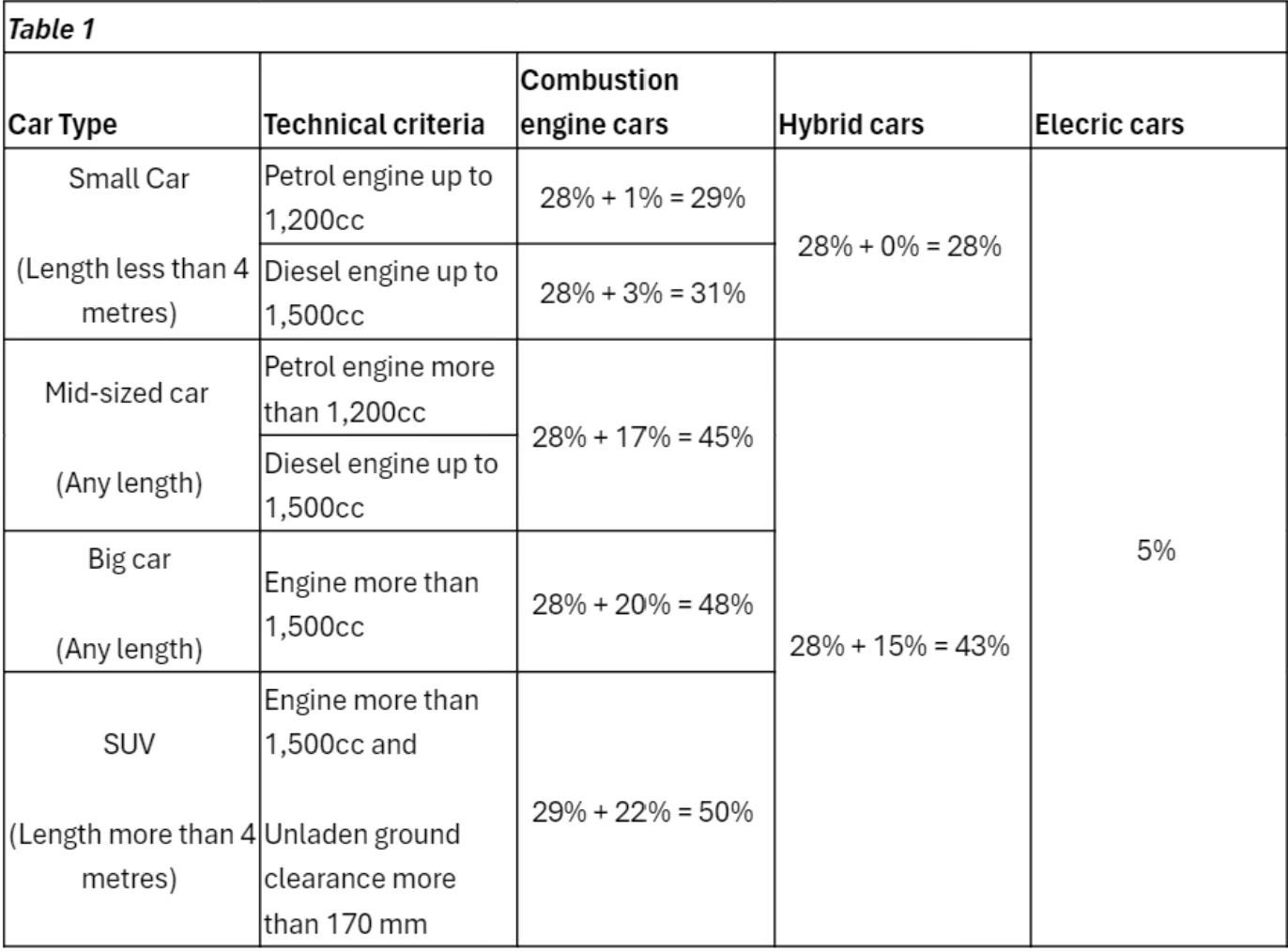
A recent Livemint article had this table on the taxes levied on various categories of four-wheelers in India. 

Hybrid vehicles are taxed at the highest GST rate of 28%, the same as ICE vehicles. They are also taxed with a cess of 1-7 percentage points depending on the car type. In contrast, EVs attract a preferential GST rate of 5% with no additional cess. 

The article points to the case for hybrid four-wheeler vehicles over EVs.

Pro-hybrid companies have argued that hybrid vehicles emit significantly lower emissions than combustion engine vehicles but continue to be taxed at nearly the same rate… These companies have further argued that even under best case scenario, electric cars will account for around 30% of new car sales by 2030, leaving a substantial portion of the market to combustion engines. In such a situation, tax cuts on hybrid vehicles could see higher adoption of hybrids in the non-electric car market, especially in the case of larger vehicles. Using the Maruti Suzuki Grand Vitara as an example again, the strong hybrid version boasts a fuel efficiency that is over 33% better than its mild hybrid variant. It’s claimed fuel economy is as much as 50% better than comparable rivals with conventional powertrains.

It’s clear that public policy in India has made the decisive choice in leapfrogging from ICE to EVs in four-wheelers. There’s no space for hybrids and plug-in hybrids in the government’s policy priorities. 

Given that meaningful reductions in emissions are an immediate necessity, is the direct shift from ICE to EVs the most practical strategy for India? Is the direct transition even possible given the local demand conditions? What’s the opportunity cost of overlooking the phased transition from ICE to EVs through full hybrids and plug-in hybrids? Have we examined the strategic considerations involved in the choice made, especially important given the global dependence on China for battery inputs and batteries themselves? What could be an alternative EV strategy for India? 

A few thoughts in this context:

1. I’m not sure whether the Indian market can support the demand for anything more than a few lakh EVs for the foreseeable future. The domestic production in 2022 was 49,800 out of 3.8 million four-wheelers and is currently about 7000-8000 per month. Imports are anyways more expensive. Even at the most optimistic growth forecasts, four-wheeler EVs are unlikely to take up more than 10% of the market share this decade. Therefore a policy that directly targets EVs while also discouraging hybrids runs the risk of foregoing the considerable immediate carbon emissions reductions possible from the far more affordable and competitive hybrids. 

2. Then there’s the question of whether the urban Indian four-wheeler market needs EVs. Given the short urban commute requirements, hybrids and plug-in hybrids more than serve the purpose. When less is enough why do more, and that too at a prohibitive cost?

3. Given the universal trend of EVs co-existing with different kinds of hybrids and the near certainty of ICE vehicles retaining a major share of the market for four-wheelers, India will not only not miss out on any global trend but would, in fact, be going with the global norm. 

4. Unlike EVs, hybrids of both kinds require smaller batteries. The battery chemistry too is less daunting. This means far less dependence on China for batteries and its inputs, with all the strategic and national security benefits. It also means a much greater likelihood of Indian battery manufacturers being able to acquire a foothold in the global battery value chain. 

5. One of the important motivators for EV adoption in India is also the Chinese strategy of plunging headlong into EVs across market segments. Like with most other areas, the Chinese policies to encourage EV adoption are extremely wasteful and motivated by larger macroeconomic imperatives of the regime in Beijing to find new drivers of economic growth to replace weakening engines of growth. India would do well to avoid being sucked into following what China is doing. 

6. On the EV side, instead of four-wheelers, India’s public policy should instead aggressively double down on two and three-wheelers. It’s far more likely that EVs will become the dominant part of these markets shortly. It’s more realistic to expect public policy to expedite that transition. Further, acquiring expertise in two and three-wheeler EVs will provide the manufacturing base and technology expertise to move more credibly into the affordable four-wheeler EV market.

7. On a prudent note too it makes sense for India to adopt a cautious wait-and-watch policy with EVs. The EV market is a rapidly changing landscape due to battery and car technology evolution. Then there’s the geo-political uncertainty of sourcing critical minerals for EV batteries. From all evidence, it appears that we are some time away from the arrival of the truly affordable EV that the Indian market requires. 

Therefore, instead of expending scarce public finance and policy efforts on four-wheeler EVs, India should prioritise two- and three-wheeler EVs and hybrid variants of four-wheelers while also keeping its eye open to engage opportunistically on four-wheeler EVs. This would help the country acquire strong domestic manufacturing capabilities in EVs and batteries, apart from achieving significant immediate reductions in carbon emissions. It would be both sound environmental policy and sound economics. 

8. Finally, the focus on EVs should not blind us to alternative transition fuels like natural gas. After all, one of the most successful examples of carbon emission reduction in the transportation sector in the country has been the adoption of CNG in public transport buses in the National Capital Region of Delhi. 

Much the same logic of phasing transitions applies to the shift from thermal to renewable power generation. Instead of trying to abandon fossil-fuel power altogether, public policy should incentivise existing thermal plants to enhance their energy efficiencies and lower emissions by improving operations and retrofitting. Policy should also encourage the use of natural gas in the transition period. 

Sunday, March 10, 2024

Weekend reading links

1. One of the less discussed but genuine successes of India's Insolvency and Bankruptcy Code (IBC) is the resolution of stressed power generation assets

“Stressed assets” — coal generators that were unable to pay their debts to lenders — became a $23 billion drag on the financial sector, but the list of plants has been whittled from 34 in 2018 to four after alternative utilities, led by state-owned NTPC Ltd., stepped in as buyers of last resort and creditors took haircuts on their investments.

This about the comparative economics between coal and solar

In 2017, a new solar or wind generator was still marginally more costly than a new coal plant. Nowadays, it’s drastically cheaper. The average Indian solar generator in 2024 needs about $30.76 per megawatt hour to break even and wind is at $39.91/MWh, according to BloombergNEF, compared to $50.53/MWh for new coal and an average tariff at NTPC, the largest coal generator, of about $59/MWh in the 2023 fiscal year.

The article writes about the return of private investments into coal plants and the slowdown in the growth of renewable investments. 

In this context, it's instructive that the major coal power investors are also the ones with the biggest renewables generation ambitions. This presents conflicting incentives. 

2. Taylor Swift's East Asia tour is confined to just two places - Singapore and Japan - leading to Swifties from across the region being forced to travel to these countries. This has in turn boosted economic activity in these countries. This about Singapore.

In contrast, during the next leg of her tour in Europe, Swift is traipsing across major and minor cities throughout the continent, hitting four European cities in May, and another six in June, including smaller U.K. cities such as Liverpool and Cardiff. Many of the more than 300,000 tickets sold in Singapore have gone to overseas fans who will fly in, and hotels and restaurants haven’t been shy. The city’s iconic five-star hotel, the Marina Bay Sands, is offering “The Wildest Dreams Package," which comes with a three-night stay, four VIP tickets and a round-trip limousine ride from the airport. The cost: nearly $40,000. More than 90% of guests buying the exclusive packages are coming from abroad, according to the hotel. Travel booking website Agoda said that searches for accommodation in Singapore spiked 160 times over usual levels after ticket sales began last summer... Nomura Bank estimates that the combined effect of six Coldplay concerts in January and six Taylor Swift concerts in March could contribute $300 million to Singapore’s tourism revenues in the first quarter. Bookings for tours and Singapore attractions have surged, according to travel booker Trip.com. “With the trade recovery yet to take off fully, Singapore is busy making ‘concert economics’ its new growth driver," said HSBC in a note.

3. The taxation structure on ICE, hybrid, and electric cars.

4. Some facts about capex in India from a Livemint long read. One point has been the declining private sector capex and the much lower public sector capex compared to the pre-reform era.

The entire reform period has seen a secular decline in public sector capex to around 6-8% of GDP, from levels of well above 10-11% of GDP in the 1980s. As an aside, what is also alarming is the steep decline in private sector capex since the global financial crisis of 2008. Importantly, the private sector never really recovered from that crisis and its after-effects.

Within public sector capex too, the share of public sector units has declined, with budgetary capex replacing PSU capex in recent years.

Add in PSE capital spends to the mix (from their own resources), as compiled by budget documents, and overall central government capex rises to over ₹14.5 trillion. But seen in the context of overall GDP, the sharp bump in absolute terms looks less impressive—even in the context of the last decade or so. Combined central government capex (main government plus PSEs) is budgeted at around 4.4% of GDP for 2024-25—that’s still lower than the level 10 years ago.

This about highways and railway spending.

In 2021-22, it budgeted a spend of ₹1.22 trillion on such projects, of which, over half was to be funded by itself (largely through borrowing). Since 2022-23, however, all of NHAI’s funding was done directly through the government budget. It was not allowed to borrow any funds directly from the market, the aim being to keep the body’s borrowing on a tight leash. For 2024-25, as much as 15% of the main central government capex, or ₹1.68 trillion, is allocated toward funding NHAI... As of 2019-20, the central government budget contributed less than half of railways capex for the year ( ₹1.46 trillion). This ratio started to creep up. As of 2024-25, almost all the capex for the railways ( ₹2.52 trillion) will come directly from the central government budget, with just ₹10,000 crore earmarked to be raised by the railways directly from the bond market or its internal resources. In this sense, at least a significant part of the increase in capex is a shifting of funds—bringing them ‘on-budget’—rather than extra spending.

5. FT has a long read on the spectacular but suspicious rise of Temu, the Chinese e-commerce platform that retails cheap clothes, toys, footwear, kitchen items etc. It has undergone the fastest retail expansion in history spreading from China to 49 countries after less than two years in operation.  Temu's parent company, PDD Holdings, owns Pinduoduo, the sister App which dominates the Chinese market. PDD is a retail e-commerce giant and is known for its aggressive marketing and discounting. 

When it still published such numbers, PDD reported more than 870mn active users in the country supplied by over 13mn merchants who, it claimed, together generated a third of all parcel traffic in the country, tens of billions of packages a year. After just nine years in business, PDD is now bearing down on the world’s biggest ecommerce group Alibaba, both in terms of retail scale and stock market capitalisation. Worth $162bn, it regularly trades places with the older retail giant as the most valuable Chinese company listed on a US stock exchange.

The article points to the surprisingly limited asset base, low cash flow, low manpower etc., despite the firm's market impact and compared to competitors.

Why do balance sheet metrics move at a different pace to revenues? How does a $200bn company own less than $150mn worth of hard assets?... It operates like eBay and Amazon’s third party marketplace, connecting buyers with sellers to take a cut of each transaction and charging merchants to advertise on its platform. In its most recent quarter those revenues almost doubled versus the previous year, to $9.4bn, prompting Alibaba founder Jack Ma to exhort his former company to “change and reform” in response. PDD reported $2.5bn of cash flow, even as it appears to throw very large sums at the expansion of Temu. It has achieved this with a headcount that upends all assumptions about ecommerce logistics: it started last year with 12,992 employees, an order of magnitude less than Alibaba and a small fraction of Amazon’s 1.5mn staff. PDD’s physical footprint is also minuscule, a striking contrast with Amazon, JD.com and Alibaba, where control of logistics was long seen as a competitive advantage; a way to ensure speed, capacity and satisfactory service. Where Alibaba spends $5bn a year on property and equipment, including the upkeep of 1,100 warehouses, PDD owns just $146mn of hard assets — mainly office equipment and IT hardware and software... 

It doesn’t report the size, location or number of the warehouses it rents. Those logistics, like PDD’s servers and customer service call centres, are mostly outsourced, ephemeral and unenumerated. The opacity extends inside the business. Staff use pseudonyms and know little about other teams. The structure is flat, with a small group of decision makers directing the “grassroots”, young people chosen for their poverty or debt obligations which motivate them to work long hours... Over 2020 and 2021, PDD reported selling $2bn worth of merchandise without disclosing any stocks of inventory on its balance sheet, or the costs of those goods sold, two standard retail accounting items. Then it stopped selling mystery merchandise as abruptly as it started... Research and development spending that year rose only slightly to $1.5bn in total, similar in scale to eBay rather than Alibaba’s $8bn annual spend on product development... In the blow-out recent quarter, marketing services grew at roughly the same pace they have since the middle of 2021, about 40 per cent year-on-year. But over the same period, transaction fee revenues grew at more than three times the rate of marketing services. Based on the transaction fee rate PDD reported in 2021, that would suggest an improbable level of activity, making the PDD ecosystem twice the size of Alibaba and on a par with the $2.2tn annual output of the Italian economy. Instead, PDD must be charging its merchants a lot more.

This is the most stunning point, Temu's rise is not being felt by its competitors

PDD’s impact is hard to detect in their numbers. In the battle of online flea markets, Alibaba’s Taobao reported improving take rates and growing merchant numbers last month that hardly indicate obliteration by Pinduoduo. Alibaba’s executives have not addressed their upstart rival by name on any of their earnings calls. Outside China, both eBay and US discount chain Five Below said last year they hadn’t seen any impact on their business from Temu. Amazon didn’t mention it when reporting results last month... If PDD’s numbers are indeed to be believed, then a shrewd executive team directing pseudonymous underlings has created one of the most successful businesses the world has ever seen. But it is not clear how the several thousand staff who run PDD deal with the risks in administering hundreds of millions of transactions, and tens of millions of suppliers delivering tens of billions of parcels...
Investors searching for further detail were unlikely to find it at the most recent earnings call, when Chen took a total of six questions from three analysts and made pronouncements that resembled state political sloganeering. “We are dedicated to generating value through innovations, which forms the foundation of our high-quality development,” he said, echoing a key tenet of his country’s latest five-year plan. They would also draw a blank attempting to direct questions to a chief financial officer. PDD doesn’t have one. Instead it is on its fourth “vice-president of finance” since the 2018 initial public offering, if a period when founder Huang added the job to his duties is counted. It seems that while profits are good, investors are willing to tolerate such opacity. On Wall Street, 53 out of 56 analysts recommend their clients buy, and not one suggests they sell... Unlike other large US-listed Chinese companies, PDD — which is nominally headquartered in Dublin — hasn’t courted the investors who might know it best with a secondary Hong Kong listing. The structure for foreign ownership of Chinese assets remains untested, with “heightened operational and legal risks”, according to the head of the Securities and Exchange Commission. Holders of PDD stock own shares in a Cayman Islands company that has unpublished contractual agreements said to entitle it to the profits of the Chinese operating companies.

On the face of it, it's hard not to come away with the feeling that we might be witnessing the biggest Ponzi scheme of the digital age! 

6. The pushback against low-cost and short-haul flights in Europe on environmental grounds throws up several difficult public policy challenges. From an FT long read.

Last week Spain followed France in unveiling a limited ban on short-haul flights. The Netherlands, Denmark and France have pushed ahead with plans for higher taxes on flying, while the Dutch government previously tried to impose a hard cap to lower the number of flights at Schiphol... But policymakers also need to acknowledge the public popularity of cheap flying and confront the lack of viable alternatives... Aviation supports close to 5mn jobs in the EU and contributes €300bn, or 2.1 per cent, to European GDP, according to European Commission figures. But it is also responsible for around 4 per cent of EU carbon emissions. It is one of the fastest-growing sources of pollution and faces a huge technological challenge to decarbonise... European airlines and airports laid out a detailed plan in 2021 to reach net zero by 2050. Most of that will be achieved through a switch to so-called sustainable aviation fuels or SAFs, which are made from feedstocks other than fossil fuels and, from production to combustion, emit less carbon.

There's the challenge of tightening regulations and forcing the internalisation of negative externalities to create a level playing field for alternative transport options like high-speed rail.

Airlines in Europe say they are already subject to the toughest environmental rules in the world courtesy of a carbon tax imposed on intra-European flights and a requirement that 6 per cent of fuel on every flight is sustainable by 2030... The industry says the rising cost of the EU’s emissions regime will drive ticket prices higher and deter some people from flying. Pricing travellers out contributes around 15 per cent of the net carbon emissions reduction within the industry’s net zero road map. But it is not enough for environmental groups, which want the clampdown on cheap flights to go much further. T&E has called for higher carbon prices, a tax on aviation fuel and for value added tax to be added on airline tickets. Currently, airlines pay no duty on their fuel while tickets are exempt from VAT and airports and aircraft makers often receive state subsidy, T&E says. That gives flying a cost advantage; a Greenpeace study comparing ticket prices on more than 100 routes between major European cities last summer found that trains were on average twice as expensive as flights. Paul Morozzo, a transport campaigner at Greenpeace, says flying “only looks like a bargain because airlines are not forced to pay for the devastating cost of their pollution”. “The failure of governments to properly tax the aviation sector for the fuel it uses and the pollution it causes has created an uneven playing field.”

But even with the regulations and higher prices, and its several advantages, rail transport faces daunting challenges to emerging as a competitive alternative. Connectivity infrastructure need large investments.

Cost is not the only issue preventing more rail travel. A much bigger problem is that the network simply does not provide the connectivity that travellers demand. A Eurobarometer survey published in 2020 found that while the main obstacle to greener forms of travel was cost, 40 per cent of respondents also cited speed. Even allowing time for travelling to and passing through airports, flights are almost always quicker than trains at present... Part of its efforts are to put more concerted focus — and investment — into the so-called TEN-T network — a trans-European spider web of roads and rail lines intended to link the continent’s major hubs. It forms the backbone of the EU’s land transport policy. The commission’s overarching but non-binding target is to double high speed rail traffic by 2030 and triple it by 2050, ensuring that passenger trains running on the TEN-T network travel at a minimum speed of 160km/h. The Green Deal climate law, which commits the bloc to reaching net zero emissions by 2050, stipulates that greenhouse gas emissions from transport must be cut by 90 per cent. But compared to the vast expansion of airline routes in recent decades, land-based connections have been painfully slow to open up, despite Brussels’ efforts to stimulate growth... Transport also consumes the biggest share of the EU’s €723bn Recovery and Resilience Facility, while rail accounts for the majority of projects within the €25.8bn provided for transport by the EU’s Connecting Europe Facility. But new rail infrastructure is expensive, often subject to delays and takes a long time to pay back the capital absorbed in construction, making it less attractive to private finance and difficult for states to justify when public finances are stretched.

Besides railways are largely state-owned monopolies, which in turn creates its set of problems.

While aviation is a highly competitive marketplace with frequent price wars, rail remains dominated by state-run monopoly operators whose domestic priorities often trump efforts to improve international connectivity... Whatever Brussels proposes in terms of international connections often butts up against national concerns, according to Bas Eickhout, a Dutch Green MEP. “No matter what, all the national decisions always go to improving the domestic train system,” he says. “So if the Dutch need to decide: ‘am I going to improve Amsterdam-Berlin or Amsterdam-Utrecht?’ they [will] decide it’s going to be Amsterdam-Utrecht.” Because such thinking is replicated across the EU, he adds, “of course we are having difficulties in having a credible alternative for short-haul flights.”

Finally, there's the complex political economy of the energy transitions.

Politicians increasingly fear voters will punish those pushing for climate-related policies such phasing out gas boilers in favour of heat pumps or curtailing the use of combustion-engine cars. Even efforts to complete existing legislation have slowed; a revision to the energy taxation directive that would have reduced exemptions for jet fuel has stalled, for instance, and will not be agreed before the end of the commission’s mandate. Brussels is also hesitant about forcing costly decarbonisation rules on industry amid concerns for the bloc’s competitiveness... The Dutch government in November bowed to pressure from airlines, the EU and the US government — all of whom warned of a hit to competition — and paused plans to lower the number of flights at Schiphol. The future of the airport is now part of coalition negotiations following national elections.

7. Don't know how you can revive economic growth through a radical austerity programme that crushes both consumption and investment as Javier Milei is doing in Argentina

Milei is trying to push through a radical, high-risk programme of austerity to heal Argentina’s stricken economy. A political outsider, he is facing stiff opposition from Congress, unions, social movements and protected industries. In response, he has doubled down on confrontation, insulting anyone who opposes him and refusing to negotiate. For the time being, Milei’s popularity is holding up — giving him some space to direct public disquiet towards the politicians and vested interests he blames for the country’s economic woes. But if that popular support falters, he will have little institutional backing for his controversial agenda. Some political observers are already wondering privately whether his presidency will last its full four-year term...
Milei only entered politics just over two years ago and his La Libertad Avanza party holds less than 15 per cent of seats in Argentina’s Congress. He quickly ran into trouble when he tried to pass ambitious legislation to overhaul the heavily regulated economy. The president tabled about 1,000 reforms aimed at deregulating the labour market, promoting competition and raising some taxes to balance the budget. About a third of the measures were contained in an emergency decree, which faces a wave of legal challenges on the grounds it may be unconstitutional. The remainder were in a huge “omnibus bill” intended to sweep away 40 years of regulation.

None of his major measures have passed the Congress. In response to the opposition, Milei has doubled down with confrontation, often carried out in social media platforms. 

People who deal with the government say the president is now more dependent than ever on a small inner circle of true believers and his army of social media followers, to whom he devotes more than two hours a day online. His closest advisers include his sister Karina, who used to sell specially decorated cakes on Instagram and is now the presidential chief of staff, and Santiago Caputo, a 38-year-old political consultant and social media guru whose father is a cousin of Luis Caputo, the former Wall Street trader now serving as finance minister... Some question Milei’s economic results too. Eduardo Levy Yeyati, an economist and professor at Torcuato di Tella university in Buenos Aires, believes the much-vaunted fiscal surplus in January benefited from accounting tricks such as shuffling government payments around.

8. Martin Wolf points to China's extraordinary savings, at 28% of the total global savings in 2023 it's only slightly less than the combined US and EU share of 33%. 

This is a good summary of the problems facing Chinese policymakers

If demand is to match potential supply in such an economy, domestic investment, plus the current account surplus, must match the desired savings. If they do not, the adjustment will work through weak economic activity — that is, a recession or even a depression. This is “secular stagnation”. With savings as high as China’s that is hard to avoid. Doing so required a huge current account surplus prior to the 2008 global financial crisis and, subsequently, China’s debt-fuelled property boom. The latter is now apparently over. So what next? A natural course would be for the investment rate to fall significantly. It is highly implausible that the economically profitable rate of investment can remain over 40 per cent of GDP in an economy whose potential rate of growth has, at the very least, halved over the past 15 years. That makes no sense. The property boom masked this reality. Now it is here. If the savings rate remains where it is and the investment rate duly falls, the “solution” will then be a rise in the current account surplus as savings flow abroad. Official data do not yet show this. But there are doubts about this. Brad Setser of the Council on Foreign Relations argues that the surplus may be double what the official data show, at 4 per cent of GDP... 

A current account surplus of 4 per cent of GDP does not look large by China’s past standards. But, since 2007, when China’s current account surplus peaked at 10 per cent of GDP, its share of the world economy (at market prices, which is what matters here) has jumped from 6 to 17 per cent. So, from the point of view of the rest of the world, a Chinese surplus of 4 per cent of GDP is far bigger than one of 10 per cent in 2007. Who is going to run the offsetting deficits? Who, in particular, will run them when the concomitant rise in exports will be driven by investment in competitive manufactures, such as electric vehicles? The answer is not creditworthy high-income countries: they will view these as “beggar-my-neighbour” policies. The same will surely be true for big emerging economies, such as India. If China wants the mercantilist solution to excess savings it will have to fund smaller emerging and developing countries. It can pretend these are loans. But much of the money will be grants, after the fact. If it ends up funding renewable energy there, that could be good for the world. But, from China’s perspective, it would be a costly gift... Given China’s size, stage of development and excessive savings, an essential part of any strategy for macroeconomic stability must be a jump in private and public consumption as shares of GDP. Moreover, given the financial difficulties of local government, this will also mean a bigger role for central government spending.

The automobile sector is rapidly emerging as an important source of investments and surpluses.  


But in a world fearful of Chinese intentions, these surpluses are simply unsustainable. Contrary to the media commentaries, China it seems is much more dependent on the world economy for its survival in the current form than acknowledged.  

9. Cocoa prices have surged to touch historic highs

Prices of beans have surged to all-time highs, with cocoa futures in New York more than doubling from the same period last year. On Tuesday cocoa futures in London traded at a record high of £5,827 per tonne. On the same day last year, they traded at £1,968. Prices are rising in part because supply is stretched. Poor weather in Ivory Coast and Ghana, which together produce around two-thirds of the world’s cocoa beans, has affected crop yields. El Niño, the sea temperature phenomenon which occurs every three to five years, returned last year, first bringing unseasonal heavy rainfall to the region and then dry heat. The result is a global crop 11 per cent smaller than last year’s season, according to forecasts published by the International Cocoa Organization on Thursday. Analysts are warning that chocolate makers and brands will pass along higher costs to consumers... Years of vast cocoa output, especially in neighbouring Ivory Coast which produces nearly half of the global supply, have kept prices low generally. That might be good news for Western consumers, but here it has meant that cash-strapped farmers have not been able to invest in their cocoa plantations. Most have not planted new trees since the early 2000s, and can ill-afford to use fertiliser or pesticides. As trees age, they become less productive and more vulnerable to disease and adverse weather events.
10. Finally an excellent long FT Alphaville post on the private equity industry, specifically how its long-term returns compare with the market. The main challenge is with benchmarking PE industry returns. But now the wealth of evidence points to nothing superior about PE returns.
One of the first broadsides against private equity was Steven Kaplan and Antoinette Schoar’s Private Equity Performance: Returns, Persistence and Capital Flows. Published by the Journal of Finance in 2005 it sensationally argued that returns were roughly similar to that of public equities after adjusting for the eye-watering fees. In 2012, Kaplan and colleagues Robert Harris and Tim Jenkinson... published a new paper that estimated returns had exceeded public markets for “a long period of time” and by a healthy margin — more than 3 per cent per year on average... In 2013 Andrew Ang, Bingxu Chen, William Goetzmann and Ludovic Phalippou caused a stir by arguing that “private equity is, to a first approximation, a levered investment in small and mid-cap equities”. Then in 2020 Phalippou, a professor of financial economics at Oxford’s Saïd Business School... published an incendiary paper... calculating that the only people to do well out of it (on average) are the private equity tycoons themselves.

There are at least two factors that raise questions about the industry's future. One the industry is today a behemoth with $5 trillion in assets under management and $2.9 trillion in dry powder it's struggling to deploy. With size comes intense competition and limited opportunities in a relative sense. Two, the industry was boosted by declining and low-interest rates over the last four decades, which are now bygone. 

Four decades of falling interest rates helped increase corporate earnings and swell equity market valuations. Indeed, a Federal Reserve paper published last year estimated that lower interest expenses and tax rates explain almost half of all growth in US corporate profits between 1989 and 2019. At the same time, valuations of those earnings streams have increased because of lower discount rates used to calculate their worth. Despite private equity insisting that they improve companies, Bain’s latest report on the industry estimates that “nearly all the value creation” in private equity-owned companies between 2012 and 2022 actually came from revenue growth and multiple expansion. “Margin expansion barely registers,” the consultancy noted drily... Kaplan and Schoar’s 2005 paper highlighted nearly two decades ago that there was “substantial persistence” in the performance of private equity funds... However, more recent studies indicate that the persistence of private equity fund performance is weakening, and since 2000 there is “little evidence” of it, according to a 2020 paper by Harris, Jenkinson, Kaplan and Ruediger Stucke.

The institutional LPs like pension and sovereign wealth funds with very large funds to deploy and have been deterred by the high fees charged by PE firms are now seeking to invest through their own internal teams or co-invest with the PE funds. 

Co-investments (and in some cases direct investments) have become far more prevalent in recent years, as Canadian, Australian and European pension plans have followed the path first taken by a few sovereign wealth funds... While CEM Benchmarking estimates that internally managed private equity portfolios on average do slightly worse than the industry as a whole, the cost saving “far outweighs any difference in top line return”.

Finally, the article questions the low volatility of PE funds, and the so-called illiquidity premium they generate. 

Because private companies don’t trade like stocks on an exchange, private equity funds only do modest quarterly valuations and firmer annual ones. These can often be more art than science. That means that there’s a lot of scope for smoothing out returns, making them look both better and gentler than those derived from stock markets. Perhaps they don’t go up as much in a rally but they often stay steady in a bear market — a welcome cushion for institutional investors, even if it is just an artifice of accounting rules. This doesn’t get talked about too loudly. A lot of investors in private equity prefer to justify their large and growing allocations with a reference to a mythical creature called the illiquidity premium, a fairy that apparently sprinkles private markets with its magical return-enhancing dust.

See also this about the fake smoothness of private markets.

Wednesday, March 6, 2024

Industrialisation and development

Livemint has an excellent long-read story about how industrial growth has transformed Krishnagiri district in Tamil Nadu, one of the state's most backward districts. This is a great example of how transformative development happens with industrialisation and productive job creation. In the space of three years, the manufacturing investments in the region have created tens of thousands of jobs. Since most of these jobs employ women, it has also transformed the society and gender relations in one of the state's worst gender-imbalanced districts. 

This is a very good summary of the transformative effects of industrialisation

Krishnagiri is among Tamil Nadu’s most underdeveloped districts and ranks poorly on almost all social parameters, especially those pertaining to women. It has a sex ratio of 929 women to 1,000 men, much lower than the state average of 996. This is because sex determination and abortions are rampant. Girls are rarely educated beyond the 10th standard and female literacy is at just 57%. Child marriage is common, and so are teenage pregnancies. Infant mortality, at 12 per 1,000 births, is much higher than the state average of 8.2. There is a deep-rooted belief that men are superior... “Women have no respect or say in the family as they are seen as a liability," explains K.M. Sarayu, the collector of Krishnagiri district. Successive governments have tried their best to improve the condition of women, with limited success...

In the last three years, thanks to a spate of investments by Ola Electric, shoemaker Fairway Enterprises, precision component manufacturer Tata Electronics and many others, the lives of 40,000 girls in Krishnagiri and its neighbouring districts have been transformed... “In the last few years, investments worth ₹20,840 crore have been made in the district. These investments have created a lot of jobs specifically for women," says V. Vishnu, managing director and chief executive officer (CEO) of Guidance, Tamil Nadu’s single-window investment promotion arm. Ola employs 2,500 women at its plant, called Futurefactory. Its assembly line is entirely staffed by women, who produce as many as 40,000 e-scooters a month. Next door, Fairway Enterprises has 6,000 women workers producing shoes for global customers. Some 70km away, Tata Electronics, which makes components for handset makers such as Apple, employs about 14,000 workers, again mostly women, state government officials say…

“The recent investments and the jobs they are offering are creating a significant tailwind for government efforts and accelerating the change," says T.R.B. Rajaa, minister for industries, investment promotion and commerce in the Dravida Munnetra Kazhagam (DMK) government... Enrolment of girls into a college or a polytechnic has surged 89% in 2022-23 from the previous year. The average age of marriage has risen from 14 years to 21 years in the last two years. Child marriage may not have stopped but it has dropped sharply… “Dropouts from school are almost zero this year and enrolment into higher education (colleges/diploma) has risen 89%," says Maheswari, the district’s chief educational officer… The families now respect women—their newfound financial independence has given them a say in family affairs and over their own lives. It is only a matter of time, experts say, before the sex ratio, per capita income and other social parameters of the district improve. “Krishnagiri’s destiny is all set to change because of industrialization," says Sarayu… As more jobs chase fewer girls, their stock is rising. To retain the girls, the companies offer a free ‘doorstep pick up and drop’ service, free food, good pay, daycare facilities, a career growth path, options to study while working, and so on. The exposure the girls receive is also teaching them to dream big…

Today, the jobs created by the influx of investments far outnumber the women available to take on such roles in Krishnagiri district. And so, a desperate industry is casting the net wider. “Earlier, companies looked for graduates or diploma holders. Now, they are okay taking in someone who has passed the 10th standard and training them," says S. Deenadayalan, a human resources consultant who works in the district and identifies talent for employers. Considering the future demand for jobs and the need to employ girls from faraway districts, the government is setting up large industrial hostels. On its part, industry is working closely with local polytechnics and engineering colleges to dovetail the curriculum to suit their needs.

Contrast this rapid, deep, and broad-based transformation with the slow-drawn and diffuse palliative effects of the government’s welfare and social mobilisation efforts

The foremost responsibility of K. Vijayalakshmi, the district social welfare officer, is to prevent child marriages, and that often leaves her exasperated. “We monitor the girls very closely at school. Even if they are absent for a few days, we visit their homes to check on them," she explains. But the parents are smart. They find ways to hoodwink us and get them married. The threat of a first information report (FIR) and even the arrest of parents has had very little impact. Ramesh Kumar, deputy director—health, Krishnagiri, is in a similar predicament. Despite the government’s best efforts, the sex ratio of the district has failed to improve significantly. “Even educated parents want a male child," he says. They go out of their way to determine the sex of the foetus and terminate the pregnancy if it is a girl. There are mobile scanning vans and most scanning happens in mangroves or in nearby forests. “Even a daily wage labourer spends as much as ₹40,000 to scan and terminate a pregnancy," he adds. That leads to other problems. Most often, the pregnancy is terminated illegally and that causes health issues later on—the maternal mortality rate is high. 

The article has some stories of how the whole fortunes of families have been transformed by a woman from the household getting a job in one of these factories. These jobs typically provide Rs 12,000 -15,000 per month, and come with benefits like transportation, meals, daycare facility, basic health care etc. They also provide job security and are a reasonably assured long-term income source. Enterprising women also have career progression opportunities - from factory worker to supervisor to manager to officer worker etc. The economic and social empowerment and income security associated with such jobs are unmatched.

This example is a sobering reminder to both the free-market enthusiasts and those who extoll the virtues of field experiments and evidence-based policymaking about the trajectories of development and economic growth. To the former, it’s a reminder that industrialisation does not happen without active engagement by the government. To the latter, it’s about prioritising economic growth by purusing the well-trodden paths of structural transformation, instead of being caught up with micro-development interventions and fancy micro-innovations.

It’s hard to think of any other structural transformation and economic growth pathway that can have as dramatic an impact as manufacturing. Government jobs (teachers, nurses, armed forces etc), services outsourcing, and non-farm self-employment (for example, triggered by the likes of e-commerce firms - equivalent to Alibaba’s Rural Taobaos) are three other potential structural transformation pathways for rural areas that can create productive jobs. But none of them carry the potential for such replicable, large-scale, broad-based, and productive growth with transformative social impacts as manufacturing. 

It’s harder still to think of how such industrialisation could happen without the active role of the government. This role goes beyond macro-level engagement through enabling policies and creation of infrastructure facilities, to solve the co-ordination problems and attract the initial set of firms to invest in the area. This necessarily involves an industrial policy that picks places and winners. It’s also here that things generally go astray in the face of political economy factors, and bureaucratic apathy and inefficiencies, and vested interests emerge.

In theory, India’s pathway to productive and sustainable growth would involve prioritising the full development of perhaps 75-100 such local clusters of varying levels and intensity of industrialisation (Krishnagiri may be an example of very high-intensity manufacturing). At the minimum, ease of doing business enablers that both make it easy to start and run a business and also ensure competitiveness should be complemented with infrastructure investments. All this should, in turn, be supplemented with active industrial policy - business facilitation, land allocation, fiscal incentives, and input subsidies. As I have written in earlier posts, the challenge may be to do this most cost-effectively (read, with the least fiscal cost). 

However, such cluster locations may have certain endogenous features. The area must have labour supply with the requisite skills. It helps if it also has some industrial base to build on. It helped Krishnagiri that neighbouring Hosur has been an industrial hub since the early eighties with several core engineering firms having factories there. 

But the handicap of the absence of a prior industrial base can be overcome through a combination of aggressive courting of anchor investor(s) and generous subsidies. The Kia automobile manufacturing facility in Penukonda mandal of Ananthapur district in Andhra Pradesh is a great example of near-virgin development. It’ll be interesting to see the trajectory of development of this area in the years ahead. There’s nothing inevitable about the region’s development even after the establishment of the large Kia facility. The government will have to remain actively engaged to attract future investments and coordinate local industrial growth. There is no magic of markets that will solve all these problems, even with a large anchor investor. 

In any case, identifying and creating the conditions in such areas to make them industrial clusters should be one of the most important priorities of state and local governments. None of these requirements are discussed or can be explained by economic orthodoxy or theoretical models. 

In this context, in a recent interview, Dani Rodrik had some sage advice on the practice of industrial policy:

Successful industrial policy typically operates in what a sociologist would call an “embedded” manner: the policymaking process is coordinated around information moving between the private sector, policy entrepreneurs and other local stakeholders. You need to base policy on input, information, iteration and learning. You have to practise industrial policy in a way where the government is constantly interacting with the private sector to understand where the opportunities are. Otherwise, it suffers from a lack of information… it requires a certain amount of government discipline… The kind of discipline that’s required is the discipline of monitoring, figuring out whether what you’re doing is working, and being able to move away from mistakes when things aren’t working. Successful industrial policy is not about picking winners, it’s about letting the losers go. Some of the worst cases of industrial policy are when you keep putting good money after bad.

This makes structural transformation by creating and nurturing industrial clusters a highly iterative and bespoke process. The point he makes about government discipline is very important. Its deficiency is what leads to capture by vested interests. All this means that there’s a need for high-quality, top-level, long-drawn engagement at the cluster level itself. This demands leadership from both the political and bureaucratic executives.  

Monday, March 4, 2024

Overcoming the hesitations of the Indian bureaucracy

I have written and blogged on the hesitations of bureaucrats about making high-stakes decisions for fear of subsequent fault finding by auditors, investigators, and courts. Such decision paralysis is not unique to India, but a feature of all bureaucracies exposed to public scrutiny and oversight agencies like auditors, investigative and vigilance institutions, and courts.

Such decision paralysis had become acute in India following a series of high-profile corruption cases in the early 2010s where senior officers were investigated and prosecuted after long-drawn humiliating media trials. New norms became established among auditors, investigating and vigilance officials, and courts about fixing accountability for decisions that are wrong or bad. These norms made no distinction between bonafide and malafide decisions. 

The bureaucracy collectively developed a strong reluctance to stick their necks out and make recommendations when faced with high-stakes decision choices. Individual bureaucrats became reluctant to exercise discretion and use their powers to make important decisions.

Consider the following decisions.

1. Over-turn a high-pitch tax demand raised by a subordinate officer. Or waive off a wrong tax demand or penalty imposed.

2. Recommend against a new tax or fee or an increase in the rate of an existing tax/fee, thereby foregoing significant revenues.  

3. Decide to reduce the specification for a critical component in a DPR prepared by the consulting firm. Or decide to purchase a piece of equipment with a higher specification.

4. Propose for the allotment of certain additional incentives or waive off certain liabilities to make a project contract viable.

5. Decide against appealing a court ruling dismissing the government’s claim on a property or a claim.

6. Recommend or approve time extension on a contract without imposing liquidated damages.

7. Recommend or approve the request of a contractor for a deviation or forbearance in a contract or a concession agreement.

8. Decide in favour of the private party on a contractual dispute or renegotiate a disputed contract. Or interpret an ambiguous provision in a contract or agreement that ends up benefiting the concessionaire.

9. Award a nomination contract to a non-profit organisation to conduct an evaluation study.

10. Over-rule the objection raised by a subordinate and approve the release of an industrial policy incentive payment (or some other finances) to a firm.

There are two common strands in each of these decisions. One, the decision makes a choice or a preference between competing options. And in each case, the options cannot be quantitatively evaluated to make the choice. So, the choice is essentially an exercise of discretion or judgment.

Two, irrespective of the net aggregate social benefit, the decision generally ends up benefiting a particular private individual or entity to the exclusion of other private individuals or entities, and often at the cost of public finance.

Taken together, it’s easy to interpret the decision as one taken to benefit private interests at public cost. The officials associated with proposing and recommending (or even taking) the decision get imputed with questionable motives. This causal attribution is the problem – the accusation that the decision was taken with wrong intentions for personal aggrandizement.

This reasoning became the entrenched norm due to the earlier Section 13(1)(d)(iii) of the Prevention of Corruption Act 1988 which permitted the prosecution of officers merely if their actions benefited private parties even if there was no intention to do so. The formulation of this Section had created an environment of decision paralysis within the government.

An amendment to the Act in 2018 incorporated the guilty intention as an essential requirement to attract the provisions of the Section. By introducing the universal requirement of mens rea, the amendment sought to protect honest and well-meaning officials whose bonafide decisions can sometimes benefit certain private individuals or firms.  

However, this amendment may not be sufficient to overcome the general reluctance and fear among officers to make high-stakes decisions. There’s a need for two additional requirements.

One, the amendment to the law must be complemented with changes in the processes and practices among the oversight agencies of the government and courts. For example, investigators continue to view all decisions that benefit one individual or firm over others with the default lens of malafide intent. Conditional on criminality (or criminal intent), the investigation then becomes an exercise in establishing that intent. Selective and insinuating leaks, arrests, and the associated media trials invariably follow. The public process becomes worse than the punishment.

Another example is how performance audits conducted by the Comptroller and Auditor General (CAG) of India have come to comment on the merits of the policies approved by following due process. The Regulation 1.13 of the CAG’s Performance Audit Guidelines, 2014, mandates that the audit should cover whether things are being done in the right wayand whether the right things are being done. There’s a thin line that separates this inquiry from an examination of the merits of the policy itself. Accordingly, in practice, performance audits end up commenting on the merits of policies and implicating the officers concerned.

In the circumstances, here are a few measures to recalibrate the norm among public oversight agencies.

(a) The norms on what constitutes decisions that merit vigilance inquiries should change. Bonafide decisions that were erroneous or might have gone wrong or benefited private parties must not be subject to vigilance inquiry. There should be an explicit acknowledgement within the internal processes of auditors and investigators about the reality of such decisions and their exclusion from vigilance inquiries and investigations.

(b) The oversight agencies must invert their current framework of examining such decisions. Their internal processes must make the conscious distinction between bonafide and malafide actions and examine whether there’s a corrupt intent. The actions to prove criminality and initiate prosecution must begin only if the malafide aspect is established.

(c) The investigators and prosecutors should strive to avoid hindsight bias and assess the decision based on the context and the conditions that prevailed when the decision was made in real-time. This appreciation of the context is critical to understanding the motivations behind the decision.

(d) The vigilance aspect of audits done by the CAG should be confined to its financial and regularity adherence dimensions. Are the approval and implementation processes “true and fair”? Is the expenditure reasonable, incurred with the approval of the competent authority, and following the relevant accounting framework?

(e) The performance audits should be confined to whether value for money has been secured, conditional on the policy. Accordingly, it should be confined only to deficiencies and omissions in securing value for money – whether the right (or relevant) performance parameters are in place, have the right procedures to capture and report those parameters, and these performance measures are incorporated into the management’s decision-making processes. The vigilance aspects of performance audits should be confined to the lapses in these areas. This would be per the provisions of Regulation 4.16 of the CAG Performance Audit Guidelines 2014.

(f) The performance audit should strictly avoid commenting on the merits of a policy decision. The value for money analysis should document learnings that can be used to improve future decisions. It should highlight important lessons for the institutions audited and the government in general.

(g) The CAG should encourage its officials to focus on both vigilance and learning aspects in its audits. The latter is currently missing in the CAG’s priorities. There should be a process to consolidate the learnings from audits and it should be published every year on the same lines as the vigilance findings. These learnings should include positive findings and successes that are worthy of emulation. This would also contribute to changing the norms on audits from its current exclusive focus on fault finding to one that also includes learning.

(h) Like with advance rulings, in the case of major projects and those involving large expenditures, and especially those which are also likely controversial, there’s a compelling case for seeking a pre-audit of the processes for their adherence to legal, financial, and prudential norms before the project starts. This can be complemented with concurrent audits during implementation and feeding back its learnings to improve the implementation. Pre-audits and concurrent audits should be made mandatory for projects involving massive expenditures. It could even be considered to depute an officer from the CAG office to certain ministries to do pre- and concurrent audits of large projects and schemes.

(i) It can be considered to establish an independent internal unit within the CAG of India to validate all audit reports on their conformity to the CAG’s mandate, especially the frameworks and principles outlined here above.

(j) The mandates of auditors and investigators should be captured in the form of guidance, illustrative examples of exclusions, and checklists. It should clearly define the boundaries of audits and investigations. The guidance for auditors, for example, should provide clarity, with illustrative examples, on the accounting of presumptive losses, revenues foregone, economic cost of decisions etc. This should form a code of conduct for officials of these agencies.

(k) The officials of oversight agencies should be held strictly accountable for their actions. Instances of functional overreach and non-adherence to media disclosure protocols should be brought on record and the officer concerned punished.

(l) The strength of the deliberative process is critical to the quality of decision-making. Internal deliberations within the government should offer a safe space where expression of all views is encouraged, especially dissenting ones. The views expressed during the deliberative process should be protected from any kind of vigilance or other inquiries. This would require protecting the deliberative process from the ambit of the Right to Information Act 2004. Exemption 5 of the US Freedom of Information Act provides a “deliberative process privilege” that excludes such deliberations from the ambit of the Act. It could be considered to introduce a similar exemption in India too.

But even with these safeguards, the fear of vigilance inquiries and prosecution, and consequent decision paralysis will not disappear. A second requirement is that executive decisions must be accompanied by well-reasoned arguments while proposing or recommending or making these decisions. Such reasoned file noting requires bringing on record precedents and practices from elsewhere on the issue, enumeration of the pros and cons of the decision, overall costs-benefits assessment, and then making the argument for the specific decision choice.

Without such careful reasoning, the decision becomes liable to be questioned in audits, investigations and litigation. It leaves auditors, investigators and courts second-guessing the rationale and motivations behind the decision.

Unfortunately, making such a reasoned case on the note file is increasingly scarce and arguably a declining skill among bureaucrats. Such reasoning cannot be made in a rush and without extensive collection of data and information, its analysis, and serious deliberation. This is a lot of hard work and demands personal engagement by the decision-makers, and cannot be outsourced to consultants and outsiders. The onus is directly on the bureaucrat to make the case through clearly reasoned arguments in their note files. This is an essential skill that administrative training institutes like the Lal Bahadur Shastri National Academy of Administration, Mussoorie should try to cultivate among bureaucrats in policy-making roles.

In addition, the entire process must be transparent, involve consultation with all stakeholders, and be well-documented. Besides the decision process must follow due process and have the approval of the competent authority as per the relevant rules. Unfortunately, these too often suffer from serious lapses and shortcomings that create conditions for corruption besides inviting the suspicion of auditors and investigators.