Substack

Saturday, February 4, 2023

Weekend reading links

1. Livemint has a story that questions the conventional wisdom on IIT admissions being a pathway to large starting salaries.
While the crore-plus salaries paid by investment banks, high frequency trading (HFT) firms and quant firms are highlighted in the achievement letters of the institutes—Mint reported last month that proprietary trading company Jane Street Capital offered a salary package of ₹4 crore plus to an IIT Kanpur student—there are many who end up in jobs that pay less than ₹10 lakh annually. Even those from the established IITs... students from the computer science batch are wooed by many suitors, followed by those from electronics, electrical and the like. Civil engineering isn’t too hot. According to a placement officer in one of the newer IITs, chemical engineering isn’t either... Experts and IIT alumni say the wide variance in salaries is simply a reflection of the market and the demand for certain skills.

2. Some facts about unicorns in the US

Of the 639 US startup firms that achieved $1 billion or more in valuations between 2000 and the third quarter of 2021, 427 remain active unicorns and 212 have exited. Among the exits, 137 went public, 110 through IPOs, 18 through special purpose acquisition companies, and 9 via direct listings. An additional 44 unicorns exited through mergers and acquisitions. Only 21 of the firms that reached unicorn status during the study period failed, either filing for bankruptcy or agreeing to a merger at a value below 25 percent of their unicorn round valuation.

3. City of London factoids,

In 1631 the population of the City of London was estimated at 130,163. In 1901 it was 26,923. Today it is about 8,600. It is hardly a thriving 24-hour metropolis.

And concerns from recent trends,

Reimagined from the 19th century as a core of finance, it was rebuilt as a place of pure business. Ten proposed new office towers (peaking with the 63-storey 55 Bishopsgate) will continue to reshape its spiky skyline. Yet the City was never entirely a monoculture. It had markets and hospitals, housing estates, churches, restaurants, a proliferation of pubs and a huge newspaper industry (those latter two largely inseparable). This complex ecosystem emerged from centuries of an intense concentration of trade. New housing (with a few exceptions, notably the Barbican) was excluded. The last thing the postwar City wanted was residents complaining about a new office tower blocking their light or, heaven forbid, more voters. 

But east London’s skyline has since shifted from offices and council blocks to kitschy new residential towers aimed at foreign investors. Housing’s allure has sharpened, particularly after the pandemic shock looked likely to undermine the workplace. With residential developments now the mainstay of construction at London’s other financial centre, Canary Wharf, apartments are sneaking in along the City’s riverside and north and east fringes. Housing (so much easier to finance due to presales) is encroaching on the Square Mile in very visible towers like One Bishopsgate Plaza and serviced apartments at The Moorgate. The problem, according to former City planner Peter Rees, is not the properties themselves but their emptiness. Already 26 per cent of City residencies are classified as second homes (the national average is 1 per cent). Others are investments for children who might study here, or are occupied only a couple of nights a week. This poor use of scarce land adds little to street life. The cautionary tale is the City’s transatlantic twin, Wall Street. Trading floors have gone, business has moved midtown and bank towers are now luxury residences. The once-buzzing street and myriad small businesses are clearly dying, while empty apartments atrophy.

4. Pandemic and indebtedness in developing countries,

The public debt of developing countries, excluding China, reached $11.5tn in 2021. By some accounts, serious debt problems are largely confined to a small share of this figure, owed by highly vulnerable low-income countries such as Chad, Zambia or Ethiopia... During the pandemic, government debt ballooned by almost $2tn in more than 100 developing countries (excluding China), as social spending went up while incomes froze due to lockdowns. Now, central banks are raising interest rates, which exacerbates the problem. Rising rates have meant capital flight and currency depreciation in developing economies, as well as increasing borrowing costs. These factors have pushed countries such as Ghana or Sri Lanka into debt distress. In 2021, developing countries paid $400bn in debt service, more than twice the amount they received in official development aid. Meanwhile, their international reserves declined by over $600bn last year, almost three times what they received in emergency support through the IMF Special Drawing Rights allocation. Foreign debts are therefore eating an ever-larger piece of an ever-shrinking national resources pie.

5. Richard Bernstein writes about the Maytag Repairman effect and the US Federal Reserve,

The Maytag Repairman was a fictional washing machine mechanic who was lonely because no one ever needed to repair a reliable Maytag appliance. Instead of tools, he carried a book of crossword puzzles and cards to play solitaire to combat his boredom. For many years, the US Federal Reserve played the role of the Maytag Repairman with respect to inflation. With the expansion of globalisation and the resulting secular disinflation, there wasn’t much for it to do to fight inflation. Rather, it could generously ease monetary policy during periods of financial market volatility without much concern that its efforts to save investors might spur inflation. The repeated efforts to curtail financial market volatility led to the term the Fed “put”. Investors viewed the Fed’s behaviour as though the central bank were consistently writing a protective put option to limit investors’ downside risk. With perceived guaranteed downside protection, investors rationally took excessive risks because the Fed repeatedly quelled financial market volatility with significantly lower interest rates. Risk-taking often got extreme. There were three significant financial bubbles in the past 25 years — the dotcom boom, the housing market, and the surge in tech companies/growth stocks/cryptocurrencies before recent sharp corrections.

I have blogged on multiple occasions about the Fed's (and in general central banks') undeserved appropriation of credit for monetary stability in the last quarter century.

6. Martin Sandbu points to the downward revising global economic growth rates from the blog of IMF Chief Economist Pierre Olivier Gourinchas. 

7. John Mueller has an excellent analysis of Manchester City's Norwegian forward Erling Haaland. This about Haaland's less than impressive impact on the Club despite he himself scoring 25 goals in just 20 matches,
Even as their superstar striker collects hat-tricks (four so far) for fun, City as a team are scoring at almost exactly the same rate as last season, back when they didn’t have Haaland or often any striker at all. At the other end of the pitch, they’re conceding 40 per cent more goals than before. You do the maths on how this is going. City’s rate of points per game is down from 2.45 last season to 2.25 so far in this campaign. Their expected goal difference has plunged from +1.86 to +1.29 per game. Their team strength rating in FiveThirtyEight’s SPI model has dipped from 93.5 to 90.8, the lowest it’s been since Guardiola’s second season in charge. For the first time at any point since 2019-20, City aren’t favourites to win the Premier League.

This is a stunning graphic that shows the change in where City's centre-forwards received passes last season compared to where Haaland has received the ball this season. 

Last season’s rotating cast of striker-poets functioned as a free-floating spare attacker, popping up in midfield or out wide as often as they did in the box. This season that fluidity is gone. Erling Haaland doesn’t care about your build-up. Erling Haaland cares about goals. Instead of drifting away from the centre-backs, Haaland stays in the width of the six-yard box, receiving most of his passes around a dense, red-hot core just to the left of the penalty spot — which, not coincidentally, is also his favourite place to put his laces through a left-footed shot. Think of it as the Haaland Zone... Since Haaland doesn’t pull out wide to overload the edges of the opponent’s back line, his team-mates have to find other ways to create the three-v-two advantages that help them break through the channels and create high-value shots.

Besides, as Mueller explains nicely, the focus on Haaland leaves City's defence vulnerable to counter-attacks. 

The cost of Haaland’s goals is one fewer passer and a less flexible formation, forcing City to push the attacking tempo and take fewer touches almost everywhere in the opposing half except the centre of the box. Instead of shoving the ball down their opponents’ throats, they’re getting pressured into passing the ball around their own third. They’re less compact and less controlled — in a word, less Guardiola-ish.
A case of the world's leading striker leaving the team less well off?

8. Finally, Noah Smith writes that the biggest push for reconciliation with China will come from the finance industry,
My instinct is that the strongest calls for a conciliatory U.S. approach toward China will come from the finance industry — especially banks and asset managers... Foreign direct investment in manufacturing defined the Chimerica era, but it’s becoming less important now... U.S. banks and asset managers, hungry to find high returns wherever they can, will be eager to pour capital into China, especially now that Zero Covid is over and the real estate crackdown is being partially reversed. Some of this will go into Chinese stocks, but much of it will probably be handed off to Chinese asset managers, from where it will eventually, inevitably, flow into real estate-related investments —developers, local government financing vehicles, contractors, shadow banks, etc.

9. A less discussed big risk posed by the Adani implosion is on the infrastructure sector, where it could have the same or bigger effect as the collapse of Carillion in UK in early 2020

The Adani Group’s dominance in India’s infrastructure sector is undeniable. It may have earned its stripes as a mine developer and port operator, but the group has expanded its reach to control a significant portion of India’s airports, roads, city-gas distribution, and power generation and distribution. In 2019, it won the bid to operate six airports, and two years later, it bought a majority stake in the Mumbai airport. With this, Adani ended up controlling one-fourth of India’s air-passenger traffic and one-third of its air-cargo traffic.The group has also emerged as one of India’s biggest road developers in recent years, with 18 highway stretches in its portfolio... Once you factor in the group’s presence in city-gas distribution and power generation and distribution, it’s not easy to dismiss concerns over the level of dependency on the conglomerate for infrastructure development.

To this add the several giga watts of solar power plants, Navi Mumbai airport development, the Dharavi slum redevelopment, the several electricity transmission projects, Totex model smart meters etc. The dependence is excessive and it's certain to willy-nilly get re-evaluated.

Friday, February 3, 2023

Yuen Yuen Ang interview

I have blogged here, here, here, and here about Yuen Yuen Ang's work explaining the Chinese political and bureaucratic system.

Ezra Klein has a long interview of Yuen. Yuen's argument has been that the western narrative on China misses several important aspects. 

Far from being painted as an authoritarian state, this about how Deng Xiaoping introduced elements of democracy within the political system,

And these included partial checks on power at the highest level, such as term limits. It included accountability, with targets being assigned to officials where they have to fulfill their jobs, and not simply get promoted because they are toadies or politically correct. He also introduced a tremendous amount of competition into the political system. And very importantly, he also introduced the norms of pragmatism and honest feedback, so that officials within the party wouldn’t be afraid to tell the truth, and there would be a moderate but necessary amount of debate within the party. And so these are what I call democratic qualities or characteristics. They do not add up to make China a liberal democracy. But just by liberalizing the party and society partially, that went a long way to providing a political foundation of stability, pragmatism and good governance that allowed China to prosper for the next 35 years... it was a collective leadership of elites in the Politburo at the highest level. So everyone gets to have a say. Everyone also gets to have a share in the gains of capitalism. 

And these elements of democracy, which have also been safety valves, have now been closed by Xi Jinping through his "personalist dictatorship", thereby creating tensions and engendering political instability.  

On the "boring politics and exciting bureaucracy" in China compared to their reversed opposites in the US,

Well, we can think about politics as fundamentally the system of how politicians and leaders are selected. So the obvious difference is in a democracy, you have elections. In an autocracy, you have no elections. But then below that, you have this big, grand activity called governance. And that’s what the bureaucracy does. It runs the country in multiple ways — the economy, society, social welfare... And so the China case is one in which you have the same Chinese Communist Party in office since 1949. But if you look at the bureaucracy and the governance, it has dramatically transformed up and down over time... in the United States when you have elections, that’s where all the attention goes. And we just take governance for granted. We just take for granted that the government will do whatever it’s supposed to do once the laws are passed. In China, you take the existence of the Chinese Communist Party for granted. You know that it’s the only party and it’s not going away. So the part that is really open to big changes is the bureaucracy. That’s where the action and the change happens...

About profit sharing in the political system, 

So think about profit-sharing as both a literal description as well as a metaphor of the Chinese political system in the reform era. It occurs at all levels of power. At the highest level, it’s not about salaries. But it is about the very top elites essentially privately splitting up the spoils of capitalism. And we get to have a glimpse of their deals when we see corruption scandals... profit-sharing is meant to be a metaphor to capture this whole system in which Deng Xiaoping, in order to get the whole Communist Party to embrace capitalism rather than resisting it, he gave all of them a stake in capitalist success... So everyone gets to share. Whether you are the very top elite in the Politburo, right down to being a rank-and-file bureaucrat in a particular Chinese city, you get to share, in terms of the revenue being made by your agency. So he creates — in institutional economics, we use this term called high-powered incentives. So a commission is an example of a high-powered incentives, where if you bring in sales, we’ll give you 20 percent commission.
So my incentives are very high to perform, because I get a cut of that performance. So he created this profit-sharing system where all of the officials are personally and enthusiastically invested in economic success... It is problematic... And so what happened in China is that in order to create these powerful incentives for capitalist growth, they injected this profit-sharing system, which has both advantages but also severe disadvantages. So we can see all of the consequences play out today in the combination of crazy growth and, at the same time, crazy corruption.

Explaining the different kinds of corruption using the analogy of drugs,

The growth-damaging forms of corruption are like petty bribery, embezzlement, extortion of businesses. And those we can think of as toxic drugs or, at best, as painkillers. But there is a special category of corruption that has always gone hand in hand with capitalism, and I call that access money. So businesses are paying for access, for privileges. And that, I compare them with steroids. So steroids are kind of drug that helps you grow muscles fast. But if you keep consuming steroids, it has very serious side effects that build up over time. And those side effects only explode in the event of a crisis... If we want to go back to American history, in the 19th century alone, America had multiple financial panics linked to corruption, speculation and distortions in the economy. So my argument is... the historical reality that capitalism and access money corruption has actually gone hand in hand, that development is not linear. It is interrupted by financial crises that erupt, due to the corruption and distortions from time to time.

An interesting contrast between US and China,

(T)he focus of American and democratic politics is, we’re going to limit the government, but we are going to give society as much freedom as possible... America is a society where the government is small but society is large... In China, the focus of limits and restrictions is not placed on the government, but on society. And so the party is obsessed with, how do we make sure that the media is limited, that civil society is put under caps. So it is a society where the government is large and empowered and society is relatively small, compared to government... where is the source, the primary engines of policy innovations and adaptability? In America, you see that from society — from civil society, universities, the private sector. Whereas, when you look at China, very often the source of policy adaptability comes from the bureaucracy. It comes from the government itself... And so in that sense, the two societies are flipped images of each other...
Because it is a single-party autocracy, there is no question and no secret that the number one goal of the party is to keep itself in power... from the point of view of the Communist Party, capitalism is the means to an end. It’s not an end. So capitalism is allowed to thrive, to the extent that it allows China to become prosperous. But as soon as those forces have grown to an extent that it threatens the Party’s hold on power, it then needs to crack down on that. Whereas, in the United States, I would say, I think most people might agree with me, that capitalism is an end. Capitalism is an end in itself, along with liberal democracy.

This about the challenges inherited by President Xi

There’s another kind of autocracy, which is autocracy with partial liberalization and effective governance. And that was reform China under Deng Xiaoping. But that model that he created had an expiration date. Because despite the successes it brought economically, the Gilded Age was also wired into China’s development DNA. The same economic success brought corruption, inequality, debt risks, environmental pollution — all of the defining problems facing China when Xi Jinping took over.

How has the bureaucratic incentives changed post-Xi Jinping crackdown on corruption?

(P)rior to Xi Jinping, the number one objective and incentive of government officials is economic growth. This is reflected in the targets that are assigned to them. And also, the more economic growth you can create, the more corruption and personal rents an official is able to collect... I think the key difference that Xi has introduced — and this is not a sudden thing. I think it evolved gradually in that direction over a 10-year period, is that now to be successful within the political system, the number one thing to do is to demonstrate personal loyalty to Xi. And that may still involve some economic growth, but not always.

And about the subtle reprioritisation of policies under him

When Xi took over, he began to change the basis of legitimacy of the Communist Party. So under the Deng Xiaoping era, the basis of legitimacy was performance. So that was the 6, 7 percent economic growth you’re talking about — and along with that, generally effective governance... Now when Xi took over power, he began to change that, for a number of reasons. The first reason is a good reason, which is he realized that the stage of development in China has reached the point where if you just continue to produce more 7 percent G.D.P., it’s not going to make people happy. It’s actually going to produce more problems. Because the fundamental problems are structural, things like extreme inequality. The more G.D.P. you produce, you just make the super rich people even richer. So he recognized that there was a need for legitimacy coming from things like equity, from fighting corruption. And so you see that he adjusted his domestic policies with a focus on fighting poverty, fighting corruption... You can think of them from the American lens as progressive goals, in the sense that Progressive Era policies were designed to correct the excesses of the Gilded Age. So you can think about common prosperity as Xi’s style of a progressive reform... 
At the same time, his objectives were mixed. And his desire to structurally reform the Chinese economy was also mixed up with his personal ambitions for consolidating power. And that process of consolidating power necessarily has to involve things like cracking down on the media, exercising more political control, having more surveillance. And all of these actions at the same time are anti-growth. So I would say that there are contradictions, fundamental tensions between his portfolio of multiple objectives, some of which are about himself, some of which are about keeping the Party in power and some of which are about genuinely trying to restructure the Chinese economy.

In other words, Xi's challenge was to move beyond poverty eradication to managing the excesses of capitalism while also ensuring the primacy of the Communist Party. As Xi himself acknowledged in his 2021 speech and which Yuen refers to, the Party does not have the playbook to control corruption, inequality, and environmental pollution at such scale nor manage the flowering of the innovation economy. And he worsened it by thinking that he could manage these excesses through top-down command and control.

One thing worth pointing out is the problem with the equivalence of some kind being made between the US and China (both have their set of problems and challenges etc). Both are big powers and it's only natural that the incumbent power will resit the rising power. It's also natural that the rising power will seek to assert itself. But the problem is with the means adopted by China to assert its emergence - stealing industrial technologies, forcing multinationals into submission, uncouth wolf-warrior diplomacy, and, most importantly, threatening and nibbling at its neighbours. It's the latter which makes it a rogue power, especially so in these times. 

Wednesday, February 1, 2023

The distortions from tax avoidance and tax arbitrage

Tax avoidance and tax arbitrage by multinational corporations undertaking cross-border trade should be getting much more importance that it deserves. They are a cause for major distortions in the world economy, besides perpetuating illegal business practices and money laundering. 

Brad Setser has two excellent tweet threads (HT: Ananth) highlighting their role in globalisation and distorting services trade. 

Brad Setser points to the role of tax avoidance in questioning the premise of deglobalisation. He argues that world will deglobalise only when...

American pharmaceutical firms stop taking drugs developed, sometimes with support from the NIH, in the US, and then entering into R&D cost shares and other tax arrangements with subsidiaries located in offshore financial centers with favorable tax rates, and then and producing patent protected drugs in Ireland, Switzerland, Singapore and Belgium for sale back to the US. With the majority of their global profits, of course, booked outside the US even though the majority of their sales are in the US...

When the world’s most profitable firm no longer produces the bulk of its consumer products in a few cities in China, using chips produced mostly in Taiwan using intellectual property often licensed from a US firms' tax subsidiary in say Singapore. And then notionally sells its consumer goods to its subsidiary in Ireland before reexporting those goods globally -- and, of course, booking the majority of its global profit outside both the US and China...

Chinese support of global manufactures is no longer at a record level relative to global output – and when China no longer needs to draw a record amount of net demand from the world to sustain its unbalanced economy... And when Ireland is not the United States biggest export market for a range of services – from software to research and development… and when Caribbean tax centers aren't the biggest US export market for financial services ...

This is a definitive graphic

It's hard to not feel that China never deglobalised.

Now to services trade. Let's start with some basics - US software exports.

If there's an award for the biggest distortionary public policy impacting world trade, Ireland's corporate taxation policy should be among the strongest contenders. It's inconceivable that a country of 5 million people consumes a quarter of US software exports.
In order to benefit from its ultra-low corporate tax rates, it has become standard practice for US software businesses to transfer IP to shell entities in Ireland, export software to Ireland, add their royalty margins, have it re-exported to other countries, and (minimise taxes and) maximise profits. 
Now about US software exports to Ireland compared to China,
And to European tax havens and European large economies
Ditto in R&D services, where in contrast to six tax havens, US has a deficit with the rest of the world. Tax havens distort US R&D services, big time. 
In a number of service categories, tax havens make up one-third to two-thirds of US exports
And this is the summary, from a slightly dated, but still very relevant paper by Setser 
This article explains the tax avoidance (through profit shifting) strategies of US pharmaceutical firms. 
1. Identify a valuable drug by testing it in the United States market;

2. Transfer the right to exploit the pharmaceutical product to a subsidiary in a low or no tax jurisdiction like Bermuda;

3. Set up a manufacturing subsidiary in another low tax jurisdiction (Ireland, Singapore, and Switzerland are common—but Puerto Rico also works, as it is outside the scope of U.S. corporate income tax for complex historical reasons);

4. Import the active ingredient into the United States at a high price.
Firms generally prefer to avoid exporting active ingredients from the United States and paying U.S. tax and instead prefer to produce for the European market in Ireland and the Asian market in Singapore and book their “export” profits offshore.
However way you see it, tax avoidance through tax arbitrage is a massive distortion in the world economy.

As an aside, can we imagine a developing country pursuing Ireland's beggar-thy-neighbour policy and getting away?

Monday, January 30, 2023

The Big Tech break-up litigation begins

In its latest salvo at the Big Tech and the first definitive action to break-up large companies, the US Department of Justice (DoJ) has initiated anti-trust action against Google for exercise of monopolistic control of the digital advertising market. The suit requests the Court to adjudge and decree that Google has acted to violate Section 2 of the Sherman Antitrust Act 1890 and unlawfully 
... monopolize the publisher ad server market in the United States... monopolize, or, in the alternative, attempt to monopolize, the ad exchange market in the United States ... monopolize the advertiser ad network market in the United States... tying AdX and DFP. 
Its plea,
Order the divestiture of, at minimum, the Google Ad Manager suite, including both Google’s publisher ad server, DFP, and Google’s ad exchange, AdX, along with any additional structural relief as needed to cure any anticompetitive harm; Enjoin Google from continuing to engage in the anticompetitive practices described herein and from engaging in any other practices with the same purpose and effect as the challenged practices; Enter any other preliminary or permanent relief necessary and appropriate to restore competitive conditions in the markets affected by Google’s unlawful conduct.

The suit's argument goes like this,

Every time an internet user opens a webpage with ad space to sell, ad tech tools almost instantly match that website publisher with an advertiser looking to promote its products or services to the website’s individual user. This process typically involves the use of an automated advertising exchange that runs a high-speed auction designed to identify the best match between a publisher selling internet ad space and the advertisers looking to buy it... One industry behemoth, Google, has corrupted legitimate competition in the ad tech industry by engaging in a systematic campaign to seize control of the wide swath of high-tech tools used by publishers, advertisers, and brokers, to facilitate digital advertising. Having inserted itself into all aspects of the digital advertising marketplace, Google has used anticompetitive, exclusionary, and unlawful means to eliminate or severely diminish any threat to its dominance over digital advertising technologies.

Google’s plan has been simple but effective: (1) neutralize or eliminate ad tech competitors, actual or potential, through a series of acquisitions; and (2) wield its dominance across digital advertising markets to force more publishers and advertisers to use its products while disrupting their ability to use competing products effectively... Google, a single company with pervasive conflicts of interest, now controls: (1) the technology used by nearly every major website publisher to offer advertising space for sale; (2) the leading tools used by advertisers to buy that advertising space; and (3) the largest ad exchange that matches publishers with advertisers each time that ad space is sold. Google’s pervasive power over the entire ad tech industry has been questioned by its own digital advertising executives, at least one of whom aptly begged the question: “[I]s there a deeper issue with us owning the platform, the exchange, and a huge network? The analogy would be if Goldman or Citibank owned the NYSE.”

By deploying opaque rules that benefit itself and harm rivals, Google has wielded its power across the ad tech industry to dictate how digital advertising is sold, and the very terms on which its rivals can compete. Google abuses its monopoly power to disadvantage website publishers and advertisers who dare to use competing ad tech products in a search for higher quality, or lower cost, matches. Google uses its dominion over digital advertising technology to funnel more transactions to its own ad tech products where it extracts inflated fees to line its own pockets at the expense of the advertisers and publishers it purportedly serves. 

Google’s anticompetitive behavior has raised barriers to entry to artificially high levels, forced key competitors to abandon the market for ad tech tools, dissuaded potential competitors from joining the market, and left Google’s few remaining competitors marginalized and unfairly disadvantaged. Google has thwarted meaningful competition and deterred innovation in the digital advertising industry, taken supra-competitive profits for itself, and prevented the free market from functioning fairly to support the interests of the advertisers and publishers who make today’s powerful internet possible.

The harm is clear: website creators earn less, and advertisers pay more, than they would in a market where unfettered competitive pressure could discipline prices and lead to more innovative ad tech tools that would ultimately result in higher quality and lower cost transactions for market participants. And this conduct hurts all of us because, as publishers make less money from advertisements, fewer publishers are able to offer internet content without subscriptions, paywalls, or alternative forms of monetization. One troubling, but revealing, statistic demonstrates the point: on average, Google keeps at least thirty cents—and sometimes far more—of each advertising dollar flowing from advertisers to website publishers through Google’s ad tech tools. Google’s own internal documents concede that Google would earn far less in a competitive market.

Google corners 35 cents of each advertising dollar that flows through its Ad-tech tools!


The scale of monopoly power and its pervasiveness across the entire chain is staggering

Bloomberg has a good summary article. See also this. 

As I blogged earlier here, I'm inclined to draw comparisons between modern digital platform companies and the earliest railroad and other transportation companies. Imagine the earliest railway operators using their  ownership of railway tracks and first-mover advantage to erect entry barriers on everything related to the industry - railway carriage operation, passenger and freight transport, operational services like signalling and track maintenance, support services like ticketing, commercial activities in railway stations, electricity and telecommunication lines along tracks etc. 

Imagine Cornelius Vanderbilt being allowed to build a railway empire that gatekeeped all these activities in the guise of being a platform company. No wonder that the Woodrow Wilson administration nationalised railways in the US in 1917 under the Federal Possession and Control Act, and regulations have since firmed up globally in the brick-and-mortar economy around such platforms which are considered natural monopolies and common carriers. 

While it's cognitively easier to imagine the harmful impacts on consumer welfare and innovation in case of an industry like railways, it's no less so in digital technology platforms. 

The consumer welfare argument against anti-trust actions (which underlies the assessment of anti-trust actions by courts in the US) in case of internet search, e-commerce, and social media is deceptive since all these basic activities are offered free of cost. This argument obscures the real problems with Big Tech and provides a convenient fig leaf and ideological basis for them. In fact their commercial value comes from the network of consumers in their platforms and the data generated from them. This network of consumers forms the basis for newer business lines like advertisements, own-brand sales, payment services etc where the platform ownership also provides unfettered market power. In fact, the consumer welfare assessment of big technology companies should be based on these second-order activities. 

But the real test on competition issues in case of Big Tech should come from assessment of their impact on innovation. Given their almost general purpose nature, each of internet search, social media, and e-commerce platforms, become gatekeepers to a massive economy of numerous emerging digital services. It's simply unacceptable that the platform company should exercise so much control over the emergence of these new services. Again the aforementioned parallels with railways is instructive. This assessment of impact on innovation would involve prospective assessment of the likely costs from lack of competition in these new services. This requires considerable expansion of the scope of anti-trust actions. 

Fortunately, regulators in Germany have taken the lead in this area through Section 19a of the German Competition Act which became law in January 2021. 
Section 19a prohibits conduct in areas where platforms are not yet dominant and leaves the door open to tackling future anti-competitive behaviour that has not yet been identified. If companies are ruled to be of “paramount significance for competition across markets”, then the regulator can prohibit them from ranking their own services ahead of rivals, from denying rivals access to data, and from preventing users from taking their own data to other competing services. Since Section 19a came into effect, Germany’s antitrust watchdog has opened high-profile investigations against the world’s largest tech companies. The Federal Cartel Office’s investigation into whether Facebook grants an unfair advantage to users of its social network platforms on its VR glasses has already brought benefits to consumers, even as it continues. The German watchdog has ensured users can use the headsets without a Facebook or Instagram account. It is also investigating Google Maps over potential anti-competitive restrictions to the detriment of rivals and opened two separate probes into Amazon’s marketplace practices over concerns that the platform is disadvantaging the position of third-party sellers.
Roadways, railways, pipelines, telecommunication cables, newspapers, magazines, banks, stock exchanges etc are example of platforms. Since their emergence, they have gradually come under various forms of regulation that separates platform ownership from services delivery on the platform. 

e-commerce marketplaces, digital payment channels, digital advertisement exchanges, social media sites etc are examples of such platforms belonging to the digital industry. Like with the railways, these technologies are emerging and their markets are in the early stages of development. It's only natural that the initial land grabbers have become monopolists. 

The technology platform companies have enjoyed their period of regulatory forbearance that's characteristic of any new industry. They have grown so big now and their anti-competitive actions are so obvious (see this and this). They should have been regulated yesterday. 

The companies will invariably protest and mobilise massive efforts and resources to maintain status quo and stall regulation. This should be seen as the natural process in any emerging industry. Since  public opinion can be misled by the first order consumer welfare arguments of supporters of Big Tech and since governments are already behind the curve in regulating these companies, commentators and opinion makers should take the lead to explain the case for increasing regulation and mobilising public support. 

Saturday, January 28, 2023

Weekend reading links

1. On top of opaque lending practices which have led to debt crises in many countries, it now emerges that poor quality of construction may be another problem with at least some of the Belt and Road Initiative (BRI) projects. Some samples,

Thousands of cracks have emerged in the $2.7 billion Coca Codo Sinclair hydroelectric plant, government engineers said, raising concerns that Ecuador’s biggest source of power could break down. At the same time, the Coca River’s mountainous slopes are eroding, threatening to damage the dam... In Pakistan, officials shut down the Neelum-Jhelum hydroelectric plant last year after detecting cracks in a tunnel that transports water through a mountain to drive a turbine... The head of the country’s electricity regulator, Tauseef Farooqui, told Pakistan’s senate in November that he was concerned the tunnel could collapse just four years after the 969-megawatt plant became operational...

Uganda’s power generation company said it has identified more than 500 construction defects in a Chinese-built 183-megawatt hydropower plant on the Nile river that has suffered frequent breakdowns since it went into operation in 2019. China International Water & Electric Corp., which led construction of the Isimba Hydro Power Plant, failed to build a floating boom to protect the dam from water weeds and other debris, which has led to clogged turbines and power outages, according to the Uganda Electricity Generation Co., or UEGC. There have also been leaks in the roof of the plant’s power house, where the generators and turbines are located, UEGC said. The plant cost $567.7 million to build and was financed mostly through a $480 million loan from the Export-Import Bank of China... In Angola, 10 years after the first tenants moved into Kilamba Kiaxi, a vast social housing project outside the capital of Luanda, many locals are complaining about cracked walls, moldy ceilings and poor construction. The project, built by China’s CITIC Group, was initially funded through a $2.5 billion, oil-backed credit line from the Industrial and Commercial Bank of China that was later refinanced by the China Development Bank.

2. Gillian Tett writes that 4% may be the new inflation norm for central banks.  

3. Business Standard writes about the demand-supply gap for dialysis in India,

Dialysis in India costs $25 a session compared with $300 a session in the US. India, however, with its high hypertension- and diabetes-prone population, remains a growing market for dialysis service providers. Every year, the country adds 600,000 to 700,000 patients in need of dialysis. Given that some 40 per cent die, the net patient addition is 350,000 to 400,000, which translates into an incremental requirement of 55 million dialysis sessions every year, more than double the current number of 21-22 million. The country has 50,000 dialysis machines, 5,000 centres for dialysis and about 3,000 practising nephrologists.

Clearly the demand-supply gap is large enough to keep the supply growing at high double digits for several years. Sample this

Vikram Vuppala, founder and CEO, NephroPlus, said the market will continue to grow at 20-25 per cent over the next three or four decades and predicts that the share of organised private sector players in the dialysis market — there are several mom-and-pop centres run by doctors — will increase from 21-22 to 40 per cent in the next five years.

I'm inclined to argue that such growth rates will not persist beyond a few years and what prevents that from happening are two-fold - affordability (demand-side) and entrepreneurship and capital (supply-side). 

4. NYT article on the tuition industry at Kota

“There are two types of students in Kota — rankers and bankers,” Amit Gupta, a coaching-center biology instructor, told me. “One ranker will attract thousands of bankers. This is our modus operandi. We are in the business of selling dreams.” By Gupta’s definition, rankers are students with the potential to get into elite colleges, while bankers, who are in the majority, are students whose ambitions outrank their capacities. “A ranker was always going to get selected,” Gupta told me. “If he gets good teachers, his rank may improve, but he was already capable of selection. The business model of the coaching industry relies on the banker. We show him a dream — ‘You can also become an I.I.T.-ian or a doctor’ — even though we know all along that he would never be selected because there are just not enough seats.”

5. Noah Smith makes a very interesting observation about the link between depreciating real estate prices in Japan and the country's practice of constant tearing down and rebuilding of property once every 30 years or so.

Japan’s fervor for constant scrap-and-build construction is a major reason why rent there is so affordable, and why local politics haven’t halted dense development as they have in the West... Because Japanese people don’t use their houses as their nest eggs, as they do in much of the West, there is not nearly as much NIMBYism in Japan — people don’t fight tooth and nail to prevent any local development that they worry might reduce their property values, because their property values are going to zero anyway. As a result, Japanese cities like Tokyo have managed to build enough housing to make housing costs fall, even as people continued to stream from the countryside into the city... Even more amazingly, Japan managed all of this while increasing the size of the average person’s home...

When property tends to depreciate, it means that houses don’t cost as much to buy in the first place; that lower price frees up household cash that can be put into stocks and bonds. Basing wealth on productive assets instead of unproductive land is good for the economy — housing scarcity might pump up prices and build individual wealth for homeowners, but at the national level it simply holds back economic growth. And as it turns out, it’s good for middle-class wealth as well — in 2022, Japan’s median wealth per adult was about $120,000, compared to around $93,000 in the U.S. (And this is despite the fact that Japan’s once-legendary household savings rate has collapsed!) So Japan’s somewhat unusual choice not to tie middle-class wealth to housing prices seems like a smart one. Over the past two decades, the country has done better in terms of housing policy, construction, landscaping and urbanism than just about any country in the West. And it did this by embracing constant change rather than the physical stagnation that has prevailed in Western cities.
Noah's post is a brilliant takedown of a goodbye article by BBC's long-time Tokyo correspondent Rupert Wingfield Hayes who characterised Japan as a society resistant to change. 

6. The Big Mac Index appears to show that the Rupee is among the most undervalued currency.
7. The Economist profiles "scripted one-size-fits-all instruction" offered by NewGlobe in public schools in Nigeria's Edo state,
The government has provided tablets and training to more than 15,000 teachers. They in turn have given the new lessons to more than 300,000 children, most of them in primary schools. On any given day pupils throughout the state receive identical lessons, as dictated by the tablet... The scripts enforce instructional practices that are routine in many rich-country classrooms but often neglected in poor ones. These include techniques such as pausing frequently to pose questions to the class, instead of delivering long lectures at the blackboard, or encouraging pupils to try to solve a problem by chatting to the child sitting next to them. 

Detailed, prescriptive lesson plans are also supposed to relieve teachers of the burden of having to write their own... In Edo, tablets register when teachers arrive. They can tell if a teacher has scrolled through a lesson faster than appropriate, or if they have abandoned one halfway through. Beneath lies a low-tech foundation: a team of officials—about one for every ten schools—that observe lessons and coach teachers, helped by data from the tablets... In the past few years the approach has been applied in Gambia, Ghana, Nepal and Senegal. One programme in Kenyan government schools helped push up the number of children reaching the national standard in English by 30 percentage points... teachers sometimes bristle at the constraints that scripts impose... 

Sceptics often come round, she says, when they see kids making swift progress... other expensively trained professionals, such as pilots and surgeons, also have procedures that they must follow to the letter. After some initial complaints (similar to those expressed by dubious teachers) such regimented approaches have become widespread in those fields. They help reduce mistakes, and spread better ways of doing things.

For school systems stuck at very poor baseline instructional quality and low learning levels, scripted pedagogy of the kind that the likes of Bridge International Academies did offers promise. 

8. Livemint has a fascinating set of infographics comparing budgets over the years on a host of variables.

9. Vivek Kaul has an excellent set of graphics on the changing nature of India's banking sector. Three graphics stood out for me. The first is the stagnation in banking sector credit.
The lending of banks has remained around 50-53% of the GDP since March 2009 (with 2020-21 being an exception due to covid-19), and deposits have remained between 67-70%.

Second, in a reversal of their lending targets, banks now lend out more to individuals than businesses.

Finally, the variation across states in credit to deposit ratios - the ratio of total loans given out in the state to the deposits mobilised from the state.

The interesting story in the list is that of Bihar. The credit-deposit ratio of the state has increased from 0.32 to 0.45. Further, the credit-deposit ratio of India’s most populated state, Uttar Pradesh, has barely moved up from 0.44 to 0.45. Andhra Pradesh, Tamil Nadu and Telangana have a ratio of greater than 1, implying that banks need to import deposits from other states in order to meet their lending requirements in these states.

Wednesday, January 25, 2023

Trends on geographic concentration in global trade

One of the most important issues of concern today is the increasing concentration of global supply chain risks. Kaushik Basu raised the point about risks from vertically serrated industry in a recent oped,

In a standard oligopoly, as described by the nineteenth-century economist Augustin Cournot, a few firms produce the same good, but this is no longer the case. For example, cars had once been produced in their entirety by a single manufacturer. Today, however, many firms manufacture the different parts separately – one company makes the chassis, another the wheels, and so on – creating what I have called a vertically serrated industry. These intricate production processes have led to greater vulnerabilities. In a classic oligopoly, if a war or a pandemic broke out and 10% of manufacturers stopped producing cars, 10% fewer cars would be produced. Nowadays, however, if the world’s wheel manufacturers shut down, car production would fall by 100%. This is precisely what is happening today, as a chip shortage has disrupted the global car industry, leading to sharp price increases. A vertically serrated industry could also be weaponized. Governments could, for example, threaten to shut down production of a critical component, such as computer chips, knowing that this would bring global production to a halt. 

China's control over the supply of rare earth minerals is a case in point. Martin Wolf sums up the problems with global concentration,

Europe’s reliance on Russian gas has proved a paradigmatic case of a dangerous dependency. Lithium, rare earths, and graphite are extracted from three or fewer countries and mostly refined in China. The most sophisticated computer chips come from Taiwan.

The McKinsey Global Institute have an informative paper on the issue of trade concentration (pdf here). A few snippets.

1. Global trade concentration arises either from the presence of only a few global suppliers as a whole (global concentration) or due to some countries relying disproportionately on a handful of suppliers (economy-specific concentration). As an example, soybean trade belongs to the former group, with Brazil and US accounting for 90% of global traded supply. Wheat is an example of the latter since about 15 economies provide 90% of the global traded supply, though most countries buy wheat mainly from two or three countries among the 15. Taken together, in 40% of global trade in products (by value), the importing economy relies on three or fewer nations for the supply of a given product.

Analysis of all 128 economies for which 2021 data were available reveals that every economy sources at least 20 percent of imports (by value) from three or fewer partner economies, and at least 5 percent from two or fewer economies.
In general, agriculture and food products exhibit economy-specific concentration while minerals (especially iron, bauxite, nickel and rare earths) exhibit global concentration.
Global concentration is largely found in resources where natural endowments play a role and in some manufactured goods where a few countries have achieved a significant comparative advantage. 

2. This is a good description of the driver of concentration in manufacturing

In manufactured goods, two drivers of comparative advantage may historically have led to global concentration: reinforcing scale advantages that are difficult to replicate, and proprietary technology advantages. China established a significant comparative advantage in laptop production in part through lower factor costs and an enabling human capital, infrastructure, and policy environment. Over time, a local ecosystem of suppliers developed that may have enabled China to reinforce competitive advantages. Based on proprietary technology, Japan and South Korea established comparative advantages in many types of advanced machinery. They are the main global suppliers of the machinery used to manufacture flat panel displays, for example, representing almost 80 percent of globally traded supply.
In case of economy-specific concentration, the drivers are geography and transportation costs, consumer and business preferences, market structure, and preferential trading arrangements and barriers. 

3. While economic concentration is universal, larger economies appear to have lower levels of concentration, on average 50% lower concentration than smaller ones. 
4. But larger economies have higher concentration on specific goods.
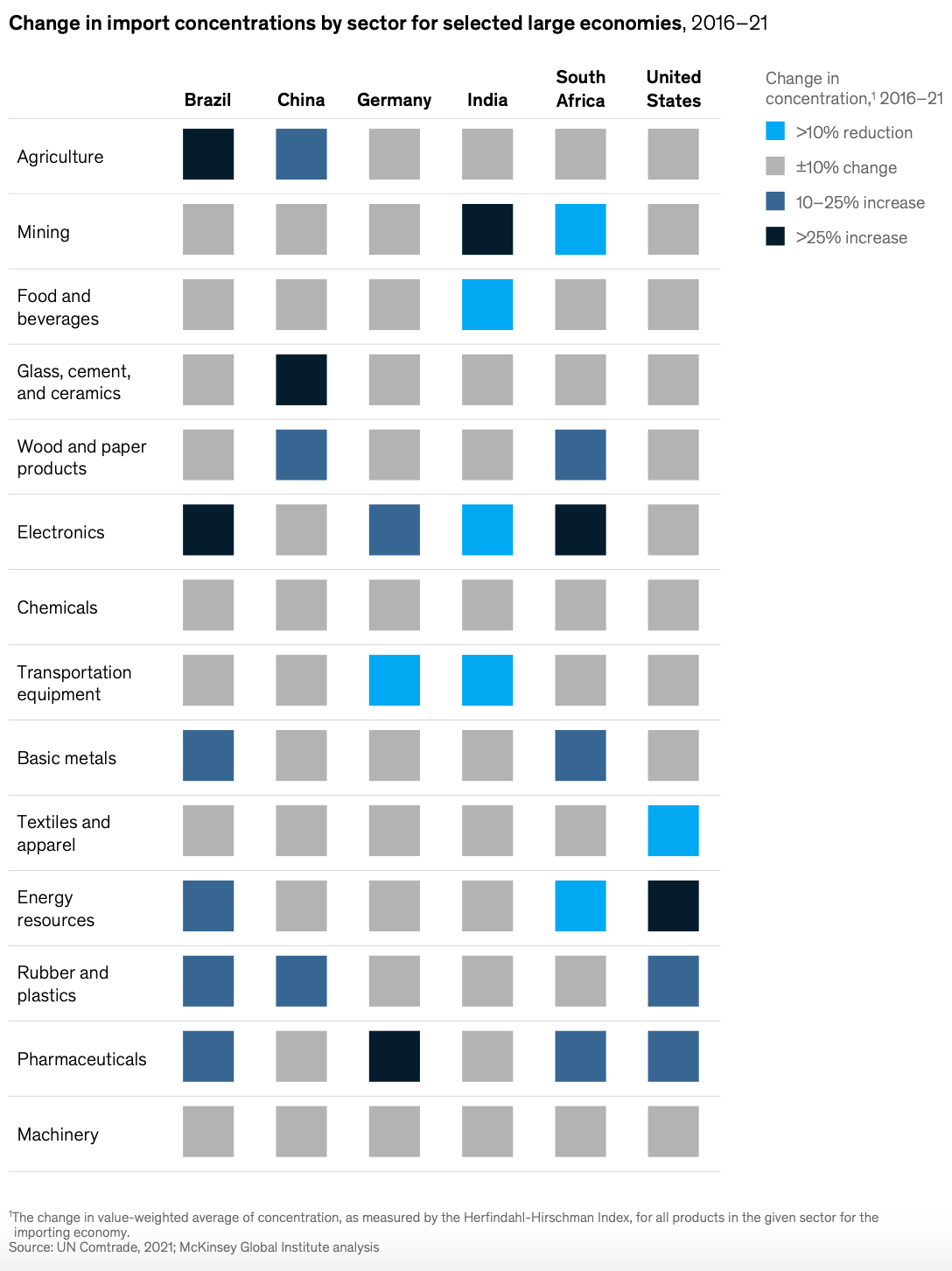
5. This graphic about India's import concentration is very useful
India’s most concentrated sector is food and beverages, largely due to vegetable oils, which account for about 80 percent of its imports in this sector. India depends on imports to meet domestic demand and is the world’s largest importer of vegetable oils, with significant imports of palm oil, 90 percent of which is supplied by Indonesia and Malaysia, and sunflower oil, 75 percent of which came from Ukraine. This concentration fingerprint proved problematic after Indonesia banned palm oil exports and the war impeded Ukrainian sunflower oil exports... In 2021, India received about 80 percent of its supply of unworked diamonds from Belgium and the United Arab Emirates these two economies.

The impressive achievement over 2016-21 was the reduction in trade concentration in important sectors like electronics and food and beverages. In fact, the concentration has remained largely stable across the 14 sectors analysed. 

Monday, January 23, 2023

The need to broaden the base of Indian economy

I have long argued that despite its massive population, India's economic foundations are built on an extremely narrow base. This means that the country needs to focus on broadening its economic base across all dimensions, and in its absence the limits to economic growth will become apparent very soon. 

The digital economy, which has been the basis for a good part of the high growth enthusiasm about India, may not be as large as is being imagined. No matter how disruptive the technology, the net addressable market of customers who are meaningful enough consumers may be far smaller than is believed. This can expand only with broad-based economic growth. 

The latest data point concerns the plateauing of mobile data users in India. The Economist has a recent article,

All but a tiny proportion of Indian internet users get online using their phones. Yet the number of wireless broadband connections is flat. In October last year, the latest month for which figures are available, the telecoms regulator counted 790m wireless broadband connections, barely exceeding the previous peak of 789m, which was recorded in August 2021. Smartphone sales are down. After growing for a decade, sales peaked at 161m units in 2021, according to IDC, a market researcher, which reckons that last year the number fell to 148m. Meanwhile the average smartphone price has surged, from $163 before the pandemic to $220 in 2022... manufacturers no longer find it worth their while to sell ultra-cheap phones, says Navkendar Singh of IDC. The market share of smartphones costing less than $100 dropped from 30% in 2019 to 12% last year, according to Counterpoint, another research firm. Before the pandemic some 5m people traded up from a dumbphone to a smart one every month. That dipped last year to about 3m, says Shilpi Jain, an analyst with Counterpoint. Mobile subscriptions are getting dearer, too. In the year to June 2022, prices rose 28%. The number of converts, from dumb to smart, is expected to fall again this year.

A Business Standard oped had this to say

The sweet spot for people in the middle and lower end of the market to upgrade from an ordinary phone to a smartphone was Rs 8,000. Thanks to the chip shortage triggered by the pandemic and the resulting supply constraints, there are no smartphones available in that range. The average selling price is Rs 16,000-Rs 20,000, say analysts.

In other words, while the global average selling price for smartphones is above $300, the majority of Indian smartphone users can only afford one for $100. 

The stagnation and decline, even at the low baseline, points to a very limited market segment which can afford these devices and services. The flush of low prices to capture the market is over and telecoms providers (and smartphone makers) realise the need to improve profitability. And when prices rise, the price sensitive nature of Indian consumers become apparent and demand tanks quickly. The Ken has a nice graphic which captures the smartphones trend

These numbers are skewed by the fact that many users have multiple connections and smartphones, thereby making it difficult to identify the true number of consumers with smartphone connections. 

The Ken has another striking statistic on the number of wireless subscribers, including those on feature phones and those not subscribed to internet usage.

In its latest report, as of October last year, TRAI puts this number at 1,144 million users. In September, it was more or less the same. Go back to January. Still the same. If you go back one full year, to January 2021, this number was a bit higher, at 1,159 million users. But essentially, this has been flat. It seems like this is the natural limit... January 2017—1,151 million users... For half a decade, India has seen almost zero growth in its mobile phone users. So while India’s mobile internet users have stopped growing for the last year or so, there’s an even deeper trend—India’s mobile users stopped growing since much, much earlier. 

The article gets to the heart of the problem,
If India needs more mobile data users, it needs to raise income levels. Cheaper smartphones will help, but only to a point.

This is important since as another Ken article here points out the number of active internet users, the addressable market for internet customers, in India too may have become stagnant. The article describes these annual active customers (AAC), 

These are the users who have access to the internet through a smartphone, use mobile apps, have some disposable income, and have bought something online at least once a year. E-commerce. Shopping. Food Delivery. Rides. Subscriptions. This is the customer base of most Indian internet companies. These are the users who pay for stuff online... if you really stretch it, it’s about 70 million users (realistically, it’s closer to 40-50 million, but more on this later)... A great proxy is the number of postpaid mobile users in India, which is around 50 million, who form the bulk of this base... Essentially, if you want to make money online in India, you’ll need to take it from these 70 million users... (who) can be broken down into three categories... 

At the lowest level, with the broadest base, comprising roughly 40 million users. These users are the ones who have bought something online, but have done it very sparingly. Maybe once or twice last year, and they have done it because they heard that one gets a good deal online for a really important purchase, which is usually a mobile phone... Also, these users are extremely price-sensitive. You’ll find it hard to persuade them to pay even a delivery fee... At the middle level, comprising roughly 20 million users. These users may buy something online, but will venture outside online shopping very, very sparingly. Think of users like our moms and dads, who spend money online to get food from Zomato as a treat, or maybe take an Ola once a month if they are feeling particularly generous. College students also form a part of this. It’s a base that’s somewhat comfortable online, but can’t be relied on to spend regularly... At the highest level, comprising 10 million users... (they) buy nearly everything online—from products, to groceries, to food... may even have a Netflix subscription... are the elite user... 

This is the customer everyone desperately wants... They may be just 15% of the active transacting customer base, but according to one founder I spoke to, they account for nearly 40% of the money spent by this pyramid... In its recent pre-IPO report, Zomato, which is a food delivery service and had a strong use-case during a pandemic, reported an average monthly transacting user base of...10 million users. Netflix has about 3 million subscribers in India (and has started tapping out) CRED claims to have about 6 million. Amazon Prime has 6-7 million users... That’s the population of Sweden... Take China for instance, which has a per capita GDP of around $10,000. That’s five times of India. Alibaba, their largest online horizontal commerce platform, has an active transacting customer base of 800 million users. India has just a tenth of that, assuming the best case scenario.

India's internet businesses are primarily locked in a battle to grow at the intensive margin by differentiating and expanding their offerings to the 10 million consumers. At the extensive margin, it's more a long-haul to get the occasional consumers to spend more and expand the base itself. The 10 million market is enough to support several unicorns, but not large enough to support a $100 billion company. 

The last part of the limits of the digital economy comes from a third article in The Ken which shines light at the very narrow pool of high quality and experienced digital technology manpower. The article puts the number at 10,000. The article points to anecdotes of the extraordinary lengths startups go to attract and retain good quality engineers. Since the pool of good quality engineers is small and since everyone is fishing in the same pond, the salaries of these engineers rocket up also pulling up salaries of others too.

However, the number of engineers absorbed by the largest ten tech unicorns is very small.

In other words, ten largest startups with a combined valuation of $116 bn employ just 8871 engineers! This also points to another insight about the technology startup industry - it's limited role in addressing the country's employment crisis.
When it comes to the top 10 Indian startups, the average engineering strength per billion dollar valuation is 77. In other words, if a company wants to increase its valuation by a billion dollars, on average, it needs 77 more engineers.
This about Byju's (and Edtech) is interesting, 
Byjus, which has built its valuation on a series of acquisitions and does not necessarily depend on a tech moat, has the lowest ratio of engineers per billion in valuation—38. This partially explains why edtech companies are able to suck up funding like crazy. They need tech to a certain point, but beyond that they don’t need engineers to scale.
In any case, the point to be made is the small size or base of India's consumer class, digitally addressable market, and skilled engineering work-force. This is far smaller than widely believed.