Substack

Sunday, December 11, 2022

Weekend reading links

1. The Adani Group has won the bid for the 259 Acres (2.5 sq km) Dharavi redevelopment project with an offer of Rs 5069 Cr. The Rs 20000 Cr project would rehabilitate 650,000 people over a period of 7 years. The redevelopment would have an FAR of 4, though there will be height restrictions given the proximity to the airport. The second highest bidder, DLF, could offer only Rs 2025 Cr. The Adani Group will construct the public housing project and subsidise it with commercial and residential developments. 

This will be the main challenge for the developer,
"...more than the technical challenges about densities and height restrictions, social rehabilitation of the slum residents shall be the biggest stumbling block and Adani has to handle it delicately to succeed in this redevelopment plan," said Gulam Zia, senior executive director at Knight Frank, a property consultant... Besides supporting the residential needs, Dharavi has thriving small sector units that sustain the needs of the residents and provide for a huge consumer base. Any negative impact on the livelihood of these residents can meet with tremendous resistance like in the past, Zia said. Dharavi is home to the potter community and leather goods makers who have been doing business in the shanty-town for decades... Prashant Thakur, senior director and head of research at Anarock Property Consultants, said that the challenge with the redevelopment of Dharavi is that too many stakeholders are involved and managing them is a big task. This is a key reason why it did not take off in the past. “The key to the success of one of the largest redevelopment projects in the world is to re-align the development scope with a more sensitive rehabilitation programme flexible enough to incorporate an interdisciplinary approach that suits the local socio-economic conditions," said Thakur... there is no template to rehabilitate such large scale tenements, including finding temporary accommodation for the residential, commercial and cottage industry occupiers.

2. Interesting long read about the four-day work week,

Advocates for the four-day week point out that unlike a season or a day, there is nothing natural about the working week. The two-day weekend — dispensing with working on Saturday morning — did not take off in the UK until after the second world war, quashing arguments that too much leisure time could spur political activism among the working classes.
3. Business Standard reports that Adani Electricity Mumbai Ltd (AEML) has been given permission under Section 14 of the Electricity Act 2003 to operate as a distribution licensee. This is the first such approval for distribution licensee, which brings in competition in the electricity supply side. The permission has been given for the Navi Mumbai area which covers nearly 500 sq km with 880,000 households (2011 census) and has a current demand of 1600 MW and 9.5 billion units. The AEML is already one of the discoms in Mumbai where it took over operations from Reliance Infrastructure in 2017. 

The area, apart from including the Adani Group owned Navi Mumbai airport, also has the JNPT and Navi Mumbai SEZ, where several large power consuming industries like data centres are being established (AdaniConneX, a JV with EdgeConneX, is developing data centres). 

The beginning of supply competition on the distribution side is welcome and an important step in ushering discipline into the sector. The concern though would be that the AEML would end up capturing all the high vale consumers, leaving the incumbent discom with all the smaller and difficult customers. What market design can mitigate such cherry picking?

In China and Taiwan, industrial policy was always a priority: the consequence of the need to survive in an industrialised world with much richer foes. Technological catch-up was a necessity for successful nation-building... In the developed west, industrial policy pushes have come not as a grand crescendo towards modernisation, but in loud and quiet cycles, peaking during periods when one power is afraid of losing out to the others. The US space race against Soviet Russia is a prime example, as well as American consternation over Japan’s ascendancies in the 1980s. Now that we are back in a period of global order-shaking, the discussion is back on loud. Western fear over China’s rise, and concerns over supply-chain security in the wake of pandemic shortages, all spurred the new EU and US chips policies. As a result, governments in the west are abandoning their taboos around talking about industrial policy, or orientalising it as only fit for east Asia. The economist Dani Rodrik remarked that the US Chips Act was significant for being “a sign that we have moved well beyond market fundamentalism and because it shows there is now bipartisan support for industrial policies”.

5. FT reports that an ILO report has found that global wages have fallen in real terms this year for the first time since records began. 

The UN agency’s annual report on pay showed that global monthly average wages in the first half of 2022 were 0.9 per cent lower in real terms than a year earlier, marking the first outright fall in worldwide living standards in the 15 years for which the ILO has published data. The drop was steepest in the developed world, where inflation picked up earlier. The ILO said that among G20 economies, which account for about 60 per cent of the world’s waged employees, real wages had fallen 2.2 per cent year on year in advanced economies. Across G20 emerging economies, wage growth slowed but remained positive at 0.8 per cent — but this was in large part due to China’s resilience, with other major countries such as Brazil hit hard.

6. Political polarisation in the US pervades everything. Consider this about jeans

Levi Strauss and Wrangler both got their start as the go-to jeans for cowboys, railroad workers and others who pioneered the American West. Today, they are on opposite sides of a political divide that is affecting not only how people votebut what they buy. Consumer research data show Democrats have become more likely to wear Levi’s than their Republican counterparts. The opposite is true with Wrangler, which is now far more popular with Republicans. There is no simple explanation behind those consumer moves. Some of it is due to social and political stances companies are taking, such as Levi’s embrace of gun control. Some is tied to larger geographic shifts in the political parties themselves, as rural counties become more Republican and urban areas lean more Democratic. Wrangler is popular in the cowboy counties of the West and Midwest while San Francisco-based Levi’s resonates more with city dwellers... 
Levi Strauss & Co. has embraced liberal causes such as gun control and support for immigrants. Wrangler has stayed out of politics but has burnished the cowboy aspects of its brand by supporting rodeo... From 2004 to 2018, the partisan split within Levi’s customer base to the Democrats grew by 3 percentage points, while Wrangler’s customer base moved 13 percentage points toward the Republicans... Nearly 60% of 1,000 Americans surveyed by Edelman last year said they would choose, switch, avoid or boycott a brand based on its stand on societal issues. That is up from 47% in 2017.

And this about cars (HT: Adam Tooze)

Wednesday, December 7, 2022

Free-market in action - online gambling edition

Free market orthodoxy would have it that markets are self-correcting and strongly oppose government interventions. They reject the possibility of market failures and argue that such apparent failures arise from government regulations or   thatthe market dynamics would correct these failures in due course. 

This orthodoxy flies in the face of reality. The real world is full of examples where market dynamics left to itself creates distortions and perversities which persist for long times, if not forever. A friend pointed me to this article in Bloomberg on the corrosive social effects of online gambling in the UK. 

UK was a pioneer in allowing online gambling in 2005. The market has since had a free-run attracting consumers and selling innovative products in a largely unregulated market. It's social costs are now becoming apparent and appear similar to the opiod problems in the US.

For four of the past five years, British punters have lost more than £14 billion on online casino games, sports betting and other forms of gambling. Fully 60% of the industry’s profits come from only 5% of its customers, according to a House of Lords’ report. As many as 138,000 people in England are classified by British regulators as problem gamblers, as well as 36,000 children aged 11-16, UK government statistics show. About 400 suicides — or around 8% of all suicides — in England are estimated to be linked to gambling each year, while it disrupts the lives of many more through broken marriages, bankruptcy, homelessness, and crime. During Covid, about 20% of higher-risk gamblers increased the time they spent gaming.

This explains how unregulated industry led to addiction,

The explosion in online gaming in the UK can be traced to the Gambling Act of 2005. Gambling firms were allowed to advertise sports betting, online casinos and poker on TV and radio for the first time, and until 2014 remote operators selling to British customers weren’t even required to hold a UK license. The law predated the technological revolution that was the smartphone. Betting firms have been exploiting that blind spot ever since, developing aggressive habit-forming games tailor-made for obsessive gambling, and cashing in while a significant subsection of their customers racked up huge losses, according to interviews with dozens of current and former employees, reformed addicts, lawmakers, consumer advocates, and academics. Firms including Bet365 Group Ltd., Ladbrokes and Paddy Power then enrolled their biggest losers into so-called VIP schemes and showered them with gifts that typically included free bets, cash deposits, tickets to sports games, flights to Las Vegas, and other inducements to keep them hooked.

On the nature of addiction and how betting companies promote this addiction,

Cooper would log in to games with names like Starburst, Gonzo’s Quest and Book of the Dead. Totally absorbed, he would lose track of time as he pressed the spin button, and the multiple reels covered in brightly colored symbols began to spin wildly. Cooper would gamble feverishly for hours without moving from his couch, sometimes wagering £100 per spin and only stopping once he’d burned through nearly all his money. He once gambled, and lost, a month’s wages in 20 seconds. If he hit a winning streak, he would gamble through the night, until his casino balance hit zero again and he stumbled to bed. Some days he would gamble for 12 hours straight, stopping only to go to the toilet or to eat...

But despite losing on average around £3,000 a month, Cooper says he only received one phone call from a gambling company checking that he was alright. None of the operators asked him if he could afford to lose that much, or checked the source of his wealth or income. But if he stopped gambling for longer than a couple of days — usually because he had lost nearly all his money and could barely scrape enough together to eat — then he would be bombarded with emails, text messages and phone calls offering him free bets, bonuses, and cash to return to their site.

With the social costs are now apparent and public pressure to tightly regulate the market and limit social damage mounting, the government has tried to intervene. But, given its profitability and well-entrenched market structure, the industry has responded with aggressive lobbying and other practices to stave off regulation. These other practices have included political capture of the most egregious nature,

Successive UK governments have done little to tighten the rules in the last decade, as an ever-increasing number of politicians have developed closer ties to the industry. Many lawmakers who have spoken out against increased regulation have also accepted thousands of pounds in hospitality from gambling companies, and regularly receive free tickets to top-flight sporting events, as well as lucrative speaking gigs and even second jobs, according to a Bloomberg News analysis of lawmakers’ financial disclosures. The government announced a review of gambling legislation in 2019, but has delayed publishing its findings at least four times. This summer, after intensive lobbying, officials in Boris Johnson’s administration watered down or removed several measures originally contained in the review, according to people familiar with the situation.
The gambling and horseracing industry has spent hundreds of thousands of pounds cultivating lawmakers of nearly every British political party, no matter who is in power. That lobbying has intensified since the end of 2019, when the ruling Conservative Party promised in its election manifesto a review of the 2005 Gambling Act. Since then, the sector has spent more than £300,000 on wages and entertainment for at least 37 UK lawmakers. On numerous occasions, they spoke in favor of the industry in parliamentary debates within weeks of being schmoozed in hospitality suites at sporting and social events.

This political capture has been complemented with regulatory capture,
In subsequent meetings with officials from the Gambling Commission and its overseers in government at the Department for Digital, Culture, Media & Sport, Prest and his colleagues discovered that the regulator was looking for something similar: It had told operators that it wanted an industry-wide tool to track their customers’ activity, known as a “single customer view.” It seemed a perfect fit. But the regulator, on a shoe-string annual budget of about £20 million, handed the job of selecting the most effective solution to the industry lobby group, the Betting & Gaming Council. The BGC told Prest and his partners at the firm they set up, called BetterRisk, that it was running the tender process and would invite them to submit their proposal. Prest says it struck him as odd that he kept being referred to the lobbyists, but he didn’t think much more of it at the time... 
As they were applying the finishing touches earlier this year, though, the bankers received an email from the BGC: They would not even get to submit their proposal because the lobby group had picked Gamstop to help develop the new system. Ten months on, Prest is still extremely frustrated. He says it’s wrong “the industry gets to be the gatekeeper controlling the scope, design, functionality and delivery timeline of a harm-prevention system which is to stop harm that they themselves are causing by their commercial activities.”... Behind the scenes, gambling firms and their lobbyists meet with government officials on an almost weekly basis, according to documents obtained under Freedom of Information requests. In the 12 months to February, ministers and officials at the Department for Digital, Culture, Media & Sport met with representatives of the online gambling industry about 35 times, or around three times a month.

It's been reported about a proposal to regulate online gaming in India. The proposed regulation made the differentiation between games of skill and chance, and wanted to confine regulation to only the former. This was apparently overruled by the Prime Minister's office which wanted to regulate both. It may be the right thing to do. 

It has been a consistent argument in this blog that corruption and venality are not restricted to developing countries and the public sector. They are inevitable whenever there is money involved. Thanks to the institutional strength and maturity, harassment corruption (on delivery of statutory public services, for example) is minimal or absent in developed countries. See this and this. 

But in the case of the highest-value businesses, corrupt practices are common place in the west as in the east. In the former, it's less in the form of egregious bribery and more in the form of quid-pro-quo influence peddling to capture the rule makers, set rules of the game, and erect preferential policies. Given the stakes involved and the universality of human character, these practices are unavoidable. We need regulations to limit them. 

In case of the private sector too, as long as the stakes are high and sufficient corporate governance restraints involving the principals (shareholders) and the agents (management) are not in place, there will be corrupt practices. The scale of such practices is likely to be bigger in the larger companies and those where the institutional restraints on senior executives is limited (for example, in companies with star chief executives). For sure, there is no loss of public resources, but these qualify as violations of fiduciary responsibilities. See this and this. 

This paper describes how executive visits to the White House to meet the US President led to preferential policy changes that boosted the share prices of the company concerned. 

Using novel data on White House visitors from 2009 through 2015, we find that corporate executives’ meetings with key policymakers are associated with positive abnormal stock returns. We also find evidence suggesting that following meetings with federal government officials, firms receive more government contracts and are more likely to receive regulatory relief (as measured by the tone of regulatory news). The investment of these firms also becomes less affected by political uncertainty after the meetings. Using the 2016 presidential election as a shock to political access, we find that firms with access to the Obama administration experience significantly lower stock returns following the release of the election result than otherwise similar firms. Overall, our results provide evidence suggesting that political access is of significant value to corporations.

This paper shows that Federal Reserve insiders systematically engaged in insider information trading with financial market actors the day before FOMC meetings.  

In this paper, I employ anonymous New York City yellow taxi records to infer variation in interactions between insiders of the Federal Reserve Bank of New York (New York Fed) and insiders of major commercial banks around Federal Open Market Committee (FOMC) meetings. Taxi rides between the vicinities of the New York Fed's and the major commercial banks' buildings serve as indicators of meetings at those institutions, and coincidental drop-offs of passengers picked up around those institutions serve as indicators of offsite meetings. Cieślak, Morse and Vissing-Jørgensen (2016) posit systematic leakage from the Federal Reserve around FOMC meetings along unofficial channels, and, in line with that hypothesis, I find highly statistically significant evidence of increases in meetings at the New York Fed late at night and in offsite meetings during typical lunch hours.

There are too many examples of fiduciary failures and criminal conduct in private sector in India and elsewhere to worth specifically linking them.

Finally, in all these cases, developed or developing country, public or private sectors, despite all institutional restraints and management-speak, the absence of corrupt practices boils down to the character of the individuals concerned.

Monday, December 5, 2022

Expenditure ideas are fine, but what about revenues?

As the Union Budget 2023-24 approaches, talking heads in television channels get busy with their wish lists of new types of tax concessions and spending proposals. All these ideas are invariably focused on the expenditure side. Some of them are doubtless good, but difficult to implement without the required resources. 

However, apart from the usual proposals on privatisation and selling of government lands (both of which face under-appreciated implementation challenges), ideas for revenues augmentation are scarce. In fact, among the long list of spending ideas, one struggles to come across even a handful of meaningful revenues mobilisation proposals. 

One can understand businesses and citizen groups talking only about tax cuts and public spending, but academicians and public commentators? Take academic research. There have been countless research papers which propose new programs and projects. But I cannot remember any which propose a new public revenue stream or increase in a tariff or user fees.

It's as though everyone wants to become a populist by spending money and avoid raising taxes and fees. 

It's perhaps not incorrect to say that there are at least a hundred times more expenditure ideas on the table than there are resources to spend. In the circumstances, I would imagine that any social optimisation of ideas generation and academic research should prioritise revenues generation over expenditure. 

Consider the following. India has one of the lowest property tax, utility tariffs, and municipal user fees in the world. I struggle to find even one paper which examines the magnitude of this problem, much less aggressively advocate reforms to raise rates and fees. 

Land registration in India suffer from several channels of leakages. Why doesn't anyone want to do a study to assess the extent of revenue leakages from land registration process? What are ideas and innovations to plug the different channels of leakages?

Where are the ideas to expand the shockingly low income, corporate, and GST bases? In particular, GST itself is a fertile ground for large-scale evasions - how can they be detected? How can  practices like cross-border transfer pricing distortions, under-invoicing of imports and over-invoicing of exports etc be avoided? How can IT be used to meaningfully (not the questionable ideas like GIS mapping of properties) plug revenue leakages? See this.

Even with selling of government lands or privatisation, the standard prescriptions on the revenue mobilisation side, there are hardly any insights on the small details of their execution. 

Actually, this reluctance of commentators and influencers to engage on the less popular issues goes beyond revenues mobilisation. For example, we're now witnessing the trend among state governments to revert to the defined benefit Old Pension Scheme (OPS) for public employees. Most people would agree that it's one of the most damaging public policy decisions of the last several decades. I'm surprised at the lack of engagement on the issue by the normally strongly opinionated public commentators and academicians (especially those based in the west).

Or consider the issues of fiscal sustainability and incentive distortions in developing countries like India of good-to-have tertiary education scholarships and tertiary care health insurance programs. I have not come across a single oped urging caution on the ever-expanding scope of such first-world welfare state. Nor have I seen serious research and sustained commentaries on the chronic problem of burgeoning manpower costs of state governments in India. 

Or rigorous scholarship on the real value of industrial incentives in business investment decisions. I have not seen a study on the marginal value of fiscal and input incentives in the determination of business investment decisions, especially in cases of large businesses, compared to say, business environment or ease of doing business reforms.

What explains this vacuum of ideas on revenues mobilisation? 

I can think of at least two simple explanations to this skewed preferences. One, we see so many problems around the world and thinking up ideas to spend more to address them is easy enough. Two, just as governments are easy targets to criticise for not spending (and thereby not solving the problem), it's as much or more difficult to criticise businesses, consumers, and taxpayers for not contributing their fair share. 

Taken together, given the pervasiveness of problems facing the world and high psychological cost of proposing pain, everyone piles on the spending bandwagon. Everyone becomes a populist to score brownie points. 

Saturday, December 3, 2022

Weekend reading links

1. Definitive signature of greening nature of global economic growth

In 2007, when China’s economy was roughly as big as India’s is today, it emitted around twice as much carbon dioxide. India and Vietnam are still powered by coal. The difference is they are making much more efficient use of it.

2. Wind power fact of the day,

One turn of an “SG 8.0-167 DD” turbine generates enough electricity to run a British home for a day and a night. SG stands for Siemens Gamesa, a subsidiary of the German industrial giant, which makes the machines in Hull. The 8.0 is the turbine’s maximum output in megawatts (MW). The 167 is the diameter of its rotor in metres: it sweeps out in a circle equivalent in area to about three football pitches. And the DD stands for direct drive, an electricity-generation technology with no fiddly gears to wear out. At Hornsea 2, a wind farm located off the Yorkshire coast, 165 of these vast turbines form a field of steel stretching farther than the eye can see. Hornsea 2, which became fully functional in August, is now the largest wind farm in the world. When the wind really blows it can power 1.4m homes... By 2010 there were 1.3 gigawatts (GW) of wind power in British waters. Today there are 14 GW... About 36% of British electricity now comes from wind, the majority of it offshore... In the process, the cost has fallen sharply. In 2015 new offshore wind cost £120 ($155) per megawatt hour; today it costs well below £40.

3. Rana Faroohar has a perceptive guide on the deglobalisng world.

After decades of a “winner take all” trend, in which the majority of prosperity has been located in a handful of cities and companies, look for business and policymakers to be more focused on ensuring that wealth and place are re-moored. This will come with costs — such as inflation. The old “efficiency” models, which assumed that people, goods and capital would move seamlessly to wherever they were needed, were cheap. Creating more opportunity at home, while still remaining connected to the global economy, will require building more resilient models — that involves better education, infrastructure, higher local wages, and less focus on the short-term bottom line. Efficiency was cheap. Resiliency will cost more. Who pays for it is up for grabs...

But as Harvard academic Gordon Hanson, one of the figures within this movement to reimagine free-market capitalism, puts it: “When workers without a college degree lose their jobs, few choose to move elsewhere, even when local market conditions are poor.” One reason for that is that they depend on the family and community ties of place to buffer them in difficult times. Hanson and his colleagues are building new, highly localised models of how economic growth happens in different areas.

About the costs of reshoring and localisation of supply chains, 

While some worry the shift would be too costly, a 2021 BCG analysis found that more localised production networks would add only a 2 per cent mark-up on a $35,000 car, a 1 per cent increase in the price of a smartphone, or 3 per cent more for a $200,000 home. This, coupled with precision data technologies that allow for extremely precise tracking within supply chains (a textile retailer can now identify the provenance of cotton down to a particular farm or field), and a younger consumer geared towards buying fewer things of better quality, will both encourage more localisation and help the planet.

4. Marianna Mazuccato has four requirements for industrial strategy involving procurements, grants, loans, and tax incentives,

Where affordable and equitable access is a policy priority, products and services with public funding should be priced accordingly. For example, the AstraZeneca Covid-19 vaccine, developed with the help of government investments in R&D, manufacturing, and advance sales, included provisions to keep prices low, limit profits during Covid and ensure knowledge-sharing for public health... Conditions can also shape the goals — or “missions” — behind investment and impose standards on companies. Decarbonising existing industries and expanding green innovation and growth is a priority... Conditions associated with a just green transition should cut across all industrial strategy investments: for example, requiring new manufacturing capacity to minimise carbon emissions and create jobs that meet labour standards. 

In addition, receipt of public funds should be conditional on sharing a proportion of royalties, equity or intellectual property with the government. This would enable the state to take a portfolio approach to investments, knowing some will succeed and some fail... Last, governments can prompt companies to channel their own investments into productive activities. Biden’s Chips and Science Act, which seeks to boost US semiconductor innovation and manufacturing, includes “guardrail” provisions that prohibit funds from being used for share buybacks. It does not yet, however, prohibit companies that receive chips act funding from engaging in such buybacks — a loophole that has led to calls for tougher rules.

5. India's labour cost and size advantage

6. The sheer scale and nature of corporate governance breakdown at FTX is staggering. FT has a good article. 
... an environment where employees’ every need was catered for, and where a circle of senior executives in their late twenties and early thirties splashed millions of dollars on everything from travel to sport sponsorship deals and luxury homes. A lack of internal controls that are typical of large financial companies meant FTX’s spending went largely unchecked, according to former employees and filings in the group’s Delaware bankruptcy case. “[It was] kids leading kids,” said one former employee. “The entire operation was idiotically inefficient, but equally mesmerising,” they added. “I had never witnessed so much money in my life. I don’t think anybody had, including SBF.”... Concerns about value for money from employees with marketing experience were brushed off by Bankman-Fried and the company’s top executives, this person said. Bankman-Fried or one of two other executives signed off hundreds of millions in spending on sponsorship deals. “It just kinda went crazy,” the employee said. “If Sam said OK, it was good to go. Regardless of the amount.” John Ray, the new FTX chief executive leading the exchange through the bankruptcy, said he had never seen “such a complete failure of corporate controls”.
Some should surely attract criminal liabilities
“The [company] did not have the type of disbursement controls that I believe are appropriate for a business enterprise,” he said in filings, adding that company money was spent on buying homes and personal items for FTX employees and advisers. “There does not appear to be documentation for certain of these transactions . . . and certain real estate was recorded in the personal name of these employees and advisers,” Ray added... Bankman-Fried’s companies also extended loans to executives, bankruptcy filings show. His trading firm Alameda Research loaned $1bn to Bankman-Fried himself, $543mn to head of engineering Nishad Singh and $55mn to Ryan Salame, co-chief executive of FTX Digital Markets, its entity in the Bahamas.

Sample this about poor quality of due diligence by venture capital investors,

The boring process of checking that potential investments can live up to their promises has fallen completely by the wayside. Due diligence once meant sending bankers to check that a mining company really had a working gold mine, hiring accountants to scour the books and asking lawyers to identify contracts that could prove troublesome in a bankruptcy. These days, it is hard to know what due diligence actually means. Ontario Teachers’ Pension Plan, which put $95mn into FTX, insists that its professionals “conduct robust due diligence on all private investments”. Tiger Global, which tossed in $38mn, pays outside consultants including Bain & Co to do the work. Yet both missed what FTX’s new chief has described as a “complete failure of corporate controls”. Sequoia Capital, which handed FTX founder Sam Bankman-Fried $214mn even though he played video games during his pitch to them, has walked a fine line... Veteran Silicon Valley dealmakers say there has been a gradual erosion of standards, as venture capitalists stopped trying to select and nurture the smartest entrepreneurs and started spraying cash around... decades of easy money and a lack of decent yields from safer alternatives mean this approach has spread from early investment rounds involving a few million dollars to gigantic deals involving billions.

7. No matter the details, the six year old public procurement website Government eMarketplace (GeM) is an outstanding success 

Prashant Kumar Singh, chief executive officer of GeM, recently said the portal would be the largest e-commerce platform in India by the end of the current financial year, crossing Amazonand Flipkart. Singh pegged the FY23 GMV target for GeM at Rs 2 trillion (around $25 billion). In FY22, GeM recorded a GMV of $14.2 billion, as against Amazon India’s $17 billion and Flipkart’s $23 billion.

8. To say that Morgan Stanley is bullish on India is an understatement

We see over the coming decade to 2031, India’s GDP more than doubling to over $7.5 trillion, the stock market compounding annually at 11 per cent to around $10 trillion, a discretionary consumption boom led by a rise in per capita income from $2,000 to over $5,000 and a quintupling of households earning in excess of $35,000/year to over 25 million, a rise in credit to GDP from 57 per cent to 100 per cent, causing a 17 per cent annual compounding of credit growth, and a doubling of India’s share in global exports.

Let's see how much of this materialises by 2031. 

9. Qatar World Cup 2022 

Since winning the competition to hold the World Cup in 2010, Qatar has spent more than $250 billion on soccer-related development, a figure that dwarfs the estimated $42 billion that China spent on the 2008 Beijing Olympics and the $55 billion that Russia spent on the Winter Olympics in 2014. Ten billion has gone on eight soccer stadiums. The rest was devoted to a wholesale transformation of the country: the complete remodeling of downtown Doha; the construction of nearly a hundred new hotels; the expansion of the port and the airport; a revamped road system; the creation of three metro lines; and a new city with homes for more than a quarter of a million people.

10. Adrian Wooldridge on Sweden

The Swedes combine the best features of German and American capitalism. German-style Swedish companies dominate global niches through a combination of engineering excellence, high-quality training and constant innovation... Swedish society at large is remarkably pro-business. The government allows private companies to run bits of the state such as schools and hospitals. The Swedish stock market is Europe’s largest, with 950 listed companies (mighty Germany comes second with around 800). Half the adult population has savings in the Swedish mutual fund account. Sweden has more venture capital investment as a share of GDP than any other European country, much of it drawn from America, and venture capital-funded investment is thought to have increased GDP by six percentage points since 2005.

11. India has received strident criticism from western politicians and commentators about buying oil from Russia. But contrary to the impression of India's purchases bailing out Russia, even today its purchases are a small share of those by Europeans. 

12. Janan Ganesh has an excellent article that captures the times,
If you tell me what you think about, say, the return of the Benin bronzes, I can infer with some confidence your views on public spending, the EU, rail strikes, immigration, working from home, climate change, Meghan Markle and much else. Nothing connects these subjects. It should be possible to be a small-government Remainer who thinks imperial loot is better off in western museums and who loses sleep to visions of a burning planet. But such a person would stand out now. To take a more concentrated example, lots of people should be anti-lockdown and pro-vaccine mandate. How many do you know?... People do not work out their beliefs and then join the corresponding tribe. They join a tribe and infer their beliefs from it. The sense of belonging, the group membership, is what hooks people, not the thrill of being right or pursuing a thought on its own terms. Politics has become a team sport, goes the line on this.

13. Finally, FT has an article on India's emergence as a major creditor to its neighbours, nearly tripling in value since 2014 to $32.5 bn. 

India’s cumulative “development assistance” since its independence in 1947 has nearly doubled from $55bn to $107bn since 2014, according to the government-backed RIS think-tank. The scale is far below what China is attempting through the BRI launched nine years ago, which the American Enterprise Institute think-tank estimates reached $838bn last year. Yet the foreign ministry said India has extended more than 300 lines of credit for around 600 projects, ranging from a cement factory in Djibouti to the Maldivian bridge. India has also funded everything from training courses to restoring overseas cultural sites such as mosques and temples.

Lending through India’s development partnership administration, by which it offers other governments lines of credit, has nearly tripled in value since Modi came to office in 2014 compared to the previous eight-year period, according to the foreign ministry, totalling $32.5bn.

In contrast with China, as the article points out, Indian credit is concessional and comes in the form of partnerships involving private companies. 

Monday, November 28, 2022

A proposal for unlocking bank finance in infrastructure projects

Opinion makers and experts on urban finance in India focus disproportionately on municipal bond issuance and Public Private Partnerships (PPPs). I believe that instead they should prioritise encouraging cities to increase their municipal revenues and also access non-recourse bank debt. Given the very nature of these works and the limited capabilities within local governments, both municipal bonds and PPPs are likely to be marginal contributors compared to other sources for the foreseeable future. 

In this context, there have been two very informative recent reports on municipal finance, from the Reserve Bank of India (RBI) and the World Bank (WB). The RBI report shows that in 2019-20 property tax as a share of GDP in India is among the lowest at 0.11% of GDP, with own tax revenues being 0.22%, own revenues (tax and non-tax) being 0.45%. Disturbingly, capital expenditure by cities was just 0.32% of GDP whereas revenue expenditure was 0.58%. Strikingly, own source revenues declined from 84.8% to 64% over 1960-61 to 2019-20, whereas property tax as a share of total revenue receipts declined from 60.9% to 15.5%. See also this from the WB report
One graphic from the WB report caught my attention. 
The RBI report informs that while cities are the engines of national economic growth, contributing 63% of national GDP, ULBs received just 5% of the credit by Scheduled Commercial Banks (SCBs) and gross municipal borrowings was less than 0.05% of GDP. In simple terms, the most important growth driver is the least leveraged and thereby employing capital in a most inefficient manner.  

This draws attention to the problem of sorely inadequate commercial debt mobilisation by ULBs. Within commercial debt, as I have written in detail here, the role of capital markets have been marginal outside of US (unique and long historical reasons) and China (where it can be better described as land bonds than municipal bonds). As is the case elsewhere, banks will have to be the predominant source of commercial debt. 

It's important that public policy prioritise the removal of barriers that come in the way of ULBs accessing bank debt, and to expand the envelope of municipal projects that can be bank financed. I'll outline a proposal in regard to the latter. 

One way to do this is to make the project self-financing and thereby unlock private capital through debt financing. Certain categories of projects can be made financially sustainable or commercially attractive with some bridge financing support. Infrastructure services which generate revenue – mass transit, water and sewerage, solid waste management etc – are good examples. In a rapidly urbanising and chronically infrastructure deficient country, while the demand for these urban infrastructure projects is massive, the available public finance is scarce. Besides, the small volume of municipal finances as aforementioned means that very few of these projects find the light of day. 

The Government of India’s (GoI’s) Viability Gap Funding (VGF) scheme already provides bridge grants (of upto 40% of project cost) to PPP projects to make them commercially attractive for private investors. But, as experience from across developed markets show, for a variety of reasons relating to risk appetite of private capital and limited supply-side, a major share of these projects will have to be public managed. The challenge is to ensure its management is efficient. 

In the circumstances, it’s proposed that the GoI expand the scope of its existing VGF scheme beyond PPPs to also include public financed revenue generating projects that become bankable once the viability gap is bridged. This can be called the Project Finance Fund for Infrastructure (PFFI). 

The Fund should be accessible to all eligible infrastructure projects. Eligibility can be defined in simple terms – projects financed by bank debt or bonds, bridge finance restricted to 40% of the project cost, non-guaranteed by state governments, and repayments to be met only from project revenues. There should not be any other restriction. Essentially, the Fund can be catalytic to crowd-in institutional finance. 

The requirement that the debt not be guaranteed should be sufficient to ensure that the proposal is not abused or subverted to push through routine public financed projects. 

Accessing the fund should also be easy and simple, so as to allow state and sub-state entities to access it without onerous conditions and administrative hassles. Simplified eligibility requirements and easy accessibility are critical requirements for the success of PFFI (an issue underlined by the failure of VGF scheme). In order to realise synergies and expertise, it can be considered to have the scheme's administration be with any of the existing or newly created development finance institutions (DFIs). 

As regards concerns about debt recovery given that a water or solid waste project are non-appropriable public goods, we only need to look at national highway projects, for example, for which bank loans are among the main source of financing. Or the case of weaker section public housing projects where too similar concerns exist. On the issue of asset-liability mismatches (ALM), many projects require loans with only 5-7 years tenor which can be managed by banks. Further, mechanisms like syndicated takeout financing can mitigate ALM risks. 

This would help kick-start several bankable urban and other infrastructure projects undertaken by public agencies that are currently unable to attract institutional finance. Institutional finance, like private participation through PPPs, can be a strong efficiency enhancing and sustainability factor in such projects.

The case for restricting VGF to PPPs rests on the premise that private management will bring in discipline and improve operating efficiencies. A comparable discipline and efficiency can be realised by mobilising project finance debt. In fact, project finance model can also help commit governments to maximise project revenues generation, thereby encouraging good practices like higher connection charges, tariffs, user fees etc and ring-fencing of such project revenues. 

The PFFI would be a good complement to the GoI’s focus on capital expenditure in general and the national infrastructure pipeline in particular. Further, it would be a welcome stimulus to support state and local governments at a time their revenues are squeezed due to the pandemic. Given that state and local governments make up two-thirds of capital expenditures, any compression in their capital expenditures would adversely impact the economic recovery from the pandemic and also medium-term economic growth prospects. 

The Fund’s proposed eligibility requirements contain easily identifiable restrictions which may be sufficient to limit its possible abuse. It can be made explicit that bank financing be limited to project finance, and not state government guarantee or general revenues of the public entity/agency. In order to ensure their skin in the game, the sponsoring public agency can be made to contribute a small minimum percentage of the project cost.

Needless to say, such financing initiatives will have to be complemented with measures to increase revenues - property taxes, non-tax revenues, and utility tariffs. The Government of India could mandate that cities seeking to access PFFI should undertake a well-defined set of reforms relevant to enhancing the commercial viability of the project being financed. The WB report consolidates the well-known list of regulatory and enabling requirements to facilitate project finance like debt mobilisation. 

Saturday, November 26, 2022

Weekend reading links

1. The universe of Mukesh Ambani's companies, or Ambaniverse.

2. In the backdrop of Elon Musk's devastation of Twitter, Simon Kuper writes,
Today’s two dominant organisational forms are practically the same: the one-man autocratic state and the one-man autocratic company. Both have the same vulnerability: the idiosyncrasy of an overpraised loner... One-man states and one-man companies have similar cycles. At first, even if the autocrat’s aim is self-enrichment, he wants approval, so he avoids self-sabotage. Being unbound by rules, he seems more agile than his collectively ruled rivals. With success, he acquires an aura. He stabilised Russia/invented Facebook/built electric cars. Why, he’s a genius! If he wants to become president for life or assign himself stock with 10 times the voting rights of other shares, well, what could possibly go wrong? Having defied gloomsters the first time around, the autocrat ignores them the second time But the initial success was generally due to a unique confluence of luck, person and moment. Few humans are two-trick ponies. Worse, hubris takes hold. Having defied gloomsters the first time around, the autocrat ignores them the second time... 

The investor Chris Sacca tweeted last week: “One of the biggest risks of wealth/power is no longer having anyone around you who can push back . . . A shrinking worldview combined with intellectual isolation leads to out-of-touch shit . . . I’ve recently watched those around him become increasingly sycophantic and opportunistic . . . agreeing with him is easier, and there is more financial & social upside.” Sacca was talking about Musk but he might as well have meant Putin.

3. The UK government has announced windfall taxes on oil companies who have raked in multi-billion dollar profits from the high oil and gas prices even as governments struggle to subsidise consumers,

The logic seems straightforward. Energy suppliers are benefiting from an unexpected bonanza because of Europe’s sudden move away from Russia’s gas and oil after its invasion of Ukraine, as opposed to any savvy strategy by the companies themselves. Shell, based in London, recently reported that it had earned $20 billion in just six months, its biggest haul on record, while BP earned $16.6 billion. TotalEnergies, based in Paris, reported profits of nearly $29 billion over the same period. American energy companies are also taking in gobs of profit. Net income for the world’s oil and gas suppliers will reach $4 trillion, the International Energy Agency estimated, double last year’s total...
On Thursday, Jeremy Hunt, Britain’s chancellor of the Exchequer, announced that he would raise $16.5 billion next year by increasing the windfall tax on oil and gas companies to 35 percent from 25 percent and introducing a temporary 45 percent levy on electricity producers. Many of these producers — including those that use solar, wind and nuclear power — have enjoyed enormous profits even though their costs haven’t increased. The European Union last month announced a temporary tax — euphemistically labeled a “solidarity contribution” — on some fossil fuel producers. An additional 33 percent levy will apply to “surplus” profits and is expected to raise $145 billion. There is also a cap on electricity profits. Individual nations have gone further. Last week the Czech Parliament approved a measure to impose a 60 percent tax on energy companies’ and banks’ windfall profits. Germany is considering taxing by 90 percent profits that electricity companies generated above the cost of production...
Yet as several economists have pointed out, whatever the drawbacks, a windfall profit tax makes the most sense when energy companies are making gargantuan profits and families and businesses are facing financial ruin from staggering energy costs. Concerns about crimping investment may also be overstated, they noted, when so many of the oil and gas companies are using the newfound revenue to increase payouts to shareholders and buy more of their own stock to nudge up its price... In a survey of more than 30 European economists conducted in June by the University of Chicago Booth School of Business, half agreed that a windfall tax on excessive oil and gas profits should be used to help households afford high energy costs. Seventeen percent were opposed, while a third were undecided.

Spain followed suit with its lawmakers approving imposition of windfall taxes on banks and energy companies. 

Spain wants to raise a total of €3bn from big banks over the next two years via a 4.8 per cent tax on their income from interest and commissions. From utilities, it is aiming to raise €4bn over the same period with a 1.2 per cent tax on their sales.

4. The hypocrisy surrounding calls to boycott the Qatar World Cup because its stadium construction involved exploited migrant labour is staggering. For countries which have a history of colonial exploitation of the worst kind, and that too not many decades back, and which have supported much worse Chinese genocide in Xinjiang, this concern is very rich. Gianni Infantino was right to call this out.  

Worst of all, the arguments about LGBT rights etc can rightfully be construed by Qataris as an attempt to impose emerging western cultural norms on the Conservative Qatari society.

5. FT has a long read which highlights Apple's dependency on China,

Apple’s reliance on the country as its manufacturing base — with responsibility for 95 per cent of iPhone production, according to Counterpoint, a market intelligence group — leaves the business vulnerable to supply chain shocks... Operating profits in greater China — which includes Hong Kong, Macau, Taiwan and mainland China — have shot up 104 per cent over 24 months to $31.2bn in the financial year to September, eclipsing the $15.2bn earned by Tencent and the $13.5bn from Alibaba in their most recent 12-month period, according to S&P Global Market Intelligence... As Huawei’s share of the Chinese market plummeted from a high of 29 per cent in mid-2020 to just 7 per cent two years later, Apple’s share jumped from 9 per cent to 17 per cent, according to Counterpoint. Virtually all of the US group’s sales were in the premium segment, where its dominance climbed from 51 per cent to 72 per cent in three years.

6. Fascinating twitter thread on how Peru has in less than 10 years risen to become the world's second largest blueberry grower and largest exporter (HT:Adam Tooze).  

Carlos Gereda was the spark that lit Peru's blueberry boom of the past decade. He asked a simple question: "can blueberries grow in Peru?" In 2006, he brought 14 varieties from Chile to see which ones adapted well to the Peruvian climate. He narrowed it down to four and, in 2009, founded Inka's Berries. The company's service consisted of assisting the development of plantations that adhered to the growing standards Carlos had conceived. The blueberry revolution ensued. In a very short time, Peru became the world's number two producer of blueberries and the world's number one in exports and per capita production. Seriously, the growth resembles that of bitcoin's value. In 2010, Peru produced 30 tons of blueberries; in 2020, 180K. This new industry ($1B in 2020) that was born seemingly out of nowhere is being led by corporations that can afford the high cost of entry. Most notably, Camposol and Hortifrut hold a combined 34% of the market. Peru's climate allows for year-round production, giving the country a competitive edge over seasonal agriculture. The productivity of Peruvian land is 13 tons per hectare. The world's top player, the USA, produces 8 tons per hectare.

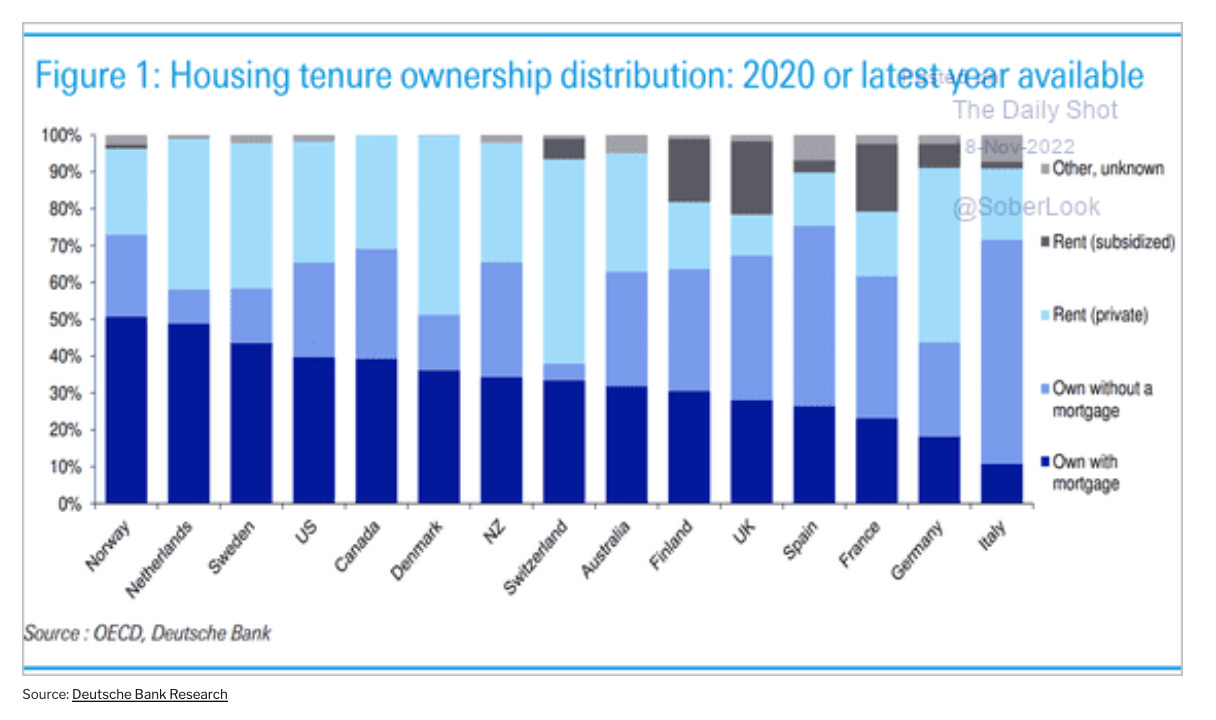
7. Housing tenure ownership patterns across advanced economies

8. For all talk of fintechs, FT writes about the enduring market power of Visa and Mastercard,
Visa last month reported annual net income of $15bn, up 21 per cent year on year. Both it and Mastercard are trading close to record highs. They have a combined market cap of $765bn, unchanged over the past year, even as the broader market has declined sharply. Ironically, it is the challengers, big and small, that are suffering more. The core explanation is simple: even the smartest fintechs are not fundamentally disrupting the market; they are merely slotting themselves into the existing payments architecture. Yes, they may make life easier for the consumer or the merchant with faster back-end processing or slicker point of sale interfaces. But this is not at the expense of Visa and Mastercard, whose electronic “rails” they nearly all rely on. The big old card companies might look ripe for disruption, facilitating as they do high “interchange” fees levied via merchants (averaging 2 per cent in the US). But thanks to the spread of their operations into every corner of the world, it has been either impossible or economically unappealing for potential competitors to build new kinds of networks.

9. Agricultural crop yields in India remains much lower than elsewhere

Soy yields in India are three-four times lower compared to the US and Argentina, while mustard yields are almost half compared to canola grown in Canada (mustard and canola belong to the same Brassica genus). India imports both varieties of edible oils to meet its large domestic shortfall. India is among the top producers of cotton in the world but yields are less than a fourth when compared to China. Average rice yields in India are 57% of China and lower than even Bangladesh and Vietnam. India is the largest producer of milk in the world but cattle milk yields (per animal per year) are 60% of China and less than a fifth of the US. 

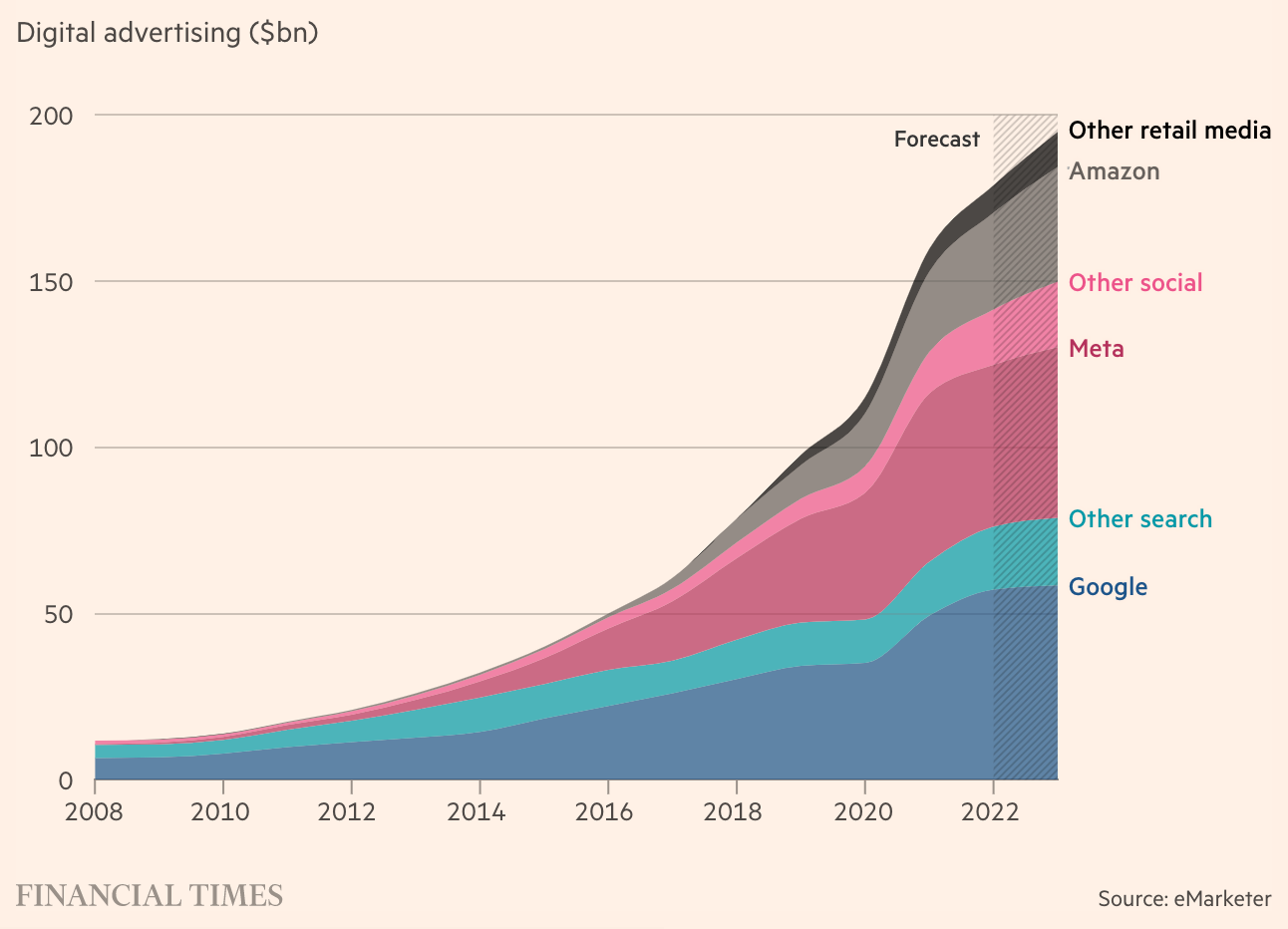
10. The dominance of Google, Meta, and Amazon in digital advertising
The article highlights the reasons why online retailers may be at an advantage in the digital advertising market compared to their social media and search engine peers. This underlines the point that advertising is a larger source of Amazon's revenues.
Amazon’s earnings report showed that its revenue from advertising was higher than fees from its Amazon Prime membership scheme, audiobooks and digital music combined, as well as more than twice the sales from its physical stores, including the Whole Foods grocery chain.

11. Bradford De Long makes an important point about the inflation target,

I think that [former Federal Reserve chair] Paul Volcker, who’d stopped [tightening monetary policy] when inflation was down to 4 per cent, was right. And Alan Greenspan [his successor], who said we should be happy that it has fallen to 2 per cent and stick there, was wrong. You really do, given the difficulties and getting your fiscal policy ducks in a row, want to have the ability to deliver a major stimulus to the economy when it falls into recession, to be able to cut interest rates by five percentage points or so. It really does require that the average inflation rate be something significantly higher than two, for interest rates to be in a configuration so that you can respond, rather than finding yourself once again at the zero lower-bound and you’re unable to convince people to spend to get the economy back to full employment. That reversing the shift from Volcker’s 4 per cent to Greenspan’s 2 per cent is something that really needs to be done.

He admits that the Russian invasion may have had the effect of raising inflationary pressures, but also feels that some inflation post-pandemic may be useful,

Right now, we have succeeded in reopening the economy after a plague, in a different, much more delivery-and-goods-production orientation, relative to in-person sales. More people driving delivery trucks, making goods and programming websites than before. And as always, when you wheel the economy into a new configuration — 1947 and 1951 are my stock examples — you need a little bit of a burst of inflation to grease things. If things go well, you just get a short transitory burst, after which things return to normal because everyone understands that this isn’t that monetary policy has lost its anchor. It’s more that the market economy is doing its thing by putting high prices on things that are [stuck in] bottlenecks. And offering higher wages to workers who will move into expanding industries.

12. Finally, Hal Brands has a series of articles on the importance of a US-led Indo-Pacific alliance involving Japan, India, Australia, and UK in deterring any Chinese invasion of Taiwan. He quotes US officials in pointing to the possibility of a war in 3-5 years. He writes,

A war that the US fights in the Western Pacific without allies is a war it runs a very high risk of losing. A war that it fights at the head of a large democratic coalition is one China probably cannot win. The more Beijing fears the latter scenario, the better deterred it may be from using force in the first place. The Chinese-American rivalry is a contest for Indo-Pacific hegemony. But in what they do and don’t do, an array of middle powers will have their say in who wins.
On India, he writes,
So how might India react if China attacked Taiwan? Although India can’t project much military power east of the Malacca Strait, it could still, in theory, do a lot. US officials quietly hope that India might grant access to its Andaman and Nicobar Islands, in the eastern Bay of Bengal, to facilitate a blockade of China’s oil supplies. The Indian Navy could help keep Chinese ships out of the Indian Ocean; perhaps the Indian Army could distract China by turning up the heat in the Himalayas. Even short of military assistance, India could rally diplomatic condemnation of a Taiwan assault in the developing world... 

New Delhi has a real stake in the survival of a free Taiwan. China has a punishing strategic geography, in that it faces security challenges on land and at sea. If taking Taiwan gave China preeminence in maritime Asia, though, Beijing could then pivot to settle affairs with India on land... a world in which China is emboldened — and the US and its democratic allies are badly bloodied — by a Taiwan conflict would be very nasty for India... What India would do in a Taiwan conflict is really anyone’s guess. The most nuanced assessment I heard came from a longtime Indian diplomat. A decade ago, he said, India would definitely have sat on the sidelines. Today, support for Taiwan and the democratic coalition is conceivable, but not likely. After another five years of tension with China and cooperation with the Quad, though, who knows?

The Economist has an article which describes India's foreign policy as "reliably unreliable"

Ever since India won independence in 1947 its foreign policy has prioritised developing its economy, defending its territory and maintaining influence and stability in its neighbourhood. And it has done so imbued with a profound fear of being dominated by a more powerful country as it was for so long.

Wednesday, November 23, 2022

Thoughts on the emerging trends on the quality of India's economic growth

This is the second part of posts on my evolving thoughts on the Indian economic prospects. In the first part early this week on India's economic prospects, I had blogged about the expectations about the future trajectory of economic growth. In the spirit of being cautious and perhaps undertaking a pre-mortem, this post will focus on some emerging trends in the quality of economic growth. 

While I believe that India appears best positioned among all major economies to ride out the impending recession in the developed economies, question marks hang over the quality of its longer-term growth trajectory. Fundamentally, even with a 6% growth, what is the likelihood that it would be broad-based than skewed? Will the rising tide lift all the boats?

Let me illustrate the point with one data point. The trends on two and four-wheeler sales in India over the 2010-22 period reveal some interesting insights, especially in the sharp divergence post-pandemic.

There are perhaps some unique factors that would have impacted automobile sales - the demand shock due to Covid 19 and supply shock due to the Ukraine invasion, the high petrol prices since July 2021, and the introduction of Euro VI emission standards from April 2020. But it can be argued that the divergence since the outbreak of the pandemic is sharp. And more worryingly are the trends in both two and four wheeler sales. 

This finding supports the K-shaped recovery arguments, which state that the formal economy used the pandemic to retrench labour and increase productivity, whereas the informal economy bore the brunt and is struggling to recover. Reinforcing the view, the sales of three-wheelers (a lower income transport) has followed two-wheelers in declining whereas those of commercial vehicles has mirrored four-wheelers. 

I'm less concerned about the short-term K-shape, but more about the long-term possibilities. The disturbing fact is the longer-term crawl of the sales of four-wheelers, a definitive marker of middle-class growth. It's today at the same level as it was six years back, and has moved in a small band. And has been so since at least 2005. At a decadal CAGR of 1.88%, four wheeler sales defy the double-digit growth expectations from a burgeoning consumption class. Even with the two-wheelers, its fastest growth phase from 2010-11 to 2018-19 equated to a CAGR of 7.97%, with that for the period till 2021-22 being just 1.23%. 

Consider other high frequency indicators - steel, cement, and electricity consumption. Their CAGR for the  decade from 2010-11 to 2020-21 were 3.7%, 2.77%, and 4.23% respectively. Excluding Covid (till 2018-19), the numbers are only slightly better - 4.65%, 4.58%, and 5.3%. These numbers don't point to an economy growing from a low-base and broad-based economic growth, where demand ought to double every few years. This is one more reason to recalibrate growth expectations.  

One or two sets of data is not sufficient to extrapolate and draw conclusions on a general economic trend. But much the same applies to several other sectors which are good proxies of economic health. The most important is the apparent decoupling of the fortunes of the formal and informal economies, and the respective fortunes of those working in them. It may no longer be the case that the rising tide is lifting all the boats. It appears that not only is the formal sector racing ahead much faster than the informal sector, but the informal sector (or at least major parts of it) may be stagnating. 

Any economic growth process will involve the transition from formal to informal, and the associated productivity improvements. But I think there are two reasons why the transition happening in the Indian economy may be worrying. One, the transition is being forced, explicitly targeting the informal sector. Fundamental structural transitions have a dynamic, and expediting them without providing sufficient buffers or cushions and also sufficient time for adjustments to happen can entail prohibitive collateral damage. After all, there are only so many Rs 100 and above haircuts (approximately the minimum price that a formalised haircutter would have to charge in a typical Indian city) that the Indian economy can support. As we wrote here, the informal to formal transitions happen less by way of the informal becoming formal but by way of the informal gradually shrinking and being displaced by the formal as the economy grows and new jobs are created.  

Second, the technology drivers of this transition may be disproportionately destructive of jobs. The vast and rapidly emerging eco-system of digital technologies is the case in point. Besides the nature of the formal jobs being created in the service sector gig economy are not the sort of good jobs that have historically supported vibrant middle class growth in today's richer countries. If manufacturing is becoming less labour intensive and services not creating good jobs, then what would be the driver of good job creation required to grow the consumption class? This is not a uniquely Indian problem, but one which casts its shadow on the world economy at large. Its impact on India, given the stage of its economic growth and size of its population, will be disproportionately higher. 

There is another problem about the formal and informal sector's fates - the critical role of governments in the latter's fortunes. Given its sheer size, India's formal sector is large enough to sustain high enough growth rates. This segment of the economy can support (at least for some more years) healthy growth rates in residential property, vehicles, consumer durables, private sector credit flows, and so on, thereby giving the impression of an economy in the pink of health. Further, central and state governments in India, by and large, have become conscious enough to not come in the way of their growth. 

In contrast, the informal sector remains entrapped in the mai-baap sarkar world (in fact, may have become more so), where they are acutely dependent on the government for everything from education to health care, water supply to electricity, and PDS rations to cash transfers. This dependence on government creates a big problem. While the government's several recent initiatives have significantly addressed problems of access to various public goods and services, their quality remains a matter of concern, thereby detracting from realisation of the desired outcomes from their use. For example, only those with good skills can access good jobs, and good skills is a function of good quality education. This draws attention to the weakness of state capability, a problem which even if recognised can only be fixed through a long drawn effort. 

Given all this, there is the danger of the Indian economy settling into a two-part equilibrium. The first part will be world-class with productivity standards matching those in the developed world. As the analysts at Marcellus Investment Managers have written, India has a disproportionately large share of listed companies with high returns on capital employed apart from an unhealthy and excessive concentration of business revenues and profits. The corporate deleveraging and bank assets clean up of the last decade mean that Indian companies and banks are in good health, ready for a new investment cycle. The Production Linked Investment (PLI) scheme may have done enough, if not by the volume of subsidies but at least by kindling animal spirits in the business environment, to finally integrate India firmly into the global supply chains. The stock markets reflect this and are perhaps on a sustainable upswing. Those working in this world have high and growing salaries and can aspire to enjoy world-class lifestyles. While the relative share of this part will be very small, it will be large enough in absolute numbers to be comparable to a larger European country, and therefore enough by itself to sustain a reasonable growth rate. 

In contrast, the second part could consist of an informal economy stagnating in productivity. In the absence of broad-based economic growth, the trappings of formalisation will only make the regulatory and other compliance costs higher, thereby driving up prices and also reduce the demand for their goods and services without anything happening at similarly expedited pace to boost the demand. The biggest problem will be the entry barriers for those in this segment to migrate to the formal economy, starting with human capacity development related barriers. Access to good quality education and opportunities of good jobs could remain elusive for the vast majority of those inhabiting the informal sector. 

This is, as prefaced, a pre-mortem of a possibility which should be acknowledged and taken into account in policy making. 

I can think of at least two broad requirements to avoid this dual-economy trap. One, the economic growth going forward has to become more broad-based and inclusive, and policies will therefore have to target the quality of economic growth. In particular, we have to prioritise good jobs creation (say, focus on  components and ancillaries to large scale manufacturing more than even getting the big contract manufacturers). Two, this would require the state to enhance its capabilities to improve the quality of delivery of public goods and services that are critical to also enable access to opportunities.