Substack

Sunday, May 21, 2017

Weekend reading links

1. Even as rest of the world is slowly converting farmland for other purposes, Singapore is going in the opposite direction and trying to become a leader in agriculture technologies,
Singapore... is making land available for agriculture for the first time in decades for farmers to come up with high-tech ways of improving the city-state’s food security. About 60 hectares of land will be released for farming from August, in a move authorities describe as providing a “buffer” against disruption in the supply chain... The south-east Asian city-state imports more than 90 per cent of the food needed to cater for its 5.6m inhabitants, and outbreaks of disease among overseas suppliers are quickly felt in price rises at markets... Farmers bidding for the new land will be encouraged to outline their plans to raise productivity as well as competing on price. Land for agriculture is scarce in Singapore and it can be hard to find skilled agricultural labour but farmers benefit from government funding for research and development... Eugene Tan, a political analyst at Singapore Management University, likened the farming plan to Singapore’s efforts to achieve self-reliance in water through rainwater catchment, recycling and desalination. Water technology developed in Singapore has been exported globally... Singapore’s government recently supported a vast farming venture in north-east China, which is intended to provide a reliable supply of pork and other staples. The Jilin farming project, managed by a public-private partnership, covers 1,450 sq km — an area twice the size of Singapore.
2. Story of Amazon stock since listing in 1996,
Amazon shares, listed at $18 at the time, have produced a compound annual return of nearly 40 per cent since the initial public offering. That means, for example, that $100 invested in Amazon stock at the IPO would be nearly $64,000 today (the stock split three times, so one share at the IPO equals 12 shares now). Up 63,990 per cent since its IPO, Amazon ranks as the best-performing US-listed IPO since 1995, according to Dealogic. For context, Netflix is fourth and Yahoo is seventh and the total return on the S&P 500 in the same period is about 300 per cent. It was not always smooth sailing, though. Its shares sold off after the initial euphoria around the listing. Then, during the dotcom bust, adjusted for the stock splits, Amazon fell from a high of $113 in December of 1999 to a low of $5.51 in October of 2001.

3. From the FT, on rising manufacturing and general wages in China,
Average wages in China’s manufacturing sector have soared above those in countries such as Brazil and Mexico and are fast catching up with Greece and Portugal after a decade of breakneck growth that has seen Chinese pay packets treble. Across China’s labour force as a whole, hourly incomes now exceed those in every major Latin American state apart from Chile, and are at around 70 per cent of the level in weaker eurozone countries, according to data from Euromonitor International, a research group.
But for countries like India, even with stagnation in manfacturing wages since 2007 at $ 0.70 per hour, this does not automatically mean good news. In fact, other factors are likely to more than offset China's erosion of competitiveness due to rising wages. The rise in Chinese wages has been accompanied by an even faster rise in productivity. Further, the massive size of Chinese market, at around 20% for a range of sectors, makes local manufacturing even more commercially attractive. These are unlikely to reverse soon.

4. Ananth points to Steve Rattner's twitter graphic on corporate tax rates and revenues as percentage of GDP.
Apart from the US problem, there is one another interesting thing that stares out of this graph. Contrary to the conventional wisdom on lower tax rates leading to higher aggregate revenues, as reflected in the Laffer curve argument, we see a more or less linear relationship. If there is a plateauing of the revenues, it appears to happen at very high rates.

5. Fascinating profile of Emmanuel Macron, the new occupant of the Elysee Palace, by Simon Kuper,
His long, lone walk to the Louvre stage on the night he became president expresses a truth: Macron walks alone. Almost uniquely in modern western democratic history, he has won power without joining a party. He doesn’t seek enduring allies. Instead he seduces useful people, then drops and humiliates them... Le Pen derided Macron as a creature of “the system”. That was wrong: Macron is nobody’s creature, because he isn’t loyal to anyone. This makes him a born transgressor like Blair, keen to trample on sacred beliefs.
The good thing with not having an ideology for a politician is that it helps him or her view problems in the most prudent manner, especially useful when navigating complex public policy challenges. The bad thing is that in the absence of an ideology, without its moral underpinnings (either equity or efficiency, social or individual), the politician becomes an opportunist. Even in this world of convergent ideologies, it is rare to find a combination that marries the two parts in an acceptable proportion.

6. The always brilliant Lant Pritchett takes down RCTs by drawing attention to its X-axis (determinant variable) focus and agnosticism about a theory of the Y-axis (the variable of interest),
Rather than asking “what would help understand the observed (or achievable) variation in Y in ways that allow maximal benefit?” the research asks “who will let me do X or evaluate the impact of their doing X?”... But whether conditional cash transfers induce more attendance at school can be individuated, and sample sizes of individuals can generate statistical power, so we have dozens and dozens of RCT studies of CCTs. This is the case even though we know and knew, for sure, both before and after the CCT research that CCTs were not a very big determinant of even school attendance (across countries, over time, or across individuals), much less learning, much less overall development...

A casually identified estimate of the impact of X on Y does not answer the question of how big the impact is relative to the magnitude to be explained... While one might argue that having a complete model of Y is unnecessary to knowing whether X is a cost-effective intervention, without some sense of “how big” it is impossible to know whether there are other, potentially much bigger Xs left unexplored... That doing X had impact ΔY in a given context is, in the absence of theory, zero rigorous evidence about the likely impact of doing X in any other context. For that matter, it is only theory that can tell us what “context” even means... What a researcher can do in a “field experiment” or an NGO might be willing and able to do with an impact evaluation built in might have nothing to do with what is scalable, particularly scalable by the public sector.
7. I am inclined to argue that India's banking sector non-performing assets crisis has been caused by a combination of three factors - bad business decisions (by both corporates and banks), adverse contextual events and trends, and plain cronyism and corruption. And if and when someone documents the ongoing banking sector crisis in India, I shall not at all be surprised if the third factor played an important role in the build up of such bad assets.

Livemint has a nice graphic that points out that there were nearly 6800 wilful defaulters (or someone who has the ability to pay) who owed nearly Rs 1 trillion or a sixth of the NPAs.

8. Upending the caricature of farmers and agriculture being the problem in bank defaults, the graphic below shows that the problems is far more with corporate loans than with farm loans.
The picture does not change with stressed loans, where too corporate loans predominate.
9. An astonishing set of stats about men's tennis,
Since Roger Federer won his first Wimbledon in 2003, the big five have won every Grand Slam but five—Federer (18), Rafael Nadal (14), Novak Djokovic (12), and Andy Murray and Stan Wawrinka (three each). And the remaining five were won by five different men. That’s 50 of 55 titles taken by just five players—and, remember, Murray’s and Wawrinka’s titles only go back the last five years... Only one of the five one-time Grand Slam winners has come close to another major title... Only 24 men have reached the finals of the last 55 Grand Slams. Of these, 33 finals have been contests exclusively between the Big Five—all of them since the French Open in 2006; that’s 33 out of the last 44. Only 10 men have won these titles and the Big Five players are the only ones to have won more than one.
It is even more staggering if you leave out Murray and Wawrinka, who are clearly at far lower level than the Big Three. Incidentally, the Big Three are the only players other than Rod Laver and Andre Agassi to have completed a career Grand Slam of having won all the four majors. Should we celebrate a rare confluence of extraordinary talent or be concerned at the deficiency of competitors?

10. Finally, Laura Alfaro and Fabio Kanczuk examine the utility of fiscal rules and have this to say,
A simple debt rule that limits the maximum amount of debt is analyzed and compared to a simple deficit rule that limits the maximum amount of deficit per period. Whereas the deficit rule does not perform well, the debt rule yields welfare gains virtually equal to the optimal rule.
This converges with India's own recent shift of its fiscal accountability framework from a deficit-based one to a debt-based rule.

Saturday, May 20, 2017

The anti-trust challenge in US

It was thought that free-market capitalism had solved the problems of monopoly and oligopoly by the nineties. Anti-trust vigilance has since taken a back-seat. But as a superb interview of Roni Michaely, a Professor at Cornell exploring business concentration and its effects, shows that the time may have come for anti-trust regulators to step in.

The rise in business concentration is uniformly across industries, 
And is also reflected in the alarming decline, amounting to a near halving, of the number of listed firms.
And evidence that the concentration is increasing pricing power (and greater surpluses at the expense of consumers) comes from a significant increase in return on assets (RoA) and profit margins of firms in industries that have become more concentrated.
The merger spree in banking since 1996 has led to the collapse of 37 banks into just four giants.
The most egregious indicator of business concentration has to be this - the share of US deposits going to the four biggest banks has risen spectacularly from just 7% to 58%, a more than eight-fold rise, over the 1995-2014 period. 
This cries out for anti-trust action

Thursday, May 18, 2017

Observations on the bankruptcy code

I finally got time to go through the regulations under the Bankruptcy Code. They look very good in theory. Well thought out with clear processes, mandatory timelines, incentive compatibility and so on. It is a paradigm shift in moving from "debtor in possession" to "creditor in control" once bankruptcy proceedings begin. I think we should all agree that we have a state-of-art regulation. 

But this is no guarantee that it will work as anticipated. In fact, I shall put my head on the block and say that we can be rest assured that it will fall short of the (inflated) expectations, at least in the foreseeable future. Though India's bankruptcy eco-system would have moved into a superior equilibrium, resolution and liquidation is unlikely to disappear as a major pain point while doing business in India. And I shall hold myself accountable five and ten years down the line and revisit this blog post to make hindsight assessments. 

I foresee some critical challenges.

1. How good will be the Insolvency Resolution Professionals (IRPs)? How good will be the valuation agencies? How fast can we develop a supply-side of sufficient quality in these services? How confident can we be that the ICSI and the ICAI, the two registered Insolvency Professional Agency (IPA), maintain high standards of certifying IRPs? How can we ensure that they (the median IRP or valuer) will not be captured? The four assurance/advisory firms will be dominant, but we have seen several instances in recent years of all of them being compromised. And the stakes here are much higher than those cases.

2. How can we be sure that the asset sale/transfer does not lead to round-tripping back to the promoter though complex set of transactions? The ARC resolution process was seriously compromised by this. In fact, as Vijay Mallaya's Goa property auction shows, after multiple tenders, it required the presence of public sector purchasers to get a private bidder to break "ranks" and bid.

3. The volume of NPAs are so huge that the depth of the market will be severely tested. This means the likelihood of low returns on sales/liquidation etc. Will the different stakeholders accept it? Will the limited depth also make gaming or cartelisation or collusion easier? 

4. Since the vast majority of creditors losses will be taken by public sector banks and the decisions will be taken elsewhere, will it engender a moral hazard in so far as the individual bankers (being public servants) now have less incentive to maximise the recoveries? Especially so since the haircut decisions now delve on the NCLT - so easy to take cover.

5. How long can we keep the honourable courts out of this process? The vast majority of losses are likely to be taken by public sector banks. PILs will follow. The promoters too will not be lying down and taking losses. Will the promoters of Bhushan Steel calmly accept the sale of their steel assets to  say, Jindal or POSCO? They will explore all avenues to litigate. The Courts will have to exercise a level of restraint that has eluded them till now. 

6. Finally, the maturity and the integrity of the NCLT bench itself becomes critical to the success of such transactions. After all, in some ways, they have the decision rights on very high stakes decisions. If this works well, we should have the NCLT added to the pantheon of the handful of credible public institutions in India. 

Answers to all these are judgement calls. It can turn out either way or meander along to some equilibrium (good or bad) over time. In fact, it is difficult to control the dynamics that lead to these sub-optimal outcomes. 

In the circumstances, the only factor that can be controlled is for the Ministry of Corporate Affairs (MCA) and the Insolvency and Bankruptcy Board (IBB) to be under constant vigilance to emerging trends in the implementation, especially in the initial years, and respond quickly with modifications to the regulations to address serious concerns. 

We have seen numerous examples of state of art regulations in sectors like capital markets, both in India and across developing countries (especially Latin America) fail to deliver anything close to their expected outcomes. There is nothing that prevents the same outcome from happening. 

The purpose of this post is not to cynically dismiss the Code. As I said, it is state-of-art and possibly the best that could have been done. But while it may be a necessary condition for the successful evolution of a good bankruptcy regime in India, it is hardly a sufficient condition. In fact, we have only got to the starting line. Now comes the real challenges. 

Instead the purpose is to interrogate the challenges likely and highlight how many of these are not only due to government inefficiencies or weaknesses, but deficiencies that reflect our stage of socio-economic development, corporate ethics and governance standards, institutional maturity, and so on. 

Now these are big bang structural reforms. But most such big bang reforms require diligent and long-drawn work to achieve the desired "bang"! Unfortunately, mainstream debates, even in very informed circles, all too often miss these nuances and blame governments for everything that goes wrong with such reforms.

Update 1 (24.07.2017)

Informative article by Ashish Pandey in Livemint about the challenges with the implementation of the Bankruptcy Code. Has good stats on the time taken for resolution and recovery rates.

Tuesday, May 16, 2017

More evidence on pricing road usage

Times has a nice article that points to research which explains that road capacity expansions, extensions to public transit, and changes in land use are not very effective in addressing traffic congestion. Instead, the only effective solution to alleviate traffic snarls may be to price road usage with something like a congestion pricing. 

We investigate the effect of lane kilometers of roads on vehicle-kilo- meters traveled (VKT) in US cities. VKT increases proportionately to roadway lane kilometers for interstate highways and probably slightly less rapidly for other types of roads. The sources for this extra VKT are increases in driving by current residents, increases in commercial traf c, and migration. Increasing lane kilometers for one type of road diverts little traf c from other types of road. We nd no evidence that the provision of public transportation affects VKT. We conclude that increased provision of roads or public transit is unlikely to relieve congestion.
And this,
Urban density appears to have a small causal effect on driving. Our estimates of the density elasticity are generally between -7% and -10% and is about -8% in our preferred specification... In particular, even concentrating the population residing in 83% of the area the continental us into an area of about 1500 square kilo-meters would result in only about a 5% decrease in aggregate driving, and this policy appears to describe the upper envelope of what densification policies can accomplish. On the other hand, existing estimates of the gasoline price elasticity of driving suggest that a similar decrease in driving would be accomplished with a gas tax that is no larger than gasoline price fluctuations observed over the past five to ten years. Congestion pricing programs appear to have even larger effects. In sum, while dense urban development may well be desirable because it provides a residential environment where people want to live and that make them work more productively, it is probably more costly to manipulate driving behavior through densification policies than through congestion pricing or gasoline taxes.
I have blogged several times, including one recently highlighting the need for a multi-pronged approach to address urban transport problems. Any meaningful effort has to involve the use of all the  four levers - increase the cost of vehicle ownership (higher emission standards, higher vehicle taxes etc), vehicle usage (congestion charging, higher parking fees etc), extensive promotion of public transport, and focus on transit-oriented development (higher FAR on transit corridors and around stations). 

Sunday, May 14, 2017

Weekend reading links

1. I have blogged on several occasions urging caution that the solar generation bids were characterised by irrational exuberance. The spectacular decline in tariff quotes rings several alarm bells. And I am surprised at the lack of serious research and commentary on this issue. But this article by Sajal Ghosh and Rohit Prasad is a welcome contribution,
International peer-reviewed studies suggest another series of winners’ curses in the making. J.J.C. Barros and others in 2016 estimated that the levelized cost of electricity for solar is around Rs9/kWh (converted from euro to rupee using average exchange rate for 2015-16) while that for coal is approximately Rs4.8/kWh... India’s solar programme is heavily dependent on imported solar cells and modules, mainly from China. In 2015-16, India had imported $2,34 billion worth of cells out of which 83.61% were from China... Under such circumstances, Indian solar project developers may find their projects unviable in the event of currency fluctuations or changes in China’s policy on solar cell and module exports. Project developers should also keep in mind the effects of declining output. In a recent study, Mike Bergin of Duke University along with others has found that dust and particulate matter might reduce the energy yield of solar power systems in north India by 17-25%.
The authors suggest changes in the auction design by introducing dynamic open reverse auctions as against the current sealed price reverse auctions. But that is unlikely to change anything. The issue here is that bidders just want to win the tender at any cost. It has been the case with such infrastructure contracts over time and across the world. Renegotiations are therefore passé. 

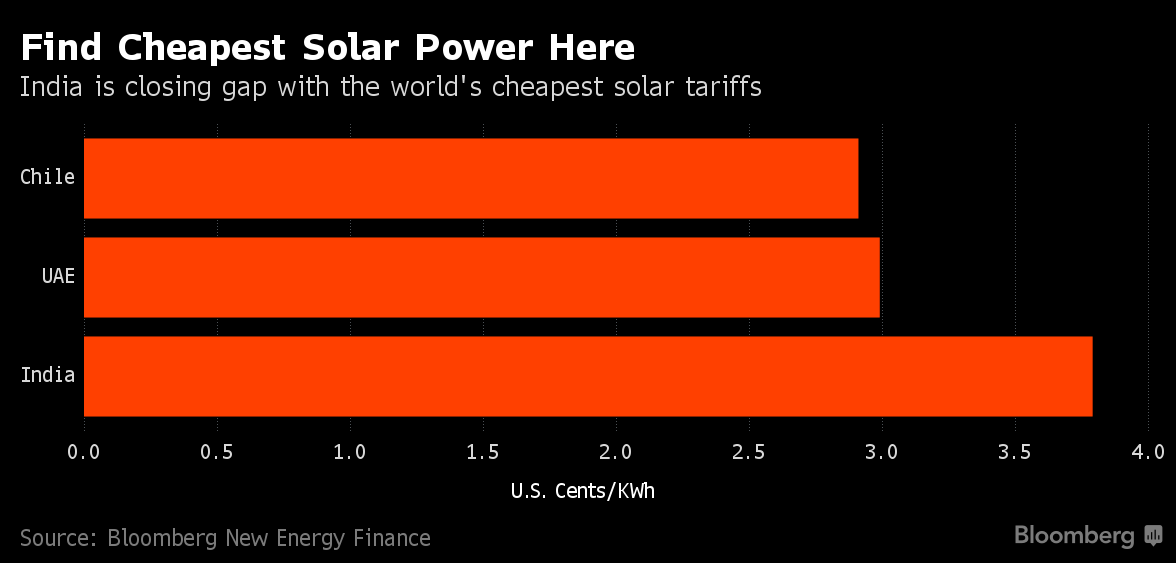
2. Staying with solar, the latest bids make India the third cheapest solar market in the world at Rs 2.62 or 3.8 cents per unit.

3. Interesting Buttonwood column highlights the challenges facing the investment management industry from proliferation of cheaper index funds; automation trends that dispense with brokers who intermediate between fund managers and savers, and with fund managers themselves (robo-advisors); and changes in investment channels. On index funds,
Big tracker funds can drive down fees through economies of scale. The expense ratio for Vanguard’s S&P tracker is just 0.04% of its assets. The average active American equity fund, which tries to beat the index, charges 0.8%. Such fund managers may claim they can outperform the market but in practice few do so consistently. Over the 15 years to the end of December 2016, less than 8% of American equity funds managed that feat. As an old quip has it, “you make your money working in active management but invest the proceeds passively.”
As companies shift pension strategies, there is the likelihood of more consolidation among asset managers,
Another challenge for fund managers is a change in the corporate-pensions market. Fewer companies are offering defined-benefit (DB) pensions, which are linked to a worker’s salary; new employees now have a defined-contribution (DC) pension, the benefits of which are not guaranteed. Employers offering DB pensions need to generate a high return to keep contributions down, so many tend to use specialised “boutique” managers. But DC plans often offer a default fund, chosen by most employees; these usually employ a more limited range of fund managers. The market tends to be concentrated in the hands of big fund-management groups and insurance companies, which can handle the administration of the scheme as well as the investing. The result is that the industry seems bound to consolidate.
4. Another article in Economist points to the declining number of listed companies in the US as well as the trend of start-ups to stay private for longer causing an IPO drought.
A big trend in American business is the collapse in the number of listed companies. There were 7,322 in 1996; today there are 3,671. It is important not to confuse this with a shrinking of the stockmarket: the value of listed firms has risen from 105% of GDP in 1996 to 136% now. But a smaller number of older, bigger firms dominate bourses. The average listed firm has a lifespan of 18 years, up from 12 years two decades ago, and is worth four times more. The number of companies doing initial public offerings (IPOs), meanwhile, has fallen from 300 a year on average in the two decades to 2000 to about 100 a year since... Although the total population of companies in America has been steady, their propensity to list their shares has roughly halved... Private markets, meanwhile, have become more sophisticated at supplying the funds they do require. Many big, mainstream fund managers, such as Fidelity and T. Rowe Price, are investing in unicorns, meaning private firms that are worth over $1bn, of which there are now roughly 100.
Several reasons have been attributed ranging from fear of red-tap to the reduced capital intensity of technology intensive firms (one of the basis of secular stagnation hypothesis) to the belief that private markets are better at allowing firms to take a long-term perspective. The last strikes at the heart of the conventional wisdom, nay holy cow, on financial intermediation. And one more reason for the shrinking universe of listed firms is disturbing,
Exits from the stockmarket by established firms—the second factor behind listed firms’ shrinking ranks—are growing in number. About a third of departures are involuntary, as companies get too small to qualify for public markets or go bust. The rest are due to takeovers. Some firms get bought by private-equity funds but most get taken over by other corporations, usually listed ones. Decades of lax antitrust enforcement mean that most industries have grown more concentrated. Bosses and consultants often argue that takeovers are evidence that capitalism has become more competitive. In fact it is evidence of the opposite: that more of the economy is controlled by large firms.
5. Staying on the issue of private markets allowing firms to take a long-term perspective, John Asker and colleagues have a new working paper which finds supporting evidence,
We evaluate differences in investment behavior between stock market listed and privately held firms in the U.S. using a rich new data source on private firms. Listed firms invest less and are less responsive to changes in investment opportunities compared to observably similar, matched private firms, especially in industries in which stock prices are particularly sensitive to current earnings. These differences do not appear to be due to unobserved differences between public and private firms, how we measure investment opportunities, lifecycle differences, or our matching criteria.
6. Greg Ip strikes a contrarian note to the conventional wisdom that robots are destroying jobs,
The U.S. has many problems, but job creation isn't one of them. In April, nonfarm private employment rose for the 86th straight month, the longest such streak on record. Monthly job creation has averaged 185,000 this year, more than double what the U.S. can sustain given its demographics... If automation were rapidly displacing workers, the productivity of the remaining workers ought to be growing rapidly. Instead, growth in productivity -- worker output per hour -- has been dismal in almost every sector, including manufacturing. In a compelling study released this week, the Information Technology and Innovation Foundation demonstrates that the supposed gale of technology-driven job destruction a myth.


Rob Atkinson, president of the industry-supported think tank, and researcher John Wu examined government data back to 1850 to measure jobs lost in slow-growing occupations and jobs created in fast-growing occupations, their proxy for job creation and destruction driven by technology and other forces. By this measure, churn relative to total employment is the lowest on record.
7. Is the hub-and-spokes model of airline industry under threat,
Two new aircraft—the Boeing 787 and the Airbus A350—make it profitable to carry smaller numbers of passengers over long-haul routes. Secondary cities half a world away from each other can increasingly sustain direct connections. That eliminates the need to change planes in the Middle East. Big legacy carriers, in addition to long-haul, low-cost pioneers such as Norwegian and AirAsia X, are buying these planes in huge numbers. The fact that Airbus has 750 outstanding orders for its A350, compared with just 107 for the A380s that Emirates flies, shows where airlines think the future of aviation is heading.

Saturday, May 13, 2017

Can bond markets differentiate the debts of sub-national entities?

The RBI's just released report on India's state government finances which point to the increase in state indebtedness has triggered a debate on the issue. There are several things going on. One that caught my attention about the debate that it triggered is the point about lack of differentiation of state borrowings despite the wide variations in the their fiscal balances. 

Consider two commentaries. Neelkanth Mishra, writing before the report was released, acknowledges the problem and concedes that addressing it is trickier,
The bond yields of states with low debt to GDP like Chhattisgarh and Odisha are no different from those of states with high debt to GDP like West Bengal and Punjab. This has been attributed to a range of factors : That the market assumes a sovereign guarantee (from the Union Government); that bond holders effectively has first access to state government revenues as the RBI, which co-ordinates the auctions, have access to state revenues in an escrow; state governments must request the Union government for extra borrowing beyond the prescribed fiscal deficit limit, which reduces default probability significantly; mandatory buying by financial institutions like banks generate sufficient demand; and lastly that these were too small to worry the markets about differentiation.
The Economist writes about the worrying mispricing of state government bond yields,
Which Indian state sounds more likely to repay a loan: Bihar, the country’s poorest, with a budget deficit of nearly 6% of its state GDP last year and a hole in its finances after it banned alcohol sales; or Gujarat, a relatively prosperous coastal region with a deficit nearer to 2%? According to bond markets at least, both are equally good credits, and so pay the same interest rate... Investors are lending money to all the states at the same rate for good reason: the central government, through much nudging, winking and head-shaking, has indicated it will look after them if the states default. It also compels publicly owned banks, pension funds and insurance companies to pile in.
There is no denying that the lack of differentiation is a problem. But I am not sure whether there is a solution to this in a tight federal arrangement like in India where implicit Union Government guarantee, especially when involving State governments, is strongly baked in and may be difficult to unhinge. Even with deeper and broader bond markets, this is unlikely to change meaningfully enough to allow fair price differentiation. 

Consider the example of Europe where sovereign bond yields converged spectacularly in the lead up to the monetary union and stayed there till the recent crisis. This was despite the far higher diversity, by order of magnitude, in debt to GDP ratios between Italy and Germany than between Bihar and Gujarat (or any other pair), as well as the absence of any form of fiscal union between the countries that would have facilitated transfers to support bailouts. And you cannot argue that bond markets in Europe suffered from financial repression. 
In fact, business as usual appears to be returning as markets stabilize and bond yields again start to coverage. 

It will be interesting to see the reliability of price differentiation among bond yields of state governments in the US, where the market expectations of a federal bailout can be expected to be lower. Or in other federal economies where states or provinces borrow directly from the market without any explicit federal guarantees and how the bond markets differentiate such borrowings of different states. 

I could be wrong, but apart from the US or in one or two other places due to circumstances which are sui generis and which cannot be replicated, I will be surprised if bond markets can differentiate in a meaningful enough way among the borrowings of sub-national entities in a fiscal union.  

Wednesday, May 10, 2017

Supreme Court upholds sanctity of contracts

Two recent judgements of the Supreme Court of India may have contributed to restoring the sanctity of contracts in India's infrastructure sector, which had been seriously compromised by the spate of renegotiations across sectors. 

First, the Court overturned the 2016 decision by Appellate Tribunal for Electricity (Aptel) allowing Tata Power's Coastal Gujarat Power Ltd and Adani Power to charge compensatory tariffs on consumers of their respective 4000 MW and 3960 MW thermal power plants at Mundra. Aptel had ruled that the Indonesian government's decision in 2010 to link all exports of coal only at international prices was a force majeure event under the Power Purchase Agreement (PPA) signed by the two companies with the discoms of Rajasthan, Gujarat, Haryana, and Punjab. The Supreme Court has rejected that contention and disallowed any compensatory tariff levy on the PPA agreed tariffs. 

Tata Power's bid in February 2006 involved an agreement to sell 4000 MW for a 25 year period at a levellized tariff of Rs 2.26 per unit, and Adani Power's 3960 MW plant agreed to sell power to Gujarat and Haryana at Rs 2.34 per unit and Rs 2.94 per unit respectively. Tata Power claims that it will lose Rs 475 bn over the 25 year PPA through under-recoveries. 

The second judgement involved the Court upholding an earlier High Court order approving the e-auction by the New Delhi Municipal Council (NDMC) of the Taj Mansingh Hotel in Delhi. It rejected the claim of Tata's Indian Hotels Co Ltd (IHCL) to right of first refusal on the auction. NDMC had entered into a 33 year lease agreement with IHCL in 1976 to run a five-star hotel. This concluded in 2011 and since then after a series of ad hoc extensions, the NDMC had decided to not renew the license and re-auction the property. 

In the first case, the bid process for the Ultra Mega Power Plants (UMPP) allowed all bidders to either quote their tariffs as a fuel pass-through (payment on actuals for fuel) or at a fixed rate. Both Tata Power and Adani Power passed over the former despite firm knowledge about their coal import exposure and the possible fuel price risks. In fact, Adani Power quoted a nil tariff on the escalable fuel-risk component!

In other words, here was a textbook tender design, offering all the possible options. But the successful bidders preferred to assume the imported coal price risk and bid aggressively to win the tender. The presumption may have been that coal prices were low and likely to remain so, and more importantly perhaps, there was always the renegotiation window. From hindsight one could say that the government should have anticipated a market failure by way of irrational bidding and not offered the flat tariff option. Fuel price should have been a mandatory pass through.

While ex-post this appears an entirely reasonable argument, ex-ante (or at least immediately after the bid is finalised) it would have been criticised by both the experts and the bidders. The government should, or so the critics would have argued, make available all the options and leave it to the market and bidders to determine what is in their best commercial interest. After all these large business groups have the expertise to hedge for such risks and generate all round efficient outcomes. Further, the media, most likely at the instigation of one or some of the disgruntled bidders, would have carried the counterfactual story of the government's faulty bid design causing massive presumptive loss to the consumers by foregoing ultra-cheap tariffs that some of the bidders (there would be "reliable sources") would have offered by assuming the fuel price risk. The most likely sequence of events post-bid would have been - an RTI application (to find out who took the decision on the bid parameters) or CAG audit, consequent media leaks which gloss over the nuance and sensationalise (say, the presumptive loss figure), vigilance enquiry and CBI investigation.

There are also issues of ownership of the Indonesian mines and cross-holdings which need to be explored before the full extent of any loss or gains can be established. Has anyone examined the ownership of the Indonesian mines? After all, the bidders could have hedged for some of the price risks by assuming an ownership stake in the mines. I have blogged in detail about these issues here

In case of the Taj Mansingh Hotel, the lease agreement did not provide for a first right of refusal and the NDMC was only exercising its rightful option. In the absence of a first right of refusal, the IHCL's financial quotes in 1976 were on the basis of a 33 year contract period. In the circumstances, it had no right to claim a first right of refusal. In fact, that IHCL claimed a first right of refusal without any such contractual provision, and the matter was litigated before the High Court and Supreme Court (instead of being dismissed at admission stage) is itself a matter of concern. I have blogged here why the concept of first right of refusal itself is questionable. 

In both cases, allowing the claims would have engendered serious moral hazard and eroded the sanctity of contracts even more. Contract negotiations have been a serious problem in power and roads sectors, and are likely to surface soon in ports and solar sectors. This is a much needed reality check on the solar generation bubble. The Supreme Court's decisions have hopefully recovered some lost ground.