There is an interesting asymmetry in the way China is covered by the Western media and commentators.
China’s trillion-dollar and rising export surplus and its rapidly growing outward foreign direct investment (FDI) are seen as signs of deepening global dependency. This framing ignores the context of a weakening domestic economy and increasing dependence on exports to sustain jobs and growth (and the social contract between the Party and citizens). It also glosses over the risks to both exports and FDI posed by the rising backlash against China’s mercantilist policies. The Chinese vulnerabilities created by this dependence (on exports) and exposure (of FDI) are rarely discussed.
This perspective stands in stark contrast to the view that bemoans the vulnerability of Western multinationals operating in China and completely ignores the buyer’s leverage on China with its importers. The same fact of deep interdependence is narrated as “strength” when it’s China exporting to the West, and as “vulnerability” to be endured when it’s the West transacting with China. For China’s trade partners, its $3.77 trillion export volume is as much a powerful bargaining chip as it is a dangerous dependence.
In this backdrop, this post provides a framework to think about combating China’s manufacturing dominance.
As I blogged here, experts and commentators ought to explore ways in which the leverage from China’s export dependence and FDI exposure can be used by its trade partners as bargaining chips to protect their interests.
In this backdrop, I used Claude to develop an analytical framework to address this asymmetry. The matrix covers six domains where every lever Beijing pulls has a symmetric counterpart.
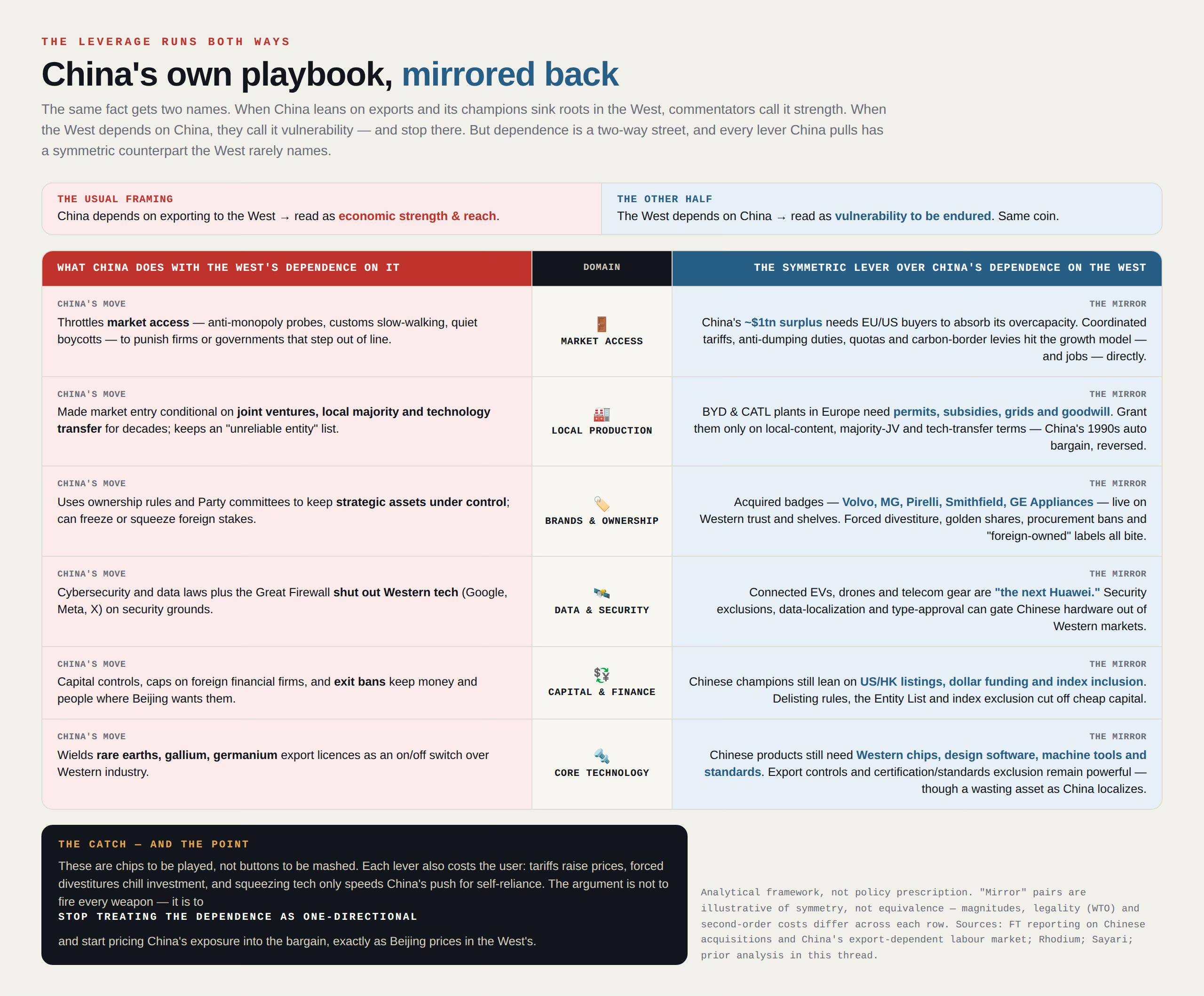
The single most underused lever is market access. China’s $ 1tn-plus surplus exists precisely because Western markets absorb the overcapacity its own weak consumers can’t. This is what keeps the factories running and the post-1980 social bargain afloat. That makes access to EU/US demand a bargaining chip of the first order, not a favour to be lamented.
Local production inverts China’s own auto playbook by making the likes of BYD and CATL now dependent on European permits, subsidies and goodwill, and leaving them vulnerable to imposition of the same local-content and tech-transfer conditions China once imposed on Volkswagen and GM.
Brands and ownership are a bargaining chip that are almost entirely ignored. Volvo, MG, Pirelli, Smithfield and GE Appliances derive their value from Western consumer trust and shelf space, which divestiture orders, golden shares and procurement bans can all reach. Data and security concerns confer enough leverage to restrict Chinese hardware out of the Western markets. Capital access through US and HK listings and dollar funding is a vulnerability that delisting and Entity-List tools can throttle. And core technology is the rare-earth lever in reverse, as outlined here.
These are chips to be priced into a bargain. Each carries a cost to the user, and the mirror pairs show symmetry, not exact equivalence in magnitude or legality. The central point is that the dependence is bilateral.
In their use of the bargaining chip, the alliance could emulate China’s rare earth playbook. An FT long read on China’s management of critical minerals trade is instructive.
Cheaply produced Chinese metals are now embedded in the just-in-time supply chains that global industries rely on, but which buckle dramatically when interrupted — as the Covid-19 pandemic, Russia’s full-scale invasion of Ukraine and the closure of the Strait of Hormuz trade waterway have shown. That has given China leverage, which it has increasingly been willing to use: since 2023, it has imposed a series of export restrictions on a wide range of niche metals… Despite the export controls, metals flows have not ground to a halt. Instead, China has created a licensing scheme under which it decides who gets which minerals. The lengthy application process gives authorities detailed information about which metals overseas companies and their contractors are using, and why. Applicants must show that the material is going into civilian, rather than military, supply chains.
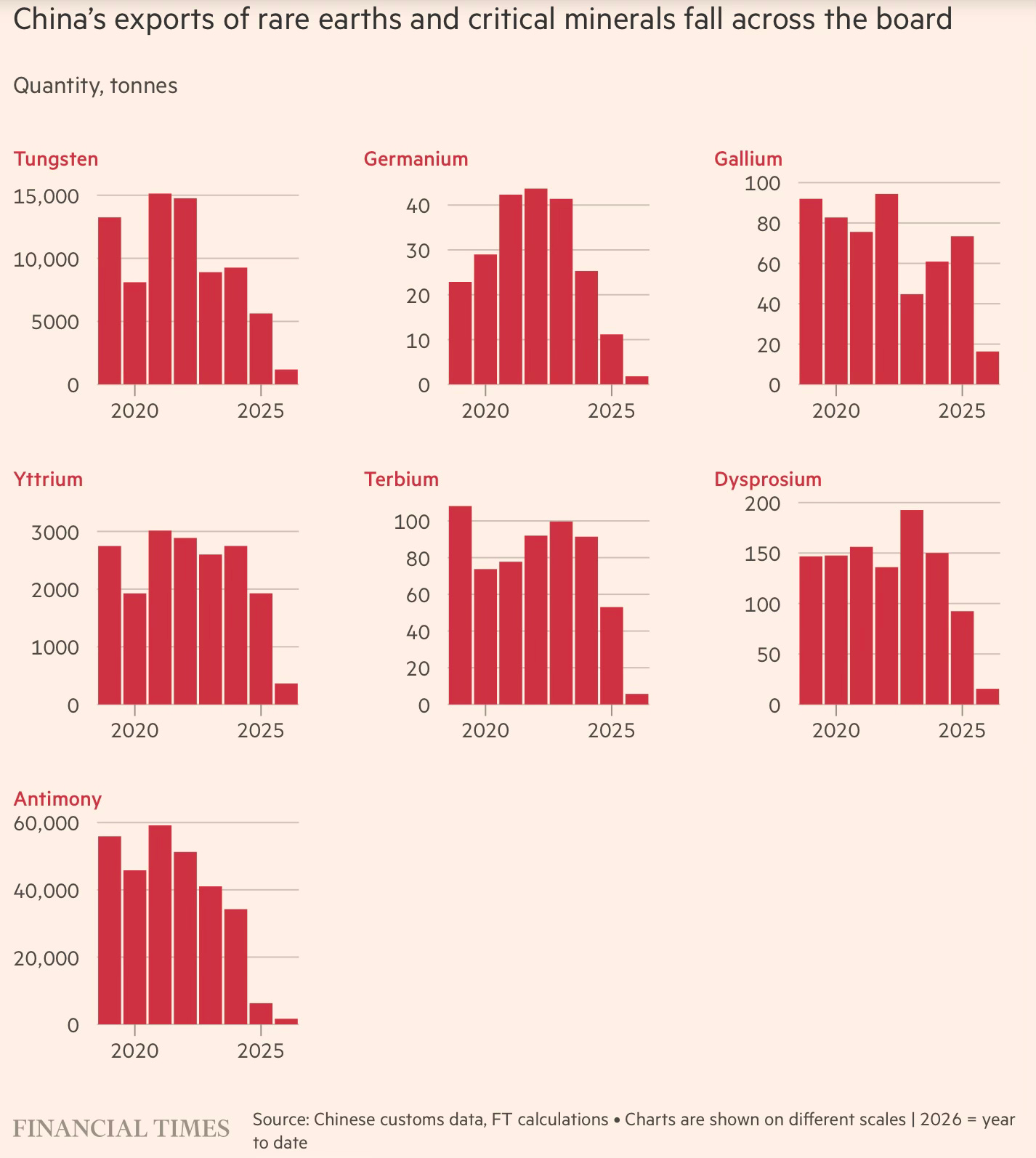
Companies, traders and analysts say material has been flowing but at unpredictable paces, with licence approval often slow. “The export control system has evolved from a crisis into a managed system”, though buyers still face “compliance and commercial” challenges, says Kyle Sullivan, vice-president of business advisory services at the US-China Business Council. This embeds new uncertainty into corporate supply chains and risks customers switching to Chinese component suppliers whose metals purchases are not being monitored and squeezed. One executive at a large Japanese user of rare earths says China wants to keep companies in a “neither alive nor dead” state, by supplying them with the minimum needed to avoid a supply chain collapse — which would hit Chinese companies that still rely on materials and components from Japan.
The big difference is China’s intent, willingness, and ability to use these chips in its strategic calculus. I’m not sure whether any of its counterparts in the West currently possess the same three at anything close to the degree present with China. The US can mobilise them if it puts its mind to the task. But it is most unlikely in the current dispensation.
Another challenge is that no one country, including the US, has anywhere like the leverage China has across industries. This means that any meaningful application of a bargaining chip would require effective coordination among a group of countries. This is precisely the point that Rush Doshi and Kurt Campbell made when they argued in favour of America mobilising an alliance of like-minded countries to respond to China’s weaponisation of trade.
Unfortunately, President Trump’s disruption of the Western alliance makes even a collaborative effort very difficult. The only option may be to wait out the regime before serious efforts in this direction.


No comments:
Post a Comment