Substack

Friday, May 19, 2023

Pension funds management

There is a heated political debate going on in India about pension reforms. Specifically, in recent months several state governments have reverted back to the defined benefit (DB) Old Pension Scheme (OPS), abandoning the defined contribution (DC) New Pension Scheme (NPS) which was introduced in 2004. I wrote about it yesterday.

There is another aspect of pension reform that is important. For a start, the reversion from NPS to OPS is a big blow to India's capital market development. In one stroke, it deprives the capital markets off the biggest source of long-term capital that's central to the broadening and deepening of capital markets, and that too at a time when economics and demographics dictate that pension fund assets should be ballooning. 

In this context, it's also appropriate to revisit the existing regulatory investment requirements for pension funds in India. 

FT has some interesting articles which examine UK's pension funds industry, which may have lessons for India. Like elsewhere, in the UK too the DB pensions have given way to DC pensions. But those DC pension funds are struggling,
Official numbers put defined contribution pensions membership, where the saver bears the risk of their eventual retirement income, about 55 per cent higher than defined benefit schemes. That doesn’t tell the whole story: thanks to the success of workplace auto-enrolment since 2012, there are more than 15 times the number of active savers in DC schemes compared with DB, according to the Pensions Regulator. Everyone knows that many of those pension pots will be inadequate. Average assets per member is low given the influx of new savers. But PwC in 2021 put the average pension pot for the first generation of DC workers to retire at about £50,000, compared with £400,000 for the average capital value of a DB member’s benefits. There are four to five times the assets in old-style pensions schemes as are held in the DC schemes typically offered to workers today. That is the first reason that DC pensions deserve more attention: a looming scandal of intergenerational inequity to rival what the housing market has to offer. Self-satisfaction about auto-enrolment, now set at 8 per cent of salary, of which just 3 per cent comes from the employer, is part justified and part premature. A 2017 review found that it should be expanded, to better cover younger or part-time workers, and that contributions should be higher... But the much-admired Australian system is moving towards 12 per cent employer contributions by 2025. “We need probably 25 per cent going into people’s pensions,” says Nico Aspinall, a DC specialist, who argues that contributions should be weighted towards employers.
In the UK, driven by regulatory restrictions, there has been a dramatic shift in the UK from equities towards fixed-income securities. 
First, private defined-benefit schemes — the dinosaurs of pensions past — have switched from equities into bonds as they closed and members approached retirement. That is the biggest factor behind the allocation of money from UK pensions to the UK stock market falling from 53 per cent in 1997 to 6 per cent in 2021, and it is not going to change. Defined-contribution schemes, with about £550bn of the pension market’s total £2.8tn in assets, still allocate more than half their assets to equities, according to think-tank New Financial, but everyone — including asset managers and insurers — has also shifted away from UK stocks seeking better opportunities overseas.

This FT long read has some excellent graphics on the UK and global pension markets. The share of equities in UK pension fund investments has dropped precipitously by £400 bn since 1997.

While their exposure to UK equities has fallen sharply, they've increased their investments in non-UK equities (primarily US equities).

This reduction in UK's exposure to equities contrasts with increased risk assumption globally among pension funds, though in the form of alternative assets.

In this context, there has been a debate among pension fund managers globally on the right level of exposure to private equity. There are those like Mikkel Svenstrup, Chief Investment Officer at Dutch Pension Fund ATP who have raised concern at private equity practices like continuation funds (where a PE firm passes investments between two funds it controls) starting to resemble ‘pyramid’ schemes. However, others like Marcie Frost at Calpers believe that the $442 billion fund’s 13% PE exposure limit is too small, and the fund may have lost $18 billion in returns between 2009-18 by avoiding PE. But this debate comes even as influential voices like Vincent Mortier, CIO of the $2 trillion Amundi Asset Management, Europe’s largest asset manager, have suggested that parts of PE resemble Ponzi Schemes. Just a couple of days back, Howard Marks of the $172 billion Oaktree Capital Management warned that the high-interest rate and economic weakness could strain the private credit market. 

The global leaders in pension funds management are the Canadian and Australian funds, the largest of whom manage funds internally and have got good returns over the last decade despite the ultra-low interest rates. 
The article points to the death of media tycoon Robert Maxwell in November 1991 which triggered risk aversion and regulatory over-kill in the UK pension funds industry,
His mysterious death triggered the swift collapse of his publishing empire as banks called in their loans. It emerged that Maxwell had used assets belonging to the Mirror group pension fund to prop up his companies. The episode contributed to a growing public clamour for tighter rules around pensions, particularly the so-called defined-benefit schemes that make payouts to members in retirement based on their salaries while in work. The result was a series of changes to tax, regulation and accounting rules that Sir John Kay, one of Britain’s leading economists, characterises as “one of the great avoidable catastrophes of British public policy”. “You had a system that worked pretty well, which was replaced by one that constrained investment strategies and effectively killed UK private sector defined-benefit schemes,” he says. 

Among the most significant changes was the introduction in 2000 of FRS17, an accounting standard that required companies to calculate the surplus or deficit on their defined-benefit pension schemes each year and disclose any deficit as a financial liability in their accounts just as they would a bank loan or a bond issue. Company boards, often shocked by both the magnitude and volatility of liabilities, rushed to close defined-benefit schemes, first to new members and then to further accruals. Trustees began shifting assets out of equities — the asset class that historically has delivered the highest inflation-adjusted returns — and into government bonds. The theory of this “liability-driven” investment strategy was that it was lower risk, but for many pension schemes it came unstuck last autumn when bond prices fell sharply following the UK government’s “mini-Budget”. The proportion of all UK pension fund assets invested in equities was 26.4 per cent in 2021, down from 55.7 per cent in 2001, according to the OECD. By contrast, Canadian funds had 40.6 per cent in equities and Australian schemes 47 per cent.
Canadian pension funds are the exemplars of global pension funds
Last year, global stocks and bonds lost more than $30tn after inflation, interest rate rises and the war in Ukraine triggered the heaviest losses in asset markets since the 2008 financial crisis. But the C$247.2bn Ontario Teachers’ Pension Plan, a defined-benefit scheme for 336,000 schoolteachers in the country’s most populous province, gained 4 per cent and maintained fully funded status for a 10th consecutive year... The scheme reduced its exposure to fixed income because of concerns about higher inflation, and boosted its holdings in infrastructure, private equity, and other more inflation-sensitive assets. OTPP’s ability to do this is the result of how the plan was designed when it was formed in 1990. Until then, Ontario teachers’ pensions had been invested solely in government bonds. But a new law that year set up OTPP’s investment board as an independent entity, gave it an exemption from public-sector pay caps so that it could hire people from the private sector, and reduced fees paid to external managers by dictating that most of its portfolio would be run internally...

The scheme’s ability to combine public market holdings along with direct investments in infrastructure, venture capital and property has helped it deliver average returns of 9.5 per cent a year since it was set up. Its model has been widely adopted across Canada’s public sector — CPP Investments, established in 1999 to oversee and invest the assets of the Canada Pension Plan, has grown from just C$12mn to C$536bn and is now one of the world’s largest investors in private equity.
Australia is another example,
The Australian superannuation system has almost A$3.5tn (£1.9tn) in assets after three decades in which contributions have been steadily raised, pots consolidated and investment diversified... One lesson from the Australian experience, argues Gregg McClymont of IFM Investors, is that the occupational schemes created their own vehicle (IFM) to pool resources and avoid leakage of fees to third parties... The Australian schemes have steadily consolidated over time, with IFM’s owners falling from 30 to 17. If the government wants to wield a big stick, pooled resources and consolidation is the place to do it. Another factor behind Australia’s success was that the system came together when its states were essentially privatising infrastructure. In other words, there was loads of good stuff to buy.
One of the important points discussed in the context of the UK's experience is the need to consolidate pension funds. For example, the UK has 86 regional funds that managed a combined £342 bn in assets as of March 2021. In fact, the UK has roughly 28,000 DC schemes. Since 2015, the UK Treasury has been, like in Australia, consolidating them. There is tension here between the increasing economies of scale from having larger assets under management and the increasing economies of return from smaller investment pools.

DC schemes are split between trust-based provisions and contract-based schemes offered through insurance companies. And while the financial markets focus on the latter, the former has had some impressive successes. Apart from the Canadian funds, this is about the corporate fund, Wellcome Trust

Observers point to the strong investment record of the Wellcome Trust, a charitable foundation whose health research is funded by a £37bn investment portfolio, as an example of how funds can thrive without the constraints of a corporate sponsor. It has generated annual returns averaging 11.7 per cent over the past two decades.

India has followed conservative regulatory restrictions on asset allocation for pension funds, compared to developed countries.  

Some questions in the context of the UK, Canadian, and Australian experience of relevance for India.

1. What should be the mandate for the appropriate mix between equities and fixed-income assets?

2. What should be the exposure to alternative assets and what conditions are associated with them?

3. How much exposure to foreign equities and bonds?

4. How to leverage pension funds to finance national and local infrastructure requirements?

The last point is of some importance in countries like India. The governments in developed countries benefited from being able to leverage their domestic patient capital sources like pension funds and insurance in an era of limited global financial integration to finance their infrastructure requirements. A UK government levelling-up white paper suggested that 5% of local government pension scheme assets should go towards local projects. 

For a country like India that's grappling with an acute deficiency of long-term capital to finance infrastructure, there is a strong case for figuring out ways to channel some of the pension fund investments into these. The political economy problem associated with going this way might be too daunting. But being deterred by this problem and not pursuing the available second-best approaches to leveraging this capital, even with their costs, might be a case of the best being the enemy of the good.

Thursday, May 18, 2023

A pension reform proposal - guaranteed pension?

I have a co-authored oped in Indian Express today with Noorul Quamer which explains the need for pension reform, why the reversion to the old pension scheme is fiscally ruinous and unsustainable, and presents an alternative that makes the current contributory pension more fair and attractive.

This is our proposal,
The government could then guarantee a certain percentage of the last drawn salary as a fixed annuity pension. The pensioner would purchase the annuity at retirement, and the government could bridge the gap, if any, between the guaranteed pension and the purchased annuity. The gap could be met by direct budget transfers to the pension. The guaranteed annuity would reduce in proportion to any lump sum withdrawal from the corpus... the guaranteed pension could be topped with additional benefits, currently unavailable to NPS pensioners. They include extending pension to the spouse, albeit with a lower annuity, health and life insurance benefits, and a minimum pension to cover for those with lower service tenures.

Given that a reversion to OPS is fiscally just not sustainable and the contributory NPS puts all risks on the pensioner, the only alternative may be to guarantee an amount that is sustainable. And it's here that the debate on pension reform should focus. 

Some graphs that are useful in reading the oped. 

1. The decline in interest rates is a secular trend in the long arc of history. And as I blogged here, demographics makes it even more likely.

2. The pension fund returns in different countries trend in the 3-5% range.

3. The demographic challenge in a graph - the post-retirement life span may be as long as the average service career!
4. Finally, the extent of escalation associated with the current OPS over a 25-year post-retirement life is in the graph above. Given the family pension too, we are looking at around 30-40 years of pension payout.
This, this, this, and this are posts which discuss the pensions problem and its reform. 

Wednesday, May 17, 2023

The misleading climate finance agenda of billions to trillions

Arguably the most misleading narrative in global development today is that climate change adaptation and mitigation can be financed by de-risking and crowding in private capital. I have blogged earlier arguing that the idea that billions can be converted to trillions using blended finance is far-fetched. 

Even if we keep aside adaptation, it's believed that mitigation can be largely financed with private, including foreign capital. This is a self-serving narrative perpetuated by MDBs like IFC and various influential global opinion makers on climate change and green transition.  

Climate change mitigation investments include renewables power generation, transmission lines for its evacuation, green hydrogen and other clean fuels for industrial and automobiles use, electric vehicles and their charging infrastructure, electricity storage solutions like batteries and hydel pumped storage, carbon capture and sequestration etc. 

Take the example of the simplest among these, solar and wind power generation. The conventional wisdom is that private capital can meet this requirement. I'm not sure.

In the bigger middle-income countries like India and Indonesia, renewables generation is already de-risked and will be mostly financed by the private sector. But it's difficult to believe that the same will apply to lower middle income and low income countries for a long time.  

There are three important constraints. One, power generation is commercially viable only if the downstream distribution side is able to recover the cost of generation. But distribution is the weakest link in the power sector, including in countries like India. Operational inefficiencies of public sector distribution companies and the difficult political economy of tariff increases ensure high cost recovery gap. 

Two, the cost of capital, both equity and debt, is prohibitive in low income countries. This arises from scarcity of equity, low domestic savings, limited depth of financial market intermediation, large commercial risks, and uncertain regulatory environment. In addition there are the macroeconomic risks of recurrent debt crises, high inflation episodes, currency devaluations, and capital flights. 

Foreign capital will be more expensive given the country and currency risk premiums required. Besides, foreign capital faces the currency mismatch of local currency expenditure and revenues and foreign currency returns expectations.   

Three, even if the utility is able to maximise operational efficiency and also collect tariffs, it's impossible for a highly politically sensitive regulated sector like electricity to be able to generate the returns that are required to cover various layers of risks and uncertainties faced by a domestic private investor (leave aside foreign investor) in addition to the cost of generation, transmission, and distribution. 

In fact, the first group of countries themselves took several decades of iteration consisting of failures, defaults, and bankruptcies, apart from distribution side reforms for these kinds of projects to now be considered de-risked enough to attract private investors. The smaller middle-income and low income countries too will take a very long time before they fulfil these conditions.

Teal Emery, a research consultant and Adjunct faculty at Johns Hopkins University, has a new paper which examines why solar power generation has not scaled in Africa despite its costs having fallen steeply. He studied the World Bank Group's 100 MW (2X50) solar project in Zambia, Scaling Solar, that resulted in a low price of 6 cents per kWh in a 2016 auction. The tariffs were fixed and would not increase for 25 years, thereby making the average price in real terms an ultra-low 4.7 cents per unit. IFC was the transaction advisor. 

Further, the Bank and IFC officials also claimed that there were no implicit or explicit subsidies and there were no complicated financial structures. It was a simple auction with a guarantee by WB's IDA to back-stop the national utility's obligation to pay for the electricity being supplied. In addition, MIGA offered political risk insurance to the project. The project was hyped, including by the WB President, as an illustration how public finance can derisk and attract private capital to invest in African solar projects. 

Two private consortiums, Neon and First Solar, and Enel won the bids and were contracted to build and operate the project for 25 years. The entire debt of $81 million was supplied by WBG and some bilateral donors. The projects were commissioned in 2019 and are now operational. 

But the project evaluation paper points to several troubling findings, which square with the two points raised earlier about why private capital flows into renewables generation will be difficult. One, low tariffs mean that the project is heavily subsidised with DFI debt, guarantees and insurance. The study estimates an annual subsidy of nearly $10 million.
Second, public finance has not been able to crowd-in significant amounts of private capital. Instead of the claims of crowding-in ten times private capital, every dollar of concessional finance catalysed just 28 cents of private financing in this instant case!
In this context, a joint report by multilateral development banks (MDBs) found that in 2019, far from leveraging private capital 10 or 20 times as is often claimed, the MDBs mobilized less than a dollar from the private sector for every dollar of MDB climate finance. 

The study also points to the classic bane of infrastructure projects. One of the developers, Neoen deliberately bid aggressively and then renegotiated immediately to get tax incentives beyond that offered to others. 

The report's findings are scathing and holds the WBG responsible.
This paper argues that IFC’s Scaling Solar is an ambitious and thoughtfully designed development finance program undermined by senior leaders’ desire to shield essential details and instead tell a magical story where a pinch of best practices and a dash of de-risking would catalyze the trillions of private sector dollars needed to fulfill the SDGs. Poor messaging and confidential contract terms kept solar developers and African governments in the dark about the drivers of Zambia’s low prices, hampering market development and contributing to governments canceling solar deals that could not reach the low prices advertised by IFC... official messaging undermined the program’s goals by denying or downplaying the critical role of explicit and implicit subsidies in Zambia’s success. This distorted price signals for African governments and solar developers. Poor messaging also undercut the case for the expansion of concessional lending vital in bringing down the cost of capital and making solar projects financially viable in lower-income countries...
It argues that the high risk premium demanded by private investors for financing utility-scale solar deals in poor countries results from genuine credit risk, not unfamiliarity with deal structures that will fade with time. Utility-scale solar is unviable at market interest rates in lower-income countries and is not being built. Projects that are unviable at market interest rates but have a high developmental impact are exactly where DFIs should be focused.

The misleading low tariffs created serious incentive distortions and policy consequences across Africa,

Multiple participants involved in the African solar market during this period report disappointment and consternation amongst African governments and project developers unable to match Scaling Solar’s purportedly unsubsidized low tariff rates. The deal economics no longer made sense for project developers compared to other investment opportunities. The low advertised tariffs caused some countries to back out of other existing deals with developers. In 2018, Nigeria’s Minister of Finance, Kemi Adeosun, cited Zambia’s lower tariffs as a reason for canceling 14 solar IPPs priced at 11.5 cents per kilowatt hour... If the actual price of developing solar power was higher than the low prices trumpeted by the IFC, this misperception might have restricted the supply of solar power in Sub-Saharan Africa by misaligning government and developer expectations. The empirical fact that only token additions to solar development have been made in much of the region in the seven years since the Zambia auction further supports participants’ claims.

The comments section in the World Bank blog post is a good pointer to how badly misleading was the claim and presentation of the project then. 

Its recommendations 

  1. Acknowledge that expanding clean power access will continue to rely heavily on concessional DFI lending and guarantees to reduce the cost of capital. 
  2. Transparently report explicit and implicit subsidies. 
  3. Innovate to enhance power contract transparency, empowering market participants to scrutinize pricing drivers and prevent the accumulation of large undisclosed public debts.
This is a tweet thread by Charles Kenny on the same project.

Given the three constraints discussed above - power sector political economy, high cost of capital, and low returns on regulated power supply - there are hard limits to de-risking and leveraging. It's therefore fair to say that the idea of de-risking climate mitigation and other infrastructure projects to attract large amounts of private capital in lower middle income and low income countries is a complete fantasy. The billions cannot be leveraged to get trillions. 

Besides, by detracting from the need for much greater public finance and concessional funding, this discourse is a big obstacle to meaningful efforts at mobilising climate finance. By delaying serious engagement with the real issues, the damage to the climate change agenda has been enormous. Like with all narratives, the entire climate finance agenda is now captive to this completely unfounded belief.

Unfortunately, this de-risk projects and use the billions to leverage trillions agenda suits all concerned. This helps the developed countries, many of whom are reluctant to even meet their 0.7% UN commitment on development assistance, can palm off their climate finance responsibilities to the developing countries. The multilateral development banks, struggling to convince their members to replenish capital, can deflect the criticism they face of not doing enough to finance climate adaptation and mitigation. The theoretically and logically appealing concepts like de-risking, attracting patient capital, blending finance, outcomes financing, structuring financial closure, and so on, keep the researchers and development cosmopolitans busy on what they think are serious efforts.

Monday, May 15, 2023

Reforming the use of consultants in government

I have now read Mariana Mazzucato's latest book, The Big Con: How the consulting industry weakens our businesses, infantilizes our governments, and warps our economies, which exposes the problems with reliance on consultants. 

This post will share some snippets from the book's concluding chapter and offer a tangible set of suggestions for a way forward. 

From the book, on banning prime contracting,

A critical reform that follows from recognizing the state as a value creator and risk taker would be to move away from all large-scale prime contracting altogether...Mandating that, when a government body does enter into a contract, it is managed internally is also important for helping the public sector to absorb the lessons that invariably emerge from the contracted task... Eliminating the intermediation by consultancies that prime contracting creates also helps to ensure that governments are able to develop purposeful, direct relationships with businesses, and are able to recognize when that partnership is no longer valuable.

On incorporating explicit learning mandates into consulting contracts,

In existing contracting processes, value is often viewed in transactional terms: capacity or expertise is provided in exchange for money. But when knowledge-sharing agreements are included in the terms of reference with contractors, procurement and other forms of partnership can also be a source of learning... learning to become independent is built into capability-building contracts... Rather than evaluating projects using cost-benefit analyses, success can also be understood based on how the organization and ecosystem it exists within benefit over time and across multiple parts of the organization and wider economy... 

Beyond judging simply whether a contract between a municipal government and an environmental consultancy succeeded in developing a strategy for investing in green infrastructure projects locally, the contract evaluation might also assess what employees internally learned from the contracting process. Was that knowledge then applied in subsequent environment-related activities, perhaps even in the implementation of the green infrastructure fund? Did the employees feel more confident or empowered in their roles from the learning process? Key here is whether the consultancy created new local capacity, supporting the public actor to become independent from future consulting needs... By embedding learning into evaluations, even when it is not clear in the beginning what the ‘spillovers’ will be, those involved on either side of the contract are forced to consider what the lessons are, and in the process record them in ways that ensure they do become part of the capabilities of the contracting organization.

On addressing conflicts of interest in consultants,

Big consultancies are often on both sides of the street – advising, for example, both the leading fossil fuel polluters and the government mandated to reduce national emissions, or auditing a large prime contractor while bidding for similar contracts, or writing national tax legislation at the same time as advising clients on how to sidestep it. In democratic societies, it is important for both business and government organizations – and their employees – to know about the conflicting interests another organization has when it enters into a contract with them... As it stands, there are no rules mandating consulting companies to disclose information about who they work for. Some companies’ financial reports describe the amount of revenue that is received within a particular industry, such as pharmaceuticals, or a geographic region, such as North America. But details of particular clients and the nature and value of work that is being carried out are allowed to remain under wraps. Knowledge about conflicting interests is critical for clients seeking to make informed decisions about which company to contract for a service... 

Citizens and businesses concerned that politicians and civil servants could abuse public money when contracting have long lobbied for governments to publish information about their contracts with third parties, and many now do this... To fully understand how a consulting firm’s clientele might affect the advice it provides, consultancies’ contracts should no longer be allowed to operate under a veil of secrecy. In the same way that publicly traded companies are mandated to provide information about their material risks to potential investors via financial reports, companies that provide consulting advice should be mandated to provide clear information about ‘conflicting interest’ risks to potential clients.

On the problems with pro-bono services,

Big consultancies often provide services to governments pro bono or for a fee that is far below market rates because they believe doing so will lead to profitable contracts in the future, whether from the contracting public sector body, or from private sector clients who value the access that working for the government brings. Smaller consultancies are usually unable to lowball in this way, because it essentially entails a huge upfront investment in the salaries of consultants who deliver work the company is not paid for. Fundamentally, this is an issue for democratic accountability, as well as for competition, because when contracts are undervalued to the extent they so often have been in governments like the United Kingdom’s over the past decade, it is impossible to assess the influence of consultancies in the public sector. The value of contracts becomes completely disembedded from changes in their scale and scope... Ultimately, because there is no such thing as free advice – pro bono contracts usually carry costs for accountability and impartiality in the long term – contracting processes also need to encourage public sector bodies to reject offers of a free lunch.

Here are a few suggestions to reform the practice of using consultants in government. 

1. All policy designs should be done inside the government. This would include the prohibition of any outsourcing of the core activity of preparation of policy documents and guidelines. In particular, policies in areas that primarily involve the private sector should necessarily be done internally. 

An exception to this would be in the preparation of detailed project reports for technical procurements - engineering works, IT solutions, technical products, etc. Here too, while the consultants can be hired to prepare the reports, the officials concerned should be accountable for making the important decisions. Each decision should be supported with a reasoned case made out by the officials (or group of officials, committee) concerned.  

2. The use of consultants to manage contractors or project management consultants, should be severely restricted. Given the fiduciary responsibility in the use of public resources, the management of contracts is a core function of governments. This activity should be managed in-house by government officials. Again, for deeply technical projects in engineering and IT, an exception can be made, but only to the extent of technical supervision (which however should have an internal oversight). 

This is important not only for establishing immediate project accountability but also for learning and building capabilities within the government. 

3. All consulting contracts should have an explicit learning and knowledge transfer dimension. Apart from transferring the entire data, process documentation, delivered reports, and other documents, this would entail transferring knowledge about the activities undertaken to the government officials/agencies involved. 

For sure, in the abstract, it would be a challenge to define benchmarks and outputs in regard to learning and knowledge transfer. But it should be possible to work out the details at the individual project level. This process can be guided by some standardized templates.

4. A good consultant's role is to advise the government, not force decisions. Accordingly, the deliverables on all consulting contracts should necessarily involve listing out the important project/program or policy determinants, their respective pros and cons, and the consultant's recommendation on each determinant. The consultant's accountability should not get diffused within a voluminous report but should be clearly and unambiguously captured in a brief to the main report. This brief shall form the basis for all accountability. 

However, the officials concerned should be accountable for making the decision on each determinant, and the consultant's recommendation should be the only one among the considerations in the decision. This would ensure accountability on both sides. This post outlines a process that can guide a consultant's engagement with the government. 

5. The consultants contracted by governments should necessarily disclose all their relationships with private and public sector clients in the same field of engagement. Instead of being a one-time exercise at the time of contracting, any new relationships entered during the duration of the contract should also be disclosed.  

This should be complemented by officials engaged with the project disclosing any relationship they or their family members have with the consultants. See this for more.

6. The practice of consultants offering their service pro-bono or at deeply discounted prices should be strongly discouraged. In fact, in all contracting systems, tenders that come in below a certain level of discount on the benchmark (or offset) amount are considered void. There's no reason to make an exception to this in the case of consultants. Pro-bono work, in particular, should be strongly discouraged. 

There are no free lunches. Why aren't other goods and services offered pro bono? Given that there is a significant cost of production, why are consultants offering their services free?

7. In certain cross-cutting traditional areas like procurements, program appraisal, and engineering designs, and in certain emerging areas like data analytics and digital solutions, governments should necessarily build in-house capabilities. These can be shared services offered by central and state governments and made available at request to government agencies. These divisions should be staffed with regular employees, with support from contracted individual experts. Apart from internal expertise, this is essential to even manage outsourced contracts, and help keep consultants and vendors honest. 

A separate recruitment mechanism can be arranged whereby they can work for a shorter duration within the government, say 10 years, and then have the option of leaving. A process of continuous recruitment will help maintain institutional memory.

8. Finally there should be a code of conduct that outlines the expectations from consultants when they work for governments. It should refer to all the generally observed problems with consultants' work with governments and should make suggestions to address them.

This code of conduct should both exercise moral suasion and have legally binding aspects, though mostly the former to begin with. This would at the least explicitly surface the problems that bedevil consultants work with governments, force everyone to confront them, and thereby reframe the narrative of the engagement. 

For sure, apart from strong opposition from vested interests, all these will create inconveniences and problems within the government itself, especially in the short to medium term. There will be several reasons adduced as to why each of these is not possible. Even if some of these are accepted as being ideal, they would be deemed impractical. Even well-intentioned officials will not be convinced. 

Therefore an essential starting point has to be by acknowledging the problems with outsourcing core functions of the government. The narrative has to be reshaped within the government itself. These efforts should be seen as part of actions to regain the lost ground and rebuild capabilities within the government. It should be about the larger and long-term project of building strong state capability. Reading Mariana Mazzucato's book would be a good start. 

There should also be a conscious determination of what constitutes the core functions of the government. Certain principles can be laid down which can be used to determine whether a task can be outsourced or not. All forms of outsourcing of these core functions and their proximate activities should be explicitly prohibited.

Once this is acknowledged, there are some things that can be done to address some of the transition challenges. 

1. Contract with individual experts or consultants. Young professionals, freelance experts, retired officials from governments and international organizations, etc are useful and cost-effective sources of expertise.

Such expertise can be contracted as per requirement for specific projects or programs or tasks, or recruited as lateral entrants in 3-5 year contracts. Apart from being cheaper, they are less likely to suffer from the level of conflicts of interest with the hiring of consulting firms.

2. Establish partnerships with colleges, universities, research institutions, and think tanks and draw their expertise as required. This could be either in the form of institutional relationships or with individual academics and experts. 

Ideally, for every program, the Government of India should empanel a list of institutions (in particular) and individual experts (as optional) with expertise in supporting governments in the design, implementation, and evaluation of the program. 

3. Identify and nurture capabilities within the Departments in the specific technical areas where it would likely need expertise. Existing officials with requisite qualifications and interests, irrespective of their seniority, can be capacitated. This can be by actively engaging them in ongoing projects to enable learning by doing, working closely with any external experts including consultants, extensive training, etc. They could also be encouraged to briefly work outside and develop expertise from outside. Working outside should also include working on deputation in agencies of the Government of India and other state governments. 

Departments that feel the need for such expertise should factor the requisite qualifications into their recruitment.

Thisthisthisthisthisthisthisthisthis, and this are earlier posts in this blog about consultants. 

Saturday, May 13, 2023

Weekend reading links

1. For all practical purposes Apple appears to be a Chinese company. Tim Cook has ensured the near complete surrender of the company to the Communist Party. Jay Newman writes in FT Alphaville that the biggest driver of its share price may be the close relationship Cook has cultivated with China.

Entente cordiale with the Chinese Communist party affords Apple a charmed existence when it comes to manufacturing and selling products in China... Cook has embedded Apple ever deeper in China over the past 20 years. After inking a secretive 2016 agreement to invest $275bn in China’s economy, workforce, and technological capabilities, the iPhone became a best-seller. In reality, Apple is now as much a Chinese company as it is American. Almost a fifth of its revenue comes from sales in China, and operating profits in greater China — Hong Kong, Macau, Taiwan, and the mainland — topped $31.2bn in 2022. That’s a hefty chunk of Apple’s earnings (though given the near impossibility of getting large sums out of China, those profits may not even be money good). Apple provides more than cash and intellectual property. Relations are enhanced by the credibility Apple’s brand bestows on a repressive, autocratic state, and the (cough) flexibility it demonstrates in supporting CCP objectives. When it comes right down to it, Apple just can’t say no...

Apple is tiptoeing — frantically — towards the exit: moving production of iPhones to India, AirPods to Vietnam, Macs to Malaysia and Ireland... But these efforts seem futile: Apple likely will never be able to completely exit China. Even small shifts risk retaliation by Chinese overlords who might retaliate by turning Chinese consumers against Apple products. Will China — which has contributed hugely to Apple’s success — allow it to slink away? Why would they? These are problems Apple made: for the foreseeable, Apple has no choice but to do what China wants.

I would not be surprised if Apple becomes an example of how corporate greed and lack of foresight brought about the downfall of the world's largest company and its most famous brand.

2. In another article Newman and others points to the problem of US companies in China not being able to repatriate their profits back. 

As a practical matter, from the perspective of capital investment, that makes China a roach motel: you can get money in, but you can’t be sure of how, when, or at what value you’ll be able to get it out. The renminbi isn’t freely convertible. So, as a threshold matter, Chinese regulators not only control the price of the currency but, implicitly, the value of investments. More important: withdrawal of capital and the repatriation of profits through dividends are discretionary. Chinese law forbids anyone from sending more than $50,000 out of China in any given year without government approval, and the Chinese state controls an extensive bureaucracy that administers those rules. If the CPC is feeling anxious about hard currency reserves, the payment of dividends to foreign investors may not be its highest priority. And, if a sanctions regime against China or Chinese entities expands further, all bets are off... There is nevertheless an argument for Western companies’ Chinese cash to be viewed as a stranded asset — and accounted for as such. In the event of a hotter Cold War, foreign investments in China could be held hostage, and the ability to repatriate significant amounts of capital could devolve, without much warning, into coerced transfer of technology and a geopolitical quagmire.
The reason why US companies continue to invest in China appears to be because the financial markets value it
Even without much evidence as to how much Chinese revenues actually contribute to the bottom line, financial markets appear to prize it. Back-of-the-envelope calculations suggest Western investors ascribe significant value to Chinese revenue on the books of Western companies — far more than the value ascribed to equivalent sales by their Chinese counterparts. A simple price-to-sales ratio points to Chinese revenues booked by Western companies being worth 50 per cent more than they would be on the books of Chinese entities...

Through the magic of arbitrage, international capital markets can be used to transform Chinese revenue from indistinct income statement entries into opportunities for Western executives and shareholders to sell their shares on American and European stock exchanges. Stranded revenue from sales within China has been a boon to the share values of Western companies: illusory Chinese renminbi have become dollars and euros.

It's only a matter of time before the high valuations of US companies investing in China would revert to their true valuations. Apple may be the biggest loser. 

3. In a definitive break from the past, the US National Security Advisor Jake Sullivan made it clear that it's not the US Government's responsibility to protect US business interests in China, thereby signalling a clear discouraging of US business investments in that country. 

“Our priority is not to get access for Goldman Sachs in China,” Sullivan said at the White House. “Our priority is to make sure that we are dealing with China’s trade abuses that are harming American jobs and American workers in the United States.”

4. Europeans tighten scrutiny of Chinese investments in Europe

Chinese investment into Europe fell to its lowest point in almost a decade last year as European countries tightened rules to stymie a slew of Chinese acquisitions. The 22 per cent decline in investment in 2022... reflects Europe’s recent moves to police the sale of assets to China after years of enthusiastically courting investment from Beijing. The researchers found that at least 10 out of 16 investment deals pursued in 2022 by Chinese entities could not be completed in the technology and infrastructure sectors, principally because of objections raised by authorities in the UK, Germany, Italy and Denmark. Several of the aborted deals, such as proposed semiconductor acquisitions in Germany and the UK, were blocked following reviews into the specific technology targeted by the Chinese investor... The overall level of Chinese investment into the EU and UK declined 22 per cent to €7.9bn in 2022, the report said. The level of investment was a fraction of the €47.4bn recorded in 2016 and the lowest total recorded since 2013. The totals include investment into new operations as well as mergers and acquisitions.

5. The Chinese government has made it an art to say one thing in public and pursue another thing in private. The latest is the efforts to woo back private investments being accompanied by restricting access to information and raids on foreign companies. Sample this about raids on the expert network group Capvision which was shown primetime on national television,

Capvision specialises in connecting international investors and management consultants, such as those from Bain and McKinsey, with its network of 450,000 subject specialists. More than 500 of the 700 employees of the company, which was founded in 2006, are based in the mainland, according to public records... Billed by state media as part of a nationally co-ordinated campaign to clean up the consulting industry in the world’s second-largest economy, it follows other raids in recent weeks on blue-chip US firm Bain & Company and due diligence group Mintz. The campaign is making it more difficult than ever for foreign investors to glean even basic information on potential acquisitions, Chinese partners or suppliers. That is at least partly by design as Beijing also methodically curtails foreign access to once openly accessible public data such as academic theses and business ownership records. The clampdown comes despite a charm offensive by Li Qiang, China’s second-ranked leader after President Xi Jinping, to woo foreign and private investors back to the country after coronavirus pandemic controls crushed growth last year...

The clampdown on expert networks comes as China has cut off foreign access to data, ranging from shipping transponders that relay global supply chain information in real time, to public databases. Last month, the country’s largest academic database CNKI, home to university theses, dissertations and other academic papers, began blocking foreign access. Private and government-run databases with Chinese corporate information, patent information, court records and procurement tenders have also snapped shut.

These raids and their public screening have been sought to be rationalised as over-kills by the lower level bureaucrats on directions from the top. To an extent lower level bureaucrats tend to overdo stuff. But in a tightly run ship as China is, if the over-kills end up hurting the purpose of the leadership to attract back foreign investors then it's difficult to believe that they would not rein in such overkills. Besides, the airing of the raids on primetime television should leave us in no doubt about the intentions of the Chinese authorities to send out a strong message to its own citizens against sharing any information with foreigners. 

Beijing believes that it can pull off the contradictory actions of wooing investors on the one side while undertaking raids and clamping down on ease of doing business for foreigners, because it feels foreign investors are greedy and short-sighted and will collectively overlook such actions when wooed individually by the Chinese government.   

See also this long read on how restrictions on travels and information access is making it difficult for Americans to understand the latest trends and issues in China.

6. Rana Faroohar has some numbers on China's concentrated market power in important sectors,

According to a 2022 US-China Economic and Security Commission review, 41.6 per cent of US penicillin imports came from the country, which also has 76 per cent of global battery cell manufacturing capacity within its borders, 73.6 per cent of permanent magnets (a critical component of electric vehicles), and from 2017 to 2020, supplied 78 per cent of US imports of rare earth compounds.

Given the pervasive concentration in markets, Faroohar writes

I’m beginning to think that we should institute a new market principle that Barry Lynn, the head of the Open Markets Institute, an antimonopoly think-tank in Washington DC, calls “a rule of four”. In crucial areas, from food to fuel to consumer electronics, critical minerals, pharmaceutical products and so on, no country or individual company should make up more than 25 per cent of the market. What’s more, countries should apply this rule both locally and globally.

7. Quiet transformation in the Business Process Outsourcing sector in Philippines.

Before the pandemic, 75% of the Philippines’ IT professionals worked in Metro Manila—the centre of BPO companies since the early 1990s. Now, it’s down to 50%, according to real-estate services provider KMC Savills... In 2022 alone, it generated a revenue of US$32.5 billion, more than 8% of the national GDP... The exodus is spreading BPO facilities across the nation as prospects for growth emerge in other regions... The migration from Manila started in 2020. However, the homecoming of workers has accelerated only recently... In 2022, 31% of BPO jobs were located outside Manila, 17 percentage points higher than in 2021... BPO companies are relocating because of a basket of reasons. One main motivator is that their staff have stronger spending power outside of Manila, and costs for those operators are lower in other major cities. It’s an equitable situation for everyone involved. Meanwhile, a new breed of companies—knowledge outsourcing process services like animators, game developers, and telehealth providers—is slowly filling in the physical void left behind by BPOs that have departed Manila... KPO service providers handle tasks that cannot be automated and require more specific skill sets, such as animation, game development, and telehealth.

8. More signals of worsening trends in American health care industry. This time NYT reports that large corporations and health insurers are gobbling up small primary health care practices.

CVS Health, with its sprawling pharmacy business and ownership of the major insurer Aetna, paid roughly $11 billion to buy Oak Street Health, a fast-growing chain of primary care centers that employs doctors in 21 states. And Amazon’s bold purchase of One Medical, another large doctors’ group, for nearly $4 billion, is another such move. The appeal is simple: Despite their lowly status, primary care doctors oversee vast numbers of patients, who bring business and profits to a hospital system, a health insurer or a pharmacy outfit eyeing expansion... The growing privatization of Medicare, the federal health insurance program for older Americans, means that more than half its 60 million beneficiaries have signed up for policies with private insurers under the Medicare Advantage program. The federal government is now paying those insurers $400 billion a year... It’s a one-stop shop for all your health care dollars...

The absorption of doctor practices is part of a vast, accelerating consolidation of medical care, leaving patients in the hands of a shrinking number of giant companies or hospital groups. Many already were the patients’ insurers and controlled the distribution of medicines through ownership of drugstore chains or pharmacy benefit managers. But now, nearly seven of 10 of all doctors are either employed by a hospital or a corporation, according to a recent analysis from the Physicians Advocacy Institute. The companies say these new arrangements will bring better, more coordinated care for patients, but some experts warn the consolidation will lead to higher prices and systems driven by the quest for profits, not patients’ welfare.

Insurers say their purchase of medical practices is a step toward what is called value-based care, with the insurer and doctor paid a flat fee to care for an individual patient. The fixed payment acts as a financial incentive to keep patients healthy, provide more access to early care and reduce hospital admissions and expensive visits to specialists. The companies say they favor the fixed fees over the existing system that pays doctors and hospitals for every test and treatment, encouraging doctors to order too many procedures.

Under Medicare Advantage, doctors often share profits with insurers if the doctors take on the financial risk of a patient’s care, earning more if they can save on treatment. Instead of receiving a few hundred dollars for an office visit, primary care doctors can be paid as much as $14,000 a year to manage a single patient.

More evidence of the corrosive effects of private equity in health care. Envision, a hospital staffing company owned by KKR is lurching towards bankruptcy after "crumbling under the weight of a $7 billion debt load it accumulated as part of its 2018 buyout".

9. After oil, the new area for tension between India and west could be on diamond trade. The west, led by the US, is exploring ways to establish traceability and restrict diamond exports from Russia, the world's largest diamond miner. Russian diamonds, from the world's largest diamond mining company Alrosa, find its way into Surat which polishes 90% of the world's diamond supply. Russian diamonds, which are smaller in size and therefore require more people to cut and polish, are the main source of employment in Surat. The diamond industry employs around 1 million people in India.

10. TT Ram Mohan examines the US Federal Reserve's report on the Silicon Valley Bank failure and draws lessons for India

The RBI's... intrusive approach is a better safeguard for banking stability than the light touch elsewhere. However, supervision can only be a third layer of defence against bank instability. Regulations are the primary layer, followed by the board. The RBI must find ways to get bank boards to do a far better job. A radical change would be to alter the way independent directors are appointed at banks. At present, the promoter or CEO has the dominant say in the appointment of independent directors (at both private and public sector banks). The RBI may want to insist that, for instance, one independent director be chosen by institutional investors and another by retail shareholders (from a list of names proposed by the Financial Services Institutions Bureau). Until we have independent directors who are distanced from the promoter and management, it’s unrealistic to expect board oversight to improve.  
The RBI is hosting a conference for bank directors later this month. Here are two suggestions. One, in the interests of transparency and accountability, the RBI may want to commission a review of the failures at IL&FS and Yes Bank. Two, it may prescribe the FRB’s review of SVB’s failure as one of the “readings” for the conference. It may also include the report of the UK’s Financial Services Authority on the failure of Royal Bank of Scotland during the GFC. At least, bank directors can’t say they weren’t warned.

11. Latest data from the implementation of the IBC

According to the Insolvency and Bankruptcy Board of India (IBBI), 611 insolvencies that yielded a resolution plan by the end of December 2022 took, on average, 482 days. Similarly, about 1,900 cases that went for liquidation took, on average, 445 days. There is clearly a need to reduce the amount of time taken to resolve insolvencies.

12. India warehousing market facts of the day

India’s warehousing stock of grade A and B facilities has grown to 330 million sq ft today, from 140 million sq ft in 2017, according to estimates by JLL, a property advisory... The US added 333.8 million sq ft of new warehousing space in 2022 alone—that’s higher than India’s overall warehousing stock as of now... ... while 51.8 million sq ft of warehousing space was leased in 2021-22 in the eight primary markets, through grade A and B warehousing, another 15 million sq ft was leased across India’s 13-15 secondary markets.

13. Vivek Kaul points to the latest data set on India's small consumption class,
As the Indus Valley Report 2023published recently pointed out, 1% of Indians take 45% of flights, 2.6% of Indians invest in mutual funds, 6.5% of users are responsible for 44% of UPI transactions, and 5% of users account for a third of the orders placed on Zomato. As Zomato recently reported: “Customers with annual order frequency >50 as a % of annual transacting customers have increased from 1.4% in 2018 to 4.7% in 2022." Basically, this means around 5% of Zomato’s customers order from it at least once a week. So, as the Indus Valley Report points out: “Much of the consumption is driven by a tiny super-user set… [The] broad user base narrows sharply when it comes to paying users."

This is the Indus Valley Report 2023 mentioned. This graphic is interesting and highlights the point about the small consumption class.  

Wednesday, May 10, 2023

The rise and rise of JP Morgan and BlackRock

The global financial markets are dominated by two institutions as never before - JP Morgan Chase in banking and BlackRock in asset management. The two institutions are bigger than too big to fail, and their Chief Executives Jamie Dimon and Larry Fink command extraordinary influence in policy making. They are the two individuals policymakers in the US turn to at times of financial market distress. In fact, it would not be a hyperbole to say that in some areas they are the market itself.

The recent decision by the US Government to sell the failing First Republic Bank to JP Morgan makes the latter even more systemically important. With this, in the space of 15 years, JP Morgan has been responsible for taking over Washington Mutual in 2008 and First Republic Bank, the largest two bank failures in US history. 

This is a brief description of the First Republic deal

The First Republic deal was different from the structures agreed for Silicon Valley Bank and Signature Bank, the two lenders that collapsed in early March, but similar in that it was another ad hoc solution to the sector’s problems. All deposits were taken over by JPMorgan, which meant the US government did not have to declare the bank a “systemic risk” to protect deposits over the $250,000 guarantee limit. At the same time, JPMorgan secured a loss-sharing agreement with federal regulators to avoid any hit from the most problematic loans on First Republic’s books, a crucial sweetener for the buyer.

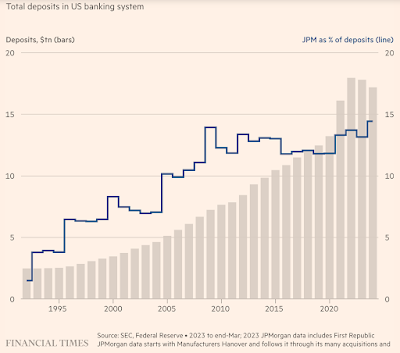
The bank now holds slightly less than 15% of all US banking sector deposits. This further increases the too big to fail (TBTF) moral hazard. Its rise in recent years has been meteoric

JPMorgan today, with $3.7tn in assets and 250,000 employees, is the result of a centuries-long consolidation process. Its heritage includes a company started by the US founding father Alexander Hamilton, the investment bank run by legendary financier John Pierpont Morgan as well as lenders that financed the Erie Canal, the Brooklyn Bridge and the UK and French armed forces in the first world war. Even as recently as 1991, the retail bank that would eventually become a global banking juggernaut had only $37bn in deposits. The group now has almost $2.5tn and its market share has grown by 10 times, from 1.5 per cent to 14.4 per cent.

... it was under Dimon, who joined the bank in 2004 when it took over Chicago-based Bank One, that the group really pulled ahead. JPMorgan is now the largest bank in the US by assets, deposits and market capitalisation, with Chase bank branches in 48 states. It also earns more from investment banking fees than any other Wall Street bank, consistently outranking Goldman Sachs, Morgan Stanley and Bank of America.

Max Abelson and Hannah Levitt (HT: Adam Tooze) wrote this in Bloomberg about JP Morgan and Jamie Dimon,

If you’re tempted to compare it to BlackRock Inc., remember that the money manager’s $9 trillion of assets are in funds it oversees for clients. JPMorgan, by comparison, finances the world (and has an asset management operation that’s itself about a third the size of BlackRock). And it processes more than $5 trillion of payments a day. You can think of it as an empire all its own. Bloomberg Opinion columnist John Authers goes further, calling Jamie Dimon the sun around which the financial system revolves and describing JPMorgan as a kind of public utility, big enough for the government itself to depend on... 

Dimon likes to say that the bank has a fortress balance sheet, an image that political economist Mark Blyth elaborates on. “If the only game in town is a medieval fortress, I want to be inside,” says Blyth, who runs the William R. Rhodes Center for International Economics and Finance at Brown University. “Hey, we have the castle. Don’t you want to be in the castle? It’s dangerous out there.” In the first three months of the year, as other banks saw savers depart, deposits at JPMorgan rose. But there’s a problem with everyone wanting to be in the castle. “What happens if the castle walls get breached?” Blyth asks. “We’re all screwed.” Economic power in the US runs in eras. As Blyth puts it, after World War II, when society more or less had to be rebuilt, the fiscal capacity of the US Treasury dominated. When inflation became the enemy and the Fed had the power to fight it, fiscal dominance gave way to monetary dominance. Now too-big-to-fail banks’ becoming bigger could usher in something new. “We may be in a world of financial dominance,” he says. “I don’t know, but it sure smells that way.”

JP Morgan took over First Republic in an auction that had three other smaller banks, PNC, Citizens Bank, and Fifth Third, whose combined assets were less than a third of JP Morgan's. The bid parameter was the least loss to the FDIC, and JP Morgan's was the cheapest at $13 bn of estimated loss. But as the FT article writes, the sheer size of JP Morgan put it at a clear advantage compared to the three competitors. Besides given its sheer size, the Treasury and regulators would have naturally thought that a takeover by JP Morgan would have had a greater confidence-building effect on the banking system. Patrick Jenkins highlights the problem with such thinking 

The Federal Deposit Insurance Corporation, which manages US bank failures and administered the First Republic transaction, made clear JPMorgan had won the deal ahead of other bidders, essentially thanks to its heft. It could afford to offer a better value package to the FDIC — and the organisation has a legal duty to choose the “least-cost” solution. But this is a self-perpetuating argument, and with the banking turbulence of recent months turning into a full-blown regional banks crisis, JPMorgan could well become the natural buyer of other troubled banks. That feels neither healthy nor sustainable. Respecting the “least-cost” law, without considering the longer-term bigger picture, is myopic.

This is perhaps an example of an instance where the government and regulators in the US ought to have kept life-cycle cost (instead of current cost-benefits) as a factor in their decision. It's one thing to ask JP Morgan to take over when nobody was willing (and JP Morgan had declined to take over Silicon Valley Bank at the height of the current banking crisis), but an altogether different thing to hand over the failing bank to JP Morgan when there were others willing to do so. Even at a higher cost, the regulators could have avoided JP Morgan and sent out a message. But that's unlikely given the political capture of decision-making in the US by Wall Street and Big Tech interests. 

It also highlights how deeply entrenched the moral hazard of bailouts has become in the US. As Ruchir Sharma and others have pointed out, it's become all too evident that the policymakers are too scared of letting anything fail that they'll anyways come up with a bailout at the end. And the market participants have internalised this belief. 

All failures have costs. But such bailouts have even greater costs. The real issue is this - do you want to suffer the immediate pain of a bank failure, or invite much bigger long-term harm through distortion of incentives and encouragement for recklessness which erodes the disciplining powers of financial markets and irreparably weakens the foundations of capitalism?

The rise of BlackRock in the asset management industry has been even more meteoric. Founded in 1988 as Blackstone Financial Management, it really took off after the global financial crisis. This is a good primer. 

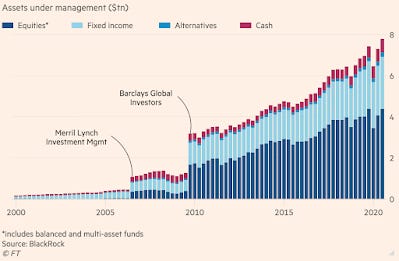
Its assets under management have risen spectacularly since the financial crisis, more than quintupling to briefly touch $10 trillion in early 2022

This while a bit dated (from November 2020) is still relevant 

The hit to the big banks from the 2008 financial crisis allowed it also to swoop on Barclays Global Investors, then the world’s largest fund manager, in time for the longest bull market in equities since the second world war. That acquisition included iShares, the exchange traded fund unit that has grown seven-fold on the back of a massive shift to passive investing and now accounts for a third of BlackRock’s assets. The iShares unit now accounts for 40 per cent of global ETF assets...

BlackRock amounts to a perpetual reinvention machine that has continually added new sources of growth, most recently from technology services to investors, including chunky contracts for its Aladdin risk management platform. Its $1.3bn acquisition last year of eFront, a risk analysis company, was the biggest deal for BlackRock since the Barclays purchase. The combination of economies of scale from client inflows and these new tech revenues allowed BlackRock to set a new record for operating margin in the third quarter, which at 47 per cent would draw the envy of the tech companies that have led the market this year

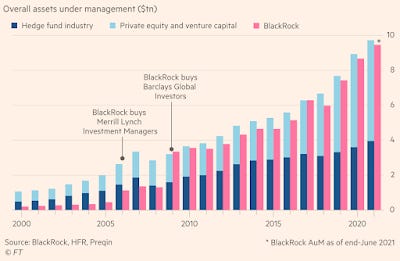
The most stunning graphic is this below - BlackRock on its own is about the size of all of the hedge fund and private equity and venture capital industries combined. 

Its AUM has recovered to $9.1 trillion after a decline of $1.4 trillion in 2022, and the Fund is actively engaging on the alternatives side, an area dominated by the likes of Blackstone and KKR. It recently tried and failed to buy Credit Suisse. 

Like with JP Morgan, BlackRock's large size gives it enormous advantages. It's amplified by its presence across the spectrum - asset management, ETF wealth management platform, risk management platform, advisory services, etc. As an illustration, its advisory arm was selected by the FDIC to help sell $114 bn portfolio of securities (mortgage-backed securities, collateralised mortgage obligations, and commercial mortgage-backed securities) inherited after the government takeover of Silicon Valley Bank and Signature Bank. 

BlackRock’s Financial Markets Advisory arm has long been the go-to team for central banks and governments when they need to deal with messy assets acquired during financial rescues. The financial powerhouse helped the US sell off assets from the 2008 collapses of Bear Stearns and AIG, evaluated troubled banks for the Irish and Greek governments, and advised both the Fed and the European Central Bank on asset purchase programmes.

Business transactions involving the Advisory arm and Aladdin feed into BlackRock's asset management business in many direct and indirect ways, and confer it an unfair advantage. In the circumstances, it's again not clear as to why BlackRock should have been selected for such sales, when the same could have just as well been done by others, perhaps at a slightly higher cost. 

BlackRock is also one among the Big Three that dominate the global asset management industry, the others being Vanguard and State Street Global Advisors. A paper by Lucian Bebchuk and Scott Hirst found

We document that the Big Three have almost quadrupled their collective ownership stake in S&P 500 companies over the past two decades; that they have captured the overwhelming majority of the inflows into the asset management industry over the past decade; that each of them now manages 5% or more of the shares in a vast number of public companies; and that they collectively cast an average of about 25% of the votes at S&P 500 companies... We estimate that the Big Three could well cast as much as 40% of the votes in S&P 500 companies within two decades. Policymakers and others must recognize — and must take seriously — the prospect of a Giant Three scenario.

As an update

As of the end of 2021, the Big Three collectively held a median stake of 21.9% in S&P 500 companies, which represented a proportion of 24.9% of the votes cast at the annual meetings of those companies. 

In their latest paper, Bebchuk and Hirst refute with great detail the arguments against systemic risk creation and market concentration by the Big Three officials, and caution at the rising power of the Big Three. They argue that the diffused ownership in public companies and the prevailing market structure present the Big Three with the ideal conditions to influence major corporate decisions. 

Even among the Big Three, BlackRock tops in its market influence,

Given that many shareholders don’t actually bother to vote at annual meetings, BlackRock, Vanguard and State Street now account for about a quarter of all votes cast on average, which will rise to 41 per cent over the next two decades, the academics estimated... In reality, calling it the Big Three is a misnomer. State Street’s inclusion is the legacy of its invention of the ETF, and its size and growth rate is far more modest than BlackRock or Vanguard’s. In practice, there is an emerging duopoly, and BlackRock’s pole position — and Fink’s willingness to throw its heft around more than Vanguard — has made it a target across the political spectrum... A host of former government officials work at BlackRock, and others have departed for plum jobs in the Biden administration. To some critics, BlackRock is the new Goldman Sachs.

The Big Three's power is amplified by the rise of ETFs. BlackRock is the world's largest ETF fund manager. ETFs, like other index funds, have a unique issue - the underlying stocks of an index fund are not owned by the retail (and other) investors who buy the index fund, but by the fund manager, who there also owns the vote. This makes the fund managers of passive funds massively influential in so far as becoming a large voting shareholders in many companies. A US Senate working paper has documented several instances of strategic voting by the Big Three in the name of "investment stewardship". The paper makes several recommendations, mostly to enhance transparency and disclosure by the Big Three. 

I can think of at least three problems with size on its own, each of which in itself is sufficiently strong enough to discourage corporate bigness, especially but not only in financial and technology markets. One, apart from the economies of scale, the magnitude of their size confers on these institutions several implicit advantages, including the cheaper cost of capital, preferential access to talent and market resources, leverage over the market ecosystem, additional margins for risk assumption, preferential treatment by regulators, and a carte-blanche backstop arising from too big to fail. 

Two, given the complex and deeply interconnected nature of financial markets, institutions of the size of JP Morgan and BlackRock are too big to manage. These are bigger than all but a couple of countries. Three, a size of such magnitude is invariably accompanied by a seat at the top of the decision-making table. Given the stakes involved and the inexorable dynamic of market incentives, such access invariably translates into being able to decide the rules of the game. Such political capture corrodes capitalism and democracy. 

The behemoths among Wall Street and Big Tech companies are the most egregious exhibits. It's time that regulatory scope expands beyond present and future consumer welfare and looks at these far more dangerous factors.