Substack

Wednesday, June 8, 2022

ESG investing and woke capitalism

ESG investing is today the fastest growing segment of the asset management industry, clocking 53% growth in 2021 to $2.7 trillion. Underlining its importance, a recent FT report indicated that while ESG was mentioned in fewer than 1% of earning calls in 2005-18, by May 2021 it was mentioned in almost a fifth of earnings calls. 

But with this rise has come disturbing concerns, especially of greenwashing or impact washing. Another one is whether ESG investing becoming woke capitalism. After Tesla was removed from the S&P's ESG Index, Elon Musk described ESG investing as a "scam",

Exxon is rated top ten best in world for environment, social & governance (ESG) by S&P 500, while Tesla didn’t make the list! ESG is a scam. It has been weaponized by phony social justice warriors.

He also described the decision "a clear case of wacktivism" and claimed that ESG scores measure "how compliant your business is with the leftist agenda". This resonates with an increasingly growing chorus describing ESG as woke capitalism.

FT has a long read on ESG investing here. The article points to the reversal in opinions about big corporations among Republican (conservative) and Democratic (liberal) voters. 

It also points to the rise of a conservative movement to save corporate America from perceived excessive wokeism. 
CEOs who took a stance on the issue left employees who disagreed with them feeling demotivated, Vanessa Burbano, a Columbia Business School professor found, while not meaningfully motivating employees who agreed with them. Weighing in on politically divisive issues, she concludes, is in fact “a riskier proposition than a lot of people realise”. Some companies already appear to be considering such risks when deciding on their own political interventions. Swarnodeep Homroy, associate professor of finance at the University of Groningen, found that companies were more likely to suspend donations to Republicans aligned with the effort to deny Joe Biden’s 2020 election victory if they were based in states with highly polarised electorates. They were less likely to do so if they faced political risks such as the chance of losing government contracts. “They tend to [take political positions] when there is no shareholder/stakeholder trade-off,” Homroy says... 

Political polarisation is likely to turn more CEOs into proxies in the social battles their employees feel most passionate about, says Burbano. The prospect of the US Supreme Court ending federal abortion rights, the renewed debate about gun control after the mass shooting at a school this week in Uvalde, Texas, and politicians’ desire to animate voters in the run-up to November’s midterm elections all signal that the political heat will intensify. “Employees are realising that their leaders are facing a choice over what to say and what to do, and they can potentially influence that in a way they didn’t five years ago,” Burbano says. Paul Polman, the former Unilever chief, echoed that view in a recent LinkedIn post. “Many have lost faith in politics to represent their views and secure their futures. They are turning to corporate power instead,” he observed. By doing so they have left business leaders “increasingly stuck between employees and politicians”, Polman warned.

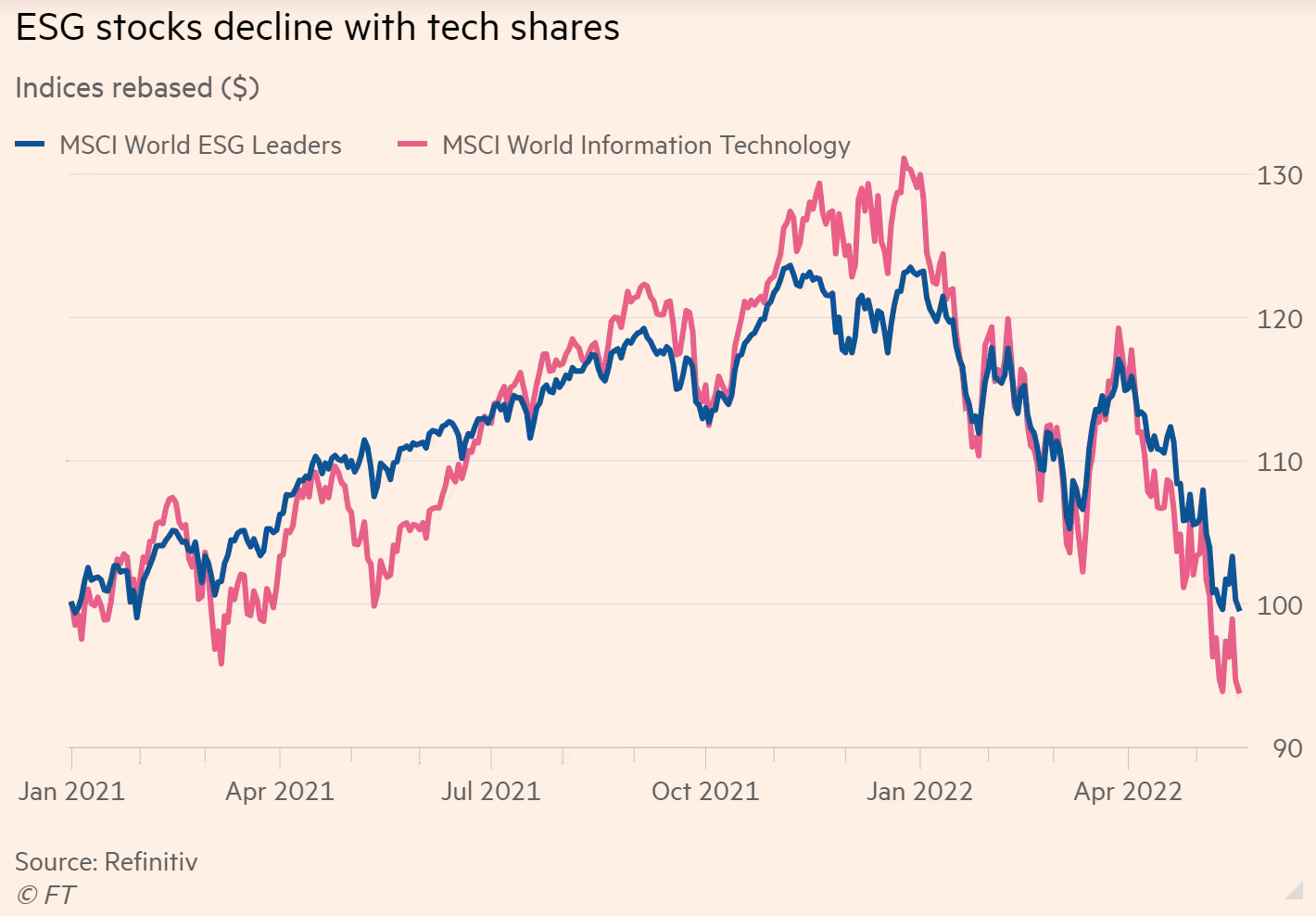
In the context of claims that ESG investments generate high returns, there is the likelihood that ESG investing has become some form of Tech washing. Consider the graphic below. 

This raises important questions. Were the high ESG investment returns concealed in their high Technology sector exposures? Alternatively, was the high ESG returns a consequence of their high correlation with growth stocks which benefited most from the market boom? Now that technology sector valuations are on the downswing, how will ESG sector investments fare?

These trends point to an important aspect about today's political economy. 

The liberals espouse causes like fighting inequality, racism, and climate change. As a group, one can imagine them as consisting of intellectuals and researchers, philanthropies and non-profits, young Ivy League educated professionals, and student population in general at the top American universities and colleges. As a population collective, they are deeply enmeshed with the same interests or contributors of these problems as investors, employees, children, friends and relatives etc. So, it's only natural that their actions while criticising the vested interests, will generally stop short of anything that overthrows the regime itself. 

In fact, most often, their energies are channeled into cosmetic efforts which while detracting attention from meaningful attempts and proposals to reform the system, also ends up strengthening the incumbents. Woke capitalism ends up undermining the efforts to address the very problems it seeks to eliminate. And the present avatar of ESG investment is a good example. 

Monday, June 6, 2022

Evidence and evaluations in development

One of the most popular narratives in the development world is the idea of evidence-based policy making. Its most salient application is the idea of independent and rigorous evaluation of causality. Is this intervention creating the intended effect?

The development academia and commentators debate about the methodological and other challenges to evaluations and lament the lack of awareness and interest among bureaucrats and politicians. However, there are three very important points to be kept in mind.

One, when academicians, commentators and donors talk about evaluations, they are generally talking about evaluations of small experimental programs or pilots. Pretty much all the literature about "rigorous impact evaluations" involve these. They are rarely talking about evaluating ongoing scaled up programs. This is despite arguably more than 95% of the development world (in terms of budgets, numbers of programs, number of people working etc) being engaged with ongoing large scaled-up programs. 

But there are serious methodological limitations to doing any meaningful enough causal evaluations of such scaled up programs. How do we evaluate an intervention that seeks to improve student learning outcomes  or improve public health or increase nutrition levels or enhance women's empowerment or equip youth with employability skills by isolating the countless known and unknown determinants? How do we insulate the fundamental efficacy of the idea itself from its implementation at scale by a weakly capacitated state? 

Second, it brings us to the point about new ideas. The assumption is that development world needs to embrace the idea of innovation and technology that has come to characterise the private sector. However, instead of blindly adopting them, they need to be evaluated for their efficacy and then implemented. 

But, as I have blogged earlier, apart from procedural tweaks and technological solutions, there are very few new ideas per se in the field of development that are not known to practitioners at large. In the last thirty years, I cannot recollect having seen new development programs with meaningful enough impact on persistent development problems which have emerged as mainstream and have been transformative. In terms of primary interventions in the major development sectors, the choice set of interventions before governments is to only marginally tweak the ongoing programs or adapt interventions which have been effective in developed countries. There are no great unknown or untried ideas which can help leapfrog universal and persistent development problems! 

The paths to improving student learning outcomes, delivering better primary health care, skilling youth, empowering women, improving nutrition levels etc are and will about bringing together certain inputs and combining them effectively. The challenge has been about combining them. While process tweaks, private participation, and technology are useful, effective implementation at scale is mainly about political economy, stakeholder demand, contextual norms, and state capability. 

Third, even if there are such unknown or untried ideas with significant likely impact, their challenge is with getting implementation right. For example, we can think of ideas like self-help groups and microfinance, community health workers, short-term skilling programs, independent quality and social audits, public private partnerships, teaching to the child, and e-governance solutions that have emerged as mainstream in the last three decades. 

But their causal evaluation in a pilot can offer limited insights and guarantees about scale effectiveness. There is the point made earlier about the implementation challenge. It should be borne in mind that even after hundreds of RCTs about microfinance, we are still no more certain about the headline issues. 

The importance of impact evaluations in development discourse is therefore vastly exaggerated. More than any serious evidence, as I have blogged earlier, the impact evaluation movement in international development has been propped up by philanthropic foundations who've been concerned with the purely reductionist approach of finding the greatest value for their small donations. 

Sunday, June 5, 2022

Weekend reading links

1. Ajay Tyagi points to value erosion due to being a public sector enterprise, 

... during the five-year period (FY17 to FY22), PSE index return (Nifty PSE) was less than 2 per cent compared to Nifty 50 return of over 90 per cent and Nifty 500 return of over 85 per cent. On a sectoral basis, PSU Bank index return of (-) 23 per cent during the same period was the worst among all sectoral indices; in comparison, Nifty Bank Index and Nifty Financial Services index gave a return of 70 per cent and 96 per cent, respectively, during this period.

This is a combination of actual poor governance, stigmatised perceptions of public ownership, and general valuation premia with private sector companies.  

Sample these examples,

The GoI came out in 2013 with the norm for listed entities to have a minimum public shareholding of 25 per cent. The PSEs were given time till 2016-17 to meet this requirement. Unfortunately, this date was extended by the government time and again. As of end March 2022, out of the total 87 listed PSEs, 32 still do not have a public shareholding of 25 per cent... As of end March 2022, 55 listed PSEs didn’t have the requisite number of independent directors and 28 didn’t have even one woman director (independent or otherwise) on their board.

2. Martin Wolf points out that China and Russia are the biggest trading partners for many major developing countries.

3. Martin Sandbu thinks European inflation is cost-push, whereas the US is suffering from the demand-pull variant. While high energy and food prices imported due to pandemic and Ukraine war related supply crunches is driving European inflation, the Americans are experiencing more broad-based inflation due to pandemic stimuluses and tight labour markets. 

4. Even with the recent corrections, US stock markets remain highly over-valued on historical terms.
5. The impact of European ban on oil imports from Russia,

India is another beneficiary because it has big refineries that can process Russian crude, turning it into diesel, some of which could end up in Europe even if the raw material came from Russia. “India is becoming the de facto refining hub for Europe,” analysts at RBC Capital Markets said in a recent report. But buying diesel from India will raise costs in Europe because it’s more expensive to ship fuel from India than to have it piped in from Russian refineries. “The unintended consequence is that Europe is effectively importing inflation to its own citizens,” the RBC analysts said. India is getting about 600,000 barrels a day from Russia, up from 90,000 a day last year, when Russia was a relatively minor supplier. It is now India’s second-biggest supplier after Iraq. But India could find it difficult to keep buying from Russia if the European Union’s restrictions on European companies insuring Russian oil shipments raise costs too much. “India is a winner,” said Helima Croft, RBC’s head of commodity strategy, “as long as they are not hit with secondary sanctions.”

6. I've been deeply sceptical of both the business model and the value addition of India's Edtech startups. They've been riding on aspirational parents weakness to provide any perceived additional edge to their children, and the pandemic provided the big boost. There are no reasonably rigorous independent studies that evaluate their efficacy. And all have resisted efforts to undertake serious independent evaluations. So the real value addition of the prevailing providers are deeply questionable.

The biggest concern, now materialising, is that these entities become the glorified version of India's tuition institutes for schools and professional course entrance examinations. 

Unacademy recently announced its foray into offline learning at its upcoming new Unacademy Centres. These will facilitate offline classes for learners and will extend access to top educators in the NEET UG, IT JEE and Foundation (9-12) course categories. The firm aims to meet the growing demand for inter-personal mentoring with this new approach. The first Unacademy Centre will be operational in Kota this month, followed by Jaipur, Bangalore, Chandigarh, Ahmedabad, Patna, Pune and Delhi. Byju’s will invest upwards of $200 million to open brick and mortar tuition centres in the next 12-18 months. Based on the feedback received from the first 80 pilot centres launched since December, it will launch 500 centres in 200 cities this year.

See also this about the stress faced by Edtech firms as the pandemic eases and children return to schools. 

7. It means something when Vincent Mortier, chief investment officer of Amundi Asset Management, Europe's largest asset manager, said this

"... parts of private equity look like a pyramid scheme... You know you can sell [assets] to another private equity firm for 20 or 30 times earnings. That’s why you can talk about a Ponzi. It’s a circular thing.”

PE firms have more than $6 trillion in assets under management and have raised and deployed record amounts in the first quarter of 2022. 

8. The ongoing coal shortage forced the GoI to advise state generators to import and blend with 10% imported coal. Many state generators expressed difficulties and requested that the GoI organise the imports on their behalf. NTPC estimates a requirement of nearly 20 mt of imported coal to meet the 10% blending requirement. 

India’s largest power generating company (genco) NTPC Limited has awarded multiple coal import contracts for 6.25 million tonne (MT) to Adani Enterprises at a cumulative value of Rs 6,585 crore... The company placed six different tenders and received technical bids from four players - Ahmedabad based Adi Tradelink, Chennai-based Chettinad Logistics, and Delhi-based Mohit Minerals Ltd along with Adani Enterprises. In March, when the coal crisis erupted, NTPChad issued five tenders for importing 5.75 MT of coal, and all the contracts went to Adani Enterprises. The cumulative amount of these tenders was Rs 8,422 crore. The technical level bidders were the same one as in the latest round... the imported coal would come from Indonesia and NTPC is not looking to import from Australia... NTPC would see its fuel cost go up to Rs 7-8 per unit from importing coal as against Rs 2 per unit from buying domestic coal from national miner Coal India Limited (CIL)... (blending) would increase the final electricity tariff of NTPC by 50-70 paisa which would be passed on to consumers. Coal price in the global market is currently five times the CIL notified coal prices.

9. On India's woefully low financial market savings,

Sample this on pension products

Consider the performance of the government’s flagship Atal Pension Yojana. By January 2022, the government said that 36.8 million people had subscribed to Atal Pension Yojana. In contrast, 277 million people have registered on e-shram portal to avail of government benefits, and there are an even greater 500 million people in the unorganised sector. Even those in the organised sector do not have adequate pension coverage.

10. T N Hari in Livemint has a long read on entrepreneurship for middle-India. This is a fascinating story about how marketing based on sachets became popular.

Chinni Krishnan, a farmer turned entrepreneur in Cuddalore, noticed how the multinationals (MNCs) had neglected the low-income consumers. He had dabbled in pharmaceuticals and fast moving consumer goods (FMCG) in the first few decades following independence. Sometime in the late 1970s, a few years before his demise, he came up with the idea of selling products in small sachets. In those days, talcum powder and epsom salts were sold in tin containers or glass bottles and the minimum quantity was nearly 100 grams. He noticed that these products were not bought by the workmen in the farms and factories, or the other low-income communities, because they were considered expensive. He took a call to change the packaging and began selling talcum powder in 20 gram packs and epsom salt in five gram sachets. He soon realized that even liquid products could be packed in sachets. The idea was a huge success. Chinni Krishnan was a great innovator, but the idea of selling shampoo in sachets would be marketed and popularized by his son C.K. Ranganathan who founded CavinKare. MNCs in India were quick to copy this innovation. Chinni Krishnan and CavinKare had figured out a door into middle India through a deep understanding of the consumer—the insight was that the middle India consumer may have been poor, but was aspirational. The problem was that most low-income families had a serious cash-flow problem and, hence, could not afford to buy the large pack. Buying a regular bottle of shampoo meant carving out a significant chunk of the monthly income for a luxury product, and this was simply untenable. The small pack sizes were a good way to get first time consumers try out a product.

11. Finally fascinating story about the use of statistical techniques in forecasting the likes of trajectories of cricket match innings.

Friday, June 3, 2022

Mathew Effect in football

An Iron Law of modern capitalism is that of Mathew Effect. The rich get richer. The efficient become more efficient. The entrenched get more entrenched. And all of these positive feedbacks engender their respective negative consequences.

European football is the latest exhibit. Since 2013 or so, thanks to their financial muscle, the English Premier League (EPL) has broken away from the rest of Europe. 

The same trend works within all the major leagues - the richest handful of clubs dominate so as to create virtual two-tier leagues. 

In the early 1990s the European Cup was far more cosmopolitan, with clubs from 13 countries reaching the semi-finals. In the past five years, three-quarters of semi-finalists came from just five urban western European regions: Paris, Madrid, Munich, London and the north-west of England. The dynamic playing out between countries has created uneven playing fields within them. Adjusted for changes in ranking methodology, in 1975 30 points separated first from last in the English top tier, and the difference between the best and worst goal difference was 52. This season, the former is 72 and goal difference 134. The risk is that England’s elite not only dominate domestically but that the Champions League in effect becomes the nation’s fourth piece of major silverware after the Premier League, FA Cup and League Cup.

It's really a simple dynamic. In the absence of any regulation, in a free market of any kind, competition will invariably end up favouring the more endowed (with resources, capacity, influence etc) at the cost of the less endowed. In other words, the starting point becomes the critical factor in the competitive race. What makes it even worse is the inevitability of political or regulatory capture that's associated with any market where concentration crosses some threshold. This is the Iron Law of a free market economy!

Wednesday, June 1, 2022

Some thoughts on the inflation debate

Inflation is on the rise across the world. US and Europe are facing decadal highs in their inflation rates.
See also this below
While it's widely agreed that inflation will subside once the supply shocks - pandemic, Ukraine war, and Chinese lockdown - stabilise. However it's a matter of debate as to whether it'll lead to a regime shift where instead of struggling to create inflation (as has been the case fo the past two decades) we'll move to a normal world where central banks will have to struggle to keep inflation down. In simple terms, have the conditions which contributed to secular stagnation have changed due to recent events, as to shift the inflation regime? Olivier Blanchard and Dario Perkins are two sides of the debate.

Two very famous personalities recently added their voice (needless to say, both over Twitter) to the debate surrounding rising inflation. 

Larry Summers warned that antitrust efforts have gone too far and that "policies that attacked bigness can easily be inflationary". He said that such "populist anti-trust policy" can lead to an economy that is "more inflationary and less resilient". 
But attacks on “largeness on its own terms”, increases in the market share of industry leaders without regard to their efficiency, shrinkage of small business market shares, private equity ownership, or destruction of communities are presumptively problematic. There are real risks. Policies that attack bigness can easily be inflationary if they prevent the exploitation of economies of scale or limit superstar firms. Likewise, policy focused on protecting competitors or communities or limiting layoffs are likely to raise costs & prices. Policies that attack vertical integration or limit contracting between firms and their suppliers and distributors may reduce efficiency and, by lengthening supply chains, reduce resilience. We need more focus on tariffs and other trade restrictions which undermine competition raise prices and reduce resilience in products ranging from gas at the pump to baby formula and automobiles to new homes.

There are so many problems with these arguments. I don't want to dwell at length and get into details. Just two would suffice. One, the pendulum on anti-trust has swung so excessively in favour of big companies that a large calibration is required. However, even with the muscular presence of trust-busters at FTC, DoJ, and White House, the ideological hegemony and elite capture are too entrenched to make much of a dent on the prevailing paradigm. Summers' comments further entrenches the incumbents. 

Two, there is already enough evidence that being big by itself is bad for the economy. An even more compelling argument against bigness comes from the political economy. Bigness and attendant market concentration invariably generates lobbying and efforts to raise entry barriers, which ends up with regulatory capture and the rules of the market effectively being set by the incumbents. 

In response to a White House tweet urging the wealthiest corporations to pay their share of taxes so as to lower inflation, Jeff Bezos blamed the Biden administration's $3.5 trillion pandemic stimulus for the surging inflation. Amazon has long been Exhibit A of tax evasion dressed up as avoidance, having paid no federal taxes in 2017 and 2018 and more. This coming from Bezos, irrespective of its merits, is clearly hypocritical. Like devil quoting the scriptures.  

Technically speaking, unlike the self-serving petulance of Bezos, White House may have been on strong wicket when it linked inflation to the surging corporate profits. Sample this (here is the EPI report)
This is true of Europe too, where profits, and not wages, were the main contributors to inflation, as businesses managed to pass-on price increases to consumers. 
Incidentally, Summers intervened (again on Twitter) in support of the White House, calling for raise in taxes to reduce demand and thereby contain inflation.

Monday, May 30, 2022

Urbanisation trends - transportation and housing facts of the day

I have blogged earlier about unaffordable housing and traffic congestions being the biggest threat to urban growth. 

Take the example of housing. Increasing the stock of affordable housing is arguably one of the biggest public policy challenges. Even when the stock of housing increases, it's often the case that the increase is confined to the supply of higher value units. Worse still, thanks to trends like gentrification and housing increasingly an investment asset in the largest cities, the stock of affordable housing ends up shrinking. Sample this from New York City (via this report),

Between 2017 and 2021, New York City lost almost 100,000 units that had rented for less than $1,500 per month, while it added 107,000 units that rent for at least $2,300 per month... In Manhattan, for example, the median effective rent in April 2022 was $3,870, more than 38 percent higher than a year before and the highest level ever recorded.

One could say that these effects are much more pronounced in rapidly growing cities of the developing world. Rapid growth of the biggest cities have made them pockets of continuing asset bubbles which in turn attract speculative and other investors, thereby pricing out the middle-class and below. 

On the transportation side, nearly 160 years after the first metro rail system was launched in London in 1863, the £19 bn Crossrail project connecting the west and east of London became partially operational last week. It's designed to halve journey times and bring the city's four airports together with just one interchange, the Elizabeth Line will bring an additional 1.5 m people to within 45 minus of central London. The project is four years late and £4 bn over budget. 

The opening of Crossrail comes at a time when metro rail systems globally are facing a crisis. Passenger growth in metro railways have been stagnant for the last decade and Covid 19 dealt a body-blow. Even after the passing of Covid, commuter traffic is only 60-70% of pre-covid levels. Even more strikingly, overall all transport modes have declined over the last two decades as people have stayed at home.

Between 2002 and 2019, the average distance people in England travelled annually fell by 10 per cent and the number of trips by 11 per cent, according to official UK data. The decline was observed across almost all modes of transport, from short walks to public transport to driving. The trend is similar in Europe and the US, even though it is sometimes masked by population growth. Even before the pandemic, fewer people were commuting the full five days a week, and more employees were on short-term contracts or working in the less routine “gig” economy. This has weakened the economic case for shiny new urban transit projects in those places. Of the 56 new metro systems that opened worldwide between 2010 and 2020, 44 were in the Asia-Pacific region, according to the International Association of Public Transport, and just one was in Europe... The pandemic has accelerated and cemented the shift. Today, more so-called knowledge workers are based at home or in third spaces closer to home, such as cafés or co-working spaces, than ever before... In Greater London, public transport use last week was still down around 33 per cent compared with February 2020 levels, according to Google Mobility data. 

While commutes are stable or declining in mature urban systems in developed countries, they're exploding in the rapidly expanding developing country cities. Worsening the problem is the unaffordability of housing, which pushes people out to the suburbs, thereby increasing commute times. In other words, at their prevailing population levels, congestion and commute times increases faster than the urban population growth itself in most major developing country cities. 

Saturday, May 28, 2022

Weekend reading links

1. David Gelles in the Times has a revisionist perspective on Jack Welch, widely considered the greatest chief executive of all time and described as "manager of the century" by Fortune magazine. Welles has a scathing summary of his deeply unflattering legacy,

Almost immediately after Mr. Welch retired in September 2001 with a $417 million severance package, G.E. went into a tailspin from which it would never recover. His pupils, though, went on to run dozens of other major companies, including Home Depot, Albertson’s, Chrysler and Boeing. Most of them failed. And in the decades since Mr. Welch assumed power, the economy at large has come to resemble his skewed priorities. Wages stagnated and jobs moved overseas. C.E.O. pay went stratospheric and buybacks and dividends boomed. Factories closed and companies found ways to pay fewer taxes. Beyond his enduring influence on the economy, Mr. Welch also redefined what it meant to be a boss, personifying an aggressive, materialistic style of management that endures to this day.

... he exerted a powerful and lasting influence on American business, informing how workers are treated, how shareholders are rewarded and how C.E.O.s comport themselves in an increasingly divisive age. When Donald J. Trump is elected president, when Jeff Bezos argues about inflation with the White House, when Elon Musk negotiates his $44 billion deal to buy Twitter by using the poop emoji — this is the world that Jack Welch helped create... In retirement, Mr. Welch continued to hold sway over the business world as an elder statesman, penning books and columns, and appearing on cable news to praise the executives he had groomed and continue his assault on taxation and regulation. Mr. Welch also pursued an unexpected retirement pastime: He became an internet troll... It was a career defined by a ruthless devotion to maximizing short-term profits at any cost, and punctuated by a foray into misinformation. And it opened the door to an era where billionaire C.E.O.s are endowed with vast power and near total impunity...

He was a compulsive dealmaker, fueling G.E.’s growth with a relentless series of mergers and acquisitions that took G.E. far from its industrial roots and set in motion a wave of corporate consolidation that would reduce competition in industries as diverse as airlines and media. He closed factories and fired employees by the tens of thousands, unleashing a series of mass layoffs that destabilized the American working class. He devised systems like “stack ranking,” which mandated that the bottom 10 percent of workers be fired each year, and took root at other companies. And he embraced offshoring and outsourcing, sending labor overseas and turning to other companies to provide back-office functions like accounting and printing... But more than the downsizing or the dealmaking, it was Mr. Welch’s obsession with finance that allowed him to steadily inflate G.E.’s valuation in the public markets... By the time he retired, the company derived much of its profit from GE Capital, which was essentially a giant unregulated bank... an amorphous, ever-changing collection of financial assets, capable of delivering whatever adjustments were most advantageous to the parent company in a moment’s notice. The finance division became G.E.’s center of gravity, ultimately accounting for 40 percent of its revenue and 60 percent of its profit. With so much money coursing through the finance division, Mr. Welch used it to his advantage, shifting zeros throughout a sprawling international web of subsidiaries, and extracting whatever he needed to meet or beat analysts’ estimates for nearly 80 quarters in a row, an unprecedented run. It was what one influential analyst called “earnings on demand.”

Never mind the diminution and break-up of GE and the corrosive implications of Jack's legacy, this is yet another example of how narratives endure despite overwhelming evidence to the contrary. 

I'm also inclined to believe that Jack Welch was the business counterpart to Milton Friedman in the academia in peddling a false and corrosive ideology that continues to exercise its hegemony. 

2. The stock market crash may have wiped trillions off Big Tech valuations, but as this Times story writes, they stand well positioned to widen their market dominance in any recession. 

3. Adam Tooze explains the success of Javelin anti-tank missiles which have been critical in the Ukrainian infantry's combat against the Russian tank-mounted cavalry. 

The Javelin is a high-tech weapon that kills at ranges often exceeding those of the Russian tank guns. It is the product of breakthroughs in the postwar period that saw hollow charge warheads combined with more powerful rocket propulsion. The more powerful rockets allowed engagement at longer distance, but also raised problems of accuracy. Unlike a shell fired out of a cannon that - due to its extreme velocity, simple aerodynamics and the direction provided by the barrel - follows a predictable path, a rocket is too unsteady to guarantee a hit at long range. A long-range rocket requires guidance, through fins activated either by wire, or as in the case of the Javelin by infrared and a highly sophisticated internal guidance system. It was the combination of long-range rocket propulsion with guidance and shaped charge that created the modernAnti-tank Guided Missile (ATGM) - a weapon that combined the lightness and mobility of a personal anti-tank device - Panzerfaust, RPG - with the long-range striking power of an anti-tank gun.

4. The Chinese government has prioritised self-sufficiency in the manufacture of cutting-edge microchips as one of its important prongs in the competition with the US. But there have been doubts about the Chinese ability to master this technology. Sample this

Eric Johnson, the CEO of JSR, one of the world’s largest suppliers of a material critical for semiconductor production, has said a lack of industry infrastructure will make it “very difficult” for China to develop cutting-edge chipmaking technology despite a push for self-sufficiency... Johnson said China would struggle to master the sophisticated chipmaking technology based on a technique known as extreme ultraviolet or EUV lithography... EUV lithography is a highly demanding process using light to etch minuscule integrated circuits on to silicon wafers. Even if China “got a paper on exactly what the chemistries were . . . to manufacture that at the purities, and the precision and reproducibility is really tough”, Johnson said. “It’s not that simple and they don’t have the supply chain to support that, either.”

James Kynge reports of record increases in foreign investors and multinational corporations intending to shift production away from China or limit investments. 

5. A fascinating Bruegel data set outlines the responses from 18 European countries to the ongoing increases in energy prices. 

It's interesting that very few countries resorted to price, retail or wholesale, regulation. The primary means to mitigate the hardships from the price rises were targeted transfers and reduction in energy taxes. 

Interesting also that Spain and France have been the most activist among European countries.

6. The graphic tracks how US CPI inflation and Fed Funds rate have tracked each other over the last sixty years. 

7. LNG tankers facts of the day,
The big three South Korean shipbuilders — Korea Shipbuilding, Daewoo Shipbuilding & Marine Engineering and Samsung Heavy Industries — are the dominant producers of LNG ships, controlling more than 70 per cent of the global market. Large-size LNG carrier orders jumped nearly seven-fold in the first four months of this year, with the Korean builders winning 30 of a total of 47 ships ordered, according to shipbroker Clarksons... Prices for building new vessels have been rising for more than a year and are up more than 26 per cent since November 2020 to the highest level in nominal terms in 13 years, according to Clarksons.

8. ESG investing is also Tech washing? Were the high ESG investment returns concealed in their high Technology sector exposures? Alternatively, was the high ESG returns a consequence of their high correlation with growth stocks which benefited most from the market boom? 

9. Private equity is the biggest act in Wall Street.
Private equity firms announced a record 14,730 deals worth $1.2tn globally last year — that is nearly double the previous high in 2007. Employees at buyout firms pocketed $23.4bn for their work — significantly more than their investment banking pals operating on Wall Street.

It's only natural that it gets the attention of competition regulators. Sample this

Critics say the increasing market share of private equity groups in some industries has given them power to control prices and labour costs in ways that are often not in the best interests of consumers and workers... The healthcare sector is an example. Buyout deals in the industry ballooned from about $42bn in 2010 to $120bn in 2019 and many essential services, including emergency room services, mental health clinics and dentistry are now in the hands of private equity. In many areas, prices have gone up and the quality of care has deteriorated, according to multiple studies. The newspaper industry is another sector where private investment firms have expanded their footprint and drawn criticism, with concerns of cost-cutting at the expense of journalism.

10. Ruchir Sharma points to shadow banks as the big financial market risk this time around,

Shadow banks include creditors of many kinds, from pension funds to private equity firms and other asset managers. Together they manage $63tn in financial assets — up from $30tn a decade ago... Though it has pulled back recently under government pressure, China’s shadow banking sector is still among the largest in the world at 60 per cent of gross domestic product — up from 4 per cent in 2009 — and deeply enmeshed in risky lending to local governments, property companies and other borrowers. In Europe, the hotbeds include financial centres like Ireland and Luxembourg, where the assets of shadow banks, particularly pension funds and insurers, have been expanding at an 8 to 10 per cent annual pace in recent years...

After 2008, as regulators tightened the screws on public debt markets, many investors turned to these private channels, which have since quadrupled in size to nearly $1.2tn. A substantial chunk of it is direct lending from private investors to often risky private corporate borrowers, many of whom are in this market precisely because it is unregulated. Nothing highlights the frenzied search for yield in private markets more clearly than so-called business development companies. Some of the world’s biggest asset managers are raising billions for BDCs, which promise returns of 7 per cent to 8 per cent on loans to small, financially fragile companies. As one investor told me: swing a stick in Manhattan these days and you are bound to hit someone involved in private lending. 

And on the borrowers side,

The borrowers to watch most closely now are corporations. In the US, corporate debt as a share of assets remains near record highs, particularly for firms in industries hardest hit by the pandemic, including airlines and restaurants. A third of publicly traded companies in the US do not earn enough to make their interest payments. Any increase in borrowing costs will make life difficult for these companies, which need easy credit to survive. Many of them rely on expensive junk debt, which has doubled over the past decade to $1.5tn, or roughly 15 per cent of total US corporate debt. Their vulnerability was exposed early in the pandemic, when default risks briefly spiked, but was quickly covered up by massive injections of liquidity from the Fed. The biggest booms are under way in private markets.

11. More on the Sri Lankan crisis. A third of the country's debt is owed to foreign sovereign debt holders.

And its share has been increasing sharply since 2013, driven by the entry of China

This puts the problems in perspective
Sri Lanka’s reserves have fallen from $7.5bn in November 2019 to the point where finding $1mn is “a challenge”, Wickremesinghe, the new prime minister, said in an address last week. This has meant shortages of not only fuel but food and medicine, with hospitals forced to postpone surgeries. The country has the worst inflation in Asia at about 30 per cent in April and the currency has almost halved in value since it was floated in March.

12. The Chinese PM Li Keqiang warns of negative growth this quarter as the country reels from Covid lockdowns in Shanghai, Beijing, and other towns. 

13. From nothing, Adani Group has become the second largest cement manufacturer in India with its acquisition of Holcim's stakes in ACC and Ambuja Cements. This is an important driver, 

Between January 2003 and May 2022, the bellwether BSE Sensex grew at a compounded annual growth rate (CAGR) of 16.3%. That’s doubling in roughly four-and-a-half years. During the same period, leaders UltraTech, ACC and Ambuja all delivered a CAGR above 17%, with Ambuja leading at 19.1%... One reason for this is the oligopolistic nature of the industry, which has a few firms dominating production and market share.

In keeping with the growing business concentration, the top five manufacturers make up 48% of cement production capacity of 550 mt. However, in terms of production, this is likely much higher since the top manufacturers have higher capacity utilisation, which has languished in the low-60s range. 

14. AK Bhattacharya points to the petrol taxes story in India,

From about $105 a barrel in 2013-14, its average price per barrel dropped to $84 in 2014-15 and $46 in 2015-16 before marginally moving up to $47 in 2016-17... For petrol, the excise duty per litre went up from Rs 9.48 in April 2014 to Rs 21.48 in April 2017, and for diesel the increase was equally steep from Rs 3.56 to Rs 17.33 in the same period... The government’s excise revenue from the petroleum sector as a result shot up from about Rs 78,000 crore in 2013-14 to Rs 1 trillion in 2014-15 and to Rs 2.43 trillion in 2016-17... By the end of March 2021, they rose to Rs 32.90 a litre for petrol and to Rs 31.80 a litre for diesel. The Centre’s excise revenue from this sector... by 2020-21, it went up to Rs 3.73 trillion... In 2017-18, the incidence of cess and surcharges accounted for about 56 per cent of the total central levies on petrol and about 35 per cent for diesel. By the end of March 2021, the share of cess and surcharges went up to 96 per cent for petrol and 94 per cent for diesel.

Two factors were responsible. One, the surcharge levied by way of special additional excise duty and the agriculture infrastructure and development cess rose to about to Rs 13.5 a litre for petrol and Rs 12 a litre for diesel. Two, the Finance Act of 2018 replaced the road cess with the road and infrastructure cess, imposing a new combined levy of Rs 8 per litre for both petrol and diesel. In the following three years, the road and infrastructure cess was raised to Rs 18 a litre for both petrol and diesel. Thus, by April 2021, the total levy of cess and surcharges rose to Rs 31.5 a litre for petrol and Rs 30 a litre for diesel. But the basic excise duty was kept at only Rs 1.4 a litre for petrol and Rs 1.8 a litre for diesel... the Centre’s revenue from road and infrastructure cess rose sharply from Rs 51,266 crore in 2018-19 to Rs 1.24 trillion in 2020-21 and Rs 2 trillion in 2021-22. Note that the share of road and infrastructure cess rose from 24 per cent in 2018-19 to 33 per cent in 2020-21 and to well over half of the total excise revenue from the petroleum sector in 2021-22... the Centre cut the road and infrastructure cess twice in the last six months — once in November 2021 and again last week. The cess thus declined from Rs 18 a litre to Rs 5 a litre for petrol and to Rs 2 a litre for diesel. As a result, the Centre lost about Rs 50,000 crore of revenue in 2021-22 and is expected to lose another Rs 86,000 crore in 2022-23.

15. In the biggest attempt to address conflicts of interests within audit and advisory firms, EY announced a surprise split of its audit work from its consulting, tax, and deal advisory work. 

An EY split would result in two separately owned businesses and would be a much bigger change than the more limited operational separation of the Big Four’s UK audit and advisory functions, which was agreed after corporate scandals at retailer BHS and outsourcer Carillion... The plans envisage an audit-focused firm being separated from the rest of the business... This firm would retain experts in areas such as tax to support company audits... EY’s surprise move... would force its rivals to consider following suit... EY, which employs 312,000 people in more than 150 countries, is structured as a network of legally separate national member firms that pay a fee each year for shared branding, systems and technology.

16. Martin Sandbu writes that deglobalisation does not show up in the statistics. World goods trade continues to grow.

And financial globalisation is going strong

Instead, Sandbu feels that we may be witnessing an era of "regionalised globalisation" involving regional blocs aligned by common values and governance.