Substack

Saturday, August 14, 2021

Weekend reading links

1. Richard Thaler on measures to increase Covid 19 vaccination rates,

A focus on teamwork is also featured in the Cleveland-Cliffs steel company’s generous offer to its employees. Vaccinated employees get a bonus depending on how many others at their work site do likewise. The company will pay vaccinated workers $1,500 if 75 percent of employees get the vaccine, and $3,000 if the proportion reaches 85 percent. This focus on group vaccination rates reinforces the message that everybody benefits if more people get jabs.

2. Morgan Housel eternal wisdom of the week,

Incentives are almost like a drug in their ability to cloud your judgment in a way you would have found unthinkable beforehand. They can get good people to justify all kinds of things... it’s hard to know what you’d be willing to do until you’re exposed to an extreme incentive, and that blindness makes it easy to criticize other people’s mistakes when you yourself may have been just as tempted if you were in their shoes...
Everything worth pursuing has a less than 100% chance of working. And a lot of terrible ideas have at least some chance of working. So you can make good decisions that don’t work, bad ones that do, and everything in between. The hard thing is that when the probability isn’t easy to determine, the path of least resistance is to put your own failures in the “good bet that unfortunately didn’t work” category and other people’s failures in the “that was clearly a bad idea” one.

3. ReNew Power has won an SECI tender for delivering 1.3 GW of hybrid renewable energy to provide round-the-clock (RTC) renewable power by quoting a tariff of Rs 2.9 per unit. This, the first such tender in the country, will involve an investment of $1.2 bn and a plant load factor of 80%. 

The company would set up the cumulative capacity at three locations – Karnataka, Maharashtra and Rajasthan. The hybrid capacity would include 0.9 Gw wind power, 0.4 Gw solar power along with corresponding battery storage... The project will be designed to operate at an 80 per cent average annual PLF and will have a minimum capacity utilisation factor of 70 per cent monthly, despite being a renewable energy project... Power from this hybrid project is likely to be sold to northern and eastern states. SECI officials did not confirm the states. The tender provides for 3 per cent tariff escalation annually for 15 years. The company said ReNew Power will supply the electricity in the first year at Rs 2.90 per unit and this tariff will increase by 3 per cent annually for the first 15 years. After which it will stabilise for the remaining 10 years of the 25-year contract. Industry calculations indicate that the average tariff over the life of the life of the project would come to around Rs 3.5-3.6 per unit.

4. The multiple "truths" (HT: Collaborative Fund Blog)

Your truth and the truth are not always the same thing. The truth is a fact. Your truth is just an opinion. Nobody values somebody who is honest about their opinions if their opinions always suck. Knowing when to offer your truth and keep your mouth shut is a rare quality. The line between thoughtful dialogue and disrespectful disagreement is razor-thin.

5. Iceland has nearly three-quarters of its population vaccinated. Despite this, its third wave is clearly the worst. Also this about the resurgence of Covid in Israel, the first country to largely vaccinate its population. 

From a few dozen daily cases in early June — even zero on June 9 — new Covid infections twice hovered near 6,000 this week, the highest daily rate in six months... The Israeli ministry of health has twice revised downwards the long-term efficacy of the jabs — from the advertised 94 per cent protection from asymptomatic infections against the then-dominant Alpha variant, to as low as 64 per cent against the now-dominant Delta variant.

6. Fascinating NYT article about Liechtenstein. In terms of pace of casinoisation, the principality has few equals,

But only four years after opening its first casino, Liechtenstein — a tiny principality squeezed between Switzerland and Austria that is known mainly for its private banking and former status as a tax haven — now has more casinos per capita than Monaco, Macau or Clark County, Nev., which is home to Las Vegas. In the past few years, Liechtenstein has seen five casinos open — aimed mainly at attracting gamblers from neighboring countries — and there are plans for five more. The proliferation is causing alarm among some in a country where gambling had largely been illegal until 2010... The gambling boom in Liechtenstein dates to 2017, with the opening that year of two casinos. Three more followed soon after, and another two are scheduled to open by the end of this year.

This is predictably creating its backlash.

7. Business Standard report about the project for redevelopment of the Bombay Development Directorate's (BDD) chawls (large buildings divided into many separate tenements, offering cheap, basic accommodation) in central Mumbai. 

Spread over 92 acres in Central Mumbai's prime localities of Worli, Lower Parel, and Dadar and consisting of 195 four-storey houses, the BDD chawls were constructed in the 1920s... They were used as prisons to house freedom fighters. Later, they were used as accommodation for textile mill workers. Now, tenants live cheek by jowl in 160-square (sq.) feet (ft) cramped spaces. These chawls have remained trapped in time, even as swanky office buildings got constructed on textile mill lands next door... The Worli chawls will be redeveloped by the Tatas. Shapoorji Pallonji Group will redevelop the chawls on NM Joshi Road. Larsen & Toubro will redevelop the chawls in the Naigaon area. We have promised to hand over the keys within three and a half years to the present-day tenants, with only Rs 100 as registration fee... Meanwhile, the tenants have been given free housing in the government's transit camps till they are given the keys to their brand new 500-sq. ft home. As an additional incentive, the new highrises will not attract maintenance fees for the next 10 years after possession... smaller structures will be replaced by nearly 40-storey buildings, the entire landmass will significantly decongest these areas, bringing in elements of recreation, retail, and open spaces... Experts say over the next decade, 12-million sq. ft development will transform the micro markets of Worli and Lower Parel into a mid-market affordable housing settlement. Worli is currently a luxury destination, with prices ranging from upwards of Rs 50,000 per square feet on carpet area. With the BDD development, prices are likely to significantly come down to the Rs 30,000-40,000 per square feet on the carpet area... The possible addition to the housing stock, after settlement of all the project-affected people, may run into over 25,000 apartments of various sizes. 

If this gets completed in even five years, it'll be a great achievement. A rare example of large urban renewal in the Indian context. 

8. A bill in the California Legislature proposes deregulation of parking requirements to boost new housing construction, 

Known as AB 1401, the legislation would abolish local parking requirements for new residential and commercial developments near bus or train stops. It applies to counties with more than 600,000 residents and cities with more than 75,000 people. The bill does not prohibit or restrict parking. It merely deregulates it, allowing developers to decide what works best for a given project. It opens up the possibility, for example, of providing parking in an off-site garage or lot. It permits tandem parking to save space or subsidized shared ride services. It doesn’t prescribe a one-size-fits-all solution to how buildings can best serve the people who use them, and it allows flexibility as transportation options evolve.

This is an illustration of the distortions engendered by restrictive parking regulations,

Shoup’s book gives the real-life example of a standard-size L.A. parcel whose zoning allows eight apartments, with required parking of 2.25 spaces each, or 18 total. The lot is only big enough to accommodate 16 spaces on one level of underground parking, however. Going from seven to eight apartments means digging down another level, which is prohibitively expensive. So the builder settles for seven units. The parking requirement costs one more family a home. The biggest beneficiaries of abolishing parking requirements would probably be the sorts of projects both planners and ordinary city dwellers tend to like: smaller infill buildings, mixed-use projects with street-level retail that neighbors can walk to, repurposed historic buildings, and nonprofit low-income projects. Stringent parking requirements encourage large buildings that can spread garage costs over many units and charge luxury prices. Add in the parking minimums for commercial operations, and many mixed-use developments become impossible... A 2020 study of Low-Income Housing Tax Credit developments, conducted by the Terner Center for Housing Innovation at the University of California, Berkeley, found that a parking structure cost nearly $36,000 a unit. “For a 100-unit building required to include an on-site parking structure, this would mean that roughly $3.6 million of the project cost goes to parking,” write the Terner Center’s David Garcia and Julian Tucker in a report on AB 1401.

9. Berliners are campaigning for expropriating large residential landlords, 

... a radical campaign urging Berlin’s city government to expropriate 240,000 properties from Germany’s biggest publicly listed residential landlords, accusing them of squeezing out lower income, long-term residents through shoddy maintenance and jacked-up rents. After collecting more than 350,000 petition signatures, their proposal — which targets corporate landlords with more than 3,000 apartments each — will be voted on in a local referendum in September. Polling suggests nearly half of Berliners support expropriation, which would force the companies to sell their properties to the city government at a “fair” price.

Also this,

A referendum due in Berlin next month on expropriating big residential landlords should be a wake-up call. The ballot, prompted by a petition, would activate a never-before-used part of the German constitution that allows the state to take over “land, natural resources and means of production” in exchange for compensation. If it passes, the largest private landlords would be forced to sell their properties to the city government at a “fair” price. This would do little to solve Berliners’ grievances, but it demonstrates the extent of anger about seemingly broken housing markets across the developed world.

10. Last week saw the latest (and first since 2013) report of the UN's Intergovernmental Panel on Climate Change, signed off by 234 scientists from more than 60 countries, which estimated that even in a best case scenario of deep cuts in greenhouse gas emissions the world is likely to temporarily reach 1.5 C of warming within 20 years. Living in a world 1.5 C warmer than it was 200 years ago means that a heatwave that would previously have occurred once in 50 years is likely to occur nine times. 

CO2 will have the dominant contribution to global surface temperature increases from various kinds of emissions.
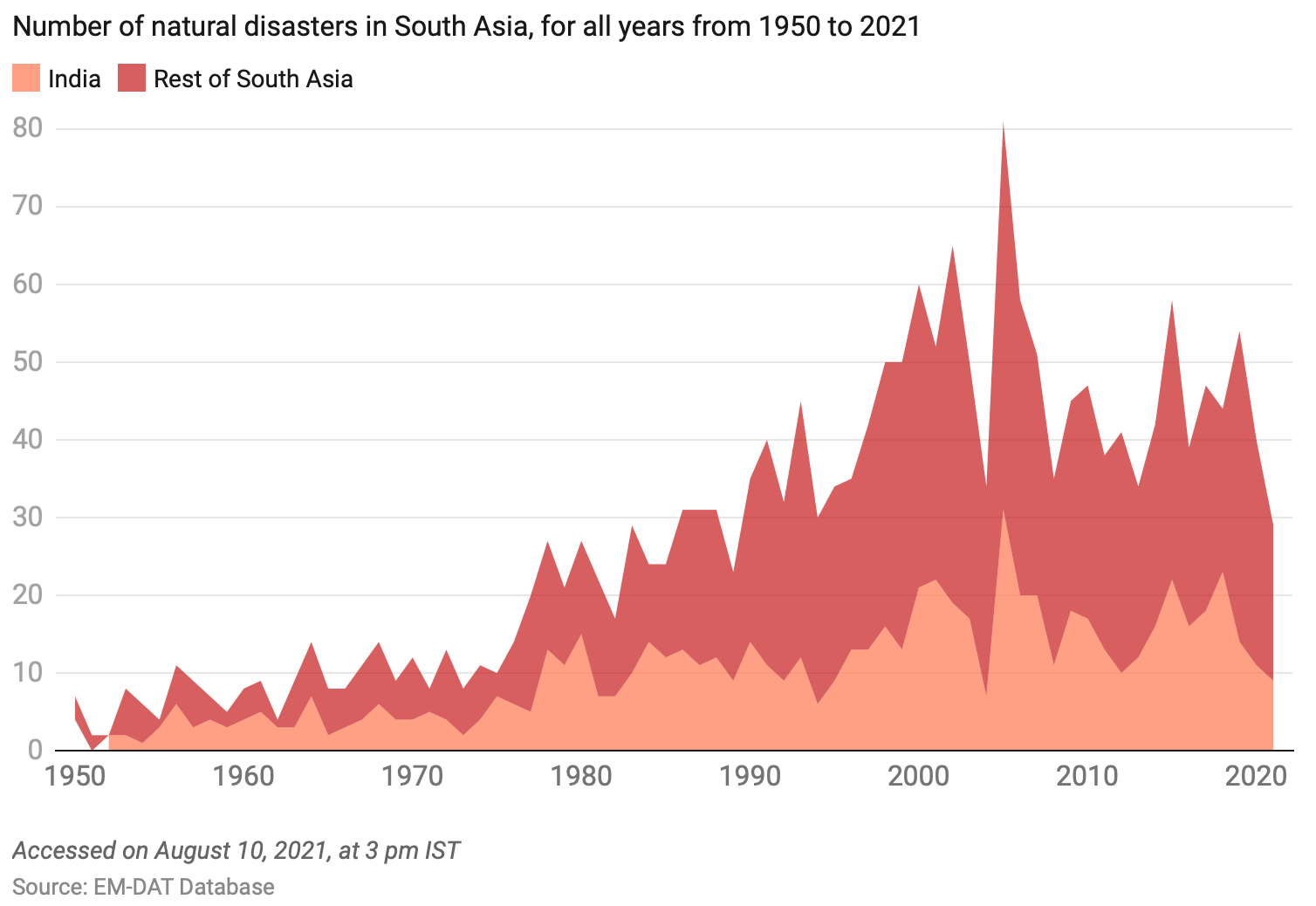
11. On a related note, India has been experiencing the effects of global warming - a 0.6 degree Celsius increase in temperature since 1950 has led to a three-fold increase in extreme rainfall and flooding. 
12. Chinese authorities have been clamping down on for-profit schools to promote public education,  
China has almost 190,000 private schools, educating more than 56m, or one-fifth of all students, according to official figures. There are more than 12,000 primary and middle schools. Beijing wants to reduce the proportion of non-high-school students attending for-profit schools from more than 10 per cent to less than 5 per cent as soon as the end of this year... Annual earnings for the tutoring industry have been forecast to fall from $100bn to less than $25bn. The problem for private sector owners of junior and middle schools has become more acute since May, when Beijing told local governments to “rectify” their runaway expansion. “We must make sure public schools are the main compulsory education provider,” said a circular sent by the central government to lower-level authorities, adding that Beijing would encourage the conversion of some for-profit schools into public ones... The education reforms marked a striking change after years of liberalisation. Over the past two decades, China’s private primary schools grew 10-fold, teaching about 9.5m students in 2019.

India faces the same problem of hugely expensive private schools creating an elite-only market and also a highly competitive coaching market. But the Chinese actions are not possible in the Indian context.

13. FT has an article on the rising trend of outsourcing of fund management by smaller investors. Globally, as on March 2020, there were about $2 trillion in assets managed with full or partial discretion by outsourced fund managers, a two-fold rise from 2013. Smaller funds and investors prefer not to incur the high fixed cost of putting in place an in-house investment team. This imperative is also amplified by the search for yields prevalent in the financial markets today. 

The article points to the latest seven year projection by Jeremy Grantham's GMO of returns from various asset classes.

14. Status report on piped drinking water supply to villages under the Jal Jeevan Mission.

This is very impressive,

New tap connections, which had ranged between 2,000 and 10,000 per day till FY20, zoomed to more than 88,000 taps per day in FY21... Government officials said one reason for this speed is the use of groundwater. Household tap water systems can be developed quickly in such villages with the next 30-40 years in mind... However, the speed has mellowed somewhat this year, despite a fivefold increase in central funding. In 2021-22 (FY22) till August, the daily rate has gone down to 18,000.

Even 18000 is impressive. The issue here is to ensure they are actually working and supply water.

15. Finally, an article that highlights how Sweden has emerged as the Silicon Valley of Europe. 

Sweden's home computer drive (government policy to put a computer in every home), and concurrent early investment in internet connectivity, help explain why its capital Stockholm has become such rich soil for startups, birthing and incubating the likes of Spotify, Skype and Klarna, even though it has some of the highest tax rates in the world... In the three years the scheme ran, 1998-2001, 850,000 home computers were purchased through it, reaching almost a quarter of the country's then-four million households, who didn't have to pay for the machines and thus included many people who were otherwise unable to afford them... Some executives and campaigners say the Scandinavian nation demonstrates that a deep social safety net, often viewed as counter to entrepreneurial spirit, can foster innovation... Childcare is, for the most part, free. A range of income insurance funds can protect you if your business fails or you lose your job, guaranteeing up to 80% of your previous salary for the first 300 days of unemployment...

It has the third highest startup rate in the world, behind Turkey and Spain, with 20 startups per 1000 employees and the highest three year survival rate for startups anywhere, at 74%, according to a 2018 study by OECD economists. Stockholm is second only to Silicon Valley in terms of unicorns - startups valued at above $1 billion - per capita, at around 0.8 per 100,000 inhabitants, according to Sarah Guemouri at venture capital firm Atomico. Silicon Valley - San Francisco and the Bay Area - boasts 1.4 unicorns per 100,000, said Guemouri, co-author of a 2020 report on European tech companies. No one can say for sure if the boom will last, though, in a country where capital gains are taxed at 30 percent and income tax can be as high as 60 percent.

Wednesday, August 11, 2021

On development and growth of private markets

The conventional wisdom is that with the right kind of regulation, markets can respond to demand in reasonably quick time and deliver good quality service. As the cliche goes, entrepreneurial energies should be released from the shackles of government regulation. And all will be well! 

But this narrative endures despite little evidence and also numerous evidence to the contrary. 

Ashok Thakur and SS Mantha have an excellent summary of the evolution of India's higher education and the challenges facing it.  

Private entrepreneurs took the lead to meet the growing demand of the country in technical education in the mid-Eighties, but with little idea of the subject. As a result, the faculty of these institutions drove the agenda of their management — and sometimes their own. When the management’s agenda entered academic bodies of various universities, the first casualty was the curriculum. Important courses... were the first to be jettisoned since they were both tough to teach for the teachers and tough to pass for the students. Subjects like materials, applied physics and thermodynamics became dispensable. Several universities merrily revised their curriculum at the expense of these courses. This softening of subjects coupled with unfettered expansion in the early and mid-2000s, though it ensured that everyone who aspired to technical education could find a seat commensurate with his/her abilities, resulted in real dilution of the overall standards in the country. At its peak in 2014-15, AICTE-approved institutes had almost 35 lakh seats, mainly due to the increased employment opportunities in the country. However, a series of reports by this paper in December 2017 revealed no takers for at least 51 per cent of the 15.5 lakh seats in 3,291 undergraduate engineering colleges in 2016-17. These reports laid bare the regulatory gaps, poor infrastructure, lack of qualified faculty and the non-existent industry linkage that contributed to the abysmal employability of graduates from most of these institutes.

Some consolidation is bound to happen in every expanding system, but that also calls for intelligent interventions to connect with the available employment opportunities if the fruits of expansion are to be enjoyed. Since 2015-16, at least 50 colleges have closed each year and this year, AICTE approved the closure of 63 institutes. However, 54 new colleges were approved for the academic year, 2021-22 in backward districts. Similar statistics rule every year... Not a single industry body, be it CII, FICCI or ASSOCHAM has managed to effectively inform the education planners on the growth in different employment sectors. Nor has the government taken any tangible steps to set up an independent body to advise AICTE on this vital aspect. In the absence of any credible information on demand side numbers, investments made by institutions will only be based on perception...

Lack of adequate number of teachers, lack of quality in those available, inability of the management to make adequate investments in a dynamic environment, lack of employment opportunities, shelf life of skills coming down with every technology-related intervention and a constant experimentation with curriculum have all been the bane of quality in technical education... The corrective measures for these shortfalls are technology intensive, are experiential, and need investments in teaching. Colleges are unwilling or not in a position to make those investments resulting in serious decline in quality... A constant fiddling with the curriculum, reducing total credits, giving multiple choices in the name of flexibility, dispensing with mathematics and physics at the qualification level, teaching in local languages may all be good arguments, but one must assess their utility and their effect on technical education in the long run. An IT-heavy curriculum in every specialisation is not called for. Reducing total credits has not only reduced the rigour of engineering education, but also meant loss in jobs for several faculty streams. National pride may be non-negotiable, but then will teaching in Marathi or Tamil increase employment opportunities besides causing several pedagogy and copyright-related issues?

There are some important takeaways from this.

1. Development and growth takes time. From supply of qualified and trained teachers to support staff, systems for accreditation and monitoring, and even the numbers of students who meet the qualifying norms without any dilution, the requirements to support expansion of the market takes time. If the time is compressed and growth becomes purely driven by market considerations, then, especially in a large and complex (from political economy) country like India, it's inevitable that norms and standards get compromised and quality suffers.

2. The inherent nature of market participants is to maximise returns. No matter all theories on repeat games or signalling that are supposed to discipline and incentivise markets, the innate preference to maximise profits prevails when the rubber hits the road. This is especially so in large countries like India. There are far too many examples of deregulated markets either generating sub-optimal outcomes (airlines, telecommunications etc) or failing to create markets (solar cells etc).

3. In the circumstances, the nature of regulation has to go beyond the minimalistic approach of putting in place enablers and letting markets take over. It has to also involve disablers to market abuse and manipulation that seeks to maximise profits by externalising costs. Regulation will have to be reasonably intrusive. 

4. The point that supporters of markets make about the need for good regulation for markets to work is a bit like physicists assuming frictionless surface or economists assuming rational human beings. If the assumptions are unrealistic, the outcomes cannot be realised and it's prudent to avoid the course of action. In this case, especially given the weak state capacity, effective regulation (of the reasonably intrusive type) becomes impossible.

Monday, August 9, 2021

Olympics and cost overruns

Cost overruns are a feature of large projects. Which category of projects have the biggest cost over-run?

Alex Lieberman makes the case for Olympic Games.

Olympics: 172% 
Mega dams: 90% 
Trains: 45% 
Bridge & tunnels: 34% 
Roads: 20%

Though the source is not available, in terms of orders of magnitude, this looks just about right. And the latest illustration is the Tokyo Olympics itself,

2013: bid projected $7.4 billion of costs 
2019: official budget of $14.6 billion 
2020: budget revised to $15.4 billion 
2021: government auditors project total spending will be $28 billion.

Apart from the pure financial cost increases to the original plan, there are some important and unavoidable reasons.

One, this is a classic example of strategic mis-representation. The organisers and governments are desperate to win the Olympics bid. A big internal obstacle to overcome before making the bid is the cost that different agencies have to incur. Large estimate generate opposition from the Finance Departments and can even trigger public outcry. This creates the natural inclination to project a lower cost to get everyone on board and go ahead with the bidding. 

Second, there is the inevitable co-ordination problem. Large projects involve the active engagement of several stakeholders. They include multiple agencies of government, often federal and sub-sovereign agencies. Then there are multiple private partners, including hundreds of contractors for various kinds of works. Finally, the time span from mobilising support to winning the bid to conduct of the games is most likely to involve multiple governments, with their varying perspectives and objectives. And all these co-ordination happens over a relatively short time, thereby opening enough and more opportunities for unforeseen expenses and associated cost escalations. Accountability for cost increases is easily diffused among the several partners in this giant co-ordination exercise. 

Third, there is also the classic hiding hand of Albert Hirschman. In complex projects, there are several uncertainties and daunting obstacles. For example, new stadiums often involve relocation of slums. Or a new rowing facility or shooting range comes with the need for environmental protection measures. All these can appear too daunting to be even listed out ex-ante. But once the project is approved, these are unavoidable realities. Fortunately human creativity kicks in to address these problems. However, they come with their incremental costs. 

Fourth, there is also the mission creep that's inevitable with grandiose projects. You start with an initial plan, and then as work starts, the ambitions rise and the scope of the plan expands. So, for example, the designs of the stadiums become more grandiose or additional features get added to an indoor stadium complex, and so on. You do an Olympics in decades, often the first time ever. So, the argument goes, do it big and grand!

Finally, there is the self-reinforcing dynamic associated with the interaction among the aforementioned four factors. For example, strategic representation is exacerbated (or encouraged) by the multiplicity of actors and the likelihood of hiding hand. 

Saturday, August 7, 2021

Weekend reading links

1. Interesting take on investing in India by Marcellus Investment Managers,

... polarised nature of corporate profitability in India — 20 Indian companies now account for over 90 per cent of profits (up from 30 per cent a decade ago). Most of these 20 companies are growing their free cash flows (FCF) at over 25 per cent per annum, despite the challenging economic circumstances in the past five years. The consolidation of the world’s fifth-largest economy in the hands of 15-20 corporate giants is a once-in-generation event, which we are focusing on.

It says volumes about the scale of wealth concentration that's happening in India and how it's distorting the country's equity markets. 

2.  The Indian economy demand side deficiency story that comes in the way of electric car ambitions,

“Unfortunately the technology presently available leads to electric cars being produced at a cost much higher than the conventional cars,” Maruti’s Chairman R.C. Bhargava said in the company’s annual report Monday. “This, along with the lack of charging infrastructure makes it very difficult to sell electric cars to people who can only afford small cars.” The market penetration of electric vehicles will be “very small” given that only 5% of cars sold in India are priced above 1.5 million rupees ($20,169), said Bhargava, who heads the local unit of Japan’s Suzuki Motor Corp.. The per capita income in India is only $2,000 -- 5% of that in Europe and Japan -- which puts expensive electric cars beyond the reach of most consumers, he said.

This does not prevent the country aspiring to attract manufacturing facilities for export markets.  

3. Livemint on the fraudulent loans made by the once poster boy of Indian banking, Rana Kapoor.

4. Populism gone amok,

Sounding the poll bugle ahead of the 2022 elections in Punjab, Shiromani Akali Dal president Sukhbir Singh Badal Tuesday announced a 13-point pre-poll promises charter, declaring that if the SAD-BSP alliance is voted to power, it would give 400 units of free electricity to residential consumers, reduce the price of diesel by Rs 10 for every litre purchased for agricultural purposes and give Rs 2,000 every month to all women heads of blue card holder families. Sukhbir also promised a 75 per cent quota for the state’s youths in private sector jobs.

5. The Government of India has introduced a Bill in Parliament to do away with the retrospective amendment on taxation of indirect transfers. The history,

In January 2012, in a landmark judgment in Vodafone’s case, the Indian Supreme Court headed by the then Chief Justice, ruled that transfer of shares of a company incorporated outside India would not be taxable in India due to absence of situs of shares in India and more importantly, absence of charging provisions to tax such transfers. However subsequently, the UPA government in its Budget of 2012 introduced an amendment making indirect transfers taxable in India purportedly clarifying the legislative intent which in effect nullified the ruling of the Apex Court. This in essence meant that capital gains arising from transfer of shares of a foreign entity deriving substantial value from assets located in India were chargeable to capital gains tax in India. The threshold for computing ‘substantial value from India’ was later defined to be fifty percent of the value of the shares of the overseas entity sought to be transferred. This led to tax demands being raised in seventeen cases including Cairn Energy Plc and Vodafone Group and more importantly, affecting sentiments of foreign investors for lack of certainty due to government making changes retrospectively in tax laws.

6. Sandeep Goyal points to the silver medalist's remorse, 

Researchers took video footage of the 1992 Summer Olympics in Barcelona, Spain. Specifically, they recorded the medal ceremonies and analysed the footage from the athletic competitions immediately following announcements of the winners. They studied the happiness displayed by each of the medalists on a 10-point scale, with 1 being “agony” and 10 being “ecstasy.” On average, the silver medalists scored a 4.8, and the bronze medalists scored a 7.1 immediately following the announcement. Later in the day, at the medal ceremony, the silver medalists scored a 4.3 on the happiness scale, while the bronze medalists scored 5.7. Statistical analyses proved that both immediately after winning, as well as later at the medal ceremony, bronze medalists were visibly happier than the silver medalists. 

A similar experiment was repeated post the judo matches at the 2004 Summer Olympics in Athens. Data was collected from 84 athletes and 35 countries at three different times: Immediately after their matches, when they received the medal, and when they posed on the podium. Altogether, the research found that 13 of the 14 gold medal winners smiled immediately after they completed their winning match, while 18 of the 26 bronze medalists smiled too. However, none of the silver medalists smiled immediately after their match ended. More interestingly, the facial expressions that were recorded among silver medal winners ranged from sadness (43 per cent) to contempt (14 per cent) to nothing (29 per cent).

7. Industrial electricity prices are among the highest in India, a consequence of the inverted tariff structure whereby residential consumers are subsidised by industrial consumers,

8. Michael Tory in FT points to a feature of the UK equity markets, where dividend distribution is disproportionately high among public limited companies. This, in turn, prevents capital appreciation and emergence of large companies. He holds the UK pension fund ecosystem as being partially responsible,

The UK has a pension and insurance company savings system biased in favour of dividends rather than capital appreciation. Indeed, the FTSE 100 has been the one of the poorest performing markets in the industrialised world in capital appreciation terms, rising just 14 per cent over the past 20 years. But the vast majority of the FTSE’s entire return over the period was generated by dividends (120 percentage points of a total return of 134 per cent). What is it about the UK ownership system that has led to this? On the pension side, it’s three features of typical funds: they have a finite life since they’re largely closed to new members; they’re very small, with an average size of £300m; and they are structurally risk averse. Insurers need to ensure their assets match long term liabilities, so they prioritise income in equity investment as it can be projected with more assurance than capital gains. Investment decisions made with such priorities then shape the UK corporate behaviour. British management and boards are sometimes criticised for risk aversion. But this largely reflects the aims of their owners, which are accommodated through over-distribution of dividends. This also favours incremental projects rather than moonshots and disruptive technologies, one of the reasons the UK has so little exposure to growth and innovation.

He argues in favour of longer-term risk capital investors, 

Canada’s CPPIB, Ontario’s Ontario Teachers’ Pension Plan and Quebec’s PSP and CDPQ are representative examples from my home country. These funds bring scale — $100bn-$500bn assets is typical (against an average UK pension fund size of $500m); an indefinite time horizon; and an appetite for, and capability to take and manage, risk with a view to enjoying long-term capital appreciation. These are the deep-pocketed and long-term investors any large economy needs. We must start to create pension funds like these today if British capitalism is to have much hope of a thriving tomorrow.

9. Malini Goyal in Livemint on the recycling of risk capital by the successful startup firms, especially the unicorns,

According to a data analysis by Zinnov, Indian unicorns have invested in 90 plus startups in more than 110 deals over the last decade. 19 of the 50 unicorns in India have made at least one investment in an Indian startup. A majority of the investments have been made by Zerodha, Paytm and Zomato, which account for more than half of all equity investments by active unicorns. Interestingly, despite the pandemic, the investment pace of these unicorns has remained consistent. This year has already seen 14 investments in the first half from the likes of Zerodha.

Take Zerodha’s Rainmatter funds for instance. Last year, it set up a dedicated team to focus on fintech startups. The Bengaluru-based fund functions more like an incubator that provides well-equipped workspaces and a funding of $100,000 to $1 million to innovative startups in the space of capital markets... Besides, being part of the Zerodha stable also helps these startups forge new connections in the industry and get relevant advice and mentorship to grow their product... Zerodha has invested in a range of startups including Streak (an end-to-end platform that creates, back-tests and deploys algos without coding), GoldenPi (India’s first online marketplace for fixed income instruments like bonds and debentures), Digio (bringing paperless documentation to business and consumers), Finception (aims to simplify all things finance for millennials from financial news to financial planning), Smallcase (a thematic investment platform that helps investors build a diversified low-cost portfolio) and Tradelab (builds cutting edge technology for capital market businesses). Through its fund, Zerodha’s attempt is to tap into adjacencies and focus on nurturing a vibrant ecosystem in the capital market with it at the centre.

Lenskart’s $20 million Vision Fund plans to invest up to $2 million each in startups that are synergistic to the eyewear, eye-care and omni-channel retail sectors. With 5,000 people, 750 plus stores and a daily processing rate of 20,000 for eyewear products, “startups that engage with us will have the potential to leverage all of this," says Lenskart co-founder Peyush Bansal... In 2019, Paytm had set aside ₹500 crore to invest in early-stage startups for the purpose. While each deal varies in its construct depending on the entrepreneur’s comfort, typically, Paytm prefers to take large strategic stakes (of 50% or above) and lets these startups leverage its platform to reach customers... Dream Sports has invested in FanCode, a sports content and commerce platform. This aligns well with the parent’s ambitions to become a one-stop solution for sports... Though no longer a startup and part of retail giant Walmart, Flipkart too has set up a $100 million fund called Flipkart Ventures. Over the last decade, the home-grown e-tailer has taken minority stakes in over 12 startups, including Blackbuck, Ninjacart and Shadowfax... The fund, managed by a dedicated team of experienced investment professionals, will do early-stage investments with a cheque size of $1-3 million for the first round which can go up to $5 million.

The attractions for unicorns and other successful startups to recycle capital,

Catching them young and investing in startups at an early stage through funds offers these unicorns a good entry point. Of course, the valuations are much lower. However, it helps them enter the fray from a position of strength. With a large user base and a deeper understanding of the digital landscape, the unicorns can spot emerging trends far ahead of others. Their young discerning founders think about risks very differently than the large traditional corporates whose risk appetite is constrained. Also, culturally unicorns can relate to these startups and their entrepreneurial energy a lot better.

10. Extract from Simon Kuper's new book that charts the rise and (now) decline of Barcelona. The extract focuses on the decline and the role of the club's leadership in the fall in fortunes since its last major win in 2015. 

Almost invisibly, Barcelona has been in free fall ever since the night in Berlin in June 2015 when it won its fourth Champions League final in 10 years. The club had achieved dominance on the cheap, thanks to a one-off generation of brilliant footballers from its own youth academy... Barça was used to overpaying. Whereas most clubs target a type — say, a young playmaker who costs under €30m — Barcelona until 2020 shopped at the top of the market, and could afford to target an ideal. In this case, Barça didn’t want a “De Jong type”. It wanted De Jong himself. As so often when bidding for a player, it had no alternative in mind, and the selling club understood this. “You know you will pay more than another club,” shrugged Rosell...Barcelona paid Ajax a transfer fee of €75m. According to football agent Hasan Cetinkaya, advising the Dutch club, this was nearly double what Ajax had initially hoped to get... Between 2017 and 2021, Messi earned a total of more than €555m, according to extracts from his 30-page contract published in El Mundo newspaper. Neither Messi nor senior Barcelona officials denied the figure. One senior Barça official told me Messi’s salary had tripled between 2014 and 2020. But he added, “Messi is not the problem. The problem is the contagion of the rest of the team.” Whenever Messi got a raise, his teammates wanted one too... In total, Barcelona spent over €1bn on transfers between 2014 and 2019, more than any other football club.

Kuper prophesies even worse times, 

This season could be worse for Barça. La Liga has been indicating it will only let the club spend about €160m or €200m on player costs this year, less than a third the amount of three years ago. Barcelona isn’t merely paying unaffordable wages. It’s also still amortising failed transfers of years ago. The club has gone from discount shopping to only signing out-of-contract players who carry no transfer fees at all. Even then, La Liga will only register them to play and re-register Messi if Barça can first slash its wage bill.

After Kuper wrote, it has gotten worse with the exit of Messi himself.

11. Tim Harford points to "ideas behind their time", or those ideas which take time to materialise in the shape of commercialised products or services despite being on the horizon for long time.

Consider the bicycle. It was not produced in even the most primitive form until the early 1800s, and a practical version with chain drive was not widespread until the 1880s — just in time to compete with the motor car. Anton Howes, author of Arts and Minds, points to the flying shuttle, invented in 1733. “It radically increased the productivity of weaving,” he writes. “It involved no new materials . . . and required no special skill or science.” The craft that it transformed has been around long enough to be mentioned in the Old Testament. Steven Johnson, in his book Extra Life, suggests that evidence-based medicine is an idea behind its time. The idea of running experiments is centuries old, but the first properly randomised controlled trial in medicine took place in 1948. It could easily have been routine before da Vinci’s time, but instead clinical trials lagged far behind anaesthetic, antibiotics, antiseptic, pasteurisation and vaccines.

Some of the reasons,

The bicycle is not as straightforward an invention as it seems. To move from ox-hauled cart to human-powered bicycle requires smooth-rolling wheel bearings, which in turn need precisely engineered bearing balls. Modern steel ball bearings were not patented until the late 1700s, and demand from the 19th-century bicycle industry helped to improve their design. We often overrate the eureka moment of the inventor’s doodle and overlook the importance of materials to enable or inspire that idea... Another obstacle to innovation is that people don’t make the right connections. The clinical trial, for example, sits on an uneasy border between medicine and statistics. The medical tradition emphasises the expertise of the doctor and the care of the patient as an individual. The statistical tradition picks patterns out of noise and uses methods that can be applied equally to brewing the perfect pint or testing the effect of fertiliser on crops. Combining the two is not an obvious step... Another issue is that many inventive people are pushed away from the world of innovations.

12. Finally Scott Galloway has this stunning graphic of change in mortalities associated with vaccine preventable diseases.

Makes vaccines one of the most successful innovations of humanity.   

Thursday, August 5, 2021

Private sector and Covid vaccination - Exhibit India

I had blogged earlier here and here arguing against relying on private sector to contribute meaningfully to India's Covid 19 vaccination campaign. 

One of the biggest disappointments of India's Covid 19 efforts has been the private sector's response to the vaccinations it was granted to distribute. While the numerous failures of the government are castigated and mocked, hardly any opinion maker has written about the private sector's failures or the pervasive price gouging and profiteering during the heights of the pandemic. In a speech to the CII, the Union Minister Piyush Goyal called this out,

You all (in the private sector) demanded and I remember how much you all fought with me and sought that vaccination be opened up for the private sector. Today, you are not even buying those 25% of vaccines (allotted to you)... I remember one industry group said ‘I will do one crore vaccinations’ and another said ‘we will go to remote areas and do it’. Nobody has gone to Bihar, Northeast, Jharkhand and Chhattisgarh to run campaigns to remove vaccine hesitancy and use up that 25% quota.

The former Cabinet Secretary KM Chandrasekhar has a very good article that cautions against pinning excessive hopes on the private sector.

On July 22... in Andhra Pradesh, out of 3.5 million doses of vaccine allotted to the private sector, only 403,000 have been utilised, while in Tamil Nadu, out of 18.5 million doses administered, the share of private sector was only 5 per cent.

These are four issues the Government of India flagged as concerns with the private covid vaccination centres (PCVCs),

First, many PCVCs were not placing indents for the full quantity of vaccine doses earmarked for them. Secondly, even when indents were made, the required payments were not made by PCVCs. Thirdly, even when payments were made, the dispatched vaccine doses were not lifted by PCVCs. Finally, even when the vaccine doses were lifted, actual administration of doses by PCVCs fell short. 

It now emerges that the Government of India have decided to scrap the 25% reservation for private sector and allow vaccines to be distributed by manufacturers based on demand. Accordingly, while private hospitals will continue to place orders, the vast majority of vaccines will go to state governments.  

India's experience with Covid vaccination is the strongest case against relying on private sector to vaccinate against epidemics, in any meaningful manner.

On a related note, perhaps the greatest success till date of covid 19 vaccination is the United States. It owes this success in large measure to the Trump administration's Operation Warp Speed, perhaps one of the biggest public policy successes of recent times. Here is what the then Secretary of Health Alex Azar wrote,

Operation Warp Speed committed to funding upfront various stages of development, including testing vaccines in humans to prove they are safe and effective, as well as the manufacturing of the vaccines. We provided funding to test vaccines in large populations, and we got results faster than ever before. The vaccines produced remarkable protection against Covid-19 and were extremely safe. After studying all the data in depth, the Food and Drug Administration granted emergency use authorizations... We did not reach our stretch goal of producing 300 million doses by January, but we hedged our bets by investing in a portfolio of vaccines and had tens of millions of doses of vaccine in production by the end of January. Many governors were able to begin general vaccination programs by March, and we had a surplus of vaccine by the end of the second quarter... We demanded all clinical trials included a diverse, representative sample of participants, and the Department of Health and Human Services provided funding for an effort by the Morehouse School of Medicine to coordinate a network of national, state, territorial, tribal and local organizations to deliver trusted information to racial and ethnic minority communities.

Finally, while talking about the constraints that face the public sector in India, KM Chandrasekhar points to a much under-appreciated point,

The US, for example, under their Operation Warp Speed, liberally financed R&D efforts of private entities and placed huge advance purchase orders, thus making private research and manufacturing activity virtually fully financed and risk free. The National Accountability Office of the US had recommended such action, but would our counterpart organisation, the Comptroller and Auditor General (CAG), have adopted a similar approach? Besides, would we have the courage and the resources to provide big money to private entities in a potentially risky operation?

Monday, August 2, 2021

The importance of roads - the academic debate

I have blogged earlier expressing my disappointment with researchers who question the economic value of investments in basic infrastructure like roads and electricity. These studies are often held up as evidence against channelling scarce resources, especially aid money, into infrastructure. Instead proponents argue in favour of investing in education, health, nutrition, skilling etc. Two samples below.

This paper on rural electrification program in Kenya finds,
We do not find meaningful medium-term impacts on economic, health, and educational outcomes nor evidence of spillovers to unconnected households. These results suggest that current efforts to increase residential electrification in rural Kenya may reduce social welfare.
This paper on India's rural roads construction program finds,
There are no major changes in consumption, assets or agricultural outcomes, and nonfarm employment in the village expands only slightly. Even with better market connections, remote areas may continue to lag in economic opportunities.

This argument is based on the methodological biases among academic researchers. George Akerlof had pointed to the same, drawing the distinction between hard (quantitative and rigorous) and soft (qualitative) methodologies to examine development phenomena. He said that the former, which is the current preferred approach, generates 'sins of omission' which leads to under-estimation of economic impacts. 

In this context, The Economist points to a new work by Ana Paula Franco et al which examined the long-term development impact of the 30,000 km long Inca Road which stretched across several countries and which was built to collect taxes and deploy troops across the 10 m sqkm empire. 

To test if the Inca road, the Incas’ main thoroughfare, has boosted modern living standards, the authors split the map into small squares. For four indicators of welfare—wages, nutrition, maths-test scores and years of schooling—they compared levels from 2007-17 in squares crossed by the road with those in neighbouring squares not on its route. On every measure, residents of roadside squares fared better than those in adjacent ones, even after controlling for differences in such factors as the slope of terrain and the presence of rivers. Women gained more than men.

How did the road grant such long-lived blessings? The Spaniards used it to ship silver and turned the warehouses into profitmaking shops, often staffed by women (possibly inculcating more equal gender roles). This made land near the road unusually valuable, encouraging colonisers to settle there. The authors argue that Spaniards who moved in claimed legal title to their landholdings and built schools and new roads in the vicinity, creating enduring property rights and public goods. Today, the presence of the Inca road alone accounts for a third of the observed difference in levels of formal land ownership between dwellers on the road and those in nearby areas. It explains half the difference in the number of schools.


From the original paper itself,

We estimate the long-term effects of the Inca Road and find a positive and statistically significant relationship between the Inca Road and hourly wages, with residence within 20 km of the Inca Road increasing hourly wages by around 10.5% as compared to wages in other areas during the period 2007-2017. This effect is as large as that of an additional year of schooling. Along the same lines, we find a significant negative relationship between the Inca Road and child malnutrition, as attendance at a school located within 20 km of the Inca Road reduced the probability of being malnourished by 3.4 percentage points (a reduction of around 8%) in 2005. In addition, we find a positive effect between the Inca Road and educational outcomes, with residence within 20 km of the Inca Road increasing the length of schooling by 1.64 years, which equals 22% of the average years of schooling of our sample (7.41 years).

With respect to the channels of persistence of the effects of the Inca Road, there is a significant and positive association between the Inca Road and the current provision of two main public goods, primary schools and roads. We report that 20-km grid cells crossed by the Inca Road have an extra 18 km of road density, which equals 82% of the road density in our sample. Similarly, we find that grid cells crossed by the Inca Road also have an additional 48 primary schools, for an increase of 79% over the sample average. What is more, we find that there is a positive association between the Inca Road and current property rights. The size of this impact can be appreciated by taking into consideration the fact that only 26% of the members of our sample own their homes, as this makes the increase attributable to the Inca Road equivalent to 31%.

Finally, we find a positive association between the Inca Road and female labor outcomes. Women who live within 20 km of the Inca Road average 1.63 more years of schooling than women who live farther from the road system. This is a sizeable increase (22%) over our sample mean (7.4 years), and one which outpaces the increase for men. Furthermore, there is also a positive association between the Inca Road and different measures of female intra-household bargaining power. Residence within 20 km of the Inca Road reduces the likelihood of being a teenage mother by 1.4 percentage points. It also increases the likelihood that women are making health-related decisions for the household by 5.2 percentage points and the likelihood that they are making decisions about high-value purchases, such as buying a home, by 5.4 percentage points.

It would be great if someone could do a study of the Grand Trunk Road or numerous other major roads built by old Indian empires, like this study of the impact of the Indian Railways by Dave Donaldson.

This is yet more reminder, if they were needed, to the western academic world engaged in development about the importance of basic infrastructure like roads and electricity.

Update 1 (07.11.2021)

Santanu Chatterjee and co-authors find differential impacts on formal and informal firms from the development of national highways,

We find that formal firms that are located in districts along the planned route of the GQ/NS-EW corridor are, on average, 9-10 percent more productive than firms that are not on the planned route. By contrast, informal firms on the highway corridor are no more productive relative to their off-route counterparts. Further, we also find that formal firms located in districts 0-30 miles from an upgraded or completed section of the corridor produce 2-4 percent more for every additional year after the completion of the project. The corresponding benefit for informal firms is much smaller, at around 1 percent. Further, using quantile regressions we find that while the productivity benefits of public investment are spread evenly across the size distribution of formal sector firms, they are strictly increasing in firm size for the informal sector. Additionally, smaller informal firms are significantly disadvantaged by the highway upgrades: public investment benefits not only the larger firms in each sector, but also formal firms much more than informal ones.

As to possibly why this happens, they write,

We use quantile regressions to examine whether public investment has a differential impact along the size distribution of firms in each sector. Here, we find evidence that the complementarities generated by an increase in public investment lead to large firms crowding out the output of smaller firms, both within and across sectors: large firms in the informal sector tend to crowd out smaller firms within that sector and, formal sector firms also tend to crowd out small informal firms. Intuitively, large informal firms tend to have a higher capital intensity in production than their smaller counterparts, and formal sector firms also tend to have higher capital intensity than their informal counterparts over all. As such, public investment benefits not only larger firms in each sector, but also formal firms much more than informal ones. This can help explain why we are unable to find any positive and significant association between public investment and informal production for the average firm in our sample.

Sunday, August 1, 2021

Weekend reading links

1. Electric vehicle sales in 2020

2.  The changing profiles of English Premier League teams' shirt sponsors,

Once small and local (Arnold Laver, a timber merchant, sponsored Sheffield United from 1985 to 1995), now sponsors are multinationals. In the late 1990s tech and telecoms companies predominated; then financial and insurance firms muscled in. Since 2005, when gambling laws were liberalised, betting firms have worked their way up the league. This season they sponsor 45% of teams.

3. The Economist reports of application of auction theory to counter the declining population of migratory turtle-birds in the British Isles, 

Paul Klemperer, Elizabeth Baldwin and Alex Teytelboym, all of Oxford University... have designed a reverse auction in which farmers bid publicly for contracts to provide suitable habitats. This is trickier than it sounds. Turtle doves need wildflower seeds to eat, shallow-sided open water to drink and thick scrubby hedgerows in which to nest—all in proximity. A farmer might wish to provide just one or two of these, and to rely on neighbours to provide the rest. Moreover, breeding pairs must be able to find the sites, but they must not be too clumped together. And finally, the habitats offered by farmers can vary in quality as well as price... To solve it this time round, the economists constructed an index of turtle-dove happiness (TDH, or “ta-das”). An algorithm searches combinations of bids, seeking to maximise ta-das for a given budget. Bids both compete with and complement each other: a high-priced offer to grow wildflowers might beat a cheaper one if they would be nearer a nesting site, and would thus create more ta-das. The Royal Society for the Protection of Birds, a charity, has used the system in two pilot auctions in Norfolk and Suffolk, attracting 63 bidders. The latest closed in June, and seeds should be sown in the autumn.

Though it'll be some time before the results become evident, it would be very interesting to see its results. 

4. India's and China's US-trade fact of the week,

From October 2017 onwards, China's goods exports have lost ground in the US to the extent of 6.5 percentage points, while India has gained 0.4 percentage points.

5. Tamal Bandopadhyay points to the near demise of Mudra bank, established in April 2015 as a refinancing institution for small business loans,

In five years, till 2020, it disbursed Rs 25,494.65 crore of which Rs 3,018.5 crore, or 11.84 per cent, flowed to the MFIs. During this period, Mudra’s refinance was just 2.13 per cent of the loans disbursed by all lenders under PMMY. A 2019 RBI inspection found that Mudra was allotted Rs 40,000 crore under Priority Sector Shortfall Fund (PSSF) since its inception but only Rs 22,500 crore had been drawn by it. “…It is lacking in achieving its objective/ mandate to provide refinance support to banks, NBFCs and MFIs for loans under PMMY and ultima­tely support to micro/small enterprises,” the inspection report says.

By 2021, the total amount drawn from RBI under PSSF dropped to Rs 20,084 crore... Banks are to channel 40 per cent of their loans to the small and medium enterprises, agriculture and other segments under the so-called priority sector norm. The shortfall in meeting the priority loans target, which the banks used to keep as deposits with Nabard and Sidbi, is given to Mudra. Incidentally, Sidbi dismantled its wing, SIDBI Foundation for Micro Credit (SFMC), in 2019 and transferred its Rs 271 crore India Microfinance Equity Fund (IMEF) to Mudra. The foundation was launched in 1999 to develop microfinance, and the fund was floated in 2011 to support small MFIs with equity and quasi-equity. I wonder whether Mudra has supported any small MFI as yet. It is governed by a truncated board without the full complement of independent directors.

6.  Andy Mukherjee point to a Deutsche Bank analysis to advocate nationalisation of debt-strapped Vodafone India,

“Private investors are extremely unlikely to save the company, given successive governments seeing telecom capital as something to target,” the Deutsche analysts write. The only viable solution for India to keep Vodafone Idea as a going concern “is for the government to convert its debt into equity.” The carrier’s stock market value of $3.3 billion comes to just over a 10th of the debt. So even with some borrowings written off, existing shareholders will get diluted heavily.

The company owes most of its $30 bn debt to the government. 

7. Property registrations have surged in Mumbai following the government's decision to lower the stamp duty temporarily. After an initial cut in August 2020, it was further cut to 2% till December, and 3% till March 2021. 

8. The latest amendment to the Factoring Regulation Act is a step in the right direction. It allows any NBFC to offer factoring of receivables.

9. Zomato's IPO highlights attention on what's turning out to be an excellent year for IPOs in the Indian stock market. While 28 companies have raised over Rs 42,000 Cr, over 50 more have announced intentions to access the public market. 


This is a good read in Livemint that provides numbers to put the Zomato IPO in perspective. 


In terms of revenue multiple, 

At ₹1.04 trillion, Zomato is valued at 49 times its latest full-year revenues. At ₹75,000 crore, Paytm would be valued at 24 times revenues. By comparison, the median revenue multiple of the sample set of 73 companies is 5 times. DoorDash, the largest food-ordering company in the US, listed in December 2020 at a revenue multiple of 11 and is currently valued at 20 times. Zomato’s only direct competitor in India, Swiggy, is unlisted. Food franchise businesses like Jubilant Foodworks (Domino’s Pizza) and HardCastle Restaurants (McDonald’s) are valued at 13 times and 9 times revenues, respectively.